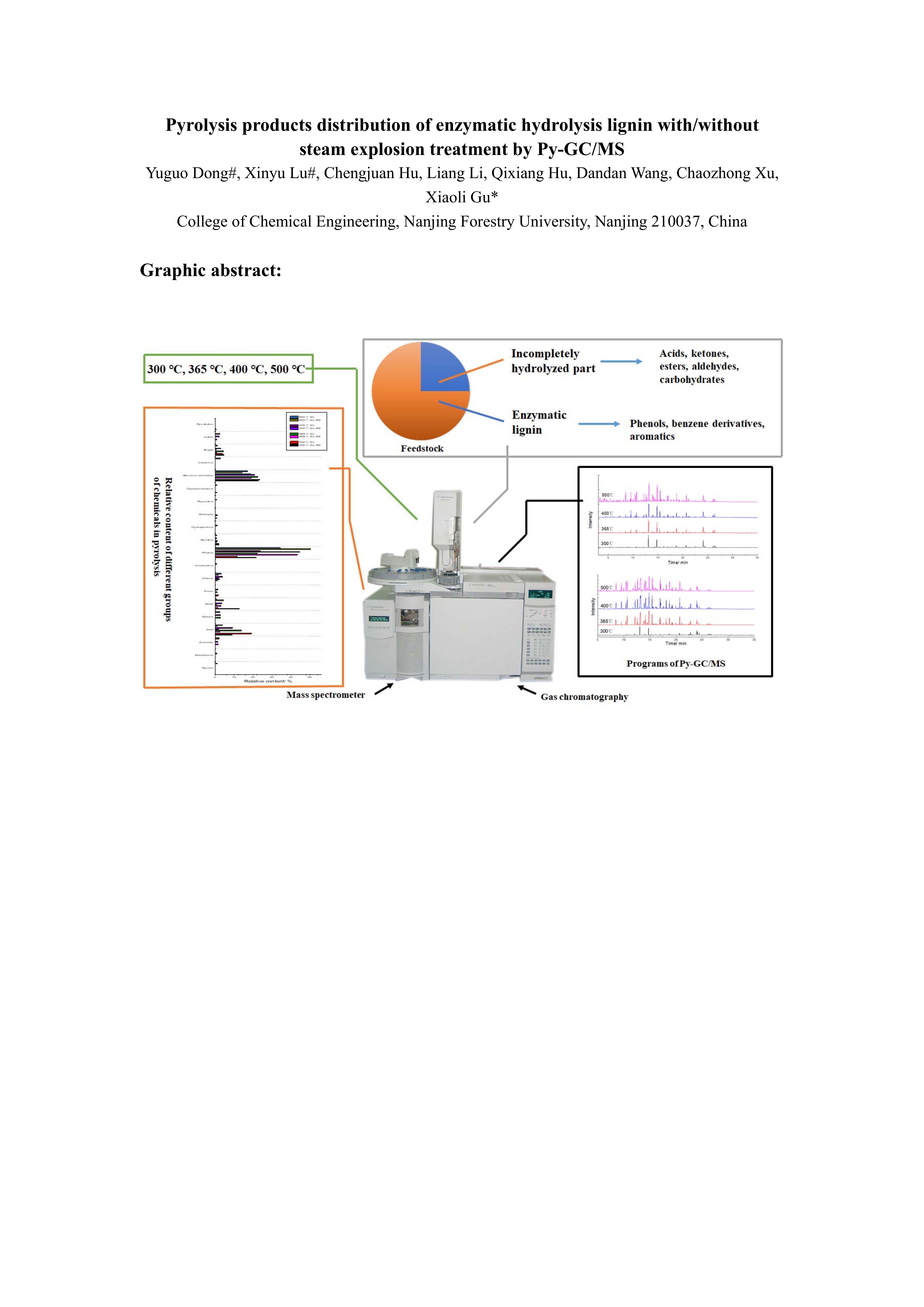
Pyrolysis Products Distribution of Enzymatic Hydrolysis Lignin with/without Steam Explosion Treatment by Py-GC/MS


Abstract
Share and Cite
Dong, Y.; Lu, X.; Hu, C.; Li, L.; Hu, Q.; Wang, D.; Xu, C.; Gu, X. Pyrolysis Products Distribution of Enzymatic Hydrolysis Lignin with/without Steam Explosion Treatment by Py-GC/MS. Catalysts 2020, 10, 187. https://doi.org/10.3390/catal10020187
Dong Y, Lu X, Hu C, Li L, Hu Q, Wang D, Xu C, Gu X. Pyrolysis Products Distribution of Enzymatic Hydrolysis Lignin with/without Steam Explosion Treatment by Py-GC/MS. Catalysts. 2020; 10(2):187. https://doi.org/10.3390/catal10020187
Chicago/Turabian StyleDong, Yuguo, Xinyu Lu, Chengjuan Hu, Liang Li, Qixiang Hu, Dandan Wang, Chaozhong Xu, and Xiaoli Gu. 2020. "Pyrolysis Products Distribution of Enzymatic Hydrolysis Lignin with/without Steam Explosion Treatment by Py-GC/MS" Catalysts 10, no. 2: 187. https://doi.org/10.3390/catal10020187
APA StyleDong, Y., Lu, X., Hu, C., Li, L., Hu, Q., Wang, D., Xu, C., & Gu, X. (2020). Pyrolysis Products Distribution of Enzymatic Hydrolysis Lignin with/without Steam Explosion Treatment by Py-GC/MS. Catalysts, 10(2), 187. https://doi.org/10.3390/catal10020187