
Promotion Thresholds, Revenue Sharing, and Delivery Risk in Reward-Based Crowdfunding


Abstract
1. Introduction
- The optimal choice of promotion and revenue-sharing rules ensure that promoted campaigns raise enough funds to start production only when the platform’s reputational cost, in case the entrepreneur is unable to deliver the product, is sufficiently high.
- The optimal revenue-sharing rule chosen by the platform may result in some campaigns definitely failing to deliver their promised products, thereby adversely affecting the platform’s reputation. We demonstrate that customizing the revenue share to product development cost, instead of utilizing an identical rule for all projects, eliminates this risk when backers are altruistic.
- Customizing the revenue sharing rule to the attributes of a product, including its development cost, enhances the platform’s profits. When customization is tied to the development cost of the project, the platform should award a larger revenue share to projects with higher development costs.
- If the platform customizes the revenue share, the FT promotion rule and the revenue sharing rule act as substitutes in aligning the objectives of the platform and the entrepreneur. In particular, when the production success is not guaranteed, the platform should increase the revenue share of the entrepreneur to compensate for a higher risk of non-delivery.
2. Literature Review
3. Model
3.1. Equilibrium Analysis for an Exogenous, Fixed Sharing Rule
3.1.1. Case 1: Low Fractional Threshold (i.e., )
- If , and
- If .
3.1.2. Case 2: Intermediate Fractional Threshold (i.e., )
3.1.3. Case 3: High Fractional Threshold (i.e., )
- (i)
- . (a) If , the platform chooses in a manner that does not guarantee production success (Cases 1 or 2), and (b) if , the platform chooses to ensure production success (Case 3).
- (ii)
- . (a) If , the platform chooses in a manner that does not guarantee production success (Cases 1 or 2), and (b) if , the platform chooses to ensure production success (Case 3).
4. Setting the Revenue Share of Campaigns Endogenously
4.1. The Platform Can Customize the Sharing Rule for Heterogeneous Campaigns
- (i)
- For Low and Intermediate Fractional Threshold cases (i.e., is sufficiently small), if and otherwise. Furthermore,
- (ii)
- For the High Fractional Threshold case (i.e., is sufficiently large), and the sharing rule is independent of
- (iii)
- For all three cases (i.e., regardless of the value of , and
4.2. The Platform Sets a Uniform Sharing Rule for Heterogeneous Campaigns
- (i)
- As the share increases, more entrepreneurs choose to run a CF campaign.
- (ii)
- If this share is sufficiently high, the solution for in (7) may exceed the value of . In this case, the entire population of entrepreneurs join the platform.
- (iii)
- If this share is sufficiently small, the solution for in (7) can fall short of the value of . In this case, none of the entrepreneurs will be interested in joining the platform.
- (iv)
- When , , and if , only a portion of the population of entrepreneurs, having relatively low development costs, participates in the campaign.
- (v)
- When , the platform cannot prevent participation of campaigns that will surely fail to deliver the product.
- (i)
- Since , when , this part follows.
- (ii)
- The entire population participates in one of two cases:
- (a)
- If the term inside the radical of the expression for is negative, namely if , there is no real solution to the equation . This is more likely to happen when the expected revenue in the campaign, , is relatively high, when the altruistic benefit, , derived by backers is high, and when the reputation cost, , incurred by the entrepreneur for non-delivery of the product is low.
- (b)
- When the real solution derived for in (7) is bigger than , once again, this is more likely when and are relatively big and is relatively small.
- (iii)
- When and are relatively small and is relatively big, the solution for in (7) may be smaller than .
- (iv)
- Substituting into the solution for in (9), yields the result.
- (v)
- Proof in document (uniform sharing rule). □
- (i)
- Suppose backers derive only consumption benefit and no altruistic benefit, and the platform selects the low fractional threshold for promotion. Then,If , the impact of on the optimal share awarded to the entrepreneur is ambiguous depending on the values of and .If , the optimal share awarded to the entrepreneur by the platform is larger when is larger.Regardless of whether is larger or smaller than , the optimal share awarded to the entrepreneur is larger when and are larger and is smaller.
- (ii)
- Suppose backers derive both consumption and altruistic benefits in the campaign, and the reputation cost of the entrepreneur is relatively low. If the CF platform uses a uniform sharing rule, it cannot prevent participation of projects that are certain to never deliver the product.
- and
4.3. The Role of Customized Revenue Share in Eliminating the Risk of Definite Delivery Failure
5. Managerial and Policy Implications
5.1. Promotion Thresholds and Revenue Sharing Are Complementary Governance Instruments
5.2. Uniform Revenue Sharing Structures May Not Be Appropriate for Heterogeneous Projects
5.3. Implications for Entrepreneurs
5.4. Broader Implications for Digital Platform Governance
6. Conclusions
6.1. Theoretical Insights
6.2. Practical Insights
6.3. Directions for Future Research
Author Contributions
Funding
Data Availability Statement
Conflicts of Interest
Appendix A. Model Extensions
Appendix A.1. General Distribution Function of the Informed Backer Population
Appendix A.2. Allowing Informed Backers to Withdraw Pledges When Few Other Informed Backers Participate
- (i)
- When or when , the platform’s expected profits are the same irrespective of whether the threshold value selected by the platform ensures the commercial success of the campaign (Cases A1 or A2).
- (ii)
- When , the expected profits of the platform are higher when the threshold level for promotion selected by the platform cannot ensure the commercial success of the campaign (Case A1) if . Otherwise the platform prefers to choose the threshold to ensure the commercial success of the campaign.
- (i)
- When :
- (a)
- If , the platform chooses in a manner that does not guarantee production success (Cases A1 or A2).
- (b)
- , the platform chooses to ensure production success (Case A3).
- (ii)
- When :
- (a)
- If , the platform chooses in a manner that guarantees commercial success but does not guarantee production success (Case A2).
- (b)
- If , the platform chooses in a manner that does not guarantee either commercial or production success (Case A1).
- (c)
- If , the platform chooses to ensure the production success of the campaign (Case A3).
- (iii)
- When :
- (a)
- If , the platform chooses in a manner that does not guarantee production success (Cases A1 or A2).
- (b)
- If , the platform chooses to ensure the production success of the campaign (Case A3).
- (iv)
- . The threshold levels decrease with the values of the parameters and increase with the values of the parameters and .
Appendix B. Empirical Motivation for the Fractional Threshold Promotion Mechanism

| Number of Observations and Unique Campaigns | ||
|---|---|---|
| Observations | Unique Campaigns | |
| Raw Dataset | 139,680 | 1605 |
| Final estimation sample | 52,620 | 1540 |
| Model 1 (Existing) | Model 2 (Lagged Rank and Arrival Rate) | Model 3 (Model 2 Applied to Product Category ‘Tabletop’) | |
|---|---|---|---|
| Intercept | 69.00 *** | 33.45 *** | 29.17 *** |
| Campaign Duration | −0.11 | −0.22 * | −0.15 |
| Days to End | −0.12 * | 0.2 *** | 0.31 ** |
| Percent Funded (Lagged) | −0.001 * | 0.00 | 0.00 |
| Increase in Percent Funded | 0.00 | 0.00 * | |
| Arrival Rate (backers/hour) | −0.07 * | −0.10 ** | |
| Lagged Rank | 0.6 *** | 0.62 *** | |
| Target | 0.000 * | 0.000 | 0.000 |
| Threshold Percent Funded (TPF = 300%) | −4.35 ** | −2.92 * | −4.83 * |
| Sort by “Popularity” | 7.53 ** | 4.28 ** | 4.24 * |
| Sort by “Recommended” | −10.11 *** | −2.45 | −5.75 |
| Sort by “Staff Picks” | 21.51 *** | 15.53 | 13.55 *** |
| Campaign Fixed Effect | No | No | No |
| Category Fixed Effect | Yes | Yes | Yes |
| Clustered SE | Yes | Yes | Yes |
| Adjusted R2 | 0.2 | 0.51 | 0.51 |
Appendix C. Numerical Illustration
Appendix C.1. Example to Illustrate Notions of Commercial and Production Success
| Parameters and Decisions | Interpretation | Value |
|---|---|---|
| Backer valuation if the product is delivered | $100 | |
| Warm-glow benefit from supporting the entrepreneur | $10 | |
| Product development cost | $8000 | |
| Entrepreneur’s revenue share | 80% | |
| Expansion factor from platform promotion | 2 | |
| Number of informed backers | 100 | |
| Pledge | $50 | |
| Target | $5000 |
Appendix C.2. The Platform’s Use of the FT Rule to Guarantee Production Success
| 1 | For terms prevalent in the crowdfunding community, we refer the reader to https://help.kickstarter.com/hc/en-us/articles/115005028514-What-are-the-basics- (accessed on 14 July 2026). |
| 2 | Such a rule is popularly known as All-or-Nothing, and is the focus of this paper. In other formats, a campaign keeps the amount even if the raised amount falls short of the target. |
| 3 | Adomavicius et al. (2018) conduct a controlled experiment to show that willingness to pay increases for a highly recommended product, even if it is of poor quality. |
| 4 | Hildebrand et al. (2016) demonstrate this possibility in the context of a peer-to-peer lending platform (Prosper.com), where the early investment of ‘group leaders’ incentivizes unsophisticated investors to extend loans to borrowers. |
| 5 | The recommended section is accessed under the “Discover” category when exploring campaigns. |
| 6 | |
| 7 | The word ‘altruistic’ is used synonymously with warm glow. See the Section 2 for papers that take a similar approach. |
| 8 | Because crowdfunding platforms use the “Load More” or “Show More” buttons at the bottom of each page of recommended campaigns to continue displaying additional campaigns from the recommended list, we use improvement in the ranking of a campaign as a measure of the recommendation in our empirical investigation. |
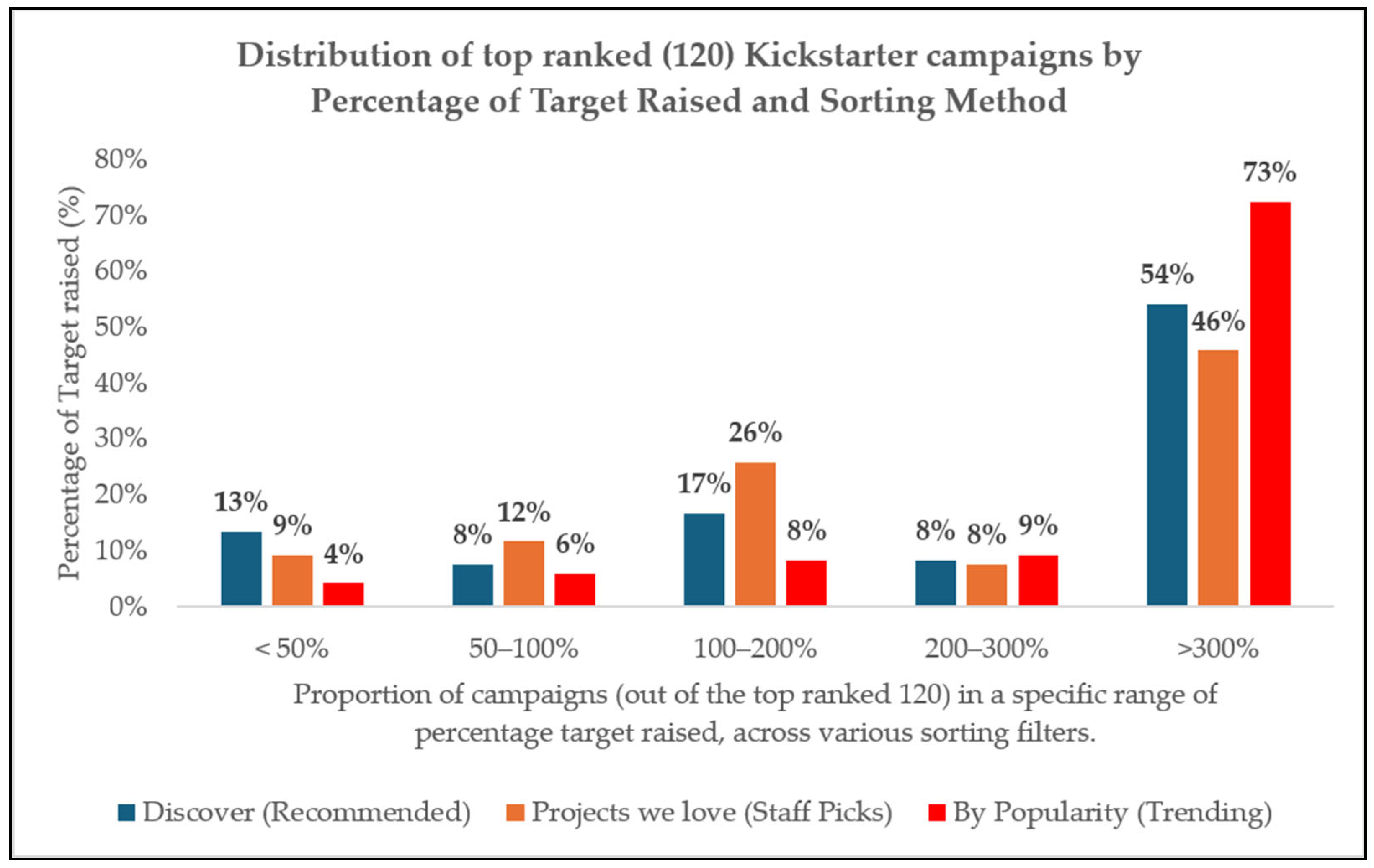
| 9 | In Appendix B, we demonstrate that the ability of a campaign to cover a significant share of its declared target soon after its launch guides Kickstarter in its promotion strategy. |
| 10 | In Appendix A.1, we show that our results remain qualitatively similar for a general distribution function. |
| 11 | We could qualify informed backers as those that have information above a certain information threshold about the underlying product. The information can be articulated as quality, value or serviceability. If the available information exceeds a threshold, the first set of ‘informed’ backers back the campaign. Our results remain the same even with this qualification of informed backers. The ‘uninformed’ backers will be those that do not have enough information and therefore do not back the campaigns, but rely on whether the campaigns get promoted. |
| 12 | In Appendix A.2, we extend our investigation to allow for the possibility that some informed backers may withdraw their pledge upon observing a low number of other informed backers participating in the campaign. |
| 13 | The backer gets the product only if the campaign is a production success. Thus, when a backer gets the product, all other informed and uninformed backers, as well as the external market, get the product. In other words, others are helped due to the backer’s pledge. By including any pure altruistic benefits in the willingness to pay due to the consumption, , our analysis can incorporate the Andreoni (1989) model of impure altruism. |
| 14 | To support our assumption that informed backers are not exposed to the risk that they lose their pledges even when the campaign is not promoted, one of two scenarios are necessary. Either , or if then . Given the result that we report in Lemma 2, the last inequality imposes an additional condition on the parameters of the model when
, namely that . The latter condition does not violate the requirement that the campaign is viable, namely that , if is sufficiently big. Hence, when is sufficiently big, we are assured that there are parameter values that support the assumption we make regarding the reduced risk to backers. |
| 15 | Our model can be easily extended to allow for the possibility that informed backers are exposed to the additional risk of losing their pledge even when the campaign is not promoted. Our qualitative results remain the same with such an extension. |
| 16 | Recall that , thus the informed backers incorporate the likelihood of the technical success of the entrepreneur in forming their expected benefit. |
| 17 | We implicitly assume that capital markets are perfect, implying that backers don’t face a budget constraint. Specifically, they can procure funds to invest in any project that they perceive to be profitable. The fact that many backers, especially those who are better informed, may be venture capital funds (Roma et al., 2018; Babich et al., 2021) justifies this assumption. |
| 18 | For instance, when . This implies that implies , and any project that qualifies for promotion will definitely lead to the start of production. |
| 19 | Refer “Can Kickstarter refund the money if a project is unable to fulfill?” in the link https://www.kickstarter.com/blog/accountability-on-kickstarter, accessed on 14 July 2026. Indiegogo, a competing crowdfunding platform, lists similar disclaimers at https://www.indiegogo.com/en/terms/backers, accessed on 14 July 2026. |
| 20 | It is possible to extend the analysis to consider heterogeneity along multiple dimensions without changing the qualitative results of our investigation. |
| 21 | The authors can provide upon request the derivations for the case that the platform chooses the threshold for promotion to ensure commercial and production success of some campaigns. |
| 22 | The solution exists if the term inside the radical in (13) is positive. Namely, if . |
| 23 | Because crowdfunding platforms use the “Load More” or “Show More” buttons at the bottom of each page of recommended campaigns to continue displaying additional campaigns from the recommended list, we use improvement in the ranking of a campaign as a measure of the recommendation in this investigation. |
| 24 | Kickstarter does not list campaigns in distinct pages but appear as one scrolls down the page. The page numbers, however, appear in the HTML script. |
| 25 | The Kickstarter platform uses the following names for sorting the campaigns, ‘Trending’ for ‘Popular’ campaigns, ‘Everything’ for ‘Recommended’ campaigns and ‘Project We Love’ for ‘Staff Picks’. |
| 26 | The name of the entrepreneur and a short description of the dataset are also available. |
| 27 | Rather than converting foreign currencies ourselves, we rely on the $ amount that Kickstarter provides. |
| 28 | We report the impact of a change in the threshold percentage of target funded at 300% only, while comment on the results obtained for the other thresholds. |
References
- Adomavicius, G., Bockstedt, J. C., Curley, S. P., & Zhang, J. (2018). Effects of online recommendations on consumers’ willingness to pay. Information Systems Research, 29(1), 84–102. [Google Scholar] [CrossRef] [Scilit]
- Agarwal, A., Hosanagar, K., & Smith, M. D. (2011). Location, location, location: An analysis of profitability of position in online advertising markets. Journal of Marketing Research, 48(6), 1057–1073. [Google Scholar] [CrossRef] [Scilit]
- Agrawal, A., Catalini, C., & Goldfarb, A. (2014). Some simple economics of crowdfunding. Innovation Policy and the Economy, 14(1), 63–97. [Google Scholar] [CrossRef] [Scilit]
- Ahlers, G. K., Cumming, D., Günther, C., & Schweizer, D. (2015). Signaling in equity crowdfunding. Entrepreneurship Theory and Practice, 39(4), 955–980. [Google Scholar] [CrossRef] [Scilit]
- Andreoni, J. (1989). Giving with impure warm-glow: Applications to charity and Ricardian equivalence. Journal of Political Economy, 97(6), 1447–1458. [Google Scholar] [CrossRef] [Scilit]
- Andreoni, J. (1990). Impure altruism and donations to public goods: A theory of warm-glow giving. The Economic Journal, 100(401), 464–477. [Google Scholar] [CrossRef] [Scilit]
- Avery, C., & Zemsky, P. (1998). Multidimensional uncertainty and herd behavior in financial markets. American Economic Review, 88, 724–748. [Google Scholar]
- Babich, V., Marinesi, S., & Tsoukalas, G. (2021). Does crowdfunding benefit entrepreneurs and venture capital investors? Manufacturing & Service Operations Management, 23(2), 508–524. [Google Scholar]
- Banerjee, A. V. (1992). A simple model of herd behavior. The Quarterly Journal of Economics, 107(3), 797–817. [Google Scholar] [CrossRef] [Scilit]
- Belavina, E., Marinesi, S., & Tsoukalas, G. (2020). Rethinking crowdfunding platform design: Mechanisms to deter misconduct and improve efficiency. Management Science, 66(11), 4980–4997. [Google Scholar] [CrossRef] [Scilit]
- Belleflamme, P., Lambert, T., & Schwienbacher, A. (2014). Crowdfunding: Tapping the right crowd. Journal of Business Venturing, 29(5), 585–609. [Google Scholar] [CrossRef] [Scilit]
- Bender, M., Gal-Or, E., & Geylani, T. (2019). Crowdfunding as a vehicle for raising capital and for price discrimination. Journal of Interactive Marketing, 46, 1–19. [Google Scholar] [CrossRef] [Scilit]
- Bikhchandani, S., Hirshleifer, D., & Welch, I. (1992). A theory of fads, fashion, custom, and cultural change as informational cascades. Journal of Political Economy, 100(5), 992–1026. [Google Scholar] [CrossRef] [Scilit]
- Bollinger, B., & Yao, S. (2018). Risk transfer versus cost reduction on two-sided microfinance platforms. Quantitative Marketing and Economics, 16, 251–287. [Google Scholar] [CrossRef] [Scilit]
- Bonnefon, J. F., Landier, A., Sastry, P., & Thesmar, D. (2025). The moral preferences of investors: Experimental evidence. Journal of Financial Economics, 163, 103955. [Google Scholar] [CrossRef] [Scilit]
- Burtch, G., Ghose, A., & Wattal, S. (2013). An empirical examination of the antecedents and consequences of contribution patterns in crowd-funded markets. Information Systems Research, 24(3), 499–519. [Google Scholar] [CrossRef] [Scilit]
- Burtch, G., Ghose, A., & Wattal, S. (2015). The hidden cost of accommodating crowdfunder privacy preferences: A randomized field experiment. Management Science, 61(5), 949–962. [Google Scholar] [CrossRef] [Scilit]
- Chakraborty, S., & Swinney, R. (2021). Signaling to the crowd: Private quality information and rewards-based crowdfunding. Manufacturing & Service Operations Management, 23(1), 155–169. [Google Scholar] [CrossRef] [Scilit]
- Chamley, C., & Scaglione, A. (2013). Social learning with decentralized choice of private signals. In 2013 IEEE global conference on signal and information processing (pp. 547–550). IEEE. [Google Scholar]
- Chemla, G., & Tinn, K. (2020). Learning through crowdfunding. Management Science, 66(5), 1783–1801. [Google Scholar] [CrossRef] [Scilit]
- Chen, S., Wang, J., & Yang, X. (2026). Pure altruism or warm-glow altruism? Altruistic motivation and gender differences in socially responsible investment. Journal of Business Ethics, 204(1), 127–144. [Google Scholar]
- Colombo, M. G., Franzoni, C., & Rossi-Lamastra, C. (2015). Internal social capital and the attraction of early contributions in crowdfunding. Entrepreneurship Theory and Practice, 39(1), 75–100. [Google Scholar] [CrossRef] [Scilit]
- Dehdashti, Y., Namin, A., Ratchford, B. T., & Chonko, L. B. (2022). The unanticipated dynamics of promoting crowdfunding donation campaigns on social media. Journal of Interactive Marketing, 57(1), 1–17. [Google Scholar] [CrossRef] [Scilit]
- Du, L., Hu, M., & Wu, J. (2022). Contingent stimulus in crowdfunding. Production and Operations Management, 31(9), 3543–3558. [Google Scholar] [CrossRef] [Scilit]
- Ellman, M., & Hurkens, S. (2019). Optimal crowdfunding design. Journal of Economic Theory, 184, 104939. [Google Scholar] [CrossRef] [Scilit]
- Gal-Or, E., Gal-Or, R., & Penmetsa, N. (2019). Can platform competition support market segmentation? Network externalities versus matching efficiency in equity crowdfunding markets. Journal of Economics & Management Strategy, 28(3), 420–435. [Google Scholar]
- Ghose, A., Ipeirotis, P. G., & Li, B. (2014). Examining the impact of ranking on consumer behavior and search engine revenue. Management Science, 60(7), 1632–1654. [Google Scholar] [CrossRef] [Scilit]
- Ghose, A., & Yang, S. (2009). An empirical analysis of search engine advertising: Sponsored search in electronic markets. Management Science, 55(10), 1605–1622. [Google Scholar] [CrossRef] [Scilit]
- Gneezy, A., Imas, A., Brown, A., Nelson, L. D., & Norton, M. I. (2012). Paying to be nice: Consistency and costly prosocial behavior. Management Science, 58(1), 179–187. [Google Scholar] [CrossRef] [Scilit]
- Godes, D. (2017). Product policy in markets with word-of-mouth communication. Management Science, 63(1), 267–278. [Google Scholar] [CrossRef] [Scilit]
- Godes, D., & Silva, J. C. (2012). Sequential and temporal dynamics of online opinion. Marketing Science, 31(3), 448–473. [Google Scholar] [CrossRef] [Scilit]
- Grossman, S. J., & Stiglitz, J. E. (1980). On the impossibility of informationally efficient markets. The American Economic Review, 70(3), 393–408. [Google Scholar]
- Hildebrand, T., Puri, M., & Rocholl, J. (2016). Adverse incentives in crowdfunding. Management Science, 63(3), 587–608. [Google Scholar]
- Hu, M., Li, X., & Shi, M. (2015). Product and pricing decisions in crowdfunding. Marketing Science, 34(3), 331–345. [Google Scholar] [CrossRef] [Scilit]
- Laik, J. (2024). Replication data for “how do reputation concerns affect the rule to promote campaigns and customization of revenue shares by a crowdfunding platform?” (V1). Harvard Dataverse. [CrossRef]
- Li, G., & Wang, J. (2019). Threshold effects on backer motivations in reward-based crowdfunding. Journal of Management Information Systems, 36(2), 546–573. [Google Scholar] [CrossRef] [Scilit]
- Li, Z., Duan, J. A., & Ransbotham, S. (2020). Coordination and dynamic promotion strategies in crowdfunding with network externalities. Production and Operations Management, 29(4), 1032–1049. [Google Scholar] [CrossRef] [Scilit]
- Long, F., & Liu, Y. (2024). Platform manipulation in online retail marketplace with sponsored advertising. Marketing Science, 43(2), 317–345. [Google Scholar] [CrossRef] [Scilit]
- Mollick, E. (2014). The dynamics of crowdfunding: An exploratory study. Journal of Business Venturing, 29(1), 1–16. [Google Scholar] [CrossRef] [Scilit]
- Mollick, E., & Nanda, R. (2016). Wisdom or madness? Comparing crowds with expert evaluation in funding the arts. Management Science, 62(6), 1533–1553. [Google Scholar] [CrossRef] [Scilit]
- Ordanini, A., Miceli, L., Pizzetti, M., & Parasuraman, A. (2011). Crowd-funding: Transforming customers into investors through innovative service platforms. Journal of Service Management, 22(4), 443–470. [Google Scholar] [CrossRef] [Scilit]
- Ottoni-Wilhelm, M., Vesterlund, L., & Xie, H. (2017). Why do people give? Testing pure and impure altruism. American Economic Review, 107(11), 3617–3633. [Google Scholar] [CrossRef] [Scilit]
- Roma, P., Gal-Or, E., & Chen, R. R. (2018). Reward-based crowdfunding campaigns: Informational value and access to venture capital. Information Systems Research, 29(3), 679–697. [Google Scholar] [CrossRef] [Scilit]
- Sayedi, A., & Baghaie, M. (2017, March 20). Crowdfunding as a marketing tool. Available online: https://ssrn.com/abstract=2938183 (accessed on 14 July 2026).
- Strahilevitz, M., & Myers, J. G. (1998). Donations to charity as purchase incentives: How well they work may depend on what you are trying to sell. Journal of Consumer Research, 24(4), 434–446. [Google Scholar] [CrossRef] [Scilit]
- Strausz, R. (2017). A theory of crowdfunding: A mechanism design approach with demand uncertainty and moral hazard. The American Economic Review, 107(6), 1430–1476. [Google Scholar] [CrossRef] [Scilit]
- Ursu, R. M. (2018). The power of rankings: Quantifying the effect of rankings on online consumer search and purchase decisions. Marketing Science, 37(4), 530–552. [Google Scholar] [CrossRef] [Scilit]


| Author(s) (Year) | TOPIC AREAS | ||||
|---|---|---|---|---|---|
| Entrepreneur Strategy | Backer Behavior | Platform Governance | Promotion & Visibility | Revenue Sharing | |
| Belleflamme et al. (2014) | ✓ | ||||
| Mollick (2014) | ✓ | ✓ | |||
| Ahlers et al. (2015) | ✓ | ✓ | |||
| Hu et al. (2015) | ✓ | ||||
| Roma et al. (2018) | ✓ | ||||
| Babich et al. (2021) | ✓ | ||||
| Chemla and Tinn (2020) | ✓ | ✓ | |||
| Sayedi and Baghaie (2017) | ✓ | ✓ | |||
| Chakraborty and Swinney (2021) | ✓ | ✓ | |||
| Strausz (2017) | ✓ | ✓ | |||
| Gal-Or et al. (2019) | ✓ | ✓ | |||
| Belavina et al. (2020) | ✓ | ✓ | ✓ | ||
| Long and Liu (2024) | ✓ | ✓ | |||
| Bollinger and Yao (2018) | ✓ | ✓ | |||
| Z. Li et al. (2020) | ✓ | ✓ | ✓ | ||
| Du et al. (2022) | ✓ | ✓ | ✓ | ||
| This Paper | ✓ | ✓ | ✓ | ✓ | ✓ |
| Parameters | |
|---|---|
| Valuation of the product | |
| Backer’s warm-glow utility from supporting a campaign | |
| Development cost of the product | |
| Random variable, with realization indicating the number of informed backers in the campaign | |
| Total size of informed backers in the population | |
| Total size of uninformed backers in the population | |
| Probability of technical success | |
| Expansion factor of backer population conditional on campaign promotion | |
| Reputation cost incurred by entrepreneur on failing to deliver the product to backers | |
| Reputation cost incurred by the platform if the entrepreneur fails to deliver the product | |
| Decision variables, indices and payoffs | |
| Pledge level that backers pay to the campaign—chosen by entrepreneur | |
| Target amount for the campaign—chosen by entrepreneur | |
| Entrepreneur’s share of campaign revenue—chosen by platform (platform’s share, or commission, is ). denotes the customized value of the entrepreneur’s share for a specific value of the development cost | |
| Threshold percentage of target that entitles campaigns for promotion—chosen by platform | |
| Profit in the external market, post campaign, if product is successfully produced | |
| Uniform sharing rule and customized sharing rule respectively. | |
| corresponding to low, intermediate and high fractional threshold value cases. | |
| Payoff of Backers for | |
| Payoff of Entrepreneur for | |
| Payoff of Platform for | |
| Optimum target that maximizes payoff to the Entrepreneur for | |
| Optimum target that maximizes payoff to the Platform for | |
Disclaimer/Publisher’s Note: The statements, opinions and data contained in all publications are solely those of the individual author(s) and contributor(s) and not of MDPI and/or the editor(s). MDPI and/or the editor(s) disclaim responsibility for any injury to people or property resulting from any ideas, methods, instructions or products referred to in the content. |
© 2026 by the authors. Licensee MDPI, Basel, Switzerland. This article is an open access article distributed under the terms and conditions of the Creative Commons Attribution (CC BY) license.
Share and Cite
Laik, J.; Gal-Or, E.; Mirchandani, P. Promotion Thresholds, Revenue Sharing, and Delivery Risk in Reward-Based Crowdfunding. Games 2026, 17, 38. https://doi.org/10.3390/g17040038
Laik J, Gal-Or E, Mirchandani P. Promotion Thresholds, Revenue Sharing, and Delivery Risk in Reward-Based Crowdfunding. Games. 2026; 17(4):38. https://doi.org/10.3390/g17040038
Chicago/Turabian StyleLaik, Joyaditya, Esther Gal-Or, and Prakash Mirchandani. 2026. "Promotion Thresholds, Revenue Sharing, and Delivery Risk in Reward-Based Crowdfunding" Games 17, no. 4: 38. https://doi.org/10.3390/g17040038
APA StyleLaik, J., Gal-Or, E., & Mirchandani, P. (2026). Promotion Thresholds, Revenue Sharing, and Delivery Risk in Reward-Based Crowdfunding. Games, 17(4), 38. https://doi.org/10.3390/g17040038