1. Introduction
Scientific theories do not survive on empirical merit alone. They survive when they fit the institutional environments that select for them—when their findings reinforce rather than threaten the ideological commitments of the states, universities, and funding bodies that determine what gets published, taught, and rewarded. The clearest historical demonstration of this dynamic is the suppression of Lev Vygotsky and Alexander Luria’s cultural-historical psychology under Soviet Stalinism, where empirically rigorous work on the cultural variability of cognition was displaced by Leontiev’s ideologically aligned Activity Theory. The standard intellectual-historical treatment of this episode (
Kozulin, 1990) frames the marginalization of Vygotsky’s work as a direct consequence of Stalinist ideological constraints on Soviet science.
Despite the obvious analytic value of formalizing such cases, game-theoretic treatments of theory survival under political pressure remain rare. The existing literature divides into game-theoretic models of authoritarian political survival (
Bueno de Mesquita et al., 2003;
Svolik, 2012;
Wintrobe, 1998), formal models of theory choice in science under normal conditions (
Brock & Durlauf, 1999;
Heesen, 2017;
Kitcher, 1990;
Strevens, 2003), and recent evolutionary-game models of state–university–researcher dynamics in contemporary innovation policy (
Zheng, 2023).
Kuhn (
1962) argued that theory change in science is rarely driven by empirical evidence alone; this study formalizes one mechanism by which non-empirical forces—specifically, institutional and ideological selection pressure—drive that process.
No published work, to this author’s knowledge, has combined these strands to model the survival of scientific theories under authoritarian ideological suppression pertaining to Vygotsky-Luria’s psychological theories. Here, such a model is developed, drawing on classical social-psychological evidence (Asch, Festinger, Milgram, Schachter, Sherif) for the microfoundations of researcher behavior, and uses the Vygotsky–Luria case to illustrate the resulting dynamics. The argument matters beyond Soviet history: the same selection pressures, in attenuated form, continue to shape what counts as scientifically legitimate knowledge in contemporary institutions.
2. Vygotsky, Luria, and the Political Construction of Acceptable Psychology
In the early Soviet years, Lev Vygotsky challenged the reflexive Pavlovian orthodoxy about learning. Most academics believed that people learn and think because of their natural abilities and that cognitive development is similar across cultures. Vygotsky, by contrast, believed that people develop consciousness and acquire higher cognitive skills through education, social interaction, and the use of cultural tools such as language and symbols. Vygotsky believed that awareness and higher-order cognitive skills require more than biological maturation (
Vygotsky, 1978). Empirical research in the early 1930s by Alexander Luria in Soviet Central Asia supported Vygotsky’s theory (
Karpov, 2007). Luria investigated literacy, formal education, and large-scale economic processes like collectivization in remote parts of the U.S.S.R. He compared the cognitive ability of Soviet institution participants to that of non-participants. The results showed that educated and uneducated people used their minds differently. Educated people used abstract classification, and non-educated people used experience-based concrete logic. Importantly, Luria did not view these variances as evidence that one mind was inferior to another. He claimed that different social structures caused the two thinking styles (
Luria, 1976). His findings revealed that culture and education affect cognitive ability as well as knowledge.
In addition to studying population comparisons, Luria studied twins. After examining the cognitive performance of several sets of identical twins in which some received special training and others did not, Luria confirmed that training could create new cognitive abilities much more quickly than biological maturation alone (
Luria, 1974). This result supported
Vygotsky’s (
1978) view that the development of higher psychological functions occurs through social interaction prior to internalization by the individual (
Karpov & Haywood, 1998). From this view, consciousness is created through interpersonal relationships and affected by the history and culture of a community (
Vygotsky, 1978).
Despite the major contributions to psychology by Vygotsky and Luria, and their international activity with researchers such as Kurt Lewin and Bluma Zeigarnik, they ultimately suffered the fate of Stalinist tyranny (
Yasnitsky, 2011;
Yasnitsky & Ferrari, 2008). The Soviet authorities became increasingly wary of perceived foreign cosmopolitan influences and saw the focus on cognitive variation among native peoples—although Vygotsky and Luria explicitly denied hierarchical inferiority—as a threat to the project of constructing a unified national identity (
Kotik-Friedgut & Friedgut, 2008).
For example, in his studies of cognitive development, Luria found that among rural villagers, those with more formal education were more likely to group objects according to abstract categories, while those with less formal education grouped objects according to more practical, everyday uses. The implications of these results are that cognitive structure is affected by both culture and education, even if there has been no alteration of an individual’s biological ability to process information. In a political context where all citizens are considered equal in terms of their ideology, all individuals collectively support one common cause, and each citizen feels part of a shared history, any cognitive differences between citizens could be seen as a threat to the state’s cohesive group ideology. Luria’s work was based on Vygotsky’s theory of cognitive processes that develop within social and cultural contexts, but Vygotsky’s work was banned for decades and only published after his death (
Joravsky, 1989).
The prevailing political environment made it clear that the institutional interpretation of state ideology would take precedence over the scientific merit of developing or disseminating knowledge. This tension resulted in the institutionalization of Pavlovian reflexology. Favored by Soviet officials for its materialist stress on physiological responses, while Vygotsky’s ideas about symbolic mediation and conscious awareness were dismissed as too abstract, cosmopolitan, and ideologically ambiguous (
Vassilieva, 2010). In the Stalinist period, in response to the growing threat of Vygotsky’s theories, Alexei Leontiev took some aspects of the cultural-historical framework and developed Activity Theory (
Kozulin, 1990). Vygotsky focused on symbolic mediation, particularly language, as the foundation of higher-order cognitive processes, whereas Leontiev focused on observable, goal-directed behavior and work.
Activity Theory proposed that human consciousness is generated through practical experience of socially organized activities involving tasks (
Leontiev, 1978). Activity Theory was much more aligned with the ideology of the Stalinist regime than Vygotsky’s original theory. By focusing on the practical experience of socially organized tasks and labor, Leontiev’s theory was much more aligned with the Marxist ideology promoted by the Soviet Union and with the materialist orientation of Pavlovian reflexology (
Bakhurst, 1991;
Kozulin, 1984). Consequently, Activity Theory gained institutional acceptance in a manner similar to Pavlovian reflexology.
Importantly, this does not imply that Activity Theory surpassed Vygotsky’s original theory in scientific terms. Activity Theory survived because it posed few ideological threats to the existing political environment. Recent historiography has complicated the simplest suppression-and-replacement narrative (
Yasnitsky, 2011;
Yasnitsky & Ferrari, 2008), showing that the Vygotsky circle continued to produce work into the 1930s and that the Vygotsky–Leontiev transition was less abrupt than often depicted; the direction of institutional selection pressure, however, is well established. Soviet psychology demonstrates that competing theories exist within ecological environments shaped by power dynamics, ideology, and survival incentives. Theories that align with prevailing ideologies are more likely to be funded, supported by institutions, published, and recognized professionally than theories that are seen as challenging those ideologies, irrespective of their scientific validity.
3. Social Psychology, Conformity, and the Construction of Social Reality
The Soviet regulation of science is one expression of a broader fact: social structures and institutions shape how individual beliefs form. The classical findings of Sherif (social norms), Asch (conformity), Festinger (cognitive dissonance), Milgram (obedience), and Schachter (deviance) establish, across several methodologies, that what people believe is shaped by social norms, authority pressure, incentives to conform or belong, and group membership.
Sherif (
1936) studied how groups manufacture a shared reality using the autokinetic effect, the illusion that a fixed point of light appears to move in darkness. Individual estimates of the apparent movement were widely divergent, but once participants judged aloud in a group, their estimates converged on a common norm—despite no objective standard and no explicit persuasion. The finding is politically significant: through repeated interaction, a group can settle on a stable, collectively held perception of reality, the basis on which propaganda, ideological conformity, and psychological manipulation operate.
Asch (
1948) showed that interpretation follows attributed authority: participants endorsed political quotations when they were attributed to Thomas Jefferson but rejected the identical statements when attributed to Vladimir Lenin. Rather than evaluating the content independently, participants filtered it through their prior social and political commitments, so the perceived identity of the author determined agreement.
In his subsequent conformity studies,
Asch (
1956) had participants judge which of several lines matched a standard while confederates gave obviously wrong answers; many participants followed the erroneous majority despite the clarity of the correct response. Social pressure can thus override plainly measurable experience—whether because people trust the group or because they fear the cost of dissent. The implication is that consensus is not evidence of truth: any institution that controls norms, prestige, and punishment can shape collective belief regardless of the evidence.
Festinger proposed two key psychological mechanisms: Social Comparison Theory (
Festinger, 1954) suggests people compare their opinions with others to find acceptance and reduce the psychological stress of uncertainty; and Cognitive Dissonance Theory (
Festinger, 1957) shows people change their beliefs to justify their behavior. In
Festinger and Carlsmith’s (
1959) study on cognitive dissonance, participants completed a boring task and were then asked to tell another person that the task was enjoyable. Some participants were paid
$1, while others were paid
$20. Those who paid
$1 later reported that the task was more enjoyable than those who paid
$20. Festinger and Carlsmith argued that the
$1 payment was not enough external justification for lying, so participants reduced their cognitive dissonance by changing their attitude toward the task. Those who paid
$20 had stronger external justification for their behavior, so they experienced less dissonance and had less need to change their beliefs.
Both ideology and institutional power, therefore, shape how people represent reality. Once individuals publicly defend or materially benefit from a belief system, they may internalize it to reduce the dissonance of defending a position they privately doubt. Conformity then becomes self-sustaining: people do not merely follow institutional directives but come to believe the narratives they are rewarded for endorsing.
Milgram (
1963) showed how far ordinary individuals would go in obeying an authority figure: most participants continued administering what they believed were dangerous shocks to an unseen ’learner’ simply because an experimenter instructed them to. The finding matters here because it demonstrates that systemic harm requires no malevolent actors—only authority structures that relocate responsibility upward. When an institution recasts compliance as a moral duty, obedience itself becomes the mechanism through which a destructive system is sustained.
Schachter (
1951) examined how groups enforce conformity and respond to deviance. In group discussions, a member who persistently dissented from the majority was progressively excluded, losing the interpersonal benefits of belonging, whereas a member whose expressed views aligned with the group retained full standing and its social rewards. Conformity is thus maintained by the threat of exclusion and the promise of acceptance.
Together, these findings show that people construct reality through group processes, institutional incentives, authority, and ongoing social reinforcement, so that agreement is not evidence of truth. The same selection operates in Soviet psychology: political institutions reward ideologically safe theories exactly as social groups reward conforming members and penalize deviants. What these classic results establish is that social reinforcement can override evidence; what the game-theoretic model in
Section 4 and
Section 5 adds is a specification of how much institutional punishment this requires and when the empirically weaker theory comes to dominate.
4. Game Theory, Institutional Survival, and the Political Selection of Knowledge
The conflict regarding Soviet psychology was shaped by the convergence of social psychology and game theory. As a discipline, historically, game theory has applied rationality to understand how individuals make decisions with respect to their own interests when making choices based on interdependence, uncertainty, reward and punishment. Utility functions were originally developed by
Von Neumann and Morgenstern (
1944) to represent the utility of actors across outcomes as numerical payoffs, beginning development within mathematical disciplines and economics, eventually making their way into psychology to provide an explanation for why individuals cooperate, conform, engage in conflict, and enter into social exchanges (
Van Lange & Balliet, 2015;
Kelley & Thibaut, 1978). While game theory originally focused on individual human behavior, it can also be used to analyze how institutional systems function and how competing scientific theories survive.
Game theory is useful here because it moves the analytic focus away from the simple assumption that truth prevails because of its inherent value. Instead, it focuses on the structure of incentives that exist within the political environment in which actors operate. Under this model, theories do not compete as a function of their explanatory power alone; they also compete as a function of the payoff structure they face within an institutional setting. If the rewards associated with supporting a particular theory exceed the costs for scientists, universities, journals, and political authorities, the long-term survival of that theory becomes more likely.
Applying game theory to scientific knowledge production has a substantial precedent.
Kitcher (
1990) developed a mathematical model to study the distribution of work among researchers in different scientific disciplines; he demonstrated that the social allocation of scientists toward competing theories is determined by their incentives, and not solely by which one they believe is scientifically correct.
Strevens (
2003) analyzed the “priority rule” in science as a resolution to a coordination problem, and demonstrated how scientific norms are created through strategic interaction.
Brock and Durlauf (
1999) developed a formal model of theory choice in science in which researchers’ decisions are shaped by social influence and reward structures, and
Heesen (
2017) extended this work to the dynamics of scientific reputation. The present paper extends this tradition by applying game-theoretic tools to the case of authoritarian regimes, where the punishment side of the payoff structure is so severe that it qualitatively changes the survival dynamics of competing theories.
Kelley and Thibaut’s (
1978) interdependence model illustrates that human interaction involves cost–benefit analyses of alternatives, including rewards and penalties. An individual will continue to participate in a relationship as long as the rewards from participation exceed the costs; alternative options can shift the calculation, leading individuals to leave the current relationship for one that offers higher relative rewards. Analogous to political authoritarianism, authoritarianism exists in the scientific community that operates under an authoritarian regime. Both
Wintrobe (
1998) and
Tullock (
1987) use a similar modeling framework to analyze the decision-making process of those operating under dictatorships using an optimization problem that describes the potential costs for deviating from what they believe are the desired results of the regime. Researchers are constantly forced to weigh the benefits of attempting to develop or pursue a specific research topic against the cost (i.e., censorship, social ostracization, etc.) associated with developing and pursuing that topic. Benefits may include institutional credibility, financial support, and publication opportunities (
Van Lange & Balliet, 2015).
Psychologists were confronted with a strategic decision during Stalinism. The potential reward from supporting either Vygotsky’s or Luria’s theory could have been substantial since each offered novel paradigms to understand the impact of social and cultural factors, such as literacy, on cognition. At the same time, there was considerable danger associated with support for these theories due to the possibility that they might provide evidence against the official ideology that all people will achieve equally regardless of environment (the “materialistic” explanation of the mind). By contrast, supporting Leontiev’s Activity Theory represented a lower-risk strategy because it conceptualized cognitive development in ways consistent with official Soviet ideology regarding labor and Pavlovian materialism.
4.1. Researcher Utility Function
The decision researchers face under Stalinism—whether to pursue empirically innovative but ideologically threatening research, or to align with state-approved theory—can be modeled as a strategic choice using a utility function. Following the standard von Neumann–Morgenstern utility framework (
Von Neumann & Morgenstern, 1944), the researcher’s utility function is defined in Equation (1).
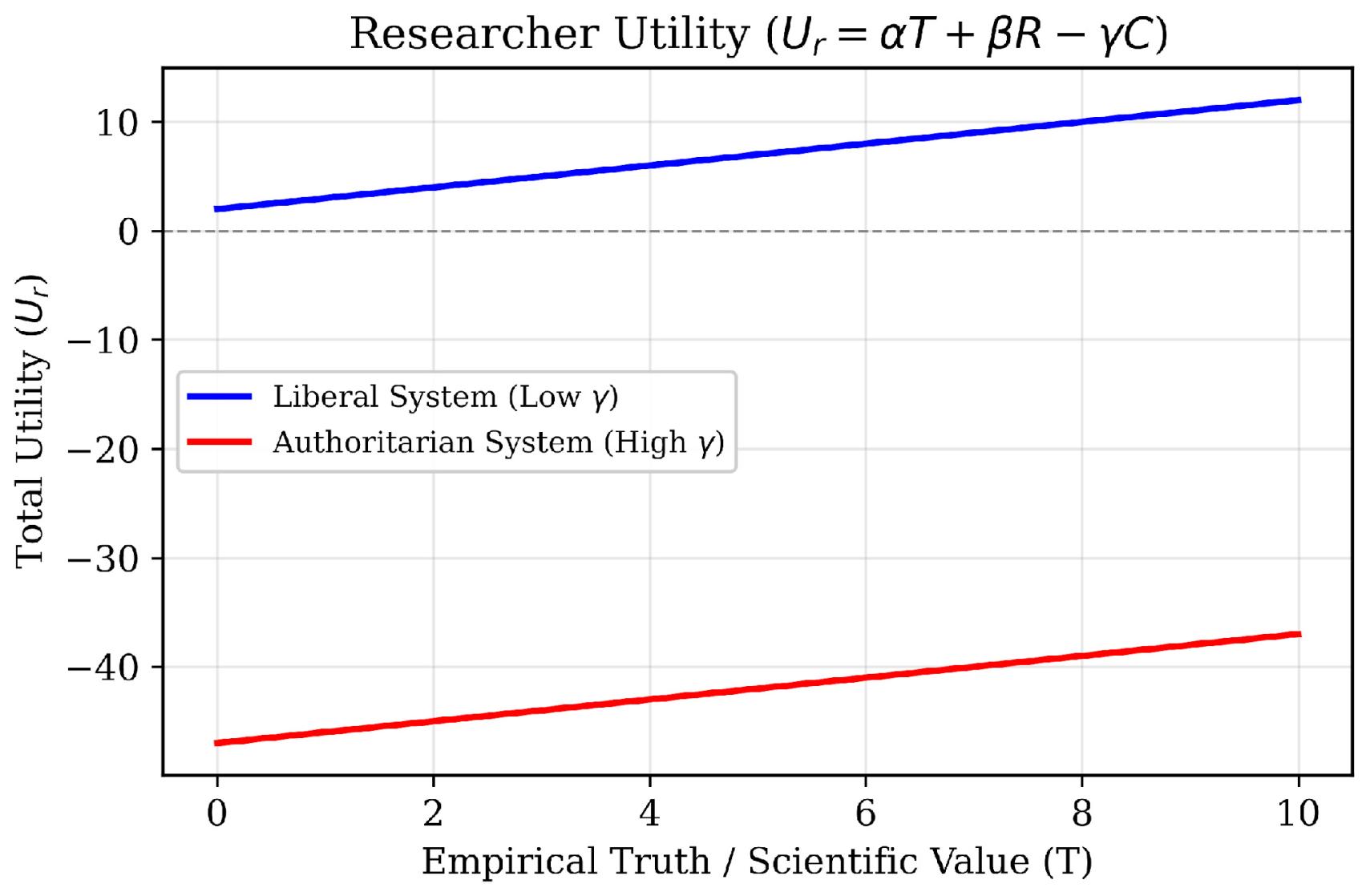
In such a system, the overall utility or strategic advantage to the individual researcher (Ur) would comprise three components: empirical truth or scientific value (T), institutional rewards (R), i.e., publishing research and advancing one’s career, and the cost of ideological punishment (C). Thus, α, β, and γ would be the relative weights for each of these components.
The punishment factor γ will become greater than both α and β under an authoritarian regime. Therefore, the strategic benefits of avoiding ideologically dangerous research will greatly exceed the strategic benefits of optimizing empirically valid results. As a result, researchers in these environments will likely feel forced to either alter or eliminate theoretical models that they believe could pose political dangers to them if published in order to survive within their respective professional institutions. Under Stalinism, this asymmetry is extreme.
That is, the cost of ideological punishment far outweighs the benefit of pursuing empirical truth.
Figure 1 illustrates this dynamic by plotting U
r against T for two systems with different punishment regimes.
4.2. State Utility Function
The state faces an analogous strategic problem. Following the political-economy tradition of modeling autocratic regimes as utility-maximizing actors (
Tullock, 1987;
Wintrobe, 1998), the state’s utility function can be expressed as Equation (3).
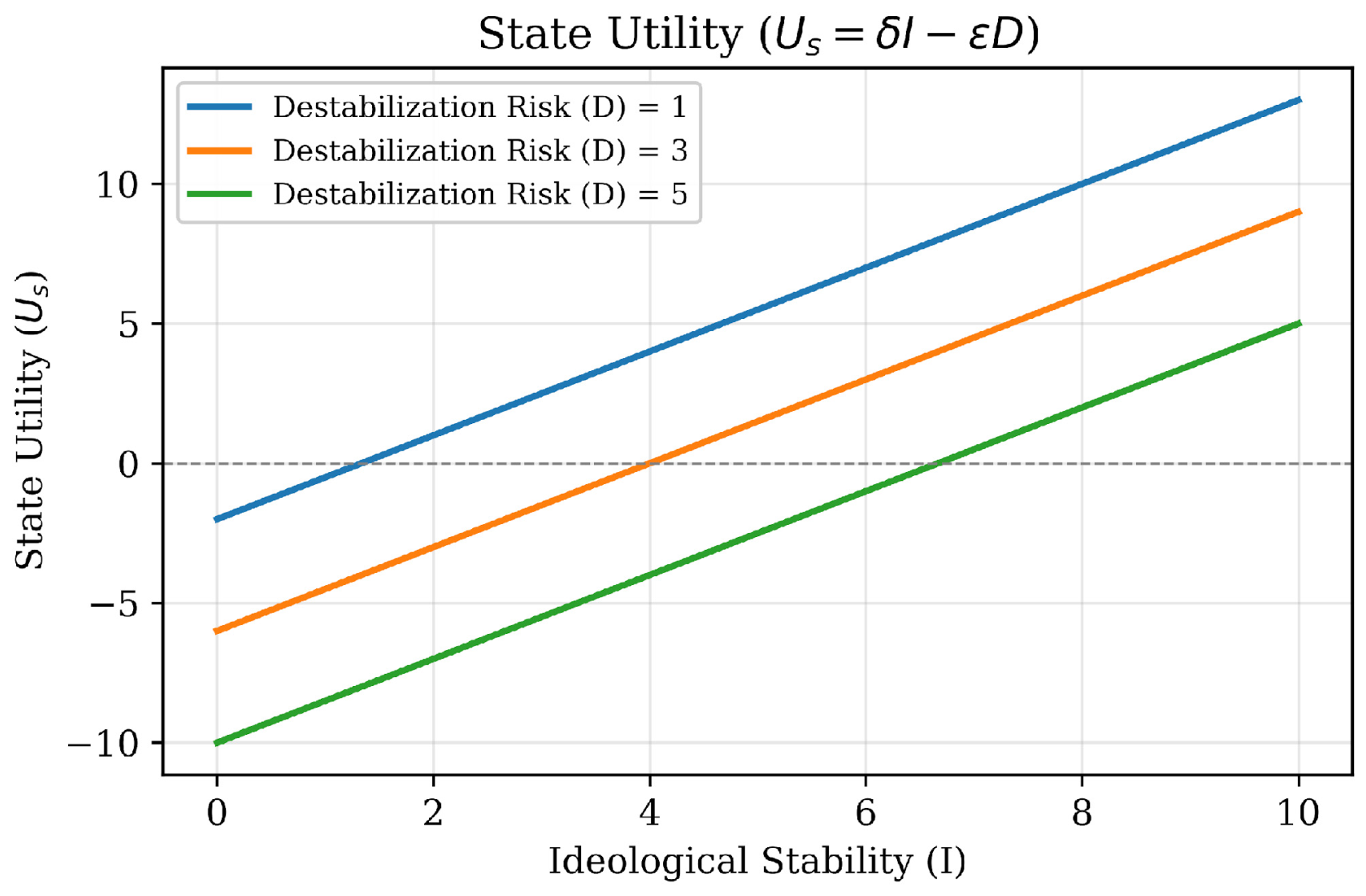
Here, I denotes ideological stability, D the destabilization risk a theory poses, and κ the cost of enforcement, with δ and ε the weights on stability and risk. Enforcement intensity e ∈ {L, H} enters through these terms: high enforcement lowers destabilization risk, D(H) < D(L), and can raise stability, I(H) ≥ I(L), but is more costly, κ(H) > κ(L). The state escalates to high enforcement when the resulting gains outweigh that cost, δ[I(H) − I(L)] + ε[D(L) − D(H)] ≥ κ(H) − κ(L), a condition satisfied when the regime places substantial weight on destabilization (large ε). The state does not judge theories by their scientific merit but by whether they threaten equality, materialism, and political consistency: as a theory’s risk D rises, U
s falls, and suppression becomes the utility-maximizing response.
Figure 2 illustrates the family of utility curves for three levels of destabilization risk.
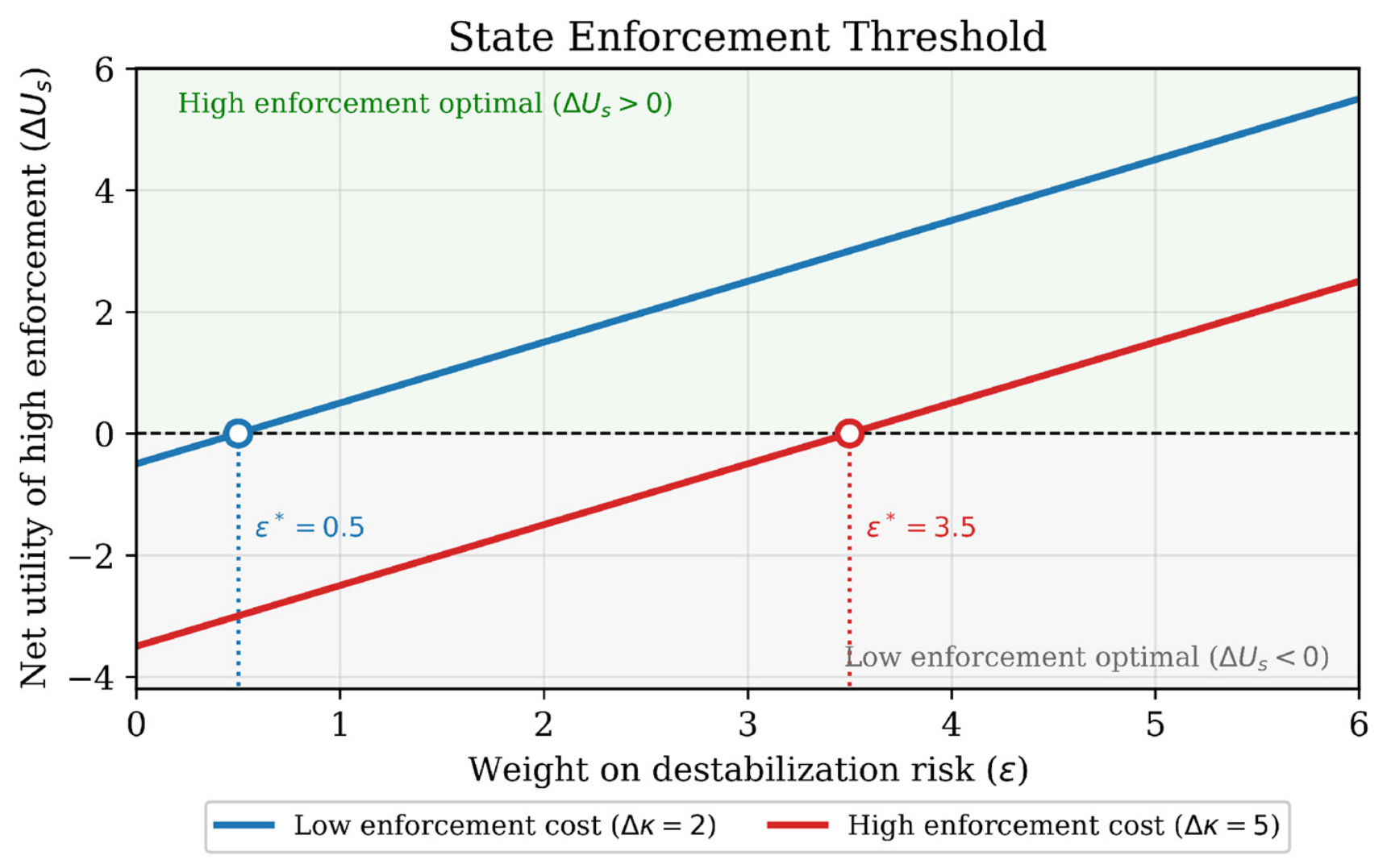
Figure 3 makes this enforcement decision explicit. It plots the net gain from high enforcement, ΔU
s = U
s(H) − U
s(L) = δ[I(H) − I(L)] + ε[D(L) − D(H)] − [κ(H) − κ(L)], as a function of the weight ε the state places on destabilization risk. High enforcement is the utility-maximizing response precisely where this quantity is positive, and the threshold ε*, at which the regime switches from low to high enforcement, falls as enforcement becomes cheaper—so regimes that either place substantial weight on destabilization or can enforce at low cost escalate to active suppression.
4.3. Evolutionary Game Theory and Institutional Selection
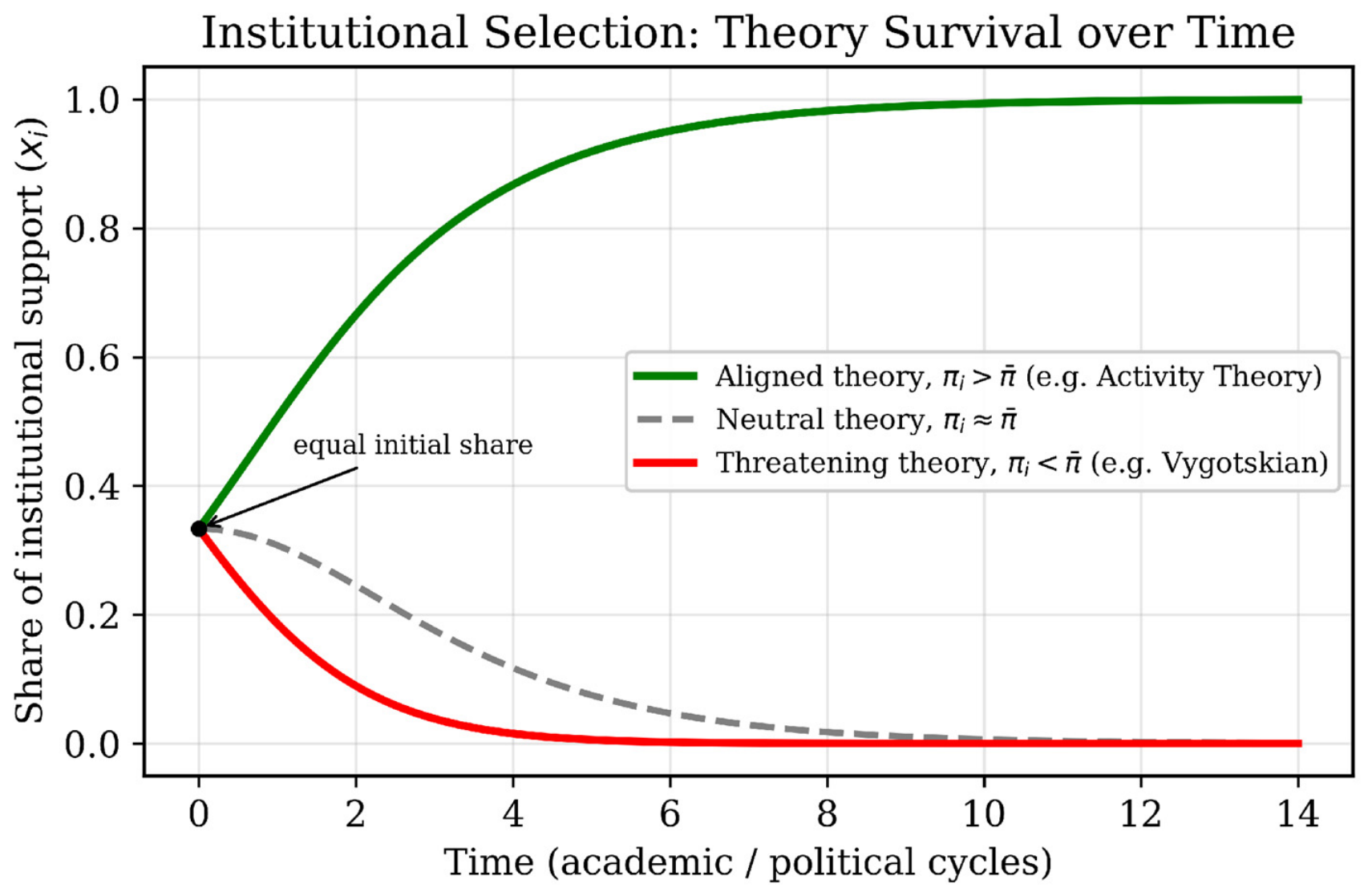
The institutional survival of theories can be modeled using the replicator equation from evolutionary game theory. According to
Taylor and Jonker (
1978), who introduced the replicator dynamic to formalize the evolutionary stability of strategies in population games, the share of a population playing a given strategy grows in proportion to how far its payoff exceeds the population average. This dynamic, now standard in the evolutionary game theory literature (
Hofbauer & Sigmund, 1998;
Weibull, 1995), is applicable to any selection process in which agents adopt strategies on the basis of differential payoffs, including the institutional selection of scientific theories. The replicator equation is given in Equation (4).
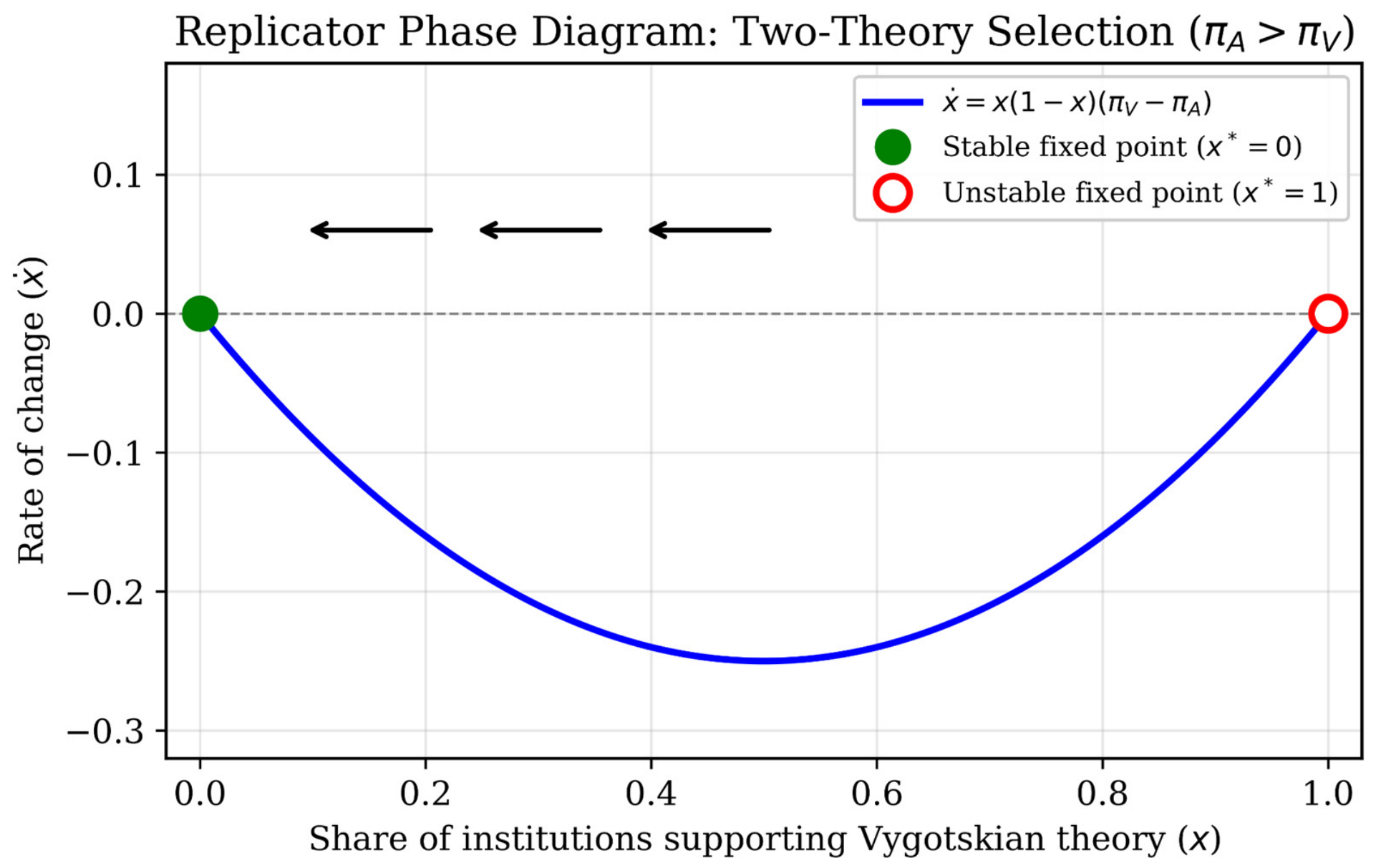
In this equation, xi represents the proportion of institutions supporting theory i; πi represents the institutional payoff of theory i; and π− represents the average payoff of competing theories. Theories with above-average institutional payoff spread through academic systems, while theories with below-average payoff gradually disappear. Importantly, institutional fitness is not synonymous with empirical truth. A theory may survive because it is politically useful, economically profitable, ideologically safe, or socially rewarding.
Theoretical survival depends on institutional fitness in the same way that biological survival depends on environmental fitness. Under Stalinism, Activity Theory had a better fit to the existing institutional structure—Soviet materialism combined with Pavlovian reflexology—than did Vygotsky’s or Luria’s theories. This better fit produced a higher institutional payoff for those who adopted it, while increasing the risk of ideological punishment for those who continued to defend Vygotskian work (
Van Geert, 1998).
Figure 4 illustrates how the proportion of institutional support evolves over academic and political cycles for theories with above-average, average, and below-average institutional payoff.
Soviet psychology thus illustrates how scientific theories compete in political systems that are structured by institutional payoffs, punishments, conformity pressures, and survival incentives. In this context, truth is selectively transmitted through systems of institutionalized power. The Soviet example illustrates what may be called epistemological selection pressure: scientific theories are selected not on the basis of falsifiability or empirical validity but on the basis of alignment with current institutional rewards. Activity Theory became more prevalent because it provided a greater institutional payoff, while Vygotskian theories declined because they carried a greater ideological penalty. From this perspective, scientific theories evolve in the same way that organisms evolve within ecosystems—through selective adaptation.
Even in the absence of objective evidence, social compliance reinforces established belief systems. Each of Sherif’s normative development studies, Asch’s conformity experiments,
Festinger’s (
1957) Cognitive Dissonance Theory,
Schachter’s (
1951) deviance research, and
Milgram’s (
1963) obedience studies demonstrates that individuals alter their behaviors and perceptions based on social reinforcement. Ultimately, these influences create stable systems where the most influential viewpoint is not always the correct or best perspective—it is simply the one supported by the most socially beneficial incentives.
Under conditions of institutionalized power, truth is partially substituted by strategic utility. Theories persist not because they offer the best explanation of reality but because they fit the environment in which knowledge is produced. The pattern is most easily observed under authoritarian systems because the consequences of deviating from institutional norms are obvious, costly, and often deadly. However, the same general principle applies, in attenuated form, outside of authoritarian regimes (
Freis, 2017). Every institution contains incentives that shape which ideas become prominent, which fade, and which are treated as socially acceptable. Hence, the history of psychology suggests that scientific knowledge cannot be regarded solely as an abstract pursuit of objective truths. Scientific knowledge development is a competitive strategic process influenced by institutional power, social conformity, institutional viability, and social reinforcement.
Table 1 summarizes these model parameters and their predicted qualitative directions under an authoritarian regime.
7. Conclusions
Psychology has been shaped throughout its history by the major societal forces of power and their influence. The construction, acceptance, and longevity of psychological theories depend on the complex interplay between institutions of power, ideologies, patterns of compliance, and the strategic and structural incentives that surround knowledge production. Vygotsky and Luria themselves experienced this under the Stalinist USSR. The cultural-historical viewpoint they developed described cognitive function as emerging from socially and historically mediated contexts shaped by culture, language, and education—an important discovery for science, but also politically dangerous because it suggested there was variability in cognition across different populations, rather than uniformly.
The Soviet response to Vygotsky’s and Luria’s theories supports a more general lesson: institutions do not typically judge ideas primarily by empirical accuracy. They assess ideas in terms of institutional viability. Activity Theory continued to be supported, at least in part, because Leontiev translated key aspects of Vygotsky’s framework into a more materialist, ideologically acceptable, and Pavlovian vocabulary centered on labor and observable action. Theoretical feasibility has come to be determined by institutional feasibility rather than solely scientific merit, as supported by the social-psychological tradition of Sherif, Asch, Festinger, Schachter, and Milgram; together they show that belief systems are revised to fit social normative expectations. These findings suggest that social reality is actively constructed through reinforcement, punishment, prestige, and institutional authority rather than passively discovered.
The game-theoretic analysis in
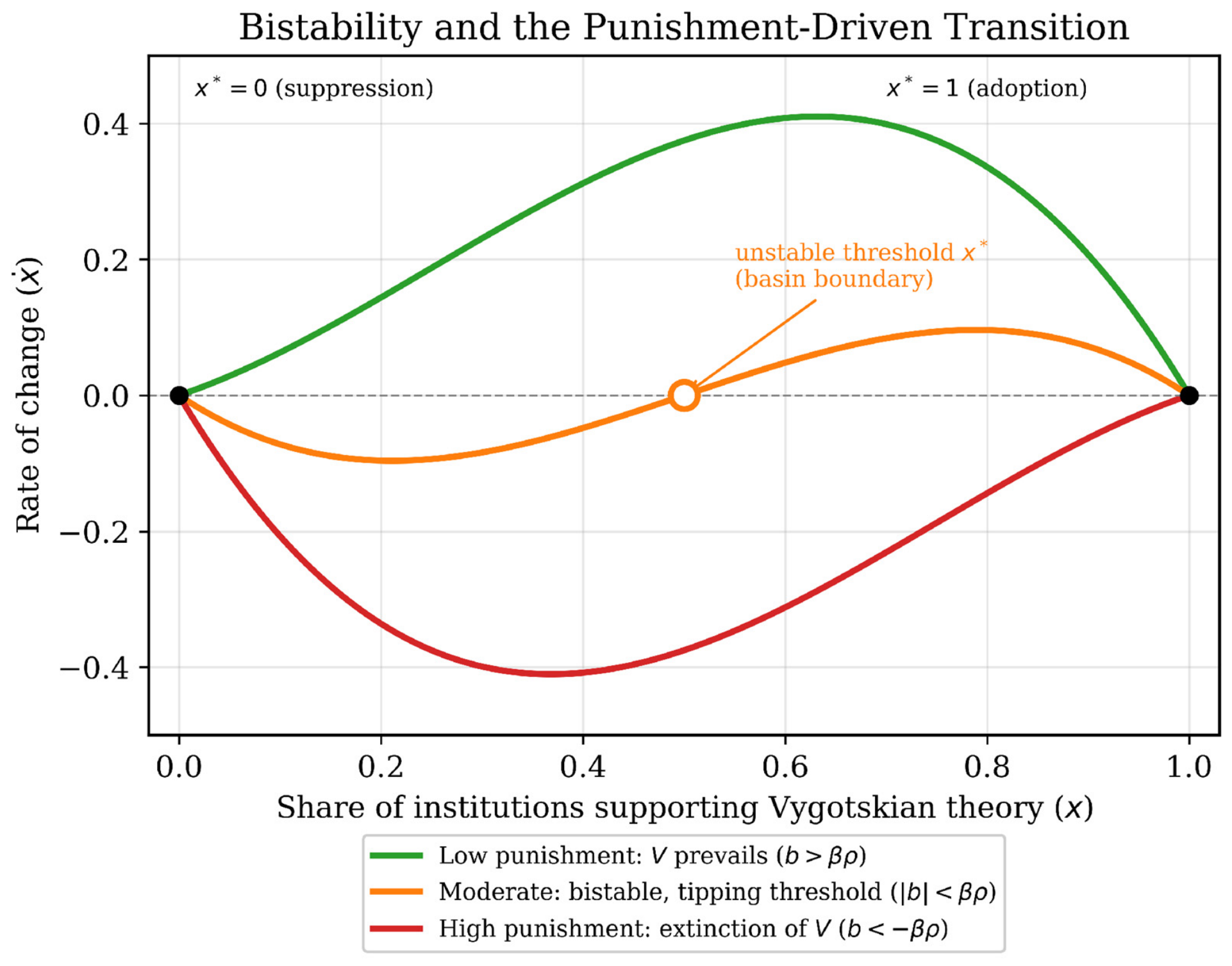
Section 5 makes this synthesis more precise. Proposition 1 establishes that, once the punishment-weight γ exceeds the indifference threshold γ*, the unique Nash equilibrium of the researcher–state game is alignment with the ideologically safe theory, and this equilibrium is invariant to increases in empirical truth. The replicator analysis shows that the same configuration produces a stable institutional attractor in which the empirically weaker theory dominates the population. Together, these results convert the historical pattern of Soviet psychology into a comparative-statics claim: under authoritarian enforcement, the empirical dimension of payoffs is dominated by the political dimension, and selection at both individual and institutional levels favors theories on the basis of ideological fit rather than predictive accuracy.
This argument should not be read as implying that there is no objective truth. Rather, it implies that many human institutions have great difficulty separating truth from power. Legitimacy, consensus, and institutional dominance are often achieved through conformity pressures and strategic reinforcement rather than through rational evaluations of evidence. As a consequence of socially stable beliefs, institutions will establish an “objective” reality for society. Therefore, what is accepted as fact and what is accepted as science is determined by how empirically grounded the issue is and how likely that institution is to be able to survive.
These implications extend beyond Soviet psychology, though the extension must be drawn carefully. The model is built on severe punishment, active enforcement, complete information, and a binary choice—conditions characteristic of authoritarian science, not of contemporary liberal institutions. Indeed, with a low weight punishment, the same model predicts the opposite outcome: empirical merit can prevail. The contemporary worry is therefore not that universities, mass media, and online platforms (etc.) suppress truth wholesale, but that within specific high-pressure domains—where reputational, financial, or political penalties for dissent are steep—the local punishment weight approaches the authoritarian regime, and selection there can favor ideologically safe positions over better-supported ones. Psychological theories that expose the mechanisms of socialization, conformity, obedience, and institutional manipulation are most likely to be perceived as threatening precisely in those domains, because they show how power maintains itself where belief is neither autonomous nor fully rational.
More broadly, the approach taken here belongs to a methodological program that, while contested in its ambitions (
Elster, 2000), remains underused in historical scholarship. Formal and quantitative tools—rational-choice and game-theoretic case analysis (
Bates et al., 1998) and the mathematical modeling of long-run social processes developed in cliodynamics and cliometrics (
Turchin, 2003,
2008;
Diebolt & Haupert, 2016)—have shown that the historian’s narrative and the formal model are complements rather than rivals: the model makes a causal mechanism explicit and exposes its assumptions to test, while the narrative supplies the cases and contingencies the model must answer to. Yet outside economic and political history, these methods are still rarely used, and rarer still in the history of science and ideas. This study is offered partly as an argument for their wider application: episodes such as the suppression of Vygotskian psychology, the Lysenko affair, and Deutsche Physik are instances where a specifiable selection mechanism can be investigated. Treating historical events in this way—across the discipline of history, not only within psychology—can convert otherwise singular narratives into comparable, mechanism-level claims.
Ultimately, the history of psychology demonstrates that science takes place within larger macro-social conflicts over authority, legitimacy, and social control (
Bourdieu, 1975;
Shapin & Schaffer, 1985). Theories survive based not only on their ability to describe reality but also on their ability to navigate the institutional environment in which knowledge is constructed (
Bloor, 1976;
Kuhn, 1962). Truth is rarely actively censored by the government or other authorities. Instead, it is often shaped by a combination of the rewards for producing certain types of thought, pressure to conform to existing norms, mechanisms used by institutions to select ideas they will promote, and their use as a means of achieving various political objectives. As the Patriots’ AI system observes in the fictional dialog of Metal Gear Solid 2: Sons of Liberty, “What we propose to do is not to control content, but to create context” (
Konami Computer Entertainment Japan, 2001). The line captures precisely what the present model formalizes: epistemological selection pressure operates not by censoring particular claims but by structuring the institutional context—the payoffs, punishments, and conformity incentives—within which some theories become sayable and rewarded while others become dangerous. Control of context, not content, is what the researcher–state game describes. This insight predates the digital era:
Lippmann (
1922) argued just over a century ago that the public responds less to reality itself than to the constructed informational environment that institutions place between them and the world. What the information age has changed is the speed and scale of context construction, not its underlying logic. Humans have been creating societal truths long before the existence of AI or social media; propaganda, institutions, social pressures to conform, authority structures, and systems of reward and punishment have all long been used to manufacture shared perceptions of what is true, and modern technology has accelerated, industrialized, and automated these methods rather than invented them. The value of an analysis like this one is to push that lens backward—to show the same selection logic that contemporary scholarship locates in media ecosystems and online platforms already at work in the institutions of Stalinist science (and future research applying similar frameworks retroactively to other historical events). From Stalinist psychology to contemporary media ecosystems, humans have continually shaped one another’s perceptions of reality—socially, psychologically, politically, and anthropologically—influencing not only what societies believe to be true but ultimately the trajectory of history itself.