1. Introduction
The rapid development of digital technologies has brought unprecedented “digital dividends” to the global economy. However, this has been accompanied by a growing “Matthew Effect” in the digital age—the increasingly prominent issue of the digital divide (
Shakina et al., 2021). The digital divide among enterprises refers to the systemic disparities in the application of digital technologies, access to, and utilization of digital resources and digital capabilities, leading to information asymmetry and a polarization in digital maturity levels between firms. The digital economy accounted for 60% of global GDP, with the scale of the digital economy in the top five economies, including the United States, China, and Germany, being particularly significant—exceeding
$33 trillion in total and maintaining an annual growth rate of over 8% (
China Academy of Information and Communications Technology, 2024). Against this backdrop, accelerating technological iteration makes digital transformation a critical pathway for enterprises to maintain competitiveness and achieve sustainable development (
Luo & Liu, 2024). As indispensable components of industrial clusters, large enterprises and small- and medium-sized enterprises (SMEs) have distinct yet complementary functional roles. Their synergistic coexistence is crucial for enhancing the resilience and overall security of national industrial systems (
Brink, 2017). SMEs form the micro-foundation of the global economy, constituting 90% of all businesses and contributing approximately 70% of employment and GDP (
International Labour Organization, 2019). They are vital sources of technological innovation and social employment. Nevertheless, the widening digital divide between SMEs and large enterprises not only exacerbates the former’s disadvantages in resource acquisition and technology adoption (
Inegbedion et al., 2024), leading to their marginalization and low-end lock-in within industrial chains, but also constrains high-quality innovation within the digital ecosystem and the sustainable evolution of industrial clusters as a whole (
Qiu & Guo, 2019).
Building an inclusive digital ecosystem is fundamental to addressing the digital divide. The United Nations’ Global Digital Compact aims to “expand inclusion in and benefits from the digital economy for all” (
United Nations, 2024). A Digital Inclusion Ecosystem is defined as a combination of programs and policies that meet a geographic community’s unique and diverse needs (
National Digital Inclusion Alliance, 2023). Governance of the digital divide primarily encompasses three dimensions: first, narrowing the structural gap in digital technology access opportunities among different organizations and individuals by strengthening communication infrastructure construction and optimizing regional coverage (
Lentz & Oden, 2001); second, alleviating skill asymmetries in the use of digital tools by enhancing IT literacy and operational competencies (
Schleife, 2010); and third, mitigating practical obstacles in accessing and using digital resources for various actors by reducing the cost of online services and improving their accessibility (
Çilan et al., 2009). Correspondingly, the implementation framework for digital inclusion consists of five core elements: (1) affordable and stable broadband Internet services; (2) Internet-enabled devices that meet user needs; (3) systematic digital literacy training resources; (4) high-quality technical support systems; and (5) applications and online content that facilitate autonomous participation and collaboration (
National Digital Inclusion Alliance, 2023). The implementation of this infrastructure not only provides a necessary prerequisite for SMEs to achieve digital transformation but also lays a systematic foundation for the entire industrial cluster to move toward digital integration (
Hussain et al., 2025). Therefore, constructing a digital inclusion ecosystem within industrial clusters is of strategic importance. Its impact extends beyond merely bridging the digital divide among enterprises to enhancing the overall competitiveness and strengthening the sustainable development capabilities of the industrial cluster.
However, a fundamental tension exists between the diverse interests of cluster firms and the public-good nature of the digital inclusion ecosystem. While digital transformation presents both opportunities and challenges for industrial clusters (
D. Chen & Wang, 2024), representing a strategic choice to break path dependency and achieve an upward shift in global value chains, its success relies on the co-construction of the cluster’s ecosystem. A critical barrier lies in the cluster’s composition, which is predominantly characterized by a concentration of small- and medium-sized enterprises (SMEs). These SMEs often face a triple bind of low value capture, small scale, and fragmented distribution (
Sun & Fan, 2023). The implementation of digital transformation requires significant resource commitments, which can be perceived as a heavy burden by SMEs (
S. Wang & Esperança, 2023). These structural obstacles collectively inhibit the digital leap of the industrial cluster. Furthermore, firms, as rational economic actors, frequently exhibit free-riding behavior. By externalizing the costs of building the digital inclusion ecosystem, individual firms can avoid investment risks while still appropriating the positive externalities generated by the digital ecosystem. This strategic choice stems from a structural conflict between individual and collective rationality, a phenomenon known as “Olson’s Dilemma”.
Platform enterprises, positioned at the core of industrial clusters, occupy the structural holes of digital transformation, acting as pivotal “bridging nodes” and assuming a quasi-governmental role. The remarkable success of the digital platform ecosystem business model is evident, as platforms have rapidly attained dominant positions across numerous economic sectors. A telling example is that, as of early 2024, five of the world’s ten most valuable companies by market capitalization were digital platform ecosystems—including Microsoft, Apple, Alphabet, Amazon, and Meta [ ]. These digital platforms provide the foundational infrastructure for a wide spectrum of economic, social, and political interactions (
Rovenskaya et al., 2025). Platform empowerment fundamentally alters the paradigm of firms operating in isolation, enabling them to leverage the platform’s capabilities for resource exchange, technology sharing, and value co-creation. It is a process through which stakeholders acquire and enhance advanced capabilities in transaction, innovation, competition, and resilience (
Zaki, 2019). By providing robust support for socialized production and serving as a low-cost infrastructure for efficient interaction, platform enterprises are perceived as having the capacity and a degree of responsibility to organize public goods and safeguard social welfare, thereby functioning as quasi-governmental actors (
Farrell, 2003). For SMEs, engaging with and being empowered by platform enterprises constitutes a critical pathway to bridge the digitalization gap and undertake business transformation (
W. Chen & Wang, 2021). Consequently, clarifying the following questions is paramount for resolving cooperation dilemmas within industrial clusters, bridging the digital divide, and fostering a digitally inclusive society:
RQ1: What are the driving mechanisms of digital inclusion ecosystem co-construction in industrial clusters?
RQ2: How does performance feedback influence the evolution of cooperation?
RQ3: Can platform enterprises, as inter-organizational network managers, promote digital inclusion?
RQ4: Under what conditions is their role positive or negative?
This study, therefore, employs a complex network game approach to investigate corporate investment behavior in the co-construction of a digital inclusion ecosystem, examining the strategic interactions between industrial clusters and platform enterprises to identify optimal pathways for bridging the digital divide. While a limited number of studies have recognized the externality and public-good nature of digital inclusion (
Yan, 2022) and have noted the tension between high investment requirements and the imperative for broad accessibility in building digital public goods within such ecosystems (
W. Li & Zhang, 2022), some research has even utilized evolutionary game theory to study the digital transformation of small- and medium-sized manufacturing enterprises (
Zhu et al., 2023). However, the distinctive role of platform enterprises within the network structure has not yet been thoroughly explored. We posit that the investment behavior of cluster firms in the digital inclusion ecosystem not only exhibits characteristics of a public goods game but also involves complex network interactions, wherein the platform enterprise plays a pivotal role.
Compared to prior research, this research makes three distinct marginal contributions. First, it pioneers an analytical framework for public goods games that integrates “complex networks + platform enterprises”. While the existing literature acknowledges both the public-good nature of digital inclusion ecosystems and the resource integration function of platform enterprises within digital ecosystems—such as Internet platforms fostering industrial chain synergy (
Yang, 2025)—few studies have situated this within an evolutionary game framework under a complex network perspective. Specifically, none have systematically combined the leadership role of platform enterprises with the efficient information transmission of small-world networks and the scale-free characteristics of power-law distribution to analyze the supply dynamics of digital inclusion public goods, such as data sharing, technology accessibility, and infrastructure co-construction. Second, this study incorporates a performance feedback mechanism into a modified Fermi learning rule. This integration addresses a key limitation in prior applications of the Fermi rule, which primarily considered social expectations (
D. Li et al., 2024). By establishing an adaptive learning benchmark based on historical aspirations, our approach more accurately captures the “action-feedback” decision-making process of firms within a digital ecosystem. Third, we further investigate the impact of platform enterprises’ strategic choices and exercise of power on evolutionary outcomes. Although some research has applied complex network theory to model the diffusion of digital decision-making among SMEs within industrial clusters (
Shu et al., 2024), these studies have not accounted for the catalytic role of platform enterprises. Our research explicitly models the process through which a platform enterprise stimulates technological investment among cluster firms and fosters collaborative cluster development. This perspective uniquely considers the dual role of platform enterprises as both market participants and quasi-governmental actors while also examining the effects of their resource allocation and rule-setting capabilities.
The remainder of this study is structured as follows.
Section 2 systematically examines the small-world and scale-free characteristics of industrial cluster networks, the network governance role of platform enterprises, and the public goods attributes of digital inclusion ecosystems. The “Evolutionary Game Model Analysis” constructs a public goods game model incorporating performance feedback, capturing firms’ strategic interactions under historical and social aspirations.
Section 4 employs Monte Carlo simulations to verify the mechanisms through which the investment return coefficient and platform empowerment strategies influence the evolution of cooperation. Finally,
Section 6 synthesizes the pathways through which platform empowerment fosters the co-construction of digital inclusion ecosystems and proposes governance insights for governments, platform enterprises, and cluster firms.
3. Model Construction
3.1. Network Construction
Suppose cluster firms constitute an industrial cluster network , where is the set of nodes representing the firms, and is the set of directed edges. A neighbor is defined as a firm that has direct business transactions with a given firm. For firms that are mutual neighbors, their business interactions are realized through the multi-dimensional coupling of resource flows, capital flows, and information flows. This coupling relationship determines the compatibility of the digital inclusion ecosystem. Firms engaged in business transactions exhibit system compatibility, while those lacking such connections demonstrate system heterogeneity. This neighborhood effect results in investment returns from the digital inclusion ecosystem having a localized spillover characteristic, where only neighboring nodes within the network topology can absorb the non-excludable benefits of ecosystem construction. If firm is a neighbor of firm , then ; otherwise, . Here, firm is the source node initiating the business flow, and firm is the target node receiving it. Conversely, if is the source and the target, then . Resource, capital, and information flows follow the business direction from the source to the target node, with the target node receiving the investment return spillovers from the source. After firm initiates a business flow, the set of neighbour firms receiving this business is , and the total number of such neighbors is . All parameters are provided in Abbreviations.
A single “platform-type chain leader” is embedded into this network structure, forming bidirectional links with the cluster firms. The cluster firms display product information and provide services (e.g., purchasing, after-sales, booking) along with their data elements on the platform. In return, the platform provides the cluster firms with data elements such as logistics, industry, competitor product, and competitor store information. This integration yields a new network
, where the platform firm is denoted as node
. The new node set is
, and the new edge set is
=. Finally, we employed the Watts–Strogatz model (
Watts & Strogatz, 1998) to construct the small-world network and the Barabási–Albert model (
Barabási & Albert, 1999) to construct the scale-free network, reflecting the distinct topological characteristics of each.
The small-world industrial cluster network is generated through the following steps. First, a scalable two-dimensional plane is generated where each cluster firm is placed as a node. All nodes are arranged in a ring on the plane, and each node connects to its nearest neighbors. The parameter represents the initial network’s average out-degree, meaning each node has an out-degree of . Second, for each node, with probability , an existing edge is randomly rewired: a connection to one neighbor is severed, and a new connection is established to a randomly selected other node, prohibiting self-loops and duplicate links. Third, after considering rewiring for every node in the original lattice with probability , the small-world network for the cluster firms is obtained. Finally, the platform firm node is established and connected to all nodes in the network. Although connections in the classical Watts–Strogatz small-world model are undirected, we assigned a bidirectional direction to each edge to align with the payoff model, representing the flow of business transactions.
The scale-free industrial cluster network is generated as follows. First, a scalable two-dimensional plane is generated, and firms are placed as initial nodes. Second, new firms join the network sequentially as additional nodes, connecting to existing nodes. The probability that a new node connects to an existing node follows a preferential attachment rule: where the denominator is the total degree of all nodes. Self-loops and duplicate connections are prohibited. Third, the process of adding nodes stops when the total number of firms reaches , resulting in a directed scale-free network for the industrial cluster. Throughout this process, the network’s average out-degree is controlled. Finally, the platform firm node is established and forms bidirectional links with the nodes in the network.
3.2. Game-Theoretic Model
Building upon the networked characteristics of industrial clusters and the quasi-public goods attributes of the digital inclusion ecosystem, we adopted a non-standard public goods game model with neighborhood effects as its analytical framework. The model’s core assumptions include non-excludable spillover benefits that players can obtain from their neighbors’ strategic choices, and a binary strategy set of ‘Invest’ or ‘Not Invest’. When a firm chooses to invest, it signifies participation in the co-construction of the digital inclusion ecosystem and bears the associated costs. Conversely, choosing not to invest represents free-riding behavior, allowing the firm to avoid construction costs. The strategy profile for all participating cluster firms is denoted as .
Within the digital inclusion ecosystem, the platform enterprise assumes a dual role as both a public actor and an economic agent. Its public actor attribute compels it to aim for the maximization of benefits for the affiliated industrial cluster; as a market-oriented entity, its economic agent attribute drives it to pursue its own profit maximization. Consequently, the platform enterprise must strategically balance between empowering the industrial cluster and pursuing its own developmental objectives.
Each firm participates in the network as a game player. We considered a finite population, meaning the total number of firms was fixed at . The number of neighbors and the direction of business flows differ among firms, leading to variations in their respective payoff matrices. From the perspective of firm , the number of players in its local interaction is , comprising itself and its neighbors. Each player’s investment cost is , and the return coefficient on investment is . Due to the neighborhood effect, only neighbor firms that are the target (receiving) nodes of business flows can share in the investment returns from a firm that chooses to invest.
Therefore, a firm
that adopts the investment strategy (
1) obtains a return of
from its own investment. The neighbors receiving business from
will each gain a spillover return of
from
. A firm
that chooses not to invest (
0) receives no return from its own action and confers no benefits to its neighbors. If
is a source node and
a target node (i.e.,
), then
will receive a spillover return of
from an investing neighbor
(where
). Consequently, the actual payoff
for firm
after one game round is given by:
Within this model, the platform enterprise’s objective of profit maximization exhibits dual dependency. Its position, being on par with all cluster firms within the industrial cluster and engaging in bidirectional business exchanges, means that its revenue level is closely tied to the strategic choices of its neighbor firms. Specifically, the platform enterprise benefits from positive externalities when all of its neighbor nodes adopt the investment strategy. Simultaneously, profit maximization also depends on the density of business connections between the platform and cluster firms; establishing an extensive network of business interfaces with firms engaged in digital inclusion co-construction can significantly enhance the platform’s revenue.
From the perspective of the cluster firms’ strategic choices, their decision-making exhibits a threshold effect. When , individual rationality aligns with collective rationality. In this scenario, a cluster firm adopting the investment strategy not only maximizes its individual payoff but also promotes the overall payoff of the industrial cluster. When , the system reaches a critical tipping point in the game dynamics, marking the threshold where strategic choice shifts from being dominated by individual rationality to being dominated by collective rationality. When , individual and collective rationality diverge. Cluster firms are inclined to choose not to invest to maximize their individual payoffs. However, from the collective perspective of the industrial cluster, optimal overall payoff is achieved only when all cluster firms choose to invest. This contradiction reveals the “Prisoner’s Dilemma” faced by cluster firms in the co-construction of the digital inclusion ecosystem.
3.3. Evolutionary Rules
Evolutionary rules describe the behavioral logic by which participants dynamically adjust their strategies in pursuit of higher payoffs, constituting a core mechanism in complex network game analysis. Within the evolutionary game framework, the emergence and sustainability of cooperative behavior are influenced not only by network structure but also crucially by the evolutionary rules themselves. Under the assumption of bounded rationality, individuals select and compare payoff differences with reference entities, iteratively updating their own strategies to gradually optimize their payoffs. This strategy update mechanism is not only a key element in capturing the fundamental dynamics of complex network evolution but is also a vital perspective for understanding the emergence of collaborative behaviors such as co-construction and co-creation. Evolutionary game theory often draws upon biological evolution strategies or social decision-making mechanisms to design evolutionary rules, such as replicator dynamics (
Vukov & Szabó, 1998), Fermi learning (
Ohtsuki et al., 2006), and the Moran process (
Pan et al., 2015). The problem of digital inclusion ecosystem co-construction examined in this study is analogous to a public goods game. However, learning mechanisms that are overly complex or tailored to specific environments often fail to adapt to a heterogeneous real world, potentially undermining model interpretability (
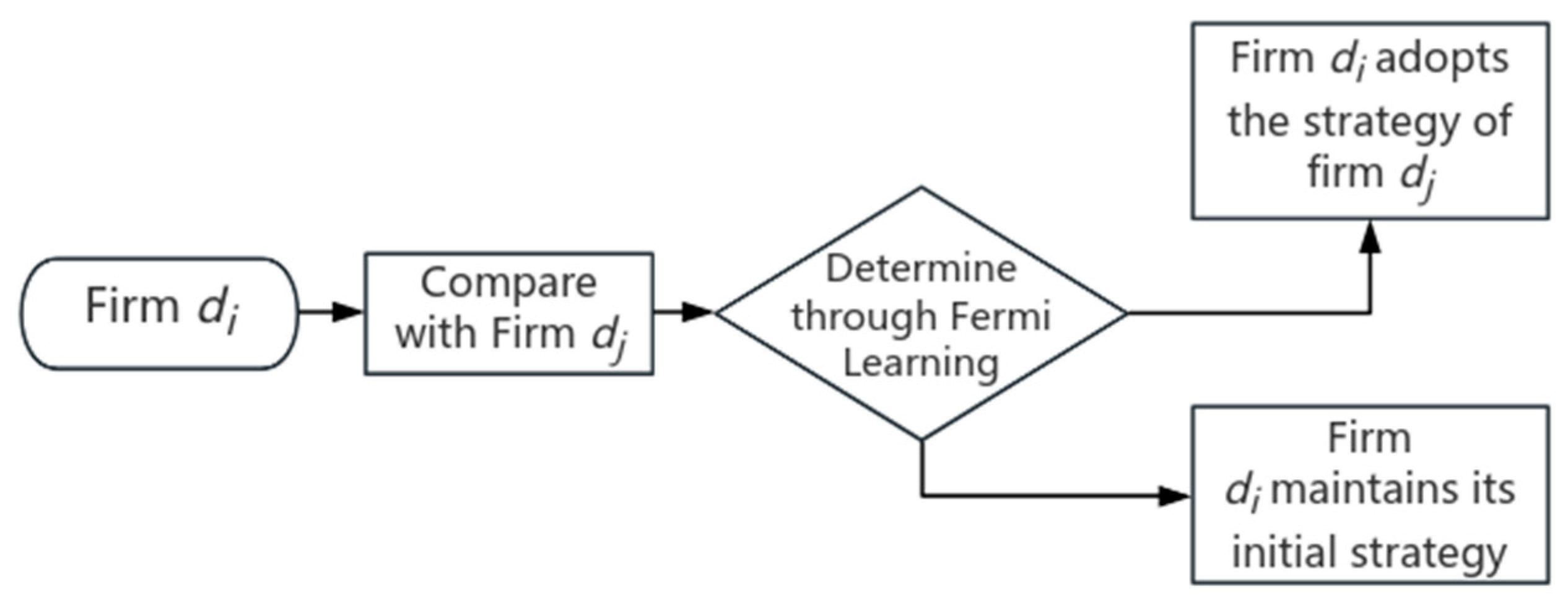
K. Chen & Meng, 2020). Balancing considerations of classical foundation and general applicability, we incorporated Fermi learning into our system of evolutionary rules. The fundamental logic of the classical Fermi algorithm is as illustrated below (
Figure 1).
The core mechanism of Fermi learning involves a game participant randomly selecting a neighbor as a reference and comparing payoffs via the Fermi function to decide whether to imitate that neighbor’s strategy (
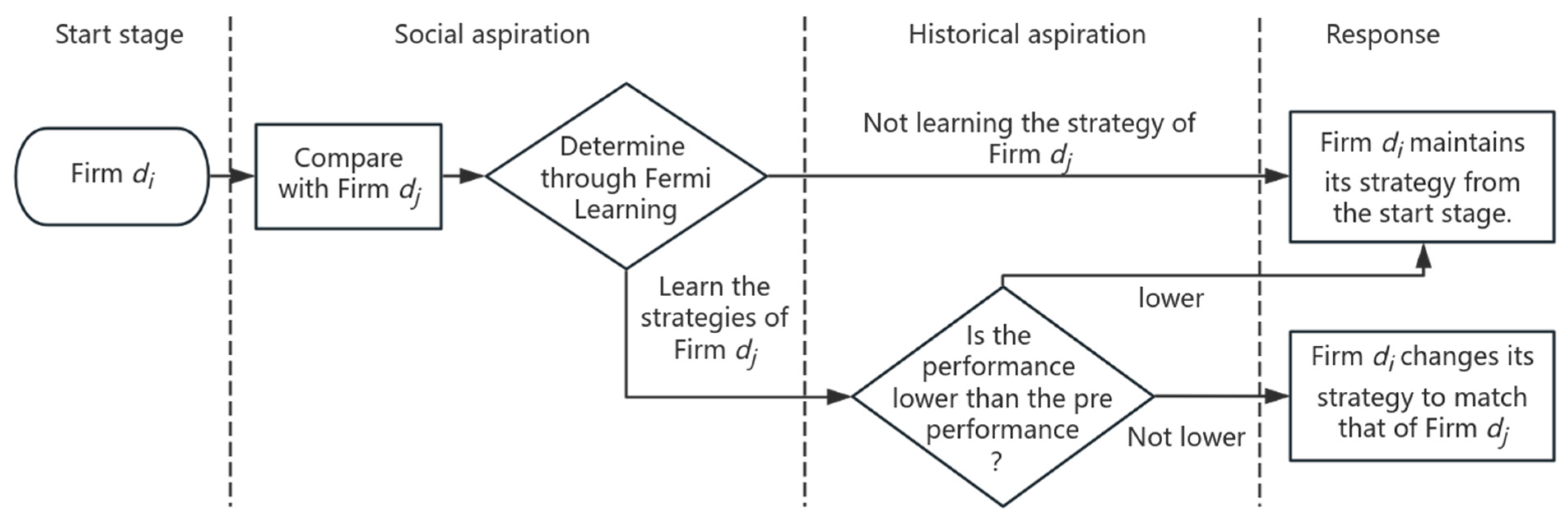
Ohtsuki et al., 2006). According to organizational learning theory, however, firms base their strategic responses on both social and historical aspirations. Therefore, this study adopted a modified Fermi learning algorithm incorporating performance feedback as the evolutionary rule. The basic logic of the algorithm is illustrated in
Figure 2.
To simplify the game process, this study used only the payoff obtained from the game as the performance indicator. Performance indicator indicators were divided into social aspiration and historical aspiration (
Greve, 1998). Social aspiration refers to a firm’s performance target derived from peer firms within its social context. Historical aspiration refers to a performance benchmark set by the firm based on its own past performance levels. Organizational performance feedback theory contains two core tenets (
Greve, 2003): first, when performance meets or exceeds aspiration levels, firms tend to persist with their past strategic actions to maintain satisfactory performance; second, when performance falls below the aspiration levels, firms engage in strategic change to ameliorate performance shortfalls or rebuild competitive advantage. The specific rules are as follows:
After randomly setting the strategies for the initial round and calculating the resulting payoffs for all firms in the supply network, only one firm updates its strategy per unit of time. In the selection stage, a firm is chosen at random to update its strategy. Firm then randomly selects a firm as its reference. In the social aspiration stage, firm decides with probability whether to consider learning firm ’s strategy. If firm decides not to learn, it proceeds directly to the response stage, manifesting as maintaining the status quo. If firm decides to learn, it enters the historical aspiration stage. This stage constitutes a trial phase for firm to test the new strategy. In this stage, firm tentatively changes its strategy to match firm ’s strategy, while the strategies of all other firms in the network remain unchanged. The actual payoff for firm after this hypothetical change is recalculated. If the post-learning performance is lower than the pre-learning performance (i.e., the payoff after the change is lower than before), then firm ultimately rejects firm ’s strategy, manifesting in the response stage as maintaining the status quo. Conversely, if the post-learning performance is not lower than the pre-learning performance, firm ultimately adopts firm ’s strategy, manifesting in the response stage as a strategy change.
The probability
is determined by the Fermi function, specifically expressed as:
In this formula, denotes the probability that firm imitates firm , and and represent the payoffs of firms and from the most recent game round. represents the noise value, capturing decision-making uncertainty. When , firm tends toward perfectly rational decision-making, and the learning process becomes deterministic, entirely governed by payoff differences. When , firm tends toward irrational decision-making, and the learning process becomes random, entirely independent of payoff comparisons.
3.4. Monte Carlo Simulation
Monte Carlo simulation serves as a numerical computation method grounded in probability and statistics, whose essence lies in approximating the behavioral characteristics of complex systems through stochastic sampling processes. By generating a large number of random samples and leveraging the law of large numbers, this method achieves statistical estimation of the target problem. It is particularly well-suited for systems too complex for analytical solutions or problems lacking closed-form analytical expressions (
S. Li & Feng, 2022). In this study, the digital inclusion ecosystem within industrial clusters involved multifaceted complexities, including multi-agent interactions, nonlinear feedback, and high stochasticity, rendering traditional analytical methods inadequate for capturing the system’s dynamic evolution. To better approximate real-world conditions, multiple stochastic mechanisms were introduced into the simulation process: firstly, randomness in generating the topology of the directed scale-free network; secondly, randomness in the initial strategy set; thirdly, randomness in the selection of agents for asynchronous strategy updates via Fermi learning; and fourthly, randomness in the selection of reference agents during the Fermi learning process. These stochastic elements can influence game outcomes and may even lead to extreme scenarios. Consequently, this study employed the Monte Carlo simulation method, conducting a substantial number of independent repeated experiments to mitigate the effects of randomness and ensure the robustness and reliability of the findings.
Each iteration of the Fermi learning process is followed by a calculation of the proportion of cluster firms in the network adopting the investment strategy relative to the total number of cluster firms, denoted as
. To ensure data comparability, the platform enterprise, acting as an opinion leader, was excluded from the calculation of
. Following Monte Carlo simulations, the mean proportion of cluster firms adopting the investment strategy—referred to as investors—across all cluster firms, denoted as
, can be calculated as follows:
In this formula, represents the number of game iterations, denotes the -th Monte Carlo simulation, and is the total number of Monte Carlo simulations. According to the law of large numbers and method of moments estimation, the sample average in Monte Carlo simulations converges to the expected value as the sample size approaches infinity. The Monte Carlo step is an important temporal unit for measuring the progress of the game evolution. Within one Monte Carlo step, the system typically executes a number of game iterations equal to the number of nodes in the network. This ensures, in a statistical sense, that each cluster firm node has at least one opportunity to be selected as the agent for Fermi learning within that step.
4. Numerical Simulation and Analysis
4.1. Network Generation
To derive valid and robust conclusions, network parameters were configured based on the established literature. We generated complex networks with parameters
and
(
Watts & Strogatz, 1998),
and
(
Q. Wei & Shi, 2017) for model simulation. For the small-world network, the edge-rewiring probability was set to
(
Q. Wei & Shi, 2017), while for the scale-free network, the initial number of firms was set to
4 or
respectively (
Y. Zhang & Qian, 2014). The evolutionary process involved
independent Monte Carlo simulations (
H. Wang et al., 2023). To enhance the comparability and controllability of the simulated data, a progressive approach was adopted for constructing the complex networks. The parameter values for the four types of industrial cluster networks are summarized in
Table 1.
The construction process comprised three stages. In the first stage, small-world and scale-free industrial cluster networks were generated separately, establishing the initial network structures. In the second stage, a platform enterprise was added to the network as node
, creating connections with the co-constructing firms. In the third stage, the platform enterprise was linked to all firms within the industrial cluster. An example of the complex network establishment process for
and
following these steps is illustrated in
Figure 3.
This progressive construction method offers dual advantages. On the one hand, it preserves the potential randomness inherent in real-world networks through the introduction of stochastic connection mechanisms. On the other hand, by controlling the gradual increase in connections, it renders the network embedding process of the opinion leader observable and regular, thereby significantly enhancing data comparability across different simulation scenarios and providing a reliable network foundation for subsequent evolutionary game analysis.
4.2. Impact of Investment Return Coefficient on Evolution
In the public goods game model, the investment return coefficient is a key variable determining the evolutionary outcome. Given the heterogeneity in the number of neighbors among firms in an industrial cluster, the effective number of players for firm can be expressed as . To comprehensively investigate the investment return effect, we examined three scenarios: , and . In all three cases, the investment return coefficient was greater than 1, meaning that any cluster firm’s investment increases the total payoff of the industrial cluster.
When , cluster firms in both complex network types satisfied , indicating the return is insufficient to incentivize widespread cooperation. When , most cluster firms reached the critical threshold , placing the game dynamics at a phase transition point between cooperation and free-riding. When , the condition was satisfied, creating favorable conditions for the evolution of cooperation.
Simultaneously, the investment cost was fixed at
to isolate the effect of
. on the evolution. To control for the influence of the noise value
, it was fixed at
, indicating that the decision-making process of game participants is boundedly rational (
Q. Wang et al., 2018). To ensure data comparability, the network from the first stage without the platform enterprise and the standard Fermi learning rule and without performance feedback were used as the baseline scenario, thereby excluding the interference from the performance feedback mechanism and platform intervention. To ensure data comparability, the first-stage network (without platform enterprise intervention) served as the baseline. The game evolution results within 10 Monte Carlo steps are shown in
Figure 4.
The results indicate that increasing the investment return coefficient demonstrates a clear incentivizing effect. As
increases, cluster firms, motivated by higher returns, exhibit a stronger tendency to adopt the investment strategy. As shown in
Figure 4, regardless of whether the network was small or large, both small-world and scale-free industrial cluster networks exhibited similar evolutionary patterns. When
is below the critical value
, free-riding behavior is prevalent among cluster firms. When
, the proportion of co-constructing firms still declines gradually. When
, the proportion of co-constructing firms increases progressively with the number of game iterations.
4.3. Impact of Performance Feedback on Evolution
Across the four types of industrial cluster networks examined in
Figure 4, under the three return coefficients
,
and
, the number of firms adopting the investment strategy within the complex network was positively correlated with collective payoff. Under these conditions, where
, the supply network achieves the optimal payoff when all firms choose the investment strategy. The impact of performance feedback on the evolutionary process within 10 Monte Carlo steps is illustrated in
Figure 5.
Performance feedback inclines firms toward greater individual rationality. As shown in
Figure 5, the four network types yielded similar evolutionary outcomes and exhibited comparable trends. When r = k/2 + 1, individual and collective rationality are in opposition, and performance feedback accelerates the decline in the proportion of co-constructing firms within the industrial cluster. When r = k +1, the system reaches the critical transition point in game dynamics; with performance feedback considered, the number of co-constructing firms approaches the number of non-co-constructing firms. When r = 2k + 1, individual and collective rationality align, and performance feedback accelerates the increase in the proportion of co-constructing firms within the industrial cluster.
4.4. Impact of Platform Enterprise Strategies on Evolution
To streamline the analysis, the network models focused on Network Type 1 and Network Type 2. With fixed parameters of and , three investment return coefficients were examined: , and . Under these coefficients, maximizing the industrial cluster’s payoff requires all firms within the cluster to adopt the investment strategy. Since maximizing the industrial cluster’s payoff is the objective of the platform enterprise in its “public actor” role, it consistently maintains an investment strategy, i.e., . Concurrently, maximizing its own payoff is the goal of the platform enterprise as an “economic agent”. Therefore, connecting exclusively with co-constructing firms to capture their spillover benefits constitutes the platform’s optimal connection strategy.
Furthermore, as a market participant, the platform can also choose to leverage its resource allocation function to reward cooperative behavior. Within the digital ecosystem of an industrial cluster, the platform enterprise functions as a central hub for resource orchestration and value integration. It possesses the capacity to formulate and implement policies that direct the flow and intensity of resource allocation across the cluster network. To incentivize participation in the co-construction of a digital inclusion ecosystem, the platform may, for instance, offer additional payoff subsidies to cooperative firms. We modeled such value empowerment as a closed-loop transfer process: when a co-constructing firm receives an empowerment value from the platform, this value is not created ex nihilo but is transferred directly from the platform’s own payoff, which is correspondingly reduced by . This assumption reflects the inherent redistribution constraint underlying platform-enabled value transfer.
In formulating specific empowerment policies, the platform takes into account both the external market environment and the internal structural characteristics of the network. We assume that the platform determines the empowerment value
according to the following formula, which responds dynamically to the macro-level investment return coefficient and the network density of the industrial cluster:
. This design implies that the platform institutes an incentive policy that allocates resources in response to the average node degree
and the investment return coefficient
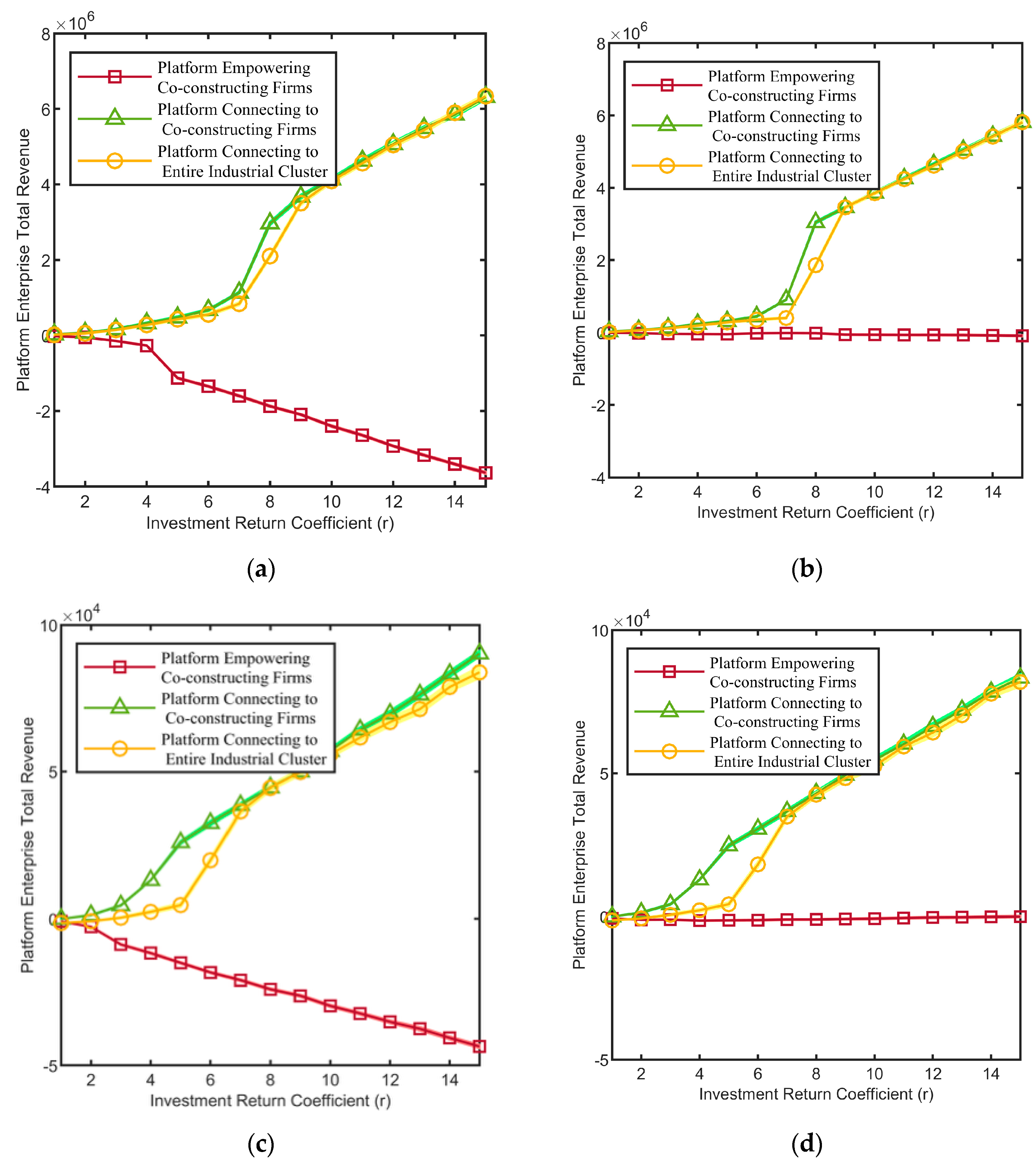
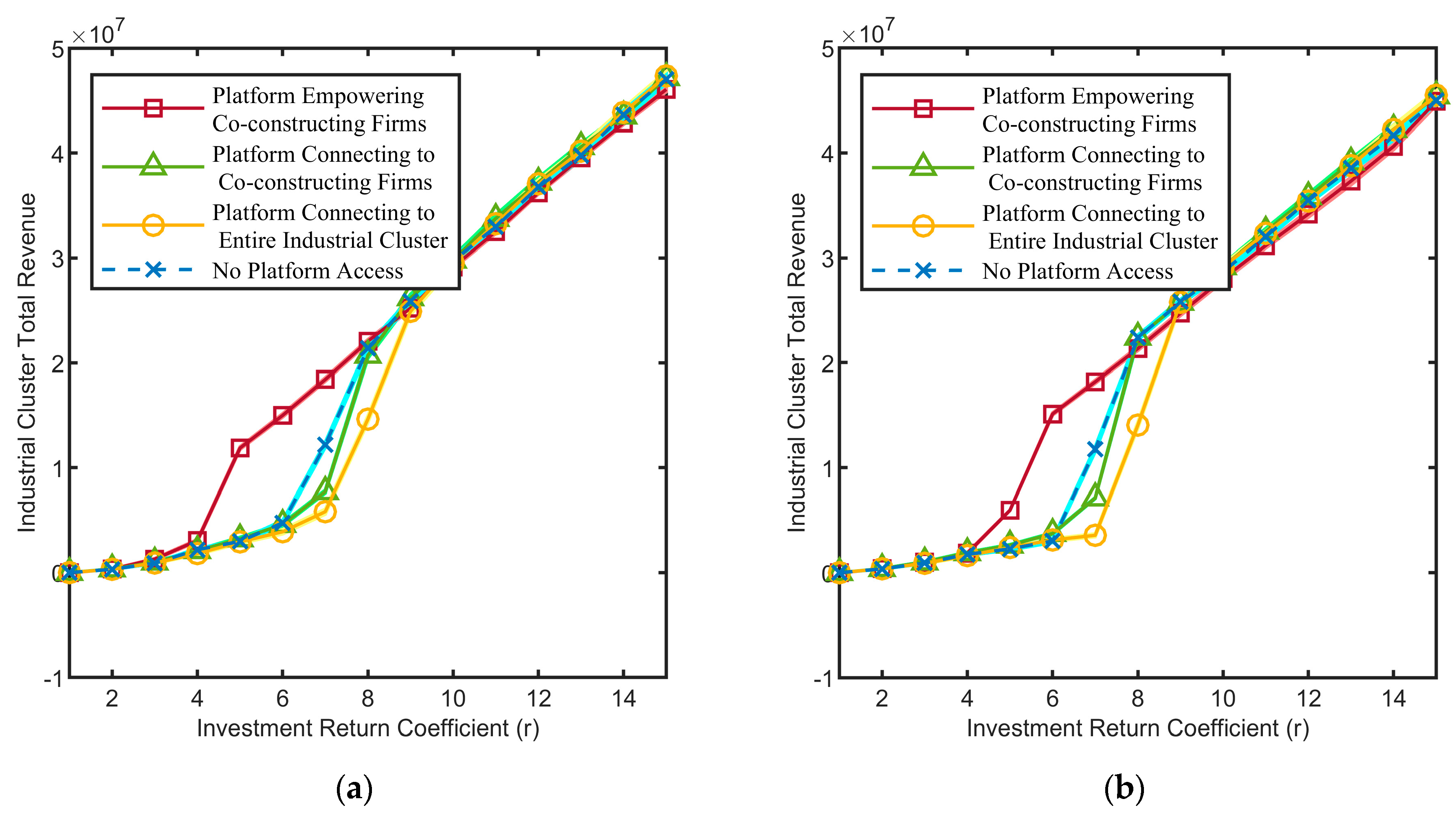
, guided by a principle of quasi-average redistribution. The policy seeks to strike a balance between incentivizing co-construction behavior and maintaining the platform’s own sustainability. “Platform Connecting to Entire Industrial Cluster” and “No Platform Access” served as control groups. To ensure data comparability, the platform’s investment behavior was excluded from the calculation of
. The resulting effects of platform enterprise strategies on the evolutionary dynamics are presented in
Figure 6.
Platform empowerment incentivizes cluster firms to co-construct the digital inclusion ecosystem. As shown in
Figure 6, for both Network Type 1 and Network Type 2, and regardless of the magnitude of the investment return, the strategy of “Platform Empowering Co-constructing Firms” resulted in a higher proportion of co-constructing firms among all cluster firms compared to the strategy of “Platform Connecting to Co-constructing Firms” and also exceeded the “No Platform Access” strategy. This indicates that under the “Platform Empowering Co-constructing Firms” strategy, cluster firms are more inclined to adopt the investment strategy. As seen in
Figure 6, when
, the proportion of co-constructing firms showed the most rapid growth. This suggests that when individual and collective rationality are at the critical transition between opposition and alignment, the platform’s selective empowerment more effectively incentivizes the industrial cluster to co-construct the digital inclusion ecosystem.
Notably, when
, simply embedding the platform within the industrial cluster without active empowerment led to a decline in the willingness to co-construct, regardless of whether the cluster had a small-world or scale-free structure. As shown in
Figure 6c,d, under both the “Platform Connecting to Co-constructing Firms” and “Platform Connecting to Entire Industrial Cluster” conditions, the proportion of co-constructing firms decreased rapidly as the number of game iterations increased. Furthermore, network structure also influences the willingness to cooperate. In
Figure 6c,d, where all conditions except network structure were identical, when the platform adopted the “Connect to Entire Industrial Cluster” strategy, the proportion of co-constructing firms declined faster in the scale-free network than in the small-world network.
6. Conclusions, Recommendations and Limitations
6.1. Conclusions
Based on the small-world and scale-free characteristics of industrial clusters, the pivotal role of platform enterprises as chain leaders, and the public goods nature of digital inclusion, this study constructed a complex network public goods evolutionary game model, utilizing a Fermi learning algorithm incorporating performance feedback as the evolutionary rule. Through Monte Carlo simulations, we analyzed the impact of investment cost, investment return coefficient, and performance feedback on network evolution. Furthermore, we investigated the effect of the investment return coefficient on the effectiveness of platform strategies, as well as the impact of these strategies on both platform revenue and overall industrial cluster revenue. The main findings are summarized as follows. (1) The investment return coefficient serves as the core driving mechanism for the co-construction of digital inclusion ecosystems within industrial clusters. (2) The introduction of a performance feedback mechanism renders firm decision-making more closely aligned with individual rationality. (3) Platform enterprises, acting as inter-organizational network managers, can effectively advance the co-construction of digital inclusion ecosystems through their empowerment behaviors. (4) The empowerment behaviors of platform enterprises exert a significantly positive role in the co-construction of digital inclusion ecosystems. This positive effect is manifested not only in an increased proportion of cooperative firms but also in the improvement of overall industrial cluster revenue. However, platform enterprises face a trade-off dilemma while fulfilling their public functions, as they experience a decline in their own revenue—a loss that is particularly pronounced in scale-free network structures. This study confirms that the optimal strategy for platform enterprises is not to indiscriminately connect with all firms, but rather to selectively empower co-constructing firms. Such a strategy not only maximizes the digital inclusion benefits of the industrial cluster but also achieves a dynamic balance between the platform’s dual roles as a public actor and an economic agent.
6.2. Recommendations
Based on the aforementioned conclusions, the following recommendations are proposed to foster a pattern of digital inclusion ecosystem co-construction within industrial clusters.
Government Level: Exercising Macro-Level Guidance and Institutional Safeguarding. As policymakers and shapers of the market environment, the government’s core responsibility is to rectify market failures through top-level design, providing positive incentives and institutional guarantees for the co-construction of the digital inclusion ecosystem. Firstly, implement precise fiscal and financial policy instruments. For instance, offer tax credits for corporate digital transformation investments, establish dedicated subsidy funds, or provide low-interest loans. The key is to align the intensity of such support with the cluster’s network density and the critical investment return threshold, ensuring effective intervention during the most vulnerable phases of cooperation. Secondly, take a leading role in advancing the development of digital public infrastructure. Invest in building open data platforms, industry-specific clouds, and public computing centers to lower the access barriers and costs for SMEs in acquiring and using digital technologies, fundamentally altering the accessibility of digital resources. Furthermore, it is crucial to establish robust data governance and benefit-sharing rules. Clarify data ownership, circulation standards, and security protocols to alleviate firms’ concerns regarding data sharing. Concurrently, enact legislation and regulations to prevent platform enterprises from abusing market dominance, ensure fair competition within the ecosystem, and foster a policy environment that encourages both innovation and inclusive prosperity.
Platform Enterprise Level: Fulfilling ‘Chain Leader’ Responsibilities and Innovating Empowerment Models. Platform enterprises, occupying central structural holes within the industrial cluster network, wield influence through their behavioral choices that serve as a bellwether for the entire ecosystem. They must transcend the purely profit-driven “economic agent” role and proactively assume “quasi-public” functions, leading inclusive development through technology spillovers, rule-setting, and resource coordination. Specifically, platforms should move away from one-size-fits-all connection strategies and instead implement differentiated empowerment based on firms’ digital maturity. For example, prioritize providing high-quality resources—such as traffic support, data insights, technical tools, and financing channels—to actively co-constructing firms, creating a virtuous cycle where “contributors gain preferential treatment”. Simultaneously, platforms should leverage their data advantage to establish transparent performance feedback and credit rating systems. This makes the cooperative efforts and contributions of cluster firms quantifiable, visible, and recognized, thereby reducing information asymmetry and building mutual trust. Furthermore, platform enterprises should explore novel cooperation mechanisms featuring shared benefits and risks with the industrial cluster, such as jointly investing in new digital infrastructure projects. This deeply embeds their own development within the long-term value creation of the cluster, facilitating a transition from the role of a “resource extractor” to that of an “irrigator”.
Industrial Cluster Firm Level: Strengthening Agency and Collaborative Synergy. SMEs constitute the main body of industrial clusters, and their collective action choices form the micro-foundation determining the success of the digital inclusion ecosystem. Cluster firms must overcome short-sighted “free-riding” mentalities and recognize that digital investment is not merely a cost but a strategic imperative for long-term survival and competitiveness. Firms should proactively integrate into the platform ecosystem, utilizing the tools and services provided to undertake digital “catch-up”—conducting comprehensive upgrades from production process optimization and industrial cluster management to marketing—and transforming external empowerment into endogenous capabilities. More importantly, firms should build trust-based collaborative networks among themselves. By forming industrial alliances, shared laboratories, or talent training consortia, they can facilitate technical exchange and knowledge sharing, generating a multiplier effect from knowledge spillovers. Firms should also adeptly utilize performance feedback mechanisms for learning, using their own historical performance and the social expectations derived from peers as benchmarks for strategy adjustment. Through imitation and experimentation, they can gradually identify stable, cooperative, and win–win strategies, thereby collectively overcoming the “Prisoner’s Dilemma” at the group level and transforming their role from passive adaptors to active co-constructors.
6.3. Limitations
Although this study developed a game model integrating complex networks and a performance feedback mechanism, yielding a series of insightful conclusions, several limitations remain. Future research could build upon this work for further depth and expansion.
First, the model assumes that digital inclusion ecosystems are pure public goods. While this captures the essence of free-riding, some digital assets exhibit partial excludability, and resources like computing power or bandwidth become congestible. Our uniform spillover rule simplifies reality but may miss heterogeneous benefit distribution. Future research could incorporate complex payoff functions or threshold mechanisms under club good or common-pool resource conditions.
Second, the network topologies are stylized. Using small-world and scale-free networks helps isolate structural effects, yet digital inclusion co-construction involves multiple stakeholders—industrial policy, non-profit training, and consumer preferences all shape outcomes. Real networks likely exhibit modularity, spatial embeddedness, and core-periphery structures that basic models underrepresent. Subsequent work should employ empirically calibrated networks or advanced generators such as stochastic block models and spatial networks to test robustness under more realistic topologies.
Third, the game-theoretic representation remains parsimonious. Performance feedback triggers strategy change only when payoffs do not decline—a simple learning heuristic based on historical and social comparison. To foreground public good logic, we modeled uniform spillovers along randomly directed edges, ignoring heterogeneity in tie strength, power asymmetry, or technical compatibility. Richer specifications—heterogeneous aspiration formation, adaptive search probabilities, or weighted networks—could better capture learning dynamics and payoff distribution.
Fourth, we assumed costless, perfect monitoring of cooperative firms for selective empowerment. This idealized case illustrates the platform’s maximal efficacy as an information hub and resource orchestrator. In practice, monitoring entails costs and faces information asymmetry, data noise, and strategic camouflage. Although modern platforms approximate high-precision monitoring via APIs, transaction streams, credit ratings, and algorithmic inference, imperfect observability and monitoring costs remain real governance constraints. Future studies could relax this assumption by introducing signal noise, monitoring cost functions, or Bayesian learning mechanisms to assess the effectiveness and robustness of platform empowerment under more realistic conditions.