



On a Special Two-Person Dynamic Game


Abstract
1. Introduction
2. Discrete Systems
2.1. Stability without Time Delays
2.2. Stability with Delays
3. Continuous Systems
3.1. Stability without Time Delays
3.2. Stability with Delays
4. Alternative Models
4.1. One-Delay Models
- (a)
- .
- (b)
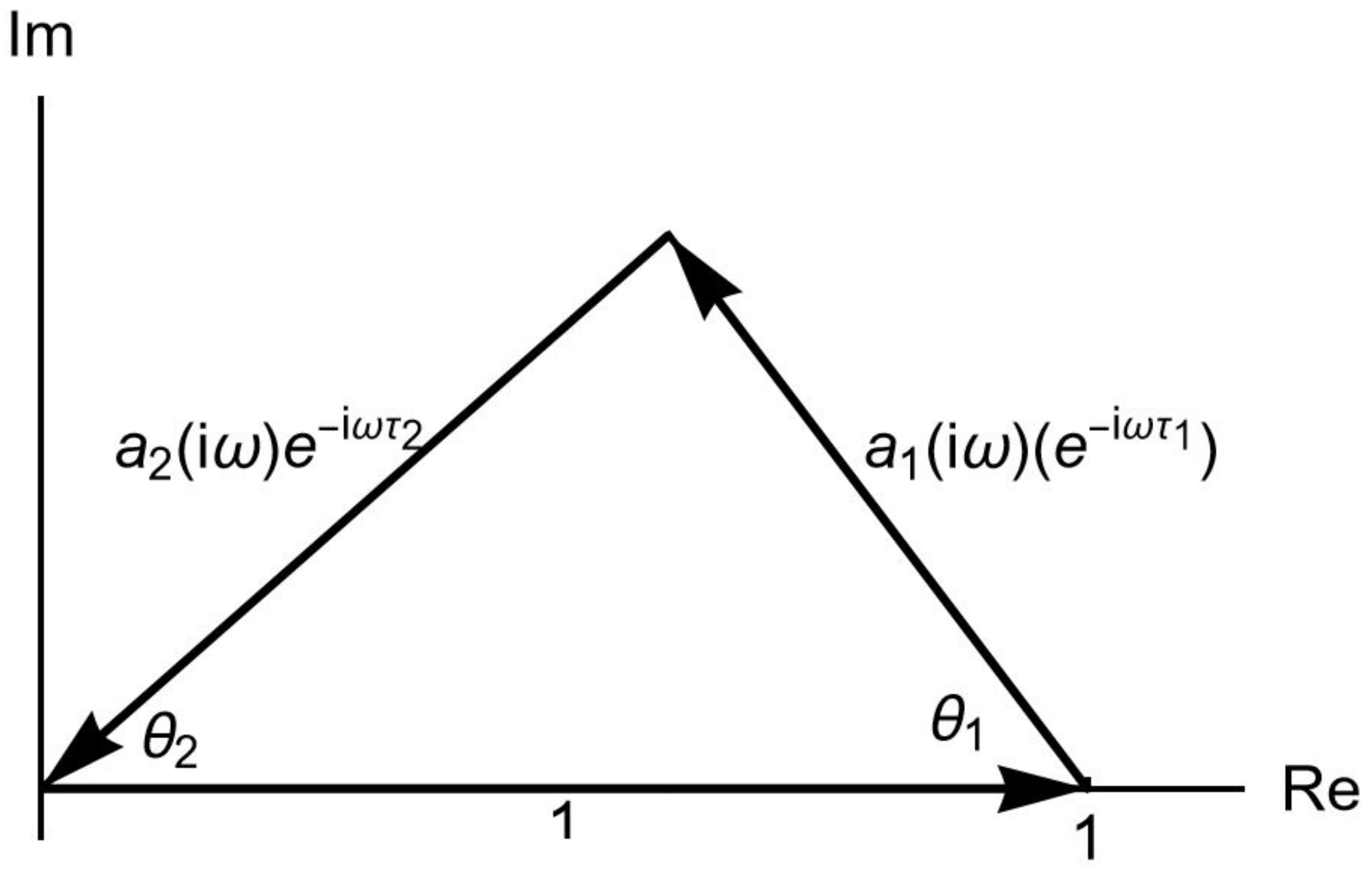
4.2. Two-Delay Model
- (a)
- so there are finitely many eigenvalues on . This clearly holds.
- (b)
- which holds if , as is assumed in the following.
- (c)
- Polynomials and have no common roots. This is obvious if . If then is a common root, which does not remove stability.
- (d)
- which is again obvious, since is quadratic, is linear, and is constant.
- (i)
- A series of closed curves;
- (ii)
- A series of spiral-like curves with either horizontal, vertical, or diagonal axes;
- (iii)
- A series of open-ended curves with endpoints converging to infinity.
4.3. Three-Delay Model
- (a)
- There are a finite number of eigenvalues on whenThis holds, since is quadratic, while and are linear and is constant.
- (b)
- The zero frequency is not an eigenvalue with any andThis condition holds if , so we have to assume this relation in the following discussion.
- (c)
- Polynomials , and have no common roots, which is trivial in our case.
- (d)
- which also holds, since is quadratic and the others have lower degrees.
- (i)
- If , then and form a loop, so the set of stability-switching curves is a collection of closed continuous curves.
- (ii)
- Otherwise, it is a collection of continuous curves with endpoints on the axes or extending to infinity in .
5. Conclusions
Author Contributions
Funding
Data Availability Statement
Acknowledgments
Conflicts of Interest
References
- Dresher, M. Games of Strategy: Theory and Applications; Applied Mathematics Series; Prentice Hall: Englewood Cliffs, NJ, USA, 1961. [Google Scholar]
- Matsumoto, A.; Szidarovszky, F. Game Theory and Its Applications; Springer: Tokyo, Japan, 2016. [Google Scholar]
- Szep, J.; Forgo, F. Introduction to the Theory of Games; Akademia Kiado: Budapest, Hungary, 1985. [Google Scholar]
- Vorob’ev, N.N. Foundation of Game Theory. Noncooperative Games; Birkhäuser: Basel, Germany, 1994. [Google Scholar]
- Fudenberg, D.; Tirole, J. Game Theory; MIT Press: Cambridge, MA, USA, 1991. [Google Scholar]
- Nash, H.F., Jr. Noncooperative Games. Ann. Math. 1951, 54, 286–295. [Google Scholar] [CrossRef] [Scilit]
- Rosen, J.B. Existence and uniquness of equilibrium points for concave n-person games. Econometrica 1965, 33, 520–534. [Google Scholar] [CrossRef] [Scilit]
- von Neumann, J.; Morgenstern, O. Theory of Games and Economic Behavior; Princeton University Press: Princeton, NJ, USA, 1944. [Google Scholar]
- Hahn, F. The stability of the Cournot oligopoly soution. Rev. Econ. Stud. 1962, 29, 329–331. [Google Scholar] [CrossRef] [Scilit]
- Okuguchi, K. Expectations and Stability in Oligopoly Models; Springer: Berlin, Germany, 1976. [Google Scholar]
- Bischi, G.-I.; Chiarella, C.; Kopel, M.; Szidarovszky, F. Nonlinear Oligopolies: Stability and Bifurcations; Springer, Science+Business Media: Heidelberg, Germany, 2010. [Google Scholar]
- Cheban, D.D. Lyapunov Stability of Non-Autonomous Systems; Nova Science Pulisher, Hauppauge: New York, NY, USA, 2013. [Google Scholar]
- Saeed, R. Lyapunov Stability Theorem with Some Applications; LAMBERT, Academic Publishing: Saarbrüchen, Germany, 2017. [Google Scholar]
- Gumowski, I.; Mira, C. Dynamique Chaotique; Cepadues Editions: Toulose, France, 1980. [Google Scholar]
- Mira, C.; Gardini, L.; Barugola, L.; Cathala, J. Chaotic Dynamics in Two Dimensional Noninvertible Maps; Nonlinear Sciences, Series A; World Scientific: Singapore, 1996. [Google Scholar]
- Bellman, R. Stability Theory of Differential Equations; Dover: New York, NY, USA, 1969. [Google Scholar]
- LaSalle, J.P. Stability theory for ordinary differential equations. J. Differ. Equ. 1968, 4, 37–65. [Google Scholar] [CrossRef] [Scilit]
- Sánchez, D.A. Ordinary Differential Equations and Stability Theory; Dover Publications: Mineola, NY, USA, 1968. [Google Scholar]
- Bellman, R.; Cooke, K.L. Differential-Difference Equations; Academic Press: New York, NY, USA, 1963. [Google Scholar]
- Cushing, J. Integro-Differential Equations and Delay Models in Population Dynamics; Springer: Berlin, Germany, 1977. [Google Scholar]
- Kuang, Y. Delay Differential Equations with Applications in Population Dynamics; Academic Press: Boston, MA, USA, 1993. [Google Scholar]
- Gori, L.; Guerrini, L.; Mauro, S. Hopf bifurcation in a cobweb model with discrete time delays. Discret. Dyn. Nat. Soc. 2014, 2014, 137090. [Google Scholar] [CrossRef] [Scilit]
- Ösbay, H.; Saglam, H.; Cagri, H.; Yüksel, M. Hopf bifurcation in one section optimal growth model with time delay. Macroecon. Dyn. 2017, 21, 1887–1901. [Google Scholar] [CrossRef] [Scilit]
- Berezowski, M. Effect of delay time on the generation of chaos in continuous systems: One dimensional model, two dimensional model-tubwar chemical reactor with recycle. Chaos Solitions Fractals 2001, 12, 83–89. [Google Scholar] [CrossRef] [Scilit]
- Wang, Q.G.; Lee, T.H.; Tan, K.K. Time delay systems. In Finite-Spectrum Assignment for Time Delay Systems; Lecture Notes in Control and Information Systems 239; Springer: London, UK, 1999. [Google Scholar]
- Farebrother, R.W. Simplified Samuelson conditions for cubic and quartic equations. Manch. Sch. Econ. Soc. 1973, 41, 395–400. [Google Scholar] [CrossRef] [Scilit]
- Gu, K.; Nicolescu, S.-I.; Chen, J. On stability crossing curves for general systems with two delays. J. Math. Appl. 2005, 311, 231–253. [Google Scholar] [CrossRef] [Scilit]
- Lin, X.; Wang, H. Stability analysis of delay differential equations with two discrete delays. Can. Appl. Math. 2012, 2, 519–533. [Google Scholar]
- Matsumoto, A.; Szidarovszky, F. Dynamic Oligopolies with Time Delays; Springer-Nature: Singapore, 2018. [Google Scholar]
- Dragicevic, A. Bayesian population dynamics of spreading species. Environ. Model. Assess. 2015, 20, 17–27. [Google Scholar] [CrossRef] [Scilit]
- Poulton, M. Computational Neural Networks for Geophysical Data Processing; Pergaron: Amsterdam, The Netherlands, 2001. [Google Scholar]
- Swingler, K. Applying Neural Networks; Academic: San Diego, CA, USA, 1996. [Google Scholar]
Disclaimer/Publisher’s Note: The statements, opinions and data contained in all publications are solely those of the individual author(s) and contributor(s) and not of MDPI and/or the editor(s). MDPI and/or the editor(s) disclaim responsibility for any injury to people or property resulting from any ideas, methods, instructions or products referred to in the content. |
© 2023 by the authors. Licensee MDPI, Basel, Switzerland. This article is an open access article distributed under the terms and conditions of the Creative Commons Attribution (CC BY) license (https://creativecommons.org/licenses/by/4.0/).
Share and Cite
Matsumoto, A.; Szidarovszky, F.; Hamidi, M. On a Special Two-Person Dynamic Game. Games 2023, 14, 67. https://doi.org/10.3390/g14060067
Matsumoto A, Szidarovszky F, Hamidi M. On a Special Two-Person Dynamic Game. Games. 2023; 14(6):67. https://doi.org/10.3390/g14060067
Chicago/Turabian StyleMatsumoto, Akio, Ferenc Szidarovszky, and Maryam Hamidi. 2023. "On a Special Two-Person Dynamic Game" Games 14, no. 6: 67. https://doi.org/10.3390/g14060067
APA StyleMatsumoto, A., Szidarovszky, F., & Hamidi, M. (2023). On a Special Two-Person Dynamic Game. Games, 14(6), 67. https://doi.org/10.3390/g14060067

