

Delay to Deal: Bargaining with Indivisibility and Round-Dependent Transfer

Abstract
1. Introduction
2. Motivation
3. Model
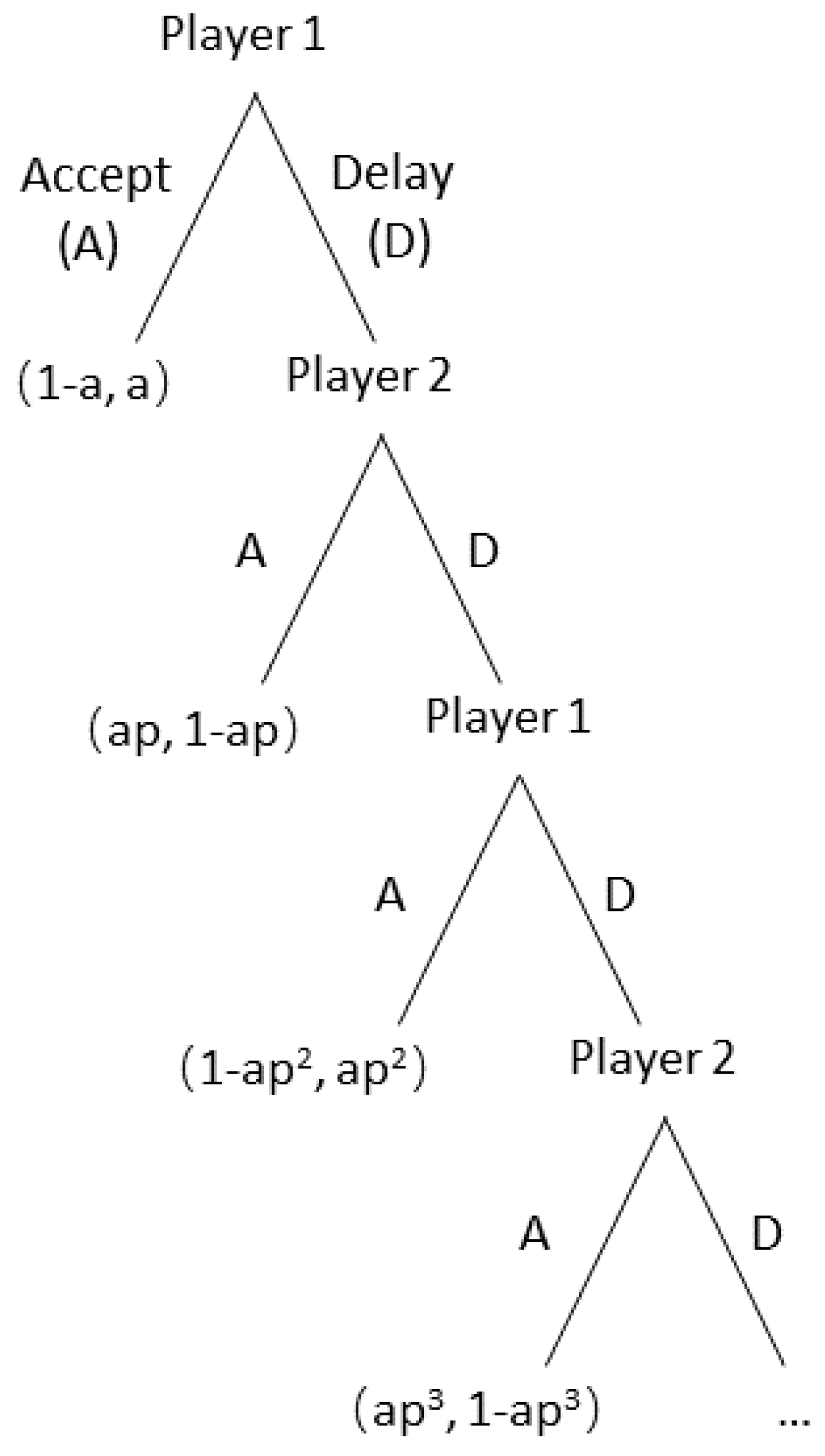
3.1. Model Setup
3.2. Strategy Analysis
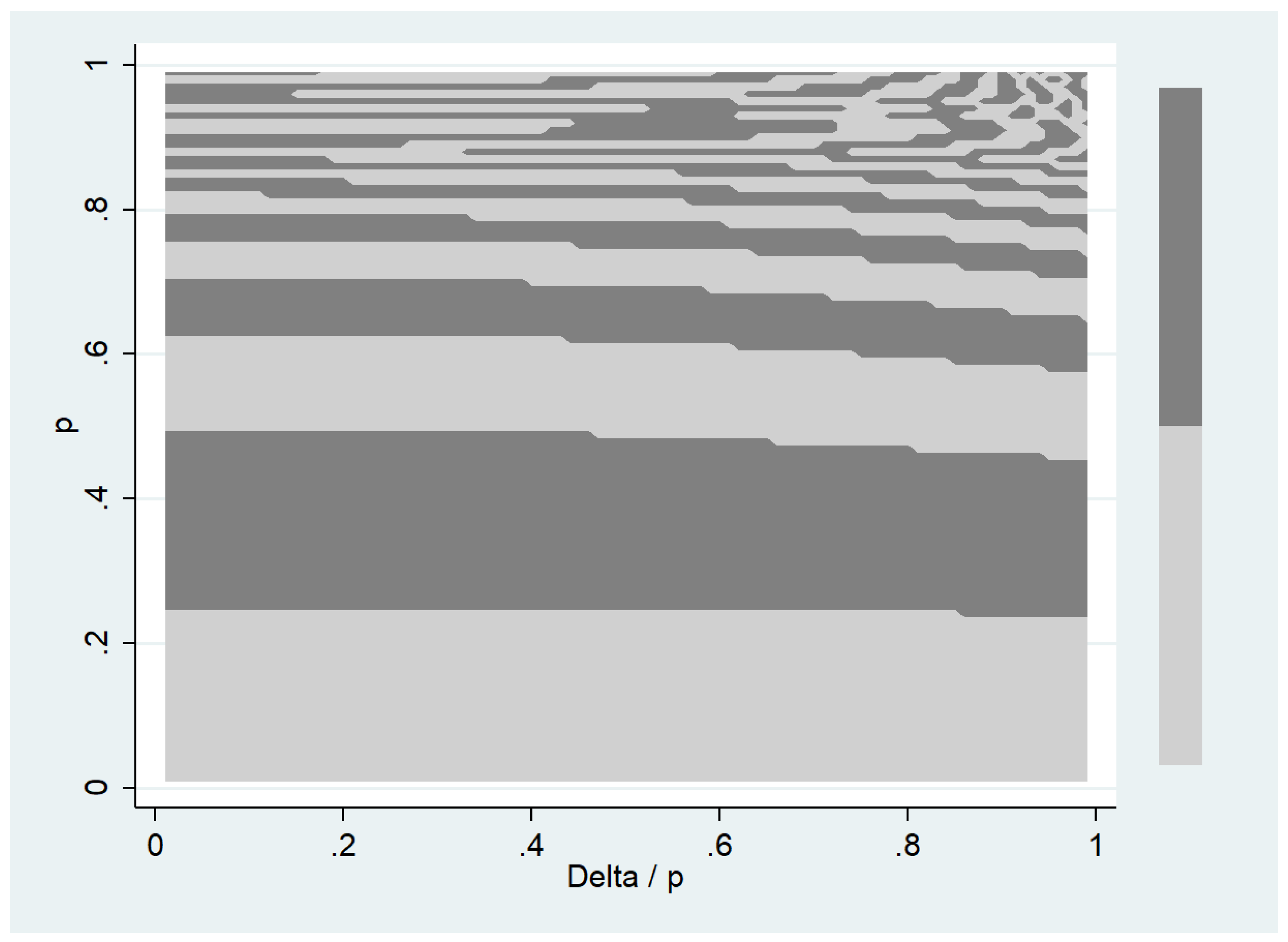
3.3. Equilibrium
4. Discussion
5. Conclusions
Funding
Institutional Review Board Statement
Data Availability Statement
Acknowledgments
Conflicts of Interest
| 1 | Note that, for , we have , and for . For , this condition is always satisfied. |
References
- Rubinstein, A. Perfect equilibrium in a bargaining model. Econom. J. Econom. Soc. 1982, 50, 97–109. [Google Scholar] [CrossRef] [Scilit]
- Backus, M.; Blake, T.; Larsen, B.; Tadelis, S. Sequential bargaining in the field: Evidence from millions of online bargaining interactions. Q. J. Econ. 2020, 135, 1319–1361. [Google Scholar] [CrossRef] [Scilit]
- Admati, A.R.; Perry, M. Strategic delay in bargaining. Rev. Econ. Stud. 1987, 54, 345–364. [Google Scholar] [CrossRef] [Scilit]
- Abreu, D.; Gul, F. Bargaining and reputation. Econometrica 2000, 68, 85–117. [Google Scholar] [CrossRef] [Scilit]
- Embrey, M.; Fréchette, G.R.; Lehrer, S.F. Bargaining and reputation: An experiment on bargaining in the presence of behavioural types. Rev. Econ. Stud. 2015, 82, 608–631. [Google Scholar] [CrossRef] [Scilit]
- Sakovics, J. Delay in bargaining games with complete information. J. Econ. Theory 1993, 59, 78–95. [Google Scholar] [CrossRef] [Scilit]
- Cai, H. Delay in Multilateral Bargaining under Complete Information. J. Econ. Theory 2000, 93, 260–276. [Google Scholar] [CrossRef] [Scilit]
- Palacios-Huerta, I.; Volij, O. Field centipedes. Am. Econ. Rev. 2009, 99, 1619–1635. [Google Scholar] [CrossRef] [Scilit]
- Yildiz, M. Waiting to persuade. Q. J. Econ. 2004, 119, 223–248. [Google Scholar] [CrossRef] [Scilit]
- Rosenthal, R.W. Games of perfect information, predatory pricing and the chain-store paradox. J. Econ. Theory 1981, 25, 92–100. [Google Scholar] [CrossRef] [Scilit]
- McKelvey, R.D.; Palfrey, T.R. An experimental study of the centipede game. Econom. J. Econom. Soc. 1992, 60, 803–836. [Google Scholar] [CrossRef] [Scilit]
- Aumann, R.J. On the centipede game. Games Econ. Behav. 1998, 23, 97–105. [Google Scholar] [CrossRef] [Scilit]
- Nash, J.F., Jr. The bargaining problem. Econom. J. Econom. Soc. 1950, 18, 155–162. [Google Scholar] [CrossRef] [Scilit]
- Kalai, E.; Smorodinsky, M. Other solutions to Nash’s bargaining problem. Econom. J. Econom. Soc. 1975, 43, 513–518. [Google Scholar] [CrossRef] [Scilit]
- Perry, M.; Reny, P.J. A non-cooperative bargaining model with strategically timed offers. J. Econ. Theory 1993, 59, 50–77. [Google Scholar] [CrossRef] [Scilit]
- Chaves, I.N.; Varas, F. Bargaining in Securities. Working Paper. 2021. Available online: https://isachavesv.github.io/papers/securitiesClean.pdf (accessed on 20 June 2023).
- Kajanus, A.; Afshordi, N.; Warneken, F. Children’s understanding of dominance and prestige in China and the UK. Evol. Hum. Behav. 2020, 41, 23–34. [Google Scholar] [CrossRef] [Scilit]
- Zheng, Y.; Shen, S.C.; Xu, M.X.; Rao, L.L.; Li, S. Worth-based choice: Giving an offered smaller pear an even greater fictional value. J. Pac. Rim Psychol. 2019, 13, e10. [Google Scholar] [CrossRef] [Scilit]
- Chater, N.; Zeitoun, H.; Melkonyan, T. The paradox of social interaction: Shared intentionality, we-reasoning, and virtual bargaining. Psychol. Rev. 2022, 129, 415. [Google Scholar] [CrossRef] [Scilit]
- Nunney, S.J.; van der Schalk, J.; Manstead, A.S. Emotion and intergroup cooperation: How verbal expressions of guilt, shame, and pride influence behavior in a social dilemma. J. Behav. Decis. Mak. 2022, 35, e2273. [Google Scholar] [CrossRef] [Scilit]
- Goddard, S.E. Uncommon ground: Indivisible territory and the politics of legitimacy. Int. Organ. 2006, 60, 35–68. [Google Scholar] [CrossRef] [Scilit]
- Hensel, P.R.; Mitchell, S.M. Issue indivisibility and territorial claims. GeoJournal 2005, 64, 275–285. [Google Scholar] [CrossRef] [Scilit]
- Spaniel, W. Issue Indivisibility as a Cause of Peace. J. Politics 2023, 85, 760–763. [Google Scholar] [CrossRef] [Scilit]
- Hoeffler, A. Can international interventions secure the peace? Int. Area Stud. Rev. 2014, 17, 75–94. [Google Scholar] [CrossRef] [Scilit]
- Eriksson, M. Targeting Peace: Understanding UN and EU Targeted Sanctions; Routledge: London, UK, 2016. [Google Scholar]
- Fey, M.; McKelvey, R.D.; Palfrey, T.R. An experimental study of constant-sum centipede games. Int. J. Game Theory 1996, 25, 269–287. [Google Scholar] [CrossRef] [Scilit]
- Selten, R. Reexamination of the perfectness concept for equilibrium points in extensive games. Int. J. Game Theory 1975, 4, 25–55. [Google Scholar] [CrossRef] [Scilit]


Disclaimer/Publisher’s Note: The statements, opinions and data contained in all publications are solely those of the individual author(s) and contributor(s) and not of MDPI and/or the editor(s). MDPI and/or the editor(s) disclaim responsibility for any injury to people or property resulting from any ideas, methods, instructions or products referred to in the content. |
© 2023 by the author. Licensee MDPI, Basel, Switzerland. This article is an open access article distributed under the terms and conditions of the Creative Commons Attribution (CC BY) license (https://creativecommons.org/licenses/by/4.0/).
Share and Cite
Fan, J. Delay to Deal: Bargaining with Indivisibility and Round-Dependent Transfer. Games 2023, 14, 60. https://doi.org/10.3390/g14050060
Fan J. Delay to Deal: Bargaining with Indivisibility and Round-Dependent Transfer. Games. 2023; 14(5):60. https://doi.org/10.3390/g14050060
Chicago/Turabian StyleFan, Jijian. 2023. "Delay to Deal: Bargaining with Indivisibility and Round-Dependent Transfer" Games 14, no. 5: 60. https://doi.org/10.3390/g14050060
APA StyleFan, J. (2023). Delay to Deal: Bargaining with Indivisibility and Round-Dependent Transfer. Games, 14(5), 60. https://doi.org/10.3390/g14050060