Article

A Bearing Fault Diagnosis Method for Variable Operating Conditions Based on MMDSC-CBAM-BiLSTM

1
Shanxi Information Industry Technology Research Institute Co., Ltd., Taiyuan 030012, China
2
School of Electronics Information Engineering, Taiyuan University of Science and Technology, Taiyuan 030024, China
*
Authors to whom correspondence should be addressed.
Computers 2026, 15(9), 614; https://doi.org/10.3390/computers15090614
Submission received: 28 July 2026 / Revised: 6 September 2026 / Accepted: 11 September 2026 / Published: 14 September 2026

Abstract

Bearing fault diagnosis under variable operating conditions is challenging because changes in rotational speed and load alter the vibration response and cause substantial distribution shifts between operating domains. To improve cross-condition fault recognition, this study proposes an MMDSC-CBAM-BiLSTM model that combines multi-scale depthwise separable convolution (MMDSC), convolutional block attention (CBAM), and bidirectional long short-term memory (BiLSTM). The vibration signals are first transformed into time–frequency representations using a wavelet transform. MMDSC then extracts complementary fault features at multiple spatial scales with reduced convolutional cost, CBAM adaptively reweights informative channel and spatial responses, and BiLSTM models bidirectional temporal dependencies before feature fusion and Softmax classification. The physical interpretation of the diagnosis is linked to the characteristic vibration responses generated by localized defects on the inner race, outer race, and rolling element, while the network itself learns discriminative representations rather than explicitly reconstructing defect morphology. Cross-condition experiments on the CWRU and Jiangnan University bearing datasets yield average accuracies of 98.22% and 93.26%, respectively, demonstrating improved robustness and generalization under varying operating conditions. The results indicate that the proposed architecture provides an effective data-driven solution for variable-condition bearing fault diagnosis.

1. Introduction

Rolling bearings serve as critical fundamental mechanical components in modern industry [1]. Failures easily occur due to complex and variable operating environments. Among the typical fault types in rolling bearings, inner race faults, outer race faults and rolling element faults are the most common, each generating distinct vibration responses at specific characteristic frequencies determined by bearing geometry and rotational speed. If faults fail to be diagnosed and eliminated in a timely manner, they may lead to reduced operational efficiency, aggravated wear of mechanical equipment, and cascading damage to associated parts, and even trigger severe safety accidents in extreme cases [2]. Therefore, timely, accurate and effective diagnosis of rolling bearing fault states is of great engineering significance [3].
Fault diagnosis research encompasses three main branches: signal processing, machine learning, and deep learning. Signal processing approaches cover time-domain, frequency-domain and time–frequency analysis [4]. Faulty rolling bearings produce prominent nonlinear and non-stationary vibration signals under complex conditions, making time–frequency analysis methods—such as Short-Time Fourier Transform (STFT) [5], wavelet transform [6], and Empirical Mode Decomposition (EMD) [7]—widely adopted for manual feature extraction. It should be noted, however, that these techniques are not restricted to steady-state signals; they are also extensively used for non-stationary analysis, e.g., during start-up and shut-down transients. Their key limitation is not the inability to handle non-stationarity, but the reliance on manually designed features and the disjoint feature extraction-classification pipeline. Machine learning algorithms like SVM [8], RF [9] and KNN [10] face the same issue: the separation of feature extraction and classification prevents learning deeply embedded discriminative features, leading to poor generalization under variable operating conditions.
At present, deep learning has demonstrated powerful automatic feature extraction capability in the field of fault diagnosis. Liu et al. [11] proposed an improved Recurrent Neural Network (RNN) model that leverages Gated Recurrent Unit (GRU) autoencoders for signal denoising and deep feature extraction, aiming to address the challenge of strong noise interference in bearing fault signal acquisition. Yan et al. [12] combined frequency-domain features with enhanced long short-term memory (LSTM) networks to accurately predict the remaining useful life of motor bearings, tackling the problem of performance degradation prediction under variable speed conditions. Yu et al. [13] put forward a hybrid method integrating Variational Mode Decomposition, continuous wavelet transform and CNN to realize bearing fault diagnosis and identification, focusing on the classification of inner and outer race faults under different load conditions. Guo et al. [14] constructed an end-to-end fault diagnosis framework based on attention-augmented CNN and bidirectional LSTM, which possesses strong universality for multi-class fault identification including rolling element defects. Liu et al. [15] designed a Siamese CNN-BiLSTM model that achieves a remarkable improvement in diagnostic accuracy for distinguishing subtle differences among various fault severity levels. Among the above methods, CNNs focus on extracting local spatial features while failing to capture dynamic temporal characteristics embedded in time-series signals.
Although these approaches have achieved promising results for bearing fault diagnosis under steady rotational speeds, bearings mostly operate under variable working conditions in practical industrial scenarios. Existing convolutional neural network models predominantly rely on standard convolutions for feature extraction, which can only mine shallow local spatial features and fail to capture the dynamic temporal characteristics of bearing vibration signals. Consequently, when applied to industrial bearings subjected to fluctuating loads and rotational speeds, these methods suffer from insufficient feature extraction and weak anti-interference capability, leading to a significant decline in diagnostic accuracy. Therefore, accurate fault feature extraction under complex variable operating conditions remains a critical research hotspot and technical challenge.
In contrast to conventional approaches that rely on manual feature design and separate extraction-classification stages, the proposed framework automatically learns discriminative fault features from raw time–frequency representations and enhances robustness via integrated spatiotemporal attention mechanisms. To address the above issues, this paper proposes a bearing fault diagnosis model integrating multi-channel multi-scale depthwise separable convolution (MMDSC), Convolutional Block Attention Module (CBAM), and Bidirectional long short-term memory network (BiLSTM). Specifically, MMDSC extracts multi-scale spatial features across different frequency bands via depthwise separable convolution; CBAM adaptively weights and enhances features from channel and spatial dimensions to suppress interference and highlight fault-relevant information; and BiLSTM captures bidirectional temporal dependencies within feature sequences for effective spatiotemporal feature fusion. Finally, the fused features are fed into fully connected layers with a Softmax classifier for accurate fault type identification.

2. Materials and Methods

2.1. Depthwise Separable Convolution

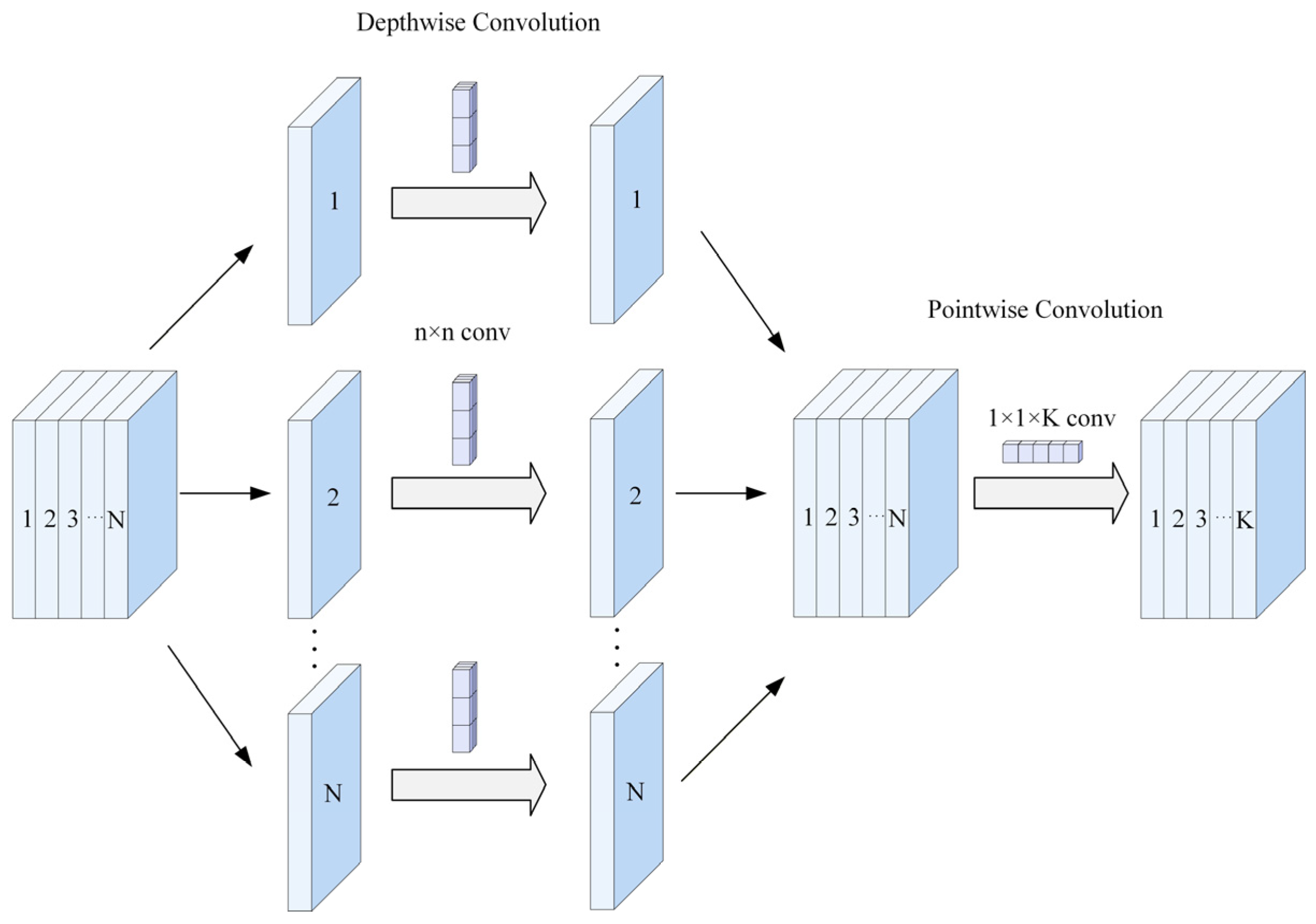
Depthwise Separable Convolution (DSC) is a classic and efficient convolution method widely utilized in various neural network models. It can optimize the operational logic of models while maintaining excellent feature extraction capability. Standard conventional convolution simultaneously performs spatial feature extraction and channel feature fusion in a single calculation process. The tight coupling of these two operations easily leads to mixed feature information and insufficient feature extraction accuracy. In contrast, DSC creatively decouples the inherent coupled mechanism of standard convolution and divides the overall feature learning process into two independent and sequential stages: depthwise convolution (DW) and pointwise convolution (PW). In the DW stage, a dedicated single-channel convolution kernel is assigned to each independent channel of the input feature map. The network only conducts spatial convolution operations on individual channels to fully extract local texture, edge, and structural features. This stage focuses on mining fine-grained spatial details without information interaction and fusion across different channels. In the subsequent PW stage, 1 × 1 convolution kernels are adopted to achieve cross-channel feature fusion. The multi-channel feature information extracted by DW is linearly weighted and integrated to establish correlations between different feature channels, realizing effective cross-channel information interaction. Finally, a fused output feature map containing both elaborate spatial details and channel correlation characteristics is generated. The specific structural composition and feature extraction procedure of DSC are illustrated in Figure 1.
Let the size of the input feature map be H × W × C i n , the convolution kernel size be K × K , and the number of output channels be C o u t . The total computational cost of the standard convolution is formulated as
F s t d = H × W × K 2 × C i n × C o u t ,
Depthwise convolution performs independent convolution on each channel, which only extracts local spatial features without cross-channel information interaction. Its computational cost is expressed as
F D W = H × W × K 2 × C i n ,
Pointwise convolution utilizes convolution kernels to achieve cross-channel feature fusion and dimension adjustment, remedying the defect of insufficient channel interaction in depthwise convolution. Its computational cost is given as
F P W = H × W × C i n × C o u t ,
The total computational cost of depthwise separable convolution is the sum of the above two operations:
F D S C = F D W + F P W = H W C i n ( K 2 + C o u t ) ,

2.2. Convolutional Block Attention

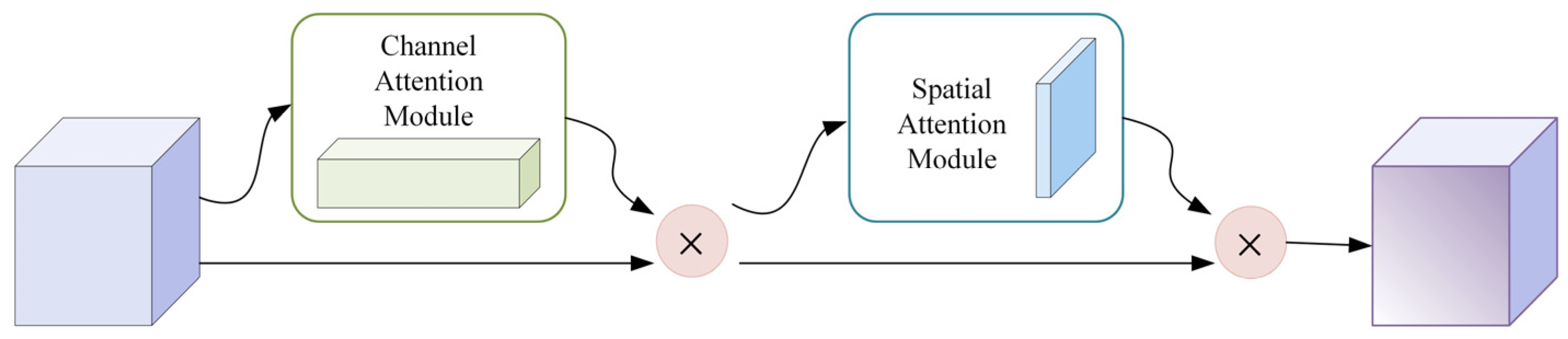
Convolutional Block Attention Module (CBAM) is a lightweight and pluggable convolutional attention module, which mainly consists of a Channel Attention Module (CAM) and a Spatial Attention Module (SAM). Its core idea is to simultaneously consider essential information from both the channel and spatial dimensions of the feature map, and enhance the model’s attention to key features by generating attention maps. The input feature map first passes through the channel attention module to generate a channel attention map, which is multiplied with the original feature map to obtain the channel-weighted feature map. Subsequently, the processed feature map is fed into the spatial attention module for spatial weighting, thereby generating the refined final feature map. The structure of the CBAM unit is illustrated in Figure 2.
Let the input feature map be, where H and W denote the height and width of the feature map, and C represents the number of channels. The overall feature optimization process of CBAM can be expressed as
F = M c F F , F = M s F F ,
where M c denotes the channel attention weight matrix, M s denotes the spatial attention weight matrix, and refers to the element-wise multiplication operation.

2.3. Long Short-Term Memory Network

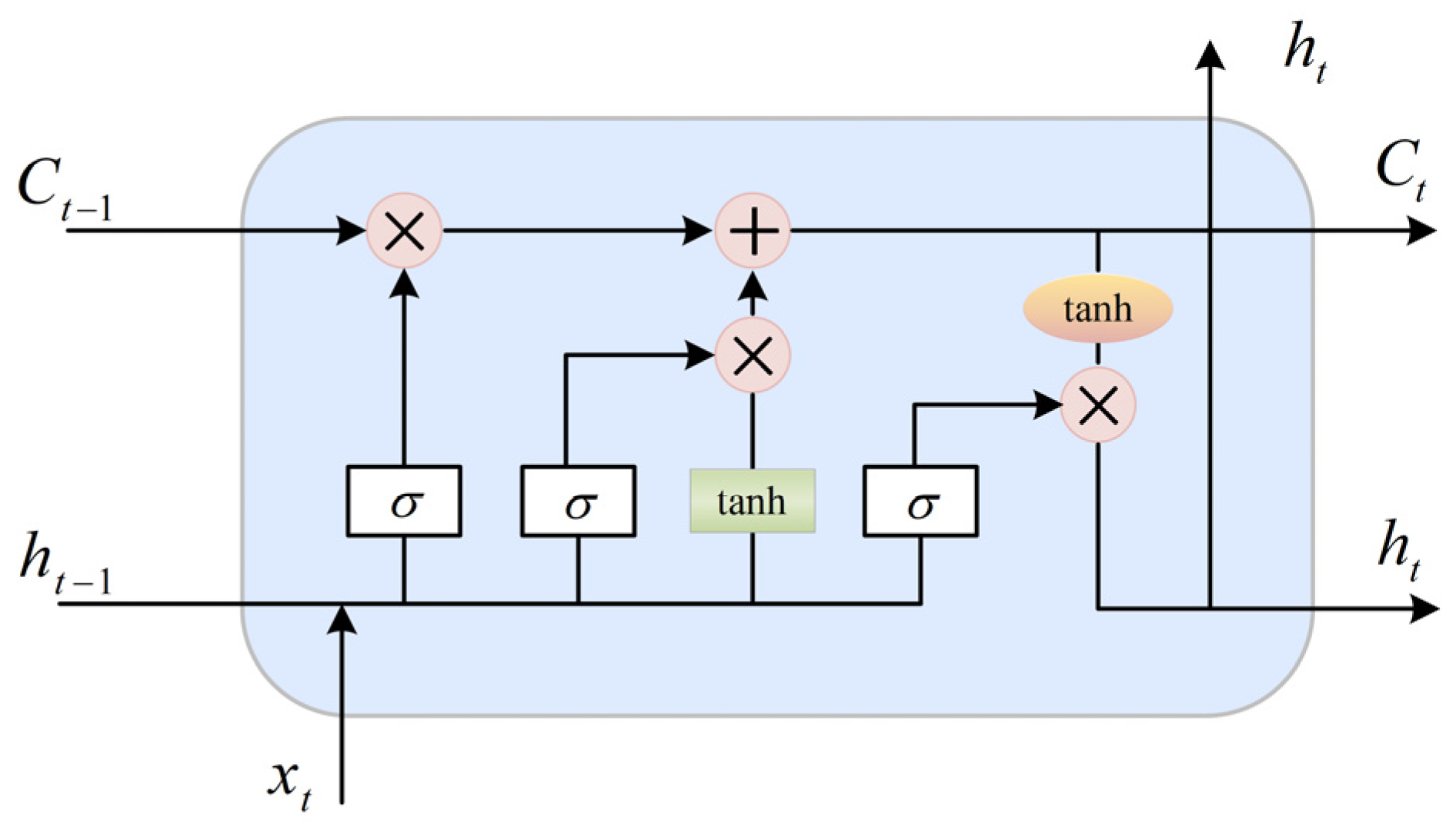
Long short-term memory (LSTM) is designed to tackle the long-range dependency dilemma encountered by conventional recurrent networks when modeling long time-series signals. Equipped with a gating regulation framework composed of a forget gate, an input gate, an output gate and an internal memory cell, LSTM supports dynamic screening, updating and storage of temporal features. It can adaptively retain valuable temporal cues while filtering out redundant and useless feature components. Relying on cyclic iterative operations, LSTM continuously refreshes sequence states and accomplishes feature propagation and iteration across adjacent time steps. The internal architecture of the LSTM cell is illustrated in Figure 3.
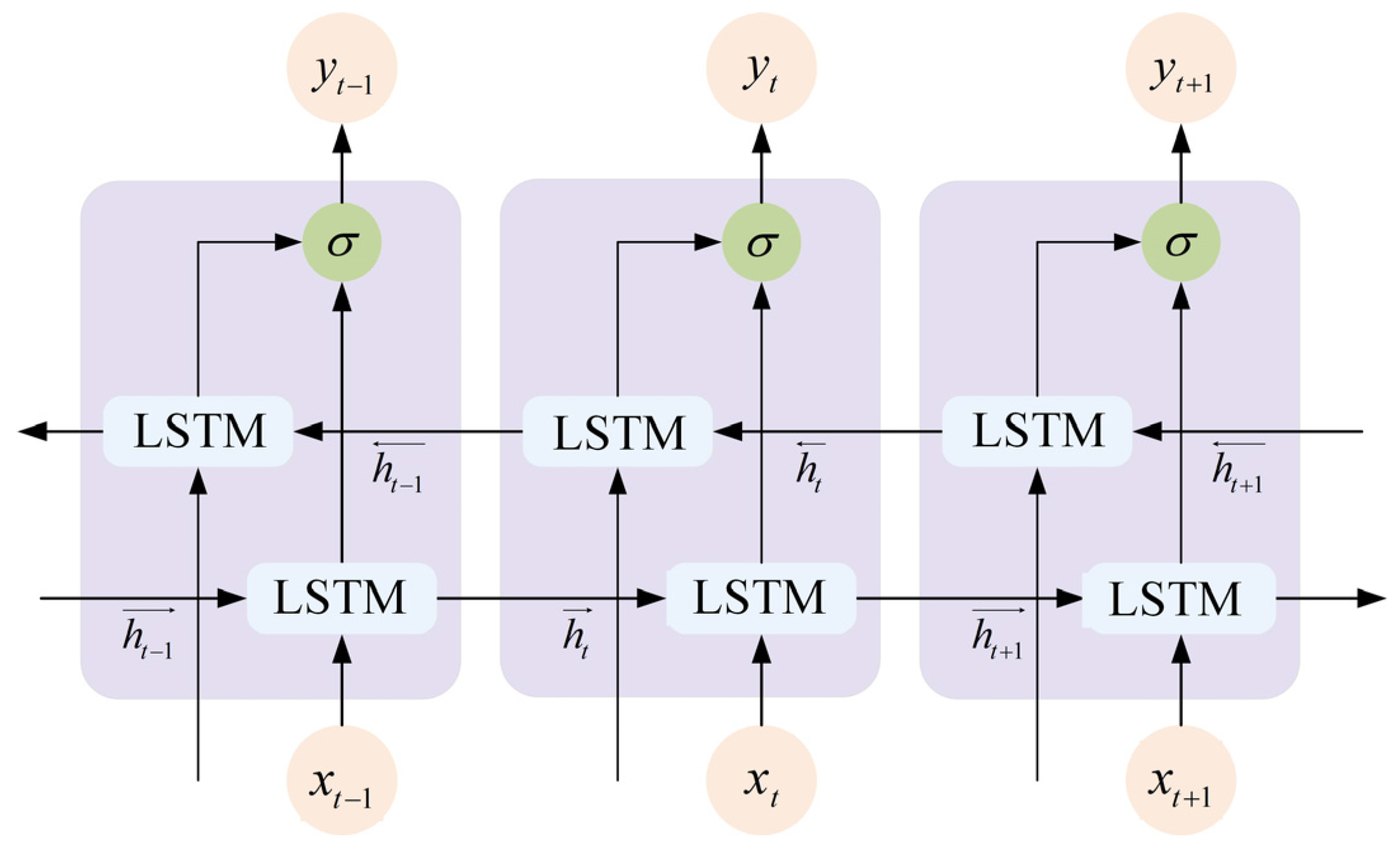
LSTM can only process data unidirectionally in chronological order and cannot simultaneously exploit bidirectional temporal correlations of sequences from past and future perspectives. BiLSTM deploys two LSTM layers with opposite propagation directions along the temporal dimension to extract forward and backward information from input sequences concurrently, which overcomes the defect of unidirectional LSTM in comprehensively capturing intrinsic temporal dependencies hidden in sequential data. By effectively modeling and fusing historical and future sequence features, BiLSTM boosts the overall learning performance of the network and elevates the utilization rate of time-series data. The network structure of BiLSTM is illustrated in Figure 4, and its operation process is described in Equations (6)–(8).
h t + 1 = L S T M x t , h t ,
Y t = σ W Y , h t + 1 , h t + 1 + b Y ,
where h t + 1 represents the hidden state of forward time step, h t + 1 denotes the hidden state of backward time step, W Y and b Y are the weight matrix and bias term, respectively.

2.4. MMDSC-CBAM-BILSTM Diagnosis Model

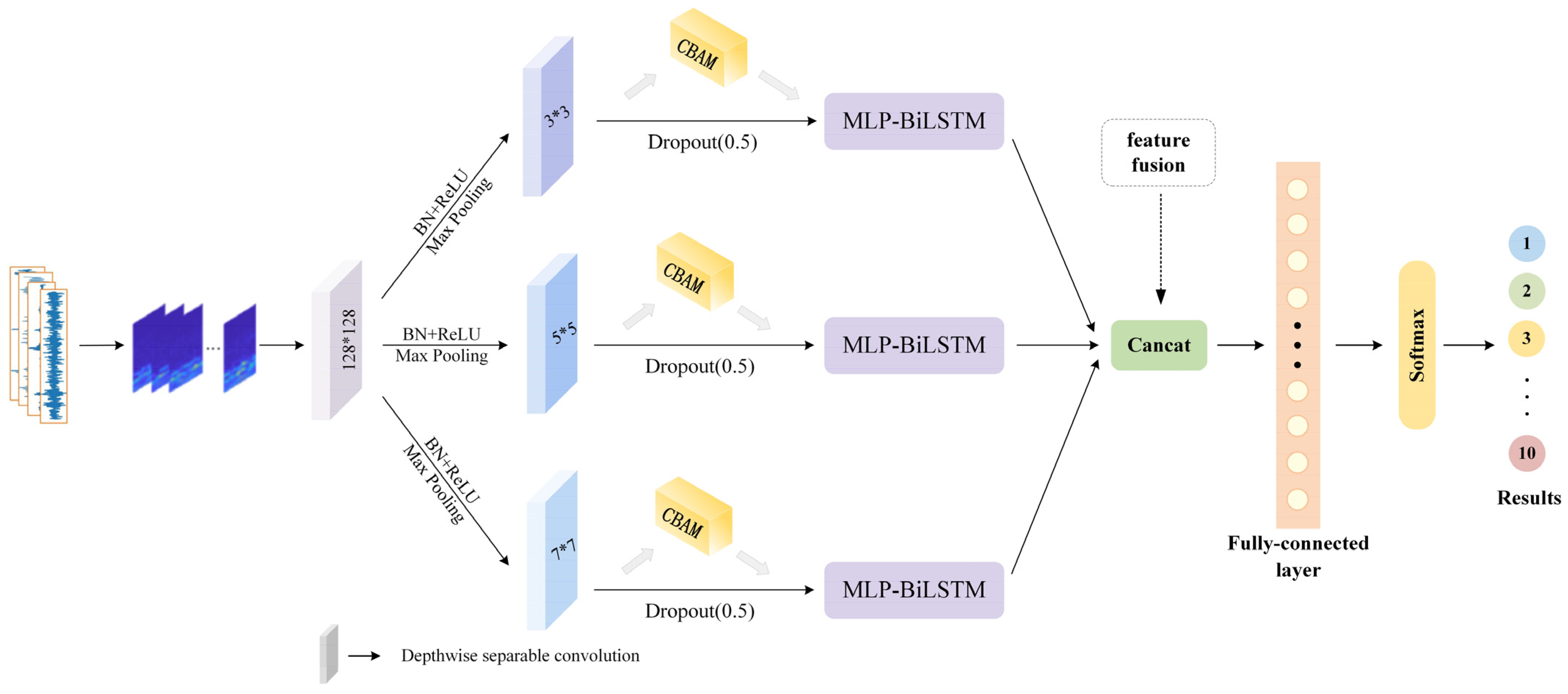
The proposed MMDSC-CBAM-BiLSTM fault diagnosis model is shown in Figure 5. All one-dimensional time-series vibration signals are transformed into time–frequency images using the continuous wavelet transform with the Complex Morlet wavelet as the mother wavelet. The center frequency and bandwidth parameter are set to 2.0 Hz and 1.0 Hz, respectively, and the resulting scalograms are resized to 224 × 224 pixels to serve as the input to the model.
To comprehensively capture the global structural distribution and overall feature trends of bearing vibration signals, a large 128 × 128 convolution kernel is firstly deployed at the initial feature extraction stage. This large-scale kernel possesses a broad receptive field, which enables the model to effectively perceive long-range dependency information and global feature representations contained in vibration signals, laying a solid foundation for subsequent fine-grained feature mining. Following the global feature pre-extraction operation, this model constructs three parallel depthwise separable convolution (DSC) branches equipped with different kernel sizes of 3 × 3, 5 × 5, and 7 × 7. Benefiting from the unique feature decoupling and fine extraction advantages of DSC, these multi-scale branches can adaptively capture subtle local fault details at different spatial scales, including tiny texture mutations, local impact characteristics and abnormal structural features of vibration signals. The multi-branch parallel extraction mechanism significantly enriches the multi-dimensional diversity and hierarchical complementarity of convolutional features, effectively overcoming the limitation of single-scale feature extraction and improving the comprehensiveness of fault feature perception. On the basis of acquiring abundant multi-scale convolutional features, a multilayer perceptron (MLP) is further introduced into the feature processing workflow. The MLP performs efficient nonlinear dimension transformation and deep feature reorganization on the initially extracted multi-scale feature maps. Through continuous nonlinear mapping and weight optimization, the model strengthens the abstract representation ability of effective fault features, realizes in-depth fusion of inter-layer channel information, and further enhances the discriminative performance of feature vectors. After completing the dimension unification and preliminary fusion of multi-scale nonlinear features, the optimized feature sequences are input into the bidirectional long short-term memory (BiLSTM) network. The bidirectional temporal learning mechanism of BiLSTM can fully mine the forward and backward temporal correlation and dynamic dependency relationships of vibration signal sequences, effectively capturing the implicit time-varying dynamic characteristics of bearing fault signals under complex and variable operating conditions, thereby improving the model’s adaptability to variable working condition scenarios. Furthermore, to address the problems of redundant feature information, invalid noise interference and uneven feature weight distribution in multi-scale feature extraction, a Convolutional Block Attention Module (CBAM) is embedded into each independent DSC branch. The dual-dimensional attention mechanism of CBAM can adaptively calibrate feature weights from both channel dimension and spatial dimension. It effectively suppresses irrelevant background noise and redundant interference features, dynamically strengthens the weight of critical fault-related feature channels and key spatial regions, and enables the model to accurately focus on core fault characteristic information. Finally, the high-quality discriminative feature vectors processed by multi-scale convolution, nonlinear mapping, temporal feature mining and attention optimization are transmitted to the fully connected layer for global feature integration and dimension mapping. Ultimately, the Softmax classifier converts the extracted high-dimensional fault features into probability distribution results, thereby realizing accurate and intelligent diagnosis and classification of different bearing fault types.

3. Results

3.1. Data Sources and Description

Experiment 1 adopts the public bearing fault dataset from Case Western Reserve University (CWRU) for research. Relying on accelerometers, this dataset completely collects vibration signals of SKF6205 rolling bearings under various operating conditions, with a focus on collecting and analyzing fault characteristics of three core bearing components: the inner race, rolling element and outer race. Each fault type in the dataset has three damage levels corresponding to defect diameters of 0.007 inches, 0.014 inches and 0.021 inches, and samples under normal bearing operating conditions are also included. The specific division is shown in Table 1.
The sampling frequency used in this paper is 48 kHz. Datasets A, B and C are constructed according to three motor loads of 1 HP, 2 HP and 3 HP. Each load corresponds to four operating states of the bearing, forming a total of 10 categories with 500 time-series vibration samples per category. The overlapping sampling method with an overlap ratio of 0.5 is adopted to intercept signal segments of 1024 data points for each sample. Wavelet transform is applied to convert the one-dimensional time-series signals into time–frequency images as the model input, and the training and test samples are divided at a ratio of 7:3.

3.2. Parameter Settings

The experiments were conducted using the TensorFlow framework and programmed in Python3.7.10 on the Windows 11 system. The Adam optimizer was employed to optimize the algorithm, and the cross-entropy loss function was used as the loss metric. Weights and biases were iteratively adjusted based on the gradient function. The batch size was set to 16, the learning rate was set to 0.0006, and the number of iterations (epochs) was set to 100. All experiments underwent 10-fold cross-validation, and the average value was taken as the final classification result for analysis.

3.3. Ablation Experiment

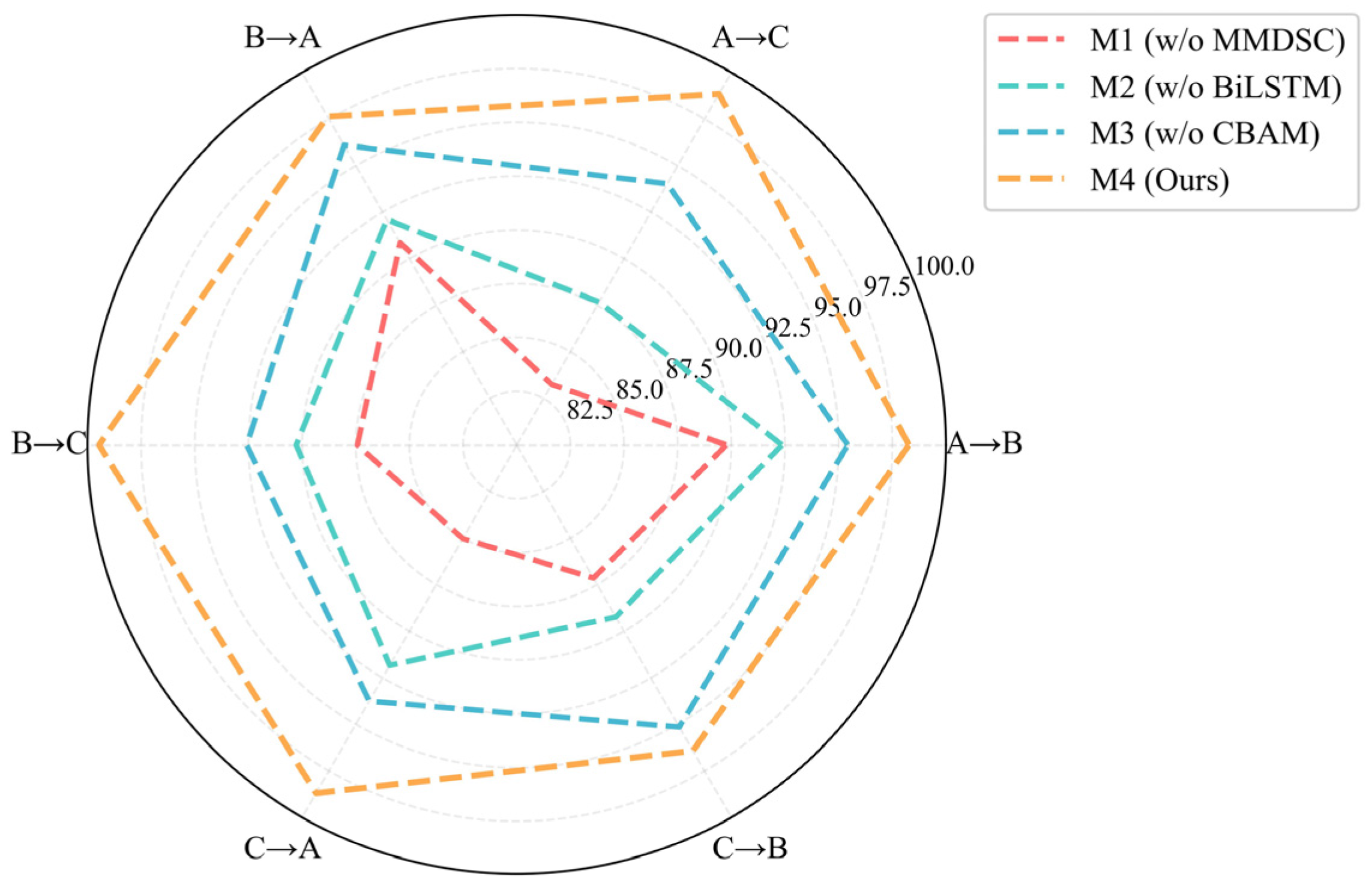
To quantitatively explore the individual contributions of each core component in the proposed model, four ablation schemes (M1–M4) are designed following the single-variable principle. Each scheme removes a single module while keeping other structures unchanged. Specifically, M1 excludes the MMDSC module, M2 removes the BiLSTM branch, and M3 eliminates the CBAM, whereas M4 denotes the complete MMDSC-CBAM-BiLSTM model. Table 2 summarizes the diagnostic accuracy and average performance of the four schemes under diverse working conditions, and Figure 6 intuitively presents their performance distribution via ablation radar charts.
Ablation experiments quantitatively verify the vital contribution of each core module to the overall diagnostic performance. Specifically, the model without the multi-scale depthwise separable convolution (MMDSC) module achieves the lowest accuracy of merely 87.25%. Restricted by single-scale convolution limitations and insufficient feature extraction dimensions, this simplified model cannot effectively mine multi-band subtle fault features from complex vibration signals. Lacking the multi-scale complementary mechanism, the model suffers from incomplete feature representation and weak anti-interference, resulting in a substantial performance decline. In comparison, removing the BiLSTM module yields 90.58% accuracy, indicating that vibration signals possess obvious temporal dynamic characteristics. Without bidirectional temporal dependency mining, the model can hardly fully explore the implicit time-varying rules of fault signals under variable operating conditions. Furthermore, excluding the CBAM module achieves 94.51% accuracy. However, without adaptive channel–spatial dual-dimensional attention regulation, the network’s ability to suppress redundant noise and screen valid fault information is weakened. Unbalanced feature weights further reduce discriminability, easily causing misclassification among similar fault samples. The proposed model synergistically integrates multi-scale depthwise separable convolution, channel–spatial attention optimization, and bidirectional temporal learning. By leveraging complementary strengths of each module, it accurately captures multi-scale spatial fault features and deep temporal correlation, effectively suppresses noise interference, and significantly boosts discriminative capability. Ultimately, the model achieves the optimal accuracy of 98.22% with outstanding stability and generalization under complex variable conditions. Ablation results confirm that MMDSC, CBAM, and BiLSTM cooperate efficiently and complement each other, remarkably strengthening multi-dimensional, highly discriminative feature representation for bearing fault diagnosis.

3.4. Comparative Experiments(CWRU)

To validate the generalization capability of the proposed method, the cross-domain fault diagnosis tests under variable operating conditions using Datasets A, B, and C are executed. The notation “A→B” denotes training on Dataset A and testing on Dataset B. Diagnosis results across variable-load scenarios are presented in Table 3.
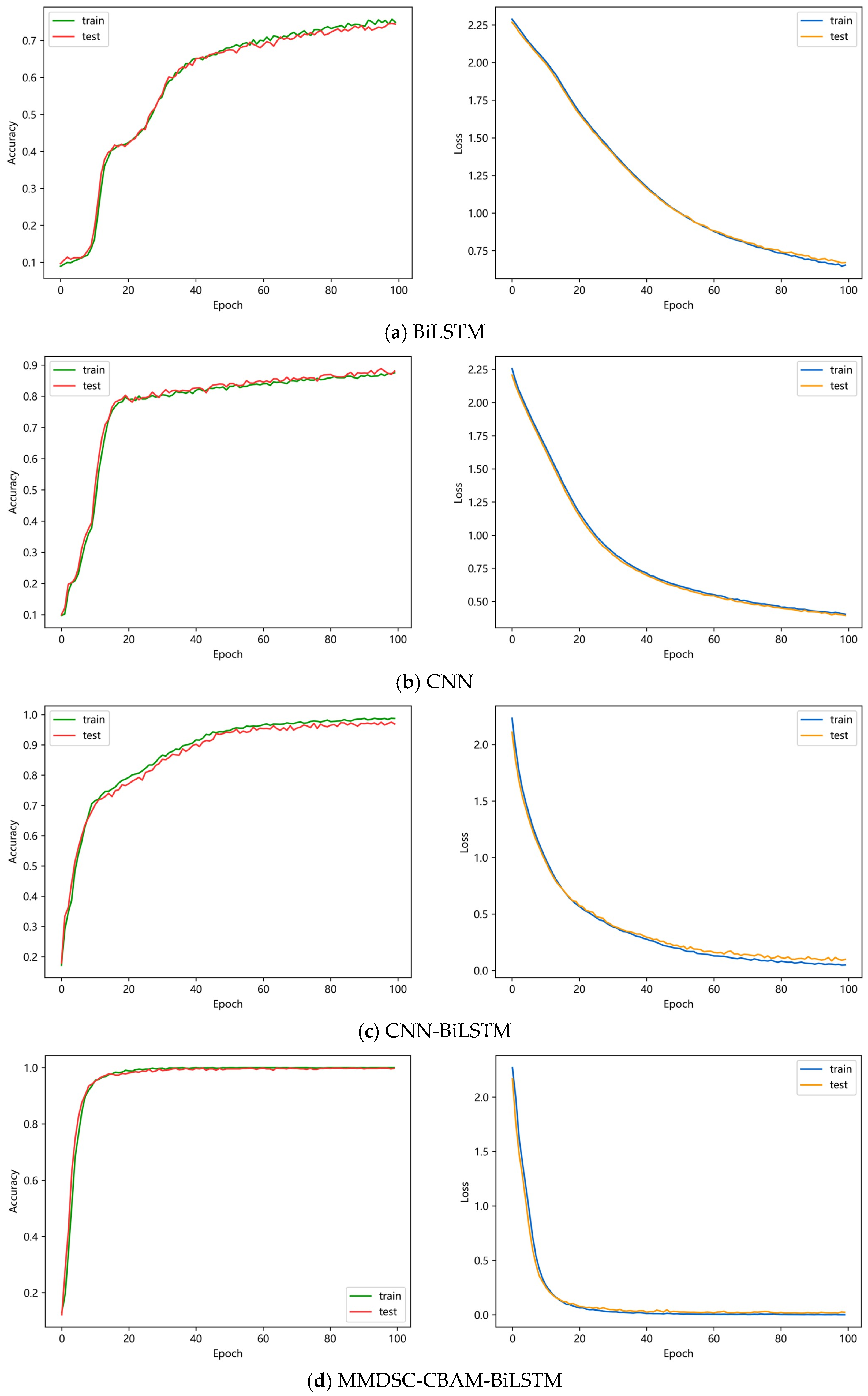
BiLSTM exhibits the lowest diagnostic accuracy due to the susceptibility of distribution shifts under variable loads. CNN has a higher accuracy than BiLSTM since the enhanced feature extraction capabilities. As we know, reliance on static spatial dependencies diminishes performance during significant load variations. CNN-BiLSTM acquires 90.22% mean accuracy through spatiotemporal feature fusion, demonstrating robust adaptability. It is noted that the proposed method outperforms CNN-BiLSTM by 5.66% mean accuracy with reducing performance variance across load conditions and validating exceptional generalization. The training accuracy and loss convergence curves of the BiLSTM, CNN, CNN-BiLSTM, and the proposed MMDSC-CBAM-BiLSTM model during 100 training epochs are illustrated in Figure 7.
The green, red, blue, and orange curves correspond to training accuracy, test accuracy, training loss, and test loss, respectively. The single BiLSTM model shows slow convergence, high residual loss, and a low final test accuracy of 0.75, owing to its inability to extract spatial features from time–frequency images despite effective temporal dependency modeling. The pure CNN achieves faster initial convergence via powerful spatial feature learning but only reaches a test accuracy of 0.88 with a significant train–test deviation, as it fails to capture bidirectional temporal information of vibration signals. The CNN-BiLSTM hybrid model combines spatial and temporal learning, improving convergence and yielding a test accuracy above 0.92, yet it still suffers from late-stage curve divergence caused by insufficient redundant feature suppression. In contrast, the proposed model achieves optimal convergence performance. It converges rapidly within 20 epochs with nearly 100% accuracy and maintains high consistency between training and test curves, while the loss quickly declines and stabilizes at a low level. These results demonstrate that the integrated multi-scale depthwise separable convolution and CBAM effectively extract multi-scale spatial fault features, suppress interference, and enhance discriminative fault characteristics. Cooperated with bidirectional temporal modeling, the proposed model achieves superior feature representation, faster convergence, and stronger generalization, validating its reliability for mechanical fault diagnosis.
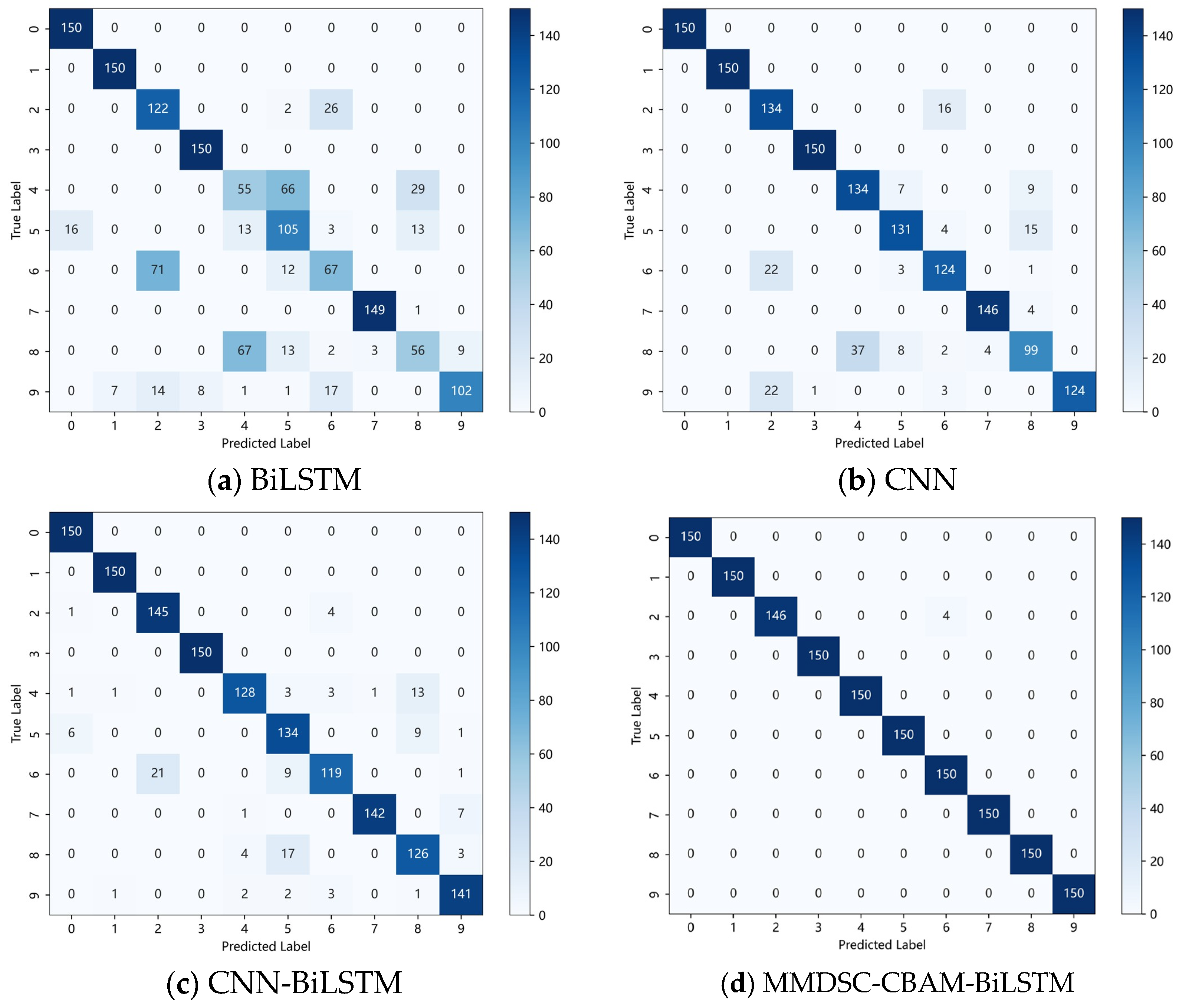
The confusion matrix provides an intuitive, tabular representation of the classification accuracy of different models across each category, including both correctly and incorrectly classified samples. The horizontal axis denotes the predicted fault types, while the vertical axis corresponds to the actual fault categories. As depicted in Figure 8.
The diagonal elements represent the number of samples correctly classified, while off-diagonal entries correspond to misclassified samples. As shown in Figure 8a, the standalone BiLSTM suffers severe misclassification across multiple fault categories. Many fault samples are confused with other similar fault modes, indicating that simple bidirectional temporal modeling cannot effectively distinguish complex fault features under variable operating conditions. The CNN model (Figure 8b) achieves improved classification performance compared with BiLSTM, yet obvious misclassification still exists for several fault types. The CNN-BiLSTM hybrid model (Figure 8c) further reduces misclassified samples by combining spatial feature extraction and temporal dependency mining. Nevertheless, partial fault samples remain hard to discriminate accurately. For the proposed MMDSC-CBAM-BiLSTM model in Figure 8d, all diagonal values reach 150, and nearly no off-diagonal prediction errors are observed. This result demonstrates that the constructed model can extract discriminative multi-scale spatial features and deep temporal fault information, suppress feature interference caused by noise, and accurately identify different bearing fault types. The confusion matrix comparison intuitively verifies the superiority of the proposed method in distinguishing similar fault samples.
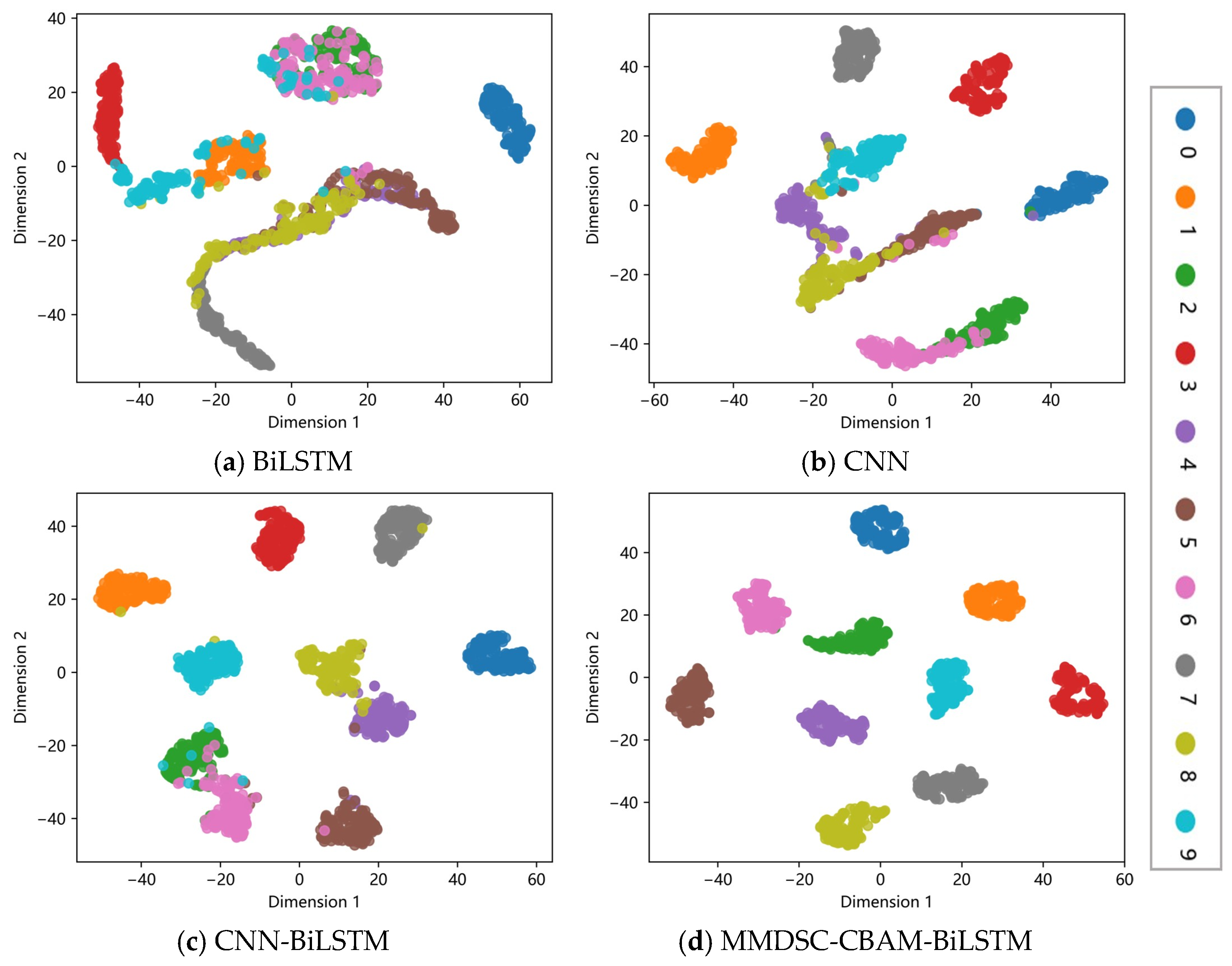
To intuitively visualize the distribution characteristics of features extracted by different models, the t-distributed Stochastic Neighbor Embedding algorithm is adopted to project the high-dimensional features output by networks into a two-dimensional plane. As shown in Figure 9. Scatter points with different colors in the figure correspond to ten types of bearing fault categories. t-SNE can clearly reveal the intra-class aggregation and inter-class separation of different fault features, qualitatively reflecting the discriminative capability of fault features learned by each mod.
The features extracted by BiLSTM show chaotic distribution with high inter-class mixing, lacking cluster structure and exhibiting low discriminability. After 1D convolution, CNN demonstrates improved spatial feature extraction, revealing initial separation between classes, but still maintains significant overlap. CNN-BiLSTM has enhanced clustering with clearer inter-class boundaries, though aliasing persists between some categories. In contrast, the proposed model yields more compact feature distributions with distinct class boundaries, achieving optimal clustering performance.

3.5. Comparative Experiments(JU)

To validate the versatility of the proposed model in diagnosing diverse rolling bearing faults, diagnostic experiments are conducted by using bearing fault data from Jiangnan University (JU). The data was acquired at a sampling frequency of 50 kHz under operating speeds of 600, 800, and 1000 r/min. Four operational states were defined: inner race fault, rolling-element fault, outer race fault, and normal state. The experimental dataset comprises 500 samples per category, with 1024 data points per sample, and a training–testing split ratio of 7:3. Additionally, three dedicated datasets were constructed based on rotational speeds as shown in Table 4.
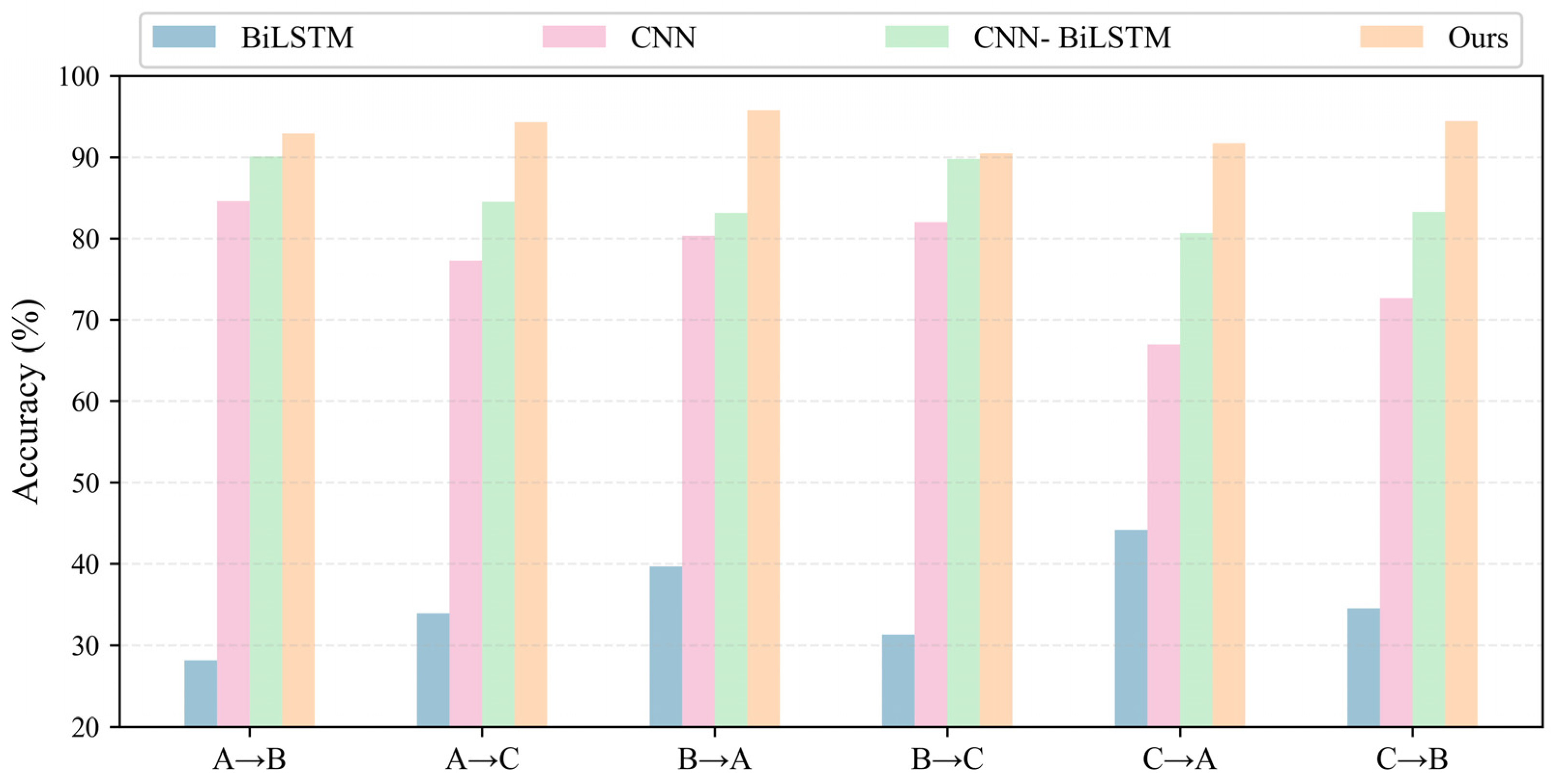
Cross-domain bearing fault diagnosis experiments under variable working conditions are carried out on the Jiangnan University dataset. Table 5 records the diagnostic accuracy of BiLSTM, CNN, CNN-BiLSTM and the proposed model under six cross-condition transfer tasks, and Figure 10 intuitively displays the accuracy comparison in the form of bar charts. It can be observed that the single BiLSTM achieves accuracy below 45% across all transfer tasks. The CNN obtains improved performance yet lacks satisfactory stability, and CNN-BiLSTM further boosts classification results by combining spatial and temporal features. In contrast, the proposed method achieves accuracy higher than 90% on all six transfer tasks and ranks first among all competitors.
Specifically, the BiLSTM relying solely on temporal modeling suffers poor generalization against distribution shifts under varying working conditions. The CNN achieves moderate performance via spatial feature extraction, yet its accuracy declines sharply on transfer tasks with large domain gaps without temporal learning. Although CNN-BiLSTM fuses spatial and temporal information, the absence of adaptive feature screening limits its cross-condition performance. By contrast, the proposed model integrates multi-scale extraction and attention regulation to capture cross-condition shared fault features and suppress domain shift interference. The bar chart reveals that our method consistently outperforms all competitors, with greater superiority on difficult transfer tasks. These results validate that the proposed network addresses the generalization defects of single and simply hybrid models, delivering excellent performance and strong robustness for variable-condition bearing fault diagnosis.

4. Conclusions

This study addresses the problems of incomplete feature extraction, insufficient utilization of temporal information, and low fault diagnosis accuracy under variable operating conditions in existing bearing fault diagnosis models, and proposes an MMDSC-CBAM-BiLSTM fault diagnosis model. The model aims to improve the accuracy and robustness of rolling bearing fault diagnosis under variable working conditions by combining multi-scale feature extraction, bidirectional temporal modeling, and attention mechanisms.
The experimental results demonstrate that the proposed model can effectively improve fault diagnosis performance under variable operating conditions. Specifically, the embedded MMDSC module extracts multi-level vibration fault features and compensates for the deficiency of single-scale feature representation, indicating that multi-scale feature learning is of great significance for coping with changing operating conditions. The BiLSTM mines temporal dependencies in vibration signals from both forward and backward directions, enabling the model to capture sequential patterns in the raw signals more completely, which is crucial for accurately distinguishing different fault types. Meanwhile, the parallel structure of CNN and CBAM further strengthens the model’s ability to focus on key fault information through multi-scale feature extraction and adaptive feature enhancement, thereby improving diagnostic stability.
Overall, the above results indicate that effectively combining multi-scale spatial feature extraction, bidirectional temporal modeling, and attention mechanisms can more comprehensively characterize the features of bearing vibration signals under variable operating conditions. This finding is of important value for real industrial scenarios where equipment operates under complex and changing conditions and requires high diagnostic reliability. It helps reduce the risk of unplanned downtime and prevent unexpected failures, providing an effective solution for intelligent bearing fault diagnosis under complex working conditions.

Author Contributions

Conceptualization, Y.W. and C.L.; methodology, Y.W.; software, Y.W.; validation, Y.W., Y.W. and J.W.; formal analysis, Y.W.; investigation, Y.W.; resources, J.W.; data curation, C.L.; writing—original draft preparation, Y.W.; writing—review and editing, C.L.; visualization, C.L.; supervision, J.W.; project administration, J.W.; funding acquisition, J.W. All authors have read and agreed to the published version of the manuscript.

Funding

This research was funded in part by the Major Science and Technology Project of Shanxi Province under Grant 202301020101001.

Data Availability Statement

The data presented in this study are available from the following publicly accessible sources. The CWRU bearing dataset is available at the Case Western Reserve University Bearing Data Center: https://engineering.case.edu/bearingdatacenter (accessed on 8 December 2025) [1]. The Jiangnan University bearing dataset is available at: https://github.com/ClarkGableWang/JNU-Bearing-Dataset?utm_source=chatgpt.com (accessed on 8 December 2025) [2].

Acknowledgments

During the preparation of this work, the authors used ChatGPT (OpenAI, GPT-4) for language refinement. After using this tool, the authors reviewed and edited the content as necessary and took full responsibility for the final publication.

Conflicts of Interest

Author Yufang Wang was employed by the company Shanxi Information Industry Technology Research Institute Co., Ltd. The remaining authors declare that the research was conducted in the absence of any commercial or financial relationships that could be construed as a potential conflict of interest.

Abbreviations

The following abbreviations are used in this manuscript:
MMDSCMulti-channel Multi-scale Depthwise Separable Convolution
DSCDepthwise Separable Convolution
DWDepthwise Convolution
PWPointwise Convolution
LSTMLong Short-Term Memory
CBAMConvolutional Block Attention Module
BiLSTMBidirectional Long Short-Term Memory
MLPMultilayer Perceptron
RNNRecurrent Neural Network
STFTShort-Time Fourier Transform
CWTContinuous Wavelet Transform
T-SNEt-distributed Stochastic Neighbor Embedding
AdamAdaptive Moment Estimation

References

  1. Zhang, A.; Huang, J.; Ji, S.; Li, D. Bearing fault pattern recognition based on image classification with CNN. J. Vib. Shock 2020, 39, 165–171. [Google Scholar]
  2. Liu, Y.; Wang, J.; Shen, Y. Research on verification of sensor fault diagnosis based on BP neural network. In Proceedings of the 11th International Conference on Prognostics and System Health Management, Jinan, China, 23–25 November 2020; pp. 456–460. [Google Scholar]
  3. Wan, L.; Chen, Y.; Li, H.; Li, C. Rolling-element bearing fault diagnosis using improved LeNet-5 network. Sensors 2020, 20, 1693. [Google Scholar] [CrossRef] [Scilit] [PubMed]
  4. Zhang, Q.; Deng, L. An intelligent fault diagnosis method of rolling bearings based on short-time Fourier transform and convolutional neural network. J. Fail. Anal. Prev. 2023, 23, 795–811. [Google Scholar] [CrossRef] [Scilit]
  5. Etana, B.B.; Dawud, A.A.; Malengier, B.; Sitek, W.; Gemechu, W.F.; Krishnamoorthy, J.; Langenhove, L.V. Discrete wavelet transform based processing of embroidered textile-electrode electromyography signal acquired with load and pressure effect. J. Ind. Text. 2024, 54, 15280837241232449. [Google Scholar] [CrossRef] [Scilit]
  6. Rios, R.A.; Mello, R.F.d. Applying empirical mode decomposition and mutual information to separate stochastic and deterministic influences embedded in signals. Signal Process. 2016, 118, 159–176. [Google Scholar] [CrossRef] [Scilit]
  7. Geetha, K.; Hota, M.K. Microseismic signal denoising based on variational mode decomposition with adaptive non-local means filtering. Pure Appl. Geophys. 2023, 180, 3709–3731. [Google Scholar] [CrossRef] [Scilit]
  8. Li, H.; Liu, T.; Wu, X.; Chen, Q. Research on bearing fault feature extraction based on singular value decomposition and optimized frequency band entropy. Mech. Syst. Signal Process. 2019, 118, 477–502. [Google Scholar] [CrossRef] [Scilit]
  9. Tuerxun, W.; Chang, X.; Guo, H.; Jin, Z.; Zhou, H. Fault diagnosis of wind turbines based on a support vector machine optimized by the sparrow search algorithm. IEEE Access 2021, 9, 69307–69315. [Google Scholar] [CrossRef] [Scilit]
  10. Yao, W.; Sun, W.; Cao, J. Research on bearing fault diagnosis based on EEMD and KNN. Inf. Technol. Informatiz. 2020, 6, 112–115. [Google Scholar]
  11. Liu, H.; Zhou, J.; Zheng, Y.; Jiang, W.; Zhang, Y. Fault diagnosis of rolling bearings with recurrent neural network-based autoencoders. ISA Trans. 2018, 77, 167–178. [Google Scholar] [CrossRef] [Scilit] [PubMed]
  12. Yan, H.; Qin, Y.; Xiang, S.; Wang, Y.; Chen, H. Long-term gear life prediction based on ordered neurons LSTM neural networks. Measurement 2020, 165, 108205. [Google Scholar] [CrossRef] [Scilit]
  13. Yu, Z.; Xiong, B.; Xiong, T.; Ou, Q.; Li, X. Fault diagnosis of helicopter bearing based on VMD-CWT and improved CNN. J. Aerosp. Power 2021, 36, 948–958. [Google Scholar]
  14. Guo, Y.; Mao, J.; Zhao, M. Rolling bearing fault diagnosis method based on attention CNN and BiLSTM network. Neural Process. Lett. 2023, 55, 3377–3410. [Google Scholar] [CrossRef] [Scilit]
  15. Liu, X.; Chen, G.; Wang, H.; Wei, X. A siamese CNN-BiLSTM-based method for unbalance few-shot fault diagnosis of rolling bearings. Meas. Control 2024, 57, 551–565. [Google Scholar] [CrossRef] [Scilit]
Figure 1. Schematic diagram of depthwise separable convolution.
Computers 15 00614 g001
Figure 2. CBAM mechanism.
Computers 15 00614 g002
Figure 3. Diagram of the LSTM network structure.
Computers 15 00614 g003
Figure 4. Diagram of the BiLSTM network structure.
Computers 15 00614 g004
Figure 5. Diagram of the MMDSC-CBAM-BiLSTM network structure.
Computers 15 00614 g005
Figure 6. Radar chart of diagnostic accuracy for ablation experiments under variable working conditions.
Computers 15 00614 g006
Figure 7. The curve of loss and accuracy changes during training and testing. (a) BiLSTM. (b) CNN. (c) CNN-BiLSTM. (d) MMDSC-CBAM-BiLSTM.
Computers 15 00614 g007
Figure 8. Confusion matrix of four methods. (a) BiLSTM. (b) CNN. (c) CNN-BiLSTM. (d) MMDSC-CBAM-BiLSTM.
Computers 15 00614 g008
Figure 9. Visualization of learned features on CWRU. (a) BiLSTM. (b) CNN. (c) CNN-BiLSTM. (d) MMDSC-CBAM-BiLSTM.
Computers 15 00614 g009
Figure 10. Fault diagnosis results of various methods under variable working conditions.
Computers 15 00614 g010
Table 1. Bearing fault state classification.
DatasetLabelFault SetFault Size/InchTraining/Testing Set
A/B/C0normal350/150
1inner race0.007350/150
2rolling element0.007350/150
3outer race0.007350/150
4inner race0.014350/150
5rolling element0.014350/150
6outer race0.014350/150
7inner race0.021350/150
8rolling element0.021350/150
9outer race0.021350/150
Table 2. Comparison of the accuracy of different ablation models across various transfer tasks.
MethodsA→BA→CB→AB→CC→AC→BAcc_Avg/%
M189.7683.2690.8787.4285.0287.1587.25
M292.3587.6892.1190.2791.8489.2390.58
M395.4294.0396.1092.5893.7595.1594.51
M498.2798.8597.6399.4698.7096.4298.22
Table 3. Fault diagnosis results under variable load scenarios.
MethodsA→BA→CB→AB→CC→AC→B
BiLSTM26.8736.7540.5729.5642.3032.45
CNN89.2775.9383.4090.1367.8574.66
CNN-BiLSTM90.1394.7392.1086.5780.3697.42
Ours98.2798.8597.6399.4698.7096.42
Table 4. Jiangnan University bearing fault dataset.
DatasetLabelFault SetTraining SetTesting Set
D/E/F0normal350150
1inner race350150
2rolling element350150
3outer race350150
Table 5. Fault diagnosis results of different methods on the Jiangnan University.
MethodsA→BA→CB→AB→CC→AC→B
BiLSTM28.1433.9239.6531.2844.1734.53
CNN84.5675.9380.3182.0266.9372.67
CNN-BiLSTM90.0877.2483.1489.7980.6583.28
Ours92.9394.2995.7490.4691.7094.42
Disclaimer/Publisher’s Note: The statements, opinions and data contained in all publications are solely those of the individual author(s) and contributor(s) and not of MDPI and/or the editor(s). MDPI and/or the editor(s) disclaim responsibility for any injury to people or property resulting from any ideas, methods, instructions or products referred to in the content.