1. Introduction
The exponential growth of data-intensive workloads, driven by large-scale machine learning inference, graph analytics, and encrypted database processing, has exposed a fundamental limitation in conventional von Neumann architectures: the physical separation of memory and compute creates a data movement bottleneck that degrades both performance and energy efficiency [
1,
2]. Empirical measurements on mobile consumer workloads confirm that data-intensive pipelines spend more than 60% of the execution time and up to 70% of the system energy on memory access rather than arithmetic [
3]. Similar bottlenecks have been observed in server-scale graph analytics and ML inference [
4,
5]. As memory bandwidth scales more slowly than compute throughput, these bottlenecks compound with each processor generation, and workloads requiring frequent access to large, sensitive datasets amplify it further.
Processing-in-memory (PIM) directly addresses this bottleneck by integrating computational logic within or adjacent to memory arrays, thereby reducing the energy and latency cost of data movement [
4,
5]. Commercial DRAM-PIM modules report 2–10× lower energy per operation and 20–93× speedups over CPU and GPU baselines in graph mining, streaming analytics, and AI inference [
6,
7]. Architectures targeting a large language model (LLM) inference achieve up to 6.94× lower total cost of ownership per query-per-second and 10–20× less energy per token relative to state-of-the-art GPUs [
8]. These performance characteristics make PIM an active deployment target across cloud, mobile, and edge contexts [
9,
10], each of which introduces distinct security requirements that the architecture was not originally designed to satisfy.
PIM’s structural departure from conventional processor–DRAM interfaces, specifically the placement of compute logic directly alongside unencrypted memory contents without the isolation guarantees of a processor memory-protection unit, creates an attack surface with no direct precedent in prior memory subsystem designs. RowHammer attacks on DRAM-PIM arrays exploit activation patterns generated by near-memory compute units; Blacksmith-class non-uniform hammering sequences bypass TRR on all tested DDR4 DIMMs [
11], and PIM’s internally generated workload-dependent row activations are structurally indistinguishable from adversarial hammering sequences from the host refresh controller’s perspective [
12,
13]. Emerging non-volatile memory (NVM) technologies such as ReRAM and PCM introduce persistent fault susceptibility and endurance-related degradation that compounds across banks. Carefully crafted wear-out patterns can embed latent faults across crossbar arrays, and resistance-state corruption from repeated adversarial writes degrades read margins over time in ways that standard error-correction cannot fully mask [
14,
15]. In multi-tenant cloud deployments, where multiple workloads share PIM hardware, these physical-layer vulnerabilities compose with software-layer isolation failures to produce cross-layer exploits for which no complete mitigation currently exists.
Prior work has addressed subsets of this problem. Mutlu and Kim [
16] provided a detailed retrospective analysis of DRAM disturbance attacks and early isolation techniques but restricted their scope to DRAM-based RowHammer vulnerabilities, which do not address cross-layer threats, Near-Data Processing (NDP) architectures or NVM technologies. Arafin and Lu [
17] identified architectural security challenges in PIM systems but offered no systematic review methodology, quantitative performance–security budget analysis, or formal adversary model. The convergence of NDP, Logic-in-Memory (LiM), and NVM-based PIM in production deployments, combined with the emergence of multi-tenant workloads and firmware-accessible near-bank compute units, creates a gap that neither work addresses. This survey addresses this gap through a systematic synthesis spanning all three PIM architecture classes. Specifically, the gap spans four dimensions: (i) no unified adversary model consolidates attacker capabilities across host firmware, interconnect protocols, and subarray-level fault phenomena; (ii) no systematic threat classification organizes attack vectors and countermeasures across LiM, NDP, and NVM-based PIM under a common analytical structure; (iii) reported defense overheads have not been cross-compared quantitatively across heterogeneous evaluation platforms; and (iv) no composable security framework addresses the interaction effects between defenses operating at adjacent architectural layers.
To address these dimensions, this survey synthesizes the PIM security literature into a unified analytical structure and identifies specific design requirements for a memory-native security framework. The following list summarizes the main contributions.
The main contributions of this paper are as follows:
A PRISMA-aligned systematic review of 47 publications on PIM security, spanning Logic-in-Memory (LiM), Near-Data Processing (NDP), and Non-Volatile Memory (NVM)-based architectures.
A six-domain threat classification mapping 13 representative defense mechanisms across the surveyed corpus, with quantitative synthesis of reported runtime and area overheads across each defense category.
A structured adversary model for PIM systems that identifies four classes of attackers with explicit capability boundaries, excluded capabilities, and success conditions. The model applies a STRIDE-inspired methodology adapted to the memory-compute threat surface.
A conceptual secure-by-design framework that integrates five composable memory-native security primitives: subarray-level isolation, temporal data lifecycle management (secure scrubbing and zeroization), distributed trust anchors, data-oblivious execution, and adaptive policy orchestration. The framework is presented as a structured design proposal supported by preliminary DRAM-interface sensitivity analysis, not as a demonstrated hardware implementation. It consolidates design requirements emerging from the gap analysis and motivates subsequent full-system experimental validation.
Identification of four open research trajectories, threat-aware design, standardized attestation interfaces, AI-aware multi-tenant models, and ecosystem coordination, each grounded in gaps identified in
Section 5 and
Section 6.
The remainder of this paper is organized as follows.
Section 2 describes the review methodology.
Section 3 provides background on PIM architectures.
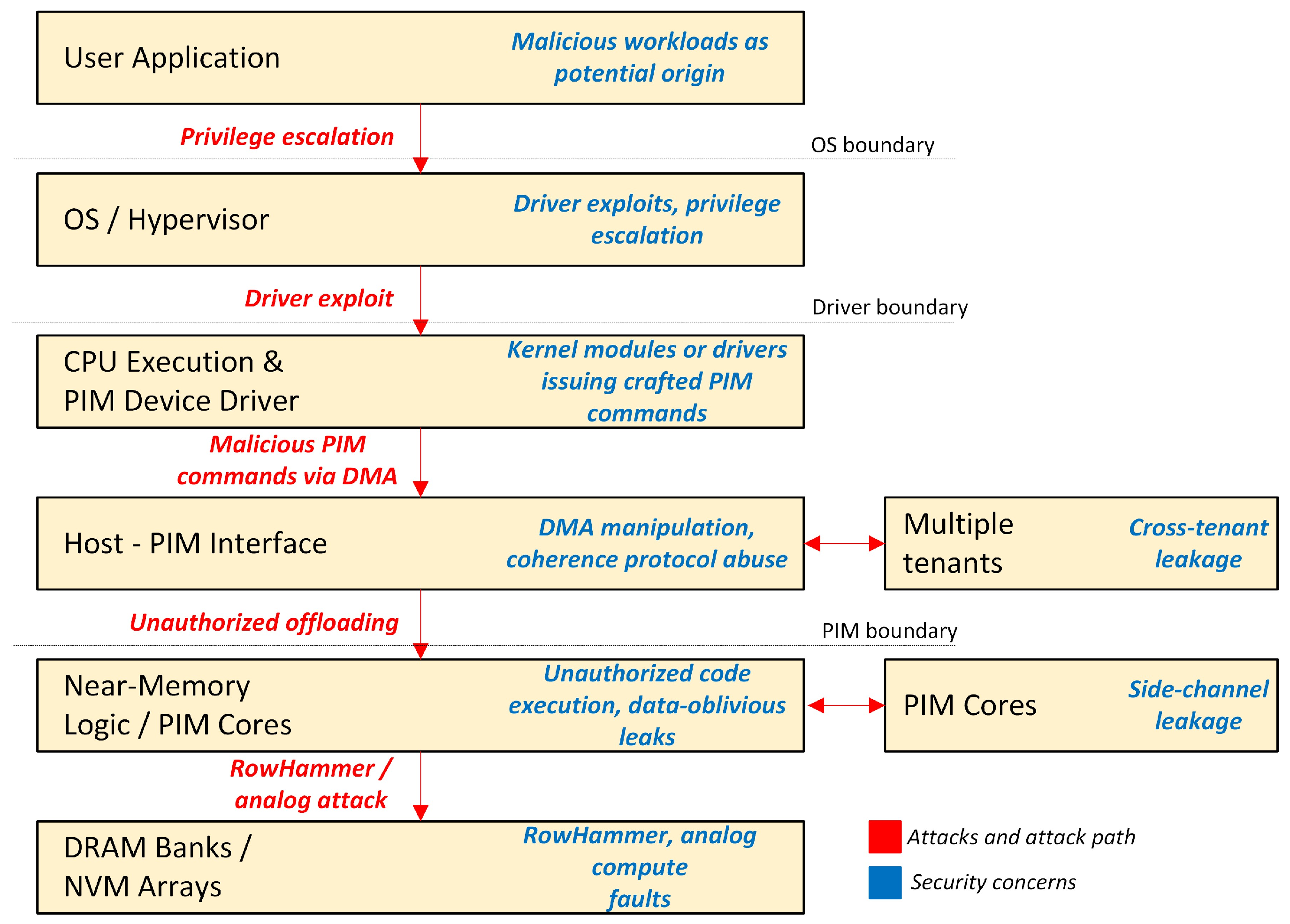
Section 4 characterizes the attack surface.
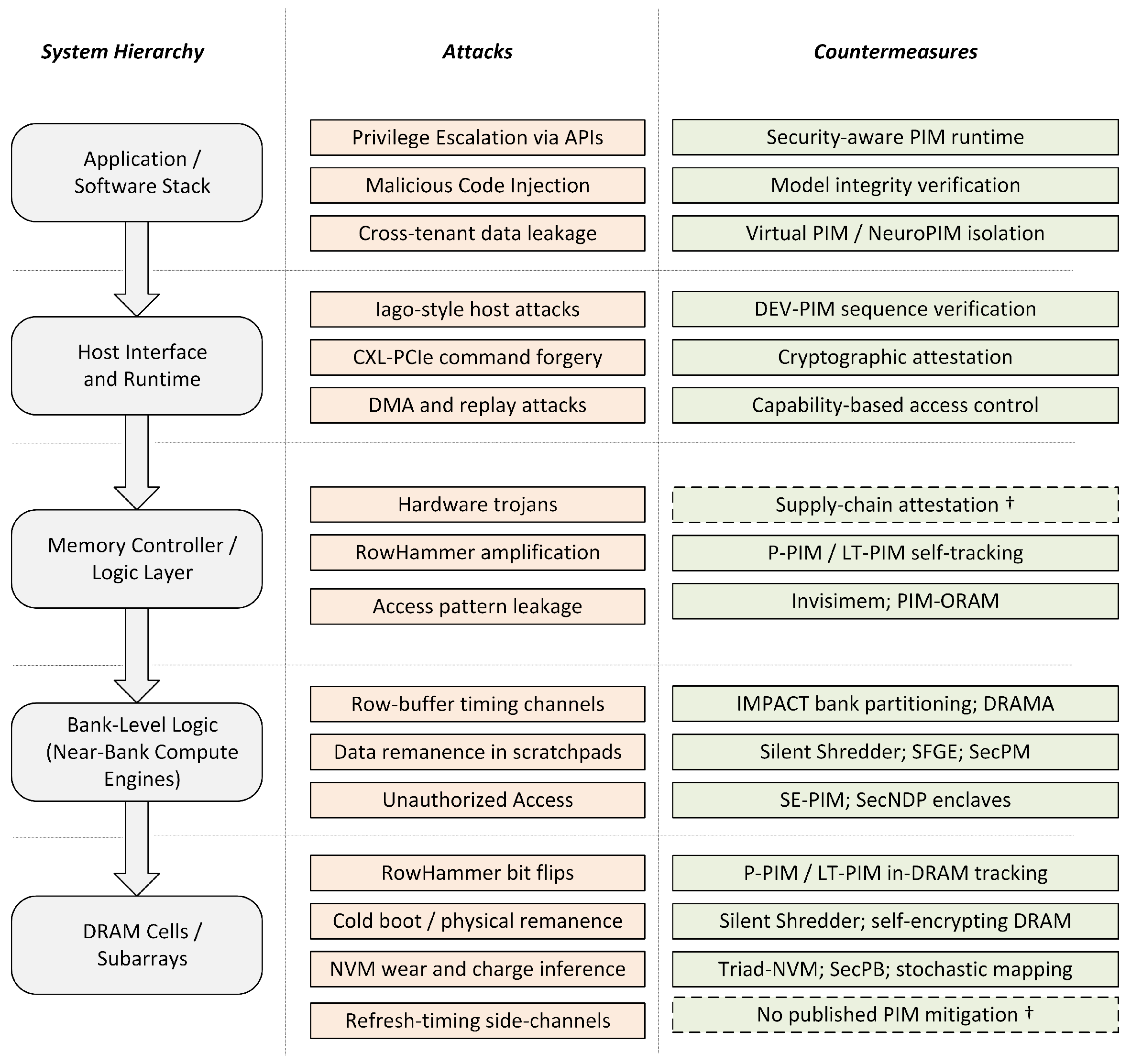
Section 5 presents threat classification and defense analysis.
Section 6 formalizes the adversary model.
Section 7 introduces the secure-by-design conceptual framework.
Section 8 identifies open research trajectories and concludes the paper.
2. Review Methodology
This review was conducted and is reported in accordance with the PRISMA 2020 statement [
18]. A completed PRISMA 2020 checklist for this review is provided in the
Supplementary Materials. Our objective was to systematically identify, screen, and synthesize research on security threats and mitigation in Processing-in-Memory (PIM) architectures.
Searches were executed in April 2025 across five databases: IEEE Xplore, ACM Digital Library, SpringerLink, ScienceDirect, and arXiv (categories cs.AR and cs.CR). Three Boolean query strings targeted distinct threat domains. Query 1 combined PIM architectural terms with security keywords: (“processing-in-memory” OR “near-data processing” OR “compute-in-memory” OR “logic-in-memory” OR “PIM” OR “NDP”) AND (“security” OR “privacy” OR “trusted execution” OR “isolation” OR “side-channel” OR “RowHammer” OR “covert channel” OR “data remanence” OR “threat model” OR “attestation” OR “enclave” OR “hardware security”). Query 2 targeted NVM-specific security mechanisms: (“non-volatile memory” OR “persistent memory” OR “ReRAM” OR “PCM” OR “NVM”) AND (“security” OR “remanence” OR “integrity” OR “side-channel” OR “encryption” OR “rollback” OR “erasure”) AND (“processing-in-memory” OR “near-data processing” OR “PIM” OR “in-memory”). Query 3 targeted DRAM disturbance attacks in PIM contexts: (“RowHammer” OR “RowPress” OR “DRAM disturbance” OR “bit flip” OR “TRR” OR “target row refresh”) AND (“processing-in-memory” OR “near-data processing” OR “PIM” OR “in-DRAM” OR “memory security” OR “isolation”).
All searches applied a date filter of January 2014 to April 2025 and were restricted to peer-reviewed journals, conference and symposium proceedings, and arXiv preprints of at least eight pages with a concrete implementation or formal model. Language was restricted to English.
A record was included if all of the following held: (IC1) the paper addresses PIM, NDP, CiM, LiM, or NVM-PIM architecture explicitly; (IC2) the paper contains a defined threat model, demonstrated attack, or evaluated defense mechanism with PIM-specific scope; (IC3) publication date falls within 2014–2025; (IC4) the venue is peer-reviewed or the arXiv preprint meets the depth criterion above; (IC5) full text is available in English.
A record was excluded if any of the following held: (EC1) security content is absent, addressing only performance or area; (EC2) the work addresses general trusted-execution or enclave security without PIM-specific threat analysis; (EC3) the work is a white paper or vendor note without peer review; (EC4) full text was unavailable; (EC5) security analysis addresses only standard DRAM reliability such as ECC without PIM-specific threat analysis.
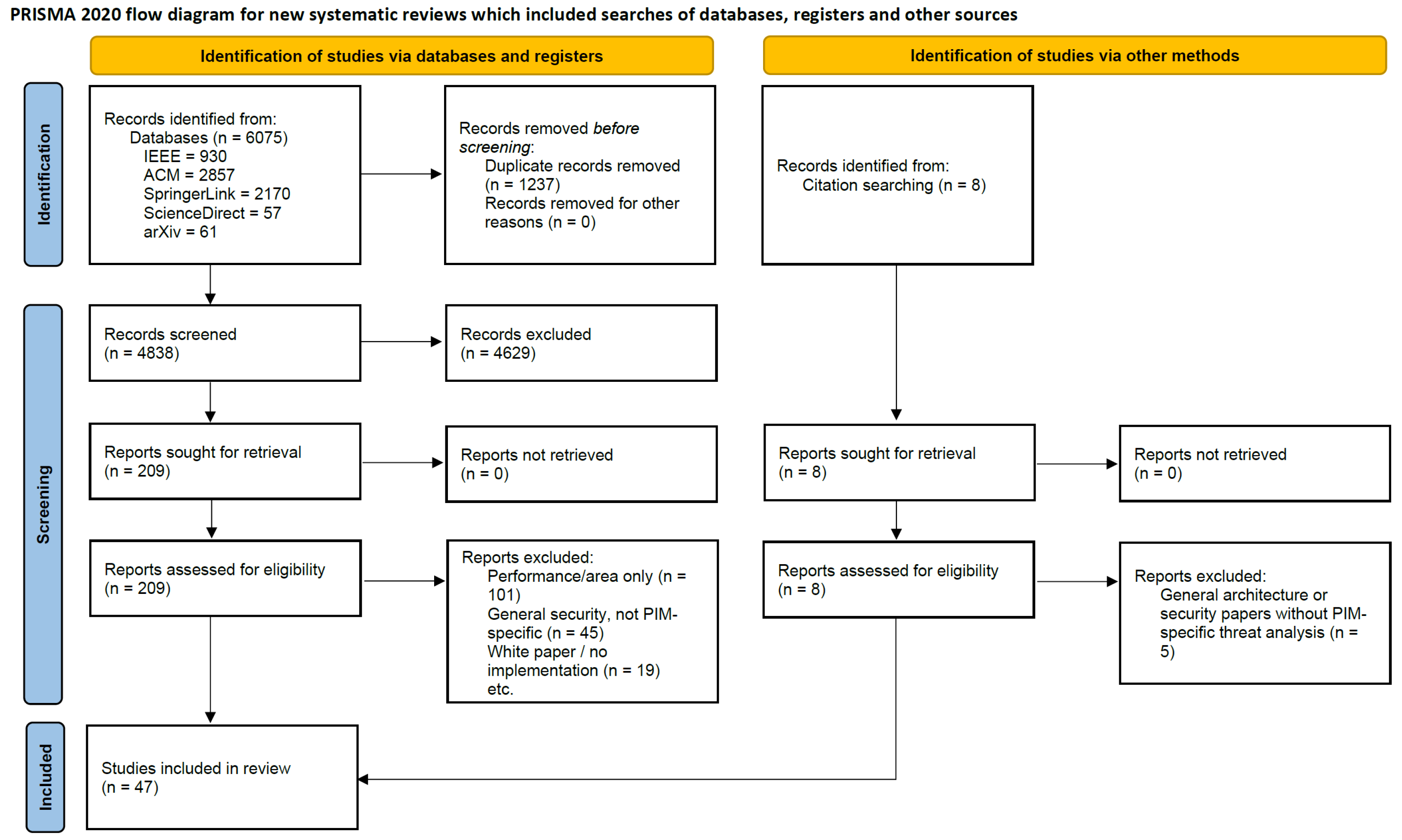
Initial retrieval yielded 930 records from IEEE Xplore, 2857 from ACM Digital Library, 2170 from SpringerLink, 57 from ScienceDirect, and 61 from arXiv, totaling 6075 records. ACM Digital Library exports were retrieved in batches due to platform constraints; 91 within-platform duplicates were identified and removed during consolidation. Eight additional records were identified through backward reference chaining of retained works. After cross-database deduplication by DOI and normalized title string, 4838 unique records remained for screening.
Title-and-abstract screening was conducted manually by the primary author. To mitigate single-reviewer bias, inclusion and exclusion criteria were iteratively refined through discussion among all co-authors before screening commenced, and the final synthesis, including threat classification assignments and defense-category mappings, was reviewed and validated by all co-authors. All screening and extraction decisions are transparently reported against the stated criteria (IC1–IC5, EC1–EC5) to enable independent verification, and a completed PRISMA 2020 checklist is provided in the
Supplementary Materials. Applying criteria IC1–IC5 and EC1–EC5 excluded 4629 records; 209 proceeded to full-text review alongside the 8 reference-chained records, for a total of 217 full-text assessments. Full-text screening excluded 170 records: 101 addressed PIM performance or area without security content (EC1); 45 addressed general trusted-execution or enclave security without PIM-specific threat analysis (EC2); 19 were white papers or lacked sufficient implementation detail (EC3); and 5 identified through reference chaining did not meet inclusion criterion IC2. Forty-four publications were retained from database searches and 3 from reference chaining, NeuroPIM, Virtual PIM, and SecPM, yielding a final synthesis corpus of 47 publications.
Figure 1 illustrates the complete PRISMA flow.
For each retained publication, the following fields were extracted into a structured coding table: (i) PIM architecture class (LiM, NDP, or NVM-based); (ii) threat category addressed (using the six-domain classification developed in
Section 5); (iii) adversary model assumptions (attacker capability level, trust boundaries, and scope exclusions); (iv) defense mechanism type and granularity; (v) evaluation platform (simulation, FPGA, or real hardware) and workload suite; and (vi) reported quantitative metrics, including performance overhead, area overhead, energy overhead, and security metrics such as covert-channel throughput or bit-flip rates, where available. Synthesis was conducted through thematic analysis: extracted data were iteratively grouped by threat domain and architectural boundary, producing the six-domain threat classification and the comparative defense summary in
Section 5.7. Cross-paper overhead comparison is also presented with explicit caveats regarding heterogeneous evaluation baselines. No meta-analytic pooling was performed, as the heterogeneity of evaluation platforms, workload suites, and reported metrics across the corpus precludes meaningful statistical aggregation.
This survey does not cover the following: (i) general-purpose DRAM reliability or ECC mechanisms without PIM-specific threat analysis; (ii) software-only encryption or privacy-preserving computation frameworks (e.g., homomorphic encryption) that do not interact with PIM hardware; (iii) supply-chain attacks requiring chip decapsulation or invasive physical modification, which are noted as an open gap but excluded from the adversary model; (iv) security analysis of analog compute-in-memory designs operating purely through charge-sharing without any digital controller, as no published PIM-specific security mechanism targets this substrate; and (v) commercial PIM products released after the search cutoff date of April 2025. The conceptual framework proposed in
Section 7 is a structured design proposal supported by preliminary DRAM-interface sensitivity analysis, not a demonstrated hardware implementation; its validation requirements are specified in
Section 7 and scoped as future work.
3. Types of Processing-in-Memory (PIM) Architectures
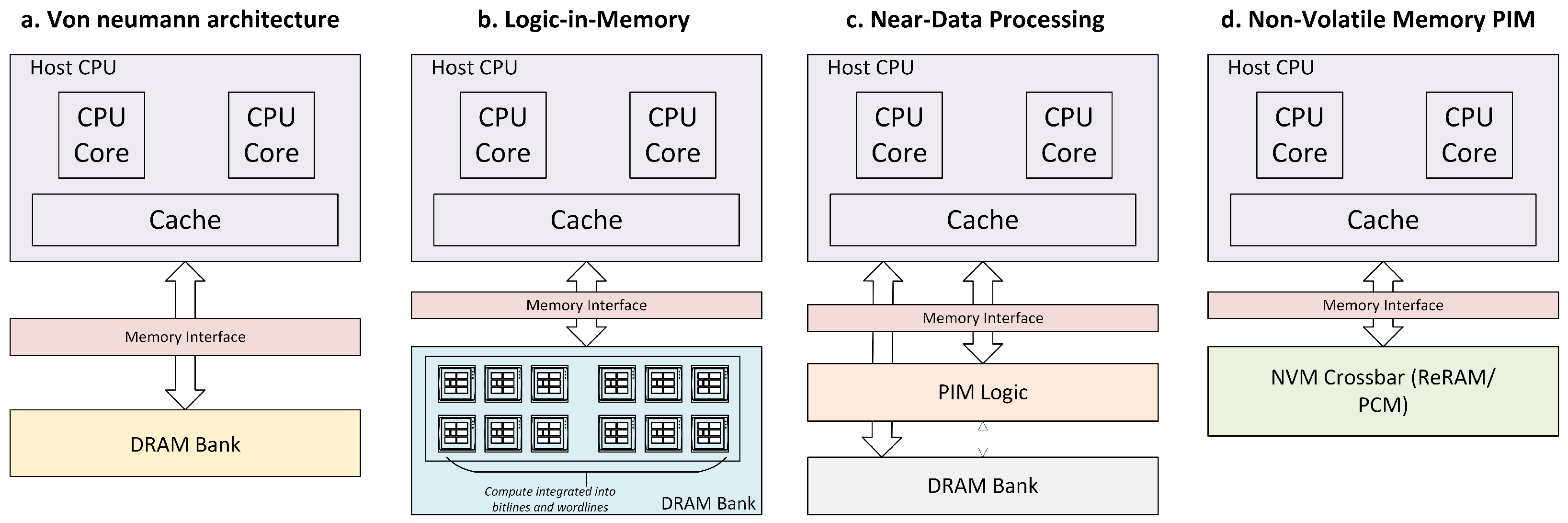
The attack surface of Processing-in-Memory (PIM) is diverse, encompassing designs that embed simple logic directly within memory arrays as well as architectures that integrate programmable cores near memory banks. This diversity is architectural and functional, spanning differences in programmability, workload scope, and underlying memory technologies. As illustrated in
Figure 2, compute placement fundamentally shapes these design classes, Logic-in-Memory (LiM), Near-Data Processing (NDP), and Non-Volatile Memory (NVM)-based PIM.
Logic-in-Memory (LiM) designs embed computation directly inside memory arrays, typically exploiting the analog properties of DRAM cells [
19,
20,
21]. Ambit, a seminal DRAM-based PIM design, employs triple-row activation to realize bulk bitwise operations such as AND, OR, and XOR through charge-sharing mechanisms [
22]. This reduces data movement and can accelerate bulk bitwise database query workloads by up to 30× throughput over CPU baselines [
23]. However, embedding logic at the row-buffer level creates security vulnerabilities specific to row-buffer logic. For example, predictable access patterns in Ambit’s bulk operations can amplify disturbance errors, exacerbating RowHammer-style attacks [
24]. Separately, since LiM relies on non-standard row activation sequences, adversaries can potentially exploit timing anomalies as side-channels, confirming the need for refresh-based mitigation or row remapping [
25].
Near-Data Processing (NDP) architectures move computation into programmable logic placed close to, but outside, the memory array. Tesseract integrates simple in-order cores beneath stacked DRAM layers in an HBM package to accelerate graph workloads, reporting up to 10× performance improvements over CPU baselines [
26]. Similarly, UPMEM’s commercial PIM-DRAM DIMMs deploy thousands of embedded RISC cores adjacent to DRAM banks, enabling data-parallel workloads such as genomics and search [
10]. While offering programmability and broader workload coverage than LiM, NDP introduces security challenges rooted in its physical organization. The proximity of programmable logic to shared memory arrays expands the attack surface for direct memory access (DMA) exploits, privileged software attacks, and multi-tenant isolation failures. In UPMEM, the absence of built-in memory encryption means security must be enforced externally, raising concerns for cloud-scale adoption. Thermal coupling between active cores and DRAM also complicates integrity guarantees, as overheating can induce retention faults exploitable by adversaries [
27].
Beyond DRAM-based designs, ReRAM, PCM, and STT-RAM enable analog computation within dense crossbar arrays [
28,
29,
30,
31,
32,
33]. PRIME leverages ReRAM’s resistive states to implement matrix–vector multiplication (MVM), a critical primitive for deep learning, achieving up to 895× energy efficiency gains over neural processing units [
14]; tools such as NeuroSim extend this to full-stack simulation across multi-layer networks [
34]. However, the shift from digital to analog in-memory computation introduces previously uncharacterized information leakage mechanisms. Device variability and resistance drift can leak information about model weights or input data, forming a new class of analog side-channels. Limited endurance also raises concerns, as carefully crafted wear-out patterns could embed persistent backdoors into the crossbar array. Security measures such as device-level error correction or stochastic bit masking mitigate reliability faults but add performance overhead, reflecting the trade-offs between efficiency and resilience [
15].
A growing class of PIM architectures combines programmable digital logic with analog compute elements, creating hybrid designs that do not fit cleanly into the LiM, NDP, or NVM-only categories above. For example, architectures that pair ReRAM crossbar arrays for analog matrix–vector multiplication with digital RISC-V controllers for non-linear activation functions and data routing [
29] inherit security exposures from both domains: the analog compute path is susceptible to resistance-drift side channels and device-variability leakage characteristic of NVM-based PIM, while the digital controller path faces code-injection and privilege-escalation risks characteristic of NDP. The security profile of such mixed-signal designs differs from pure digital systems in two specific ways. First, the analog-to-digital conversion boundary introduces a new information leakage surface, as ADC quantization noise can be correlated with input data to reconstruct operand values. Second, the absence of a unified memory protection model spanning both analog crossbar state and digital scratchpad memory means that isolation enforcement must operate across two physically distinct substrates with incompatible access semantics. These hybrid designs are not separately classified in our taxonomy because no PIM-specific security mechanism in the surveyed literature targets the analog–digital boundary as a distinct threat surface; we identify this as an open gap.
The variety of PIM designs reveals a three-way tension between computational flexibility, memory proximity, and isolation guarantees. LiM systems excel in reducing data movement but are constrained in functionality and integration. NDP provides enhanced programmability but requires memory isolation enforcement and encrypted DMA channels to mitigate the risks introduced by offloading and runtime execution. NVM-based PIM demonstrates measured energy efficiency gains for in-memory AI acceleration but faces unresolved challenges in reliability and secure analog computing [
35]. By situating future discussions in this taxonomy, supported by the comparative security posture shown in
Table 1, we establish an evaluative basis for assessing existing security solutions and identifying threat vectors unique to each class of architecture.
6. Adversary Model for PIM Systems
The attack surface of a Processing-in-Memory (PIM) system reflects the heterogeneity of its execution pipeline and the erosion of traditional trust boundaries inherent to memory-side computation. Prior analyses address individual threat classes in isolation—SecNDP and PIM-Enclave focus on descriptor authentication [
39,
53], DEV-PIM and IMPACT characterize microarchitectural inference channels [
36,
47], and P-PIM and LT-PIM examine row-disturbance effects [
12,
13]—yet no prior work consolidates adversary capabilities, architectural boundaries, and success conditions into a unified structure suitable for systematic defense evaluation.
Four adversary classes operate within this threat environment. First, a malicious co-tenant interacts with the PIM runtime through sanctioned SDKs and command queues, issuing arbitrary kernels, crafting operand layouts, and modulating contention to infer or influence a victim’s execution. Second, a compromised host OS or hypervisor exerts far broader control, capable of remapping physical memory, forging PIM descriptors, altering dispatch order, or shaping scheduling metadata. Third, a malicious or compromised firmware entity such as corrupted controller microcode or an altered in-memory instruction interpreter, poses an even more potent threat by redefining the semantics of memory-side execution. Fourth, a limited physical adversary with transient access to memory channels or DIMM connectors is bounded as a passive observer: it may monitor channel signaling and recover remanent state, but it cannot inject signals, induce faults, or perform invasive chip modification [
12,
13]. None of these adversaries are assumed capable of breaking standard cryptography or subverting hardware roots of trust that are securely provisioned into the system.
Using the adversary capabilities defined in
Table 5, the STRIDE mapping in
Table 6 was constructed as follows. For each architectural boundary, each of the six STRIDE categories was evaluated: a category was assigned if a concrete attack mechanism exploiting that boundary appears in the surveyed literature or follows directly from the boundary’s properties.
Spoofing at the host–PIM interface arises because PIM descriptors carry no cryptographic origin binding in current implementations [
44,
53]; a compromised host OS can therefore forge valid-looking descriptor sequences. Tampering at the DRAM substrate arises from RowHammer’s demonstrated ability to flip bits in physically adjacent rows without read permission on those rows [
13,
24]. Denial of service at the DRAM substrate arises from IMPACT’s demonstrated 8.2–14.8 Mb/s covert channel, which requires sustained high-rate activations that consume row-buffer cycles available to co-resident tenants [
36]. Repudiation at the NVM persistent storage layer arises because no surveyed NVM-PIM mechanism provides a tamper-evident audit log of scratchpad writes; rollback attacks can therefore erase evidence of unauthorized access [
66]. Repudiation risk extends beyond NVM persistence to the DRAM controller command queue: in current PIM architectures, command queues that schedule row activations, precharges, and PIM kernel dispatches maintain no tamper-evident log of issued commands. A compromised firmware entity or privileged attacker can issue unauthorized PIM operations and subsequently overwrite the command queue entries, eliminating evidence of the unauthorized execution. Implementing command-queue auditing within the DRAM controller would require appending a cryptographic hash or sequence number to each dispatched command and persisting these audit records in a write-protected region of the memory controller’s SRAM, analogous to DEV-PIM’s instruction-sequence verification [
47] but extended to cover all memory-side command types rather than CPU-side instructions only. The overhead of such auditing, in terms of both command-queue depth reduction and verification latency, has not been evaluated in any published PIM work. Elevation of privilege at the host–PIM interface is the success condition of descriptor forgery (above); it is listed separately because its precondition (insufficient descriptor authentication) differs from the spoofing precondition (absent origin binding). Information disclosure appears at four boundaries because timing, spatial, and remanence channels each require a distinct countermeasure class; collapsing them into a single entry would obscure the defense design space.
These threats arise at multiple architectural boundaries, mapped to their corresponding STRIDE categories in
Table 6. At the host–PIM interface, untrusted software can construct descriptor sequences or operand placements that coerce PIM logic into privilege escalation; SecNDP and PIM-Enclave enumerate these risks by demonstrating how insufficiently authenticated descriptors enable unauthorized execution [
39,
53]. Within the PIM logic itself, micro-architectural timing and operand-dependent behaviors, as characterized by DEV-PIM and IMPACT [
36,
47], create channels through which co-tenants may infer sensitive data. At the DRAM substrate, subarray-level interference, activation patterns, and row-buffer reuse amplify information leakage in ways not encountered in CPU-centric memory models. Row-disturbance failures identified in P-PIM and LT-PIM [
12,
13] demonstrate how manipulation of memory physics can corrupt nearby state or tamper with PIM-resident data. Persistent storage paths create additional attack vectors through persistent state: remanence and rollback risks documented in SecPM and TriadNVM [
64,
66] confirm how stale data may survive beyond its intended lifecycle, enabling cross-tenant recovery attacks in non-volatile memory (NVM) subsystems.
Trust in this environment resides in the secure microcode of the PIM controller, its embedded roots of trust, and the correctness of DRAM signaling at the physical level. The host software stack, including OS, hypervisor, libraries, and user runtimes, is considered untrusted. Co-tenants are likewise untrusted, even when logically isolated at the bank or subarray level by OS-enforced address-range partitioning. Such partitioning constrains memory addressing but does not prevent timing-based inference or row-disturbance across subarray boundaries, as demonstrated by IMPACT and P-PIM [
13,
36]. Fully invasive attacks requiring chip decapsulation or microprobing are excluded, as the primary deployment context addressed by this survey is cloud and data center PIM where an adversary is assumed to lack sustained unsupervised physical access to individual DIMMs; supply-chain threats operating prior to deployment are noted as an open gap in
Section 5.7 but are outside the scope of the adversary model formalized here. Timing, contention, micro-architectural interference, firmware compromise, and remanence-based observations remain fully in scope.
Across adversary classes, success conditions include exfiltrating data or model parameters through timing or spatial inference, escalating from unprivileged PIM kernels into privileged control domains, silently corrupting or biasing computation within banks or subarrays, and denying service by exhausting PIM engines, row-buffer cycles, or controller queues. These conditions structure a STRIDE threat analysis applied to the host–PIM interface, the PIM-DRAM micro-architecture, and inter-tenant sharing domains; the mapping of each boundary to its applicable STRIDE categories appears in
Table 6. Spoofing and elevation of privilege manifest as forged descriptors or compromised microcode; tampering and information disclosure arise from subarray interference and operand-dependent execution; and denial of service emerges through orchestrated contention. Representative attack paths, including IMPACT-style covert channels, RowHammer-like disturbance escalation, and remanence-driven reconstruction, are captured as attack-tree sequences (
Table 7), observed in existing prototypes.
The resulting threat model formalizes the adversarial environment in a manner suitable for evaluating existing defenses and motivating the secure-by-design PIM substrate proposed in
Section 7.
7. Conceptual Framework for Security-Centric PIM
PIM security research has reached a point where ad hoc or compartmentalized defenses demonstrate fundamental limitations that cannot be resolved through incremental refinement of existing CPU-centric models. Existing CPU-centric security models, based on monolithic enclaves, software-enforced access control, or top-down attestation, treat memory as a passive storage medium. The five mechanisms proposed here draw on primitives that appear individually in prior NDP security work; the contribution is their synthesis as a memory-resident compositional unit with explicit inter-mechanism dependencies. PIM introduces a structurally different condition: execution, communication, and data persistence coexist within the same physical domain. This section proposes a conceptual security framework that addresses this structural gap by locating trust enforcement within the memory substrate itself. No prototype of this framework has been implemented; however, a preliminary simulation characterizing DRAM-interface-level sensitivity is presented in
Section 7.1. The contribution remains a structured design proposal intended to guide future experimental and formal validation. This positioning is consistent with prior architectural proposals in the PIM and near-data processing literature that established design foundations before implementation, including early near-data processing security models [
53] and memory-side encryption frameworks [
64]. The proposed framework is intentionally positioned as a security architecture specification rather than a circuit-level implementation. It defines the enforcement locations, security invariants, and interaction requirements of five memory-native mechanisms. The preliminary simulation characterizes selected DRAM-interface-level sensitivity costs; circuit-level realization, multi-bank scheduling, and adversarial multi-tenant validation remain necessary steps before implementation-level performance or area claims can be made. Conventional enclave architectures, such as Intel SGX and ARM TrustZone, confine threats within CPU-controlled contexts and assume a single, central root of trust. Such models cannot scale to the distributed, high-bandwidth, and disaggregated topology of PIM, where thousands of compute units share banks, subarrays, and data buses. Rather than adapting these CPU-centric models, the proposed framework treats computation locality, timing, and access patterns as first-class elements of the security design. Specifically, it organizes five conceptual mechanisms—subarray-level isolation, temporal compartmentalization, distributed trust anchoring, data-oblivious execution, and adaptive policy orchestration—as complementary layers of a memory-resident defense model of the PIM threat environment.
Table 8 positions each mechanism against prior PIM security proposals across five security properties: access-control granularity, data lifetime control, attestation topology, access-pattern confidentiality, and policy adaptability.
The first mechanism is subarray-level isolation. Existing PIM defenses, including SecNDP and PIM-Enclave, enforce access control at page or bank granularity. The proposed framework instead locates enforcement at wordlines or bitline groups, the smallest physical granularity of DRAM. This finer boundary is motivated by the observation that adversarial computation can exploit spatial interference or sense-amplifier coupling within a single bank, a threat that coarser isolation boundaries do not contain. Conceptually, lightweight access-control metadata embedded within the local row decoder would associate each compute request with an authenticated context, binding privilege domains to their physical locality. Embedding digital checking circuits in the peripheral control logic of high-density DRAM raises physical feasibility concerns. DRAM row decoders operate within stringent physical layout constraints: the wordline pitch in modern DDR4/DDR5 nodes is 30–40 nm, and the row-activation timing window () is approximately 13–14 ns. Inserting metadata-check logic into this critical path risks both throughput degradation from increased and signal integrity deterioration from additional routing in the sense-amplifier peripheral region. The proposed metadata is therefore not intended to be embedded in the row decoder’s critical timing path. Instead, it would be stored in a dedicated SRAM tag array adjacent to the row decoder (analogous to the tag arrays used in CACTI-modeled cache structures), with the metadata check performed in parallel with the row-activation precharge phase rather than serialized with the wordline assertion. Under this design, the metadata check consumes the precharge interval ( ns) rather than adding to , resulting in zero additional latency for row-hit accesses and one penalty only for row-conflict accesses that require a metadata context switch. The area overhead of the tag array is estimated at 4–16 bits per row × the number of rows per subarray; for a 1024-row subarray with 8-bit tags, this yields 1 KB of SRAM per subarray, which is less than 0.1% of the subarray’s data capacity.
The proposed metadata store is modest in capacity: 1 KB per subarray represents approximately 0.1% of the data capacity in an illustrative 1024-row, 1 KB-per-row subarray organization. Existing RowHammer mitigations demonstrate the architectural use of activation-history metadata and targeted refresh logic at bank granularity, although the detailed circuit placement and implementation of commercial TRR mechanisms are proprietary [
11,
70]. Accordingly, we use TRR only as evidence that production DRAM can support bank-level metadata tracking; it does not establish that our tag-array design has the same physical implementation. The framework assumes a peripheral tag store and authorization path that operates in parallel with row-state transition handling. In DDR4-2400,
is approximately 13 ns; the preliminary evaluation therefore sweeps an added activation-path delay of 2–10 ns to cover a range from lightweight tag comparison through a conservative policy-check abstraction. A realizable design must ensure that metadata lookup, context comparison, and gating complete within the controller’s scheduled row-transition interval, or otherwise account for the residual delay explicitly. The present work does not claim timing closure; it identifies the
interval as the design-target window and bounds the overhead sensitivity through simulation. Tag updates are assumed to occur only at security-context reassignment (e.g., tenant migration), not on ordinary data accesses. Their scheduling and atomicity must be coordinated with bank quiescence, refresh scheduling, and controller state transitions; evaluating those interactions requires a modified DRAM-controller model and circuit/layout data unavailable in the present study. Likewise, routing-density, coupling, and process-compatibility effects require a proprietary DRAM PDK. The discussion therefore establishes architectural plausibility and identifies design constraints, rather than demonstrating final physical implementation feasibility.
Preliminary gem5 simulation results quantifying the timing overhead of this metadata check are presented below. Unlike static firewalling, this isolation is designed to be dynamically scalable, with context boundaries shifting as workloads migrate or memory is reconfigured under all runtime configurations. Evaluating this mechanism would require DRAMSim3 coupled with a RISC-V-based PIM ISA to emulate metadata propagation latency and verify context isolation under varied bank utilization scenarios [
58]; such evaluation is identified as future work. The applicability of subarray-level isolation to Logic-in-Memory designs warrants explicit discussion. LiM architectures such as Ambit operate through charge-sharing mechanisms at the bitline level, with no programmable logic capable of hosting metadata or context tags. Embedding access-control metadata within a LiM row decoder therefore requires adding digital logic to an analog compute substrate, a modification that increases area and may degrade the charge-sharing margins on which LiM computation depends. The honest implication is that the subarray-level isolation mechanism as described applies most directly to NDP-class PIM, where a programmable logic layer exists to host the metadata. For LiM, the appropriate security primitive is likely coarser: bank-level address-range enforcement enforced by the memory controller rather than within the array, accepting a weaker isolation guarantee in exchange for preserving LiM’s efficiency. This distinction is reflected in
Table 8, where R1 is scoped to designs with programmable logic layers.
The second mechanism is temporal compartmentalization. Persistence mechanisms such as SecPM and TriadNVM address durability and consistency but do not control how long sensitive state remains accessible after a computation completes. The proposed framework addresses this by embedding time-to-live (TTL) metadata and monotonic counters within memory controllers, such that sensitive state or cached operands expire after a bounded interval and trigger secure overwrite or obfuscation routines. This design targets rollback, remanence, and post-crash forensics threats that persistence-focused prior work leaves unaddressed. The resulting construct is referred to here as a secure execution cell: a logical unit that autonomously manages its own data retention lifecycle within a single bank context. This differs from a PIM-Enclave or standard TEE in a specific and intentional way. Existing enclave designs, including SE-PIM and PIM-Enclave, establish confidentiality and integrity boundaries for computation, but do not bound how long data persists after the computation ends. Existing enclave designs bound who can access data. A secure execution cell bounds how long the data exists; the TTL counter triggers scrubbing regardless of access state, closing the remanence window that enclave-style access control leaves open. The differentiating primitive is therefore TTL-bounded scrubbing, not access control, which existing enclave designs already provide. Overhead is expected to be dominated by timer synchronization; simulation-level validation is required before any performance claim can be made.
For TTL counters to function accurately across disaggregated memory banks, a consistent time reference must be maintained across independently clocked domains. In HBM2e stacks, each bank operates within the memory clock domain (typically 1.2–1.6 GHz), while the host controller and CXL interconnect operate on separate clock domains. The proposed TTL counters would be clocked from the memory-side clock domain, using the bank’s local row-activation clock as the time base. Cross-bank TTL consistency does not require strict clock synchronization; instead, each bank’s TTL counter operates on its local clock, and the policy co-processor (mechanism five) reconciles TTL expiration events across banks using a loosely synchronized epoch protocol, analogous to the epoch-based reclamation used in concurrent data structures. The maximum allowable clock skew between banks determines the worst-case TTL enforcement granularity: at 1.6 GHz memory clock with ±1% clock skew across banks, the TTL enforcement window has a worst-case imprecision of ±10 ns per microsecond of TTL duration, which is well within the timing margins of the scrubbing operations that TTL expiration triggers. For CXL-attached deployments where memory devices have fully independent clock domains, the host-side CXL controller would broadcast periodic synchronization beacons; the latency cost of these beacons is identified as a parameter requiring simulation-level characterization. Critically, TTL counter integrity depends on the distributed trust anchors described in the following mechanism: without anchor attestation, an adversary could forge or reset TTL counters, nullifying temporal confinement. This dependency is the primary inter-mechanism coupling in the proposed design.
The third mechanism replaces centralized enclaves with distributed trust anchors instantiated across memory banks. In prior work such as SE-PIM and PIM-Enclave, attestation flows through a static enclave hierarchy. The proposed model instead assigns each bank anchor the role of local verifier, responsible for attesting to the authenticity of PIM cores, managing ephemeral cryptographic keys, and validating operand integrity. The design specifies two attestation directions: horizontal chains across banks to prevent cross-bank impersonation, and vertical chains across hardware and software layers to authenticate orchestration commands. Horizontal attestation means that each anchor cryptographically verifies the identity of adjacent bank anchors before accepting cross-bank operands. Vertical attestation means that each anchor validates the command provenance of the orchestration layer above it before executing policy updates. These anchors could be implemented in the logic layer of HBM2e or FPGA-based Near-Data Processing prototypes, with attestation verified through lightweight cryptographic checksums embedded in command queues. This distributed structure is motivated by PIM’s physical disaggregation: a centralized root of trust is structurally incompatible with a topology in which computation and storage are distributed across hundreds of independent banks, each with co-located compute and storage resources.
A critical open question for this mechanism is how bank anchors acquire their initial identities in a vendor-disaggregated deployment, where the memory device and host controller may originate from different manufacturers. The proposed approach follows the manufacturer-provisioned endorsement model established in Sanctum [
72], in which the processor manufacturer signs a hardware root key at fabrication time, enabling remote attestation without host involvement. Adapted to the memory substrate, each bank anchor’s asymmetric key pair is generated and signed by the memory manufacturer during wafer-level test, with the endorsement certificate stored in one-time-programmable fuses in the logic layer. In a CXL-attached deployment, the host controller requests the anchor’s endorsement certificate and validates it against the manufacturer’s public root certificate, a process that requires no trusted host, only a trusted manufacturer PKI. Sanctum demonstrates this bootstrapping model on an open RISC-V implementation [
72], the same ISA class targeted for NDP-class PIM logic layers, making the provisioning model directly portable. Specifying the certificate format, revocation mechanism, and chain-of-trust policy for PIM-specific deployments is identified as a concrete standardization target within the second research trajectory of
Section 8.
When a bank anchor’s key is compromised or a memory module is replaced in a disaggregated topology, the revocation mechanism must propagate the invalidation to all peer anchors that have established horizontal attestation chains with the compromised anchor. The proposed approach uses a certificate revocation list (CRL) distributed through the CXL controller’s management channel: upon detecting a compromised anchor (via failed attestation challenge or external revocation signal from the manufacturer PKI), the CXL controller broadcasts a signed CRL update to all bank anchors in the affected CXL memory pool. Each anchor maintains a local CRL cache in its OTP-adjacent SRAM and rejects cross-bank operands from any anchor whose certificate appears on the CRL. During dynamic task migration, when a PIM workload migrates from one bank to another, the destination bank’s anchor must (i) verify that the source bank’s anchor is not revoked, (ii) establish a fresh ephemeral session key with the source anchor for secure transfer of the workload’s cryptographic context, and (iii) re-attest the migrated workload’s integrity before permitting execution. This three-step migration handshake introduces latency overhead proportional to the cryptographic operation cost (estimated at 100–500 ns for lightweight symmetric key exchange on the logic-layer process node), which must be amortized across the migration interval to remain within acceptable bounds. The precise latency and its interaction with PIM scheduling remain open empirical questions.
The fourth mechanism addresses data-oblivious execution. Full oblivious RAM (ORAM) is well established as impractical for bandwidth-heavy workloads due to its logarithmic bandwidth overhead [
60,
73]. The proposed framework instead identifies three candidate techniques, deterministic access scheduling, operand shuffling buffers, and oblivious loop unrolling, as potential intermediate approaches that reduce access-pattern leakage without incurring full ORAM cost. These techniques are proposed as design candidates, not validated mechanisms. The design target for each candidate technique is to reduce the mutual information between the observable memory access sequence and the sensitive operand value, subject to available memory bandwidth constraints. More precisely, let
X denote the sensitive operand value and
Y the observable memory access sequence (row addresses and timing). The mutual information
quantifies the information an adversary gains about
X by observing
Y. For an unprotected PIM kernel,
is bounded above by the entropy
of the operand space. Each candidate technique targets a specific reduction mechanism: deterministic access scheduling forces
Y to be independent of
X (achieving
for the scheduled access component), operand shuffling introduces noise into the
mapping (reducing
by the entropy of the shuffling permutation), and oblivious loop unrolling eliminates data-dependent branch patterns (reducing the conditional entropy
contribution from control flow). Quantifying
for each technique under realistic PIM workloads requires collecting bank-conflict timing traces from cycle-accurate simulation and applying a k-nearest-neighbor mutual information estimator [
74], a methodology established for cache side-channel analysis. This quantification is identified as future work; we note that the absence of formal mutual-information bounds is a limitation shared with all surveyed PIM defense mechanisms, none of which provide information-theoretic security guarantees.
Oblivious loop unrolling, which eliminates data-dependent branch behavior by executing all loop iterations regardless of early-exit conditions, can cause severe instruction cache (I-cache) thrashing in NDP cores. NDP-class PIM cores typically have small I-caches (e.g., UPMEM DPUs have a 24 KB instruction memory [
58]); aggressively unrolled loops expand the instruction footprint beyond the I-cache capacity, converting I-cache hits into misses and degrading throughput. The performance trade-off is quantifiable: for an unrolling depth of
d iterations with instruction body size
b bytes, the unrolled footprint is
bytes. When
exceeds the I-cache capacity
C, every unrolled iteration triggers an I-cache miss, with a miss penalty of ∼10–20 cycles on in-order NDP cores. The optimal unrolling depth limit is therefore
, beyond which the I-cache thrashing penalty exceeds the security benefit. For UPMEM DPUs with 24 KB instruction memory and a typical PIM kernel body of 64–256 bytes, this yields an optimal unrolling depth of 96–384 iterations. Beyond this limit, alternative obfuscation techniques such as operand shuffling buffers should be preferred. This trade-off must be evaluated per-platform, as I-cache sizes vary across NDP implementations. This mechanism couples with the distributed trust anchors of the third mechanism: anchor attestation extends to execution behavior, binding security guarantees to both the identity of the executing core and the obliviousness of its access schedule.
The fifth mechanism is a policy co-processor embedded within the memory controller. This unit is designed to interpret runtime directives and translate them into configuration updates for subarray access tags, TTL parameters, and oblivious scheduling modes. Conceptually, the co-processor receives three input signal classes: workload context descriptors from the host memory controller, tenant isolation directives from the orchestration layer, and attestation status flags from the distributed trust anchors. It produces two output classes: per-subarray configuration register updates and anchor reconfiguration commands. The motivation for this component is the heterogeneity of PIM deployment contexts: AI inference workloads have different isolation requirements than transactional memory operations, and a static security configuration cannot serve both without incurring unnecessary overhead in one case or insufficient protection in the other. Because the co-processor can issue reconfiguration commands to trust anchors, it must itself be treated as a trusted component; how the co-processor’s own trustworthiness is established, and whether it requires a separate bootstrap attestation step, is an open design question identified for future specification. The interface specification, latency budget, and interaction protocol with the attestation layer are scoped as future design work. On attestation failure, the co-processor halts configuration updates to affected subarrays until attestation is re-established; the precise failure semantics require formal specification.
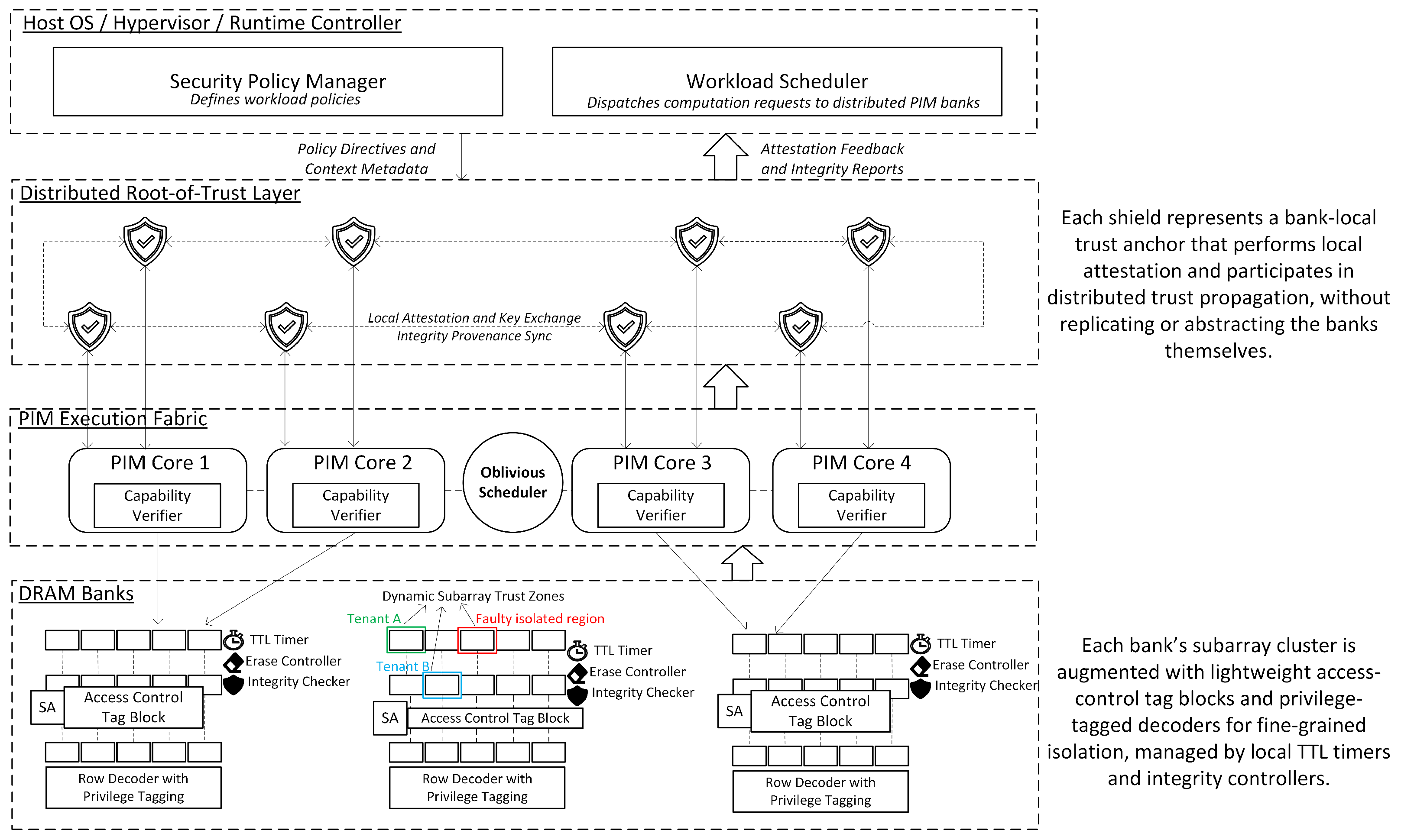
Figure 5 illustrates the conceptual relationship among these five mechanisms. The figure is architectural rather than implementational; it represents design intent and does not reflect measured or simulated behavior. As shown, the Host OS/Hypervisor layer issues policy directives and context metadata downward to the Distributed Root-of-Trust layer, whose bank-local trust anchors perform local attestation and integrity provenance synchronization with the PIM Execution layer below. Each PIM core incorporates a capability verifier, and an oblivious scheduler mediates access-pattern scheduling across cores. At the DRAM bank layer, each bank is augmented with an access-control tag block, privilege-tagged row decoders, TTL timers, erase controllers, and integrity checkers that enforce subarray-level isolation and temporal compartmentalization. Dynamic subarray trust zones, shown for two tenants and one isolated fault region, illustrate how context boundaries shift at runtime. Attestation feedback and integrity reports flow upward from the trust anchor layer to the host workload scheduler, closing the vertical attestation chain. The primary structural distinction from prior work is that the framework locates the root of trust within the memory array itself, requiring host-side software to obtain attestation from memory rather than imposing it upon memory. Whether this structural inversion produces measurable security or performance advantages over existing approaches is an open empirical question that the framework is intended to motivate.
The five mechanisms described above are designed primarily for NDP-class architectures with programmable digital controllers and, with caveats, for DRAM-based LiM designs. For purely analog compute-in-memory substrates, the proposed controller-centric mechanisms do not secure leakage originating within analog matrix–vector multiplication itself. Relevant leakage mechanisms include: (i) data-dependent current and power signatures during crossbar computation, which can reveal operand values through supply-current variation; (ii) device-state variation and drift in ReRAM/PCM cells, which causes stored weights to shift over time in a device-history-dependent manner detectable through repeated measurements; and (iii) information leakage through analog-to-digital conversion behavior, where quantization patterns at the crossbar output can correlate with input data. Mitigations such as stochastic bit masking [
15], noise shaping or injection, calibration and refresh procedures, and differential sensing must be implemented at the device or mixed-signal-periphery level and can incur energy, area, accuracy, or throughput costs whose magnitudes are implementation-dependent. These device-level mechanisms are complementary to, rather than replaceable by, digital access-control metadata.
Many production and near-production CiM designs are hybrid, combining analog crossbar arrays for matrix–vector multiplication with digital controllers for non-linear activation, data routing, and memory management [
29]. For such hybrid architectures, the framework’s applicability boundary falls at the analog-to-digital converter (ADC/DAC) interface: the five proposed mechanisms apply to the digital controller side (scheduling, access control, attestation, policy orchestration), while crossbar-internal leakage requires device- and mixed-signal-level protection. The ADC/DAC boundary is therefore a useful architectural point at which to define responsibility, but not a complete security boundary; a generally accepted composable interface that bridges digital-layer and device-layer security across this divide remains an open research problem.
Table 9 summarizes the applicability of each framework mechanism across PIM substrate types.
Validating this framework requires three methodological tracks. Functional evaluation using DRAMSim3 integrated with a RISC-V PIM ISA would quantify isolation latency, trust propagation overhead, and TTL enforcement cost under representative workloads [
58]. Formal verification using symbolic model checkers such as CoSA or SymbiYosys would verify isolation invariance and TTL erasure completeness as defined above. Scalability analysis on FPGA or HBM2e-based prototypes would measure context synchronization latency and policy switching overhead, with attestation targeting the ≈35 ns HBM2e row-activation window [
9]. Each track addresses a distinct class of claim and none substitutes for the others.
7.1. Preliminary Simulation Methodology
To provide an initial feasibility assessment of three key framework mechanisms, we use the gem5 simulator [
75] to evaluate security overhead at the DRAM interface level. The simulation runs in syscall-emulation mode with a TimingSimpleCPU at 500 MHz and a DDR4-2400 single-channel memory model. The configuration eliminates the cache hierarchy entirely: both instruction and data ports connect directly to the memory bus, ensuring that every load and store exercises the DRAM timing path where the proposed security mechanisms operate. This approximates the direct-DRAM-access behavior of NDP architectures, in which processing elements sit adjacent to DRAM banks and access memory without intervening caches, while remaining within stock gem5. Full NDP microarchitecture simulation, including bank-local scratchpad operation, host-to-NDP offloading concurrency, PIM-specific ISA extensions, and multi-bank parallel execution, is identified as future work requiring a custom simulator or gem5 fork. We parameterize three security-mechanism proxies independently: (i) subarray-level metadata checks, modeled as additional tRCD latency of 0, 2, 5, and 10 ns per row activation; (ii) data-oblivious padding, modeled as additional random memory accesses at 0%, 10%, 25%, 50%, and 100% of the original access count; and (iii) TTL counter maintenance, modeled as periodic DRAM writes at frequencies of 1/1000, 1/100, and 1/10 of the primary access rate. Three micro-benchmarks exercise distinct memory-access patterns: sequential scan (64 MB streaming), random access (uniform random over 64 MB), and strided access (4096-byte stride). Because no cache filters memory traffic, the measured overheads represent upper-bound estimates of the cost each mechanism imposes when every access reaches DRAM. We measure throughput degradation relative to the corresponding zero-overhead baseline for each benchmark. This setup constitutes a preliminary proof-of-concept evaluation at the DRAM interface level; it does not represent full system-level validation, which would require a distributed multi-channel PIM simulator with bank-local scratchpads, concurrent host-NDP traffic, and hardware-enforced isolation logic.
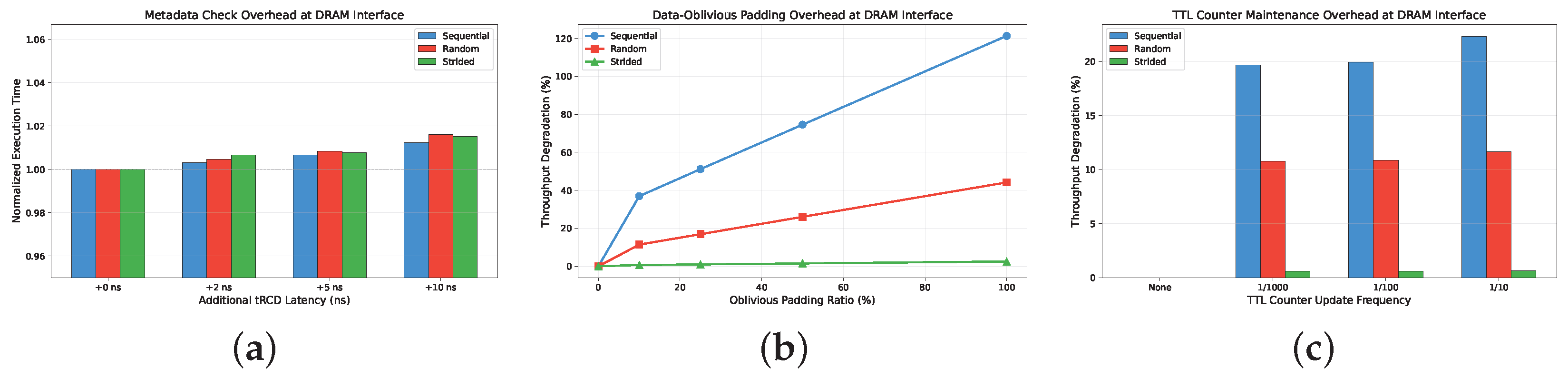
Table 10 summarizes the results across all three mechanisms and
Figure 6 visualizes the overhead trends. Because the cache hierarchy is eliminated, all memory traffic, including instruction fetches, reaches DRAM, producing uniformly high baseline row-buffer hit rates (≈92–93%) across all three benchmarks. This uniformity arises because the sequential instruction stream dominates the overall access pattern regardless of data-access locality. Metadata-check overhead (
Figure 6a) remains modest across all configurations: even at +10 ns tRCD, degradation stays within 1.2–1.6% because the additional latency is paid only on the ≈7% of accesses that are row-buffer misses. The uniformity across benchmarks confirms that subarray-level isolation tags are inexpensive when amortized over the dominant instruction-fetch traffic. Data-oblivious padding (
Figure 6b) is the most expensive mechanism: the injected dummy accesses disrupt row-buffer locality, producing up to 121.3% degradation (≈2.2× slowdown) for sequential access and 44.2% for random access at 100% padding. Both are higher than they would be with caches, as expected: without cache filtering, every dummy access incurs full DRAM latency. Overhead scales near-linearly with padding ratio, providing a predictable cost model for deployment tuning. TTL counter maintenance (
Figure 6c) imposes 19.7–22.3% overhead for sequential access and 10.8–11.7% for random access, with weak dependence on write frequency. This confirms that the cost is dominated by per-write row-buffer disruption rather than aggregate write bandwidth: even infrequent TTL writes force row closures that penalize subsequent accesses.
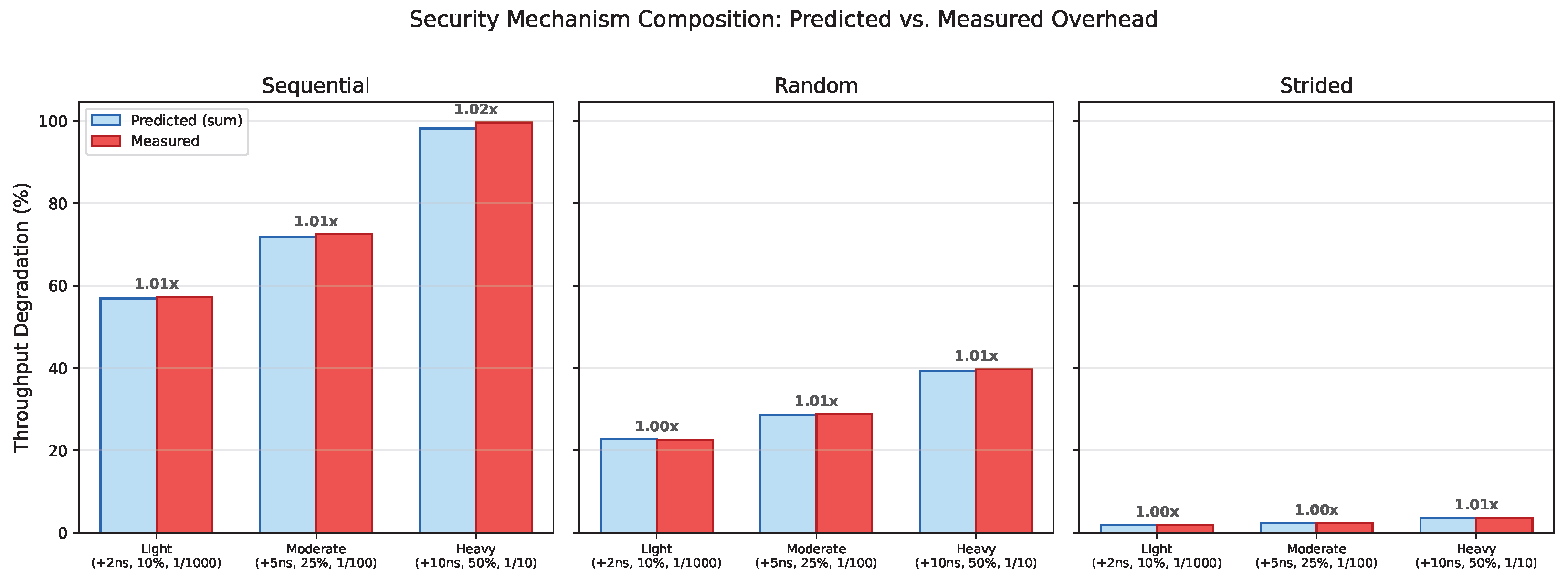
A critical question for any composable defense stack is whether overheads interact superlinearly when multiple mechanisms are deployed simultaneously. To evaluate this, we run composition experiments that combine all three mechanisms at three intensity levels: light (+2 ns tRCD, 10% padding, 1/1000 TTL), moderate (+5 ns tRCD, 25% padding, 1/100 TTL), and heavy (+10 ns tRCD, 50% padding, 1/10 TTL). For each configuration, we compute the predicted overhead as the linear sum of the three individual-mechanism overheads measured in
Table 10 and compare it against the measured overhead of the combined deployment. The ratio of measured to predicted overhead yields an interaction factor: values near 1.0 indicate linear (additive) composition, while values above 1.0 indicate superlinear interaction.
Table 11 presents the composition results. Across all nine benchmark–configuration combinations, interaction factors range from 1.00 to 1.02, confirming that the three mechanisms compose nearly linearly at the DRAM interface. The slight superlinear effect observed in the heavy-sequential configuration (1.02) is consistent with increased row-buffer contention when metadata latency, dummy padding accesses, and TTL writes all compete for the same bank: each mechanism’s additional accesses marginally increase the probability that the next mechanism’s access encounters a closed row. That this effect remains at 2% even under heavy combined load is a favorable result for the framework’s composability thesis, as visualized in
Figure 7. The near-linear composition supports the design assumption in
Section 7 that security-mechanism costs can be budgeted independently and summed for system-level planning, at least at the DRAM-interface level evaluated here. The single-bank evaluation isolates per-request costs and does not capture shared-channel contention. In a multi-bank configuration, metadata checks are modeled as bank-local because they do not introduce additional external data transfers in the proposed design; their system-level effect is therefore primarily additional activation-path latency. In contrast, oblivious padding and TTL maintenance generate additional memory requests that consume shared command-bus, data-bus, and queue capacity. If baseline channel utilization is
U and padding increases memory requests by fraction
p, the first-order offered-load estimate is
. Workloads already operating near channel saturation will consequently experience nonlinear queueing growth at lower padding ratios than lightly utilized workloads. This effect is amplified by DRAM timing constraints, activation windows (
), bank-group restrictions, read/write turnaround penalties, and periodic refresh activity, each of which reduces the effective scheduling headroom available for security traffic.
The framework therefore treats adaptive policy orchestration (mechanism five) as a necessary control mechanism. A practical controller can monitor queue occupancy, row-buffer conflict rate, and per-bank utilization, signals commonly maintained by modern memory controllers, including queue occupancy, bank state, and request-stream locality indicators, and reduce padding intensity or defer TTL maintenance when contention exceeds a configured threshold. The stability behavior of such a controller and its security–performance trade-off curve require full-system multi-bank evaluation, which is identified as the first phase of the validation roadmap below.
Future compiler-controller co-design could further reduce bandwidth pressure: grouping accesses within security domains to preserve row-buffer locality, and scheduling padding during latency-tolerant periods rather than as independent additive operations. The present study does not model such compiler transformations; defining the compiler–hardware interface for security-aware PIM memory scheduling is identified as a concrete target for future work.
Within the modeled single-channel DRAM-interface configurations, metadata-check overhead remains modest for locality-friendly workloads. Oblivious padding imposes the primary performance cost and is the natural target for optimization (e.g., adaptive padding rates tied to observed contention). Within the modeled update frequencies, TTL-maintenance overhead remains bounded. Across all configurations, the three mechanisms compose near-linearly when deployed together.
7.2. Validation Roadmap
Advancing from this proof-of-concept to system-level validation requires three evaluation phases, each targeting a distinct class of concern. Phase 1 (multi-bank composition): extend the gem5 configuration to a multi-bank DDR4-2400 model with per-bank security parameterization, measuring shared command/data-path contention, bank-group restrictions, refresh interactions, and the stability of adaptive policy control under different utilization levels. Phase 2 (multi-tenant interference): add two independent processing cores sharing the memory subsystem with distinct security contexts, evaluating isolation enforcement, timing leakage, and performance under adversarial co-tenant access patterns modeled on demonstrated DRAM/PIM-style covert-channel access patterns [
36]. Phase 3 (NDP microarchitecture): integrate a RISC-V-based PIM processing element with bank-local scratchpad into a custom gem5 module, enabling evaluation of the full security framework including trust-anchor attestation latency and policy orchestration overhead. Together, these phases define the evidence needed before translating the present framework into implementation-level area, timing, and full-system performance claims.
7.3. Implementation Limitations
The five mechanisms proposed in this framework are specified at the architectural level. They identify security functions, intended enforcement locations, and interaction requirements, but they do not provide an RTL implementation, physical layout, complete key-management protocol, or formal leakage proof. The following limitations highlight the additional areas of work that must be addressed before practical implementation and deployment claims can be substantiated:
OS and hypervisor interaction: The framework locates trust enforcement within the memory substrate and treats the host software stack as untrusted (
Section 6). A deployable design nevertheless requires interfaces through which the host communicates context assignments, memory allocation, tenant migration, DMA offloading, and failure recovery to the memory-side enforcement logic. Because the adversary model grants a compromised host the ability to remap memory, forge descriptors, and manipulate scheduling metadata, these interfaces must ensure that the host cannot unilaterally establish, modify, or revoke security contexts without memory-side verification. Specifying such interfaces and their trust semantics is an open design challenge.
Trust-anchor provisioning and TTL synchronization: Distributed trust anchors require a concrete lifecycle-management protocol for device enrollment, credential provisioning, attestation, key rotation, revocation, and recovery after component replacement or compromise. Because the adversary model includes compromised host software and controller firmware, these operations must be protected against counterfeit enrollment, suppressed revocation, replayed attestation, and redirected policy updates; otherwise the anchors themselves can be subverted. Temporal compartmentalization likewise requires that TTL metadata be integrity- and freshness-protected at the memory side: host- or firmware-maintained TTL values could otherwise be extended, shortened, rolled back, or left inconsistent across banks by an adversary operating within the capabilities defined in
Section 6. The preliminary evaluation models representative maintenance traffic, but it does not implement these distributed protocols, memory-side metadata protection, or recovery paths.
Wear management and secure erasure: In NVM-based PIM, secure erasure must coexist with wear management, address remapping, persistence, and recovery. Logical invalidation may leave residual copies in remapped physical locations. A practical solution requires controller-integrated sanitization, cryptographic erasure, or verified mapping-aware erasure; the framework identifies this requirement but does not define such a mechanism.
Side-channel protection and performance: The simulated padding mechanism is configurable traffic shaping rather than a formal ORAM construction. It quantifies DRAM-interface performance sensitivity under the modeled workloads but does not establish an information-theoretic bound on access-pattern leakage. More generally, padding, isolation, monitoring, and scheduling restrictions may trade throughput and utilization for reduced leakage. Full-system multi-bank and multi-tenant evaluation is needed to characterize this trade-off and adaptive-policy stability.
These limitations expose a trust-transition gap. The framework declares the host untrusted yet does not specify how security-critical state (context assignments, TTL metadata, anchor credentials) is established and maintained without host involvement. Memory-side enforcement requires that these operations be verifiable independently of the host, but the interfaces and protocols for achieving this remain unspecified. Resolving this gap is the central prerequisite for the implementation and validation agenda outlined in the preceding roadmap.