
The Use of Music and Virtual Reality in Health Contexts: A Scoping Review

 ,
,  ,
, 
 ,
,  and
and
Abstract
1. Introduction
2. State of the Art
3. Materials and Methods
3.1. Data Sources and Methods
- Population/Participants: clinical populations, rehabilitation-related users, or healthy participants when the intervention was relevant to rehabilitation, training, therapy, or health-related outcomes.
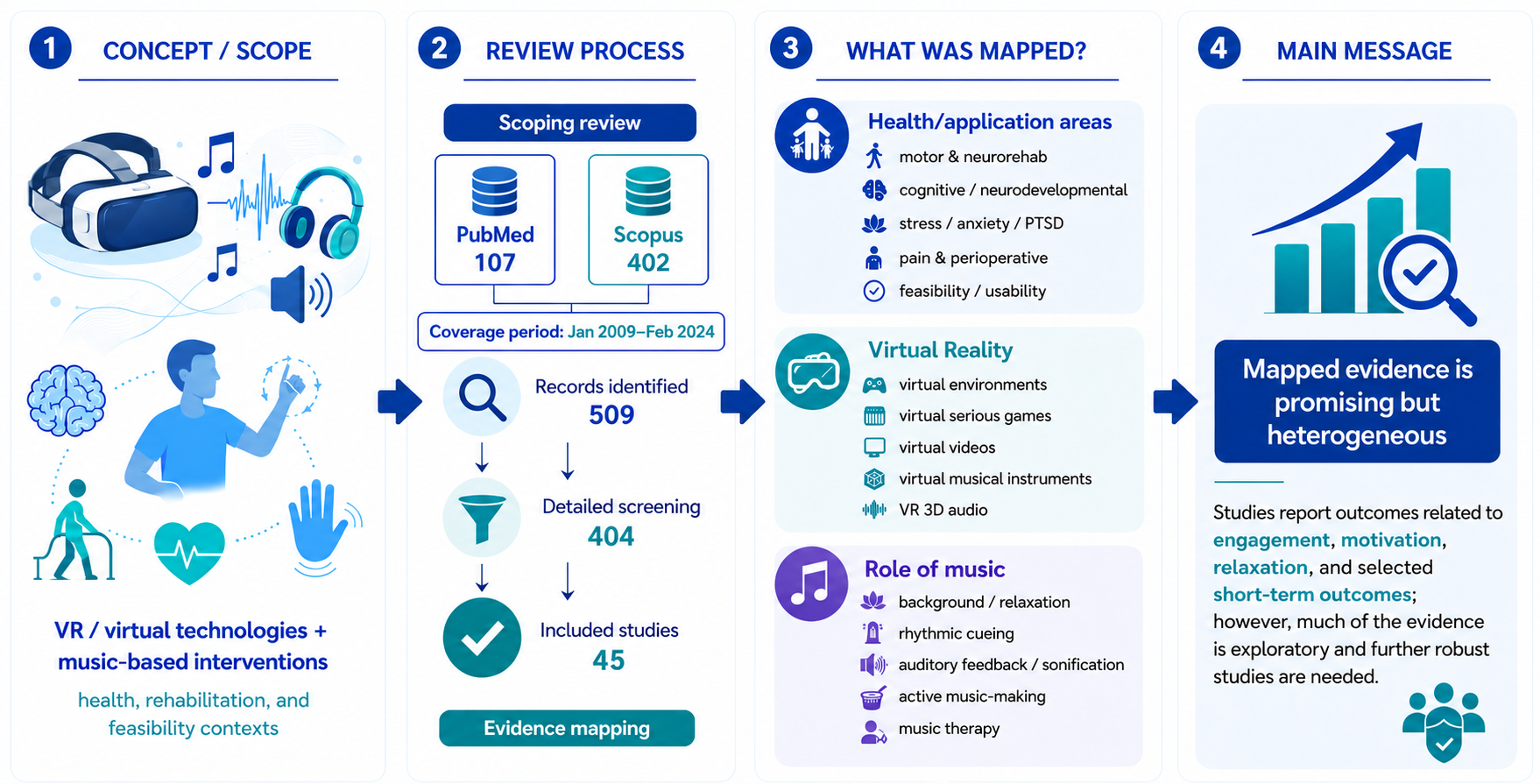
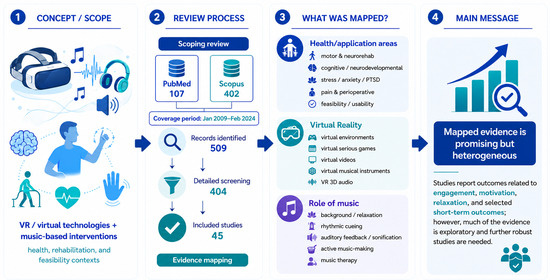
- Concept: combined use of VR and related virtual technologies with music-based or auditory components in health-related contexts. The review mapped two distinct dimensions: the virtual-technology modality (e.g., virtual environments, serious games, virtual videos, virtual musical instruments, AR/XR, or VR 3D audio) and the music-related component (e.g., music listening, music therapy, music production, combined listening/production, natural or environmental sounds, auditory feedback, or sonification).
- Context: rehabilitation, neurorehabilitation, motor or cognitive training, stress or anxiety management, pain or perioperative support, neurodevelopmental applications, and related clinical, quasi-clinical, or feasibility contexts.
- In which health contexts have music and virtual reality been combined?
- What types of virtual or immersive technologies are used in the included studies?
- What role does music play within the virtual or immersive interventions?
- Which outcome domains have been reported in the included studies?
- What gaps can be identified in the existing literature?
3.2. Study Selection
3.2.1. Inclusion Criteria
- (1)
- written in English
- (2)
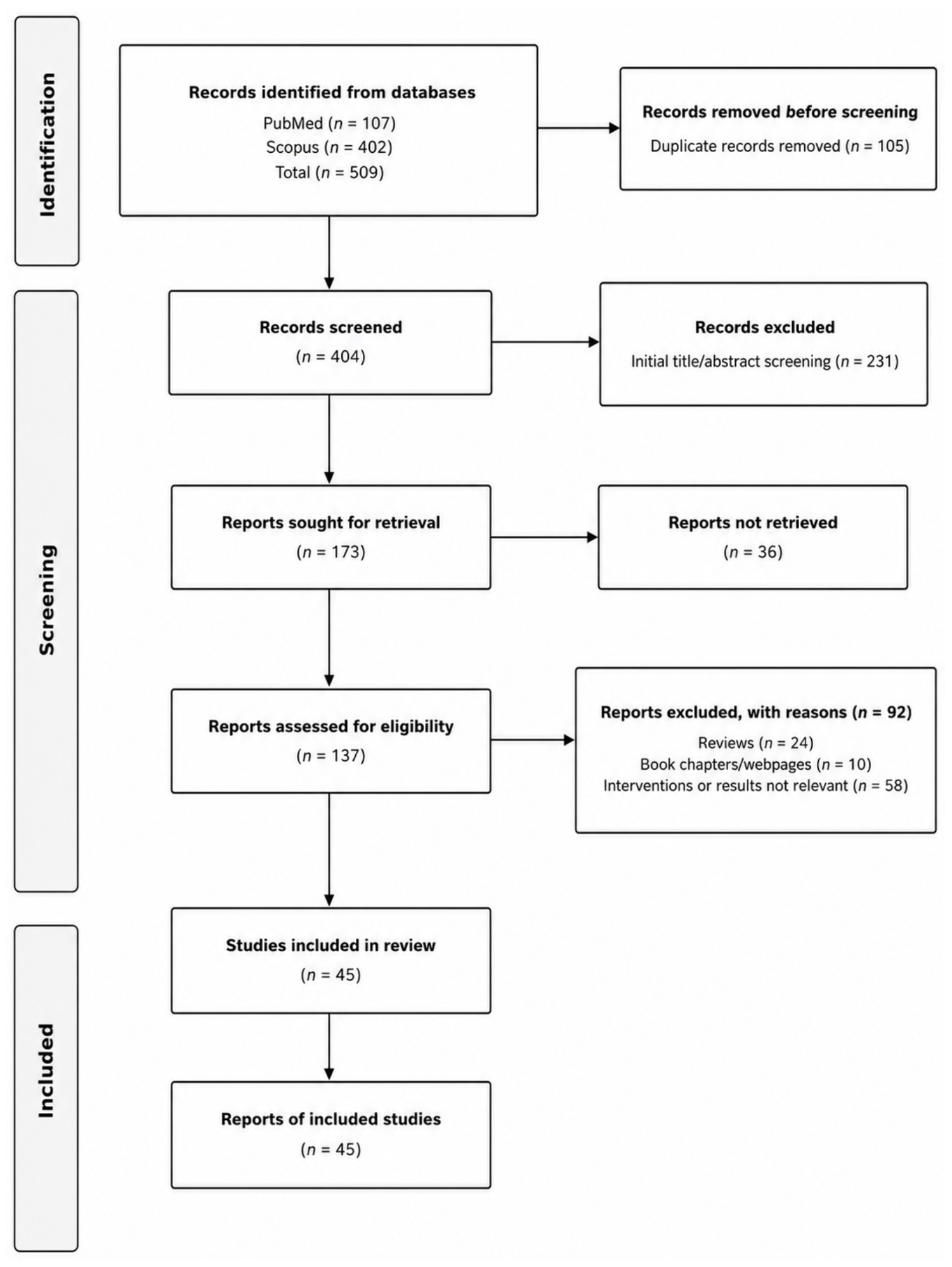
- published between January 2009 and 15 February 2024
- (3)
- providing results (qualitative or quantitative)
- (4)
- combining music-based components with virtual technologies in health-related contexts
3.2.2. Exclusion Criteria
- (1)
- Systematic reviews and book chapters
- (2)
- studies that are limited to theoretical or conceptual discussions without actual implementation or outcome data
- (3)
- studies that included one of the two intended interventions
3.3. Data Extraction and Charting Process
3.4. Data Synthesis and Evidence Mapping
3.5. Tools Used for Data Analysis

4. Results
5. Discussion
5.1. Interpretation of the Mapped Intervention Patterns
5.2. Synthesis in Relation to the Research Questions
5.3. Limitations and Future Directions
6. Conclusions
Supplementary Materials
Author Contributions
Funding
Institutional Review Board Statement
Data Availability Statement
Conflicts of Interest
References
- Steinmetz, J.D.; Seeher, K.M.; Schiess, N.; Nichols, E.; Cao, B.; Servili, C.; Cavallera, V.; Cousin, E.; Hagins, H.; Moberg, M.E.; et al. Global, regional, and national burden of disorders affecting the nervous system, 1990–2021: A systematic analysis for the Global Burden of Disease Study 2021. Lancet Neurol. 2024, 23, 344–381. [Google Scholar]
- Di Sarno, L.; Curatola, A.; Cammisa, I.; Capossela, L. Non-pharmacologic approaches to neurological stimulation in patients with severe brain injuries: A systematic review. Eur. Rev. Med. Pharmacol. Sci. 2022, 26, 6856–6870. [Google Scholar] [PubMed]
- Khan, F.; Amatya, B.; Galea, M.P.; Gonzenbach, R.; Kesselring, J. Neurorehabilitation: Applied neuroplasticity. J. Neurol. 2017, 264, 603–615. [Google Scholar] [PubMed]
- Brancatisano, O.; Baird, A.; Thompson, W.F. Why is music therapeutic for neurological disorders? The Therapeutic Music Capacities Model. Neurosci. Biobehav. Rev. 2020, 112, 600–615. [Google Scholar] [CrossRef] [PubMed]
- Hallam, S.; Cross, I.; Thaut, M. Oxford Handbook of Music Psychology; Oxford University Press: Oxford, UK, 2009. [Google Scholar]
- American Music Therapy Association (AMTA). Definition and Quotes About Music Therapy; American Music Therapy Association (AMTA): Silver Spring, MD, USA, 2014. [Google Scholar]
- World Federation of Music Therapy (WFMT). Definition of Music Therapy; World Federation of Music Therapy (WFMT): Genoa, Italy, 2011. [Google Scholar]
- Thaut, M.; Hoemberg, V. Handbook of Neurologic Music Therapy; Oxford University Press: New York, NY, USA, 2014. [Google Scholar]
- Wiebe, A.; Kannen, K.; Selaskowski, B.; Mehren, A.; Thöne, A.K.; Pramme, L.; Blumenthal, N.; Li, M.; Asché, L.; Jonas, S.; et al. Virtual reality in the diagnostic and therapy for mental disorders: A systematic review. Clin. Psychol. Rev. 2022, 98, 102213. [Google Scholar] [CrossRef] [PubMed]
- Park, M.J.; Kim, D.J.; Lee, U.; Na, E.J.; Jeon, H.J. A literature overview of virtual reality (VR) in treatment of psychiatric disorders: Recent advances and limitations. Front. Psychiatry 2019, 10, 505. [Google Scholar] [CrossRef] [PubMed]
- Abbas, J.R.; O’Connor, A.; Ganapathy, E.; Isba, R.; Payton, A.; McGrath, B.; Tolley, N.; Bruce, I.A. What is virtual reality? A healthcare-focused systematic review of definitions. Health Policy Technol. 2023, 12, 100741. [Google Scholar] [CrossRef]
- Ventura, S.; Brivio, E.; Riva, G.; Baños, R.M. Immersive versus non-immersive experience: Exploring the feasibility of memory assessment through 360 technology. Front. Psychol. 2019, 10, 2509. [Google Scholar] [CrossRef] [PubMed]
- Slater, M.; Sanchez-Vives, M.V. Enhancing our lives with immersive virtual reality. Front. Robot. AI 2016, 3, 74. [Google Scholar] [CrossRef]
- Tuominen, P.P.; Saarni, L.A. The use of virtual technologies with music in rehabilitation: A scoping systematic review. Front. Virtual Real. 2024, 5, 1290396. [Google Scholar] [CrossRef]
- Xiong, J.; Hsiang, E.L.; He, Z.; Zhan, T.; Wu, S.T. Augmented reality and virtual reality displays: Emerging technologies and future perspectives. Light Sci. Appl. 2021, 10, 216. [Google Scholar] [CrossRef] [PubMed]
- Wong, K.; Yee, H.M.; Xavier, B.A.; Grillone, G.A. Applications of augmented reality in otolaryngology: A systematic review. Otolaryngol.-Head Neck Surg. 2018, 159, 956–967. [Google Scholar] [CrossRef] [PubMed]
- Ioannou, A.; Papastavrou, E.; Avraamides, M.N.; Charalambous, A. Virtual reality and symptoms management of anxiety, depression, fatigue, and pain: A systematic review. SAGE Open Nurs. 2020, 6, 2377960820936163. [Google Scholar] [CrossRef] [PubMed]
- Yang, Z.Q.; Du, D.; Wei, X.Y.; Tong, R.K.Y. Augmented reality for stroke rehabilitation during COVID-19. J. Neuroeng. Rehabil. 2022, 19, 136. [Google Scholar] [CrossRef] [PubMed]
- Partesotti, E.; Magee, W.L. Integrating innovation: Arts technologies for aiding recovery in rehabilitation. Nord. J. Music. Ther. 2025, 34, 1–3. [Google Scholar] [CrossRef]
- Glaubitz, J. Using GlassOuse assistive technology to facilitate original music creation with GarageBand by a patient with tetraplegia. Nord. J. Music. Ther. 2025, 34, 4–12. [Google Scholar]
- Vaudreuil, R.; Nordstrom, M.; DeGraba, T.; Pasquina, P. The role of technology in music therapy, occupational therapy, and co-treatment of an injured United States service member. Nord. J. Music. Ther. 2025, 34, 13–30. [Google Scholar] [CrossRef]
- Goncalves, C.S.G.A.; Oliveira, R.S.D.; Reis, S.A.R.; Cunha, A.D.S.; Hembecker, P.K.; Tsunoda, A.T.; Nohama, P. Dedicated low-cost electronic ocarina for people with COPD: Rationale and prototype development. Nord. J. Music. Ther. 2025, 34, 42–61. [Google Scholar]
- Park, S.; Lee, S.; Howard, S.; Yi, J. Technology-Based Music Interventions to Reduce Anxiety and Pain Among Patients Undergoing Surgery or Procedures: Systematic Review of the Literature. JMIR mHealth uHealth 2024, 12, e48802. [Google Scholar] [CrossRef] [PubMed]
- Agres, K.R.; Schaefer, R.S.; Volk, A.; van Hooren, S.; Holzapfel, A.; Dalla Bella, S.; Magee, W.L. Music, computing, and health: A roadmap for the current and future roles of music technology for health care and well-being. Music Sci. 2021, 4, 2059204321997709. [Google Scholar] [CrossRef]
- Federici, S.; Bracalenti, M.; Meloni, F.; Luciano, J.V. World Health Organization disability assessment schedule 2.0: An international systematic review. Disabil. Rehabil. 2017, 39, 2347–2380. [Google Scholar] [CrossRef] [PubMed]
- Spanos, G.; Angelis, L. The impact of information security events to the stock market: A systematic literature review. Comput. Secur. 2016, 58, 216–229. [Google Scholar] [CrossRef]
- Polymeni, S.; Athanasakis, E.; Spanos, G.; Votis, K.; Tzovaras, D. IoT-based prediction models in the environmental context: A systematic Literature Review. Internet Things 2022, 20, 100612. [Google Scholar] [CrossRef]
- Ketsetsis, A.P.; Kourounis, C.; Spanos, G.; Giannoutakis, K.M.; Pavlidis, P.; Vazakidis, D.; Champeris, T.; Thomas, D.; Tzovaras, D. Deep learning techniques for stock market prediction in the European union: A systematic review. In Proceedings of the 2020 International Conference on Computational Science and Computational Intelligence (CSCI), Las Vegas, NV, USA, 16–18 December 2020; pp. 605–610. [Google Scholar]
- Nikoletos, G.; Papoutsoglou, I.; Spanos, G.; Nizamis, A.; Lalas, A.; Votis, K.; Tzovaras, D. Digital marketplaces in European research landscape: A systematic literature review. Open Res. Eur. 2024, 4, 223. [Google Scholar] [CrossRef] [PubMed]
- Rutkowski, S.; Kiper, P.; Cacciante, L.; Cieslik, B.; Mazurek, J.; Turolla, A.; Szczepanska-Gieracha, J. Use of virtual reality-based training in different fields of rehabilitation: A systematic review and meta-analysis. J. Rehabil. Med. 2020, 52, jrm00121. [Google Scholar] [CrossRef] [PubMed]
- Carroll, J.; Hopper, L.; Farrelly, A.M.; Lombard-Vance, R.; Bamidis, P.D.; Konstantinidis, E.I. A scoping review of augmented/virtual reality health and wellbeing interventions for older adults: Redefining immersive virtual reality. Front. Virtual Real. 2021, 2, 655338. [Google Scholar] [CrossRef]
- Li, G.; Li, X.; Chen, L. Effects of virtual reality-based interventions on the physical and mental health of older residents in long-term care facilities: A systematic review. Int. J. Nurs. Stud. 2022, 136, 104378. [Google Scholar] [CrossRef] [PubMed]
- Emmelkamp, P.M.; Meyerbröker, K. Virtual reality therapy in mental health. Annu. Rev. Clin. Psychol. 2021, 17, 495–519. [Google Scholar] [CrossRef] [PubMed]
- McConnell, T.; Porter, S. Music therapy for palliative care: A realist review. Palliat. Support. Care 2017, 15, 454–464. [Google Scholar] [PubMed]
- Lomax, T. Music therapy for depression: Is it music to our ears? BJPsych Adv. 2024, 30, 73–77. [Google Scholar] [CrossRef]
- Liang, J.; Tian, X.; Yang, W. Application of music therapy in general surgical treatment. BioMed Res. Int. 2021, 2021, 6169183. [Google Scholar] [CrossRef] [PubMed]
- Danso, A.; Leandertz, M.; Ala-Ruona, E.; Rousi, R. Neglect, Virtual Reality and Music Therapy: A Narrative Review. Music. Med. 2022, 14, 174–186. [Google Scholar] [CrossRef]
- Campbell, F.; Tricco, A.C.; Munn, Z.; Pollock, D.; Saran, A.; Sutton, A.; White, H.; Khalil, H. Mapping reviews, scoping reviews, and evidence and gap maps (EGMs): The same but different—The “Big Picture” review family. Syst. Rev. 2023, 12, 45. [Google Scholar] [CrossRef] [PubMed]
- Tricco, A.C.; Lillie, E.; Zarin, W.; O’Brien, K.K.; Colquhoun, H.; Levac, D.; Moher, D.; Peters, M.D.J.; Horsley, T.; Weeks, L.; et al. PRISMA Extension for Scoping Reviews (PRISMA-ScR): Checklist and Explanation. Ann. Intern. Med. 2018, 169, 467–473. [Google Scholar] [CrossRef] [PubMed]
- Page, M.J.; McKenzie, J.E.; Bossuyt, P.M.; Boutron, I.; Hoffmann, T.C.; Mulrow, C.D.; Shamseer, L.; Tetzlaff, J.M.; Akl, E.A.; Brennan, S.E.; et al. The PRISMA 2020 statement: An updated guideline for reporting systematic reviews. BMJ 2021, 372, n71. [Google Scholar] [CrossRef] [PubMed]
- Peters, M.D.J.; Marnie, C.; Tricco, A.C.; Pollock, D.; Munn, Z.; Alexander, L.; McInerney, P.; Godfrey, C.M.; Khalil, H. Updated methodological guidance for the conduct of scoping reviews. JBI Evid. Synth. 2020, 18, 2119–2126. [Google Scholar] [CrossRef] [PubMed]
- Zhao, Q.; He, Y.; Wu, N.; Wang, L.; Dai, J.; Wang, J.; Ma, J. Non-pharmacological interventions to improve physical function in patients with end-stage renal disease: A network meta-analysis. Am. J. Nephrol. 2023, 54, 35–41. [Google Scholar] [CrossRef] [PubMed]
- Qin, Y.; Zhang, H.; Wang, Y.; Mao, M.; Chen, F. 3D music impact on autonomic nervous system response and its therapeutic potential. In Proceedings of the 2020 IEEE Conference on Multimedia Information Processing and Retrieval (MIPR), Shenzhen, China, 6–8 August 2020; pp. 364–369. [Google Scholar]
- Giannaraki, M.; Moumoutzis, N.; Papatzanis, Y.; Kourkoutas, E.; Mania, K. A 3D rhythm-based serious game for collaboration improvement of children with Attention Deficit Hyperactivity Disorder (ADHD). In Proceedings of the 2021 IEEE Global Engineering Education Conference (EDUCON), Vienna, Austria, 21–23 April 2021; pp. 1217–1225. [Google Scholar]
- Boulay, M.; Benveniste, S.; Boespflug, S.; Jouvelot, P.; Rigaud, A.S. A pilot usability study of MINWii, a music therapy game for demented patients. Technol. Health Care 2011, 19, 233–246. [Google Scholar] [CrossRef] [PubMed]
- Ince, G.; Yorganci, R.; Ozkul, A.; Duman, T.B.; Köse, H. An audiovisual interface-based drumming system for multimodal human–robot interaction. J. Multimodal User Interfaces 2021, 15, 413–428. [Google Scholar] [CrossRef]
- Van Gelderen, M.J.; Nijdam, M.J.; Vermetten, E. An innovative framework for delivering psychotherapy to patients with treatment-resistant posttraumatic stress disorder: Rationale for interactive motion-assisted therapy. Front. Psychiatry 2018, 9, 176. [Google Scholar] [CrossRef] [PubMed]
- Kirwan, N.J.; Overholt, D.; Erkut, C. Bean: A digital musical instrument for use in music therapy. In Proceedings of the 12th Sound and Music Computing Conference, Maynooth, Ireland, 26 July–1 August 2015. [Google Scholar]
- Barclay, S.A.; Klausing, L.N.; Hill, T.M.; Kinney, A.L.; Reissman, T.; Reissman, M.E. Characterization of Upper Extremity Kinematics Using Virtual Reality Movement Tasks and Wearable IMU Technology. Sensors 2023, 24, 233. [Google Scholar] [CrossRef] [PubMed]
- Latif, R.A.; Ismail, R. Comparing sound types for stress therapy in a virtual-reality environment. J. Teknol. 2015, 77. [Google Scholar] [CrossRef]
- Geiser, N.; Kaufmann, B.C.; Knobel, S.E.J.; Cazzoli, D.; Nef, T.; Nyffeler, T. Comparison of uni-and multimodal motion stimulation on visual neglect: A proof-of-concept study. Cortex 2024, 171, 194–203. [Google Scholar] [CrossRef] [PubMed]
- Optale, G.; Urgesi, C.; Busato, V.; Marin, S.; Piron, L.; Priftis, K.; Gamberini, L.; Capodieci, S.; Bordin, A. Controlling memory impairment in elderly adults using virtual reality memory training: A randomized controlled pilot study. Neurorehabilit. Neural Repair 2010, 24, 348–357. [Google Scholar] [CrossRef] [PubMed]
- Zhu, L.; Tian, X.; Xu, X.; Shu, L. Design and evaluation of the mental relaxation VR scenes using forehead EEG features. In Proceedings of the 2019 IEEE MTT-S International Microwave Biomedical Conference (IMBioC), Nanjing, China, 6–8 May 2019; Volume 1, pp. 1–4. [Google Scholar]
- Adamovich, S.V.; Fluet, G.G.; Mathai, A.; Qiu, Q.; Lewis, J.; Merians, A.S. Design of a complex virtual reality simulation to train finger motion for persons with hemiparesis: A proof of concept study. J. Neuroeng. Rehabil. 2009, 6, 28. [Google Scholar] [CrossRef] [PubMed]
- Tamplin, J.; Loveridge, B.; Clarke, K.; Li, Y.; J Berlowitz, D. Development and feasibility testing of an online virtual reality platform for delivering therapeutic group singing interventions for people living with spinal cord injury. J. Telemed. Telecare 2020, 26, 365–375. [Google Scholar] [CrossRef] [PubMed]
- Kanehira, R.; Ito, Y.; Suzuki, M.; Hideo, F. Enhanced relaxation effect of music therapy with VR. In Proceedings of the 2018 14th International Conference on Natural Computation, Fuzzy Systems and Knowledge Discovery (ICNC-FSKD), Huangshan, China, 28–30 July 2018; pp. 1374–1378. [Google Scholar]
- Touil, N.; Pavlopoulou, A.; Momeni, M.; Van Pee, B.; Barbier, O.; Sermeus, L.; Roelants, F. Evaluation of virtual reality combining music and a hypnosis session to reduce anxiety before hand surgery under axillary plexus block: A prospective study. Int. J. Clin. Pract. 2021, 75, e15008. [Google Scholar] [CrossRef] [PubMed]
- Pedersen, L.B.; Adjorlu, A.; Bauer, V. Exploring the Possibilities of Music Therapy in Virtual Reality: Social Skills Training for Adolescents with Autism Spectrum Disorder. In Proceedings of the 19th Sound and Music Computing Conference, Saint-Étienne, France, 5–12 June 2022. [Google Scholar]
- Heyse, J.; Carlier, S.; Verhelst, E.; Vander Linden, C.; De Backere, F.; De Turck, F. From patient to musician: A multi-sensory virtual reality rehabilitation tool for spatial neglect. Appl. Sci. 2022, 12, 1242. [Google Scholar] [CrossRef]
- Luo, Z.; Durairaj, P.; Lau, C.M.; Katsumoto, Y.; Do, E.Y.L.; Zainuddin, A.S.B.; Kawauchi, K. Gamification of upper limb virtual rehabilitation in post stroke elderly using silvertune-a multi-sensory tactile musical assistive system. In Proceedings of the 2021 IEEE 7th International Conference on Virtual Reality (ICVR), Foshan, China, 20–22 May 2021; pp. 149–155. [Google Scholar]
- Fonteles, J.H.; Serpa, Y.R.; Barbosa, R.G.; Rodrigues, M.A.F.; Alves, M.S.P.L. Gesture-controlled interactive musical game to practice hand therapy exercises and learn rhythm and melodic structures. In Proceedings of the 2018 IEEE 6th International Conference on Serious Games and Applications for Health (SEGAH), Vienna, Austria, 16–18 May 2018; pp. 1–8. [Google Scholar]
- Zondervan, D.K.; Friedman, N.; Chang, E.; Zhao, X.; Augsburger, R.; Reinkensmeyer, D.J.; Cramer, S.C. Home-based hand rehabilitation after chronic stroke: Randomized, controlled single-blind trial comparing the MusicGlove with a conventional exercise program. J. Rehabil. Res. Dev. 2016, 53, 457–472. [Google Scholar] [CrossRef] [PubMed]
- Perez, P.; Vallejo, E.; Revuelta, M.; Redondo Vega, M.V.; Guervós Sánchez, E.; Ruiz, J. Immersive music therapy for elderly patients. In Proceedings of the 2022 ACM International Conference on Interactive Media Experiences, Aveiro, Portugal, 22–24 June 2022; pp. 47–52. [Google Scholar]
- Seinfeld, S.; Bergstrom, I.; Pomes, A.; Arroyo-Palacios, J.; Vico, F.; Slater, M.; Sanchez-Vives, M.V. Influence of music on anxiety induced by fear of heights in virtual reality. Front. Psychol. 2016, 6, 1969. [Google Scholar] [CrossRef] [PubMed]
- Zhou, T.; Wu, Y.; Meng, Q.; Kang, J. Influence of the acoustic environment in hospital wards on patient physiological and psychological indices. Front. Psychol. 2020, 11, 1600. [Google Scholar] [CrossRef] [PubMed]
- Baur, K.; Speth, F.; Nagle, A.; Riener, R.; Klamroth-Marganska, V. Music meets robotics: A prospective randomized study on motivation during robot aided therapy. J. Neuroeng. Rehabil. 2018, 15, 79. [Google Scholar] [CrossRef] [PubMed]
- Bauer, V.; Adjorlu, A.; Pedersen, L.B.; Bouchara, T.; Serafin, S. Music Therapy in Virtual Reality for Autistic Children with Severe Learning Disabilities. In Proceedings of the 29th ACM Symposium on Virtual Reality Software and Technology, Christchurch, New Zealand, 9–11 October 2023; pp. 1–9. [Google Scholar]
- Covarrubias, M.; Aruanno, B.; Cianferoni, T.; Rossini, M.; Komarova, S.; Molteni, F. Neuro Rehabilitation System Through Virtual Reality, Music and Fragrance Therapy. In Proceedings of the Converging Clinical and Engineering Research on Neurorehabilitation III: Proceedings of the 4th International Conference on NeuroRehabilitation (ICNR2018), 16–20 October 2018, Pisa, Italy; Springer International Publishing: Cham, Switzerland, 2019; pp. 848–852. [Google Scholar]
- Corrêa, A.G.D.; de Assis, G.A.; do Nascimento, M.; de Deus Lopes, R. Perceptions of clinical utility of an Augmented Reality musical software among health care professionals. Disabil. Rehabil. Assist. Technol. 2017, 12, 205–216. [Google Scholar] [CrossRef] [PubMed]
- Keshavarz, B.; Hecht, H. Pleasant music as a countermeasure against visually induced motion sickness. Appl. Ergon. 2014, 45, 521–527. [Google Scholar] [CrossRef] [PubMed]
- Latif, R.A. Preferred sound type for stress therapy. In Proceedings of the 2018 4th International Conference on Computer and Information Sciences (ICCOINS), Kuala Lumpur, Malaysia, 13–14 August 2018; pp. 1–6. [Google Scholar]
- Roy, M.J.; Bellini, P.; Kruger, S.E.; Dunbar, K.; Atallah, H.; Haight, T.; Vermetten, E. Randomized controlled trial of motion-assisted exposure therapy for posttraumatic stress disorder after mild traumatic brain injury, with and without an eye movement task. Front. Virtual Real. 2022, 3, 1005774. [Google Scholar] [CrossRef]
- Gu, L.; Sun, B.; Liu, L.; Li, Y.; Zhang, Q.; Yang, J. Research and verification of a new relaxation technology based on virtual reality for human psychological security and psychosomatic recovery. In Proceedings of the 2021 IEEE International Conference on Intelligence and Safety for Robotics (ISR), Tokoname, Japan, 4–6 March 2021; pp. 33–37. [Google Scholar]
- Sooriyaghandan, I.V.; Mohamad Jailaini, M.F.; Nik Abeed, N.N.; Ng, B.H.; Yu-Lin, A.B.; Shah, S.A.; Abdul Hamid, M.F. Satisfaction and tolerability using virtual reality (VR) as adjunctive treatment during flexible bronchoscopy: A randomized control trial. BMC Pulm. Med. 2023, 23, 10. [Google Scholar] [CrossRef] [PubMed]
- van Veelen, N.; Boonekamp, R.; Schoonderwoerd, T.; Emmerik, M.; Nijdam, M.; Bruinsma, B.; Geuze, E.; Jones, C.; Vermetten, E. Tailored immersion: Implementing personalized components into virtual reality for veterans with post-traumatic stress disorder. Front. Virtual Real. 2021, 2, 740795. [Google Scholar] [CrossRef]
- Gür, E.Y.; Apay, S.E. The effect of cognitive behavioral techniques using virtual reality on birth pain: A randomized controlled trial. Midwifery 2020, 91, 102856. [Google Scholar] [CrossRef] [PubMed]
- Martí-Hereu, L.; Navarra-Ventura, G.; Navas-Pérez, A.M.; Férnandez-Gonzalo, S.; Pérez-López, F.; de Haro-López, C.; Gomà-Fernández, G. Usage of immersive virtual reality as a relaxation method in an intensive care unit. Enferm. Intensiv. (Engl. Ed.) 2024, 35, 107–113. [Google Scholar] [CrossRef] [PubMed]
- Shahab, M.; Taheri, A.; Mokhtari, M.; Shariati, A.; Heidari, R.; Meghdari, A.; Alemi, M. Utilizing social virtual reality robot (V2R) for music education to children with high-functioning autism. Educ. Inf. Technol. 2022, 27, 819–843. [Google Scholar] [CrossRef]
- Alexanian, S.; Foxman, M.; Pimentel, D. Virtual reality and music’s impact on psychological well-being. Front. Rehabil. Sci. 2022, 3, 864990. [Google Scholar] [CrossRef] [PubMed]
- Taneja, A.; Vishal, S.B.; Mahesh, V.; Geethanjali, B. Virtual reality based neuro-rehabilitation for mental stress reduction. In Proceedings of the 2017 Fourth International Conference on Signal Processing, Communication and Networking (ICSCN), Chennai, India, 16–18 March 2017; pp. 1–5. [Google Scholar]
- Araujo-Duran, J.; Kopac, O.; Montalvo Campana, M.; Bakal, O.; Sessler, D.I.; Hofstra, R.L.; Shah, K.; Turan, A.; Ayad, S. Virtual reality distraction for reducing acute postoperative pain after hip arthroplasty: A randomized trial. Anesth. Analg. 2024, 138, 751–759. [Google Scholar] [CrossRef] [PubMed]
- Sun, M.; Bu, Q.; Hou, Y.; Ju, X.; Yu, L.; Lim, E.G.; Sun, J. Virtual Reality Music Instrument Playing Game for Upper Limb Rehabilitation Training. In Proceedings of the Companion Publication of the 25th International Conference on Multimodal Interaction, Paris, France, 9–13 October 2023; pp. 96–100. [Google Scholar]
- Adjorlu, A.; Barriga, N.B.B.; Serafin, S. Virtual reality music intervention to reduce social anxiety in adolescents diagnosed with autism spectrum disorder. In Proceedings of the 16th Sound and Music Computing Conference, Malaga, Spain, 28–31 May 2019; pp. 261–268. [Google Scholar]
- Baka, E.; Kentros, M.; Papagiannakis, G.; Magnenat-Thalmann, N. Virtual reality rehabilitation based on neurologic music therapy: A qualitative preliminary clinical study. In Proceedings of the Learning and Collaboration Technologies. Learning and Teaching: 5th International Conference, LCT 2018, Held as Part of HCI International 2018, Las Vegas, NV, USA, 15–20, July 2018; Proceedings, Part II 5; Springer International Publishing: Berlin/Heidelberg, Germany, 2018; pp. 113–127. [Google Scholar]
- Cameirão, M.S.; Pereira, F.; i Badia, S.B. Virtual reality with customized positive stimuli in a cognitive-motor rehabilitation task. In Proceedings of the 2017 International Conference on Virtual Rehabilitation (ICVR), Montreal, QC, Canada, 19–22 June 2017; pp. 1–7. [Google Scholar]
- Lin, X.; Mahmud, S.; Jones, E.; Shaker, A.; Miskinis, A.; Kanan, S.; Kim, J.H. Virtual reality-based musical therapy for mental health management. In Proceedings of the 2020 10th Annual Computing and Communication Workshop and Conference (CCWC), Las Vegas, NV, USA, 6–8 January 2020; pp. 948–952. [Google Scholar]
- Buzzi, M.C.; Buzzi, M.; Maugeri, M.; Paolini, G.; Paratore, M.T.; Sbragia, A.; Senette, C.; Trujillo, A. Which virtual piano keyboard for children with autism? A pilot study. In Proceedings of the HCI International 2019–Late Breaking Papers: 21st HCI International Conference, HCII 2019, Orlando, FL, USA, 26–31 July 2019; Proceedings 21; Springer International Publishing: Berlin/Heidelberg, Germany, 2019; pp. 280–291. [Google Scholar]
- Wheeler, B.L. Music Therapy Handbook; Guilford Publications: New York, NY, USA, 2015. [Google Scholar]
- Bruscia, K.E. Defining Music Therapy, 3rd ed.; Barcelona Publishers: Gilsum, NH, USA, 2014. [Google Scholar]
- Grocke, D.; Wigram, T. Receptive Methods in Music Therapy: Techniques and Clinical Applications for Music Therapy Clinicians, Educators and Students; Jessica Kingsley Publishers: London, UK, 2007. [Google Scholar]



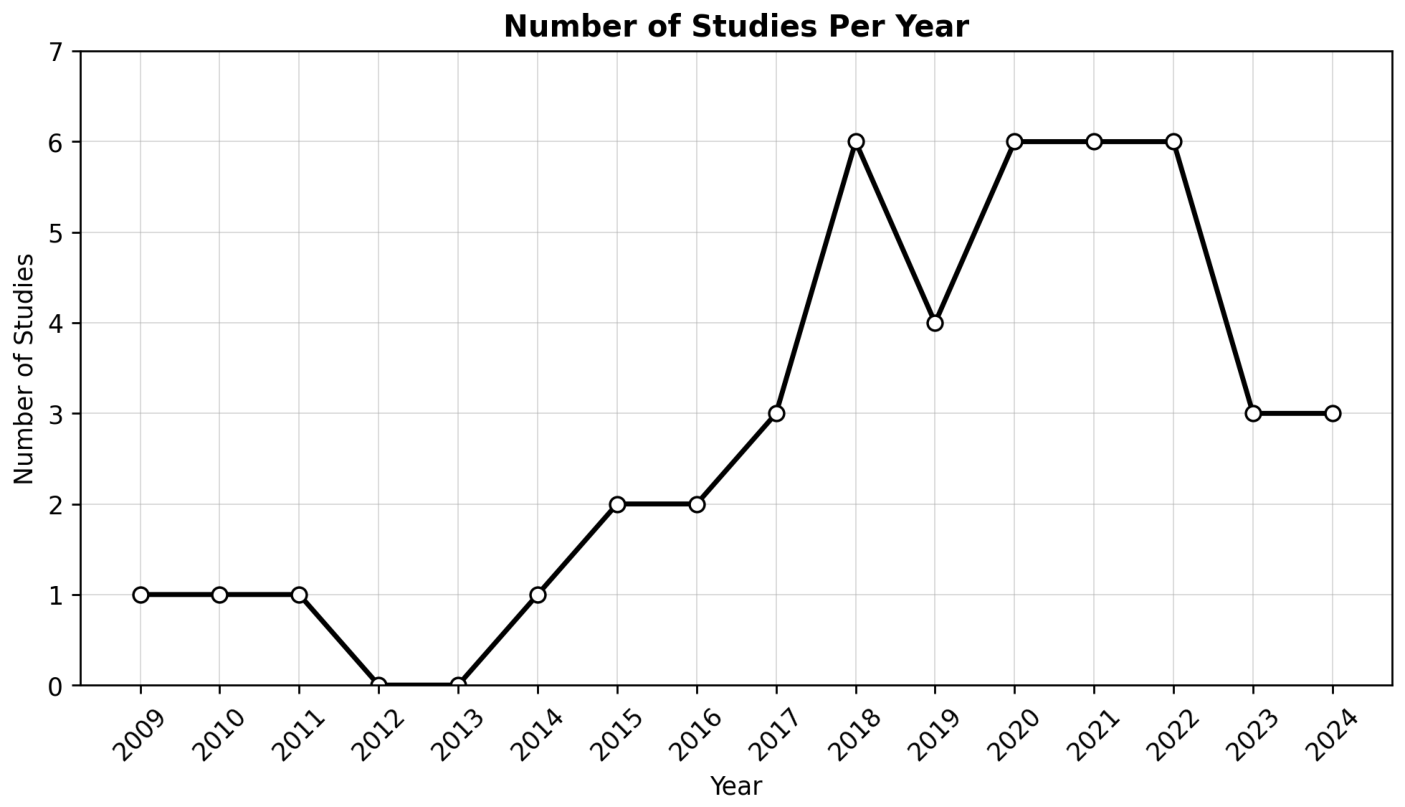
| Authors | Publication Source | Publication Type | Year | Article No. |
|---|---|---|---|---|
| Yi Qin, Huayu Zhang, Yuni Wang, Mei Mao, Fuguo Chen [43] | IEEE Conference on Multimedia Information Processing and Retrieval (MIPR) | Conference | 2020 | a1 |
| Marina Giannaraki, Nektarios Moumoutzis, Yiannis Papatzanis, Elias Kourkoutas, Katerina Mania [44] | IEEE Global Engineering Education Conference (EDUCON) | Conference | 2021 | a2 |
| Boulay Mélodie, Benveniste Samuelc, Boespflug Sandra, Jouvelot Pierre, Rigaud Anne-Sophie [45] | Technology and Health Care | Journal | 2011 | a3 |
| Gökhan Ince, Rabia Yorganci, Ahmet Ozkul, Taha Berkay Duman, Hatice Köse [46] | Journal on Multimodal User Interfaces | Journal | 2021 | a4 |
| Marieke J. van Gelderen, Mirjam J. Nijdam, Eric Vermetten [47] | Frontiers in Psychiatry | Journal | 2018 | a5 |
| Kirwan, N. J., Overholt, D., & Erkut, C. [48] | Sound and Music Computing Conference | Conference | 2015 | a6 |
| Barclay, S. A., Klausing, L. N., Hill, T. M., Kinney, A. L., Reissman, T., & Reissman, M. E. [49] | Sensors | Journal | 2023 | a7 |
| Rubijesmin Abdul Latif, Rozita Ismail [50] | Intelligence and Interactivity for Future Computing | Journal | 2015 | a8 |
| Geiser, N., Kaufmann, B. C., Knobel, S. E. J., Cazzoli, D., Nef, T., & Nyffeler, T [51] | Cortex | Journal | 2024 | a9 |
| Optale, G., Urgesi, C., Busato, V., Marin, S., Piron, L., Priftis, K., ...& Bordin, A [52] | Neurorehabilitation and Neural Repair | Journal | 2010 | a10 |
| Zhu, L., Tian, X., Xu, X., & Shu, L. [53] | IEEE MTT-S International Microwave Biomedical Conference (IMBioC) | Conference | 2019 | a11 |
| Adamovich, S. V., Fluet, G. G., Mathai, A., Qiu, Q., Lewis, J., & Merians, A. S. [54] | Journal of NeuroEngineering and Rehabilitation | Journal | 2009 | a12 |
| Tamplin, J., Loveridge, B., Clarke, K., Li, Y., & J Berlowitz, D. [55] | Journal of Telemedicine and Telecare | Journal | 2020 | a13 |
| Kanehira, R., Ito, Y., Suzuki, M., & Hideo, F. [56] | International Conference on Natural Computation, Fuzzy Systems and Knowledge Discovery (ICNC-FSKD) | Conference | 2018 | a14 |
| Touil, N., Pavlopoulou, A., Momeni, M., Van Pee, B., Barbier, O., Sermeus, L., & Roelants, F. [57] | International Journal of Clinical Practice | Journal | 2021 | a15 |
| Pedersen, L. B., Adjorlu, A., & Bauer, V. [58] | Sound and Music Computing Conference | Conference | 2022 | a16 |
| Heyse, J., Carlier, S., Verhelst, E., Vander Linden, C., De Backere, F., & De Turck, F. [59] | Applied Sciences | Journal | 2022 | a17 |
| Luo, Z., Durairaj, P., Lau, C. M., Katsumoto, Y., Do, E. Y. L., Zainuddin, A. S. B., & Kawauchi, K [60] | IEEE International Conference on Virtual Reality (ICVR) | Conference | 2021 | a18 |
| Fonteles, J. H., Serpa, Y. R., Barbosa, R. G., Rodrigues, M. A. F., & Alves, M. S. P. L. [61] | IEEE International Conference on Serious Games and Applications for Health (SeGAH) | Conference | 2018 | a19 |
| Zondervan, D. K., Friedman, N., Chang, E., Zhao, X., Augsburger, R., Reinkensmeyer, D. J., & Cramer, S. C. [62] | Journal of rehabilitation research and development | Journal | 2016 | a20 |
| Perez, P., Vallejo, E., Revuelta, M., Redondo Vega, M. V., Guervós Sánchez, E., & Ruiz, J [63] | ACM International Conference on Interactive Media Experiences | Conference | 2022 | a21 |
| Seinfeld, S., Bergstrom, I., Pomes, A., Arroyo-Palacios, J., Vico, F., Slater, M., & Sanchez-Vives, M. V [64] | Frontiers in psychology | Journal | 2016 | a22 |
| Zhou, T., Wu, Y., Meng, Q., & Kang, J [65] | Frontiers in psychology | Journal | 2020 | a23 |
| Baur, K., Speth, F., Nagle, A., Riener, R., & Klamroth-Marganska, V. [66] | Journal of NeuroEngineering and Rehabilitation | Journal | 2018 | a24 |
| Bauer, V., Adjorlu, A., Pedersen, L. B., Bouchara, T., & Serafin, S. [67] | ACM Symposium on Virtual Reality Software and Technology | Conference | 2023 | a25 |
| Covarrubias, M., Aruanno, B., Cianferoni, T., Rossini, M., Komarova, S., & Molteni, F. [68] | International Conference on NeuroRehabilitation (ICNR) | Conference | 2019 | a26 |
| Corrêa, A. G. D., de Assis, G. A., do Nascimento, M., & de Deus Lopes, R. [69] | Disability and Rehabilitation: Assistive Technology | Journal | 2017 | a27 |
| Keshavarz, B., & Hecht, H. [70] | Applied Ergonomics | Journal | 2014 | a28 |
| Latif, R. A. [71] | International Conference on Computer and Information Sciences (ICCOINS) | Conference | 2018 | a29 |
| Roy, M. J., Bellini, P., Kruger, S. E., Dunbar, K., Atallah, H., Haight, T., & Vermetten, E. [72] | Frontiers in Virtual Reality | Journal | 2022 | a30 |
| Gu, L., Sun, B., Liu, L., Li, Y., Zhang, Q., & Yang, J. [73] | IEEE International Conference on Intelligence and Safety for Robotics (ISR) | Conference | 2021 | a31 |
| Sooriyaghandan, I. V., Mohamad Jailaini, M. F., Nik Abeed, N. N., Ng, B. H., Yu-Lin, A. B., Shah, S. A., & Abdul Hamid, M. F. [74] | BMC Pulmonary Medicine | Journal | 2023 | a32 |
| van Veelen, N., Boonekamp, R. C., Schoonderwoerd, T. A., van Emmerik, M. L., Nijdam, M. J., Bruinsma, B., ...& Vermetten, E [75] | Frontiers in Virtual Reality | Journal | 2021 | a33 |
| Gür, E. Y., & Apay, S. E. [76] | Midwifery | Journal | 2020 | a34 |
| Martí-Hereu, L., Navarra-Ventura, G., Navas-Pérez, A. M., Férnandez-Gonzalo, S., Pérez-López, F., de Haro-López, C., & Gomà-Fernández, G. [77] | Enfermería Intensiva | Journal | 2024 | a35 |
| Shahab, M., Taheri, A., Mokhtari, M., Shariati, A., Heidari, R., Meghdari, A., & Alemi, M. [78] | Education and Information Technologies | Journal | 2022 | a36 |
| Alexanian, S., Foxman, M., & Pimentel, D. [79] | Frontiers in Rehabilitation Sciences | Journal | 2022 | a37 |
| Taneja, A., Vishal, S. B., Mahesh, V., & Geethanjali, B. [80] | International Conference on Signal Processing, Communication and Networking (ICSCN) | Conference | 2017 | a38 |
| Araujo-Duran, J., Kopac, O., Campana, M. M., Bakal, O., Sessler, D. I., Hofstra, R. L., ...& Ayad, S. [81] | Anesthesia & Analgesia | Journal | 2024 | a39 |
| Sun, M., Bu, Q., Hou, Y., Ju, X., Yu, L., Lim, E. G., & Sun, J [82] | International Conference on Multimodal Interaction | Conference | 2023 | a40 |
| Adjorlu, A., Barriga, N. B. B., & Serafin, S [83] | Sound and Music Computing Conference (SMC2019) | Conference | 2019 | a41 |
| Baka, E., Kentros, M., Papagiannakis, G., & Magnenat-Thalmann, N. [84] | Learning and Collaboration Technologies | Conference | 2018 | a42 |
| Cameirão, M. S., Pereira, F., & i Badia, S. B. [85] | International Conference on Virtual Rehabilitation (ICVR) | Conference | 2017 | a43 |
| Lin, X., Mahmud, S., Jones, E., Shaker, A., Miskinis, A., Kanan, S., & Kim, J. H. [86] | Annual Computing and Communication Workshop and Conference (CCWC) | Conference | 2020 | a44 |
| Buzzi, M. C., Buzzi, M., Maugeri, M., Paolini, G., Paratore, M. T., Sbragia, A., ...& Trujillo, A. [87] | HCI International | Conference | 2019 | a45 |
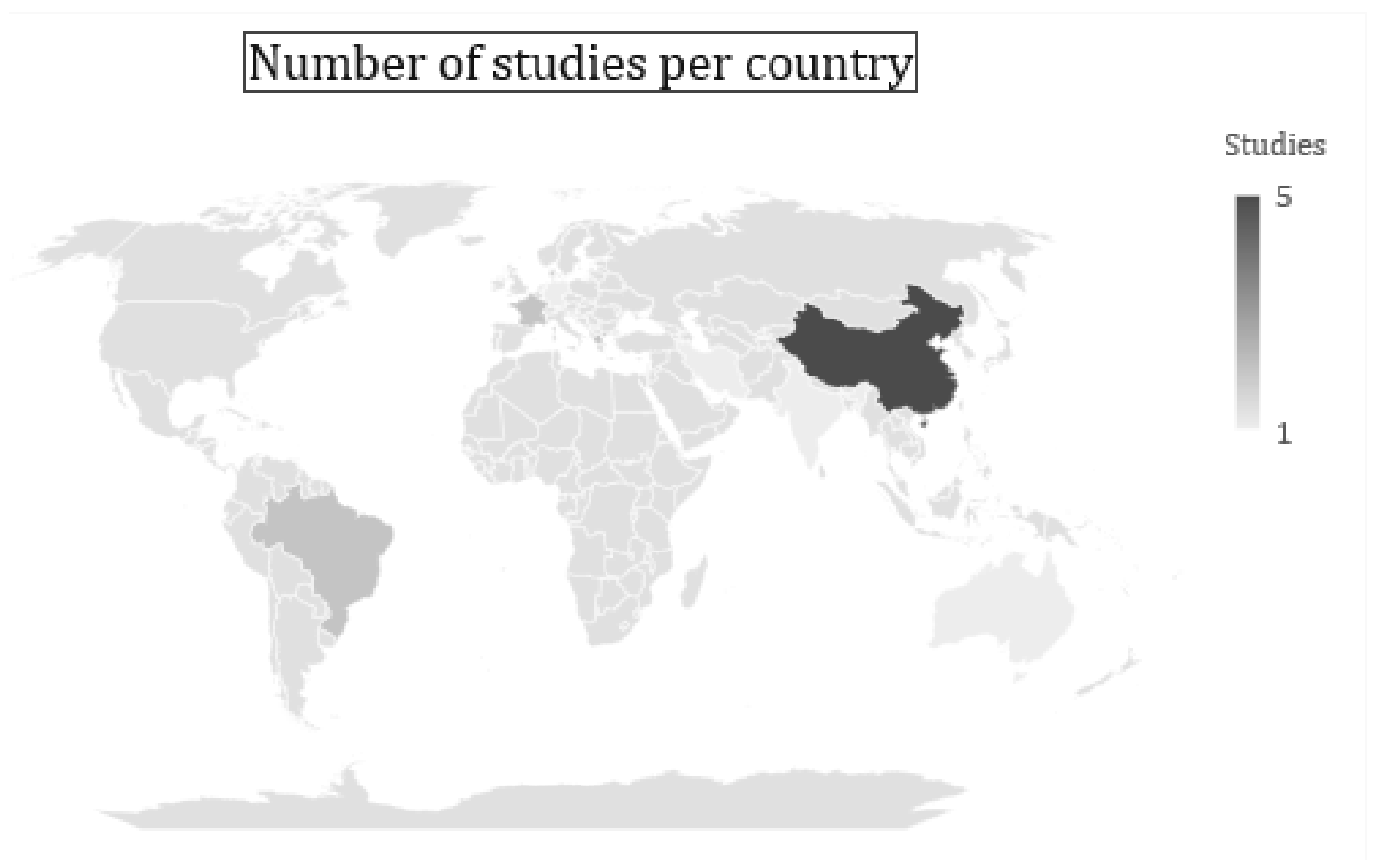
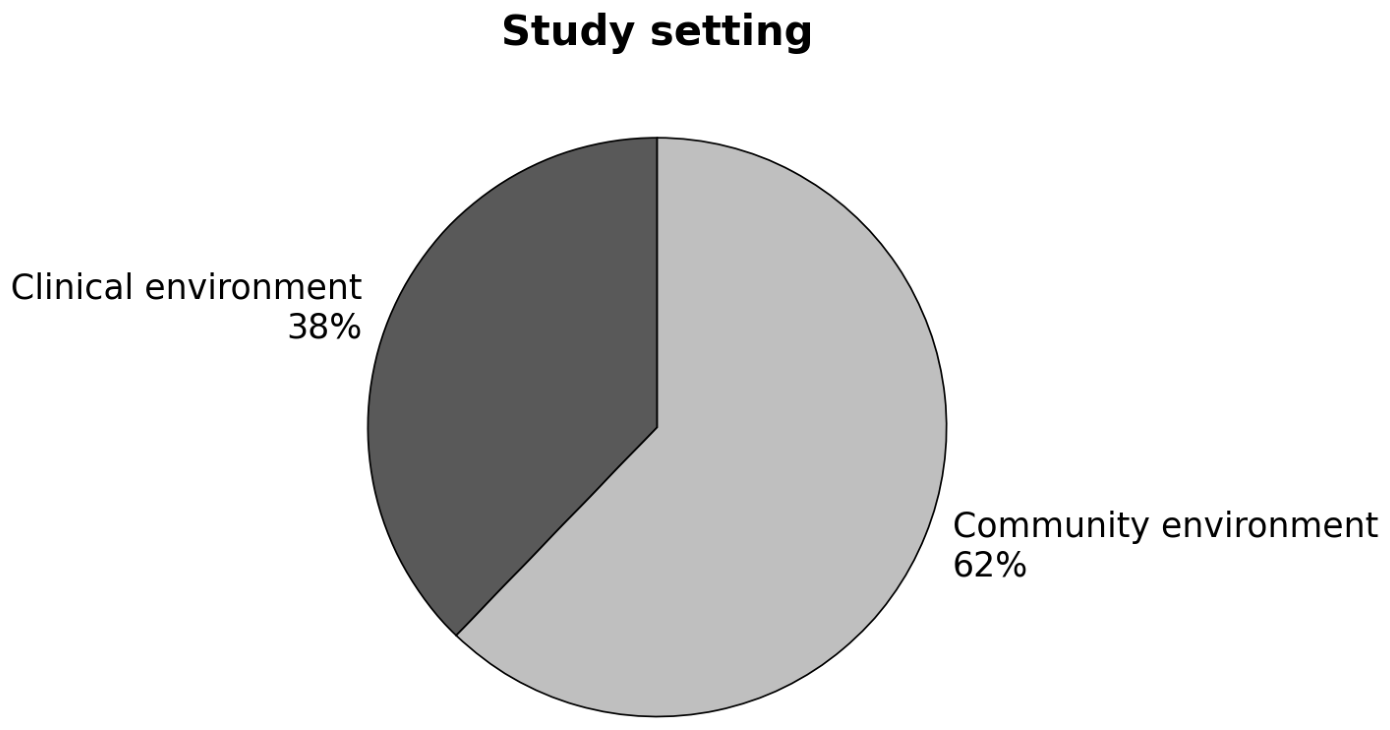
| Country | Environment | Sample Description | Article No. |
|---|---|---|---|
| China | Community | Seventy-three (30 males, 43 females) ages: <12 years (1 person), 13–18 years (6 people), 19–28 years (16 people), 29–40 years (10 people),41–50 years (6 people), 51–66 years (16 people), >66 (18 people). Four groups. | a1 |
| Greece | Community | 4 children: 3 male, 1 female (2 diagnosed with ADHD, and 2 without ADHD), ages: 8–12 years | a2 |
| France | Clinical | 7 (4 women, 3 men, mean age 88.5) | a3 |
| Turkey | Community | 1st scenario: 20 students (10 women-10 men, average ages: 25.5. 2nd scenario: 8 participants (4 men-4 women with average age 23.5) they participated and in the first scenario. 3rd Scenario: 20 participants (10 women-10 men, average age : 23.1, did not participate in scenario 1 and 2) | a4 |
| Holland | Community | 3 patients | a5 |
| Ireland | Community | 4 (2 male, early twenties participants and 2 therapists) | a6 |
| United Emirates | Community | 16 healthy (7 females-9 males, mean age 21.69 ± 0.6 years) | a7 |
| Malaysia | Community | 28 participants (14 males-14 females, ages 19–22) | a8 |
| Switzerland | Clinical | 28 patients (15 women-13 men, mean age 72.64) | a9 |
| Italy | Community | 36 participants (24 female-12 male, mean age 80 years). Final sample completed intervention 31 participants | a10 |
| China | Community | 13 students (20–30 years old) | a11 |
| USA | Community | 4 subjects: with hemiparesis after stroke (mean age 51.5 years), with mild or moderate impairment (according to Chedoke McMaster Stroke Assessment), with minimal to moderate spasticity (according to Modified Ashworth Scale), with stroke began from 11 months to 7 years. | a12 |
| Australia | Clinical | 6 participants (5 male-1 female) with mean age 43.5 and spinal cord injury | a13 |
| Japan | Community | 8 university students | a14 |
| Belgium | Clinical | 48 patients (27 females 21 males—mean age 49 years) | a15 |
| Denmark | Community | 25 healthy children (9 years old) | a16 |
| Belgium | Clinical | 4 patients with brain injury unilateral spatial neglect (USN), >12 years old, six months after injury and 3 with left side neglect and one with right side. | a17 |
| Singapore | Clinical | 11 participants (7 male-4 female) after stroke, 69.45 mean age | a18 |
| Brazil | Community | 4 participants: 2 children (ages: 7 & 8), 2 adults (ages 27 & 28 years old) | a19 |
| USA | Community | 17 participants with hand impairment after stroke conventional group (8): 5 male-3 female mean age: 59 years & Music Glove group (9): 4 female-5 male, mean age: 60 years | a20 |
| Spain | Community | 16 patients (12 female-4 male, mean age: 87.8 years) | a21 |
| Spain | Community | 40 patients (music group: 12 females-8 males Mean Age : 27.15 years, Non-Music Group: 15 females-5 males Mean age: 25.40 years | a22 |
| China | Clinical | 70 patients (36men-34 women, mean age: 48.2 years) | a23 |
| Switzerland | Community | 16 (10 males-6 females, mean age: 27.2 years) | a24 |
| France | Clinical | 13 children with autism (10 male-3 female with mean age: 10.46), 4 children verbal-6 “limited verbal abilities”-3 “minimal to non-verbal abilities) | a25 |
| Italy | Clinical | 10 healthy (4 female-6 male ages between 18–23 years) in the preliminary tests and in the main test the sample was with Individuals undergoing mental health rehabilitation | a26 |
| Brazil | Clinical | 19 healthy (1 male and 18 female therapists) | a27 |
| Germany | Community | 93 participants (50 female-43 male) but 20 participants didn’t complete the experiment | a28 |
| Malaysia | Community | 30 (15 males-15 females) healthy students at university in Malaysia, (ages between 19–25 years) assigned into 3 groups | a29 |
| USA | Community | 20 Individuals (10 males and 10 females), Mean age: 45.1 years. 16 participants completed the intervention | a30 |
| China | Community | 32 participants (20 males-12 females, mean age: 23.2 years) | a31 |
| Malaysia | Clinical | 80 patients (40 each group, mean age: above 67 years for intervention group and 64 years for control arm group)) | a32 |
| - | Community | 3 (two male-one female) | a33 |
| Turkey | Clinical | 273 pregnant women (55 in B, C, D group and 54 in A, E group) | a34 |
| Spain | Clinical | 20 patients (12 male-8 female, mean age: 64 years) | a35 |
| Iran | Community | 5 children (male), mean age: 7.09 years | a36 |
| International (Asia, USA, Africa) | Community | 90 participants (56 males, 33 females, 1 not say) | a37 |
| India | Community | 20 students (14 males-6 females, ages 18–21 years) | a38 |
| USA (Ohio) | Clinical | 106 individuals (in VR group: 27 females from 52 mean age 66 years, in 2D group: 25 from 46 were females with mean age 63 years) | a39 |
| China | Clinical | 2 patients | a40 |
| Denmark | Community | 4 participants (male, ages: 18–20 years) with social anxiety, diagnosed with ASD | a41 |
| Greece | Clinical | 3 participants (2 female-1 male, ages: 32–52 years) | a42 |
| Portugal | Clinical | 13 participants: 7 in VR group (2 females & 5 males, ages: 57–83 years), 6 in Control group (3 females & 3 males, ages: 42–86 years) | a43 |
| USA | Community | 19 participants (16 males-3 females, mean age: 17.7 years) | a44 |
| - | Community | 4 children (ages: 11–15 years) | a45 |
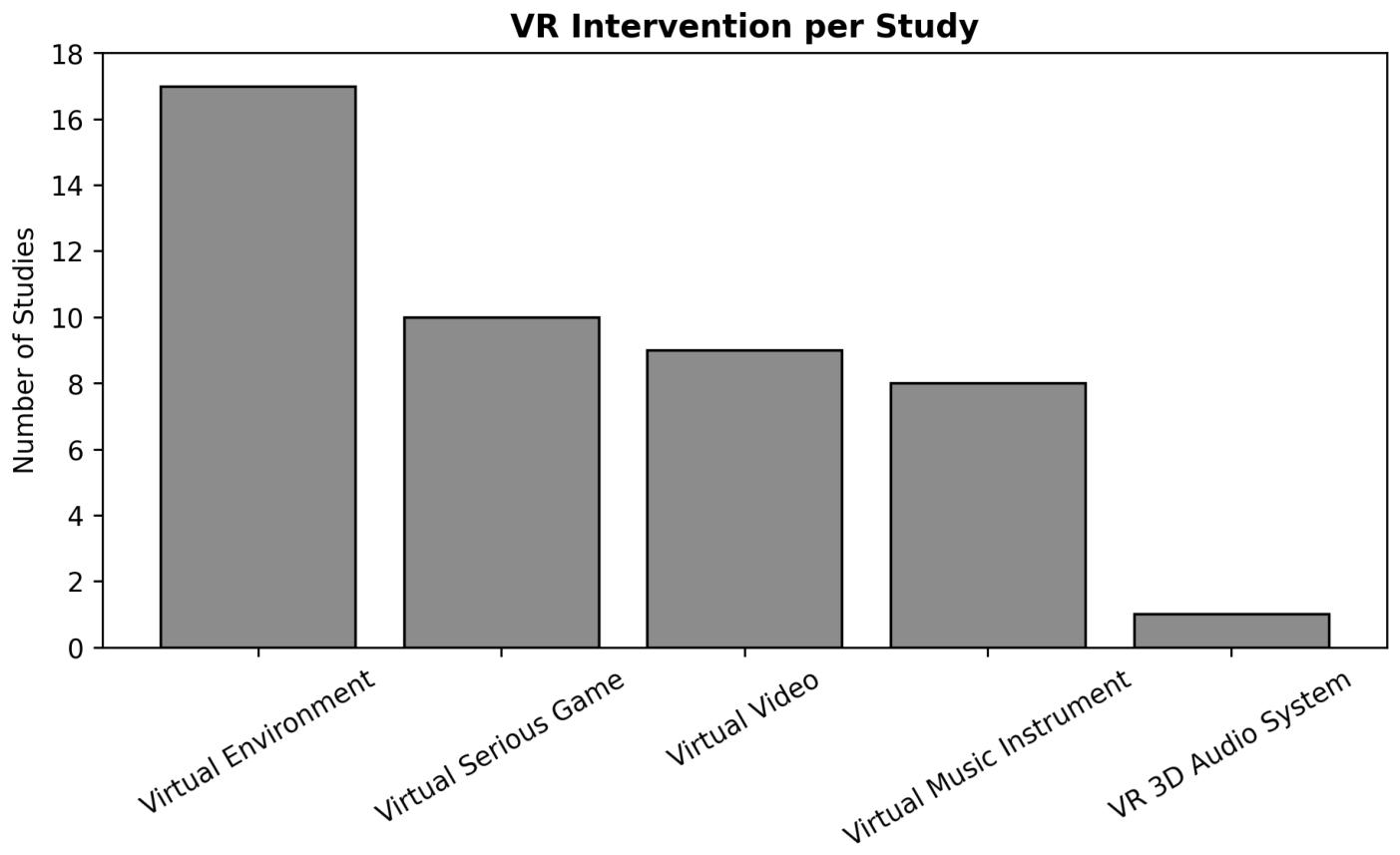
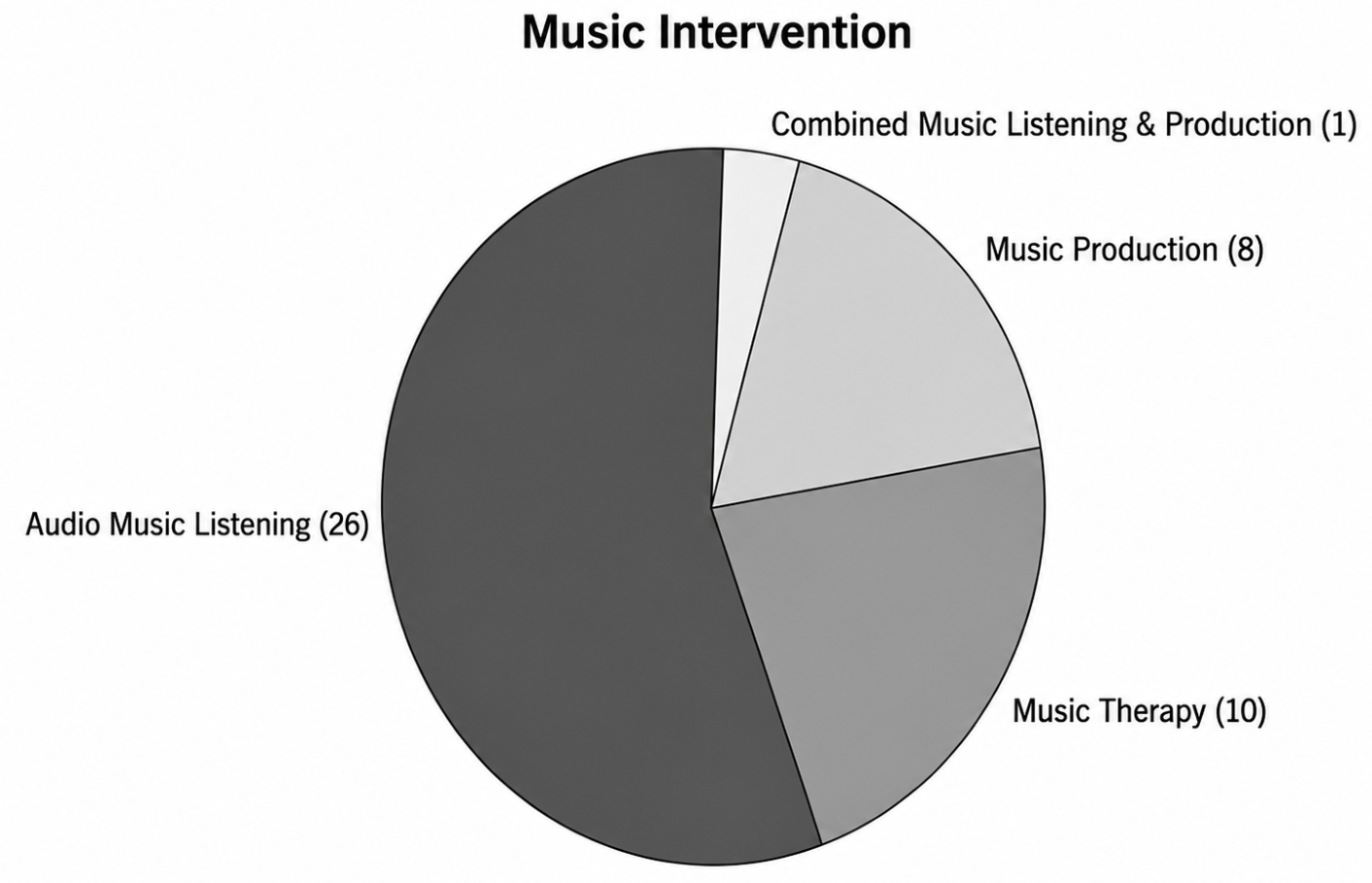
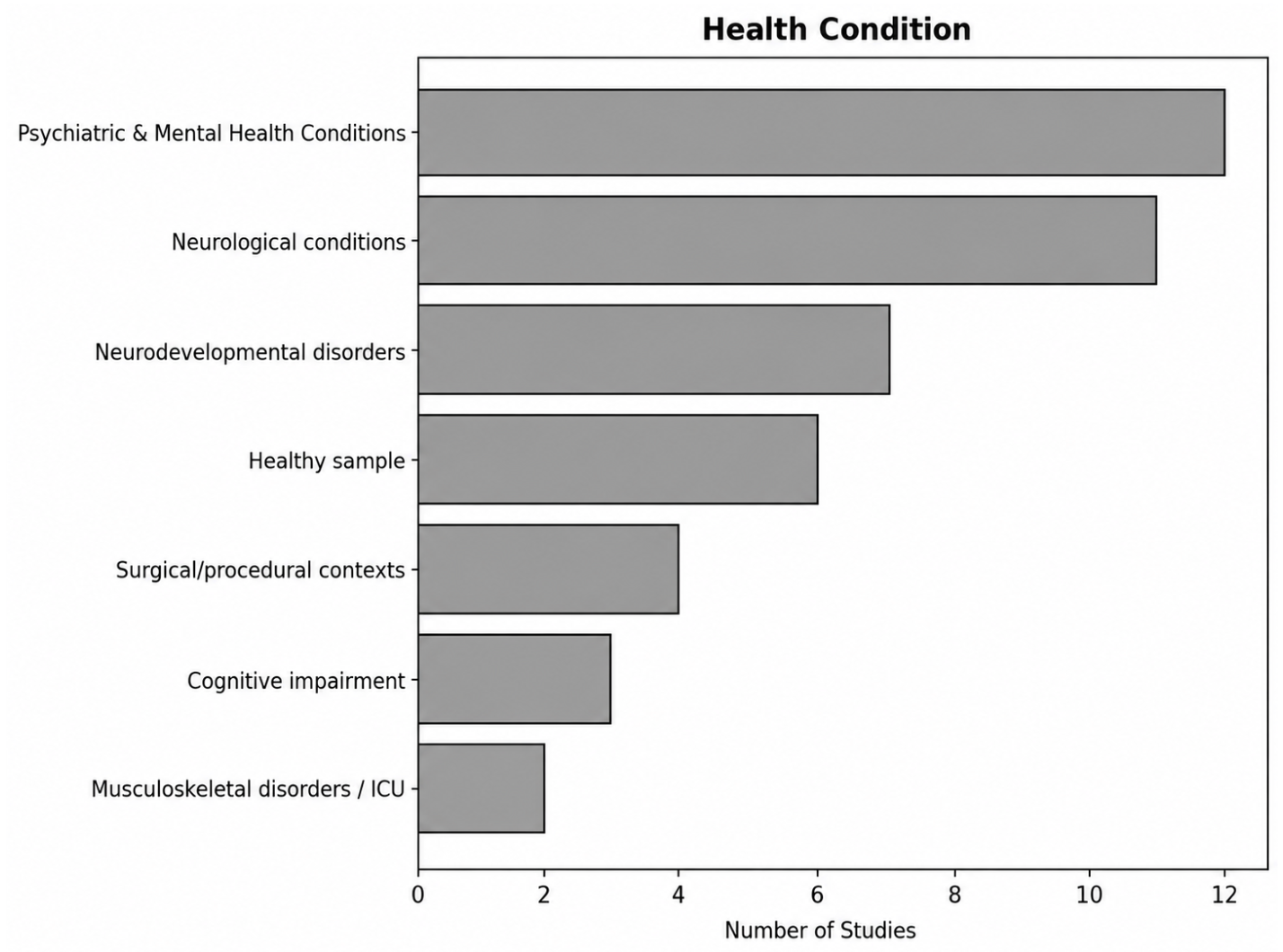
| VR Intervention | Music Intervention | Health Condition | Measurement Tool | Reported Finding | Article No. |
|---|---|---|---|---|---|
| VR 3D audio | Audio Music Listening (2D Audio & 3D Audio in fast/slow tempo) | Healthy (intended for Stress) | Human body metrics (galvanic) | Positive | a1 |
| Virtual Musical Instrument | Music Production (Musical Rhythms with VR Drum) | Attention Deficit Hyperactivity Disorder (ADHD) | Questionnaires, Game metrics | Positive | a2 |
| Virtual Serious Game | Active Music Therapy (Playing melodies in virtual keyboard) | Dementia (Alzheimer mild to moderate) | Game metrics, Questionnaires and Observation | Positive | a3 |
| Virtual Game (VR robot/VR avatar playing drum) | Music Production (imitate drum rhythms with Motions) | Healthy (intended for Special needs) | Questionnaires, Observation, Game metrics | Positive | a4 |
| Virtual Environment | Audio Music Listening (participants preference) | Posttraumatic Stress Disorder (PTSD) | Questionnaire (PCL-5) | Positive | a5 |
| Virtual Musical Instrument | Music Therapy (Voice Improvisation with 5 tonic tones) | Intellectual Disability | Observation | Neutral | a6 |
| Virtual Serious Game | Audio Music Listening (Songs combined with moves) | Healthy (for kinetic) | Human Body metrics | Positive | a7 |
| Virtual Environment | Audio Music Listening (nature & Zikr sounds) | Stress | Questionnaires, Interviews | Positive | a8 |
| Virtual Video | Audio Music Listening (one of these: Classic, Pop, Country, traditional Swiss folk music, or Jazz) | Visual Neglect | Human Body metrics (Records eye movements with video oculography) | Positive | a9 |
| Virtual Environment | Music Therapy (listening to music) | Memory Impairment | Questionnaires (Neuropsychological tests) | Positive | a10 |
| Virtual Video | Audio Music Listening (Western & New Century Music) | Stress | Human Body Metrics (EEG signals recordings), Questionnaires, (SAM scale emotional responses) | Positive | a11 |
| Virtual Musical Instrument (piano) | Music Production (VR piano) | Stroke (hemiparesis) | Game metrics. Human Body metrics (tests for motion impairment, Wolf Motor Function Test (WMFT) & Jebsen Test of Hand Function (JTHF) | Positive | a12 |
| Virtual Environment | Music Therapy (Singing) | Spinal cord | Questionnaires, Interviews | Positive | a13 |
| Virtual Video | Music Therapy (Audio music listening including Healing, favorite, white noise) | Stress | Human Body Metrics, Questionnaires | Positive | a14 |
| Virtual Video | Audio Music Listening | Surgery (hand) | Questionnaires | Positive | a15 |
| VR Environment | Music Therapy (Sounds of Musical Instruments) | Autism | Observation, Interviews | Positive | a16 |
| Virtual Musical Instrument | Music Therapy (Neurologic Music Therapy Technique—Musical Neglect Therapy) | Spatial Neglect | Game metrics, Interviews | Positive | a17 |
| Virtual Serious Game | Audio Music Listening (Sounds of Musical Instruments) | Stroke | Human Body Metrics (Canadian Occupational Performance Measure (COPM) & Fugl-Meyer Assessment—Upper Extremity (FMA-UE), Questionnaires, Game metrics | Neutral performance, Positive satisfaction | a18 |
| Virtual Serious Game | Music Production (Playing notes/songs combined with gestures) | Repetitive strain injury (RSI) | Game metrics, Questionnaires | Positive (entertainment and completed all levels of 3 tasks) | a19 |
| Virtual Serious Game (robotic equipment) | Music Production (Music rhythms & audio feedback combined with hand-finger exercises) | Stroke (motor-hand) | Human Body Metrics (Box and Block Test, Nine Hole Peg Test) & Questionnaires (stroke scale, depression scale), Interviews (Motor Activity Log (QOM & AOU), Action Research Arm Test) | Positive | a20 |
| Virtual Video | Audio Music Listening | Cognitive Impairment (depression) | Questionnaires | Positive | a21 |
| Virtual Video | Audio Music Listening (Instrumental) | High Anxiety | Human Body Metrics [galvanic skin-electrodermal activity (EDA. & Electrocardiogram (ECG)] Questionnaires | Positive | a22 |
| Virtual Environment | Audio Music Listening (hospital sounds) | Hospital Anxiety (chronic disease) | Human Body Metrics, Questionnaires | Neutral | a23 |
| Virtual Serious Game (Robotic Equipment) | Music Production (rhythm, melody, tempo, harmonies linked to movements, sonification) | Healthy (for arm motor rehabilitation) | Game metrics, Questionnaires (Intrinsic Motivation Inventory, Borg Scale) | Positive | a24 |
| Virtual Musical Instrument | Audio Music Listening (Instrumental sounds) | Autism | Questionnaires, Observation | Positive | a25 |
| Virtual Environment | Music therapy (with harp) | Mental recovery post stroke | Questionnaires | Positive | a26 |
| Virtual Serious Game | Audio Music Listening (musical instrumental sounds MIDI) | Healthy (for physical and cognitive disabilities) | Questionnaires | Positive | a27 |
| Virtual Video | Audio Music Listening (relaxing: instrumental, neutral: pop music, stressfulness music: electronic music) | Visually Induced Motion Sickness (VIMS) | Questionnaires | Positive | a28 |
| Virtual Environment (Immersive) | Audio Music Listening (nature sounds, zikr sounds) | Stress | Human Body Metrics, Interview | Positive | a29 |
| Virtual Environment | Audio Music (favorite songs) | PTSD | Questionnaires [PCL-5, Neurobehavioral Symptom Inventory (NSI), Patient Health Questionnaire Depression module (PHQ-9), e Insomnia Severity Index (ISI)] | Positive | a30 |
| Virtual Environment | Audio Music (nature sounds/ relaxing music) | Stress | Human Body Metrics (EEG, EDA electrodermal activity), Questionnaires (PANAS) | Positive | a31 |
| Virtual Environment | Audio Music (Instrumental music) | Bronchoscopy Surgery | Questionnaires (Satisfaction, Visual Analogue Scale, State-Trait-Anxiety-Inventory) | Positive | a32 |
| Virtual Environment | Audio Music (neutral) | PTSD | Interview, Human Body Metrics, Observation | Positive | a33 |
| Virtual Video | Audio Music (classical music) | Labor | Interviews, Questionnaires (VAS, VRS-Verbal rating scale) | Positive | a34 |
| Virtual Environment | Audio music (natures sounds/binaural beats) | Intensive care | Questionnaires (STAI, Satisfaction) | Positive | a35 |
| Virtual Musical Instrument | Audio music (Drum and Xylophone sounds) | Autism | Game metrics, Questionnaires, Observation | Positive | a36 |
| VR Environment | Audio music (low pitches, slow tempo) | Healthy | Questionnaires [POMS-Profile of Mood States & SPEC—Spatial presence Experience Scale] | Mixed | a37 |
| Virtual Environment | Audio music (piano and other instrumental music) | Mental stress | Game metrics (GO NOGO TASK), Questionnaires (PANAS) | Positive | a38 |
| Virtual Video | Audio Music (binaural audio) | Hip Surgery | Human Body Metrics (opium consumption-medical records, antiemetic medication), Questionnaires [Pain Scores (numeric pain scale), patient usability scale, mobility scale, Routine pain, Pain Outcomes Questionnaire Short Form (POQ-SF) | Neutral | a39 |
| Virtual Musical Instrument | Music production (create melodies in xylophone and rhythms in drums) | Stroke | Game metrics | Positive | a40 |
| Virtual Environment | Audio music + sing (favorite songs) | Autism | Questionnaires [Liebowitz Social Anxiety Scale (LSA), Witmer Singer presence questionnaire (PQ), Immersive Tendency Questionnaire (ITQ)] | Positive | a41 |
| Virtual Serious Game | Neurologic Music Therapy techniques: TIMP & PSE | Stroke (arm paretic) | Questionnaires (stress & self-efficacy), Game metrics | Positive | a42 |
| Virtual Environment (Immersive) | Audio Music (favorite songs) | Stroke | Game metrics, Human Body Metrics [(Fugl-Meyer Assessment Test for Upper Extremities (FM-UE), Chedoke Arm and Hand Activity Inventory (CAHAI)], Questionnaires (Montreal Cognitive Assessment (MoCA), Bells test Barthell Index | Positive | a43 |
| Virtual Serious Game | Music Therapy (Playing Xylophone, drums, piano) | Stress anxiety | Questionnaires | Positive | a44 |
| Virtual Musical Instrument | Music production (Piano) | Autism | Game metrics, Observation | Positive | a45 |
Disclaimer/Publisher’s Note: The statements, opinions and data contained in all publications are solely those of the individual author(s) and contributor(s) and not of MDPI and/or the editor(s). MDPI and/or the editor(s) disclaim responsibility for any injury to people or property resulting from any ideas, methods, instructions or products referred to in the content. |
© 2026 by the authors. Licensee MDPI, Basel, Switzerland. This article is an open access article distributed under the terms and conditions of the Creative Commons Attribution (CC BY) license.
Share and Cite
Kandylidou, A.; Spanos, G.; Karagiannidis, C.; Vlachos, F.; Nizamis, A.; Votis, K. The Use of Music and Virtual Reality in Health Contexts: A Scoping Review. Computers 2026, 15, 491. https://doi.org/10.3390/computers15080491
Kandylidou A, Spanos G, Karagiannidis C, Vlachos F, Nizamis A, Votis K. The Use of Music and Virtual Reality in Health Contexts: A Scoping Review. Computers. 2026; 15(8):491. https://doi.org/10.3390/computers15080491
Chicago/Turabian StyleKandylidou, Anna, Georgios Spanos, Charalampos Karagiannidis, Filippos Vlachos, Alexandros Nizamis, and Konstantinos Votis. 2026. "The Use of Music and Virtual Reality in Health Contexts: A Scoping Review" Computers 15, no. 8: 491. https://doi.org/10.3390/computers15080491
APA StyleKandylidou, A., Spanos, G., Karagiannidis, C., Vlachos, F., Nizamis, A., & Votis, K. (2026). The Use of Music and Virtual Reality in Health Contexts: A Scoping Review. Computers, 15(8), 491. https://doi.org/10.3390/computers15080491