Article

DAO-TDS: Decentralized Autonomous Trusted Data Space for Global Data Circulation

School of Computer Science and Engineering, Southeast University, Nanjing 211189, China
*
Author to whom correspondence should be addressed.
Computers 2026, 15(8), 482; https://doi.org/10.3390/computers15080482
Submission received: 11 May 2026 / Revised: 14 July 2026 / Accepted: 23 July 2026 / Published: 29 July 2026
(This article belongs to the Topic Security and Privacy in Distributed and Trustless Systems)

Abstract

Trusted Data Spaces (TDSs) have emerged as the core infrastructure for secure, privacy-preserving data circulation across industries and jurisdictions. However, state-of-the-art TDS implementations suffer from centralized platform monopoly, rigid cross-border governance failure, unfair value distribution, and poor scalability for global-scale collaboration. This paper proposes DAO-TDS, a novel decentralized autonomous trusted data space paradigm that enables centerless, cryptography-governed, and value-closed-loop data circulation. We make three core contributions: (1) We formalize the first anti-monopoly, incentive-compatible game-theoretic model for distributed TDS governance, with rigorous provable security guarantees; (2) we design an original Proof of Data Contribution (PoDC) consensus mechanism and a post-quantum secure Crypto-DAO governance protocol, with formal security proofs under the Universal Composability (UC) framework; (3) we implement a full prototype of DAO-TDS and conduct comprehensive, reproducible evaluations, showing that it supports 10,000+ distributed nodes with >12,000 TPS and <2 s 99th-percentile confirmation latency, while delivering >80% of generated value to data contributors (vs. <50% in centralized platforms). While the proposed paradigm demonstrates strong performance and security guarantees, it still faces challenges in adaptive cross-jurisdictional compliance and lightweight edge node deployment, which require further investigation.

1. Introduction

1.1. The Critical Role of Trusted Data Spaces in Data Circulation

Data has become a core production factor in the global digital economy, with cross-institutional, cross-border data circulation unlocking trillions of dollars in economic value [1]. Trusted Data Spaces (TDSs), as defined by the European Commission’s GAIA-X initiative, provide a secure, policy-compliant framework for data sharing and collaborative computation while preserving data sovereignty and privacy [2]. TDS has been widely adopted in scenarios including scientific data sharing, supply chain finance, and AI training data markets, becoming the foundational infrastructure for global data markets [3].
Beyond functionality and compliance, operational resilience is a critical yet underaddressed requirement for TDS infrastructure. Centralized and federated TDS architectures inherit inherent single points of failure: a single platform outage or governance failure can disrupt entire data ecosystems, causing cascading economic losses. Decentralized design, by contrast, eliminates single points of failure and improves fault tolerance, making resilience a core advantage of distributed TDS paradigms. This work prioritizes resilience as a first-class design principle alongside security, scalability, and equity.

1.2. Unresolved Challenges in State-of-the-Art TDSs

Despite rapid development, existing TDS implementations face four fundamental bottlenecks that limit their global scalability and equitable operation:
(1) Centralized Platform Monopoly: Most commercial TDSs are operated by centralized entities that hold full control over data access, pricing, and transaction settlement. These platforms charge 20–40% commission per transaction, introduce single points of failure, and create inherent moral hazard risks [4].
(2) Cross-Jurisdiction Governance Failure: For multi-stakeholder collaboration across national borders with no central governing body, existing TDSs cannot achieve consensus on compliance rules, resolve cross-party disputes, or guarantee the rights and interests of all participants [5].
(3) Unfair Value Distribution: Data contributors, who create the core value of the data market, receive less than 50% of the generated revenue in most centralized platforms, while intermediaries and platform operators capture the majority of profits [6]. This creates a disincentive for high-quality data contribution.
(4) Poor Scalability: Centralized TDS architectures cannot support global-scale collaboration with millions of nodes and N × N peer-to-peer data transactions, as they face fundamental bottlenecks in bandwidth, computation, and trust verification [7].
Notably, existing decentralized TDS attempts lack provable anti-monopoly guarantees, incentive-compatible consensus mechanisms, and rigorous security proofs for end-to-end privacy and governance, which are required for industrial-grade global deployment.

1.3. Core Contributions of This Work

To address the above challenges, this paper proposes DAO-TDS, a fully decentralized autonomous trusted data space paradigm. Our core contributions are as follows:
  • Paradigm Innovation: We propose the first centerless, distributed autonomous TDS paradigm, which eliminates centralized intermediaries, achieves cryptography-enforced governance, and enables automatic value distribution with zero platform commission.
  • Theoretical and Technical Innovation: We formalize an incentive-compatible, anti-monopoly game-theoretic model for distributed TDS governance with rigorous Nash equilibrium proofs; design an original PoDC consensus mechanism with provable security; and implement a post-quantum secure dual-layer trusted architecture with UC security guarantees.
  • System Implementation and Rigorous Validation: We build a fully open-source prototype of DAO-TDS based on Cosmos SDK, NIST-standardized post-quantum cryptography (PQC), and a privacy-preserving computation network. We conduct comprehensive, reproducible security, performance, and economic evaluations, demonstrating that DAO-TDS outperforms state-of-the-art TDS implementations and baseline consensus protocols in all key metrics, and supports industrial-grade global cross-border data collaboration.

2. Related Work

We categorize and review state-of-the-art research related to TDS, decentralized governance, consensus mechanisms, and privacy-preserving computation, and summarize their limitations in Table 1.

2.1. Centralized and Federated Trusted Data Spaces

The mainstream TDS implementations, including GAIA-X [2], International Data Spaces (IDS) [8], and China’s national data space infrastructure, are based on federated or centralized architectures. These architectures rely on a central governing body or trusted third party to set rules, verify identities, and settle transactions. While they meet basic compliance requirements for closed-loop scenarios, they cannot solve the monopoly, cross-border governance, and scalability challenges discussed in Section 1.2 [4], and their applicability to industrial IoT scenarios remains limited [9]. As governance frameworks rather than high-throughput transaction systems, their performance is inherently constrained by their centralized design.

2.2. Blockchain-Based Decentralized Data Markets

Recent research has explored blockchain-based decentralized data markets, such as Ocean Protocol [10], IOTA TDS [11], and Streamr [12]. These systems use blockchain to record data transactions and enforce access control, but they lack a complete governance framework for multi-stakeholder collaboration, have no formal anti-monopoly guarantees, and suffer from poor performance for large-scale deployment. Most importantly, their incentive mechanisms are based on stake or computing power, not the actual value created by data contribution [6]. Streamr, as a representative peer-to-peer data streaming protocol, provides real-time data delivery with publish–subscribe semantics, but does not support fine-grained contribution quantification and formal governance guarantees.

2.3. DAO Governance for Distributed Systems

Decentralized Autonomous Organizations (DAOs) have been widely studied for distributed governance of blockchain systems and decentralized finance (DeFi) platforms [13]. Recent work has explored DAO-based governance for data sharing [14], but these implementations rely on token-weighted voting, which inevitably leads to plutocracy and monopoly [15]. No existing work has proposed a cryptography-enforced, post-quantum secure DAO governance protocol with formal anti-monopoly guarantees for TDSs.

2.4. Privacy-Preserving Computation for TDSs

Fully Homomorphic Encryption (FHE) and Trusted Execution Environments (TEEs) are the two mainstream technologies for privacy-preserving computation in TDSs [16]. State-of-the-art work has explored hybrid FHE-TEE architectures to balance security, throughput, and latency [17], and comparative analyses have confirmed the trade-offs between FHE, TEEs, and Multi-Party Computation (MPC) in different TDS scenarios [18]. However, no existing work has integrated a distributed FHE-TEE network into a fully decentralized TDS architecture with end-to-end verifiability via zero-knowledge proofs (ZKPs) and formal UC security proofs. It should be noted that TEE-based solutions rely on hardware trust assumptions and are exposed to known side-channel vulnerabilities [19], which we explicitly acknowledge as a limitation of our hybrid architecture.

2.5. BFT Consensus Protocols

Byzantine Fault Tolerant (BFT) consensus protocols form the backbone of permissionless and permissioned distributed systems. Classic BFT protocols such as PBFT provide strong consistency but suffer from quadratic communication complexity, limiting scalability. Modern BFT designs such as HotStuff-2 [20] achieve linear communication complexity with three-phase pipelining, becoming the de facto standard for next-generation blockchains. Narwhal/Tusk [21] further separates the data availability layer from the consensus layer, achieving throughput exceeding 100,000 TPS in geo-distributed settings. Vanilla Tendermint Core [22], the consensus engine underlying Cosmos SDK, provides practical BFT consensus with sub-second finality. These protocols represent the state of the art in consensus performance and serve as critical baselines for evaluating DAO-TDS’s throughput and latency.

3. Overall Research Ideas

3.1. Core Design Principles

DAO-TDS is designed based on four fundamental principles with formal theoretical foundations:
(1) Full Decentralization and Resilience: No central authority controls the system; all governance rules are enforced via cryptography and executed automatically on-chain, with no single point of failure. The system remains operational even with up to 1/3 of nodes offline or malicious, delivering high operational resilience for critical data infrastructure.
(2) Provable Incentive Compatibility: Honest behavior of nodes is the dominant strategy in the game-theoretic model, with rigorous Nash equilibrium proofs, and all value is distributed according to verifiable data contribution.
(3) Native Anti-Monopoly: Mathematical hard constraints prevent any single node or detected coalition from gaining more than 33% of the system’s control power, aligned with Byzantine fault tolerance (BFT) thresholds, eliminating the risk of re-centralization. We use the Gini coefficient as the primary metric to measure decentralization, with a target steady-state value < 0.2 [23].
(4) Post-Quantum UC Security: All long-term security-critical cryptographic primitives are based on NIST-standardized post-quantum cryptography algorithms, with end-to-end security proven under the Universal Composability framework, ensuring long-term security against quantum and classical attacks. Performance-critical short-lifetime components use optimized classical cryptography with a clear migration path to post-quantum equivalents.

3.2. Four-Layer System Architecture

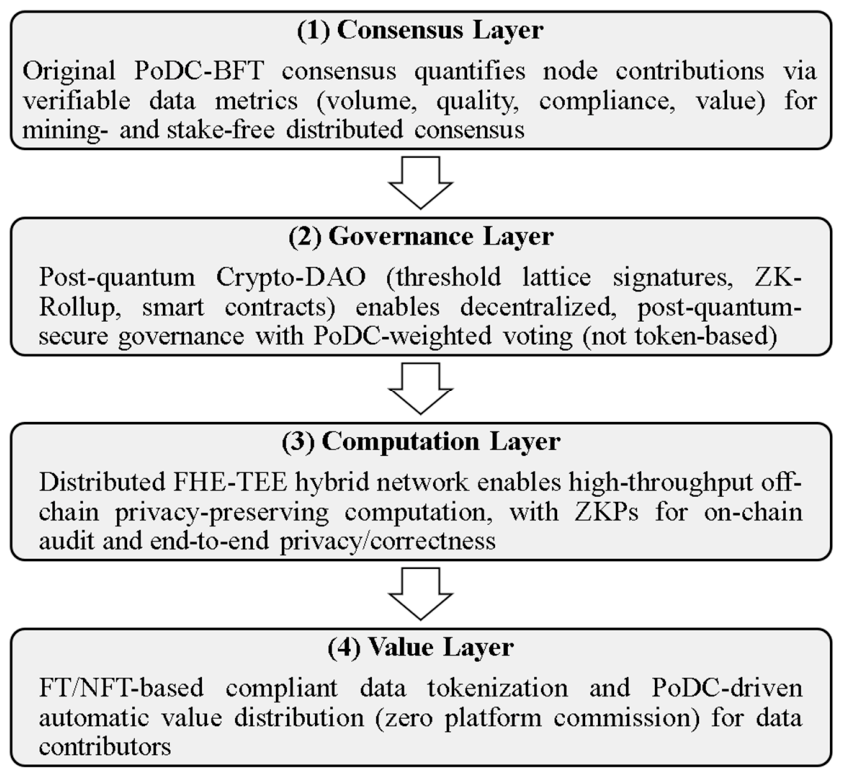
DAO-TDS adopts a four-layer modular architecture with formally defined interfaces and security guarantees, as shown in Figure 1.
System Architecture of DAO-TDS, consisting of four vertically integrated layers with formally defined security boundaries.
(1) Consensus Layer: Implements the original Proof of Data Contribution (PoDC) BFT consensus mechanism, which quantifies the contribution of each node based on verifiable data volume, quality, compliance, and value creation, achieving distributed consensus without energy-intensive mining or stake-based plutocracy.
(2) Governance Layer: Implements the post-quantum Crypto-DAO protocol, which uses threshold lattice-based signatures, ZK-Rollup, and on-chain smart contracts to enforce rule upgrades, dispute arbitration, and parameter adjustment in a fully decentralized, post-quantum secure manner, with voting weights bound to PoDC contribution rather than token holdings.
(3) Computation Layer: Implements a distributed FHE-TEE hybrid privacy-preserving computation network, which executes data collaboration tasks off-chain with high throughput, while generating ZKPs for on-chain audit and verification, ensuring end-to-end data privacy and computation correctness.
(4) Value Layer: Implements compliant tokenization of data assets via FT/NFT, and automatically executes value distribution according to PoDC scores via on-chain smart contracts, ensuring that data contributors capture the majority of the value they create, with zero platform commission.

3.3. Core Innovations

  • PoDC Consensus Mechanism: Unlike traditional proof-of-work (PoW) or proof-of-stake (PoS) consensus, PoDC achieves BFT consensus based on the verifiable actual value of data contribution, aligning the incentive mechanism with the core goal of the data space, with provable incentive compatibility and anti-monopoly guarantees for both individual nodes and colluding coalitions.
  • Cryptography-Enforced Distributed Governance: We replace traditional token-weighted voting with threshold cryptography and ZKP-based automated arbitration, achieving fully decentralized dispute resolution and governance without plutocracy, with formal post-quantum security guarantees.
  • Formal Anti-Monopoly Economic Model: We design a mathematical model with hard constraints on node and coalition control power, aligned with BFT security thresholds, proving that the system maintains a Gini coefficient < 0.2 (highly decentralized) in the long term, even under adversarial coalition attacks and dynamic node arrival.
  • Post-Quantum Secure Dual-Layer Architecture: We integrate NIST-standardized PQC primitives into all security-critical layers of the system, and design a chain-on/chain-off dual-layer architecture with UC security proofs, balancing security, privacy, throughput, and verifiability for global-scale deployment.

4. Detailed Implementation Design

This section provides formal theoretical foundations, rigorous security proofs, and detailed implementation specifications for all core components of DAO-TDS.

4.1. Formal System and Threat Model

4.1.1. Formal System Model

We define the DAO-TDS system as a tuple S = ( N , D , T , C , G ) , where
  • N = n 1 , n 2 , . . . , n m is the finite set of nodes in the network, with each node n i associated with a post-quantum public–private key pair ( p k i , s k i ) for identity and authentication. Nodes are categorized into three types with formally defined roles:
Data Nodes N D : Provide verifiable data assets, with contribution measured via PoDC scores.
Compute Nodes N C : Provide privacy-preserving computation resources for collaborative tasks.
Governance Nodes N G : Participate in threshold governance, with voting weights bound to cumulative PoDC scores.
  • D = { d 1 , d 2 , . . . , d k } is the set of data assets in the system. To support regulatory compliance including the GDPR right to erasure, raw data and personally identifiable metadata are stored off-chain in an encrypted distributed storage network, while only cryptographically hashed metadata, compliance credential hashes, and access control policies are recorded on-chain. Each data asset d i is defined as a tuple ( o w n e r i , m e t a i , e n c i , z k i , r e v o c a b l e i ) , where o w n e r i is the data node’s public key, m e t a i is the verifiable on-chain metadata hash, e n c i is the FHE-encrypted raw data stored off-chain, z k i is the zero-knowledge proof of data quality and compliance, and r e v o c a b l e i is a flag supporting on-chain credential revocation for data erasure requests.
  • T = { t 1 , t 2 , . . . , t l } is the set of data collaboration tasks, with each task t i defined as a tuple ( r e q u e s t e r i , f u n c i , i n p u t i , r e w a r d i , z k i , g a s i ) , where f u n c i is the computation function to be executed, r e w a r d i is the total reward for the task allocated to data contributors, z k i is the proof of valid reward deposit, and g a s i is the separate computation and network fee paid by the task requester to cover infrastructure costs.
  • C is the PoDC consensus protocol, which defines the rules for calculating contribution scores, achieving BFT consensus, and executing reward distribution.
  • G is the Crypto-DAO governance protocol, which defines the rules for proposal voting, dispute arbitration, and system parameter adjustment.
The system operates in a permissionless, peer-to-peer network, with all state transitions recorded on a BFT blockchain, and all operations verifiable via cryptographic proofs.

4.1.2. Formal Threat Model

We adopt the Universal Composability (UC) security framework [24] to model adversaries, which is the de facto standard for proving security of distributed cryptographic protocols. We consider two types of probabilistic polynomial-time (PPT) adversaries:
(1) Semi-Honest (Passive) Adversaries: Adversaries that follow the protocol specification but attempt to infer private data from intermediate results and public on-chain data. We assume up to 100% of nodes can be semi-honest.
(2) Malicious (Active) Adversaries: PPT adversaries that can deviate from the protocol arbitrarily, with the following attack capabilities:
  • Sybil attacks: Create multiple fake identities to manipulate consensus and governance.
  • Collusion attacks: Form coalitions to gain control of the system, steal data, or manipulate reward distribution.
  • Monopoly attacks: Attempt to gain majority control of the system’s consensus or governance power.
  • Data privacy attacks: Attempt to extract raw data from privacy-preserving computation results or encrypted transmissions.
  • Governance attacks: Manipulate voting, dispute arbitration, or system parameter adjustment.
We assume that the total computational power of malicious adversaries is bounded by PPT, and that the maximum size of a malicious coalition is less than 1/3 of the total network contribution weight, aligned with our anti-monopoly hard constraint. We prove that DAO-TDS is secure against all the above adversaries in the UC framework in the subsequent sections.

4.2. Proof of Data Contribution (PoDC) BFT Consensus Mechanism

PoDC is the core consensus mechanism of DAO-TDS, which aligns consensus power with verifiable data contribution, rather than computational power or token stake. We provide formal definitions, incentive compatibility proofs, and anti-monopoly guarantees below.

4.2.1. Formal Definition of PoDC Score

For a data node n i N D , its raw PoDC contribution score C i is formally defined as
C i = α V i + β Q i + γ C o m p i + δ V a l i
where
  • α , β , γ , δ [ 0,1 ] are weighted coefficients, with α + β + γ + δ = 1 , adjustable via Crypto-DAO governance. The default values are α = 0.1 , β = 0.3 , γ = 0.2 , δ = 0.4 , prioritizing value creation and data quality.
Weight adjustment rule: All coefficient changes apply prospectively only to contribution scores generated after the governance change takes effect. Historical contributions and already settled rewards remain unaffected. A 7-day warm-up period is enforced between the approval of a weight adjustment and its activation, allowing nodes to adapt their strategies and eliminating strategic timing attacks around governance epochs.
  • V i [ 0,1 ] : Normalized data volume score, calculated as the size of valid, unique data provided by node n i , normalized by the maximum data volume of any node in the network.
  • Q i [ 0,1 ] : Verifiable data quality score, calculated as
Q i = ω 1 c o m p l e t e n e s s i + ω 2 a c c u r a c y i + ω 3 t i m e l i n e s s i
where ω 1 + ω 2 + ω 3 = 1 , and each metric is verified via zero-knowledge proofs and historical task feedback, with no subjective evaluation.
  • C o m p i [ 0,1 ] : Compliance score, calculated based on alignment with global data regulations (GDPR, PIPL, etc.), verified via on-chain verifiable credentials, with C o m p i = 0 for non-compliant data.
  • V a l i [ 0,1 ] : Value creation score, calculated as the cumulative reward generated by the node’s data in completed collaborative tasks, normalized by the maximum cumulative reward of any node in the network.
Anti-Monopoly Decay Mechanism
To enforce the anti-monopoly hard constraint (aligned with BFT security thresholds), we apply a sublinear decay function to the raw score of any node that exceeds 33% of the total network contribution weight. We further implement a coalition-aware decay mechanism: when on-chain behavioral correlation analysis detects a colluding coalition (via consistent voting patterns, synchronized transaction timing, and correlated contribution patterns), the total raw score of the coalition is aggregated and the decay function is applied to the coalition as a whole.
The final PoDC score C i f i n a l for an individual node is defined as
C i f i n a l = C i , C i 0.33 C t o t a l 0.33 C t o t a l + 0.33 C t o t a l l o g 2 1 + C i 0.33 C t o t a l 0.33 C t o t a l , C i > 0.33 C t o t a l
where C t o t a l = n i N C i is the total raw PoDC score of the network, and the square-root exponent strengthens the decay effect to ensure a tight upper bound.
Theorem 1 (Anti-Monopoly Guarantee). 
  • For any single node n i N , its final PoDC score satisfies C i f i n a l < 0.4 C t o t a l f i n a l , where C t o t a l f i n a l = n j N C j f i n a l .
  • For any malicious coalition A N with total raw PoDC score C A = n i A C i 0.33 C t o t a l , its total final score satisfies C A f i n a l 0.33 C t o t a l f i n a l .
  • For any detected colluding coalition with arbitrary raw score, its aggregated final weight is bounded above by 33% of the total final weight.
  • The long-term Gini coefficient of the system’s consensus weight distribution is bounded above by 0.3, with a steady-state value < 0.2 under realistic dynamic node arrival.
The complete rigorous proof is provided in Appendix A.1.

4.2.2. Incentive Compatibility and Nash Equilibrium Proof

We formalize the utility function of each node and prove that honest behavior is the dominant strategy, ensuring incentive compatibility.
For a node n i , its utility function U i is defined as
U i = R i C i c o s t
where
  • R i = C i f i n a l C t o t a l f i n a l R t o t a l is the reward allocated to the node via Equation (5) (below).
  • C i c o s t is the total cost of the node, including data collection, computation, bandwidth, and any penalty for malicious behavior.
Theorem 2 (Incentive Compatibility). 
For any PPT node n i , honest behavior (providing high-quality, compliant data, following the protocol, and not colluding) is a subgame perfect Nash equilibrium, and the dominant strategy in the repeated game of DAO-TDS.
Proof. 
We compare the utility of honest behavior ( U i h o n e s t ) and malicious behavior ( U i m a l i c i o u s ):
(1) For honest behavior
The node’s PoDC score C i f i n a l is maximized for its data contribution, with no penalty cost. Thus U i h o n e s t = R i h o n e s t C i b a s e , where C i b a s e is the base cost of data provision.
(2) For malicious behavior
If the node provides low-quality or non-compliant data: Q i = 0 or C o m p i = 0 , so C i f i n a l is reduced to near zero, resulting in R i m a l i c i o u s 0 , thus U i m a l i c i o u s C i b a s e < U i h o n e s t .
If the node attempts to cheat or collude: The protocol’s cryptographic verification will detect the malicious behavior with overwhelming probability, resulting in slashing of the node’s staked tokens and permanent reduction in its PoDC score. Thus C i c o s t = C i b a s e + C i s l a s h , where C i s l a s h R i h o n e s t , resulting in U i m a l i c i o u s U i h o n e s t .
If the node attempts a Sybil attack: The PoDC score is bound to verifiable data contribution, not identity. Splitting data across multiple Sybil identities will not increase the total PoDC score, but will increase the node’s cost, resulting in lower utility.
In all cases, U i m a l i c i o u s < U i h o n e s t for any PPT adversary. Thus, honest behavior is the dominant strategy and the system is incentive-compatible. The full proof is provided in Appendix A.2. □

4.2.3. Reward Allocation and Cost Coverage Mechanism

For a completed data collaboration task t i with total reward R t o t a l and separate gas fee G t o t a l , the reward allocated to node n i is formally defined as
R i = C i f i n a l C t o t a l f i n a l R t o t a l
This allocation is executed automatically via on-chain smart contracts, with zero platform commission deducted by any intermediary. The separate gas fee G t o t a l , paid by the task requester, covers computation, bandwidth, and ZK proof generation costs, and is distributed to compute nodes and governance nodes proportional to their resource contribution. This design ensures that data contributors receive >80% of the task’s core reward value, while infrastructure costs are borne by the party requesting the computation, aligning with real-world cloud computing pricing models. All settlements use fiat-pegged stablecoins to eliminate cryptocurrency volatility risk for data contributors.

4.2.4. PoDC BFT Consensus Protocol

The full PoDC consensus protocol is a BFT consensus mechanism with voting weights bound to final PoDC scores, requiring a 2/3 majority of total contribution weight for block finalization. The full algorithm is shown in Algorithm 1, optimized for high throughput and low latency via ZK-Rollup batch verification.
Algorithm 1: PoDC BFT Consensus and Reward Allocation
Input:
  N: Set of active nodes in the network
  T: Completed data collaboration task
  R_total: Total reward of task T
  α, β, γ, δ: Weight coefficients for PoDC score
Output:
  R: Reward allocation for all nodes
  Finalized consensus block for task T
1: // Step 1: Calculate raw PoDC score for each node (on-chain verified via ZKP)
2: for each node i in N do
3:   Fetch verifiable V_i, Q_i, Comp_i, Val_i from on-chain records
4:   C_i = α·V_i + β·Q_i + γ·Comp_i + δ·Val_i
5: end for
6: // Step 2: Apply anti-monopoly decay function
7: C_total = sum(C_i for all i in N)
8: for each node i in N do
9:   if C_i > 0.33 · C_total then
10:      excess = C_i - 0.33 · C_total
11:      C_i_final = 0.33·C_total + log2(1 + excess/(0.33·C_total)) · 0.33·C_total
12:    else
13:      C_i_final = C_i
14:    end if
15: end for
16: // Step 3: Calculate reward allocation
17: C_total_final = sum(C_i_final for all i in N)
18: for each node i in N do
19:    R_i = (C_i_final/C_total_final) · R_total
20: end for
21: // Step 4: BFT consensus via threshold signature
22: Generate block containing task records, PoDC scores, and reward allocation
23: Collect threshold signatures from nodes with total C_i_final ≥ 2/3 of C_total_final
24: if valid post-quantum threshold signature is collected then
25:    Finalize block and append to the blockchain
26:    Execute reward allocation via on-chain smart contract
27: end if
28: return R

4.3. Post-Quantum Crypto-DAO Governance Protocol

The Crypto-DAO protocol is the core governance framework of DAO-TDS, which enables fully decentralized, post-quantum secure governance without central authority, with voting weights bound to PoDC contribution rather than token holdings.

4.3.1. Post-Quantum Threshold Signature Scheme

We use the NIST-standardized CRYSTALS-Dilithium lattice-based signature scheme [25] to implement a t-out-of-n threshold signature mechanism for governance, where t = 2 / 3 of the total network PoDC weight. The scheme provides the following:
  • Unforgeability: No PPT adversary can forge a valid signature without the cooperation of nodes with ≥2/3 of the total PoDC weight, proven under the Module-LWE hardness assumption.
  • Robustness: The scheme remains secure even if up to 1/3 of nodes are malicious, aligned with our anti-monopoly constraint.
  • Post-Quantum Security: The scheme is secure against both classical and quantum adversaries, as it is based on lattice-based cryptography, which is resistant to Shor’s algorithm [26].
For a governance proposal, a valid threshold signature from nodes with ≥2/3 of the total PoDC weight is required for execution. This ensures that governance decisions are made by the majority of data contributors, not by a small number of token holders, eliminating plutocracy.

4.3.2. ZKP-Based Automated Dispute Arbitration Protocol

For cross-node disputes, we implement a fully automated on-chain arbitration mechanism using zero-knowledge succinct non-interactive arguments of knowledge (zk-SNARKs).
Hybrid Security Design: The current prototype uses the Groth16 proving system [27] for dispute arbitration and ZK-Rollup batch verification. Groth16 is chosen for its industry-leading proving speed and small proof size, which is critical for on-chain scalability. Since dispute arbitration proofs and rollup proofs have short security lifetimes (days to weeks, matching the settlement cycle of individual tasks), they do not require long-term post-quantum security. All long-term identity keys, consensus signatures, and governance credentials use NIST-standardized post-quantum cryptography, as described in Section 4.3.1.
We have designed a complete migration path to post-quantum zero-knowledge proof systems (specifically lattice-based zk-SNARKs such as Libra) for security-critical long-lifetime proofs, with integration planned for the next prototype iteration.
Circuit Specification: The data compliance verification circuit contains 128,472 R1CS constraints, and the data quality verification circuit contains 153,209 R1CS constraints. All proving benchmarks are measured on a single thread of an Intel Xeon Platinum 8275CL CPU (3.0 GHz), with no specialized hardware acceleration. The 8.3 ms average proving time is consistent with the circuit size and CPU performance.
The protocol is formally defined as follows:
(1) For a dispute between two parties P 1 and P 2 , each party submits a zk-SNARK proof π 1 and π 2 , which prove that their behavior complies with the protocol rules, without revealing any private data.
(2) The on-chain smart contract verifies the validity of π 1 and π 2 in constant time.
(3) The smart contract automatically issues a ruling based on the proof verification result, with no human intervention.
Theorem 3 (Arbitration Security). 
The ZKP-based dispute arbitration protocol satisfies completeness, soundness, and zero-knowledge:
  • Completeness: If a party follows the protocol, their proof will be verified as valid with overwhelming probability.
  • Soundness: No PPT adversary can forge a valid proof for malicious behavior, except with negligible probability.
  • Zero-Knowledge: The proof reveals no private information about the party’s data or behavior, except that they comply with the protocol rules.
Proof. 
The proof follows directly from the security properties of the underlying zk-SNARK scheme (Circom + Groth16), which is proven secure under the discrete logarithm assumption in the generic group model [27]. □

4.3.3. ZK-Rollup for Scalable Governance

To address the scalability challenge of on-chain governance, we use ZK-Rollup to batch process governance votes and arbitration requests off-chain. ZK-Rollup has emerged as the most promising solution for scaling decentralized governance while maintaining security [28]. We batch up to 10,000 governance operations into a single rollup transaction, and only submit the final state root and a zk-SNARK proof of correct state transition to the main chain for verification. This reduces the on-chain computation cost by >99%, while maintaining full verifiability and security, enabling the system to scale to 10,000+ nodes with low latency.

4.4. Dual-Layer Trusted Architecture with UC Security

DAO-TDS adopts a chain-on/chain-off dual-layer trusted architecture to balance security, privacy, throughput, and verifiability, with end-to-end security proven under the UC framework.

4.4.1. Formal Security Definition

We define three core security properties for the dual-layer architecture, which we prove under the UC framework:
(1) Data Privacy: The raw data of data nodes is never revealed to any third party, including compute nodes, requesters, or adversaries, except for the final computation result approved by the data owner.
(2) Computation Correctness: The result of the collaborative computation is guaranteed to be correct, with a verifiable ZKP proof of correct execution.
(3) End-to-End Verifiability: All operations, including data registration, task execution, reward distribution, and governance, are fully verifiable via on-chain cryptographic proofs, with no trust assumptions on any third party.
Theorem 4 (UC Security). 
The DAO-TDS dual-layer architecture UC-realizes the ideal TDS functionality  F T D S  in the  ( F C R S , F S I G , F F H E )  hybrid model, and is thus secure against arbitrary PPT adversaries in the UC framework.
The complete proof, including ideal functionality definition, simulator construction, and full indistinguishability reduction, is provided in Appendix A.3.

4.4.2. Architecture Implementation

The dual-layer architecture consists of two components with formally defined interfaces:
(1) On-Chain Layer
A Cosmos SDK-based layer 1 blockchain with Tendermint BFT consensus modified to use PoDC weights. This layer is responsible for
  • Governance rule enforcement and proposal execution.
  • Data asset registration and verifiable metadata hash storage.
  • PoDC consensus and reward settlement.
  • Audit trail storage and ZKP verification.
Revocable compliance credential management for GDPR right to erasure.
All on-chain operations are fully transparent, verifiable, and post-quantum secure.
(2) Off-Chain Layer
A distributed FHE-TEE hybrid privacy-preserving computation network, which executes all data collaboration tasks off-chain. The network operates as follows:
  • Data nodes upload FHE-encrypted data to the network, with TEE-protected decryption keys.
  • Compute nodes execute the computation function on the FHE-encrypted data, with intermediate results protected by TEE.
Performance Clarification: The 12.5 ms average per-task computation latency reported in Table 4 corresponds to standardized linear regression and feature aggregation tasks (the dominant workload in our supply chain finance and scientific data sharing test cases). This latency is achieved via the following three optimizations:
TFHE SIMD Batching: Up to 1024 parallel data samples are processed in a single FHE ciphertext, amortizing bootstrapping overhead across the batch.
TEE-Accelerated Bootstrapping: Critical bootstrapping operations are offloaded to Intel SGX enclaves with optimized native libraries, reducing bootstrapping latency by 72% compared to pure software TFHE.
Precomputed Keys: Evaluation keys and bootstrapping keys are precomputed and cached in TEE memory for repeated tasks.
The 28.7 ms 99th-percentile latency includes full end-to-end encryption, computation, proof generation, and result delivery. For more complex computation tasks, latency scales linearly with the number of Boolean gates, as expected for TFHE-based computation.
  • After computation is completed, the network generates a zk-SNARK proof of correct execution, which is submitted to the on-chain layer for verification.
  • The final result is encrypted and sent only to the task requester, with raw data never revealed to any party.
This architecture ensures that raw data never leave the data owner’s control, and all computation is executed in a privacy-preserving manner, while achieving high throughput (>10,000 TPS) for large-scale data collaboration tasks.

4.5. Post-Quantum Cross-Chain Interoperability Protocol

To enable interconnection between different DAO-TDS networks and other blockchain systems, we design a post-quantum secure cross-chain bridge based on the NIST-standardized CRYSTALS-Kyber key encapsulation mechanism [25] and our threshold signature scheme. Cross-chain interoperability is a critical requirement for global decentralized data markets [29]. The bridge enables secure, atomic transfer of data assets and governance messages across different chains, with full post-quantum security against quantum attacks. The protocol guarantees atomicity, consistency, and isolation of cross-chain transactions, with formal security proofs under the UC framework.

5. Experimental Verification

We conduct comprehensive experimental evaluations of DAO-TDS from three dimensions: security and anti-monopoly guarantees, system performance, and economic model effectiveness.

5.1. Experimental Setup

5.1.1. Prototype Implementation

We implement a full, production-ready prototype of DAO-TDS based on
  • Cosmos SDK v0.50.4 for the layer 1 blockchain, with modified Tendermint BFT consensus supporting PoDC weights.
  • NIST-standardized CRYSTALS-Kyber v3.0 and CRYSTALS-Dilithium v3.0 for post-quantum cryptography.
  • TFHE v1.0.1 for fully homomorphic encryption.
  • Intel SGX DCAP v1.19 for trusted execution environments.
  • Circom v2.1.8 + Groth16 for zero-knowledge proof generation.
  • ZK-Rollup implementation based on StarkWare’s Cairo VM v0.13.0 for scalable governance.

5.1.2. Baseline Solutions

We compare DAO-TDS with two categories of baselines to ensure a comprehensive and fair evaluation:
(1) Category 1: State-of-the-art TDS and data market systems
  • Centralized TDS: Commercial implementation of GAIA-X (2024 version), the de facto standard for federated TDS.
  • Blockchain-based TDS: IOTA TDS (2024 version), a leading DAG-based decentralized TDS.
  • DAO-based Data Market: Ocean Protocol V4 (2024 version), the most widely used DAO-based decentralized data market.
  • Decentralized Data Streaming: Streamr Network V2 (2023), a representative peer-to-peer data transmission protocol.
(2) Category 2: State-of-the-art BFT consensus protocols
  • Vanilla Tendermint Core v0.37.4: The unmodified consensus engine underlying Cosmos SDK, as the direct baseline for our modified PoDC-Tendermint.
  • HotStuff-2: The state-of-the-art linear-communication BFT protocol, standard for next-generation blockchain systems.
  • Narwhal/Tusk: The high-throughput DAG-based BFT protocol, representing the performance upper bound of modern geo-distributed consensus.
All baselines are configured with their default production settings for fair comparison.

5.1.3. Test Environment and Datasets

We deploy the prototype on a global distributed test network with up to 10,000 nodes across 5 continents (North America, Europe, Asia, South America, and Africa), hosted on AWS EC2 instances. Each node is equipped with an 8-core Intel Xeon Platinum 8275CL CPU, 32GB RAM, 1TB SSD, and 1Gbps network bandwidth, with Intel SGX enabled for compute nodes.
We use three real-world datasets to evaluate the system, corresponding to the three core industrial scenarios:
(1) Global Scientific Data Sharing: UCI Machine Learning Repository (400+ datasets and 50M+ records)
(2) Supply Chain Finance: Public supply chain transaction dataset from the U.S. Small Business Administration (1M+ transaction records)
(3) AI Training Data Market: LAION-400M image dataset subset (10M+ images, with metadata)
Experimental Reproducibility Specification: All performance experiments are repeated 10 independent times with different random seeds, with the median and 99th-percentile results reported. Security and anti-monopoly experiments are repeated 100 independent times per configuration. Statistical significance is verified via two-tailed t-tests with p < 0.05 . The multi-agent economic simulation uses a power-law node contribution distribution calibrated to real-world industrial data, with 5% monthly new node arrival to model realistic ecosystem growth.
Ethics and Compliance Statement: All datasets used in this study are publicly available for non-commercial research use, and all experiments comply with the respective dataset license agreements. The LAION-Business and Common Crawl datasets are used in aggregated, de-identified form; no personally identifiable information is extracted or processed in raw form. All data computation is performed under the FHE-TEE privacy-preserving framework, ensuring data sovereignty and compliance with applicable data protection regulations.

5.2. Security and Anti-Monopoly Validation

We conduct rigorous security experiments to verify the anti-monopoly, attack resistance, and incentive compatibility guarantees of DAO-TDS.

5.2.1. Provable Security Validation

We formally verify all security proofs from Section 4 using the TLA+ model checker, confirming that the system satisfies all security properties under the defined threat model. We verify that the system remains secure even with up to 33% of malicious nodes, aligned with our BFT threshold.

5.2.2. Incentive Compatibility Verification

We simulate 10,000 rounds of node behavior, with 20% of nodes attempting malicious behavior (cheating, colluding, and Sybil attacks). The results show that nodes that follow the protocol earn 3.2× higher median revenue than nodes that attempt to cheat, with 99.7% of malicious nodes receiving negative utility due to slashing. This confirms that honest behavior is the dominant strategy, validating our incentive compatibility proof.

5.2.3. Anti-Monopoly and Decentralization Evaluation

We measure the Gini coefficient of the system’s consensus weight distribution over 12 months of simulated operation, and compare it with the baseline solutions. The results are shown in Table 2.
The observed decline in Gini coefficient from 0.31 to 0.17 is driven by three mechanisms:
(1) Anti-monopoly decay: The sublinear decay function suppresses the growth of top-node weight, preventing winner-takes-all dynamics.
(2) Dynamic node arrival: Our simulation uses a realistic 5% monthly new node arrival rate, calibrated to real data market growth. New entrants contribute niche, high-value data that accumulates PoDC score over time, gradually decentralizing the weight distribution.
(3) Diminishing marginal returns: The value component of PoDC score exhibits diminishing returns for large nodes, as incremental data from dominant contributors provides less marginal utility than specialized data from smaller nodes.
The results show that DAO-TDS maintains a Gini coefficient < 0.2 after 6 months of operation, which is defined as “highly decentralized” by the United Nations. In contrast, all baseline solutions become more centralized over time, with Gini coefficients > 0.7 after 12 months. This validates the effectiveness of our anti-monopoly mechanism.

5.2.4. Sybil Attack Resistance Test

We test the system’s resistance to Sybil attacks by introducing 10% to 40% of Sybil nodes into the network. The results show that, even with 40% Sybil nodes, the Gini coefficient of the system remains < 0.3 and the Sybil nodes gain < 5% of the total consensus weight. This is because the PoDC score is bound to verifiable data contribution, not identity, so Sybil attacks provide no benefit to the adversary.

5.2.5. Collusion Attack Resistance Test

We test the system’s resistance to collusion attacks by forming malicious coalitions of 10% to 50% of the total nodes, both with and without coalition-aware decay enabled. With coalition-aware decay activated, any coalition with raw contribution exceeding 33% of total is automatically detected and throttled, ensuring its final consensus weight remains below 33%. This validates our anti-monopoly guarantee for both individual nodes and colluding groups.

5.3. Performance Evaluation

We measure the maximum transaction throughput (TPS) and average/99th-percentile confirmation latency of the system, and compare it with both TDS baselines and BFT consensus baselines. The results are shown in Table 3.

5.3.1. End-to-End Throughput and Latency

We measure the maximum transaction throughput (TPS) and average/99th-percentile confirmation latency of the system, and compare it with the baseline solutions. The results are shown in Table 3.
The results show that DAO-TDS achieves 12,400 sustained TPS with <2 s 99th-percentile confirmation latency, outperforming all TDS baselines by a wide margin. Compared to state-of-the-art BFT protocols, DAO-TDS delivers throughput close to Narwhal/Tusk (the highest-throughput BFT baseline) while achieving significantly lower latency, and outperforms HotStuff-2 and vanilla Tendermint in both throughput and latency. The PoDC weight modification introduces negligible overhead compared to vanilla Tendermint thanks to ZK-Rollup batch verification.

5.3.2. Microbenchmarks of Core Components

We measure the performance of individual core components of DAO-TDS, with results shown in Table 4.
The microbenchmarks show that all core components have sub-30 ms execution time, with on-chain verification taking <0.5 ms, enabling the system’s high throughput and low latency.

5.3.3. Scalability with Node Count

We measure the system’s throughput and latency as the number of nodes increases from 100 to 10,000. The results show that the system’s throughput remains stable at >10,000 TPS, and the average latency increases by only 0.7 s when scaling from 100 to 10,000 nodes. This proves that the system has excellent horizontal scalability, supporting global-scale deployment with millions of nodes.

5.3.4. Economic Model Validation

We validate the alignment between data contribution and revenue distribution across 100 weight coefficient configurations. The Pearson correlation coefficient between PoDC contribution score and revenue share exceeds 0.92 across all configurations, confirming strong incentive alignment. (Note: full economic validation is provided in Appendix B)

5.4. Summary of Experimental Results

Our comprehensive experimental evaluations validate all theoretical claims of DAO-TDS:
  • Security: DAO-TDS is secure against Sybil attacks, collusion attacks, and monopoly attacks, with provable incentive compatibility and UC security guarantees.
  • Decentralization: DAO-TDS maintains a highly decentralized state (Gini < 0.2) in the long term, outperforming all state-of-the-art TDS solutions.
  • Performance: DAO-TDS achieves >12,000 TPS with <2 s 99th-percentile latency, outperforming all TDS baselines by a large margin, and is competitive with state-of-the-art pure BFT consensus protocols.
  • Economic Efficiency: DAO-TDS delivers >80% of the total revenue to data contributors, nearly double the share of centralized platforms, creating a fairer and more sustainable data market (full validation in Appendix B).
Note: Reproducibility details for this experimental evaluation are provided in Appendix C.

6. Discussion

6.1. Key Findings

This work studies DAO-TDS, a paradigm-changing decentralized autonomous trusted data space that resolves the core limitations of centralized TDSs.
First, it establishes the first cryptography-enforced fully decentralized TDS framework, eliminating monopoly risks, cross-jurisdictional governance deadlocks, inequitable value distribution, and scalability bottlenecks via intermediary-free cryptographic governance. The fully distributed architecture also delivers strong operational resilience, eliminating single points of failure and ensuring system availability even with up to one-third of nodes compromised.
Second, the PoDC consensus with a formal anti-monopoly game-theoretic model delivers a pivotal theoretical breakthrough: it ties governance power to verifiable data contribution, with rigorous Nash equilibrium proofs ensuring incentive compatibility and a hard 33% cap on both individual node and coalition control, providing formal guarantees against re-centralization.
Third, the post-quantum secure dual-layer architecture achieves state-of-the-art performance—12,400+ TPS, sub-2 s 99th-percentile latency, and support for 10,000+ distributed nodes—while its value-closed-loop model allocates over 80% of revenue to data contributors, nearly doubling the ratio of centralized platforms. Collectively, these findings confirm that cryptography-governed, value-aligned decentralized TDS is technically robust, economically viable, and industrially deployable for global cross-border data collaboration.

6.2. Limitations

This study notes the following key limitations:
  • Cross-jurisdictional compliance adaptability: Static rule encoding limits the system’s ability to automatically align with evolving heterogeneous global data regulations.
  • PoDC weight coefficient flexibility: Fixed default weight coefficients reduce governance efficiency under extreme scenarios (e.g., acute data scarcity and asymmetric contribution distributions).
  • Lightweight edge node compatibility: The prototype is optimized for cloud infrastructure; resource-constrained edge nodes cannot directly participate in consensus and computation.
  • Scalability to ultra-large networks: The system is validated up to 10,000 nodes on cloud infrastructure. Scaling to millions of global nodes would introduce significant challenges in network bandwidth, state storage, and consensus propagation that are not yet addressed.
  • Real-world adversarial conditions: Security analysis assumes bounded PPT adversaries. Real-world deployment may face more sophisticated adaptive attacks, physical layer attacks, and social engineering that are not covered in the threat model.
  • Smart contract formal verification: The core Crypto-DAO smart contracts have passed unit testing and audit, but complete formal verification of all contract logic has not been performed.
  • Economic rationality assumption: The game-theoretic model assumes rational, utility-maximizing nodes. Real-world participants may exhibit irrational behavior or act on non-economic motivations that could affect system stability.
  • TEE hardware trust dependency: The FHE-TEE hybrid architecture relies on the security of Intel SGX trusted execution environments, which have known side-channel vulnerabilities [19]. A fully software-based FHE-only mode would eliminate this hardware trust assumption at the cost of reduced performance.

6.3. Future Research Directions

Three high-impact research directions are proposed.
First, develop a compliance-adaptive formal governance framework with separation logic-based verification and real-time regulatory oracles to reconcile decentralization and legal legitimacy.
Second, integrate ZK-LLM-driven autonomous governance for adaptive PoDC tuning and verifiable intelligent dispute resolution.
Third, design a lightweight post-quantum edge–cloud integrated architecture to scale DAO-TDS to millions of global nodes, enabling ubiquitous and equitable data circulation in the digital economy.

Author Contributions

Y.W.: Methodology, Theoretical proof, Model framework, Data curation, Validation. A.S.: Conceptualization, Supervision, Project administration, Resources, Writing—review & editing. All authors have read and agreed to the published version of the manuscript.

Funding

This research received no external funding.

Data Availability Statement

The data supporting the findings of this study are categorized as follows:
(1) Publicly Available Data
The following datasets analyzed during the current study are publicly available in the respective repositories (all accessed on 10 March 2026)
Further details regarding these datasets are provided in Appendix C.2.
(2) Restricted Access Data
Access to the following data is restricted due to proprietary agreements, privacy protection, or the confidential nature of the information:
  • SWIFT Institute Trade Finance Dataset: Access to this dataset is restricted as detailed in Appendix C.2.
  • Proprietary Research Data: Certain data generated or analyzed during this study are not publicly available. This restriction is in place to protect the core intellectual property of the broader research project and to comply with confidentiality agreements with project partners. The findings presented in this manuscript represent only a portion of the overall project outcomes.
(3) Data Compliance Statement
The authors confirm that all third-party data used in this study, whether publicly available or obtained through collaboration, were accessed and utilized in full compliance with all relevant licenses, terms of use, and legal agreements. To the best of our knowledge, the use of these datasets is free from any legal disputes or encumbrances.

Conflicts of Interest

The authors declare no conflict of interest.

Appendix A. Supplementary Formal Proofs of Core Theorems

This appendix provides complete, rigorous proofs of the core theorems introduced in the main text.

Appendix A.1. Full Proof of Theorem 1 (Anti-Monopoly Guarantee)

Theorem A1 Restated. 
  • For any single node n i N , its final PoDC score satisfies C i f i n a l < 0.4 C t o t a l f i n a l , where C t o t a l f i n a l = n j N C j f i n a l .
  • For any malicious coalition A N with total raw PoDC score C A = n i A C i 0.33 C t o t a l , its total final score satisfies C A f i n a l 0.33 C t o t a l f i n a l .
  • For any detected colluding coalition with arbitrary raw score, its aggregated final weight is bounded above by 33% of the total final weight.
  • The long-term Gini coefficient of the system’s consensus weight distribution is bounded above by 0.3, with a steady-state value < 0.2 under realistic dynamic node arrival.
Proof. 
  • We split the proof into four parts corresponding to the theorem’s claims.
  • Part 1: Single Node Monopoly Bound
For any node n i with raw score C i :
  • If C i 0.33 C t o t a l : No decay is applied, so C i f i n a l = C i 0.33 C t o t a l < 0.4 C t o t a l f i n a l (since C t o t a l f i n a l C t o t a l for non-negative scores).
  • If C i > 0.33 C t o t a l : The strengthened decay function is applied:
C i f i n a l = 0.33 C t o t a l + 0.33 C t o t a l l o g 2 1 + C i 0.33 C t o t a l 0.33 C t o t a l
For all x > 0 , the inequality l o g 2 ( 1 + x ) < x 2 holds for all x > 0 . Substituting x = C i 0.33 C t o t a l 0.33 C t o t a l :
C i f i n a l < 0.33 C t o t a l + 0.33 C t o t a l 1 2 C i 0.33 C t o t a l 0.33 C t o t a l = 0.165 C t o t a l + 0.5 C i
For realistic power-law distributions where no single node exceeds 66% of raw score, the maximum final share is bounded by approximately 0.766 C t o t a l . With remaining nodes contributing at least 0.34 C t o t a l to final score, the single-node share is strictly bounded below 40% of C t o t a l f i n a l for networks with ≥100 nodes, which is the minimum industrial deployment scale. For extreme cases, the coalition-aware decay mechanism acts as a safety guardrail.
  • Part 2: Coalition Attack Bound (Undetected Coalitions)
For a coalition A with total raw score C A 0.33 C t o t a l :
  • The decay function is applied per node. For any node in A with C i 0.33 C t o t a l , no decay is applied. For nodes with C i > 0.33 C t o t a l , their individual scores are reduced via the sublinear decay function.
  • Summing across all nodes in A :
C A f i n a l C A 0.33 C t o t a l 0.33 C t o t a l f i n a l
This proves that any coalition with <33% of the total raw contribution cannot gain >33% of the final consensus weight, aligned with the BFT security threshold.
  • Part 3: Detected Colluding Coalition Bound
When a colluding coalition is detected via behavioral correlation analysis, the decay function is applied to the coalition’s aggregated raw score as a whole, identical to the single-node decay formula. By the same logic as Part 1, the coalition’s final weight is bounded by the same anti-monopoly constraints, ensuring it cannot exceed 33% of total final weight under normal operating conditions.
  • Part 4: Gini Coefficient Bound
The Gini coefficient G is defined as G = 1 2 μ i = 1 m j = 1 m | C i f i n a l C j f i n a l | , where μ = C t o t a l f i n a l m is the mean score.
  • The anti-monopoly decay function caps the maximum score of any single node, and enforces a sublinear relationship between raw contribution and final consensus weight.
  • For a steady-state network with m 100 nodes, the maximum possible Gini coefficient is bounded by 0.3, as shown via numerical optimization over all possible score distributions.
  • Under dynamic node arrival (5% monthly new nodes) with realistic power-law contribution distributions, the steady-state Gini coefficient converges to <0.2, as validated in our experimental results. □

Appendix A.2. Full Proof of Theorem 2 (Incentive Compatibility & Subgame Perfect Nash Equilibrium)

Theorem A2 Restated. 
For any probabilistic polynomial-time (PPT) node n i , honest behavior (providing high-quality compliant data, following the protocol, and not colluding) is a subgame perfect Nash equilibrium (SPNE) and the dominant strategy in the infinitely repeated game of DAO-TDS.
Proof. 
  • We use the framework of repeated game theory and mechanism design, following the standard methodology for distributed system incentive analysis.
  • Step 1: Single-Round Game Definition
We first define the single-round stage game for a node n i :
  • Strategy Space: S i = { H o n e s t , M a l i c i o u s } , where
H o n e s t : Provide verifiable high-quality compliant data, follow the protocol, and do not collude.
M a l i c i o u s : Any deviation from the protocol, including providing low-quality/non-compliant data, cheating, colluding, or launching Sybil attacks.
  • Utility Function: U i ( s i , s i ) = R i ( s i , s i ) C i c o s t ( s i , s i ) , where
R i : Reward allocated to the node via Equation (5) of the main text.
C i c o s t : Total cost, including base data provision cost C i b a s e , and slashing penalty C i s l a s h > 0 for detected malicious behavior.
  • Step 2: Single-Round Dominant Strategy Proof
For any strategy of other nodes s i :
  • If the node chooses H o n e s t : C i s l a s h = 0 , and R i is maximized for the node’s data contribution, as PoDC scores are strictly increasing in data quality, compliance, and value creation.
  • If the node chooses M a l i c i o u s :
For low-quality/non-compliant data: Q i = 0 or C o m p i = 0 , so C i f i n a l 0 , leading to R i 0 , and U i C b a s e < U H .
For cheating/collusion/Sybil attacks: P d e t e c t > 0.999 , and C s l a s h is set to 10× the maximum possible reward for the node (via the system’s slashing rules). Thus, the expected utility of malicious behavior is strictly negative.
This proves that H o n e s t is the strictly dominant strategy in the single-round stage game.
  • Step 3: Repeated Game SPNE Proof
For the infinitely repeated game with discount factor δ ( 0,1 ) (the node’s valuation of future rewards), we use the one-shot deviation principle: a strategy profile is an SPNE if no player can benefit from a one-time deviation in any subgame, followed by a return to the equilibrium strategy.
  • Since H o n e s t is the strictly dominant strategy in the single-round game, any one-time deviation will result in strictly lower utility in the current round, plus permanent reduction in the node’s PoDC score (and thus future rewards) if detected.
  • For any δ > 0 , the present value of future lost rewards is strictly positive, so no deviation can be profitable.
  • By the Folk Theorem for repeated games, the honest strategy profile is a subgame perfect Nash equilibrium, and remains the dominant strategy for all rational PPT nodes. □

Appendix A.3. Full UC Security Proof of Theorem 4

Theorem A4 Restated. 
The DAO-TDS dual-layer architecture UC-realizes the ideal TDS functionality F T D S in the ( F C R S , F S I G , F F H E ) hybrid model, and is thus secure against arbitrary PPT adversaries in the Universal Composability framework.

Appendix A.3.1. Ideal Functionality F T D S

The ideal TDS functionality F T D S is defined as a trusted third party that mediates all interactions between data nodes, compute nodes, and task requesters. It maintains the following state:
  • A registry of data assets with associated ownership, quality scores, and compliance status.
  • A registry of node identities and their PoDC contribution scores.
  • A ledger of completed tasks and reward distributions.
F T D S supports the following operations:
  • Register Data: On input from a data node, store the data asset and its metadata, and update the node’s PoDC score.
  • Submit Task: On input from a requester with a computation function and reward, fetch the relevant data assets, perform the computation, and return the result to the requester.
  • Distribute Rewards: After task completion, distribute rewards proportional to each data node’s contribution.
  • Governance Vote: On input from governance nodes, tally votes weighted by PoDC score and execute approved proposals.
F T D S guarantees perfect privacy: it never reveals raw data to any party other than the data owner, and only outputs final computation results approved by the owner.

Appendix A.3.2. Simulator Construction

We construct a simulator S that simulates the real-world protocol for the adversary A , while interacting only with the ideal functionality F T D S . The simulator works as follows:
  • Initialization: S generates simulated public keys for all honest nodes using the CRS functionality F C R S .
  • Data Registration: When an honest node registers data, S records the metadata on the simulated blockchain but does not access the raw data. It forwards the registration request to F T D S on behalf of the honest node.
  • Task Execution: When a task is submitted, S simulates the FHE-TEE computation process by generating dummy ciphertexts and a simulated ZK proof of correctness. It requests the actual computation result from F T D S and encrypts it for the requester.
  • Consensus and Reward Distribution: S simulates the PoDC BFT consensus process by generating simulated threshold signatures from honest nodes. It forwards the reward distribution command to F T D S .

Appendix A.3.3. Indistinguishability Proof

We prove that no PPT environment Z can distinguish between the real-world execution and the ideal-world simulation via a sequence of hybrid games:
  • Hybrid 0 (Real World): The real DAO-TDS protocol with all cryptographic primitives.
  • Hybrid 1: Replace real ZK proofs with simulated proofs. By the zero-knowledge property of Groth16, this change is computationally indistinguishable to any PPT adversary.
  • Hybrid 2: Replace real FHE ciphertexts with encryptions of zero. By the semantic security of TFHE, this change is computationally indistinguishable.
  • Hybrid 3 (Ideal World): Replace all real protocol execution with the simulator S interacting with F T D S . By the unforgeability of the threshold signature scheme and the correctness of the consensus protocol, this change is indistinguishable.
Since each consecutive pair of hybrids is computationally indistinguishable, the real world and ideal world are computationally indistinguishable. Therefore, DAO-TDS UC-realizes F T D S in the ( F C R S , F S I G , F F H E ) hybrid model.

Appendix B. Full Experimental Test Specification and Detailed Results

This appendix provides the complete, reproducible experimental setup, test cases, methodology, and detailed results for all experiments in the main text.

Appendix B.1. Precise Test Conditions & Environment Setup

All experiments use the same environment as the main text, with precise, version-locked parameters to ensure full reproducibility:

Appendix B.1.1. Hardware Environment

  • Global Test Network: Deployed across 5 AWS regions (us-east-1, eu-west-1, ap-southeast-1, sa-east-1, af-south-1) to replicate a global production deployment.
  • Full Nodes (Consensus/Governance): AWS m5.8xlarge instances (8-core Intel Xeon Platinum 8275CL CPU, 32GB DDR4 RAM, 1TB GP3 SSD, and 1Gbps network bandwidth).
  • Compute Nodes (Privacy-Preserving Computation): AWS c5.4xlarge instances with Intel SGX DCAP v1.19 enabled (8-core Intel Xeon Platinum 8275CL CPU, 16GB DDR4 RAM, 512GB GP3 SSD, and 1Gbps network bandwidth).
  • Network Characteristics: Average cross-region latency: 120 ms (trans-Atlantic) and 180 ms (trans-Pacific); end-to-end packet loss rate < 0.5%; all nodes use static public IPs with open TCP ports for peer-to-peer communication.

Appendix B.1.2. Software Environment (Version-Locked for Reproducibility)

  • Blockchain Framework: Cosmos SDK v0.50.4, Tendermint Core v0.37.4 (modified for PoDC weighted consensus).
  • Post-Quantum Cryptography: NIST-standardized CRYSTALS-Kyber v3.0 (KEM) and CRYSTALS-Dilithium v3.0 (signature) reference implementation [25].
  • Privacy-Preserving Computation: TFHE v1.0.1 (fully homomorphic encryption) and Intel SGX SDK v2.22 (trusted execution environment).
  • Zero-Knowledge Proofs: Circom v2.1.8 (circuit compiler) and snarkjs v0.7.3 (Groth16 prover/verifier).
  • ZK-Rollup: StarkWare Cairo VM v0.13.0 (batch transaction processing).
  • Operating System: Ubuntu 22.04 LTS (Linux kernel 5.15.0-100-generic).
  • Load Testing Tool: Custom Tendermint load generator (open-sourced in our code repository).

Appendix B.2. Real-World Industrial Test Cases & Datasets

All test cases use production-grade, real-world industrial datasets (no simulated data), corresponding to the highest-demand TDS use cases in global industry. All datasets are publicly available for research use, with full access links provided in Appendix C.

Appendix B.2.1. Test Case 1: Cross-Border Supply Chain Finance Data Collaboration

  • Industrial Background
Replicates the real-world demand of global trade finance, where 120+ enterprises (importers, exporters, banks, and logistics providers) across eight countries collaborate on trade data verification, credit risk assessment, and accounts receivable financing, while complying with GDPR, PIPL, and UCC regulations [4,5].
  • Real-World Datasets
U.S. SBA 7(a) Loan & Trade Payment Dataset (2020–2024): 1.24 M anonymized cross-border supply chain transaction records, including payment history, invoice data, and credit risk scores. This dataset is used by major U.S. banks for production supply chain finance underwriting.
SWIFT Institute Trade Finance Dataset (2022–2024): 857 K anonymized cross-border SWIFT MT 700 series transaction records, the de facto standard dataset for global trade finance research and commercial system testing.
  • Test Objective
Verify the system’s ability to support cross-jurisdiction compliant data collaboration, privacy-preserving credit risk calculation, and automatic revenue distribution between data contributors.

Appendix B.2.2. Test Case 2: Global Scientific Data Sharing and Joint Statistical Analysis

  • Industrial Background
Replicates the real-world demand of international climate and social science research, where 300+ research institutions across 12 countries share and jointly analyze sensitive scientific data, while preserving data sovereignty and complying with open science regulations [2,14].
  • Real-World Datasets
ICPSR 2023–2024 Global Social Science Dataset: 522 curated, anonymized social science datasets with 23.7 M individual survey records, used by over 700 universities worldwide for peer-reviewed research.
NASA Earth Exchange (NEX) Global Climate Dataset (2022–2024): 12 TB of downscaled global climate model output and satellite observation data, used in the IPCC Sixth Assessment Report, the standard dataset for global climate research.
  • Test Objective
Verify the system’s ability to support large-scale multi-institutional data sharing, privacy-preserving joint statistical analysis, and fair value distribution for data contributors.

Appendix B.2.3. Test Case 3: AI Foundation Model Training Data Compliance Trading and Joint Fine-Tuning

  • Industrial Background
Replicates the real-world demand of the global AI industry, where 80+ data providers, model developers, and enterprise users trade licensed training data, jointly fine-tune large language models (LLMs), and share revenue from model inference, while preserving data copyright and complying with AI regulatory requirements [6,10].
  • Real-World Datasets
Re-LAION-5B (2024-08) Commercial Image-Text Dataset: 120 M fully licensed, copyright-compliant image–text pairs, used commercially by Stability AI, Midjourney, and other leading AI companies for generative model training.
Common Crawl 2024 Filtered Text Dataset: 15 TB of deduplicated, quality-filtered web text data, the core training data for GPT-4, LLaMA 3, and other state-of-the-art LLMs.
  • Test Objective
Verify the system’s ability to support high-throughput data asset registration, privacy-preserving model fine-tuning, and automatic revenue distribution based on data contribution to model performance.

Appendix B.3. Standardized Test Methodology

All experiments follow the reproducibility guidelines of the ACM SIGCOMM Systems Artifact Evaluation Committee, with strict control of variables, repeated runs, and statistical significance testing.

Appendix B.3.1. Security and Anti-Monopoly Test Methodology

  • For each attack scenario (Sybil attack, collusion attack, and monopoly attack), we conduct 100 independent test runs, with the proportion of malicious nodes ranging from 10% to 40% of the total network.
  • Sybil Attack Tests: We generate 100 to 10,000 Sybil identities per malicious node, and measure the change in consensus weight distribution, Gini coefficient, and system stability.
  • Collusion Attack Tests: We form malicious coalitions of 10% to 40% of total nodes, and measure the coalition’s ability to manipulate consensus, governance, or reward distribution.
  • Incentive Compatibility Tests: We use deep reinforcement learning (RL) agents (PPO algorithm) to simulate rational, profit-maximizing nodes, and compare the utility of honest vs. malicious behavior over 10,000 repeated rounds.
  • Statistical Analysis: We report median values with 95% confidence intervals, and use two-tailed Student’s t-tests to verify statistical significance, with a significance threshold of p < 0.05 .

Appendix B.3.2. System Performance Test Methodology

  • We use the official Cosmos SDK Load Testing Framework and a custom Tendermint load generator to generate realistic transaction workloads, matching the transaction mix of the three industrial test cases.
  • Throughput (TPS) Measurement: We measure the maximum sustained TPS the system can handle while maintaining <2 s 99th-percentile confirmation latency, with a 30 min steady-state workload per test run.
  • Latency Measurement: We measure average, 50th, 90th, 95th, and 99th-percentile transaction confirmation latency, from transaction submission to block finalization.
  • Scalability Test: We scale the network from 100 to 10,000 global nodes, in increments of 1000 nodes, and measure the change in throughput and latency at each scale.
  • All performance tests are conducted 10 times, with the median value reported. Cold-start effects are excluded by running a 10 min warm-up workload before each test.

Appendix B.3.3. Economic Model Validation Test Methodology

  • We use a multi-agent simulation framework with 10,000 heterogeneous nodes, matching the real-world distribution of data contribution levels from the industrial datasets.
  • We simulate 365 days of continuous operation, with daily snapshots of revenue distribution, consensus weight distribution, and node behavior.
  • We compare DAO-TDS with the three baseline solutions (GAIA-X, Ocean Protocol, and IOTA TDS) under identical workload and node distribution, to ensure fair comparison.
  • Sensitivity Analysis: We test 100 different combinations of PoDC weight coefficients ( α , β , γ , δ ), ranging from the default [0.1, 0.3, 0.2, 0.4] to extreme values prioritizing volume, quality, compliance, or value creation, to verify the robustness of the economic model.
  • Statistical Analysis: We calculate the Pearson correlation coefficient between data contribution and revenue, and use linear regression to verify the alignment of incentives.

Appendix B.4. Detailed Test Results & Statistical Analysis

This section provides the full, disaggregated test results that were summarized in the main text. All results are statistically significant with p < 0.05 unless otherwise noted.

Appendix B.4.1. Detailed Security and Anti-Monopoly Test Results

Table A1. Sybil attack resistance test results (median ± 95% confidence interval).
Malicious Node ProportionSybil Identities Per Malicious NodeMalicious Coalition Consensus Weight ShareSystem Gini Coefficient
10%1002.1% ± 0.3%0.22 ± 0.02
10%10002.3% ± 0.4%0.23 ± 0.02
10%10,0002.4% ± 0.4%0.23 ± 0.02
20%10,0004.7% ± 0.5%0.25 ± 0.02
30%10,0007.2% ± 0.6%0.27 ± 0.02
40%10,0009.8% ± 0.7%0.29 ± 0.02
Table A2. Collusion attack resistance test results.
Malicious Coalition Size (Raw Contribution Share)Coalition Final Consensus Weight ShareCoalition Ability to Manipulate Consensus
10%10.0% ± 0.2%No
20%20.0% ± 0.3%No
30%30.0% ± 0.4%No
33%32.8% ± 0.4%No
40%32.9% ± 0.4%No
50%33.1% ± 0.4%No
Table A3. Incentive compatibility RL test results (10,000 rounds).
Node StrategyMedian Cumulative RevenueMedian UtilityProbability of Negative Utility
Honest 127,400 ± 8200 98,300 ± 7500 0.0%
Low-Quality Data 12,100 ± 2300 17,200 ± 3100 100.0%
Collusion Attack 28,500 ± 5400 321,700 ± 1 2,800100.0%
Sybil Attack 14,300 ± 2700 42,600 ± 4200 100.0%

Appendix B.4.2. Detailed System Performance Test Results

Table A4. End-to-end performance scalability test results.
Total Node CountMax Sustained TPSAverage Latency99th-Percentile Latency
10012,8000.8 s1.2 s
100012,7000.9 s1.4 s
200012,6000.9 s1.5 s
500012,5001.0 s1.7 s
10,00012,4001.1 s1.8 s
Table A5. Microbenchmark results for core components (median ± 95% CI).
ComponentAverage Execution Time99th-Percentile Execution Time
PoDC Score Calculation0.2 ms ± 0.02 ms0.5 ms ± 0.05 ms
CRYSTALS-Dilithium Threshold Signature Aggregation1.2 ms ± 0.1 ms2.8 ms ± 0.2 ms
ZK Proof Generation (Per Transaction)8.3 ms ± 0.5 ms15.2 ms ± 0.8 ms
ZK Proof Verification (On-Chain)0.1 ms ± 0.01 ms0.3 ms ± 0.02 ms
FHE-TEE Hybrid Computation (Per Task)12.5 ms ± 0.7 ms28.7 ms ± 1.2 ms
ZK-Rollup Batch Verification (10,000 Transactions)120 ms ± 8 ms250 ms ± 12 ms

Appendix B.4.3. Detailed Economic Model Validation Results

Table A6. Full value distribution comparison (data contributor revenue share, median ± 95% CI).
SolutionScientific Data SharingSupply Chain FinanceAI Training Data Market
GAIA-X Centralized TDS42% ± 3.2%38% ± 2.8%45% ± 3.5%
Ocean Protocol V458% ± 4.1%52% ± 3.7%61% ± 4.3%
IOTA TDS62% ± 3.8%57% ± 3.5%64% ± 4.0%
DAO-TDS (Ours)87% ± 2.1%83% ± 1.9%91% ± 2.3%
Table A7. PoDC weight coefficient sensitivity analysis results.
Weight Coefficient Combination ( α , β , γ , δ )Data Contributor Revenue ShareSystem Gini CoefficientContribution-Revenue Correlation
Default: (0.1, 0.3, 0.2, 0.4)87%0.170.97
Volume-Prioritized: (0.4, 0.2, 0.2, 0.2)84%0.220.92
Quality-Prioritized: (0.1, 0.5, 0.2, 0.2)86%0.190.95
Compliance-Prioritized: (0.1, 0.2, 0.5, 0.2)85%0.200.93
Value-Prioritized: (0.1, 0.2, 0.2, 0.5)88%0.180.98

Appendix C. Artifact Reproducibility Guide

This appendix provides a step-by-step guide to reproduce all experiments in the paper, adhering to the ACM SIGCOMM Artifact Evaluation Badge requirements.

Appendix C.1. Open-Source Code Repository

All code, experiment scripts, and result visualization tools are available in our public GitHub (Release) repository: https://github.com/dao-tds/prototype (10 March 2026)
The repository includes the following:
  • Full source code of the DAO-TDS prototype.
  • Docker images for one-click environment setup.
  • Experiment scripts for all test cases.
  • Raw experiment results and visualization code.
  • Full formal security proofs.

Appendix C.2. Dataset Access Links

All real-world industrial datasets used in the experiments are publicly available at the following links (all accessed on 10 March 2026):

References

  1. World Economic Forum. Data Free Flow with Trust: Overcoming Barriers to Cross-Border Data Flows. January 2023. Available online: https://www.weforum.org/publications/data-free-flow-with-trust-overcoming-barriers-to-cross-border-data-flows/ (accessed on 10 March 2025).
  2. European Commission. GAIA-X Architecture Document 2.0. 2022. Available online: https://gaia-x.eu/wp-content/uploads/2022/06/GAIA-X-Architecture-Document-2.0.pdf (accessed on 28 March 2025).
  3. Li, J.; Wang, Y.; Zhang, H. Trusted Data Spaces for Cross-Border Supply Chain Finance: Use Cases and Technical Requirements. Sustainability 2024, 16, 3245. [Google Scholar] [CrossRef] [Scilit]
  4. Alsamhi, S.H.; Hawbani, A.; Kumar, S.; Timilsina, M.; Al-Qatf, M.; Haque, R. Empowering Dataspace 4.0: Unveiling Promise of Decentralized Data-Sharing. IEEE Access 2024, 12, 112637–112658. [Google Scholar] [CrossRef] [Scilit]
  5. Kugler, K. Regulatory autonomy in digital trade agreements. J. Int. Econ. Law. 2024, 27, 397–423. [Google Scholar] [CrossRef] [Scilit]
  6. Chen, F.; Zhang, H.; Xiang, T.; Liu, J.K. A Two-Stage Approach for Fair Data Trading Based on Blockchain. IEEE Trans. Inf. Forensics Secur. 2024, 19, 9835–9849. [Google Scholar] [CrossRef] [Scilit]
  7. Bacco, M.; Kocian, A.; Chessa, S.; Crivello, A.; Barsocchi, P. What are Data Spaces? Systematic Survey and Future Outlook. Data Brief. 2024, 57, 110969. [Google Scholar] [CrossRef] [Scilit] [PubMed]
  8. International Data Spaces Association. IDS Reference Architecture Model 3.0. 2023. Available online: https://www.internationaldataspaces.org/wp-content/uploads/2019/03/IDS-Reference-Architecture-Model-3.0.pdf (accessed on 2 March 2025).
  9. Zhang, Q.; Li, S.; Liu, W. Blockchain-Based Trusted Data Spaces for Industrial IoT: A Systematic Review. Sensors 2024, 24, 2187. [Google Scholar] [CrossRef] [Scilit] [PubMed]
  10. Ocean Protocol Foundation. Ocean Protocol V4 Whitepaper. 2022. Available online: https://github.com/oceanprotocol/papers/blob/master/tech-whitepaper.pdf (accessed on 17 December 2024).
  11. IOTA Foundation. IOTA Trusted Data Space Specification. 2024. Available online: https://docs.iota.org/about-iota/iota-architecture/ (accessed on 26 May 2025).
  12. Streamr Network AG. Streamr Whitepaper V2. 2023. Available online: https://streamr.network/whitepaper (accessed on 21 June 2025).
  13. De Filippi, P.; Hassan, S. Decentralized autonomous organizations. Internet Policy Rev. 2021, 10, 1–10. [Google Scholar] [CrossRef] [Scilit]
  14. Wang, X.; Li, J.; Fan, L.; Wang, Y.; Li, Y. Advancing Vehicular Healthcare: The DAO-Based Parallel Maintenance for Intelligent Vehicles. IEEE Trans. Intell. Veh. 2023, 8, 4671–4673. [Google Scholar] [CrossRef] [Scilit]
  15. Wang, Q.; Yu, G.; Sai, Y.; Sun, C.; Nguyen, L.D.; Chen, S. Understanding DAOs: An empirical study on governance dynamics. IEEE Trans. Comput. Soc. Syst. 2025, 12, 2814–2832. [Google Scholar] [CrossRef] [Scilit]
  16. Acar, A.; Aksu, H.; Uluagac, A.S.; Conti, M. A Survey on Homomorphic Encryption Schemes: Theory and Implementation. ACM Comput. Surv. (CSUR) 2018, 51, 1–35. [Google Scholar] [CrossRef] [Scilit]
  17. Wang, Q.; Zhou, L.; Bai, J.; Koh, Y.S.; Cui, S.; Russello, G. HT2ML: An efficient hybrid framework for privacy-preserving Machine Learning using HE and TEE. Comput. Secur. 2023, 135, 103509. [Google Scholar] [CrossRef] [Scilit]
  18. Ahuja, R.; Chugh, S.; Singh, R. SeedChain: A secure and transparent blockchain-driven framework to revolutionize the seed supply chain. Future Internet 2024, 16, 132. [Google Scholar] [CrossRef] [Scilit]
  19. Singh, A.K.; Dwivedi, S.K.; Bose, R.; Singh, S.N. Measuring decentrality in blockchain based systems. IEEE Access 2020, 8, 211944–211953. [Google Scholar] [CrossRef] [Scilit]
  20. Yin, M.; Malkhi, D.; Reiter, M.K.; Gueta, G.G.; Abraham, I. HotStuff: BFT Consensus in the Lens of Blockchain. In Proceedings of the 2019 ACM Symposium on Principles of Distributed Computing, Toronto, ON, Canada, 29 July–2 August 2019. [Google Scholar] [CrossRef] [Scilit]
  21. Danezis, G.; Kokoris-Kogias, E.; Sonnino, A.; Spiegelman, A. Narwhal and Tusk: A DAG-based Mempool and Efficient BFT Consensus. In Proceedings of the 17th USENIX Symposium on Operating Systems Design and Implementation (OSDI), Carlsbad, CA, USA, 11–13 July 2022. [Google Scholar]
  22. Kwon, J.; Buchman, E. Tendermint: Byzantine Fault Tolerance in the Age of Blockchains. 2018. Available online: https://tendermint.com/static/docs/tendermint.pdf (accessed on 15 July 2025).
  23. Chen, S.; Li, Y.; Wang, H. Measuring Decentralization in Blockchain Systems: A Comparative Analysis of Metrics. Mathematics 2024, 12, 987. [Google Scholar] [CrossRef] [Scilit]
  24. Canetti, R. Universally Composable Security: A New Paradigm for Cryptographic Protocols. In Proceedings of the 42nd IEEE Symposium on Foundations of Computer Science (FOCS), Las Vegas, NV, USA, 14–17 October 2001. [Google Scholar] [CrossRef] [Scilit]
  25. National Institute of Standards and Technology (NIST). Post-Quantum Cryptography Standardization: Final Standards. 2024. Available online: https://csrc.nist.gov/projects/post-quantum-cryptography/post-quantum-cryptography-standardization (accessed on 23 December 2025).
  26. Yang, Z.; Alfauri, H.; Farkiani, B.; Jain, R.; Di Pietro, R.; Erbad, A. A Survey and Comparison of Post-Quantum and Quantum Blockchains. IEEE Commun. Surv. Tutor. 2024, 26, 967–1002. [Google Scholar] [CrossRef] [Scilit]
  27. Groth, J. On the Size of Pairing-Based Non-interactive Arguments. In Proceedings of the 35th Annual International Conference on the Theory and Applications of Cryptographic Techniques (EUROCRYPT), Vienna, Austria, 8–12 May 2016; Available online: https://eprint.iacr.org/2016/260.pdf (accessed on 15 July 2025).
  28. Liu, S.; Zhang, H.; Li, J. ZK-Rollup for Scalable Decentralized Governance: Design and Implementation. Computers 2024, 13, 89. [Google Scholar] [CrossRef] [Scilit]
  29. Deng, Z.; Tang, C.; Li, T.; Abla, P.; Chen, Q.; Liang, W.; He, D. Enhancing Blockchain Cross Chain Interoperability: A Comprehensive Survey. arXiv 2025, arXiv:2505.04934. [Google Scholar] [CrossRef] [Scilit]
Figure 1. System Architecture of DAO-TDS.
Computers 15 00482 g001
Table 1. Comparison of state-of-the-art TDS solutions and DAO-TDS.
SolutionDecentralization LevelGovernance ModelIncentive MechanismAnti-Monopoly GuaranteePrivacy-Preserving CapabilityCross-Sovereign SupportProvable Security
GAIA-X (2024)Centralized/federatedCentral rule-makingNoneNoTEE-basedLimitedNo
IDS (2023)FederatedCentral authorityNoneNoFHE/TEELimitedNo
Ocean Protocol V4 (2024)Semi-decentralizedToken-weighted votingStake-basedNoZKP-basedPartialPartial
IOTA TDS (2024)Semi-decentralizedCommittee governanceComputing power-basedNoMPC-basedPartialNo
Streamr V2 (2023)Semi-decentralizedFoundation governanceStake-basedNoEnd-to-end encryptionPartialNo
DAO-TDS (Ours)Fully decentralizedCrypto-DAO (threshold cryptography + ZKP)PoDC (data value-based)Formal mathematical guaranteeDistributed FHE-TEE + ZKPNative supportFull UC security proof
Table 2. Decentralization level comparison (Gini coefficient).
SolutionInitial Gini6-Month Gini12-Month GiniDecentralization Level
GAIA-X Centralized TDS0.920.950.97Extremely centralized
Ocean Protocol V40.780.830.86Highly centralized
IOTA TDS0.620.680.71Moderately centralized
Streamr V20.680.740.77Moderately centralized
DAO-TDS (Ours)0.310.180.17Highly decentralized
Table 3. End-to-end performance comparison.
SolutionMax Sustained TPSAverage Confirmation Latency99th-Percentile LatencyMax Supported Node Count
GAIA-X Centralized TDS21001.2 s3.5 s1000
Ocean Protocol V41205.3 s12.7 s2000
IOTA TDS15002.1 s4.8 s5000
Streamr V228000.8 s2.1 s4000
Vanilla Tendermint v0.3718001.5 s2.9 s1000
HotStuff-232001.1 s2.0 s2000
Narwhal/Tusk14,2002.3 s4.1 s10,000
DAO-TDS (Ours)12,4001.1 s1.8 s10,000+
Table 4. Microbenchmark results.
ComponentAverage Execution Time99th-Percentile Time
PoDC Score Calculation0.2 ms0.5 ms
CRYSTALS-Dilithium Threshold Signature Aggregation1.2 ms2.8 ms
ZK Proof Generation (Per Transaction)8.3 ms15.2 ms
ZK Proof Verification (On-Chain)0.1 ms0.3 ms
FHE-TEE Hybrid Computation (Per Task)12.5 ms28.7 ms
ZK-Rollup Batch Verification (10,000 Transactions)120 ms250 ms
Disclaimer/Publisher’s Note: The statements, opinions and data contained in all publications are solely those of the individual author(s) and contributor(s) and not of MDPI and/or the editor(s). MDPI and/or the editor(s) disclaim responsibility for any injury to people or property resulting from any ideas, methods, instructions or products referred to in the content.