
DAO-TDS: Decentralized Autonomous Trusted Data Space for Global Data Circulation


Abstract
1. Introduction
1.1. The Critical Role of Trusted Data Spaces in Data Circulation
1.2. Unresolved Challenges in State-of-the-Art TDSs
1.3. Core Contributions of This Work
- Paradigm Innovation: We propose the first centerless, distributed autonomous TDS paradigm, which eliminates centralized intermediaries, achieves cryptography-enforced governance, and enables automatic value distribution with zero platform commission.
- Theoretical and Technical Innovation: We formalize an incentive-compatible, anti-monopoly game-theoretic model for distributed TDS governance with rigorous Nash equilibrium proofs; design an original PoDC consensus mechanism with provable security; and implement a post-quantum secure dual-layer trusted architecture with UC security guarantees.
- System Implementation and Rigorous Validation: We build a fully open-source prototype of DAO-TDS based on Cosmos SDK, NIST-standardized post-quantum cryptography (PQC), and a privacy-preserving computation network. We conduct comprehensive, reproducible security, performance, and economic evaluations, demonstrating that DAO-TDS outperforms state-of-the-art TDS implementations and baseline consensus protocols in all key metrics, and supports industrial-grade global cross-border data collaboration.
2. Related Work
2.1. Centralized and Federated Trusted Data Spaces
2.2. Blockchain-Based Decentralized Data Markets
2.3. DAO Governance for Distributed Systems
2.4. Privacy-Preserving Computation for TDSs
2.5. BFT Consensus Protocols
3. Overall Research Ideas
3.1. Core Design Principles
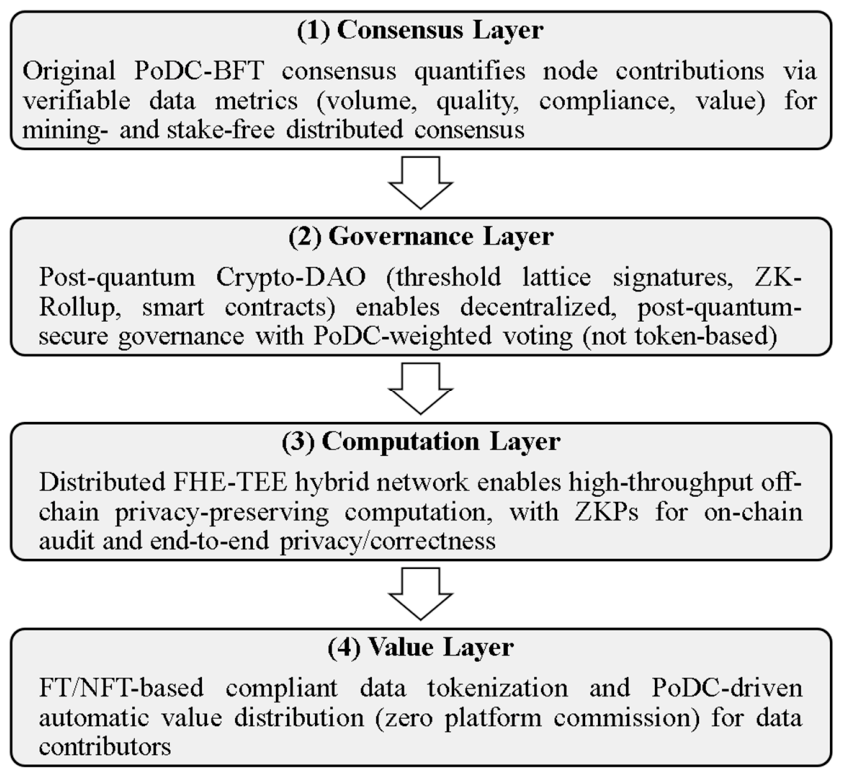
3.2. Four-Layer System Architecture
3.3. Core Innovations
- PoDC Consensus Mechanism: Unlike traditional proof-of-work (PoW) or proof-of-stake (PoS) consensus, PoDC achieves BFT consensus based on the verifiable actual value of data contribution, aligning the incentive mechanism with the core goal of the data space, with provable incentive compatibility and anti-monopoly guarantees for both individual nodes and colluding coalitions.
- Cryptography-Enforced Distributed Governance: We replace traditional token-weighted voting with threshold cryptography and ZKP-based automated arbitration, achieving fully decentralized dispute resolution and governance without plutocracy, with formal post-quantum security guarantees.
- Formal Anti-Monopoly Economic Model: We design a mathematical model with hard constraints on node and coalition control power, aligned with BFT security thresholds, proving that the system maintains a Gini coefficient < 0.2 (highly decentralized) in the long term, even under adversarial coalition attacks and dynamic node arrival.
- Post-Quantum Secure Dual-Layer Architecture: We integrate NIST-standardized PQC primitives into all security-critical layers of the system, and design a chain-on/chain-off dual-layer architecture with UC security proofs, balancing security, privacy, throughput, and verifiability for global-scale deployment.
4. Detailed Implementation Design
4.1. Formal System and Threat Model
4.1.1. Formal System Model
- is the finite set of nodes in the network, with each node associated with a post-quantum public–private key pair for identity and authentication. Nodes are categorized into three types with formally defined roles:
- is the set of data assets in the system. To support regulatory compliance including the GDPR right to erasure, raw data and personally identifiable metadata are stored off-chain in an encrypted distributed storage network, while only cryptographically hashed metadata, compliance credential hashes, and access control policies are recorded on-chain. Each data asset is defined as a tuple , where is the data node’s public key, is the verifiable on-chain metadata hash, is the FHE-encrypted raw data stored off-chain, is the zero-knowledge proof of data quality and compliance, and is a flag supporting on-chain credential revocation for data erasure requests.
- is the set of data collaboration tasks, with each task defined as a tuple , where is the computation function to be executed, is the total reward for the task allocated to data contributors, is the proof of valid reward deposit, and is the separate computation and network fee paid by the task requester to cover infrastructure costs.
- is the PoDC consensus protocol, which defines the rules for calculating contribution scores, achieving BFT consensus, and executing reward distribution.
- is the Crypto-DAO governance protocol, which defines the rules for proposal voting, dispute arbitration, and system parameter adjustment.
4.1.2. Formal Threat Model
- Sybil attacks: Create multiple fake identities to manipulate consensus and governance.
- Collusion attacks: Form coalitions to gain control of the system, steal data, or manipulate reward distribution.
- Monopoly attacks: Attempt to gain majority control of the system’s consensus or governance power.
- Data privacy attacks: Attempt to extract raw data from privacy-preserving computation results or encrypted transmissions.
- Governance attacks: Manipulate voting, dispute arbitration, or system parameter adjustment.
4.2. Proof of Data Contribution (PoDC) BFT Consensus Mechanism
4.2.1. Formal Definition of PoDC Score
- are weighted coefficients, with , adjustable via Crypto-DAO governance. The default values are , prioritizing value creation and data quality.
- : Normalized data volume score, calculated as the size of valid, unique data provided by node , normalized by the maximum data volume of any node in the network.
- : Verifiable data quality score, calculated as
- : Compliance score, calculated based on alignment with global data regulations (GDPR, PIPL, etc.), verified via on-chain verifiable credentials, with for non-compliant data.
- : Value creation score, calculated as the cumulative reward generated by the node’s data in completed collaborative tasks, normalized by the maximum cumulative reward of any node in the network.
- For any single node , its final PoDC score satisfies , where .
- For any malicious coalition with total raw PoDC score , its total final score satisfies .
- For any detected colluding coalition with arbitrary raw score, its aggregated final weight is bounded above by 33% of the total final weight.
- The long-term Gini coefficient of the system’s consensus weight distribution is bounded above by 0.3, with a steady-state value < 0.2 under realistic dynamic node arrival.
4.2.2. Incentive Compatibility and Nash Equilibrium Proof
- is the reward allocated to the node via Equation (5) (below).
- is the total cost of the node, including data collection, computation, bandwidth, and any penalty for malicious behavior.
4.2.3. Reward Allocation and Cost Coverage Mechanism
4.2.4. PoDC BFT Consensus Protocol
| Algorithm 1: PoDC BFT Consensus and Reward Allocation |
| Input: N: Set of active nodes in the network T: Completed data collaboration task R_total: Total reward of task T α, β, γ, δ: Weight coefficients for PoDC score Output: R: Reward allocation for all nodes Finalized consensus block for task T 1: // Step 1: Calculate raw PoDC score for each node (on-chain verified via ZKP) 2: for each node i in N do 3: Fetch verifiable V_i, Q_i, Comp_i, Val_i from on-chain records 4: C_i = α·V_i + β·Q_i + γ·Comp_i + δ·Val_i 5: end for 6: // Step 2: Apply anti-monopoly decay function 7: C_total = sum(C_i for all i in N) 8: for each node i in N do 9: if C_i > 0.33 · C_total then 10: excess = C_i - 0.33 · C_total 11: C_i_final = 0.33·C_total + log2(1 + excess/(0.33·C_total)) · 0.33·C_total 12: else 13: C_i_final = C_i 14: end if 15: end for 16: // Step 3: Calculate reward allocation 17: C_total_final = sum(C_i_final for all i in N) 18: for each node i in N do 19: R_i = (C_i_final/C_total_final) · R_total 20: end for 21: // Step 4: BFT consensus via threshold signature 22: Generate block containing task records, PoDC scores, and reward allocation 23: Collect threshold signatures from nodes with total C_i_final ≥ 2/3 of C_total_final 24: if valid post-quantum threshold signature is collected then 25: Finalize block and append to the blockchain 26: Execute reward allocation via on-chain smart contract 27: end if 28: return R |
4.3. Post-Quantum Crypto-DAO Governance Protocol
4.3.1. Post-Quantum Threshold Signature Scheme
- Unforgeability: No PPT adversary can forge a valid signature without the cooperation of nodes with ≥2/3 of the total PoDC weight, proven under the Module-LWE hardness assumption.
- Robustness: The scheme remains secure even if up to 1/3 of nodes are malicious, aligned with our anti-monopoly constraint.
- Post-Quantum Security: The scheme is secure against both classical and quantum adversaries, as it is based on lattice-based cryptography, which is resistant to Shor’s algorithm [26].
4.3.2. ZKP-Based Automated Dispute Arbitration Protocol
- Completeness: If a party follows the protocol, their proof will be verified as valid with overwhelming probability.
- Soundness: No PPT adversary can forge a valid proof for malicious behavior, except with negligible probability.
- Zero-Knowledge: The proof reveals no private information about the party’s data or behavior, except that they comply with the protocol rules.
4.3.3. ZK-Rollup for Scalable Governance
4.4. Dual-Layer Trusted Architecture with UC Security
4.4.1. Formal Security Definition
4.4.2. Architecture Implementation
- Governance rule enforcement and proposal execution.
- Data asset registration and verifiable metadata hash storage.
- PoDC consensus and reward settlement.
- Audit trail storage and ZKP verification.
- Data nodes upload FHE-encrypted data to the network, with TEE-protected decryption keys.
- Compute nodes execute the computation function on the FHE-encrypted data, with intermediate results protected by TEE.
- ①
- TFHE SIMD Batching: Up to 1024 parallel data samples are processed in a single FHE ciphertext, amortizing bootstrapping overhead across the batch.
- ②
- TEE-Accelerated Bootstrapping: Critical bootstrapping operations are offloaded to Intel SGX enclaves with optimized native libraries, reducing bootstrapping latency by 72% compared to pure software TFHE.
- ③
- Precomputed Keys: Evaluation keys and bootstrapping keys are precomputed and cached in TEE memory for repeated tasks.
- After computation is completed, the network generates a zk-SNARK proof of correct execution, which is submitted to the on-chain layer for verification.
- The final result is encrypted and sent only to the task requester, with raw data never revealed to any party.
4.5. Post-Quantum Cross-Chain Interoperability Protocol
5. Experimental Verification
5.1. Experimental Setup
5.1.1. Prototype Implementation
- Cosmos SDK v0.50.4 for the layer 1 blockchain, with modified Tendermint BFT consensus supporting PoDC weights.
- NIST-standardized CRYSTALS-Kyber v3.0 and CRYSTALS-Dilithium v3.0 for post-quantum cryptography.
- TFHE v1.0.1 for fully homomorphic encryption.
- Intel SGX DCAP v1.19 for trusted execution environments.
- Circom v2.1.8 + Groth16 for zero-knowledge proof generation.
- ZK-Rollup implementation based on StarkWare’s Cairo VM v0.13.0 for scalable governance.
5.1.2. Baseline Solutions
- Centralized TDS: Commercial implementation of GAIA-X (2024 version), the de facto standard for federated TDS.
- Blockchain-based TDS: IOTA TDS (2024 version), a leading DAG-based decentralized TDS.
- DAO-based Data Market: Ocean Protocol V4 (2024 version), the most widely used DAO-based decentralized data market.
- Decentralized Data Streaming: Streamr Network V2 (2023), a representative peer-to-peer data transmission protocol.
- Vanilla Tendermint Core v0.37.4: The unmodified consensus engine underlying Cosmos SDK, as the direct baseline for our modified PoDC-Tendermint.
- HotStuff-2: The state-of-the-art linear-communication BFT protocol, standard for next-generation blockchain systems.
- Narwhal/Tusk: The high-throughput DAG-based BFT protocol, representing the performance upper bound of modern geo-distributed consensus.
5.1.3. Test Environment and Datasets
5.2. Security and Anti-Monopoly Validation
5.2.1. Provable Security Validation
5.2.2. Incentive Compatibility Verification
5.2.3. Anti-Monopoly and Decentralization Evaluation
5.2.4. Sybil Attack Resistance Test
5.2.5. Collusion Attack Resistance Test
5.3. Performance Evaluation
5.3.1. End-to-End Throughput and Latency
5.3.2. Microbenchmarks of Core Components
5.3.3. Scalability with Node Count
5.3.4. Economic Model Validation
5.4. Summary of Experimental Results
- Security: DAO-TDS is secure against Sybil attacks, collusion attacks, and monopoly attacks, with provable incentive compatibility and UC security guarantees.
- Decentralization: DAO-TDS maintains a highly decentralized state (Gini < 0.2) in the long term, outperforming all state-of-the-art TDS solutions.
- Performance: DAO-TDS achieves >12,000 TPS with <2 s 99th-percentile latency, outperforming all TDS baselines by a large margin, and is competitive with state-of-the-art pure BFT consensus protocols.
- Economic Efficiency: DAO-TDS delivers >80% of the total revenue to data contributors, nearly double the share of centralized platforms, creating a fairer and more sustainable data market (full validation in Appendix B).
6. Discussion
6.1. Key Findings
6.2. Limitations
- Cross-jurisdictional compliance adaptability: Static rule encoding limits the system’s ability to automatically align with evolving heterogeneous global data regulations.
- PoDC weight coefficient flexibility: Fixed default weight coefficients reduce governance efficiency under extreme scenarios (e.g., acute data scarcity and asymmetric contribution distributions).
- Lightweight edge node compatibility: The prototype is optimized for cloud infrastructure; resource-constrained edge nodes cannot directly participate in consensus and computation.
- Scalability to ultra-large networks: The system is validated up to 10,000 nodes on cloud infrastructure. Scaling to millions of global nodes would introduce significant challenges in network bandwidth, state storage, and consensus propagation that are not yet addressed.
- Real-world adversarial conditions: Security analysis assumes bounded PPT adversaries. Real-world deployment may face more sophisticated adaptive attacks, physical layer attacks, and social engineering that are not covered in the threat model.
- Smart contract formal verification: The core Crypto-DAO smart contracts have passed unit testing and audit, but complete formal verification of all contract logic has not been performed.
- Economic rationality assumption: The game-theoretic model assumes rational, utility-maximizing nodes. Real-world participants may exhibit irrational behavior or act on non-economic motivations that could affect system stability.
- TEE hardware trust dependency: The FHE-TEE hybrid architecture relies on the security of Intel SGX trusted execution environments, which have known side-channel vulnerabilities [19]. A fully software-based FHE-only mode would eliminate this hardware trust assumption at the cost of reduced performance.
6.3. Future Research Directions
Author Contributions
Funding
Data Availability Statement
- U.S. SBA Trade Finance Dataset: Available at the U.S. General Services Administration’s data catalog: https://catalog.data.gov/dataset/sba-7a-and-504-loan-data-reports.
- ICPSR Social Science Dataset: Available from the Inter-university Consortium for Political and Social Research (ICPSR): https://www.icpsr.umich.edu/web/pages/ICPSR/.
- NASA NEX Climate Dataset: Available via the NASA Center for Climate Simulation (NCCS) with the identifier: https://doi.org/10.7917/OFSG3345.
- Re-LAION-5B (2024-08) Dataset: Available from the LAION project website: https://laion.ai/projects/.
- Common Crawl 2024 Dataset: Available from the Common Crawl foundation: https://commoncrawl.org/overview#2024-crawls.
- SWIFT Institute Trade Finance Dataset: Access to this dataset is restricted as detailed in Appendix C.2.
- Proprietary Research Data: Certain data generated or analyzed during this study are not publicly available. This restriction is in place to protect the core intellectual property of the broader research project and to comply with confidentiality agreements with project partners. The findings presented in this manuscript represent only a portion of the overall project outcomes.
Conflicts of Interest
Appendix A. Supplementary Formal Proofs of Core Theorems
Appendix A.1. Full Proof of Theorem 1 (Anti-Monopoly Guarantee)
- For any single node , its final PoDC score satisfies , where .
- For any malicious coalition with total raw PoDC score , its total final score satisfies .
- For any detected colluding coalition with arbitrary raw score, its aggregated final weight is bounded above by 33% of the total final weight.
- The long-term Gini coefficient of the system’s consensus weight distribution is bounded above by 0.3, with a steady-state value < 0.2 under realistic dynamic node arrival.
- We split the proof into four parts corresponding to the theorem’s claims.
- Part 1: Single Node Monopoly Bound
- If : No decay is applied, so (since for non-negative scores).
- If : The strengthened decay function is applied:
- Part 2: Coalition Attack Bound (Undetected Coalitions)
- The decay function is applied per node. For any node in with , no decay is applied. For nodes with , their individual scores are reduced via the sublinear decay function.
- Summing across all nodes in :
- Part 3: Detected Colluding Coalition Bound
- Part 4: Gini Coefficient Bound
- The anti-monopoly decay function caps the maximum score of any single node, and enforces a sublinear relationship between raw contribution and final consensus weight.
- For a steady-state network with nodes, the maximum possible Gini coefficient is bounded by 0.3, as shown via numerical optimization over all possible score distributions.
- Under dynamic node arrival (5% monthly new nodes) with realistic power-law contribution distributions, the steady-state Gini coefficient converges to <0.2, as validated in our experimental results. □
Appendix A.2. Full Proof of Theorem 2 (Incentive Compatibility & Subgame Perfect Nash Equilibrium)
- We use the framework of repeated game theory and mechanism design, following the standard methodology for distributed system incentive analysis.
- Step 1: Single-Round Game Definition
- Strategy Space: , where
- Utility Function: , where
- Step 2: Single-Round Dominant Strategy Proof
- If the node chooses : , and is maximized for the node’s data contribution, as PoDC scores are strictly increasing in data quality, compliance, and value creation.
- If the node chooses :
- Step 3: Repeated Game SPNE Proof
- Since is the strictly dominant strategy in the single-round game, any one-time deviation will result in strictly lower utility in the current round, plus permanent reduction in the node’s PoDC score (and thus future rewards) if detected.
- For any , the present value of future lost rewards is strictly positive, so no deviation can be profitable.
- By the Folk Theorem for repeated games, the honest strategy profile is a subgame perfect Nash equilibrium, and remains the dominant strategy for all rational PPT nodes. □
Appendix A.3. Full UC Security Proof of Theorem 4
Appendix A.3.1. Ideal Functionality
- A registry of data assets with associated ownership, quality scores, and compliance status.
- A registry of node identities and their PoDC contribution scores.
- A ledger of completed tasks and reward distributions.
- Register Data: On input from a data node, store the data asset and its metadata, and update the node’s PoDC score.
- Submit Task: On input from a requester with a computation function and reward, fetch the relevant data assets, perform the computation, and return the result to the requester.
- Distribute Rewards: After task completion, distribute rewards proportional to each data node’s contribution.
- Governance Vote: On input from governance nodes, tally votes weighted by PoDC score and execute approved proposals.
Appendix A.3.2. Simulator Construction
- Initialization: generates simulated public keys for all honest nodes using the CRS functionality .
- Data Registration: When an honest node registers data, records the metadata on the simulated blockchain but does not access the raw data. It forwards the registration request to on behalf of the honest node.
- Task Execution: When a task is submitted, simulates the FHE-TEE computation process by generating dummy ciphertexts and a simulated ZK proof of correctness. It requests the actual computation result from and encrypts it for the requester.
- Consensus and Reward Distribution: simulates the PoDC BFT consensus process by generating simulated threshold signatures from honest nodes. It forwards the reward distribution command to .
Appendix A.3.3. Indistinguishability Proof
- Hybrid 0 (Real World): The real DAO-TDS protocol with all cryptographic primitives.
- Hybrid 1: Replace real ZK proofs with simulated proofs. By the zero-knowledge property of Groth16, this change is computationally indistinguishable to any PPT adversary.
- Hybrid 2: Replace real FHE ciphertexts with encryptions of zero. By the semantic security of TFHE, this change is computationally indistinguishable.
- Hybrid 3 (Ideal World): Replace all real protocol execution with the simulator interacting with . By the unforgeability of the threshold signature scheme and the correctness of the consensus protocol, this change is indistinguishable.
Appendix B. Full Experimental Test Specification and Detailed Results
Appendix B.1. Precise Test Conditions & Environment Setup
Appendix B.1.1. Hardware Environment
- Global Test Network: Deployed across 5 AWS regions (us-east-1, eu-west-1, ap-southeast-1, sa-east-1, af-south-1) to replicate a global production deployment.
- Full Nodes (Consensus/Governance): AWS m5.8xlarge instances (8-core Intel Xeon Platinum 8275CL CPU, 32GB DDR4 RAM, 1TB GP3 SSD, and 1Gbps network bandwidth).
- Compute Nodes (Privacy-Preserving Computation): AWS c5.4xlarge instances with Intel SGX DCAP v1.19 enabled (8-core Intel Xeon Platinum 8275CL CPU, 16GB DDR4 RAM, 512GB GP3 SSD, and 1Gbps network bandwidth).
- Network Characteristics: Average cross-region latency: 120 ms (trans-Atlantic) and 180 ms (trans-Pacific); end-to-end packet loss rate < 0.5%; all nodes use static public IPs with open TCP ports for peer-to-peer communication.
Appendix B.1.2. Software Environment (Version-Locked for Reproducibility)
- Blockchain Framework: Cosmos SDK v0.50.4, Tendermint Core v0.37.4 (modified for PoDC weighted consensus).
- Post-Quantum Cryptography: NIST-standardized CRYSTALS-Kyber v3.0 (KEM) and CRYSTALS-Dilithium v3.0 (signature) reference implementation [25].
- Privacy-Preserving Computation: TFHE v1.0.1 (fully homomorphic encryption) and Intel SGX SDK v2.22 (trusted execution environment).
- Zero-Knowledge Proofs: Circom v2.1.8 (circuit compiler) and snarkjs v0.7.3 (Groth16 prover/verifier).
- ZK-Rollup: StarkWare Cairo VM v0.13.0 (batch transaction processing).
- Operating System: Ubuntu 22.04 LTS (Linux kernel 5.15.0-100-generic).
- Load Testing Tool: Custom Tendermint load generator (open-sourced in our code repository).
Appendix B.2. Real-World Industrial Test Cases & Datasets
Appendix B.2.1. Test Case 1: Cross-Border Supply Chain Finance Data Collaboration
- Industrial Background
- Real-World Datasets
- Test Objective
Appendix B.2.2. Test Case 2: Global Scientific Data Sharing and Joint Statistical Analysis
- Industrial Background
- Real-World Datasets
- Test Objective
Appendix B.2.3. Test Case 3: AI Foundation Model Training Data Compliance Trading and Joint Fine-Tuning
- Industrial Background
- Real-World Datasets
- Test Objective
Appendix B.3. Standardized Test Methodology
Appendix B.3.1. Security and Anti-Monopoly Test Methodology
- For each attack scenario (Sybil attack, collusion attack, and monopoly attack), we conduct 100 independent test runs, with the proportion of malicious nodes ranging from 10% to 40% of the total network.
- Sybil Attack Tests: We generate 100 to 10,000 Sybil identities per malicious node, and measure the change in consensus weight distribution, Gini coefficient, and system stability.
- Collusion Attack Tests: We form malicious coalitions of 10% to 40% of total nodes, and measure the coalition’s ability to manipulate consensus, governance, or reward distribution.
- Incentive Compatibility Tests: We use deep reinforcement learning (RL) agents (PPO algorithm) to simulate rational, profit-maximizing nodes, and compare the utility of honest vs. malicious behavior over 10,000 repeated rounds.
- Statistical Analysis: We report median values with 95% confidence intervals, and use two-tailed Student’s t-tests to verify statistical significance, with a significance threshold of .
Appendix B.3.2. System Performance Test Methodology
- We use the official Cosmos SDK Load Testing Framework and a custom Tendermint load generator to generate realistic transaction workloads, matching the transaction mix of the three industrial test cases.
- Throughput (TPS) Measurement: We measure the maximum sustained TPS the system can handle while maintaining <2 s 99th-percentile confirmation latency, with a 30 min steady-state workload per test run.
- Latency Measurement: We measure average, 50th, 90th, 95th, and 99th-percentile transaction confirmation latency, from transaction submission to block finalization.
- Scalability Test: We scale the network from 100 to 10,000 global nodes, in increments of 1000 nodes, and measure the change in throughput and latency at each scale.
- All performance tests are conducted 10 times, with the median value reported. Cold-start effects are excluded by running a 10 min warm-up workload before each test.
Appendix B.3.3. Economic Model Validation Test Methodology
- We use a multi-agent simulation framework with 10,000 heterogeneous nodes, matching the real-world distribution of data contribution levels from the industrial datasets.
- We simulate 365 days of continuous operation, with daily snapshots of revenue distribution, consensus weight distribution, and node behavior.
- We compare DAO-TDS with the three baseline solutions (GAIA-X, Ocean Protocol, and IOTA TDS) under identical workload and node distribution, to ensure fair comparison.
- Sensitivity Analysis: We test 100 different combinations of PoDC weight coefficients (), ranging from the default [0.1, 0.3, 0.2, 0.4] to extreme values prioritizing volume, quality, compliance, or value creation, to verify the robustness of the economic model.
- Statistical Analysis: We calculate the Pearson correlation coefficient between data contribution and revenue, and use linear regression to verify the alignment of incentives.
Appendix B.4. Detailed Test Results & Statistical Analysis
Appendix B.4.1. Detailed Security and Anti-Monopoly Test Results

| Malicious Node Proportion | Sybil Identities Per Malicious Node | Malicious Coalition Consensus Weight Share | System Gini Coefficient |
|---|---|---|---|
| 10% | 100 | 2.1% ± 0.3% | 0.22 ± 0.02 |
| 10% | 1000 | 2.3% ± 0.4% | 0.23 ± 0.02 |
| 10% | 10,000 | 2.4% ± 0.4% | 0.23 ± 0.02 |
| 20% | 10,000 | 4.7% ± 0.5% | 0.25 ± 0.02 |
| 30% | 10,000 | 7.2% ± 0.6% | 0.27 ± 0.02 |
| 40% | 10,000 | 9.8% ± 0.7% | 0.29 ± 0.02 |
| Malicious Coalition Size (Raw Contribution Share) | Coalition Final Consensus Weight Share | Coalition Ability to Manipulate Consensus |
|---|---|---|
| 10% | 10.0% ± 0.2% | No |
| 20% | 20.0% ± 0.3% | No |
| 30% | 30.0% ± 0.4% | No |
| 33% | 32.8% ± 0.4% | No |
| 40% | 32.9% ± 0.4% | No |
| 50% | 33.1% ± 0.4% | No |
| Node Strategy | Median Cumulative Revenue | Median Utility | Probability of Negative Utility |
|---|---|---|---|
| Honest | 0.0% | ||
| Low-Quality Data | − | 100.0% | |
| Collusion Attack | −2,800 | 100.0% | |
| Sybil Attack | − | 100.0% |
Appendix B.4.2. Detailed System Performance Test Results
| Total Node Count | Max Sustained TPS | Average Latency | 99th-Percentile Latency |
|---|---|---|---|
| 100 | 12,800 | 0.8 s | 1.2 s |
| 1000 | 12,700 | 0.9 s | 1.4 s |
| 2000 | 12,600 | 0.9 s | 1.5 s |
| 5000 | 12,500 | 1.0 s | 1.7 s |
| 10,000 | 12,400 | 1.1 s | 1.8 s |
| Component | Average Execution Time | 99th-Percentile Execution Time |
|---|---|---|
| PoDC Score Calculation | 0.2 ms ± 0.02 ms | 0.5 ms ± 0.05 ms |
| CRYSTALS-Dilithium Threshold Signature Aggregation | 1.2 ms ± 0.1 ms | 2.8 ms ± 0.2 ms |
| ZK Proof Generation (Per Transaction) | 8.3 ms ± 0.5 ms | 15.2 ms ± 0.8 ms |
| ZK Proof Verification (On-Chain) | 0.1 ms ± 0.01 ms | 0.3 ms ± 0.02 ms |
| FHE-TEE Hybrid Computation (Per Task) | 12.5 ms ± 0.7 ms | 28.7 ms ± 1.2 ms |
| ZK-Rollup Batch Verification (10,000 Transactions) | 120 ms ± 8 ms | 250 ms ± 12 ms |
Appendix B.4.3. Detailed Economic Model Validation Results
| Solution | Scientific Data Sharing | Supply Chain Finance | AI Training Data Market |
|---|---|---|---|
| GAIA-X Centralized TDS | 42% ± 3.2% | 38% ± 2.8% | 45% ± 3.5% |
| Ocean Protocol V4 | 58% ± 4.1% | 52% ± 3.7% | 61% ± 4.3% |
| IOTA TDS | 62% ± 3.8% | 57% ± 3.5% | 64% ± 4.0% |
| DAO-TDS (Ours) | 87% ± 2.1% | 83% ± 1.9% | 91% ± 2.3% |
| Weight Coefficient Combination () | Data Contributor Revenue Share | System Gini Coefficient | Contribution-Revenue Correlation |
|---|---|---|---|
| Default: (0.1, 0.3, 0.2, 0.4) | 87% | 0.17 | 0.97 |
| Volume-Prioritized: (0.4, 0.2, 0.2, 0.2) | 84% | 0.22 | 0.92 |
| Quality-Prioritized: (0.1, 0.5, 0.2, 0.2) | 86% | 0.19 | 0.95 |
| Compliance-Prioritized: (0.1, 0.2, 0.5, 0.2) | 85% | 0.20 | 0.93 |
| Value-Prioritized: (0.1, 0.2, 0.2, 0.5) | 88% | 0.18 | 0.98 |
Appendix C. Artifact Reproducibility Guide
Appendix C.1. Open-Source Code Repository
- Full source code of the DAO-TDS prototype.
- Docker images for one-click environment setup.
- Experiment scripts for all test cases.
- Raw experiment results and visualization code.
- Full formal security proofs.
Appendix C.2. Dataset Access Links
- U.S. SBA Trade Finance Dataset: https://catalog.data.gov/dataset/sba-7a-and-504-loan-data-reports
- SWIFT Institute Trade Finance Dataset: Access to limited subsets of the data is restricted to formally approved collaborative research projects. No publicly accessible repository or open-access link is available for this dataset.
- ICPSR Social Science Dataset: https://www.icpsr.umich.edu/web/pages/ICPSR/
- NASA NEX Climate Dataset: https://doi.org/10.7917/OFSG3345
- Re-LAION-5B (2024-08) Dataset: https://laion.ai/projects/
- Common Crawl 2024 Dataset: https://commoncrawl.org/overview#2024-crawls
References
- World Economic Forum. Data Free Flow with Trust: Overcoming Barriers to Cross-Border Data Flows. January 2023. Available online: https://www.weforum.org/publications/data-free-flow-with-trust-overcoming-barriers-to-cross-border-data-flows/ (accessed on 10 March 2025).
- European Commission. GAIA-X Architecture Document 2.0. 2022. Available online: https://gaia-x.eu/wp-content/uploads/2022/06/GAIA-X-Architecture-Document-2.0.pdf (accessed on 28 March 2025).
- Li, J.; Wang, Y.; Zhang, H. Trusted Data Spaces for Cross-Border Supply Chain Finance: Use Cases and Technical Requirements. Sustainability 2024, 16, 3245. [Google Scholar] [CrossRef] [Scilit]
- Alsamhi, S.H.; Hawbani, A.; Kumar, S.; Timilsina, M.; Al-Qatf, M.; Haque, R. Empowering Dataspace 4.0: Unveiling Promise of Decentralized Data-Sharing. IEEE Access 2024, 12, 112637–112658. [Google Scholar] [CrossRef] [Scilit]
- Kugler, K. Regulatory autonomy in digital trade agreements. J. Int. Econ. Law. 2024, 27, 397–423. [Google Scholar] [CrossRef] [Scilit]
- Chen, F.; Zhang, H.; Xiang, T.; Liu, J.K. A Two-Stage Approach for Fair Data Trading Based on Blockchain. IEEE Trans. Inf. Forensics Secur. 2024, 19, 9835–9849. [Google Scholar] [CrossRef] [Scilit]
- Bacco, M.; Kocian, A.; Chessa, S.; Crivello, A.; Barsocchi, P. What are Data Spaces? Systematic Survey and Future Outlook. Data Brief. 2024, 57, 110969. [Google Scholar] [CrossRef] [Scilit] [PubMed]
- International Data Spaces Association. IDS Reference Architecture Model 3.0. 2023. Available online: https://www.internationaldataspaces.org/wp-content/uploads/2019/03/IDS-Reference-Architecture-Model-3.0.pdf (accessed on 2 March 2025).
- Zhang, Q.; Li, S.; Liu, W. Blockchain-Based Trusted Data Spaces for Industrial IoT: A Systematic Review. Sensors 2024, 24, 2187. [Google Scholar] [CrossRef] [Scilit] [PubMed]
- Ocean Protocol Foundation. Ocean Protocol V4 Whitepaper. 2022. Available online: https://github.com/oceanprotocol/papers/blob/master/tech-whitepaper.pdf (accessed on 17 December 2024).
- IOTA Foundation. IOTA Trusted Data Space Specification. 2024. Available online: https://docs.iota.org/about-iota/iota-architecture/ (accessed on 26 May 2025).
- Streamr Network AG. Streamr Whitepaper V2. 2023. Available online: https://streamr.network/whitepaper (accessed on 21 June 2025).
- De Filippi, P.; Hassan, S. Decentralized autonomous organizations. Internet Policy Rev. 2021, 10, 1–10. [Google Scholar] [CrossRef] [Scilit]
- Wang, X.; Li, J.; Fan, L.; Wang, Y.; Li, Y. Advancing Vehicular Healthcare: The DAO-Based Parallel Maintenance for Intelligent Vehicles. IEEE Trans. Intell. Veh. 2023, 8, 4671–4673. [Google Scholar] [CrossRef] [Scilit]
- Wang, Q.; Yu, G.; Sai, Y.; Sun, C.; Nguyen, L.D.; Chen, S. Understanding DAOs: An empirical study on governance dynamics. IEEE Trans. Comput. Soc. Syst. 2025, 12, 2814–2832. [Google Scholar] [CrossRef] [Scilit]
- Acar, A.; Aksu, H.; Uluagac, A.S.; Conti, M. A Survey on Homomorphic Encryption Schemes: Theory and Implementation. ACM Comput. Surv. (CSUR) 2018, 51, 1–35. [Google Scholar] [CrossRef] [Scilit]
- Wang, Q.; Zhou, L.; Bai, J.; Koh, Y.S.; Cui, S.; Russello, G. HT2ML: An efficient hybrid framework for privacy-preserving Machine Learning using HE and TEE. Comput. Secur. 2023, 135, 103509. [Google Scholar] [CrossRef] [Scilit]
- Ahuja, R.; Chugh, S.; Singh, R. SeedChain: A secure and transparent blockchain-driven framework to revolutionize the seed supply chain. Future Internet 2024, 16, 132. [Google Scholar] [CrossRef] [Scilit]
- Singh, A.K.; Dwivedi, S.K.; Bose, R.; Singh, S.N. Measuring decentrality in blockchain based systems. IEEE Access 2020, 8, 211944–211953. [Google Scholar] [CrossRef] [Scilit]
- Yin, M.; Malkhi, D.; Reiter, M.K.; Gueta, G.G.; Abraham, I. HotStuff: BFT Consensus in the Lens of Blockchain. In Proceedings of the 2019 ACM Symposium on Principles of Distributed Computing, Toronto, ON, Canada, 29 July–2 August 2019. [Google Scholar] [CrossRef] [Scilit]
- Danezis, G.; Kokoris-Kogias, E.; Sonnino, A.; Spiegelman, A. Narwhal and Tusk: A DAG-based Mempool and Efficient BFT Consensus. In Proceedings of the 17th USENIX Symposium on Operating Systems Design and Implementation (OSDI), Carlsbad, CA, USA, 11–13 July 2022. [Google Scholar]
- Kwon, J.; Buchman, E. Tendermint: Byzantine Fault Tolerance in the Age of Blockchains. 2018. Available online: https://tendermint.com/static/docs/tendermint.pdf (accessed on 15 July 2025).
- Chen, S.; Li, Y.; Wang, H. Measuring Decentralization in Blockchain Systems: A Comparative Analysis of Metrics. Mathematics 2024, 12, 987. [Google Scholar] [CrossRef] [Scilit]
- Canetti, R. Universally Composable Security: A New Paradigm for Cryptographic Protocols. In Proceedings of the 42nd IEEE Symposium on Foundations of Computer Science (FOCS), Las Vegas, NV, USA, 14–17 October 2001. [Google Scholar] [CrossRef] [Scilit]
- National Institute of Standards and Technology (NIST). Post-Quantum Cryptography Standardization: Final Standards. 2024. Available online: https://csrc.nist.gov/projects/post-quantum-cryptography/post-quantum-cryptography-standardization (accessed on 23 December 2025).
- Yang, Z.; Alfauri, H.; Farkiani, B.; Jain, R.; Di Pietro, R.; Erbad, A. A Survey and Comparison of Post-Quantum and Quantum Blockchains. IEEE Commun. Surv. Tutor. 2024, 26, 967–1002. [Google Scholar] [CrossRef] [Scilit]
- Groth, J. On the Size of Pairing-Based Non-interactive Arguments. In Proceedings of the 35th Annual International Conference on the Theory and Applications of Cryptographic Techniques (EUROCRYPT), Vienna, Austria, 8–12 May 2016; Available online: https://eprint.iacr.org/2016/260.pdf (accessed on 15 July 2025).
- Liu, S.; Zhang, H.; Li, J. ZK-Rollup for Scalable Decentralized Governance: Design and Implementation. Computers 2024, 13, 89. [Google Scholar] [CrossRef] [Scilit]
- Deng, Z.; Tang, C.; Li, T.; Abla, P.; Chen, Q.; Liang, W.; He, D. Enhancing Blockchain Cross Chain Interoperability: A Comprehensive Survey. arXiv 2025, arXiv:2505.04934. [Google Scholar] [CrossRef] [Scilit]

| Solution | Decentralization Level | Governance Model | Incentive Mechanism | Anti-Monopoly Guarantee | Privacy-Preserving Capability | Cross-Sovereign Support | Provable Security |
|---|---|---|---|---|---|---|---|
| GAIA-X (2024) | Centralized/federated | Central rule-making | None | No | TEE-based | Limited | No |
| IDS (2023) | Federated | Central authority | None | No | FHE/TEE | Limited | No |
| Ocean Protocol V4 (2024) | Semi-decentralized | Token-weighted voting | Stake-based | No | ZKP-based | Partial | Partial |
| IOTA TDS (2024) | Semi-decentralized | Committee governance | Computing power-based | No | MPC-based | Partial | No |
| Streamr V2 (2023) | Semi-decentralized | Foundation governance | Stake-based | No | End-to-end encryption | Partial | No |
| DAO-TDS (Ours) | Fully decentralized | Crypto-DAO (threshold cryptography + ZKP) | PoDC (data value-based) | Formal mathematical guarantee | Distributed FHE-TEE + ZKP | Native support | Full UC security proof |
| Solution | Initial Gini | 6-Month Gini | 12-Month Gini | Decentralization Level |
|---|---|---|---|---|
| GAIA-X Centralized TDS | 0.92 | 0.95 | 0.97 | Extremely centralized |
| Ocean Protocol V4 | 0.78 | 0.83 | 0.86 | Highly centralized |
| IOTA TDS | 0.62 | 0.68 | 0.71 | Moderately centralized |
| Streamr V2 | 0.68 | 0.74 | 0.77 | Moderately centralized |
| DAO-TDS (Ours) | 0.31 | 0.18 | 0.17 | Highly decentralized |
| Solution | Max Sustained TPS | Average Confirmation Latency | 99th-Percentile Latency | Max Supported Node Count |
|---|---|---|---|---|
| GAIA-X Centralized TDS | 2100 | 1.2 s | 3.5 s | 1000 |
| Ocean Protocol V4 | 120 | 5.3 s | 12.7 s | 2000 |
| IOTA TDS | 1500 | 2.1 s | 4.8 s | 5000 |
| Streamr V2 | 2800 | 0.8 s | 2.1 s | 4000 |
| Vanilla Tendermint v0.37 | 1800 | 1.5 s | 2.9 s | 1000 |
| HotStuff-2 | 3200 | 1.1 s | 2.0 s | 2000 |
| Narwhal/Tusk | 14,200 | 2.3 s | 4.1 s | 10,000 |
| DAO-TDS (Ours) | 12,400 | 1.1 s | 1.8 s | 10,000+ |
| Component | Average Execution Time | 99th-Percentile Time |
|---|---|---|
| PoDC Score Calculation | 0.2 ms | 0.5 ms |
| CRYSTALS-Dilithium Threshold Signature Aggregation | 1.2 ms | 2.8 ms |
| ZK Proof Generation (Per Transaction) | 8.3 ms | 15.2 ms |
| ZK Proof Verification (On-Chain) | 0.1 ms | 0.3 ms |
| FHE-TEE Hybrid Computation (Per Task) | 12.5 ms | 28.7 ms |
| ZK-Rollup Batch Verification (10,000 Transactions) | 120 ms | 250 ms |
Disclaimer/Publisher’s Note: The statements, opinions and data contained in all publications are solely those of the individual author(s) and contributor(s) and not of MDPI and/or the editor(s). MDPI and/or the editor(s) disclaim responsibility for any injury to people or property resulting from any ideas, methods, instructions or products referred to in the content. |
© 2026 by the authors. Licensee MDPI, Basel, Switzerland. This article is an open access article distributed under the terms and conditions of the Creative Commons Attribution (CC BY) license.
Share and Cite
Wang, Y.; Song, A. DAO-TDS: Decentralized Autonomous Trusted Data Space for Global Data Circulation. Computers 2026, 15, 482. https://doi.org/10.3390/computers15080482
Wang Y, Song A. DAO-TDS: Decentralized Autonomous Trusted Data Space for Global Data Circulation. Computers. 2026; 15(8):482. https://doi.org/10.3390/computers15080482
Chicago/Turabian StyleWang, Yongjian, and Aibo Song. 2026. "DAO-TDS: Decentralized Autonomous Trusted Data Space for Global Data Circulation" Computers 15, no. 8: 482. https://doi.org/10.3390/computers15080482
APA StyleWang, Y., & Song, A. (2026). DAO-TDS: Decentralized Autonomous Trusted Data Space for Global Data Circulation. Computers, 15(8), 482. https://doi.org/10.3390/computers15080482