1.1. Background
In modern naval warfare, aircraft carriers must maintain continuous combat readiness to respond to the rapidly changing operational requirements. The sortie generation capability of carrier-based aircraft is therefore a core determinant of aircraft carrier combat effectiveness. Before an aircraft can be launched, a series of tightly coupled support operations must be completed on and below the flight deck, including inspection, fueling, ammunition preparation, weapon loading, and dispatch coordination. Different from land-based aircraft servicing, shipboard ordnance preparation is restricted by narrow deck space, rigid task sequences and shared human-equipment resources, all of which jointly restrict feasible scheduling schemes [
1,
2,
3,
4]. Any delay in ammunition preparation or transfer may propagate to the flight deck schedule and reduce the sortie rate of the carrier air wing.
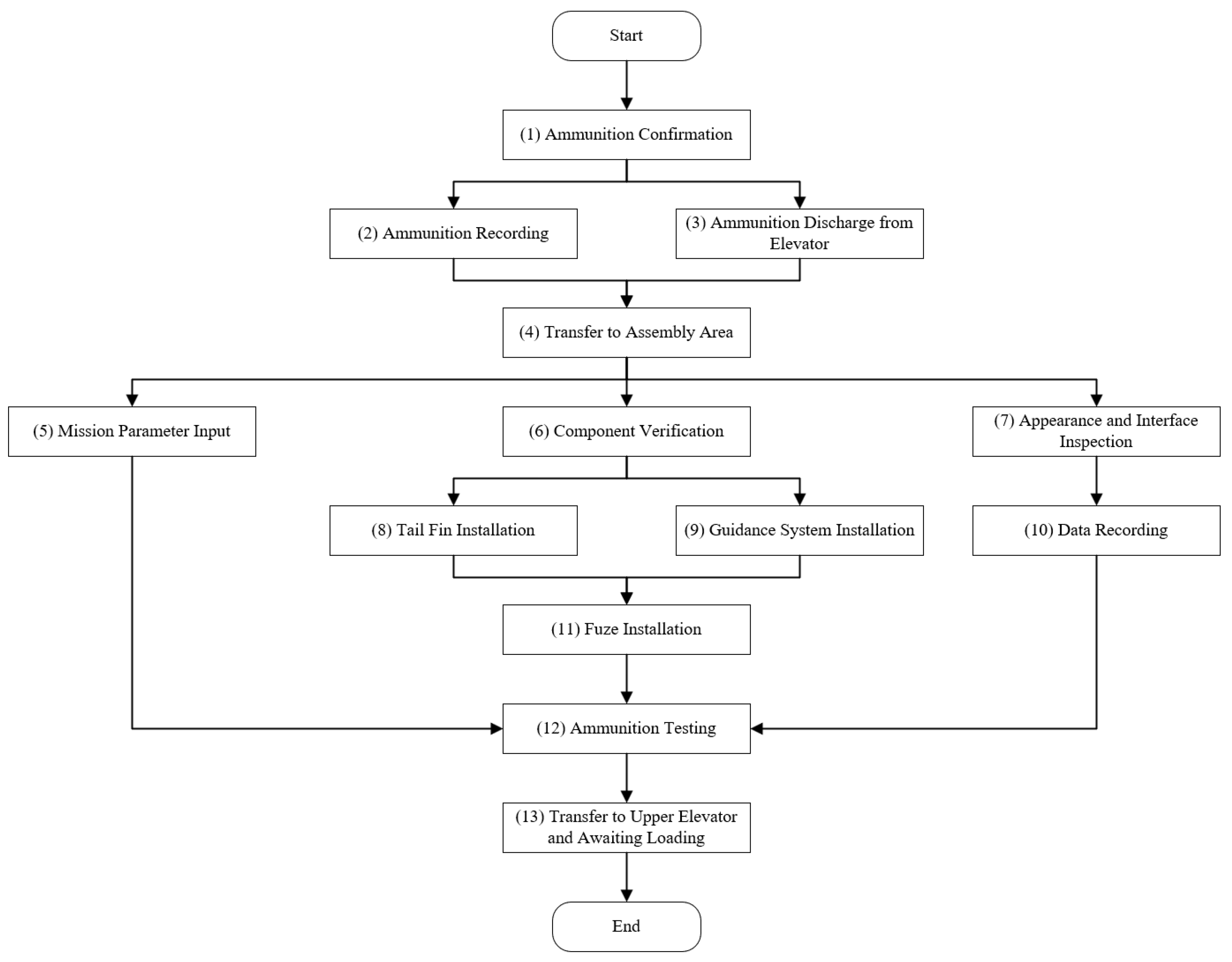
Ammunition support is one of the most time-consuming and labor-intensive activities in the carrier-based aircraft support process. Before flight deck weapon loading can commence, mission-required munitions must be retrieved from the magazine area, transferred through internal elevators, temporarily staged, assembled, inspected, and then delivered upward to the deck ammunition well. This intermediate operation area is referred to in this study as the intermediate ordnance staging deck. Serving as the critical interface between the lower magazine layer and the upper flight deck layer, the intermediate ordnance staging deck is responsible for receiving ammunition from lower elevators, conducting inspection and assembly operations, allocating temporary holding resources, and dispatching finished ammunition batches to the upper elevator according to the mission plan.
The intermediate ordnance staging deck is a resource coordination hub in which multiple specialized support groups, transfer devices, elevators, operation stations, and ammunition batches interact under spatial and temporal constraints. Its scheduling problem has three prominent characteristics. First, the available space for personnel and equipment is limited. Simply increasing the number of workers or support devices may increase congestion and coordination conflicts rather than reduce completion time [
5,
6]. Second, the intermediate ordnance staging deck operation contains several sequential and partially parallel procedures, such as elevator-out transport, inspection, assembly, elevator-in transport, and handover to the upper layer. These procedures have strict precedence relationships and may require different personnel qualifications. Third, the operational objective is inherently multi-objective: commanders expect the ammunition batch to be completed as early as possible, while managers must also avoid unreasonable personnel workload imbalance, excessive fatigue, and inefficient staffing.
From an optimization perspective, intermediate ordnance staging deck ammunition support can be abstracted as a multi-resource, multi-constraint, multi-objective scheduling problem. Ammunition rounds or batches can be regarded as jobs; operation procedures correspond to ordered processing steps; and qualified personnel groups act as flexible processing resources. This structure is closely related to the flexible job shop scheduling problem (FJSP), which has been widely used to model systems in which each operation can be assigned to one of several eligible resources [
7,
8,
9,
10]. However, intermediate ordnance staging deck ammunition support differs from conventional workshop scheduling because personnel allocation and operation scheduling are strongly coupled. A staffing plan determines the feasible schedule space, but the value of a staffing plan can only be evaluated through the resulting schedule. Therefore, a sequential approach that first fixes personnel allocation and then optimizes the schedule may fail to identify an effective trade-off between operation time and personnel utilization.
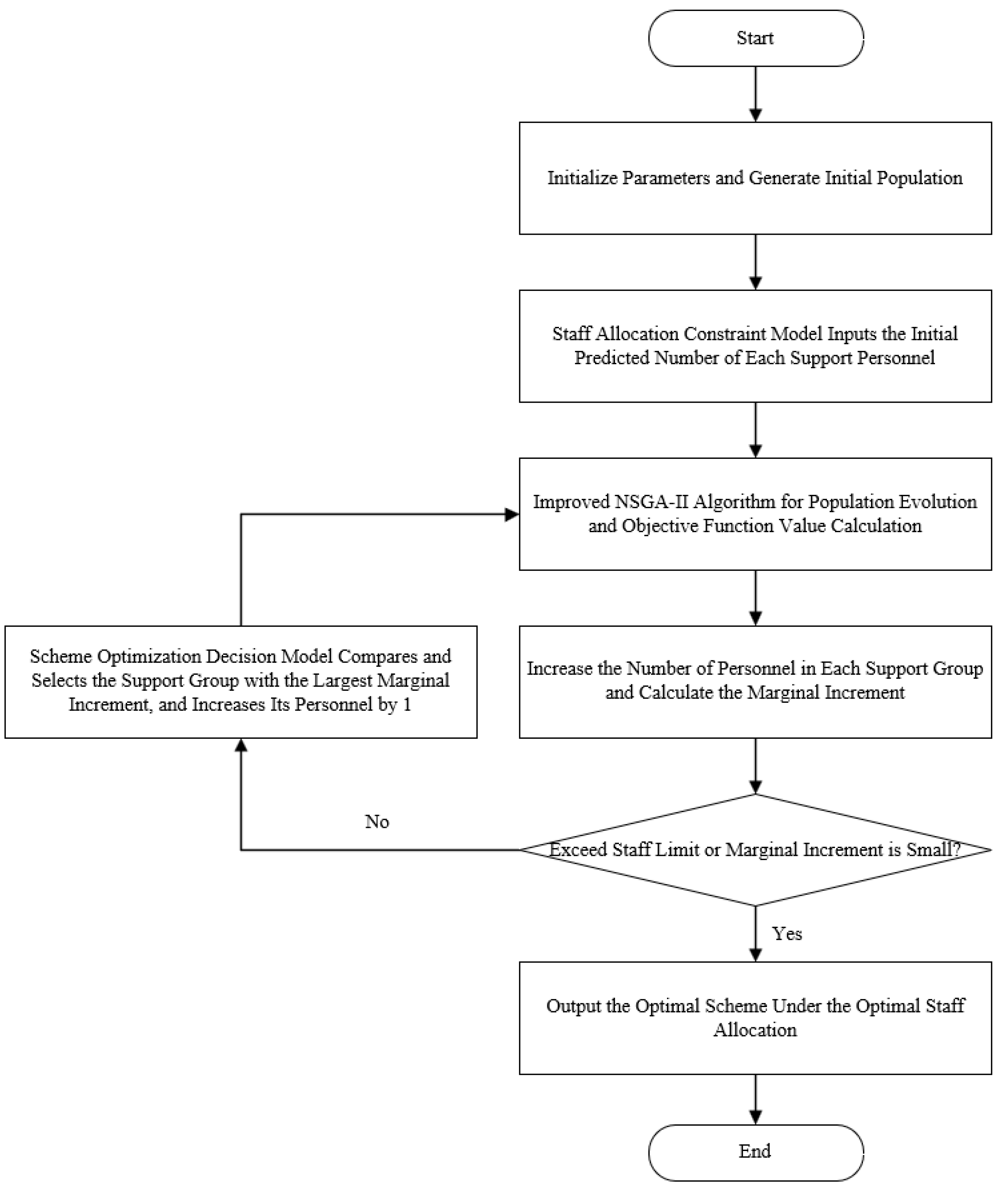
To address this issue, this paper studies the ammunition support operation scheduling problem at the carrier-based aircraft intermediate ordnance staging deck. A bi-objective scheduling model is formulated to simultaneously minimize the batch completion time and the imbalance of personnel workload. An improved Non-dominated Sorting Genetic Algorithm II (NSGA-II) is then developed as the core optimization algorithm, and a constraint decision model is introduced to coordinate the relationship between personnel configuration and schedule quality. The aim is to generate a practical intermediate ordnance staging deck ammunition support scheme that satisfies operational precedence constraints, personnel constraints, and mission timing requirements while maintaining a reasonable workload distribution.
1.2. Literature Review
The present study is closely related to three streams of research: carrier-based aircraft support scheduling, flexible job shop and resource-constrained scheduling, and personnel allocation with workload balancing.
Research on carrier-based aircraft support scheduling has mainly focused on flight deck operations, where multiple aircraft, personnel teams, support equipment, and fixed service stations must be coordinated in a narrow and dynamic environment. Existing studies commonly model flight deck support as a resource-constrained project scheduling problem or its extensions. Cui et al. [
1] established an integrated optimization model for flight deck operation scheduling and resource configuration, considering resource transfer time and multiple execution modes, and solved the resulting multi-objective problem using a hyper-heuristic framework. Cui et al. [
2] further proposed a dual-population multi-operator genetic algorithm for multi-aircraft flight deck scheduling with resource transfer times. Su et al. [
3] examined a resource-constrained multi-aircraft scheduling problem in which both aircraft transfer and resource transfer are considered, showing that ignoring aircraft movement may lead to unrealistic schedules. Other studies have addressed robust scheduling under uncertain activity durations [
4], deck path planning and dispatch control [
11], fixed aviation support station configuration [
12], and automated or learning-based scheduling for carrier flight deck operations [
13,
14]. These studies demonstrate that carrier aviation support is essentially a constrained and dynamic scheduling system.
Nevertheless, most publicly available carrier scheduling studies concentrate on the flight deck. The ammunition support chain below the deck, especially the intermediate ordnance staging deck between magazines and the flight deck, has received much less attention. Existing ammunition support studies often treat storage retrieval, vertical transfer, deck transportation, and loading as a unified full-process problem. Such integrated modeling is useful for global analysis, but it tends to hide the independent operational characteristics of each layer. In practice, the magazine layer, intermediate ordnance staging deck, and deck layer have different resource structures, working spaces, and disturbance patterns. A full-process model may therefore be too coarse to capture the intermediate ordnance staging deck’s internal bottlenecks, especially the trade-off between adding personnel and avoiding congestion. Recent formal modeling work on carrier-borne aircraft ammunition support also indicates that ammunition support scheduling requires rigorous representation of resource relationships and operation logic [
15]. This motivates a layer-specific study of intermediate ordnance staging deck ammunition support operations.
Flexible job shop scheduling provides an important theoretical basis for the abstraction used in this paper. The FJSP extends the classical job shop scheduling problem by allowing each operation to be processed by one of several eligible machines or resources, thereby better representing flexible and decentralized production environments [
7,
8,
9,
10]. Because FJSP and its multi-objective variants are NP-hard, exact methods are often computationally expensive for medium and large-scale cases. Metaheuristic and evolutionary algorithms have therefore become dominant solution approaches. Deb et al. [
16] proposed NSGA-II, which remains one of the most widely used multi-objective evolutionary algorithms due to its fast non-dominated sorting and crowding-distance-based diversity preservation. Zhang and Li [
17] proposed MOEA/D, offering a decomposition-based alternative for multi-objective optimization. Recent surveys and studies show that genetic algorithms, particle swarm optimization, Jaya algorithms, swarm intelligence methods, and hybrid evolutionary algorithms continue to play major roles in FJSP research [
18,
19,
20,
21,
22]. As a classic multi-objective optimization method, NSGA-II has also been widely applied to resource scheduling and workload balancing problems in complex industrial scenarios [
23].
In recent years, FJSP research has moved toward more realistic resource coupling and dynamic decision-making. For example, studies have incorporated transport constraints, controllable processing times, energy consumption, machine breakdowns, and dynamic job arrivals [
24,
25,
26,
27,
28]. Deep reinforcement learning and graph neural networks have also been introduced to improve the real-time response capability of scheduling systems. Song et al. [
29] proposed a graph neural network and deep reinforcement learning method for flexible job-shop scheduling, while Su et al. [
30] developed a preference-conditioned graph reinforcement learning approach for fast Pareto set approximation in multi-objective FJSP. Wu et al. [
31] studied dynamic FJSP in Processes using a deep reinforcement learning approach, and Lei et al. [
32] developed a hierarchical reinforcement learning framework for large-scale dynamic FJSP with random job arrivals. These works indicate a clear trend: scheduling models are increasingly expected to reflect realistic resource constraints and to provide actionable decisions under complex operating environments.
The various intelligent optimization algorithms discussed above exhibit distinct applicability characteristics and inherent limitations. For instance, while particle swarm optimization (PSO) [
33] features straightforward parameter configuration and rapid convergence, it is prone to becoming trapped in local optima when applied to high-dimensional discrete combinatorial optimization problems. Moreover, its single-best-solution guidance mechanism renders it difficult to obtain a well-distributed Pareto front in a single run. Ant colony optimization (ACO), by virtue of its positive-feedback pheromone mechanism, excels in path-construction problems; however, its convergence behavior is highly sensitive to the selection of initial parameters, and it is susceptible to stagnation. Furthermore, ACO [
34] was originally designed for single-objective optimization, and extending it to multi-objective problems necessitates the additional incorporation of non-dominated sorting and diversity maintenance strategies, which substantially increases algorithmic complexity. Reinforcement learning (RL) [
35] has demonstrated strong self-learning and adaptive potential in dynamic sequential decision-making scenarios. Nevertheless, its effective training relies on a large number of interaction samples and a carefully designed reward function. In static deterministic scheduling problems, RL does not yet exhibit a clear advantage over evolutionary algorithms in terms of solution efficiency and convergence stability, and it struggles to directly handle explicit hard constraints inherent in such problems. In contrast, genetic algorithms, as population-based evolutionary search methods, possess inherent parallelism and global search capability. They do not require gradient information of the problem and exhibit favorable structural compatibility with discrete combinatorial optimization problems. Among them, the non-dominated sorting genetic algorithm NSGA-II [
36], through its mechanisms of fast non-dominated sorting, crowding distance computation, and elitist preservation, is capable of generating a uniformly distributed set of Pareto-optimal solutions in a single run. It has thus become one of the most mature and widely adopted algorithmic frameworks in the field of multi-objective scheduling. Considering NSGA-II’s established application track record in multi-objective scheduling contexts, its natural suitability for encoding discrete decision variables, and the practical advantage of providing multiple non-dominated alternatives for decision-makers to evaluate trade-offs in a single run, this paper adopts an improved NSGA-II algorithm to solve the problem under investigation.
Personnel allocation and workload balancing form another important research stream. In many labor-intensive systems, personnel are not identical resources; they differ in skill, qualification, fatigue, and workload tolerance. Recent production scheduling studies therefore increasingly include worker assignment, ergonomic constraints, and workload equity. Usman and Lu [
37] studied job-shop scheduling with limited flexible workers and ergonomic factors, jointly minimizing makespan, maximum worker workload, and human energy expenditure. Other work has integrated machine layout, transporter allocation, and worker assignment into job-shop scheduling, showing that worker assignment with skill differences can reduce workload imbalance and improve system performance [
38]. Human factors, including worker flexibility and learning–forgetting effects, have also been incorporated into multi-objective FJSP models [
39]. In addition, resource-constrained project scheduling studies emphasize that resource leveling and workload balance are essential when activity durations are uncertain or shared resources are scarce [
19,
40]. For intermediate ordnance staging deck ammunition support, these considerations are especially important because fatigue, improper staffing, or uneven workload may directly affect operation reliability and safety.
Existing research has laid a solid theoretical foundation for modeling the scheduling of ammunition support resources on aircraft carriers; however, there still exist research gaps [
22,
40]:
Current studies on carrier-based aircraft ammunition scheduling mainly focus on the flight deck level, whereas the transfer level between the magazine and the flight deck has rarely been investigated. As a critical link bridging the magazine and deck ammunition support, the transfer level encompasses several support processes that must be executed, such as transfer, electromechanical operations, recording, and assembly. This level exhibits strong operational independence and considerable room for scheduling optimization. Most existing studies tend to adopt whole-process modeling, which cannot accurately reflect the internal scheduling efficiency of the transfer level.
Traditional Flexible Job-shop Scheduling Problem (FJSP) models usually treat equipment as stable processing resources, with common optimization objectives including maximizing equipment utilization, minimizing energy consumption, and minimizing completion time. However, since an aircraft carrier is a vital national defense asset, its resource allocation is often very abundant, making some of these objectives not the primary concerns. Operations at the transfer level are mainly performed by personnel teams; therefore, crew numbers, workload, and qualifications must be co-optimized with the support completion time to achieve a balanced personnel allocation. These aspects have rarely been addressed in existing studies.
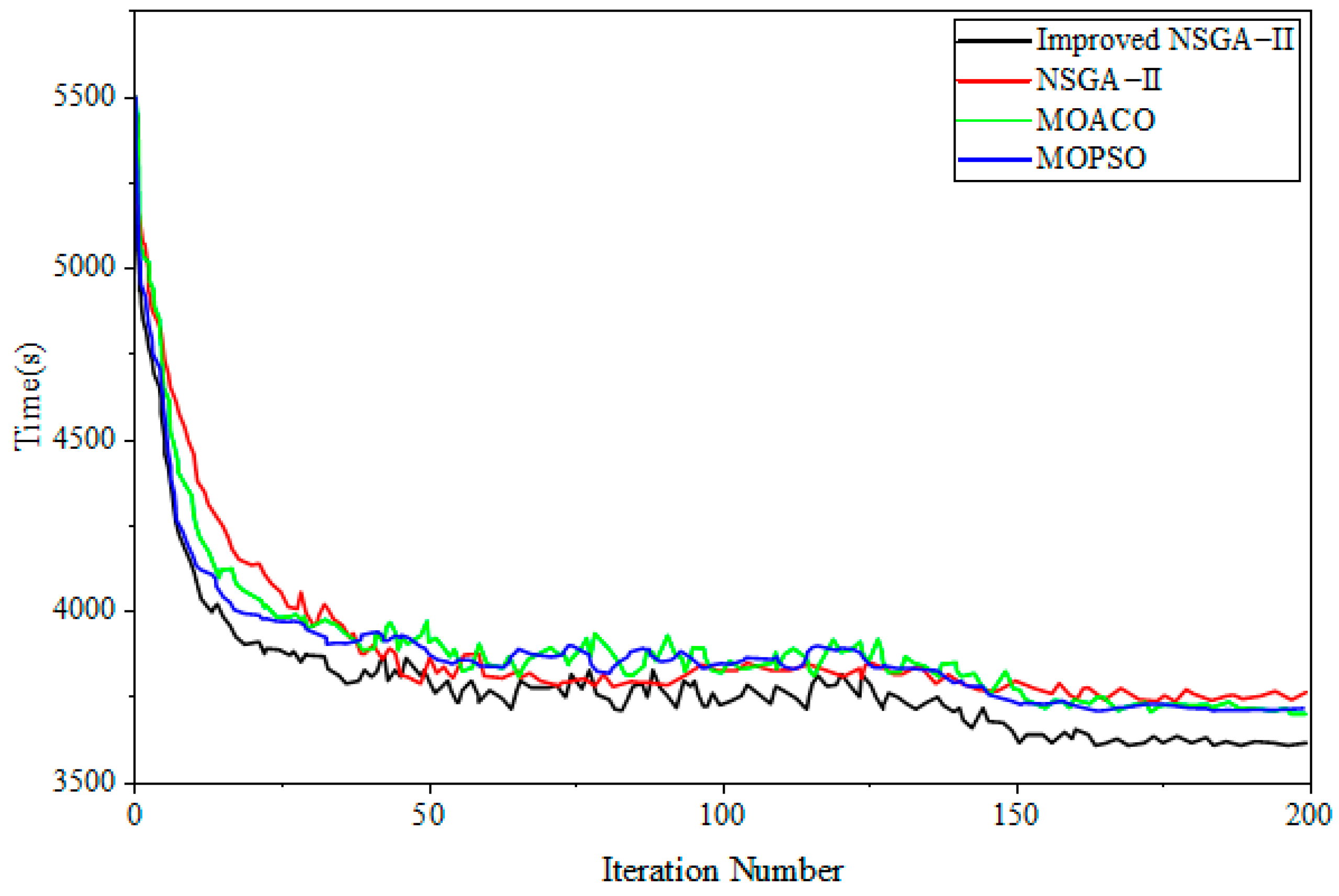
Under a highly constrained search space, the standard NSGA-II algorithm easily loses population diversity, which may lead to premature convergence and difficulty in thoroughly exploring the trade-off relationship between personnel allocation and support completion time. Existing improvement methods proposed by other scholars may not be suitable for the scheduling requirements of the carrier transfer level, creating an urgent need to develop a superior solution algorithm.
To fill these research gaps, the innovations of this study are primarily reflected in the following:
- 4.
The ammunition support process at the transfer level is analyzed as an independent operational scenario situated between the magazine level and the flight deck level. Its operational procedures, resource constraints, and scheduling requirements are formalized, providing a theoretical basis for future scholars studying related scenarios.
- 5.
By mapping ammunition support operations onto an FJSP-like structure, a bi-objective scheduling optimization model that considers differences in personnel workload is constructed for the carrier transfer level. This refines the modeling of the carrier ammunition support process down to the transfer level, thereby expanding the scope for ammunition support optimization.
- 6.
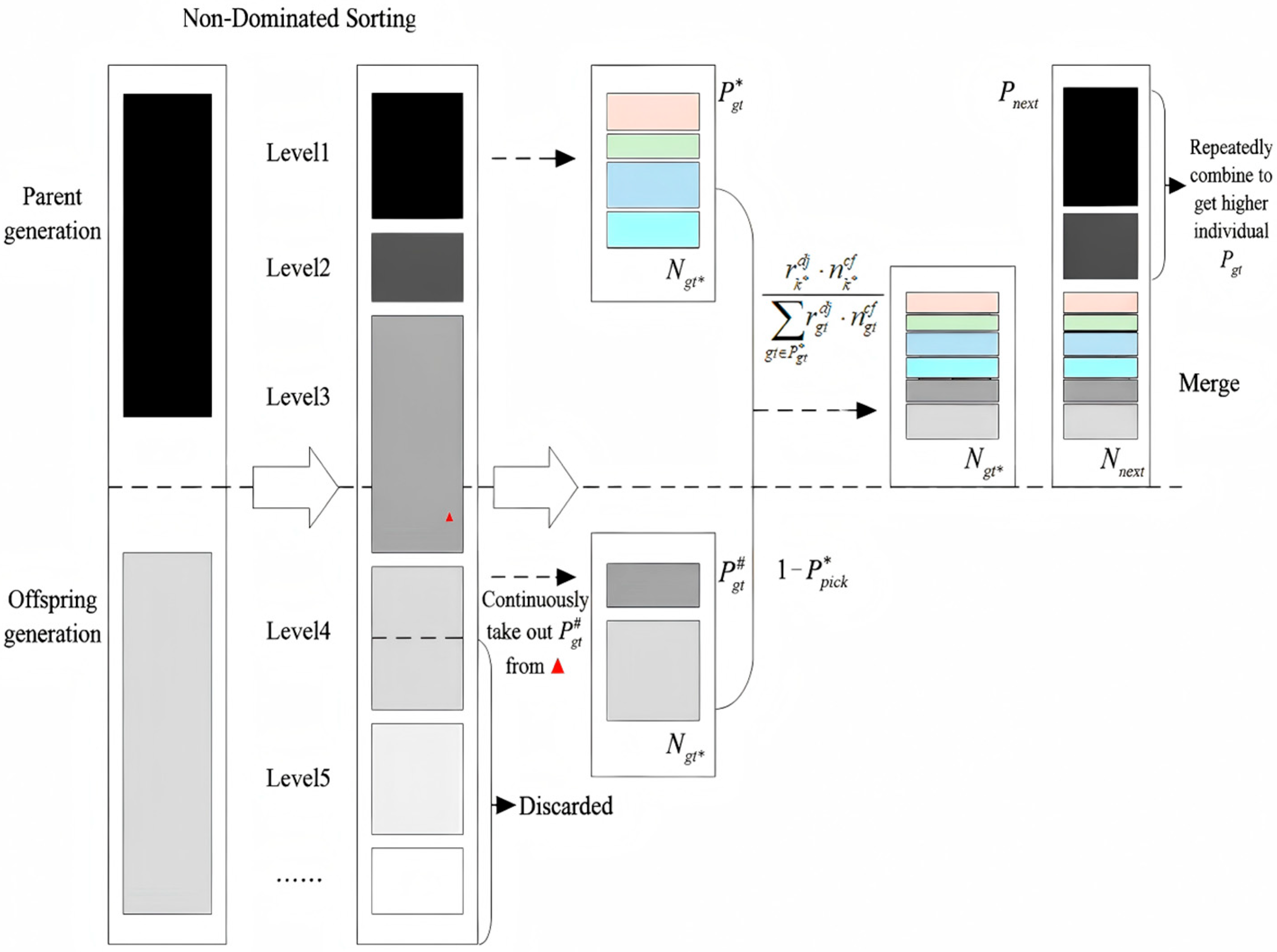
A solution framework combining an improved NSGA-II with an iterative feedback mechanism based on marginal benefit is developed, rather than merely employing a simple genetic algorithm. While enhancing solution diversity and convergence performance, this framework also coordinates personnel allocation and job scheduling, enabling the method to identify balanced support schemes rather than optimizing personnel allocation or time scheduling in isolation.
The remainder of this paper is organized as follows.
Section 2 analyzes the intermediate ordnance staging deck ammunition support operation process and defines the scheduling problem.
Section 3 constructs the mathematical model and objective functions.
Section 4 presents the improved NSGA-II algorithm and the constraint decision model.
Section 5 reports the simulation experiments and comparative analysis.
Section 6 concludes the study and discusses future research directions.