Article

VR-Based Creative Interventions for Vulnerable Populations: A Scoping Review and HCI Design Framework


1
Department of Philosophy “Piero Martinetti”, Università degli studi di Milano, Via Festa del Perdono 7, 20122 Milan, Italy
2
Faculty of Business and Management Sciences, University of Novo Mesto, Na Loko 2, 8000 Novo Mesto, Slovenia
3
Faculty of Tourism and Hospitality Management, University of Rijeka, Primorska 46, p.p. 97, 51410 Opatija, Croatia
*
Author to whom correspondence should be addressed.
Computers 2026, 15(6), 384; https://doi.org/10.3390/computers15060384 (registering DOI)
Submission received: 31 January 2025 / Revised: 30 May 2026 / Accepted: 3 June 2026 / Published: 12 June 2026

Abstract

Virtual Reality (VR) is increasingly used in clinical, educational, and supportive-care contexts, but evidence on VR-based creative interventions for vulnerable populations remains fragmented. This article presents a scoping review and proposes VR-CREAT (Virtual Reality for Creative Resilience, Expression, and Social Integration) as an HCI-oriented conceptual framework for future design and evaluation. The review maps empirical and design-oriented literature on immersive VR, creative engagement, emotional resilience, and social connectedness, distinguishing direct creative-VR evidence from partial clinical, adjacent creative, and contextual sources. The evidence suggests that creative VR may support engagement, perceived agency, emotional expression, and social connectedness, but direct clinical evidence remains limited and preliminary. VR-CREAT translates the mapped evidence into candidate mechanisms, design requirements, testable propositions, and evaluation domains for future prototyping, usability testing, and controlled studies. The framework should therefore be understood as an unvalidated design and evaluation model, not as evidence of clinical effectiveness, cost-effectiveness, or readiness for large-scale implementation.

1. Introduction

Virtual Reality (VR) has emerged as a powerful tool in psychological treatments, leveraging its immersive capabilities to simulate real-world environments and complex stimuli. This technology’s potential to create controlled, safe, and engaging environments has made it particularly effective in addressing a variety of psychological issues, including anxiety disorders, post-traumatic stress disorder (PTSD), specific phobias, and pain management [1,2,3,4,5,6]. VR can facilitate exposure therapy by providing a fully immersive experience, allowing patients to confront and manage their fears and anxieties in a controlled setting without real-world risks. In oncology, VR has also been reviewed and tested as a promising supportive-care tool during cancer treatment, including chemotherapy, radiotherapy, antiblastic therapy, and palliative care [7,8,9,10,11,12,13,14,15,16]. From a technology adoption perspective, the decreasing cost of VR hardware has substantially lowered barriers to entry for healthcare providers and individual users alike. Entry-level consumer VR headsets are currently available for under United States American Dollars (USD) 300 (e.g., Meta Quest 3S; manufacturer retail pricing as of 2024), compared with prices exceeding USD 800 for first-generation consumer devices.
Beyond its applications in psychological therapy, VR has also shown considerable promise in educational and training contexts. Its ability to create interactive, engaging learning experiences can enhance knowledge retention and skill acquisition, making it a valuable tool for medical training, professional development, and classroom education [17]. As contextual background, the global market for VR in healthcare was valued at approximately USD 1.2 billion in 2023, with a compound annual growth rate of approximately 33% projected through 2030 (Future Data Stats) (Virtual Reality in Healthcare Market; Future Data Stats: 2024. Available online: https://www.futuredatastats.com/virtual-reality-in-healthcare-market (accessed 16 December 2025).

1.1. Problem Statement and Rationale

Despite growing interest in immersive VR interventions for clinical, educational, and supportive-care contexts, the evidence relevant to creative VR for vulnerable populations remains dispersed across several adjacent perspectives rather than forming a single consolidated research field. Clinical VR studies primarily examine exposure, distraction, psychoeducation, relaxation, symptom management, or supportive care outcomes; creative arts and art therapy studies examine expressive activity and emotional processing, often without immersive VR; and HCI/design studies examine creative interaction, embodiment, presence, or social VR, frequently in non-clinical populations. As a result, existing evidence does not yet establish a coherent or validated intervention category linking VR, creative expression, and emotional resilience. The gap addressed by this paper is therefore more specific: there is a lack of an HCI-oriented synthesis that distinguishes direct creative-VR evidence from partial clinical VR evidence and adjacent creative or design evidence, and that translates this heterogeneous evidence base into cautious, testable design and evaluation propositions.
The novelty of the paper is therefore narrowly scoped. It does not claim that VR, creative expression, or emotional resilience are novel constructs in themselves, nor that VR-CREAT is a validated clinical or implementation model. Rather, the contribution lies in mapping how these adjacent bodies of work can inform the design of future creative-VR systems for vulnerable users, while explicitly separating direct evidence, partial clinical evidence, adjacent creative/design evidence, and contextual theoretical sources. On this basis, the paper proposes VR-CREAT as an unvalidated HCI-oriented conceptual framework intended to guide future prototyping, usability testing, controlled trials, and evaluation design.
From an HCI and computer-science perspective, the central problem is not simply whether VR is clinically promising, but how immersive systems should be designed, evaluated, and governed when vulnerable users are asked to create, manipulate, save, share, or revisit emotionally meaningful digital artefacts. This paper, therefore, has two distinct objectives. First, the scoping review component maps the available evidence on VR-based creative interventions and related adjacent perspectives, while distinguishing among direct, partial, adjacent, and contextual sources. Second, the framework-development component translates the mapped evidence into VR-CREAT, an HCI-oriented conceptual framework that specifies candidate mechanisms, design requirements, testable propositions, and evaluation domains for future validation [8,18,19].

1.2. Research Questions

The review is guided by three primary research questions:
  • RQ1: What empirical evidence exists regarding emotional resilience, psychological well-being, creative engagement, and social integration outcomes in VR-based creative interventions for vulnerable populations?
  • RQ2: What candidate psychological and technological mechanisms are reported or implied in the mapped literature?
  • RQ3: What moderators, implementation factors, and evidence gaps are identifiable across the mapped studies?

1.3. Target Population and Scope

We adopt a broad definition of vulnerable populations: individuals facing significant life stressors that undermine psychological well-being, including but not limited to those with chronic illness (e.g., breast cancer), physical disabilities, social isolation, trauma exposure, or age-related fragility.
We use vulnerable populations as an umbrella construct not to imply clinical equivalence across groups, but to identify populations sharing heightened exposure to psychological distress, reduced agency, social isolation, or health-related fragility. Findings are therefore synthesised at the level of design mechanisms and intervention affordances rather than as population-specific estimates of clinical efficacy.
In this article, creative engagement refers to active user-generated expressive activity inside or in relation to a VR environment, including digital painting, sculpting, visual or spatial composition, storytelling, music/visual creation, avatar-based self-expression, collaborative art-making, and the creation, modification, saving, sharing, or revisiting of expressive digital artefacts. Passive viewing, relaxation, psychoeducation, or distraction-only VR is not treated as direct creative engagement, although such studies may be used as partial contextual evidence where they inform feasibility, acceptability, anxiety, distress, or implementation plausibility.
Because the empirical evidence base is concentrated mainly in oncology, palliative care, anxiety/PTSD-related, and social-isolation contexts, the umbrella term “vulnerable populations” should be interpreted cautiously. Vulnerability is treated here as a relational and contextual condition rather than as a diagnostic category. Consequently, the VR-CREAT framework should be adapted and validated separately for specific populations before population-level clinical or implementation recommendations are generalised.

2. Methods: Structured Scoping Review and Conceptual Framework Development

2.1. Review Design

This article combines a structured scoping review with a conceptual component for developing an HCI framework. The review was conducted in accordance with the PRISMA Extension for Scoping Reviews (PRISMA-ScR) guidelines [2,4,6,8,9,14,15,17,18] because the purpose was to map concepts, evidence gaps, and working definitions in an emerging interdisciplinary field. PRISMA-ScR is retained as a reporting and transparency framework; the manuscript does not claim to provide a quantitative systematic review or meta-analysis. The conceptual component uses the mapped empirical/design-oriented evidence, together with clearly identified theoretical and methodological sources, to construct the VR-CREAT design and evaluation framework.

2.2. Search Strategy

A structured search was conducted across four bibliographic databases (PubMed, Scopus, Web of Science, and PsycINFO) supplemented by targeted Google Scholar searches. Records retrieved from bibliographic databases and through supplementary searches were used to identify empirical/design-oriented studies eligible for the scoping review. Secondary reviews, theoretical contributions, methodological papers, and psychometric validation papers were retained only after empirical source selection, and only to contextualise the synthesis, support measurement choices, or interpret framework components derived from the mapped evidence. The search covered publications from January 2015 to 15 December 2025. The 2015–2025 date restriction applies to empirical studies included in the scoping review; foundational theoretical and methodological references cited for framework or measurement purposes were not treated as primary evidence for the review.
Methodological references, including scale development papers and systematic review guidelines, are cited at their original publication date regardless of the review time window, in keeping with standard scientific practice of crediting the source validation study for any measurement instrument employed. The following methodological works fall outside the 2015–2025 window but are retained for this reason: Thomas and Harden (2008) [20], whose thematic synthesis method underpins the qualitative synthesis approach described in Section 2.6; Cline et al. (1992) [21], the original standardisation study for the Visual Analogue Scale (VAS) used as an enjoyment measure across several included studies; Resnick and Inguito (2011) [22], whose Resilience Scale (RS) is one of the primary outcome instruments assessed in the reviewed literature; and Ubbiali et al. (2013) [23], whose Italian adaptation of the Big Five Inventory (BFI) is used in studies involving Italian-speaking populations. Validated affect and well-being measures used in the reviewed literature also include the Flourishing Scale and the Scale of Positive and Negative Experience as adapted and validated in Italian samples [24]. Replacing these citations with more recent proxies would misattribute the psychometric or methodological work to authors who did not perform it.
Finally, two additional pre-2015 sources are cited in the manuscript outside the primary empirical review window for specific contextual purposes. Rizzo et al. (2009) [5] is cited in Section 5.2 as a seminal clinical reference work on VR exposure therapy for a specific therapeutic modality (combat-related PTSD) for which no functionally equivalent post-2015 foundational source exists; it is retained as historical-contextual support and is not counted among the reviewed studies. Tomich and Helgeson (2012) [25] is included in Appendix A.3 as contextual empirical evidence for post-traumatic growth and quality of life in cancer survivors; it is included because post-traumatic growth remains a relevant long-term outcome domain for the populations under review and because the theoretical construct it supports has not been superseded by a more recent primary reference. Neither source contributes to the outcome-related claims of the scoping review.
The search string combined three thematic blocks using Boolean operators:
  • VR terms: (“virtual reality” OR “VR” OR “immersive environment” OR “head-mounted display” OR “HMD”);
  • Creative/emotional terms: (“creative expression” OR “art therapy” OR “digital art” OR “emotional resilience” OR “psychological well-being” OR “anxiety” OR “mood”);
  • Population terms: (“vulnerable population” OR “breast cancer” OR “chronic illness” OR “oncology” OR “social isolation” OR “elderly” OR “trauma”).
Additional studies were identified through hand-searching the reference lists of included articles and relevant reviews.
The final search was conducted on 15 December 2025. No review protocol was registered. Google Scholar was used as a supplementary source through targeted searches. Across the simplified Google Scholar searches, screening was limited to the first 200 results sorted by relevance. Eligible languages were limited to English, Italian, and Croatian because the review team could reliably screen and interpret full texts in these languages. Non-English records were screened by reviewers fluent in the relevant language; no machine-only translation was used for final inclusion decisions.

2.3. Inclusion and Exclusion Criteria

The eligibility criteria were structured into three explicit evidence levels to avoid conflating direct creative-VR evidence with contextual or adjacent support.
A. Core/direct inclusion criteria: Studies were classified as core/direct evidence when they met all of the following criteria: (i) participants belonged to a vulnerable population or a population experiencing physical, emotional, social, or health-related fragility; (ii) the intervention used immersive VR; (iii) the VR activity involved active creative engagement, such as digital painting, sculpting, storytelling, collaborative art-making, music/visual creation, avatar-based self-expression, or other user-generated expressive activity; (iv) the study reported at least one relevant emotional, well-being, creative-engagement, social-integration, feasibility, usability, or implementation outcome; and (v) the publication was a peer-reviewed empirical article or full conference paper published between 2015 and 2025 in English, Italian, or Croatian.
B. Contextual/partial inclusion criteria: Studies were retained as partial evidence when they examined immersive VR in vulnerable or clinical populations and reported relevant emotional, anxiety, distress, well-being, social, feasibility, or implementation outcomes, but did not include an explicit creative component. These studies were used only to support the feasibility, acceptability, and plausibility of anxiety/distress, and to inform implementation reasoning; they were not treated as direct proof of creative-VR efficacy.
C. Adjacent evidence: Studies were retained as adjacent evidence when they examined creative or art-based interventions without VR, or VR-based creativity in non-vulnerable users. Adjacent evidence informed design rationale, candidate mechanisms, and outcome selection, but was not used as direct evidence of clinical effectiveness in vulnerable populations.
Excluded records included (i) VR used solely for distraction or passive viewing when the record did not inform partial clinical/contextual evidence; (ii) studies on healthy, non-vulnerable populations without explicit relevance to fragility, creative expression, or HCI design; (iii) AR or MR studies without full VR immersion; (iv) records without relevant outcome or implementation information; (v) non-peer-reviewed material; and (vi) records in languages outside English, Italian, and Croatian.
Only core/direct and relevant partial empirical studies were used for outcome-related claims. Adjacent evidence was used only for design rationale and mechanism generation. Theoretical, methodological, psychometric, and review sources were not counted as empirical included studies.

2.4. Study Selection and Data Extraction

Two reviewers independently screened titles and abstracts. The same two reviewers independently assessed full texts for eligibility and evidence role classification. Screening was not piloted as a formal calibration exercise; however, eligibility ambiguities were discussed during early screening, and the evidence-level hierarchy was applied consistently during full-text assessment.
Disagreements were logged in the screening spreadsheet and resolved through discussion. Third-reviewer arbitration was reserved for unresolved borderline cases, principally where the appropriate evidence role (core/direct, partial, adjacent, or contextual) was unclear. Formal inter-rater agreement statistics, including Cohen’s kappa, were not calculated; this is acknowledged as a methodological limitation.
Data extracted from each included study:
  • Bibliographic information (authors, year, journal);
  • Population characteristics (type of vulnerability, sample size, age, gender);
  • VR intervention (hardware, software, duration, frequency, creative tasks);
  • Outcome measures (instruments used);
  • Main findings (qualitative and quantitative, where available);
  • Reported mechanisms and moderators;
  • Economic or implementation outcomes (cost, scalability, adoption barriers) where available;
  • Limitations.

2.5. Quality Assessment

Quality of the 19 primary empirical/design-oriented sources was assessed using the Mixed Methods Appraisal Tool (MMAT) version 2018. Two reviewers independently appraised each empirical/design-oriented source. MMAT categories were selected according to study design, and item-level judgements were summarised as clearly met, partially met/unclear, not met, or not applicable. Disagreements were resolved by consensus discussion. No study was excluded solely on quality grounds; instead, appraisal results were used to calibrate the strength of the narrative claims and to avoid overstating findings derived from small, uncontrolled, qualitative, or adjacent studies.

2.6. Synthesis Approach

We employed a narrative synthesis structured around three thematic domains derived from the revised research questions: (1) mapped outcome evidence, (2) candidate mechanisms, and (3) moderators and implementation factors. Consistent with PRISMA-ScR guidance for scoping reviews [26], we did not perform a formal meta-analysis. Because the included empirical/design-oriented sources were heterogeneous in design, intervention format, comparator, population, and outcome instrument, quantitative findings are summarised qualitatively and narratively rather than through effect-size ranges. Qualitative and design-oriented findings were analysed using thematic synthesis [20]. Outcome-related claims were calibrated according to evidence class and, where available, MMAT appraisal.

2.7. Evidence Relevance Classification

Because the literature at the intersection of immersive VR, creative expression, and vulnerable populations remains limited and heterogeneous, each source was classified according to the three-level hierarchy defined above (Table 1).
Core/direct evidence combined VR, active creative engagement, and vulnerable populations. Contextual/partial evidence examined VR in vulnerable populations without an explicit creative component. Adjacent evidence included creative/art-based interventions without VR, as well as VR creativity studies conducted in non-vulnerable populations. Theoretical, methodological, psychometric, and review sources were used only to inform the conceptual framework, measurement choices, or background. This hierarchy was applied consistently in Section 3 to ensure that clinical VR findings are not presented as direct evidence of the efficacy of creative VR.

2.8. Framework Derivation Procedure

The VR-CREAT framework was developed after completion of study selection, evidence-role classification, data extraction, and narrative synthesis. The framework was not used as an inclusion or exclusion criterion during screening. Its components were derived through a three-step synthesis procedure. First, extracted findings from the 19 primary empirical/design-oriented sources were coded according to reported or implied outcomes, mechanisms, moderators, and interaction features. Second, recurring mechanisms and affordances were clustered into higher-order categories, including presence, embodied interaction, creative agency, symbolic externalisation, co-presence/social connection, accessibility, and data governance. Third, these categories were translated into HCI-oriented design requirements, testable propositions, and evaluation metrics. Theoretical and methodological sources were used only to label, interpret, or operationalise these categories, not to determine source eligibility. This procedure ensured that VR-CREAT functioned as a synthesis product of the mapped evidence and contextual literature rather than as a prior screening framework.

3. Results

3.1. Study Selection and Corpus Composition (PRISMA-ScR-Informed Flowchart)

Figure 1 presents a PRISMA-ScR-informed flow diagram for source selection. Of the 847 records identified through database and supplementary searches, 213 duplicates were removed. After screening 634 records by title and abstract, 412 records were excluded (278 not relevant to VR or creative expression, 89 not involving a vulnerable population, 45 not empirical). The remaining 222 full-text articles were assessed for eligibility, of which 169 were excluded for the following reasons: no creative engagement or no relevant partial/contextual contribution (passive VR only; n = 67), no relevant outcome measure (n = 43), AR/MR without full immersion (n = 22), healthy population only (n = 19), non-peer-reviewed (n = 11), and language other than English/Italian/Croatian (n = 7). This resulted in a final review framework corpus of 53 sources. Within this corpus, 19 were primary empirical/design-oriented sources and constituted the empirical evidence base for outcome and design mapping. The remaining 34 sources were retained as secondary reviews, theoretical works, methodological/psychometric papers, reporting guidelines, or population- or context-related references. They were used for contextualisation and framework development, not as equivalent empirical evidence.
The approximately 76% exclusion rate at the full-text stage reflects the broad initial search strategy, intentionally designed to capture an emerging interdisciplinary field, combined with stricter application of the creative-engagement criterion and the evidence-role hierarchy at that stage. Notably, many excluded full-text articles used VR solely as a passive distraction and did not provide sufficient creative, HCI, or contextual contributions to the present review question.
Characteristics of the final corpus: The scoping review’s empirical evidence base comprised 19 primary empirical/design-oriented studies (Table 2). An additional 34 sources, including reviews, theoretical works, methodological papers, psychometric validation studies, reporting guidelines, and population- and context-related references, were used to contextualise the synthesis and support framework development. The composition and role of each source are reported in Appendix A.1, Table A1 and the reconstructed counts are reported in Appendix A.2, Table A2.

Quality Appraisal

MMAT appraisal was applied only to the 19 primary empirical/design-oriented sources. The evidence base was methodologically heterogeneous, including randomised and controlled clinical VR studies, pilot and feasibility studies, open trials, qualitative studies, participatory design studies, HCI studies, and case-based art-therapy papers. Quality ratings were therefore not used to exclude studies but to calibrate the strength of narrative claims.
The detailed study-level appraisal is provided in Appendix A.3, Table A3. The strongest empirical support came from randomised or controlled clinical VR studies in oncology or palliative care contexts, but these studies were mostly partial rather than direct evidence of the creative use of VR. Conversely, the most directly relevant creative-VR evidence was often qualitative, case-based, design-oriented, or conducted in non-clinical populations. This distinction informs the cautious interpretation of direct, partial, and adjacent evidence throughout the synthesis.
Because this was a scoping review, MMAT ratings were used as structured quality-appraisal indicators rather than as a formal risk-of-bias assessment. Item-level judgement summaries are included to make the appraisal logic more transparent.

3.2. RQ1: Mapped Outcome Evidence

Evidence for RQ1 was drawn mainly from partial VR clinical studies and adjacent creative-intervention studies, with limited direct evidence from creative VR interventions. The mapped evidence supports the creative VR interventions, but direct clinical evidence remains preliminary.

3.2.1. Emotional Resilience

Several partial clinical VR studies reported improvements in coping-related, anxiety, mood, or well-being outcomes, whereas direct creative VR studies more often reported empowerment, engagement, agency, and expressive value. Because outcome instruments, intervention formats, comparators, and populations were highly heterogeneous, the findings are summarised narratively rather than quantitatively.
Key findings:
  • Torres García et al. [29]: In breast cancer patients before first chemotherapy, a four-session VR psychoeducational protocol reduced anticipatory anxiety, depression, and emotional distress more than standard psychoeducation and improved disease-coping dimensions measured with the MINI-MAC coping scale.
  • Woo et al. [34] and Niki et al. [13]: palliative-care VR studies reported reductions in physical/emotional distress and symptom burden, supporting VR as a coping-oriented intervention in vulnerable clinical populations, while not providing direct evidence for validated resilience-effect estimates.
  • Cohen [27] and Zeevi [28]: qualitative VR art-making/art-therapy studies with adolescents, including trauma-exposed or socially anxious youth, report empowerment, non-verbal expression, therapeutic engagement, and safe-space construction rather than validated resilience effect sizes.

3.2.2. Anxiety and Mood

Several primary empirical studies used standardised or validated instruments to assess anxiety, mood, distress, quality of life, symptom burden, affective state, social connectedness, or related outcomes. Because the present article does not include a full extraction matrix of comparable quantitative outcomes, the number of studies using specific instruments is not reported as a fixed count; instead, instruments and findings are discussed descriptively where directly relevant to the reported outcomes.
Across the empirical literature, partial clinical VR studies reported reductions in state anxiety, emotional discomfort, or negative mood, and some studies reported improvements in positive affect or well-being indicators. These findings support the plausibility of VR as a supportive tool in vulnerable populations but should not be interpreted as direct proof that creative VR components themselves produce clinical benefit.
Key findings:
  • Torres García et al. [29]: In breast cancer patients before the first chemotherapy, VR-based psychoeducation produced greater reductions in anxiety, depression, and emotional discomfort than standard psychoeducation and improved coping responses.
  • Ding et al. [31]: VR sculpting in a repeated-measures university sample significantly decreased GAD-7 anxiety scores, increased positive affect on PANAS, and improved HRV indices; relevance to vulnerable clinical populations requires replication.
  • Chirico et al. [10], Fabi et al. [11], Buche et al. [35], and Burrai et al. [7]: oncology studies from Italian and French clinical contexts provide partial evidence that supportive immersive VR may reduce anxiety, support emotional management, or improve distress-related outcomes during chemotherapy or antiblastic therapy. However, most of these interventions are supportive, psychoeducational, relaxation-based, or distraction-based rather than explicitly creative, and therefore cannot be treated as direct evidence of the efficacy of creative VR.
  • Di Pompeo et al. [36], Schröder et al. [6], Rutkowski et al. [14], Burrai et al. [8], and Gautama et al. [12]: systematic reviews and meta-analyses support VR as a plausible tool for anxiety and symptom reduction while emphasising heterogeneity, small sample sizes, and the need for standardised protocols.

3.2.3. Social Integration

Several empirical/design-oriented sources examined social integration, social support, perceived belonging, or connectedness, using heterogeneous quantitative, qualitative, or feasibility-oriented indicators. The evidence is most useful for HCI design of social VR functions rather than for firm clinical claims.
Evidence for social integration was less consistently quantified than anxiety and mood outcomes. Studies using social support, connectedness, belonging, or qualitative co-presence indicators generally suggest the design relevance of group-mediated, participatory, or avatar-supported VR, but the measures and intervention formats are too heterogeneous to support aggregate quantitative claims.
Key findings:
  • Thabrew et al. [37]: an open trial with hospitalised children and young people found immersive reality technology feasible and potentially useful for reducing social isolation and improving connectedness and well-being.
  • Kershner et al. [38]: a pilot randomised trial of remote group-mediated VR physical activity in older adults supports the feasibility, acceptability, and relevance of group-mediated VR for social connection, though it is not a creative-art intervention.
  • Ng et al. [39], Seiler et al. [15], and Niki et al. [13]: palliative-care VR work highlights the relevance of life review, simulated travel, avatars, gaze/non-verbal communication, and shared or personally meaningful virtual experiences for connectedness and psychosocial well-being.
  • Zeevi [28]: VR art-therapy and Croatian-language VR therapy evidence support the clinical relevance of virtual environments for socially anxious or communication-vulnerable users, while requiring cautious transfer to oncology-focused creative VR.

3.2.4. Creative Engagement

Creative engagement is defined here as active user-generated expressive activity in or through VR. It includes digital painting, sculpting, spatial composition, storytelling, music/visual creation, avatar-mediated self-expression, collaborative art-making, and the creation, saving, sharing, or revisiting of expressive artefacts. Across the empirical and adjacent HCI literature, creative engagement was usually assessed through time-on-task, self-reported enjoyment, qualitative engagement, expressive richness, or therapist/user appraisal; these indicators are design-relevant but not standardised clinical outcomes.
Accordingly, creative-engagement findings should be interpreted as evidence of feasibility, acceptability, user agency, and interaction-design value, not as proof that creative VR is clinically effective. Standardised measures of creative engagement and clinical outcomes are needed before stronger claims can be made.
Key findings:
  • Graessler and Taplick [40] and Yuan and Gao [41]: VR can support creativity, engagement, avatar-mediated interaction, and peer presence in educational or design-learning settings; these findings are relevant to design principles but should not be generalised directly to vulnerable clinical populations.
  • Wagener et al. [42]: Mood Worlds demonstrates an immersive environment for autonomous emotional expression and supports the design relevance of user-led affective creation.
  • Hacmun et al. [43] and Hadjipanayi et al. [44]: art therapists and scoping-review evidence identify distinctive affordances of VR as an artistic medium for therapy, including virtual materiality, embodied interaction, therapeutic setting, and user experience.
  • Cohen [27]: adolescent VR art-making enabled three-dimensional safe-space construction and was described as an expressive tool supporting engagement and empowerment.
  • Archer et al. [18], Erdoğan Yüce et al. [30], and Folgieri et al. [45]: broader creative-arts and art-experience literature supports the relevance of emotional expression and creativity for psycho-oncology and well-being outcomes, but it remains adjacent evidence. It should inform the selection of mechanisms and the design rationale, not make direct claims about the efficacy of VR creative intervention.

3.3. RQ2: Mechanisms

From the qualitative, design-oriented, and empirical literature, six recurring mechanisms were identified as candidate pathways through which VR-based creative interventions may support vulnerable users (Table 3).
These mechanisms should be interpreted as recurring explanatory themes and design targets rather than as validated causal mediators or prevalence estimates. Qualitative excerpts illustrate these mechanisms:
To avoid conflating illustrative design language with empirical participant quotations, no composite quotations are used as evidence in this synthesis. The six mechanisms are treated as candidate design constructs and require future mediation testing.

3.4. RQ3: Moderators

Several moderating factors were identified across studies, with implications for intervention targeting and technology deployment (Table 4).
The available studies did not provide sufficient consistent evidence to assess moderation by gender, educational level, or type of vulnerability. The moderator patterns reported above are descriptive only and are derived from individual studies rather than from a pooled moderator analysis. Due to heterogeneity in study designs, outcome measures, and sample characteristics, these observations should not be interpreted as formal moderator effects. Future research with standardised protocols and larger samples is needed to confirm these tentative patterns.

3.5. Economic and Implementation Outcomes: Availability in Included Studies

Only a small number of empirical/design-oriented sources reported implementation variables such as cost per session, staff training time, patient retention, or hardware failure rates. None provided sufficient primary economic data to support claims about cost per quality-adjusted life year (QALY), healthcare utilisation offsets, formal cost-effectiveness metrics (e.g., ICER), or reimbursement. These concepts are therefore treated only as future evaluation priorities in Section 6, not as findings of the review.

4. Discussion: Interpretation of the Mapped Evidence

4.1. Summary of Evidence

The mapped evidence should be interpreted less as confirmation of a clinical intervention model and more as an indication of where HCI design hypotheses can be formulated responsibly. The most important pattern is not the magnitude of effects reported in individual studies, but the asymmetry between evidence types. Controlled and clinical VR studies provide the strongest support for feasibility, acceptability, anxiety reduction, distress management, and supportive-care plausibility, particularly in oncology, palliative-care, chemotherapy, anxiety, and symptom-management contexts [7,10,11,13,29,34,35]. However, most of these studies involve passive, psychoeducational, relaxation-based, music-supported, or distraction-oriented VR rather than active creative engagement [4,9,10,14,15]. Conversely, the studies most directly relevant to creative VR are often qualitative, case-based, design-oriented, or conducted in non-clinical populations [27,28,31,40,41,42,43]. This means that the evidence base is informative for design reasoning, but not yet sufficient for claims about clinical effectiveness.
This asymmetry has two implications. First, creative engagement should currently be treated as a candidate active ingredient rather than as a validated therapeutic mechanism. The reviewed literature suggests that agency, symbolic externalisation, emotional safety, embodied interaction, co-presence, and mastery are plausible mechanisms through which creative VR may support vulnerable users [27,28,42,43,44], but these mechanisms remain hypotheses for future testing. Second, the paper’s framework contribution is justified precisely because the empirical literature is fragmented: VR-CREAT does not synthesise a mature intervention field but organises partial, adjacent, and direct evidence into a structure that can guide prototyping, usability studies, mediation testing, and controlled trials.
The review, therefore, supports a cautious design-oriented conclusion. Creative VR appears promising for engagement, expression, perceived agency, and social connection [27,28,37,38,39,41,42], while broader creative-arts and art-experience literature supports the relevance of expressive activity for emotional processing and well-being in oncology and related contexts [18,30,45]. However, its added value over passive VR, traditional art therapy, or other supportive interventions remains untested. Cross-literature comparisons with psychotherapy or pharmacological interventions should therefore remain avoided at this stage because of differences in populations, designs, comparators, and outcome measures [46,47]. Future studies should directly compare creative and non-creative VR conditions, use standardised measures of outcomes and engagement, and examine whether the proposed mechanisms explain changes in emotional, social, or resilience-related outcomes.

4.2. Theoretical Contributions of VR-CREAT

Consistent with the scoped novelty claim introduced in Section 1.1, VR-CREAT should be understood as a synthesis-based HCI framework rather than as a validated clinical model. Its contribution lies in organising adjacent and heterogeneous evidence into a testable structure that links VR affordances, creative engagement, candidate resilience-related mechanisms, and implementation considerations for future validation in vulnerable populations.
The theoretical contribution of the model lies in its shift from a receptive model of VR use to a generative model of VR interaction. In receptive models, users primarily experience, observe, or are exposed to immersive environments. In the generative model proposed here, users create, modify, save, share, and revisit expressive artefacts. This distinction matters because the candidate mechanisms identified in the review—creative agency, symbolic externalisation, emotional safety, co-presence, and mastery—depend on active user participation rather than on immersion alone. Prior frameworks have addressed partially overlapping constructs. Slater and Wilbur’s FIVE framework [48] established the foundational vocabulary of immersion and presence but did not address creative mechanisms, emotional outcomes, or implementation factors. Freeman et al. [3] mapped VR applications across mental health disorders without integrating creative expression as an active ingredient. Hadjipanayi et al. [44] provided the most directly adjacent scoping review of VR art therapy, but did not propose a formal multi-layer HCI framework linking affordances, mechanisms, moderators, outcomes, and evaluation metrics. VR-CREAT therefore contributes a synthesis-based structure in which technological affordances, candidate psychological mechanisms, moderating factors, and outcome domains are organised into testable propositions for future HCI and clinical evaluation.
The model has three theoretical advantages. First, it is testable because each pathway generates falsifiable hypotheses. Second, it is adaptable across different VR platforms, populations, and delivery contexts. Third, it identifies candidate design levers—rather than validated deployment guidelines—that can be evaluated in future prototyping, usability testing, controlled trials, and implementation studies.

4.3. Distinctive Contribution Relative to Adjacent Perspectives

VR-CREAT is positioned at the boundary of three adjacent perspectives: clinical/supportive VR, creative-arts and art-therapy research, and HCI/design research on creative or social VR. Compared with clinical VR literature, the framework shifts the focus from VR as an environment to be experienced toward VR as a generative medium in which users actively create, modify, save, share, and revisit meaningful digital artefacts. Existing clinical VR work has demonstrated the relevance of exposure, distraction, psychoeducation, relaxation, symptom management, and supportive-care applications in mental health, oncology, procedural pain, chemotherapy, and palliative-care contexts [3,4,5,6,9,10,14,15]. However, these studies usually do not isolate creative expression as an active ingredient. VR-CREAT therefore treats creative engagement as a candidate mechanism to be tested, not as an already validated source of therapeutic benefit.
Compared with creative-arts and art-therapy literature, the framework specifies the technological affordances that make immersive creative interaction distinctive. Traditional and digital creative interventions support emotional expression, meaning-making, and psychological processing in vulnerable or clinical populations [18,30,45]. VR art-therapy and expert art-therapist perspectives further highlight virtual materiality, embodied interaction, therapeutic setting, and user experience as distinctive affordances of immersive artistic creation [28,43,44]. VR-CREAT builds on this literature by translating these affordances into HCI-oriented design requirements and evaluation domains, including embodied interaction, creative agency, symbolic externalisation, save/revisit functions, privacy-controlled sharing, and social co-presence.
Compared with general HCI, educational, and social-VR research, VR-CREAT foregrounds vulnerability, emotional safety, accessibility, and data governance as candidate design constraints requiring empirical validation. Studies on VR creativity, sculpting, avatar-mediated interaction, emotional expression, group-mediated VR, and participatory palliative-care design show that immersive environments can support creative engagement, peer presence, co-presence, and autonomous affective expression [31,37,38,39,40,41,42]. However, many of these studies involve educational, design-learning, non-clinical, or broader social contexts. The contribution of VR-CREAT is therefore not to claim clinical superiority, but to organise these adjacent insights into a cautious framework for future testing with vulnerable populations.
This positioning clarifies the model’s added value while avoiding overclaiming. VR-CREAT should be understood as a bridge between adjacent evidence bases: it translates plausible mechanisms and design affordances into testable propositions, but it does not establish that creative VR is more effective than passive VR, traditional art therapy, or standard supportive-care interventions.

5. The VR-CREAT Framework as a Synthesis Product

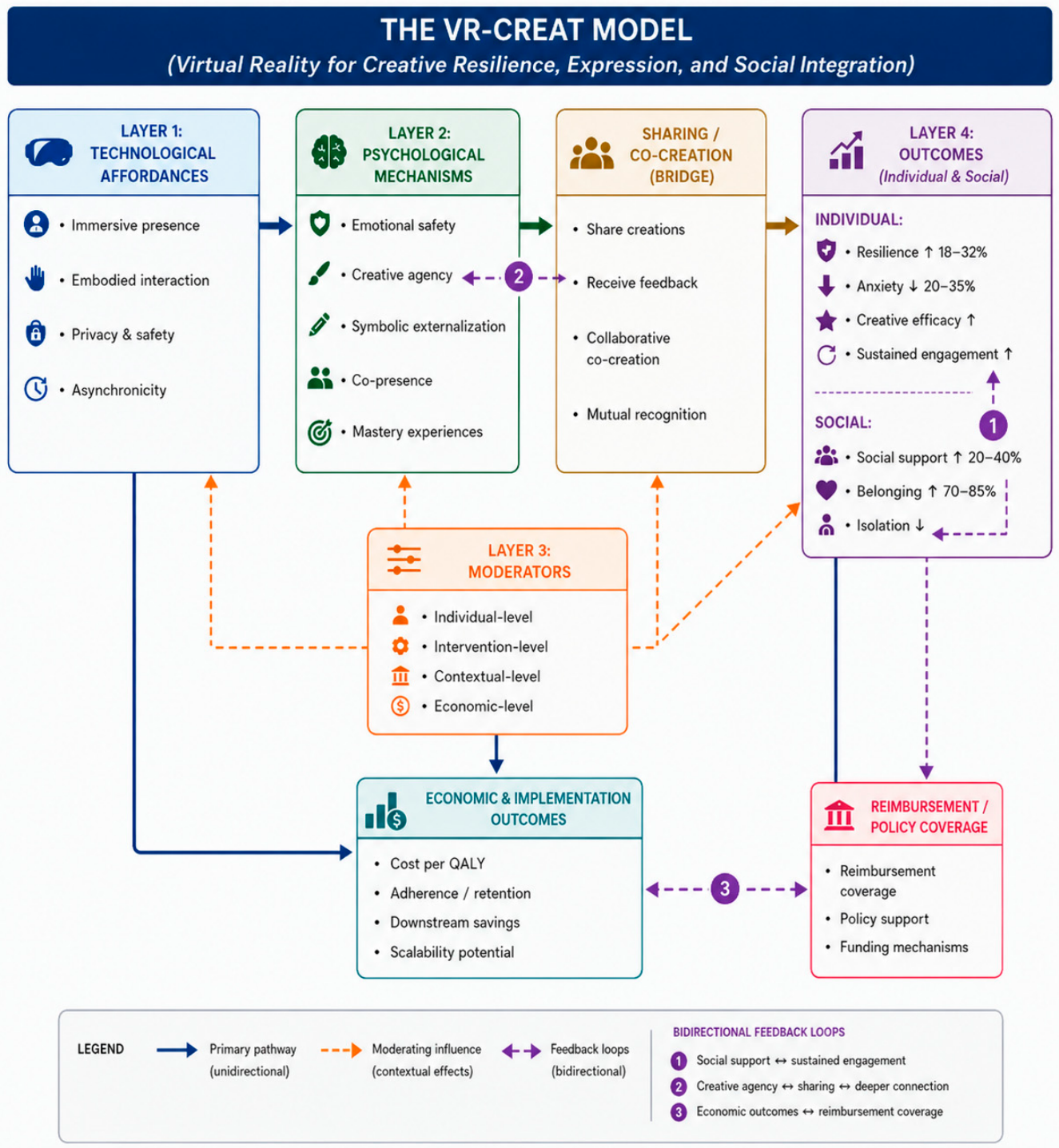
The preceding Results and Discussion indicate that the available evidence is informative for HCI design reasoning, but not yet sufficient to support claims of clinical effectiveness for creative VR interventions. The strongest empirical support comes from clinical and supportive VR studies, whereas the most directly relevant creative-VR evidence remains qualitative, case-based, design-oriented, or adjacent. VR-CREAT—Virtual Reality for Creative Resilience, Expression, and Social Integration—is therefore proposed as a synthesis product that translates this heterogeneous evidence base into an HCI-oriented design and evaluation framework for immersive systems. The model is organised into four interconnected layers: technological affordances, psychological and creative mechanisms, moderating factors, and outcome domains. It should be read as an unvalidated conceptual model for future prototyping, usability testing, mediation testing, controlled trials, and implementation research, rather than as a confirmed causal, clinical-effectiveness, or deployment model.

5.1. Operationalisation of the VR-CREAT Model

Table 5 operationalises the VR-CREAT model for HCI research by linking each mechanism or layer to a system requirement, a testable proposition, and a measurable evaluation endpoint. These propositions should be treated as hypotheses for prototyping, usability testing, and future controlled trials.

5.2. Theoretical Foundations of the Framework

The VR-CREAT model does not claim to invent the psychological mechanisms it incorporates. Rather, it synthesises and adapts established constructs from multiple disciplines into a framework specifically tailored to VR-based creative interventions for vulnerable populations. The following foundational theories inform the model:
  • Immersion and presence: Slater and Wilbur (1997) [48]: the subjective feeling of “being there” in a virtual environment;
  • Emotional safety: Rogers (1957) [33]: the conditions for psychological exploration without threat;
  • Creative agency and autonomy: Deci and Ryan (1985) [49]: Self-Determination Theory’s emphasis on autonomy and competence;
  • Symbolic externalisation: Winnicott (1971) [50]: the use of transitional objects and creative play in psychological development;
  • Co-presence and social presence: Goffman (1959) [51]; Biocca (1997) [52]: the perception of being with others in mediated environments;
  • Mastery experiences: Bandura (1977) [32]: self-efficacy gained through successful task completion.
The incremental novelty of the VR-CREAT model lies not in these individual mechanisms but in (a) their integration into a single testable framework for VR-based creative interventions, (b) the articulation of bidirectional feedback loops between individual and social outcomes, and (c) the explicit inclusion of economic and implementation moderators, which are absent from prior purely psychological models.

5.3. Layer 1: Core Technological Affordances

These are the intrinsic properties of VR technology that may enable supportive, expressive, and engagement-related effects. Specifically, immersive presence is the subjective feeling of being in the virtual environment and may reduce attention to real-world stressors; embodied interaction means bodily movements translate directly into creative acts such as painting, sculpting, arranging, or gesturing; privacy and safety allow emotional experimentation with user control over saving, deleting, or sharing outputs; and asynchronicity allows users to create, pause, revisit, and reflect at different times, accommodating fatigue, treatment schedules, and home-based use.

5.4. Layer 2: Psychological Mechanisms (Mediators)

These mechanisms explain how VR affordances may contribute to outcomes. Immersion/presence refers to the perceived sense of being in the virtual environment. Emotional safety refers to the perceived freedom to express oneself without fear. Creative agency represents the sense of authorship over one’s creations. Symbolic externalisation consists of translating internal states into external forms. Co-presence/social connection relates to perceived connection to others in shared or socially mediated spaces. Mastery/self-efficacy refers to the successful completion of creative tasks, leading to perceived competence and control.

5.5. Layer 3: Moderating Factors

We consider individual-level moderators (baseline resilience/anxiety, prior VR familiarity, motivation for creative expression); intervention-level moderators (session duration and frequency, social vs. solo format, guided vs. free exploration); contextual moderators (clinical setting vs. home, facilitator availability, technical support, safeguarding procedures); and implementation moderators (hardware cost, staff training, maintenance burden, bandwidth, procurement constraints, and organisational readiness). Specific economic endpoints, such as reimbursement, cost per QALY, healthcare utilisation offsets, software licencing models, API-first design, and HL7/FHIR compatibility, are identified as future evaluation priorities in Section 6.

5.6. Layer 4: Outcomes

Outcomes are divided into individual, social, and implementation domains. Individual outcomes include coping-related emotional resilience, reduced anxiety and negative mood, positive affect, creative self-efficacy, perceived agency, and emotional articulation. Social outcomes include perceived social support, reduced isolation, safe co-presence, and a sense of belonging to the community. Implementation outcomes include acceptability, usability, adherence, dropout, staff burden, technical reliability, accessibility, and privacy trust. Economic endpoints are not treated as mapped findings; they are proposed as future evaluation targets in Section 6.
In summary, as shown in Figure 2, the VR-CREAT model hypothesises relationships from technological affordances to psychological and creative mechanisms to outcomes, with moderating factors operating at each stage. The core technological affordances include immersive presence, embodied interaction, privacy and safety, and asynchronicity options. These affordances activate six recurring mechanisms: immersion/presence, emotional safety, creative agency, symbolic externalisation, co-presence/social connection, and mastery/self-efficacy. The strength and direction of these pathways are expected to be moderated by individual-level, intervention-level, contextual, and economic factors. The model produces individual, social, and implementation-related outcomes. Bidirectional feedback loops operate such that social support may sustain engagement, creative agency may increase sharing, and stronger implementation evidence may support wider access.

6. Implications, Limitations, and Future Evidence Needs

6.1. Limitations of the Review

Several limitations should be acknowledged. First, heterogeneity in outcome measures precluded formal meta-analysis. Second, most studies had small samples and short follow-up periods. Third, publication bias may favour positive results. Fourth, the broad umbrella category of vulnerable populations limits population-specific clinical conclusions. Fifth, few empirical/design-oriented studies included economic outcomes or implementation metrics, limiting rigorous assessment of cost-effectiveness and scalability. Sixth, formal inter-rater agreement statistics were not calculated. Seventh, database-specific retrieval counts were not retained separately during the original December 2025 search, which limits exact reconstruction of the original PRISMA-ScR flow. To improve transparency, the final search strings were rerun on 27 May 2026, and reconstructed retrieval counts are reported in Appendix A.2, Table A2. Because database contents, indexing, and filter availability may change over time, the reconstructed total of 1161 records should be interpreted as a transparency-oriented reconstruction rather than an exact reproduction of the original aggregate export of 847 records. Although MMAT was used to appraise empirical/design-oriented sources, the overall evidence base remains exploratory, and the distinction between direct, partial, adjacent, and contextual evidence must remain central to interpretation.

6.2. Implications for Research

Several research priorities emerge from this review. Immediate priorities include longitudinal studies with at least 6 months of follow-up to assess durability; randomised controlled trials comparing creative VR with passive VR and traditional art therapy; studies explicitly testing moderation by vulnerability type; and the development of standardised creative VR outcome measures, including implementation and economic endpoints.
Medium-term priorities include large-scale multi-site trials, cost-effectiveness analyses from both healthcare payer and societal perspectives, implementation science studies on barriers to clinical adoption, and business model analyses comparing direct-to-consumer, subscription, and provider-licenced distribution channels.

6.3. HCI and Implementation Implications for VR System Design

The following recommendations should be interpreted as HCI and implementation hypotheses derived from the mapped literature and the VR-CREAT framework, rather than as empirically validated deployment guidelines.
For clinicians, healthcare administrators, and technology developers, the VR-CREAT model suggests several practical recommendations.
For clinical practice, clinicians should prioritise creative agency by allowing users to make meaningful choices rather than merely following instructions. When the goal is reducing isolation, incorporating social features is particularly beneficial. The intensity of the intervention should be matched to the user’s level of vulnerability: patients with higher anxiety may benefit from more guided sessions initially. Technical quality matters, as low-end VR may compromise immersion and, consequently, emotional outcomes. Home-based delivery is feasible and should be explored for scalability.
For technology developers and entrepreneurs, the VR-CREAT framework suggests several testable product-design principles. First, creative tools such as drawing, sculpting, music, storytelling, spatial composition, and avatar-based self-expression should be prioritised when the intended mechanism is agency or symbolic externalisation. Second, social features such as shared galleries, moderated co-creation, and avatar-mediated interaction should be tested when the intended outcome is connectedness. Third, session duration should be designed around fatigue, cybersickness risk, battery life, and treatment schedules rather than assumed to be universally optimal. Fourth, asynchronous capabilities such as saving works in progress and returning later may accommodate users with fatigue or unpredictable schedules. Fifth, analytics dashboards should be limited to clinically and ethically justified data, with explicit consent and data-minimisation safeguards.
For healthcare payers and policymakers, the present review provides no evidence of cost-effectiveness. Any policy or reimbursement argument should therefore be based on future studies that prospectively measure implementation cost, staff time, adherence, clinical outcomes, and downstream service-use effects.
These design implications should be validated through user-centred testing, feasibility studies, and longitudinal evaluations before being treated as deployment guidelines.

6.4. Future Implementation and Economic Evaluation Agenda

Because economic and implementation outcomes were rarely reported in the included empirical/design-oriented literature, the following points constitute a future research and design agenda rather than evidence-based conclusions on cost-effectiveness.
Future evaluations should predefine implementation and economic endpoints rather than infer them post hoc. Relevant endpoints include headset amortisation, software licencing, facilitator time, staff training, maintenance, technical support, adverse events, dropout, retention, patient or user adherence, and cost per completed session. Where clinical endpoints are sufficiently robust, future trials should also model cost per QALY, incremental cost-effectiveness ratios, and downstream healthcare utilisation offsets. Reimbursement analyses should be jurisdiction-specific and should not be claimed until controlled trials produce credible effect estimates. From a system-design perspective, API-first architecture, HL7/FHIR compatibility, role-based access, audit logs, local-first processing where feasible, and exportable implementation metrics should be treated as testable interoperability and adoption requirements rather than as evidence-based conclusions of the current review.

6.5. Ethical, Accessibility, and Data Governance Considerations as Future Design Constraints

These considerations are not presented as independent findings of the scoping review, but as HCI design constraints derived from the vulnerability of the target populations and from the accessibility and data-governance layer of VR-CREAT.
Future creative-VR systems for vulnerable users should treat accessibility as a candidate core design requirement rather than as an optional adaptation. Future prototypes and studies should evaluate whether interfaces minimise fatigue, support seated and low-mobility use, accommodate low digital literacy, reduce cybersickness through stable frame rates and careful locomotion design, and provide clear exit, pause, and assistance functions.
Emotional safety should also be treated as a candidate interaction-design requirement. Users should retain control over whether to save, erase, share, or revisit creative outputs. Where emotionally distressing content may emerge, future studies and prototypes should evaluate informed consent procedures, debriefing options, and escalation procedures. In social VR settings, privacy-preserving sharing, moderation, pseudonymity options, private galleries, and safeguards against unwanted exposure or peer judgement should be treated as testable design requirements.
Data governance requires specific attention because creative outputs, mood ratings, voice, movement traces, avatar behaviour, and session analytics may constitute sensitive personal data. Future systems should therefore evaluate data minimisation, local processing where feasible, purpose limitation, role-based access, encryption, retention limits, and explicit consent for sharing or secondary data use alongside engagement, usability, and clinical outcomes.

7. Conclusions

7.1. Summary of Contributions

This paper makes three main contributions to the literature. First, it maps a heterogeneous empirical evidence base of 19 primary empirical/design-oriented sources on VR, creative expression, emotional resilience, and vulnerable populations, while using an additional 34 sources for contextualisation, theory, measurement, and framework development. Second, it introduces the VR-CREAT model, an HCI-oriented design and evaluation framework articulating six candidate mechanisms: immersion/presence, emotional safety, creative agency, symbolic externalisation, co-presence/social connection, and mastery/self-efficacy. Third, it outlines an agenda for research, design, implementation, accessibility, data governance, and economic evaluation to support the future validation of VR-based creative interventions.

7.2. Final Remarks

Because vulnerability was treated as an umbrella construct, the framework should be adapted and validated separately for specific populations before clinical or implementation recommendations are generalised.
The intersection of VR, creative expression, and emotional resilience represents a promising area for research in immersive technology and HCI-informed digital health design. The current evidence supports the plausibility and design relevance of creative VR interventions, particularly regarding engagement, perceived agency, emotional expression, and social connectedness. However, direct clinical evidence for VR-based creative interventions remains limited, heterogeneous, and preliminary.
The VR-CREAT model should therefore be understood as a design and evaluation framework rather than as a confirmed causal or clinical-effectiveness model. It identifies candidate mechanisms, system affordances, moderating factors, and outcome domains that can guide future prototyping, usability testing, controlled trials, and implementation research. Further longitudinal, controlled, and implementation-oriented studies are needed before strong claims can be made about clinical effectiveness, cost-effectiveness, or large-scale adoption.

Author Contributions

Conceptualisation, R.F. and T.B.; methodology, S.G. and T.B.; formal analysis, R.F. and T.B.; writing, original draft preparation, R.F., T.B. and C.L.; writing, review and editing, C.L., R.F. and T.B.; visualisation, S.G.; supervision, T.B. and R.F.; project administration, S.G. All authors have read and agreed to the published version of the manuscript.

Funding

This research was funded by the Department of Philosophy “Piero Martinetti” of the University of Milan under the Project “Departments of Excellence 2023–2027” awarded by the Ministry of University and Research (MUR). Certain sections of this article were written using tools funded by the Slovenian Research and Innovation Agency, under grant number CRP-2023 V5-2331. The APC was funded by the same institution. The University of Rijeka, Faculty of Tourism and Hospitality Management, funded this research with grant number ZIP-UNIRI-116-1-23, and the APC was also funded by the University of Rijeka, Faculty of Tourism and Hospitality Management.

Data Availability Statement

No new primary data were collected for this review. The full list of sources included in the final corpus and their role in the synthesis is provided in Appendix A.1, Table A1.

Acknowledgments

This project developed the conceptual basis for future research on NFT-related applications in tourism, including the ethical preservation and sharing of VR creative artefacts among vulnerable users and tourists.

Conflicts of Interest

The authors declare no conflicts of interest. The funders had no role in the design, analysis, interpretation, writing, or decision to publish.

Appendix A

Appendix A.1

Table A1. Final corpus of sources informing the scoping review and conceptual framework (S1).
Ref.Source TypeContext/PopulationMain Relevance to the ReviewRole in Synthesis
[1]Narrative/clinical reviewAnxiety disordersVR exposure therapy and anxiety-treatment contextContextual support
[18]Systematic review of RCTsAdult cancer patientsCreative psychological interventions in oncologySecondary evidence/comparator
[46]Meta-analysisAnxiety disordersBenchmark for anxiety-treatment effect sizesComparator/contextual evidence
[32]Theoretical articleGeneral psychologySelf-efficacy and mastery experiencesTheoretical framework
[17]Systematic reviewMedical educationVR-based head-mounted devices in training and educationTechnology-adoption context
[52]Theoretical articleMediated environmentsSocial presence and embodiment in virtual environmentsTheoretical framework
[35]Empirical/clinical articleChemotherapy patientsVR and emotional management during chemotherapyOutcome-related evidence
[7]Randomised controlled trialCancer patients undergoing antiblastic therapyImmersive VR effects on cancer-treatment-related symptomsPrimary empirical evidence
[8]Systematic review and meta-analysisCancer patients undergoing chemotherapyVR effects on anxiety, fatigue and painSecondary evidence
[9]Mini-reviewCancer treatmentVR during cancer treatmentOncology VR context
[10]Empirical clinical studyBreast cancer patients during chemotherapyVR and music therapy for anxiety and moodPrimary empirical evidence
[2]Systematic review of reviewsPsychiatric disordersVR applications in psychiatric treatmentSecondary evidence
[21]Psychometric/methodological paperMeasurementVisual Analogue Scale standardisationMethodological support
[27]Comparative empirical studyAdolescents3D VR art-making vs. 2D traditional art-makingPrimary creative-engagement evidence
[47]Systematic review and meta-analysisDepression/psychotherapyBenchmark for psychotherapy effectsComparator/contextual evidence
[49]Theoretical monographMotivation psychologyAutonomy, competence and self-determinationTheoretical framework
[36]Systematic reviewMood induction/VRPositive mood induction from real settings to VRMechanism-related secondary evidence
[31]Case study/empirical educational interventionUniversity art classVR sculpting and anxiety reductionCreative-engagement evidence; non-clinical
[30]Systematic review and meta-analysisCancer patientsArt-based interventions for cancer patientsSecondary evidence/creative intervention context
[11]Prospective clinical studyEarly breast and ovarian cancer patientsImmersive VR during chemotherapyPrimary empirical evidence
[45]Conference paper/preliminary studyArt experience/anxietyBCI and anxiety change during an art experienceContextual creative-emotional evidence
[3]Narrative/clinical reviewMental health disordersVR in the assessment and treatment of mental health disordersContextual support
[19]Survey validation/needsBreast cancer patientsSupportive care needs in breast cancerPopulation-context evidence
[12]Systematic review and meta-analysis of RCTsCancer patients receiving chemotherapyImmersive VR effectiveness during chemotherapySecondary evidence
[24]Psychometric validation studyItalian-speaking populationsFlourishing Scale and SPANE validationMethodological support
[51]Theoretical monographSocial interactionCo-presence and social interactionTheoretical framework
[40]Empirical design studyEngineering design educationVR and creativity supportCreative-engagement evidence; non-clinical
[43]Qualitative study with expert art therapistsArt therapy/VRArtistic creation in VR for art therapyMechanism and design evidence
[44]Scoping reviewVR art therapyArt as therapy in virtual realitySecondary evidence/conceptual support
[4]Comprehensive literature reviewMedical procedures/pain and distressVR as a distraction interventionBackground/comparator evidence
[38]Pilot randomised controlled trialOlder adultsRemote group-mediated VR physical activitySocial connection/feasibility evidence
[53]Croatian article/review or clinical discussionStuttering therapyVR therapy in Croatian rehabilitation literatureCroatian-language contextual evidence
[39]Participatory design studyPalliative careVR life-review therapy system designDesign and co-presence evidence
[13]Preliminary prospective multicentre studyTerminal cancer patientsVR in palliative care symptom managementPrimary empirical evidence
[22]Psychometric/methodological paperOlder adultsResilience Scale psychometric propertiesMethodological support
[5]Clinical/theoretical book chapterCombat-related PTSDVR exposure therapy for PTSDHistorical/contextual VR therapy support
[3]Theoretical articlePsychotherapyPsychological safety and therapeutic changeTheoretical framework
[14]Systematic review and meta-analysisCancer patients undergoing chemotherapyVR for anxiety and fatigue in chemotherapySecondary evidence
[6]Systematic review and meta-analysis of RCTsAnxiety disordersVR applications in anxiety treatmentSecondary evidence
[15]Systematic review and meta-analysisPalliative careEffectiveness of VR in palliative careSecondary evidence
[48]Theoretical articleImmersive virtual environmentsPresence and immersion frameworkTheoretical framework
[37]Open trialHospitalised children and young peopleImmersive reality for social isolation and connectednessPrimary empirical evidence
[20]Methodological paperQualitative synthesisThematic synthesis methodMethodological support
[25]Empirical cancer survivorship studyCancer survivorsPosttraumatic growth and quality of lifeContextual outcome evidence
[29]Randomised studyBreast cancer patients before chemotherapyVR intervention for anxiety, depression and copingPrimary empirical evidence
[26]Reporting guidelineScoping reviewsPRISMA-ScR checklist and explanationMethodological support
[23]Psychometric validation studyItalian-speaking populationsItalian adaptation of the Big Five InventoryMethodological support
[42]Empirical HCI/design studyEmotional expression in VRMood Worlds and Autonomous Emotional ExpressionCreative-emotional design evidence
[50]Theoretical monographPsychoanalysis/creativityTransitional objects and creative playTheoretical framework
[34]Randomised controlled trialPalliative care patientsFLOW-VRT-Relaxation vs. traditional relaxationPrimary empirical evidence
[41]Empirical educational studyVR classroomsAvatar appearance and peer interactionSocial/peer-interaction evidence; non-clinical
[16]ReviewBreast cancer/oncologyVR as a supportive tool in breast cancer treatmentSecondary evidence
[28]Clinical/art-therapy case-based articleAdolescentsIntegration of VR into art therapyCreative-expression and therapeutic-engagement evidence

Appendix A.2

Table A2. Full search strategy by database and reconstructed database-specific retrieval counts (S2).
DatabaseDate SearchedFull Search StringLimits AppliedRecords Retrieved
PubMedOriginal search: December 2025; rerun for database-specific counts: 27 May 2026((“virtual reality” [Title/Abstract] OR “VR” [Title/Abstract] OR “immersive environment” [Title/Abstract] OR “head-mounted display” [Title/Abstract] OR “HMD” [Title/Abstract]) AND (“creative expression” [Title/Abstract] OR “art therapy” [Title/Abstract] OR “digital art” [Title/Abstract] OR “emotional resilience” [Title/Abstract] OR “psychological well-being” [Title/Abstract] OR “anxiety” [Title/Abstract] OR “mood” [Title/Abstract]) AND (“vulnerable population” [Title/Abstract] OR “breast cancer” [Title/Abstract] OR “chronic illness” [Title/Abstract] OR “oncology” [Title/Abstract] OR “social isolation” [Title/Abstract] OR “elderly” [Title/Abstract] OR “trauma” [Title/Abstract]))2015–2025; English, Italian, and Croatian; humans; empirical publication types where available, including Clinical Study, Clinical Trial, Controlled Clinical Trial, Randomized Controlled Trial, Observational Study, Comparative Study, Evaluation Study, Validation Study, Multicenter Study, Case Reports, and Conference Proceedings. Reviews, meta-analyses, scoping reviews, editorials, letters, comments, guidelines, preprints, datasets, errata, retractions, and news items were not treated as primary empirical sources.51
ScopusOriginal search: December 2025; rerun for database-specific counts: 27 May 2026TITLE-ABS-KEY ((“virtual reality” OR VR OR “immersive environment” OR “head-mounted display” OR HMD) AND (“creative expression” OR “art therapy” OR “digital art” OR “emotional resilience” OR “psychological well-being” OR anxiety OR mood) AND (“vulnerable population” OR “breast cancer” OR “chronic illness” OR oncology OR “social isolation” OR elderly OR trauma))2015–2025; English, Italian, Croatian; articles, reviews screened for references, and conference papers413
Web of Science Core CollectionOriginal search: December 2025; rerun for database-specific counts: 27 May 2026TS = ((“virtual reality” OR VR OR “immersive environment” OR “head-mounted display” OR HMD) AND (“creative expression” OR “art therapy” OR “digital art” OR “emotional resilience” OR “psychological well-being” OR anxiety OR mood) AND (“vulnerable population” OR “breast cancer” OR “chronic illness” OR oncology OR “social isolation” OR elderly OR trauma))2015–2025; English, Italian, Croatian; article and proceedings paper document types301
PsycINFOOriginal search: December 2025; rerun for database-specific counts: 27 May 2026((“virtual reality” OR VR OR “immersive environment” OR “head-mounted display” OR HMD) AND (“creative expression” OR “art therapy” OR “digital art” OR “emotional resilience” OR “psychological well-being” OR anxiety OR mood) AND (“vulnerable population” OR “breast cancer” OR “chronic illness” OR oncology OR “social isolation” OR elderly OR trauma))2015–2025; English, Italian, Croatian; peer-reviewed journal articles and empirical studies where available196
Google ScholarOriginal search: December 2025; rerun for database-specific counts: 27 May 2026Targeted simplified searches combining the main terms, including: “virtual reality” “creative expression” “vulnerable populations”; “virtual reality” “art therapy” “breast cancer”; “VR” “emotional resilience” “oncology”; “immersive virtual reality” “social isolation” “well-being”; “virtual reality” “creative engagement” “anxiety”2015–2025 where identifiable; English, Italian, Croatian; first 200 results sorted by relevance screened200
Total1161
Note: Database-specific search strings were adapted to the syntax of each database while preserving the same three conceptual blocks: VR-related terms, creative/emotional terms, and vulnerable-population terms. The original search was conducted in December 2025 and produced an aggregate export of 847 records, which was used for the PRISMA-ScR screening flow reported in Figure 1. Database-specific retrieval counts were not retained separately during the original search. To improve transparency, the final search strings were rerun on 27 May 2026 using the same conceptual search blocks and comparable limits. The rerun produced a reconstructed retrieval total of 1161 records across PubMed, Scopus, Web of Science Core Collection, PsycINFO, and Google Scholar. Because database contents, indexing, and available filters may change over time, these reconstructed counts should not be interpreted as exact reproductions of the original December 2025 export and were not used to recalculate the downstream screening numbers. Hand-searching/reference-list records were part of the original search process but could not be reconstructed separately and are therefore not included in the total for the reconstructed retrieval.
Appendix A.3 Table A3 reports an MMAT-informed appraisal of the 19 empirical, clinical, qualitative, intervention, and design-oriented sources included in the mapped empirical evidence base. Two reviewers independently appraised each source and resolved disagreements by consensus discussion. Reviews, meta-analyses, theoretical works, psychometric validation papers, and methodological references were not appraised with MMAT because they did not constitute primary empirical/design-oriented evidence for the purposes of the present synthesis. Judgement codes are Y = criterion clearly met; PY = partially met or unclear; N = criterion not met; NA = not applicable to the selected MMAT category. The ratings should not be interpreted as a formal risk-of-bias assessment.

Appendix A.3

Table A3. MMAT-informed appraisal of empirical and design-oriented sources (S3).
Ref.StudyStudy Design/MMAT CategoryEvidence RoleOverall AppraisalMMAT Judgement SummaryMain Quality Concern
[35]Buche et al. 2023Quantitative non-randomised/clinical empirical studyPartial evidenceModerateS1 Y; S2 Y; Q1 Y; Q2 PY; Q3 PY; Q4 Y; Q5 PYSupportive clinical VR evidence; creative component not explicit; limited generalisability to creative VR
[7]Burrai et al. 2023Quantitative randomised controlled trialPartial evidenceModerate/highS1 Y; S2 Y; Q1 Y; Q2 Y; Q3 PY; Q4 Y; Q5 PYRCT design strengthens internal validity, but the intervention is supportive VR rather than explicitly creative
[10]Chirico et al. 2020Quantitative clinical intervention studyPartial evidenceModerate/highS1 Y; S2 Y; Q1 Y; Q2 Y; Q3 PY; Q4 Y; Q5 PYRelevant oncology setting, but VR/music intervention is primarily a distraction/supportive rather than a creative expression
[27]Cohen 2023Comparative empirical studyDirect evidenceModerateS1 Y; S2 Y; Q1 Y; Q2 PY; Q3 PY; Q4 Y; Q5 PYDirectly relevant to VR art-making, but the adolescent sample and comparative design limit generalisability
[31]Ding et al. 2025Case study/repeated-measures empirical interventionAdjacent evidenceLow/moderateS1 Y; S2 Y; Q1 PY; Q2 PY; Q3 N; Q4 PY; Q5 PYVR sculpting is directly relevant to creative engagement, but the sample is non-clinical and the design is preliminary
[11]Fabi et al. 2022Prospective clinical studyPartial evidenceModerateS1 Y; S2 Y; Q1 Y; Q2 PY; Q3 PY; Q4 Y; Q5 PYRelevant oncology VR evidence, but the intervention is not explicitly creative and follow-up appears limited
[45]Folgieri et al. 2024Preliminary conference studyAdjacent/contextual evidenceLow/moderateS1 Y; S2 PY; Q1 PY; Q2 PY; Q3 N; Q4 PY; Q5 PYPreliminary data; useful for art/anxiety context but not a mature VR creative-intervention trial
[40]Graessler and Taplick 2019Empirical design/HCI studyAdjacent evidenceModerateS1 Y; S2 Y; Q1 Y; Q2 PY; Q3 PY; Q4 Y; Q5 PYRelevant for VR creativity and design, but educational/design context limits transfer to vulnerable populations
[43]Hacmun et al. 2021Qualitative study with expert art therapistsDirect/adjacent mechanism evidenceModerate/highS1 Y; S2 Y; Q1 Y; Q2 Y; Q3 Y; Q4 PY; Q5 YStrong qualitative relevance to VR art therapy, but based on expert perspectives rather than patient outcomes
[38]Kershner et al. 2024Pilot randomised controlled trialPartial evidenceModerate/highS1 Y; S2 Y; Q1 Y; Q2 Y; Q3 PY; Q4 Y; Q5 PYUseful for group-mediated VR feasibility and social connection, but not a creative-art intervention
[39]Ng et al. 2024Participatory design studyPartial/design evidenceModerate/highS1 Y; S2 Y; Q1 Y; Q2 Y; Q3 Y; Q4 PY; Q5 YStrong design relevance for palliative VR, but primarily system design/life review rather than outcome efficacy
[13]Niki et al. 2019Preliminary prospective multicentre studyPartial evidenceModerateS1 Y; S2 Y; Q1 Y; Q2 PY; Q3 PY; Q4 Y; Q5 PYClinically relevant palliative VR evidence, but non-randomised and not explicitly creative
[37]Thabrew et al. 2022Open trialPartial evidenceModerateS1 Y; S2 Y; Q1 Y; Q2 PY; Q3 PY; Q4 Y; Q5 PYRelevant for social isolation and connectedness, but open design and heterogeneous population limit causal inference
[25]Tomich and Helgeson 2012Quantitative observational survivorship studyContextual empirical evidenceModerate/highS1 Y; S2 Y; Q1 Y; Q2 Y; Q3 PY; Q4 Y; Q5 PYUseful for post-traumatic growth and quality-of-life context, but not VR-based
[29]Torres García et al. 2024Randomised/controlled clinical studyPartial evidenceModerate/highS1 Y; S2 Y; Q1 Y; Q2 Y; Q3 PY; Q4 Y; Q5 PYStrong breast cancer VR evidence, but psychoeducational/supportive rather than explicitly creative
[42]Wagener et al. 2022Empirical HCI/design studyAdjacent evidenceModerate/highS1 Y; S2 Y; Q1 Y; Q2 Y; Q3 PY; Q4 Y; Q5 YHighly relevant to autonomous emotional expression in VR, but not clinical/vulnerable-population efficacy evidence
[34]Woo et al. 2024Randomised controlled trialPartial evidenceModerate/highS1 Y; S2 Y; Q1 Y; Q2 Y; Q3 PY; Q4 Y; Q5 PYStronger clinical design, but relaxation/palliative VR rather than creative VR intervention
[41]Yuan and Gao 2024Empirical educational/HCI studyAdjacent evidenceModerate/highS1 Y; S2 Y; Q1 Y; Q2 Y; Q3 PY; Q4 Y; Q5 YRelevant to avatar interaction and social presence, but the educational context limits clinical transfer
[28]Zeevi 2021Clinical/art-therapy case-based articleDirect/creative-expression evidenceModerateS1 Y; S2 Y; Q1 Y; Q2 PY; Q3 N; Q4 Y; Q5 PYClinically relevant to VR art therapy with adolescents, but case-based and not a controlled outcome study
Note: The MMAT-informed appraisal should be interpreted as a structured quality-appraisal summary based on extracted study characteristics rather than as a substitute for a full risk-of-bias assessment. Ratings were used to calibrate narrative claims, prioritise convergent or higher-quality evidence, and avoid treating small, uncontrolled, qualitative, case-based, or adjacent HCI studies as equivalent to controlled clinical evidence.

References

  1. Anderson, P.L.; Molloy, A. Maximizing the impact of virtual reality exposure therapy for anxiety disorders. Curr. Opin. Psychol. 2020, 36, 153–157. [Google Scholar] [CrossRef]
  2. Cieślik, B.; Mazurek, J.; Rutkowski, S.; Kiper, P.; Turolla, A.; Szczepańska-Gieracha, J. Virtual reality in psychiatric disorders: A systematic review of reviews. Complement. Ther. Med. 2020, 52, 102480. [Google Scholar] [CrossRef]
  3. Freeman, D.; Reeve, S.; Robinson, A.; Ehlers, A.; Clark, D.; Spanlang, B.; Slater, M. Virtual reality in the assessment, understanding, and treatment of mental health disorders. Psychol. Med. 2017, 47, 2393–2400. [Google Scholar] [CrossRef] [PubMed]
  4. Indovina, P.; Barone, D.; Gallo, L.; Chirico, A.; De Pietro, G.; Giordano, A. Virtual Reality as a Distraction Intervention to Relieve Pain and Distress During Medical Procedures: A Comprehensive Literature Review. Clin. J. Pain 2018, 34, 858–877. [Google Scholar] [CrossRef]
  5. Rizzo, A.; Reger, G.; Gahm, G.; Difede, J.; Rothbaum, B.O. Virtual reality exposure therapy for combat-related PTSD. In Post-Traumatic Stress Disorder: Basic Science and Clinical Practice; Humana Press: Totowa, NJ, USA, 2009; pp. 375–399. [Google Scholar]
  6. Schröder, D.; Wrona, K.J.; Müller, F.; Heinemann, S.; Fischer, F.; Dockweiler, C. Impact of virtual reality applications in the treatment of anxiety disorders: A systematic review and meta-analysis of randomized-controlled trials. J. Behav. Ther. Exp. Psychiatry 2023, 81, 101893. [Google Scholar] [CrossRef]
  7. Burrai, F.; Ortu, S.; Marinucci, M.; De Marinis, M.G.; Piredda, M. Effectiveness of Immersive Virtual Reality in People with Cancer Undergoing Antiblastic Therapy: A Randomized Controlled Trial. Semin. Oncol. Nurs. 2023, 39, 151470. [Google Scholar] [CrossRef]
  8. Burrai, F.; Sguanci, M.; Petrucci, G.; De Marinis, M.G.; Piredda, M. Effectiveness of immersive virtual reality on anxiety, fatigue and pain in patients with cancer undergoing chemotherapy: A systematic review and meta-analysis. Eur. J. Oncol. Nurs. 2023, 64, 102340. [Google Scholar] [CrossRef]
  9. Chirico, A.; Lucidi, F.; De Laurentiis, M.; Milanese, C.; Napoli, A.; Giordano, A. Virtual reality in health system: Beyond entertainment. A mini-review on the efficacy of VR during cancer treatment. J. Cell. Physiol. 2016, 231, 275–287. [Google Scholar] [CrossRef] [PubMed]
  10. Chirico, A.; Maiorano, P.; Indovina, P.; Milanese, C.; Giordano, G.G.; Alivernini, F.; Lodice, G.; Gallo, L.; De Peitro, G.; Lucidi, L.; et al. Virtual reality and music therapy as distraction interventions to alleviate anxiety and improve mood states in breast cancer patients during chemotherapy. J. Cell. Physiol. 2020, 235, 5353–5362. [Google Scholar] [CrossRef]
  11. Fabi, A.; Fotia, L.; Giuseppine, F.; Gaeta, A.; Falciccho, C.; Giuliani, G.; Savarese, A.; Taraborelli, E.; Rossi, V.; Malaguti, P.; et al. The immersive experience of virtual reality during chemotherapy in patients with early breast and ovarian cancers: The Patient’s Dream study. Front. Oncol. 2022, 12, 960387. [Google Scholar] [CrossRef] [PubMed]
  12. Gautama, M.S.N.; Huang, T.-W.; Haryani, H. A systematic review and meta-analysis of randomized controlled trials on the effectiveness of immersive virtual reality in cancer patients receiving chemotherapy. Eur. J. Oncol. Nurs. 2023, 65, 102424. [Google Scholar] [CrossRef] [PubMed]
  13. Niki, K.; Okamoto, Y.; Maeda, I.; Mori, I.; Ishii, R.; Matsuda, Y.; Takagi, T. A novel palliative care approach using virtual reality for improving various symptoms of terminal cancer patients: A preliminary prospective, multicenter study. J. Palliat. Med. 2019, 22, 702–707. [Google Scholar] [CrossRef] [PubMed]
  14. Rutkowski, S.; Czech, O.; Wrzeciono, A.; Kiper, P.; Szczepańska-Gieracha, J.; Malicka, I. Virtual reality as a chemotherapy support in treatment of anxiety and fatigue in patients with cancer: A systematic review and meta-analysis and future research directions. Complement. Ther. Med. 2021, 61, 102767. [Google Scholar] [CrossRef]
  15. Seiler, A.; Liaw, S.-T.; Baracos, V.E.; Gray, R. How effective is virtual reality technology in palliative care? A systematic review and meta-analysis. Palliat. Med. 2022, 36, 1047–1058. [Google Scholar] [CrossRef] [PubMed]
  16. Zasadzka, E.; Pieczyńska, A.; Trzmiel, T.; Hojan, K. Virtual reality as a promising tool supporting oncological treatment in breast cancer. Int. J. Environ. Res. Public Health 2021, 18, 8768. [Google Scholar] [CrossRef]
  17. Barteit, S.; Lanfermann, L.; Bärnighausen, T.; Neuhann, F.; Beiersmann, C. Augmented, mixed, and virtual reality-based head-mounted devices for medical education: Systematic review. JMIR Serious Games 2019, 7, e29080. [Google Scholar] [CrossRef]
  18. Archer, S.; Buxton, S.; Sheffield, D. The effect of creative psychological interventions on psychological outcomes for adult cancer patients: A systematic review of randomised controlled trials. Psycho-Oncology 2015, 24, 1–10. [Google Scholar] [CrossRef]
  19. Gálvez-Hernández, C.L.; Boyes, A.; Ortega-Mondragón, A.; Romo-González, A.G.; Mohar, A.; Mesa-Chavez, F.; Villarreal-Garza, C. Unmet needs among breast cancer patients in a developing country and supportive care needs survey validation. Rev. Investig. Clín. 2021, 73, 245–250. [Google Scholar] [CrossRef]
  20. Thomas, J.; Harden, A. Methods for the Thematic Synthesis of Qualitative Research in Systematic Reviews. BMC Med. Res. Methodol. 2008, 8, 45. [Google Scholar] [CrossRef]
  21. Cline, M.E.; Herman, J.; Shaw, E.R.; Morton, R.D. Standardisation of the visual analogue scale. Nurs. Res. 1992, 41, 378–379. [Google Scholar] [CrossRef]
  22. Resnick, B.A.; Inguito, P.L. The Resilience Scale: Psychometric properties and clinical applicability in older adults. Arch. Psychiatr. Nurs. 2011, 25, 11–20. [Google Scholar] [CrossRef]
  23. Ubbiali, A.; Chiorri, C.; Hampton, P.; Donati, D. Psychometric properties of the Italian adaptation of the Big Five Inventory (BFI). Boll. Psicol. Appl. 2013, 266, 37–46. [Google Scholar]
  24. Giuntoli, L.; Ceccarini, F.; Sica, C.; Caudek, C. Validation of the Italian Versions of the Flourishing Scale and of the Scale of Positive and Negative Experience. Sage Open 2017, 7, 2158244016682293. [Google Scholar] [CrossRef]
  25. Tomich, P.L.; Helgeson, V.S. Posttraumatic growth following cancer: Links to quality of life. J. Trauma. Stress 2012, 25, 567–573. [Google Scholar] [CrossRef] [PubMed]
  26. Tricco, A.C.; Lillie, E.; Zarin, W.; O’Brien, K.K.; Colquhoun, H.; Levac, D.; Moher, D.; Peters, M.D.J.; Horsley, T.; Weeks, L.; et al. PRISMA Extension for Scoping Reviews (PRISMA-ScR): Checklist and Explanation. Ann. Intern. Med. 2018, 169, 467–473. [Google Scholar] [PubMed]
  27. Cohen, L. A comparison study between 3D virtual reality art-making and 2D art-making with traditional art materials among adolescents. Arts Psychother. 2023, 86, 102089. [Google Scholar] [CrossRef]
  28. Zeevi, L.S. Making Art Therapy Virtual: Integrating Virtual Reality Into Art Therapy With Adolescents. Front. Psychol. 2021, 12, 584943. [Google Scholar] [CrossRef]
  29. Torres García, A.; Morcillo Serra, C.; Argilés Huguet, M.; González Gardó, L.; Abad Esteve, A.; Ramos-Quiroga, J.A. Efficacy of a Virtual Reality Intervention for Reducing Anxiety, Depression, and Increasing Disease Coping in Patients with Breast Cancer Before Their First Chemotherapy Dose. Cogn. Ther. Res. 2024, 48, 451–465. [Google Scholar] [CrossRef]
  30. Erdoğan Yüce, G.; Alkan, S. The effectiveness of art-based interventions for cancer patients: A systematic review and meta-analysis. Eur. J. Oncol. Nurs. 2024, 73, 102755. [Google Scholar] [CrossRef]
  31. Ding, H.; Lin, B.; Xu, Y.; Shang, D.; Han, Y. VR sculpting as a therapeutic intervention for alleviating anxiety: A case study from a university art class. Front. Psychiatry 2025, 16, 1588745. [Google Scholar] [CrossRef]
  32. Bandura, A. Self-efficacy: Toward a unifying theory of behavioral change. Psychol. Rev. 1977, 84, 191–215. [Google Scholar] [CrossRef]
  33. Rogers, C.R. The necessary and sufficient conditions of therapeutic personality change. J. Consult. Psychol. 1957, 21, 95–103. [Google Scholar] [CrossRef] [PubMed]
  34. Woo, O.K.L.; Lee, A.M.; Ng, R.; Eckhoff, D.; Lo, R.; Cassinelli, A. Flourishing-Life-Of-Wish Virtual Reality Relaxation Therapy (FLOW-VRT-Relaxation) outperforms traditional relaxation therapy in palliative care: Results from a randomized controlled trial. Front. Virtual Real. 2024, 4, 1304155. [Google Scholar] [CrossRef]
  35. Buche, H.; Michel, A.; Blanc, N. When virtual reality supports patients’ emotional management in chemotherapy. Front. Virtual Real. 2023, 4, 1294482. [Google Scholar] [CrossRef]
  36. Di Pompeo, I.; D’Aurizio, G.; Burattini, C.; Bisegna, F.; Curcio, G. Positive mood induction to promote well-being and health: A systematic review from real settings to virtual reality. J. Environ. Psychol. 2023, 91, 102095. [Google Scholar] [CrossRef]
  37. Thabrew, H.; Chubb, L.A.; Kumar, H.; Fouché, C. Immersive reality experience technology for reducing social isolation and improving social connectedness and well-being of children and young people who are hospitalized: Open trial. JMIR Pediatr. Parent. 2022, 5, e29164. [Google Scholar] [CrossRef] [PubMed]
  38. Kershner, K.; Morton, D.; Robison, J.; N’dah, K.W.; Fanning, J. Assessing the Feasibility and Acceptability of Virtual Reality for Remote Group-Mediated Physical Activity in Older Adults: Pilot Randomized Controlled Trial. JMIR Form. Res. 2024, 8, e53156. [Google Scholar] [CrossRef] [PubMed]
  39. Ng, R.N.; Woo, O.K.L.; Eckhoff, D.; Zhu, M.; Lee, A.; Cassinelli, A. Participatory design of a virtual reality life review therapy system for palliative care. Front. Virtual Real. 2024, 5, 1304615. [Google Scholar] [CrossRef]
  40. Graessler, I.; Taplick, P. Supporting creativity with virtual reality technology. In Proceedings of the Design Society: International Conference on Engineering Design; Cambridge University Press: Cambridge, UK, 2019; Volume 1, pp. 2011–2020. [Google Scholar]
  41. Yuan, Q.; Gao, Q. Being there, and being together: Avatar appearance and peer interaction in VR classrooms for video-based learning. Int. J. Hum.-Comput. Interact. 2024, 40, 3313–3333. [Google Scholar] [CrossRef]
  42. Wagener, N.; Niess, J.; Rogers, Y.; Schöning, J. Mood worlds: A virtual environment for autonomous emotional expression. In Proceedings of the 2022 CHI Conference on Human Factors in Computing Systems; Association for Computing Machinery: New York, NY, USA, 2022; pp. 1–16. [Google Scholar]
  43. Hacmun, I.; Regev, D.; Salomon, R. Artistic creation in virtual reality for art therapy: A qualitative study with expert art therapists. Arts Psychother. 2021, 72, 101745. [Google Scholar] [CrossRef]
  44. Hadjipanayi, C.; Banakou, D.; Michael-Grigoriou, D. Art as therapy in virtual reality: A scoping review. Front. Virtual Real. 2023, 4, 1065863. [Google Scholar] [CrossRef]
  45. Folgieri, R.; Banzi, A.; Vanutelli, M.E.; Ferrara, V.; Lucchiari, C. Can Brain-Computer Interface predict change in anxiety during an art experience? Preliminary data from the ASBA project. In Proceedings of EVA London 2024; BCS Learning & Development: Newbridge, UK, 2024; pp. 165–167. [Google Scholar]
  46. Bandelow, B.; Reitt, M.; Röver, C.; Michaelis, S.; Görlich, Y.; Wedekind, D. Efficacy of treatments for anxiety disorders: A meta-analysis. Int. Clin. Psychopharmacol. 2015, 30, 183–192. [Google Scholar] [CrossRef] [PubMed]
  47. Cuijpers, P.; Karyotaki, E.; Eckshtain, D.; Ng, M.Y.; Corteselli, K.A.; Noma, H.; Quero, S.; Weisz, J. Psychotherapy for depression across different age groups: A systematic review and meta-analysis. JAMA Psychiatry 2020, 77, 694–702. [Google Scholar] [CrossRef]
  48. Slater, M.; Wilbur, S. A framework for immersive virtual environments (FIVE): Speculations on the role of presence in virtual environments. Presence Teleoperators Virtual Environ. 1997, 6, 603–616. [Google Scholar] [CrossRef]
  49. Deci, E.L.; Ryan, R.M. Intrinsic Motivation and Self-Determination in Human Behavior; Plenum Press-Long Lane: London, UK, 1985. [Google Scholar]
  50. Winnicott, D.W. Playing and Reality; Tavistock Publications: London, UK, 1971. [Google Scholar]
  51. Goffman, E. The Presentation of Self in Everyday Life; Anchor Books: New York, NY, USA, 1959. [Google Scholar]
  52. Biocca, F. The cyborg’s dilemma: Progressive embodiment in virtual environments. J. Comput.-Mediat. Commun. 1997, 3, JCMC324. [Google Scholar] [CrossRef]
  53. Marušić, P.; Leko Krhen, A. Virtualna stvarnost kao terapija mucanja. Hrvat. Rev. Rehabil. Istraž. 2022, 58, 104–118. [Google Scholar] [CrossRef]
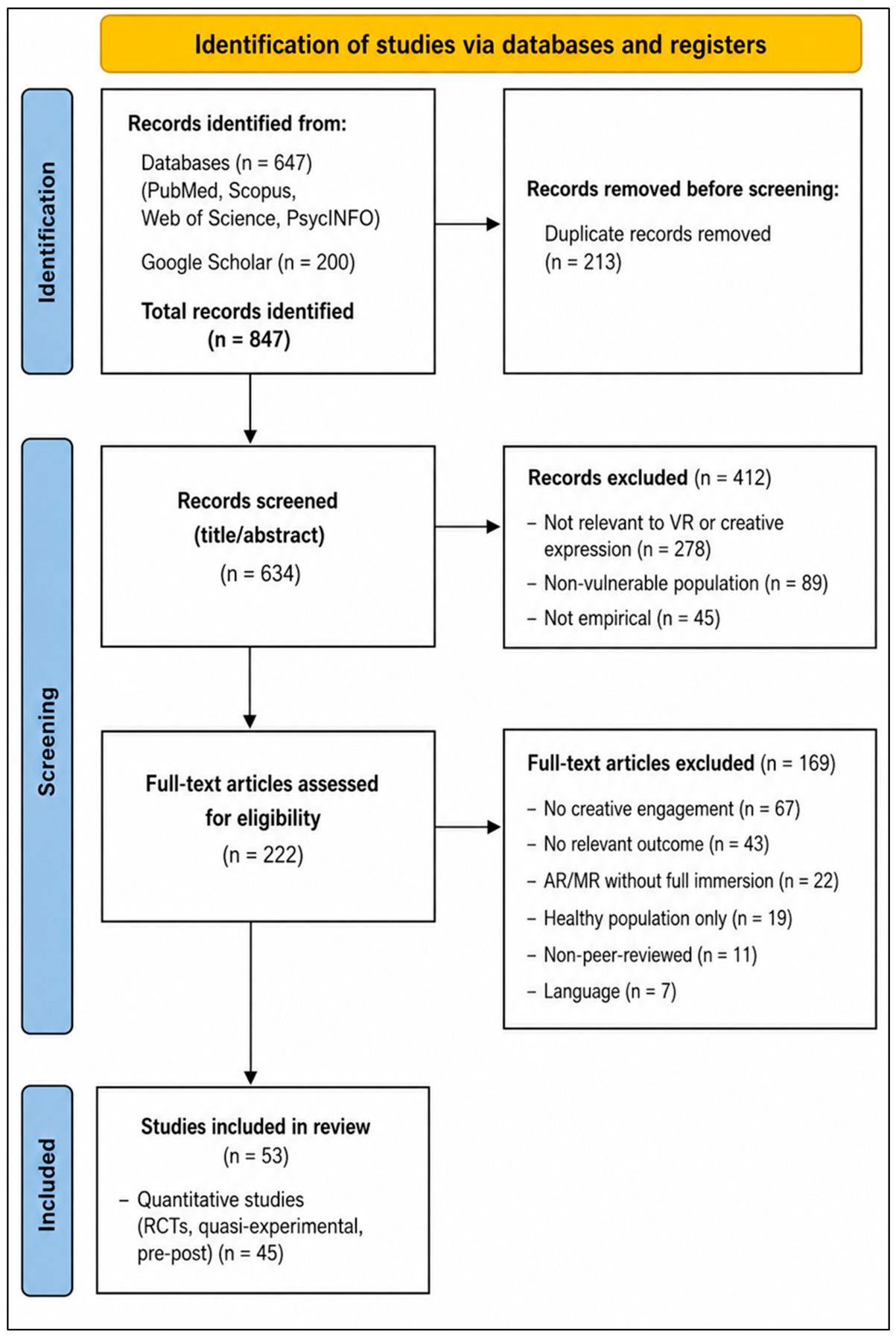
Figure 1. PRISMA-ScR-informed flow diagram. Note: The PRISMA-ScR flow diagram reports the original December 2025 screening process, based on an aggregate export of 847 records. Database-specific retrieval counts were not retained separately during the original search. To improve transparency, the final search strings were rerun on 27 May 2026, producing a reconstructed retrieval total of 1161 records across PubMed, Scopus, Web of Science Core Collection, PsycINFO, and Google Scholar. Because database contents, indexing, and filter availability may change over time, these reconstructed counts should not be interpreted as an exact reproduction of the original December 2025 export and were not used to recalculate the downstream screening flow.
Computers 15 00384 g001
Figure 2. The VR-CREAT model. Visual representation.
Computers 15 00384 g002
Table 1. Evidence-role classification is used in the synthesis.
Evidence ClassDefinitionExamples from CorpusRole in Synthesis
A. Core/direct evidenceVR + active creative engagement + vulnerable population + relevant outcomeCohen [27], Zeevi [28]Main evidence for creative-engagement, agency, and direct design claims; not sufficient for strong clinical efficacy claims
B. Contextual/partial evidenceVR + vulnerable population + relevant emotional, social, feasibility, or implementation outcome, but no explicit creative componentTorres Garcia et al. [29], Burrai et al. [7], Fabi et al. [11]Supports feasibility, anxiety, distress, well-being plausibility, and implementation reasoning; not direct proof of creative-VR efficacy
C. Adjacent evidenceCreative/art intervention without VR, or VR creativity in non-vulnerable usersArcher et al. [18], Erdogan Yuce and Alkan [30], Ding et al. [31]Informs design rationale, candidate mechanisms, and outcome selection; not direct clinical evidence
D. Contextual/theoretical/methodologicalTheory, reviews, psychometrics, methodology, reporting guidanceBandura [32], Rogers [33], PRISMA-ScR [26]Supports framework, measurement, background, and methods only; no direct outcome extraction
Authors’ completions.
Table 2. Classification of the final corpus.
Source CategoryNumber of SourcesRole in the ManuscriptUsed for Outcome Claims?
Primary empirical/design-oriented studies19Direct, partial, or adjacent empirical/design-oriented evidenceYes, when directly relevant and empirical/design-oriented
Secondary reviews, meta-analyses, scoping reviews, and narrative reviews19Contextual or comparator evidence; not treated as primary included studiesNo direct outcome extraction
Theoretical or conceptual sources8VR-CREAT model development and theoretical scaffoldingNo
Psychometric, methodological, reporting, or population-context sources7Measurement, method, reporting, or population-context supportNo
Note: Sources were assigned to the category corresponding to their primary role in the synthesis.
Table 3. Six recurring mechanisms of VR-based creative interventions.
MechanismDescriptionEvidence BasisImplication for Technology Design
Immersion/presenceFeeling of being present in the virtual environment and temporarily less focused on real-world stressorsRecurrently described across VR therapy, art therapy, and HCI sourcesHigh-fidelity graphics, low latency, stable tracking, and comfort safeguards are critical
Emotional safetyLow-stakes, private environment for emotional explorationMainly qualitative and theoretical evidencePrivate, non-judgemental spaces; pause/exit controls; ability to erase or redo without consequence
Creative agencyUser-driven creative choices that restore perceived authorship and controlDirect and adjacent creative-VR evidenceCustomisable tools, user-led navigation, flexible difficulty, and meaningful expressive choices
Symbolic externalisationTranslating internal states into visible, manipulable, or shareable formsArt-therapy, qualitative, and design-oriented evidenceRich visual feedback, abstraction tools, metaphor-friendly environments, and save/revisit functions
Co-presence/social connectionSharing, viewing, or co-creating with others in ways that may normalise emotions and reduce isolationSocial VR, group-mediated, and participatory design evidenceShared galleries, collaborative projects, avatar-mediated interaction, privacy controls, and moderation tools
Mastery/self-efficacyCompleting creative tasks may strengthen perceived competence, control, and confidenceTheoretical and empirical support for mastery experiencesGraded tasks, progress feedback, undo/redo, prompts, and achievable creative goals
Authors’ completions.
Table 4. Moderating factors.
ModeratorDirectionEvidence StrengthNotes
Prior VR experiencePositive (higher baseline → greater benefit)Descriptive positive association reported in individual studiesInitial training may be required for users with no prior VR exposure
Initial anxiety levelPositive (higher baseline → greater reduction)Descriptive positive association reported in individual studiesHigh-anxiety populations may show larger improvements
AgeSlightly negative (older → smaller effect on technical ease, not on emotional outcome)No consistent emotional-outcome moderation; technical ease may vary by ageUI adaptations for older adults may be beneficial, but not strictly necessary
Session frequency (≥2×/week vs. weekly)PositiveDescriptive evidence suggests that more frequent sessions may enhance outcomesFrequency appears to enhance outcomes, but increases delivery costs
Social facilitation (group vs. solo)Positive for social outcomesDescriptive evidence suggests stronger effects for social outcomes in group formatsGroup formats require a facilitator/moderator, increasing per-session cost
Technical quality (high-end vs. low-end VR)PositiveDescriptive evidence suggests that higher immersion/technical quality may improve engagementTrade-off: higher upfront hardware cost vs. potentially better user engagement
Authors’ completions.
Table 5. HCI Features or System requirements and related testable propositions and example metrics.
VR-CREAT
Mechanism/Layer
HCI Feature or System RequirementTestable PropositionExample Evaluation Metric
Immersive presenceStable low-latency environment, comfort safeguards, seated mode, careful locomotion designHigher presence and lower cybersickness will predict longer engagement and lower dropout.Presence scale; cybersickness scale; latency logs; dropout
Embodied interaction6-DoF input, gesture-based painting/sculpting, accessible controller optionsIntuitive embodied creation will reduce interaction errors and increase creative agency.System Usability Scale; task completion; interaction-error rate; NASA-TLX
Creative agencyUser-controlled tools, free and guided modes, undo/redo, meaningful expressive choicesGreater expressive choice will increase perceived autonomy and willingness to continue.Intrinsic Motivation Inventory/autonomy; engagement duration; return rate
Symbolic externalisationVisual metaphor tools, affect labels, abstraction tools, save/revisit functionsTurning internal states into manipulable artefacts will improve emotional articulation.Affect labelling; qualitative coding; pre–post mood ratings
Co-presence/social connectionShared galleries, collaborative creation, avatars, moderation, privacy-preserving sharingSafe sharing and co-creation will improve perceived connectedness without reducing privacy comfort.Social Presence Scale; connectedness scale; privacy-comfort rating
Accessibility and data governanceSeated use, fatigue limits, clear exit/pause functions, local-first storage, consent, encryption, retention limitsAccessibility and transparent governance will reduce attrition and increase trust among vulnerable users.Fatigue/cybersickness; completion/dropout; consent comprehension; trust and data-sharing choices
Authors’ completions.
Disclaimer/Publisher’s Note: The statements, opinions and data contained in all publications are solely those of the individual author(s) and contributor(s) and not of MDPI and/or the editor(s). MDPI and/or the editor(s) disclaim responsibility for any injury to people or property resulting from any ideas, methods, instructions or products referred to in the content.