Article

Fake News Detection Using Text-Based Graph Convolutional Networks

by
Faisal A. Alshuwaier
1,2 and
Fawaz A. Alsulaiman
1,*
1
Department of Computer Science, College of Computer and Information Sciences, King Saud University, Riyadh 11543, Saudi Arabia
2
AI & Robotics Institute, KACST 6086, Riyadh 11442, Saudi Arabia
*
Author to whom correspondence should be addressed.
Computers 2026, 15(6), 352; https://doi.org/10.3390/computers15060352
Submission received: 6 April 2026 / Revised: 25 May 2026 / Accepted: 26 May 2026 / Published: 30 May 2026
(This article belongs to the Special Issue Advances in Semantic Multimedia and Personalized Digital Content)

Abstract

Detecting fake news is a challenging task and an important area of research for social media researchers. This task also involves clarifying accountability mechanisms that demonstrate the credibility of quotable sources, such as networks that document the spread of misinformation. Deep learning techniques, particularly neural networks that rely on popular graph representation techniques such as graph convolutional networks (GCNs), are increasingly being utilized to detect fake news, fake accounts, and rumors spreading through social media. In this paper, features were extracted using TF-IDF, Bag-of-Words, and bigrams. The evaluation was conducted using the standard Kaggle/ISOT and GossipCop datasets, which include news headlines and published models. Using the extracted features, the proposed GCN-based model/classifier achieved a high detection accuracy of 95% by combining TF-IDF and Bag-of-Words representations. The results demonstrate that the extracted features improve the efficiency of the detection model.

1. Introduction

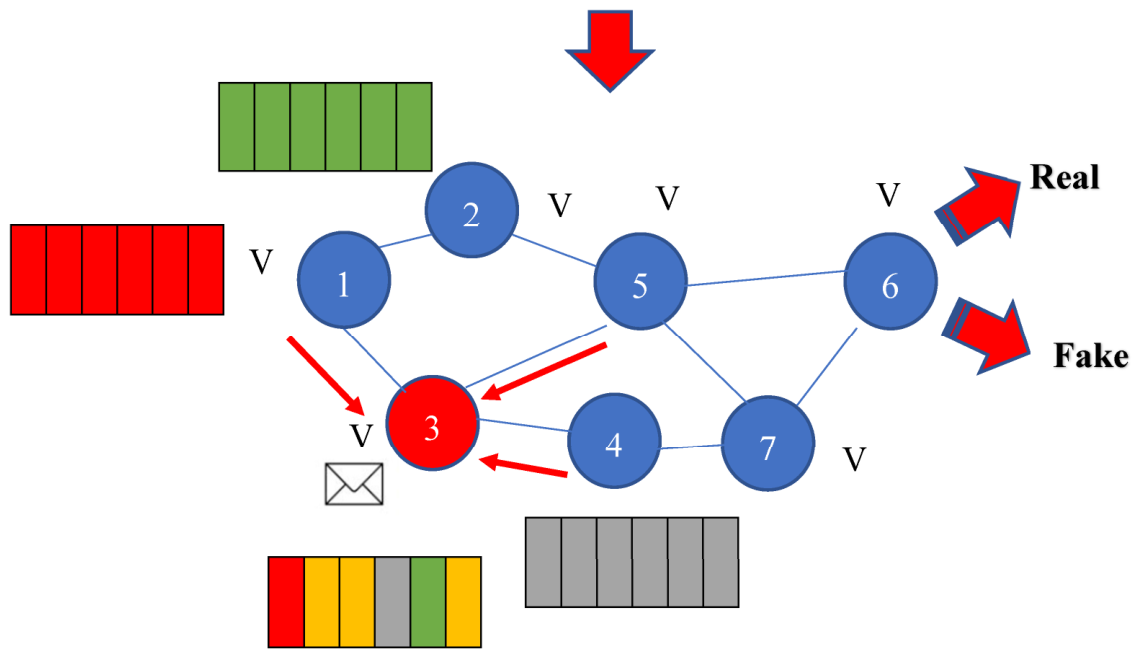
In recent years, media outlets and social media platforms have become common sources for transmitting and sharing information due to their ease of use and accessibility. Fake news can be defined as the deliberate dissemination of misleading information presented as genuine news, often including fabricated text, images, or videos. This type of content is typically presented in a sensational and contrived manner with the aim of deceiving readers and influencing their critical thinking to influence society. Such content proliferates rapidly across digital platforms and often employs emotionally charged content. Consequently, misinformation can spread very quickly and easily. Given the large influx of information from these platforms and the high number of users, it is difficult to monitor every text and verify its accuracy manually [1]. Fake news poses numerous risks to societies [2,3,4]. Therefore, it is essential to develop effective systems for detecting fake news and preventing its widespread dissemination online. The Graph Convolutional Network (GCN) has demonstrated promising potential in the field of fake news detection by utilizing texts with structural relationships [5,6,7,8,9]. GCNs rely on the dynamics of information diffusion, specifically, content, retweets, likes, comments, and links within social networks, to generate graph-based representations, in contrast to text-only data. There are advantages to relying specifically on textual data in fake news analysis across various types of websites or text-based news sources. Text is the most accessible form of information on news websites, facilitating in-depth analysis without the need for complex data acquisition methods [10,11]. Furthermore, these algorithms effectively analyze text for the early detection of fake news, which can negatively impact user engagement. By analyzing and processing text, this method can significantly reduce the spread of fake news. GCN-based techniques have thus demonstrated high accuracy in this domain. However, since textual representations can be expressed in multiple configurations, relying on a single graph may not provide sufficiently accurate representations of a given model. This study proposes an approach based on combining word groupings to construct graphs that reflect the diverse semantic aspects of the text, enabling more efficient and accurate representations. Figure 1 presents an overview of the proposed GCN-based model.
Detecting fake news using graph convolutional networks (GCNs) involves treating news articles, their textual properties, and their dissemination potential as homogeneous nodes in a graph. Textual properties contribute to assessing the veracity of news and are generally categorized into content-level properties (lexical and semantic), grammatical/structural properties, and contextual properties (social/dissemination).
GCNs effectively learn from textual properties by constructing graphs composed of nodes representing words, phrases, or users, allowing the model to capture non-traditional structural patterns.
To facilitate readers’ understanding of the overall structure, the remainder of this study is organized as follows. Section 2 reviews and analyzes relevant GCN-based fake news detection studies and datasets, highlighting shortcomings in existing models for fake news detection. Section 3 explains the methodology, Section 4 presents the implementation and experiments, and Section 5 provides the conclusions. Finally, the references are provided at the end of this paper.

2. The Importance of Exposing Fake News and Its Impact on Solutions

The use of GCNs in fake news detection has enabled more comprehensive detection by modeling structural relationships, allowing for more efficient and faster identification. GCNs leverage the social context and the dissemination of fake news by mapping news, users, and their interactions and by representing fake news as complex graph structures.
GCNs leverage social context and dissemination dynamics to identify fabricated narratives designed to appear credible.
The expected effects of fake news detection using GCNs are summarized as follows:
  • Improved accuracy and reliability: GCN models often outperform traditional methods (such as LSTM or SVM) by detecting complex relationships in dissemination data, thereby reducing the opportunity for unreliable news to spread.
  • Preemptive identification of fake news: By understanding structural patterns in advance, GCN-based methods reduce the “spread of false news” across platforms.
  • Handling specific data for current topics: This is achieved by learning from a small set of newly classified nodes (news articles) and then propagating them across an undefined network structure [12].

3. Related Works

Due to the success of convolutional neural networks (CNNs) in modeling graph-structured data, research interest in GCNs has increased significantly. Consequently, well-defined neural network models are being applied to graph-structured data. These convolution-based approaches use neural networks to extract node and neighborhood features, as well as to embed graphs.
GCNs have achieved strong results in semi-supervised learning on graph-structured data. This success is mainly attributed to Kipf and Welling, who proposed a model specifically for graph-structured data and established the GCN framework. Although it has achieved strong results on large datasets, it is affected by two limitations. First, GCNs require computational cost due to the stacking of convolutional layers. Second, GCNs repeatedly aggregate information from neighboring nodes; in other words, deeper layers influence lower-level representations, thereby progressively altering the information structure at each step [3].
Lu and Li (2020) [7] addressed fake news detection on social media platforms. Their methodology analyzes the source of a tweet (its text) and the sequence of retweets to predict whether the tweet is fake using the Twitter15 and Twitter16 datasets. This process is presented in a simplified manner by highlighting evidence related to inauthentic retweets and the keywords they contain. The authors developed a novel neural network-based model, the Graph-Aware Common Interest Network (GCAN). Through extensive experiments on multiple tweet datasets, GCAN achieved an average accuracy of 90.84% on the Twitter16 dataset, outperforming existing methods by more than 15%. Furthermore, case studies show that GCAN improves interpretability.
Nguyen et al. (2020) [8] represented textual context as a graph for fake news detection. This model improves scalability during training, as it does not require maintaining all nodes, and provides efficient inference without reprocessing the full graph representation. The results show that the model is effective in capturing social context, achieving an accuracy of 75.18%. In particular, the model improves the detection of misinformation and is robust across specific training datasets.
Bian et al. (2020) [9] presented a novel bidirectional graph-based model (Bi-GCN) designed to capture both top-down and bottom-up rumor propagation. This model employs a top-down graph-directed GCN for rumor detection to study rumor multiplication patterns and a bottom-up graph-directed GCN to identify rumor multiplication structures. Information from each graph is integrated at each GCN layer to strengthen representations of rumor sources. The authors evaluated the model on three real-world datasets: Weibo, Twitter15, and Twitter16. On the Weibo dataset, the model achieved an accuracy of 96.10% using social context features. The experimental results demonstrate that the model outperforms baseline methods under the evaluation criteria.
Shakil Sejan et al. (2023) [10] proposed a GCN model to improve node selection performance for classification tasks. The GCN layer was constructed by updating the clustering function using a weighting parameter and Node2Vec features. A contiguity matrix was used to calculate input values, and an identity matrix was used in the clustering function. To evaluate accuracy, evaluations were conducted on seven datasets: Cora, Citeseer, PubMed, Amazon Photos, Amazon Computer, Cora Full, and Coauthor CS. For the CS dataset, a test accuracy of 92.42% was achieved using a single layer.
As a continuation of the output classification process discussed in a previous study, output classification is also relevant to fake news detection and sentiment analysis. GCNs have achieved strong results in this area, as demonstrated in the recent literature. Accordingly, GCN-based textual representations were reviewed in terms of their structural properties and scalability for large datasets. Their strengths and limitations were identified, and their performance was compared across different benchmark datasets [11].
To further classify texts and determine classification types, graph neural networks (GNNs) provide useful mechanisms for capturing sequential semantic and syntactic information. GNNs were introduced to address text classification tasks and to determine output categories. A new framework, TensorGCN, was developed. To further address the classification problem, a text graph tensor was first constructed to represent semantic, syntactic, and sequential contextual information by aggregating information from adjacent nodes into a unified graph. A distribution between graphs was used to coordinate heterogeneous information across different graph types. Therefore, the text collections included five datasets for classifying text outputs: the 20 News Collections dataset, the Ohsumed dataset, the Reuters R52 dataset, the Reuters R8 dataset, and the Film Review dataset. Numerous experiments were conducted on standard datasets, and the results demonstrated the robustness of the proposed model in maintaining coherence across heterogeneous information from different graph types. The accuracy of 98.04% was achieved with the Reuters R8 dataset [13].
Rajani et al. (2024) [14] presented a method for creating graphical representations of news texts and classifying them using a GNN. The method iteratively models word-level information within sentences to establish relationships between them using BERT-derived contextual features. This is achieved via a weighted graph adjacency matrix, which is used to construct a third-order frequency tensor. The resulting representations demonstrated more efficient contextual information capture in news texts using the Kaggle dataset. Furthermore, the method was evaluated on two real-world datasets, outperforming other methods in both binary and multi-category classification tasks. Specifically, modifications to the multi-category output classification achieved high accuracy on the selected dataset, reaching 70% accuracy on the training set.
The effectiveness of advanced machine learning models—CNNs, BERTs, and pre-trained generative transformer (GPT)-based models—for accurately filtering fake news was confirmed by Roumeliotis et al. (2025) [15]. Each model demonstrates strength in specific aspects of performance, ranging from the pattern-recognition capabilities of CNNs to the contextual understanding of BERTs and GPTs within the embedding space. The results showed that the improved GPT-4 Omni models achieved 98.6% accuracy, significantly outperforming traditional models, which achieved substantially lower accuracy. Notably, the smaller GPT-4o mini model performed similarly to its larger counterpart, highlighting its efficiency.
Hu et al. (2025) [16] proposed a two-way convolutional neural network for graphs to integrate message text with its distribution paths. This model aims to improve network discovery performance by transforming disparate user posts into a two-way graph structure. Using two datasets, Twitter15 and Twitter16, accuracy rates of 89.7% and 91.7%, respectively, were achieved, significantly outperforming baseline models.
Golovin et al. (2025) [17] presented an innovative recommendation system based on Knowledge Schemas and Graph Attention Networks (GATs). This model aims to understand semantic relationships within textual content and social communication structures, enabling it to detect fake news with high accuracy. The model assigns different weights to adjacent nodes to determine the importance of users in information dissemination. The model was evaluated using the FakeNewsNet dataset, and its performance was compared with traditional machine learning models. The results showed that the proposed model achieved outstanding performance, with an F1-score of 95%.
Papageorgiou et al. (2025) [18] evaluated feature extraction using large language models (LLMs) for detecting fake news across the LIAR, FakeNewsNet, and Politifact datasets. They also compared text representations based on BERT models to extract authentic snippets from news articles. The results provided insights into how misinformation detection can be enhanced using LLMs and graph-based techniques. The model achieved a classification accuracy of 99%.
Alshehri et al. (2025) [19] presented a systematic literature review (SLR) analyzing approximately 28 recent academic studies published over the past 25 years. Major databases, including IEEE, ACM, Scopus, and Springer, were used. The review aimed to evaluate the application of graph neural network (GNN) models in detecting various types of malicious text, particularly those targeting the Internet of Things (IoT), web services, phishing, and network traffic. The studies were categorized based on dataset type and GNN model architecture, and a comparison of existing methodologies was provided to identify gaps across studies. Finally, a focused perspective on the potential of graph neural networks in cybersecurity was presented, offering developmental insights to guide future research in this field.
Binh et al. (2026) [20] proposed a hybrid intrusion detection model, called HybridSAGETransformerGlobal, by combining a SAGEConv-based graph neural network (GNN) with a Transformer encoder to capture local structural information from network traffic. The proposed method was evaluated using a unified preprocessing and training pipeline on two reference datasets, UNSW-NB15 and CIC-IDS2017, and compared with several other models, including GCN, GAT, and GraphSAGE. Ultimately, the proposed hybrid model demonstrated high efficiency, achieving an accuracy of 97.49%.

4. Methodology

This research addresses the problem of fake news detection. In this section, we describe the proposed methodology for constructing graph representations from textual features using a Graph Convolutional Network (GCN). We then classify the output as either real or fake news using extracted features and model their interactions.

4.1. Dataset

The model was trained to classify real and fake news articles from both text-based and social media sources. Two datasets were used: ISOT (available on Kaggle) and the GossipCop dataset.

4.1.1. ISOT Dataset

The proposed model utilizes the ISOT dataset, a comprehensive repository available on Kaggle that contains real-world data specifically designed for fake news detection tasks (see Table 1) [21]. The dataset includes text articles from various news sources. Because this research focuses on analyzing sentence-level interactions within news texts and social media content, this dataset is particularly valuable due to its multi-sentence structure and thematic diversity. Therefore, the ISOT dataset provides a rich and varied set of examples for training fake news detection models [22].

4.1.2. GossipCop Dataset

The proposed model also utilizes the GossipCop dataset [23]. This dataset consists of labeled news articles and social context information. It contains more than 22,000 instances of fake and real news, with a higher proportion of real news samples, as shown in Table 1. Prior to training, standard preprocessing steps were applied to clean the text, including converting all text to lowercase, removing punctuation, and eliminating irrelevant words. The GossipCop dataset is known for its significant class imbalance, with a clear bias toward real news. Based on recent studies, this imbalance (approximately 16,817 real news items versus approximately 5323 fake news items) often causes classifiers to favor the majority class, leading to reduced detection performance for fake news. As a result, a baseline accuracy of approximately 76% can be achieved by predicting only the majority-class, which highlights the need for more robust evaluation metrics beyond accuracy. Appropriate evaluation criteria therefore include the F1-score, which accounts for class imbalance by balancing precision and recall, as well as considering precision and recall individually. This study introduces a practical approach to the class imbalance problem in the GossipCop dataset using Random Oversampling (ROS), along with multiple textual feature extraction techniques and GCN-based modeling. This approach improves minority-class representation and enhances overall classification performance. A random subset representing approximately 45% of the dataset was selected, consisting of 7596 real news articles and 2404 fake news articles, indicating a significant class imbalance. ROS was then applied to the minority class (fake news) with a 100% oversampling ratio, increasing the number of fake news instances to 4808 to improve class balance and support classification performance.

4.2. Data Preprocessing

First, the data were preprocessed to prepare the raw text data for model training. For fake news detection, several preprocessing steps were applied to both ISOT news articles and GossipCop Twitter data. The preprocessing of the ISOT dataset typically involves merging the “real” and “fake” news articles in a single dataset and filtering textual content from sources such as Reuters and PolitiFact. The GossipCop dataset, on the other hand, often involves extracting text and user IDs from tweets and removing irrelevant information related to their propagation across social networks. These steps include the following:
  • Removing punctuation marks to reduce noise in the data.
  • Removing extra whitespace to eliminate formatting inconsistencies.
  • Removing stop words such as “is”, “the”, and “what”.
  • Data normalization, which involves converting text to lowercase, standardizing spelling, and resolving abbreviations to ensure consistency across the dataset.
  • Tokenization, which converts large text segments into smaller units, representing groups of words rather than complete sentences.
  • Stemming and lemmatization, which are used to process text and prepare words and documents for deep learning models. The model employs context-dependent lemmatization techniques, while stemming is faster than lemmatization because it removes word forms without considering context. Lemmatization is a traditional dictionary-based strategy, whereas stemming is a rule-based method [3,4,5,6,7,8,9].

4.3. Feature Extraction

In this study, text data were used in fake news detection to construct various features, including “Bag-of-Words”, “TF-IDF”, and “n-gram” representations. These features enable algorithms to process and classify text by improving word representations to better reflect meaning, connotation, and contextual usage [24]. In fact, tweet content was used to construct Bag-of-Words, TF-IDF, and n-gram representations as a basis for feature extraction.

4.3.1. Bag-of-Words Representation

The first step in feature extraction involves constructing vector representations that enumerate the words appearing in the text using the Bag-of-Words approach. Researchers are aware that one challenge they face is that textual data are often unstructured and inconsistent. Deep learning algorithms typically require consistent, fixed-length inputs, making it necessary to transform variable-length texts into fixed-length vectors using the Bag-of-Words representation [10,11,13,14,22,25].
Furthermore, deep learning models process data after transformation into numerical representations [26]. Specifically, sentences are transformed into integer vectors using the Bag-of-Words representation, implemented with the scikit-learn library.

4.3.2. TF-IDF Representation

Another approach used in this study is to weight term counts based on their frequency across all texts. TF-IDF aims to describe the importance of a term within a given text.
Two measures are multiplied to determine the TF-IDF score for a word in a text: term frequency (TF) and inverse document frequency (IDF). Term frequency represents the frequency of a word within a text. The simplest way to compute this value is by counting how many times the word appears in the text.
The frequency can also be normalized using other approaches, for example, by dividing the number of occurrences of a word in a text by the frequency of the most frequently occurring term in that text. The term frequency is defined as the ratio of the number of times a word appears in a text to the total number of words in the text. The expression is shown in Formula (1) [24,25,26]:
T F = n u m b e r   o f   t i m e s   t h e   t e r m   a p p e r s   i n   t h e   t e x t t o t a l   n u m b e r   o f   t e r m s   i n   t h e   t e x t
Inverse document frequency (IDF) reduces the weight of words that appear frequently across the corpus. The expression is shown in Formula (2) for a term t:
I D F ( t ) = log ( N d f ( t ) )
where N represents the total number of texts in the collection and df denotes the number of texts containing term t. The TF-IDF score of a word in a text is the product of its TF and IDF values [24,25,26]. TF-IDF scores were computed using the scikit-learn library. TF-IDF is defined as follows:
T F I D F ( t ,   d ) = T F ( t ,   d ) I D F ( t )
where t denotes a term and d denotes a document.

4.3.3. N-Gram Representation

N-grams are an important feature extraction and analysis technique used in natural language processing and deep learning. An n-gram consists of a contiguous sequence of elements ranging in length from 1 to n. These elements may be words or characters. Character-based and word-based n-grams are among the most commonly used features for text classification. In this study, word-based n-grams were used to capture contextual information and generate features for classification. This was done to differentiate between fake and real news.
The idea was to generate various n-gram feature representations from the training data to classify fake and real news. A bigram (n = 2) configuration was used, and its effect on classification accuracy was investigated. N-gram models improve text classification by capturing local context and word order, which are not captured by the Bag-of-Words approach. They produce high-dimensional, informative feature vectors that help models detect fake news. N-gram features generate a sparse vector representation of text, where contiguous word sequences are used as input to the classifier [12,27,28].

4.4. K-Nearest Neighbors Method for Distance Metrics

The k-nearest neighbor (k-NN) algorithm is one of the simplest methods. It effectively establishes neighborhood relationships based on feature similarity. Therefore, k-NN was utilized to construct the graph structure for the GCN model.
To perform graph construction, the similarity distance between feature vectors was first computed. Then, the k nearest neighboring nodes were identified to establish connectivity in the GCN graph structure, with the following settings:
  • k = 5 was selected based on prior GCN-based studies [29,30], as it helps preserve meaningful local neighborhood relationships while maintaining stable graph connectivity, which may improve GCN performance.
  • Algorithm = auto, to select the most appropriate algorithm based on the input data passed to the fit method.
  • Distance metric = cosine similarity, used to compute the angle between vectors A and B (texts), as shown in Formula (4):
cos ( θ ) = A · B A B = I = 1 n A i B i i = 1 n A i 2 · i = 1 n B i 2
where Ai and Bi are the ith components of vectors A and B, respectively.
Its advantages include simplicity and effectiveness in establishing neighborhood connectivity based on feature similarity for graph construction [31].

4.5. Adjacency Matrix Normalization

The adjacency matrix of a bipartite graph is obtained using Formulas (5) and (6) to prevent overfitting, where 1 indicates the presence of an edge:
A d j M = [ 0 Y Y T 0 ]
where Y represents the connection between vectors A and B, YT is the transpose of Y, and AdjM is the adjacency matrix.
Y i , j = { 1     if   edge   exists , 0                 otherwise

4.6. Graph Convolution Network (GCN) Algorithm

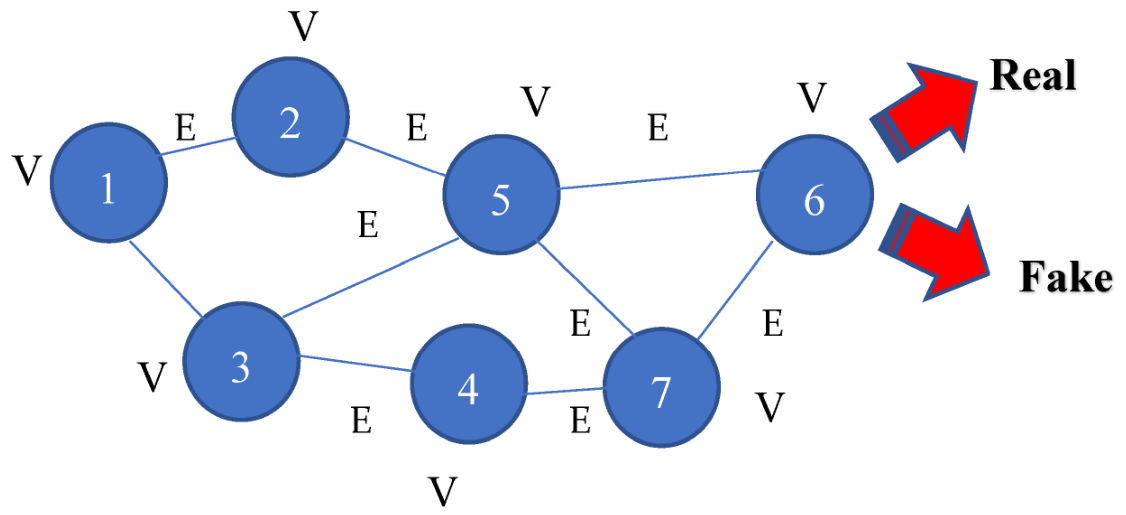
A GCN is a generalized version of a traditional CNN that operates directly on graphs. Assume that G = (V, E, A) denotes the graph obtained after converting text data into a graph representation, where |V| = n is the set of graph nodes, E is the set of graph edges, and adjA ∈ Rn×f is the adjacency matrix of the graph. During training, node representations in the hidden layers are computed by encoding both graph structure and node features through a propagation rule, as shown in Formula (7) [13]:
H ( l + 1 ) = f ( H ( l ) , A d j M ) , ( l = 0 , 1 , . . , L )
where H ( l ) R n × f is the feature matrix at the lth layer and L is the total number of layers in the GCN.
To compute nonlinear activation function, the ReLU function is used. In the final layer, a max-based function is typically applied, and the number of output features per node corresponds to the number of classes. In this study, there are two classes: real and fake. The ReLU function is defined in Formula (8):
ReLU = max ( 0 , x )
where x represents the input signal for the GCN. The ReLU function outputs the input directly if it is greater than zero; otherwise, it outputs zero.

4.6.1. GCN Classification

This classification approach is used to categorize graphs into two classes. One application is distinguishing between real and fake text. This approach improves classification performance compared with traditional methods. GNN architectures typically consist of two layers; in this study, the first GCN layer contains 128 output channels, while the second GCN layer produces the final class predictions. The model was trained using the Adam optimizer and the cross-entropy loss function for 100 epochs with a learning rate of 0.001. The graph structure was dynamically regenerated during each training iteration, as shown in Figure 2 [32].

4.6.2. Message Passing and Aggregation

Message passing aims to obtain optimal node representations through iterative updates that capture contextual information from edges and neighboring nodes. It consists of two main steps: aggregation and updating. In the proposed GCN framework, message passing and feature aggregation are used to collect information from neighboring connected nodes in the graph structure. This aggregation mechanism is implemented using the PyTorch Geometric (PyG) library; within this framework, feature aggregation is handled by a dedicated message-passing class. It condenses information from adjacent nodes or entire graphs into a single representative vector. Message passing assumes a graph with six nodes, as shown in Figure 3, each with multiple attributes, some of which are six-dimensional. For illustration, we consider node 3. Message passing first aggregates the features of its neighboring nodes connected via edges (as defined by the adjacency matrix). After aggregation, the node updates its features accordingly. Message passing has two key components:
  • The aggregation function must be permutation invariant, such as sum or mean.
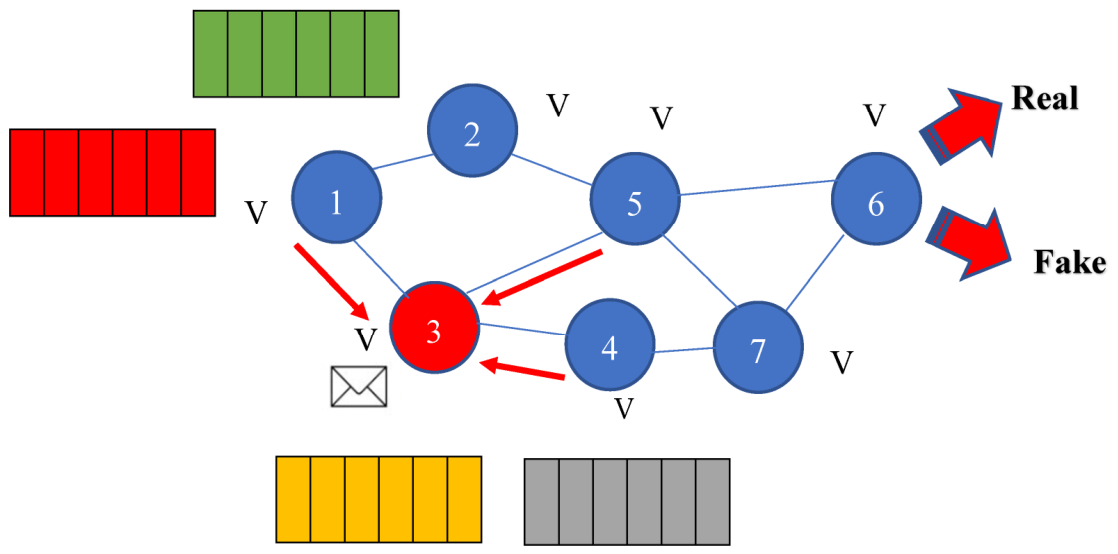
  • The update function can be implemented using a neural network, with or without an attention mechanism, to update the node’s state, as shown in Figure 4 [32].
Figure 3. Message passing.
Computers 15 00352 g003
Figure 4. Message update.
Computers 15 00352 g004

4.6.3. GCN Architecture

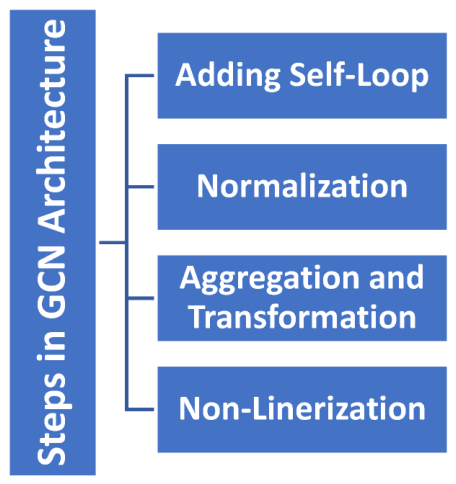
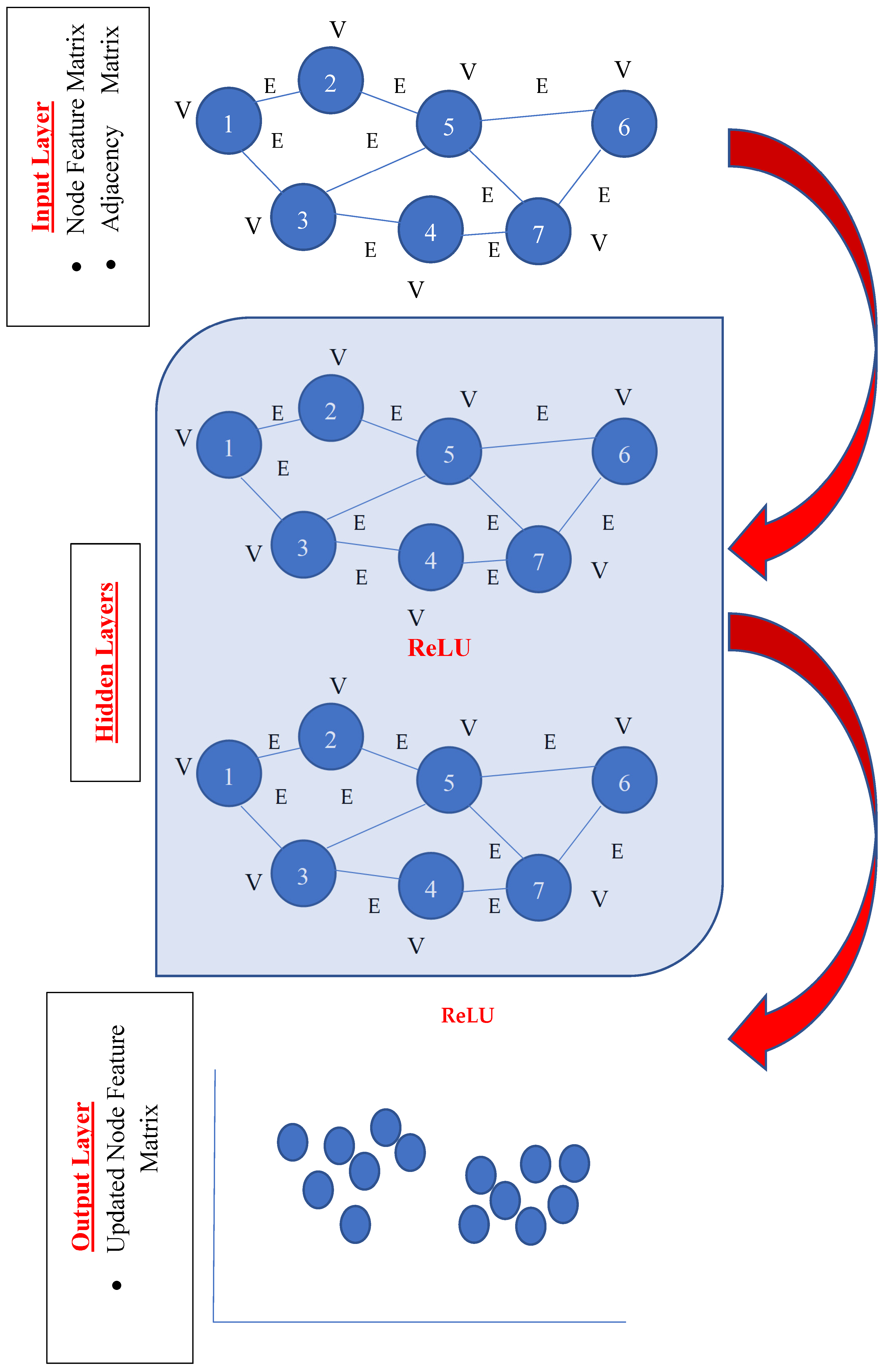
Figure 5 and Figure 6 illustrate the structure and workflow of the GCN architecture, which consists of an input layer, a hidden layer, and an output layer.
The feature transformation can be expressed using Formula (9):
h t r a n s = W h a g g r
where h t r a n s is the transformed node feature, W is the weight matrix, and h a g g r is the aggregated node feature.
To prevent bias toward nodes with large degrees, normalization is applied, as shown in Formula (10).
A d j M ^ = D 1 / 2 ( A d j M + I ) D 1 / 2
where A d j M ^ is the normalized adjacency matrix, D is the degree matrix defined in Formula (11), and I is the identity matrix defined in Formulas (11) and (12):
D = ( d 0 0 d )
I = ( 1 0 0 1 )
Finally, the softmax layer is typically used as the output stage for node classification tasks. It converts raw outputs from the final GCN layer into probability distributions over target classes. The GCN layer can be expressed using Formula (13):
H = A d j M ^   R e L U ( A d j M ^   X   W )
where X is the input feature matrix and W is the weight matrix.
The softmax function is defined in Formula (14) [33]:
Softmax   ( z ) i = e z i j = 1 K e z j   for   i = 1 , 2 , , K
where z is a vector of logits (real-valued outputs), which is transformed into a probability distribution. For binary node classification, gradients are computed to determine whether a text is real or fake. In the proposed GCN model, the Softmax layer is used at the final output stage to convert the output logits into class probabilities. Cross-entropy loss is used as the training objective, combining the Softmax function and the loss function into a single differentiable function. This is a standard loss function for binary classification tasks such as real versus fake text classification. Binary classification with cross-entropy loss is used because many machine learning tasks rely on binary decisions, such as true/false predictions. The loss function measures the difference between the predicted probabilities and the actual class labels, allowing the model to refine its predictions during training. This formulation integrates the Softmax activation function with the loss computation into a single class to improve numerical stability and training efficiency [4,24,25,34].

4.6.4. GCN Sample

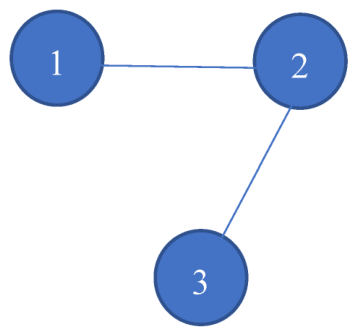
This section provides a practical and mathematical explanation of the GCN. Figure 7 represents the problem graph used to classify fake and real news [6,7].
  • The degree matrix is shown below and is based on Formula (11):
D = ( 1 0 0 0 2 0 0 0 1 )
2.
Self-loops (AdjM + I) are added as follows:
A d j M = ( 0 1 0 1 0 1 0 1 0 ) + I = ( 1 0 0 0 1 0 0 0 1 ) = ( 1 1 0 1 1 1 0 1 1 )
3.
The degree matrix is then modified, as shown in Figure 8.
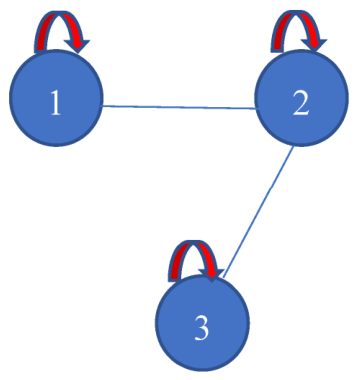
Figure 8. Modified degree matrix.
Computers 15 00352 g008
D = ( 2 0 0 0 3 0 0 0 2 )
D 1 / 2 = ( 1 / 2 0 0 0 1 / 3 0 0 0 1 / 2 )
4.
Normalization is applied, as shown in Formula (10):
A d j M ^ = D 1 / 2 ( A d j M + I ) D 1 / 2
( 1 / 2 0 0 0 1 / 3 0 0 0 1 / 2 ) ( 1 1 0 1 1 1 0 1 1 ) ( 1 / 2 0 0 0 1 / 3 0 0 0 1 / 2 ) = ( 1 / 2 1 / 6 0 1 / 6 1 / 3 1 / 6 0 1 / 6 1 / 2 )
5.
Aggregation
Suppose the initial feature matrix is H ( 0 ) =   ( 1   0 0 1 1 1 ) ,   W ( 0 ) =   ( 1   0 0 1 )
6.
The feature vector for the next layer in the GCN is
H ( 1 ) = A d j M ^   H ( 0 )   W ( 0 )
7.
The final GCN layer is expressed using Formula (13):
H = A d j M ^   R e L U   ( A d j M ^   X   W )

4.7. GCN Training

The model is trained for several epochs using the Adam optimizer and the cross-entropy loss function. The training process consists of the following steps:
  • Zero the gradients.
  • Perform a single forward message-passing step.
  • Compute the cross-entropy loss using the training nodes.
  • Compute gradients for binary classification to determine whether the text is real or fake. Cross-entropy loss is used to define a criterion that combines softmax and the loss into a single class. It is a standard loss function for fake or real text classification.

4.8. GCN Testing

Testing involved the following steps:
  • Predict node classes and select the class with the highest score during evaluation.
  • Extract the class label with the highest probability for fake or real news.
  • Verify the number of correctly predicted values.
  • Compute the accuracy as the ratio of correct predictions to the total number of nodes.

4.9. Pseudocode of the Algorithm

Pseudo
Algorithm: GCN-based fake news detection
Require: News dataset
Ensure: Predicted labels (fake/real)
Phase 1: Preprocessing and Feature Extraction
  • Convert text to lowercase.
  • Remove punctuation marks.
  • Remove extra whitespace.
  • Extract label columns as the target variable.
  • Initialize feature vectors with a limited number of features.
  • Normalize features.
Phase 2: Graph Construction
  • Initialize G = (V, E), where |V| = N nodes.
  • Compute similarity between pairs of articles.
Phase 3: GCN Architecture Definition and Adjacency Matrix
  • Define GCN layers.
  • Define input features, hidden dimensions, and output classes.
Phase 4: Training, Cross-Validation, and Classification
  • Split nodes into training (cross-validation) and testing sets.
  • Set hyperparameters: learning rate, epochs, and Adam optimizer.
  • Apply softmax classification.

5. Results and Discussion

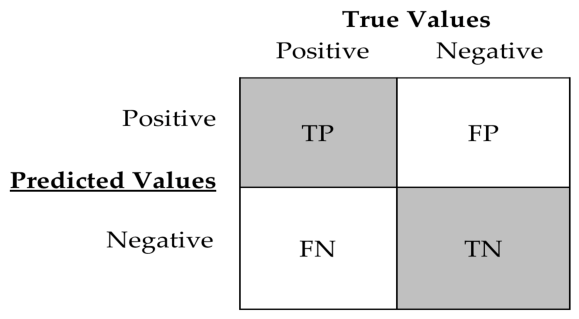
To evaluate the performance of the proposed model, the predicted classifications were computed and compared with the actual classifications. Based on these results, the model accuracy was calculated for both classes. Since true positives (TP), false positives (FP), true negatives (TN), and false negatives (FN) were recorded during model evaluation, accuracy was used to measure model effectiveness as the ratio of correct predictions made by the deep learning model (GCN) to the total number of predictions. Model performance was evaluated using the following metrics:
  • Accuracy: The accuracy of the model can be determined by assessing its ability to correctly distinguish fake and real news. Accuracy is computed as the ratio of true positive results to true negative results for all cases evaluated during training. The formula for accuracy is shown in Formula (15) [24]:
A c c u r a c y = T P + T N T P + F N + T N + F P
  • Recall: Recall measures a model’s ability to identify all instances related to a specific category. It is defined as the ratio of correctly predicted positive observations to the total number of actual positive observations, providing an indication of how well the model captures instances of a given class, as shown in Formula (16) [24]:
R e c a l l = T P T P + F N
  • Precision: Precision measures the proportion of cases or samples classified correctly out of all other classifications that were labeled positive. The formula for precision is shown in Formula (17) [24]:
P r e c i s i o n = T P T P + F P
  • F1-score: The F1-score is an evaluation metric that combines accuracy and recall to measure model performance. It is defined as the harmonic mean of precision and recall, as shown in Formula (18) [24]:
F 1 S c o r e = 2 P r e c i s i o n R e c a l l P r e c i s i o n + R e c a l l
F1-score and accuracy are represented as ratios, while precision and recall are derived from the confusion matrix shown in Figure 9 [24].
The dataset was split into training and test sets to evaluate the performance of our model. This approach is used in tasks such as classifying news as real or fake. The dataset was divided into two subsets. The first subset, the training set, was used to train the model. The second subset, the test set, was not used during training; instead, it was used to generate predictions, which were then compared with the actual labels.
  • Training set: Used to train the deep learning model.
  • Test set: Used to evaluate the performance of the deep learning model after training.
The goal was to estimate the model’s performance on unseen data, i.e., data not used during training [24].
For the ISOT dataset, a random subset representing approximately 45% of the dataset was selected, resulting in 20,000 samples. This was followed by an 80% training and 20% testing split. Subsequently, 10-fold cross-validation was applied to the training set. Similarly, for the GossipCop dataset, a random subset representing approximately 45% of the dataset was selected. To address the class imbalance problem in the GossipCop dataset, which initially consisted of 7596 real news articles and 2404 fake news articles, random oversampling (ROS) was applied to the minority class (fake news) with a 100% oversampling ratio. This increased the number of fake news instances to 4808, improving minority-class representation and classification performance.
The classification results obtained using the TF-IDF feature on the ISOT dataset are presented in Table 1. The highest F1-score (95.67%) was observed for the fake class.
The classification results obtained using the TF-IDF feature on the GossipCop dataset are presented in Table 2. The highest F1-score (92.50%) was observed for the real class.
The classification results obtained using the Bag-of-Words representation on the ISOT dataset are presented in Table 3. An identical F1-score of 94.50% was observed for both the real and fake classes.
The classification results obtained using the n-gram (bigram) representation on the ISOT dataset are presented in Table 4. The highest F1-score (96%) was observed for the fake class.
The classification results obtained using the TF-IDF and Bag-of-Words representations on the ISOT dataset are presented in Table 5. An identical F1-score of 95.33% was observed for both the real and fake classes.
The classification results obtained using the n-gram (bigram) representation on the GossipCop dataset are presented in Table 6. The highest F1-score (90.30%) was observed for the real class.
The classification results obtained using the BoW representation on the GossipCop dataset are presented in Table 7. The highest F1-score (93.60%) was observed for the real class.
The classification results obtained using the TF-IDF and Bag-of-Words representations on the GossipCop dataset are presented in Table 8. The highest F1-score (90.60%) was observed for the real class.
The performance of the proposed model is summarized in Table 9.
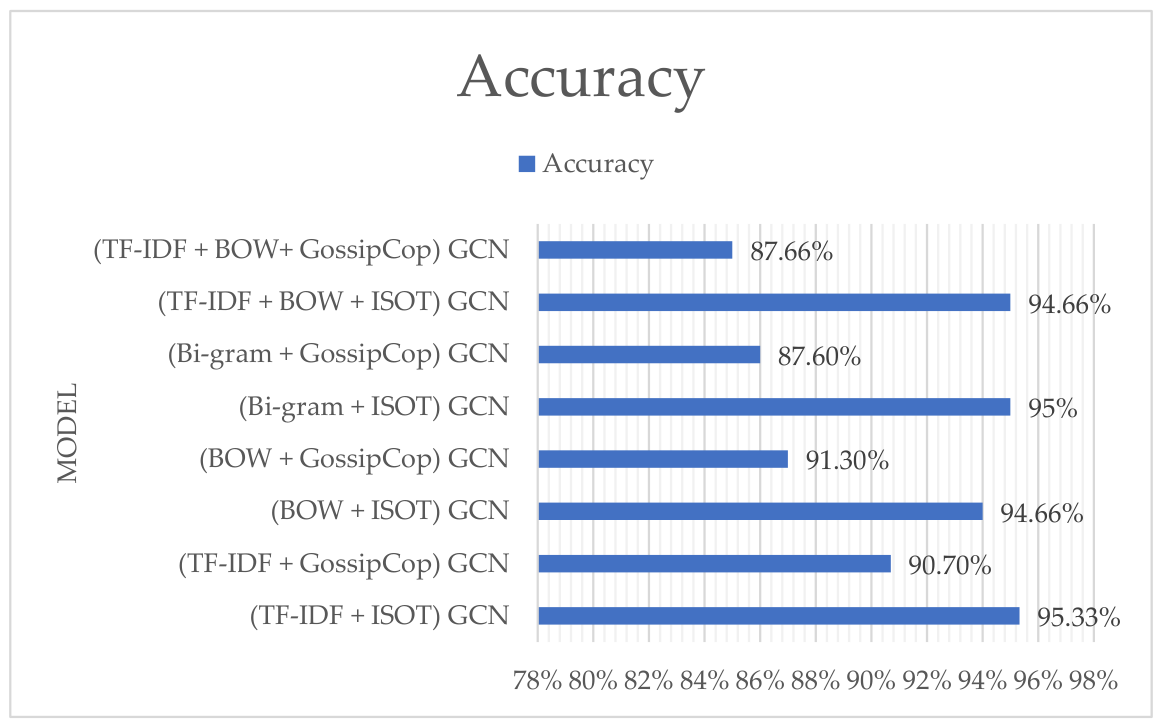
Table 9 and Figure 10 show that the model achieved high accuracy using the TF-IDF feature. A similar trend was observed with the ISOT dataset. Different datasets for fake news detection are used to ensure a clear evaluation across domains and linguistic styles. The GossipCop dataset contains social media-based fake news with associated metadata and dissemination patterns, including user-profile metadata. In addition, it contains user-generated reactions such as opinions and emotional responses to fake news [35]. Meanwhile, the ISOT dataset consists of traditional news articles with a clearer distinction between fake and real news [21]. Recent studies [34,36] have shown that DistilBERT (baseline)—a distilled, lightweight version of BERT—achieves up to 98% accuracy on the ISOT dataset and 96% accuracy on the GossipCop dataset, demonstrating its computational efficiency.
In this study, the proposed model was evaluated using the ISOT dataset, which contains 21,417 real news articles and 23,481 fake news articles. This dataset includes political, governmental, American, and Middle Eastern news and was specifically designed for fake news detection tasks [21]. It comprises articles from multiple news domains. Because this research focuses on analyzing sentence-level interactions in news texts and social media, the dataset is particularly valuable due to its multi-sentence structure and thematic diversity. Therefore, the ISOT dataset provides a rich and varied set of examples for training fake news detection models [22]. Each article includes the following features: title, text, type, and publication date.
However, the GossipCop dataset [23] was also used in this study. It consists of 16,817 real news articles and 5323 fake news articles and provides social context information. The dataset contains approximately 22,000 articles in total, with a higher proportion of genuine news samples. Each article includes the following features: title, news URL, and tweet ID.
Analysis of the dataset reveals that the best-performing feature configuration for the GossipCop dataset is the model without the attention mechanism, which, despite the overall trend, may indicate overfitting or noise in the dataset. Other research findings suggest that using non-attentional models with node features can, in some cases, yield high accuracy depending on the configuration. The ISOT dataset achieved the highest accuracy and robustness with the underlying model unchanged, confirming its sensitivity to architectural modifications. As reflected in the accuracy results, the model achieved a success rate of 94.66% on the ISOT dataset. This indicates the model’s strong ability to distinguish between real and fake news in long, well-structured articles. However, on GossipCop, which contains more real-world social media content, performance was lower, with diffusion patterns being flatter, noisier, and less community structured.
Comparison of the results shows that combining TF-IDF and Bag-of-Words improves accuracy, reaching up to 94.66%, compared with using either the GossipCop dataset or the Bag-of-Words feature alone.
One advantage of GCNs is their ability to detect complex structural relationships among news content, users, and information diffusion processes, enabling the detection of fake news—an ability that purely text-based models lack. These networks achieve high accuracy by modeling how news propagates, identifying unreliable accounts, and capturing nonlinear interactions within social network graphs.
Key reasons for using GCNs for fake news detection include the following:
  • Diffusion-oriented modeling: Fake news differs from real news in its sharing and reposting patterns, allowing the model to detect fabricated content through diffusion patterns [12].
  • Heterogeneous data usage: By integrating user profiles, textual content, and multimedia data, GCNs construct a unified graph representation that captures relationships between users and their posting histories.
  • Social context understanding: Graph neural networks (GCNs) extract structural features, such as user belief networks, social influence, and interactions, which are crucial for identifying misinformation.
  • Structural feature modeling: The ability to capture structural features helps reduce classification errors and improve robustness [12].
One advantage of TF-IDF is its ability to capture social context to identify distribution patterns in data. Another advantage is its ability to minimize overshooting and produce good results when combined with GCN-based models, demonstrating in handling sparse textual data. TF-IDF is also heavily node-based in graph representations [12].
However, a limitation of TF-IDF is its tendency to lose information. Unlike embedding techniques, TF-IDF often fails to capture context and descriptive meaning, leading to slower training and reduced scalability. Furthermore, this study and previous research have shown that it is unsuitable for early detection because it requires the information to be distributed before analysis can occur [3,4,5,6,7,8,12].
One advantage of BoW is its use of the social context embedded within the network structure. It also integrates textual data with graph structures. Furthermore, it provides a simple semantic representation that offers an efficient method for converting text into numerical vectors. This feature is beneficial for expansion analysis, which involves collecting data from closely connected users.
However, BoW has several limitations. It lacks word order and contextual information, resulting in high computational costs because GCNs require significant memory to store graph structures. Additionally, it relies on disjointed words when constructing graphs [11,13,14,22].
Bigrams have several advantages, including their ability to accommodate structural diffusion and provide rich semantic representations, allowing the model to integrate bigrams with local context. Additionally, these networks are effective in detecting fake news. They also demonstrate strong performance in semi-supervised environments, enabling high accuracy even with limited datasets.
However, their limitations include high computational costs and limited capacity to capture long-range dependencies in text. Although bigrams help models understand local context, they do not effectively represent long-range semantic dependencies within lengthy articles. Another major drawback is over-smoothing, in which representations of bigram features become unclear, making it difficult to distinguish between categories [15,16,17,18,19,35].
Table 10 summarizes the key characteristics of previous studies.
Table 11 summarizes the advantages and limitations of previous studies reported in the literature.
Existing studies have utilized several of these features independently; however, combining different features may improve classification performance by providing complementary information to classifiers. Therefore, this study utilized these combined features to enhance model effectiveness.

Experimental Environment

The experiments were conducted using Google Colab cloud computing environment with the following specifications:
  • Hardware: V5e-1 TPU with Tensor Cores and 12.7 GB of RAM. These components are essential for handling large datasets and efficiently running complex deep learning models.
  • Software: The software package was built on Google Colab [37] using Python 3 libraries such as scikit-learn (version 1.6.1) [38], TensorFlow (version 2.20.0) [39], and PyTorch (version 2.10.0) [40], and PyTorch Geometric (PyG) library (version 2.7.0) [41]. These libraries are used to develop models and conduct experiments efficiently.

6. Limitations

Although GCNs excel at classifying graph-structured data by exploiting intertextual relationships, BoW, TF-IDF, and basic binary data models suffer from significant shortcomings in fake news detection. These shortcomings arise from their lack of semantic properties, vulnerability to paraphrasing, and inability to incorporate external fact checking.
Another drawback is scalability, as recalculating the entire graph is time-consuming and expensive.
Furthermore, these models lack sequential ordering because BoW and TF-IDF models treat each word (or binary value) as an independent dimension, disregarding word order within the text.
Additionally, retweets, likes, and comments were not included in the analysis conducted in this study.

7. Conclusions

With the worldwide proliferation of news and the widespread use of social media, fake news has become a significant challenge. Researchers are therefore working diligently to develop effective methods for detecting it. In this study, we investigated fake news detection using a GCN model. TF-IDF, Bag-of-Words, and bigram representations were incorporated into the model for evaluation on two datasets: ISOT and GossipCop. The proposed model achieved high accuracy, reaching up to 95%. We also discussed the advantages and limitations of each feature type based on the evaluation criteria. The findings indicate that fake news detection will remain an important area of future research. Deep learning models can reduce the rate of incorrect predictions, thereby improving detection performance. We hope that this study contributes to fake news detection research by identifying new methods and supporting the development of future approaches. Therefore, future work will further investigate fake news detection using additional features and expanded experimental settings involving various datasets. Future studies will also investigate other deep learning methods and evaluate their effectiveness. As mentioned earlier, this study mainly focused on traditional textual analysis. Future work may investigate the integration of diverse multimodal data sources to further enhance fake news detection performance. This includes the use of image-based features, as fake news frequently involves manipulated or misleading visual content. In addition, future studies may expand the experimental evaluation using additional benchmark datasets, such as LIAR-PLUS, to improve model generalizability and support the analysis of short textual claims and statements.

Author Contributions

Conceptualization, F.A.A. (Faisal A. Alshuwaier) and F.A.A. (Fawaz A. Alsulaiman); methodology, F.A.A. (Faisal A. Alshuwaier) and F.A.A. (Fawaz A. Alsulaiman); software, F.A.A. (Faisal A. Alshuwaier); formal analysis, F.A.A. (Faisal A. Alshuwaier) and F.A.A. (Fawaz A. Alsulaiman); investigation, F.A.A. (Faisal A. Alshuwaier); project administration, F.A.A. (Fawaz A. Alsulaiman); resources, F.A.A. (Faisal A. Alshuwaier); data curation, F.A.A. (Faisal A. Alshuwaier); visualization, F.A.A. (Faisal A. Alshuwaier); supervision, F.A.A. (Fawaz A. Alsulaiman); writing—original draft, F.A.A. (Faisal A. Alshuwaier); writing—review and editing, F.A.A. (Faisal A. Alshuwaier) and F.A.A. (Fawaz A. Alsulaiman). All authors have read and agreed to the published version of the manuscript.

Funding

This research received no funding.

Data Availability Statement

The ISOT and GossipCop datasets used in this study are publicly available.

Conflicts of Interest

The authors declare no conflicts of interest.

References

  1. Li, P.C.; Li, C.T. Chapter 11 TCGNN: Text-Clustering Graph Neural Networks for Fake News Detection on Social Media. In Advances in Knowledge Discovery and Data Mining; Springer Nature: Singapore, 2024. [Google Scholar]
  2. Kipf, T.N.; Welling, M. Semi-supervised classification with graph convolutional networks. In Proceedings of the International Conference on Learning Representations (ICLR), Toulon, France, 24–26 April 2017. [Google Scholar]
  3. Soni, U.; Bhambhani, M.; Khapra, M. Network embedding using hierarchical feature aggregation. In Proceedings of the Workshop-Track, ICLR, Vancouver, BC, Canada, 30 April–3 May 2018. [Google Scholar]
  4. Ni, B.; Guo, Z.; Li, J.; Jiang, M. Improving Generalizability of Fake News Detection Methods using Propensity Score Matching. arXiv 2020, arXiv:2002.00838. [Google Scholar] [CrossRef] [Scilit]
  5. Agarap, A. Deep Learning using Rectified Units Linear (ReLU). arXiv 2026, arXiv:1803.08375. [Google Scholar]
  6. Sejan, M.A.S.; Rahman, M.H.; Aziz, M.A.; Baik, J.I.; You, Y.H.; Song, H.K. Graph Convolutional Network Design for Node Classification Accuracy Improvement. Mathematics 2023, 11, 3680. [Google Scholar] [CrossRef] [Scilit]
  7. Lu, Y.J.; Li, C.T. GCAN: Graph-aware co-attention networks for explainable fake news detection on social media. In Proceedings of the 58th Annual Meeting of the Association for Computational Linguistics, Online, 5–10 July 2020; pp. 505–514. [Google Scholar]
  8. Nguyen, V.H.; Sugiyama, K.; Nakov, P.; Kan, M.Y. Fang: Leveraging social context for fake news detection using graph representation. In Proceedings of the 29th ACM International Conference on Information and Knowledge Management, Virtual, 19–23 October 2020; pp. 1165–1174. [Google Scholar]
  9. Bian, T.; Xiao, X.; Xu, T.; Zhao, P.; Huang, W.; Rong, Y.; Huang, J. Rumour detection on social media with bi-directional graph convolutional networks. In Proceedings of the AAAI Conference on Artificial Intelligence, New York, NY, USA, 7–12 February 2020; Volume 34, pp. 549–556. [Google Scholar]
  10. Rizvi, S.; Imran, R.; Mahmood, A. Text Classification using Graph Convolutional Networks: A Comprehensive Survey. ACM Comput. Surv. 2025, 57, 1–38. [Google Scholar] [CrossRef] [Scilit]
  11. Liu, X.; You, X.; Zhang, X.; Wu, J.; Lv, P. Tensor Graph Convolutional Networks for Text Classification. In Proceedings of the AAAI Conference on Artificial Intelligence, New York, NY, USA, 7–12 February 2020. [Google Scholar]
  12. Setiawan, Y.; Maulidevi, N.; Surendro, K. The Optimazation of n-Gram Feature Extraction Based on Term Occurrence for Cyberbulling Classification. Data Sci. J. 2024, 23, 31. [Google Scholar] [CrossRef] [Scilit]
  13. Vasavi, A.; Omma, P.; Manikyam, P.; Gaddam, P. Fake News Classification Using Tensor Decomposition and Graph Convolutional Network. IJMECE 2024, 12. Available online: https://ijfans.org/uploads/paper/a7de2317f27c25816715fc09a10ff3f5.pdf (accessed on 25 May 2026).
  14. Rajani, K.; Sindhu, K.; Shruthi, J.; Pranavi, M. Classification of Fake News Utilizing Tensor Decomposition and Graph Convolutional Network. J. Comput. Anal. Appl. (JoCAAA) 2024, 32, 339–348. Available online: https://eudoxuspress.com/index.php/pub/article/view/2708 (accessed on 25 May 2026).
  15. Roumeliotis, K.I.; Tselikas, N.D.; Nasiopoulos, D.K. Fake News Detection and Classification: A Comparative Study of Convolutional Neural Networks, Large Language Models, and Natural Language Processing Models. Future Internet 2025, 17, 28. [Google Scholar] [CrossRef] [Scilit]
  16. Hu, J.; Yang, M.; Tang, B.; Hu, J. Integrating Message Content and Propagation Path for Enhanced False Information Detection Using Bidirectional Graph Convolutional Neural Networks. Appl. Sci. 2025, 15, 3457. [Google Scholar] [CrossRef] [Scilit]
  17. Golovin, A.; Zhukova, N.; Delhibabu, R.; Subbotin, A. Improving Recommender Systems for Fake News Detection in Social Networks with Knowledge Graphs and Graph Attention Networks. Mathematics 2025, 13, 1011. [Google Scholar] [CrossRef] [Scilit]
  18. Papageorgiou, E.; Varlamis, I.; Chronis, C. Harnessing Large Language Models and Deep Neural Networks for Fake News Detection. Information 2025, 16, 297. [Google Scholar] [CrossRef] [Scilit]
  19. Alshehri, S.M.; Sharaf, S.A.; Molla, R.A. Systematic Review of Graph Neural Network for Malicious Attack Detection. Information 2025, 16, 470. [Google Scholar] [CrossRef] [Scilit]
  20. Duc Binh, H.; Choi, Y.-h.; Jeong, J.; Lee, Y.-J.; Shin, D. A Study on a Network Intrusion Detection System Based on the Fusion of SAGEConv-GNN and a Transformer Encoder. Electronics 2026, 15, 1737. [Google Scholar] [CrossRef] [Scilit]
  21. Al-alshaqi, M.; Rawat, D.B.; Liu, C. Ensemble Techniques for Robust Fake News Detection: Integrating Transformers, Natural Language Processing, and Machine Learning. Sensors 2024, 24, 6062. [Google Scholar] [CrossRef] [Scilit]
  22. Narayanan, A. Gossipcop. Available online: https://www.kaggle.com/datasets/akshaynarayananb/gossipcop (accessed on 20 September 2025).
  23. Alshuwaier, F.; Areshey, A.; Poon, J. Applications and Enhancement of Document-Based Sentiment Analysis in Deep learning Methods: Systematic Literature Review. Intell. Syst. Appl. 2022, 15, 200090. [Google Scholar] [CrossRef] [Scilit]
  24. Shu, K.; Mahudeswaran, D.; Wang, S.; Lee, D.; Liu, H. FakeNewsNet: A Data Repository with News Content, Social Context and Dynamic Information for Studying Fake News on Social Media. arXiv 2018, arXiv:1809.01286. [Google Scholar] [CrossRef] [Scilit]
  25. Kodi, M. ISOT Fake News Dataset. Available online: https://www.kaggle.com/datasets/csmalarkodi/isot-fake-news-dataset (accessed on 10 September 2025).
  26. Abdallah, Y.; Salhab, N.; Falou, A. Towards Fake News Identification using Machine Learning. In Proceedings of the 1st International Conference on Advanced Innovations in Smart Cities (ICAISC), Jeddah, Saudi Arabia, 23–25 January 2023. [Google Scholar]
  27. Ahmed, H.; Traore, I.; Saad, S. Detection of Online Fake News Using N-Gram Analysis and Machine Learning Techniques. In Intelligent, Secure, and Dependable Systems in Distributed and Cloud Environments. ISDDC 2017; Springer: Cham, Switzerland, 2017. [Google Scholar]
  28. Kang, S. k-Nearest Neighbor Learning with Graph Neural Networks. Mathematics 2021, 9, 830. [Google Scholar] [CrossRef] [Scilit]
  29. Jurafsky, D.; Martin, H. Speech and Language Processing, 3rd ed.; Sandford University: Stanford, CA, USA, 2024. [Google Scholar]
  30. Sun, Z.; Khvostikov, A.; Krylov, A. Tissue type classification for whole slide histological images with graph convolutional neural network. In Proceedings of the 2024 9th International Conference on Biomedical Imaging, Signal Processing (ICBSP ’24); Association for Computing Machinery: New York, NY, USA, 2025; pp. 18–24. [Google Scholar]
  31. Aboagye, S.; Zhai, L.; Cui, S. A Generalizable Low-Precision Softmax Approximation for Small-FPGA Deployment of Vision Transformers. Electronics 2026, 15, 1774. [Google Scholar] [CrossRef] [Scilit]
  32. Hu, J.; Wang, Z.; Peng, L.; Zhang, Y. MPNNLIGHT: A self-Attention Enhanced Message Passing Graph Neural Network for Multi-Intersection Traffic Signal Control. Electronics 2026, 15, 1655. [Google Scholar] [CrossRef] [Scilit]
  33. Alshuwaier, F.A.; Alsulaiman, F.A. Fake News Detection Using Machine Learning and Deep Learning Algorithms: A Comprehensive Review and Future Perspectives. Computers 2025, 14, 394. [Google Scholar] [CrossRef] [Scilit]
  34. Farahi, M.; Jafarinejad, F. Multimodal fusion for rumor sleuthing: A comprehensive approach. Expert Syst. Appl. 2025, 288, 128327. [Google Scholar] [CrossRef] [Scilit]
  35. AbouGrad, H.; Riaz, F.; Qadoos, A. NLP Framework with DistilBERT-Based Binary Classification to Enhance Misinformation and Fake News Detection Accuracy Performance. Iris J. Math. 2026, 1, 508. [Google Scholar]
  36. Wang, L.; Li, K.; Hu, X.P. Graph convolutional network for MRI analysis based on connectivity neighborhood. New Neurosis 2021, 5, 83–95. [Google Scholar] [CrossRef] [Scilit]
  37. Google Colaboratory: Python Tools for Machine Learning and Data Science. Available online: https://colab.research.google.com/ (accessed on 12 January 2026).
  38. Pedregosa, F.; Varoquaux, G.; Gramfort, A.; Michel, V.; Thirion, B.; Grisel, O.; Blondel, M.; Prettenhofer, P.; Weiss, R.; Dubourg, V.; et al. Scikit-learn: Machine Learning in Python. J. Mach. Learn. Res. 2011, 12, 2825–2830. Available online: https://www.jmlr.org/papers/volume12/pedregosa11a/pedregosa11a.pdf?source=post_page (accessed on 12 January 2026).
  39. Abadi, M.; Agarwal, A.; Barham, P.; Brevdo, E.; Chen, Z.; Citro, C.; Corrado, G.S.; Davis, A.; Dean, J.; Devin, M.; et al. TensorFlow: Large-Scale Machine Learning on Heterogeneous Systems. 2015. Available online: https://www.tensorflow.org/ (accessed on 25 May 2026).
  40. Paszke, A.; Gross, S.; Massa, F.; Lerer, A.; Bradbury, J.; Chanan, G.; Killeen, T.; Lin, Z.; Gimelshein, N.; Antiga, L.; et al. PyTorch: An Imperative Style, High-Performance Deep Learning Library. In Advances in Neural Information Processing Systems 32 (NeurIPS 2019); Wallach, H., Larochelle, H., Beygelzimer, A., d’Alché-Buc, F., Fox, E., Garnett, R., Eds.; Curran Associates, Inc.: Red Hook, NY, USA, 2019; pp. 8024–8035. [Google Scholar]
  41. Fey, M.; Lenssen, J.E. Fast Graph Representation Learning with PyTorch Geometric. In Proceedings of the ICLR Workshop on Representation Learning on Graphs and Manifolds, New Orleans, LA, USA, 6 May 2019. [Google Scholar]
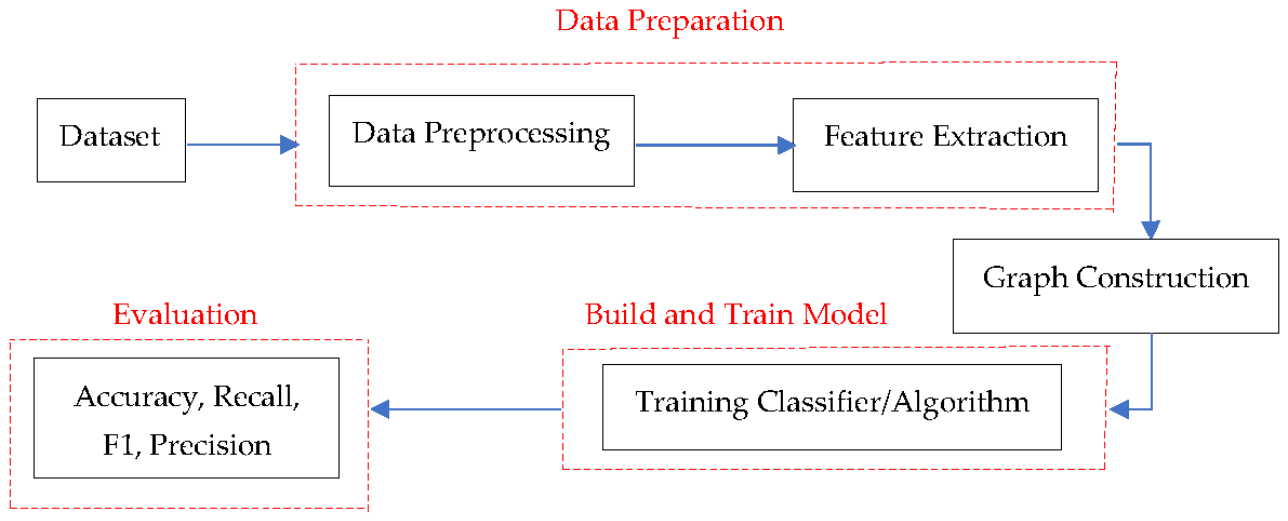
Figure 1. Overview of the proposed model.
Computers 15 00352 g001
Figure 2. Overview of GCN.
Computers 15 00352 g002
Figure 5. GCN architecture.
Computers 15 00352 g005
Figure 6. Workflow of the GCN architecture.
Computers 15 00352 g006
Figure 7. GCN sample.
Computers 15 00352 g007
Figure 9. Confusion matrix.
Computers 15 00352 g009
Figure 10. Accuracy results.
Computers 15 00352 g010
Table 1. Classification results using the TF-IDF feature on the ISOT dataset.
Precision Recall F1-Score EpochLossAccuracy
Real Class95.33% ± 0.4795.33% ± 0.4795.33% ± 0.47Epoch 00.827195.33% ± 0.47
Fake Class95.67% ± 0.4795.67% ± 0.4795.67% ± 0.47Epoch 10
Epoch 20
Epoch 30
Epoch 40
Epoch 50
Epoch 60
Epoch 70
Epoch 80
Epoch 90
0.2769
0.2249
0.1984
0.1819
0.1694
0.1586
0.1489
0.1399
0.1315
Table 2. Classification results using the TF-IDF feature on the GossipCop dataset.
Precision Recall F1-Score EpochLossAccuracy
Real Class92% ± 1.5391.33% ± 0.5892.50% ± 0.58Epoch 00.843690.70% ± 0.58
Fake Class86.67% ± 0.5888.70% ± 0.3087.40% ± 0.30Epoch 10
Epoch 20
Epoch 30
Epoch 40
Epoch 50
Epoch 60
Epoch 70
Epoch 80
Epoch 90
0.4044
0.3522
0.3255
0.3078
0.2945
0.2831
0.2729
0.2635
0.2546
Table 3. Classification results using the Bag-of-Words representation on the ISOT dataset.
Precision RecallF1-ScoreEpochLossAccuracy
Real Class94.50% ± 0.2594.50% ± 0.2594.50% ± 0.25Epoch 00.992594.66% ± 0.47
Fake Class94.50% ± 0.2594.50% ± 0.2594.50% ± 0.25Epoch 10
Epoch 20
Epoch 30
Epoch 40
Epoch 50
Epoch 60
Epoch 70
Epoch 80
Epoch 90
0.3061
0.2531
0.2250
0.2094
0.1968
0.1873
0.1791
0.1717
0.1649
Table 4. Classification results using the n-gram (bigram) representation on the ISOT dataset.
Precision RecallF1-ScoreEpochLossAccuracy
Real Class96% ± 0.095% ± 0.095% ± 0.0Epoch 00.692895% ± 0.0
Fake Class95% ± 0.096% ± 0.096% ± 0.0Epoch 10
Epoch 20
Epoch 30
Epoch 40
Epoch 50
Epoch 60
Epoch 70
Epoch 80
Epoch 90
0.2587
0.2193
0.1958
0.1816
0.1694
0.1587
0.1488
0.1394
0.1304
Table 5. Classification results using the TF-IDF and Bag-of-Words representations on the ISOT dataset.
Precision RecallF1-ScoreEpochLossAccuracy
Real Class95.33% ± 0.4795.33% ± 0.4795.33% ± 0.47Epoch 01.486694.66% ± 0.47
Fake Class95.33% ± 0.4795.33% ± 0.4795.33% ± 0.47Epoch 10
Epoch 20
Epoch 30
Epoch 40
Epoch 50
Epoch 60
Epoch 70
Epoch 80
Epoch 90
0.2849
0.2312
0.2039
0.1895
0.1764
0.1669
0.1583
0.1505
0.1430
Table 6. Classification results using the n-gram (bigram) representation on the GossipCop dataset.
Precision RecallF1-ScoreEpochLossAccuracy
Real Class88.30% ± 0.7591.30% ± 0.7590.30% ± 0.75Epoch 00.868887.60% ± 0.25
Fake Class86.60% ± 0.7581.60% ± 0.7583.60% ± 0.75Epoch 10
Epoch 20
Epoch 30
Epoch 40
Epoch 50
Epoch 60
Epoch 70
Epoch 80
Epoch 90
0.4069
0.3648
0.3448
0.3323
0.3231
0.3153
0.3084
0.3020
0.2959
Table 7. Classification results using the BoW representation on the GossipCop dataset.
Precision RecallF1-ScoreEpochLossAccuracy
Real Class93.60% ± 0.2592.60% ± 0.2593.60% ± 0.25Epoch 00.762491.30% ± 0.75
Fake Class88.30% ± 0.2589.30% ± 0.2589.30% ± 0.25Epoch 10
Epoch 20
Epoch 30
Epoch 40
Epoch 50
Epoch 60
Epoch 70
Epoch 80
Epoch 90
0.3969
0.3500
0.3222
0.3021
0.2850
0.2969
0.2554
0.2418
0.2290
Table 8. Classification results using the TF-IDF and BoW representations on the GossipCop dataset.
Precision RecallF1-ScoreEpochLossAccuracy
Real Class89.66% ± 0.3091.33% ± 0.3090.60% ± 0.30Epoch 00.835187.66% ± 0.60
Fake Class85.60% ± 0.6082.30% ± 0.6683.66% ± 0.30Epoch 10
Epoch 20
Epoch 30
Epoch 40
Epoch 50
Epoch 60
Epoch 70
Epoch 80
Epoch 90
0.4498
0.4035
0.3779
0.3605
0.3471
0.3355
0.3251
0.3154
0.3061
Table 9. Performance summary.
DatasetTF-IDFBoWBigramDistelBERTAccuracy
ISOTXX 94.66%
GossipCopX 90.70%
ISOT X 94.66%
GossipCop X 91.30%
ISOT X 95%
GossipCop X 87.60%
ISOTX 95.33%
GossipCopXX 87.66%
ISOT X98%
GossipCop X96%
Table 10. Datasets, and Key characteristics of previous studies.
ReferenceDatasetKey Characteristics
S1 [7]
  • Twitter15
  • Twitter16
  • Short-text tweets
  • Retweet sequences
S2 [8]
  • Twitter
  • Graph representation
  • Sources, articles, users
S3 [9]
  • Sina Weibo
  • Twitter15
  • Twitter16
  • Propagation structures (tree/graph)
  • Node features
  • Labels
S4 [10]
  • Cora
  • Citeseer
  • PubMed
  • Amazon Photos
  • Amazon Computers
  • Cora Full
  • Coauthor CS
  • Normalization and activation
  • Layer redesign
S5 [11]
  • R8 News
  • R52 News
  • Ohsumed Medical
  • 20 Newsgroups
  • MR Sentiment
  • AG News
  • Cora
  • Corpus-level supervision (e.g., TextGCN)
  • Fundamental GCNs
S6 [13]
  • 20 Newsgroups (20NG)
  • Ohsumed
  • R8 and R52
  • Movie Review (MR)
  • Text graph tensor construction
  • Two-stage propagation learning
S7 [14]
  • ISOT
  • Article graph representation
  • Tensor decomposition
S9 [15]
  • Romanian context studies from Kaggle
  • Labeled structure
  • Preprocessing
S10 [16]
  • Pheme
  • SemEval 2017 Task 8
  • Deep semantic features using BERT
  • Propagation content
  • Propagation topology
S11 [17]
  • GossipCop
  • PolitiFact
  • Knowledge graph format using mapping language
S12 [18]
  • GossipCop
  • PolitiFact
  • Textual and semantic content
  • Social context and metadata
  • Targeted content
S13 [19]
  • IoT-23
  • UNSW-NB15
  • CICIDS2018
  • BoT-IoT
  • Malware Bazaar
  • PRISMA-guided systematic review
  • Synthesis of studies from major databases
S14 [20]
  • UNSW-NB15
  • CIC-IDS2017
  • Modeling global contextual dependencies within network traffic
Table 11. Advantages and limitations of previous studies.
ReferenceAdvantagesLimitations
S1 [7]
  • High accuracy (16% higher than comparable algorithms in the same field
  • Explainability
  • Short-text efficiency
  • Dual co-attention
  • High computational cost
  • Restricted data access
  • Potential forecasting bias
S2 [8]
  • Inductive learning and scalability
  • Ability to capture complex heterogeneous interactions
  • Incorporation of temporality and sentiment
  • Robustness with limited data
  • Reliance on high-quality external annotations
  • Potential model complexity
  • Moderate performance on complex real-world cases
  • Potential loss of latent information
S3 [9]
  • Comprehensive structural modeling
  • Incorporation of source information
  • Superior performance
  • Early detection capabilities
  • Limitations in static graph modeling
  • Reliance on independent feature extraction
  • High dependency on labeled data
  • Lack of interpretability
S4 [10]
  • Superior accuracy with shallow architectures
  • Improved aggregation methods
  • High versatility
  • Robustness training performance
  • Marginal gains on specific datasets
  • Lower accuracy on high-class datasets
  • High computational complexity
S5 [11]
  • Effective use of lobal information
  • Strong performance in semi-supervised settings
  • Improved accuracy on complex data
  • Over-smoothing
  • High computational cost and complexity
  • Loss of sequential order
S6 [13]
  • Comprehensive information integration
  • Superior performance
  • Multi-stage propagation learning
  • High computational complexity
  • Transudative nature
  • Preprocessing overhead
  • Hyperparameter sensitivity
S7 [14]
  • Accurate contextual representation
  • Effective modeling of local interactions
  • High classification accuracy
  • Relies on specific data
  • High computational complexity
  • Limitations in modeling highly complex relationships
S9 [15]
  • High accuracy
  • Strong contextual understanding
  • Adaptability
  • Resource-intensive
  • Lack of transparency
S10 [16]
  • Bidirectional modeling
  • Strong contextual understanding using BERT
  • Superior performance
  • High computational complexity (BERT-based)
  • Reliance on complete data
  • Static graph structure
  • Requires structured inputs
S11 [17]
  • Context-aware-modeling (GAT-based)
  • Dynamic learning
  • Open-source framework
  • Dependence on external knowledge sources
  • Implementation complexity
  • High computational cost in GAT
S12 [18]
  • Strong contextual understanding using BERT
  • Improved accuracy and generalization
  • Data augmentation
  • Challenges with evolving misinformation
  • High computational cost of pre-trained models
S13 [19]
  • Reduced feature engineering requirements
  • Effective for IoT/Web security applications
  • Interpretable modeling
  • Dependence on high-quality graph construction
  • Scalability issues
  • Lack of labeled data
S14 [20]
  • Dual-perspective feature extraction
  • Transformer-based encoder
  • Effective on imbalanced data
  • Data preprocessing requirements
  • Potential for over-smoothing
  • Sensitivity to hyperparameters
  • Generalization challenges
Disclaimer/Publisher’s Note: The statements, opinions and data contained in all publications are solely those of the individual author(s) and contributor(s) and not of MDPI and/or the editor(s). MDPI and/or the editor(s) disclaim responsibility for any injury to people or property resulting from any ideas, methods, instructions or products referred to in the content.