Access control is imposed through Roles, ClusterRoles, RoleBindings, and ClusterRoleBindings within a Kubernetes-like cloud container environment. Within a specific namespace, individual role collects permissions (verbs on API resources), while ClusterRoles can allow permissions within the entire cluster. In order to determine what tasks each subject is permitted to execute, bindings attach these roles to subjects, such as human users, groups, or service accounts.
The formulation beneath is correlated to a fixed RBAC snapshot expressed by the current subjects, roles, permissions, workload requirements, and security policies. Under identical inputs this snapshot abstraction is effective for determinig the constrained optimization issue and for benchmarking optimizers. In an operational deployment the same model can be re-instantiated whenever manifests, audit-log evidence, service accounts, namespaces, custom resources, or API permissions are altered. It should not be interpreted as assuming that Kubernetes clusters are fixed.
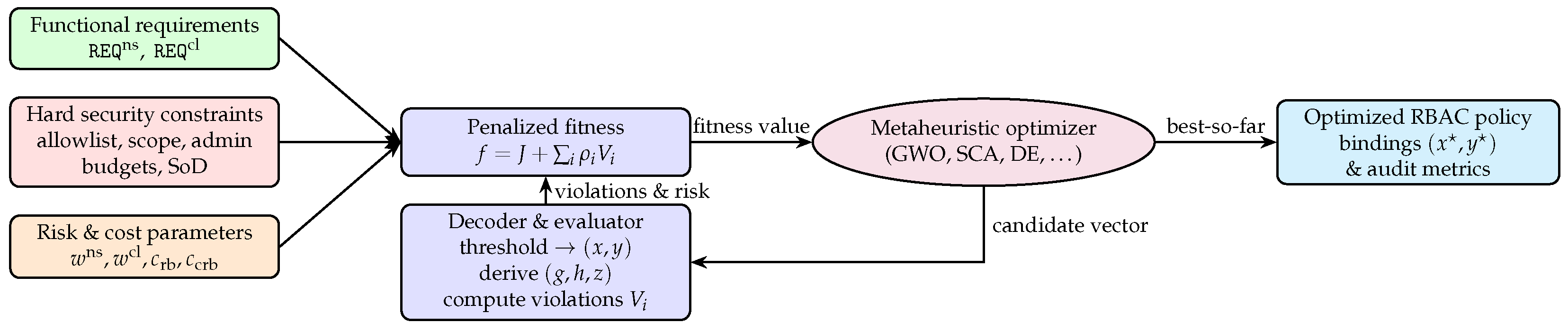
The security goal in this environment is to enforce an RBAC configuration that concurrently enables all functional requirements and meets strict security restrictions. The necessary actions must be executed through every subject in the appropriate namespaces or at the cluster domain, while the implementation must abide to strict security policies which include namespace allowlists, role scoping rules, administrative restrictions on ClusterRoleBindings, binding budget limits, and separation-of-duty restrictions. Simultaneously, the configuration should reduce overall security risk by reducing unnecessary or excessive privileges, complying as closely as possible to the least-privilege principle, and continue to be operationally simple by avoiding an unnecessary number of bindings. The flow of the proposed least-privilege RBAC optimization loop is shown in
Figure 1.
We introduce this design task as a constrained single-objective optimization issue. Dealing with the model strictly as a mixed-integer program can be computationally expensive due to the decisions being binary and the constraints being numerous and complicated. Rather, we utilize population-based metaheuristic optimizers (such as GWO, PSO, SCA, and relevant algorithms) along with a unified penalty-based fitness function that encodes both risk and constraint abuses. Various optimizers to be benchmarked objectively on the same RBAC instance are permitted as a result of this formulation.
3.3. Pseudocode and Description
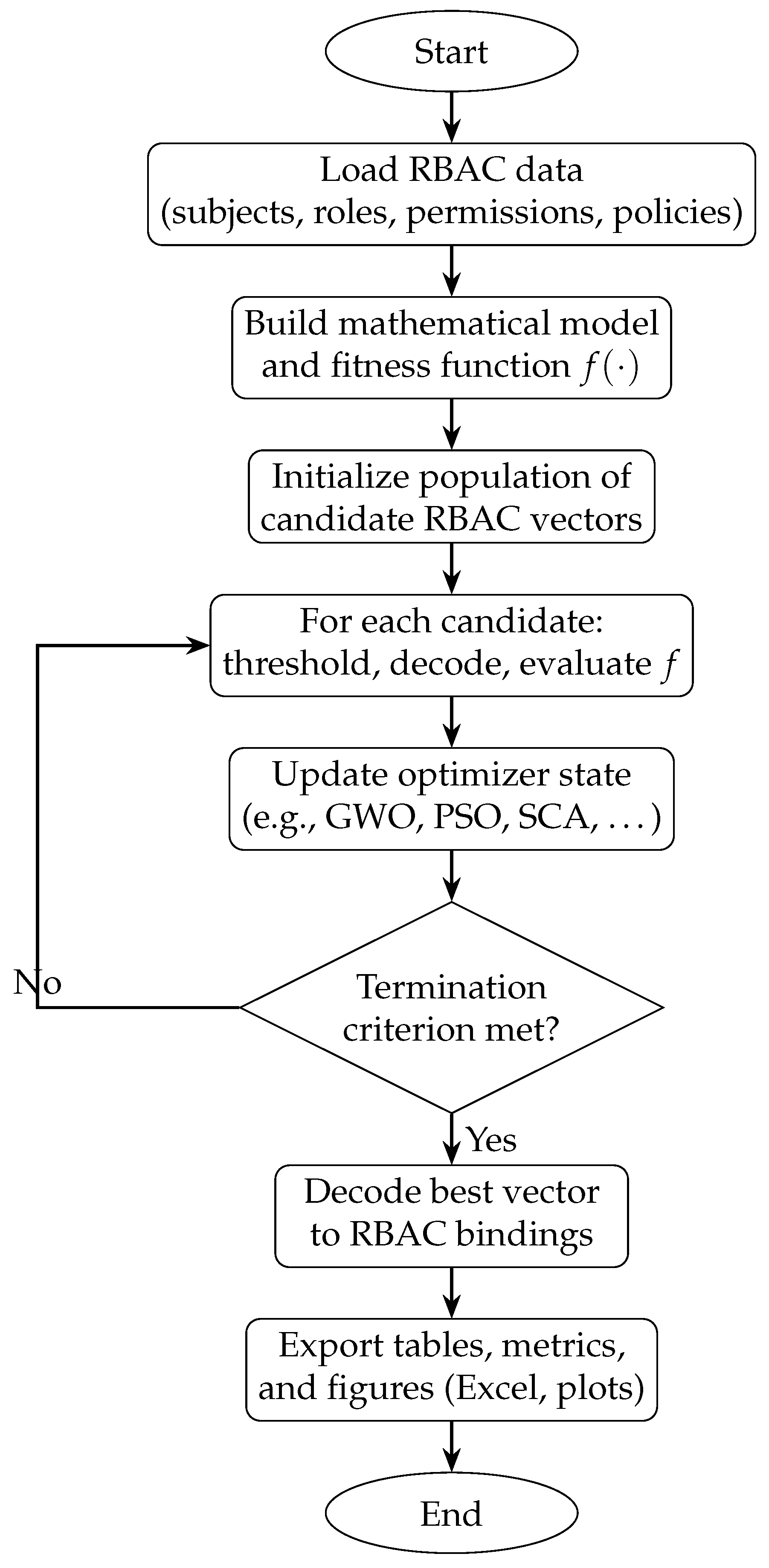
Algorithm 1 conveys one metaheuristic optimizer run (e.g., GWO) on the RBAC issue. Various optimizers share the same interface: population size, iteration budget, bounds, and a handle to the fitness function
.
| Algorithm 1 Metaheuristic RBAC Optimizer (Generic Skeleton) |
| Require: Population size , max iterations , bounds , fitness . |
| Ensure: Best decision vector and its fitness . |
| 1: Input: RBAC data (subjects, namespaces, roles, permissions, policies) |
| 2: Build model parameters and internal data structures |
| 3: Define fitness function via penalized evaluation ▹ Equation (18) |
| 4: Initialize population uniformly in |
| 5: Initialize optimizer-specific state (e.g., alpha/beta/delta wolves for GWO) |
| 6: for to do |
| 7: for to do |
| 8: Enforce bounds: |
| 9: Threshold to binary: |
| 10: Decode from |
| 11: Compute and violations |
| 12: Compute fitness |
| 13: Update best-known solution if |
| 14: end for |
| 15: Update population according to metaheuristic rules |
| 16: Optionally, record convergence curve: |
| 17: end for |
| 18: return
|
3.3.1. Problem Setup
The RBAC dataset is loaded and preprocessed into the internal model factors within the primary stage of the algorithm. This consists of the structure of the namespaced and cluster permission matrices and , the requirement indicators and , and the different policy aims such as ALLOWNS, AdminOK, binding budgets, and separation-of-duty capability maps. Risk weights and are also started at this stage. Based on these structures, a penalized fitness function is defined, encapsulating both the RBAC semantics and all constraint terms in a single scalar objective.
3.3.2. Initialization
Initialization begins through constructing a population of continuous candidate vectors within the bounded domain, typically using a uniform distribution over . Each specifc vector represents a flattened version of all binary decisions and that determine an RBAC formulation. Simultaneously, the optimizer may initialize its own internal state.
3.3.3. Main Loop
The main iterative loop shown in lines 6–18 is the core of the algorithm). At each alteration, each candidate vector is first clipped to the permitted bounds to authenticate feasibility in the continuous search space. To construct a concrete binding configuration, a continuous vector is thresholded to a binary representation. Subsequently, this binary vector is decoded into the role-binding variables x and cluster-role-binding variables y, which are subsequently used to calculate the effective permissions g and h and the capability indicators z.
The evaluator computes the fitness value by gathering the base objective (risk and binding complexity) with all constraint violations, weighted by their penalty factors when the derived quantities are available. The outcome is a single scalar f that returns both security quality and constraint satisfaction. The optimum solution and its related metrics are updated appropriately once the fitness value is compared to the best-so-far solution, and if it is strictly better.
3.3.4. Population Update
Correlating with line 17, the optimizer executes a population update step after all individuals within the population have been calculated and the optimum solution has been updated. The accurate update mechanism depend on the selected metaheuristic: in GWO it is dependent on the relative positions of alpha, beta, and delta wolves; in PSO it integrates personal and global best positions; in SCA it uses sinusoidal transformations, and so on. Importantly, the framework handles this update as a black-box operation that only requires access to the present population and their corresponding fitness values.
3.3.5. Termination and Output
The algorithm repeats to iterate until the largest quantity of iterations is derived, or a different termination position is satisfied (for example, convergence of the fitness values). Ultimately, the optimum decision vector and its fitness are returned, collected along with the convergence history. This best vector is decoded into the last RBAC formulation, as well as the explicit RoleBindings and ClusterRoleBindings, which can then be inspected, exported, and, if suitable, deployed in the target environment.
3.4. Framework Description
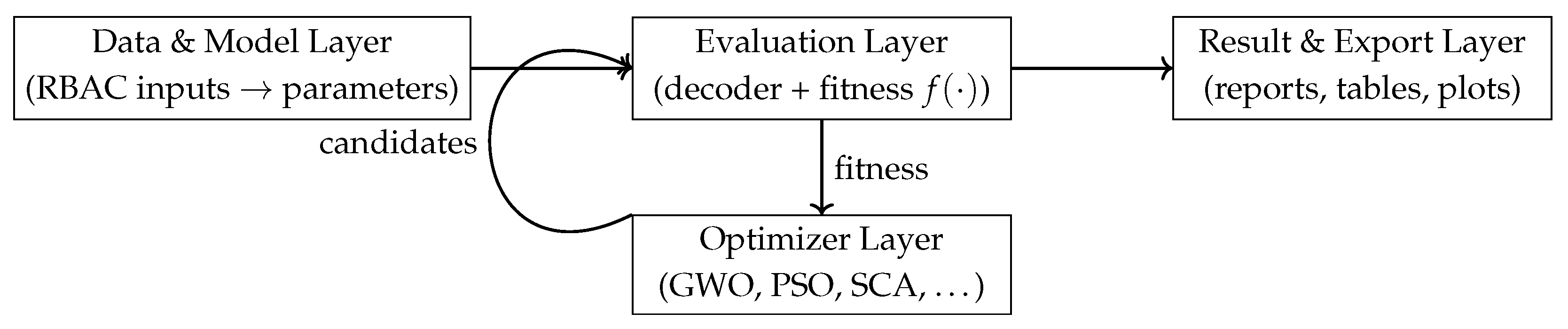
The data and model layer is tasked with transforming raw RBAC information into a consistent numerical representation. It receives as input the lists of subjects, namespaces, roles and clusterRoles, permission atoms, and all related security policies. From these inputs, it formulates the permission matrices and , the requirement indicators and , the namespace allowlists ALLOWNS, the administrative restriction map AdminOK, binding budgets and , capability maps and , and the set of forbidden capability pairs . This layer creates the real-world RBAC knowledge and limitations, even remains agnostic to the specific optimization algorithm that will utilize these parameters.
The evaluation layer applies the prime mapping from a potential decision vector . It primarily implements thresholding to alter the continuous vector into a binary representation, and then decodes that representation into the binding variable x and y. Using these variables, the evaluator recreates the effective permissions g and h, and calculates capability indicators z. It then calculates all relevant violations, including missing required permissions, invalid bindings, binding-budget violations, and separation-of-duty violations. Lastly, it collects these counts with the base risk and binding complexity to create the penalized fitness value. In conjunction to the scalar fitness, the evaluation layer can provide comprehensive diagnostics such as binding counts, violation statistics, risk decomposition, and accuracy metrics such as precision, recall, F1 score, and over-privilege.
One or more metaheuristic algorithms are hosted through the optimizer layer. (such as GWO, PSO, SCA, MFO, HHO, MVO, ALO, BOA, or SSA) that operate on the same RBAC issue. Each optimizer executes its own internal representation of the population and its own update principles, however all optimizers operate with the evaluation layer through a typical interface: they propose candidate vectors, receive fitness values in return, and alter their populations correspondingly. These optimizers are interchangeable black boxes, within the perspective of the RBAC issue, which permits for reasonable and systematic benchmarking of various algorithms on exactly the same model and data.
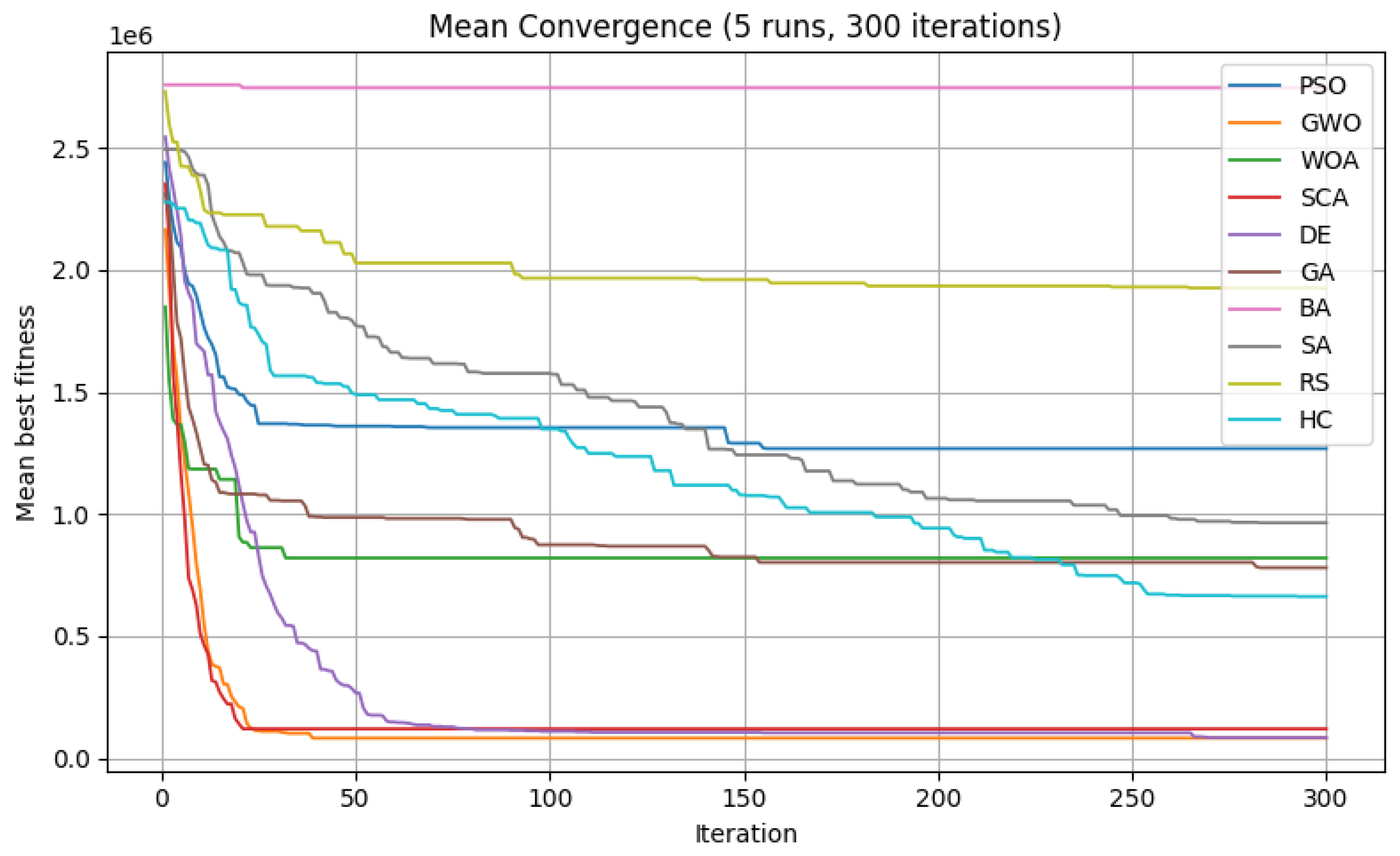
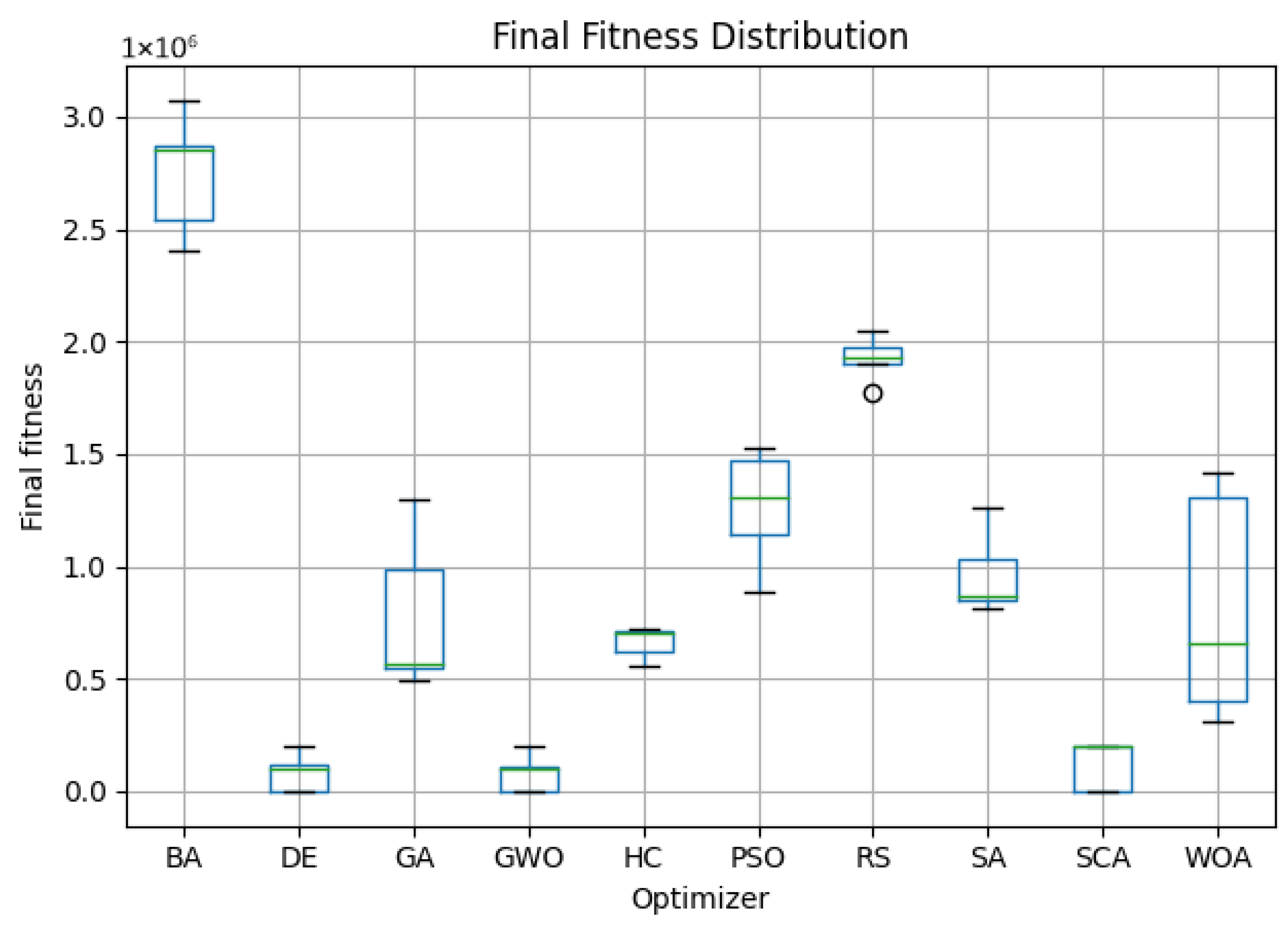
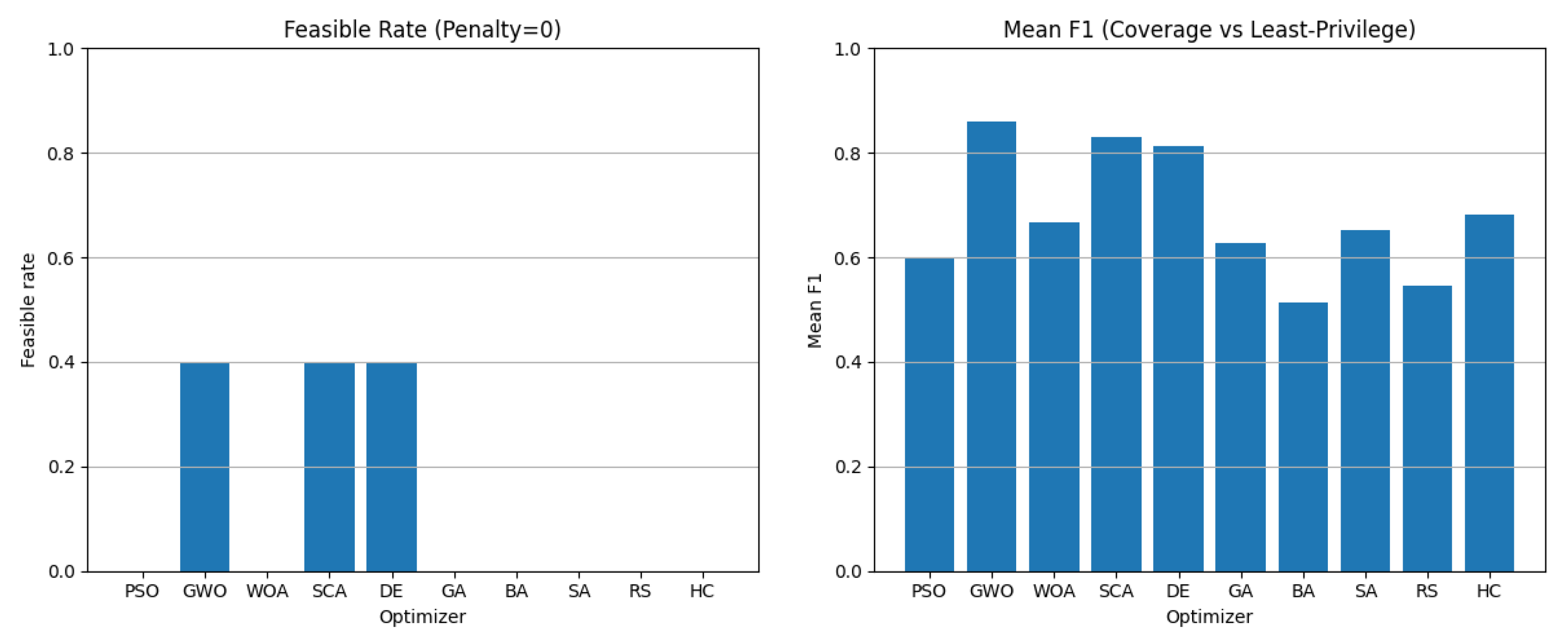
The result analysis and export layer processes the outputs created by the optimizers. It decodes the optimum solutions established by each algorithm into explicit RoleBindings and ClusterRoleBindings, and computes aggregate statistics within runs, including the fraction of feasible runs, the mean and standard deviation of the fitness, and the mean values of security metrics like F1 score. This layer also yields tables and figures to external formats, for example creating Excel workbooks and graphical plots of convergence curves, boxplots, and bar charts. These externals form the basis for scientific reporting, which include LaTeX tables and figures summarizing performance and security characteristics of the optimized RBAC configurations.
Figure 3 illustrates the conceptual framework and the interactions between the layers. The data and model layer provides the evaluation layer with the essential parameters. The evaluation layer provides fitness values and receiving candidate solutions by interacting bidirectionally with the optimizer. Ultimately, the evaluation outputs are transferred on to the result analysis and export layer.
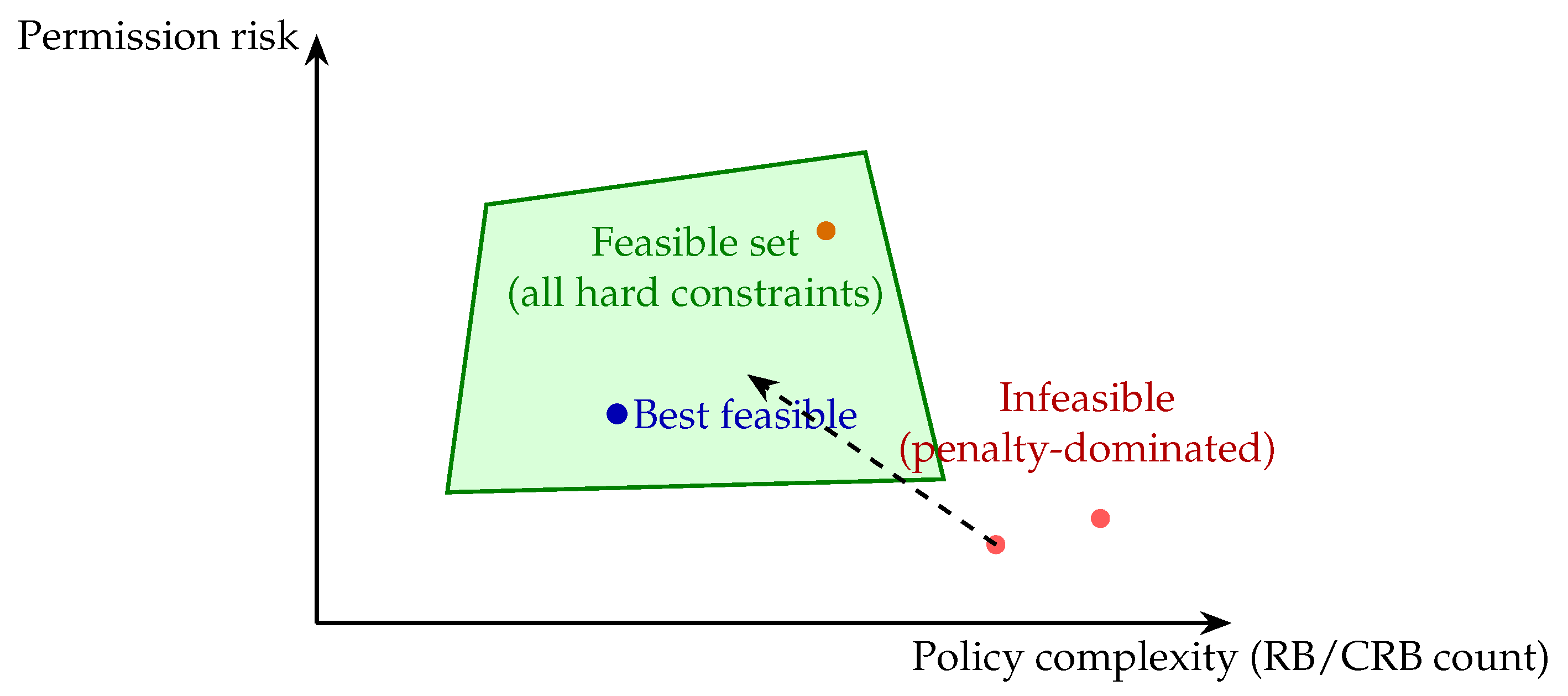
Instead of being executed as a one-time tool, the same layers can be executed as recurring hardening loops for production use. Periodically, the data layer refreshes inputs from manifests, the live RBAC state, audit logs, and policy-as-code rules; the optimizer nominates a candidate RBAC update; the evaluation layer inspects functional coverage and security limitations; and the outcome layer exports a minimal change set for dry-run validation, canary deployment, rollback monitoring, and operator approval. The Conceptual view of the search landscape is shown in
Figure 4. An Interpretation of the compact feasible GWO/SCA policy in the benchmark instance is shown in
Table 2.




 ,
,