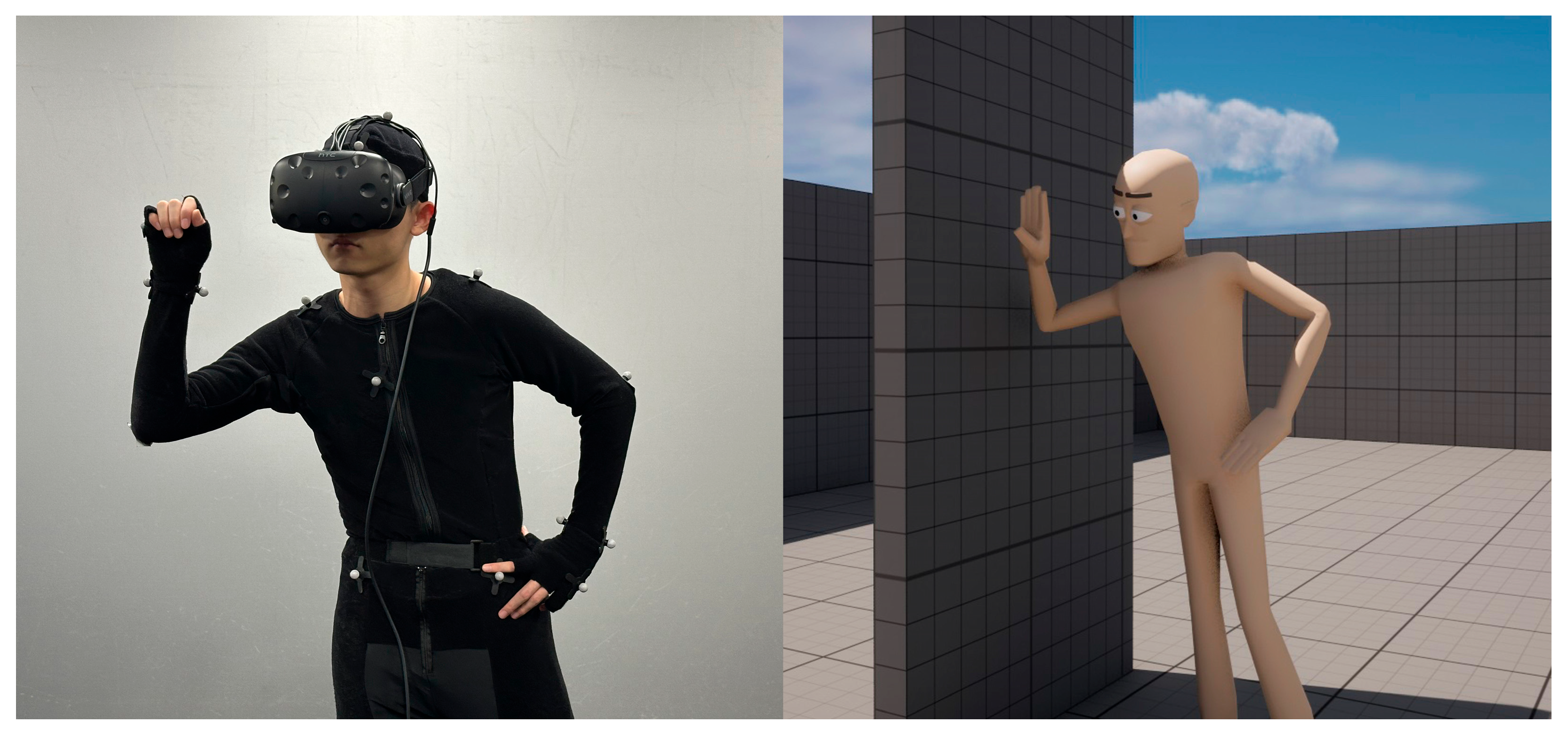

Immersive VR-MoCap for Creative Motion Design in Character Animation Training: A Classroom-Based Comparative Study


Abstract
1. Introduction
2. Literature Review
2.1. Traditional Character Animation Training
2.2. Motion Capture Technology in Education
2.3. Virtual Reality Technology in Education
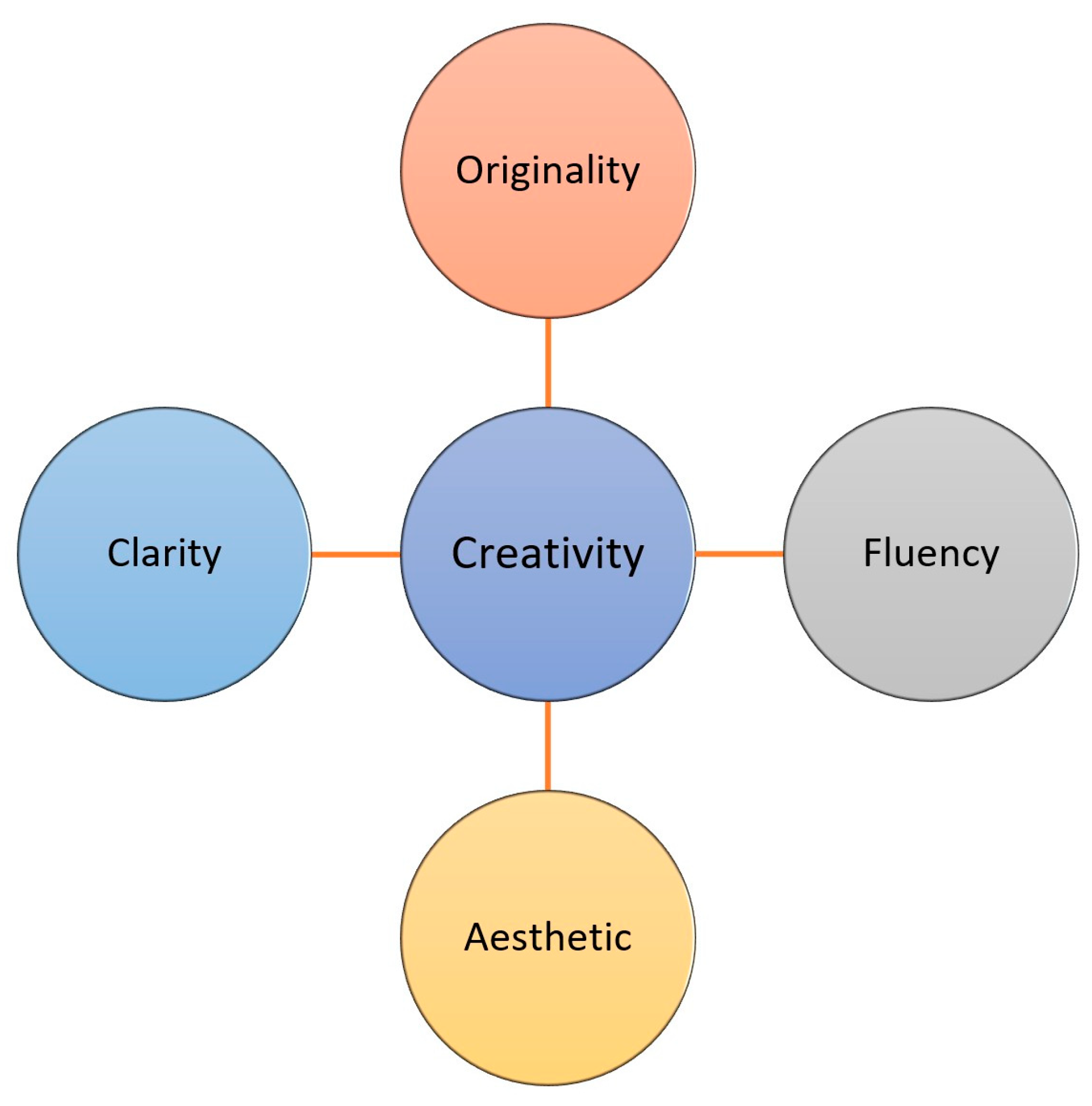
2.4. Creativity in Motion Design
2.5. Current Study
3. Methods
3.1. Objectives
3.2. Materials and Methods
3.2.1. Sample
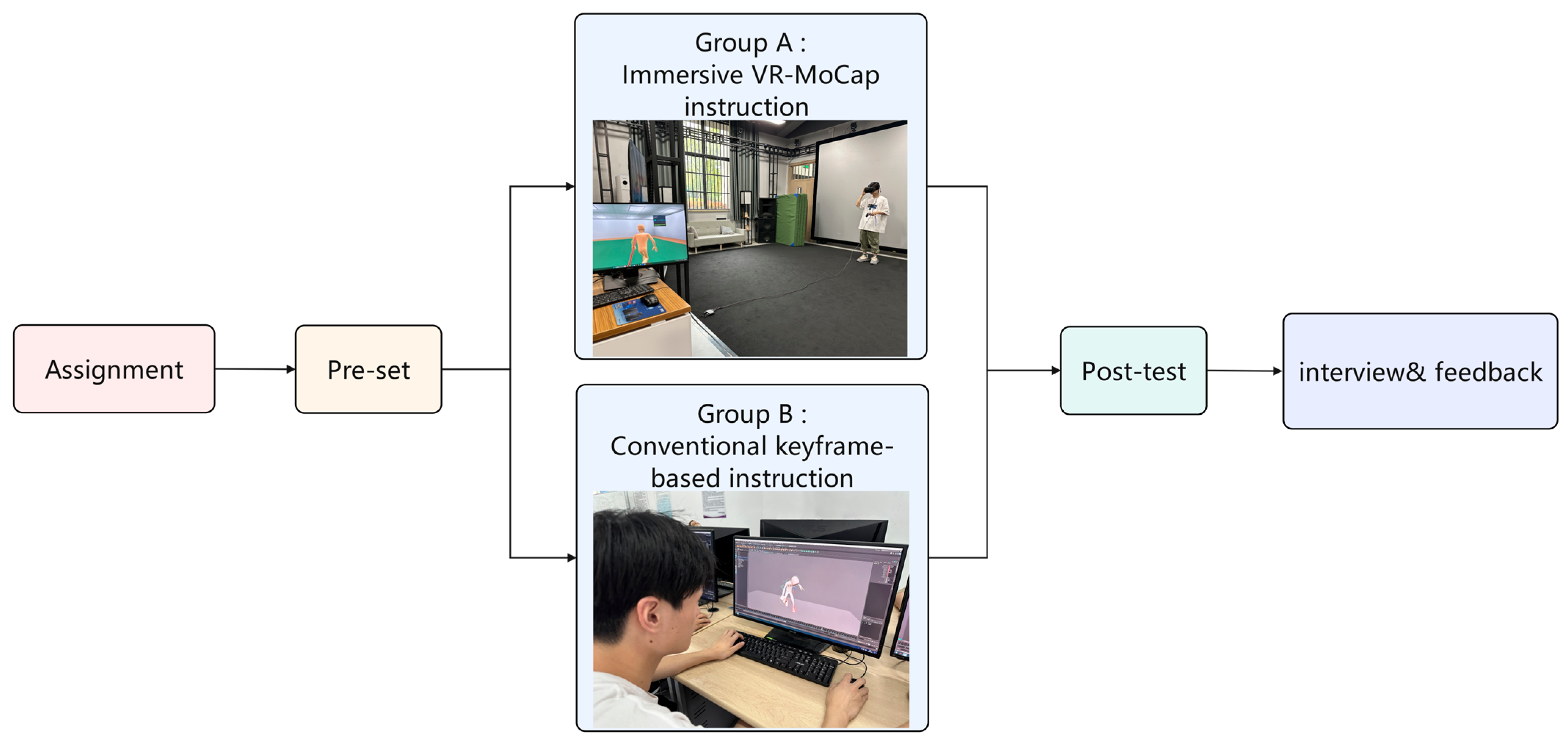
3.2.2. Procedures
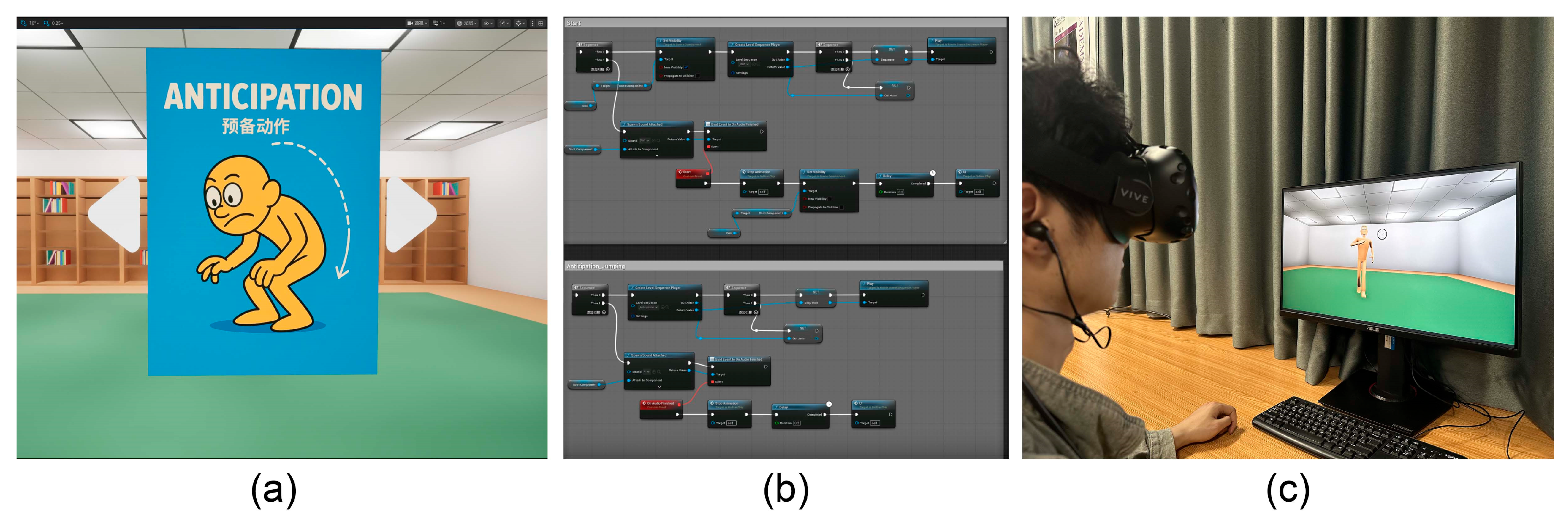
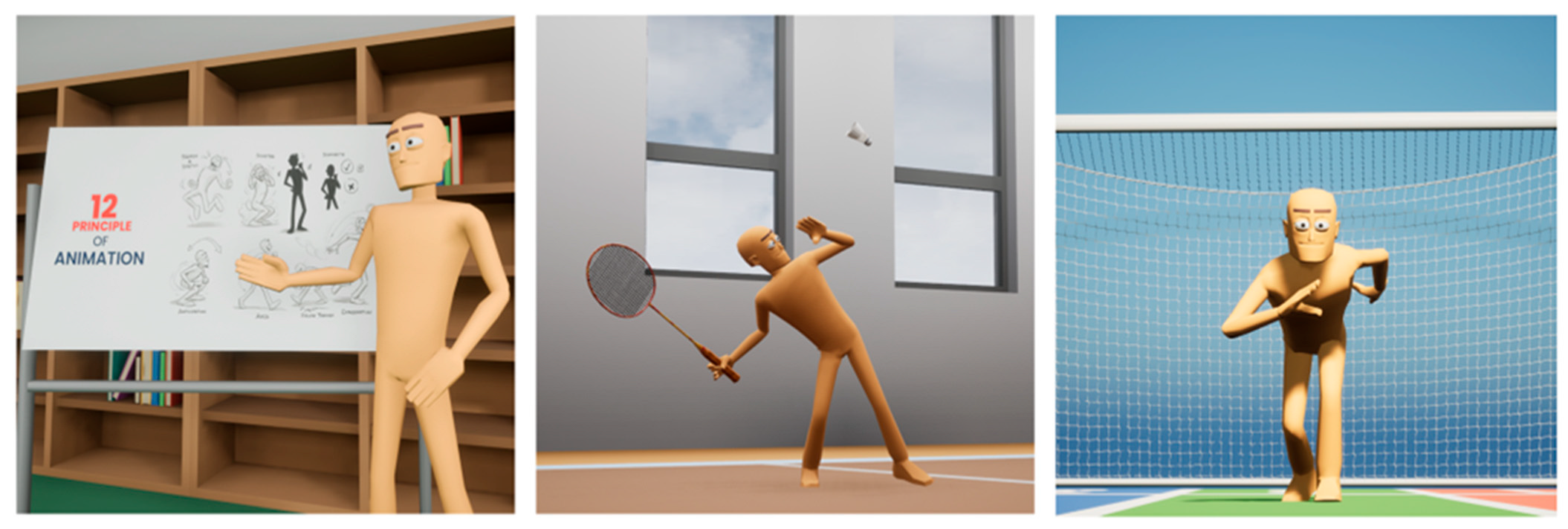
3.2.3. Materials and Devices
3.2.4. Data Analysis
4. Results
4.1. Demographic Group Differences
4.2. Group Differences in Creative Training Outcomes
4.3. Participants’ Attitudes Towards MoCap Design
- Participant A: “Compared with MAYA, MoCap is more direct and faster. It pays more attention to bodily performance rather than keyboard-and-mouse operation.”
- Participant B: “Because I had to perform the action myself, I became fully involved. It gave me a stronger sense of immersion.”
- Participant C: “I felt that my own actions were transferred from reality to the virtual character. It was a very interesting and even magical experience.”
- Participant D: “Motion capture avoided repeated keyframing and improved production efficiency.”
- Participant E: “It is more convenient and efficient than Maya keyframing. It is easier to get started.”
- Participant F: “Using motion capture improved the fluency of motion design, because I could quickly design continuous movements.”
- Participant G: “MoCap allowed me to improvise, and unexpected effects could appear during performance.”
- Participant H: “In keyframe animation, my ideas are often restricted. MoCap allows me to imitate and create more quickly.”
- Participant I: “When using MoCap, I was more willing to try exaggerated actions, which improved creativity and performance.”
- Participant J: “When I was recording with motion capture, the virtual character felt like my shadow.”
- Participant K: “I do what the character does, and the character does what I do. I felt that I was inside the script and the character setting.”
- Participant L: “When I watched the animation afterward, it felt as if the character and I were connected emotionally.”
- Participant M: “Motion capture promoted team communication. Every part is connected, and each step requires coordination.”
- Participant N: “This production method gives group members more chances to collaborate with one another.”
- Participant O: “When recording an emotional action, we discussed different bodily expressions together before choosing the final performance.”
- Participant P: “The most challenging part was wearing the motion capture suit. At first it felt embarrassing, but I gradually adapted.”
- Participant Q: “When recording complex actions, the accuracy was sometimes not high, and recalibration was needed.”
- Participant R: “Some dangerous or highly exaggerated actions could not be completed directly and had to be simulated or transformed.”
5. Discussion
5.1. Theoretical Implications
5.2. Practical Implications
5.3. Comparative Analysis with Related Studies
5.4. Limitations and Suggestions for Future Research
6. Conclusions
Author Contributions
Funding
Data Availability Statement
Acknowledgments
Conflicts of Interest
References
- Thomas, F.; Johnston, O. Disney Animation: The Illusion of Life; Abbeville Press: New York, NY, USA, 1981. [Google Scholar]
- Hooks, E. Acting for Animators; Routledge: London, UK, 2017. [Google Scholar]
- Williams, R. The Animator’s Survival Kit: A Manual of Methods, Principles and Formulas for Classical, Computer, Games, Stop Motion and Internet Animators; Macmillan: New York, NY, USA, 2012. [Google Scholar]
- Hosea, B. Drawing animation. Animation 2010, 5, 353–367. [Google Scholar] [CrossRef]
- Menache, A. Understanding Motion Capture for Computer Animation and Video Games; Morgan Kaufmann: San Francisco, CA, USA, 2000. [Google Scholar]
- Nirme, J.; Haake, M.; Gulz, A.; Gullberg, M. Motion capture-based animated characters for the study of speech–gesture integration. Behav. Res. Methods 2020, 52, 1339–1354. [Google Scholar] [CrossRef] [PubMed]
- Pullen, K.; Bregler, C. Motion capture assisted animation: Texturing and synthesis. In Proceedings of the 29th Annual Conference on Computer Graphics and Interactive Techniques, San Antonio, TX, USA, 21–26 July 2002. [Google Scholar]
- Lasseter, J. Principles of traditional animation applied to 3D computer animation. In Seminal Graphics: Pioneering Efforts that Shaped the Field; ACM: New York, NY, USA, 1998; pp. 263–272. [Google Scholar]
- Musa, S.; Ziatdinov, R.; Griffiths, C. Introduction to computer animation and its possible educational applications. arXiv 2013, arXiv:1312.1824. [Google Scholar] [CrossRef]
- de Vries, H. Space for STEAM: New creativity challenge in education. Front. Psychol. 2021, 12, 586318. [Google Scholar] [CrossRef]
- Yakman, G. STEAM education: An overview of creating a model of integrative education. In PATT-17 and PATT-19 Conference (Pupils’ Attitudes Towards Technology); ITEEA: Reston, VA, USA, 2008. [Google Scholar]
- Kennedy, J. Vactor ontologies: Framing acting within a motion capture context. Int. J. Perform. Arts Digit. Media 2022, 18, 341–356. [Google Scholar] [CrossRef]
- Radianti, J.; Majchrzak, T.A.; Fromm, J.; Wohlgenannt, I. A systematic review of immersive virtual reality applications for higher education: Design elements, lessons learned, and research agenda. Comput. Educ. 2020, 147, 103778. [Google Scholar] [CrossRef]
- Strojny, P.; Dużmańska-Misiarczyk, N. Measuring the effectiveness of virtual training: A systematic review. Comput. Educ. X Real. 2023, 2, 100006. [Google Scholar] [CrossRef]
- Bennett, G.; Denton, A. Developing practical models for teaching motion capture. In ACM SIGGRAPH ASIA 2009 Educators Program; ACM: New York, NY, USA, 2009; pp. 1–5. [Google Scholar]
- Wang, X.; Yang, C.; Wang, L. Applying motion capture in computer animation education. Int. J. Eng. Manuf. 2011, 1, 44–52. [Google Scholar] [CrossRef][Green Version]
- Mou, T.-Y. Keyframe or motion capture? Reflections on education of character animation. EURASIA J. Math. Sci. Technol. Educ. 2018, 14, em1649. [Google Scholar] [CrossRef]
- O’Hailey, T. Hybrid Animation: Integrating 2D and 3D Assets; Routledge: London, UK, 2012. [Google Scholar]
- Najafi, H.; Kennedy, J.; Ramsay, E.; Todoroki, M.; Bennett, G. A Pedagogical Workflow for Interconnected Learning: Integrating Motion Capture in Animation, Visual Effects, and Game Design: Major/Minor curriculum structure that supports the integration of Motion Capture with Animation, Visual Effects and Game Design Teaching Pathways. In Proceedings of the SIGGRAPH Asia 2024 Educator’s Forum, Tokyo, Japan, 3–6 December 2024. [Google Scholar]
- Jiang, X.; Ibrahim, Z.; Jiang, J.; Liu, G. Motion Capture as an Immersive Learning Technology: A Systematic Review of Its Applications in Computer Animation Training. Multimodal Technol. Interact. 2025, 10, 1. [Google Scholar] [CrossRef]
- Kitagawa, M.; Windsor, B. MoCap for Artists: Workflow and Techniques for Motion Capture; Routledge: London, UK, 2020. [Google Scholar]
- Schiffer, S. How actors can animate game characters: Integrating performance theory in the emotion model of a game character. In Proceedings of the AAAI Conference on Artificial Intelligence and Interactive Digital Entertainment, Atlanta, GA, USA, 8–12 October 2019. [Google Scholar]
- Chen, H.-Y.; Cheng, Y.-H.; Lo, A. Improve dancing skills with motion capture systems: Case study of a taiwanese high school dance class. Res. Dance Educ. 2023, 24, 342–360. [Google Scholar] [CrossRef]
- Istenic Starcic, A.; Lipsmeyer, W.M.; Lin, L. Motion capture technology supporting cognitive, psychomotor, and affective-social learning. In International Conference on Innovative Technologies and Learning; Springer: Berlin/Heidelberg, Germany, 2018. [Google Scholar]
- Lu, Y.; Long, H. Motion capture algorithm for students’ physical activity recognition in physical education curriculum. J. Artif. Intell. Technol. 2025, 5, 1–9. [Google Scholar] [CrossRef]
- Fu, Q.; Zhang, X.; Xu, J.; Zhang, H. Capture of 3D human motion pose in virtual reality based on video recognition. Complexity 2020, 2020, 8857748. [Google Scholar] [CrossRef]
- Johnson-Glenberg, M.C. Immersive VR and education: Embodied design principles that include gesture and hand controls. Front. Robot. AI 2018, 5, 375272. [Google Scholar] [CrossRef]
- Khorasani, S.; Syiem, B.V.; Nawaz, S.; Knibbe, J.; Velloso, E. Hands-on or hands-off: Deciphering the impact of interactivity on embodied learning in VR. Comput. Educ. X Real. 2023, 3, 100037. [Google Scholar] [CrossRef]
- Makransky, G.; Petersen, G.B. The cognitive affective model of immersive learning (CAMIL): A theoretical research-based model of learning in immersive virtual reality. Educ. Psychol. Rev. 2021, 33, 937–958. [Google Scholar] [CrossRef]
- Petersen, G.B.; Petkakis, G.; Makransky, G. A study of how immersion and interactivity drive VR learning. Comput. Educ. 2022, 179, 104429. [Google Scholar] [CrossRef]
- Wilson, M. Six views of embodied cognition. Psychon. Bull. Rev. 2002, 9, 625–636. [Google Scholar] [CrossRef]
- Klingenberg, S.; Bosse, R.; Mayer, R.E.; Makransky, G. Does embodiment in virtual reality boost learning transfer? Testing an immersion-interactivity framework. Educ. Psychol. Rev. 2024, 36, 116. [Google Scholar] [CrossRef]
- Lehrman, A.L. Embodied learning through immersive virtual reality: Theoretical perspectives for art and design education. Behav. Sci. 2025, 15, 917. [Google Scholar] [CrossRef] [PubMed]
- Torrance, E.P. Torrance tests of creative thinking. In Educational and Psychological Measurement; Personnel Press: Lexington, MA, USA, 1974. [Google Scholar]
- Alabbasi, A.M.A.; Paek, S.H.; Kim, D.; Cramond, B. What do educators need to know about the Torrance Tests of Creative Thinking: A comprehensive review. Front. Psychol. 2022, 13, 1000385. [Google Scholar] [CrossRef]
- Erwin, A.K.; Tran, K.; Koutstaal, W. Evaluating the predictive validity of four divergent thinking tasks for the originality of design product ideation. PLoS ONE 2022, 17, e0265116. [Google Scholar] [CrossRef] [PubMed]
- Frith, E.; Miller, S.E. Creativity in motion: Examining the impact of meaningful movement on creative cognition. Front. Cogn. 2024, 3, 1386375. [Google Scholar] [CrossRef]
- Richey, R.C.; Klein, J.D. Design and Development Research: Methods, Strategies, and Issues; Routledge: London, UK, 2014. [Google Scholar]
- Mann, H.B.; Whitney, D.R. On a test of whether one of two random variables is stochastically larger than the other. Ann. Math. Stat. 1947, 18, 50–60. [Google Scholar] [CrossRef]
- Kolb, D.A. Experiential Learning: Experience as the Source of Learning and Development; FT Press: Upper Saddle River, NJ, USA, 2014. [Google Scholar]
- Slater, M. Place illusion and plausibility can lead to realistic behaviour in immersive virtual environments. Philos. Trans. R. Soc. B Biol. Sci. 2009, 364, 3549–3557. [Google Scholar] [CrossRef]
- Sawyer, R.K. Group Creativity: Music, Theater, Collaboration; Psychology Press: Abingdon, UK, 2014. [Google Scholar]
- Moreno, R.; Mayer, R. Interactive multimodal learning environments: Special issue on interactive learning environments: Contemporary issues and trends. Educ. Psychol. Rev. 2007, 19, 309–326. [Google Scholar] [CrossRef]
- Barsalou, L.W. Grounded cognition. Annu. Rev. Psychol. 2008, 59, 617–645. [Google Scholar] [CrossRef]
- Schon, D.A.; Wiggins, G. Kinds of seeing and their functions in designing. Des. Stud. 1992, 13, 135–156. [Google Scholar] [CrossRef]
- Dow, S.P.; Glassco, A.; Kass, J.; Schwarz, M.; Schwartz, D.L.; Klemmer, S.R. Parallel prototyping leads to better design results, more divergence, and increased self-efficacy. ACM Trans. Comput.-Hum. Interact. 2010, 17, 1–24. [Google Scholar] [CrossRef]
- Terra, S.C.L.; Metoyer, R.A. A performance-based technique for timing keyframe animations. Graph. Models 2007, 69, 89–105. [Google Scholar] [CrossRef]
- Jiang, X.; Ibrahim, Z.; Jiang, J.; Wang, J.; Liu, G. The Cognitive Affective Model of Motion Capture Training: A Theoretical Framework for Enhancing Embodied Learning and Creative Skill Development in Computer Animation Design. Computers 2026, 15, 100. [Google Scholar] [CrossRef]
- Pan, Y.; Mitchell, K. Group-based expert walkthroughs: How immersive technologies can facilitate the collaborative authoring of character animation. In 2020 IEEE Conference on Virtual Reality and 3D User Interfaces Abstracts and Workshops (VRW); IEEE: Piscataway, NJ, USA, 2020. [Google Scholar]
- Reuter, A.S.; Schindler, M. Motion capture systems and their use in educational research: Insights from a systematic literature review. Educ. Sci. 2023, 13, 167. [Google Scholar] [CrossRef]



| Steep | Topics | Activities |
|---|---|---|
| 1 | Introduction MoCap | Overview of motion capture technology, its role in animation, types of systems, and its relevance to student learning in character animation. |
| 2 | System Setup | Introduction to the system, camera calibration, software configuration, and basic movement capture (e.g., walking and running), followed by initial processing in Maya. |
| 3 | Basic Practice | Review of the 12 principles of animation and their application in character animation. |
| 4 | Animation Principles and Performance | Applying MoCap data to character rigs in Maya while maintaining animation principles. Importing MoCap data into Unreal Engine for VR applications. |
| 5 | Design Practice | Retargeting captured motion data to character rigs in Maya, importing animation into Unreal Engine for VR applications, and developing short creative animation tasks. |
| 6 | Performance Recording and Final Animation Development | Recording students’ or actors’ movement data, transferring it to virtual characters, refining the animation, and completing a final MoCap-based animation project. |
| Outcome | Keyframe (n = 33) M +/− SD | VR-MoCap (n = 35) M +/− SD | Mean Difference [95% CI] | Welch’s t (df) | p | Holm-Adjusted p | Hedges’ g |
|---|---|---|---|---|---|---|---|
| Originality | 3.55 +/− 1.23 | 4.43 +/− 1.17 | 0.88 [0.30, 1.46] | 3.03 (65.25) | 0.003 | 0.007 | 0.73 |
| Fluency | 2.91 +/− 0.84 | 4.14 +/− 1.09 | 1.23 [0.76, 1.70] | 5.24 (63.64) | <0.001 | <0.001 | 1.25 |
| Aesthetic | 3.15 +/− 1.50 | 3.74 +/− 1.58 | 0.59 [−0.15, 1.34] | 1.58 (65.99) | 0.118 | 0.118 | 0.38 |
| Clarity | 3.45 +/− 1.18 | 4.97 +/− 0.95 | 1.52 [1.00, 2.04] | 5.82 (61.72) | <0.001 | <0.001 | 1.41 |
| Composite total score | 13.06 +/− 3.60 | 17.29 +/− 4.07 | 4.23 [2.37, 6.08] | 4.54 (65.73) | <0.001 | n/a | 1.09 |
Disclaimer/Publisher’s Note: The statements, opinions and data contained in all publications are solely those of the individual author(s) and contributor(s) and not of MDPI and/or the editor(s). MDPI and/or the editor(s) disclaim responsibility for any injury to people or property resulting from any ideas, methods, instructions or products referred to in the content. |
© 2026 by the authors. Licensee MDPI, Basel, Switzerland. This article is an open access article distributed under the terms and conditions of the Creative Commons Attribution (CC BY) license.
Share and Cite
Jiang, X.; Luo, M.; Ibrahim, Z.; Aziz, A.A.; Jamil, A. Immersive VR-MoCap for Creative Motion Design in Character Animation Training: A Classroom-Based Comparative Study. Computers 2026, 15, 284. https://doi.org/10.3390/computers15050284
Jiang X, Luo M, Ibrahim Z, Aziz AA, Jamil A. Immersive VR-MoCap for Creative Motion Design in Character Animation Training: A Classroom-Based Comparative Study. Computers. 2026; 15(5):284. https://doi.org/10.3390/computers15050284
Chicago/Turabian StyleJiang, Xinyi, Muying Luo, Zainuddin Ibrahim, Azlan Abdul Aziz, and Azhar Jamil. 2026. "Immersive VR-MoCap for Creative Motion Design in Character Animation Training: A Classroom-Based Comparative Study" Computers 15, no. 5: 284. https://doi.org/10.3390/computers15050284
APA StyleJiang, X., Luo, M., Ibrahim, Z., Aziz, A. A., & Jamil, A. (2026). Immersive VR-MoCap for Creative Motion Design in Character Animation Training: A Classroom-Based Comparative Study. Computers, 15(5), 284. https://doi.org/10.3390/computers15050284