1. Introduction
Influencer marketing has become one of the most prominent forms of digital marketing communication in contemporary social media environments. Across platforms such as Instagram, TikTok, and YouTube, influencers increasingly shape how consumers discover products, interpret recommendations, and form marketplace responses. Compared with traditional celebrity endorsers, influencers often cultivate sustained visibility, perceived accessibility, and repeated interaction with followers through continuous content sharing, self-disclosure, and platform-mediated engagement. Their marketplace impact, therefore, is not determined solely by message content, but also by how followers interpret influencer-related cues and translate those perceptions into internal psychological responses and subsequent behavioral outcomes [
1,
2,
3].
A growing body of research has shown that influencer characteristics matter for consumer outcomes. Prior studies have linked source-related evaluations, parasocial interaction, and trust to favorable downstream responses, including purchase intention, loyalty, and recommendation behavior [
2,
3,
4,
5]. Taken together, this literature suggests that influencer effectiveness depends not only on exposure to promotional content, but also on how followers evaluate the influencer as a source and convert those evaluations into internal responses. At the same time, existing research has often treated these processes in relatively broad or fragmented terms, leaving the internal structure of influencer effectiveness insufficiently specified.
Despite these advances, three theoretical issues remain insufficiently resolved. First, prior research has often treated source-related evaluations in broad terms, making it difficult to determine how specific influencer cues, particularly attractiveness and expertise, are translated into follower responses through different internal mechanisms. As a result, the respective roles of attractiveness and expertise in shaping consumer responses remain under-specified. Second, although parasocial interaction and trust are both frequently invoked as important internal mechanisms in influencer marketing, they are often treated as parallel or only loosely connected constructs. This leaves insufficient clarity as to whether feeling emotionally connected to an influencer should be regarded as equivalent to, or distinct from, a willingness to rely on that influencer’s recommendations. Third, prior research has tended to examine downstream outcomes in a fragmented manner, with particular emphasis on purchase intention, thereby offering limited explanation of whether trust functions as a common mechanism across relational, transactional, and advocacy-oriented responses.
These unresolved issues are theoretically important because they bear directly on how influencer-related evaluations are translated into consumer responses. If different source cues are associated with different internal mechanisms, then treating source credibility as a generalized perception may obscure meaningful variation in how influence operates. Likewise, if parasocial interaction reflects perceived emotional closeness and relational connectedness, whereas trust reflects a more consequential willingness to rely on the influencer under conditions of uncertainty, then the organism stage should be specified more precisely rather than treated as an undifferentiated internal state [
6,
7,
8]. Clarifying these distinctions is necessary not only for explaining how influencer-related evaluations are linked to multiple forms of consumer response, but also for showing why influencer marketing should not be treated as a simple extension of conventional endorsement logic.
To address these gaps, the present study draws on the Stimulus–Organism–Response (S-O-R) framework to explain how influencer attractiveness and expertise shape consumer responses through parasocial interaction and trust [
9]. Within this framework, attractiveness and expertise are conceptualized as two selected source-related stimulus cues, parasocial interaction and trust are modeled as conceptually related but analytically separable organismic states, and loyalty, purchase intention, and recommendation intention are treated as response outcomes. More specifically, attractiveness is expected to be more strongly associated with parasocial interaction, whereas expertise is expected to be more directly associated with trust. Parasocial interaction is further expected to contribute to trust, which in turn is modeled as a key organismic mechanism linking internal evaluations to downstream responses.
The present study is distinctive in that it does not merely assemble familiar constructs within a general causal chain. Rather, it seeks to specify a more differentiated cue–mechanism–response structure for influencer marketing. In particular, the study argues that attractiveness and expertise should not be assumed to operate through the same psychological route, and that parasocial interaction and trust should not be collapsed into a single internal mechanism. By modeling these constructs as functionally differentiated yet sequentially connected components, the study aims to provide a more precise account of how influencer-related evaluations are converted into consumer responses in platform-mediated relationship environments.
This study contributes to the influencer marketing literature in three ways. First, it moves beyond a unitary treatment of source-related evaluations by distinguishing attractiveness from expertise and explaining why these cues should not be assumed to operate through the same internal process. Specifically, attractiveness is theorized as a social-affective cue more closely associated with parasocial interaction, whereas expertise is theorized as a competence-based cue more directly associated with trust. Second, the study refines the application of the S-O-R framework by distinguishing parasocial interaction and trust as two conceptually related but analytically separable organismic states. Rather than treating them as interchangeable mechanisms, the study conceptualizes parasocial interaction as a relational state and trust as a reliance-oriented state. Third, the study extends prior influencer marketing research by examining whether trust links influencer evaluations to three distinct downstream outcomes—loyalty, purchase intention, and recommendation intention. In doing so, it clarifies whether trust operates only as a purchase-enabling mechanism or also as a broader mechanism underlying relational continuity and advocacy-oriented response.
The study also has practical relevance for marketers and influencer managers. If attractiveness is more closely associated with relational closeness whereas expertise more directly supports trust, then effective influencer strategy requires more than visibility and appeal alone. It also requires alignment between campaign objectives, influencer attributes, and the psychological mechanism through which influence is expected to occur. In this sense, the study provides a basis for thinking more systematically about influencer selection, content design, and the conditions under which influencer campaigns are likely to generate attachment, conversion, or advocacy.
The remainder of this article is organized as follows. The next section reviews the relevant literature and develops the hypotheses. The subsequent section describes the research methodology, including sampling, measurement, and analytical procedures. The results of the empirical analysis are then presented, followed by a discussion of the theoretical and practical implications, limitations, and directions for future research.
3. Materials and Methods
3.1. Research Design and Conceptual Model
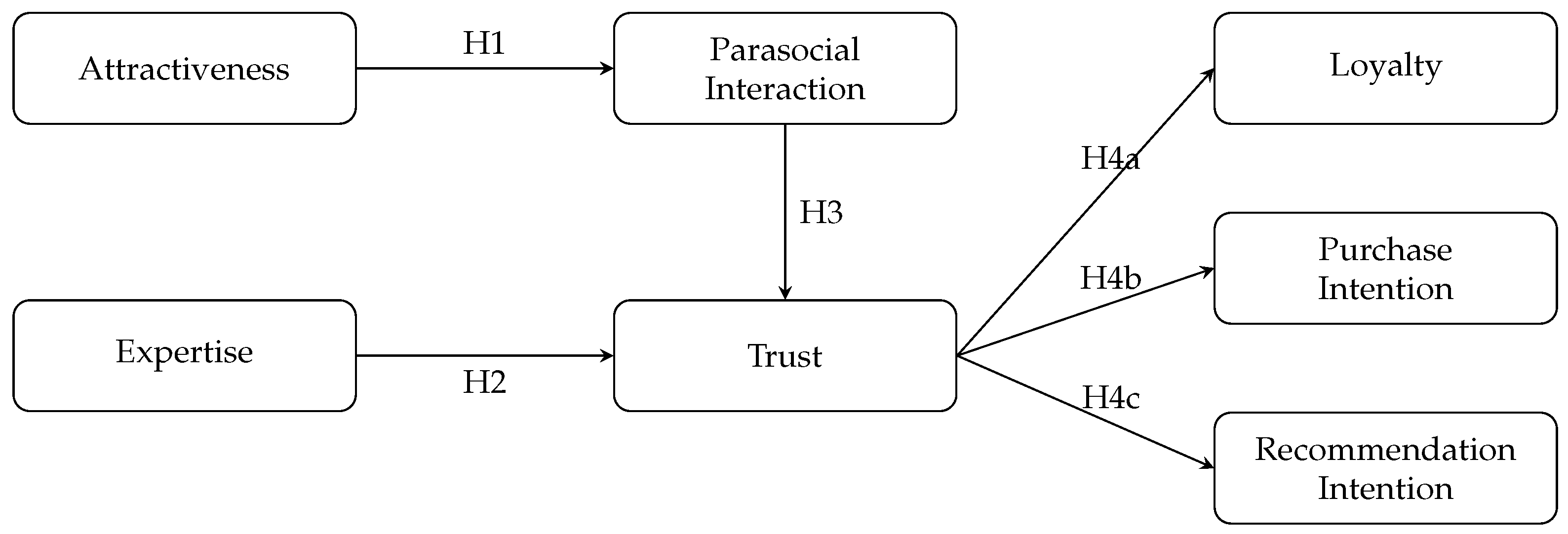
This study adopts a quantitative research design to examine how influencer attractiveness and expertise shape consumer responses through parasocial interaction and trust. Guided by the Stimulus–Organism–Response (S-O-R) framework, attractiveness and expertise are modeled as source-related stimuli, parasocial interaction and trust as organismic states, and loyalty, purchase intention, and recommendation intention as response outcomes.
As illustrated in
Figure 1, the proposed framework specifies that attractiveness predicts parasocial interaction, expertise predicts trust, parasocial interaction further strengthens trust, and trust predicts loyalty, purchase intention, and recommendation intention. Accordingly, the model explains how selected influencer cues are translated into multiple consumer responses through interconnected organismic states.
For analytical clarity, the structural relationships tested in the proposed model are expressed as follows:
where
denotes attractiveness,
denotes expertise,
denotes parasocial interaction,
denotes trust,
denotes loyalty,
denotes purchase intention, and
denotes recommendation intention.
3.2. Sample and Data Collection
The target population of this study consisted of social media users who had experience following influencers and viewing influencer-generated or influencer-endorsed content. Because the proposed framework focuses on followers’ perceptions of and responses to influencers, respondents were required to have prior exposure to influencer content in order to provide meaningful evaluations.
Data were collected using an online self-administered questionnaire developed in Google Forms. A convenience sampling approach was adopted, and the survey link was distributed through social media and online discussion platforms, including Facebook, Dcard, and PTT. Before completing the main questionnaire, respondents were asked screening questions to determine whether they regularly followed at least one influencer and whether they had previously encountered product or service recommendations made by that influencer. Only those who met these criteria were retained for further analysis.
To reduce uncontrolled heterogeneity, respondents were instructed to think of one influencer they frequently follow and to answer all items based on their overall impressions of that influencer. The questionnaire also collected several demographic and contextual variables, including gender, age, frequency of social media use, influencer content category, follower-size tier, and primary platform, in order to provide a clearer profile of the sample.
Several procedures were implemented to enhance data quality. The questionnaire included two attention-check items instructing respondents to select specific response options. During data cleaning, responses were excluded if they failed the attention checks, showed evidence of straight-lining, or had unusually short completion times that suggested insufficient engagement with the questionnaire.
Data collection was conducted from July to September 2025, during which 630 responses were received. After excluding incomplete or otherwise unusable questionnaires, 573 responses remained for further screening. Additional data-quality screening was then conducted using the predefined criteria described above. After these screening procedures, 532 valid responses were retained for the final analysis.
Because convenience sampling does not produce a statistically representative sample, the final analytical sample was used primarily to describe the composition of respondents and to test the proposed relationships within the observed dataset rather than to support claims of population representativeness. Accordingly, the findings should be interpreted as reflecting Taiwanese social media users who actively follow influencers, with the final sample being particularly informative for younger users and platform-specific social media environments.
3.3. Measurement of Constructs
All constructs in this study were measured using multi-item scales adapted from prior literature and modified slightly to fit the context of influencer marketing. The questionnaire included seven constructs: attractiveness, expertise, parasocial interaction, trust, loyalty, purchase intention, and recommendation intention. In total, the final instrument contained 27 items. All items were measured on a seven-point Likert scale ranging from 1 (strongly disagree) to 7 (strongly agree).
Attractiveness was defined as followers’ positive perceptions of an influencer’s appearance, image, and overall style, reflecting the influencer’s visual appeal and external attractiveness. This construct was measured using four items adapted primarily from Ohanian [
14] and Sokolova and Kefi [
3]. Example items included “This influencer is attractive” and “This influencer has a stylish appearance”.
Expertise referred to followers’ perceptions of an influencer’s knowledge, experience, qualifications, and evaluative ability in relation to a specific product category or field. This construct was measured using four items adapted from Ohanian [
14] and Sokolova and Kefi [
3]. Representative items included “This influencer is knowledgeable about the products he/she recommends” and “This influencer is qualified to evaluate such products”.
Parasocial interaction was defined as the one-sided psychological bond that followers develop through continued exposure to influencer content, including feelings of closeness, familiarity, and friend-like interaction. This construct was measured using four items adapted from Lee and Watkins [
4] and Lou and Kim [
5]. Example items included “I feel a sense of closeness to this influencer” and “Following this influencer feels somewhat like interacting with a friend”.
Trust referred to followers’ overall judgment that the influencer is sincere, honest, reliable, and worthy of reliance when making recommendations. This construct was measured using three items adapted from Doney and Cannon [
6] and Sirdeshmukh et al. [
8]. Example items included “The information provided by this influencer is sincere and honest” and “I can trust the promises made by this influencer”.
Loyalty referred to followers’ tendency to continue paying attention to, support, engage with, and maintain a relationship with the influencer in the future. In the present study, loyalty refers specifically to loyalty toward the influencer rather than loyalty toward the endorsed brand. This construct was measured using four items adapted from Eyal and Rubin [
21] and related influencer-based applications. Representative items included “I would continue following this influencer in the future” and “I feel attached to this influencer”.
Purchase intention referred to followers’ likelihood of purchasing, trying, or considering products recommended by the influencer. This construct was measured using four items adapted from prior studies [
2,
3,
22,
23,
24]. Example items included “I would consider buying products recommended by this influencer” and “I would be willing to try products promoted by this influencer”.
Recommendation intention referred to followers’ willingness to recommend the influencer to others and to speak positively about the influencer. This construct was measured using four items adapted from prior studies [
25] and reworded to fit the present study’s focus on recommending the influencer rather than the endorsed product. Representative items included “I am likely to recommend this influencer to others” and “I would speak positively about this influencer to people around me”.
Because the original scales were drawn primarily from English-language studies, the questionnaire was translated into Traditional Chinese using a translation and back-translation procedure following Brislin [
26]. First, the original English items were translated into Traditional Chinese by a bilingual researcher. Second, a separate bilingual translator independently translated the items back into English. The two English versions were then compared, and discrepancies were discussed and resolved in order to ensure semantic equivalence and preserve content validity across languages.
To ensure contextual appropriateness, minor wording revisions were made to all items so that they referred specifically to influencers and influencer-recommended products. Prior to formal data collection, the questionnaire was pretested with a small group of respondents to identify potential wording ambiguities, assess readability, and confirm the appropriateness of the translated items.
3.4. Data Analysis Strategy
The data were analyzed using IBM SPSS Statistics 26 and SmartPLS 4. Descriptive statistics were first used to summarize respondents’ demographic characteristics and social media usage patterns. PLS-SEM was then employed to assess both the measurement model and the structural model.
The use of PLS-SEM was appropriate because this study aimed to examine a prediction-oriented model involving multiple endogenous constructs, several mediating relationships, and multiple downstream outcomes [
27]. In addition, the proposed framework includes conceptually linked organismic states, making PLS-SEM suitable for estimating the model in an integrated manner.
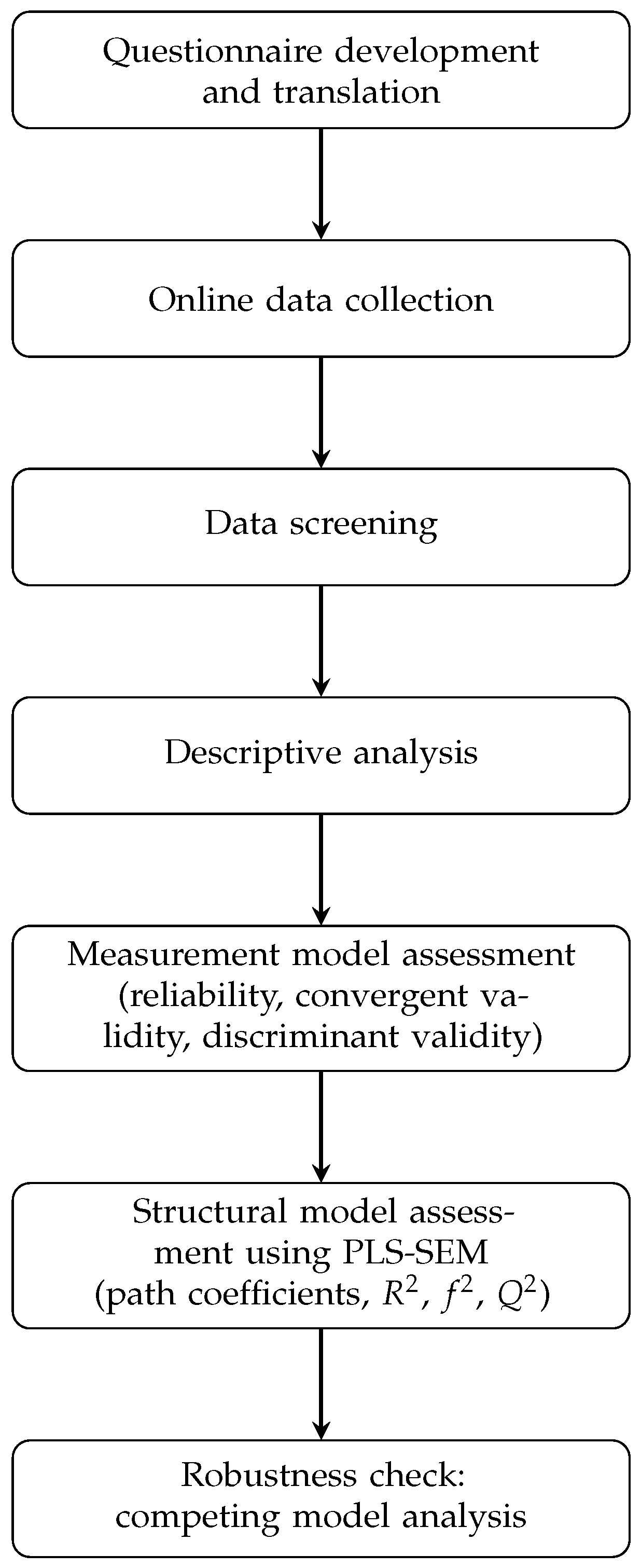
To enhance methodological transparency, the analytical procedure of this study is summarized in
Figure 2.
The procedure involved questionnaire development and translation, online data collection, data screening, descriptive statistical analysis, measurement model assessment, structural model assessment using PLS-SEM, and a robustness check through competing model analysis.
More specifically, the analysis proceeded in six steps. First, the raw questionnaire responses were screened by removing incomplete or invalid cases and by applying the predefined data-quality criteria, including attention checks, straight-lining detection, and completion-time screening. Second, descriptive statistics were computed to profile the sample and summarize the focal variables. Third, the measurement model was evaluated in terms of internal consistency reliability, convergent validity, and discriminant validity. Internal consistency reliability was assessed using Cronbach’s alpha and composite reliability (CR), whereas convergent validity was examined through indicator loadings and average variance extracted (AVE). Discriminant validity was evaluated using the Fornell–Larcker criterion [
28] and the heterotrait–monotrait ratio (HTMT) [
29]. Fourth, the structural model was assessed using bootstrapping with 5000 resamples to estimate path coefficients,
t-values, and
p-values. Fifth, the explanatory power and predictive relevance of the model were evaluated using
,
, and
values. Sixth, as a robustness check, an alternative competing model with theoretically plausible cross-paths was estimated and compared with the proposed model.
Because the study relied on a single-source, cross-sectional questionnaire, additional statistical diagnostics were conducted to assess the potential influence of common method bias. Harman’s single-factor test was treated as a preliminary diagnostic, whereas the primary assessment relied on full-collinearity diagnostics within the PLS-SEM framework. In line with prior PLS-SEM guidance [
30], variance inflation factor (VIF) values were examined for all latent constructs, and values below 3.3 were interpreted as indicating that common method bias was unlikely to pose a serious threat to the model estimates.
4. Results
4.1. Respondent Profile and Data Screening
A total of 630 questionnaires were initially collected. Before hypothesis testing, the data were screened in two stages. First, incomplete or otherwise unusable questionnaires were removed, leaving 573 responses for further review. Second, additional screening procedures were applied to enhance data quality. Specifically, responses were excluded if they failed the embedded attention-check items, exhibited straight-lining behavior, or showed unusually short completion times. After these screening procedures, 532 valid responses were retained for subsequent analysis, representing 84.44% of the original sample.
Among the excluded cases at the second screening stage, 18 failed the attention checks, 14 showed straight-lining patterns, and 9 were identified as implausibly fast responses. These screening results suggest that the data-cleaning procedures were effective in reducing careless or insufficient-effort responding.
In terms of respondent characteristics, female respondents accounted for 55.6% of the valid sample, male respondents for 41.0%, and the remainder identified as non-binary/other or preferred not to disclose their gender. With regard to age, the largest groups were respondents aged 18–24 (35.2%) and 25–34 (33.5%), followed by those aged 35–44 (23.1%) and 45 or above (8.3%). Thus, 68.7% of the sample was under the age of 35, indicating that the final sample predominantly reflects younger social media users. Regarding social media usage frequency, most respondents reported using social media for 1–3 h per day (41.9%) or 3–5 h per day (31.0%).
With respect to the influencer context, the most frequently reported influencer categories were beauty (22.4%), fashion (17.5%), and lifestyle (16.2%). In terms of follower-size tier, micro influencers accounted for 41.2% of the selected influencers, macro influencers for 38.3%, and mega influencers for 20.5%. The most commonly reported primary platforms were Instagram (34.8%), TikTok (33.5%), and YouTube (26.3%). Overall, these distributions indicate that the sample covered multiple influencer categories and platform contexts, thereby providing an adequate basis for testing the proposed model.
4.2. Measurement Model Assessment
4.2.1. Descriptive Statistics
The mean scores of the focal constructs ranged from 4.09 to 4.25 on a seven-point scale, indicating moderate to moderately positive evaluations across the measured variables. More specifically, attractiveness recorded the highest mean score (, ), followed by trust (, ), expertise (, ), parasocial interaction (, ), purchase intention (, ), recommendation intention (, ), and loyalty (, ). Overall, these results suggest that respondents held slightly favorable perceptions of the focal influencer and reported moderate levels of relational attachment, trust, and behavioral intention.
4.2.2. Reliability and Convergent Validity
The measurement model was first evaluated in terms of internal consistency reliability and convergent validity. As shown in
Table 1, all item loadings exceeded the recommended threshold of 0.70 [
27]. In addition, Cronbach’s alpha and composite reliability (CR) values for all constructs were above 0.70, indicating satisfactory internal consistency. The average variance extracted (AVE) values for all constructs also exceeded the recommended threshold of 0.50, thereby supporting convergent validity. Taken together, these results suggest that the measurement model demonstrated satisfactory reliability and convergent validity.
4.2.3. Discriminant Validity
Discriminant validity was assessed using both the Fornell–Larcker criterion and the heterotrait–monotrait ratio (HTMT). As shown in
Table 2, the square roots of the AVE values exceeded the corresponding inter-construct correlations, indicating that each construct shared more variance with its own indicators than with other constructs [
28]. Furthermore, the HTMT values reported in
Table 3 ranged from 0.077 to 0.632, all of which were below the recommended threshold [
29]. These findings provide consistent evidence that the constructs were empirically distinct and that the measurement model demonstrated satisfactory discriminant validity.
4.3. Common Method Bias Assessment
Because all variables were measured using a single-source, self-reported questionnaire, common method bias was assessed using both a preliminary diagnostic and a more rigorous PLS-based procedure. First, Harman’s single-factor test showed that the first unrotated factor accounted for 31.7% of the total variance, which is below the commonly cited threshold of 50%. This result suggests that no single factor dominated the covariance structure of the measurement items.
More importantly, full-collinearity diagnostics were evaluated following Kock (2015). As shown in
Table 4, the variance inflation factor (VIF) values for all latent constructs ranged from 1.292 to 2.255, and the highest value remained well below the recommended threshold of 3.3. These results indicate that common method bias was unlikely to pose a serious threat to the validity of the model estimates. Taken together, the findings suggest that common method bias was not severe enough to undermine interpretation of the study results.
4.4. Structural Model Results and Hypothesis Testing
The structural model was evaluated to test the proposed hypotheses. As reported in
Table 5, all hypothesized paths were positive and statistically significant, thereby supporting H1 to H4c.
Attractiveness had a significant positive effect on parasocial interaction (, , , ), supporting H1. Expertise also had a significant positive effect on trust (, , , ), supporting H2. In addition, parasocial interaction exerted a significant positive effect on trust (, , , ), supporting H3. These findings suggest that attractiveness primarily contributes to relational closeness, whereas expertise and parasocial interaction both play important roles in shaping trust.
With respect to the response variables, trust had a significant positive effect on loyalty (, , , ), purchase intention (, , , ), and recommendation intention (, , , ), thereby supporting H4a, H4b, and H4c. Among the three trust-to-outcome relationships, the strongest effect was observed for recommendation intention, followed by loyalty and purchase intention. This pattern suggests that trust is especially important in shaping advocacy-oriented responses in influencer contexts.
In terms of explanatory power, attractiveness explained 32.9% of the variance in parasocial interaction (adjusted
). Expertise and parasocial interaction jointly explained 30.7% of the variance in trust (adjusted
). Trust explained 25.5% of the variance in loyalty (adjusted
), 24.8% of the variance in purchase intention (adjusted
), and 26.9% of the variance in recommendation intention (adjusted
). Overall, these results indicate that the proposed model demonstrated moderate explanatory power across the endogenous constructs. For comparison purposes, the raw
values used in the competing model analysis are reported separately in
Table 6.
As shown in
Table 7, the effect sizes (
) ranged from 0.190 to 0.451, indicating medium to large effects across the hypothesized paths. In addition, all
values were above zero, suggesting that the model demonstrated satisfactory predictive relevance for the endogenous constructs.
4.5. Robustness Check: Competing Model Analysis
To assess the robustness of the proposed parsimonious model, an alternative competing model was estimated by adding two theoretically plausible cross-paths: Attractiveness → Trust and Expertise → Parasocial Interaction. These additional paths were included because prior research suggests that attractiveness may foster trust through a halo effect, whereas expertise may also contribute to parasocial interaction when followers admire or repeatedly seek guidance from knowledgeable influencers.
The results of the competing model are presented in
Table 8. The two additional cross-paths were not supported. Specifically, the path from Expertise to Parasocial Interaction was negligible and non-significant (
,
, 95% CI
), and the path from Attractiveness to Trust was also non-significant (
,
, 95% CI
). By contrast, the core hypothesized relationships remained stable. The effect of Attractiveness on Parasocial Interaction remained virtually unchanged (
), the effect of Expertise on Trust remained strong (
), and the effect of Parasocial Interaction on Trust remained significant, although slightly reduced (
).
Table 6 further shows that the competing model did not materially improve explanatory power. The raw
value for Parasocial Interaction remained unchanged at 0.311, whereas the raw
value for Trust increased only marginally from 0.316 to 0.318. The explanatory power for Loyalty, Purchase Intention, and Recommendation Intention remained unchanged. Overall, these findings indicate that the proposed model adequately captures the central pattern of relationships in the data and that excluding the two additional cross-paths does not materially alter the substantive conclusions.
5. Discussion
5.1. Discussion and Theoretical Implications
This study examined how influencer attractiveness and expertise shape consumer responses through parasocial interaction and trust within an S-O-R framework. Overall, the findings support the proposed framework and provide a more distinctive account of influencer effectiveness by showing that different source-related cues are translated into consumer responses through functionally differentiated internal mechanisms. More specifically, attractiveness was more strongly associated with parasocial interaction, whereas expertise was more directly associated with trust. In addition, parasocial interaction contributed positively to trust, and trust subsequently predicted loyalty, purchase intention, and recommendation intention. Taken together, these findings suggest that influencer effectiveness should not be conceptualized as a generalized source-evaluation process, but rather as a differentiated cue–mechanism–response structure.
A first theoretical implication concerns the distinct roles of attractiveness and expertise. The significant effect of attractiveness on parasocial interaction indicates that attractiveness does more than generate a favorable first impression. In influencer environments, attractiveness appears to function as a social-affective cue that enhances interpersonal appeal, approachability, and follower interest. This finding is consistent with the idea that influencers are evaluated not only as information sources, but also as socially meaningful figures with whom followers develop a sense of imagined closeness. In social media settings, where content is often self-disclosive, visually curated, and interaction-like in tone, attractiveness may strengthen parasocial interaction by making influencers appear more relatable, engaging, and emotionally accessible.
By contrast, expertise exerted a direct positive effect on trust, suggesting that followers are more willing to rely on influencers who are perceived as knowledgeable and competent, especially when recommendations involve uncertainty regarding product quality, usage, or performance. This finding reinforces the importance of distinguishing competence-based source evaluations from social-affective appeal. Whereas attractiveness appears to facilitate relational connection, expertise appears to foster reliance by increasing confidence in the influencer’s judgment. Accordingly, the present study extends source credibility research in influencer marketing by showing that different source cues should not be assumed to operate through the same internal process.
A second theoretical implication lies in the differentiation of organismic states. The positive effect of parasocial interaction on trust suggests that relational closeness and reliance should be treated as related but distinct organismic states rather than as interchangeable constructs. Feeling psychologically close to an influencer does not necessarily imply that followers are ready to rely on that influencer’s recommendations. However, parasocial interaction may create the relational conditions under which trust becomes more likely to develop by reducing psychological distance, increasing familiarity, and making recommendations feel more personally relevant. The findings therefore support a more differentiated view of the organism stage in the S-O-R framework and indicate that internal responses in influencer marketing are sequentially connected rather than theoretically redundant.
Importantly, the distinctiveness of the present study is further strengthened by the competing model analysis. Although two theoretically plausible cross-paths were added—from Expertise to Parasocial Interaction and from Attractiveness to Trust—neither path was supported. Specifically, the path from Expertise to Parasocial Interaction was negligible and non-significant (, 95% CI ), and the path from Attractiveness to Trust was also non-significant (, 95% CI ). Moreover, the competing model produced only a marginal increase in the explanatory power of Trust and no meaningful improvement for the other endogenous constructs. This pattern is theoretically important because it indicates that the proposed model is not merely a simplified version of a broader endorsement framework. Rather, it captures a more precise functional structure in which attractiveness primarily activates parasocial closeness, whereas expertise more directly supports reliance. In this sense, the study’s contribution lies not in introducing entirely new constructs, but in demonstrating that familiar constructs assume more differentiated roles when situated in influencer-based, platform-mediated relationship environments.
A third theoretical implication concerns the downstream role of trust. One of the most notable findings is that trust had the strongest effect on recommendation intention, followed by loyalty and purchase intention. This pattern warrants particular attention because recommendation intention is not simply another behavioral outcome; it is an advocacy-oriented response involving greater interpersonal visibility and reputational exposure. Purchasing a recommended product may remain a relatively private decision, whereas recommending an influencer or endorsed product to others places one’s own judgment, credibility, and social image at stake. In contemporary digital environments, where recommendations can be public, traceable, and rapidly circulated through social platforms, the social risk associated with advocacy is amplified. Under such conditions, followers are unlikely to recommend an influencer unless they perceive that influencer as sufficiently credible, dependable, and worthy of social endorsement. This helps explain why trust exerts a stronger influence on recommendation intention than on purchase intention.
This finding also contributes to current discussions of social risk in influencer marketing. In platform-based environments, consumers do not merely assess whether a recommendation is useful; they also consider how their own endorsement behavior may be interpreted by peers, followers, or online communities. Recommending an influencer to others implies a form of reputational co-signing. Trust therefore becomes especially important when consumer behavior moves from private evaluation to public advocacy. In this respect, the present study suggests that trust in influencer marketing should be understood not only as a purchase-enabling mechanism, but also as a socially protective mechanism that reduces the perceived interpersonal risk of recommendation behavior.
The study also contributes to the ongoing conceptual discussion surrounding source credibility and trustworthiness. The present model focused on attractiveness and expertise as the selected source-level cues and did not incorporate trustworthiness as a separate stimulus variable. This decision was made to preserve conceptual separation between source-level evaluations and organism-level trust. Trustworthiness, as typically conceptualized in source credibility theory, refers to the perceived honesty, sincerity, and reliability of the communicator as an attribute. Trust, in contrast, refers to the follower’s broader willingness to rely on the influencer’s recommendations under uncertainty. The findings suggest that trust can be meaningfully modeled as an organismic state without requiring trustworthiness to be treated simultaneously as a parallel source-level predictor in the same parsimonious framework. At the same time, the importance of trust in the present results indicates that the conceptual boundary between trustworthiness and trust warrants continued attention in future research.
Another implication concerns the interpretive scope of the sample. The data were drawn from Taiwanese social media users recruited through Facebook, Dcard, and PTT, and the final analytical sample was predominantly composed of younger respondents, with 68.7% under the age of 35. The findings should therefore be interpreted primarily as reflecting a Taiwanese youth and young adult perspective rather than as a universal account of consumer behavior across all age groups and platform environments. This boundary condition is theoretically important because influencer–follower dynamics are likely to vary across cultural settings, platform affordances, and age cohorts. For younger users in particular, parasocial closeness, platform-based visibility, and social endorsement norms may be especially salient in shaping how trust is formed and how recommendations are acted upon.
Taken together, these findings contribute to influencer marketing theory by clarifying how selected influencer cues are translated into multiple consumer responses through differentiated internal mechanisms. Rather than treating source-related evaluations, parasocial interaction, and trust as loosely connected correlates of influencer effectiveness, the present study shows that influencer effectiveness is better understood as a differentiated cue–mechanism–response process shaped by ongoing exposure, self-disclosure, content-based relationship building, and socially visible platform interaction. This also helps explain why influencer marketing should not be treated as a simple extension of traditional celebrity endorsement research.
5.2. Practical Implications
The findings offer several practical implications for marketers and influencer managers. Most importantly, they suggest that influencer strategy should be developed through a cue–mechanism–outcome alignment perspective. Rather than selecting influencers primarily on the basis of popularity, reach, or visibility, managers should match campaign goals with the type of cue most likely to activate the relevant internal mechanism and downstream response.
First, influencer selection should not rely solely on broad indicators of exposure. The results indicate that attractiveness and expertise contribute to effectiveness through different mechanisms. Influencers with strong visual appeal and a compelling personal image may be especially effective at fostering parasocial interaction and strengthening followers’ sense of closeness. By contrast, influencers who are perceived as knowledgeable and competent may be more effective at building trust and increasing confidence in product recommendations. Managers should therefore move beyond a one-size-fits-all view of influencer effectiveness and evaluate influencers in terms of the specific psychological route through which they are likely to influence followers.
Second, campaign objectives should be aligned with the type of influencer cue most relevant to the desired response. If the goal is to strengthen ongoing engagement, audience attachment, or long-term follower loyalty, influencers who can cultivate relational closeness may be particularly useful. Such campaigns may benefit from content emphasizing self-disclosure, lifestyle sharing, conversational tone, and continuity of interaction. If the goal is to reduce uncertainty surrounding a recommendation and encourage product trial or purchase, expertise-related signals become especially important. In such cases, managers should prioritize influencers who can provide product-relevant explanations, informed comparisons, usage demonstrations, and clear evaluative reasoning. The present findings therefore imply that effective influencer selection depends not only on who the influencer is, but also on what kind of response the campaign aims to generate.
Third, trust should be treated as a central performance mechanism in influencer strategy. Because trust significantly predicts loyalty, purchase intention, and recommendation intention, managers should pay close attention to how influencer content communicates sincerity, consistency, and evaluative competence. In practical terms, this means that campaigns should not rely exclusively on visual appeal or stylistic polish. Instead, managers should encourage influencers to provide transparent reasoning, first-hand experience, product-specific evidence, and consistent judgment over time. These trust-building elements are particularly important when brands seek not merely short-term attention, but durable relationship outcomes and commercially meaningful follower responses.
Fourth, the especially strong effect of trust on recommendation intention implies that trust is critical when campaigns depend on word-of-mouth diffusion and follower advocacy. In digitally networked environments, public recommendations are socially visible and reputationally consequential. Followers are unlikely to recommend an influencer or the influencer’s endorsed products to others unless they perceive that influencer as sufficiently reliable and socially safe to endorse. Managers seeking to stimulate recommendation behavior should therefore focus not only on generating attention, but also on cultivating the type of credibility that followers feel comfortable passing on to others. From a managerial perspective, this means that advocacy-oriented campaigns should emphasize credibility, consistency, and social transferability rather than exposure alone.
More broadly, the findings imply that effective influencer marketing requires balancing relational appeal with informational credibility. Campaigns built only on attractiveness may generate attention and emotional engagement, but their commercial and advocacy-related effectiveness may remain limited if followers do not develop sufficient trust. Conversely, expertise without relational warmth may strengthen perceived competence but fail to generate the sense of closeness needed to sustain follower attachment. Effective influencer campaigns should therefore be designed with both relational and reliance-oriented processes in mind, particularly in platform environments where follower responses are shaped by ongoing interaction, perceived intimacy, and socially visible recommendation behavior.
In this sense, the present study offers a practical decision logic for influencer campaign design: attractiveness-oriented cues are especially useful for cultivating parasocial closeness and follower attachment, whereas expertise-oriented cues are more effective for building trust and supporting conversion and advocacy outcomes. Managers who align influencer attributes, content strategy, and campaign objectives more carefully are likely to achieve stronger and more sustainable results than those who rely only on visibility-based influencer selection.
5.3. Limitations and Future Research
This study has several limitations that should be considered when interpreting the findings. First, the data were collected using a cross-sectional survey design, which does not permit strong causal inference. Although the hypothesized relationships were theoretically grounded and empirically supported, future research could adopt longitudinal, experimental, or multi-wave designs to establish temporal ordering more convincingly.
Second, the study relied on self-reported data from a single source, which may raise concerns regarding common method bias and social desirability. Although both procedural remedies and statistical diagnostics suggested that common method bias was unlikely to pose a serious threat, future research could strengthen the design by incorporating behavioral indicators, observational data, or multi-source data.
Third, the sample was obtained through convenience sampling and should not be interpreted as fully representative of the broader population. More specifically, the final analytical sample primarily reflects Taiwanese social media users who actively follow influencers and is especially informative for youth and young adult users. Future research could test the proposed framework across different age groups, cultural settings, and platform-specific environments to examine whether the observed pattern of relationships varies across social media contexts.
Fourth, the present study adopted a theoretically focused and parsimonious model. Although this approach allowed for clearer construct separation and sharper theoretical interpretation, future research may extend the framework by incorporating additional source-level cues, including trustworthiness, or by examining whether platform characteristics, influencer type, or product category moderate the observed relationships. Such extensions would help clarify how stable the present findings are across different configurations of influencer marketing.
Finally, the present study examined recommendation intention, purchase intention, and loyalty as downstream outcomes, but other responses may also be relevant. Future research could expand the outcome domain by examining variables such as engagement behavior, content sharing, message acceptance, resistance to persuasion, or long-term relationship maintenance. Such work would further clarify how trust operates across different stages and forms of influencer-related consumer response.