
Article

Course-Bound and Beyond-Course Interaction in Higher Education: Exploring the Latent Structure of a Perception Scale

by
Andrés F. Mena-Guacas
1,*,
Eilien Tovio-Martínez
1,
Claudia Liliana Muñoz
1 and
Eloy López-Meneses
2
1
Education Faculty, Universidad Cooperativa de Colombia, Avenida Caracas # 37-63, Bogotá 111311, Colombia
2
Departamento de Educación y Psicología Social, Universidad Pablo de Olavide, 41013 Seville, Spain
*
Author to whom correspondence should be addressed.
Computers 2026, 15(4), 205; https://doi.org/10.3390/computers15040205
Submission received: 16 January 2026 / Revised: 15 March 2026 / Accepted: 18 March 2026 / Published: 26 March 2026
(This article belongs to the Special Issue Recent Advances in Social Networks and Social Media (2nd Edition))

Abstract

This study explores the latent structure of students’ perceptions about (a) teacher strategies to promote interaction (FOM) and (b) perceived interaction with actors and content (ACT) in undergraduate courses. Using survey responses from 158 students, we conducted exploratory factor analysis (MINRES, varimax) after assessing factorability (KMO, Bartlett) and factor retention (parallel analysis). Analyses were conducted in Python (Google Colab) using pandas, NumPy, SciPy, factor_analyzer, and Pingouin. an interpretable two-factor solution in which FOM items load primarily on one factor, while a subset of ACT items (Act5–Act8) loads more strongly on a second factor, although several ACT items and some FOM items also show non-trivial cross-loadings. We interpreted factor loadings ≥ 0.30 and report results based on the corrected item set. Findings are exploratory and suggest that perceived promotion of interaction aligns more closely with within-course interaction targets than with extra-course ones.

1. Introduction

Social life comprises a network of complex interactions across various spheres of human activity, including the professional realm, and occurs when individuals engage in shared activities (Trevelyan 2010; Child & Shaw 2019) [1,2]. Meaningful social interactions contribute to the formation of personal identity and self-concept clarity through shared experiences and social validation (Koudenburg et al., 2024) [3]. These interactions are essential for the development and functioning of society. In educational settings, they offer students the chance to develop new ethical perspectives by exploring behaviors, attitudes, and philosophies of life, encouraging them to reflect, debate, and build their identity based on their training and evolution (Raufelder et al. 2016) [4]. In traditional classrooms, social interaction improves the learning performance of handicapped students (Sarwar & Sherief, 2024) [5] and their engagement (Ciudad et al., 2023) [6]. Social interaction within academic environments enhances faculty members’ social capital, benefiting from organizational dynamics, security, standardization, value creation, compensation, education, skills development, and personality growth (Samouei et al. 2022) [7]. In this sense, it is also worth mentioning that the purpose of higher education spans more than just career preparation, including socializing students to broader perspectives and helping them clarify their value (Trinidad et al., 2021) [8].
Recent studies have highlighted the multifaceted benefits of social interaction in university settings, emphasizing its critical role in supporting student and faculty success. Jeram (2023) [9] stressed how such interactions, particularly in large lecture halls, foster social connections, well-being, and persistence among students. Miao and Ma (2022) [10] extended this understanding to online learning and demonstrated that social engagement promotes self-regulation and social presence, leading to greater participation and improved learning outcomes. Similarly, Ayalew (2022) [11] identified the enhancement of social integration, support networks, a sense of belonging, and better academic performance as key outcomes of these interactions, which is reinforced by Jia and Stapa (2024) [12], who point out that the use of the social interaction strategy provides a natural and conducive environment for students to socialize and cooperate in achieving group goals. Finally, it is noteworthy that students’ boundary-crossing movements between academic and out-of-university activities can lead to specific learning processes (Cattaruzza et al., 2022) [13]. For early career faculty, Atalay et al. (2022) [14] underscored the importance of social engagement in aiding organizational and professional socialization while fostering a supportive and inclusive academic environment. Additionally, Nguyen (2021) [15] highlighted the significance of interactions beyond the classroom, noting their role in improving communication skills, building relationships, and boosting overall student engagement.

Interactions Inside and Outside the Classroom

In learning environments, interaction can take place between students and teachers (Akçay, 2022) [16], between students and content (Akçay, 2022; Al Mamun & Lawrie, 2023) [16,17], and between students and resources and methods (Dos Santos and Nicot, 2020) [18]. This interaction can occur both within and outside the course (Ellinger et al. 2023) [19]. On the one hand, the continuous exchange between the teacher and students during the course fosters personal and cognitive growth (Reason, Terenzini, & Domingo, 2006) [20] and leads both parties to modify not only the course content but also their own perspectives through dynamic argumentative discussions (Manrique & Valle, 2023) [21]. On the other hand, a supportive community environment that includes external actors, such as family and friends, creates a space for interaction that significantly impacts student well-being (Douwes et al., 2023) [22]. Moreover, evidence has shown that student–teacher interaction outside the classroom is linked to various positive outcomes (Cuseo, 2015) [23].
It is important to note that the external actors with whom students interact include not only teachers and peers from the same or different faculties but also friends and family and, according to the Tsymbalaru (2019) [24] curriculum and school policies. Academic administrators, individuals from other areas, employers, and content outside the curriculum should also be considered. Pineda Morales and Ortiz (2011) [25] emphasized that the interaction between a university and its broader environment can have social, business, or cultural dimensions. These interactions should align with internal capabilities and the diverse needs of society and should not be limited to economic considerations alone.
However, interactions with external actors, such as faculty members, are relatively uncommon, particularly outside classrooms (Cox et al., 2010) [26]. Most research has focused on interactions occurring within the classroom (Cox and Orehovec, 2007) [27], with few studies examining interactions outside it (Volkwein, King & Terenzini, 1986) [28]. Therefore, this research distinguishes course-bound and extra-course interaction targets, as student-environment interaction is crucial for holistic learning (Vygotsky, 1978) [29]. Here, it is important to clarify that the extra-course domain, as operationalized in this study, includes not only interaction targets beyond the course, but also self-sourced learning resources not provided by the instructor. Accordingly, extra-course is used as an umbrella label rather than as a fully homogeneous construct. Additionally, such interactions promote interdisciplinarity, which is essential for addressing global challenges (Tarrant & Thiele 2017) [30] and creates a more innovative and stimulating learning environment that can enhance critical thinking and creativity (Christensen et al., 2021) [31]. Furthermore, engagement with key actors—employers—offers significant benefits for developing skills and employability. For example, internships not only enhance students’ competencies but also increase their attractiveness to employers (Chen & Gan, 2021) [32].
As a counterpoint, Astin (1984) [33] highlighted that students’ limited time and energy often compete with external demands such as friends, family, and employment, which can impact their personal development and commitment to education. This consideration is important because encouraging interaction with external actors may inadvertently reduce students’ educational engagement.
Recent research has highlighted the diverse advantages of social interaction in university academic settings, underlining its essential role in enhancing the success of both students and academicians. Although interactions occurring inside classrooms have been extensively studied, those occurring outside have not been deeply examined.
Despite the growing literature on interaction in technology-mediated learning, most studies prioritize interactions occurring within the immediate course environment (e.g., student–teacher, student–student, student–content designed by the instructor). Less attention has been paid to interaction patterns that extend beyond the course boundaries—such as engagement with external actors (e.g., peers from other programs, institutional staff, or people outside the university) and with resources not provided by the instructor. Importantly, these beyond-course activities are not conceptually identical: some involve boundary-crossing social or institutional engagement, whereas others involve self-directed use of non-instructor-provided learning resources. This gap matters because these external interactions may shape students’ learning opportunities and their perceived support network in blended or online settings. To address this gap, this study examines interaction practices by distinguishing course-bound interactions from extra-course activity, while acknowledging that the latter may include more than one form of engagement, and it uses exploratory factor analysis to examine how these targets are structured in higher education.
Considering the above, the question guiding this research is as follows: To what extent are perceived teacher strategies to promote interaction (FOM) associated with students’ perceived interaction with actors and learning resources located within and beyond the focal course (ACT)?

2. Methodology

2.1. Research Design

This study followed a quantitative, cross-sectional design. We performed an exploratory factor analysis (EFA) to examine the latent structure of the questionnaire items. Analyses were conducted in Python 3.12.13 (Google Colab) using pandas, NumPy, SciPy, factor_analyzer, and Pingouin. Item-level measures of sampling adequacy (MSA) ranged from 0.83 to 0.96, indicating very good to excellent adequacy for all items and supporting the suitability of the correlation matrix for EFA. Internal consistency was assessed for each dimension using Cronbach’s α and McDonald’s ωt. Omega was computed separately for ACT and FOM using a one-factor common-factor model (MINRES) for each subscale, as a model-based reliability index consistent with the exploratory nature of the study. Sampling adequacy and factorability were assessed with the Kaiser–Meyer–Olkin (KMO) measure and Bartlett’s test of sphericity. The number of factors to retain was determined through parallel analysis. EFA was estimated using the minimum residual method (MINRES) with varimax rotation. Factor loadings ≥ 0.30 were used for interpretation. Varimax rotation was used in this exploratory phase to facilitate simple-structure interpretation of the adapted item set. Although conceptual overlap between ACT and FOM suggests that oblique rotation may also be plausible, the present analysis prioritized interpretability as an initial step in scale refinement.
Data handling. All ACT and FOM items were answered on a 0–4 Likert scale. For the main analyses, responses were treated as approximately interval to compute Pearson correlations, consistent with common practice in exploratory analyses of Likert-type items. Because these indicators are ordinal, an additional sensitivity analysis was conducted using polychoric correlations. Specifically, the retained two-factor exploratory factor solution was re-estimated on the polychoric correlation matrix using the same extraction and rotation settings as in the main analysis (MINRES + varimax). This supplementary analysis was used to assess whether the substantive interpretation of the factor structure was robust to ordinal-data handling assumptions. Missing data were not present in the analytic dataset (N = 158): there were no missing values in the ACT+FOM item set; therefore, no imputation procedures were required.
In this study, extra-course is treated as an umbrella label for learning-related activity that extends beyond the immediate instructional design of the focal course. Importantly, this umbrella does not refer to a single homogeneous type of engagement. Rather, it includes at least two conceptually distinct forms: (a) the use of non-instructor-provided resources to support learning and (b) boundary-crossing interaction with actors or institutional units beyond the course. The former refers to self-sourced materials such as videos, open courses, or documents, whereas the latter refers to exchanges with other groups, campuses, university units, or external individuals. For exploratory purposes, both forms were initially retained within the ACT block; however, the empirical pattern suggests that they may function differently and therefore should be examined as distinct but related subdimensions in future studies.
Internal consistency coefficients (Cronbach’s α) were estimated to assess score reliability, not construct validity. Evidence for validity in the present study is limited to (i) content-oriented procedures (expert review/pilot testing) and (ii) internal structure evidence from EFA (factorability tests, factor solution interpretability, and item loadings). Additional validity evidence (e.g., convergent/discriminant validity and criterion validity) requires external measures and is therefore reserved for subsequent studies.

2.2. Research Population and Sample

The survey link was distributed by the Academic Subdirection to the undergraduate student body at the Bogotá campus. A total of 167 responses were received; 158 participants provided informed consent and were included in the analyses. The exact number of students who received the invitation was not available to the research team; based on administrative estimates, the invited population was approximately 800 students. Therefore, the response rate is reported descriptively rather than as a precise percentage. All results reported in this manuscript correspond to the final analytic sample (N = 158).
All legal age participants received comprehensive information about the study and had the opportunity to address any questions or concerns. The digital questionnaire included an informed consent section in which participants were required to affirmatively check in order to proceed with completing the instrument, outlining the academic purposes of the study, and affirming their right to withdraw at any time. The confidentiality of the data is ensured, and the participants’ rights are fully respected.
Table 1 presents the distribution of the consented analytic sample across academic programs and semesters (N = 158). These data are reported to characterize the composition of the participating group used in the psychometric analyses and to contextualize the descriptive heterogeneity observed in factor scores across academic contexts. Because the invited population was available only as an administrative estimate and no complete sampling frame was accessible to the research team, the representativeness of the consented sample cannot be formally established. Accordingly, the findings should be generalized cautiously and interpreted as exploratory evidence from the participating students rather than as precise estimates for the full invited population.

2.3. Instrument

The instrument used was a Likert-scale questionnaire (Appendix A) with five response options ranging from 0 to 4 (very low, low, medium, high, and very high). The questionnaire was adapted from Abril and Alvarado (2020) [34], whose instrument is reported in their Appendix A and was originally taken and adapted from Mena (2018) [35]. The ACT block was refined to differentiate (a) course-bound targets, (b) self-sourced resources beyond the teacher-provided materials, and (c) actors or institutional units beyond the focal course. The FOM block was expanded beyond the five practices reported in Abril and Alvarado (2020) [34] to improve content coverage in higher-education collaborative learning contexts; a provenance/adaptation map is provided in Appendix A.
The instrument was organized into five sections: (I) informed consent, (II) characterization, (III) actors and content with whom students interact (ACT), (IV) teacher promotion of interaction (FOM), and (V) level/quality of interaction (NIV). The informed consent section described the study objectives, emphasized voluntary participation, assured anonymity, and specified that the data would be used exclusively for academic and research purposes; participants authorized data use before starting the questionnaire. Section II included two items on academic program and current semester of enrollment.
For the analyses reported in this manuscript, we focused on Sections III and IV, which contain the items directly related to students’ perceived interaction with actors/content and teachers’ strategies to promote interaction. Section III (ACT) comprised eight items (Act1–Act8) in which participants rated the degree of interaction perceived with various actors and resources in their courses. Section IV (FOM) comprised seven items (Fom1–Fom7) in which students evaluated the extent to which teachers emphasized actions aimed at fostering interaction in the courses they attended. Section V (NIV) is part of the full instrument; however, it is outside the scope of the psychometric analyses reported here, which focus on the ACT and FOM constructs.
Internal consistency was assessed for each dimension using Cronbach’s α and McDonald’s ωt. Omega was estimated separately for ACT and FOM using a one-factor common-factor model (MINRES) for each subscale, as a model-based reliability index consistent with the exploratory phase. Omega estimates are reported as reliability evidence and should not be interpreted as confirmatory validation.

2.4. The Items

Table 2 and Table 3 present the final set of questionnaire items included in this study. Items are grouped by section: ACT (Act1–Act8) for perceived interaction with actors and content, and FOM (Fom1–Fom7) for teacher strategies to promote interaction. During data screening, we identified that the FOM item “Plan the interaction among the course actors” had been presented twice in the administered questionnaire. For the psychometric analyses reported here, the first occurrence was retained and the second duplicate response column was removed prior to reliability estimation, correlation analysis, and EFA, so that the final analytic FOM set comprised seven unique items. As a quality-control check, the two duplicate columns were compared and showed substantial association rather than exact redundancy (Spearman’s ρ = 0.740, p < 0.001; exact agreement = 64.8%), supporting the decision to retain a single version of the item in the analytic dataset. The first occurrence was retained and the second duplicate column was dropped prior to analysis. All analyses reported in this manuscript are based on the corrected item set shown in Table 2 and Table 3 and Appendix A.

2.5. Reliability Tests

The instrument is based on that of Abril and Alvarado (2020) [34], with adjustments made for word-specific items. The study was validated by two experts: a Doctor of Sociology from Universidad Andrés Bello and a Doctor of Education Sciences from Universidad Cooperativa de Colombia. Each expert independently reviewed item relevance, wording clarity, and coverage of the intended constructs (ACT and FOM). Feedback was consolidated in a joint review, and minor wording adjustments were implemented to improve clarity and avoid ambiguity, while preserving the original intent of each item.
A pilot study was conducted with 55 participants between 17 and 23 May 2023, using the Outlook Forms tool, which was licensed by Universidad Cooperativa de Colombia. In addition to completing all the questionnaire items, the participants were asked two additional questions. The first was a closed-ended question in which the participants provided feedback on the instrument’s clarity, length, and time required to complete it. The second was an open-ended question that allowed participants to offer suggestions for improving the instrument. The results are presented in Table 4:
Lastly, internal consistency was evaluated at the dimension level (ACT and FOM) using Cronbach’s α and McDonald’s ωt. Omega was estimated separately for each subscale using a one-factor common-factor model (MINRES), as a model-based reliability index consistent with the exploratory phase.

3. Results

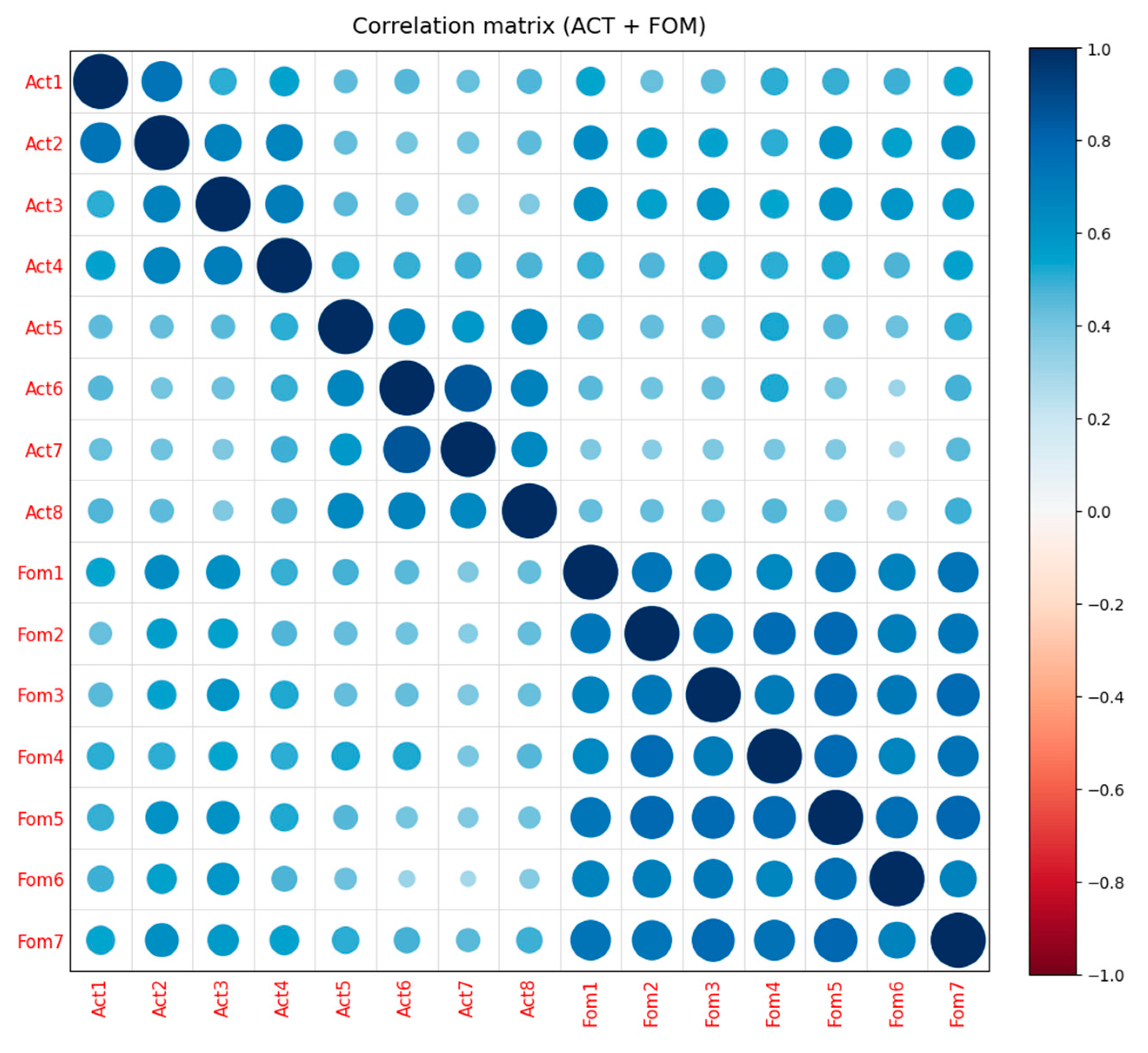
Figure 1 presents a bubble plot of the correlation matrix for the ACT and FOM items. The pattern suggests that Act5–Act8 are comparatively less correlated with the FOM items than Act1–Act4, which is consistent with a differentiated subgroup of interaction targets (see Table 5). To examine the latent structure of the ACT + FOM item set (15 items; N = 158), we conducted an exploratory factor analysis (EFA). The dataset showed adequate factorability (KMO = 0.9243; Bartlett’s test of sphericity: χ2 = 2001.49, p < 0.001). Internal consistency was strong overall (α = 0.9453) and at the dimension level (ACT: α = 0.8999, ωt = 0.902; FOM: α = 0.9496, ωt = 0.950). These indices provide reliability evidence consistent with an exploratory measurement phase; the factor structure should be examined in independent samples in future confirmatory work.
As an additional sensitivity check for ordinal data handling, the retained two-factor EFA solution was re-estimated using a polychoric correlation matrix while preserving the same extraction and rotation settings as in the main analysis (MINRES + varimax). The polychoric-based solution reproduced the same general structure observed with Pearson correlations: FOM items loaded primarily on the first factor, whereas Act5–Act8 loaded more strongly on the second factor. Act4 again showed a mixed pattern, with similar loadings on both factors. Overall, the ordinal sensitivity analysis did not materially alter the substantive interpretation of the factor structure (Table S1).
Item-level KMO (MSA) values were acceptable across all items (0.83–0.96), with the lowest values observed for Act6 and Act7 (Table 6). The overall KMO measure was 0.9243, indicating that the correlation matrix is suitable for factor analysis. Table 6 presents the MSA for each item, from which it can be observed that all items contribute.
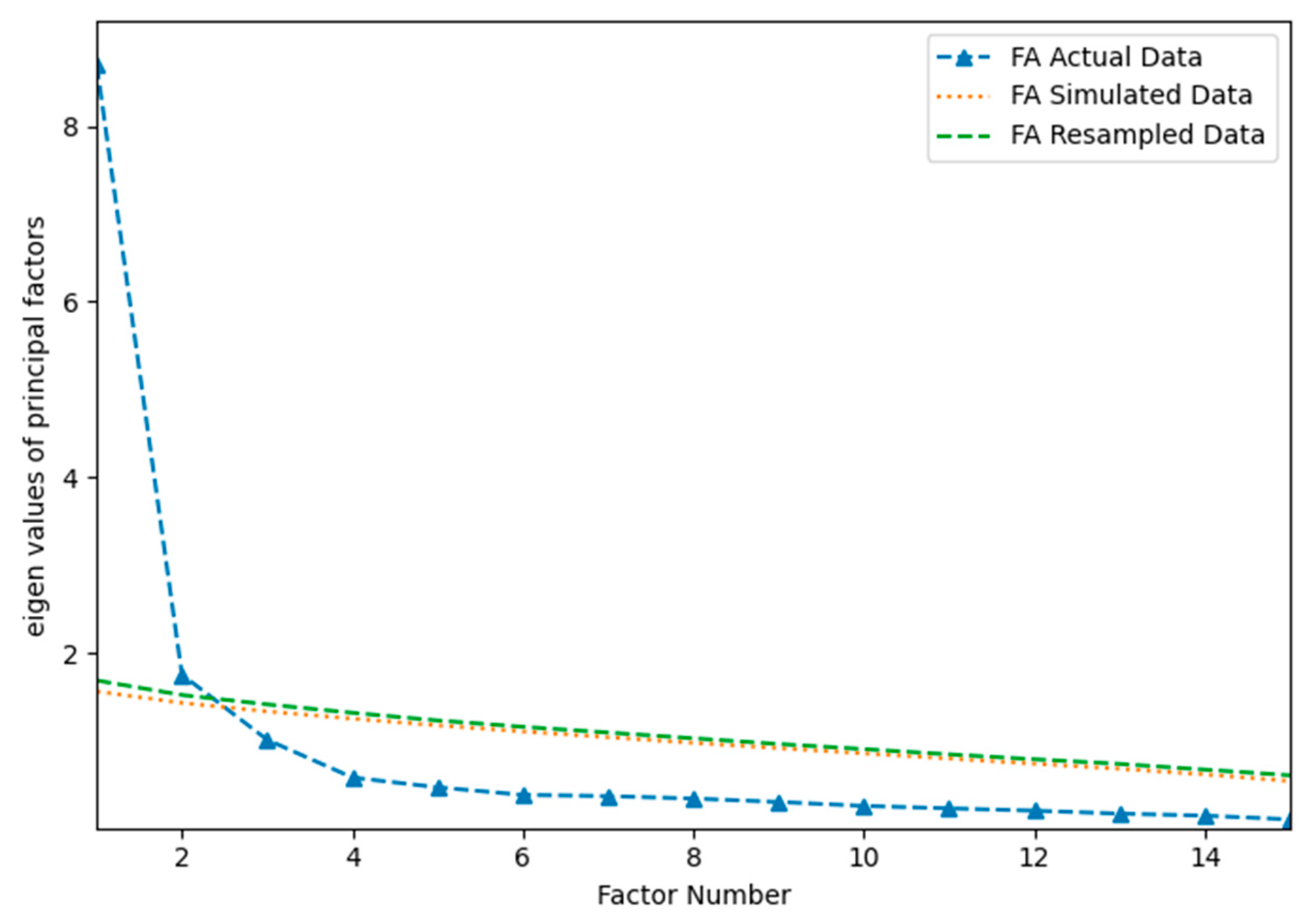
Parallel analysis was used to determine the number of factors to retain (Figure 2 and Table 7). Using both the mean and the 95th-percentile criteria for random eigenvalues, the analysis suggested a two-factor solution. Accordingly, subsequent EFA models were estimated with two factors. The two-factor solution explained 65.6% of the total variance (Factor 1: 41.0%; Factor 2: 24.5%). We also report rotated loadings and communalities (h2) to evaluate how well each item is represented by the retained factor solution. Communalities were computed as the sum of squared loadings across retained factors. However, for items with notable cross-loadings, interpretability depends more on the pattern of relative loading dominance than on a strictly simple loading structure.
Table 7 indicates that the retained two-factor solution is interpretable but not characterized by a fully simple structure. Several ACT items (especially Act1–Act5) show non-trivial cross-loadings, with Act4 displaying an almost even split across the two factors. In addition, some FOM items (notably Fom1, Fom4, and Fom7) also exhibit secondary loadings on MR2. These results suggest that the factors are distinguishable at the level of dominant item clustering, but not sharply separated at the level of all individual loadings. Table 7 also reports communalities (h2), which indicate how well each item is represented by the retained solution; overall, these values suggest that the two-factor model still captures a meaningful proportion of item variance even when some items are not uniquely associated with a single factor. Thus, the two-factor solution remains interpretable because the dominant loading pattern is coherent, even though several items exhibit meaningful cross-loadings that soften the separation at the item level.
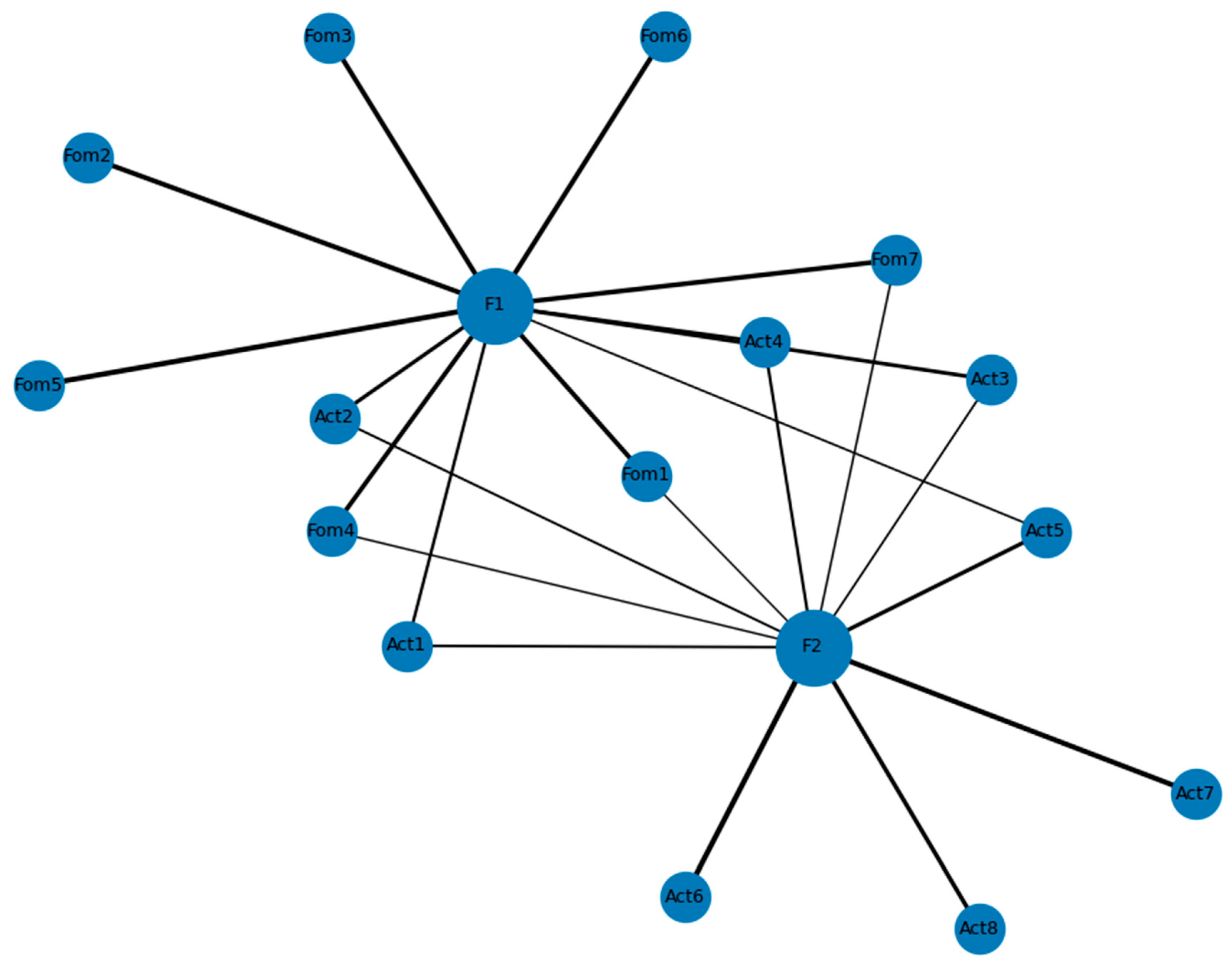
Also, Figure 3 graphically presents the factor analysis results for the questionnaire data. The two-factor model explained 65.6% of the total variance (Factor 1: 41.0%; Factor 2: 24.5%). However, this structure should be interpreted with caution, as several items showed non-trivial cross-loadings.
Robustness check (program and semester). As an additional check, factor scores were examined across academic programs and semesters using the original survey metadata for the consented sample (N = 158). Program and semester jointly explained a proportion of variance in factor scores (F1: R2 = 0.233, p = 0.034; F2: R2 = 0.314, p < 0.001), indicating that perceived interaction patterns vary across academic contexts. This check is descriptive and does not constitute measurement invariance testing. Importantly, this heterogeneity does not alter the interpretation of the two-factor structure; rather, it suggests that contextual factors may contribute to differences in perceived interaction beyond the immediate course setting.
The program and semester distribution of the consented analytic sample is reported in Table 1 to contextualize this heterogeneity. These descriptive differences should not be interpreted as evidence of representativeness or measurement invariance.

4. Discussion

Figure 1 displays the correlation matrix for the ACT and FOM items using a bubble plot, where circle size reflects the magnitude of the correlation, and color indicates its direction. Overall, FOM items show strong intercorrelations, suggesting that students perceive teacher strategies to promote interaction as a coherent set of practices. In contrast, the ACT items present a differentiated pattern: Act1–Act4 correlate more strongly with each other and with the FOM items, whereas Act5–Act8 form a comparatively distinct subgroup and exhibit weaker correlations with the remaining items. Table 5 provides a focused view of this pattern, showing that correlations involving Act5–Act8 are generally moderate-to-weak, with several values below 0.50 and some below 0.30, indicating limited alignment between these interaction targets and the rest of the instrument.
To further examine the latent structure of the ACT+FOM item set, we conducted an exploratory factor analysis. Table 6 shows that item-level sampling adequacy was acceptable (MSA/KMO values ranging from 0.83 to 0.96), supporting the suitability of the dataset for factor analysis. Parallel analysis (Figure 2) indicated a two-factor solution. Accordingly, an EFA using the minimum residual method (MINRES) with varimax rotation was estimated, and factor loadings ≥ 0.30 were used for interpretation (Table 7). The resulting structure is consistent with the correlational evidence: FOM items load predominantly on one factor, while a subset of ACT items—especially Act6–Act8, and to a lesser extent Act5—load more strongly on a second factor (Table 7; Figure 3). By contrast, Act4—focused on non-instructor-provided content—showed a more mixed position, suggesting that self-sourced resource use may be closer to within-course learning regulation than to boundary-crossing social or institutional interaction. Together, these results suggest that students perceived teacher efforts to promote interaction (FOM) are more closely aligned with perceived interaction targets commonly situated within the immediate course context, whereas the second factor is defined mainly by interaction targets involving actors or institutional units beyond the focal course. At the same time, the presence of several non-trivial cross-loadings indicates that this two-factor solution should be interpreted as differentiated but not cleanly partitioned, particularly for Act1–Act4 and for a small subset of FOM items.
These findings should be interpreted as exploratory and descriptive. Because the study relies on cross-sectional self-reported perceptions, the results do not support causal conclusions about instructional effectiveness or claims of success or failure. Rather, they indicate a differentiated pattern in how interaction targets relate to perceived teacher promotion of interaction. A plausible explanation is that interaction beyond the course context may depend on additional conditions not captured in the present design, such as institutional arrangements (e.g., structured partnerships, external projects), access to external networks and opportunities, course modality and logistics, or students’ prior experiences. Future research could test this structure using confirmatory factor analysis in independent samples and examine whether the relationship between perceived promotion of interaction and external interaction targets varies by program characteristics, course design features, or the availability of authentic engagement opportunities beyond the classroom.

Comparison with Previous Studies

Teachers employ various strategies to foster interaction in learning environments. Display questions, scaffolding, and referential questions are commonly used to provoke student conversations (Farrelly & Sinwongsuwat, 2021) [36]. In smart classrooms, the preparation of resources, technology-supported cooperative learning, and technology-based assessment strategies can enhance interactions between teachers and students and between individuals and computers (Kang & Yang, 2023) [37]. Preservice teachers recommend combining student interests with didactic media, providing motivational videos, applying total psychological response methods, and utilizing web-based learning to create an active learning environment (Wibowo et al., 2020) [38]. However, some teachers still rely on traditional approaches, leading to teacher dominance and student passivity (Ncube & Newlin, 2021) [39]. Challenges include a lack of student response, a preference for passivity, and a lack of active verbal participation (Farrelly & Sinwongsuwat, 2021) [36]. To address these issues, teachers should employ more engaging strategies that promote critical thinking, creativity, and discovery learning (Ncube & Newlin, 2021) [39].
According to the results, Figure 3 shows that the promotion items (FOM) cluster predominantly with Act1, Act2, and Act3, although these items also retain non-trivial secondary loadings, which more clearly to interaction targets within the immediate course context. Act4, however, occupies a more intermediate position. Although it is related to learning activity connected to the course, it refers specifically to self-sourced content different from that proposed by the teacher and therefore should not be interpreted as fully equivalent either to course-bound interaction or to boundary-crossing social engagement. In contrast, items Act5, Act6, Act7, and Act8—related to interaction with actors and content beyond what is proposed for the course—exhibit a comparatively different pattern, with stronger primary loadings on the second factor despite some residual overlap. Table 5 also indicates that correlations involving Act5–Act8 are among the lowest in the matrix. This suggests that variation in the remaining items is only weakly associated with variation in these four items. In practical terms, while some association may exist, the alignment between perceived promotion of interaction and interaction targets outside the immediate learning environment appears limited in strength and consistency.
The above suggests that the strategies implemented by teachers to promote interaction within educational environments, as described in prior work (Farrelly & Sinwongsuwat, 2021; Kang & Yang, 2023; Wibowo et al., 2020; Ncube & Newlin, 2021) [36,37,38,39], may be more closely aligned with interaction targets within the course than with boundary-crossing interaction targets beyond it. At the same time, the mixed loading of Act4 suggests that the use of non-instructor-provided resources may represent a partially different phenomenon—one linked less to social or institutional boundary crossing and more to self-directed extension of course-related learning. Alternatively, it is possible that strategies known to support active learning and interaction (Nafea, 2020; Rossi et al., 2019) [40,41] are not being implemented with sufficient intensity, structure, or opportunities to translate into perceived interaction with external actors and content. The most serious aspect of this situation is that previous research suggests that interaction with actors and content outside the course can foster learning, promote interdisciplinarity, and enhance employment opportunities, as discussed below.
Research and observations from various studies highlight the critical role that interaction with individuals outside a traditional course framework plays in enhancing learning outcomes. Hurst et al. (2013) [42] established that socially interactive learners are more engaged, a notion supported by the importance of student–faculty interactions highlighted by Komarraju, Musulkin, & Bhattacharya (2010) [43] and the benefits derived from positive interactions with faculty members as noted by Cox et al., (2010) [26]. The positive impact of quality relationships and communication with faculty on student grades was evident in the findings of Anaya and Cole (2001) [44], suggesting that the academic benefits of external interactions are substantial. Furthermore, innovative educational strategies like mentor co-teaching have been shown to improve learning satisfaction and efficacy (Chen et al., 2013) [45], while industry engagement through internships and plant tours (Burns & Chopra 2017) [46], collaborative entrepreneurial efforts with start-up companies (Saukkonen et al. 2016) [47], can enhance practical experience and professional skills. The data from this study, presented in Figure 3, indicates that interaction targets beyond the immediate course context (Act5–Act8) are less aligned with perceived teacher promotion of interaction. Consequently, opportunities for the benefits reported in prior research may be less likely to emerge unless external engagement is intentionally supported through structured opportunities and course design.
The positive impact of interaction with actors outside the course is also linked to interdisciplinarity. This is not just beneficial; it is imperative for solving world problems (Tarrant & Thiele 2017) [30] and fostering sustainable development (Vasilyeva, 2020) [48]. Ashby and Exter (2018) [49] and Urea (2015) [50] emphasized the value of enhancing problem-solving skills and competencies. The ability to work and communicate in an interdisciplinary context does not arise by itself (Godemann, 2006) [51]; therefore, teachers should promote this ability from within their courses. In the present study, the observed separation between within-course interaction targets (Act1–Act4) and external interaction targets (Act5–Act8) suggests that external engagement may require additional supports and opportunities beyond generic interaction-promoting strategies. Consequently, the development of interdisciplinary competence that could be facilitated through external interaction may be less likely to occur unless external engagement is intentionally integrated into course design. It is important to pay attention to this matter because the teacher plays a key role in promoting the development of students’ interdisciplinary competence by designing activities to enhance skills in virtual environments (González-M, Rodriguez-Paz and Caballero-Montes, 2019) [52] and through collaborative projects (González-Carrasco et al. 2016) [53]. In summary, intercultural competence is promoted through intentional classroom design (Havis, 2020) [54] and teaching strategies (Hadri, 2022) [55]. It should also be noted that interdisciplinary and international experiences greatly enrich traditional learning (Arnold et al., 2022) [56] and impact learning skills, motivation, and collaboration (Berasategi et al., 2020) [57]. Despite the evident benefits and student enthusiasm for such approaches, as noted by Gill et al. (2021) [58], there remains a call for greater commitment to interdisciplinary training (Morales, 2021) [59].
Finally, interaction with external actors in the course context, particularly employers, has been associated with benefits for students’ employability prospects. Binder et al. (2015) [60], for example, underscore this by highlighting the positive effects of internships on academic outcomes and career indicators, benefiting both advantaged and disadvantaged students. This is further supported by Baert et al. (2019) [61], who conducted a field experiment and found that internship experience boosted the probability of being invited to a job interview by 12.6%. Ramírez et al. (2017) [62] also align with this perspective, acknowledging the role of internships in improving employment opportunities. Moreover, Hergert (2009) [63] highlighted the invaluable connections and networking opportunities that internships provide, directly contributing to enhanced employment prospects. Vukić (2020) [64] also stated that many students secure employment opportunities during their internships. Angelique (2001) [65] emphasized the empowering effect of internships, facilitating the development of collaborative relationships within the community, and further enriching students’ professional readiness and appeal to potential employers. Although this evidence refers primarily to internships, it highlights the broader relevance of creating structured opportunities for interaction with external actors. In the present study, external interaction targets (Act5–Act8) appear less aligned with perceived teacher promotion of interaction, suggesting that such benefits may require intentional course design and institutional supports rather than relying solely on generic interaction-promoting strategies.
The weaker associations for extra-course interaction (ACT5–ACT8) should be read as a potential decoupling between course-level fostering strategies and interaction dynamics beyond the course, rather than as evidence that such interaction “does not occur.” This interpretation applies more clearly to boundary-crossing interaction with actors or institutional units beyond the course than to Act4, whose mixed loading suggests that self-sourced resource use occupies a more intermediate position. A plausible explanation is structural: instructors can directly design and scaffold in-course interaction, whereas extra-course interaction depends on opportunities and constraints that are not systematically embedded in the course. In addition, time and grading incentives may shift student effort toward assessed activities, and unequal access to external networks (social capital) may reduce associations at the aggregate level. Finally, organizational protocols and logistics can raise barriers to engaging with external actors. These interpretations are consistent with the observed pattern, but the cross-sectional design does not support causal claims.

5. Conclusions

This study provides exploratory evidence of a two-factor structure in the combined set of items assessing students’ perceptions of teacher strategies to promote interaction (FOM) and perceived interaction with actors and content (ACT). However, this structure is not fully simple at the item level: several ACT items and some FOM items showed non-trivial cross-loadings. The second factor was defined mainly by items capturing boundary-crossing interaction with actors or institutional units beyond the focal course (Act5–Act8), whereas the item referring to non-instructor-provided resources (Act4) showed a more mixed pattern. Thus, the evidence does not support treating all “extra-course” targets as a single, homogeneous construct, and the retained two-factor solution should be interpreted as differentiated but not sharply separated. This suggests a differentiated pattern in how students perceive interaction targets relative to perceived teacher promotion of interaction. These findings should be interpreted as associations between perceptions rather than as causal evidence of instructional success or failure.
From a practical perspective, the results motivate further investigation into the conditions that may facilitate interaction beyond course boundaries, such as intentionally designed opportunities for external engagement, institutional partnerships, authentic projects, and structured support for connecting with external actors and resources. Future work should (a) test the two-factor structure using confirmatory approaches in new samples, (b) incorporate additional variables that capture opportunities and constraints for external engagement, and (c) continue refining measurement instruments to assess the frequency and quality of interaction with external actors and content.
The following proposals should be understood as design hypotheses for future intervention research rather than as evidence-based effects demonstrated by the present study.
One possible design hypothesis is to test a small “boundary-crossing” task that requires contact with a real stakeholder beyond the course (e.g., an institutional unit, community partner, or practitioner). Students produce a concise artifact for that stakeholder (briefing note, needs snapshot, or evidence summary) and submit simple proof of interaction (email confirmation and a short meeting note), making extra-course engagement planned and observable. A second design hypothesis would be to examine whether a low-friction external mentoring touchpoint organized by the course (one short session with an alumnus or professional), supported by a question guide aligned with course concepts. Students submit a brief synthesis connecting the external input to their work, which standardizes opportunity and mitigates differences in students’ pre-existing networks. A third design hypothesis would be to evaluate whether a small assessment criterion (e.g., 5–10%) for verifiable, relevant extra-course interaction, emphasizing quality and relevance over quantity. Students document one or two meaningful interactions (cross-program peers, institutional services, or external learning resources followed by peer discussion) and justify how these informed their task, increasing intentional engagement without adding heavy workloads.

Limitations

One limitation identified post hoc was the presence of a duplicated item. Although the analyses were rerun after removing it, this issue highlights the need for stronger instrument validation in future applications. In addition, because the total invited population was available only as an administrative estimate, the precision of the response rate and the assessment of potential non-response bias remain limited. Another constraint concerns data linkage: because multiple respondents shared identical ACT + FOM response patterns, it was not possible to establish a unique one-to-one linkage of program and semester to the anonymized analytic file based solely on item responses. For this reason, program and semester checks were conducted directly on the consented survey dataset. It is also important to note that the psychometric objective of this study was primarily exploratory, focused on refining and documenting the adapted item set and examining its latent structure in this specific educational context. Although the ordinal sensitivity analysis based on polychoric correlations reproduced the same general two-factor structure, future research should extend this assessment using confirmatory models for ordinal indicators and additional robustness checks in independent samples. Therefore, future research should apply confirmatory factor analysis (CFA) in an independent sample or through cross-validation to evaluate model fit more rigorously, including indices such as CFI, TLI, RMSEA, and SRMR, as well as measurement invariance across relevant subgroups. Accordingly, the present findings should be interpreted as evidence of an interpretable two-factor structure rather than as definitive confirmatory validation. In addition, the retained two-factor solution showed several non-trivial cross-loadings, indicating that item-level separation between the factors is partial rather than complete. Future research should examine whether revised item wording or alternative modeling strategies yield a cleaner factorial structure. Relatedly, the use of an orthogonal rotation should also be interpreted with caution. Although varimax facilitated a clearer exploratory solution, the constructs examined in this study may plausibly be related rather than fully independent. Future research should therefore examine the stability of the present structure using oblique rotations as well as confirmatory factor analysis in independent samples. A further measurement limitation concerns the heterogeneity of the extra-course domain. In its current form, this domain combines conceptually distinct phenomena: the use of self-sourced learning resources not provided by the instructor and boundary-crossing interaction with actors or institutional units beyond the focal course. Although both occur beyond the immediate instructional design, the present results suggest that they may function differently rather than as a single homogeneous construct. Future research should therefore refine this measurement by modeling these components as distinct but related subdimensions.

Supplementary Materials

The following supporting information can be downloaded at: https://www.mdpi.com/article/10.3390/computers15040205/s1, Table S1 shows a sensitivity analysis using polychoric correlations: MINRES + varimax factor loadings and communalities for the retained two-factor solution.

Author Contributions

Conceptualization, A.F.M.-G., E.T.-M., C.L.M. and E.L.-M.; Methodology, A.F.M.-G., E.T.-M., C.L.M. and E.L.-M.; Software, A.F.M.-G.; Validation, A.F.M.-G., C.L.M. and E.L.-M.; Formal analysis, A.F.M.-G.; Investigation, A.F.M.-G.; Data curation, A.F.M.-G. and E.T.-M.; Writing—original draft, A.F.M.-G., E.T.-M., C.L.M. and E.L.-M.; Writing—review & editing, A.F.M.-G. and E.L.-M.; Visualization, A.F.M.-G.; Supervision, A.F.M.-G. All authors have read and agreed to the published version of the manuscript.

Funding

This research was funded by Universidad Cooperativa de Colombia by grant number INV3289, and The APC was also funded by Universidad Cooperativa de Colombia.

Institutional Review Board Statement

The Research Committee of the Bogotá campus of Universidad Cooperativa de Colombia granted approval for this study on 10 June 2022 (Ref. No. 006-2022). In alignment with ethical principles, this research adheres to Resolution No. 008430 of 1993, which established guidelines for health research. The study is classified as low risk because it does not involve direct contact with participants or invasive procedures. The digital questionnaire included an informed consent section in which participants were required to affirmatively check in order to proceed with completing the instrument, outlining the academic purposes of the study, and affirming their right to withdraw at any time. The confidentiality of the data is ensured, and the participants’ rights are fully respected.

Data Availability Statement

The original contributions presented in this study are included in the article. Further inquiries can be directed to the corresponding author.

Acknowledgments

During the preparation of this work, the author(s) used ChatGPT 5.2 to improve the translation of the article. After using this tool/service, the author(s) reviewed and edited the content as needed and take(s) full responsibility for the content of the publication.

Conflicts of Interest

The authors declare no conflict of interest.

Appendix A

Note. Appendix A presents the corrected analytic version of the instrument. In the originally administered survey, one FOM item (“Plan the interaction among the course actors”) appeared twice; one duplicate was removed before analysis.
RESEARCH INSTRUMENT
Questionnaire Perception of Interaction in
Learning Environments.
  • O. E. 2: To describe the perception of interaction of undergraduate students at the Bogotá campus of the Cooperative University of Colombia
Questionnaire Perception of Interaction in Learning Environments
    Dear Student,
    We ask you to please answer the following survey that aims to know the perception of interaction of students of the Bogotá campus of the Cooperative University of Colombia (UCC), in learning environments. This instrument is an input to the project with code INV3289 of the Research Information System (Sínfoni) of the Cooperative University of Colombia, and which aims to “Analyze the relationship between the development of specific competencies and the perception of interaction of students of the Bogotá campus of the Cooperative University of Colombia, in learning environments”.
    We are sending you this survey because you are an active student in one of the undergraduate programs of the Bogotá campus of the Universidad Cooperativa de Colombia and through them you can give an insight into the phenomenon of study.
    Thank you in advance.

Appendix A.1. Consent to Use of Information

Project objective: To analyze the relationship between the development of specific competencies and the perception of interaction of students at the Bogotá campus of the Universidad Cooperativa de Colombia, in learning environments.
Description of the instrument: perception questionnaire with closed questions about the interaction that takes place in the courses.
Your participation is voluntary, risk-free and you can withdraw whenever you deem necessary, without any negative consequences for you. If in the course of your participation or after it you have any questions or comments, you can contact the responsible researcher: Andrés Felipe Mena Guacas (andres.mena@campusucc.edu.co).
The foregoing, according to resolution 8430 of 1993 and the Helsinki declarations, latest version in 2000.
The research team guarantees that personal data will be kept anonymous and that the information will be used only for academic and research purposes. The information will be kept by the researchers in the computer equipment used for the investigation and will be used only for the purpose indicated in compliance with the Personal Data Protection Law, Law 1581 of 2012.
I confirm that I have read this informed consent completely and that all doubts about it (if any) have been clarified. Therefore, I freely, voluntarily and consciously agree to participate in the completion of this instrument, associated with the INV3289 project entitled “Analyze the level of development of specific competencies of undergraduate students of the Bogotá campus of the Cooperative University of Colombia”.
I declare that the questionnaire has been sufficiently explained to me and therefore I give my consent for the use of the information I provide in this questionnaire, provided that it is anonymously and for strictly academic and research purposes.
If you choose not to consent, please click on the “No” option and the questionnaire will end. If you have decided to support us with the process, select the “Yes” option and continue to the questions.

Appendix A.2. Characterization

Academic Program you are studying
  • Business Administration
  • International trade
  • Social Communication
  • Public Accounting
  • Right
  • Economy
  • Systems Engineering
  • Telecommunications Engineering
  • Electronic Engineering
  • Industrial Engineering
  • Environmental Engineering
  • Marketing
  • Dentistry
  • Psychology
  • Other undergraduate
  • Graduate
Semester you are studying:
  • First
  • Second
  • Third
  • Room
  • Fifth
  • Sixth
  • Seventh
  • Eighth
  • Ninth
  • Tenth

Appendix A.3. Actors with Whom One Interacts

Indicate the degree of interaction that you think has occurred in the development of the courses, according to the following statements.
DescriptionVery LowLowMiddleHighVery High
Among students enrolled in courses in which you have participated
Between students enrolled in the courses in which you have participated and the professors of the same courses
Between students and the thematic content proposed by the teachers of the courses in which you have participated (documents, platform, audiovisual resources, etc.)
Among the students and content different from those proposed by the teachers of the courses in which they have been enrolled (videos, free courses, documents)
Between students and people from other areas of the University (only applies if in some way they contribute to their training and can be a library, laboratories, practical learning environments, research, among others.)
Between students of the courses in which you have participated and students of other faculties or campuses of the University (only applicable if they contribute in some way to your training)
Between students of the courses in which you have participated and professors from other faculties or campuses of the University (only applicable if they contribute in some way to your training)
Between students and people outside the University (only applies if in some way they contribute to their education and can be parents, friends, partners, among others)

Appendix A.4. Encouraging Interaction in the Course

Indicate the degree of importance you think the Professors have given to the following actions in the development of the courses.
DescriptionVery LowLowMiddleHighVery High
Plan the interaction between the actors of the course
Foster closeness with students
Motivate students to interact with content
Motivate students to interact with other students
Motivate students to interact with the teacher
Recognize student participation
Analyze the situations of cooperation and competition that arise in the course

Appendix A.5. Levels of Interaction

Indicate the degree of interaction that you think has occurred in the development of the courses, according to the following statements.
DescriptionVery LowLowMiddleHighVery High
I work with colleagues, but without communication
Messages (written or oral) such as greetings, goodbyes or thanks
Messages (written or oral) about topics other than what is being discussed at the moment
Response through gestures or emoticons to express agreement or disagreement
Verbal or written response to express agreement or disagreement, without mentioning the arguments that support the opinion
Proposal of a new topic of conversation related to the topic of the class
Verbal or written response to express agreement or disagreement, with arguments that support the opinion
Ask about the topic being discussed at the moment
Conversation in which there are more than two responses between the people participating at that moment
Item Provenance and Adaptation Map (Abril & Alvarado, 2020 [34] → This Study).
Item (This Study)SectionStatusWhat Was AdaptedRationale
ACT1–ACT3ACT (Interaction targets within course)Retained (reworded)Aligned with the original targets (student–student within the course; student–teacher; student–course content), with wording adjusted for the higher-education setting and English version.Preserve construct equivalence for course-bound interaction targets.
ACT4–ACT5ACT (Targets beyond teacher-provided content/other university units)ExpandedItems were specified to distinguish interaction with non-instructor-provided resources (ACT4) and with other university units (ACT5), extending the target coverage beyond the immediate course environment.Increase conceptual granularity to capture extra-course interaction opportunities in technology-mediated learning.
ACT6–ACT7ACT (Other faculties/campuses)New (context-driven extension)Added to differentiate interactions with students and teachers from other faculties/campuses (beyond the focal course).Capture cross-program/cross-campus interaction patterns relevant in university settings.
ACT8ACT (External individuals)Retained (reworded)Maintains the “outside the university” target, with clarifying wording (“only applies if…”).Preserve equivalence for external interaction targets while improving interpretability.
FOM1–FOM5FOM (Encouraging interaction)Retained (reworded)Correspond to the original “encouraging interaction” practices (planning interaction; promoting closeness; motivating interaction with content/peers/teacher), with wording adjusted for English and higher education.Preserve the core facilitation practices of the source instrument.
FOM6–FOM7FOMExpanded/NewAdded practices not explicitly listed in the 5-item source block (recognizing participation; analyzing cooperation/competition dynamics).Improve content coverage of facilitation practices commonly emphasized in collaborative learning research and practice.
FOM8 (duplicate item)FOMRemoved prior to analysisAppeared twice in the administered questionnaire; the first occurrence was retained and the second duplicate column was removed prior to analysis. Duplicate responses showed substantial association (Spearman’s ρ = 0.740; exact agreement = 64.8%).Quality control: avoid redundancy and potential inflation of reliability due to repeated content.
NIV1–NIV9NIV (Levels of interaction)Collected, not analyzedNot included in the analyses reported in this manuscript.Out of scope for the present research questions, which focus on interaction targets (ACT) and facilitation practices (FOM).

References

  1. Trevelyan, J. Reconstructing engineering from practice. Eng. Stud. 2010, 2, 175–195. [Google Scholar] [CrossRef]
  2. Child, S.; Shaw, S. Towards an operational framework for establishing and assessing collaborative interactions. Res. Pap. Educ. 2019, 34, 276–297. [Google Scholar] [CrossRef]
  3. Koudenburg, N.; Jetten, J.; Enz, K.F.; Haslam, S.A. The social grounds of personal self: Interactions that build a sense of ‘we’ help clarify who ‘I’ am. Eur. J. Soc. Psychol. 2024, 54, 1153–1167. [Google Scholar] [CrossRef]
  4. Raufelder, D.; Nitsche, L.; Breitmeyer, S.; Keßler, S.; Herrmann, E.; Regner, N. Students’ perception of “good” and “bad” teachers—Results of a qualitative thematic analysis with German adolescents. Int. J. Educ. Res. 2016, 75, 31–44. [Google Scholar] [CrossRef]
  5. Sarwar, M.A.; Sherief, S.R. Effect of Social Interaction on Learning Performance of Handicapped Students. Int. J. Res. Publ. Rev. 2024, 5, 4768–4773. [Google Scholar] [CrossRef]
  6. Ciudad, D.M.; Mañgulamas, M.; Mañgulamas, S.; Toquero, C.M. Analysis of online engagement of students in emergency online learning. Int. J. Educ. Res. Innov. 2023, 20, 1–15. [Google Scholar] [CrossRef]
  7. Samouei, R.; Nazari-Kamal, M.; Golshiri, P.; Samouei, S. Strategies to increase social capital and interaction of faculty members of medical universities. J. Educ. Health Promot. 2022, 11, 300. [Google Scholar] [CrossRef]
  8. Trinidad, J.E.; Raz, M.D.; Magsalin, I.M. “More than professional skills:” student perspectives on higher education’s purpose. Teach. High. Educ. 2021, 28, 1380–1394. [Google Scholar] [CrossRef]
  9. Jeram, S. Fostering Social Connection in Large Lecture Classes. Coll. Teach. 2023, 72, 379–387. [Google Scholar] [CrossRef]
  10. Miao, J.; Ma, L. Students’ online interaction, self-regulation, and learning engagement in higher education: The importance of social presence to online learning. Front. Psychol. 2022, 13, 815220. [Google Scholar] [CrossRef]
  11. Ayalew, M. Socialization Experiences Among Undergraduate Students in Higher Learning Institutions (HLI); IntechOpen: London, UK, 2022. [Google Scholar] [CrossRef]
  12. Jia, J.; Stapa, M. The use of english interaction strategies in cooperative learning: A case study of four chinese college students’ spoken discourse. J. Nusant. Stud. 2024, 9, 25–52. [Google Scholar] [CrossRef]
  13. Cattaruzza, E.; Kloetzer, L.; Iannaccone, A. Boundary-Crossing Movements: A Resource for Student Learning. Front. Educ. 2022, 7, 730263. [Google Scholar] [CrossRef]
  14. Atalay, A.; Seylim, E.; Balci, A. Socialization at Universities: A Case Study. Eur. J. Educ. Sci. 2022, 9, 19–43. [Google Scholar] [CrossRef]
  15. Nguyen, N. The Vital Role of Student Social Interaction Outside Class in the University Environment. Cent. Eur. Manag. J. 2021, 30, 461–468. [Google Scholar] [CrossRef]
  16. Akçay, A.; Çoklar, A.N. Interaction in Online Learning Environments: A View From Theory to Practice. In Handbook of Research on Managing and Designing Online Courses in Synchronous and Asynchronous Environments; Durak, G., Çankaya, S., Eds.; IGI Global: Hershey, PA, USA, 2022; pp. 214–232. [Google Scholar] [CrossRef]
  17. Al Mamun, M.; Lawrie, G. Student-content interactions: Exploring behavioural engagement with self-regulated inquiry-based online learning modules. Smart Learn. Environ. 2023, 10, 1. [Google Scholar] [CrossRef]
  18. dos Santos, C.P.; Nicot, Y.E. A interatividade no processo de ensino e aprendizagem de ciências. Rede Amaz. De Educ. Em Ciências E Matemática 2020, 8, 98–112. [Google Scholar] [CrossRef]
  19. Ellinger, J.; Mess, F.; Bachner, J.; von Au, J.; Mall, C. Changes in social interaction, social relatedness, and friendships in Education Outside the Classroom: A social network analysis. Front. Psychol. 2023, 14, 1031693. [Google Scholar] [CrossRef]
  20. Reason, R.; Terenzini, P.; Domingo, R. First things first: Developing competence in the first year of college. Res. High. Educ. 2006, 47, 149–176. [Google Scholar] [CrossRef]
  21. Manrique, H.; Valle, C. Teacher-Student Interaction and Decision-Making: A Theoretical Approach. Educ. Y Educ. 2023, 25, e2532. [Google Scholar] [CrossRef]
  22. Douwes, R.; Metselaar, J.; Pijnenborg, G.; Boonstra, N. Well-being of students in higher education: The importance of a student perspective. Cogent Educ. 2023, 10, 2190697. [Google Scholar] [CrossRef]
  23. Cuseo, J. The Power of Student-Faculty Contact Outside The Classroom: Supporting Evidence Underlying Explanations; ResearchGate: Berlin, Germany, 2015. [Google Scholar] [CrossRef]
  24. Tsymbalaru, A. Organization of educational interaction of students with the objects of the educational environment: The state of school practice. Ukr. Educ. J. 2019, 4, 79–85. [Google Scholar] [CrossRef]
  25. Pineda, K.; Morales, M.; Ortiz, M. Models and Mechanisms of University-Industry-Government Interaction: Challenges for Colombian Universities. Equidad Y Desarro. 2011, 15, 41–67. [Google Scholar] [CrossRef]
  26. Cox, B.E.; McIntosh, K.L.; Terenzini, P.T.; Reason, R.D.; Lutovsky Quaye, B.R. Pedagogical Signals of Faculty Approachability: Factors Shaping Faculty–Student Interaction Outside the Classroom. Res. High. Educ. 2010, 51, 767–788. [Google Scholar] [CrossRef]
  27. Cox, B.; Orehovec, E. Faculty-Student Interaction Outside the Classroom: A Typology from a Residential College. Rev. High. Educ. 2007, 30, 343–362. [Google Scholar] [CrossRef]
  28. Volkwein, J.F.; King, M.C.; Terenzini, P.T. Student–faculty relationships and intellectual growth among transfer students. J. High. Educ. 1986, 57, 413–430. [Google Scholar] [CrossRef]
  29. Vygotsky, L. The Development of Higher Psychological Processes, 2009th ed.; Furió, S., Translator; Crítica: Barcelona, Spain, 1978. [Google Scholar]
  30. Tarrant, S.; Thiele, L. Enhancing and promoting interdisciplinarity in higher education. J. Environ. Stud. Sci. 2017, 7, 355–360. [Google Scholar] [CrossRef]
  31. Christensen, J.; Ekelund, N.G.; Melin, M.; Widén, P. The Beautiful Risk of Collaborative and Interdisciplinary Research. A Challenging Collaborative and Critical Approach toward Sustainable Learning Processes in Academic Profession. Sustainability 2021, 13, 4723. [Google Scholar] [CrossRef]
  32. Chen, Y.; Gan, N. Sustainable Development of Employability of University Students Based on Participation in the Internship Promotion Programme of Zhejiang Province. Sustainability 2021, 13, 13454. [Google Scholar] [CrossRef]
  33. Astin, A. Student Development Involvement: A Developmental Theory for Higher Education. J. Coll. Stud. Dev. 1999, 40, 518–529. [Google Scholar]
  34. Abril Caro, J.A.; Alvarado Díaz, N.C. Collaborative Learning Environment Without Group-Based Collaboration in Physical Education. Master’s Thesis, Universidad Cooperativa de Colombia, Bogotá, Colombia, 2020. Available online: https://repository.ucc.edu.co/entities/publication/42e2baaa-bb97-42c2-81f8-16f77c616a5f (accessed on 17 March 2026).
  35. Mena, A. Aprendizaje Red Como Alternativa Teórica y Metodológica para el Fomento de la Interacción en Escenarios de Aprendizaje Universitarios de Modalidad Virtual. Doctoral Dissertation, UNED, Universidad Nacional de Educación a Distancia, Madrid, Spain, 2018. Available online: https://dialnet.unirioja.es/servlet/cittes?codigo=205419 (accessed on 17 March 2026).
  36. Farrelly, M.J.; Sinwongsuwat, K. Strategies Used and Challenges Faced by Thai EFL Teachers When Eliciting Talk During Classroom Interactions in High School Contexts. SAGE Open 2021, 11, 215824402110503. [Google Scholar] [CrossRef]
  37. Kang, J.; Yang, W. Research on Teaching Strategies to Promote Classroom Interaction in Smart Classroom Environment. In Proceedings of the 2023 International Symposium on Educational Technology (ISET), Hong Kong, China, 17–20 July 2023; pp. 121–123. [Google Scholar] [CrossRef]
  38. Wibowo, A.Y.; Pratolo, B.W.; Sari, O.W.; Fahmi, F.; Ihsan, N. The Strategies in Building an Active Learning Environment in English Classroom: Pre-service Teachers’ Perceptions. Univers. J. Educ. Res. 2020, 8, 7583–7595. [Google Scholar] [CrossRef]
  39. Ncube, C.; Newlin, M. Interaction strategies used by English first additional language teachers in the Libode education district in South Africa. Int. J. Sci. Res. 2021, 77, 48–67. [Google Scholar]
  40. Nafea, I.T. Active Learning Multi-Strategies. Int. J. Innov. Technol. Explor. Eng. 2020, 10, 87–94. [Google Scholar] [CrossRef]
  41. Rossi, P.G.; Ranieri, M.; Li, Y.; Perifanou, M.A. Interaction, feedback and active learning: Where we are and where we want to go. Form@Re Open J. Per La Form. Rete 2019, 19, 1–5. [Google Scholar] [CrossRef]
  42. Hurst, B.; Wallace, R.; Nixon, S. The Impact of Social Interaction on Student Learning. Read. Horiz. 2013, 52, 375–398. [Google Scholar]
  43. Komarraju, M.; Musulkin, S.; Bhattacharya, G. Role of Student–Faculty Interactions in Developing College Students’ Academic Self-Concept, Motivation, and Achievement. J. Coll. Stud. Dev. 2010, 51, 332–342. [Google Scholar] [CrossRef]
  44. Anaya, G.; Cole, D.G. Latina/o student achievement: Exploring the influence of student-faculty interactions on college grades. J. Coll. Stud. Dev. 2001, 42, 3–15. [Google Scholar]
  45. Chen, S.; Hsiao, H.; Chang, J.; Chou, C.; Chen, C.; Shen, C. Can the entrepreneurship course improve the entrepreneurial intentions of students? Int. Entrep. Manag. J. 2013, 11, 557–569. [Google Scholar] [CrossRef]
  46. Burns, C.; Chopra, S. A Meta-Analysis of the Effect of Industry Engagement on Student Learning in Undergraduate Programs. 2017. Available online: https://www.semanticscholar.org/paper/A-Meta-analysis-of-the-Effect-of-Industry-on-in-Burns-Chopra/2e8d09b0e169ebb5123b12ae55411cae70ffea38 (accessed on 17 March 2026).
  47. Saukkonen, J.; Nukari, J.; Ballard, S.M.; Levie, J. Start-up entrepreneurs and university students in a co-learning mode. Ind. High. Educ. 2016, 30, 224–238. [Google Scholar] [CrossRef]
  48. Vasilyeva, E.; Samigullina, L.; Danilova, O. Interdisciplinarity as a Key Component Contributing to Sustainable Development of Modern Engineering Education. In Proceedings of the International Scientific Conference on Philosophy of Education, Law and Science in the Era of Globalization (PELSEG 2020), Ekaterinburg, Russia, 13–14 February 2020. [Google Scholar] [CrossRef]
  49. Ashby, I.V.; Exter, M.E. Designing for Interdisciplinarity in Higher Education: Considerations for Instructional Designers. TechTrends 2018, 63, 202–208. [Google Scholar] [CrossRef]
  50. Urea, R. The Perceived Significances of Interdisciplinarity at Students in Educational Sciences. Procedia Soc. Behav. Sci. 2015, 187, 228–233. [Google Scholar] [CrossRef]
  51. Godemann, J. Promotion of Interdisciplinarity Competence as a Challenge for Higher Education. J. Soc. Sci. Educ. 2006, 5, 51–61. [Google Scholar] [CrossRef]
  52. González-M, J.A.; Rodríguez-Paz, M.X.; Caballero-Montes, E. Virtual Reality and Collaborative Interdisciplinary Work in the Development of Competences. In Proceedings of the ICETC ‘19: 11th International Conference on Education Technology and Computers, Amsterdam, The Netherlands, 28–31 October 2019; pp. 100–104. [Google Scholar] [CrossRef]
  53. González-Carrasco, M.; Ortega, J.F.; Vila, R.D.C.; Vivas, M.C.; Molina, J.S.; Bonmati, J.M. The development of professional competences using the interdisciplinary project approach with university students. J. Technol. Sci. Educ. 2016, 6, 121–134. [Google Scholar] [CrossRef]
  54. Havis, L.R. Active Learning Strategies for Promoting Intercultural Competence Development in Students; Emerald Publishing Limited: Leeds, UK, 2020. [Google Scholar] [CrossRef]
  55. EL Hadri, O. Development of Moroccan University Students’ Intercultural Competence -Department of English Studies. Int. J. Lang. Lit. Stud. 2022, 4, 37–59. [Google Scholar] [CrossRef]
  56. Arnold, H.; Felgentreff, C.; Franz, M.; Higgs, B.M. The effects of interdisciplinarity and internationality of group compositions in student fieldwork. J. Geogr. High. Educ. 2022, 47, 451–466. [Google Scholar] [CrossRef]
  57. Berasategi, N.; Aróstegui, I.; Jaureguizar, J.; Aizpurua, A.; Guerra, N.; Arribillaga-Iriarte, A. Interdisciplinary Learning at University: Assessment of an Interdisciplinary Experience Based on the Case Study Methodology. Sustainability 2020, 12, 7732. [Google Scholar] [CrossRef]
  58. Gill, A.S.; Irwin, D.S.; Ng, R.Y.; Towey, D.A.; Wang, T.; Wells, R.; Zhang, Y. Breaking Boundaries: Students’ Motivation Toward. Interdisciplinary Learning in Higher Education. In Proceedings of the 2021 IEEE International Conference on Engineering, Technology Education (TALE), Wuhan, China, 5–8 December 2021; IEEE: New York, NY, USA, 2021; pp. 268–275. [Google Scholar] [CrossRef]
  59. Morales, A.; González, É.O. Interdisciplinariedad en la formación universitaria del diseño gráfico: Entre la teoría y la práctica. Educación 2021, 30, 228–249. [Google Scholar] [CrossRef]
  60. Binder, J.F.; Baguley, T.S.; Crook, C.J.; Miller, F. The academic value of internships: Benefits across disciplines and student backgrounds. Contemp. Educ. Psychol. 2015, 41, 73–82. [Google Scholar] [CrossRef]
  61. Baert, B.S.; Neyt, B.; Siedler, T.; Tobback, I.; Verhaest, D. Student Internships and Employment Opportunities after Graduation: A Field Experiment. Econ. Educ. Rev. 2021, 83, 102141. [Google Scholar] [CrossRef]
  62. Ramírez, M.Á.; Ciriza, E.A.; Gil, C.R.; Cabestre, F.J. Satisfaction with External Internships: Do Students Acquire the Professional Skills Necessary to Improve their Employability? Int. J. Hum. Cap. Inf. Technol. Prof. 2017, 8, 42–50. [Google Scholar] [CrossRef]
  63. Hergert, M.L. Student Perceptions of The Value of Internships in Business Education. Am. J. Bus. Educ. 2009, 2, 9–14. [Google Scholar] [CrossRef]
  64. Vukić, M.D.; Kuzmanović, M.; Vukić, M. Students’ perspective of internship in vocational higher education. Manag. J. Sustain. Bus. Manag. Solut. Emerg. Econ. 2022, 27, 11–20. [Google Scholar] [CrossRef]
  65. Angelique, H.L. Linking the Academy to the Community Through Internships: A Model of Service Learning, Student Empowerment, and Transformative Education. Sociol. Pract. 2001, 3, 37–53. [Google Scholar] [CrossRef]
Figure 1. Correlation matrix (ACT + FOM) displayed as a bubble plot.
Computers 15 00205 g001
Figure 2. The parallel analysis scree plots.
Computers 15 00205 g002
Figure 3. Factor analysis of the data (MINRES + varimax), cutoff ≥ 0.30.
Computers 15 00205 g003
Table 1. Sample distribution by academic program and current semester.
Programn%
Public Accounting3019
Business Administration2918.4
Psychology2817.7
International Business127.6
Systems Engineering106.3
Other undergraduate program95.7
Marketing85.1
Law74.4
Industrial Engineering53.2
Economics42.5
Social Communication42.5
Environmental Engineering31.9
Electronic Engineering31.9
Dentistry31.9
Telecommunications Engineering21.3
Postgraduate10.6
Total158100
Semestern%
Fourth148.9
Tenth148.9
Ninth10.6
Eighth2314.6
First2817.7
Fifth2213.9
Second31.9
Sixth3019
Seventh2012.7
Third31.9
Total158100
Table 2. Items from section III of the questionnaire (ACT).
#Item
1Among the students enrolled in the courses in which you have participated
2Between students enrolled in the courses in which you have participated and the teachers of those courses
3Between students and the thematic content proposed by the teachers of the courses in which you have participated (documents, platforms, audiovisual resources, etc.)
4Between students and content different from that proposed by the teachers of the courses in which you have been enrolled (videos, open courses, documents)
5Between students and people from other areas of the University (only applies if they somehow contribute to your training and can be libraries, laboratories, practical learning environments, research, among others.)
6Between students of the courses in which you have participated and students from other faculties or campuses of the University (only applies if they somehow contribute to your training)
7Between students of the courses in which you have participated and teachers from other faculties or campuses of the University (only applies if they somehow contribute to your training)
8Between students and external individuals to the University (only applies if they somehow contribute to your training and can be parents, friends, partners, among others)
Note. In the ACT block, Act1–Act3 refer to course-bound interaction targets, whereas the beyond-course domain includes two conceptually distinct forms: Act4 captures the use of self-sourced learning resources not provided by the instructor, and Act5–Act8 capture boundary-crossing interaction with actors or institutional units beyond the focal course.
Table 3. Items from section IV of the questionnaire (FOM).
#Item
1To plan the interaction among the course actors
2To promote closeness with students
3To motivate students to interact with the content
4To motivate students to interact with other students
5To motivate students to interact with the teacher
6To recognize the participation of the students
7To analyze situations of cooperation and competition that occur in the course
Table 4. Evaluation of the instrument in the pilot study.
ClarityLengthTime Spent
Very high24.5%24.5%30.2%
High54.7%56.6%52.8%
Medium15.1%13.2%13.2%
Low3.8%3.8%1.9%
Very low1.9%1.9%1.9%
TOTAL100%100%100%
Table 5. Correlations of items between Acts 5 and 8.
Act1Act2Act3Act4Fom1Fom2Fom3Fom4Fom5Fom6Fom7
Act50.4390.4340.4460.5060.4800.4370.4300.5260.4560.4140.505
Act60.4600.4020.4220.4940.4490.4110.4300.5170.4040.3150.484
Act70.4230.4060.3900.4900.3840.3640.3880.3910.3810.2960.446
Act80.4640.4450.3810.4760.4320.4320.4260.4560.4090.3700.486
Table 6. KMO by item (MSA).
Act1Act2Act3Act4Act5Act6Act7Act8Fom1Fom2Fom3Fom4Fom5Fom6Fom7
0.890.890.930.940.950.830.830.950.950.940.960.910.950.960.96
Table 7. Rotated factor loadings (varimax) and communalities (h2) for the retained two-factor EFA solution (MINRES extraction); cutoff ≥ 0.30.
ItemMR1MR2h2u2
Act10.5060.4370.4470.553
Act20.6360.3890.5560.444
Act30.6450.3510.5390.461
Act40.5170.490.5070.493
Act50.3490.6640.5620.438
Act6 0.8850.8300.170
Act7 0.8490.7510.249
Act8 0.7160.5970.403
Fom10.7720.30.6860.314
Fom20.811 0.7120.288
Fom30.802 0.7100.290
Fom40.7560.3310.6800.320
Fom50.875 0.8160.184
Fom60.809 0.6830.317
Fom70.7980.3410.7540.246
Disclaimer/Publisher’s Note: The statements, opinions and data contained in all publications are solely those of the individual author(s) and contributor(s) and not of MDPI and/or the editor(s). MDPI and/or the editor(s) disclaim responsibility for any injury to people or property resulting from any ideas, methods, instructions or products referred to in the content.