
Adversarial Robustness in Quantum Machine Learning: A Scoping Review



Abstract
1. Introduction
2. Methodology
2.1. Related Studies Search Method
2.2. Identification of Studies
2.3. Screening
2.4. Included Studies
2.5. Quality Appraisal
2.6. Data Extraction
3. Results
3.1. RQ1-What Types of Adversarial Threat Vectors Have Been Investigated?
3.2. RQ2-Which QML Models Have Been Studied in Adversarial Robustness Research
3.3. RQ3-What Defense Strategies Have Been Proposed to Improve Adversarial Robustness?
3.4. RQ4-How Is Adversarial Robustness Evaluated in Existing Studies?
3.5. RQ5-What Practical and Technological Constraints Influence Adversarial Robustness Research?
3.6. RQ6-What Future Research Directions Are Proposed for Advancing Adversarial Robustness?
4. Discussion
- QML native and lifecycle threat models, including attacks grounded in quantum specific properties and pipeline level vulnerabilities beyond input perturbations, such as cloud, compiler, scheduling, and side channel risks.
- Benchmarking and reporting standards, including shared datasets, attack parameter reporting, hardware condition reporting, and reproducibility protocols to address the lack of standardized benchmarking.
- Scalable defenses validated on real hardware, explicitly addressing device variability, noise, and deployment constraints, since this is the top future direction and a major current gap.
- Robustness certification integrated with practice, focusing on methods that provide tight bounds and remain meaningful under NISQ noise, closing the theory practice gap highlighted in evaluation methods.
- Broadening model and task coverage, especially robustness for non-classification QML (optimization, reinforcement, continual learning) and underrepresented model families, addressing both RQ2 gaps and RQ6 priorities.
- Robustness under realistic constraints and tradeoffs, including the systematic study of accuracy robustness tradeoffs, defense transferability across attacks, and measurement cost aware evaluation, since these constraints repeatedly shape what is feasible.
5. Limitations
6. Conclusions
Supplementary Materials
Author Contributions
Funding
Data Availability Statement
Conflicts of Interest
Abbreviations
| ASR | Attack Success Rate |
| AT | Adversarial Training |
| BIM | Basic Iterative Method |
| CIA | Confidentiality, Integrity, and Availability |
| FGSM | Fast Gradient Sign Method |
| HCQNN | Hybrid Classical–Quantum Neural Network |
| HQNN | Hybrid Quantum Neural Network |
| MIM | Momentum Iterative Method |
| MNIST | Modified National Institute of Standards and Technology dataset |
| MSE | Mean Squared Error |
| NISQ | Noisy Intermediate-Scale Quantum |
| PCA | Principal Component Analysis |
| PGD | Projected Gradient Descent |
| PQC | Parameterized Quantum Circuit |
| PRISMA-ScR | Preferred Reporting Items for Systematic Reviews and Meta-Analyses Extension for Scoping Reviews |
| QAE | Quantum Autoencoder |
| QAOA | Quantum Approximate Optimization Algorithm |
| QCNN | Quantum Convolutional Neural Network |
| QFL | Quantum Federated Learning |
| QGAN | Quantum Generative Adversarial Network |
| QML | Quantum Machine Learning |
| QNN | Quantum Neural Network |
| QPU | Quantum Processing Unit |
| QRL | Quantum Reinforcement Learning |
| QSVM | Quantum Support Vector Machine |
| QTL | Quantum Transfer Learning |
| RIS | Research Information Systems |
| SDP | Semidefinite Programming |
| t-SNE | t-Distributed Stochastic Neighbor Embedding |
| VQC | Variational Quantum Circuit |
| VQE | Variational Quantum Eigensolver |
References
- Klusch, M.; Lässig, J.; Müssig, D.; Macaluso, A.; Wilhelm, F.K. Quantum Artificial Intelligence: A Brief Survey. Künstl. Intell. 2024, 38, 257–276. [Google Scholar] [CrossRef]
- Lamichhane, P.; Rawat, D.B. Quantum Machine Learning: Recent Advances, Challenges, and Perspectives. IEEE Access 2025, 13, 94057–94105. [Google Scholar] [CrossRef]
- Kalinin, M.; Krundyshev, V. Security Intrusion Detection Using Quantum Machine Learning Techniques. J. Comput. Virol. Hacking Technol. 2022, 19, 125–136. [Google Scholar] [CrossRef]
- Ullah, U.; Garcia-Zapirain, B. Quantum Machine Learning Revolution in Healthcare: A Systematic Review of Emerging Perspectives and Applications. IEEE Access 2024, 12, 11423–11450. [Google Scholar] [CrossRef]
- Rattan, A.; Rudra Pal, A.; Gurusamy, M. Quantum Computing for Advanced Driver Assistance Systems and Autonomous Vehicles: A Review. IEEE Access 2025, 13, 17554–17582. [Google Scholar] [CrossRef]
- Liu, N.; Du, M.; Guo, R.; Liu, H.; Hu, X. Adversarial Attacks and Defenses: An Interpretation Perspective. SIGKDD Explor. Newsl. 2021, 23, 86–99. [Google Scholar] [CrossRef]
- Kariya, M. Paper Discussion: Explaining and Harnessing Adversarial Examples. Medium. 2018. Available online: https://medium.com/@mahendrakariya/paper-discussion-explaining-and-harnessing-adversarial-examples-908a1b7123b5 (accessed on 11 November 2025).
- Zhao, W.; Alwidian, S.; Mahmoud, Q.H.; Zhao, W.; Alwidian, S.; Mahmoud, Q.H. Adversarial Training Methods for Deep Learning: A Systematic Review. Algorithms 2022, 15, 283. [Google Scholar] [CrossRef]
- Tian, J.; Wang, B.; Li, J.; Konstantinou, C. Adversarial Attack and Defense Methods for Neural Network Based State Estimation in Smart Grid. IET Renew. Power Gener. 2022, 16, 3507–3518. [Google Scholar] [CrossRef]
- Vyas, D.; Kapadia, V.V. Designing Defensive Techniques to Handle Adversarial Attack on Deep Learning Based Model. PeerJ Comput. Sci. 2024, 10, e1868. [Google Scholar] [CrossRef]
- Nowroozi, E.; Mohammadi, M.; Savaş, E.; Mekdad, Y.; Conti, M. Employing Deep Ensemble Learning for Improving the Security of Computer Networks Against Adversarial Attacks. IEEE Trans. Netw. Serv. Manag. 2023, 20, 2096–2105. [Google Scholar] [CrossRef]
- West, M.T.; Tsang, S.-L.; Low, J.S.; Hill, C.D.; Leckie, C.; Hollenberg, L.C.L.; Erfani, S.M.; Usman, M. Towards quantum enhanced adversarial robustness in machine learning. arXiv 2023, arXiv:2306.12688. [Google Scholar] [CrossRef]
- Montalbano, G.; Banchi, L. Quantum Adversarial Learning for Kernel Methods. Quantum Mach. Intell. 2025, 7, 15. [Google Scholar] [CrossRef]
- Nowmi, S.R.; Lopez, J.; Imon, M.M.A.; Pouryousef, S.; Rahman, M.S. Critical evaluation of quantum machine learning for adversarial robustness. arXiv 2025, arXiv:2511.14989. [Google Scholar] [CrossRef]
- Suryotrisongko, H.; Musashi, Y.; Tsuneda, A.; Sugitani, K. Adversarial Robustness in Hybrid Quantum-Classical Deep Learning for Botnet DGA Detection. J. Inf. Process. 2022, 30, 636–644. [Google Scholar] [CrossRef]
- Afane, M.; Ebbrecht, G.; Wang, Y.; Chen, J.; Farooq, J. ATP: Adaptive Threshold Pruning for Efficient Data Encoding in Quantum Neural Networks. arXiv 2025, arXiv:2503.21815. [Google Scholar] [CrossRef]
- Tricco, A.C.; Lillie, E.; Zarin, W.; O’Brien, K.K.; Colquhoun, H.; Levac, D.; Moher, D.; Peters, M.D.J.; Horsley, T.; Weeks, L.; et al. PRISMA Extension for Scoping Reviews (PRISMA-ScR): Checklist and Explanation. Ann. Intern. Med. 2018, 169, 467–473. [Google Scholar] [CrossRef]
- Arksey, H.; O’Malley, L. Scoping Studies: Towards a Methodological Framework. Int. J. Soc. Res. Methodol. 2005, 8, 19–32. [Google Scholar] [CrossRef]
- Rayyan: AI-Powered Systematic Review Management Platform. Available online: https://www.rayyan.ai/ (accessed on 30 January 2026).
- Johnson, N.; Phillips, M. Rayyan for Systematic Reviews. J. Electron. Resour. Librariansh. 2018, 30, 46–48. [Google Scholar] [CrossRef]
- Casares, P.A.M.; Martin-Delgado, M.A. A Quantum Active Learning Algorithm for Sampling against Adversarial Attacks. New J. Phys. 2020, 22, 073026. [Google Scholar] [CrossRef]
- Lu, S.; Duan, L.-M.; Deng, D.-L. Quantum Adversarial Machine Learning. Phys. Rev. Res. 2020, 2, 033212. [Google Scholar] [CrossRef]
- Gong, W.; Deng, D.-L. Universal Adversarial Examples and Perturbations for Quantum Classifiers. Natl. Sci. Rev. 2021, 9, nwab130. [Google Scholar] [CrossRef]
- Kehoe, A.; Wittek, P.; Xue, Y.; Pozas-Kerstjens, A. Defence against Adversarial Attacks Using Classical and Quantum-Enhanced Boltzmann Machines†. Mach. Learn. Sci. Technol. 2021, 2, 045006. [Google Scholar] [CrossRef]
- Weber, M.; Liu, N.; Li, B.; Zhang, C.; Zhao, Z. Optimal Provable Robustness of Quantum Classification via Quantum Hypothesis Testing. npj Quantum Inf. 2021, 7, 76. [Google Scholar] [CrossRef]
- Kundu, S.; Ghosh, S. Security Aspects of Quantum Machine Learning: Opportunities, Threats and Defenses. In Proceedings of the Great Lakes Symposium on VLSI 2022; Association for Computing Machinery: New York, NY, USA, 2022; pp. 463–468. [Google Scholar]
- Hou, Y.-Y.; Li, J.; Chen, X.-B.; Ye, C.-Q. Quantum Adversarial Metric Learning Model Based on Triplet Loss Function. EPJ Quantum Technol. 2023, 10, 24. [Google Scholar] [CrossRef]
- Huang, C.; Zhang, S. Enhancing Adversarial Robustness of Quantum Neural Networks by Adding Noise Layers. New J. Phys. 2023, 25, 083019. [Google Scholar] [CrossRef]
- Konar, D.; Sarma, A.D.; Bhandary, S.; Bhattacharyya, S.; Cangi, A.; Aggarwal, V. A Shallow Hybrid Classical–Quantum Spiking Feedforward Neural Network for Noise-Robust Image Classification. Appl. Soft Comput. 2023, 136, 110099. [Google Scholar] [CrossRef]
- Qiu, Y.-Z. Universal Adversarial Perturbations for Multiple Classification Tasks with Quantum Classifiers. Mach. Learn. Sci. Technol. 2023, 4, 045009. [Google Scholar] [CrossRef]
- West, M.T.; Erfani, S.M.; Leckie, C.; Sevior, M.; Hollenberg, L.C.L.; Usman, M. Benchmarking Adversarially Robust Quantum Machine Learning at Scale. Phys. Rev. Res. 2023, 5, 023186. [Google Scholar] [CrossRef]
- Akash, A.R.; Khot, A.; Kim, T. Quantum Annealing-Based Machine Learning for Battery Health Monitoring Robust to Adversarial Attacks. In Proceedings of the 2023 IEEE Energy Conversion Congress and Exposition (ECCE), Nashville, TN, USA, 29 October–2 November 2023; pp. 6307–6311. [Google Scholar]
- Akter, M.S.; Shahriar, H.; Iqbal, I.; Hossain, M.; Karim, M.A.; Clincy, V.; Voicu, R. Exploring the Vulnerabilities of Machine Learning and Quantum Machine Learning to Adversarial Attacks Using a Malware Dataset: A Comparative Analysis. In Proceedings of the 2023 IEEE International Conference on Software Services Engineering (SSE), Chicago, IL, USA, 2–8 July 2023; pp. 222–231. [Google Scholar]
- Anil, G.; Vinod, V.; Narayan, A. Generating Universal Adversarial Perturbations for Quantum Classifiers. In Proceedings of the AAAI Conference on Artificial Intelligence; Association for the Advancement of Artificial Intelligence: Washington, DC, USA, 2024; Volume 38, pp. 10891–10899. [Google Scholar] [CrossRef]
- Gong, W.; Yuan, D.; Li, W.; Deng, D.-L. Enhancing Quantum Adversarial Robustness by Randomized Encodings. Phys. Rev. Res. 2024, 6, 023020. [Google Scholar] [CrossRef]
- Huang, C.; Zhang, S. Adversarial Examples Detection Based on Quantum Fuzzy Convolution Neural Network. Quantum Inf. Process. 2024, 23, 143. [Google Scholar] [CrossRef]
- Reers, V.; Maußner, M. Comparative Analysis of Vulnerabilities in Classical and Quantum Machine Learning. In Proceedings of the Jahrestagung der Gesellschaft für Informatik (INFORMATIK 2024), Wiesbaden, Germany, 24–26 September 2024. [Google Scholar] [CrossRef]
- Winderl, D.; Franco, N.; Lorenz, J.M. Quantum Neural Networks under Depolarization Noise: Exploring White-Box Attacks and Defenses. Quantum Mach. Intell. 2024, 6, 83. [Google Scholar] [CrossRef]
- Yang, Y.; Zhang, S.; Yan, L.; Chang, Y. Hybrid Classical Quantum Neural Network with High Adversarial Robustness. In Proceedings of the 2024 International Conference on Machine Learning and Intelligent Computing, Wuhan, China, 26–28 April 2024. [Google Scholar]
- Akter, M.S.; Shahriar, H.; Cuzzocrea, A.; Wu, F. Quantum Adversarial Attacks: Developing Quantum FGSM Algorithm. In Proceedings of the 2024 IEEE 48th Annual Computers, Software, and Applications Conference (COMPSAC), Osaka, Japan, 2–4 July 2024; pp. 1073–1079. [Google Scholar]
- El Maouaki, W.; Marchisio, A.; Said, T.; Shafique, M.; Bennai, M. RobQuNNs: A Methodology for Robust Quanvolutional Neural Networks against Adversarial Attacks. In Proceedings of the 2024 IEEE International Conference on Image Processing Challenges and Workshops (ICIPCW), Abu Dhabi, United Arab Emirates, 27–30 October 2024; pp. 4090–4095. [Google Scholar]
- Georgiou, P.; Jose, S.T.; Simeone, O. Adversarial Quantum Machine Learning: An Information-Theoretic Generalization Analysis. In Proceedings of the 2024 IEEE International Symposium on Information Theory (ISIT), Athens, Greece, 7–12 July 2024; pp. 789–794. [Google Scholar]
- Kundu, S.; Choudhury, N.; Das, S.; Raha, A.; Basu, K. QNAD: Quantum Noise Injection for Adversarial Defense in Deep Neural Networks. In Proceedings of the 2024 IEEE International Symposium on Hardware Oriented Security and Trust (HOST), Tysons Corner, VA, USA, 6–9 May 2024; pp. 1–11. [Google Scholar]
- Maouaki, W.E.; Marchisio, A.; Said, T.; Bennai, M.; Shafique, M. AdvQuNN: A Methodology for Analyzing the Adversarial Robustness of Quanvolutional Neural Networks. In Proceedings of the 2024 IEEE International Conference on Quantum Software (QSW), Shenzhen, China, 7–13 July 2024; pp. 175–181. [Google Scholar]
- Saxena, A.; Wollschläger, T.; Franco, N.; Lorenz, J.M.; Günnemann, S. Certifiably Robust Encoding Schemes. In Proceedings of the 2024 IEEE International Conference on Quantum Computing and Engineering (QCE), Montreal, QC, Canada, 15–20 September 2024; Volume 1, pp. 1571–1582. [Google Scholar]
- Wendlinger, M.; Tscharke, K.; Debus, P. A Comparative Analysis of Adversarial Robustness for Quantum and Classical Machine Learning Models. In Proceedings of the 2024 IEEE International Conference on Quantum Computing and Engineering (QCE), Montreal, QC, Canada, 15–20 September 2024; Volume 1, pp. 1447–1457. [Google Scholar]
- Yu, S.; Zhou, Y. Quantum Adversarial Machine Learning for Robust Power System Stability Assessment. In Proceedings of the 2024 IEEE Power & Energy Society General Meeting (PESGM), Seattle, WA, USA, 21–25 July 2024; pp. 1–5. [Google Scholar]
- Kundu, S.; Ghosh, S. SoK Paper: Security Concerns in Quantum Machine Learning as a Service. In Proceedings of the International Workshop on Hardware and Architectural Support for Security and Privacy 2024; Association for Computing Machinery: New York, NY, USA, 2024; pp. 28–36. [Google Scholar]
- Kundu, S.; Kundu, D.; Ghosh, S. Evaluating Efficacy of Model Stealing Attacks and Defenses on Quantum Neural Networks. In Proceedings of the Great Lakes Symposium on VLSI 2024; Association for Computing Machinery: New York, NY, USA, 2024; pp. 556–559. [Google Scholar]
- Khatun, A.; Usman, M. Classical Autoencoder Distillation of Quantum Adversarial Manipulations. Phys. Rev. Res. 2025, 7, L042054. [Google Scholar] [CrossRef]
- Khatun, A.; Usman, M. Quantum Transfer Learning with Adversarial Robustness for Classification of High-Resolution Image Datasets. Adv. Quantum Technol. 2025, 8, 2400268. [Google Scholar] [CrossRef]
- Lin, Y.; Guan, J.; Fang, W.; Ying, M.; Su, Z. VeriQR: A Robustness Verification Tool for Quantum Machine Learning Models. In Proceedings of the Formal Methods; Platzer, A., Rozier, K.Y., Pradella, M., Rossi, M., Eds.; Springer Nature: Cham, Switzerland, 2025; pp. 403–421. [Google Scholar]
- Sihare, S.R. Decoherence and Quantum Threats in Voice Biometric Authentication with Post-Quantum Countermeasures. Quantum Inf. Process. 2025, 24, 370. [Google Scholar] [CrossRef]
- Tan, D.; Yan, L.; Zhao, J.; Chang, Y.; Zhang, S. A Black-Box Attack Method of Machine Learning Algorithms Based on Quantum Autoencoders. Phys. A Stat. Mech. Its Appl. 2025, 680, 131033. [Google Scholar] [CrossRef]
- Debus, P.; Wendlinger, M.; Tscharke, K.; Herr, D.; Brügmann, C.; De Mello, D.O.; Ulmanis, J.; Erhard, A.; Schmidt, A.; Petsch, F. Entangled Threats: A Unified Kill Chain Model for Quantum Machine Learning Security. In Proceedings of the 2025 IEEE International Conference on Quantum Computing and Engineering (QCE), Albuquerque, NM, USA, 31 August–5 September 2025; Volume 1, pp. 1653–1664. [Google Scholar]
- Ergu, Y.A.; Nguyen, V.-L.; Lin, P.-C.; Hwang, R.-H. Q-Poison: Quantum Adversarial Attacks against QML-Driven Interference Classification in O-RAN. In Proceedings of the 2025 IEEE International Conference on Machine Learning for Communication and Networking (ICMLCN), Barcelona, Spain, 26–29 May 2025; pp. 1–6. [Google Scholar]
- Innan, N.; Kashif, M.; Marchisio, A.; Bennai, M.; Shafique, M. Next-Generation Quantum Neural Networks: Enhancing Efficiency, Security, and Privacy. In Proceedings of the 2025 IEEE 31st International Symposium on On-Line Testing and Robust System Design (IOLTS), Ischia, Italy, 7–9 July 2025; pp. 1–4. [Google Scholar]
- Li, B.; Alpcan, T.; Thapa, C.; Parampalli, U. Computable Model-Independent Bounds for Adversarial Quantum Machine Learning. IEEE Trans. Quantum Eng. 2025, 6, 3102322. [Google Scholar] [CrossRef]
- Marchiori, F.; Conti, M. ATTAQ: Adversarial Robustness of Quantum Machine Learning. In Proceedings of the 2025 55th Annual IEEE/IFIP International Conference on Dependable Systems and Networks Workshops (DSN-W), Naples, Italy, 23–26 June 2025; pp. 200–207. [Google Scholar]
- Nguyen, V.-L.; Nguyen, L.-H.; Hwang, R.-H.; Canberk, B.; Duong, T.Q. Quantum Machine Learning for 6G Network Intelligence and Adversarial Threats. IEEE Commun. Stand. Mag. 2025, 9, 40–48. [Google Scholar] [CrossRef]
- Nowmi, S.R.; Lopez, J.; Imon, M.M.A.; Cadena, V.; Pouryousef, S.; Rahman, M.S. Towards Robust Quantum Machine Learning. In Proceedings of the 2025 IEEE International Conference on Quantum Computing and Engineering (QCE), Albuquerque, NM, USA, 31 August–5 September 2025; Volume 2, pp. 632–633. [Google Scholar]
- Onim, M.S.H.; Thapliyal, H. Detection of Physiological Data Tampering Attacks with Quantum Machine Learning. In Proceedings of the 2025 IEEE International Symposium on Circuits and Systems (ISCAS), London, UK, 25–28 May 2025; pp. 1–5. [Google Scholar]
- Pathak, I.P.; Yilmazer, N.; Pankajkumar Patel, D. Quantum GAN-Based Adversarial Attack Generation for Network Intrusion Detection System. In Proceedings of the 2025 IEEE International Carnahan Conference on Security Technology (ICCST), San Antonio, TX, USA, 13–17 October 2025; pp. 1–6. [Google Scholar]
- Pokharel, A.; Rahman, R.; Shaon, S.; Morris, T.; Nguyen, D.C. Differentially Private Federated Quantum Learning via Quantum Noise. In Proceedings of the 2025 IEEE International Conference on Quantum Computing and Engineering (QCE), Albuquerque, NM, USA, 31 August–5 September 2025; Volume 1, pp. 1559–1565. [Google Scholar]
- Quadri, H.; Wang, H.; Islam, S.; Li, B.; Li, X. Quantum SVM Algorithms for Efficient Defense Against Gradient-Based Adversarial Attacks. In Proceedings of the 2025 International Conference on Networking and Network Applications (NaNA), Tashkent City, Uzbekistan, 8–11 August 2025; pp. 458–464. [Google Scholar]
- Bhaskar, S.V.; Spoorthi, K.R.; Harshith, C.M.; Santhosh Krishna, B.V.; Ramani, D.R.; Vijayasekaran, G. Quantum-Driven Machine Learning Framework for Enhanced Detection of Malicious URLs in Cybersecurity. In Proceedings of the 2025 3rd International Conference on Sustainable Computing and Data Communication Systems (ICSCDS), Erode, India, 6–8 August 2025; pp. 360–367. [Google Scholar]
- Upadhyay, S.; Ghosh, S. Quantum Data Breach: Reusing Training Dataset by Untrusted Quantum Clouds. In Proceedings of the 2025 26th International Symposium on Quality Electronic Design (ISQED), San Francisco, CA, USA, 23–25 April 2025; pp. 1–7. [Google Scholar]
- Upadhyay, S.; Ghosh, S. Quantum Quandaries: Unraveling Encoding Vulnerabilities in Quantum Neural Networks. In Proceedings of the 2025 26th International Symposium on Quality Electronic Design (ISQED), San Francisco, CA, USA, 23–25 April 2025; pp. 1–7. [Google Scholar]
- Winderl, D.; Franco, N.; Lorenz, J.M. Constructing Optimal Noise Channels for Enhanced Robustness in Quantum Machine Learning. In Proceedings of the 2025 IEEE International Conference on Quantum Computing and Engineering (QCE), Albuquerque, NM, USA, 31 August–5 September 2025; Volume 1, pp. 1566–1577. [Google Scholar]
- Kundu, S.; Ghosh, S. Adversarial Data Poisoning Attack on Quantum Machine Learning in the NISQ Era. In Proceedings of the Great Lakes Symposium on VLSI 2025; Association for Computing Machinery: New York, NY, USA, 2025; pp. 976–981. [Google Scholar]
- Shi, J.; Xiao, Z.; Shi, H.; Jiang, Y.; Li, X. QuanTest: Entanglement-Guided Testing of Quantum Neural Network Systems. ACM Trans. Softw. Eng. Methodol. 2025, 34, 32. [Google Scholar] [CrossRef]
- Addo, K.; Kabeya, M.; Ojo, E.E. Federated Quantum Machine Learning for Distributed Cybersecurity in Multi-Agent Energy Systems. Energies 2025, 18, 5418. [Google Scholar] [CrossRef]
- Li, Y.; Ma, C.; Li, Y.; Li, S.; Chen, Y.; Dong, Z. QSTAformer: A Quantum-Enhanced Transformer for Robust Short-Term Voltage Stability Assessment against Adversarial Attacks. Appl. Energy 2026, 405, 127196. [Google Scholar] [CrossRef]
- Peters, M.D.J.; Marnie, C.; Tricco, A.C.; Pollock, D.; Munn, Z.; Alexander, L.; McInerney, P.; Godfrey, C.M.; Khalil, H. Updated Methodological Guidance for the Conduct of Scoping Reviews. JBI Evid. Synth. 2020, 18, 2119–2126. [Google Scholar] [CrossRef] [PubMed]
- Milburn, G.J. Quantum Learning Machines. arXiv 2023, arXiv:2305.07801. [Google Scholar] [CrossRef]
- Wood, C.; Shrapnel, S.; Milburn, G.J. A Kerr Kernel Quantum Learning Machine. arXiv 2024, arXiv:2404.01787. [Google Scholar] [CrossRef]
- Milburn, G.J.; Basiri-Esfahani, S. The Physics of Learning Machines. Contemp. Phys. 2022, 63, 34–60. [Google Scholar] [CrossRef]
- Borah, S.; Sarma, B.; Kewming, M.; Milburn, G.J.; Twamley, J. Measurement-Based Feedback Quantum Control with Deep Reinforcement Learning for a Double-Well Nonlinear Potential. Phys. Rev. Lett. 2021, 127, 190403. [Google Scholar] [CrossRef]



| Research Question (RQ) | Description and Purpose |
|---|---|
| RQ1. What types of adversarial threat vectors have been investigated? | Identify and classify the adversarial threat surfaces studied in QML. |
| RQ2. Which QML models have been studied in adversarial robustness research? | Map the QML model families examined under adversarial conditions. |
| RQ3. What defense strategies have been proposed to improve adversarial robustness? | Describe and categorize defense mechanisms proposed in the literature. |
| RQ4. How is adversarial robustness evaluated in existing studies? | Examine how studies define and measure robustness. |
| RQ5. What practical and technological constraints influence adversarial robustness research? | Identify constraints shaping study design and outcomes. |
| RQ6. What future research directions are proposed for advancing adversarial robustness? | Synthesize prospective research directions and open challenges reported across studies |
| Aspect | Description |
|---|---|
| Databases | Scopus, ACM, and IEEE Xplore; MDPI (supplementary source) |
| Search Strings | • ACM: “quantum machine learning” AND adversarial attacks • IEEE Xplore: (“All Metadata”: “quantum machine learning”) AND (“All Metadata”: adversarial attacks) • MDPI: “quantum machine learning” AND adversarial attacks • Scopus: TITLE-ABS-KEY ((“quantum machine learning”) AND (adversarial attacks)) |
| Inclusion Criteria | • Empirical studies examining adversarial robustness in QML, including the design, analysis, or evaluation of threat vectors and defense strategies. • Language: English. • Type of study: Primary research (original experiments, benchmarks, or formal analyses conducted by the authors, including robustness evaluation under attack or defense conditions). |
| Exclusion Criteria | Studies outside the scope of adversarial robustness in QML, classical only adversarial ML without a quantum component, QML articles with no adversarial or robustness focus, not in English, not primary research, preprints and non-peer reviewed manuscripts. |
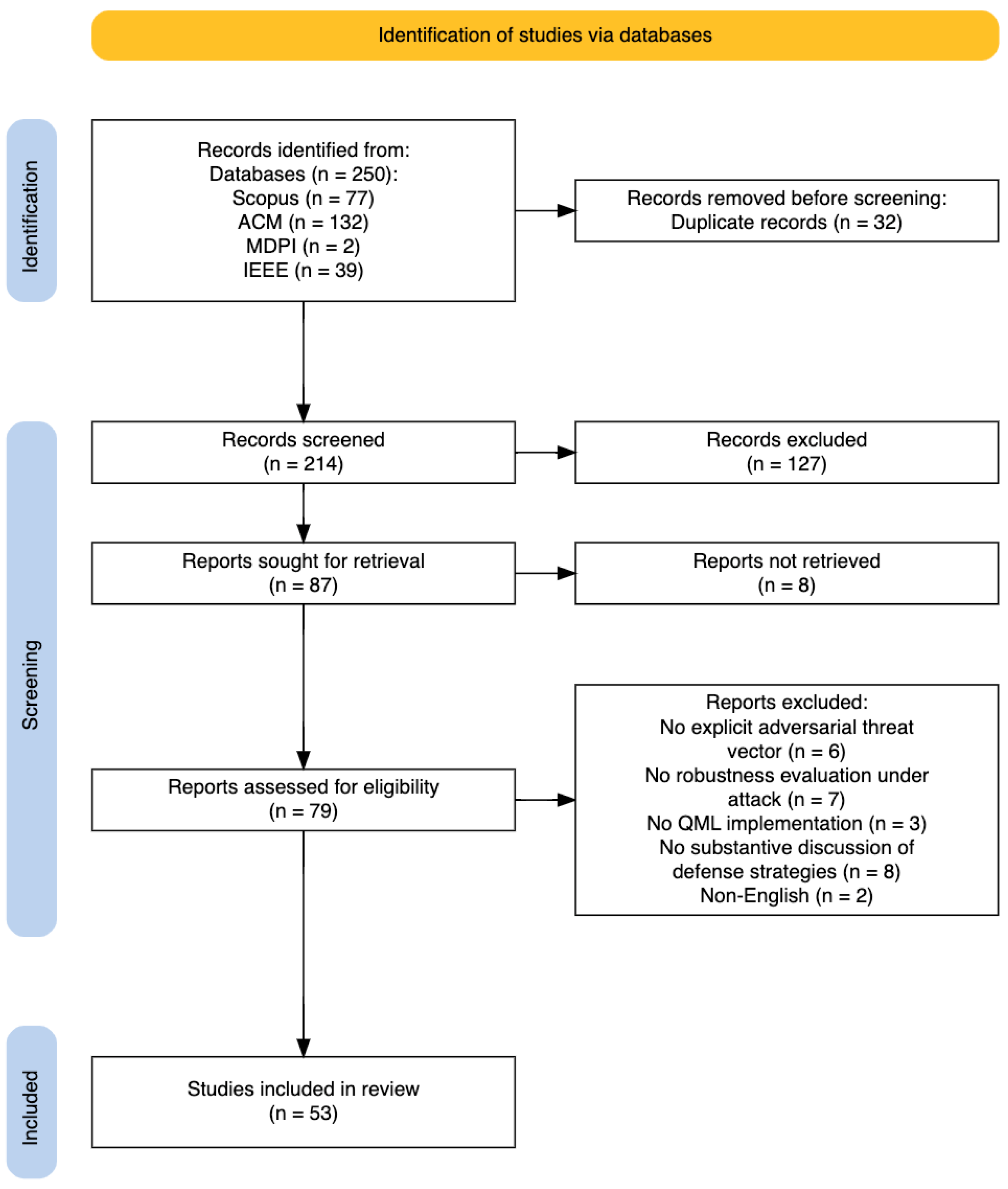
| Total Record Obtained | Scopus (77), ACM (132), MDPI (2), IEEE Xplore (39). Total Records: 250 |
| Published Year | Database | Refs. |
|---|---|---|
| 2020 | Scopus | [21,22] |
| 2021 | Scopus | [23,24,25] |
| 2022 | ACM | [26] |
| 2023 | Scopus | [27,28,29,30,31] |
| IEEE Xplore | [32,33] | |
| 2024 | Scopus | [34,35,36,37,38,39] |
| IEEE Xplore | [40,41,42,43,44,45,46,47] | |
| ACM | [48,49] | |
| 2025 | Scopus | [50,51,52,53,54] |
| IEEE Xplore | [55,56,57,58,59,60,61,62,63,64,65,66,67,68,69] | |
| ACM | [70,71] | |
| MDPI | [72] | |
| 2026 | Scopus | [73] |
| Threat Category | Description | Occurrence | Percentage |
|---|---|---|---|
| Adversarial Examples | Evasion attacks using perturbations on input data to cause misclassification. | 38 | 40.4% |
| Poisoning Attacks | Training-time manipulations such as label flips, data poisoning, or removal of training data. | 8 | 8.5% |
| Transfer Attacks | Crafting adversarial examples on surrogate models and transferring to target quantum/classical models. | 8 | 8.5% |
| Noise/Corruption Attacks | Random noise perturbations or naturally occurring/engineered noise manipulation. | 7 | 7.4% |
| Functional/Physical Attacks | Perturbations constrained by physical realizability. | 6 | 6.4% |
| Fault Injection/Crosstalk Attacks | Attacks exploiting hardware effects to degrade or manipulate performance. | 4 | 4.3% |
| Universal Adversarial Perturbations | Specific class of adversarial inputs that generalize across inputs or models. | 3 | 3.2% |
| Model Stealing/Extraction Attacks | Attacker queries to clone or extract the model. | 3 | 3.2% |
| Side-Channel Attacks | Using power, timing, crosstalk to infer or leak model information. | 3 | 3.2% |
| Backdoor/Trojan Attacks | Malicious circuit insertions or embedded triggers causing targeted misclassification. | 3 | 3.2% |
| Data Obfuscation/Evasion | Obfuscation of circuit or input data to evade detection or degrade performance. | 3 | 3.2% |
| Quantum State Poisoning Attacks | Manipulating quantum states directly in training or inference. | 3 | 3.2% |
| Inference/Membership Attacks | Attacks revealing sensitive information from models and data. | 2 | 2.1% |
| Denial of Service/Availability Attacks | Attacks aimed at disrupting service availability. | 2 | 2.1% |
| Adversarial Metric Learning Attacks | Attacks targeting metric learning objectives. | 1 | 1.1% |
| Evaluation Method Category | Description | Evaluation Environment | Refs. |
|---|---|---|---|
| Empirical Performance Metrics under Attack | Measuring classification or regression performance (accuracy, F1, precision, recall, MSE, R2, etc.) on perturbed inputs. | Classical Simulators | [22,24,27,28,29,30,31,32,33,34,36,39,40,41,43,44,46,47,50,51,52,54,56,57,59,61,62,64,65,66,67,68,69,71,72,73] |
| Robust Accuracy or Adversarial Accuracy | Quantifying robustness as classification accuracy specifically on adversarial test sets or robust accuracy metrics. | Classical Simulators | [22,23,24,26,27,28,30,31,32,34,38,39,41,43,44,45,46,50,51,52,57,59,64,65,69,73] |
| Theoretical/Provable Robustness Guarantees | Using mathematical guarantees, bounds, or certification methods based on fidelity, distance metrics (Uhlmann, trace), SDP formulations, Lipschitz constants, or quantum hypothesis testing. | Mathematical Modeling and Formal Analysis | [21,23,25,35,38,42,45,52,55,58,69] |
| Similarity and Fidelity Metrics | Employing fidelity or closeness metrics between clean and adversarial quantum states to quantify perturbation impact. | Classical Simulators | [22,23,30,34,37,40,50,54,56,57,60,63,69] |
| Robustness under Different Attack Types | Evaluation across varying adversarial methods (FGSM, BIM, PGD, MIM, universal, white-box, black-box, targeted, untargeted) | Classical Simulators | [22,23,28,30,31,33,34,38,40,41,43,44,54,59,64,65] |
| Transferability and Generalizability | Evaluating if adversarial examples transfer between models or how defense generalizes across attacks. | Classical Simulators | [23,26,34,36,40,44,54,59] |
| Attack Success Rate (ASR) and Accuracy Drop | Measuring how often adversarial attacks successfully mislead models and corresponding drops in accuracy. | Classical Simulators | [22,33,37,40,54,59,64] |
| Privacy and Security Related Metrics | Robustness evaluated within broader security frameworks including Total Variation Distance, Privacy budget analysis, CIA triad. | Hybrid (Classical simulators combined with formal security analysis) | [26,48,55,60,67,72] |
| Adversarial Risk/Error Rates | Measuring difference in population risk and training risk under adversarial conditions, or adversarial error rates. | Theoretical/ Statistical Analysis | [42,52,58,59] |
| Noise Injection or Randomized Encodings | Study how noise layers or randomized encodings improve robustness under attack. | Classical Simulators | [28,35,43,69] |
| Visualizations and Geometric Proxies | Visualization of data separations, Hilbert space separability, t-SNE, or other geometry-based proxies for robustness. | Simulation-based visual analytics | [27,62,63] |
| Statistical Testing and Hypothesis Tests | Using paired significance tests (e.g., Wilcoxon signed-rank test) to validate improvements in robustness. | Simulation-based statistical validation | [29] |
| Constraint Category | Description | No of Studies Mentioned | Refs. |
|---|---|---|---|
| Hardware Limitations | Small number of qubits, limited qubit connectivity, device architecture constraints. Limits model size and circuit depth. | 28 | [21,24,26,27,31,32,33,34,35,37,38,39,40,42,44,46,47,48,49,55,56,57,58,59,61,69,70,72,73] |
| NISQ Noise and Errors | Gate errors, decoherence, measurement noise, crosstalk, limiting fidelity and increasing vulnerability. | 22 | [22,24,25,26,27,31,36,37,38,42,43,46,47,48,49,52,55,57,58,59,60,70] |
| Simulation and Computational Resource Limits | High cost and limits on classical simulation of quantum systems; constrained data dimension due to qubit limits; slow training. | 21 | [21,23,26,27,28,29,31,33,34,36,37,42,44,46,48,49,52,58,61,64,71] |
| Model Training Challenges | Barren plateaus (vanishing gradients), expensive adversarial training, gradient estimation overhead, lack of backpropagation. | 18 | [22,26,27,28,38,39,42,48,49,53,54,57,58,59,60,61,70,73] |
| Data Dimensionality/Encoding Issues | Necessity of dimension reduction (e.g., PCA), difficulty encoding classical data into quantum states due to limited qubits. | 17 | [21,27,30,33,34,39,40,46,47,51,54,57,65,66,68,69] |
| Defense and Robustness Trade-offs | Trade-off between accuracy and robustness; oversmoothing noise can degrade accuracy; limited generalization across attacks. | 11 | [22,24,25,35,44,45,46,57,59,60,61] |
| Algorithmic and Theoretical Constraints | Lack of closed-form solutions, difficulty in guaranteeing robustness for multi-class or large spaces, limited theoretical tools. | 10 | [22,25,30,38,42,44,45,46,54,58] |
| Practical Dataset Constraints | Small or downscaled datasets (e.g., MNIST 7 × 7, 16 × 16), limited number of training samples, task-specific benchmarks. | 10 | [24,29,33,34,36,44,50,54,61,66] |
| Security and Trust Issues | Cloud opacity, untrusted compilers, multi-tenant cloud risks, reusing datasets, data leakage, leak of IP, adversarial access. | 7 | [26,37,52,55,67,68,73] |
| Measurement and Testing Constraints | Need for large number of shots/samples, statistical estimation, verification challenges due to continuous quantum states. | 5 | [25,48,52,58,71] |
| Proposed Research Direction | No of Mentioned | Refs. |
|---|---|---|
| Developing experiment-feasible and scalable adversarial defense mechanisms on real quantum hardware | 8 | [21,23,24,28,31,34,39,73] |
| Improving robustness certification and verification tools including tight generalization and robustness bounds | 7 | [25,42,45,52,58,61,69] |
| Extending adversarial robustness studies beyond current supervised learning to unsupervised, reinforcement learning, and continual learning settings | 6 | [22,23,30,35,37,61] |
| Studying specific quantum architectures or ansatz designs to inherently improve robustness | 6 | [24,38,41,44,57,68] |
| Developing robustness against advanced and universal adversarial attacks, including transfer attacks and poisoning | 6 | [23,26,30,40,55,70] |
| Integrating quantum noise or randomized encodings as a defense mechanism | 5 | [28,35,43,59,69] |
| Benchmarking robustness across various QML architectures, data types, and attacks | 5 | [31,37,46,55,71] |
| Optimizing model architectures and training strategies to balance robustness and accuracy | 4 | [27,44,46,51] |
| Combining classical and quantum methods for hybrid defense frameworks | 3 | [24,41,59] |
| Aspect | Directly Inherited from Classical Adversarial ML | Genuinely Quantum-Specific Elements |
|---|---|---|
| Adversarial Threat Vectors (RQ1) | Input-level evasion attacks using gradient-based perturbations such as FGSM, PGD, and BIM; training-time poisoning (e.g., label flipping); model stealing and extraction attacks. | Quantum state-level attacks (e.g., quantum state poisoning); functional or physical perturbations targeting unitary operations; hardware-level attacks such as fault injection and crosstalk exploitation. |
| Defense Strategies (RQ3) | Adversarial Training (dominant approach); defensive distillation; gradient masking; classical data augmentation and differential privacy mechanisms. | Quantum randomized smoothing using native noise channels (e.g., depolarizing, phase damping); randomized encoding or cloaking to induce barren plateaus; ansatz and circuit architecture optimization for inherent robustness. |
| Evaluation Methods (RQ4) | Empirical performance metrics under attack (accuracy, F1-score, precision, recall); attack success rate (ASR); evaluation on perturbed classical datasets. | Quantum state-level metrics such as fidelity (e.g., Uhlmann fidelity) and trace distance; robustness certification via quantum hypothesis testing and semidefinite programming formulations. |
| Practical and Technological Constraints (RQ5) | Accuracy–robustness trade-offs; computational resource limitations; reliance on simplified or downscaled datasets (e.g., MNIST). | NISQ-era constraints including decoherence, gate errors, and measurement noise; barren plateaus (vanishing gradients); limited qubit connectivity; no-cloning theorem affecting gradient estimation and data reuse. |
| Research Methodology (RQ2 and RQ6) | Focus on supervised classification tasks; reliance on white-box and black-box attack paradigms adapted from classical deep learning. | Exploration of quantum-native tasks (e.g., entanglement classification, Hamiltonian learning); consideration of thermodynamic and dissipative learning dynamics in quantum systems. |
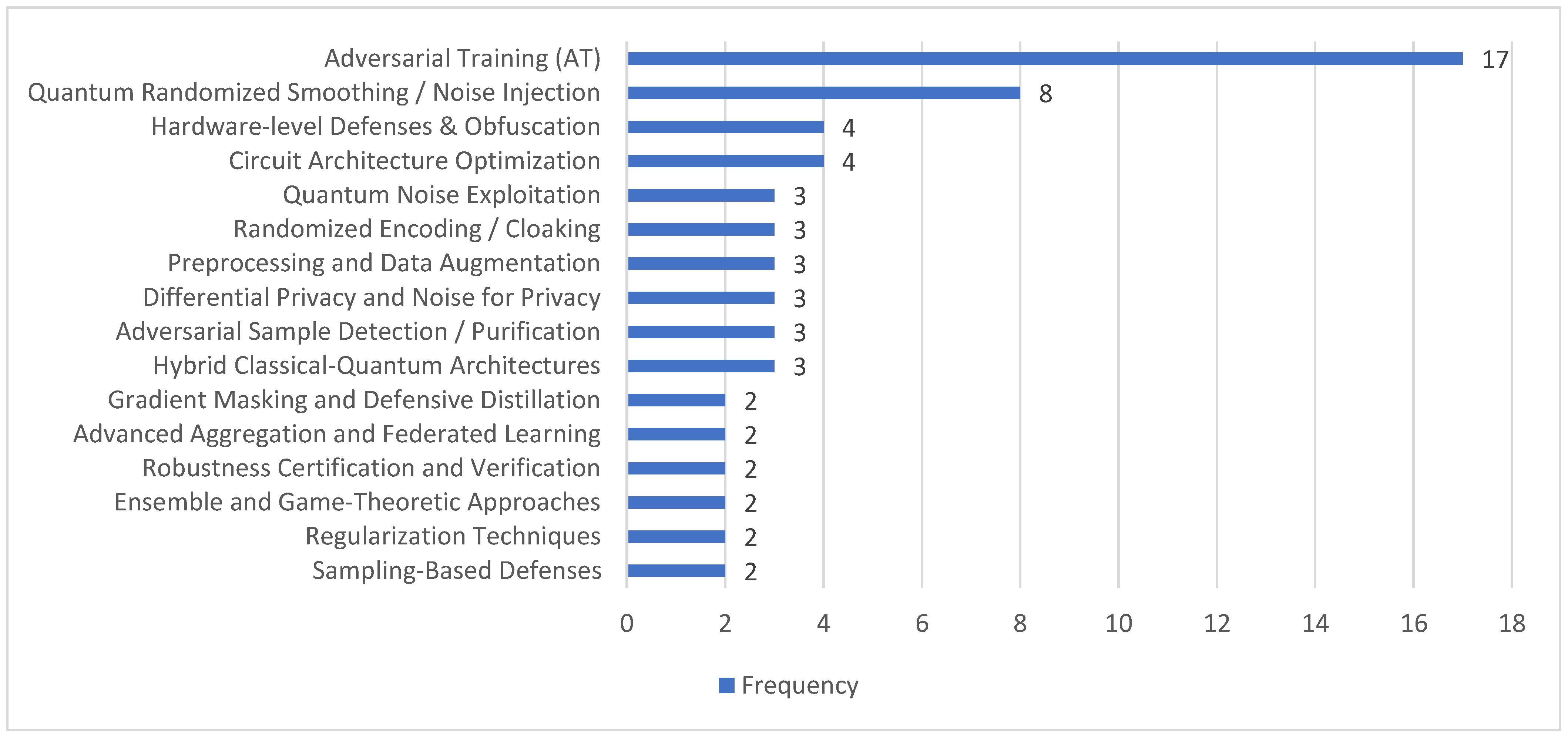
| Defense Strategy | Robustness Gain | Accuracy Impact | Computational Cost |
|---|---|---|---|
| Adversarial Training (AT) | High | Moderate | Very High |
| Sampling-Based Defenses | High | Low | Low |
| Regularization Techniques | Moderate | Low | Low |
| Ensemble and Game-Theoretic Approaches | Moderate | - | Moderate |
| Robustness Certification and Verification | High | - | High |
| Advanced Aggregation and Federated Learning | High | Low | Low |
| Gradient Masking and Defensive Distillation | High | Low | Low |
| Hybrid Classical-Quantum Architectures | Moderate | Low | Moderate |
| Adversarial Sample Detection/Purification | High | Low | Low |
| Differential Privacy (DP) and Noise for Privacy | Moderate | High | Moderate |
| Preprocessing and Data Augmentation | High | Low | Low |
| Randomized Encoding/Cloaking | Moderate | Low | Low |
| Quantum Noise Exploitation | High | Moderate | Low |
| Circuit Architecture Optimization | High | Low | - |
| Hardware-level Defenses and Obfuscation | Low | Low | Low |
| Quantum Randomized Smoothing/Noise Injection | Moderate | Moderate | High |
Disclaimer/Publisher’s Note: The statements, opinions and data contained in all publications are solely those of the individual author(s) and contributor(s) and not of MDPI and/or the editor(s). MDPI and/or the editor(s) disclaim responsibility for any injury to people or property resulting from any ideas, methods, instructions or products referred to in the content. |
© 2026 by the authors. Licensee MDPI, Basel, Switzerland. This article is an open access article distributed under the terms and conditions of the Creative Commons Attribution (CC BY) license.
Share and Cite
Kustiawan, Y.A.; Ghauth, K.I. Adversarial Robustness in Quantum Machine Learning: A Scoping Review. Computers 2026, 15, 233. https://doi.org/10.3390/computers15040233
Kustiawan YA, Ghauth KI. Adversarial Robustness in Quantum Machine Learning: A Scoping Review. Computers. 2026; 15(4):233. https://doi.org/10.3390/computers15040233
Chicago/Turabian StyleKustiawan, Yanche Ari, and Khairil Imran Ghauth. 2026. "Adversarial Robustness in Quantum Machine Learning: A Scoping Review" Computers 15, no. 4: 233. https://doi.org/10.3390/computers15040233
APA StyleKustiawan, Y. A., & Ghauth, K. I. (2026). Adversarial Robustness in Quantum Machine Learning: A Scoping Review. Computers, 15(4), 233. https://doi.org/10.3390/computers15040233