1. Introduction
The digital transformation driven by Industry 4.0 has brought about profound changes in production systems, characterised by the integration of advanced technologies such as artificial intelligence, the Internet of Things, automation and big data analytics. This context demands professionals with technical, digital and cross-disciplinary skills that enable them to thrive in highly technological and constantly evolving environments. Consequently, higher education institutions face the challenge of rethinking their training models, especially in engineering degrees, in order to ensure the employability and competitiveness of their graduates [
1,
2].
In this scenario, Artificial Intelligence (AI) has established itself as one of the strategic technologies of Industry 4.0, with applications ranging from process optimisation to decision-making in complex environments. Its impact extends to the field of education, where it is used to support the personalisation of learning, automate assessment processes, analyse educational data and support evidence-based pedagogical decisions [
3]. However, various authors warn that technological availability alone does not guarantee improvements in educational outcomes; for AI to contribute effectively, appropriate pedagogical design and critical and responsible integration into teaching-learning processes are required [
4].
Despite the rapid development of AI-based tools, their adoption in university teaching remains uneven and, in many cases, limited to instrumental or exploratory uses [
5]. This situation justifies the need to analyse how teachers are incorporating these technologies into their teaching practice and what significance they attribute to them in relation to preparing students for Industry 4.0.
Therefore, this study aims to analyse the degree of adoption and use of AI by engineering professors in higher education, as well as their perception of the contribution of these technologies to preparing students for the challenges of Industry 4.0. Faculty perception is considered a key element in understanding the current state of AI integration in university education and identifying training needs and opportunities for improvement.
We consider our work to be important because it provides a deep and contextualised understanding of the real state of artificial intelligence adoption in university engineering teaching, focusing not only on the use of technology, but also on teachers’ perceptions of its contribution to preparing students for Industry 4.0. Unlike many previous studies that were quantitative or focused on the theoretical potential of AI, this research is distinguished by its qualitative approach, which allows us to capture nuances, tensions and contradictions in teaching experiences, as well as to identify training, pedagogical and institutional barriers that condition its effective integration. Furthermore, the study explicitly links the adoption of AI with the development of digital skills and employability, offering empirical evidence from a strategic degree programme such as engineering and helping to bridge the gap between innovative discourse and actual educational practice in higher education.
In recent years, especially since 2023, the literature on the adoption of artificial intelligence in higher education has experienced exponential growth, driven by the expansion of generative systems and advanced automation tools. Recent research has begun to analyse not only technological acceptance, but also the pedagogical, ethical and institutional implications of its integration [
6,
7,
8]. These studies highlight the need to understand how teachers are reinterpreting their role in the face of the emergence of generative AI systems, as well as changes in assessment and instructional design practices. However, much of this recent output has focused on conceptual analyses, systematic reviews or studies of students’ general perceptions, with limited qualitative empirical evidence exploring in depth how teachers in strategic degree programmes such as engineering are incorporating these technologies and how they link their use to preparing students for Industry 4.0. In this regard, there remains a gap in the literature regarding contextualised studies that connect the adoption of AI by teachers with skills development and employability in advanced technological environments.
In this context, this study provides contextualised qualitative evidence on how AI is being incorporated into university engineering teaching and why its pedagogical integration remains limited despite its perceived high utility. Unlike predominantly conceptual or general survey-based studies, this study identifies a ‘backstage–frontstage’ adoption pattern: AI is initially integrated as a tool to support teaching efficiency (planning and material generation) and only incipiently as a structural pedagogical technology (assessment and personalisation). Likewise, the relationship between AI and Industry 4.0 is operationalised through explicit mapping between teaching uses and I4.0 competencies. Based on an extension of the Technology Acceptance Model (TAM), the results suggest that the gap between potential and practice is explained less by perceived usefulness and more by perceived ease of use, teaching self-efficacy, and institutional governance. These findings offer concrete implications for the design of university policies and professional development programmes in engineering.
2. Theoretical Framework
2.1. Artificial Intelligence in Higher Education
Artificial intelligence is defined as the set of systems and techniques capable of simulating human cognitive processes, such as learning, reasoning and decision-making, using advanced algorithms and computational models. In the field of education, AI has been implemented in applications such as intelligent tutoring systems, learning analytics, automated assessment and virtual assistants, among others. Recent literature highlights that AI in higher education can contribute to more personalised and student-centred teaching, allowing content, learning pace and feedback to be adapted to individual needs [
9]. These possibilities are particularly relevant in university contexts characterised by large groups and a high diversity of academic profiles, such as engineering degrees.
Nevertheless, the implementation of artificial intelligence in higher education poses significant pedagogical, ethical and organisational challenges. Therefore, the need for critical, ethical and responsible integration of artificial intelligence into teaching practices and university pedagogical models is emphasised.
These include algorithm transparency, personal data protection, algorithmic bias, and the risk of excessive automation of educational processes [
10,
11]. Consequently, various authors emphasise the need for critical, ethical and responsible integration of AI, aligned with clear pedagogical principles and appropriate institutional governance.
While these studies provide an understanding of the potential and challenges of AI in higher education, it is necessary to adopt an explanatory theoretical framework that allows for a systematic analysis of the factors that condition its effective integration into teaching practice.
However, it is important to highlight the use and implementation of generative AI, as it has substantially transformed the academic debate on the integration of AI in higher education. Recent research emphasises that generative AI is not only a technological innovation, but also a pedagogical turning point that requires a rethinking of methodologies, assessment systems and academic authorship criteria [
6,
12].
Likewise, international studies warn that the rapid adoption of these tools by students has, in many cases, exceeded the institutional capacity to regulate their use, creating tensions between innovation, academic integrity and curricular transformation [
13]. This situation has intensified interest in analysing how teachers interpret, accept or resist these technologies in their teaching practice.
Likewise, the risk of excessive cognitive outsourcing has been raised, where the indiscriminate use of these tools could affect the development of key skills such as critical thinking, argumentative ability, or autonomous problem-solving [
14,
15]. This debate is particularly relevant in engineering degrees, where deep conceptual understanding and practical application are essential pillars of education.
2.2. Technology Acceptance Model as an Explanatory Framework
From the perspective of technology adoption, the Technology Acceptance Model (TAM) is one of the most established models for explaining the acceptance and use of new technologies. Originally proposed by Davis [
16], the model argues that technology adoption is primarily determined by two fundamental constructs: perceived usefulness and perceived ease of use.
Perceived usefulness is defined as the degree to which a person believes that using a technology will improve their professional performance, while perceived ease of use refers to the degree to which using that technology is perceived as effortless. Both constructs influence attitudes towards technology use and, ultimately, behavioural intention to adopt and effective use [
17].
In the field of higher education, TAM has been widely validated to explain the incorporation of virtual platforms, learning management systems, and digital tools [
18]. Empirical evidence shows that perceived usefulness is often the strongest predictor of intention to use, while ease of use influences both directly and indirectly through perceived usefulness.
In the specific case of artificial intelligence, TAM offers a particularly suitable framework, as it allows us to analyse how teachers’ perceptions of the effectiveness and complexity of these tools influence their willingness to integrate them into their teaching practice. Unlike purely descriptive approaches, this model provides an analytical structure that explains the gap between the theoretical potential of AI and its actual adoption in the classroom [
3,
5].
The application of TAM to the study of AI in engineering degrees requires specific contextualisation of its central constructs. In this context, the perceived usefulness of artificial intelligence can be understood not only as an improvement in individual teaching performance, but also as its ability to optimise feedback and assessment, personalise learning, and/or contribute to the development of skills aligned with Industry 4.0 [
19].
For its part, the perceived ease of use in the case of AI is closely linked to external variables such as the level of digital competence of teachers, specific training in AI tools, and the institutional support available. Recent research indicates that the lack of specialised training and the absence of clear institutional strategies are recurring barriers to its effective integration [
20].
From this perspective, training and institutional variables can be understood as antecedents that influence perceived ease of use, which, in turn, affects perceived usefulness and attitudes towards AI. This relational structure explains why, despite widespread recognition of its potential, the integration of artificial intelligence in higher education remains limited.
2.3. Artificial Intelligence and Preparation for Industry 4.0
In engineering degrees, the integration of AI takes on an additional strategic dimension in relation to the demands of Industry 4.0, characterised by advanced automation, big data analysis and the interconnection of intelligent systems [
1,
2].
Higher education plays a key role in developing the technical, digital and cross-cutting skills needed for this new productive paradigm. Several studies argue that the pedagogical integration of artificial intelligence can significantly contribute to preparing students for such professional environments [
21,
22,
23].
From the TAM framework, the perception that AI promotes preparation for Industry 4.0 can be conceptualised as a specific component of perceived usefulness. Consequently, the greater the perception among teachers that AI contributes to the development of skills aligned with this paradigm, the more positive their attitude towards its integration in the classroom will be.
Industry 4.0 demands professionals capable of interacting with intelligent systems, analysing large volumes of data, solving complex problems and adapting to constantly changing technological contexts [
24]. In this regard, higher education plays a key role in developing technical, digital and cross-cutting skills aligned with these requirements [
1,
2]. Several studies argue that the pedagogical integration of artificial intelligence into teaching and learning processes can significantly contribute to preparing students for these professional environments, provided that it is accompanied by solid teacher training and appropriate methodological approaches [
21,
25,
26]. However, there remains a gap between the theoretical potential of AI (understood as its capacity to personalise learning, optimise assessment, support data-driven decision-making, and foster Industry 4.0-related competencies) and its effective integration into university education [
3,
27]. From the TAM perspective, this gap can be interpreted as the result of insufficient levels of perceived usefulness or perceived ease of use among faculty, which limits their intention to adopt it.
Based on the theoretical framework developed, this study adopts TAM as an explanatory framework to analyse engineering teachers’ perceptions of artificial intelligence. It is proposed that perceived usefulness positively influences attitudes towards its integration, while perceived ease of use affects both usefulness and attitudes. Likewise, specific training and institutional support act as antecedents of ease of use, and the perception of contribution to Industry 4.0 reinforces perceived usefulness. This model provides a structured theoretical basis for the empirical analysis of AI adoption in higher education.
2.4. Skills for Industry 4.0 in Engineering Education
To operationalise the link between AI teaching and preparation for Industry 4.0, this study adopts a set of key skills that recur in the literature on employability and digital transformation in engineering. Specifically, the following skill dimensions are considered [
1,
2]:
Data literacy and analytical thinking: ability to interpret, use and communicate data-based information, as well as evaluate the quality and relevance of results.
Interaction with intelligent systems (human–AI interaction): ability to use AI tools in an informed manner, formulating instructions, evaluating outputs and making decisions with human supervision.
Complex problem solving and computational thinking: breaking down problems, modelling, designing solutions and verifying results in technical contexts.
Process automation and optimisation: use of digital tools to improve efficiency, reduce time and standardise procedures with quality control.
Ethics, governance, and data protection: recognition of biases, traceability, academic authorship, integrity, and regulatory compliance in the use of data and algorithms.
Continuous learning and technological adaptability: willingness and ability to update skills in the face of emerging technologies and new professional demands.
Technical communication and documentation: ability to generate and review explanations, reports, specifications, and technical materials with clarity.
This operationalisation allows us to analyse readiness for Industry 4.0 not only as a general perception, but as a set of observable competencies that can be linked to specific AI-mediated teaching practices. From the TAM perspective, the contribution of AI to Industry 4.0 can be interpreted as a specific component of perceived utility (e.g., skills development and employability), while training and institutional barriers act as antecedents to perceived ease of use and condition effective pedagogical integration.
4. Method
4.1. Research Design
A qualitative descriptive-interpretative methodology was developed using semi-structured interviews. This approach allows us to understand the perceptions and experiences of engineering professors regarding the use of AI in university teaching, prioritising meanings, attitudes and assessments over causal relationships or statistical generalisations.
The aim of the study is not to generalise the results statistically, but rather to generate interpretative and contextualised knowledge that allows for an in-depth understanding of teachers’ perceptions in a specific environment. From a qualitative research perspective, the value of the study lies in its explanatory power and in the analytical transferability of the findings to contexts with similar structural characteristics, rather than in its numerical representativeness.
4.2. Sample
The sample consisted of 32 university lecturers who teach engineering degrees (Civil Engineering, Telecommunications Engineering, Mechanical Engineering, Electrical Engineering, among others) at the University of Seville (
Table 1).
Although this study was conducted at a single university, the results obtained should be interpreted from the perspective of analytical transferability inherent to qualitative research, rather than statistical generalisation. The University of Seville is a medium-to-large public institution with well-established engineering degrees, characteristics shared by many European and Latin American universities. In this sense, the patterns identified (incipient adoption, instrumental use and positive perception of the educational potential of AI) may be relevant to institutional contexts with similar academic and cultural structures. However, future comparative research between universities and countries will allow these findings to be expanded and verified.
Participants were accessed through non-probabilistic convenience sampling, supported by the snowball technique, which allowed potential teachers within the study population to be progressively identified. The interviews were conducted during November and December 2025 with teachers who could be contacted by telephone and who agreed to participate voluntarily.
The final sample size was determined using the theoretical saturation criterion typical of qualitative research. Saturation was assessed progressively during the data collection and preliminary analysis process, considering it to have been reached when the interviews did not contribute any new categories, subcategories or relevant nuances to the previously identified categorical system. From interview number 28 onwards, a systematic repetition of the discourses around the analysed dimensions was observed, confirming saturation in the final interviews (29–32), in which no new codes or substantive conceptual variations emerged. Therefore, data saturation was considered to have been achieved, which justified the closure of the information collection process.
4.3. Data Collection Tool
The information gathering tool was a semi-structured interview, which allowed us to maintain a common script while delving deeper into relevant aspects based on the teachers’ responses. The interview script is presented in
Table 2.
Although the interview questions were formulated in open-ended format, their design was conceptually aligned with the core constructs of the TAM. Specifically, questions related to the perceived advantages, contribution to Industry 4.0, development of skills, and usefulness in teaching practice (Questions 5, 6, and 7) were analytically interpreted under the construct of perceived usefulness, understood as the degree to which lecturers believe that AI enhances their teaching performance and students’ professional preparation. Likewise, questions addressing familiarity, frequency of use, and difficulties in implementation (Questions 2, 3, and 4) were examined in relation to perceived ease of use, insofar as they reflect lecturers’ perceptions of complexity, confidence, and effort required to integrate AI tools into their teaching practice. Therefore, TAM was not used as a psychometric measurement instrument but as an explanatory analytical framework to interpret qualitative data, allowing the categorisation of responses according to perceived usefulness and perceived ease of use dimensions.
In qualitative research, TAM constructs were operationalised at a conceptual level rather than through validated scales, ensuring theoretical coherence without imposing quantitative measurement criteria.
Given that some questions required reflection and elaboration (e.g., specific experiences or assessment of advantages and skills), sufficient time was allowed during the interview for responses, as well as additional clarification when necessary, in order to reduce cognitive load and encourage complete answers.
The interview script underwent a validation process using expert judgement following the Delphi method [
28]. Eight specialists in higher education and digital technologies applied to teaching participated, with experience in artificial intelligence and engineering training. The panel was selected based on criteria of teaching and research experience in the field of AI in higher education. Likewise, the Expert Competence Coefficient (K) was estimated, obtaining high values that supported the suitability of the panel. This process allowed for adjustments to be made to the clarity, relevance, and consistency of the questions, reinforcing the content validity of the instrument and the methodological quality of the study [
29].
4.4. Procedure
The interviews were conducted by telephone, ensuring the confidentiality of the participants. Contact details were used exclusively for the purpose of inviting participants and coordinating the interviews. No names or identifying details were recorded during the data collection process; instead, each participant was assigned a numerical code. The database used for the analysis did not contain any personal information that would allow individual identification.
This method was chosen to facilitate the participation of teachers with limited mobility and to promote an accessible communication environment. The interviews lasted an average of approximately 15 min and were conducted between November and December 2025.
4.5. Ethical Considerations
Before beginning the interviews, participants were informed about the objectives of the study, the voluntary nature of their participation, and the confidential treatment of the information, requesting informed consent in accordance with international ethical principles and the General Data Protection Regulation (EU 2016/679) [
30]. The study was approved by the Ethics Committee of the University of Seville. The anonymity of the participants was guaranteed, and the data was used exclusively for scientific and educational purposes.
4.6. Data Analysis Techniques
The interviews were recorded and subsequently transcribed in full. After an exploratory reading, a mainly deductive coding was carried out based on the research questions, complemented by the emergence of nuances during the analysis. A categorical system was developed, organised into three main categories and their corresponding subcategories. Content analysis was performed using Atlas.ti (2022). In order to reinforce the reliability of the coding process beyond consensus discussions, a second researcher from the team cross-checked part of the corpus. Both coders independently analysed a representative sample of the interviews and then compared the codes assigned. The discrepancies identified were examined through reflective discussion until informed agreements were reached, allowing the categorical system to be adjusted and stabilised. This procedure helped to ensure the consistency and coherence of the analysis.
Furthermore, in order to ensure the reliability of the coding process, two independent researchers from the team carried out double coding on a representative sample of the interviews (25% of the total). Subsequently, a systematic comparison of the assigned codes was carried out, calculating the degree of initial agreement and analysing the discrepancies detected. The differences were reviewed through reflective discussion until consensus was reached and the categorical system was adjusted where necessary. This procedure strengthened the internal consistency of the analysis and ensured the interpretative stability of the categorisation process.
Strategies aimed at strengthening the analytical reliability of the study were also incorporated. First, a reflective attitude was adopted throughout the analysis process, promoting critical review of interpretations and identification of possible biases derived from the research team’s own positions. Secondly, a systematic record of the analytical process was kept, documenting decisions regarding the construction, modification, and reorganisation of categories and subcategories, as well as the criteria used for their delimitation. These strategies helped to ensure the transparency, consistency, and traceability of the qualitative analysis process.
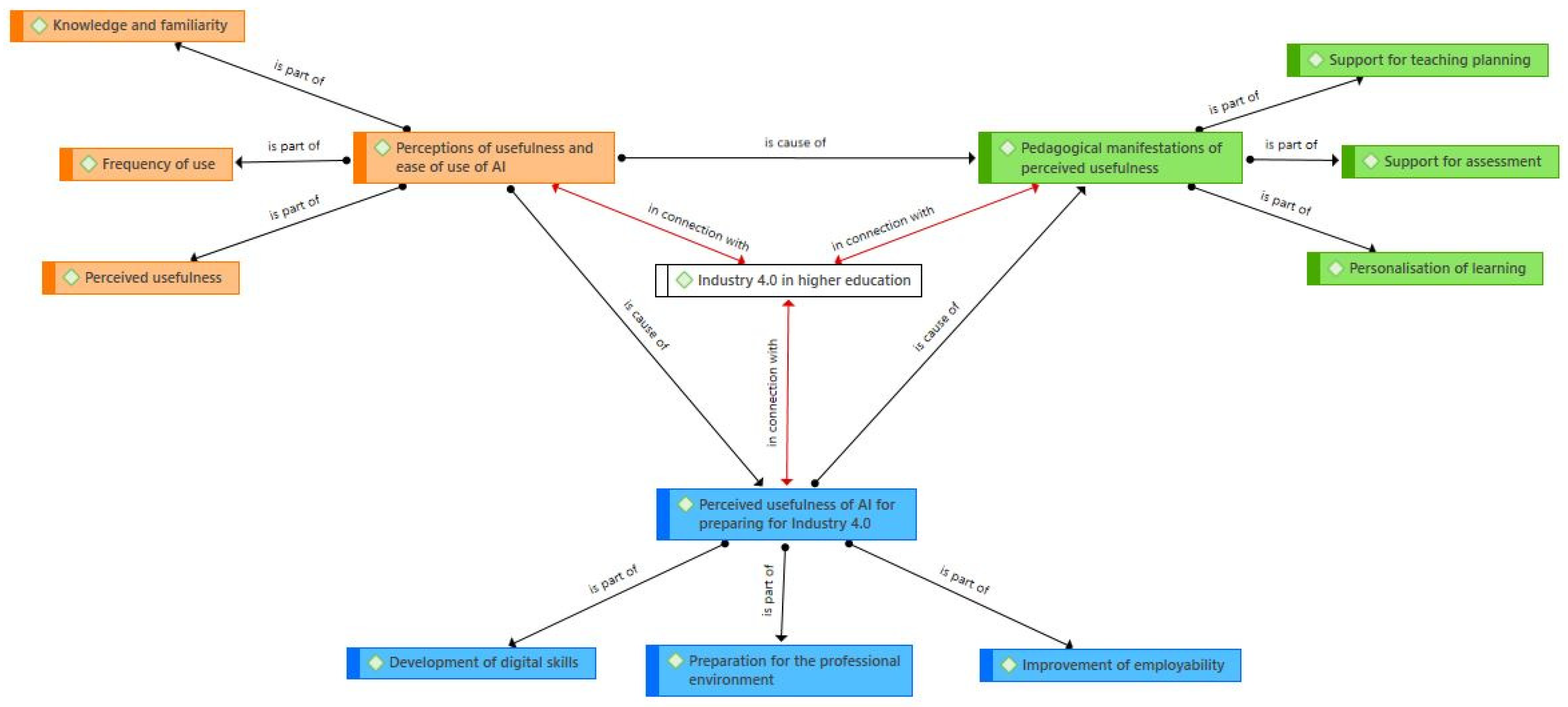
The categorical system developed has been divided into three broad categories, in accordance with the research questions posed at the beginning of the study. Firstly, the category ‘Perceptions of usefulness and ease of use of AI’ (PU) attempts to describe the degree of knowledge, frequency and usefulness that the teachers interviewed perceive in AI. It allows us to understand the extent to which AI is part of normal teaching practice and how it is valued as a support tool in the university context. Therefore, this category is divided into the subcategories ‘Knowledge and familiarity’ (KF) with AI, ‘Frequency of use’ (FU) of this tool in their daily lives, and ‘Perceived usefulness’ (UP) in their daily practice. Secondly, we find the category ‘Pedagogical manifestations of perceived usefulness (PM)’, which covers the main ways in which teachers integrate AI into teaching and learning processes. This is divided into ‘Support for teaching planning’ (STP) with the use of AI, ‘Support for assessment’ (SA) and ‘Personalisation of learning’ (PL), highlighting the pedagogical potential attributed to these technologies in engineering education. Finally, there is the category ‘Perceived usefulness of AI for preparing for Industry 4.0’ (PU), which groups together teachers’ assessments of the impact of artificial intelligence on the training of students for their future professional integration. This category includes ‘Development of digital skills’ (DDS), ‘Preparation for the professional environment’ (PPE) thanks to the use of AI, and ‘Improvement of employability’ (IE). All of this can be seen in
Table 3.
5. Results
Figure 1 presents the semantic network resulting from the analysis in Atlas.ti, where the relationships between categories and subcategories are visualised (
Figure 1).
The results are presented below, organised according to the three categories of the analysis system. Representative quotes illustrating the perceptions of the teaching staff are included.
5.1. Perceptions of Usefulness and Ease of Use of AI
In the category ‘Perceptions of usefulness and ease of use of AI’, there is notable heterogeneity. A significant proportion of teachers report a basic or intermediate level of knowledge, especially associated with widely used tools (e.g., text generation assistants or programming support). However, this knowledge does not always translate into systematic use in the classroom, but rather into occasional and complementary incorporation, linked to specific tasks or subjects.
Likewise, there is greater caution among older teachers, who report limitations related to lack of training, low confidence in integrating these tools, or difficulty in understanding how they work with sufficient pedagogical certainty.
In terms of perceived usefulness, there is consensus among respondents in highlighting the potential of AI to optimise the time spent on teaching tasks and improve efficiency in the preparation of materials. However, such integration has not yet been consolidated as a structural part of teaching methodology:
“Although artificial intelligence is very present nowadays, its use in my teaching is still limited and is not part of my usual methodology. I think I need more time to learn how to use it properly in my classes.”
(Interview 09)
“The use of artificial intelligence in my classrooms is very sporadic. I don’t usually use it consistently; I use it on certain occasions and for specific activities, because that way I feel more confident.”
(Interview 12)
5.2. Pedagogical Manifestations of Perceived Usefulness
The analysis suggests that pedagogical uses of AI are mainly concentrated in functions that support teachers. Among the most common applications are the development of teaching resources, the generation of contextualised examples in the field of engineering, and the design of training activities.
Likewise, its application is identified in tasks related to assessment, especially for preliminary tasks such as the initial review of work or the development of rubrics. On this point, teachers insist that the tool must be used with human supervision to ensure reliability and fairness in assessment. Finally, the personalisation of learning is mentioned as an area with potential, although its use is still limited.
“I mainly use it to design materials and propose exercises related to real engineering problems.”
(Interview 08)
“I find it useful as an assessment aid, especially for reviewing work, although I always check the results.”
(Interview 12)
5.3. Perceived Usefulness of AI for Preparing for Industry 4.0
The results presented below reflect exclusively the perception of the teachers interviewed regarding the students’ preparation and do not constitute a direct assessment of the students’ actual skills.
With regard to the category ‘Perceived usefulness of AI for preparing for Industry 4.0’, the qualitative analysis shows a predominantly positive assessment. Perceptions are organised around three subcategories: (a) development of digital skills, (b) preparation for the professional environment, and (c) improvement of employability.
Firstly, there is consensus on the role of AI as a catalyst for the development of digital skills considered relevant in engineering, such as computational thinking, problem solving, and more critical digital literacy. One teacher expresses it as follows:
“Its use in the classroom helps to develop key digital skills for their professional future, especially because students get used to working with tools similar to those they will encounter outside.”
(Interview 10)
However, it is noted that the contribution depends on the pedagogical approach:
“If it is not well integrated into the subject, AI remains superficial.”
(Interview 05)
Secondly, participants emphasise that the integration of AI brings university education closer to environments characteristic of Industry 4.0, where automation, digitalisation and intensive use of data predominate:
“Contact with these technologies brings students closer to the reality of Industry 4.0, where everything is automated and data-driven.”
(Interview 26)
However, some participants highlight limitations associated with resources and training to simulate complex scenarios:
“There is a lack of resources and training to simulate real industry scenarios, which makes it difficult to achieve a more realistic approach to professional contexts.”
(Interview 01)
Thirdly, employability appears as a notable indirect consequence. A valuation is observed that knowledge of AI tools can provide professional differentiation, although its impact will depend on the depth with which it is integrated into the curriculum:
“The use of AI adds value to the training of engineering students and differentiates them from other profiles.”
(Interview 08)
“Companies are looking for people who already have some experience with this type of technology, even if it is only at a basic level.”
(Interview 12)
Although questions 6 and 7 address different dimensions (preparation for Industry 4.0 and skills development), the analysis established an explicit relationship between the two, identifying the skills mentioned by teachers and linking them to the skills frameworks associated with Industry 4.0.
Table 4 operationalises the connection between AI and Industry 4.0 by linking the identified teaching uses (planning, assessment and personalisation) with an explicit set of I4.0 skills. The emerging pattern suggests that current adoption is concentrated in optimisation and material production practices (AP), which mainly contribute to automation/efficiency and technical communication, while the uses with the greatest transformative capacity for I4.0 skills (AE and, especially, PA) appear to be conditioned by criteria of reliability, governance and training. Consequently, the contribution to Industry 4.0 is perceived as high overall, but heterogeneous when analysed by skills and specific practices.
6. Discussion
The results of this study provide a deeper understanding of the current state of artificial intelligence (AI) adoption in university engineering education and its perceived contribution to preparing students for the challenges of Industry 4.0. Overall, the findings confirm the existence of a significant gap between the educational potential attributed to AI and its effective integration into teaching practices, a phenomenon that has been noted in previous research in the field of higher education [
3,
5].
This mismatch between perceived potential and effective integration can be interpreted as a phenomenon of superficial or instrumental adoption, in which technological innovation is initially incorporated into peripheral tasks before transforming core teaching-learning processes. This dynamic suggests that the integration of AI into engineering education is still in an exploratory phase rather than a stage of structural consolidation.
6.1. Level of AI Adoption in Engineering Teaching
In relation to the first research question, the findings indicate that the adoption of AI by engineering teachers is in its infancy, uneven and predominantly instrumental. Although a significant proportion of teachers claim to have basic or intermediate knowledge of AI-based tools, this knowledge does not systematically translate into integrated use in everyday teaching practice. This situation coincides with studies that indicate that technological familiarity does not guarantee meaningful pedagogical adoption if it is not accompanied by didactic training and institutional support [
31].
From the perspective of the Technology Acceptance Model (TAM), the findings suggest that the perceived usefulness of AI is high, while perceived ease of use and teacher self-efficacy continue to act as limiting factors. This pattern is particularly visible among older teachers, who show greater caution or resistance, which has been widely documented in the literature on educational innovation in higher education [
11,
32]. Likewise, the sporadic nature of AI use reinforces the idea that its integration depends largely on individual teacher initiative rather than on established institutional strategies, which limits its transformative impact.
Furthermore, the results suggest that adoption does not depend exclusively on individual variables, but also on organisational factors such as institutional culture, the existence of formal incentives, and regulatory clarity regarding the use of AI. This finding suggests that it would be advisable to complement TAM with approaches that integrate contextual and structural dimensions, broadening the understanding of the phenomenon beyond the individual perception of teachers.
6.2. Predominant Pedagogical Uses of AI
Regarding the second research question, the results show that the pedagogical uses of AI are mainly concentrated in functions that support lesson planning and the development of teaching materials, followed by applications related to assessment. These findings are consistent with previous research that identifies these areas as the first in which AI is adopted due to its low pedagogical risk and immediate benefits in terms of efficiency and time savings [
33].
The use of AI to support assessment is characterised by a cautious attitude on the part of teachers, who recognise its usefulness but emphasise the need for human supervision. This position is in line with current debates on ethics, algorithmic transparency and teacher responsibility, which warn of the risks of excessive automation of assessment processes [
10].
On the other hand, although personalised learning is emerging as an area with high pedagogical potential, its actual implementation remains limited. This gap between potential and practice has been identified in previous studies, which point out that AI-based personalisation requires not only technological tools, but also a methodological redesign and greater digital pedagogical competence on the part of teachers [
22,
34].
This focus on instrumental uses could be interpreted as a strategy for reducing pedagogical risk, in which teachers prioritise applications that optimise existing processes without significantly altering the didactic architecture of the subjects. However, this approach limits the transformative potential of AI, which would require more profound methodological redesigns aimed at solving complex problems, project-based learning or the simulation of professional scenarios.
6.3. Perceived Contribution of AI to Preparation for Industry 4.0
With regard to the third research question, there is a broadly positive perception among teachers of the role of AI in preparing students for Industry 4.0, especially in terms of developing digital skills, approaching the professional environment and improving employability. This consensus reinforces the findings of the World Economic Forum [
2], which identifies advanced digital literacy, computational thinking and technological adaptability as key skills for the professionals of the future.
The development of digital skills appears to be the strongest dimension more solid. The ability of AI to familiarise students with technological tools and environments similar to those they will encounter in the job market is noteworthy, reinforcing the connection between academic training and professional reality [
4,
12].
In terms of preparation for the professional environment, the results indicate that AI contributes to reducing the gap between academic training and industrial reality, although this approximation remains partial. The lack of resources, infrastructure and teacher training hinders the recreation of complex scenarios specific to this emerging professional context of Industry 4.0., which limits the potential of AI as an experiential learning tool. Finally, improving employability is perceived as a significant effect, but one that is conditional on deeper and more systematic curricular integration, reinforcing the need for cross-cutting and not merely technological approaches [
1].
Although this study was conducted at a single university, the results obtained can be interpreted in light of widely documented trends in the international literature on the adoption of artificial intelligence in higher education. The incipient and predominantly instrumental incorporation of AI, the gap between its pedagogical potential and its effective integration, as well as the influence of teacher training and institutional support, have been highlighted in research conducted in various national and disciplinary contexts [
3,
5,
11]. In this sense, although the findings respond to the specific reality of a Spanish public university and engineering degrees, the patterns identified (occasional use, positive perception of educational potential, and demand for greater teacher training) could be present in other higher education institutions with similar characteristics in terms of organisational structure, academic culture, and level of digitisation.
However, the transferability of the results should be considered with caution in contexts with different levels of technological development, more consolidated institutional policies on AI, or teaching cultures more oriented towards pedagogical innovation. Therefore, rather than attempting statistical generalisation, this study offers interpretative keys that can serve as a frame of reference for future comparative research in other university settings.
The results allow us to distinguish different levels of impact on preparation for Industry 4.0: a basic level of technological familiarisation, an intermediate level of instrumental application in academic tasks, and an advanced level linked to the simulation of professional environments and complex decision-making. While the first two levels appear to be well established in the perception of teachers, the third remains in its infancy, which shows that the educational potential of AI has yet to be fully integrated. In this regard, the evidence obtained suggests that the sustainable integration of AI into university teaching cannot depend solely on the individual initiative of teachers, but requires explicit institutional policies, structured continuing education programmes, and clear ethical frameworks to guide its pedagogical use. Without these conditions, adoption will tend to remain fragmented and uneven.
It should also be noted that teachers’ perceptions do not necessarily translate into observable changes in teaching practices or direct improvements in learning outcomes, which highlights the need for future research based on empirical evidence of implementation and evaluation of educational impact. Overall, the study shows that AI already occupies a strategic place in the educational imagination of university engineering, but its pedagogical institutionalisation remains partial. This transitional moment, characterised by high expectations and still predominantly instrumental applications, represents a key opportunity to move towards more systemic models of integration that are pedagogically grounded and aligned with the requirements of Industry 4.0.
From a theoretical perspective, the study allows us to propose a typology of progressive integration of AI into engineering teaching geared towards Industry 4.0. This typology distinguishes three levels: (1) an instrumental level focused on optimising teaching tasks, (2) a pedagogical integration level linked to methodological redesign and skills development, and (3) a transformative level oriented towards the simulation of complex professional environments and data-based decision-making. The results suggest that most teachers currently fall within the first two levels, which indicates a transitional stage of adoption that could be conceptualised as transitional instrumental adoption. This category helps to refine classic models of technology acceptance, such as TAM, by incorporating the pedagogical and organisational dimensions into the analysis of AI-based innovation in higher education.
7. Conclusions
This study has analysed the degree of adoption and use of AI by university lecturers teaching engineering degrees at the University of Seville, as well as their perception of the contribution of these tools to preparing students for the challenges of Industry 4.0. Using a qualitative approach based on semi-structured interviews, a detailed overview of current teaching practices, attitudes towards AI and expectations associated with its integration into university education has been obtained.
Firstly, the results show that engineering professors generally have a basic or intermediate level of knowledge about AI-based tools, with those that are widely used at a social level, such as text generation or programming support assistants, being the most common. However, the frequency of use of these tools in teaching is mostly sporadic and complementary, suggesting that their incorporation responds more to individual initiatives than to consolidated institutional strategies. Despite this, the perception of the usefulness of AI is high, with its ability to optimise teaching time and support tasks such as planning and developing teaching materials being particularly noteworthy.
Secondly, it has been found that the pedagogical uses of AI are mainly concentrated in functions that support teachers, especially in lesson planning and, to a lesser extent, in assessment. Although the personalisation of learning is identified as an area with high pedagogical potential, its actual implementation remains limited and is conditioned by the lack of specific training and the need to maintain human control over educational processes.
Overall, the results show that the adoption of AI in engineering education is in an early stage of integration, characterised by limited use but with recognised high potential.
Moving towards a more systematic and transformative incorporation of artificial intelligence in higher education requires coordinated action at different levels.
At the teaching level, it is necessary to strengthen specific training for teachers, not only in the technical use of AI-based tools, but also in their critical and ethical pedagogical integration. At the institutional level, clear policies and strategies need to be designed to guide the use of AI in teaching, establish ethical frameworks for action, and provide adequate structural support and infrastructure. At the curriculum level, it is recommended that AI be integrated across the board into engineering curricula, linking it to the development of advanced digital skills and preparation for professional environments typical of Industry 4.0.
The findings also provide guidance that may be relevant to other higher education institutions in the early stages of integrating AI into teaching.
Rather than offering generalisable results, this study provides contextualised evidence that contributes to the understanding of AI adoption in higher education from a teaching perspective, providing an empirical basis for future comparative research at national and international level.
7.1. Limitations
Despite its contributions, this study has some limitations that should be considered when interpreting the results. First, the research was conducted at a single university, which limits the generalisation of the findings to other educational contexts with different organisational, cultural or technological characteristics. Furthermore, although adequate for a qualitative exploratory study, the sample size is small and was obtained through non-probabilistic convenience and snowball sampling, which may introduce bias in the selection of participants.
From a qualitative research perspective, the value of the study does not lie in statistical generalisation, but rather in the possibility of analytical generalisation, that is, in the theoretical extrapolation of interpretative patterns to contexts with similar structural characteristics. In this case, the findings allow us to identify recurring dynamics (such as incipient adoption, predominantly instrumental use, and positive perception conditioned by training barriers) that can serve as an interpretative framework for other engineering faculties in public universities with comparable levels of digitisation. Therefore, the study contributes to the theoretical construction of the adoption of AI in higher education by teachers, beyond the specific context analysed. Furthermore, the study only reflects the perspective of teaching staff, so future research should incorporate the voices of students and other institutional agents to offer a more comprehensive view of the phenomenon.
Secondly, the sample shows a notable gender imbalance, partly reflecting the reality of engineering degrees, but which may influence the diversity of perspectives gathered. In addition, the interviews were conducted by telephone and were of limited duration, which, although it facilitated the participation of teachers, may have restricted the depth of some responses.
Finally, the study focuses exclusively on the perceptions of faculty members, without incorporating the views of students or other institutional actors, thus offering only a partial understanding of the phenomenon analysed. These limitations open the door to future research that broadens the methodological and contextual scope of the analysis.
The results should be interpreted from a perspective of analytical transferability rather than statistical generalisation, taking into account the structural and contextual similarities with other higher education institutions.
7.2. Practical Implications
The results of the study have several practical implications for higher education institutions and, in particular, for engineering degrees. First, there is a clear need to design and implement specific teacher training programmes in artificial intelligence, focused not only on the technical use of the tools, but also on their pedagogical, ethical and didactic integration into the teaching-learning processes.
Secondly, the findings suggest that it would be advisable to develop clear institutional strategies that promote the consistent and cross-cutting incorporation of AI into engineering curricula. These strategies could include the creation of good practice guidelines, the establishment of common criteria for the use of AI in assessment, and the promotion of forums for teachers to share experiences and resources.
It is also essential to provide universities with adequate infrastructure and resources to simulate environments close to the reality of Industry 4.0, promoting more experiential learning connected to the professional context. In this regard, collaboration with companies and agents in the productive environment can play a key role in aligning university education with the demands of the labour market.
Finally, the practical implications point to the need to conceive of artificial intelligence not as an isolated resource, but as an element integrated across the board into engineering education, contributing to the development of advanced digital skills and improving the employability of students in a professional context increasingly marked by digital transformation.




 ,
,