
A Hybrid Ensemble Framework for Rare Event Detection in Large-Scale Tabular Data

 , , ,
, , ,  and
and
Abstract
1. Introduction
2. Related Work
3. Materials and Methods
3.1. Data Source and Problem Formulation
- 1.
- Replacing infinities with spaces (3):
- 2.
- Physiological validity of AST: values that do not correspond to the meaning of the measurement are excluded from the construction of the label (4):
- 3.
- Eliminate duplicate columns (if there are duplicates after joins/merges): the first version of the feature is kept, while the others are removed to avoid ambiguity in the display.
3.2. Variables and Feature Set
3.3. Machine Learning Models Used
- 1.
- The baseline model was a DummyClassifier with a naive strategy, which is necessary for correctly interpreting quality gains relative to a trivial solution. Model (constant prediction based on class mode) (18):
- 2.
- Class-balanced logistic regression was employed as an interpretable and robust linear baseline model.
- 3.
- Tree ensembles—Random Forest and Extra Trees, which can model nonlinearities and feature interactions without strict scaling requirements. Tree ensemble and probability averaging (21):
- 4.
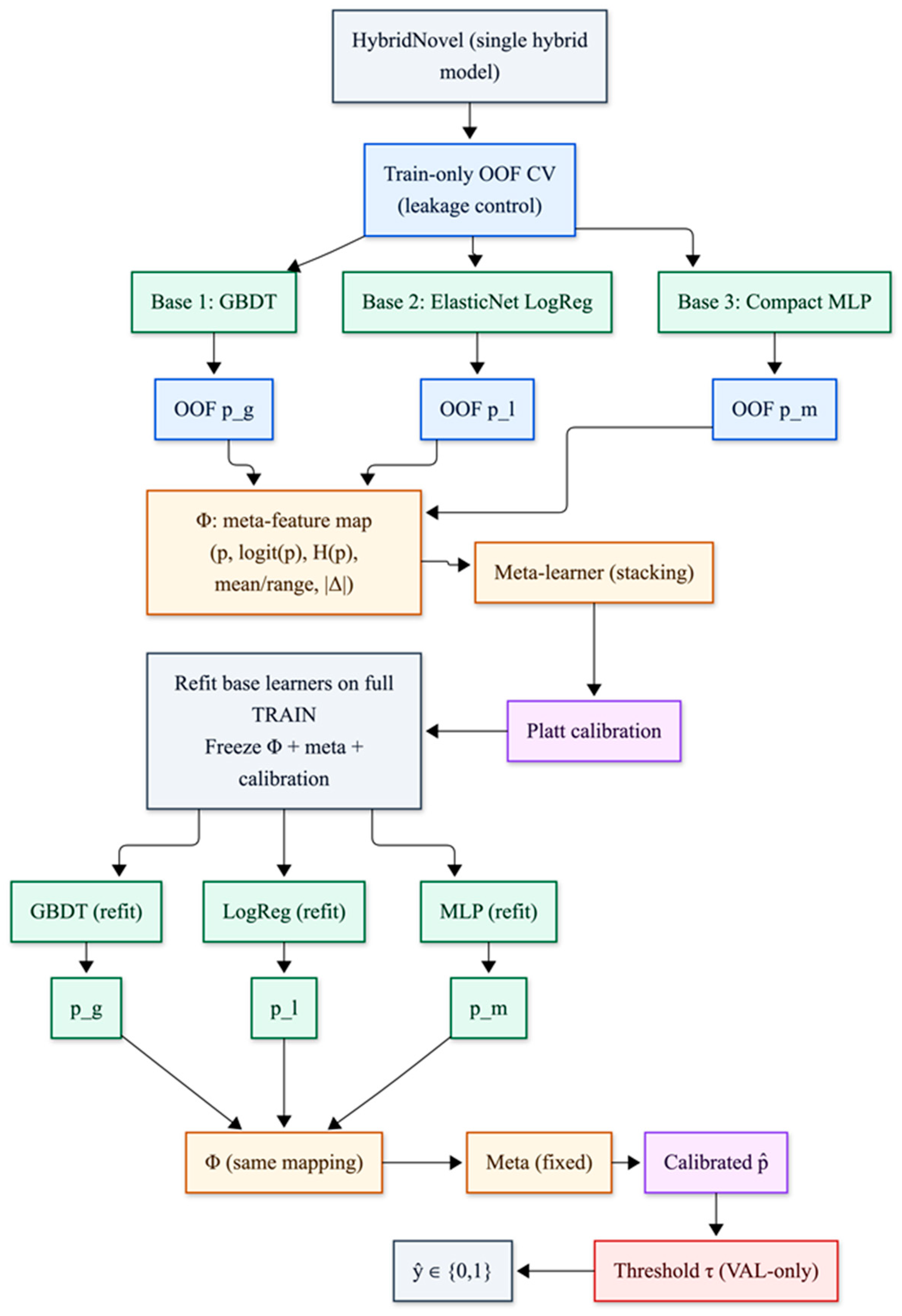
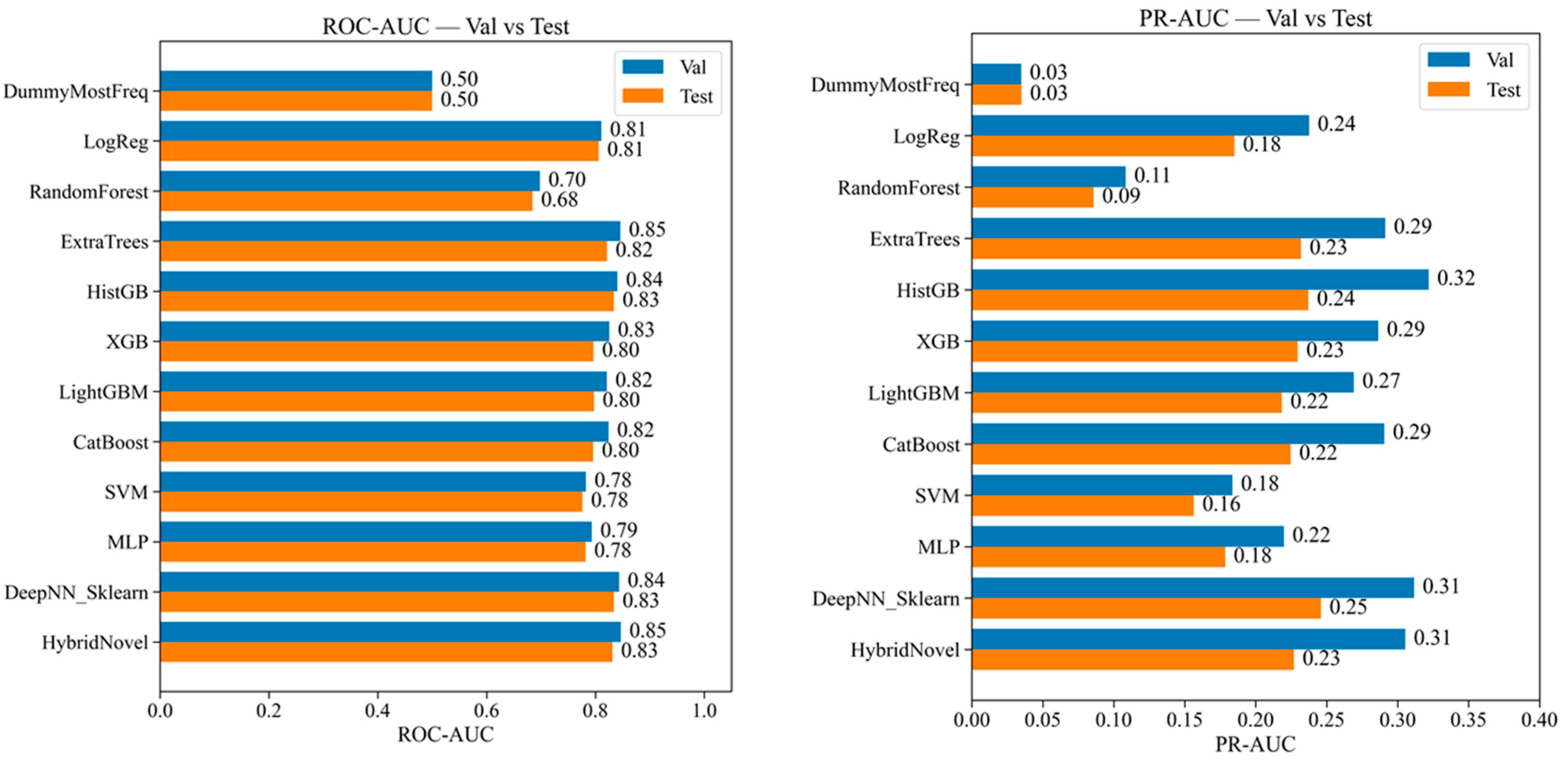
- HybridNovel designed to improve the robustness of rare positive class detection and reduce the risk of missing AST exceedances with individual ULN.
4. Results
4.1. Data Analysis
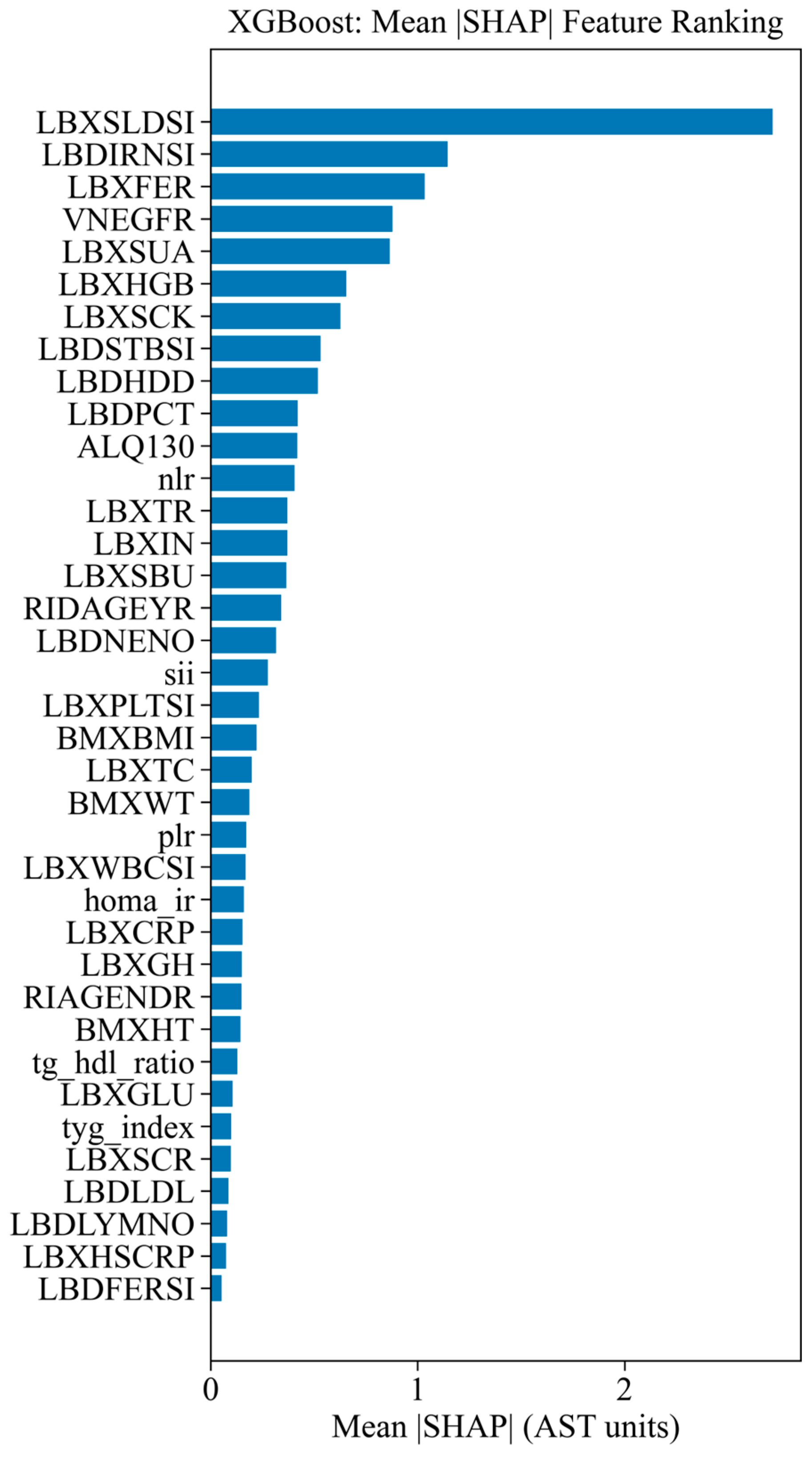
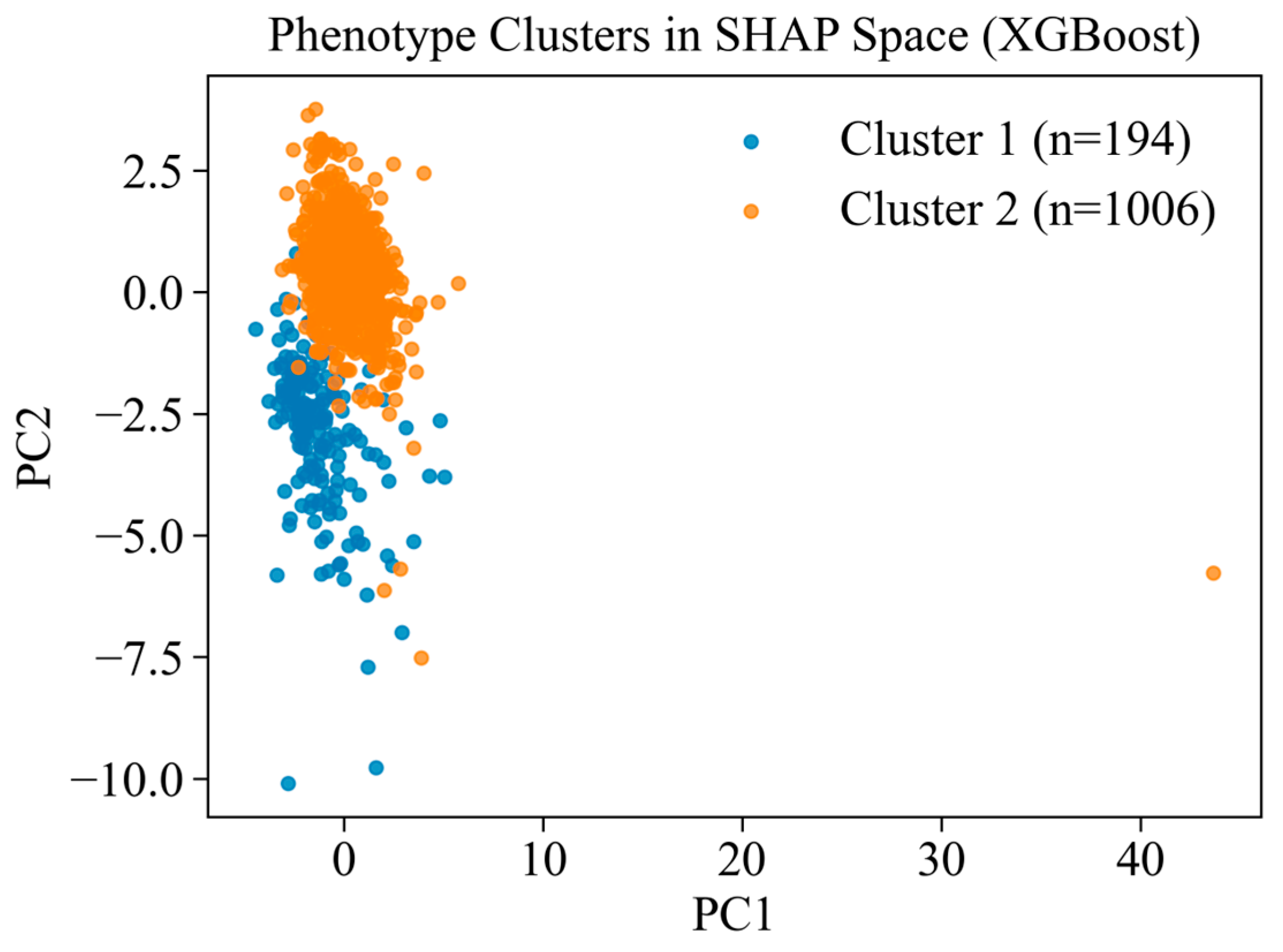
4.2. Model Interpretation Based on Feature Contributions
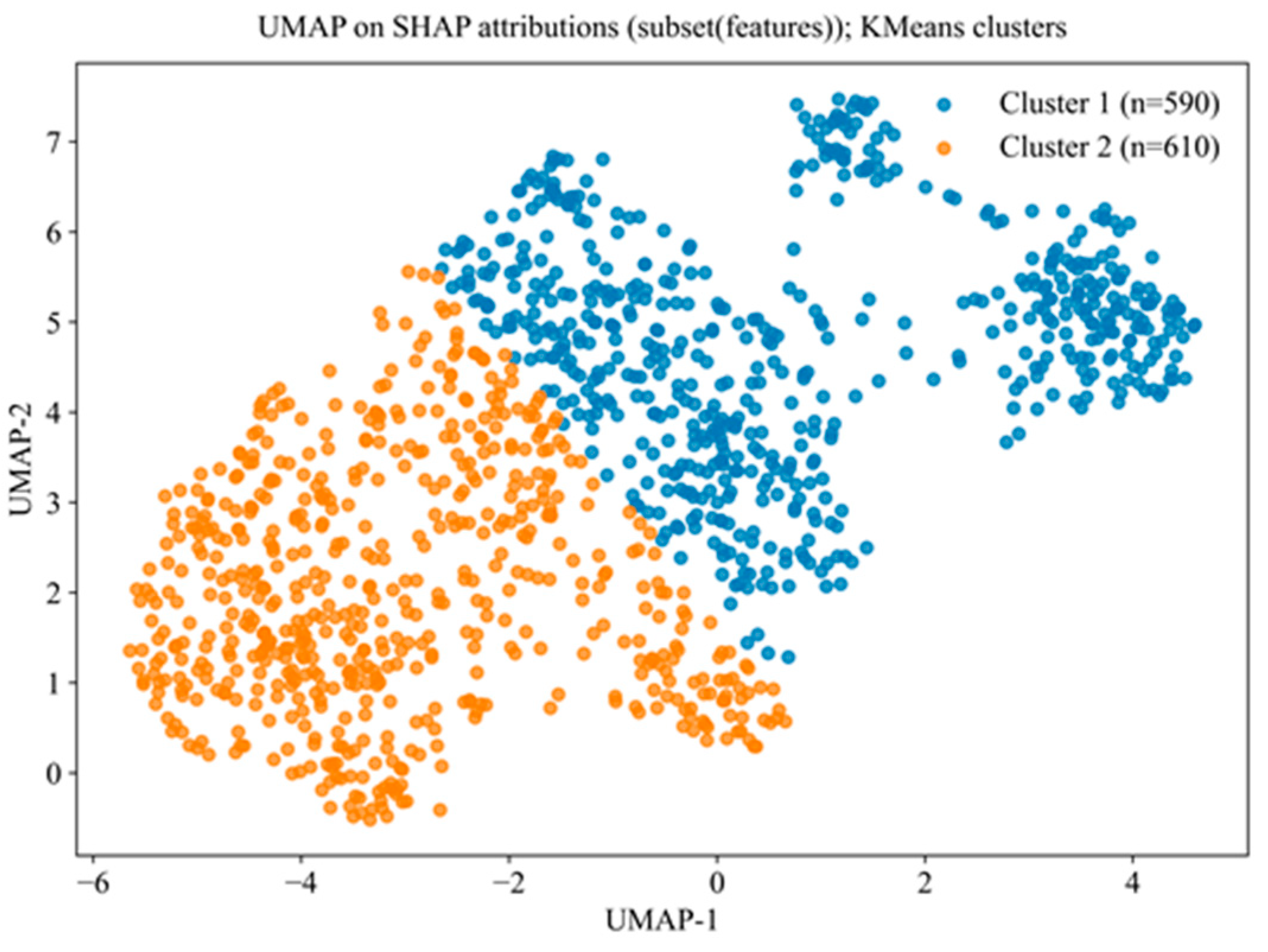
- Nonlinear representation of data structure. UMAP can reconstruct complex nonlinear manifolds from high-dimensional SHAP vectors. This is particularly relevant for gradient-boosted SHAP attributions, where feature effects are often nonlinear and depend on interactions. In linear projections, some of these structures can be “flattened”, leading to greater cluster overlap.
- Better preservation of local neighborhoods. UMAP focuses on topological proximity (local relationships), so groups of observations with similar prediction mechanisms often form compact regions. In a linear PCA projection, proximity is determined by global dispersion directions, which do not always coincide with the local “semantics” of SHAP profiles.
- Stability of cluster separability with K-means. K-means assumes that the data lie in predominantly spherical clusters in the chosen space. The UMAP representation often makes clusters more “geometrically suitable” for K-means, reducing overlap and increasing the interpretability of boundaries in 2D visualization.
- Comparability of cluster sizes. In this case, the clusters are similar in size (590/610), reducing the risk that any single cluster reflects only a small group of atypical observations. In the previous scheme (with a significantly smaller cluster), the emphasis shifted to identifying a compact subgroup that could be sensitive to outliers and rare combinations of SHAP patterns.
5. Discussion
6. Conclusions
Author Contributions
Funding
Data Availability Statement
Conflicts of Interest
Abbreviations
| AST | Aspartate Aminotransferase |
| ULN | Upper Limit of Normal |
| NHANES | National Health and Nutrition Examination Survey |
| ML | Machine Learning |
| XAI | Explainable Artificial Intelligence |
| SHAP | Shapley Additive Explanations |
| ROC-AUC | Area Under the Receiver Operating Characteristic Curve |
| PR-AUC | Area Under the Precision–Recall Curve |
| F1_Pos | F1-score for the Positive Class |
| GBDT | Gradient Boosted Decision Trees |
| XGBoost | eXtreme Gradient Boosting |
| LightGBM | Light Gradient Boosting Machine |
| CatBoost | Categorical Boosting |
| HistGB | Histogram-based Gradient Boosting |
| SVM | Support Vector Machine |
| RBF | Radial Basis Function |
| MLP | Multilayer Perceptron |
| OOF | Out-of-Fold |
| UMAP | Uniform Manifold Approximation and Projection |
| PCA | Principal Component Analysis |
| MI | Mutual Information |
| IQR | Interquartile Range |
| HOMA-IR | Homeostatic Model Assessment of Insulin Resistance |
| NLR | Neutrophil-to-Lymphocyte Ratio |
| PLR | Platelet-to-Lymphocyte Ratio |
| SII | Systemic Immune-Inflammation Index |
| TyG | Triglyceride–Glucose Index |
| eGFR | Estimated Glomerular Filtration Rate |
References
- Huang, R.; Liu, J.; Wang, J.; Qiu, Y.; Zhu, L.; Li, Y.; Liu, Y.; Zhan, J.; Xue, R.; Jiang, S.; et al. Histological features of chronic hepatitis B patients with normal alanine aminotransferase according to different criteria. Hepatol. Commun. 2024, 8, e0357. [Google Scholar] [CrossRef] [Scilit]
- Rossi, G.P.; Bernini, G.; Caliumi, C.; Desideri, G.; Fabris, B.; Ferri, C.; Ganzaroli, C.; Giacchetti, G.; Letizia, C.; Maccario, M.; et al. A prospective study of the prevalence of primary aldosteronism in 1125 hypertensive patients. J. Am. Coll. Cardiol. 2006, 48, 2293–2300. [Google Scholar] [CrossRef] [Scilit]
- Ma, S.; Yu, J.; Qin, X.; Liu, J. Current status and challenges in establishing reference intervals based on real-world data. Crit. Rev. Clin. Lab. Sci. 2023, 60, 427–441. [Google Scholar] [CrossRef]
- Nkongolo, S.; Mahamed, D.; Kuipery, A.; Vasquez, J.D.S.; Kim, S.C.; Mehrotra, A.; Patel, A.; Hu, C.; McGilvray, I.; Feld, J.J.; et al. Longitudinal liver sampling in patients with chronic hepatitis B starting antiviral therapy reveals hepatotoxic CD8+ T cells. J. Clin. Investig. 2023, 133, e158903. [Google Scholar] [CrossRef] [Scilit]
- Buchta, C.; Benka, B.; Delatour, V.; Faé, I.; Griesmacher, A.; Hellbert, K.; Huggett, J.; Kaiser, P.; Kammel, M.; Kessler, A.; et al. Reference, calibration and referral laboratories–a look at current European provisions and beyond. Clin. Chem. Lab. Med. (CCLM) 2025, 63, 656–669. [Google Scholar] [CrossRef] [Scilit]
- Yang, Y.; Wang, Z.Y.; Liu, Q.; Sun, S.; Wang, K.; Chellappa, R.; Zhou, Z.; Yuille, A.; Zhu, L.; Zhang, Y.-D.; et al. Medical World Model. In Proceedings of the IEEE/CVF International Conference on Computer Vision; Computer Vision Foundation: New York, NY, USA, 2025; pp. 8319–8329. [Google Scholar] [CrossRef] [Scilit]
- Yu, K.H.; Healey, E.; Leong, T.Y.; Kohane, I.S.; Manrai, A.K. Medical artificial intelligence and human values. N. Engl. J. Med. 2024, 390, 1895–1904. [Google Scholar] [CrossRef] [Scilit]
- Khera, R.; Oikonomou, E.K.; Nadkarni, G.N.; Morley, J.R.; Wiens, J.; Butte, A.J.; Topol, E.J. Transforming cardiovascular care with artificial intelligence: From discovery to practice: JACC state-of-the-art review. J. Am. Coll. Cardiol. 2024, 84, 97–114. [Google Scholar] [CrossRef] [Scilit]
- Cappuccio, E.; Kathirgamanathan, B.; Rinzivillo, S.; Andrienko, G.; Andrienko, N. Integrating human knowledge for explainable AI. Mach. Learn. 2025, 114, 250. [Google Scholar] [CrossRef] [Scilit]
- Aliferis, C.; Simon, G. Overfitting, underfitting and general model overconfidence and under-performance pitfalls and best practices in machine learning and AI. In Artificial Intelligence and Machine Learning in Health Care and Medical Sciences: Best Practices and Pitfalls; Springer: Berlin/Heidelberg, Germany, 2024; pp. 477–524. [Google Scholar] [CrossRef] [Scilit]
- Gallegos, A.; Nasef, D.; Toma, M. Leveraging convolutional neural networks to address overfitting and generalizability in automated bone fracture detection. Glob. Transl. Med. 2025, 4, 83–95. [Google Scholar] [CrossRef] [Scilit]
- Gichoya, J.W.; Banerjee, I.; Bhimireddy, A.R.; Burns, J.L.; Celi, L.A.; Chen, L.C.; Correa, R.; Dullerud, N.; Ghassemi, M.; Huang, S.-C.; et al. AI recognition of patient race in medical imaging: A modelling study. Lancet Digit. Health 2022, 4, e406–e414. [Google Scholar] [CrossRef] [Scilit] [PubMed]
- Diallo, R.; Edalo, C.; Awe, O.O. Machine learning evaluation of imbalanced health data: A comparative analysis of balanced accuracy, MCC, and F1 score. In Practical Statistical Learning and Data Science Methods: Case Studies from LISA 2020 Global Network, USA; Springer Nature: Cham, Switzerland, 2024; pp. 283–312. [Google Scholar] [CrossRef] [Scilit]
- Ma, Y.; Tian, Y.; Moniz, N.; Chawla, N.V. Class-imbalanced learning on graphs: A survey. ACM Comput. Surv. 2025, 57, 1–16. [Google Scholar] [CrossRef] [Scilit]
- Chicco, D.; Jurman, G. The Matthews correlation coefficient (MCC) should replace the ROC AUC as the standard metric for assessing binary classification. BioData Min. 2023, 16, 4. [Google Scholar] [CrossRef] [Scilit]
- Lamptey, E.; Oparebea, J.; Anyaele, G.; Ofosu, B.; Hanson, G.; Sakyi, P.O.; Agyapong, O.; Amuzu, D.S.Y.; Miller, W.A.; Kwofie, S.K.; et al. PLASMOpred: A Machine Learning-Based Web Application for Predicting Antimalarial Small Molecules Targeting the Apical Membrane Antigen 1–Rhoptry Neck Protein 2 Invasion Complex. Pharmaceuticals 2025, 18, 776. [Google Scholar] [CrossRef] [Scilit]
- Apicella, A.; Isgrò, F.; Prevete, R. Don’t push the button! exploring data leakage risks in machine learning and transfer learning. Artif. Intell. Rev. 2025, 58, 339. [Google Scholar] [CrossRef] [Scilit]
- Prata, M.; Masi, G.; Berti, L.; Arrigoni, V.; Coletta, A.; Cannistraci, I.; Vyetrenko, S.; Velardi, P.; Bartolini, N. Lob-based deep learning models for stock price trend prediction: A benchmark study. Artif. Intell. Rev. 2024, 57, 116. [Google Scholar] [CrossRef] [Scilit]
- Elaanba, A.; Ridouani, M.; Hassouni, L. A stacked generalization chest-x-ray-based framework for mispositioned medical tubes and catheters detection. Biomed. Signal Process. Control 2023, 79, 104111. [Google Scholar] [CrossRef] [Scilit]
- Laohaprasitiporn, P.; Kittithamvongs, P.; Monteerarat, Y.; Suriyarak, T.; Siripoonyothai, S.; Neti, N. A Multicenter Validation of a Novel Prediction Model for Elbow Flexion Recovery after Nerve Transfer Surgery in Brachial Plexus Injuries. Plast. Reconstr. Surg.–Glob. Open 2024, 12, e6118. [Google Scholar] [CrossRef] [Scilit]
- Coskun, A. Diagnosis based on population data versus personalized data: The evolving paradigm in laboratory medicine. Diagnostics 2024, 14, 2135. [Google Scholar] [CrossRef] [Scilit]
- Miranda, O.; Fan, P.; Qi, X.; Wang, H.; Brannock, M.D.; Kosten, T.R.; Ryan, N.D.; Kirisci, L.; Wang, L. DeepBiomarker2: Prediction of alcohol and substance use disorder risk in post-traumatic stress disorder patients using electronic medical records and multiple social determinants of health. J. Pers. Med. 2024, 14, 94. [Google Scholar] [CrossRef] [Scilit]
- Kosenko, E.; Tikhonova, L.; Alilova, G.; Montoliu, C. Erythrocytes Functionality in SARS-CoV-2 Infection: Potential Link with Alzheimer’s Disease. Int. J. Mol. Sci. 2023, 24, 5739. [Google Scholar] [CrossRef] [Scilit]
- Nagesh, V.K.; Pulipaka, S.P.; Bhuju, R.; Martinez, E.; Badam, S.; Nageswaran, G.A.; Tran, H.H.-V.; Elias, D.; Mansour, C.; Musalli, J.; et al. Management of gastrointestinal bleed in the intensive care setting, an updated literature review. World J. Crit. Care Med. 2025, 14, 101639. [Google Scholar] [CrossRef] [Scilit] [PubMed]
- Røys, E.Å.; Viste, K.; Farrell, C.J.; Kellmann, R.; Alaour, B.; Sylte, M.S.; Torsvik, J.; Strand, H.; Marber, M.; Omland, T.; et al. A Parametric Empirical Bayes Approach to Personalized Reference Intervals and Reference Change Values. Clin. Chem. 2025, 71, 1147–1157. [Google Scholar] [CrossRef] [Scilit] [PubMed]
- Salmi, M.; Atif, D.; Oliva, D.; Abraham, A.; Ventura, S. Handling imbalanced medical datasets: Review of a decade of research. Artif. Intell. Rev. 2024, 57, 273. [Google Scholar] [CrossRef] [Scilit]
- Fiseha, T.; Alemayehu, E.; Mohammed Adem, O.; Eshetu, B.; Gebreweld, A. Reference intervals for common clinical chemistry parameters in healthy adults of Northeast Ethiopia. PLoS ONE 2022, 17, e0276825. [Google Scholar] [CrossRef] [Scilit]
- Liu, S.; Roemer, F.; Ge, Y.; Bedrick, E.J.; Li, Z.M.; Guermazi, A.; Sharma, L.; Eaton, C.; Hochberg, M.C.; Hunter, D.J.; et al. Comparison of evaluation metrics of deep learning for imbalanced imaging data in osteoarthritis studies. Osteoarthr. Cartil. 2023, 31, 1242–1248. [Google Scholar] [CrossRef] [Scilit]
- Ismailova, A.; Abdikerimova, G.; Uzakkyzy, N.; Muratkhan, R.; Aitimov, M.; Tergeusizova, A.; Beissegul, A. Development of a Feature Vector for Accurate Breast Cancer Detection in Mammographic Images. Int. J. Cogn. Comput. Eng. 2025, 7, 12–25. [Google Scholar] [CrossRef] [Scilit]
- Kumar, R.; Sporn, K.; Prabhakar, V.; Alnemri, A.; Khanna, A.; Paladugu, P.; Gowda, C.; Clarkson, L.; Zaman, N.; Tavakkoli, A. Computational and imaging approaches for precision characterization of bone, cartilage, and synovial biomolecules. J. Pers. Med. 2025, 15, 298. [Google Scholar] [CrossRef] [Scilit] [PubMed]
- Chicco, D.; Jurman, G. A statistical comparison between Matthews correlation coefficient (MCC), prevalence threshold, and Fowlkes–Mallows index. J. Biomed. Inform. 2023, 144, 104426. [Google Scholar] [CrossRef] [Scilit]
- Chabbouh, M.; Bechikh, S.; Mezura-Montes, E.; Ben Said, L. Evolutionary optimization of the area under precision-recall curve for classifying imbalanced multi-class data. J. Heuristics 2025, 31, 9. [Google Scholar] [CrossRef] [Scilit]
- Sweet, L.B.; Athanasiadis, I.N.; van Bree, R.; Castellano, A.; Martre, P.; Paudel, D.; Ruane, A.C.; Zscheischler, J. Transdisciplinary coordination is essential for advancing agricultural modeling with machine learning. One Earth 2025, 8, 101233. [Google Scholar] [CrossRef] [Scilit]
- Piórkowski, R.; Mantiuk, R.; Wernikowski, M. Learning to predict perceptual visibility of rendering deterioration in computer games. Sci. Rep. 2024, 14, 27830. [Google Scholar] [CrossRef] [Scilit] [PubMed]
- Laboratory Tests Reference Ranges. Clinical Cases and Practice (Back Matter). Available online: https://ecampusontario.pressbooks.pub/clinicalcases/back-matter/laboratory-tests-reference-ranges/ (accessed on 15 December 2025).



| Variable | N | Average | SD | Median | Q25 | Q75 | IQR | Min | Max |
|---|---|---|---|---|---|---|---|---|---|
| ALQ130 | 23,834 | 2.758 | 2.737 | 2.000 | 1.000 | 3.000 | 2.000 | 1.000 | 83.000 |
| BMXBMI | 49,240 | 28.448 | 6.748 | 27.390 | 23.780 | 31.840 | 8.060 | 13.180 | 86.200 |
| BMXHT | 49,377 | 166.95 | 10.133 | 166.60 | 159.50 | 174.20 | 14.700 | 127.00 | 204.500 |
| BMXWT | 49,216 | 79.537 | 21.061 | 76.550 | 64.800 | 90.700 | 25.900 | 27.750 | 371.000 |
| LBDFERSI | 23,413 | 112.15 | 142.49 | 67.000 | 31.000 | 142.00 | 111.00 | 1.040 | 3234.000 |
| LBDHDD | 49,535 | 52.549 | 15.770 | 50.000 | 41.000 | 61.000 | 20.000 | 6.000 | 226.000 |
| LBDIRNSI | 20,445 | 15.385 | 6.706 | 14.510 | 10.740 | 19.000 | 8.260 | 0.540 | 86.100 |
| LBDLDL | 22,541 | 114.90 | 36.416 | 112.00 | 89.000 | 137.00 | 48.000 | 14.000 | 629.000 |
| LBDLYMNO | 49,707 | 2.182 | 1.002 | 2.100 | 1.700 | 2.600 | 0.900 | 0.200 | 49.000 |
| LBDNENO | 42,630 | 4.268 | 1.724 | 4.000 | 3.100 | 5.100 | 2.000 | 0.100 | 35.200 |
| LBDPCT | 20,331 | 25.126 | 11.544 | 23.700 | 17.100 | 31.300 | 14.200 | 0.500 | 99.600 |
| LBDSTBSI | 49,837 | 11.047 | 5.017 | 10.260 | 7.695 | 13.680 | 5.985 | 0.000 | 39.330 |
| LBXCRP | 28,834 | 0.443 | 0.855 | 0.210 | 0.100 | 0.450 | 0.350 | 0.010 | 29.600 |
| LBXFER | 23,413 | 112.15 | 142.49 | 67.000 | 31.000 | 142.00 | 111.00 | 1.040 | 3234.000 |
| LBXGH | 49,605 | 5.656 | 1.058 | 5.400 | 5.100 | 5.800 | 0.700 | 2.000 | 18.800 |
| LBXGLU | 26,330 | 108.86 | 39.368 | 98.200 | 91.000 | 110.77 | 19.775 | 21.000 | 686.200 |
| LBXHGB | 49,796 | 14.057 | 1.547 | 14.100 | 13.100 | 15.100 | 2.000 | 5.650 | 19.900 |
| LBXHSCRP | 10,357 | 4.181 | 8.166 | 1.900 | 0.800 | 4.500 | 3.700 | 0.080 | 188.500 |
| LBXIN | 26,765 | 14.661 | 16.656 | 10.010 | 6.380 | 16.680 | 10.300 | 0.140 | 293.580 |
| LBXPLTSI | 49,804 | 253.99 | 67.749 | 246.87 | 208.00 | 292.00 | 84.000 | 8.000 | 1000.000 |
| LBXSBU | 44,313 | 14.259 | 6.030 | 13.000 | 11.000 | 17.000 | 6.000 | 1.000 | 104.000 |
| LBXSCK | 20,756 | 160.67 | 235.77 | 112.00 | 75.000 | 178.00 | 103.00 | 6.000 | 12,795.00 |
| LBXSCR | 49,946 | 0.913 | 0.432 | 0.880 | 0.710 | 1.020 | 0.310 | 0.160 | 17.800 |
| LBXSLDSI | 49,455 | 138.59 | 35.185 | 133.00 | 116.00 | 155.00 | 39.000 | 4.000 | 1274.000 |
| LBXSUA | 49,194 | 5.363 | 1.449 | 5.200 | 4.300 | 6.200 | 1.900 | 0.200 | 18.000 |
| LBXTC | 49,896 | 193.82 | 42.860 | 190.00 | 164.00 | 220.00 | 56.000 | 59.000 | 813.000 |
| LBXTR | 27,114 | 131.54 | 104.98 | 106.00 | 72.000 | 158.00 | 86.000 | 10.000 | 2740.000 |
| LBXWBCSI | 48,839 | 7.250 | 2.483 | 6.900 | 5.700 | 8.400 | 2.700 | 1.400 | 117.200 |
| RIDAGEYR | 49,950 | 47.414 | 19.242 | 46.000 | 31.000 | 63.000 | 32.000 | 18.000 | 90.000 |
| VNEGFR | 49,929 | 91.165 | 24.885 | 92.158 | 74.668 | 108.99 | 34.322 | 1.854 | 187.370 |
| homa_ir | 26,060 | 4.388 | 7.094 | 2.514 | 1.517 | 4.546 | 3.029 | 0.026 | 185.292 |
| nlr | 42,623 | 2.178 | 1.201 | 1.941 | 1.447 | 2.600 | 1.153 | 0.009 | 30.667 |
| plr | 49,691 | 127.84 | 50.903 | 119.20 | 94.500 | 150.45 | 55.955 | 2.424 | 920.000 |
| sii | 42,610 | 546.37 | 352.06 | 470.82 | 334.71 | 664.10 | 329.39 | 1.529 | 11,700.00 |
| tg_hdl_ratio | 26,896 | 2.982 | 3.548 | 2.075 | 1.255 | 3.500 | 2.245 | 0.128 | 90.667 |
| tyg_index | 25,707 | 8.654 | 0.706 | 8.599 | 8.161 | 9.070 | 0.910 | 5.647 | 12.723 |
| LBXSASSI (AST) | 49,950 | 24.482 | 12.209 | 22.000 | 18.000 | 27.000 | 9.000 | 6.000 | 200.000 |
| Variable | Level (Code) | n | Share, % | N |
|---|---|---|---|---|
| RIAGENDR | 2 | 25,974 | 52.0 | 49,950 |
| RIAGENDR | 1 | 23,976 | 48.0 | 49,950 |
| Features | Percentage of Gaps | Number of Gaps (n) | Number of Unique Values |
|---|---|---|---|
| LBXHSCRP | 0.793 | 39,593 | 1366 |
| LBDPCT | 0.593 | 29,619 | 995 |
| LBDIRNSI | 0.591 | 29,505 | 909 |
| LBXSCK | 0.584 | 29,194 | 902 |
| LBDLDL | 0.549 | 27,409 | 352 |
| LBDFERSI | 0.531 | 26,537 | 1956 |
| LBXFER | 0.531 | 26,537 | 1956 |
| ALQ130 | 0.523 | 26,116 | 31 |
| tyg_index | 0.485 | 24,243 | 15,050 |
| homa_ir | 0.478 | 23,890 | 23,822 |
| LBXGLU | 0.473 | 23,620 | 2475 |
| LBXIN | 0.464 | 23,185 | 5302 |
| tg_hdl_ratio | 0.462 | 23,054 | 11,490 |
| LBXTR | 0.457 | 22,836 | 884 |
| LBXCRP | 0.423 | 21,116 | 681 |
| Features | Cluster 1 (Mean SHAP) | Cluster 2 (Mean SHAP) |
|---|---|---|
| RIAGENDR | −0.4643 | 0.4491 |
| −0.3599 | 0.3481 | |
| LBXFER | −0.3227 | 0.3121 |
| BMXWT | 0.3061 | −0.2961 |
| LBDIRNSI | −0.3023 | 0.2923 |
| LBDNENO | −0.2940 | 0.2844 |
| LBXTR | −0.2865 | 0.2771 |
| LBXHGB | −0.2718 | 0.2628 |
| LBXSUA | −0.2519 | 0.2437 |
| BMXHT | 0.2274 | −0.2200 |
| LBXCRP | 0.2192 | −0.2120 |
| 0.2129 | −0.2059 | |
| BMXBMI | 0.2111 | −0.2042 |
| LBXIN | −0.2023 | 0.1957 |
| tg_hdl_ratio | 0.1735 | −0.1678 |
| Model Variant | ROC-AUC | PR-AUC | Balanced Acc | F1_Pos |
|---|---|---|---|---|
| Full HybridNovel | 0.83 | 0.23 | 0.65 | 0.30 |
| - Meta-features (probabilities only) | 0.82 | 0.21 | 0.63 | 0.27 |
| - Calibration | 0.83 | 0.22 | 0.62 | 0.28 |
| - MLP base learner | 0.82 | 0.22 | 0.64 | 0.29 |
Disclaimer/Publisher’s Note: The statements, opinions and data contained in all publications are solely those of the individual author(s) and contributor(s) and not of MDPI and/or the editor(s). MDPI and/or the editor(s) disclaim responsibility for any injury to people or property resulting from any ideas, methods, instructions or products referred to in the content. |
© 2026 by the authors. Licensee MDPI, Basel, Switzerland. This article is an open access article distributed under the terms and conditions of the Creative Commons Attribution (CC BY) license.
Share and Cite
Maxutova, N.; Kassymova, A.; Kadirkulov, K.; Ismailova, A.; Zhidekulova, G.; Azhibekova, Z.; Tussupov, J.; Rakhimov, Q.; Kenzhebayeva, Z. A Hybrid Ensemble Framework for Rare Event Detection in Large-Scale Tabular Data. Computers 2026, 15, 151. https://doi.org/10.3390/computers15030151
Maxutova N, Kassymova A, Kadirkulov K, Ismailova A, Zhidekulova G, Azhibekova Z, Tussupov J, Rakhimov Q, Kenzhebayeva Z. A Hybrid Ensemble Framework for Rare Event Detection in Large-Scale Tabular Data. Computers. 2026; 15(3):151. https://doi.org/10.3390/computers15030151
Chicago/Turabian StyleMaxutova, Natalya, Akmaral Kassymova, Kuanysh Kadirkulov, Aisulu Ismailova, Gulkiz Zhidekulova, Zhanar Azhibekova, Jamalbek Tussupov, Quvvatali Rakhimov, and Zhanat Kenzhebayeva. 2026. "A Hybrid Ensemble Framework for Rare Event Detection in Large-Scale Tabular Data" Computers 15, no. 3: 151. https://doi.org/10.3390/computers15030151
APA StyleMaxutova, N., Kassymova, A., Kadirkulov, K., Ismailova, A., Zhidekulova, G., Azhibekova, Z., Tussupov, J., Rakhimov, Q., & Kenzhebayeva, Z. (2026). A Hybrid Ensemble Framework for Rare Event Detection in Large-Scale Tabular Data. Computers, 15(3), 151. https://doi.org/10.3390/computers15030151