
Designing an Intelligent Learning System Based on the Knowledge Tracing Model to Enhance Self-Efficacy, Academic Passion, and Achievement Among Educational Technology Students

 ,
, 
Abstract
1. Introduction
1.1. The Current Research
1.2. Research Hypotheses
2. Materials and Methods
2.1. Research Design and Participants
2.2. Research Instruments
- Academic Achievement Test:
- 2.
- Self-Efficacy Scale
- 3.
- Academic Passion Scale
2.3. Implementation Procedures for the Proposed Learning Environment
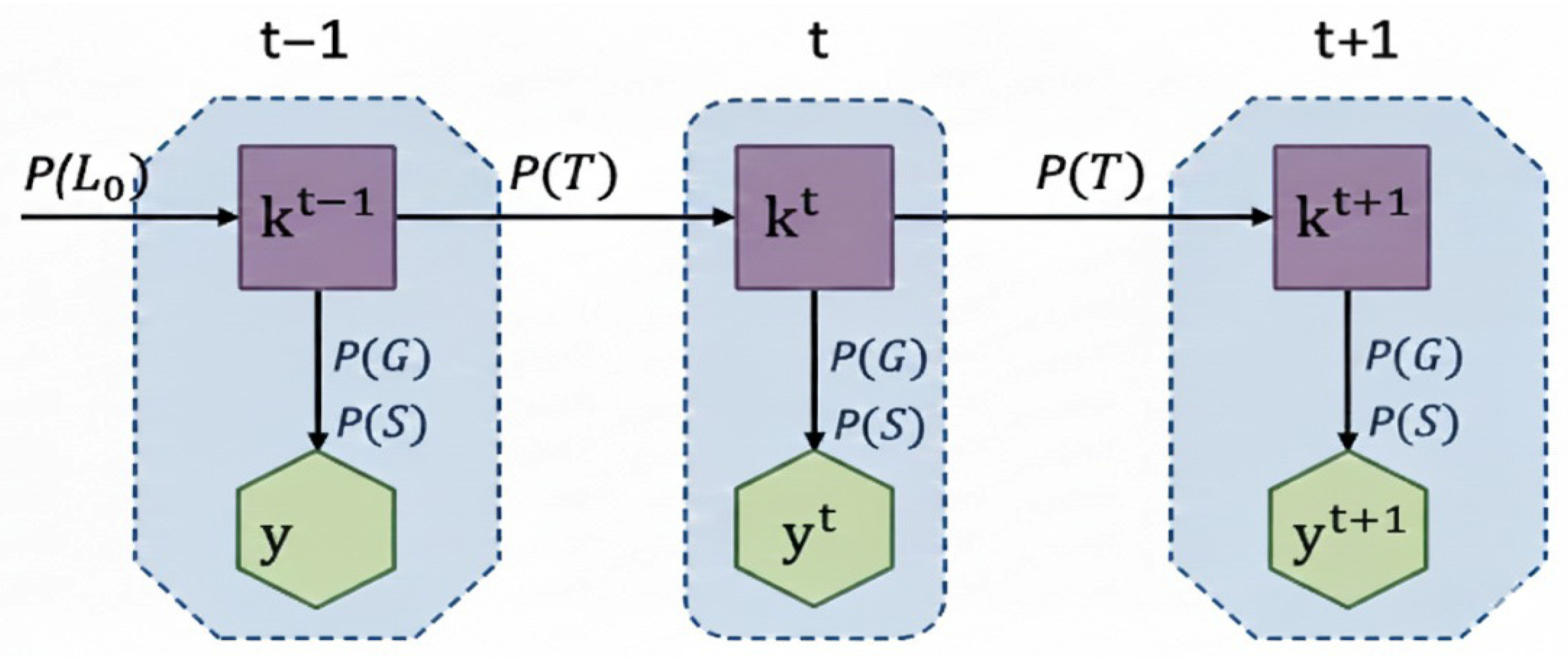
2.3.1. Intelligent Learning System and Knowledge Tracing Model
- -
- Prior probability (P(L0)) represents the learner’s initial likelihood of having mastered a given knowledge concept before engaging with the learning activities.
- -
- Guess probability (P(G)) reflects the chance that a learner provides a correct response despite not actually mastering the concept.
- -
- Slip probability (P(S)) reflects the chance that a learner provides an incorrect response even though the concept has already been mastered.
- -
- Transition probability (P(T)) denotes the likelihood that a learner who has not yet mastered a skill will achieve mastery after the subsequent learning or practice opportunity.
- Initial Knowledge (P(L0))
- 2.
- Hidden Mastery State (kt)
- 3.
- Learning Transition Probability (P(T))
- 4.
- Observation Model: Guess and Slip Probabilities (P(G), P(S))
- 5.
- Observable Response (yt)
2.3.2. System Origin and Technical Specifications
2.3.3. Pedagogical Role of Knowledge Tracing in Personalization
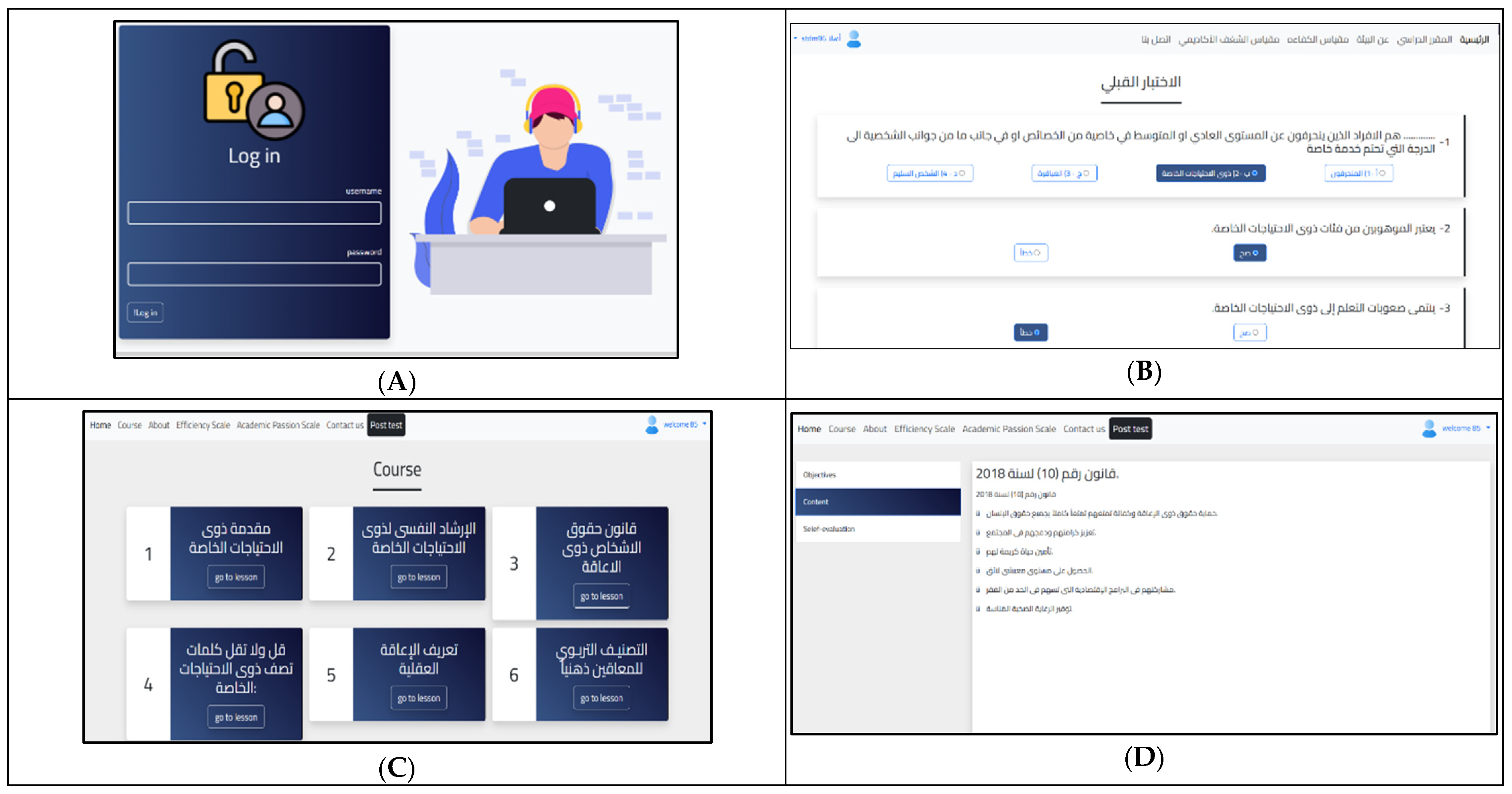
- Each student logs into the environment by entering a unique username and password.
- Each student first completes a pre-test for the Special Needs Care course. The purpose of this test is to measure the student’s initial cognitive level before beginning the learning process.
- The course content is divided into a set of lessons and concepts, comprising approximately 16 lessons and 49 concepts. Notably, students cannot proceed to the next lesson unless they have studied the current lesson and answered its associated questions.
- Upon entering a lesson, a screen appears displaying the lesson objectives, content (i.e., the concepts associated with the lesson, which vary in number), and self-assessment questions.
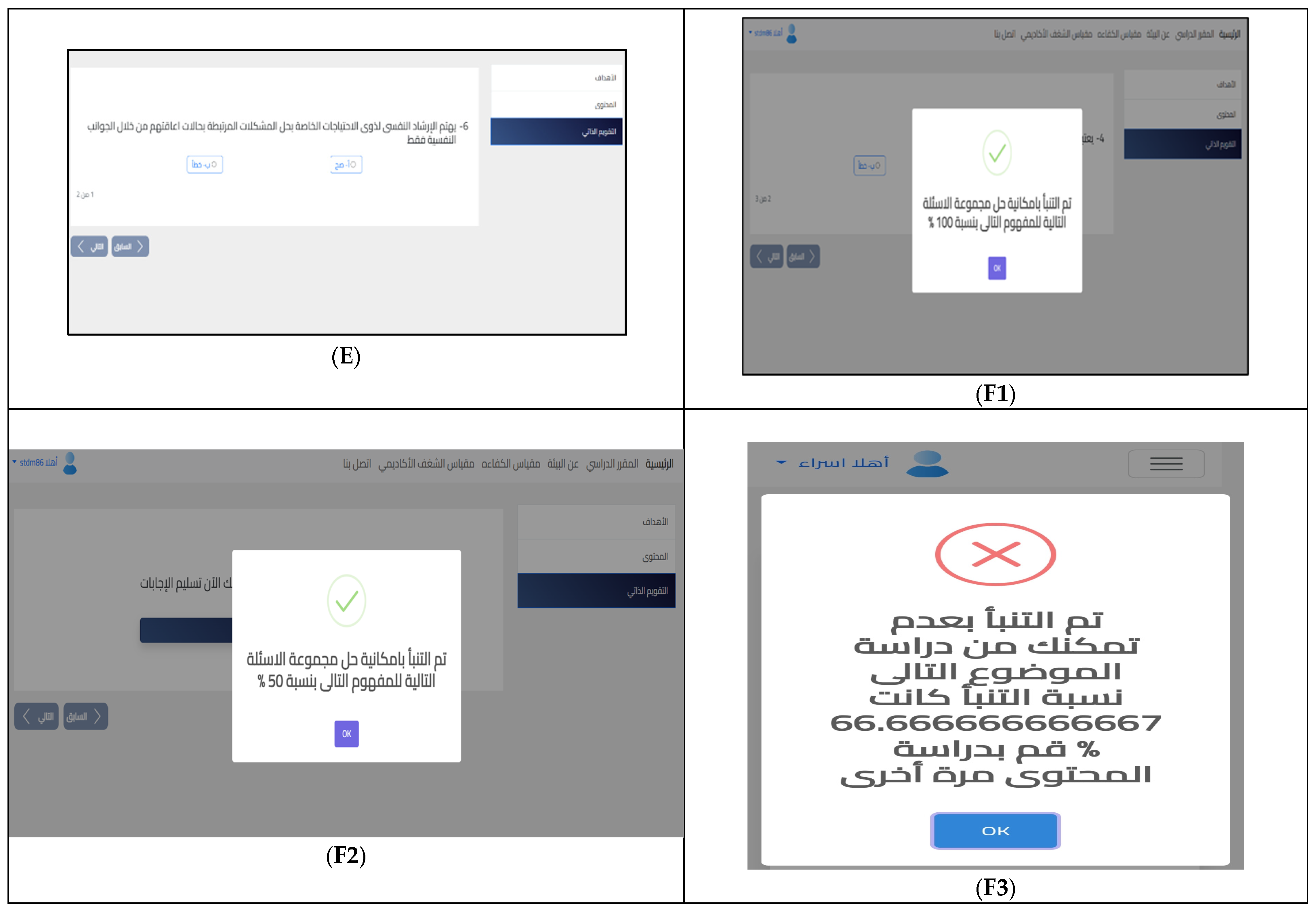
- After studying the lesson content and concepts, the student proceeds to complete the self-assessment questions.
- The system then predicts student performance on subsequent tasks, which determines whether the student can proceed to the next concept or must review the current lesson. This process includes:
- (a)
- For the first student, the prediction rate is 100%. Based on the intelligent learning system’s analysis using the Knowledge Tracing model, the system predicts that this student can master the next concept with full confidence. This high-rate results from the interconnected nature of the concepts, which require mastery of preceding material before progression.
- (b)
- For the second student, the prediction rate is 50%. The system informs the student that there is a 50% likelihood of correctly answering the questions related to the next concept. This prediction is based on the student’s performance in studying and answering questions on the current concept.
- (c)
- For the third student, the system records a prediction rate of approximately 66.7%. This indicates that the student is not yet ready to study or solve questions for the next concept. Consequently, the student is advised to review the current lesson content and its associated concepts due to insufficient mastery.
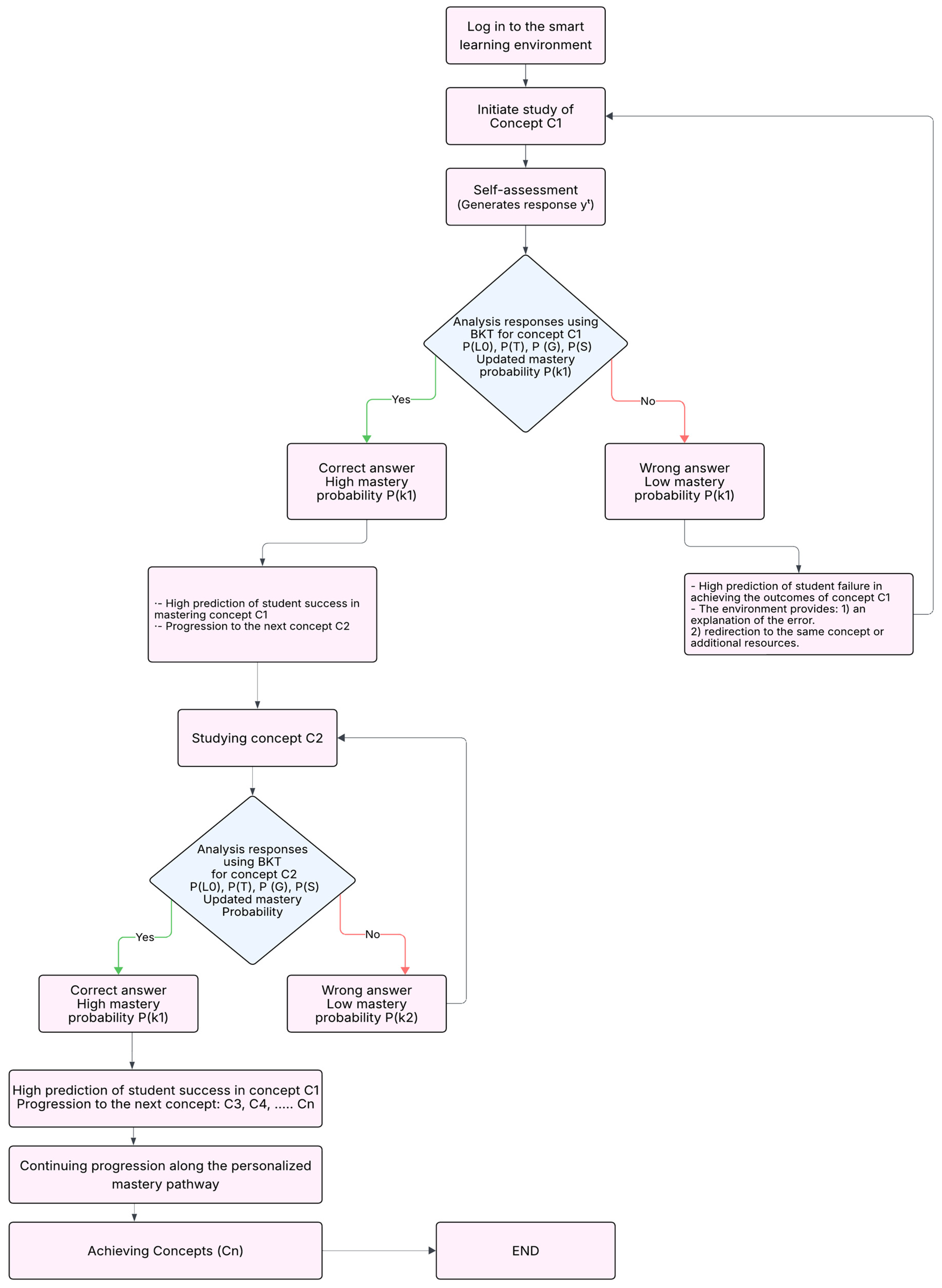
2.3.4. Adaptive Learning Workflow of the Proposed System
- High Mastery Probability: If the mastery probability exceeds the predefined progression threshold, the system predicts a high likelihood of success for concept C1, allowing the learner to advance to the next concept (C2).
- Low Mastery Probability: If the mastery probability remains below the threshold, the model predicts a higher probability of failure. In this case, the environment delivers targeted remediation, which may include explanations of errors, additional worked examples, redirection to the same concept, or access to supplementary resources to reinforce comprehension.
2.4. Data Collection and Analysis
3. Results
Gender Differences in Post-Test Outcomes
4. Discussion
5. Limitations
6. Conclusions
Author Contributions
Funding
Institutional Review Board Statement
Informed Consent Statement
Data Availability Statement
Conflicts of Interest
References
- Wang, H.; Wu, Q.; Bao, C.; Ji, W.; Zhou, G. Research on knowledge tracing based on learner fatigue state. Complex Intell. Syst. 2025, 11, 226. [Google Scholar] [CrossRef]
- VanLehn, K. The relative effectiveness of human tutoring, intelligent tutoring systems, and other tutoring systems. Educ. Psychol. 2011, 46, 197–221. [Google Scholar] [CrossRef]
- Kerimbayev, N.; Adamova, K.; Shadiev, R.; Altinay, Z. Intelligent educational technologies in individual learning: A systematic literature review. Smart Learn. Environ. 2025, 12, 1. [Google Scholar] [CrossRef]
- Troussas, C.; Krouska, A.; Sgouropoulou, C. Learner Modeling and Analysis. In Human-Computer Interaction and Augmented Intelligence: The Paradigm of Interactive Machine Learning in Educational Software; Springer Nature: Cham, Switzerland, 2025; pp. 305–345. [Google Scholar] [CrossRef]
- Anderson, J.R. Cognitive Modelling and Intelligent Tutoring; National Science Foundation: Washington, DC, USA, 1986.
- Anderson, J.R.; Boyle, C.F.; Corbett, A.T.; Lewis, M.W. Cognitive modeling and intelligent tutoring. Artif. Intell. 1990, 42, 7–49. [Google Scholar] [CrossRef]
- Liu, M.; Yu, D. Towards intelligent E-learning systems. Educ. Inf. Technol. 2023, 28, 7845–7876. [Google Scholar] [CrossRef] [PubMed]
- Zhang, J.; Shi, X.; King, I.; Yeung, D.Y. Dynamic key-value memory networks for knowledge tracing. In Proceedings of the 26th International Conference on World Wide Web, Perth, Australia, 3–7 April 2017; pp. 765–774. [Google Scholar] [CrossRef]
- Ghosh, A.; Heffernan, N.; Lan, A.S. Context-aware attentive knowledge tracing. In Proceedings of the 26th ACM SIGKDD International Conference on Knowledge Discovery & Data Mining, San Diego, CA, USA, 23–27 August 2020; pp. 2330–2339. [Google Scholar] [CrossRef]
- Labra, C.; Santos, O.C. Exploring cognitive models to augment explainability in Deep Knowledge Tracing. In Proceedings of the 31st ACM Conference on User Modeling, Adaptation and Personalization, Limassol, Cyprus, 26–29 June 2023; pp. 220–223. [Google Scholar] [CrossRef]
- Shen, S.; Liu, Q.; Huang, Z.; Zheng, Y.; Yin, M.; Wang, M.; Chen, E. A survey of knowledge tracing: Models, variants, and applications. IEEE Trans. Learn. Technol. 2024, 17, 1858–1879. [Google Scholar] [CrossRef]
- Corbett, A.T.; Anderson, J.R. Knowledge tracing: Modeling the acquisition of procedural knowledge. User Model. User-Adapt. Interact. 1994, 4, 253–278. [Google Scholar] [CrossRef]
- Piech, C.; Bassen, J.; Huang, J.; Ganguli, S.; Sahami, M.; Guibas, L.J.; Sohl-Dickstein, J. Deep Knowledge Tracing. In Advances in Neural Information Processing Systems 28; MIT Press: Cambridge, MA, USA, 2015; pp. 505–513. [Google Scholar]
- Lu, Y.; Tong, L.; Cheng, Y. Advanced Knowledge Tracing: Incorporating Process Data and Curricula Information via an Attention-Based Framework for Accuracy and Interpretability. J. Educ. Data Min. 2024, 16, 58–84. [Google Scholar] [CrossRef]
- Junco, R.; Cotten, S.R. No A 4 U: The relationship between multitasking and academic performance. Comput. Educ. 2012, 59, 505–514. [Google Scholar] [CrossRef]
- Abouelenein, Y.A.M.; Selim, S.A.S.; Aldosemani, T.I. Impact of an adaptive environment based on learning analytics on pre-service science teacher behavior and self-regulation. Smart Learn. Environ. 2025, 12, 8. [Google Scholar] [CrossRef]
- Dong, J.; Mohd Rum, S.N.; Kasmiran, K.A.; Aris, T.N.M.; Mohamed, R. Artificial intelligence in adaptive and intelligent educational systems: A review. Future Internet 2022, 14, 245. [Google Scholar] [CrossRef]
- Chen, J.-Y.; Saeedvand, S.; Lai, I.-W. Adaptive learning path navigation based on knowledge tracing and reinforcement learning. arXiv 2023, arXiv:2305.04475. [Google Scholar] [CrossRef]
- Adler, I.; Warren, S.; Norris, C.; Soloway, E. Leveraging opportunities for self-regulated learning in smart learning environments. Smart Learn. Environ. 2025, 12, 6. [Google Scholar] [CrossRef]
- El Sabagh, H.A. Adaptive e-learning environment based on learning styles and its impact on students’ engagement. Int. J. Educ. Technol. High. Educ. 2021, 18, 53. [Google Scholar] [CrossRef]
- Ludwig, J.; Dignath, D.; Lukas, S. Positive and negative action-effects improve task-switching performance. Acta Psychol. 2021, 221, 103440. [Google Scholar] [CrossRef]
- Schunk, D.H.; Pajares, F. Self-Efficacy Theory. In Handbook of Motivation at School; Routledge: Milton Park, UK, 2009; pp. 49–68. [Google Scholar]
- Ryan, R.M.; Deci, E.L. Self-Determination Theory: Basic Psychological Needs in Motivation, Development, and Wellness; Guilford Press: New York, NY, USA, 2017. [Google Scholar]
- Chen, J.; Liu, Z.; Huang, S.; Liu, Q.; Luo, W. Self-determination theory and the influence of social support, self-regulated learning, and flow experience on student learning engagement in self-directed e-learning. Front. Psychol. 2025, 16, 1545980. [Google Scholar] [CrossRef]
- Bandura, A.; Wessels, S. Self-Efficacy; Cambridge University Press: Cambridge, UK, 1997; pp. 4–6. [Google Scholar]
- Zimmerman, B.J. Self-efficacy: An essential motive to learn. Contemp. Educ. Psychol. 2000, 25, 82–91. [Google Scholar] [CrossRef]
- Aleven, V.; McLaughlin, E.A.; Glenn, R.A.; Koedinger, K.R. Instruction based on adaptive learning technologies. In Handbook of Research on Learning and Instruction, 2nd ed.; Routledge: New York, NY, USA, 2016; pp. 522–560. [Google Scholar]
- Fredricks, J.A.; Blumenfeld, P.C.; Paris, A.H. School engagement: Potential of the concept, state of the evidence. Rev. Educ. Res. 2004, 74, 59–109. [Google Scholar] [CrossRef]
- Deci, E.L.; Ryan, R.M. The “what” and “why” of goal pursuits: Human needs and the self-determination of behavior. Psychol. Inq. 2000, 11, 227–268. [Google Scholar] [CrossRef]
- Vallerand, R.J.; Houlfort, N. Passion at work: Toward a new conceptualization. In Emerging Perspectives on Values in Organizations; Emerald Group Publishing: Bingley, UK, 2003; pp. 175–204. [Google Scholar] [CrossRef]
- Heffernan, N.T.; Heffernan, C.L. The ASSISTments ecosystem: Building a platform that brings scientists and teachers together for minimally invasive research on human learning and teaching. Int. J. Artif. Intell. Educ. 2014, 24, 470–497. [Google Scholar] [CrossRef]
- Li, Y.; Lu, B. Intelligent educational systems based on adaptive learning algorithms and multimodal behavior modeling. PeerJ Comput. Sci. 2025, 11, e3157. [Google Scholar] [CrossRef]
- Liu, Z.; Guo, T.; Liang, Q.; Hou, M.; Zhan, B.; Tang, J.; Luo, W.; Weng, J. Deep learning based knowledge tracing: A review, a tool and empirical studies. IEEE Trans. Knowl. Data Eng. 2025, 37, 4512–4536. [Google Scholar] [CrossRef]
- Dai, M.; Hung, J.; Du, X.; Tang, H.; Li, H. Knowledge Tracing: A Review of Available Techniques. J. Educ. Technol. Dev. Exch. 2021, 14, 1–20. [Google Scholar] [CrossRef]
- Fu, Z. Integrating Reinforcement Learning with Dynamic Knowledge Tracing for personalized learning path optimization. Sci. Rep. 2025, 15, 40202. [Google Scholar] [CrossRef]
- Mohamed, A.; Shaalan, K.; Saeed, A.Q.; Elnekiti, A.; Alhyari, O.; Yousuf, H.; Ghazal, T.M. Emotion-Aware Course Personalization in Virtual Classrooms via Multi-Modal Fusion Learning Systems. In Proceedings of the 2025 3rd International Conference on Cyber Resilience (ICCR); IEEE: New York, NY, USA, 2025; pp. 1–7. [Google Scholar] [CrossRef]
- Bai, Y.; Li, X.; Liu, Z.; Huang, Y.; Tian, M.; Luo, W. Rethinking and Improving Student Learning and Forgetting Processes for Attention based Knowledge Tracing Models. Proc. AAAI Conf. Artif. Intell. 2025, 39, 27822–27830. [Google Scholar] [CrossRef]
- Liu, Q.; Xu, L. Deep Graph Knowledge Tracing with Multi-head Self-attention and Forgetting Mechanism. In Neural Information Processing. ICONIP 2025; Taniguchi, T., Leung, C.S.A., Kozuno, T., Yoshimoto, J., Mahmud, M., Doborjeh, M., Doya, K., Eds.; Communications in Computer and Information Science; Springer: Singapore, 2026; Volume 2754. [Google Scholar] [CrossRef]
- Schwarzer, R.; Jerusalem, M. Generalized Self-Efficacy scale. In Measures in Health Psychology: A User’s Portfolio. CAUSAL and Control Beliefs; Weinman, J., Wright, S., Johnston, M., Eds.; NFER-NELSON: Slough, UK, 1995; pp. 35–37. [Google Scholar]
- Vallerand, R.J.; Blanchard, C.; Mageau, G.A.; Koestner, R.; Ratelle, C.; Léonard, M.; Gagné, M.; Marsolais, J. Les passions de l’âme: On obsessive and harmonious passion. J. Personal. Soc. Psychol. 2003, 85, 756–767. [Google Scholar] [CrossRef] [PubMed]
- IBM Corp. IBM SPSS Statistics for Windows, version 30.0. [Computer software]. IBM Corp: Armonk, NY, USA, 2023.
- JASP Team. JASP, version 0.18.2. [Computer software]. JASP Team: Amsterdam, Netherlands, 2023. Available online: https://jasp-stats.org/ (accessed on 1 November 2025).
- Tuo, P.; Bicakci, M.; Ziegler, A.; Zhang, B. Measuring Personalized Learning in the Smart Classroom Learning Environment: Development and Validation of an Instrument. Educ. Sci. 2025, 15, 620. [Google Scholar] [CrossRef]
- Levin, I.; Semenov, A.L.; Gorsky, M. Smart Learning in the 21st Century: Advancing Constructionism Across Three Digital Epochs. Educ. Sci. 2025, 15, 45. [Google Scholar] [CrossRef]
- He, L.; Li, X.; Wang, P.; Tang, J.; Wang, T. Integrating fine-grained attention into multi-task learning for knowledge tracing. World Wide Web 2023, 26, 3347–3372. [Google Scholar] [CrossRef]
- An, S.; Kim, J.; Kim, M.; Park, J. No task left behind: Multi-task learning of knowledge tracing and option tracing for better student assessment. In Proceedings of the AAAI Conference on Artificial Intelligence, Online, 22 February–1 March 2022; Volume 36, pp. 4424–4431. [Google Scholar] [CrossRef]
- Krumsvik, R.J. Smartphones, media multitasking and cognitive overload. Nord. J. Digit. Lit. 2025, 20, 5–15. [Google Scholar] [CrossRef]
- Koedinger, K.R.; Booth, J.L.; Klahr, D. Instructional complexity and the science to constrain it. Science 2013, 342, 935–937. [Google Scholar] [CrossRef]
- Sweller, J. Cognitive load during problem solving: Effects on learning. Cogn. Sci. 1988, 12, 257–285. [Google Scholar] [CrossRef]
- Dabbagh, N.; Kitsantas, A. Personal Learning Environments, social media, and self-regulated learning: A natural formula for connecting formal and informal learning. Internet High. Educ. 2012, 15, 3–8. [Google Scholar] [CrossRef]
- Shaban, A.; Chang, V.; Amodu, O.D.; Attia, M.R.; Abdelhamid, G.S.M. A Systematic Review of Working Memory Applications for Children with Learning Difficulties: Transfer Outcomes and Design Principles. Educ. Sci. 2024, 14, 1260. [Google Scholar] [CrossRef]
- Xiong, X.; Zhao, S.; Van Inwegen, E.; Beck, J. Going deeper with deep knowledge tracing. In Proceedings of the 9th International Conference on Educational Data Mining (EDM), Raleigh, CA, USA, 29 June–2 July 2016; pp. 545–550. Available online: https://eric.ed.gov/?id=ED592679 (accessed on 1 November 2025).
- Gutierrez, R.; Villegas-Ch, W.; Navarro, A.M.; Luján-Mora, S. Optimizing Problem-Solving in Technical Education: An Adaptive Learning System Based on Artificial Intelligence. IEEE Access 2025, 3, 61350–61367. [Google Scholar] [CrossRef]
- Lindsey, R.V.; Shroyer, J.D.; Pashler, H.; Mozer, M.C. Improving students’ long-term knowledge retention through personalized review. Psychol. Sci. 2014, 25, 639–647. [Google Scholar] [CrossRef]
- Thai-Nghe, N.; Drumond, L.; Horváth, T.; Krohn-Grimberghe, A.; Nanopoulos, A.; Schmidt-Thieme, L. Factorization techniques for predicting student performance. In Educational Recommender Systems and Technologies: Practices and Challenges; IGI Global Scientific Publishing: Hershey, PA, USA, 2012; pp. 129–153. [Google Scholar] [CrossRef]
- Wang, Z.; Hou, Y.; Zeng, C.; Zhang, S.; Ye, R. Multiple learning features–enhanced knowledge tracing based on learner–resource response channels. Sustainability 2023, 15, 9427. [Google Scholar] [CrossRef]
- Son, T. Intelligent Tutoring Systems in Mathematics Education: A Systematic Literature Review Using the Substitution, Augmentation, Modification, Redefinition Model. Computers 2024, 13, 270. [Google Scholar] [CrossRef]
- Khatiry, A.R.; Abdallah, S.E. The successful transition to university: Socioeconomic and personal determinants affecting first-year undergraduates. J. Soc. Stud. Educ. Res. 2023, 14, 132–156. Available online: https://jsser.org/index.php/jsser/article/view/5382 (accessed on 1 November 2025).
- Alkathiri, M.S.; Alrayes, N.S.; Khatiry, A.R. Examining leadership competencies of first-year undergraduates: The mediation and moderation effects of gender and academic disciplines. J. Soc. Stud. Educ. Res. 2024, 15, 146–172. [Google Scholar]
- Lee, J.; Brunskill, E. The impact on individualizing student models on necessary practice opportunities. In Proceedings of the International Conference on Educational Data Mining (EDM), Chania, Greece, 19– 21 June 2012; pp. 118–125. [Google Scholar]
- Yudelson, M.V.; Koedinger, K.R.; Gordon, G.J. Individualized Bayesian knowledge tracing models. In Artificial Intelligence in Education, Proceedings of the 16th International Conference, AIED 2013, Memphis, TN, USA, 9–13 July 2013; Springer: Berlin/Heidelberg, Germany, 2013; pp. 171–180. [Google Scholar] [CrossRef]
- Song, X.; Li, J.; Cai, T.; Yang, S.; Yang, T.; Liu, C. A survey on deep learning based knowledge tracing. Knowl.-Based Syst. 2022, 258, 110036. [Google Scholar] [CrossRef]
- Li, H.; Chen, Y.; Liao, W.; Wang, X. Collaborative Learning Groupings Incorporating Deep Knowledge Tracing Optimization Strategies. Appl. Sci. 2025, 15, 2692. [Google Scholar] [CrossRef]
- Wu, C.H.; Chen, Y.S.; Chen, T.G. An adaptive e-learning system for enhancing learning performance: Based on dynamic scaffolding theory. EURASIA J. Math. Sci. Technol. Educ. 2017, 14, 903–913. [Google Scholar] [CrossRef]
- Guo, S.; Halim, H.B.A.; Saad, M.R.B.M. Leveraging AI-enabled mobile learning platforms to enhance the effectiveness of English teaching in universities. Sci. Rep. 2025, 15, 15873. [Google Scholar] [CrossRef] [PubMed]
- Huang, X.; Xu, W.; Liu, R. Effects of intelligent tutoring systems on educational outcomes: A meta-analysis. Int. J. Distance Educ. Technol. 2025, 23, 1–25. [Google Scholar] [CrossRef]
- Liu, J.; Hamid, H.A.; Bao, X. Motivation and achievement in EFL: The power of instructional approach. Front. Educ. 2025, 10, 1614388. [Google Scholar] [CrossRef]
- Eid, M.; Ewees, H.; Khatiry, A. Using artificial intelligence in educational research: The competencies of researchers. Innov. Educ. Teach. Int. 2025, 1–16. [Google Scholar] [CrossRef]
- Abdelhamid, G.S.M.; Hidalgo, M.D.; French, B.F.; Gómez-Benito, J. Partitioning Dichotomous Items Using Mokken Scale Analysis, Exploratory Graph Analysis and Parallel Analysis: A Monte Carlo Simulation. Methodology 2024, 20, e12503. [Google Scholar] [CrossRef]



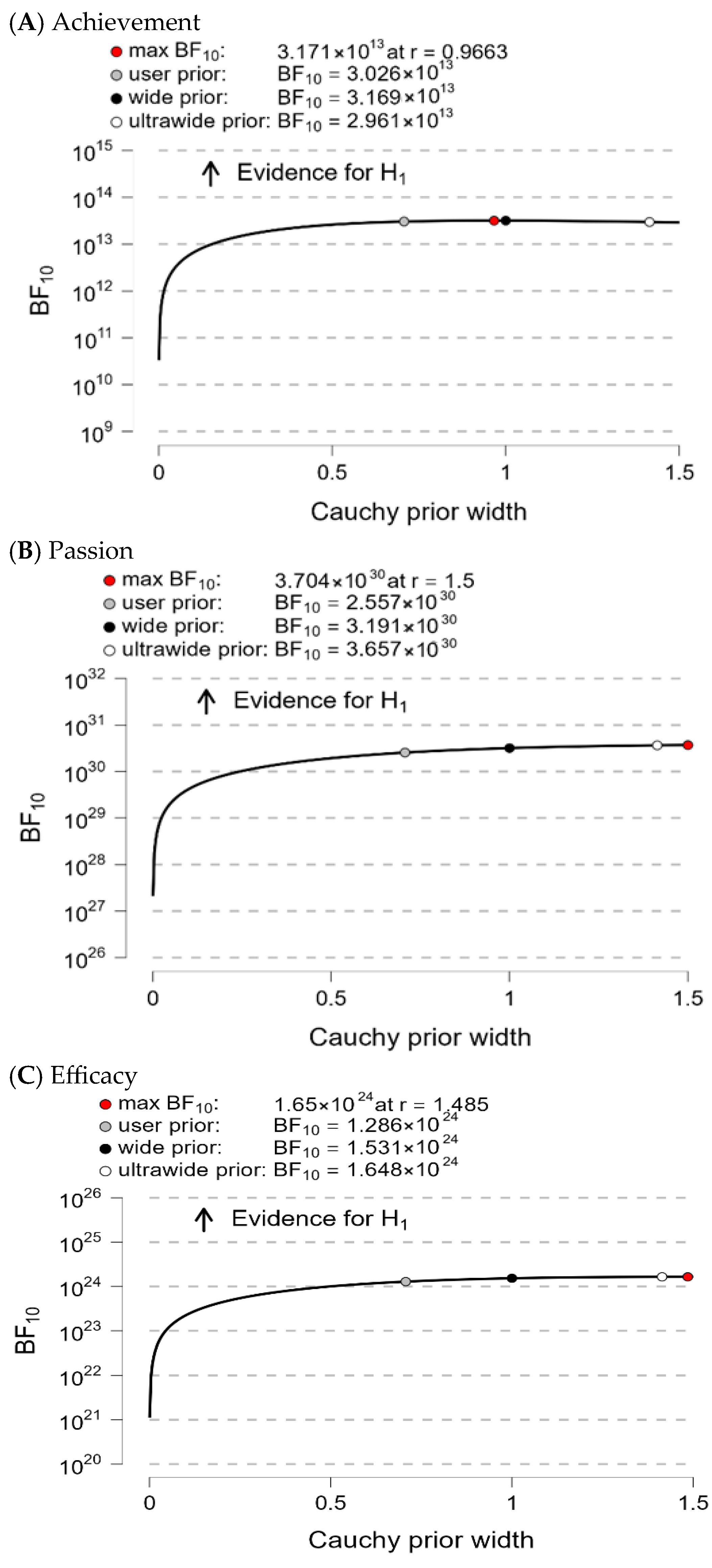
| Variable | Test of Normality (Shapiro–Wilk) | Pre-Test | Post-Test | Bayes Factor | t | df | Sig. | Effect Size Cohen’s d, 95% CI | 95% CI | |
|---|---|---|---|---|---|---|---|---|---|---|
| W | p | |||||||||
| Achievement | 0.945 | 0.061 | 67.36 | 86.77 | 0.000 | 9.877 | 99 | <0.001 | 0.988 [0.747–1.23] | 0.496 [0.35–0.63] |
| Academic Passion | 0.993 | 0.894 | 65.03 | 84.27 | 0.000 | 17.16 | 99 | <0.001 | 1.83 [1.514–2.16] | 0.748 [0.66–0.83] |
| Self-efficacy | 0.992 | 0.855 | 94.78 | 118.5 | 0.000 | 15.02 | 99 | <0.001 | 1.50 [1.214–1.79] | 0.695 [0.59–0.79] |
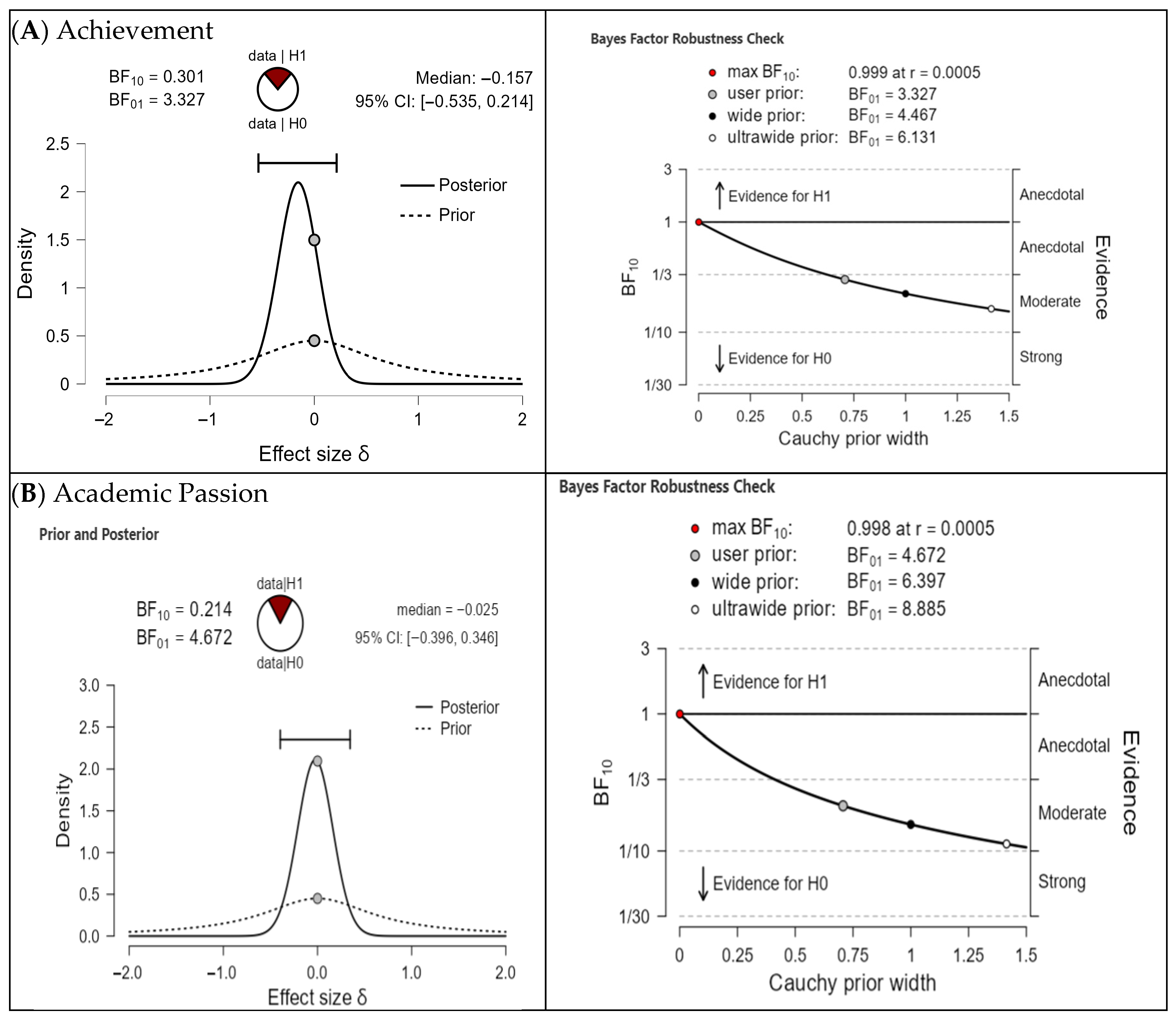
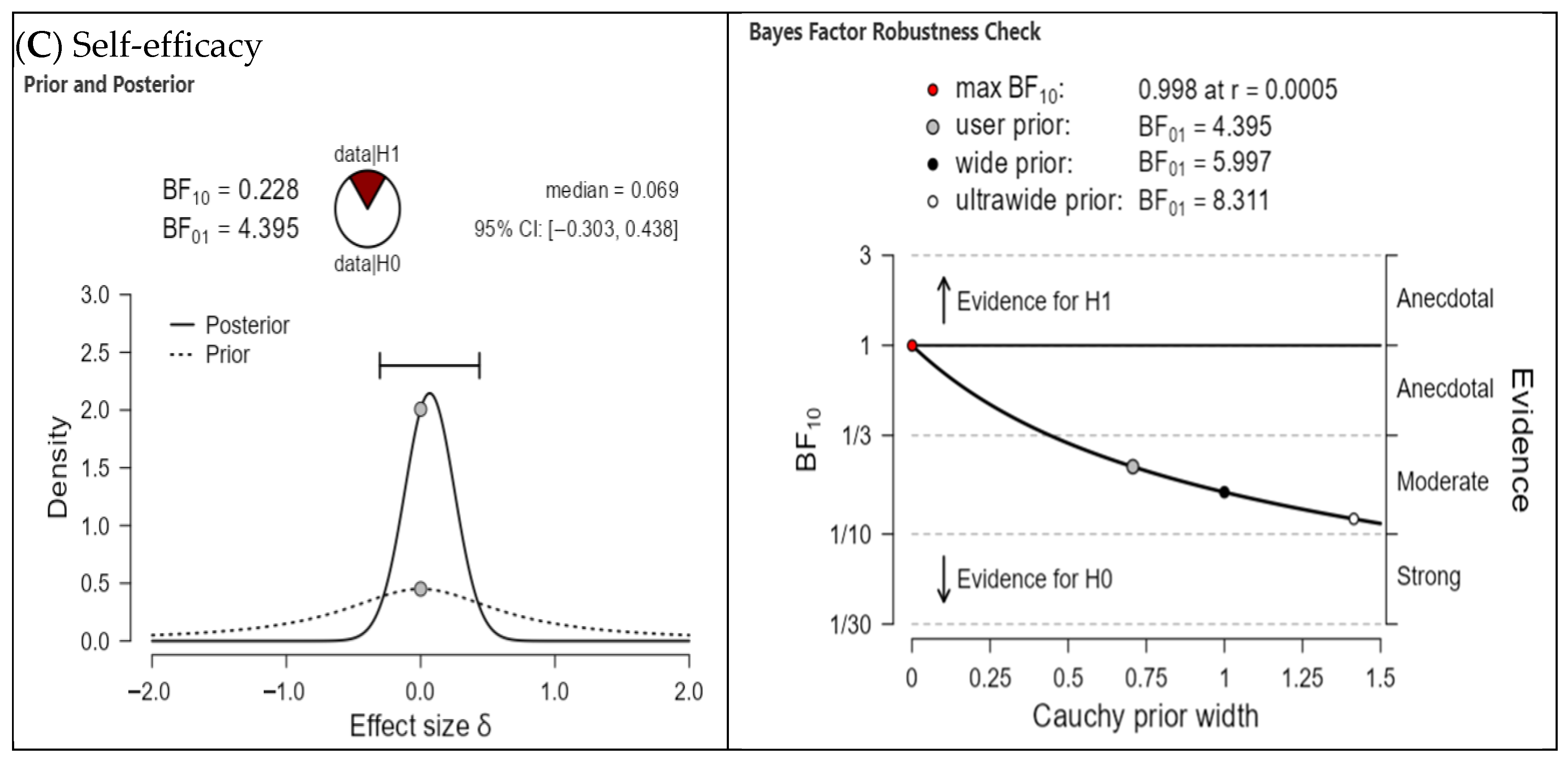
| Variables (Post_Test) | Statistic | df | p | Mean Difference | SE Difference | |
|---|---|---|---|---|---|---|
| Achievement | Student’s t | −0.883 | 98 | 0.379 | −3.024 | 3.42 |
| Bayes factor10 | 0.301 | |||||
| Academic Passion | Student’s t | −0.12 | 98 | 0.905 | −0.229 | 1.9 |
| Bayes factor10 | 0.214 | |||||
| Self-efficacy | Student’s t | 0.39 | 98 | 0.698 | 0.953 | 2.44 |
| Bayes factor10 | 0.228 |
Disclaimer/Publisher’s Note: The statements, opinions and data contained in all publications are solely those of the individual author(s) and contributor(s) and not of MDPI and/or the editor(s). MDPI and/or the editor(s) disclaim responsibility for any injury to people or property resulting from any ideas, methods, instructions or products referred to in the content. |
© 2026 by the authors. Licensee MDPI, Basel, Switzerland. This article is an open access article distributed under the terms and conditions of the Creative Commons Attribution (CC BY) license.
Share and Cite
Attia, M.R.; Soufy, S.Y.; Kamaleldin, R.M.; Abdelhamid, G.S.M. Designing an Intelligent Learning System Based on the Knowledge Tracing Model to Enhance Self-Efficacy, Academic Passion, and Achievement Among Educational Technology Students. Computers 2026, 15, 90. https://doi.org/10.3390/computers15020090
Attia MR, Soufy SY, Kamaleldin RM, Abdelhamid GSM. Designing an Intelligent Learning System Based on the Knowledge Tracing Model to Enhance Self-Efficacy, Academic Passion, and Achievement Among Educational Technology Students. Computers. 2026; 15(2):90. https://doi.org/10.3390/computers15020090
Chicago/Turabian StyleAttia, Mohamed Ramadan, Shaimaa Youssef Soufy, Riham Moustafa Kamaleldin, and Gomaa Said Mohamed Abdelhamid. 2026. "Designing an Intelligent Learning System Based on the Knowledge Tracing Model to Enhance Self-Efficacy, Academic Passion, and Achievement Among Educational Technology Students" Computers 15, no. 2: 90. https://doi.org/10.3390/computers15020090
APA StyleAttia, M. R., Soufy, S. Y., Kamaleldin, R. M., & Abdelhamid, G. S. M. (2026). Designing an Intelligent Learning System Based on the Knowledge Tracing Model to Enhance Self-Efficacy, Academic Passion, and Achievement Among Educational Technology Students. Computers, 15(2), 90. https://doi.org/10.3390/computers15020090