Article

Delphi-Based Expert Evaluation of the XR2Learn Hybrid Instructional Design Framework for XR Education

by
Christoforos Karachristos
1,*,
Theodora Kouvara
1,
Vasilis Zafeiropoulos
1,*,
Theofanis Orphanoudakis
1,2,
Giorgos Anastasakis
1,
Alessandra Antonaci
3,
Ioannis Chatzigiannakis
4,
Maria Paola Conte
5,
Angelica Marsico
5,
Sindi Devole
5,
Silvia Giordano
6 and
Matteo Besenzoni
6
1
School of Science and Technology, Hellenic Open University, 26331 Patras, Greece
2
Department of Industrial Design and Production Engineering, University of West Attica, Egaleo, 12243 Athens, Greece
3
EADTU-European Association of Distance Teaching Universities, 6212 XN Maastricht, The Netherlands
4
Department of Computer, Control and Management Engineering, Sapienza University of Rome, 00185 Rome, Italy
5
EIT Manufacturing South S.r.l., 20121 Milano, Italy
6
Department of Innovative Technologies, University of Applied Sciences and Arts of Southern Switzerland, 6962 Viganello, Switzerland
*
Authors to whom correspondence should be addressed.
Computers 2026, 15(2), 131; https://doi.org/10.3390/computers15020131
Submission received: 1 December 2025 / Revised: 5 February 2026 / Accepted: 10 February 2026 / Published: 19 February 2026

Abstract

Extended Reality (XR) has reshaped how learning can be structured, yet its integration into formal curricula continues to lag behind its technological potential. Established instructional design models such as ADDIE and ASSURE provide stable planning structures, but were not developed to address the spatial, embodied and interactive characteristics of immersive environments. The XR2Learn framework was developed to bridge this gap by combining structured instructional planning with XR-specific pedagogical considerations. This study presents a multi-round Delphi-based expert evaluation of XR2Learn, involving twenty specialists in instructional design and XR-enhanced education. Experts assessed the framework across four dimensions: validity, clarity, usability and suitability. Qualitative feedback was thematically analyzed and subsequently quantified to establish consensus. The findings show strong agreement regarding the framework’s pedagogical grounding, logical structure and alignment with established instructional design practices. At the same time, experts identified limitations related to practical enactment, accessibility and the explicit integration of XR-specific learning constructs such as presence and social interaction. Overall, the results position XR2Learn as a framework at a transitional stage, moving from conceptual formulation toward practical instructional use. The study provides the first systematic expert validation of XR2Learn and outlines targeted directions for its refinement as a robust instructional design framework for XR-based education.

1. Introduction

1.1. XR in Education

XR, the umbrella term for Virtual Reality (VR), Augmented Reality (AR) and Mixed Reality (MR), has redrawn the borders of the classroom [1,2]. Learning is simulated through embodied presence, spatial navigation and multi-sensory interaction within these environments. VR transports learners into entirely digital spaces where they can act, observe and experiment without the limits of the physical world [1,3]. AR, instead of removing learners from reality, inserts digital fragments like labels, images, and 3D models directly into the environment [4]. MR sits somewhere in between, blending physical and digital elements and letting them interact fluidly. In classrooms and labs, these technologies have been used to support engagement and deepen conceptual understanding. In science education, for instance, students can step into virtual laboratories to conduct experiments that might be too dangerous, costly, or simply impossible in real life. Molecules can be rotated in the air and historical ruins can be reconstructed before one’s eyes.

1.2. Aim of the Study

In this study, XR2Learn is defined as a hybrid instructional design framework that integrates established instructional models with XR-specific learning constructs, such as presence, embodiment and social interaction, to support the design of immersive learning experiences. The framework is presented as an exploratory instructional design framework that builds on two well-established and widely adopted models, ASSURE and TPACK, as introduced in earlier work [5]. These frameworks were intentionally selected because they offer a familiar and pedagogically stable foundation for educators and instructional designers, despite not having been originally developed for immersive learning environments. XR2Learn extends this foundation by introducing XR-specific considerations within an existing instructional structure, rather than proposing a fully novel or theory-driven model.
At this stage, XR2Learn is primarily conceptual and has not yet been examined through large-scale or classroom-based empirical implementations. The purpose of the present study is therefore not to demonstrate instructional effectiveness, but to subject the framework to systematic expert scrutiny before applied validation. Using a multi-round Delphi approach, the study investigates how specialists in instructional design and XR-enhanced education evaluate the framework’s validity, clarity, usability and suitability for immersive learning contexts. In particular, the study aims to identify strengths, design tensions and areas requiring refinement, including the extent to which the proposed adaptations adequately address the pedagogical and practical demands of XR-based instruction. By doing so, the study positions expert consensus as a formative step toward the further development and operationalization of XR2Learn. In this direction, XR-related constructs are conceptualized as design-relevant dimensions of immersive instruction and are examined through expert judgement, not as empirically measured learner outcomes.

2. Background/Literature Review

2.1. The Need for Appropriate Educational Frameworks for Better Integration

While immersive learning supports experiential and constructivist forms of engagement, critical questions are raised regarding the assumptions underlying traditional IDs, particularly those originally developed for more conventional digital learning contexts [6]. Traditional IDs such as ADDIE [7] and ASSURE [8] place strong emphasis on structured sequencing, predefined content delivery and clearly measurable outcomes. These approaches tend to align with modular design, linear navigation and a high degree of standardization [8]. Immersive learning, by contrast, is characterized as fluid, co-constructed and nonlinear [9]. Knowledge is generated through spatial interaction, situational decision making and sensory engagement, rather than through a pre-ordered progression of content. Immersive environments introduce distinct demands, including continuous user control, narrative branching, real-time interaction and embodied cognition. Many instructional teams continue to rely on legacy frameworks, often under the assumption that these models are sufficiently adaptable. As a result, designers are faced with a dual challenge, navigating immersive complexity while depending on design tools that were not developed to account for these environments. What is needed is stronger pedagogical integration that goes beyond technological novelty and explicitly supports inclusion and scalability.
Although the affordances of XR outlined above point to a rich and potentially transformative learning medium, XR is part of the broader field of educational technology rather than a standalone solution. In this sense, evidence from innovation adoption and the economics of education shows that XR interventions, like any other educational technology, lead to meaningful learning gains only when they are deliberately designed, pedagogically embedded and supported by appropriate organizational and human capacities [10,11]. Related analyses further emphasize that the effectiveness of technology-supported instruction depends on a combination of pedagogical, organizational and technological factors, including classroom dynamics, teacher capacity, learner engagement and local implementation conditions. Technology tends to function effectively as a complementary mechanism that strengthens instructional processes by supporting differentiation, formative feedback and instruction at an appropriate level, rather than as a standalone solution. Large-scale experimental and quasi-experimental studies consistently demonstrate that technology aided instruction produces measurable learning gains only when it is aligned with instructional processes and supported by adequate human and institutional capacities. Taken together, this line of research demonstrates that instructional design frameworks play a critical mediating role between technological potential and educational impact, particularly in complex and resource-demanding contexts such as XR-based learning, where issues of adoption, integration and scalability are especially pronounced [11].
Additionally, it has been shown that educational investments in innovative technologies, like XR, lead to meaningful outcomes only when accompanied by the development of educators’ skills, the redesign of teaching practices and the integration of technology into existing instructional routines, rather than being treated as standalone solutions. At the same time, research on innovation adoption highlights the role of organizational and institutional conditions, such as cultures, incentives and professional practices, in shaping technology use, indicating the need for mechanisms that bridge these gaps [12] in the case of XR as well. From a technology acceptance perspective, adoption is understood as a gradual process influenced by experience, support and social interaction, while cognitive and affective factors, including self-efficacy, anxiety and professional identity, play a critical role in the sustainability of technology integration [13]. Viewed together, these strands of literature point to educators’ competencies as a central condition for the sustainable adoption of XR technologies. The inclusion of TPACK in the proposed model reflects this synthesis, as it frames technology adoption not as a matter of technical proficiency alone, but as a complex capability emerging from the interaction of pedagogical knowledge, content knowledge and technological understanding, thereby supporting the alignment between technological innovation and educational impact.
Other reasons that strengthen this need are introduced below. The cost of equipment alone, including headsets, sensors, capable computers and hardware, remains a burden for most schools [14]. Aside from infrastructure, a more subtle barrier exists, as teachers often lack the time, training, or confidence to design meaningful XR-based lessons and curriculums [14]. Accessibility is another concern, as some schools experiment with XR regularly, but others do not have access to VR equipment such as headsets, etc. Furthermore, the content problem persists, as there is still a shortage of high-quality, curriculum-aligned XR materials [9]. Finally, evidence from information technology adoption research shows that educational gains do not stem from technology alone, but from complementary investments in organizational practices, work processes and skills [10]. From this view, the uneven impact of XR reflects misaligned instructional design rather than technological limits. XR2Learn is positioned as such a complementary mechanism, supporting educators in restructuring teaching practices so that immersive technologies are used purposefully rather than superficially.

2.2. XR-Specific Frameworks (State of the Art and Beyond)

In technology-enhanced learning environments, the role of ID becomes increasingly critical. Effective ID ensures that technology functions not merely as a delivery medium but as an enabler of meaningful learning, addressing learner diversity, fostering engagement and supporting the accessibility and scalability of educational content. However, as noted in [15], no fully established and validated pedagogical or instructional design method currently exists for technology-rich, digitally enhanced and immersive learning environments.
Furthermore, ref. [16] argues that the application of traditional instructional strategies and design principles to Virtual Reality (VR) environments is particularly challenging due to their immersive, interactive and dynamic characteristics, which disrupt conventional assumptions regarding learner roles, cognitive load management and assessment practices. The BIM-enabled VR-based pedagogical framework proposed in [17] represents an effort to develop, evaluate and validate a digitally enhanced pedagogical methodology applicable to architectural design studios in higher education. According to the systematic literature review presented in [15], four instructional design models specifically targeting immersive XR contexts have been identified. These are the XR ABC Framework [18], the iVR Learning (M-iVRL) Framework [19], the TESLA Instructional Design Model [20] and the design model proposed by Castronovo et al. [16]. The XR ABC Framework conceptualizes interactivity in XR through the dimensions of absorb, blend and create, corresponding, respectively, to the use of existing applications, the modification of content and the development of new XR materials. The M-iVRL Framework is grounded in the Cognitive Theory of Multimedia Learning (CTML) [21] and provides design guidance for immersive VR learning environments based on established multimedia learning research. In [19], the authors emphasize the need for hybrid instructional design approaches and propose a framework combining the ASSURE model with TPACK, closely aligned with the approach adopted in this study. Finally, the design model by Castronovo et al. [16] adapts the ADDIE framework for instructional design in immersive VR contexts and a comprehensive framework outlining key design characteristics necessary for achieving intended learning outcomes in Virtual Reality Learning Environments (VRLEs).
Beyond procedural models, recent work has focused on explaining how XR-specific learning constructs, such as presence and agency, influence learning. The Cognitive–Affective Model of Immersive Learning (CAMIL) [22] describes how core XR features, such as presence and agency, affect learning outcomes through mediating factors like interest, embodiment, cognitive load and self-regulation. In this way, the CAMIL helps link the traditional logic of TPACK with the distinct cognitive and affective processes that emerge in immersive learning environments.

3. The XR2Learn Instructional Design Framework

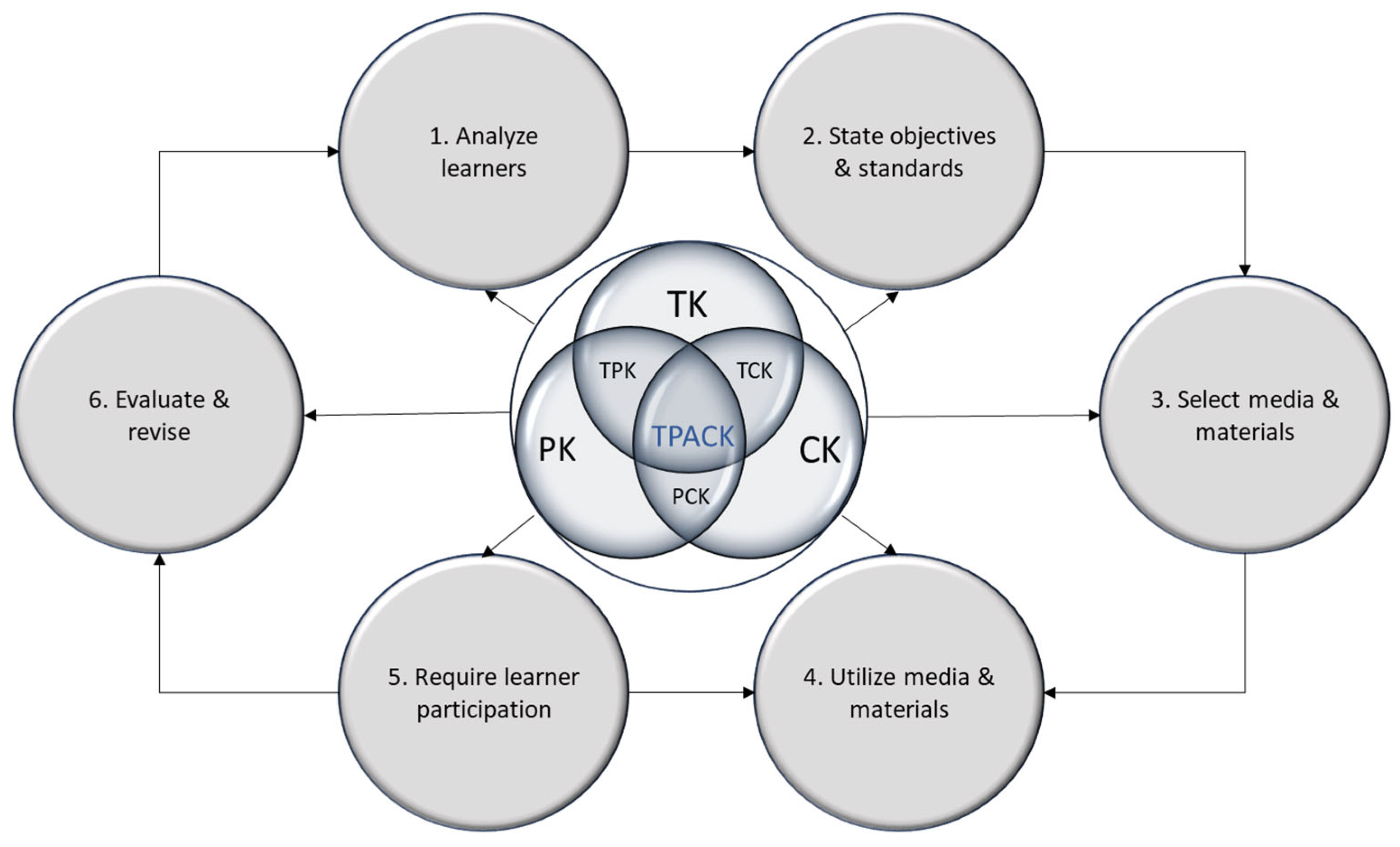
The XR2Learn framework amalgamates two already trusted design models: TPACK and the ASSURE instructional design model (see Figure 1).
Firstly, the TPACK framework is used to ensure that teachers possess the core knowledge required to integrate XR meaningfully into teaching. It functions as a guiding lens, helping educators align technological choices with pedagogy and content rather than letting technology dominate. This operates on two levels: firstly, on a macro level, where the three knowledge domains (Technological, Pedagogical and Content) are considered in relation to XR-specific parameters; and secondly, on a micro level, where this knowledge is applied to concrete XR learning interventions.
Secondly, the ASSURE model provides an overarching instructional structure. It offers a clear and procedural backbone for planning XR lessons or training activities. Combined with XR-specific additions, the two frameworks support educators in designing immersive learning experiences that respond to learner needs, foster engagement and enable deeper understanding through immersion.
Phase 1: Analyze learners
The process begins with a systematic analysis of learners. This includes demographic characteristics such as age and educational level, prior subject knowledge and technological competence. Learning preferences, whether visual, auditory, or kinesthetic, are also considered. The aim is to ensure that instructional design decisions are grounded in both traditional learner characteristics and their interaction with immersive environments. From a TPACK perspective, TK is used to assess how learners engage with VR technologies and their level of technical readiness. PK informs decisions on how immersive experiences can support engagement and learning processes. CK guides decisions about how subject matter can be meaningfully represented through VR.
Phase 2: State standards and objectives (S)
At this stage, clear learning objectives are formulated, explicitly integrating content, pedagogy and technology. Objectives are designed to reflect how immersive technologies can support meaningful learning outcomes rather than simply replicating traditional instruction. Here, pedagogical content knowledge (PCK) guides decisions on how specific content should be taught within immersive contexts. Technological pedagogical knowledge (TPK) informs how VR can enrich instructional strategies, for example, by enabling experiential or situated learning. Technological content knowledge (TCK) ensures that the selected technologies enhance the understanding of the subject matter.
Phase 3: Select media and materials (S)
This step focuses on the selection of appropriate media, tools and content that align with the stated objectives. Emphasis is placed on choosing VR applications and materials that fully exploit immersive affordances while remaining accessible to learners. TK supports informed choices about VR platforms and tools, while TPK ensures that these choices promote active learning through interaction, exploration and engagement.
Phase 4: Utilize media and materials (U)
Once selected, media and materials are implemented in ways that are pedagogically purposeful. The use of VR is carefully planned to support learning activities rather than distract from them. TCK is applied to ensure that immersive experiences effectively communicate complex concepts, such as visualizing abstract systems or historical settings. TPK supports alignment between VR use and instructional strategies, including collaboration, problem solving and guided exploration.
Phase 5: Require learner participation (R)
Learner engagement is central to the XR2Learn framework. Activities are designed to require active participation, encouraging learners to interact with content, technology and peers in meaningful ways. TPK informs the design of tasks that require purposeful use of VR, such as solving authentic problems within immersive environments. PCK ensures that these activities are aligned with learning strategies that promote higher-order thinking and collaboration.
Phase 6: Evaluate and revise (E)
The final step involves evaluating both learning outcomes and the effectiveness of technology integration. Findings from this evaluation inform revisions to instructional design. TK helps to assess whether the selected technologies supported learning objectives effectively. TPK helps evaluate the impact of VR on teaching practices and learner engagement. TCK supports reflection on whether immersive technologies enhanced understanding of complex subject matter and contributed meaningfully to learning.

3.1. The XR2Learn Framework Contributions

XR2Learn preserves the structured approach of ASSURE’s six phases, as described earlier, but hybridizes each phase with XR-specific design and the TPACK mindset. This means at every step, technological considerations are interwoven with pedagogical and content decisions, ensuring that the use of AR/VR/MR is purposeful and effectively supports learning. The XR2Learn extensions per step are analyzed below.
(A) Analyze learners
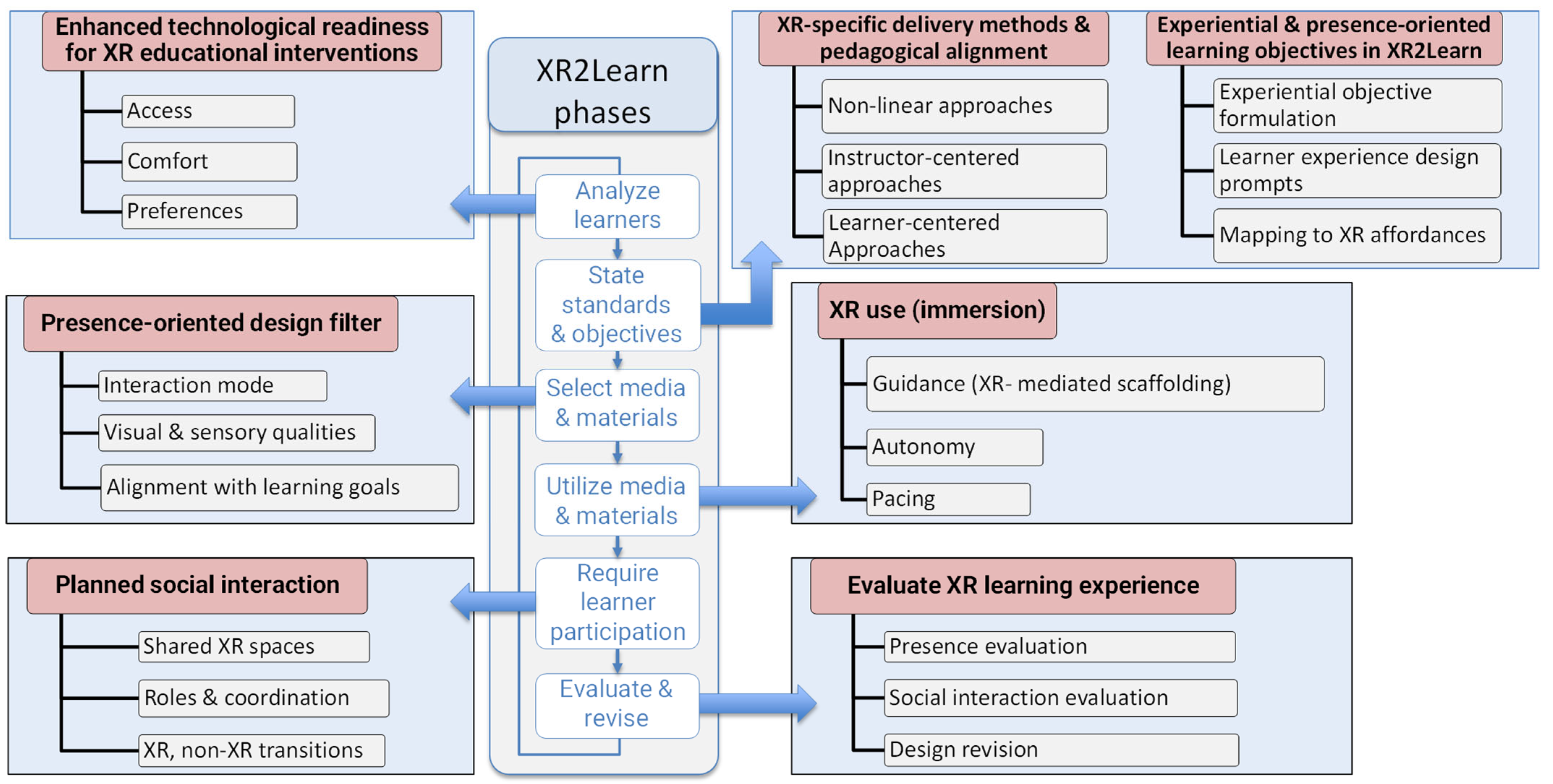
XR identifies learners and emphasizes enhanced technological readiness for XR educational interventions in Phase 1 by focusing on three dimensions, namely Access, Comfort and Preferences, which often overlap. Access concerns the availability of XR hardware, software and connectivity, alongside contingency planning when these are limited, for example, through the use of 360° video to maintain a degree of immersion. Comfort relates to learners’ familiarity with XR interfaces, as confusion or hesitation can quickly undermine engagement, making short tutorials or guided walkthroughs necessary. Preferences reflect learners’ inclinations toward different XR modes, such as fully immersive VR or more context-anchored AR experiences. Overall, this dimension recognizes that effective immersive learning depends not only on prior knowledge, but also on learners’ ability and willingness to engage with XR environments.
(B) State standards and objectives
XR2Learn proposes (a) XR-specific delivery methods in Phase 2 with pedagogical alignment driven by an analysis of the expectations related to what learners should achieve and (b) definition of experiential and presence-oriented learning objectives. This way of delivery responds to evidence that traditional instructional models struggle to accommodate the non-linear, experiential and learner-driven nature of immersive learning environments with learner-centred, exploratory approaches. Such delivery methods leverage immersion, embodiment and spatial interaction to support learning experiences that cannot be effectively realized through conventional instructional modalities. XR2Learn extends learning objectives by explicitly including experiential outcomes related to presence and embodiment. In addition to defining what learners should know or do, objectives also address how learners are expected to experience the XR environment, for example, through spatial awareness, embodied decision making and perspective taking. This shift encourages designers to align immersive affordances with pedagogical intent, rather than treating presence as a by-product of XR technology.
(C) Select media and materials
XR2Learn introduces a presence-oriented design filter in Phase 3. Specifically, it extends media and material selection by prompting designers to explicitly consider how chosen XR media support presence-related qualities such as perceptual continuity, embodied interaction and attentional focus. Rather than assuming that immersion automatically produces presence, designers are encouraged to justify how interaction modes, visual fidelity and sensory cues contribute to the intended learning experience.
(D) Utilize media and material
In Phase 4, instructional designers are urged to plan implementation focusing on XR use (immersion). XR2Learn extends the utilization phase by emphasizing deliberate planning of how, when and for how long XR media are used during instruction. Designers are prompted to consider the sequencing of immersive activities, transitions between XR and non-XR moments and the level of guidance provided during use. This helps ensure that XR media are integrated as part of the instructional flow rather than introduced as stand-alone experiences.
(E) Require learner participation
In Phase 5, XR2Learn proposes planning of social interaction as a means to achieve learner engagement in immersive learning, strengthening the utilization phase. Designers are encouraged to plan how XR activities support collaboration through shared virtual spaces, coordinated roles or structured sequences of interaction across immersive and non-immersive settings. This framing treats social interaction as an intentional design element rather than an incidental effect of XR use.
(F) Evaluate and revise
Finally, XR2Learn extends the evaluation phase by treating presence and social interaction as explicit, evaluable dimensions of XR learning design in order to derive possibilities to improve the design process. Rather than remaining abstract qualities, immersive and social aspects are examined through simple indicators and reflective questions that inform iterative refinement of the learning experience.
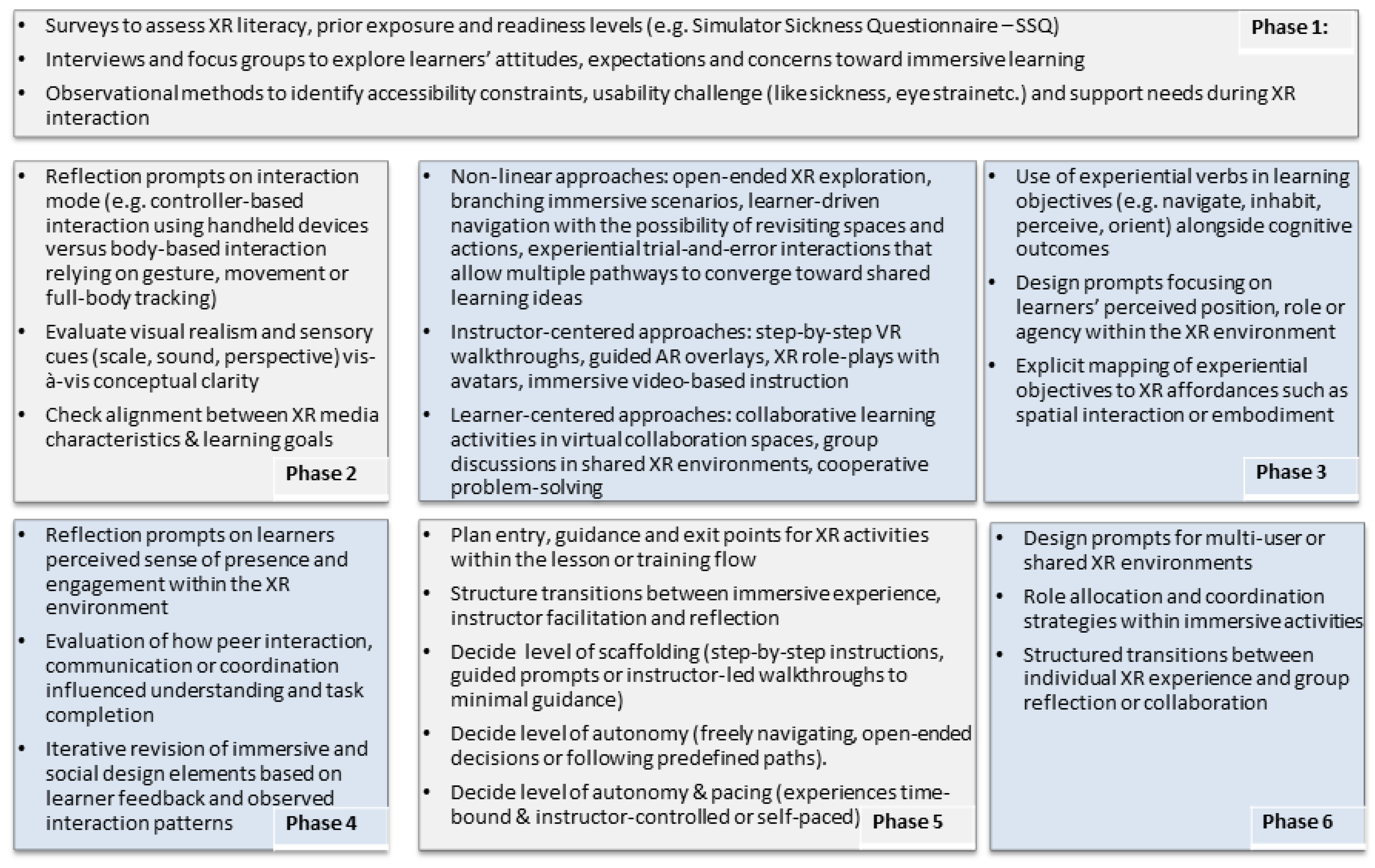
Figure 2 summarizes the way XR2Learn augments the traditional ASSURE model as discussed above. While it presents the additional XR-related elements introduced at each phase of the ASSURE model, these extensions remain, to some extent, abstract at the level of design principles. To support their interpretation and practical use, Figure 3 moves one step further by illustrating indicative methods and tools through which these extensions may be operationalized in instructional design practice. Rather than prescribing fixed solutions, the figure provides examples that help designers translate the XR2Learn enhancements into concrete design decisions, depending on context, learner characteristics and available technologies.
In this sense, Figure 3 complements Figure 2 by bridging conceptual augmentation with applied instructional action. It also acknowledges the variability of real educational settings, where instructional choices are shaped by institutional constraints, educator expertise and technological readiness. By foregrounding flexibility rather than procedural compliance, the figure positions XR2Learn as a supportive design guide rather than a rigid implementation recipe.

3.2. XR-Sensitive Interpretation of TPACK Within XR2Learn

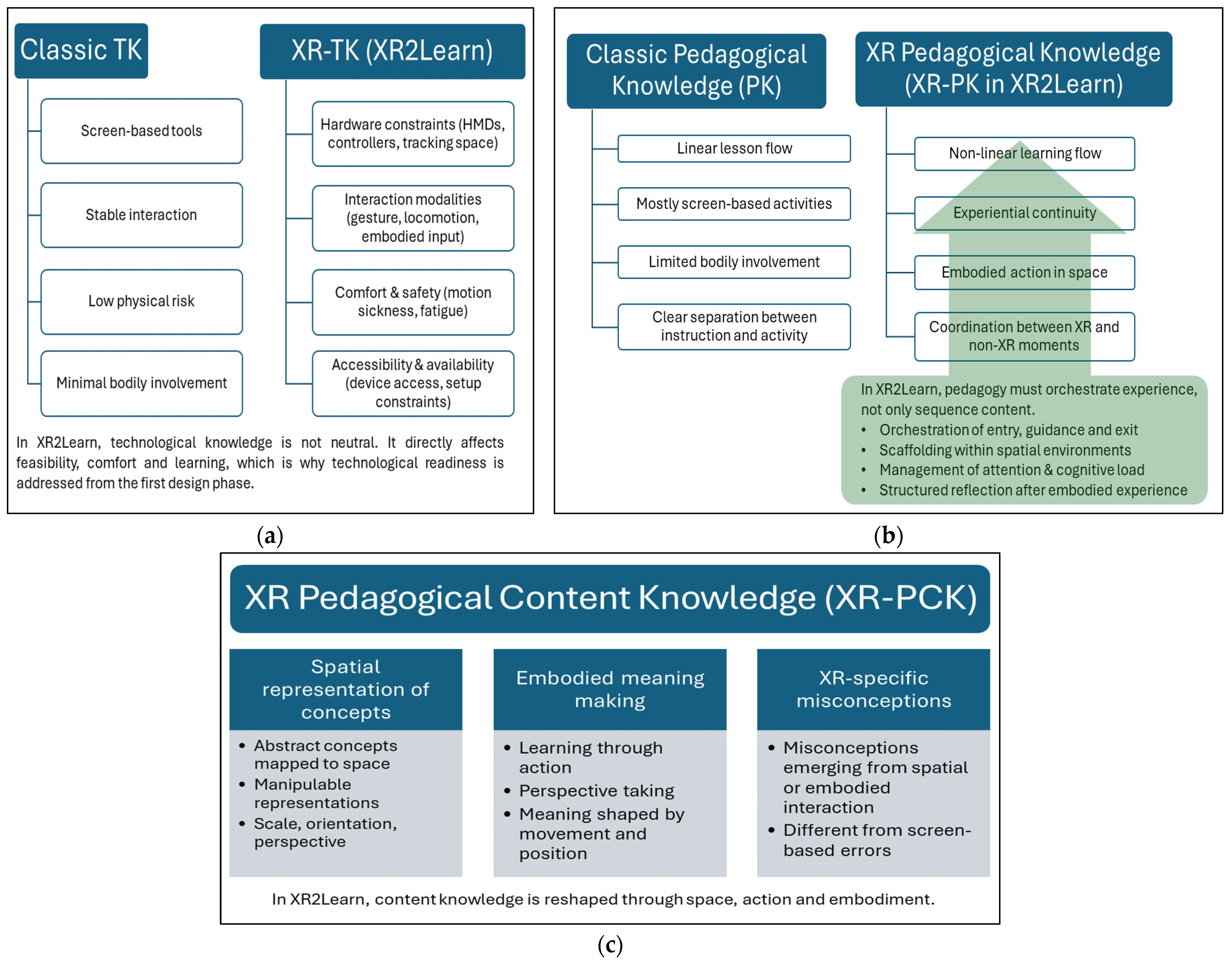
Within the XR2Learn framework, TPACK is not treated as a static background model, but as an XR-sensitive knowledge framework. While the three core knowledge domains remain unchanged, their interpretation is extended to reflect the constraints and affordances of immersive learning environments (see Figure 4).

4. Framework Validation—Research Design and Methodology

4.1. Delphi Method Rationale and Summary

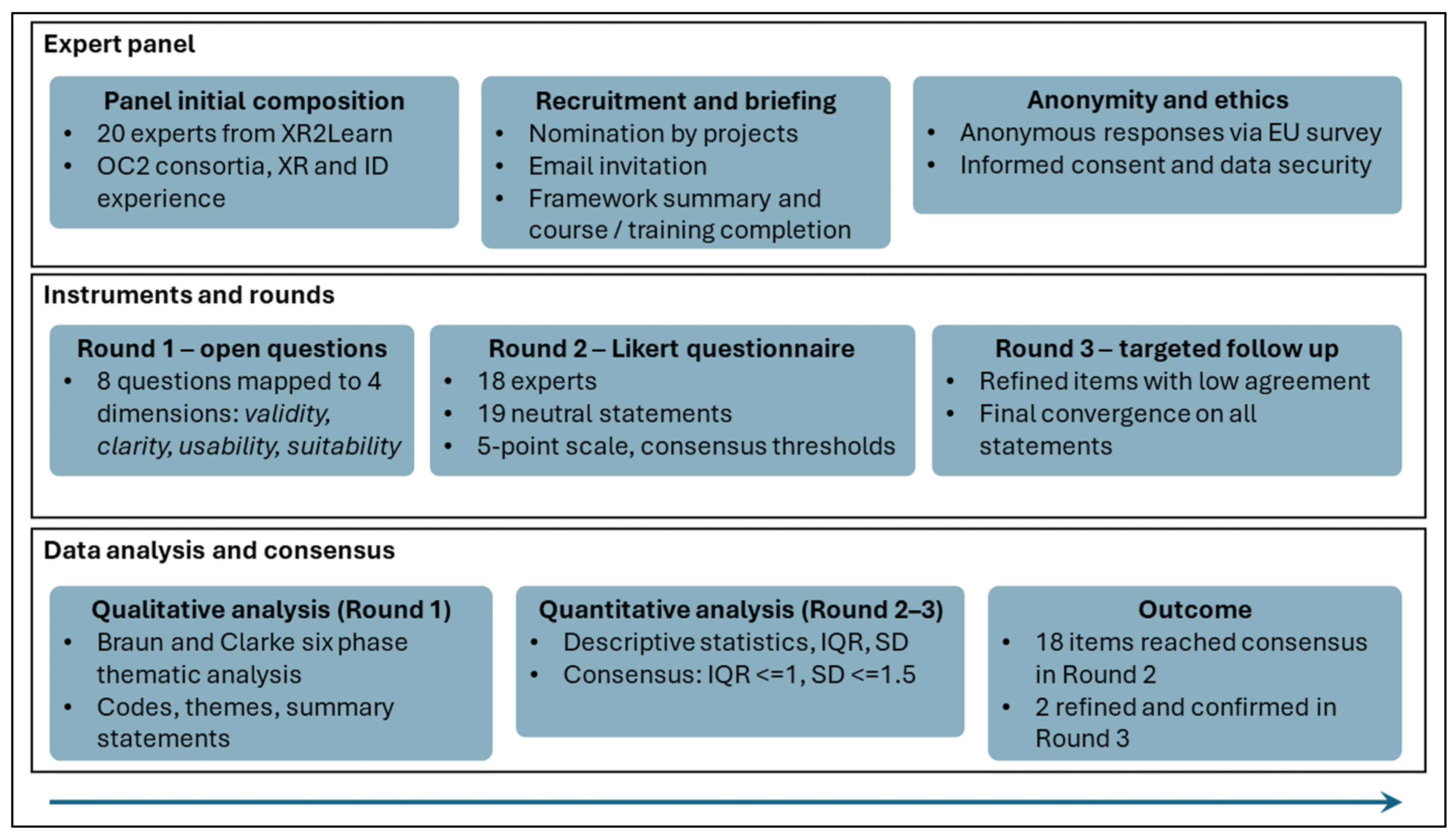
A Delphi study was selected because the XR2Learn framework remains in a formative, pre-validation stage. Although it is conceptually structured and theoretically grounded, it has not yet been tested in real or large-scale educational settings. Before moving to classroom pilots, there was a need to examine whether its internal logic holds under expert scrutiny. The Delphi method offers a systematic yet flexible way to gather informed judgement from specialists in instructional design and immersive learning. Through iterative rounds, ambiguities, overlaps and theoretical gaps can be identified and gradually refined. At this stage, application-focused methods such as case studies or pilots would be premature, as the framework still requires conceptual clarification. Below (see Figure 5) is an overview of the study.

4.2. Participant (Expert Panel) Recruitment

The expert panel was recruited from participants involved in the open call, round two (OC2), of the Horizon Europe-funded project XR2Learn [23], aiming at fostering the creation of human-centric XR applications for education and training. The project runs a series of open calls to fund and support innovative projects (startups, research groups, companies, educational institutions) that apply XR to real-world learning problems. The winners receive funding, mentoring and integration into the XR2Learn ecosystem. In this case, they also provided a pool of experts for the Delphi study.
The potential experts were first introduced to the development of the framework and its intended purpose during a workshop for digital pedagogies for XR, held in Lugano, Switzerland, in May 2025. During this session, they were introduced to the rationale behind the XR2Learn framework and its intended scope of use. Importantly, this introduction did not take the form of structured training, guided instruction, or prescribed usage procedures.
No step-by-step demonstrations, examples of “correct” application, or evaluative criteria were provided. Instead, participants were encouraged to explore the framework independently and to interpret its phases based on their own professional experience. Each project team applied the framework in an exploratory manner by designing a training scenario or lesson according to their own understanding. This approach was deliberately chosen to avoid influencing expert judgement and to preserve the independence of evaluations, which is a core requirement of Delphi-based research. As a result, expert feedback reflected individual interpretation and critical appraisal rather than compliance with predefined usage patterns or instructional guidance.
After the event, each project team was invited to nominate three individuals with demonstrated expertise in XR-enhanced education or training. The term expert was defined broadly and included instructional designers, educational technologists, learning scientists, trainers with hands-on XR experience and researchers working on immersive learning. The emphasis was placed on practical familiarity with XR in educational or professional settings rather than on formal qualifications alone. Using these criteria, both academic and practitioner perspectives were represented.
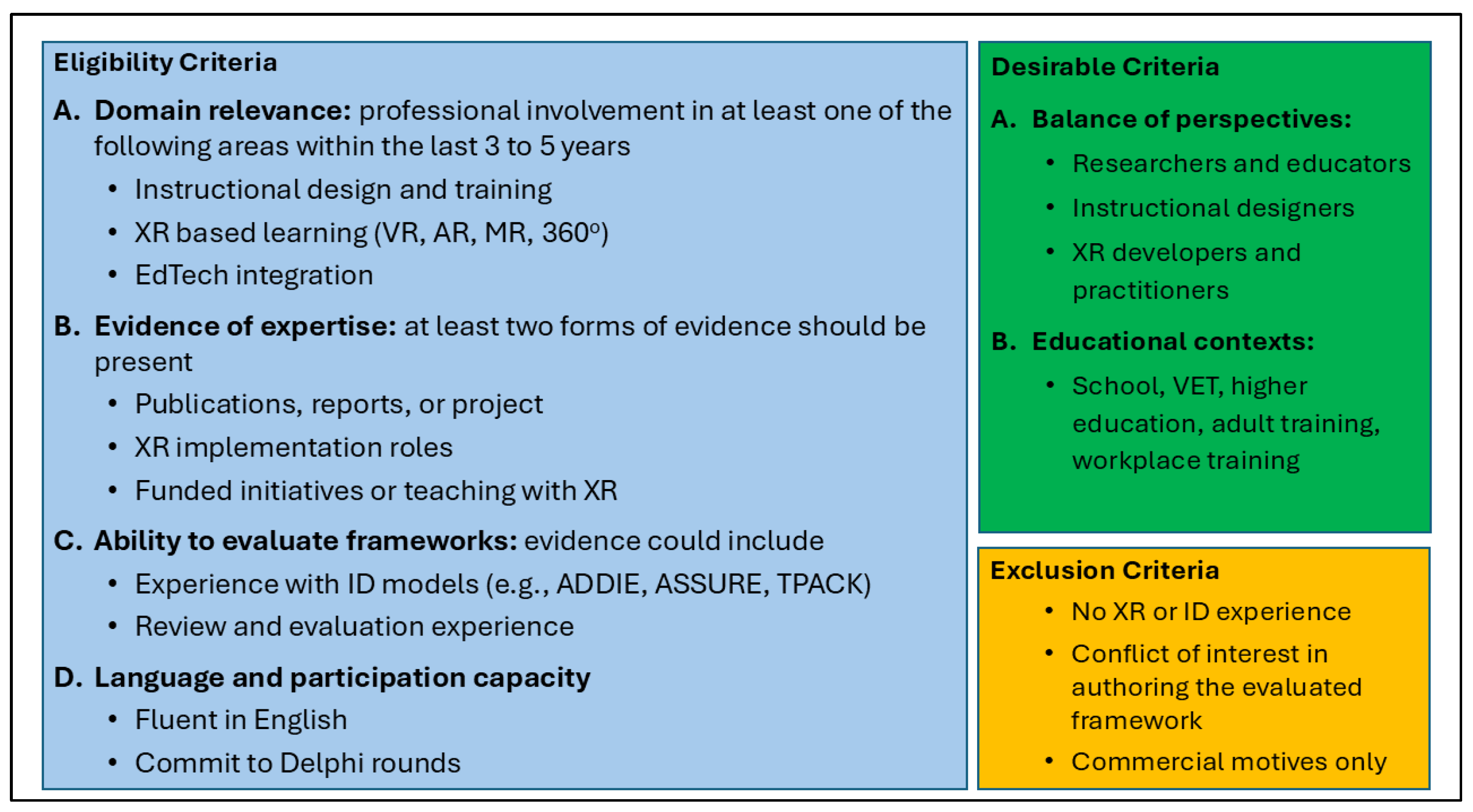
All nominated individuals were screened against predefined inclusion and exclusion criteria (see Figure 6), focusing on XR-related experience, familiarity with instructional design frameworks and availability to participate in all Delphi rounds. Candidates who did not meet these requirements or presented potential conflicts of interest were excluded. Through this process, twenty (N = 20) experts were selected for the Delphi panel, ensuring diversity of roles and contexts while maintaining independent judgement.

4.3. Instruments and Phases of Delphi Data Analysis

4.3.1. Survey Development for Round 1

For the first round of Delphi a survey was conducted. The open-ended questions were shaped through a layered process, partly utilizing input from the literature and partly from the experience of the two members of the research team. The four main research questions, which are about validity, clarity, usability and suitability (see Table 1), were taken as the backbone.
From each research question, more detailed prompts were drafted. For instance, under validity, the framework’s theoretical foundation and pedagogical alignment were emphasized. Experts were asked to describe strengths and weaknesses of the XR2Learn framework in these terms. Under clarity, the focus was placed on how well phases and components were communicated. As a result, questions were written to assess whether terminology, structure and sequencing were clear or confusing. Guiding sub-questions were added (for example, asking about feasibility of implementation or adaptability across contexts). This choice was informed by Delphi methodological advice, which notes that experts often provide richer answers when prompts point them toward specific aspects.
In the end, the final set of eight open-ended questions (see Table 2, Table 3, Table 4 and Table 5) emerged as a hybrid product shaped by theory, by methodological recommendations and by the team’s practical sense of what was needed for XR2Learn ID framework evaluation.

4.3.2. Round 1—Collection of Expert Feedback and Data Preparation

The first round of the Delphi process began once the open-ended questionnaire was finalized. The study was conducted in accordance with the ethical principles and standards set forth in the Code of Ethics and Good Practice of the Hellenic Open University. To uphold participants’ autonomy and reduce potential burden, adequate time was allocated between survey rounds, and deadlines were adjusted upon request where feasible. All personal data were handled in compliance with applicable legal and institutional data protection requirements, ensuring confidentiality and the protection of participants’ rights.
Each expert received a personalized invitation email that included a short briefing note explaining the study purpose, confidentiality terms and a concise overview of the XR2Learn framework. The questionnaire link was distributed simultaneously to all panel members, accompanied by a clear two-week completion window. The anonymity of the Delphi process was emphasized repeatedly in all correspondences to encourage open, critical and honest feedback without social or professional pressure.
Once the submission window closed, all responses were exported from the platform in csv format and checked for completeness and technical errors. Each question entry was assigned a unique identifier (expert ID_sub-question ID). The raw material at this stage consisted mainly of unstructured text entries, which, in some cases, were long reflective narratives and, in other cases, were short bullet-point observations. These initial responses formed the foundation for thematic analysis and for developing the structured instrument that would later guide Round 2.
The first step after gathering the responses was a completeness check of the dataset. Each entry was carefully reviewed to confirm that the csv file contained all expert inputs and that no technical errors, such as corrupted cells or missing values, were present. The dataset contained 158 question entries in total (2 entries—1 in R1-SQ3 and 1 in R1-SQ5—were missing). Since the survey was designed to be fully anonymous from the beginning, no further anonymization procedures were required, as the material was already stripped of identifiers, which meant that the analysis concentrated exclusively on the content of expert judgments. Partially completed open-ended responses were retained, provided that sufficient content was available to meaningfully interpret the expert’s perspective, as the qualitative analysis focused on themes rather than item-level completeness. Once verified, the responses were organized systematically according to the four guiding research questions (RQ1–RQ4). This structuring allowed the material to be examined in a focused manner, with feedback clearly aligned to the evaluation dimensions of the framework (validity, clarity, usability and suitability) so that expert perspectives could be mapped directly onto the intended categories of assessment. For this reason, the analysis of the qualitative material followed Braun and Clarke’s six-phase model of thematic analysis [24].

4.3.3. Qualitative Analysis

In this phase, two researchers independently read the full dataset multiple times to become familiar with the content and to develop an initial sense of recurring evaluative orientations. During this phase, both researchers produced short analytic memos to record early impressions, points of ambiguity and emergent patterns, without finalizing any coding decisions. Memos were kept alongside the dataset to support traceability of interpretive decisions.
For Phase 2 (segmentation into units of meaning), the unit of analysis was a “meaning unit,” defined as the smallest excerpt that expressed a complete evaluative claim about the framework. To ensure consistency in the qualitative analysis, clear segmentation rules were applied when identifying meaning units. A meaning unit was defined as the smallest text segment expressing a single evaluative claim, judgement, or suggestion about the XR2Learn framework. Responses containing multiple distinct ideas were segmented into separate units, even when these appeared within the same sentence. Contextual or descriptive statements were kept within the same unit when they directly supported an evaluative claim. Bullet-point responses were segmented so that each item constituted a separate meaning unit, while repetitions or rephrasing of the same point were merged unless a new emphasis was introduced.
To illustrate the application of these rules, consider the following examples. A statement such as
“The framework is conceptually strong and aligns well with established instructional design models”
was treated as a single meaning unit, as it expresses one coherent evaluative judgement. In contrast, a sentence like
“The framework is clear overall, but it lacks concrete guidance for real classroom implementation”
was segmented into two meaning units, as it contains two distinct evaluations related to clarity and usability. When experts addressed different dimensions within a single sentence, for example,
“The phases are logically structured, although the terminology related to XR could be simplified”
each evaluative component was segmented separately. Bullet-point responses were segmented so that each bullet constituted an individual meaning unit when it conveyed an independent idea. Conversely, statements that reiterated the same judgement across consecutive sentences, such as comments on flexibility or adaptability, were merged into a single meaning unit unless additional nuance was introduced. These examples illustrate how segmentation decisions were guided by analytical consistency while preserving the nuance and intent of expert feedback.
Across the full dataset, 565 meaning units were identified (sub-question range: (44–175)).
For Phase 3 (open coding), meaning units were first coded inductively. The two researchers coded independently, using descriptive labels that remained close to the participants’ wording where possible (111 codes). Following initial coding, in Phase 4 (code refinement and reduction), a structured comparison process was conducted. First, the two coders met for three consensus sessions to review overlaps, resolve definitional drift and merge synonymous labels. Codes were then reduced by:
(i) Merging semantically overlapping labels. Specifically, the initial codes “Support for engaging and meaningful learning experiences” and “Strong support for performance-based XR training” both reflected positive judgements about the framework’s experiential and engagement-oriented contribution. These were therefore consolidated into the final code “Engagement and experiential learning value of the framework.” This merged code captures expert recognition of XR2Learn’s capacity to support immersive, action-oriented and meaningful learning experiences.
(ii) Eliminating idiosyncratic codes that could not be supported beyond isolated instances unless they reflected a critical design concern raised with clear rationale. For example, “Content repetition leading to potential cognitive overload” was not maintained as a separate usability issue but was incorporated into the final code “Cognitive load and redundancy management”. This allowed individual observations about repetition to be interpreted within a broader instructional design concern rather than treated in isolation.
After refinement, the analysis retained fifty-six (56) codes.
For Phase 5 (theme development), refined codes were clustered into candidate themes within each sub-question, guided by conceptual coherence (i.e., whether codes addressed the same underlying evaluative issue) and analytical usefulness (i.e., whether a theme could inform a clear Delphi statement). Theme boundaries were iteratively reviewed against the coded extracts to ensure that each theme captured a distinct pattern and remained grounded in the data. Themes were labelled to reflect both the focus of the expert evaluation (e.g., procedural clarity, XR-specificity, usability constraints) and the direction of feedback (strength, weakness or area for refinement). Across all sub-questions, thirty-seven (37) themes were identified (sub-question range: 3–7). An overview of all identified themes, organized by sub-question, is provided in Table 6.
In the final phase, Phase 6 (question-specific synthesis and item construction), for each sub-question, the identified themes were translated into candidate Delphi statements intended for Round 2. Item construction followed explicit criteria, which are (i) fidelity to the theme (the statement had to reflect the core meaning shared across the coded extracts), (ii) measurability (the statement had to be assessable with a Likert-type response without requiring additional interpretation), (iii) specificity (statements were phrased to avoid double-barreled claims) and (iv) non-redundancy (overlapping candidate statements were merged where they captured the same evaluative proposition).
To illustrate how the qualitative themes were operationalized into Delphi items, selected examples of the mapping between Table 6 and Table 7 are provided. For instance, Theme 1 (Pedagogical coherence and instructional structure) was translated into Statement Q7, which focuses explicitly on the logical sequencing and step-by-step structure of the framework, thereby preserving fidelity to the shared meaning of the coded extracts while remaining directly measurable through a Likert-type response. Similarly, Theme 5 (Practical enactment and educator usability) informed Statement Q11, which isolates the issue of actionable guidance through steps, examples or templates, avoiding double-barreled claims and ensuring specificity. Theme 3 (Integration of XR affordances with pedagogy and content) was reflected in Statement Q19, which assesses the extent to which immersive and interactive affordances are pedagogically translated into learning tasks, without overlapping with items addressing general engagement or structural clarity. Concerns captured in Theme 16 (Communication, representation and cognitive accessibility) were mapped to Statement Q10, focusing solely on language and presentation accessibility for non-expert users. Finally, Theme 4 (XR epistemological depth and theoretical specificity) was operationalized in Statement Q3, which directly addresses the perceived lack of explicit XR-specific learning theories. Across all cases, candidate statements were formulated to ensure fidelity to the underlying theme, measurability through Likert scale ratings, conceptual specificity and non-redundancy across the final item set.
This process produced nineteen (19) candidate statements. These were then reviewed by the research team in a structured synthesis meeting to ensure balanced coverage across the study dimensions (validity, clarity, usability and suitability) and across the eight sub-questions, resulting in nineteen final statements for Round 2.

4.3.4. Round 2—Quantitative Analysis and Results

In the second Delphi round, eighteen (N = 18) experts completed the quantitative rating of the nineteen statements. Minor attrition from the initial panel is common in Delphi studies due to expert availability and did not affect the expertise composition of the panel. To determine when the panel had reached agreement on an item, we adopted stringent yet literature-backed criteria. An interquartile range (IQR) ≤ 1, meaning that over half of all expert ratings fell within a single point on the five-point Likert scale, was used as a primary indicator of consensus, consistent with Delphi methodology guidelines [25]. In fact, many Delphi studies treat an IQR ≤ 1 as evidence of high consensus on 5–7-point scales [26]. We further required a standard deviation (SD) ≤ 1.5 as a complementary dispersion criterion, as some authors suggest using an SD threshold (≈1.5) to verify low variability in expert responses [27]. This dual cutoff (IQR ≤ 1 and SD ≤ 1.5) is in line with recent Delphi designs of similar scope, which have defined consensus with these same thresholds for five-point expert ratings [28]. The rationale is that a narrow IQR captures a tight clustering of opinions (indicating concentrated agreement), while the SD constraint guards against any large outlying disagreements, together ensuring robust convergence of the panel. Our chosen thresholds reflect a compromise found in Delphi practice, maximizing confidence in the included framework components while remaining attainable within three rounds [29]. Each item meeting both dispersion criteria [27] was considered to have achieved consensus and was retained for the final framework.
For each of the nineteen statements, the following indicators were computed, namely mean, median, SD, IQR and percentage of agreement (the proportion of responses rated 4 or 5). Most items achieved relatively tight clustering around the upper end of the scale. Seventeen out of nineteen statements met the consensus thresholds, while the remaining two displayed a little more variability, mainly in those linked to XR-specific design principles and implementation feasibility. Median values hovered mostly around 4, which shows a generally strong level of endorsement, though not blind agreement.
To make the overall pattern a bit clearer, the key descriptive and consensus statistics from Round 2 are summarized below (see Table 7) and analyzed after.
The results of Q1 demonstrate strong agreement that the framework effectively adapts established instructional design models to XR contexts. Experts recognized its ability to translate the structure and logic of models such as ASSURE and ADDIE into immersive learning scenarios, while accommodating nonlinear flows and XR-specific constraints. High central tendency (M = 4.06, Md = 4.00) and low dispersion (SD = 0.64, IQR = 0.00), together with an agreement rate of 83.33%, confirm this as a clear strength.
Similarly, Q2 shows strong consensus that the framework is grounded in clear pedagogical principles and established learning theories. The median score of 4.00, agreement rate of 88.89% and low dispersion (SD = 0.80, IQR = 0.00) demonstrate a shared view that the framework’s instructional logic is theoretically sound, even without explicitly prescribing XR-specific theories.
In contrast, Q3 did not reach consensus regarding insufficient integration of XR-specific learning theories. Ratings clustered around neutrality (M = 2.89, Md = 3.00) with higher variability (SD = 1.08, IQR = 2.00) and a low agreement rate of 44.44%. This shows that the absence of explicit XR-specific theories is not widely perceived as a clear weakness, although divergent views point to the potential value of making such theories more visible and systematically articulated in future refinements.
The results of Q4 show strong agreement that the framework clearly aligns learning objectives, XR-based activities and assessment. This indicates solid internal coherence and support for constructive alignment. The median score of 4.00, agreement rate of 83.33% and low dispersion (SD = 0.87, IQR = 0.00) confirm this as a key strength.
Similarly, Q5 reveals strong consensus that the framework defines appropriate evaluation criteria and measurable indicators for assessing learning outcomes and instructional effectiveness in XR contexts. A median of 4.00, agreement rate of 83.33% and very low dispersion (SD = 0.68, IQR = 0.00) demonstrate high convergence among experts.
Q6 shows general agreement that the framework supports evidence-informed iterative revision. Although convergence is slightly lower than in other areas (agreement rate 72.22%, SD = 0.88, IQR = 0.75), the median value of 4.00 demonstrates a positive overall evaluation. This finding highlights iterative refinement as an acknowledged strength, while also showing that this mechanism could be made more explicit in future versions.
The results of Q7 demonstrate strong agreement that the framework is logically structured and easy to follow. High central tendency (M = 4.11, Md = 4.00), a strong agreement rate of 88.89% and low dispersion (SD = 0.76, IQR = 0.75) demonstrate broad consensus that users can clearly trace the instructional flow, confirming clarity and logical sequencing as a key strength.
Q8 shows strong agreement that the terminology aligns well with XR learning contexts. The high mean score (M = 4.22), median of 4.00 and agreement rate of 77.78%, with acceptable dispersion (SD = 0.81, IQR = 1.00), support the view that the framework uses conceptually appropriate and scientifically grounded XR terminology.
Q9 demonstrates general agreement that the framework provides sufficient examples, templates and case studies to support practical understanding. A median of 4.00, agreement rate of 77.78% and low dispersion (SD = 0.99, IQR = 0.00) show that practical guidance is perceived as a strength, while also leaving room for further enrichment in future iterations.
Q10 reveals strong consensus that the language and overall presentation are accessible to educators, EdTech experts and instructional designers beyond the XR domain. The mean score of 4.11, median of 4.00 and agreement rate of 77.78%, with moderate dispersion (SD = 0.90, IQR = 1.00), confirm accessibility and clarity across diverse professional audiences as another key strength of the framework.
The results of Q11 demonstrate moderate consensus that the framework currently lacks sufficiently concrete and actionable guidance for direct implementation in XR contexts. Low central tendency (M = 2.44, Md = 2.00) and an agreement rate of 61.11%, with moderate dispersion (SD = 0.92, IQR = 1.00), point to this aspect as a perceived weakness. Experts largely agree that additional operational detail, such as clearer steps, worked examples or explicit templates, would better support practical use.
For Q12, responses reflect a mixed but slightly leaning view regarding the need for additional training or professional development. The mean score of 2.72 and median of 2.00 show general disagreement that substantial extra training is required, yet the agreement rate of 55.56% and higher dispersion (SD = 1.27, IQR = 1.00) reveal notable variability. This demonstrates that while many experts find the framework accessible, others perceive time constraints and professional development needs as potential barriers, depending on prior XR experience and institutional context.
In contrast, Q13 did not reach consensus on resource-related constraints. Neutral central tendency (M = 3.06, Md = 3.00), high dispersion (SD = 1.21, IQR = 2.00) and a low agreement rate of 33.33% show that cost and infrastructure are not widely viewed as clear limitations of the framework. Instead, feasibility appears to depend on local conditions and institutional capacity rather than representing a systematic weakness. This finding is also in line with the evidence from earlier research findings in the field of innovation adoption and the economics of education, as has been discussed in Section 2.1 above. However, the lack of consensus also revealed another point of potential misunderstanding in the way the question has been placed. The role of an ID framework should be to extend to all necessary dimensions in order to equip designers with the knowledge of all factors and the methods they need to apply, as well as all the involved risks in this process, rather than affecting these factors and risks per se. Thus, the role of the proposed framework is not intended to somehow result in optimization of resource consumption or institutional readiness, but rather to raise the awareness of the teams involved in instructional design on the need to account for these factors in the design process.
The results of Q14 show strong agreement that the framework aligns well with existing instructional design practices. High central tendency (M = 4.06, Md = 4.00), a strong agreement rate of 83.33% and very low dispersion (SD = 0.64, IQR = 0.00) demonstrate clear consensus that XR2Learn fits established workflows without requiring major shifts in professional practice, confirming this as a key strength.
Similarly, Q15 demonstrates strong agreement regarding the framework’s adaptability across educational contexts and XR technologies. A mean of 4.06, median of 4.00 and agreement of 77.78%, with acceptable dispersion (SD = 0.87, IQR = 1.00), show that the framework can be applied flexibly across different settings, learner groups and XR modalities.
The results of Q16 further demonstrate strong consensus that the framework supports core XR learning characteristics such as spatial interaction, multimodal engagement and adaptive interaction. The median score of 4.00, agreement rate of 77.78% and low dispersion (SD = 0.71, IQR = 0.00) reinforce the framework’s alignment with key affordances of immersive learning environments.
In contrast, Q17 reveals strong agreement that the framework would benefit from explicit extensions addressing AI-based adaptivity and personalization. With a mean of 4.06, median of 4.00 and agreement rate of 77.78%, this finding highlights a perceived gap rather than a current strength, indicating the need for more clearly defined AI-driven mechanisms to support personalized XR learning design.
The results of Q18 show very strong agreement that the framework offers sufficient guidance for designing engaging and meaningful XR learning experiences. High central tendency (M = 3.94, Md = 4.00), an exceptionally high agreement rate of 94.44% and very low dispersion (SD = 0.54, IQR = 0.00) demonstrate near consensus among experts. This confirms pedagogical clarity and experiential, engagement-focused guidance as one of the most strongly endorsed strengths of the framework.
Finally, Q19 demonstrates general agreement that the framework effectively leverages XR affordances in the design of learning activities. The mean score of 3.78, median of 4.00 and agreement rate of 66.67%, with moderate dispersion (SD = 0.81, IQR = 1.00), reflect a positive overall perception. Although initially framed as a potential weakness, experts largely viewed the pedagogical use of XR affordances as a strength, while also showing that this aspect could be further clarified and strengthened in future iterations.


4.3.5. Round 3—Quantitative Analysis

Since Round 2 did not achieve consensus for two items (Q3 and Q13), a third Delphi round was launched to obtain final agreement and clarification. The same panel of 18 experts participated again. Before distribution, the two items were rewarded for clarity, ensuring that participants could respond precisely to the intended meaning of each construct. The revised statements are listed in Table 8 below.
Both statements satisfied the dispersion-based criteria for consensus (IQR ≤ 1 and SD ≤ 1.5). The results of Q3 demonstrate strong agreement among experts regarding the importance of integrating learning theories specific to Extended Reality into the framework. The high mean value (4.17) and median of 4.00 reflect a clear positive stance, while the low dispersion values (SD = 0.62, IQR = 0.75) show a high level of convergence in responses. This is further supported by the agreement rate of 88.89%, indicating broad consensus within the panel. Overall, the finding highlights that concepts such as presence, embodiment and social constructivism are not seen as optional additions but as core elements for enhancing the educational effectiveness of the framework.
The results of Q13 show that applying the framework in a concrete use case is not perceived as entirely resource neutral, even when the required XR and software infrastructure is assumed to be available. The median value of 4.00 and a 66.67% agreement demonstrate a general tendency toward agreement, though not full consensus. Dispersion values (SD = 1.29, IQR = 1.00) show relatively aligned views, showing that additional resources are acknowledged but may vary by context. These resources relate less to technology itself and more to organizational, pedagogical and human factors, such as design time, adaptation effort and user support, indicating that the framework is not viewed as a purely plug-and-play solution.

5. Discussion

Overall, the results demonstrate a strong and consistent endorsement of the XR2Learn framework across most evaluated dimensions. The pattern of expert responses suggests that XR2Learn is primarily valued as a stabilizing pedagogical scaffold rather than as a prescriptive XR-specific method. In particular, the very strong consensus on Q18 highlights that the framework is seen as providing clear and meaningful guidance for designing XR learning experiences, which constitutes a central validation of its core purpose.
Items related to usability and enactment expose areas of tension. While the framework is regarded as understandable and theoretically coherent, lower scores on Q11 show that experts perceive a gap between conceptual guidance and hands-on operational support. In other words, the framework is seen as sound in principle, but not yet explicit for direct, routine application without additional scaffolding, examples, or templates.
The findings related to XR-specific theory integration are particularly telling. Τhe initial lack of consensus regarding the integration of XR-specific learning theories reflects differing professional expectations about the role of theory in XR instructional design. While some experts appear to prioritize practical flexibility over explicit theoretical grounding, others view constructs such as presence and embodiment as essential pedagogical anchors. The convergence observed in Round 3 suggests that, when framed as design-relevant enhancements rather than prescriptive requirements, XR-specific theories are broadly recognized as necessary for strengthening the framework.
Resource-related perceptions also appear context-sensitive. The lack of consensus on Q13 in Round 2 demonstrates that implementation feasibility is not uniformly perceived as a structural limitation of the framework itself. Instead, experts interpret resource demands as dependent on institutional conditions, existing infrastructure and educator expertise. This reinforces the interpretation of XR2Learn as a framework operating within a resource-intensive ecosystem, rather than being the primary source of complexity.
Finally, the strong agreement on Q17 points toward an emerging expectation rather than a current deficiency. Experts clearly perceive AI-based personalization as a logical next step for XR instructional design, positioning XR2Learn as extensible rather than complete. Taken together, the results portray XR2Learn as a framework at a transitional stage. It is widely perceived as pedagogically credible and structurally sound, yet still evolving toward greater XR specificity, operational clarity and future-oriented extensions.

5.1. Limitations

This study has several limitations that should be acknowledged. First, the Delphi method relies on expert judgement and therefore captures perceived validity, clarity and usability of the XR2Learn framework rather than empirical evidence of instructional effectiveness. The findings reflect informed professional perspectives on the framework’s design logic, not measured learner outcomes or performance gains. As such, the results should be interpreted as design-level validation rather than outcome-level evaluation.
Second, the expert panel consisted primarily of XR-experienced designers and innovation-oriented practitioners. While this composition ensured informed and critical feedback, it may limit transferability to more traditional, resource-constrained or non-innovative educational settings. Perspectives from classroom teachers with limited XR exposure, learners, or institutional decision-makers were not included and may surface additional constraints or concerns.
Third, although experts were drawn from multiple institutions, the study was conducted within a European and project-driven context. Educational systems with substantially different structural, regulatory or resource conditions were not represented. Caution is therefore required when generalizing the findings to contexts with different policy environments or institutional capacities.
Finally, the study did not empirically compare XR2Learn with alternative XR-specific instructional design frameworks using a shared set of evaluation criteria. Consequently, conclusions regarding relative effectiveness, efficiency or added value remain interpretive and grounded in expert judgement rather than direct comparative evidence. This limitation reflects the formative scope of the study and points to a clear direction for future research.

5.2. Future Steps for Framework Refinement and Future Research Directions

In the short term, the next step involves targeted refinement of XR2Learn based directly on the weaknesses and tensions identified by the experts. Particular emphasis should be placed on making XR-specific learning constructs more explicit within the existing phases. Rather than adding new phases, short design prompts or checkpoints related to presence, embodiment and social interaction should be embedded where instructional decisions are already made, for example, during media selection, utilization and learner participation. This refinement should remain lightweight, increasing theoretical clarity without raising the cognitive or practical burden on educators.
At the same time, additional operational scaffolding should be developed. This includes worked examples, short XR lesson scenarios and phase-aligned templates that illustrate how the framework can be applied in concrete contexts. These artefacts are expected to support practitioners with limited XR experience and to reduce the gap between conceptual guidance and everyday instructional design practice.
Refinement should also address ethical, safety and governance considerations. Future versions of the framework should be explicitly aligned with established XR privacy and safety guidelines, such as the XRSI Privacy and Safety Framework. Embedding privacy, safety and learner protection checkpoints within learner analysis, media selection and evaluation phases would strengthen institutional trust and support responsible adoption.
Beyond framework refinement, future research should move from expert-based validation toward empirical investigation in authentic educational settings. Small-scale pilot studies across different contexts, such as secondary education, higher education and professional training, should be conducted to examine feasibility, interpretability and patterns of use. At this stage, the focus should remain on design processes and enactment rather than on learning outcomes alone.
Further research is also needed to better understand institutional and organizational factors influencing adoption. Teacher workload, training needs, local infrastructure and peer support are likely to shape whether instructional design frameworks for XR are sustained beyond pilot use. Studying these factors would help position XR2Learn not only as a pedagogical framework, but also as a mechanism aligned to institutional decision making.
Finally, the strong expert agreement on the potential role of AI-driven adaptivity opens a broader research avenue. Future work could explore how adaptive mechanisms, learner profiling or AI-supported scenario branching can be meaningfully integrated into XR instructional design, while preserving pedagogical transparency and alignment with established instructional design principles. In this sense, XR2Learn can also serve as a testbed for examining how emerging AI and XR technologies jointly reshape instructional design practice.

5.3. Conclusions

This study presented a Delphi-based expert evaluation of the XR2Learn instructional design framework, aiming to examine its validity, clarity, usability and suitability for XR-based education. Rather than proposing a completely new model, XR2Learn was intentionally framed as an exploratory synthesis built on familiar instructional design foundations, namely ASSURE and TPACK, and subjected to systematic expert scrutiny. The multi-round Delphi process allowed the framework to be examined, questioned and gradually refined through collective judgement rather than author-driven claims.
The findings demonstrate strong expert agreement on the framework’s pedagogical grounding, logical structure and alignment with established instructional design practices. XR2Learn was generally perceived as a coherent and usable guide that helps educators navigate the complexity of immersive learning design. At the same time, the study revealed persistent tensions. Experts pointed to gaps in the explicit integration of XR-specific learning theories, the need for more concrete implementation support and the importance of addressing human and organizational factors that shape real-world adoption.
Taken together, these findings position XR2Learn at a transitional point. It is no longer only a conceptual proposal, but not yet a fully operationalized design system. Its main contribution lies in offering a structured, pedagogically grounded starting point for XR instructional design, while openly exposing the areas that require further development. In this sense, the value of the study is not limited to validating a framework, but also in mapping the conditions under which such frameworks can realistically support immersive education as it moves from experimental pilots toward more stable and scalable practice.

Author Contributions

Conceptualization, C.K., T.K. and T.O.; Methodology, C.K., T.K., V.Z., T.O. and A.A.; Validation, C.K. and T.O.; Formal analysis, C.K.; Investigation, C.K., T.K., V.Z., T.O. and A.A.; Resources, C.K.; Data curation, C.K. and T.O.; Writing—original draft, C.K., T.K., V.Z., T.O. and A.A.; Writing—review & editing, C.K., T.K., V.Z., T.O., G.A., A.A., I.C., M.P.C., A.M., S.D., S.G. and M.B.; Visualization, C.K.; Supervision, C.K., V.Z., T.O. and A.A.; Project administration, C.K. and T.O. All authors have read and agreed to the published version of the manuscript.

Funding

This research received no external funding.

Data Availability Statement

The data presented in this study are available on request from the corresponding authors.

Acknowledgments

The work presented in this paper is part of the European project XR2Learn, which received funding from the European Union’s Horizon Europe Innovation Actions (Program Grant Agreement no. 101092851).

Conflicts of Interest

Author Maria Paola Conte, Angelica Marsico and Sindi Devole are employed by the company EIT Manufacturing South S.r.l. The remaining authors declare that the research was conducted in the absence of any commercial or financial relationships that could be construed as a potential conflict of interest.

References

  1. Radianti, J.; Majchrzak, T.A.; Fromm, J.; Wohlgenannt, I. A Systematic Review of Immersive Virtual Reality Applications for Higher Education: Design Elements, Lessons Learned and Research Agenda. Comput. Educ. 2020, 147, 103778. [Google Scholar] [CrossRef] [Scilit]
  2. Baxter, G.; Hainey, T. Student Perceptions of Virtual Reality Use in Higher Education. J. Appl. Res. High. Educ. 2019, 12, 413–424. [Google Scholar] [CrossRef] [Scilit]
  3. Martín-Gutiérrez, J.; Mora, C.E.; Añorbe-Díaz, B.; González-Marrero, A. Virtual Technologies Trends in Education. Eurasia J. Math. Sci. Technol. Educ. 2017, 13, 469–486. [Google Scholar] [CrossRef] [Scilit]
  4. Idrees, A.; Morton, M.; Dabrowski, G. Advancing Extended Reality Teaching and Learning Opportunities Across the Disciplines in Higher Education. In Proceedings of the 2022 8th International Conference of the Immersive Learning Research Network (iLRN); IEEE: Vienna, Austria, 2022; pp. 1–8. [Google Scholar]
  5. Karachristos, C.; Kouvara, T.; Orphanoudakis, T. From Abstract Theory to Immersive Reality: Addressing the XR Dimensions in Education Through a Hybrid Instructional Design Model. In Proceedings of the 2025 MIPRO 48th ICT and Electronics Convention; IEEE: Opatija, Croatia, 2025; pp. 258–263. [Google Scholar]
  6. Straub, E.T. Understanding Technology Adoption: Theory and Future Directions for Informal Learning. Rev. Educ. Res. 2009, 79, 625–649. [Google Scholar] [CrossRef] [Scilit]
  7. Molenda, M. In Search of the Elusive ADDIE Model. Perf. Improv. 2003, 42, 34–36. [Google Scholar] [CrossRef] [Scilit]
  8. Molenda, M.; Russell, J.D.; Smaldino, S.E. Instructional Media and Technologies for Learning, 7th ed.; Heinich, R., Ed.; Merrill Prentice-Hall: Upper Saddle River, NJ, USA, 2002; ISBN 978-0-13-030536-7. [Google Scholar]
  9. Nemani, S. Barriers and Enablers to Adopting Virtual Reality in Lower Secondary STEAM Curricula. J. Adv. Res. Educ. 2025, 4, 1–14. [Google Scholar] [CrossRef] [Scilit]
  10. Muralidharan, K.; Singh, A.; Ganimian, A.J. Disrupting Education? Experimental Evidence on Technology-Aided Instruction in India. Am. Econ. Rev. 2019, 109, 1426–1460. [Google Scholar] [CrossRef] [Scilit]
  11. Bresnahan, T.F.; Brynjolfsson, E.; Hitt, L.M. Information Technology, Workplace Organization and the Demand for Skilled Labor: Firm-Level Evidence. Q. J. Econ. 2002, 117, 339–376. [Google Scholar] [CrossRef] [Scilit]
  12. Kaye, T.; Ehren, M.C.M. Exploring the use of computer-assisted instruction as a means of improving educational outcomes in low- and middle-income countries: A realist review. Int. J. Educ. Dev. 2015, 40, 63–75. [Google Scholar]
  13. Siegel, D.S.; Waldman, D.; Link, A. Assessing the Impact of Organizational Practices on the Relative Productivity of University Technology Transfer Offices: An Exploratory Study. Res. Policy 2003, 32, 27–48. [Google Scholar] [CrossRef] [Scilit]
  14. Abuhassna, H.; Alnawajha, S. Instructional Design Made Easy! Instructional Design Models, Categories, Frameworks, Educational Context and Recommendations for Future Work. Eur. J. Investig. Health Psychol. Educ. 2023, 13, 715–735. [Google Scholar] [CrossRef] [Scilit] [PubMed]
  15. Burke, D.; Crompton, H.; Nickel, C. The Use of Extended Reality (XR) in Higher Education: A Systematic Review. TechTrends 2025, 69, 998–1011. [Google Scholar] [CrossRef] [Scilit]
  16. Castronovo, F.; Nikolic, D.; Mastrolembo Ventura, S.; Shroff, V.; Nguyen, A.; Dinh, N.; Yilmaz, S.; Akhavian, R.; Gaedicke, C. Design and Development of a Virtual Reality Educational Game for Architectural and Construction Reviews. In Proceedings of the 2019 ASEE Annual Conference & Exposition Proceedings; ASEE Conferences: Tampa, FL, USA, 2019; p. 32592. [Google Scholar]
  17. Hajirasouli, A.; Banihashemi, S.; Sanders, P.; Rahimian, F. BIM-Enabled Virtual Reality (VR)-Based Pedagogical Framework in Architectural Design Studios. Smart Sustain. Built Environ. 2024, 13, 1490–1510. [Google Scholar] [CrossRef] [Scilit]
  18. Lion-Bailey, C.; Lubinsky, J.; Shippee, M. The XR ABC Framework: Fostering Immersive Learning Through Augmented and Virtual Realities. In Immersive Education; MacDowell, P., Lock, J., Eds.; Springer International Publishing: Cham, Switzerland, 2022; pp. 123–134. ISBN 978-3-031-18137-5. [Google Scholar]
  19. Mulders, M.; Buchner, J.; Kerres, M. Virtual Reality in Vocational Training: A Study Demonstrating the Potential of a VR-Based Vehicle Painting Simulator for Skills Acquisition in Apprenticeship Training. Technol. Knowl. Learn. 2024, 29, 697–712. [Google Scholar] [CrossRef] [Scilit]
  20. Fragkaki, M.; Hatzligeroydis, I.; Palkova, Z.; Kovas, K. Instructional Design in Virtual Reality Environments: The Case of Palestinian HEIs. In Proceedings of the 2019 10th International Conference on Information, Intelligence, Systems and Applications (IISA); IEEE: Patras, Greece, 2019; pp. 1–4. [Google Scholar]
  21. Mayer, R.E. Applying the Science of Learning to Multimedia Instruction. In Psychology of Learning and Motivation; Elsevier: Amsterdam, The Netherlands, 2011; Volume 55, pp. 77–108. ISBN 978-0-12-387691-1. [Google Scholar]
  22. Makransky, G.; Petersen, G.B. The Cognitive Affective Model of Immersive Learning (CAMIL): A Theoretical Research-Based Model of Learning in Immersive Virtual Reality. Educ. Psychol. Rev. 2021, 33, 937–958. [Google Scholar] [CrossRef] [Scilit]
  23. XR2Learn. XR2Learn—Extended Reality for Learning in New Dimensions. Available online: https://xr2learn.eu/ (accessed on 30 November 2025).
  24. Braun, V.; Clarke, V. Using Thematic Analysis in Psychology. Qual. Res. Psychol. 2006, 3, 77–101. [Google Scholar] [CrossRef] [Scilit]
  25. Ahuja, M.; Aseltine, R.; Warren, N.; Reisine, S.; Williams, P.H.; Cislo, A. Challenges Faced with the Implementation of Web-Based Data Query Systems for Population Health: Development of a Questionnaire Based on Expert Consensus. Pilot Feasibility Stud. 2018, 4, 113. [Google Scholar] [CrossRef] [Scilit] [PubMed]
  26. Schnakers, C.; Overbeek, B.; Fullmer, N.; Teixeira, L.; Zandalasini, M.; Yatsko, K.; Morrissey, A.-M.; Zasler, N.; Estraneo, A. Consensus on Covert Awareness: A Delphi Study. Brain Commun. 2025, 7, fcaf462. [Google Scholar] [CrossRef] [Scilit]
  27. Giannarou, L.; Zervas, E. Using Delphi Technique to Build Consensus in Practice. Int. J. Bus. Sci. Appl. Manag. 2014, 9, 65–82. [Google Scholar] [CrossRef] [Scilit]
  28. Wang, Y.-F.; Hsu, Y.-F.; Fang, K.-T.; Kuo, L.-T. Gamification in Medical Education: Identifying and Prioritizing Key Elements through Delphi Method. Med. Educ. Online 2024, 29, 2302231. [Google Scholar] [CrossRef] [Scilit]
  29. Shang, Z. Use of Delphi in Health Sciences Research: A Narrative Review. Medicine 2023, 102, e32829. [Google Scholar] [CrossRef] [Scilit] [PubMed]
Figure 1. XR2Learn ID based on ASSURE ID on the substrate of TPACK.
Computers 15 00131 g001
Figure 2. XR2Learn additional elements for each phase of the ASSURE model and ID application guidelines.
Computers 15 00131 g002
Figure 3. Indicative methods and tools for applying XR2Learn ID extensions.
Computers 15 00131 g003
Figure 4. TPACK within XR2Learn: (a) classic TK versus XR-specific TK in XR2Learn, (b) classic pedagogical knowledge compared with XR pedagogical knowledge in XR2Learn, emphasizing the shift from linear instruction to experiential, embodied and orchestrated learning flows, and (c) XR pedagogical content knowledge (XR-PCK) in XR2Learn, highlighting how content understanding is reshaped through spatial representation, embodied meaning making and XR-specific misconceptions.
Computers 15 00131 g004
Figure 5. Delphi-based expert evaluation of the XR2Learn framework.
Computers 15 00131 g005
Figure 6. Participant selection criteria.
Computers 15 00131 g006
Table 1. Open-ended Delphi questions mapped to research dimensions.
Question and Purpose in Each Dimension
Validity: To what extent do experts perceive the XR2Learn framework as a valid instructional design framework for immersive learning environments?
Clarity: How clearly and comprehensively are the phases, components and processes of the XR2Learn framework articulated and communicated?
Usability: To what extent is the XR2Learn framework considered usable and practical for instructional designers and educators implementing immersive learning activities?
Suitability: How suitable is the XR2Learn framework for addressing the unique pedagogical, technological and content-related demands of immersive (VR/AR/XR) educational environments?
Table 2. Summary of the sub-questions (validity).
Research Dimension Sub-Questions (Validity)
S1. Evaluation of XR2Learn theoretical and pedagogical foundations
  • Strengths of the instructional design framework
  • Weaknesses, with emphasis on XR-specific dimensions
  • Alignment with challenges of XR instructional design and current state of the art
  • Expert suggestions for improvement based on XR experience
S2. Guidance and applicability of XR2Learn for XR instructional design
  • Adequacy of guidance for VR, AR and XR instructional designers
  • Effective framework components or structural features
  • Limitations or concerns for immersive learning design
  • Overall validity of the framework for immersive learning contexts
Table 3. Summary of the sub-questions (clarity).
Research Dimension Sub-Questions (Clarity)
S3. Clarity and comprehensibility of XR2Learn structure and processes
  • Clarity of phases, components and processes
  • Logical coherence and ease of following the framework structure
  • Areas where articulation or presentation could be improved
  • Suggestions to enhance comprehensibility for educators and instructional designers
S4. Effectiveness of XR2Learn terminology and structural communication
  • Appropriateness of terminology in conveying purpose and instructional framework
  • Alignment between terminology and intended XR pedagogical logic
  • Potential alternative terms to improve clarity or precision
  • Suggested structural adjustments to strengthen communication
Table 4. Summary of the sub-questions (usability).
Research Dimension Sub-Questions (Usability)
S5. Practicality and usability of XR2Learn in real educational settings
  • Feasibility of applying the framework in authentic instructional contexts
  • Ease of implementation for educators and instructional designers
  • Resource demands, including time, tools and infrastructure
  • Compatibility with existing instructional design practices
S6. Practitioner support, challenges and adaptability of XR2Learn
  • Framework elements that most support practitioners in XR design
  • Aspects perceived as challenging in practice
  • Accommodation of real-world constraints such as technology readiness, time and expertise
  • Adaptability across educational settings, learner profiles and XR technologies
  • Suggestions to improve flexibility and scalability
Table 5. Summary of the sub-questions (suitability).
Research Dimension Sub-Questions (Suitability)
S7. Alignment of XR2Learn with XR-specific pedagogical and technological demands
  • Coverage of pedagogical, technological and content-related challenges in XR contexts
  • Support for XR-specific design considerations such as spatial interaction, presence and embodiment
  • Treatment of multimodal content delivery within immersive environments
  • Overall adequacy of the framework for immersive learning design requirements
S8. Appropriateness of XR2Learn for meaningful and engaging XR learning
  • Suitability of the framework for designing engaging and effective XR learning experiences
  • Consideration of XR affordances and constraints
  • Degree of differentiation from traditional instructional design approaches
  • Overall assessment of the framework’s relevance for immersive learning contexts
Table 6. Final themes.
Theme
Theme 1. Pedagogical coherence and instructional structure: This theme reflects experts’ shared view that the framework is pedagogically coherent and methodologically sound, with a clear stepwise structure and iterative evaluation that effectively support instructional planning and decision making.
Theme 2. Learner-centred and experiential orientation in XR learning: This theme captures experts’ emphasis on the framework’s learner-centred and experiential orientation, highlighting active participation, embodiment and meaningful experience design as particularly important for effective learning in XR contexts.
Theme 3. Integration of XR affordances with pedagogy and content: This theme reflects experts’ views on how the framework aligns pedagogy, content and technology with XR affordances, recognizing its effort to adapt traditional instructional design to immersive contexts while also noting gaps in the consistent integration of XR-specific affordances into instructional decisions.
Theme 4. XR epistemological depth and theoretical specificity: This theme captures experts’ concerns that, despite the framework’s solid pedagogical grounding, XR-specific learning theories are not sufficiently operationalized, resulting in a weaker and less explicit XR epistemological positioning.
Theme 5. Practical enactment and educator usability: This theme reflects experts’ focus on the need for practical tools, templates and examples that translate the framework into concrete design actions, while highlighting usability gaps, especially for less experienced instructional designers.
Theme 6. Implementation constraints, scalability and institutional readiness: This theme captures experts’ concerns about implementation and scalability, highlighting time, technical, infrastructural and training constraints that may limit adoption in resource-limited or highly regulated institutional contexts.
Theme 7. Inclusion, accessibility and ethical considerations in XR design: This theme reflects experts’ concerns that inclusion, accessibility and ethical considerations are underrepresented in the framework, particularly in relation to learner diversity, data use and XR-specific risks such as cybersickness and unequal access to technology.
Theme 8. Instructional clarity and pedagogical coherence: This theme highlights experts’ emphasis on the framework’s clear, stepwise instructional structure and strong pedagogical grounding, which were seen as supporting coherent planning, evaluation and alignment of learning outcomes.
Theme 9. Iterative design and learning impact orientation: This theme reflects experts’ emphasis on iterative refinement and learning impact, highlighting the importance of built-in evaluation and continuous improvement to support realistic simulation and transfer of learning to practice.
Theme 10. Learner wellbeing and inclusive design considerations: This theme captures experts’ attention to learner wellbeing and inclusive design, noting that although these aspects are valued, they require more systematic and explicit consideration in immersive and extended XR use contexts.
Theme 11. XR specificity and design depth: This theme reflects experts’ concerns that XR specificity and design depth are unevenly developed, with limited differentiation across XR modalities and insufficient guidance on XR-specific principles such as collaboration, narrative, agency and pacing.
Theme 12. Educator support and enactment capacity: This theme highlights experts’ emphasis on the need for practical supports and professional development, noting that effective enactment of the framework depends on educator readiness and access to targeted training.
Theme 13. Implementation constraints and scalability challenges: This theme captures experts’ concerns that, despite the framework’s conceptual strength, time, resource, technical and institutional constraints may limit its scalability and adoption, especially in large-scale or resource-constrained settings.
Theme 14. Future-oriented enhancement opportunities: This theme reflects experts’ identification of future enhancement opportunities, such as AI-driven personalization and co-design, which were framed as directions for further refinement rather than current strengths of the framework.
Theme 15. Structural clarity and coherence of the framework: This theme reflects experts’ shared perception that the framework is logically organized and structurally coherent, supporting clear understanding and systematic application.
Theme 16. Communication, representation and cognitive accessibility: This theme captures experts’ concerns about the accessibility of the framework’s presentation, emphasizing the need for clearer visual representations, reduced abstraction and more accessible language to limit cognitive overload and improve usability.
Theme 17. Practical usability for diverse user groups: This theme reflects experts’ views that, for non-expert users and SMEs, the framework requires more concrete examples and ready-to-use templates to bridge the gap between conceptual clarity and real-world application.
Theme 18. Process dynamics and iteration: This theme captures experts’ concerns that the framework may appear overly linear, highlighting the need to more clearly represent iterative and cyclical design processes aligned with authentic instructional design practice.
Theme 19. Conceptual alignment of terminology with XR practice: This theme reflects experts’ concerns that some traditional instructional design terminology does not fully align with the epistemological and practical characteristics of XR learning, indicating a need for terminology that more explicitly reflects immersive and embodied practices.
Theme 20. Linguistic accessibility and cross-disciplinary communication: This theme captures experts’ emphasis on the need for clear and accessible language that supports effective communication and use of the framework across interdisciplinary teams without reliance on overly specialized or abstract terminology.
Theme 21. Need for practical mediation between pedagogy and technology: This theme reflects experts’ calls for practical mediation between pedagogy and technology, emphasizing the need for concrete examples, quick reference materials and clearer separation of pedagogical and technical dimensions to support actionable design decisions and collaboration.
Theme 22. Practical alignment with existing instructional design practice: This theme reflects experts’ perceptions that the framework aligns well with established instructional design workflows, supporting its practicality, usability and ease of conceptual adoption.
Theme 23. Implementation effort and capacity demands: This theme captures experts’ concerns that effective implementation of the framework requires significant time, resources and capacity building, including adequate training, professional development and institutional support.
Theme 24. Operational support and scalability considerations: This theme reflects experts’ emphasis on the need for operational supports, such as templates and guides, to enable scalability and sustainable adoption of the framework beyond expert users and into more diverse organizational contexts.
Theme 25. Pedagogical support and experiential learning potential: This theme reflects experts’ views that the framework provides strong pedagogical support for learner engagement and experiential learning, particularly through safe simulation of complex or high-risk tasks where real-world practice is difficult.
Theme 26. Integration with existing practices and contextual fit: This theme captures experts’ views that the framework fits well with existing instructional workflows and organizational practices, enabling integration without major disruption and supporting practical relevance across diverse contexts.
Theme 27. Implementation barriers and educator readiness: This theme reflects experts’ concerns that time, resources, hardware access and educator technical readiness are key barriers influencing the effective adoption of the framework, especially in settings with limited infrastructure or professional development opportunities.
Theme 28. Need for scalable support and adaptability: This theme reflects experts’ emphasis on the need for adaptable and scalable supports, such as templates and concrete examples, to extend the framework across contexts and XR modalities and enable broader, sustainable adoption.
Theme 29. XR-specific learning constructs and experiential learning potential: This theme reflects experts’ recognition of the framework’s experiential learning potential while noting that XR-specific learning constructs, such as presence, embodiment and agency, are not always sufficiently foregrounded or operationalized.
Theme 30. Technical robustness and system-level considerations: This theme captures experts’ concerns that technical XR factors, including latency, field of view, feedback mechanisms and system interoperability, strongly influence learning quality and should be more explicitly integrated into instructional design decisions.
Theme 31. Design processes for stability, safety and refinement: This theme reflects experts’ emphasis on iterative testing, refinement and attention to safety and comfort as essential design processes for stable and sustainable XR deployment, particularly in complex or high-risk contexts.
Theme 32. Multimodal interaction and content delivery: This theme reflects experts’ recognition of the framework’s support for multimodal interaction and content delivery, which was viewed positively but often described without being fully articulated as a deliberate design strategy.
Theme 33. Need for deeper XR-specific design guidance: This theme reflects experts’ calls for deeper and more granular XR-specific design guidance to translate high-level considerations into concrete instructional and technical actions.
Theme 34. Engagement and performance-oriented learning in XR: This theme reflects experts’ views that the framework effectively supports engaging and performance-oriented XR learning, particularly in contexts emphasizing skill practice, demonstration and assessment.
Theme 35. Use and underuse of XR-specific affordances: This theme reflects experts’ mixed views on the framework’s use of XR affordances, acknowledging experiential and embodied strengths while highlighting underuse of XR-native interactions such as storytelling, role play and co-presence.
Theme 36. Tension between traditional instructional design and XR-native thinking: This theme captures experts’ perception that the framework’s close alignment with traditional instructional design provides structural stability but may constrain more XR-native approaches to learning design.
Theme 37. Need for concrete XR-native enactment support: This theme reflects experts’ calls for concrete XR-native examples, scenarios and templates to support practical enactment and move designers beyond conventional instructional design patterns.
Table 7. Descriptive statistics and consensus.
Strength or WeaknessMeanMedianSDIQR% AgreementConsensus
Q1. The framework effectively adapts established instructional design models (e.g., ADDIE, ASSURE) to the specific requirements of XR learning environments.strength4.064.000.640.0083.33Yes
Q2. The framework is grounded in clearly articulated pedagogical principles and learning theories that inform its overall instructional design.strength3.944.000.800.0088.89Yes
Q3. The framework does not sufficiently integrate XR-specific learning constructs (e.g., presence, embodiment, situated and social constructivist learning) to inform the design of immersive learning experiences.weakness2.893.001.082.0044.44No
Q4. The framework clearly specifies alignment between learning objectives, learning activities and assessment methods within XR learning scenarios.strength3.944.000.870.0083.33Yes
Q5. The framework defines appropriate evaluation criteria and measurable indicators to assess the effectiveness of XR-based learning experiences.strength3.894.000.680.0083.33Yes
Q6. The framework explicitly defines procedures for evidence-based iterative revision and continuous improvement.strength3.784.000.880.7572.22Yes
Q7. The XR2Learn framework follows a clear and logically coherent structure that supports step-by-step understanding of its phases.strength4.114.000.760.7588.89Yes
Q8. The terminology used in the framework is conceptually accurate and well aligned with established XR learning concepts and practices.strength4.224.000.811.0077.78Yes
Q9. The framework includes sufficient concrete examples, templates and case studies to support practical understanding and real-world application.strength3.834.000.990.0077.78Yes
Q10. The language and overall presentation of the framework are accessible and appropriate for educators, EdTech experts and instructional designers outside the XR context.strength4.114.000.901.0077.78Yes
Q11. The framework provides sufficiently concrete and actionable guidance (e.g., steps, examples, or templates) to support implementation in XR learning contexts.weakness2.442.000.921.0061.11Yes
Q12. Implementing the framework requires substantial additional training or professional development for educators.weakness2.722.001.271.0055.56Yes
Q13. Implementing the framework requires significant additional resources, such as technological infrastructure or financial investment.weakness3.063.001.212.0033.33No
Q14. The framework aligns well with existing instructional design practices and workflows commonly used by educators.strength4.064.000.640.0083.33Yes
Q15. The framework is adaptable to diverse educational contexts, learner groups and XR technologies, allowing for flexible application across different instructional settings.strength4.064.000.871.0077.78Yes
Q16. The framework explicitly accounts for core XR-specific learning constructs, such as spatial interaction, embodiment, multimodal feedback and immersive user interaction.strength3.834.000.710.0077.78Yes
Q17. The framework would benefit from explicit extensions that address AI-based adaptivity and learner personalization to more effectively support XR learning scenario design.weakness4.064.001.001.0077.78Yes
Q18. The framework provides clear and sufficient instructional guidance to support educators in designing structured and pedagogically meaningful XR learning experiences.strength3.944.000.540.0094.44Yes
Q19. The framework effectively supports the pedagogical exploitation of XR-specific learning constructs by translating immersive and interactive capabilities into engaging learning tasks and activities.strength3.784.000.811.0066.67Yes
Table 8. Descriptive statistics and consensus for the two items without consensus.
MeanMedianSDIQR% AgreementConsensus
Q3. (revised) The framework needs to integrate XR-specific learning theories (e.g., presence, embodiment, situated and social constructivist learning) to inform the design of immersive learning experiences.4.174.000.620.7588.89Yes
Q13. (revised) Implementing the framework requires significant additional resources, such as technological infrastructure or financial investment, assuming that the necessary XR and software equipment are already available.3.564.001.291.0066.67Yes
Disclaimer/Publisher’s Note: The statements, opinions and data contained in all publications are solely those of the individual author(s) and contributor(s) and not of MDPI and/or the editor(s). MDPI and/or the editor(s) disclaim responsibility for any injury to people or property resulting from any ideas, methods, instructions or products referred to in the content.