
sEMG-Driven Robotic Manipulation in Simulation: LOPO Classification, Confidence-Gated Supervision, and Gesture-Scheduled LQR Control

 ,
,  ,
,  and
and 
Abstract
1. Introduction
- A 40-participant comparison of four classifiers using random-split evaluation and LOPO cross-validation.
- A confidence-gated FSM with model-specific thresholds and a three-prediction dwell rule, evaluated in an offline mapping protocol.
- Minimum-jerk trajectory generation with zero-velocity boundary conditions between confirmed gesture states.
- A gesture-scheduled LQR formulation whose state cost incorporates the manipulator position Jacobian.
- A descriptive separation of raw recognition performance, scheduled-state correctness, and simulated tracking objectives.
2. Related Work
2.1. Surface Electromyography Signal
2.2. Backpropagation Neural Network (BPNN)
2.3. Generalized Matrix Learning Vector Quantization (GMLVQ)
2.4. Transformer-Based Architectures for EMG Pattern Recognition
2.5. Control Strategy for sEMG-Driven Robotic Manipulation
3. Materials and Methods
3.1. Dataset and Signal Acquisition
3.2. Feature Extraction
3.3. Classification Models
3.3.1. Backpropagation Neural Network
3.3.2. GMLVQ Classifier
3.3.3. Hybrid Model
3.3.4. EMGTFNet
3.4. Evaluation Protocol
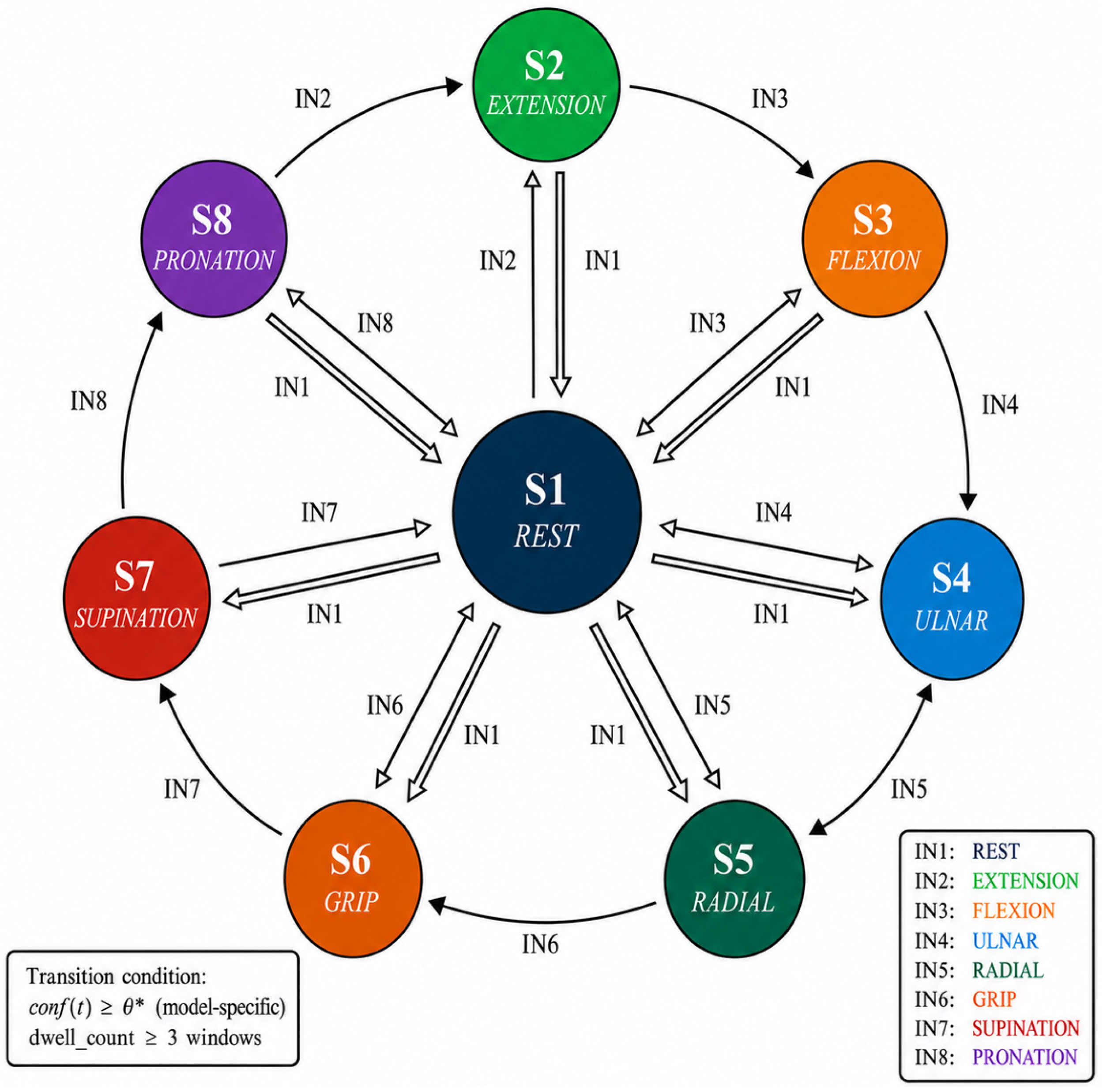
3.5. Confidence-Gated Finite-State Machine
3.6. Classifier-to-Robot Mapping Protocol
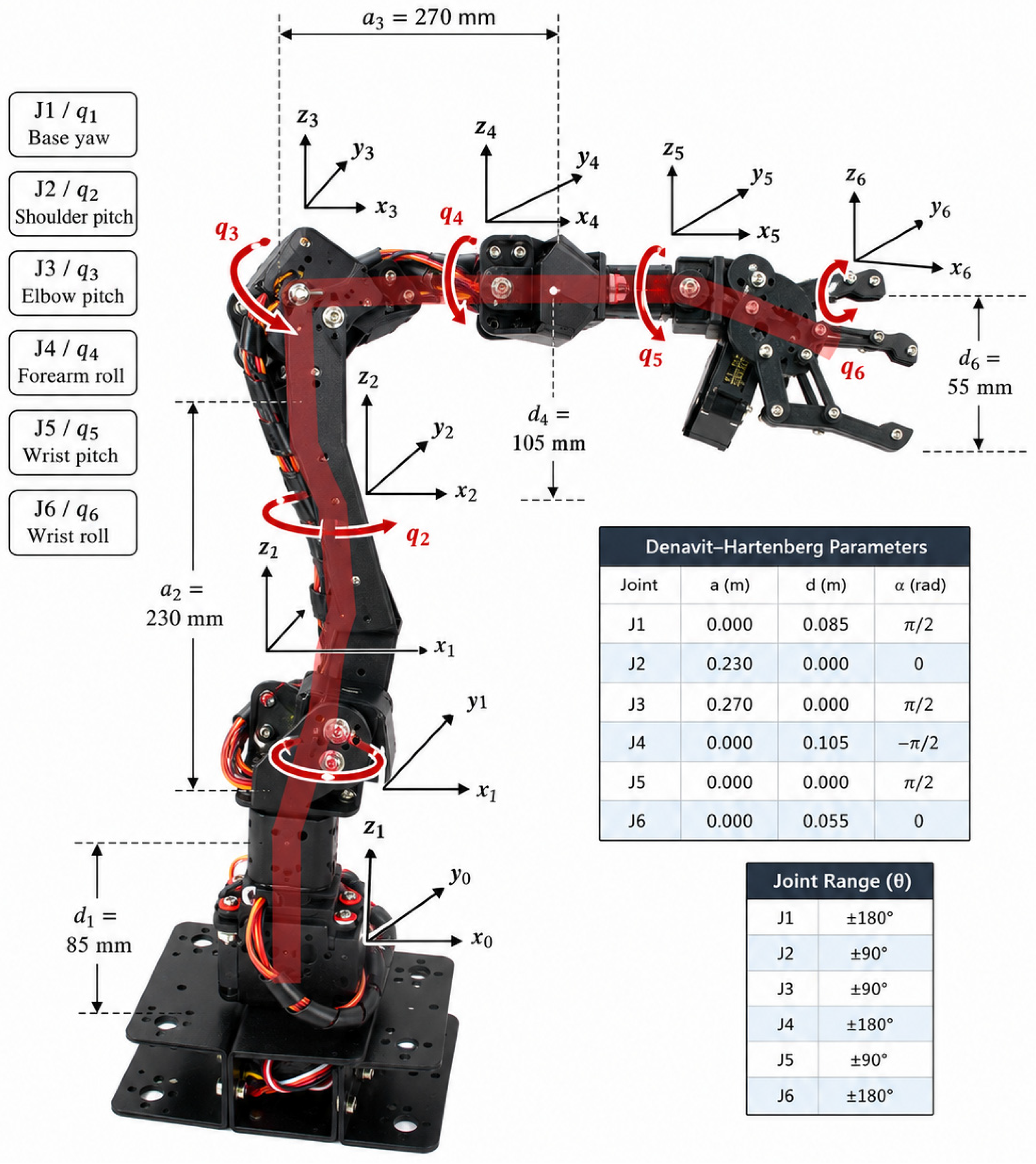
3.7. Virtual 6-DOF Robotic Manipulator
3.7.1. Forward Kinematics
3.7.2. Inverse Kinematics
3.7.3. Velocity Kinematics and Position of Jacobian
3.7.4. Linearized Joint-Space Dynamic Model
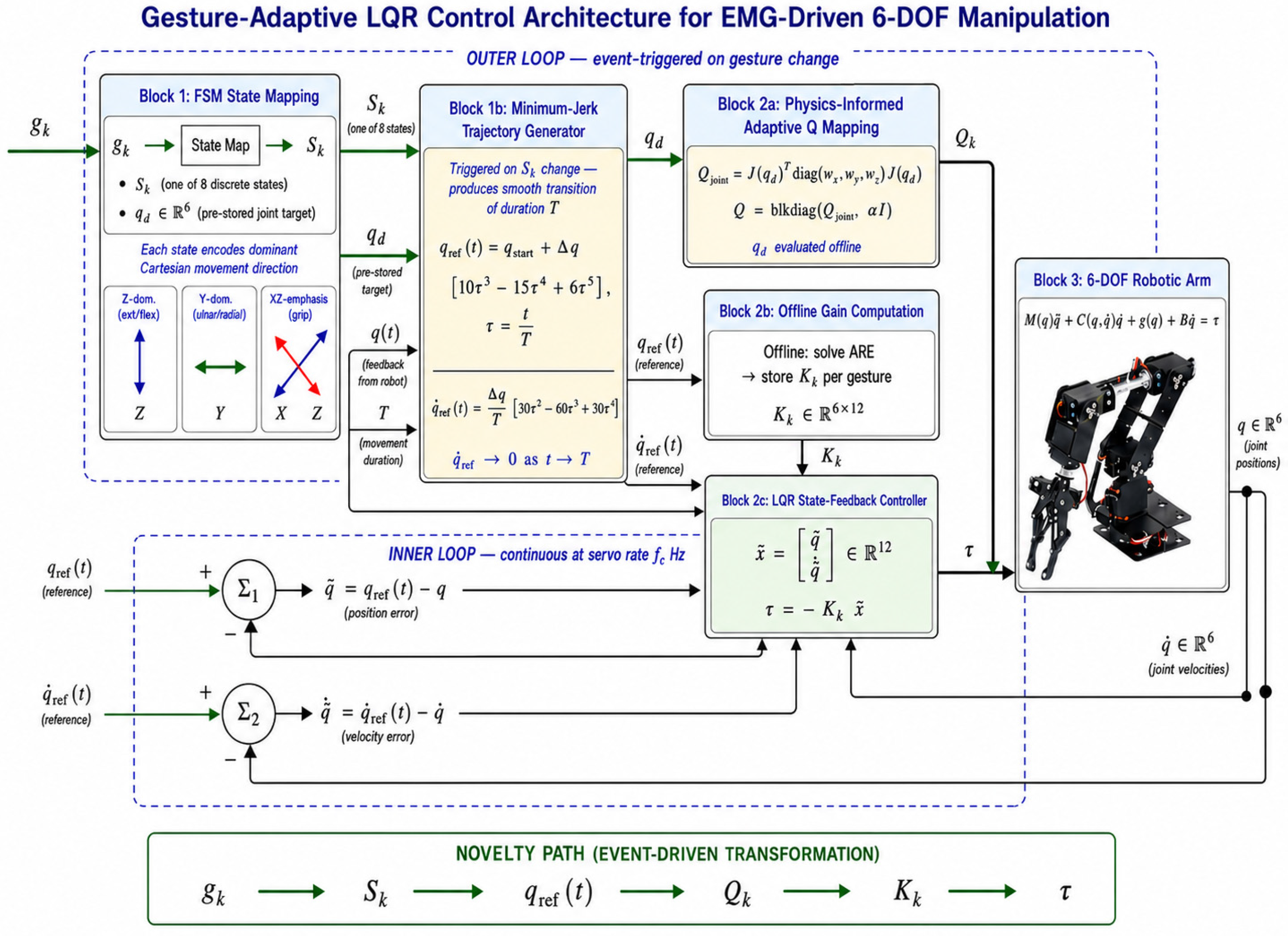
3.8. Control Architecture
3.8.1. Minimum-Jerk Trajectory Generation
3.8.2. Kinematically Informed LQR Design
3.8.3. Dual-Metric Performance Assessment
4. Results
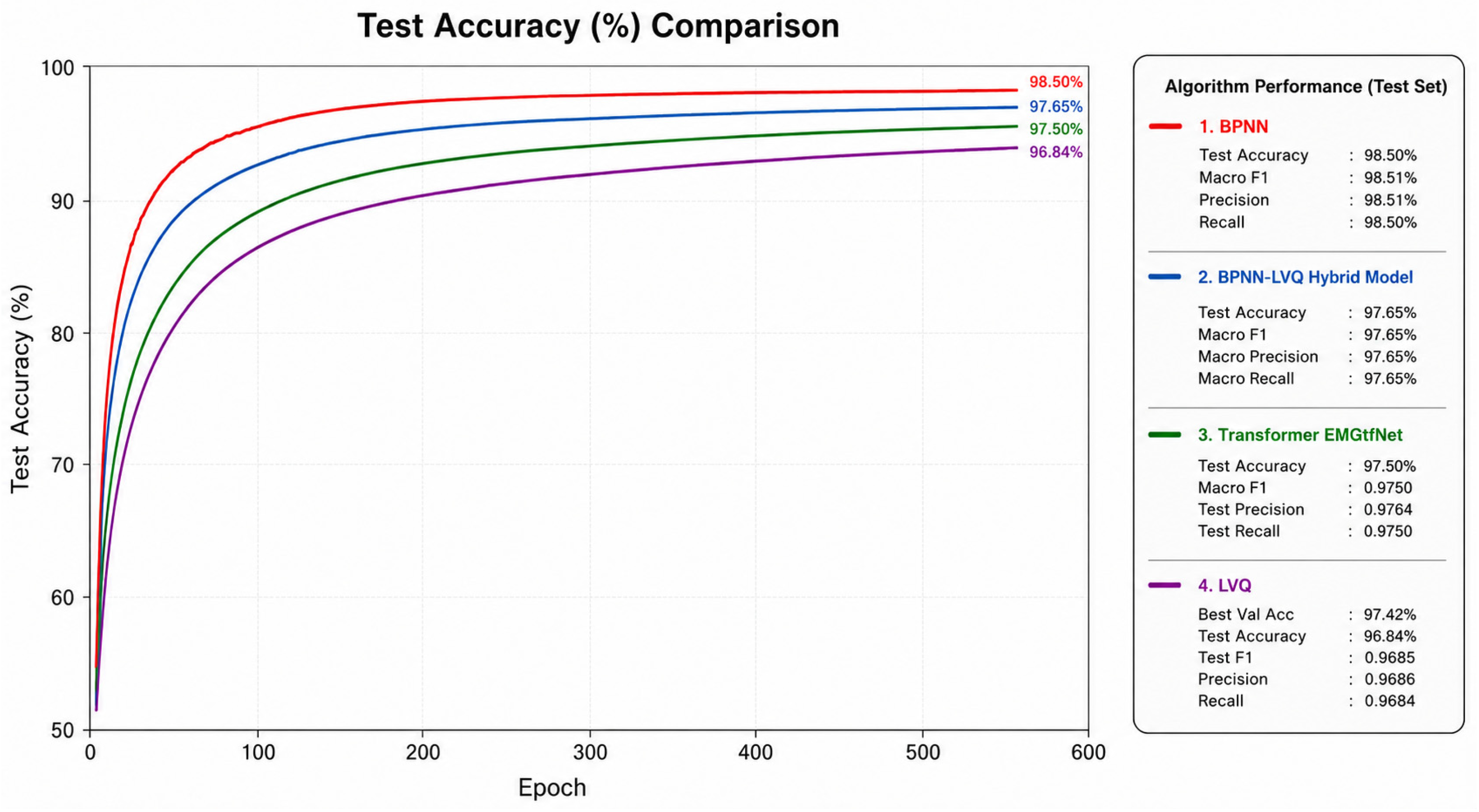
4.1. Classification Performance Under Random-Split Validation
4.2. Cross-Subject Generalization: Leave-One-Participant-Out Evaluation
4.3. Statistical Validation
4.4. Computational Complexity and Real-Time Feasibility
4.5. Gesture-Driven Robotic Control Performance
4.6. Confidence Threshold Sensitivity
5. Discussion
5.1. Comparative Classification Performance
5.2. Statistical Significance
5.3. Control System Effectiveness
5.4. Limitations
6. Conclusions
Author Contributions
Funding
Institutional Review Board Statement
Informed Consent Statement
Data Availability Statement
Conflicts of Interest
References
- Li, K.; Zhang, J.; Wang, L.; Zhang, M.; Li, J.; Bao, S. A review of the key technologies for sEMG-based human-robot interaction systems. Biomed. Signal Process. Control 2020, 62, 102074. [Google Scholar] [CrossRef] [Scilit]
- Li, W.; Shi, P.; Yu, H. Gesture Recognition Using Surface Electromyography and Deep Learning for Prostheses Hand: State-of-the-Art, Challenges, and Future. Front. Neurosci. 2021, 15, 621885. [Google Scholar] [CrossRef] [Scilit] [PubMed]
- Xiong, D.; Zhang, D.; Chu, Y.; Zhao, Y.; Zhao, X. Intuitive Human-Robot-Environment Interaction with EMG Signals: A Review. IEEE/CAA J. Autom. Sin. 2024, 11, 1075–1091. [Google Scholar] [CrossRef] [Scilit]
- Igual, C.; Pardo, L.A.; Hahne, J.M.; Igual, J. Myoelectric control for upper limb prostheses. Electronics 2019, 8, 1244. [Google Scholar] [CrossRef] [Scilit]
- Patriarca, F.; Di, L.P.; Arrichiello, F. EMG-Driven Shared Control Architecture for Human–Robot Co-Manipulation Tasks †. Machines 2025, 13, 669. [Google Scholar] [CrossRef] [Scilit]
- Li, X.; Tian, L.; Zheng, Y.; Samuel, O.W.; Fang, P.; Wang, L.; Li, G. A new strategy based on feature filtering technique for improving the real-time control performance of myoelectric prostheses. Biomed. Signal Process. Control 2021, 70, 102969. [Google Scholar] [CrossRef] [Scilit]
- Xiong, D.; Fu, X.; Zhang, D.; Chu, Y.; Zhao, Y.; Zhao, X. Robotic telemanipulation with EMG-driven strategy-assisted shared control method. Sci. China Technol. Sci. 2024, 67, 3812–3824. [Google Scholar] [CrossRef] [Scilit]
- Tsinganos, P.; Jansen, B.; Cornelis, J.; Skodras, A. Real-Time Analysis of Hand Gesture Recognition with Temporal Convolutional Networks. Sensors 2022, 22, 1694. [Google Scholar] [CrossRef] [Scilit] [PubMed]
- Çelik, Y.; Can, U. Surface EMG-Based Hand Gesture Recognition Using a Hybrid Multistream Deep Learning Architecture. Sensors 2026, 26, 2281. [Google Scholar] [CrossRef] [Scilit] [PubMed]
- Ozdemir, M.A.; Kisa, D.H.; Guren, O.; Akan, A. Dataset for multi-channel surface electromyography (sEMG) signals of hand gestures. Data Brief 2022, 41, 107921. [Google Scholar] [CrossRef] [Scilit] [PubMed]
- Sofyan, A.F.; Susanto, E.; Irsyad, R.N.; Prabaswara, A.S.; Rodiana, I.M. An Application Inverse Kinematic Based LQR Control for a 3 DOF Robot Arm. J. INFOTEL 2025, 17, 191–209. [Google Scholar] [CrossRef] [Scilit]
- Roveda, L.; Piga, D. Robust state dependent Riccati equation variable impedance control for robotic force-tracking tasks. Int. J. Intell. Robot. Appl. 2020, 4, 507–519. [Google Scholar] [CrossRef] [Scilit]
- Pérez-Reynoso, F.; Farrera, N.; Capetillo, C.; Méndez-Lozano, N.; González-Gutiérrez, C.; López-Neri, E. Pattern Recognition of EMG Signals by Machine Learning for the Control of a Manipulator Robot. Sensors 2022, 22, 3424. [Google Scholar] [CrossRef] [Scilit] [PubMed]
- Abdelmoneam, A.H.; Abdelaziz, M.; Zayed, N. Pattern Recognition of sEMG Signals by CNN-BiLSTM Algorithm for Bio-Robotics Applications. In 2025 International Telecommunications Conference (ITC-Egypt); IEEE: Piscataway, NJ, USA, 2025; pp. 483–490. [Google Scholar] [CrossRef] [Scilit]
- Moslhi, A.M.; Aly, H.H.; ElMessiery, M. The Impact of Feature Extraction on Classification Accuracy Examined by Employing a Signal Transformer to Classify Hand Gestures Using Surface Electromyography Signals. Sensors 2024, 24, 1259. [Google Scholar] [CrossRef] [Scilit] [PubMed]
- Gilstrap, T.A.; Alghamdi, M.M.; Phan, T.; Lee, S.W. EMG-Based Continuous Estimation of Index Finger Movements With Varying Interjoint Coordination Patterns by Modeling Musculoskeletal Dynamics. IEEE Access 2025, 13, 13454–13463. [Google Scholar] [CrossRef] [Scilit]
- Wu, C.; Yan, Y.; Cao, Q.; Fei, F.; Yang, D.; Lu, X.; Xu, B.; Zeng, H.; Song, A. sEMG Measurement Position and Feature Optimization Strategy for Gesture Recognition Based on ANOVA and Neural Networks. IEEE Access 2020, 8, 56290–56299. [Google Scholar] [CrossRef] [Scilit]
- Montecinos, C.; Espinoza, J.; Zamora Zapata, M.; Meruane, V.; Fernandez, R. Improving Fast EMG Classification for Hand Gesture Recognition: A Comprehensive Analysis of Temporal, Spatial, and Algorithm Configurations for Healthy and Post-Stroke Subjects. Sensors 2025, 25, 6980. [Google Scholar] [CrossRef] [Scilit] [PubMed]
- Huang, Y.; Chen, K.; Zhang, X.; Wang, K.; Ota, J. Joint torque estimation for the human arm from sEMG using backpropagation neural networks and autoencoders. Biomed. Signal Process. Control 2020, 62, 102051. [Google Scholar] [CrossRef] [Scilit]
- Huang, Y.; Chen, K.; Zhang, X.; Wang, K.; Ota, J. Motion estimation of elbow joint from sEMG using continuous wavelet transform and back propagation neural networks. Biomed. Signal Process. Control 2021, 68, 102657. [Google Scholar] [CrossRef] [Scilit]
- Schneider, P.; Biehl, M.; Hammer, B. Adaptive Relevance Matrices in Learning Vector Quantization. Neural Comput. 2009, 21, 3532–3561. [Google Scholar] [CrossRef] [Scilit] [PubMed]
- Hammer, B.; Villmann, T. Generalized relevance learning vector quantization. Neural Netw. 2002, 15, 1059–1068. [Google Scholar] [CrossRef] [Scilit] [PubMed]
- Schneider, P.; Bunte, K.; Stiekema, H.; Hammer, B.; Villmann, T.; Biehl, M. Regularization in matrix relevance learning. IEEE Trans. Neural Netw. 2010, 21, 831–840. [Google Scholar] [CrossRef] [Scilit] [PubMed]
- Tang, F.; Tino, P.; Yu, H. Generalized Learning Vector Quantization With Log-Euclidean Metric Learning on Symmetric Positive-Definite Manifold. IEEE Trans. Cybern. 2023, 53, 5178–5190. [Google Scholar] [CrossRef] [Scilit] [PubMed]
- Lövdal, S.; Biehl, M. Iterated Relevance Matrix Analysis (IRMA) for the Identification of Class-Discriminative Subspaces. Available online: http://arxiv.org/abs/2401.12842 (accessed on 23 January 2026).
- Tang, F.; Feng, H.; Tino, P.; Si, B.; Ji, D. Probabilistic Learning Vector Quantization on Manifold of Symmetric Positive Definite Matrices. Available online: http://arxiv.org/abs/2102.00667 (accessed on 15 February 2026).
- Abdi, L.; Prete, A.; Arlt, W.; Biehl, M. Leveraging ordinal generalized matrix learning vector quantization for improved classification. Neural Comput. Appl. 2026, 38, 174. [Google Scholar] [CrossRef] [Scilit]
- de Boer, J.; Dedja, K.; Vens, C. SurvivalLVQ: Interpretable supervised clustering and prediction in survival analysis via Learning Vector Quantization. Pattern Recognit. 2024, 153, 110497. [Google Scholar] [CrossRef] [Scilit]
- Ravichandran, J.; Kaden, M.; Villmann, T. Variants of recurrent learning vector quantization. Neurocomputing 2022, 502, 27–36. [Google Scholar] [CrossRef] [Scilit]
- Kohonen, T. Learning Vector Quantization. In Self-Organizing Maps; Kohonen, T., Ed.; Springer: Berlin/Heidelberg, Germany, 2001; pp. 245–261. [Google Scholar] [CrossRef] [Scilit]
- Van, V.R.; Biehl, M.; Nl, M.B. sklvq: Scikit Learning Vector Quantization. J. Mach. Learn. Res. 2021, 22, 1–6. [Google Scholar]
- Engelsberger, A.; Villmann, T. Quantum Computing Approaches for Vector Quantization—Current Perspectives and Developments. Entropy 2023, 25, 540. [Google Scholar] [CrossRef] [Scilit] [PubMed]
- Pan, T.; Wang, H.; Si, H.; Li, Y.; Shang, L. Identification of pilots’ fatigue status based on electrocardiogram signals. Sensors 2021, 21, 3003. [Google Scholar] [CrossRef] [Scilit] [PubMed]
- Zabihi, S.; Rahimian, E.; Asif, A.; Mohammadi, A. TraHGR: Transformer for Hand Gesture Recognition via Electromyography. IEEE Trans. Neural Syst. Rehabil. Eng. 2023, 31, 4211–4224. [Google Scholar] [CrossRef] [Scilit] [PubMed]
- Zhang, W.; Zhao, T.; Zhang, J.; Wang, Y. LST-EMG-Net: Long short-term transformer feature fusion network for sEMG gesture recognition. Front. Neurorobot. 2023, 17, 1127338. [Google Scholar] [CrossRef] [Scilit] [PubMed]
- Rodriguez Serrezuela, R.; Zamora, R.S.; Hermosilla, D.M.; Gomez, A.E.R.; Reyes, E.M. Hybrid Convolutional Vision Transformer for Robust Low-Channel sEMG Hand Gesture Recognition: A Comparative Study with CNNs. Biomimetics 2025, 10, 806. [Google Scholar] [CrossRef] [Scilit] [PubMed]
- Dere, M.D.; Lee, B. A Novel Approach to Surface EMG-Based Gesture Classification Using a Vision Transformer Integrated With Convolutive Blind Source Separation. IEEE J. BioMed. Health Inf. 2024, 28, 181–192. [Google Scholar] [CrossRef] [Scilit] [PubMed]
- Montazerin, M.; Rahimian, E.; Naderkhani, F.; Atashzar, S.F.; Yanushkevich, S.; Mohammadi, A. Transformer-based hand gesture recognition from instantaneous to fused neural decomposition of high-density EMG signals. Sci. Rep. 2023, 13, 11000. [Google Scholar] [CrossRef] [Scilit] [PubMed]
- Liu, Y.; Li, X.; Yang, L.; Yu, H. A Transformer-Based Gesture Prediction Model via sEMG Sensor for Human–Robot Interaction. In IEEE Transactions on Instrumentation and Measurement; IEEE: Piscataway, NJ, USA, 2024; Volume 73, pp. 1–15. [Google Scholar] [CrossRef] [Scilit]
- Córdova, J.C.; Flores, C.; Andreu-Perez, J. EMGTFNet: Fuzzy Vision Transformer to Decode Upperlimb sEMG Signals for Hand Gestures Recognition. In 2023 IEEE International Conference on Fuzzy Systems (FUZZ); IEEE: Piscataway, NJ, USA, 2023; pp. 1–6. [Google Scholar] [CrossRef] [Scilit]
- Cruz, P.J.; Vásconez, J.P.; Romero, R.; Chico, A.; Benalcázar, M.E.; Álvarez, R.; López, L.I.B.; Caraguay, Á.L.V. A Deep Q-Network based hand gesture recognition system for control of robotic platforms. Sci. Rep. 2023, 13, 7956. [Google Scholar] [CrossRef] [Scilit] [PubMed]
- Song, T.; Zhang, K.; Yan, Z.; Li, Y.; Guo, S.; Li, X. Research on Upper Limb Motion Intention Classification and Rehabilitation Robot Control Based on sEMG. Sensors 2025, 25, 1057. [Google Scholar] [CrossRef] [Scilit] [PubMed]
- Iovene, E.; Monaco, R.; Fu, J.; Costa, F.; Ferrigno, G.; De Momi, E. EMG-Based Variable Impedance Control for Enhanced Haptic Feedback in Real-Time Material Recognition. IEEE Trans. Haptics 2025, 18, 220–231. [Google Scholar] [CrossRef] [Scilit] [PubMed]
- Obuz, S.; Tatlicioglu, E.; Zergeroglu, E. Adaptive Cartesian space control of robotic manipulators: A concurrent learning based approach. J. Frankl. Inst. 2024, 361, 106701. [Google Scholar] [CrossRef] [Scilit]
- Hocaoglu, E.; Patoglu, V. SEMG-Based Natural Control Interface for a Variable Stiffness Transradial Hand Prosthesis. Front. Neurorobot. 2022, 16, 789341. [Google Scholar] [CrossRef] [Scilit] [PubMed]
- Lambelet, C.; Mathis, M.; Siegenthaler, M.; Held, J.P.O.; Woolley, D.; Lambercy, O.; Gassert, R.; Wenderoth, N. Variable admittance control with sEMG-based support for wearable wrist exoskeleton. Front. Neurorobot. 2025, 19, 1562675. [Google Scholar] [CrossRef] [Scilit] [PubMed]
- Ahmed, K.; Aly, A.A.; Elhabib, M.O. Design of Adaptive LQR Control Based on Improved Grey Wolf Optimization for Prosthetic Hand. Biomimetics 2025, 10, 423. [Google Scholar] [CrossRef] [Scilit] [PubMed]
- Xie, C.; Lyu, Y.; Li, G.; Tong, R.K.-Y.; Xia, H.; Song, R.; Li, Z. A Cable-Driven Upper Limb Rehabilitation Robot With Muscle-Synergy-Based Myoelectric Controller. IEEE Trans. Robot. 2024, 40, 3199–3211. [Google Scholar] [CrossRef] [Scilit]
- Yang, J.; Shibata, K.; Weber, D.; Erickson, Z. High-density electromyography for effective gesture-based control of physically assistive mobile manipulators. npj Robot. 2025, 3, 2. [Google Scholar] [CrossRef] [Scilit]
- Ma, C.; Jiang, X.; Nazarpour, K. Pre-training, personalization, and self-calibration: All a neural network-based myoelectric decoder needs. Front. Neurorobot. 2025, 19, 1604453. [Google Scholar] [CrossRef] [Scilit] [PubMed]



| Model | Input Representation | Preprocessing/Sampling | Window/Sequence Setup | Layer Parameters |
|---|---|---|---|---|
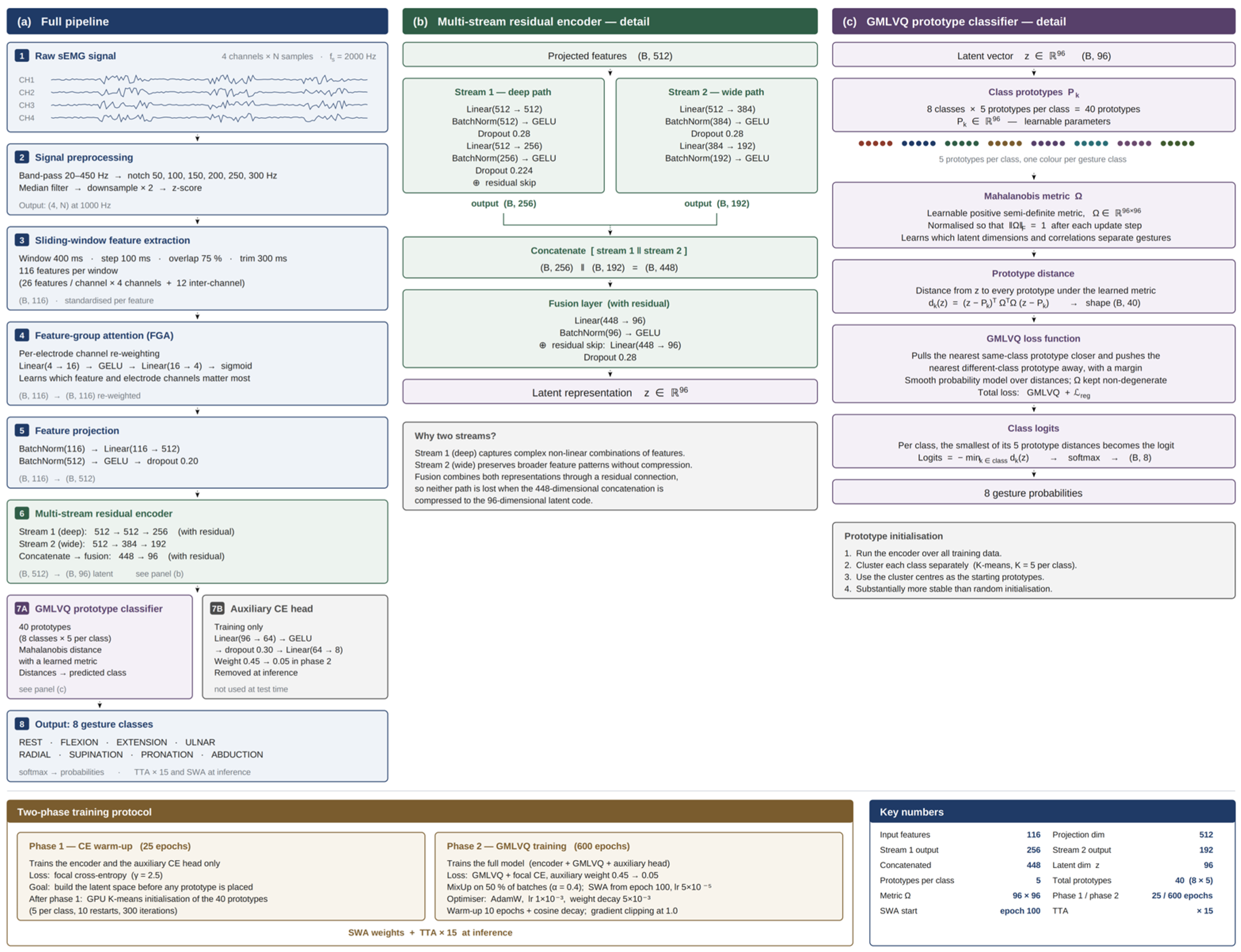
| BPNN | 116 handcrafted EMG features | Bandpass 20–450 Hz, multi-notch filtering (50–300 Hz), median filtering, FIR decimation from 2000 Hz to 1000 Hz, per-channel z-score normalization | 400 ms windows, 75% overlap, gesture-consistent segmentation, 116-dimensional feature vector per window | FeatureGroupAttention → projection 116 → 512 → Stream 1 512 → 256 (residual)‖Stream 2 384 → 192 → Fusion 448 → 512 (residual) → Head 128 → Output |
| GMLVQ | Same | Bandpass 20–450 Hz, multi-notch filtering (50–300 Hz), median filtering, FIR decimation from 2000 Hz to 1000 Hz, per-channel z-score normalization | 400 ms windows, 75% overlap, gesture-consistent segmentation, 116-dimensional feature vector per window | Encoder MLP: 116 → 512 → 256 → 128, then GMLVQ with latent dimension 128, 5 prototypes per class, learnable metric matrix Ω ∈ ℝ^ (128 × 128) |
| Hybrid BPNN–GMLVQ | Same | Same feature-generation pipeline as BPNN and GMLVQ; bandpass 20–450 Hz, multi-notch filtering, median filtering, 2000 Hz → 1000 Hz down-sampling, z-score normalization | 400 ms windows, 75% overlap, gesture-consistent segmentation, 116-dimensional feature vector per window | FeatureGroupAttention → projection 116 → 512 → Stream 1 512 → 256 (residual)‖Stream 2 384→192 → Fusion 448 → 192 (residual) → GMLVQ head with latent dimension 192, 8 prototypes per class, auxiliary head 192 → 8 |
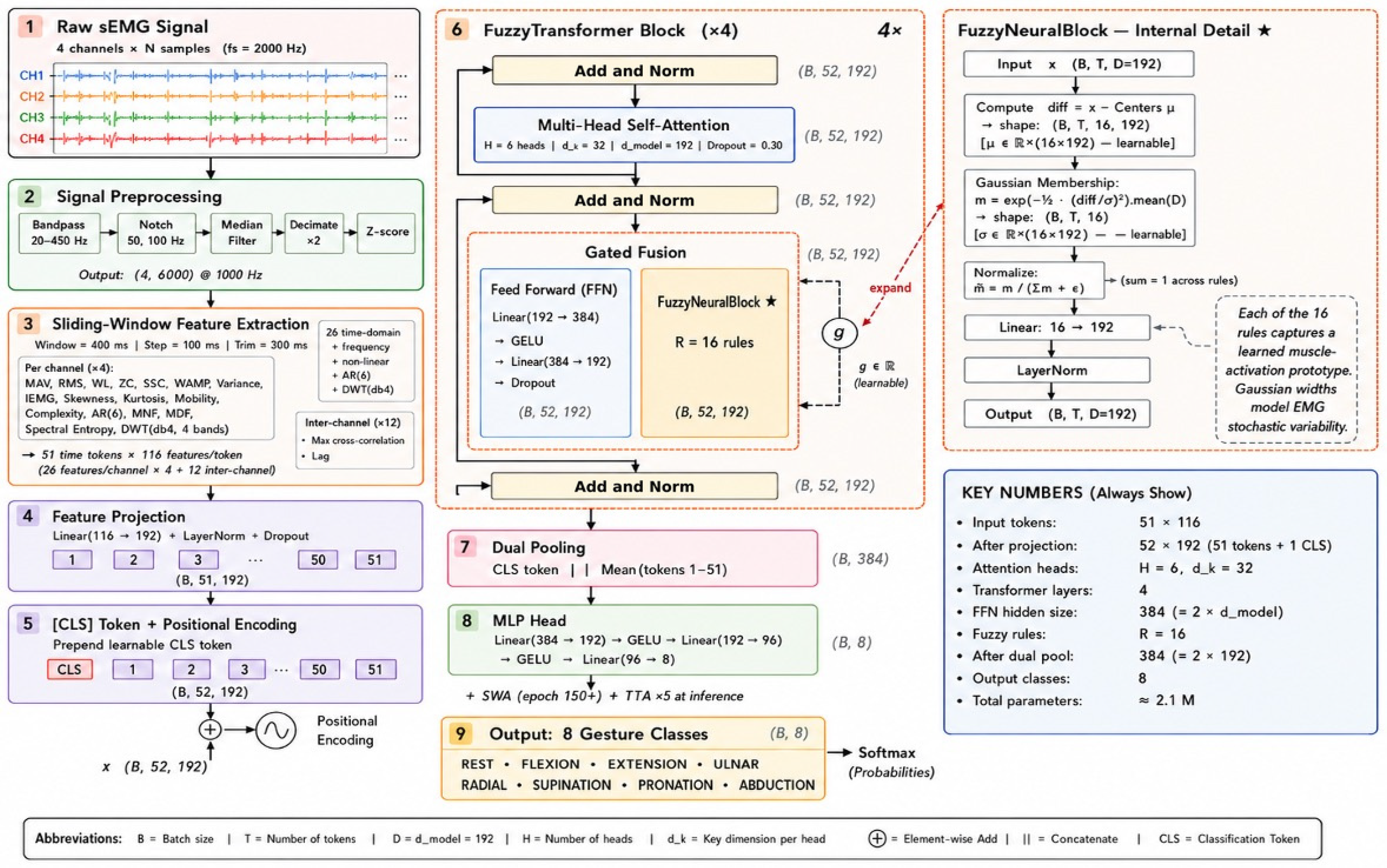
| Transformer | Feature-sequence input: 116 handcrafted EMG features across time | Bandpass 20–450 Hz, notch 50/100 Hz, median filtering, FIR decimation from 2000 Hz to 1000 Hz, per-channel z-score normalization | Full 6 s gesture treated as one sample; 400 ms feature windows, 100 ms step, trimmed gesture boundaries, approximately 51 time steps × 116 features | Input 116 → 192 projection → CLS token + positional encoding → 4 fuzzy transformer layers → dual pooling (CLS + average pooling, total 384) → MLP classifier |
| State | Gesture Class | Desired Joint Angles in Degrees | Desired Movement | |||||
|---|---|---|---|---|---|---|---|---|
| q1 (°) | q2 (°) | q3 (°) | q4 (°) | q5 (°) | q6 (°) | |||
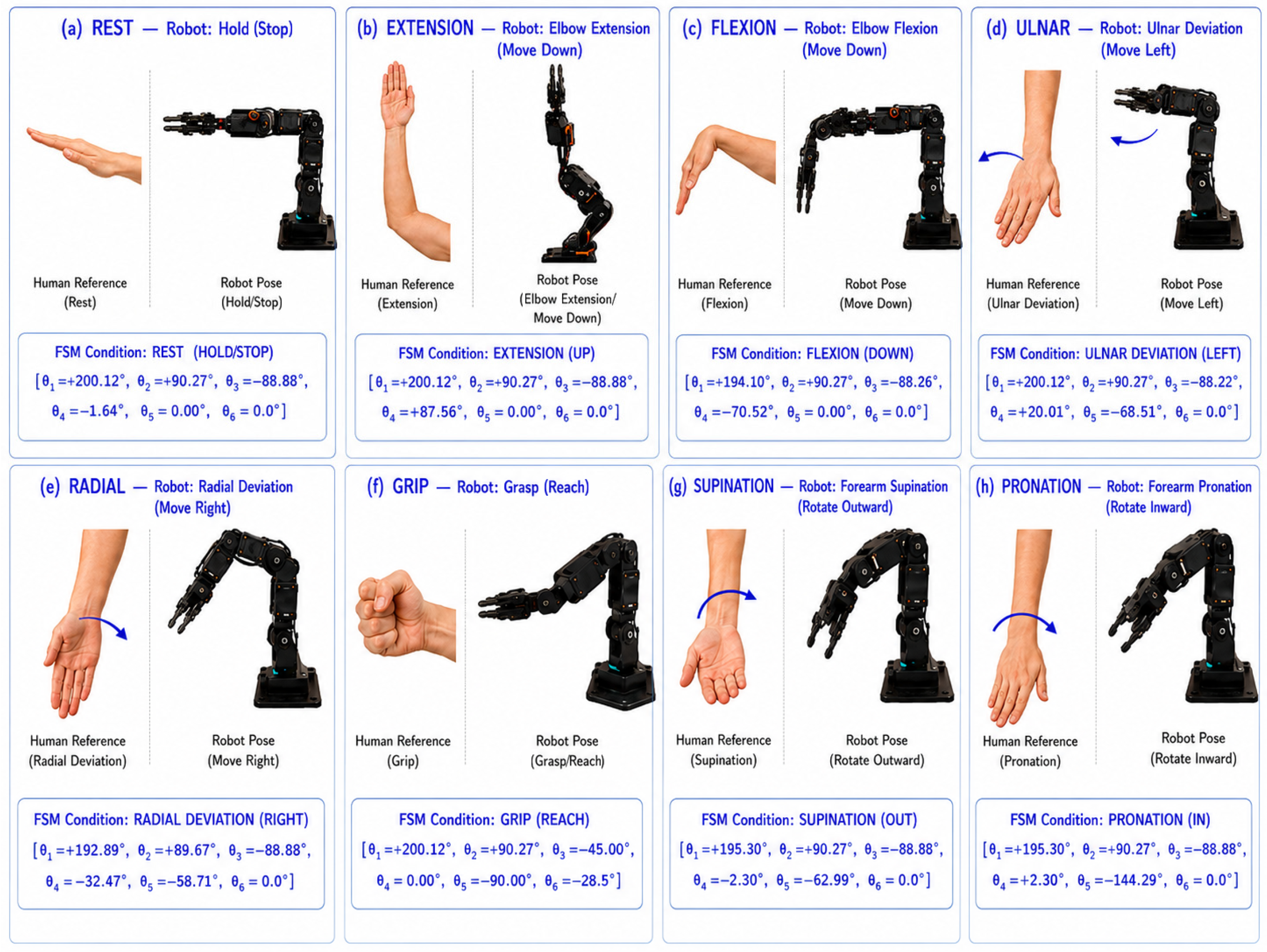
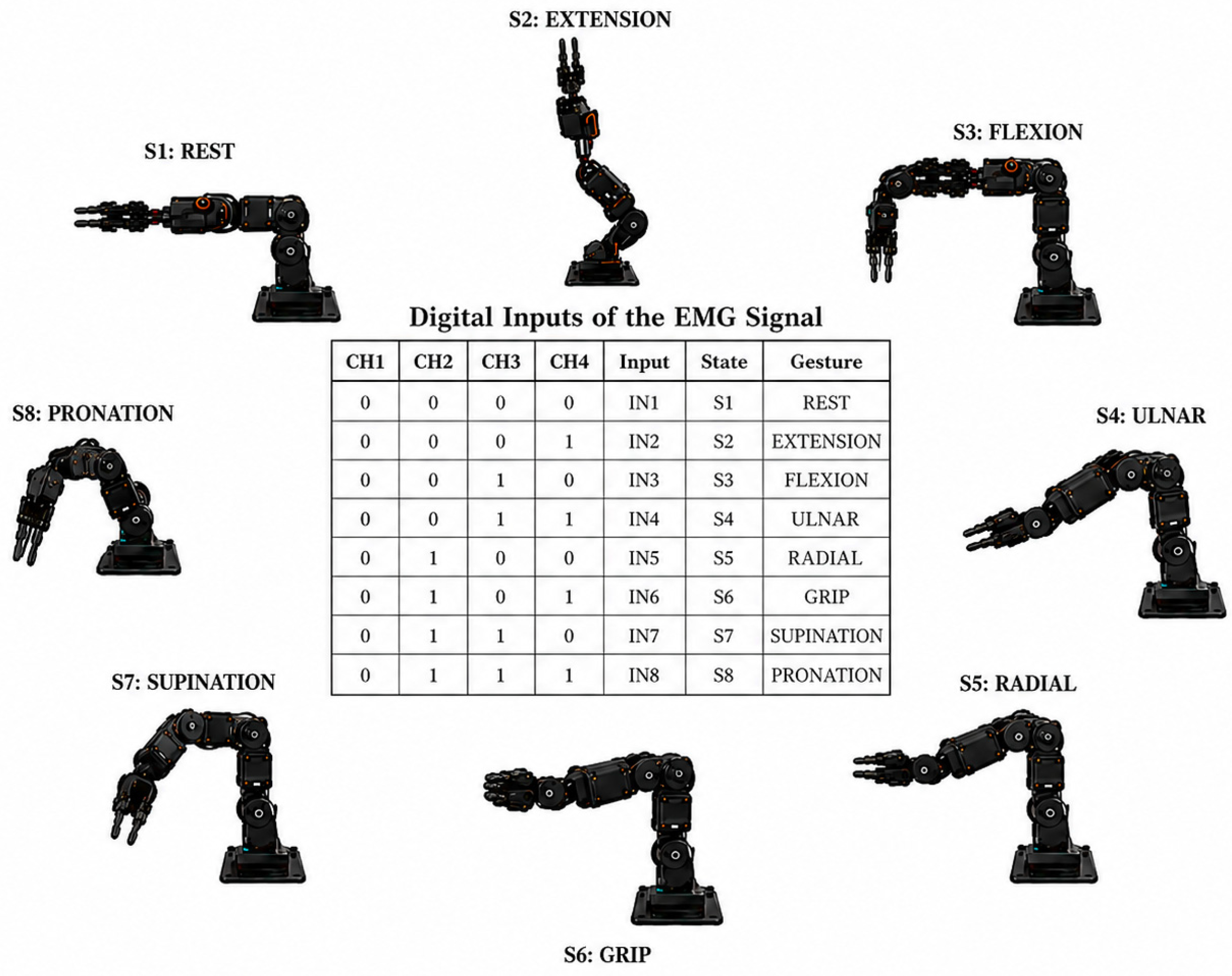
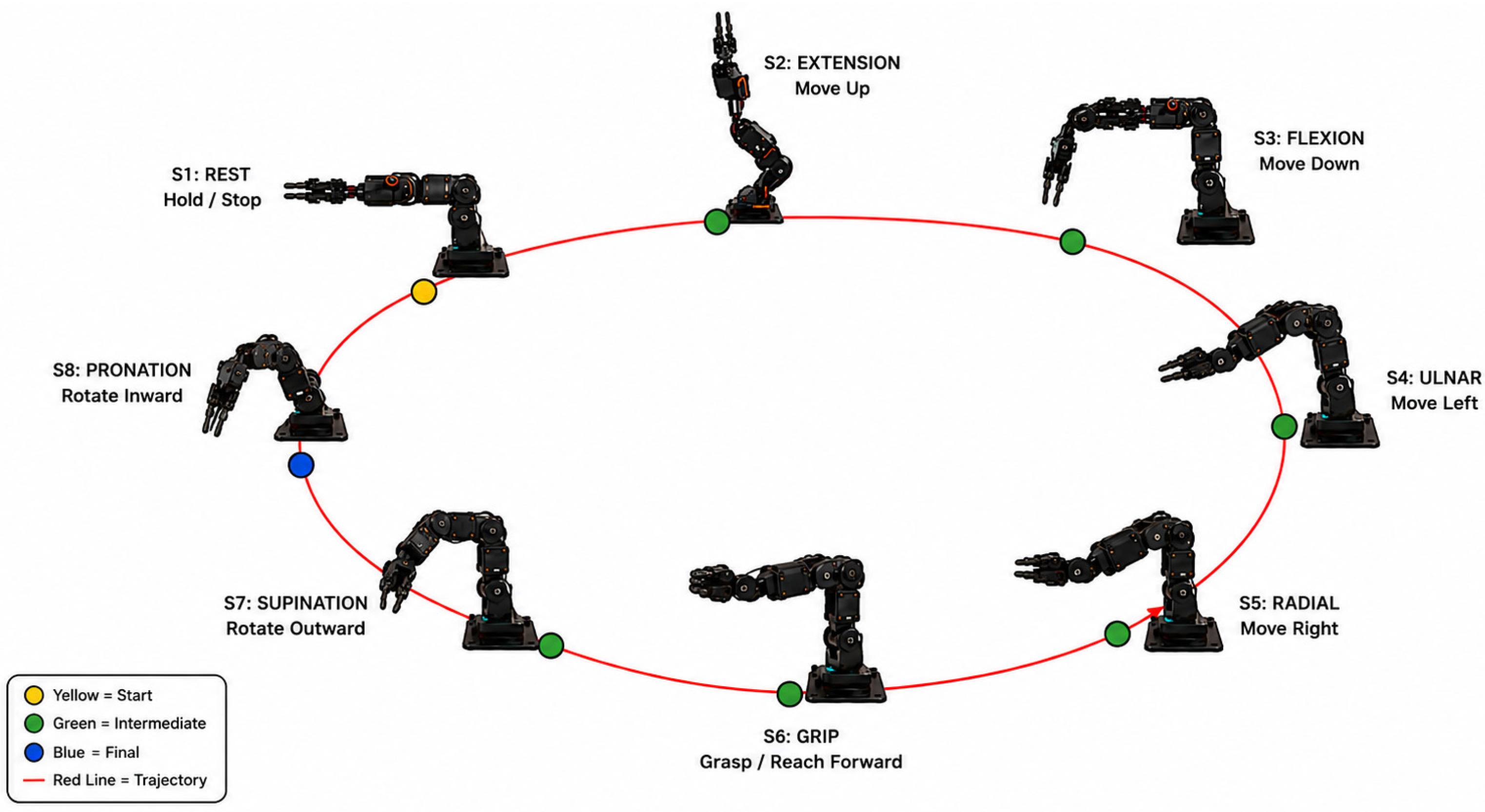
| S1 | Rest | +200.12 | +90.27 | −88.88 | −1.64 | 0 | 0 | Hold/Stop |
| S2 | Extension | +200.12 | +90.27 | −88.88 | +87.56 | 0 | 0 | Move Up |
| S3 | Flexion | +194.10 | +90.27 | −88.26 | −70.52 | 0 | 0 | Move Down |
| S4 | Ulnar Deviation | +200.12 | +90.27 | −88.22 | +20.01 | −68.51 | 0 | Move Left |
| S5 | Radial Deviation | +192.89 | +89.67 | −88.88 | −32.47 | −58.71 | 0 | Movie Right |
| S6 | Grip | +200.12 | +90.27 | −45.00 | 0 | −90.00 | −28.50 | Grasp/Reach |
| S7 | Supination | +195.30 | +90.27 | −88.88 | −2.30 | −62.99 | 0 | Rotate Outward |
| S8 | Pronation | +195.30 | +90.27 | −88.88 | +2.30 | −144.29 | 0 | Rotate Inward |
| Classifier | Accuracy (%) | Macro F1-Score (%) | Macro Precision (%) |
|---|---|---|---|
| BPNN | 98.50 | 98.51 | 98.51 |
| Hybrid BPNN–GMLVQ | 97.65 | 97.65 | 97.65 |
| EMGTFNet | 97.50 | 97.50 | 97.64 |
| GMLVQ | 97.42 | 96.85 | 96.86 |
| Classifier | Accuracy Mean ± SD (%) | F1-Score Mean ± SD (%) | Precision Mean ± SD (%) |
|---|---|---|---|
| Hybrid | 85.38 ± 8.93 | 84.79 ± 9.40 | 86.00 ± 9.43 |
| EMGTFNet | 85.31 ± 9.74 | 83.71 ± 11.17 | 86.87 ± 10.20 |
| GMLVQ | 80.69 ± 14.84 | 79.34 ± 15.95 | 83.66 ± 14.19 |
| BPNN | 77.56 ± 12.83 | 75.38 ± 14.16 | 80.12 ± 13.96 |
| Class | BPNN P% | BPNN R% | BPNN F1% | GMLVQ P% | GMLVQ R% | GMLVQ F1% | Hybrid P% | Hybrid R% | Hybrid F1% | EMGTFNet P% | EMGTFNet R% | EMGTFNet F1% |
|---|---|---|---|---|---|---|---|---|---|---|---|---|
| Extension | 0.8883 | 0.9150 | 0.9015 | 0.8986 | 0.9300 | 0.9140 | 0.8899 | 0.9700 | 0.9282 | 0.8957 | 0.9450 | 0.9197 |
| Flexion | 0.9254 | 0.9300 | 0.9277 | 0.8868 | 0.9400 | 0.9126 | 0.9282 | 0.9700 | 0.9487 | 0.8311 | 0.9350 | 0.8800 |
| Grip | 0.7363 | 0.7400 | 0.7382 | 0.8526 | 0.8100 | 0.8308 | 0.8912 | 0.8600 | 0.8753 | 0.9029 | 0.7900 | 0.8427 |
| Pronation | 0.6627 | 0.5600 | 0.6070 | 0.6763 | 0.7000 | 0.6880 | 0.7500 | 0.6750 | 0.7105 | 0.8387 | 0.7800 | 0.8083 |
| Radial | 0.7358 | 0.7800 | 0.7573 | 0.7500 | 0.7950 | 0.7718 | 0.8958 | 0.8600 | 0.8776 | 0.8065 | 0.8750 | 0.8393 |
| Rest | 0.7759 | 0.9000 | 0.8333 | 0.7778 | 0.8400 | 0.8077 | 0.8465 | 0.8550 | 0.8507 | 0.8565 | 0.8950 | 0.8753 |
| Supination | 0.7278 | 0.6550 | 0.6895 | 0.8462 | 0.7700 | 0.8063 | 0.8077 | 0.8400 | 0.8235 | 0.8683 | 0.8900 | 0.8790 |
| Ulnar | 0.7286 | 0.7250 | 0.7268 | 0.7701 | 0.6700 | 0.7166 | 0.8081 | 0.8000 | 0.8040 | 0.8314 | 0.7150 | 0.7688 |
| Macro avg | 0.7726 | 0.7756 | 0.7727 | 0.8073 | 0.8069 | 0.8060 | 0.8522 | 0.8538 | 0.8523 | 0.8539 | 0.8531 | 0.8516 |
| Metric | F-Statistic | df (Model, Error) | p-Value | Decision (α = 0.05) | Statistical Significance |
|---|---|---|---|---|---|
| Accuracy | 13.19 | (3, 117) | 1.78 × 10⁻⁷ | Reject H0 | Highly Significant |
| F1-score | 13.85 | (3, 117) | 8.62 × 10⁻⁸ | Reject H0 | Highly Significant |
| Precision | 5.95 | (3, 117) | 8.20 × 10⁻⁴ | Reject H0 | Highly Significant |
| Metric | χ2 (Chi-Square) | df | p-Value | Decision (α = 0.05) | Statistical Significance |
|---|---|---|---|---|---|
| Accuracy | 23.35 | 3 | 3.42 × 10⁻⁵ | Reject H0 | Highly Significant |
| F1-score | 22.67 | 3 | 4.74 × 10⁻⁵ | Reject H0 | Highly Significant |
| Precision | 12.54 | 3 | 5.75 × 10⁻³ | Reject H0 | Very Significant |
| Model | Parameters | FLOPs per Model Input | Inference Time | Input Unit |
|---|---|---|---|---|
| BPNN | 1.39 M | 2.76 M | 2.53 ms | Feature vector |
| GMLVQ | 0.26 M | 0.48 M | 0.99 ms | Feature vector |
| BPNN–GMLVQ | 1.01 M | 1.94 M | 2.52 ms | Feature vector |
| EMGTFNet | 1.35 M | 134.73 M | 8.99 ms | ~51-token sequence |
| Model | Test | Correct States | Correct (%) | Reported Total (s) | Step Sum (s) |
|---|---|---|---|---|---|
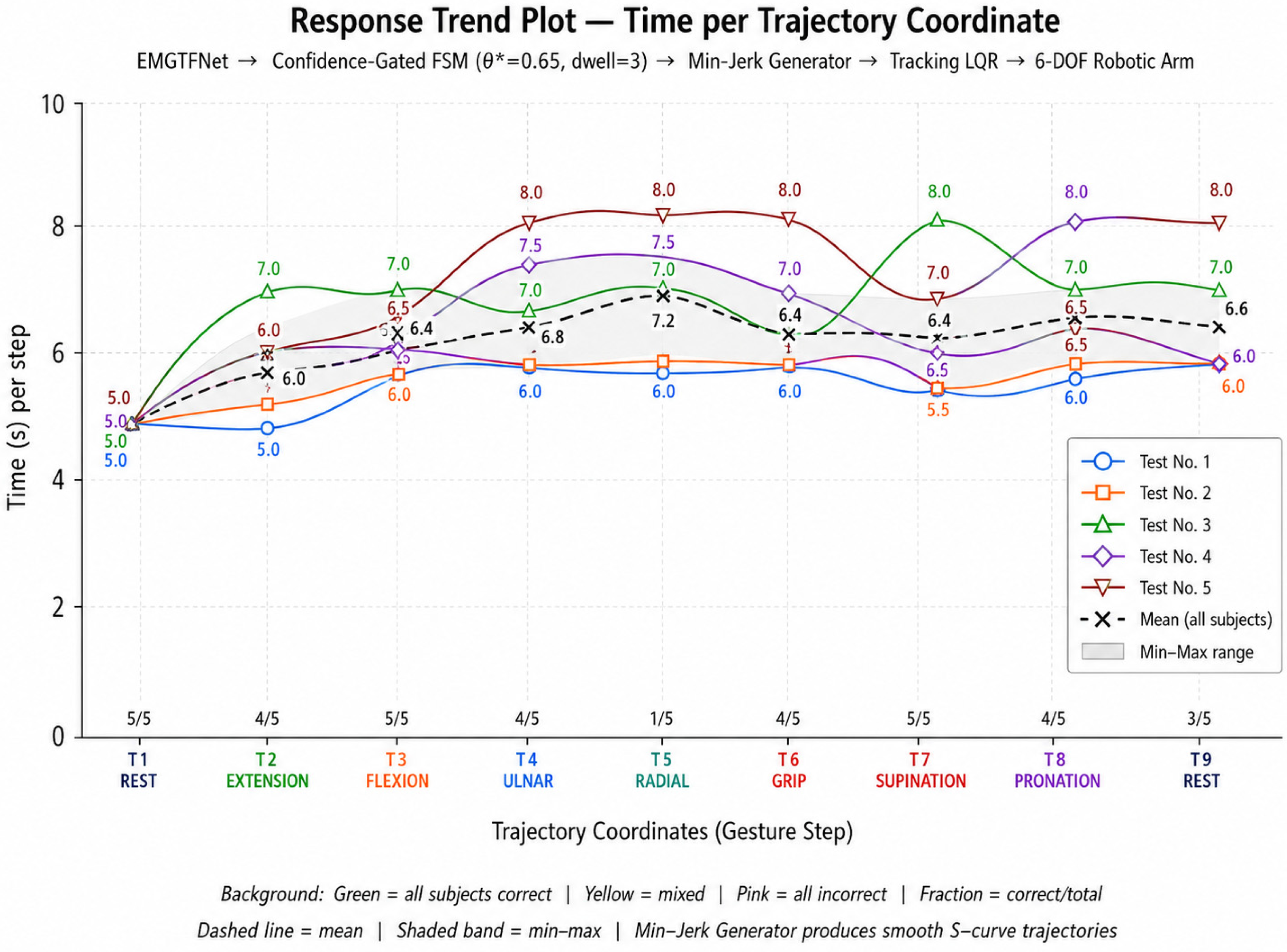
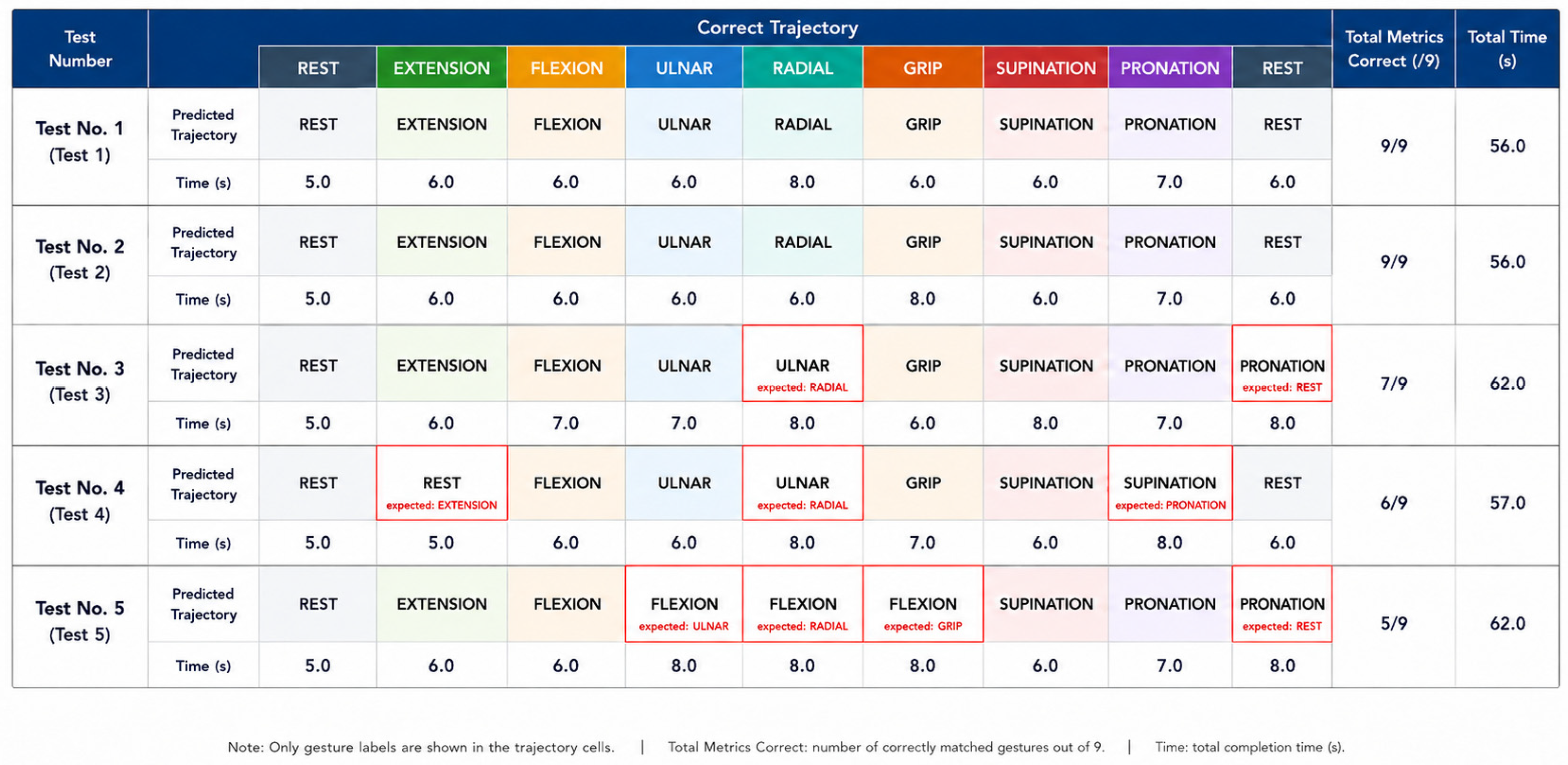
| EMGTFNet | 1 | 9/9 | 100.00 | 56 | 56 |
| EMGTFNet | 2 | 9/9 | 100.00 | 56 | 56 |
| EMGTFNet | 3 | 7/9 | 77.78 | 62 | 62 |
| EMGTFNet | 4 | 6/9 | 66.67 | 57 | 57 |
| EMGTFNet | 5 | 5/9 | 55.56 | 62 | 62 |
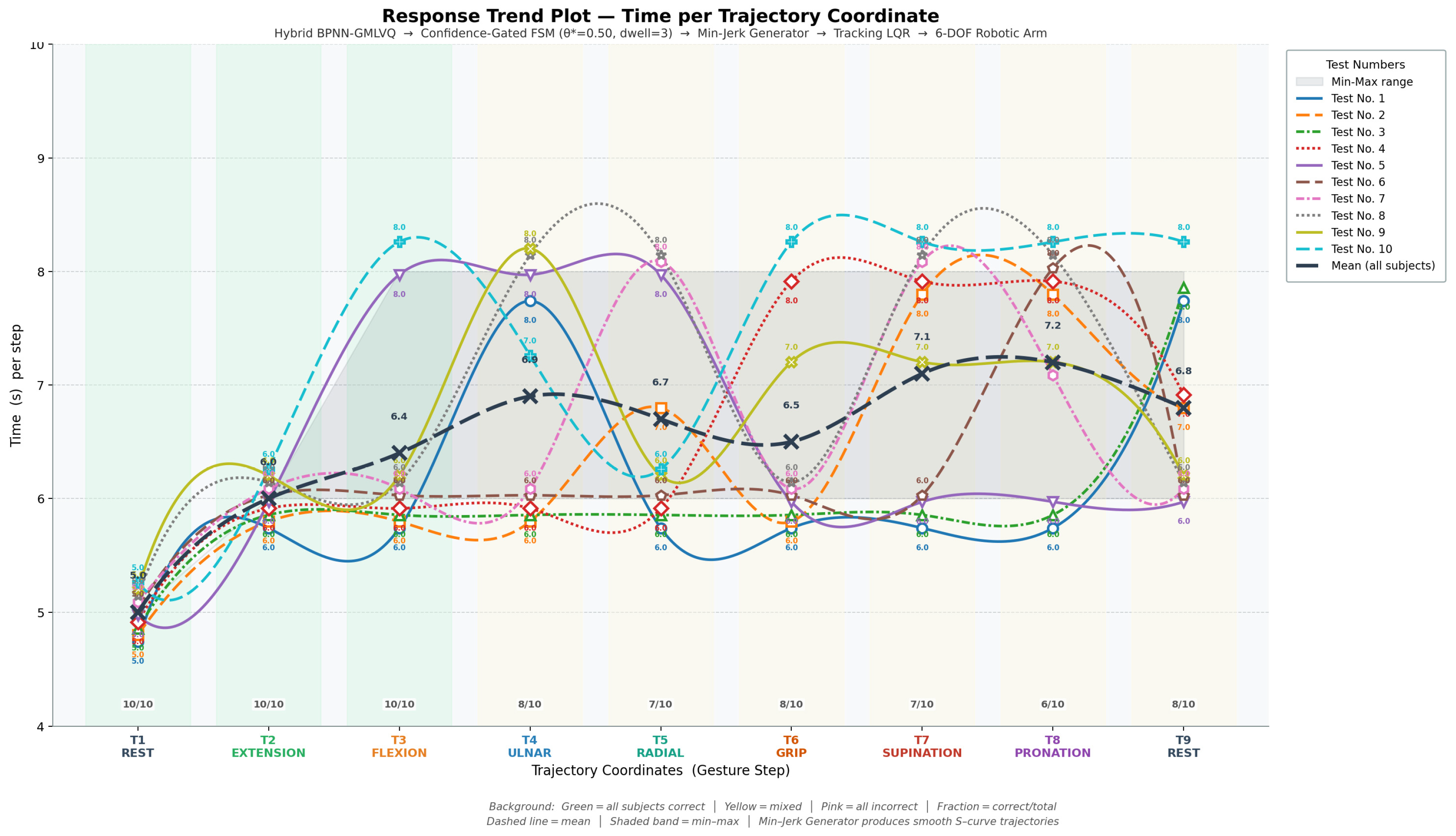
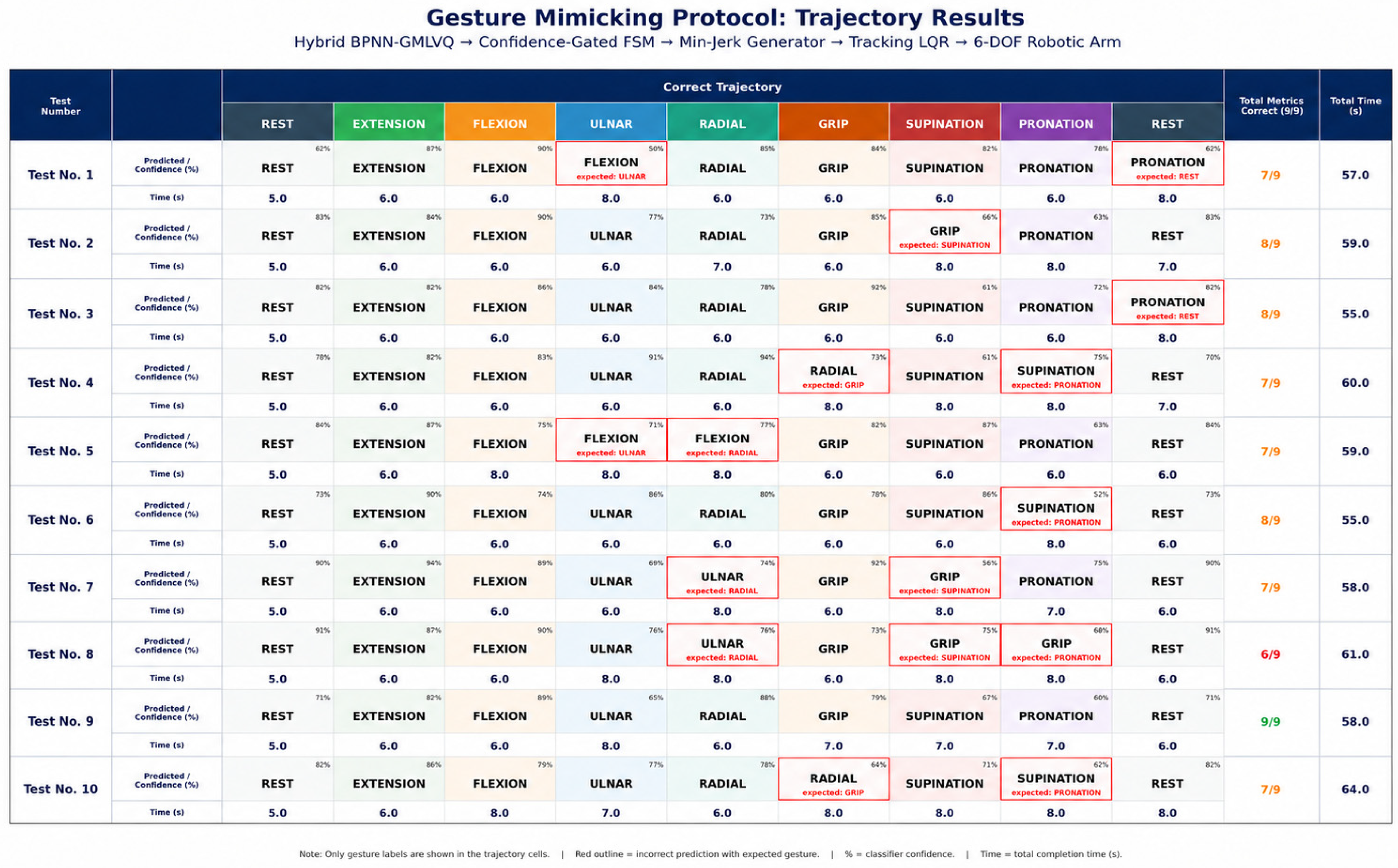
| Hybrid | 1 | 7/9 | 77.78 | 57 | 58 |
| Hybrid | 2 | 8/9 | 88.89 | 59 | 59 |
| Hybrid | 3 | 8/9 | 88.89 | 55 | 55 |
| Hybrid | 4 | 7/9 | 77.78 | 60 | 58 |
| Hybrid | 5 | 7/9 | 77.78 | 59 | 59 |
| Hybrid | 6 | 8/9 | 88.89 | 55 | 55 |
| Hybrid | 7 | 7/9 | 77.78 | 58 | 58 |
| Hybrid | 8 | 6/9 | 66.67 | 61 | 61 |
| Hybrid | 9 | 9/9 | 100.00 | 58 | 58 |
| Hybrid | 10 | 7/9 | 77.78 | 64 | 64 |
| Model | Tests | All Scheduled States | After Initial REST | Fully Correct Tests |
|---|---|---|---|---|
| EMGTFNet | 5 | 36/45 (80.00%) | 31/40 (77.50%) | 2/5 |
| Hybrid | 10 | 74/90 (82.22%) | 64/80 (80.00%) | 1/10 |
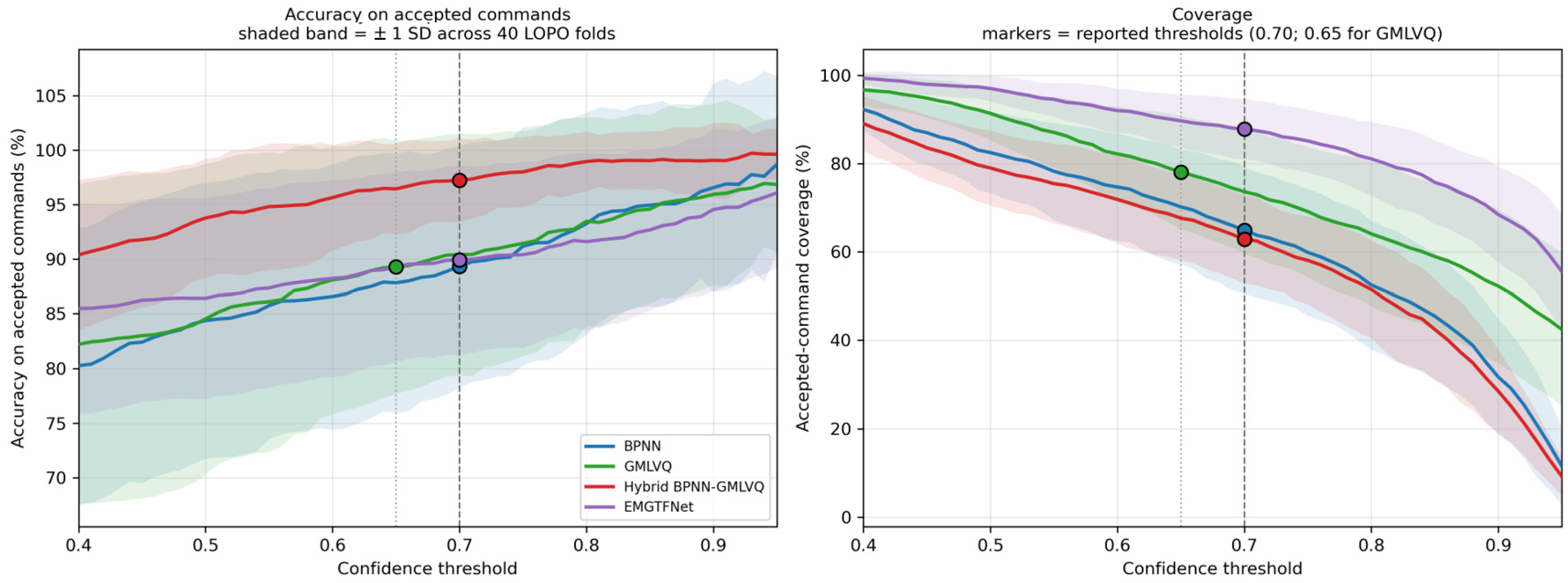
| Model | Threshold | Coverage (%) | Accuracy on Accepted (%) | Accepted but Incorrect (%) | Missed (%) |
|---|---|---|---|---|---|
| BPNN | 0.70 | 64.94 ± 14.42 | 89.34 ± 11.04 | 6.25 ± 5.52 | 35.06 ± 14.42 |
| GMLVQ | 0.65 | 78.06 ± 12.85 | 89.30 ± 11.58 | 7.75 ± 8.28 | 21.94 ± 12.85 |
| BPNN–GMLVQ | 0.70 | 62.88 ± 9.96 | 97.24 ± 3.81 | 1.56 ± 2.09 | 37.12 ± 9.96 |
| EMGTFNet | 0.70 | 87.81 ± 6.80 | 89.93 ± 8.69 | 8.62 ± 7.25 | 12.19 ± 6.80 |
| Threshold | BPNN | GMLVQ | Hybrid BPNN–GMLVQ | EMGTFNet |
|---|---|---|---|---|
| 0.40 | 92.2/80.3 | 96.7/82.2 | 89.1/90.4 | 99.3/85.5 |
| 0.50 | 82.5/84.4 | 91.4/84.5 | 79.0/93.8 | 97.0/86.4 |
| 0.60 | 74.7/86.6 | 82.2/88.1 | 71.9/95.7 | 92.0/88.3 |
| 0.65 | 70.2/87.8 | 78.1/89.3 | 67.6/96.4 | 89.7/89.3 |
| 0.70 | 64.9/89.3 | 73.6/90.4 | 62.9/97.2 | 87.8/89.9 |
| 0.75 | 59.9/91.2 | 69.1/91.4 | 58.1/98.0 | 85.1/90.4 |
| 0.80 | 52.5/93.3 | 64.1/93.5 | 51.5/99.0 | 81.1/91.6 |
| 0.85 | 45.4/95.0 | 58.9/94.6 | 42.4/99.0 | 75.8/92.7 |
| 0.90 | 31.7/96.6 | 52.2/95.9 | 28.5/99.1 | 68.4/94.6 |
| 0.95 | 11.6/98.7 | 42.4/96.9 | 9.2/99.6 | 55.6/96.1 |
| Paper | Model | Extraction Technique | Participants | Purpose | Performance |
|---|---|---|---|---|---|
| Montecinos et al. [18] | ANN | PSD + PCA | 40 (healthy + stroke) | Hand gesture recognition (healthy + stroke patients) | 95.31% (RS); 35–40% (cross-patient) |
| Rodriguez et al. [36] | CViT (CNN + ViT) | Convolutional feature maps | 10/11 (able-bodied/amputees) | Low channel sEMG gesture recognition for prosthetic control | 96.60% (able-bodied); 94.20% (amputees) |
| Zabihi et al. [34] | TraHGR (Temporal + Feature Transformer) | Windowed sEMG time-series (200 ms) | 40 (NinaPro DB2) | Large-scale hand gesture recognition via sEMG | 86.18% (RS) |
| This study | BPNN/GMLVQ/Hybrid/EMGTFNet + Confidence-Gated FSM + Min-Jerk Trajectory + Kinematic LQR | Time-domain + spectral (116-dim) + cross-correlation | 40 | Offline classification and simulated 6-DOF control | 98.50% (RS); 85.38% (LOPO); F1: 84.79% (LOPO) |
Disclaimer/Publisher’s Note: The statements, opinions and data contained in all publications are solely those of the individual author(s) and contributor(s) and not of MDPI and/or the editor(s). MDPI and/or the editor(s) disclaim responsibility for any injury to people or property resulting from any ideas, methods, instructions or products referred to in the content. |
© 2026 by the authors. Licensee MDPI, Basel, Switzerland. This article is an open access article distributed under the terms and conditions of the Creative Commons Attribution (CC BY) license.
Share and Cite
Abdelmoneam, A.H.; Zayed, N.; Abdallah, M.S.; Abdelaziz, M. sEMG-Driven Robotic Manipulation in Simulation: LOPO Classification, Confidence-Gated Supervision, and Gesture-Scheduled LQR Control. Computers 2026, 15, 670. https://doi.org/10.3390/computers15100670
Abdelmoneam AH, Zayed N, Abdallah MS, Abdelaziz M. sEMG-Driven Robotic Manipulation in Simulation: LOPO Classification, Confidence-Gated Supervision, and Gesture-Scheduled LQR Control. Computers. 2026; 15(10):670. https://doi.org/10.3390/computers15100670
Chicago/Turabian StyleAbdelmoneam, Anas Hassan, Nourhan Zayed, Mohamed S. Abdallah, and Mostafa Abdelaziz. 2026. "sEMG-Driven Robotic Manipulation in Simulation: LOPO Classification, Confidence-Gated Supervision, and Gesture-Scheduled LQR Control" Computers 15, no. 10: 670. https://doi.org/10.3390/computers15100670
APA StyleAbdelmoneam, A. H., Zayed, N., Abdallah, M. S., & Abdelaziz, M. (2026). sEMG-Driven Robotic Manipulation in Simulation: LOPO Classification, Confidence-Gated Supervision, and Gesture-Scheduled LQR Control. Computers, 15(10), 670. https://doi.org/10.3390/computers15100670