


Abstract
Blockchain technology has rapidly evolved as a cornerstone of decentralized computing, transforming how trust, data integrity, and transparency are achieved in digital ecosystems. However, despite extensive adoption, significant gaps remain in understanding how key blockchain variables, such as block size, consensus mechanisms, and network latency, affect system vulnerabilities and susceptibility to cyberattacks. This survey addresses this gap by combining qualitative and quantitative analyses across multiple blockchain environments. Using simulation tools such as Ganache and Bitcoin Core, and reviewing peer-reviewed studies from 2016 to 2024, the research systematically maps blockchain parameters to cyberattack vectors including 51% attacks, Sybil attacks, and double-spending. Findings indicate that design choices like block size, block interval, and consensus type substantially influence resilience against attacks. The Blockchain Variable Quantitative Risk Framework (BVQRF) introduced here integrates NIST’s cybersecurity principles with quantitative scoring to assess risks. This framework represents a novel contribution by operationalizing theoretical security constructs into actionable evaluation metrics, enabling predictive modeling and adaptive risk mitigation strategies for blockchain systems.
1. Introduction
Blockchain technology enables multiple participants to maintain a shared, tamper-resistant ledger without centralized control. It underpins applications such as cryptocurrencies, supply chain systems, voting mechanisms, and decentralized finance (DeFi). Its transparency and trustless design offer significant advantages, yet vulnerabilities persist due to flaws in configuration and protocol design.
Empirical studies, such as “Secure framework for land record management using blockchain technology” [1] and “A novel permissioned blockchain approach for scalable and privacy-preserving IoT authentication” [2], demonstrate that design weaknesses can expose networks to critical threats. Ref. [3] emphasize, blockchain’s potential to enhance transparency, integrity, and accountability is counterbalanced by its susceptibility to exploitation if governance and technical safeguards are insufficient.
Core variables including block size, creation interval, consensus mechanisms, and encryption methods directly affect blockchain performance and security [4]. Poorly configured parameters can enable attacks or degrade system resilience [5]. Major platforms such as Bitcoin, Ethereum, and Polkadot adjust these parameters to balance scalability and protection [6]. As Nakamoto observed, even a successful attacker cannot arbitrarily alter transactions or create new funds.
This study analyzes how blockchain design variables influence security risks and proposes strategies to mitigate them, emphasizing that a systematic understanding of these parameters is essential for developing resilient distributed ledger systems.
Objectives and Methodology
The main objectives of this study are to
- Identify and categorize key blockchain design variables.
- Map these variables to major attack vectors.
- Analyze how variable manipulation influences vulnerability through empirical examples and simulations.
- Propose mitigation strategies and design recommendations for future blockchain systems.
A mixed-methods approach is employed, combining qualitative analysis through a literature review of peer-reviewed studies and documented cyberattacks (2016–2024) and quantitative analysis via data modeling and visualization in simulated blockchain environments [7,8,9,10,11,12].
Simulation tools include Ganache, a private Ethereum testing framework, and Bitcoin Core [13], which validates and maintains consensus for the Bitcoin network [14]. An example of shared agreement (consensus) mechanisms is provided in Table 1.
Table 1.
Example of shared agreement (consensus).
The case study examines blockchain attacks and their financial impact between 2016 and 2024 using the following tools:
- -
- Ganache is a private Ethereum environment used for controlled simulation of blockchain transactions.
- -
- Bitcoin Core validates transaction chains through consensus, ensuring only legitimate blocks are accepted while enhancing decentralization, privacy, and user security.
- -
- Python 3.12.3 with Matplotlib 3.9.2 used for data modeling and visualization [15].
- -
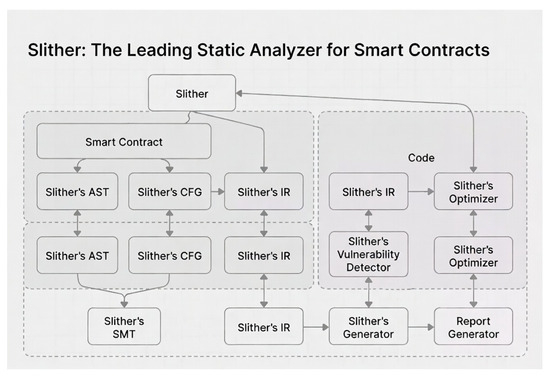
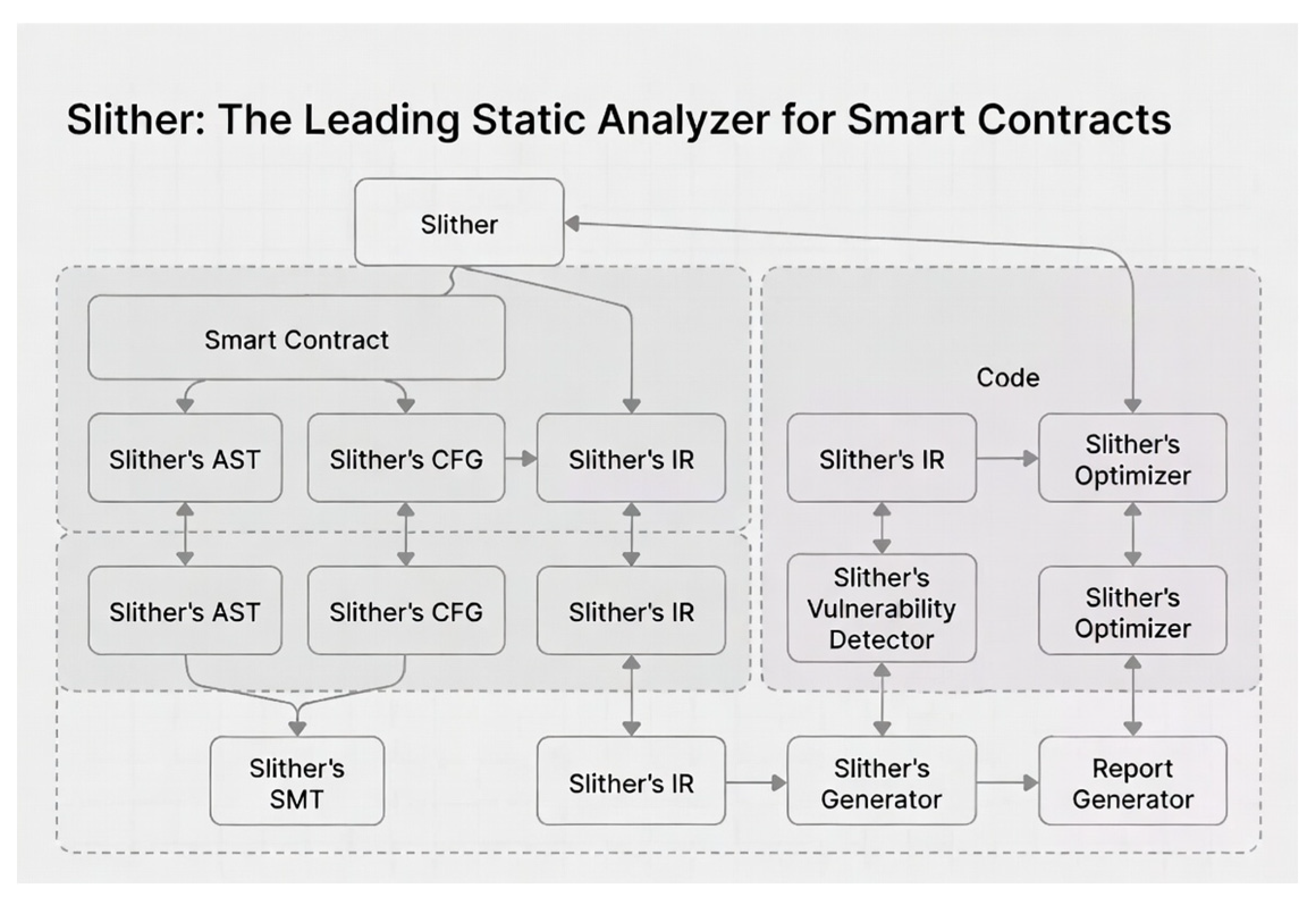
- Mythril and Slither are Ethereum smart contract analysis tools. Mythril 0.24.2 applies symbolic execution and taint analysis to detect vulnerabilities such as overflow and reentrancy, while Slither 0.10.4 performs static code analysis and identifies optimization opportunities within frameworks like Truffle and Hardhat. A schematic representation of the Slither algorithm is shown in Figure 1.Figure 1. Representation of the Slither algorithm.
A schematic representation of the Slither algorithm is shown below:
2. Literature Review
Existing literature extensively explores blockchain’s technical evolution [16], yet limited attention is given to quantitative modeling of variable-specific vulnerabilities. Refs. [9,17] categorize security threats across consensus, data, and network layers, while Ref. [18] emphasize architectural dependence of attack surfaces. However, most prior studies adopt qualitative perspectives, leaving the relationship between blockchain configuration variables and attack likelihoods underexplored [19,20,21,22,23]. This study bridges that gap by developing a unified analytical framework, the BVQRF, which integrates prior security taxonomies with empirical case studies (from 2016 to 2024). By synthesizing research from both academic and applied contexts, this review establishes the theoretical foundation for the quantitative analysis presented herein.
3. Blockchain System
Blockchain, also known as Distributed Ledger Technology (DLT), enables digital storage and exchange of assets through interconnected data blocks. Each block securely links to the previous one, creating an immutable chain resistant to tampering. The technology ensures transparency, decentralization, and digital document integrity.
Unlike conventional systems where files are copied or transferred, blockchain distributes synchronized data across participants, preventing unauthorized alteration. As noted by [24] blockchain is “a method of recording information that makes it difficult or impossible to change, hack, or manipulate.”
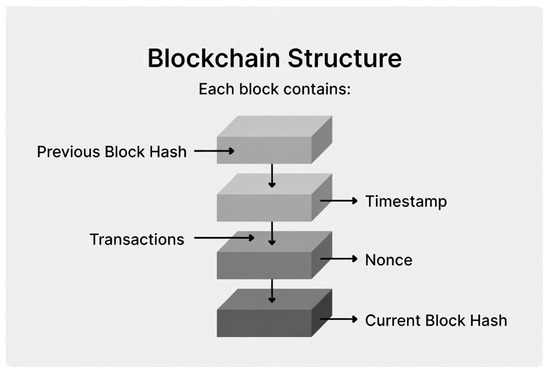
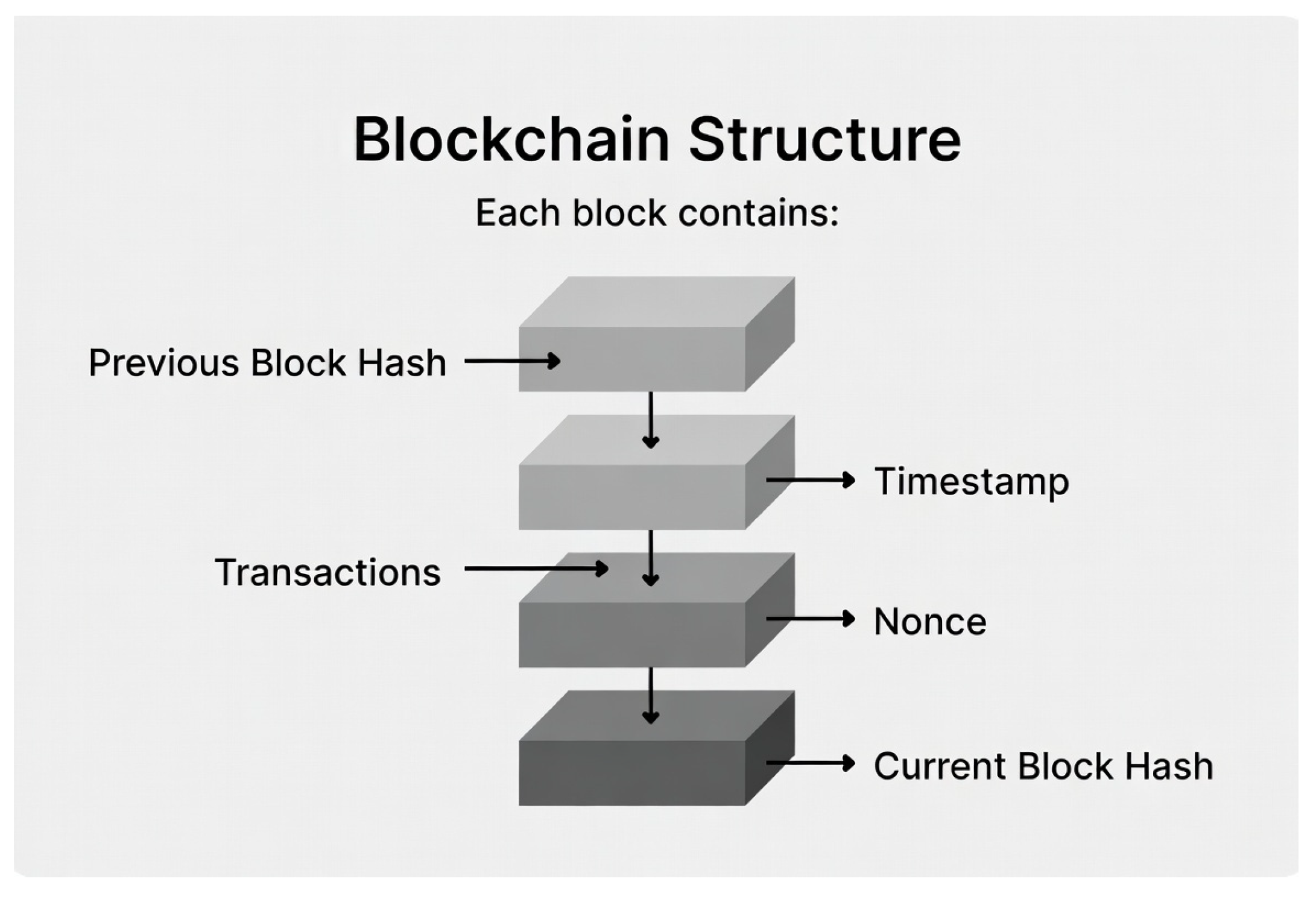
Each block contains four core components:
- -
- Previous hash which links to the preceding block.
- -
- Transaction details that records processed transactions.
- -
- Nonce which is a random cryptographic number ensuring uniqueness.
- -
- Block hash which is a unique 256-bit identifier generated via hashing.
Mining involves solving cryptographic puzzles to validate transactions through proof-of-work, as described by [25]. The general structure of a blockchain [26] is illustrated in Figure 2. The first miner to find the correct hash receives a reward, reinforcing the network’s integrity and consensus.
Figure 2.
The blockchain structure.
3.1. Types of Blockchain
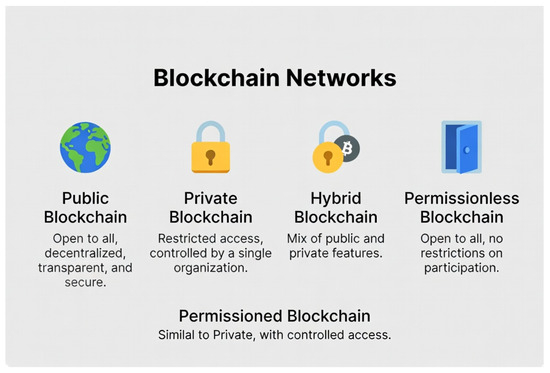
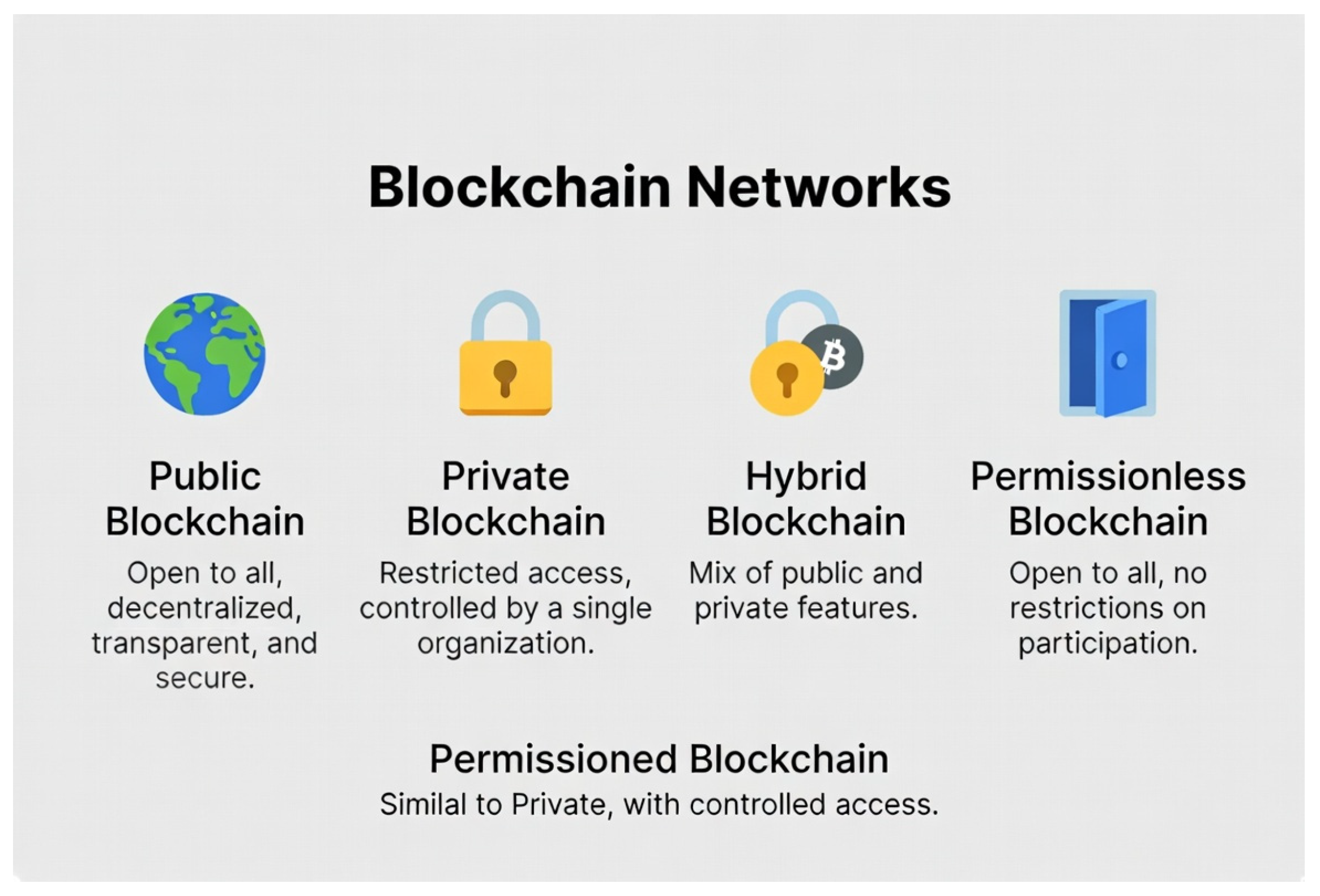
Blockchain networks [25] include public, private, consortium, and hybrid models, each differing in transparency, control, and scalability (Figure 3).
Figure 3.
Types of blockchain.
Blockchain networks are classified into several types, each designed for specific purposes and use cases(Table 2).
Table 2.
Blockchain types and access levels.
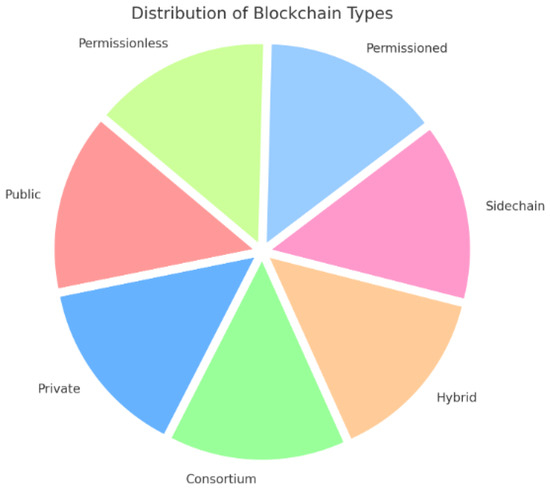
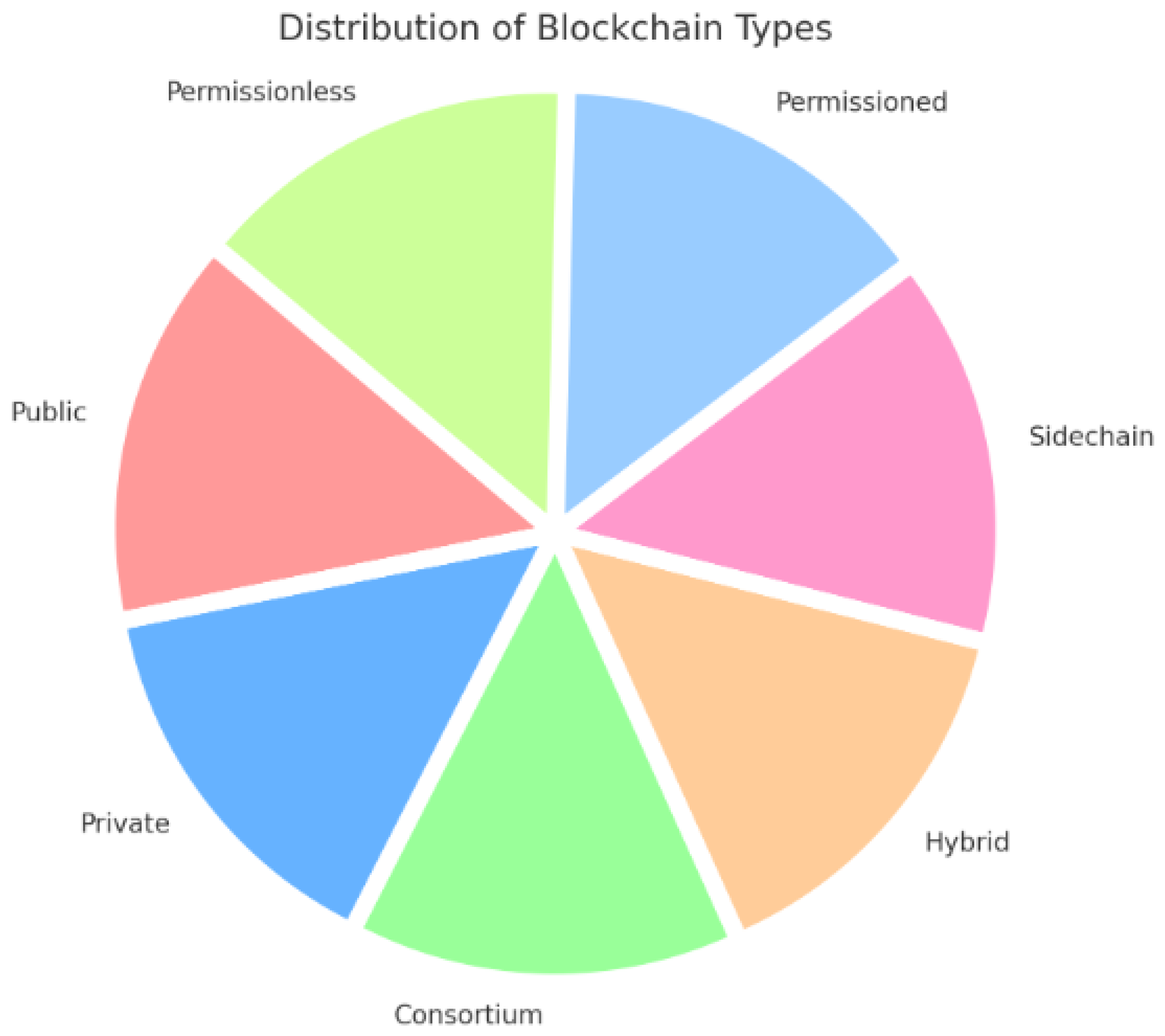
The pie chart in Figure 4 illustrates the distribution of blockchain types according to access level and governance model.
Figure 4.
Distribution of Blockchain.
3.2. Properties of a Blockchain
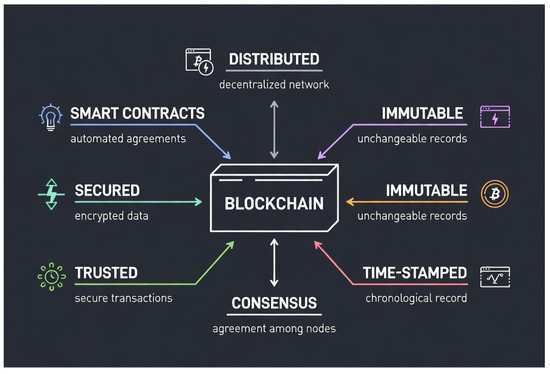
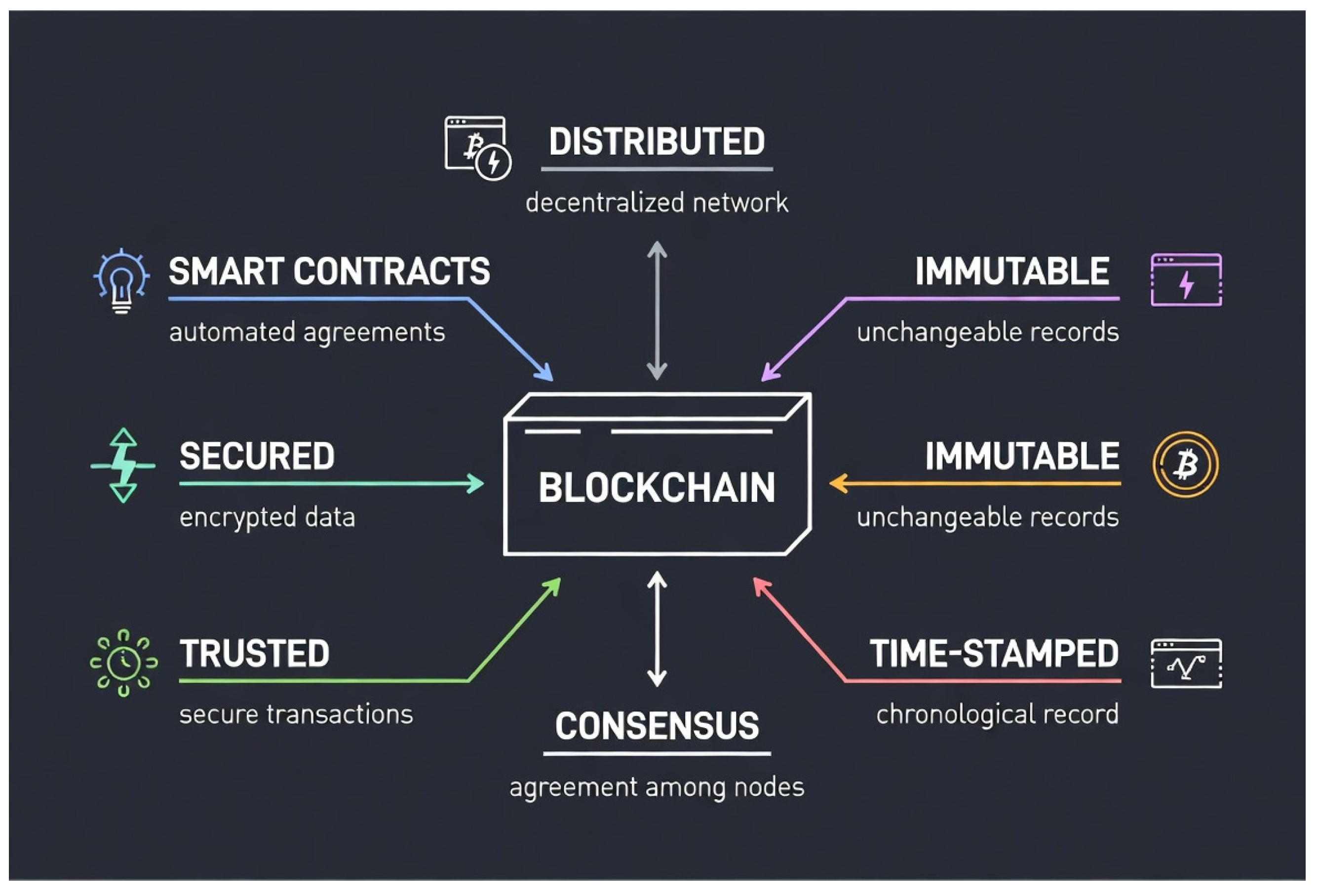
Blockchain is a transformative technology offering decentralization, security, transparency, and immutability. As it evolves, new applications will continue to emerge. The following key features highlight its significance(Table 3). The core properties of blockchain technology are summarized in Figure 5.
Table 3.
Properties of Blockchain.
Figure 5.
Properties of blockchain.
Blockchain is crucial for transforming the banking industry. As the digital era evolves, banks must adapt quickly, and blockchain offers a secure, efficient, and cost-effective way to process transactions and improve operations.
4. Key Blockchain Variables
Blockchain records and shares digital information through immutable transaction logs [27]. Its key variables include
- (a)
- Block size which determines data capacity per block. Larger sizes increase throughput but also propagation delays and vulnerability to forking or selfish mining. Bitcoin addressed this with SegWit and the Lightning Network.
- (b)
- Block interval is the time between block creations affects transaction speed and security. Short intervals raise fork risks, while long ones slow confirmations.
- (c)
- Consensus algorithm defines network security and efficiency.PoW—secure but energy-heavy and prone to 51% attacks.PoS—energy-efficient but vulnerable to stake centralization and long-range attacks [28,29].DPoS—fast but relies on few validators, risking collusion.
- (d)
- Network topology and latency. The peer-to-peer structure and communication delays impact consensus reliability. Poor connectivity can enable eclipse attacks by isolating nodes.
4.1. Blockchain Design Variables and Their Effects
Blockchain variables include block size, block interval, consensus mechanism, network topology, node identity system, and smart contract layer, each influencing security differently. Their impacts and platform examples are summarized in Table 4.
Table 4.
Key Blockchain variables and their effects.
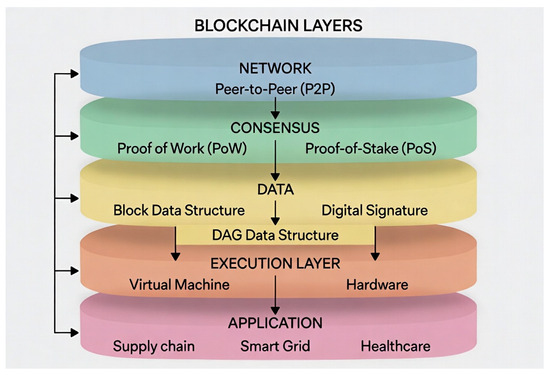
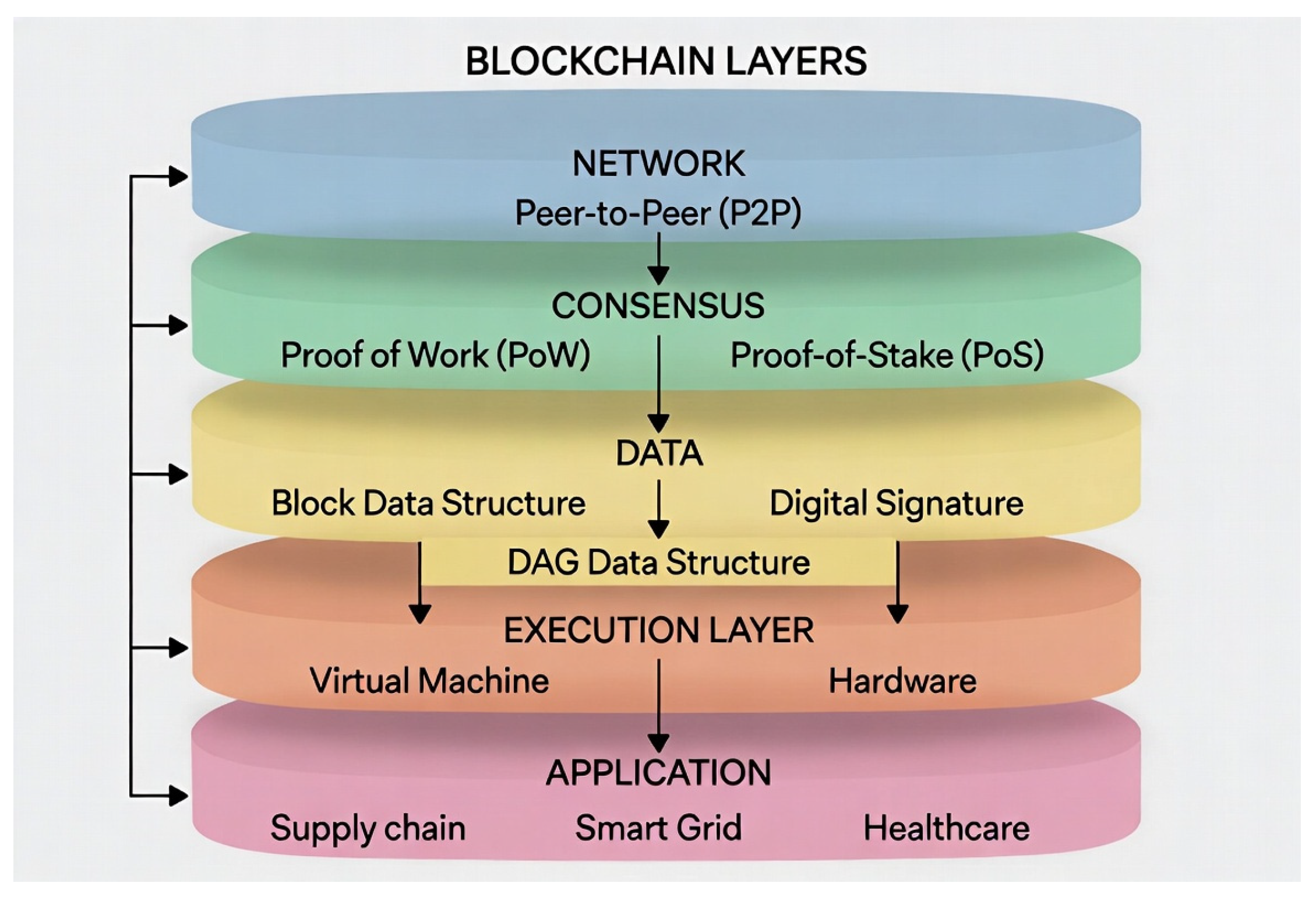
4.2. Blockchain Layers
Blockchain has evolved beyond cryptocurrencies into a transformative technology across industries. Its layered architecture ensures scalability, security, and interoperability, with each layer serving a distinct role:
- (a)
- Network layer
Forms the foundation of Distributed Ledger Technology (DLT) through a decentralized P2P network. Full nodes store the entire ledger and enforce consensus, while lightweight nodes handle transactions. Network size, peer discovery, and latency affect performance.
- (b)
- Consensus layer
Ensures all nodes agree on the ledger’s state. Main types include proof-based systems like Proof of Work (PoW), which secures Bitcoin but is resource-intensive, and Practical Byzantine Fault Tolerance (PBFT), offering faster, less energy-demanding alternatives.
- (c)
- Data layer
Stores and secures blockchain data using blocks, hashes, Merkle trees, and timestamps. These structures maintain integrity and resistance to tampering, though they can be energy and time-intensive.
While Merkle trees ensure secure and decentralized transactions, they can be energy-intensive and slow to process because each transaction’s hash must be repeatedly computed and verified through multiple hierarchical levels of the tree. This recursive hashing requires substantial computational power, especially in large-scale blockchains like Bitcoin, where thousands of hashes are generated and validated per block. Moreover, any change to a single transaction triggers recalculation of all parent hashes up to the Merkle root, increasing time complexity and energy consumption. The verification process, while essential for data integrity, thus contributes to latency and reduced throughput in decentralized networks.
- (d)
- Execution layer
Hosts runtime environments (e.g., virtual machines) for executing smart contracts, self-enforcing programs that establish trust and automate transactions across nodes.
- (e)
- Application layer
Connects decentralized applications (dApps) to the blockchain. It powers cryptocurrencies, wallets, and smart contracts, and extends to IoT-based systems like smart cities, healthcare, and agriculture.
A layered architecture of modern blockchain systems is depicted in Figure 6.
Figure 6.
Blockchain layers.
4.3. Platforms of Blockchain
Blockchain protocols define how data is recorded, shared, and secured, forming the foundation of blockchain networks. Platforms built on these protocols provide tools for developing and deploying decentralized applications (dApps) [30]. While protocols establish core functions, platforms extend them to enable practical applications. The choice of platform depends on the project’s needs [31].
- (a)
- Hyperledger Fabric
A modular, permissioned blockchain supporting private transactions and customizable consensus. It offers high modularity, low-latency finality, multi-language smart contracts, and queryable data [30].
- (b)
- Hyperledger Sawtooth
An open-source platform using Proof of Elapsed Time (PoET) consensus, developed by Hyperledger and the Linux Foundation. It provides flexibility through the Sawtooth Library and Splinter networking [31].
- (c)
- Ethereum
A public blockchain platform for decentralized applications and smart contracts. It supports tokenization, rapid deployment, and a large developer community, operating mainly on a Proof-of-Work system [30].
Emerging Blockchain Protocols with Advanced Cryptographic and AI Techniques
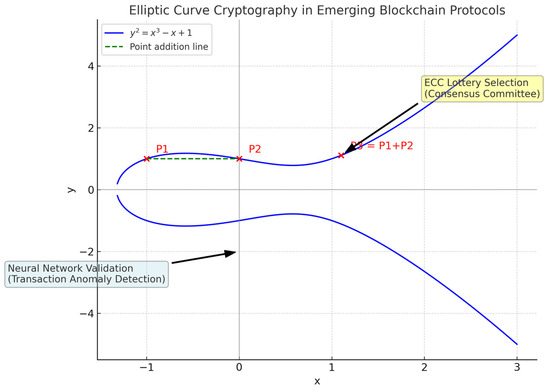
Recent blockchain research integrates elliptic curve cryptography (ECC) and artificial intelligence (AI), especially neural networks, to improve fairness, resilience, and efficiency. These advances strengthen consensus and communication layers, mitigating threats like Sybil and 51% attacks through adaptive cryptography and AI-based detection.
- (a)
- Neural Fairness Blockchain Protocol using Elliptic Curve Lottery
Ref. [32] proposed a protocol combining ECC and neural networks for fairness-driven consensus in permissionless blockchains (https://www.mdpi.com/2227-7390/10/17/3040) (accessed on 20 November 2025).
An ECC-based lottery securely selects consensus committee members, reducing centralization risks, while neural networks validate transactions and detect anomalies to prevent double-spending [32]
- (b)
- Neural Networks and ECC for Secure Communication:
Ref. [33] integrated neural networks with ECC to enhance secure peer-to-peer communication in blockchain systems (https://arxiv.org/abs/2407.08831) (accessed on 20 November 2025).
Neural models manage asymmetric cryptography to protect data exchanges and resist eavesdropping, while multiple ECC curves and lightweight design suit IoT applications [33].
These protocols demonstrate how ECC and AI can reinforce blockchain security and fairness, though further testing is needed to ensure scalability and robustness.
The role of elliptic curve cryptography in the two emerging AI-enhanced protocols is represented in Figure 7.
Figure 7.
Elliptic curve cryptography in emerging blockchain protocols.
P1 = Traditional ECC-based asymmetric key generation and signing
P2 = Neural network layer used for transaction validation and anomaly detection
P3 = Hybrid consensus committee selection via ECC lottery combined with neural fairness scoring
5. Common Blockchain Attacks and Related Variables: Case Studies of Main Significant Attacks from 2016 to 2024
As blockchain adoption expands across critical sectors, understanding its security vulnerabilities is vital. Despite its decentralized design, blockchain remains susceptible to threats like 51% attacks, Sybil attacks, smart contract flaws, and phishing schemes. These exploits depend on factors such as network size, consensus type, coding quality, and user behavior. Analyzing these attacks and variables offers key insights for improving blockchain security and resilience.
5.1. The Main Attack Types
- (a)
- 51% Attack:
Occurs when an entity controls most of a network’s mining or validation power, enabling double-spending or transaction censorship. Caused by low hash rate or stake concentration. Ethereum Classic suffered multiple 51% attacks in 2020 [34].
- (b)
- Sybil Attack:
Attackers create numerous fake identities to gain network influence, exploiting weak identity verification or consensus without economic barriers [35,36,37,38,39,40,41,42,43,44]. Prevented through PoW/PoS resource constraints or social graph verification [45].
- (c)
- Double-Spending Attack:
Involves reusing the same tokens by exploiting slow confirmation and network delays. Mitigation includes longer confirmation times and real-time monitoring.
- (d)
- Eclipse Attack:
An attacker isolates a node by hijacking its connections, feeding false data to enable double-spending or selfish mining. Prevented through diversified peer connections and randomized node lists [46].
- (e)
- Smart Contract Exploits:
Turing-complete contracts (e.g., on Ethereum) are prone to flaws like reentrancy (DAO hack), integer overflows, and gas manipulation. These stem from coding errors tied to variables like gas limits and governance [47,48].
Overall, blockchain attacks exploit decentralization, consensus, and P2P structures, prompting stronger algorithms, improved topologies, and economic deterrents. Smaller networks remain more vulnerable than established ones like Bitcoin or Ethereum.
5.2. Blockchain Ecosystem Possible Attacks
The blockchain ecosystem is a transformative framework enabling secure, transparent, and decentralized data and transaction management without central authorities. Since Bitcoin’s launch in 2009, blockchain has evolved to support cryptocurrencies, DApps, smart contracts, and applications across finance, supply chain, healthcare, and governance [49,50].
At its core, blockchain is a distributed ledger of cryptographically linked blocks maintained by network nodes that ensure trust via consensus mechanisms. The ecosystem spans multiple layers from data and network protocols to consensus, smart contracts, and user applications engaging participants from individuals to governments.
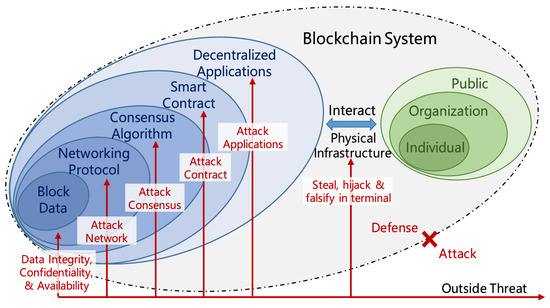
While blockchain offers immutability, transparency, and decentralization, it also introduces vulnerabilities that demand strong security at every layer. As the foundation of Web3, the expanding blockchain ecosystem continues to reshape digital infrastructure. The diagram below illustrates potential attack points (data, network, consensus, contracts, applications) and threats from both internal vulnerabilities and external actors [30].
For instance, the introduction of smart contracts on platforms like Ethereum has created new vulnerabilities such as reentrancy attacks, where malicious actors repeatedly withdraw funds before a contract updates its balance. This was exemplified by the 2016 DAO hack, which exploited a coding flaw to siphon approximately $60 million worth of Ether, demonstrating how innovative blockchain features can also expand the system’s attack surface. Potential attack points across the entire blockchain ecosystem are visualized in Figure 8. The diagram illustrates five primary attack surfaces: Block data layer, Networking protocol layer, Consensus algorithm layer, Smart-contract layer, Decentralized applications and user-facing layer. Red X symbols indicate recommended defensive measures or mitigation controls that should be implemented at each corresponding layer to prevent or reduce the severity of the associated attacks.
Figure 8.
Blockchain ecosystem possible attacks.
The blockchain system represents an integrated framework encompassing technical components (blocks, networking protocols, consensus mechanisms, smart contracts, and DApps), diverse user groups (individuals, organizations, the public), and physical infrastructure (hardware, servers, and nodes). Together, these elements form the operational foundation of blockchain technology.
Within this framework, multiple layers constitute distinct attack surfaces:
- (a)
- Block data—stores raw transaction details. Compromises threaten data integrity, confidentiality, and availability.
- (b)
- Networking protocol—governs node communication. Attacks may drop, delay, or modify messages, or perform eclipse attacks that isolate nodes.
- (c)
- Consensus algorithm—ensures ledger agreement (e.g., PoW, PoS) but remains vulnerable to 51% and Sybil attacks, undermining system trust.
- (d)
- Smart contracts—self-executing code subject to vulnerabilities such as reentrancy (DAO hack) or flawed logic, causing fund loss or freezing.
- (e)
- Decentralized applications (DApps)—built atop smart contracts, DApps face logic flaws, integration errors, and library exploits affecting deployed services.
The physical infrastructure layer connects blockchain networks with real-world devices and is exposed to risks like terminal hijacking, malware, and data interception. External actors further heighten vulnerabilities through phishing, credential theft, or organizational exploitation. Attack escalation can progress upward from data breaches to application-level exploits, while defenses (marked by red crosses) must counter threats at each layer.
Regulatory oversight plays a crucial role in securing blockchain ecosystems. Governments and financial regulators increasingly influence blockchain development through policy and enforcement, particularly after the rise in ICOs and cross-border applications.
This study reviews major blockchain-related attacks (2016–2024) and their financial impact. The movement of remaining bitcoin after the Harmony Bridge hack is illustrated in Table 5.
- -
- 2016–2018: The DAO hack ($60 M ETH loss) and Parity wallet flaw ($150 M ETH locked).
- -
- 2019–2021: Increasingly complex incidents, including the 2020 KuCoin hack ($281 M stolen) and the 2021 Poly Network exploit ($600 M stolen, later mostly returned). The Colonial Pipeline ransomware case (2021) also underscored cryptocurrency’s role in ransom payments (75 BTC; [51]).
- -
- 2022–2024: Major cross-chain breaches included the 2022 Ronin Network hack ($620 M) and Harmony’s Horizon Bridge theft ($100 M), both linked to North Korea’s Lazarus Group. According to a 2023 FBI report, $60 M in stolen ETH was laundered via the RAILGUN protocol and partially frozen through cooperation with virtual asset service providers [13,52,53,54,55,56,57,58,59,60]. The remaining Bitcoin was later traced to multiple new addresses.
Table 5.
Movement of remaining bitcoin in the Harmony Bridge hack [59].
MOVEit Data Breach [61]: The Cl0p ransomware group exploited a SQL injection vulnerability in MOVEit Transfer, exposing data from over 2700 organizations and 93.3 million individuals [7]. Affected versions included builds before 2021.0.8 (13.0.8), 2021.1.6 (13.1.6), 2022.0.6 (14.0.6), 2022.1.7 (14.1.7), and 2023.0.3 (15.0.3). Fixed versions: 2020.1.10 (12.1.10) 2023.0.3 (15.0.3). https://cve.mitre.org/cgi-bin/cvename.cgi?name=CVE-2023-35708 (accessed on 20 November 2025).
British Library Cyberattack [62]: The Rhysida hacker group attacked the British Library’s online systems, demanding 20 BTC (aprox. $400,000). Upon refusal, they released about 600 GB of stolen data. https://www.bl.uk/cyber-incident/, https://www.bl.uk/home/british-library-cyber-incident-review-8-march-2024.pdf (accessed on 20 November 2025).
ByBit Exchange Hack [63]: The Lazarus Group (alias TraderTraitor) infiltrated ByBit, stealing approximately $1.5 billion in digital assets the largest cryptocurrency heist to date (Table 6). https://www.bbc.com/news/articles/c2kgndwwd7lo (accessed on 20 November 2025).
Table 6.
Summary of financial losses (2016–2025).
The chart shows the escalating damage, highlighting the importance of such studies.
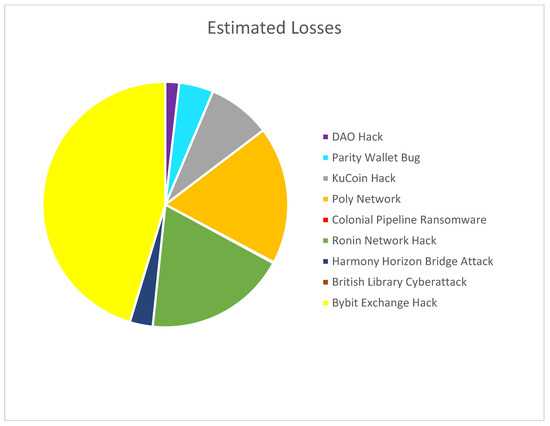
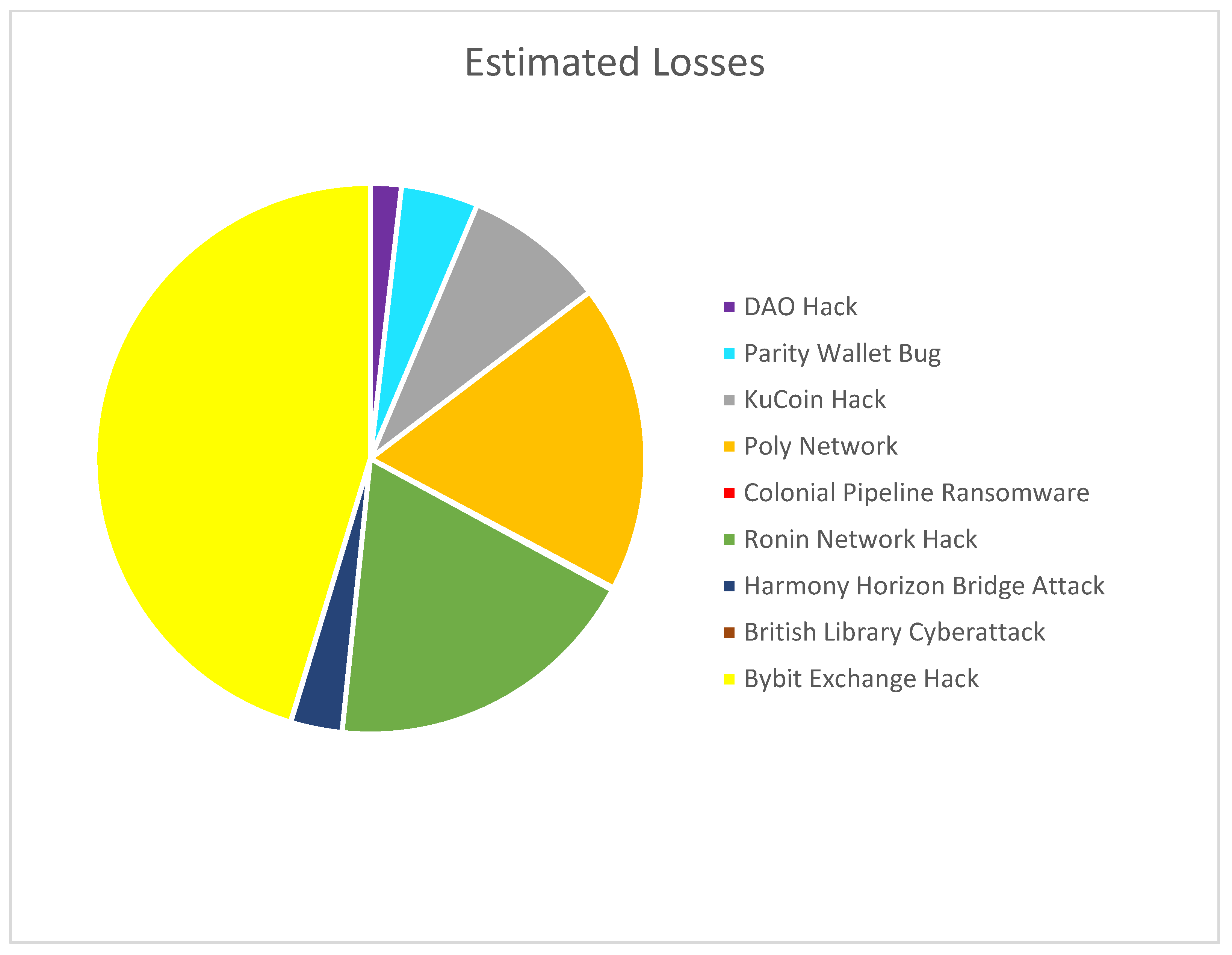
The chart showing estimated financial losses from major incidents (2016–2025) is presented in Figure 9.
Figure 9.
Estimated losses from major incidents (USD, millions).
6. Mapping Blockchain Variables to Attack Vectors
6.1. Potential Vulnerabilities
Blockchain technology offers trust, transparency, and security in digital transactions but remains vulnerable when key variables such as transaction data, consensus mecha-nisms, cryptographic keys, or network con-ditions which are manipulated, enabling attacks that compromise its integrity and reliability. Potential vulnerabilities and their mapped attack vectors [64] are detailed in Table 7.
Table 7.
Potential vulnerabilities and mapped attack vectors.
To assess how variable manipulation affects a system’s vulnerability, we examine blockchain as an example sensitive to variables like transaction data, cryptographic keys, consensus mechanisms, and timestamps. In such systems, altering key variables can undermine integrity and increase attack susceptibility.
6.2. Variable Manipulation in Blockchain
The decentralized nature of blockchain eliminates central control but also introduces risks. Since it depends on variables like transaction data, consensus mechanisms, and timestamps to maintain a secure ledger, manipulation of these elements can compromise system integrity. Altering transaction data can enable double-spending, modifying consensus rules may lead to 51% attacks, and changing timestamps can reorder transactions, creating new vulnerabilities. Understanding these interactions helps strengthen blockchain resilience against exploits.
- Example 1: Double-spending (Transaction data)
A double-spending attack occurs when an attacker sends the same funds twice (e.g., Andrew sends 100 BTC to both Jane and Adrian). If both transactions are confirmed by different miners, the same funds are spent twice, undermining trust and value stability.
- Example 2: Consensus manipulation (PoS control)
In Proof of Stake (PoS) systems, voting power depends on stake size. If an attacker gains majority control, they can approve fraudulent transactions or block legitimate ones executing a 51% attack that compromises network trust.
- Example 3: Timestamp manipulation
Each block’s timestamp maintains transaction order. If altered, an attacker can reorder blocks to make earlier transactions appear invalid or already spent, enabling double-spending and network confusion.
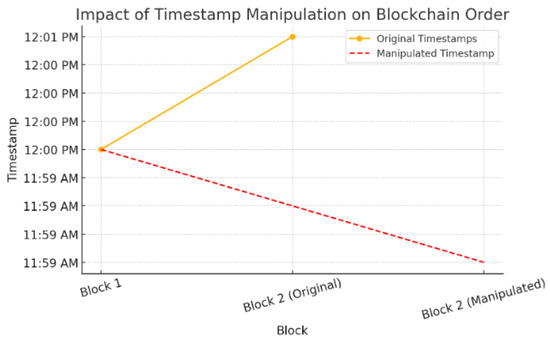
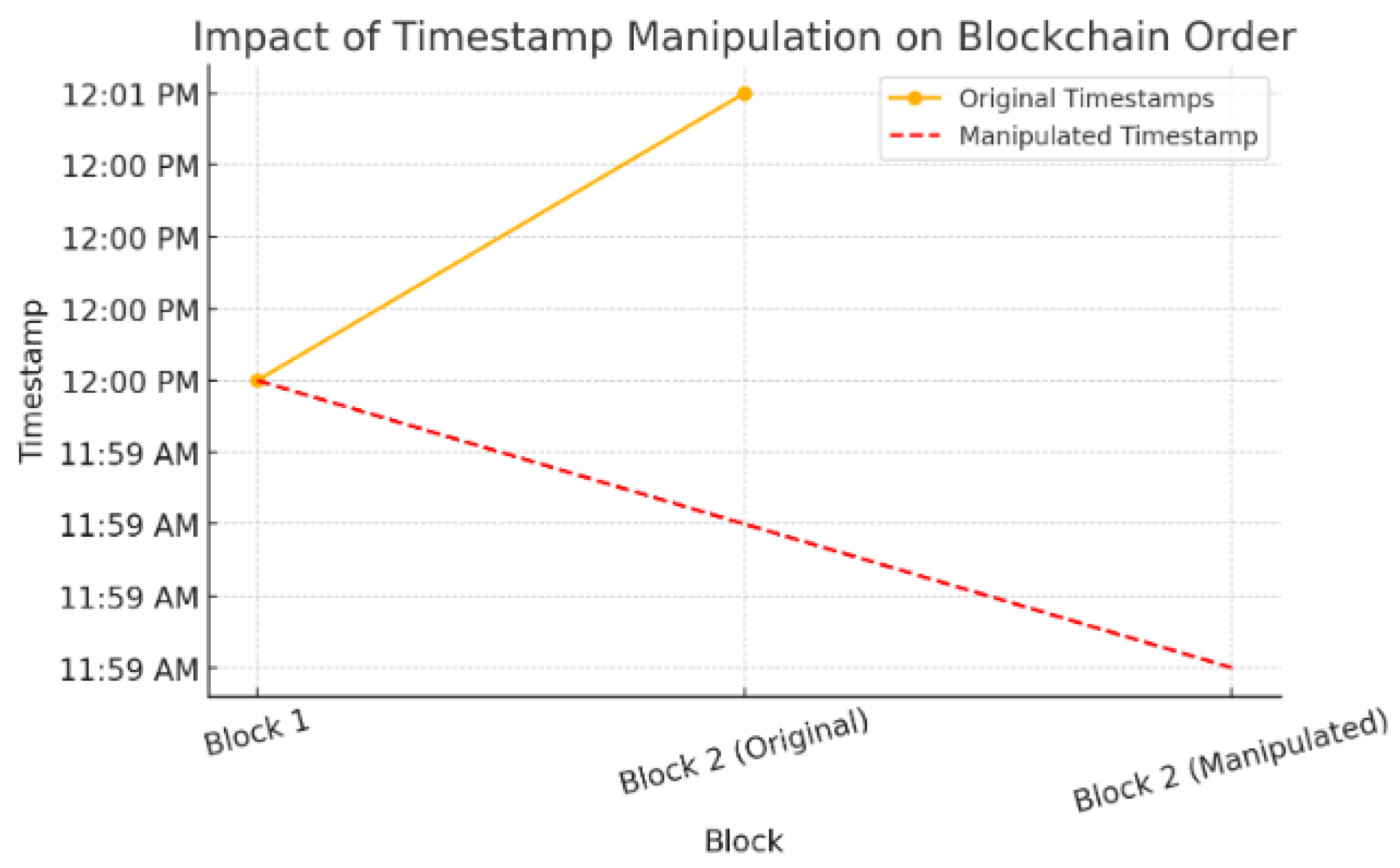
The effect of timestamp manipulation on transaction ordering is demonstrated in Figure 10.
Figure 10.
Impact of time stamp manipulation on blockchain order.
Visualization:
- Block 1: Transaction A → Andrew to Jane (12:00 PM)
- Block 2: Transaction B → Andrew to Adrian (12:01 PM)
Attacker manipulates Block 2’s timestamp to 11:59 a.m., making it appear earlier than Block 1 creating confusion about transaction order and enabling double-spending vulnerabilities.
Empirical Example: 51% Attack on Bitcoin (PoW)
In Proof of Work systems like Bitcoin, an attacker controlling over 51% of total hash power can rewrite the blockchain.
Steps:
- -
- Gain majority mining power.
- -
- Mine blocks faster than the rest of the network.
- -
- Publish a longer, alternative chain.
- -
- Network accepts the attacker’s chain, invalidating the original.
Impact: Enables transaction reversal, double-spending, and widespread network disruption.
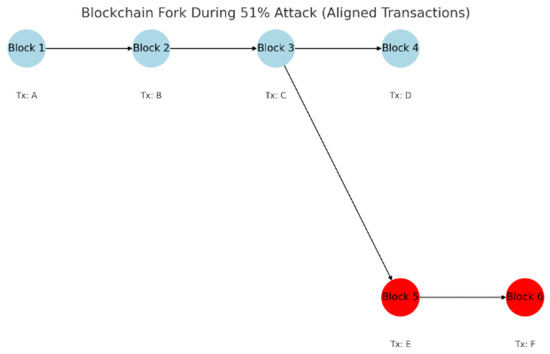
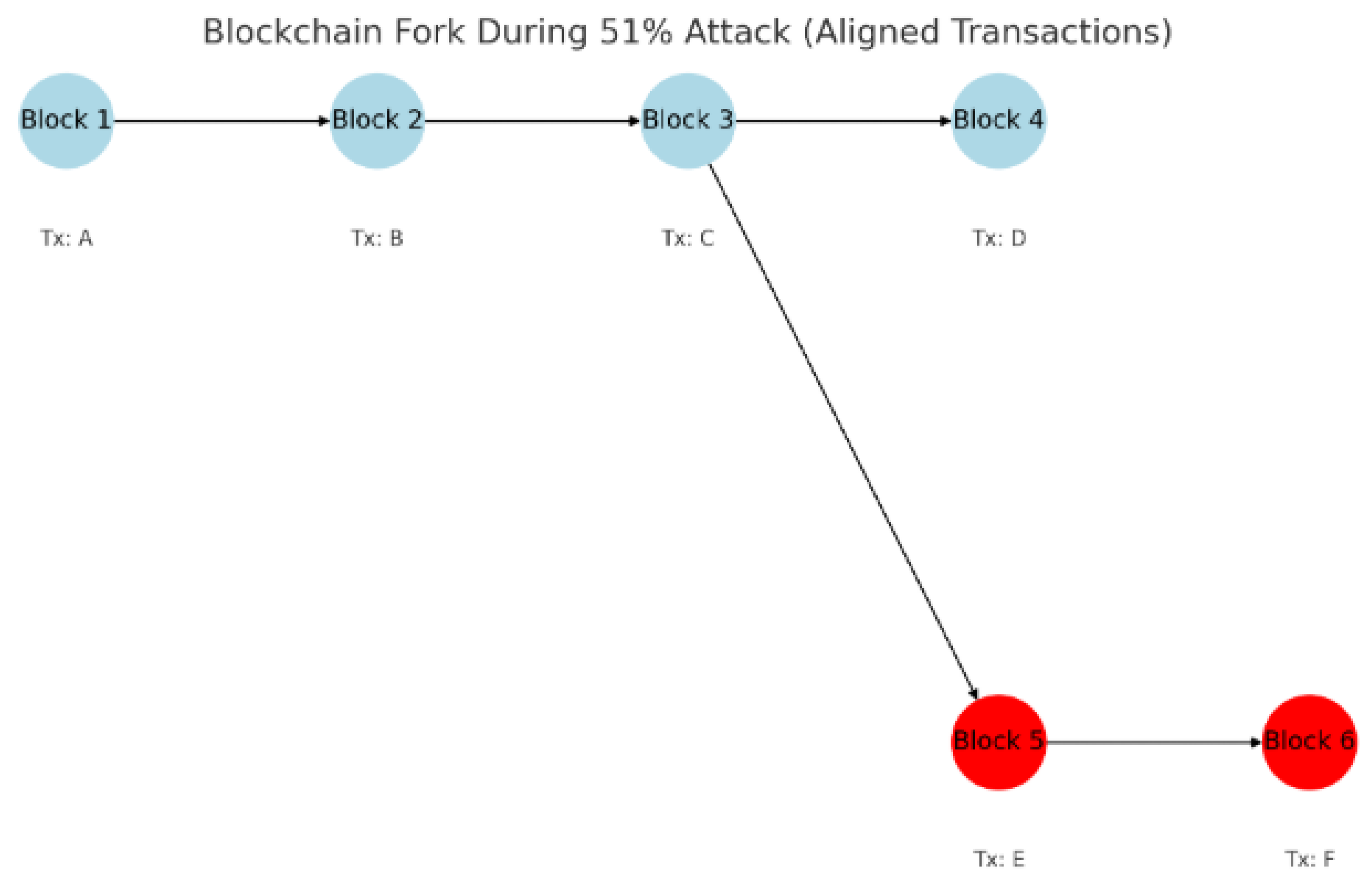
A graphical representation of a blockchain fork during a successful 51% attack is provided in Figure 11.
Figure 11.
Blockchain fork during 51% attack (aligned transactions).
Graphical representation of attack susceptibility:
Before attack:
Blocks process sequential transactions (A → B → C → D).
During attack (51% Control):
The attacker forks from Block 3, mines faster, and creates a longer chain.
Original: Block 1 → Block 2 → Block 3 → Block 4
Attacker: Block 1 → Block 2 → Block 3 → Block 5 → Block 6
After attack:
The network adopts the attacker’s longer chain, invalidating previous transactions.
Variable manipulation of transaction data, consensus rules, or timestamps creates major vulnerabilities like double-spending and 51% attacks. Robust consensus design, cryptographic proofs, and timestamp validation are essential to preserve blockchain integrity.
7. Mitigation Techniques and Design Guidelines
To enhance blockchain resilience, developers should align consensus mechanisms with threat models and application needs. Optimizing block size and timing improves capacity and security, while peer diversity and latency controls help prevent eclipse attacks. Formal smart contract verification and economic incentives can deter Sybil and 51% attacks [66]. Emerging solutions like zero-knowledge proofs, layer-2 scaling, and decentralized identity systems further strengthen scalability and security.
Key strategies:
- (a)
- User education—promote phishing awareness, private key best practices, and hardware wallet use for secure storage.
- (b)
- Strengthened protocols—employ multi-signature wallets, decentralized identity frameworks, and conduct regular smart contract audits to minimize vulnerabilities.
7.1. Best Practices and Mitigation
Ensuring blockchain security and resilience demands comprehensive safeguards to maintain trust, performance, and sustainability as adoption grows across critical sectors. Recommended best practices and mitigation strate-gies are consolidated in Table 8.
Table 8.
Best practices and mitigation strategies.
7.2. Risk Evaluation
- (a)
- Blockchain security framework
Ref. [4] in “Classification of threats and countermeasures of cloud computing” outlines a layered defense model addressing threats like data breaches, insecure APIs, and DoS attacks via encryption, IAM, segmentation, and monitoring. Adapting this framework to blockchain allows researchers to link design variables, such as block size, consensus type, and node identity, to specific vulnerabilities (e.g., weak consensus leading to Sybil or 51% attacks), thereby improving the resilience of decentralized systems.
- (b)
- Data encryption
Encryption safeguards private keys, transactions, and smart contract data using public-key cryptography (e.g., elliptic curve cryptography). It protects data both at rest and in transit, reducing breach and tampering risks.
- (c)
- Identity and access management (IAM)
IAM verifies and controls access to nodes, wallets, and contracts through decentralized identity systems and zero-knowledge proofs. For example, Ethereum uses private keys for wallet-based authentication. IAM prevents unauthorized actions and insider threats.
- (d)
- Network segmentation
Segmentation isolates nodes or layers to limit attack spread and enhance privacy. In Hyperledger Fabric, channels create private subnets for participants, preventing network-wide breaches and supporting scalability.
- (e)
- Monitoring protocols
Real-time monitoring tools (e.g., block explorers, IDS) track anomalies like double-spending or Sybil attacks. Continuous observation ensures auditability and rapid threat response, preserving network integrity.
- (f)
- Layered defense strategy
Combining encryption, IAM, segmentation, and monitoring builds a multi-layered defense that reduces attack surfaces and strengthens blockchain resilience.
- (g)
- Quantitative risk assessment
Risk metrics such as Annualized Loss Expectancy (ALE = SLE × ARO) help prioritize mitigation.
Example: A 51% attack on a mid-sized PoW network may have SLE ≈ $500 M and ARO = 0.1, yielding ALE = $50 M. Decentralization measures can cut ARO by 80%, reducing ALE to $10 M [29].
CVSS scoring (0–10) ranks vulnerabilities by impact; DAO reentrancy bugs rate 9.8 (Critical), underscoring the need for audits [26].
7.3. Cyber Security Risk and Threats
The NIST Cybersecurity Framework offers a structured method for assessing and mitigating IT security risks through its five core functions: identify, protect, detect, respond, and recover. Aligning assets, threat intelligence, and risk management with NIST standards helps organizations anticipate and minimize cyberattacks, ensuring resilience and compliance across industries.
Research by [9] identifies human vulnerabilities, errors, negligence, poor training, and social engineering as leading threats, with 12 documented cases in critical infrastructure.
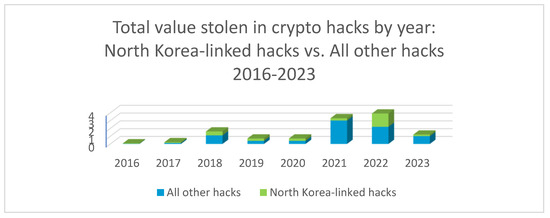
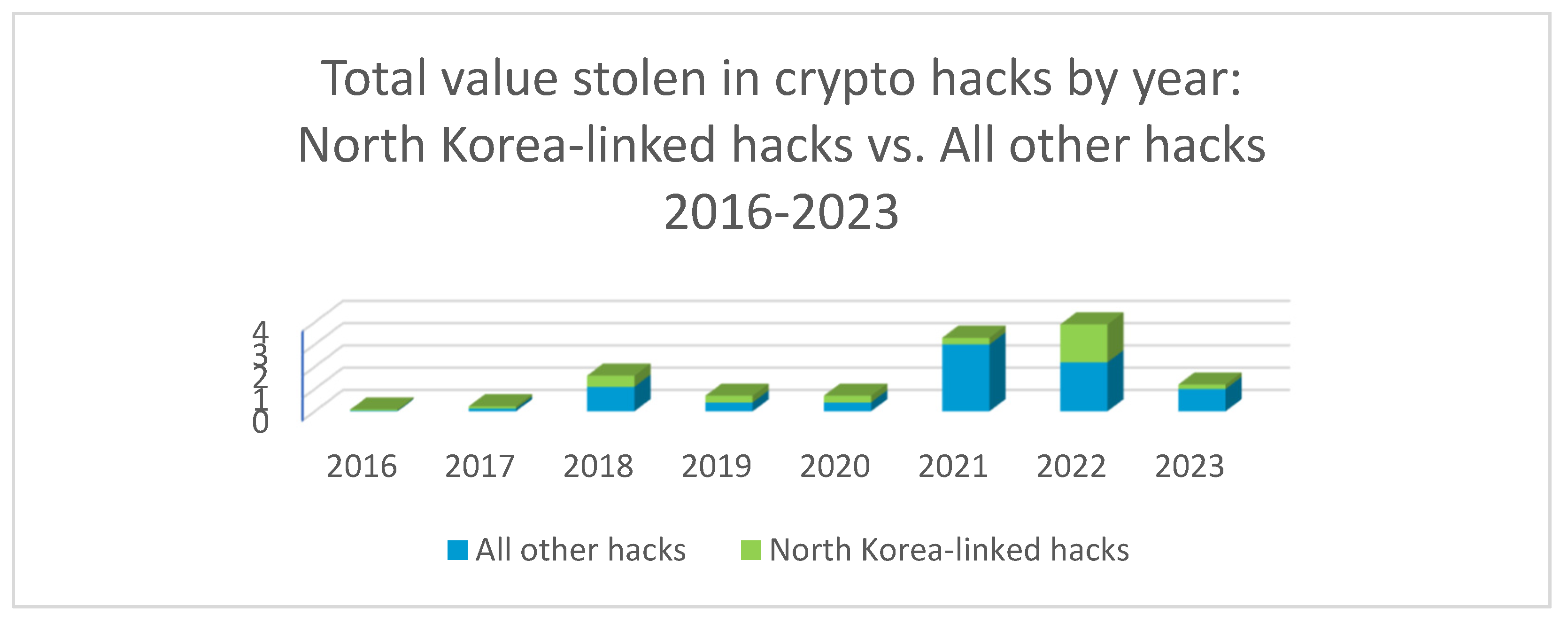
According to [10], DPRK-linked groups stole $340.4 million in cryptocurrency in 2023, down from $1.65 billion in 2022, reflecting a decline but underscoring the persistence of advanced state-sponsored cyberattacks. Total value stolen in cryptocurrency hacks and money-laundering activities by DPRK-linked actors (2017–2024) is shown in Figure 12.
Figure 12.
Total value stolen in cryptocurrency hacks and money-laundering activities by DPRK-linked actors (2017–2023) (own chart compiled from Chainalysis) [67].
7.4. Basic Framework: Blockchain Variable Quantitative Risk Framework
The NIST Cybersecurity Framework manages risks through five core functions: identify, protect, detect, respond, and recover. Integrating these with the proposed Blockchain Variable Quantitative Risk Framework (BVQRF) enhances blockchain-specific risk analysis by mapping NIST’s qualitative functions to variables such as block size, consensus mechanisms, and network topology. The BVQRF incorporates quantitative metrics to evaluate vulnerabilities like 51% attacks, Sybil attacks, and smart contract exploits, combining NIST’s qualitative structure with data-driven precision. The proposed Blockchain Variable Quantitative Risk Framework (BVQRF) is presented in Table 9, mapping NIST functions to blockchain variables and quantitative risk metrics
Table 9.
Blockchain variable quantitative risk framework.
The Blockchain Variable Quantitative Risk Framework (BVQRF) introduces a variable-centric, predictive approach to modeling blockchain risks. By quantifying variable impacts, e.g., increasing node diversity can raise the eclipse attack mitigation factor from 0.75 to 0.9, reducing risk by 60% [8,46] BVQRF enhances security analysis through simulation tools like Ganache. Future research could automate BVQRF’s scoring with AI using real-time data (e.g., Chainalysis, Hexagate), test it on hybrid blockchains (e.g., Polkadot), and integrate human vulnerability metrics [9]. This mapping operationalizes NIST’s qualitative framework into a quantitative, data-driven blockchain security model.
8. Conclusions
This study advances blockchain security by introducing the Blockchain Variable Quantitative Risk Framework (BVQRF)—a novel, data-driven model that links qualitative cybersecurity theory with quantitative risk assessment. Using simulations and case data (2016–2025), BVQRF demonstrates that key blockchain variables—such as block size, interval, consensus design, and network topology—directly influence attack susceptibility, including 51% attacks, Sybil exploits, and smart contract vulnerabilities.
Findings show that optimizing variable configurations can reduce attack probability by up to 60%, notably through increased node diversity [8,46]. Quantitative analysis estimates an ALE of $50 million for mid-sized PoW networks, validated by incidents like Ethereum Classic and the 2025 Monero attack. Integrating NIST’s cybersecurity functions (identify–recover) with blockchain metrics, BVQRF transforms qualitative guidance into actionable, measurable security practices.
Future work should apply AI-driven real-time scoring to automate BVQRF assessments, test the framework across hybrid blockchains (e.g., Polkadot), and integrate human risk factors [9]. By quantifying the impact of blockchain design choices, BVQRF offers a predictive, scalable model for strengthening resilience and guiding secure blockchain development across critical industries.
Author Contributions
Conceptualization, A.A.B. and D.E.P.; methodology, A.A.B.; software, A.A.B.; validation, A.A.B. and D.E.P.; formal analysis, A.A.B.; investigation, A.A.B.; resources, A.A.B. and D.E.P.; data curation, A.A.B.; writing—original draft preparation, A.A.B.; writing—review and editing, A.A.B. and D.E.P.; visualization, A.A.B.; supervision, D.E.P.; project administration, D.E.P.; funding acquisition, D.E.P. All authors have read and agreed to the published version of the manuscript.
Funding
The article processing charge (APC) was funded by the University of Oradea, Romania.
Data Availability Statement
The data presented in this study are available on request from the corresponding authors. The raw simulation datasets generated using Ganache, Bitcoin Core, Python/Matplotlib scripts, and the statistical analyses of historical attack incidents (2016–2025) are not publicly archived due to their large size and ongoing use in follow-up research; however, they can be obtained upon reasonable request. All publicly available incident data (e.g., Chainalysis reports, CVE entries, and FBI press releases) are cited in the References section with corresponding access dates.
Conflicts of Interest
The authors declare no conflict of interest.
References
- Addula, S.R.; Aitizaz, A. Novel Permissioned Blockchain Approach for Scalable and Privacy-Preserving IoT Authentication. J. Cyber Secur. Risk Audit. 2025, 2025, 222–237. [Google Scholar] [CrossRef]
- Addula, S.R.; Norozpour, S.; Amin, M. Risk Assesment for Identifying Threats, Vulnerabilities and countermeasures in Cloud Computing. Jordanian J. Inform. Comput. 2025. Available online: https://www.semanticscholar.org/paper/Risk-Assessment-for-Identifying-Threats%2C-and-in-Addula-Norozpour/e068f77951f00ca2ba4e2aca41a7f86a4c945789 (accessed on 20 November 2025).
- Aljumaiah, O.; Jiang, W.; Addula, S.R.; Almaiah, M.A. Analyzing cybersecurity risks and threats in IT infrastructure based on the NIST framework. J. Cyber Secur. Risk Audit. 2025, 2025, 2–15. [Google Scholar] [CrossRef]
- Almanasir, R.; Al Al-Solomon, D.; Indrawes, S.; Amin Almaiah, M.; Islam, U.; Alshar’e, M. Classification of Threats and Countermeasures of Cloud Computing. J. Cyber Secur. Risk Audit. 2025, 2025, 27–42. [Google Scholar] [CrossRef]
- Available online: https://www.bbc.com/news/articles/c2kgndwwd7lo (accessed on 20 November 2025).
- Alkhalifah, A.; Ng, A.; Kayes, A.S.M.; Chowdhury, J.; Alazab, M. A taxonomy of blockchain threats and vulnerabilities. In Blockchain for Cybersecurity in Cyber-Physical Systems; Springer: Berlin/Heidelberg, Germany, 2022; pp. 3–28. [Google Scholar] [CrossRef]
- Available online: https://www.bl.uk/home/british-library-cyber-incident-review-8-march-2024.pdf/ (accessed on 20 November 2025).
- Li, X.; Jiang, P.; Chen, T.; Luo, X.; Wen, Q. A Survey on the Security of Blockchain Systems. Future Gener. Comput. Syst. 2020, 107, 841–853. [Google Scholar] [CrossRef]
- Liu, Y.; Hei, X.; Xu, W.; Yu, T. A survey on blockchain systems: Attacks, defenses, and privacy preservation. High-Confid. Comput. 2021, 1, 100002. [Google Scholar] [CrossRef]
- Nakamoto, S. Bitcoin: A Peer-to-Peer Electronic Cash System. 2008. Available online: https://bitcoin.org/bitcoin.pdf (accessed on 18 May 2025).
- Paulavičius, R.; Grigaitis, S.; Filatovas, E. A Systematic Review and Empirical Analysis of Blockchain Simulators. IEEE Access 2021, 9, 38010–38028. [Google Scholar] [CrossRef]
- Polge, J.; Ghatpande, S.; Kubler, S.; Robert, J.; Le Traon, Y. BlockPerf: A Hybrid Blockchain Emulator/Simulator Framework. IEEE Access 2021, 9, 107858–107872. [Google Scholar] [CrossRef]
- Available online: https://www.bl.uk/cyber-incident/ (accessed on 20 November 2025).
- Alyounis, S.; Yasin, M.M. Secure Framework for Land Record Management using Blockchain Technology. J. Cyber Secur. Risk Audit. 2023, 2023, 19–48. [Google Scholar] [CrossRef]
- Antonopoulos, A.M. Mastering Bitcoin: Programming the Open Blockchain, 2nd ed.; O’Reilly Media: Sebastopol, CA, USA, 2017. [Google Scholar]
- Available online: https://jjic.thestap.com/archives/volume-2025-1/680f20ddcd605702a281651f (accessed on 20 November 2025).
- Bellamkonda, S. Ransomware Attacks on Critical Infrastructure: A Study of the Colonial Pipeline Incident. Int. J. Res. Comput. Appl. Inf. Technol. 2024, 7, 1423–1433. [Google Scholar] [CrossRef]
- Belotti, M.; Bozic, N.; Pujolle, G.; Secci, S. A Vademecum on Blockchain Technologies: When, Which, and How. IEEE Commun. Surv. Tutor. 2019, 21, 3796–3838. [Google Scholar] [CrossRef]
- Xinyi, Y.; Yi, Z.; He, Y. Technical Characteristics and Model of Blockchain. In Proceedings of the 2018 10th International Conference on Communication Software and Networks (ICCSN), Chengdu, China, 6–9 July 2018; pp. 562–566. Available online: https://www.researchgate.net/publication/328246761_Technical_Characteristics_and_Model_of_Blockchain (accessed on 20 November 2025).
- Yu, H.; Gibbons, P.B.; Kaminsky, M.; Flaxman, A. SybilGuard: Defending Against Sybil Attacks via Social Networks. IEEE/ACM Trans. Netw. 2008, 16, 576–589. [Google Scholar] [CrossRef]
- Zhang, Q.; Kasahara, S.; Shen, Y.; Jiang, X.; Wan, J. Smart contract-based access control for the Internet of Things. IEEE Internet Things J. 2019, 6, 1594–1605. [Google Scholar] [CrossRef]
- Zhang, R.; Xue, R.; Liu, L. Security and privacy on blockchain. ACM Comput. Surv. 2019, 52, 1–34. [Google Scholar] [CrossRef]
- Zheng, Z.; Xie, S.; Dai, H.; Chen, X.; Wang, H. An overview of blockchain technology: Architecture, consensus, and future trends. In Proceedings of the 2017 IEEE International Congress on Big Data, Honolulu, HI, USA, 25–30 June 2017; pp. 557–564. [Google Scholar] [CrossRef]
- Cachin, C.; Vukolić, M. Blockchain consensus protocols in the wild. arXiv 2017, arXiv:1707.01873. [Google Scholar] [CrossRef]
- Caldarola, F.; d’Atri, G.; Zanardo, E. Neural Fairness Blockchain Protocol Using an Elliptic Curves Lottery. Mathematics 2022, 10, 3040. [Google Scholar] [CrossRef]
- Available online: https://www.tenable.com/cybersecurity-guide/principles/common-vulnerability-scoring-system-cvss (accessed on 20 November 2025).
- Kaur, M.; Khan, M.Z.; Gupta, S.; Noorwali, A.; Chakraborty, C.; Pani, S.K. MBCP: Performance Analysis of Large Scale Mainstream Blockchain Consensus Protocols. IEEE Access 2021, 9, 80931–80944. [Google Scholar] [CrossRef]
- Saleh, F. Blockchain Without Waste: Proof-of-Stake. Rev. Financ. Stud. 2020, 34, 1156–1190. [Google Scholar] [CrossRef]
- Available online: https://www.fintechfutures.com/blockchain-crypto-digital-assets/cryptocurrencies-and-the-critical-vulnerability-of-a-51-attack (accessed on 20 November 2025).
- Chen, H.; Pendleton, M.; Njilla, L.; Xu, S. A survey on Ethereum systems security: Vulnerabilities, attacks, and defenses. ACM Comput. Surv. 2020, 53, 1–43. [Google Scholar] [CrossRef]
- Coindesk. Ethereum Classic Suffers Third 51% Attack in a Month. 2020. Available online: https://www.coindesk.com (accessed on 20 November 2025).
- Cormen, T.H.; Leiserson, C.E.; Rivest, R.L.; Stein, C. Introduction to Algorithms; The MIT Press: Cambridge, MA, USA, 2009. [Google Scholar]
- Dunphy, P.; Petitcolas, F.A.P. A First Look at Identity Management Schemes on the Blockchain. IEEE Secur. Priv. 2018, 16, 20–29. [Google Scholar] [CrossRef]
- Decker, C.; Wattenhofer, R. Information Propagation in the Bitcoin Network. In Proceedings of the IEEE P2P 2013 Proceedings, Trento, Italy, 9–11 September 2013; Available online: https://ieeexplore.ieee.org/document/6688704 (accessed on 20 November 2025).
- Wan, Z.; Guan, Z.; Zhou, Y.; Gao, J. Security in blockchain: A systematic literature review. IEEE Access 2020, 8, 62296–62319. [Google Scholar] [CrossRef]
- Woien, M.C.; Catak, F.O.; Kuzlu, M.; Cali, U. Neural Networks Meet Elliptic Curve Cryptography: A Novel Approach to Secure Communication. arXiv 2024, arXiv:2407.08831. [Google Scholar] [CrossRef]
- Available online: https://blockchain.gov.in/Home/BlockChain?blockchain=blockchain (accessed on 20 November 2025).
- Available online: https://crustlab.com/blog/types-of-blockchain-technology-a-complete-overview/ (accessed on 20 November 2025).
- Available online: https://encyclopedia.pub/entry/24357 (accessed on 20 November 2025).
- Available online: https://ntiprit.gov.in/pdf/blockchainanddistributed/Blockchain_Introduction_KR.pdf (accessed on 20 November 2025).
- Available online: https://www.bbc.com/news/technology-58331959 (accessed on 20 November 2025).
- Available online: https://www.h-x.technology/blog/top-3-smart-contract-audit-tools (accessed on 20 November 2025).
- Available online: https://www.ibm.com/think/topics/blockchain (accessed on 20 November 2025).
- Available online: https://www.researchgate.net/publication/386014193_Ransomware_Attacks_On_Critical_Infrastructure_A_Study_Of_The_Colonial_Pipeline_Incident (accessed on 20 November 2025).
- Eyal, I.; Sirer, E.G. Majority is Not Enough: Bitcoin Mining is Vulnerable. In Financial Cryptography and Data Security; Lecture Notes in Computer Science; Spring: Berlin/Heidelberg, Germany, 2014; Volume 8437, Available online: https://www.researchgate.net/publication/258224002_Majority_Is_Not_Enough_Bitcoin_Mining_Is_Vulnerable (accessed on 20 November 2025).
- Heilman, E.; Kendler, A.; Zohar, A.; Goldberg, S. Eclipse Attacks on Bitcoin’s Peer-to-Peer Network. In Proceedings of the 24th USENIX Security Symposium, Washington, DC, USA, 12–14 August 2015; Available online: https://www.usenix.org/system/files/conference/usenixsecurity15/sec15-paper-heilman.pdf (accessed on 20 November 2025).
- Atzei, N.; Bartoletti, M.; Cimoli, T. A Survey of Attacks on Ethereum Smart Contracts Sok. In Proceedings of the 6th International Conference on Principles of Security and Trust, Uppsala, Sweden, 22–29 April 2017; Volume 10204, pp. 164–2186. [Google Scholar] [CrossRef]
- Bartoletti, M.; Carta, S.; Cimoli, T.; Saia, R. Dissecting Ponzi schemes on Ethereum: Identification, analysis, and impact. Future Gener. Comput. Syst. 2020, 102, 259–277. [Google Scholar] [CrossRef]
- Carter, L.; Ubacht, J. Blockchain applications in government. In Proceedings of the 19th Annual International Conference on Digital Government Research: Governance in the Data Age, Delft, The Netherlands, 30 May–1 June 2018; Available online: https://www.researchgate.net/publication/325497149_Blockchain_applications_in_government (accessed on 20 November 2025).
- Catalini, C.; Gans, J.S. The Blockchain Ecosystem. SSRN Electron. J. 2018. Available online: https://papers.ssrn.com/sol3/papers.cfm?abstract_id=2874598 (accessed on 20 November 2025).
- Hao, Y.; Li, Y.; Dong, X.; Fang, L.; Chen, P. Performance Analysis of Consensus Algorithm in Private Blockchain. In Proceedings of the 2018 IEEE Intelligent Vehicles Symposium (IV), Changshu, China, 26–30 June 2018; pp. 280–285. Available online: https://www.researchgate.net/publication/328457612_Performance_Analysis_of_Consensus_Algorithm_in_Private_Blockchain (accessed on 20 November 2025). [CrossRef]
- Available online: https://www.simplilearn.com/tutorials/blockchain-tutorial/blockchain-technology (accessed on 20 November 2025).
- Available online: https://crypto.com/glossary/the-dao-hack (accessed on 20 November 2025).
- Available online: https://techcrunch.com/2017/11/07/a-major-vulnerability-has-frozen-hundreds-of-millions-of-dollars-of-ethereum/ (accessed on 20 November 2025).
- Available online: https://www.reuters.com/article/technology/un-experts-point-finger-at-north-korea-for-281-million-cyber-theft-kucoin-li-idUSKBN2AA08T/ (accessed on 20 November 2025).
- Available online: https://www.reuters.com/technology/how-hackers-stole-613-million-crypto-tokens-poly-network-2021-08-12/ (accessed on 20 November 2025).
- Available online: https://www.cisa.gov/news-events/news/attack-colonial-pipeline-what-weve-learned-what-weve-done-over-past-two-years (accessed on 20 November 2025).
- Available online: https://therecord.media/us-agency-attributes-540-million-ronin-hack-to-north-korean-apt-group (accessed on 20 November 2025).
- Available online: https://www.fbi.gov/news/press-releases/fbi-confirms-lazarus-group-cyber-actors-responsible-for-harmonys-horizon-bridge-currency-theft (accessed on 20 November 2025).
- Available online: https://cve.mitre.org/cgi-bin/cvename.cgi?name=CVE-2023-35708 (accessed on 20 November 2025).
- Homoliak, I.; Venugopalan, S.; Hum, Q.; Reijsbergen, D.; Szalachowski, P.; Sun, Q. The security reference architecture for blockchains: Toward a standardized model for studying vulnerabilities, risks, attacks, and defenses. IEEE Commun. Surv. Tutor. 2020, 22, 3334–3395. [Google Scholar] [CrossRef]
- Hunter, J.D. Matplotlib: A 2D Graphics Environment. Comput. Sci. Eng. 2007, 9, 90–95. [Google Scholar] [CrossRef]
- Jimmy, F.N.U. Cyber security Vulnerabilities and Remediation Through Cloud Security Tools. J. Artif. Intell. Gen. Sci. (JAIGS) 2024, 2, 129–171. [Google Scholar]
- Saad, M.; Spaulding, J.; Njilla, L.; Kamhoua, C.; Shetty, S.; Nyang, D.; Mohaisen, A. Exploring the attack surface of blockchain: A comprehensive survey. IEEE Commun. Surv. Tutor. 2020, 22, 1977–2008. [Google Scholar] [CrossRef]
- Available online: https://arxiv.org/abs/2407.08831 (accessed on 20 November 2025).
- Available online: https://www.mdpi.com/2227-7390/10/17/3040 (accessed on 20 November 2025).
- Available online: https://www.chainalysis.com/blog/north-korea-russia-crypto-money-laundering/ (accessed on 20 November 2025).

Disclaimer/Publisher’s Note: The statements, opinions and data contained in all publications are solely those of the individual author(s) and contributor(s) and not of MDPI and/or the editor(s). MDPI and/or the editor(s) disclaim responsibility for any injury to people or property resulting from any ideas, methods, instructions or products referred to in the content. |
© 2025 by the authors. Licensee MDPI, Basel, Switzerland. This article is an open access article distributed under the terms and conditions of the Creative Commons Attribution (CC BY) license (https://creativecommons.org/licenses/by/4.0/).