Uveal Melanoma Ground Truth Labeling in Machine Learning

 , , ,
, , ,  and
and
Simple Summary
Abstract
1. Introduction
2. Methods
3. Overview of UM Ground Truth Methods
3.1. Clinical Examination
3.2. Histopathology
3.3. Genetic Profiling
3.4. Risk Factor-Based Scoring Tools
3.5. Manual Image Annotation
3.6. Prospective Monitoring
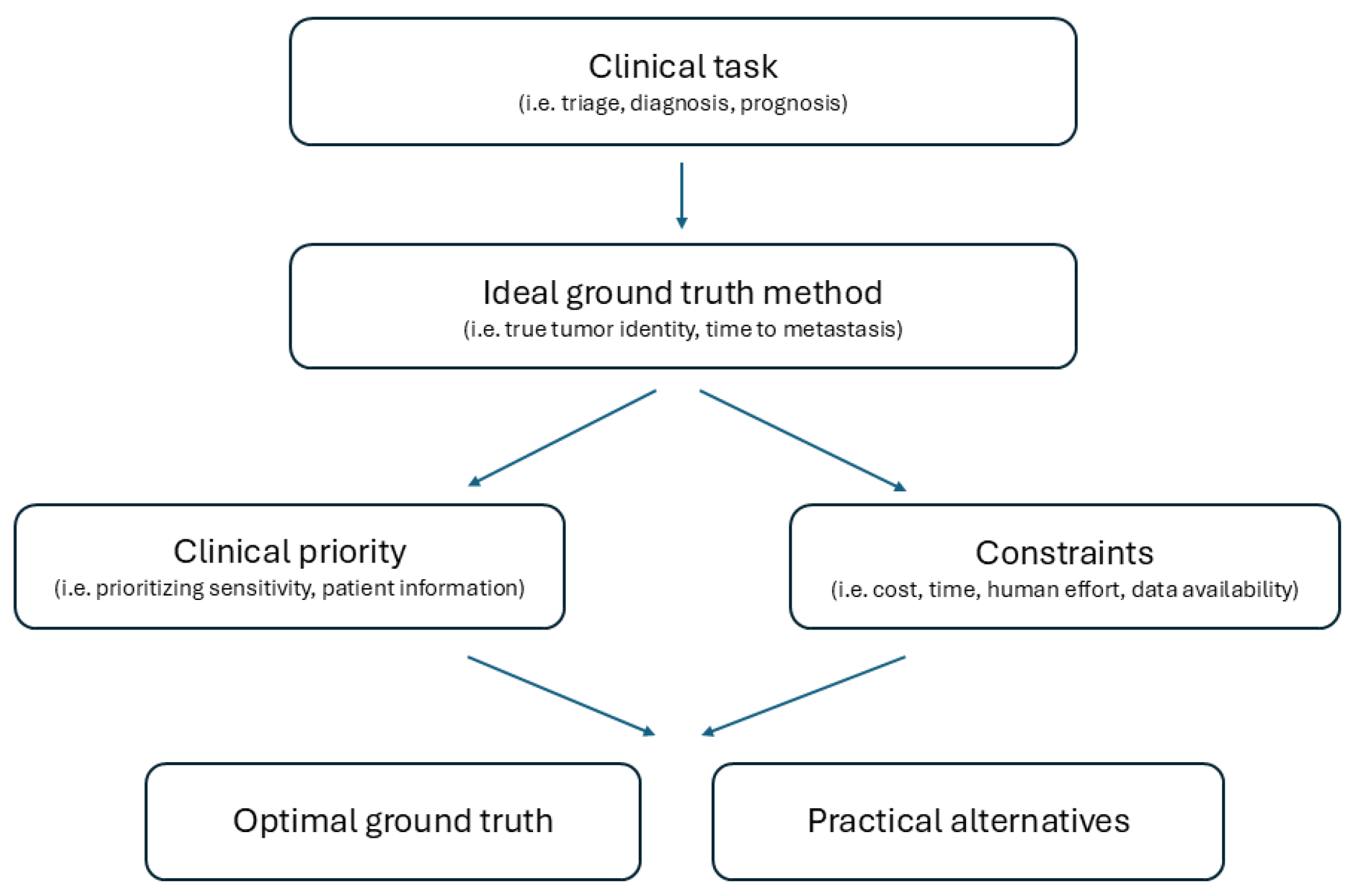
4. Ideal Ground Truths by Clinical Task
4.1. Automated Triage
4.2. Initial Diagnosis
4.3. Management Decision
4.4. Radiation Treatment Planning
4.5. Long-Term Outcome Prediction
4.6. Patient Counseling
5. Areas for Improvement in Current Practice
6. Conclusions and Future Directions
Author Contributions
Funding
Institutional Review Board Statement
Informed Consent Statement
Data Availability Statement
Conflicts of Interest
Abbreviations
| UM | Uveal melanoma |
| AI | Artificial intelligence |
| ML | Machine learning |
| OCT | Optical coherence tomography |
| COMS | Collaborative Ocular Melanoma Study |
| AJCC | The American Joint Committee on Cancer |
| LUMPO | Liverpool Uveal Melanoma Prognosticator Online |
| IMCT | Indeterminate melanocytic choroidal tumors |
| GEP | Gene expression profiling |
| MOLES | Mushroom shape, Orange pigment, Large size, Enlarging tumor, Subretinal fluid |
| TFSOM | Thickness, subretinal Fluid, Symptoms, Orange pigment, Margin |
| NCCN | National Comprehensive Cancer Network |
| RCT | Randomized controlled trial |
References
- Hou, X.; Rokohl, A.C.; Li, X.; Guo, Y.; Ju, X.; Fan, W.; Heindl, L.M. Global Incidence and Prevalence in Uveal Melanoma. Adv. Ophthalmol. Pract. Res. 2024, 4, 226–232. [Google Scholar] [CrossRef]
- Stålhammar, G.; Herrspiegel, C. Long-Term Relative Survival in Uveal Melanoma: A Systematic Review and Meta-Analysis. Commun. Med. 2022, 2, 18. [Google Scholar] [CrossRef]
- Kaliki, S.; Shields, C.; Shields, J. Uveal Melanoma: Estimating Prognosis. Indian J. Ophthalmol. 2015, 63, 93–102. [Google Scholar] [CrossRef] [PubMed]
- Chattopadhyay, C.; Kim, D.W.; Gombos, D.S.; Oba, J.; Qin, Y.; Williams, M.D.; Esmaeli, B.; Grimm, E.A.; Wargo, J.A.; Woodman, S.E.; et al. Uveal Melanoma: From Diagnosis to Treatment and the Science in Between. Cancer 2016, 122, 2299–2312. [Google Scholar] [CrossRef] [PubMed]
- Hanratty, K.; Finegan, G.; Rochfort, K.D.; Kennedy, S. Current Treatment of Uveal Melanoma. Cancers 2025, 17, 1403. [Google Scholar] [CrossRef] [PubMed]
- Shields, J.A.; Mashayekhi, A.; Ra, S.; Shields, C.L. Pseudomelanomas of the Posterior Uveal Tract: The 2006 Taylor R. Smith Lecture. Retina 2005, 25, 767–771. [Google Scholar] [CrossRef]
- Bajwa, J.; Munir, U.; Nori, A.; Williams, B. Artificial Intelligence in Healthcare: Transforming the Practice of Medicine. Future Healthc. J. 2021, 8, e188–e194. [Google Scholar] [CrossRef]
- Krizhevsky, A.; Sutskever, I.; Hinton, G.E. ImageNet Classification with Deep Convolutional Neural Networks. Commun. ACM 2017, 60, 84–90. [Google Scholar] [CrossRef]
- Long, J.; Shelhamer, E.; Darrell, T. Fully Convolutional Networks for Semantic Segmentation. In Proceedings of the 2015 IEEE Conference on Computer Vision and Pattern Recognition (CVPR), Boston, MA, USA, 7–12 June 2015; IEEE: New York, NY, USA, 2015; pp. 3431–3440. [Google Scholar]
- Khalifa, M.; Albadawy, M. Artificial Intelligence for Clinical Prediction: Exploring Key Domains and Essential Functions. Comput. Methods Programs Biomed. Update 2024, 5, 100148. [Google Scholar] [CrossRef]
- Tailor, P.D.; Kopinski, P.K.; D’Souza, H.S.; Leske, D.A.; Olsen, T.W.; Shields, C.L.; Shields, J.A.; Dalvin, L.A. Predicting Choroidal Nevus Transformation to Melanoma Using Machine Learning. Ophthalmol. Sci. 2025, 5, 100584. [Google Scholar] [CrossRef]
- Liu, T.Y.A.; Chen, H.; Koseoglu, N.D.; Kolchinski, A.; Unberath, M.; Correa, Z.M. Direct Prediction of 48 Month Survival Status in Patients with Uveal Melanoma Using Deep Learning and Digital Cytopathology Images. Cancers 2025, 17, 230. [Google Scholar] [CrossRef] [PubMed]
- Iddir, S.P.; Love, J.; Ma, J.S.; Bryan, J.M.; Ganesh, S.; Heiferman, M.J.; Yi, D. Predicting Malignant Transformation of Choroidal Nevi Using Machine Learning. Res. Sq. 2023, rs.3.rs-3778562. [Google Scholar] [CrossRef]
- Raikovskaia, A.; Rakhimzhanov, N.; Pianykh, O.S. Interpretation Drift in Explainable AI under Label Noise. Sci. Rep. 2026, 16, 8528. [Google Scholar] [CrossRef] [PubMed]
- Lieu, A.C.; Chuter, B.G.; Radgoudarzi, N.; Walker, E.H.; Huang, J.H.; Scott, N.L.; Afshari, N.A. Geographic Patterns of Ocular Oncologist Supply and Patient Demand for Uveal Melanoma Treatment in the United States: A Supply and Demand Analysis. Clin. Ophthalmol. 2024, 18, 2487–2502. [Google Scholar] [CrossRef]
- Tasso, V.; Ganesh, S.; Iddir, S.; AlAhmadi, R.; Heiferman, M.J.; Yi, D. Uveal Pigmented Lesion Classification, Detection, and Segmentation: A Comparative Analysis of Machine Learning Tasks. Transl. Vis. Sci. Technol. 2025, 14, 35. [Google Scholar] [CrossRef]
- Dadzie, A.K.; Iddir, S.P.; Abtahi, M.; Ebrahimi, B.; Le, D.; Ganesh, S.; Son, T.; Heiferman, M.J.; Yao, X. Colour Fusion Effect on Deep Learning Classification of Uveal Melanoma. Eye 2024, 38, 2781–2787. [Google Scholar] [CrossRef]
- Krig, S. (Ed.) Ground Truth Data, Content, Metrics, and Analysis. In Computer Vision Metrics: Survey, Taxonomy, and Analysis; Apress: Berkeley, CA, USA, 2014; pp. 283–311. ISBN 978-3-319-33762-3. [Google Scholar]
- Ma, J.; Iddir, S.P.; Ganesh, S.; Yi, D.; Heiferman, M.J. Automated Segmentation for Early Detection of Uveal Melanoma. Can. J. Ophthalmol. 2024, 59, e784–e791. [Google Scholar] [CrossRef]
- Wang, X.; Zhao, J.; Marostica, E.; Yuan, W.; Jin, J.; Zhang, J.; Li, R.; Tang, H.; Wang, K.; Li, Y.; et al. A Pathology Foundation Model for Cancer Diagnosis and Prognosis Prediction. Nature 2024, 634, 970–978. [Google Scholar] [CrossRef]
- Lindner, H.A.; Thiel, M.; Schneider-Lindner, V. Clinical Ground Truth in Machine Learning for Early Sepsis Diagnosis. Lancet Digit. Health 2023, 5, e338–e339. [Google Scholar] [CrossRef]
- Lea, A.S. Pyrite Standards: Medical Uncertainty, Ground Truth, and AI Model Evaluation in Historical Perspective. J. Gen. Intern. Med. 2024, 39, 2856–2857. [Google Scholar] [CrossRef]
- Girard-Chanudet, C. Ground-Truth Is Law: The Invisible Conceptual Work behind AI. Big Data Soc. 2025, 12, 20539517251352823. [Google Scholar] [CrossRef]
- Chen, P.-H.C.; Mermel, C.H.; Liu, Y. Evaluation of Artificial Intelligence on a Reference Standard Based on Subjective Interpretation. Lancet Digit. Health 2021, 3, e693–e695. [Google Scholar] [CrossRef] [PubMed]
- Chacon, M.; Liu, C.W.; Crawford, L.; Polydore, H.; Ting, T.; Wakeman, D.; Wilson, N.A. In Search of the Truth: Choice of Ground Truth for Predictive Modeling of Trauma Team Activation in Pediatric Trauma. J. Am. Coll. Surg. 2024, 239, 134–144. [Google Scholar] [CrossRef] [PubMed]
- Chadwick, W.F.; Ganesh, S.; Dadzie, A.K.; Ebrahimi, B.; Rahimi, M.; Son, T.; Alahmadi, R.; Yao, X.; Heiferman, M.J. Clinical Applications of Artificial Intelligence in Uveal Melanoma. Anticancer Res. 2025, 45, 4669–4681. [Google Scholar] [CrossRef]
- Tarlan, B.; Kıratlı, H. Uveal Melanoma: Current Trends in Diagnosis and Management. Turk. J. Ophthalmol. 2016, 46, 123–137. [Google Scholar] [CrossRef]
- Collaborative Ocular Melanoma Study Group. Accuracy of Diagnosis of Choroidal Melanomas in the Collaborative Ocular Melanoma Study: COMS Report No. 1. Arch. Ophthalmol. 1990, 108, 1268–1273. [Google Scholar] [CrossRef]
- Updated AJCC Classification for Posterior Uveal Melanoma. Available online: https://retinatoday.com/articles/2018-may-june/updated-ajcc-classification-for-posterior-uveal-melanoma (accessed on 19 February 2026).
- Augsburger, J.J.; Corrêa, Z.M.; Trichopoulos, N.; Shaikh, A. Size Overlap between Benign Melanocytic Choroidal Nevi and Choroidal Malignant Melanomas. Investig. Ophthalmol. Vis. Sci. 2008, 49, 2823–2828. [Google Scholar] [CrossRef]
- Char, D.H.; Kroll, S.; Stone, R.D.; Harrie, R.; Kerman, B. Ultrasonographic Measurement of Uveal Melanoma Thickness: Interobserver Variability. Br. J. Ophthalmol. 1990, 74, 183–185. [Google Scholar] [CrossRef]
- Singh, A.D.; Grossniklaus, H.E. What’s in a Name? Large Choroidal Nevus, Small Choroidal Melanoma, or Indeterminate Melanocytic Tumor. Ocul. Oncol. Pathol. 2021, 7, 235–238. [Google Scholar] [CrossRef]
- Collaborative Ocular Melanoma Study Group. Histopathologic Characteristics of Uveal Melanomas in Eyes Enucleated from the Collaborative Ocular Melanoma Study COMS Report No. 6. Am. J. Ophthalmol. 1998, 125, 745–766. [Google Scholar] [CrossRef]
- Berus, T.; Halon, A.; Markiewicz, A.; Orlowska-Heitzman, J.; Romanowska-Dixon, B.; Donizy, P. Clinical, Histopathological and Cytogenetic Prognosticators in Uveal Melanoma—A Comprehensive Review. Anticancer Res. 2017, 37, 6541–6549. [Google Scholar] [CrossRef]
- Rishi, P.; Koundanya, V.; Shields, C. Using Risk Factors for Detection and Prognostication of Uveal Melanoma. Indian J. Ophthalmol. 2015, 63, 110–116. [Google Scholar] [CrossRef] [PubMed]
- Foulds, W.S. The Uses and Limitations of Intraocular Biopsy. Eye 1992, 6, 11–27. [Google Scholar] [CrossRef] [PubMed]
- Lou, H.; Yue, H.; Qian, J.; Bi, Y.; Lin, X.; Chen, H.; Xu, B.; Ma, R.; Xue, K.; Guo, J. Insights into Shape of Uveal Melanoma: A Comprehensive Evaluation of Clinical Features, Pathological Features, and Prognosis Analysis. Front. Med. 2025, 12, 1687291. [Google Scholar] [CrossRef] [PubMed]
- Harbour, J.W.; Correa, Z.M.; Schefler, A.C.; Mruthyunjaya, P.; Materin, M.A.; Aaberg, T.A.; Skalet, A.H.; Reichstein, D.A.; Weis, E.; Kim, I.K.; et al. 15-Gene Expression Profile and PRAME as Integrated Prognostic Test for Uveal Melanoma: First Report of Collaborative Ocular Oncology Group Study No. 2 (COOG2.1). J. Clin. Oncol. 2024, 42, 3319–3329. [Google Scholar] [CrossRef]
- Aaberg, T.M.; Covington, K.R.; Tsai, T.; Shildkrot, Y.; Plasseraud, K.M.; Alsina, K.M.; Oelschlager, K.M.; Monzon, F.A. Gene Expression Profiling in Uveal Melanoma: Five-Year Prospective Outcomes and Meta-Analysis. Ocul. Oncol. Pathol. 2020, 6, 360–367. [Google Scholar] [CrossRef]
- Onken, M.D.; Worley, L.A.; Char, D.H.; Augsburger, J.J.; Correa, Z.M.; Nudleman, E.; Aaberg, T.M.; Altaweel, M.M.; Bardenstein, D.S.; Finger, P.T.; et al. Collaborative Ocular Oncology Group Report Number 1: Prospective Validation of a Multi-Gene Prognostic Assay in Uveal Melanoma. Ophthalmology 2012, 119, 1596–1603. [Google Scholar] [CrossRef]
- Doherty, R.E.; Alfawaz, M.; Francis, J.; Lijka-Jones, B.; Sisley, K. Genetics of Uveal Melanoma. In Noncutaneous Melanoma; Scott, J.F., Gerstenblith, M.R., Eds.; Codon Publications: Singapore, 2018; pp. 19–35. ISBN 9780994438157. [Google Scholar]
- Miguez, S.; Lee, R.Y.; Chan, A.X.; Demkowicz, P.C.; Jones, B.S.C.L.; Long, C.P.; Abramson, D.H.; Bosenberg, M.; Sznol, M.; Kluger, H.; et al. Validation of the Prognostic Usefulness of the Gene Expression Profiling Test in Patients with Uveal Melanoma. Ophthalmology 2023, 130, 598–607. [Google Scholar] [CrossRef]
- Enabling Personalized Medicine in the Management of Uveal Melanoma. Available online: https://retinatoday.com/articles/2013-nov-dec/enabling-personalized-medicine-in-the-management-of-uveal-melanoma (accessed on 19 February 2026).
- Cross, J.L.; Choma, M.A.; Onofrey, J.A. Bias in Medical AI: Implications for Clinical Decision-Making. PLoS Digit. Health 2024, 3, e0000651. [Google Scholar] [CrossRef]
- Plasseraud, K.M.; Wilkinson, J.K.; Oelschlager, K.M.; Poteet, T.M.; Cook, R.W.; Stone, J.F.; Monzon, F.A. Gene Expression Profiling in Uveal Melanoma: Technical Reliability and Correlation of Molecular Class with Pathologic Characteristics. Diagn. Pathol. 2017, 12, 59. [Google Scholar] [CrossRef]
- Damato, B.E. Can the MOLES Acronym and Scoring System Improve the Management of Patients with Melanocytic Choroidal Tumours? Eye 2023, 37, 830–836. [Google Scholar] [CrossRef]
- Roelofs, K.A.; O’Day, R.; Harby, L.A.; Arora, A.K.; Cohen, V.M.L.; Sagoo, M.S.; Damato, B. The MOLES System for Planning Management of Melanocytic Choroidal Tumors: Is It Safe? Cancers 2020, 12, 1311. [Google Scholar] [CrossRef] [PubMed]
- Jahnke, D.; Grohmann, C.; Fuisting, B.; Skevas, C.; Spitzer, M.S.; Birtel, J. Performance of the MOLES and TFSOM-DIM Scores in Classifying Choroidal Nevi and Melanoma. Sci. Rep. 2024, 14, 28534. [Google Scholar] [CrossRef]
- Ryabtsev, A.; Lederman, R.; Sosna, J.; Joskowicz, L. Streamlining the Annotation Process by Radiologists of Volumetric Medical Images with Few-Shot Learning. Int. J. Comput. Assist. Radiol. Surg. 2025, 20, 1863–1873. [Google Scholar] [CrossRef] [PubMed]
- Jabbarli, L.; Lever, M.; Kiefer, T.; Biewald, E.; Rating, P.; Guberina, M.; Flühs, D.; Guberina, N.; Jabbarli, R.; Stuschke, M.; et al. Long-Term Outcome after Treatment of Large Uveal Melanoma. Int. Ophthalmol. 2025, 45, 279. [Google Scholar] [CrossRef] [PubMed]
- Van Hezewijk, M.; Elske Van Den Akker, M.; Van De Velde, C.J.H.; Scholten, A.N.; Hille, E.T.M. Costs of Different Follow-up Strategies in Early Breast Cancer: A Review of the Literature. Breast 2012, 21, 693–700. [Google Scholar] [CrossRef]
- Hayes, D.F.; Cristofanilli, M.; Budd, G.T.; Ellis, M.J.; Stopeck, A.; Miller, M.C.; Matera, J.; Allard, W.J.; Doyle, G.V.; Terstappen, L.W.W.M. Circulating Tumor Cells at Each Follow-up Time Point during Therapy of Metastatic Breast Cancer Patients Predict Progression-Free and Overall Survival. Clin. Cancer Res. 2006, 12, 4218–4224. [Google Scholar] [CrossRef]
- Finlayson, S.G.; Subbaswamy, A.; Singh, K.; Bowers, J.; Kupke, A.; Zittrain, J.; Kohane, I.S.; Saria, S. The Clinician and Dataset Shift in Artificial Intelligence. N. Engl. J. Med. 2021, 385, 283–286. [Google Scholar] [CrossRef]
- Gallo, B.; Ching, J.; Damato, B.; Sagoo, M.S. Validation of MOLES Score for Small Choroidal Melanomas: Impact of Assuming Enlargement for Telemedicine in Sizable Lesions. Eye 2026, 40, 709–714. [Google Scholar] [CrossRef]
- Eleuteri, A.; Damato, B.; Coupland, S.E.; Taktak, A.F.G. Enhancing Survival Prognostication in Patients with Choroidal Melanoma by Integrating Pathologic, Clinical and Genetic Predictors of Metastasis. Int. J. Biomed. Eng. Technol. 2012, 8, 18. [Google Scholar] [CrossRef]
- Koch, E.A.T.; Petzold, A.; Wessely, A.; Dippel, E.; Erdmann, M.; Heinzerling, L.; Hohberger, B.; Knorr, H.; Leiter, U.; Meier, F.; et al. Clinical Determinants of Long-Term Survival in Metastatic Uveal Melanoma. Cancer Immunol. Immunother. 2022, 71, 1467–1477. [Google Scholar] [CrossRef]
- Dadzie, A.K.; Iddir, S.P.; Ganesh, S.; Ebrahimi, B.; Rahimi, M.; Abtahi, M.; Son, T.; Heiferman, M.J.; Yao, X. Artificial Intelligence in the Diagnosis of Uveal Melanoma: Advances and Applications. Exp. Biol. Med. 2025, 250, 10444. [Google Scholar] [CrossRef] [PubMed]
- Augsburger, J.J.; Corrêa, Z.M.; Augsburger, B.D. Frequency and Implications of Discordant Gene Expression Profile Class in Posterior Uveal Melanomas Sampled by Fine Needle Aspiration Biopsy. Am. J. Ophthalmol. 2015, 159, 248–256. [Google Scholar] [CrossRef] [PubMed]
- Zako, C.; Nisanova, A.; Weinberg, V.; Scholey, J.; Swason, C.; Afshar, A.R.; Quivey, J.; Daftari, I.K.; Tsai, T.; Park, S.S.; et al. Long-Term Clinical Outcomes for Adolescent and Young-Adult Uveal Melanoma Patients Treated with Dedicated Particle-Beam Radiation. Cancers 2025, 17, 2042. [Google Scholar] [CrossRef] [PubMed]
- Cennamo, G.; Montorio, D.; D’ Andrea, L.; Farella, A.; Matano, E.; Giuliano, M.; Liuzzi, R.; Breve, M.A.; De Placido, S.; Cennamo, G. Long-Term Outcomes in Uveal Melanoma After Ruthenium-106 Brachytherapy. Front. Oncol. 2022, 11, 754108. [Google Scholar] [CrossRef]
- Damato, B.; Eleuteri, A.; Taktak, A.; Hussain, R.; Fili, M.; Stålhammar, G.; Heimann, H.; Coupland, S.E. Deferral of Treatment for Small Choroidal Melanoma and the Risk of Metastasis: An Investigation Using the Liverpool Uveal Melanoma Prognosticator Online (LUMPO). Cancers 2024, 16, 1607. [Google Scholar] [CrossRef]
- Rao, P.K.; Barker, C.; Coit, D.G.; Joseph, R.W.; Materin, M.; Rengan, R.; Sosman, J.; Thompson, J.A.; Albertini, M.R.; Boland, G.; et al. NCCN Guidelines Insights: Uveal Melanoma, Version 1.2019. J. Natl. Compr. Cancer Netw. 2020, 18, 120–131. [Google Scholar]
- Bailey, C.; Pearce, I.; Dinah, C.; Dodds, M.; Vidal-Brime, L.; Wilson, A.; Ellis, J.; Hall, J.; Pohler, R.; Shi, B.; et al. Automated Data Collection from an Electronic Medical Record for a Prospective Real-World Study in Patients with Retinal Disease (VOYAGER). Clin. Trials 2025, 22, 637–648. [Google Scholar] [CrossRef]
- Saldanha, E.F.; Ribeiro, M.F.; Hirsch, I.; Spreafico, A.; Saibil, S.D.; Butler, M.O. How We Treat Patients with Metastatic Uveal Melanoma. ESMO Open 2025, 10, 104496. [Google Scholar] [CrossRef]
- Fu, Y.; Zhang, H.; Morris, E.D.; Glide-Hurst, C.K.; Pai, S.; Traverso, A.; Wee, L.; Hadzic, I.; Lønne, P.-I.; Shen, C.; et al. Artificial Intelligence in Radiation Therapy. In IEEE Transactions on Radiation and Plasma Medical Sciences; IEEE: New York, NY, USA, 2022; Volume 6, pp. 158–181. [Google Scholar] [CrossRef]
- Wan, G.; Leung, B.W.; DeSimone, M.S.; Nguyen, N.; Rajeh, A.; Collier, M.R.; Rashdan, H.; Roster, K.; Zhou, X.; Moseley, C.B.; et al. Development and Validation of Time-to-Event Models to Predict Metastatic Recurrence of Localized Cutaneous Melanoma. J. Am. Acad. Dermatol. 2024, 90, 288–298. [Google Scholar] [CrossRef]
- Mansournia, M.A.; Higgins, J.P.T.; Sterne, J.A.C.; Hernán, M.A. Biases in Randomized Trials: A Conversation between Trialists and Epidemiologists. Epidemiology 2017, 28, 54–59. [Google Scholar] [CrossRef]
- Williams, B.K.; Siegel, J.J.; Alsina, K.M.; Johnston, L.; Sisco, A.; LiPira, K.; Selig, S.M.; Hovland, P.G. Uveal Melanoma Patient Attitudes Towards Prognostic Testing Using Gene Expression Profiling. Melanoma Manag. 2022, 9, MMT62. [Google Scholar] [CrossRef]
- Wan, Q.; Hou, C.; Wei, R.; Zhang, M.; Yan, N.; Ma, K.; Deng, Y. Histopathological Images-Based Deep-Learning for Risk Stratification of Uveal Melanoma. Chin. Med. J. 2025. [Google Scholar] [CrossRef]
- Woodman, S.E. Metastatic Uveal Melanoma: Biology and Emerging Treatments. Cancer J. 2012, 18, 148–152. [Google Scholar] [CrossRef]
- Sureshkumar, H.; Kolla, S.; Erukulla, R.; Ma, W.; Alahmadi, R.; Sun, J.; Heiferman, M.J. Effect of Social Determinants of Health and Geography on Uveal Melanoma. Clin. Ophthalmol. 2025, 19, 4597–4611. [Google Scholar] [CrossRef]


| Ground Truth | Time | Cost | Invasiveness | Expertise | Subjectivity | Other Factors |
|---|---|---|---|---|---|---|
| Clinical examination | + | + | + | +++ | +++ | • IMCT labels leave true diagnosis un-known • May reflect clinician experience and management bias |
| Histopathology | ++ | ++ | +++ | +++ | ++ | • Traditional diagnostic reference standard • May not be possible for very small lesions |
| Genetic profiling | ++ | ++ | ++ | + | + | • Biologically specific and relatively objective • Not yet validated for diagnosis |
| Risk factor-based scoring tools (e.g., TFSOM, MOLES) | + | + | + | + | ++ | • High sensitivity • Facilitates standardized risk assessment |
| Manual annotation (e.g., chart/image review for diagnosis; drawing segmentation maps) | ++ | ++ | + | +++ | ++ | • Essential for image segmentation-related tasks • Subject to inter-observer variability |
| Prospective monitoring (e.g., time to metastasis; clinical trial) | +++ | +++ | + | + | + | • Precise in relation to true, clinically relevant outcomes • Requires prolonged follow-up infrastructure |
| Clinical Task | Best-Aligned Ground Truth | Practical Alternatives |
|---|---|---|
| Automated triage | Specialist clinical diagnosis • Best reflects real-world referral triage after ophthalmic evaluation • Aligns model output with real-world referral workflows | Risk factor-based scoring tools (e.g., TFSOM, MOLES) • Useful in non-specialist settings • Prioritizes sensitivity and standardized risk stratification |
| Initial diagnosis | Prospective longitudinal outcome confirmation • Most biologically faithful method for distinguishing melanoma from indeterminate lesions • Reduces reliance on presentation-time assumptions | Specialist clinical diagnosis or consensus diagnosis • Most relevant to real-world diagnosis at presentation • Most feasible for retrospective datasets Histopathology • Traditional tissue-based reference standard • High specificity when tissue is available Genetic profiling • Adds biologic precision • Provides objective, stable labels |
| Management decision | Prospective clinical trial • Captures outcomes associated with specific presentations and management decisions • Particularly relevant for treat-versus-observe decisions in borderline or genetically low-risk lesions • Randomized trials are ideal when feasible across tumor sizes, features, and genetic profiles | Consensus recommendation • Reflects expert intended management • Reduces single-clinician noise • Can be difficult to reach agreement Observed treatment decision • Readily available in retrospective datasets • Incorporates real-world constraints and patient preference • Does not consider treatment plans not chosen due to these constraints |
| Radiation Treatment Planning | Expert manual annotation • Supports accurate tumor segmentation and dosimetric planning • Directly reflects clinician input required for treatment planning | Historic clinician-approved treatment plans • Scalable for supervised learning from prior care • May capture institutional planning preferences rather than optimal plans |
| Long-term disease- specific outcome risk | Prospective monitoring • Directly reflects clinically meaningful endpoints • Enables time-to-metastasis modeling | LUMPO staging • Integrates multiple clinicopathologic factors • Widely understood across specialties • Useful for population-level risk stratification but less individualized |
| Patient counseling | Genetic profiling • Provides individualized metastatic risk information • Often the most actionable information for prognosis-focused counseling | Clinical and size-based prognostic factors • Non-invasive and broadly available • Less biologically specific but often sufficient for initial counseling Histopathology • Can provide additional prognostic information • Greater availability in some countries |
Disclaimer/Publisher’s Note: The statements, opinions and data contained in all publications are solely those of the individual author(s) and contributor(s) and not of MDPI and/or the editor(s). MDPI and/or the editor(s) disclaim responsibility for any injury to people or property resulting from any ideas, methods, instructions or products referred to in the content. |
© 2026 by the authors. Licensee MDPI, Basel, Switzerland. This article is an open access article distributed under the terms and conditions of the Creative Commons Attribution (CC BY) license.
Share and Cite
Kao, E.; Ganesh, S.; Chadwick, W.F.; Alahmadi, R.; Yao, X.; Heiferman, M.J. Uveal Melanoma Ground Truth Labeling in Machine Learning. Cancers 2026, 18, 1357. https://doi.org/10.3390/cancers18091357
Kao E, Ganesh S, Chadwick WF, Alahmadi R, Yao X, Heiferman MJ. Uveal Melanoma Ground Truth Labeling in Machine Learning. Cancers. 2026; 18(9):1357. https://doi.org/10.3390/cancers18091357
Chicago/Turabian StyleKao, Emily, Sanjay Ganesh, William F. Chadwick, Reem Alahmadi, Xincheng Yao, and Michael J. Heiferman. 2026. "Uveal Melanoma Ground Truth Labeling in Machine Learning" Cancers 18, no. 9: 1357. https://doi.org/10.3390/cancers18091357
APA StyleKao, E., Ganesh, S., Chadwick, W. F., Alahmadi, R., Yao, X., & Heiferman, M. J. (2026). Uveal Melanoma Ground Truth Labeling in Machine Learning. Cancers, 18(9), 1357. https://doi.org/10.3390/cancers18091357