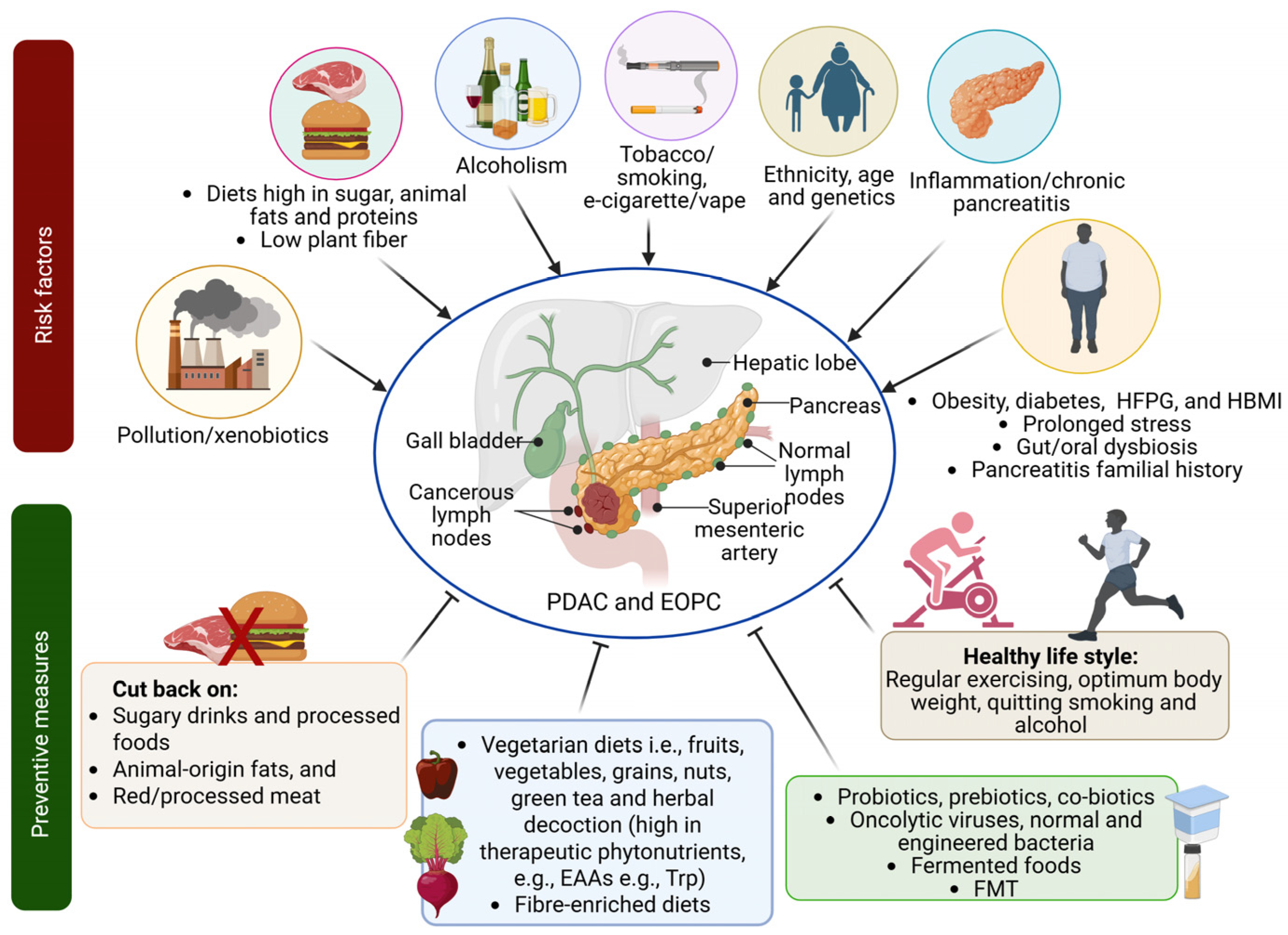
Microbiome and Diet Interplay: An Emerging Frontier in PDAC Diagnosis and Prevention
 , and
, and
Simple Summary
Abstract
1. Introduction
2. Pancreatic Cancer Epidemiology
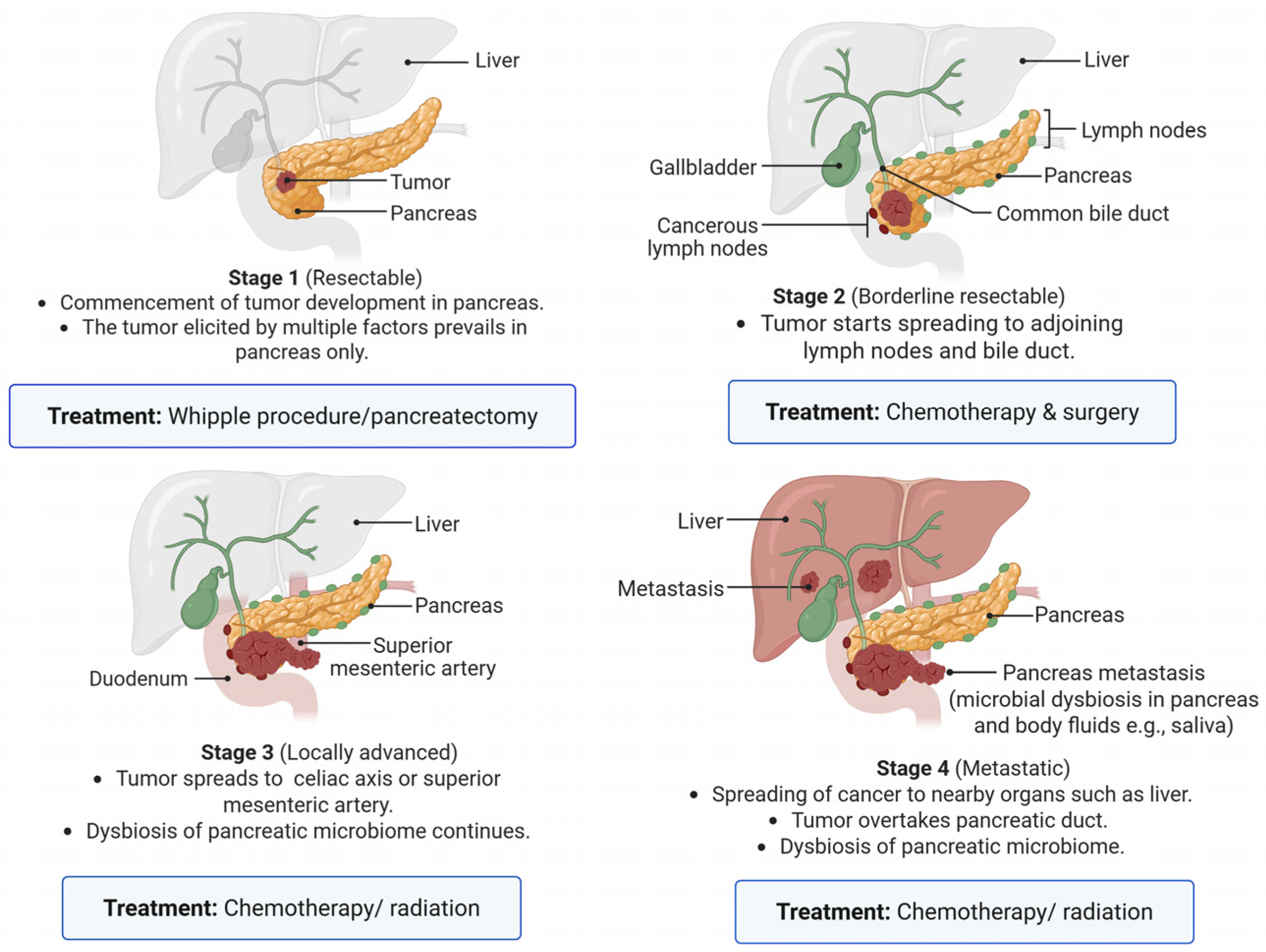
3. What Causes PDAC?

4. Microbiome and PDAC Camaraderie
5. Biomarkers of PDAs
5.1. Gut and Intratumoral Microbiota as PDAC Signatures
5.2. Biochemical Markers
6. PDAC Preventive Measures
6.1. Dietary Interventions
6.2. Vegan Diets and Phytotherapeutics
6.3. Microbial Therapies
6.4. Fecal Microbiota Transplantation
6.5. Life Style Measures
7. Outlook and Challenges

| Marker | Salient Features, Limitations and Recommendations (References) |
|---|---|
| CA 19-9 | A mucin-like glycoprotein discovered on the cancer cell surface, duly approved by USFDA to diagnose PDAC. The CA 19-9 has 79–81% sensitivity, and 89–90% specificity, and yields better results when combined with other markers [76]. Clinical utility is limited by non-specificity in certain cases, leading to false-positives in benign biliary conditions, false-negatives in cells negative for Lewis enzymes. The sensitivity is low for early-stage detection [77]. |
| CEA | CEA is a protein-based tumor marker, which can be used alongside CA 19-9 for PDAC prognosis [78]. The sensitivity ranges from 44.2 to 54.0%, which is higher than CA 19-9. Compared to CA 19-9, the CEA is a more robust marker of PDAC [79]. As non-cancerous conditions (bowel diseases, infections and cancers) may affect the CEA expression levels, it is not a reliable universal PDAC diagnostic marker. |
| sAXL | A protein fragment used as novel plasma biomarker to diagnose PDAC, HCC, CP and glioblastoma. sAXL is used to differentiate PDAC from chronic pancreatitis, accuracy is higher than CA 19-9 [80]. |
| MIC-1 | Also known as GDF15, belongs to TGF-superfamily. Serum MIC-1 acts as biomarker of prostate cancer, PC, CRC, metastasis and some inflammatory conditions, and tumor-promoting inflammation. In combination with CA 19-9, the MIC-1 is used for early-stage detection of PDAC [81]. Compared to CA 19-9 sensitivity (59%), the serum MIC-1 has higher sensitivity (71%) [81]. |
| ctDNA, exosomes: | KRAS mutations improve detection of stage 1 and 2 PDAC. Methylation profiling of ctDNA is used to develop an assay (named PDACatch) which serves as a sensitive and non-invasive tool for PDAC detection [82]. |
| miRNA Panels | Better detection of PDAC during early stages using miRNAs (e.g., miR-143/miR-30e) based on cellular metabolites, e.g., proline, creatinine, palmitic acid, etc. The miRNA, being stable in blood circulation, serves as a non-invasive marker for early detection of tumor-specific profiles [83,84]. |
| Microbial signatures | The microbial profiles serve non-invasive biomarkers of tumors, combination of gut microbiome profiling and CA 19-9 found to improve PDAC detection [76]. |
8. Conclusions
Author Contributions
Funding
Data Availability Statement
Acknowledgments
Conflicts of Interest
References
- Bray, F.; Laversanne, M.; Sung, H.; Ferlay, J.; Siegel, R.L.; Soerjomataram, I.; Jemal, A. Global Cancer Statistics 2022: GLOBOCAN Estimates of Incidence and Mortality Worldwide for 36 Cancers in 185 Countries. CA Cancer J. Clin. 2024, 74, 229–263. [Google Scholar] [CrossRef]
- Wagle, N.S.; Nogueira, L.; Devasia, T.P.; Mariotto, A.B.; Yabroff, K.R.; Islami, F.; Jemal, A.; Alteri, R.; Ganz, P.A.; Siegel, R.L. Cancer Treatment and Survivorship Statistics, 2025. CA Cancer J. Clin. 2025, 75, 308–340. [Google Scholar] [CrossRef] [PubMed]
- Vinaixa, J.; Martínez-Bosch, N.; Gibert, J.; Manero-Rupérez, N.; Santofimia-Castaño, P.; Baudou, F.G.; Vera, R.E.; Pease, D.R.; Iglesias, M.; Sen, S.; et al. Nuclear Galectin-1 Promotes KRAS-Dependent Activation of Pancreatic Cancer Stellate Cells. Proc. Natl. Acad. Sci. USA 2025, 122, e2424051122. [Google Scholar] [CrossRef] [PubMed]
- Li, T.; Lin, C.; Wang, W. Global, Regional, and National Burden of Pancreatic Cancer from 1990 to 2021, Its Attributable Risk Factors, and Projections to 2050: A Systematic Analysis of the Global Burden of Disease Study 2021. BMC Cancer 2025, 25, 189. [Google Scholar] [CrossRef] [PubMed]
- Siegel, R.L.; Kratzer, T.B.; Giaquinto, A.N.; Sung, H.; Jemal, A. Cancer Statistics, 2025. CA Cancer J. Clin. 2025, 75, 10–45. [Google Scholar] [CrossRef]
- Stoop, T.F.; Javed, A.A.; Oba, A.; Koerkamp, B.G.; Seufferlein, T.; Wilmink, J.W.; Besselink, M.G. Pancreatic Cancer. Lancet 2025, 405, 1182–1202. [Google Scholar] [CrossRef]
- Mercanti, L.; Sindaco, M.; Mazzone, M.; Di Marcantonio, M.C.; Piscione, M.; Muraro, R.; Mincione, G. PDAC, the Influencer Cancer: Cross-Talk with Tumor Microenvironment and Connected Potential Therapy Strategies. Cancers 2023, 15, 2923. [Google Scholar] [CrossRef]
- Frulloni, L.; Gabbrielli, A.; Pezzilli, R.; Zerbi, A.; Cavestro, G.M.; Marotta, F.; Falconi, M.; Gaia, E.; Uomo, G.; Maringhini, A.; et al. Chronic Pancreatitis: Report from a Multicenter Italian Survey (PanCroInfAISP) on 893 Patients. Dig. Liver Dis. 2009, 41, 311–317. [Google Scholar] [CrossRef]
- Sassano, M.; Collatuzzo, G.; Teglia, F.; Boffetta, P. Occupational Exposure to Diesel Exhausts and Liver and Pancreatic Cancers: A Systematic Review and Meta-Analysis. Eur. J. Epidemiol. 2024, 39, 241–255. [Google Scholar] [CrossRef]
- Khong, T.M.T.; Bui, T.T.; Kang, H.-Y.; Park, E.; Ki, M.; Choi, Y.-J.; Kim, B.; Oh, J.-K. Cancer Risk According to Lifestyle Risk Score Trajectories: A Population-Based Cohort Study. BJC Rep. 2025, 3, 28. [Google Scholar] [CrossRef]
- Catanzaro, R.; Celep, G.; Zerbinati, N.; Papacharalambous, M.; Nagpal, R.; Marotta, F.; Rastmanesh, R.; Milazzo, M.; Lorenzetti, A.; Bertuccelli, G.; et al. In Vitro Protective Effect of Celergen, a Bioactive Marine Compound, on Interleukin-6-Related Invasiveness of Pancreatic Cancer. Acta Biomed. 2014, 85, 44–51. [Google Scholar] [PubMed]
- Ye, J.; Wang, J.-G.; Liu, R.-Q.; Shi, Q.; Wang, W.-X. Association between Intra-Pancreatic Fat Deposition and Diseases of the Exocrine Pancreas: A Narrative Review. World J. Gastroenterol. 2025, 31, 101180. [Google Scholar] [CrossRef] [PubMed]
- Ghiorzo, P. Genetic Predisposition to Pancreatic Cancer. World. J Gastroenterol. 2014, 20, 10778. [Google Scholar] [CrossRef] [PubMed]
- McGuigan, A.; Kelly, P.; Turkington, R.C.; Jones, C.; Coleman, H.G.; McCain, R.S. Pancreatic Cancer: A Review of Clinical Diagnosis, Epidemiology, Treatment and Outcomes. World J. Gastroenterol. 2018, 24, 4846–4861. [Google Scholar] [CrossRef]
- Dreyer, S.B.; Beer, P.; Hingorani, S.R.; Biankin, A.V. Improving Outcomes of Patients with Pancreatic Cancer. Nat. Rev. Clin. Oncol. 2025, 22, 439–456. [Google Scholar] [CrossRef]
- Ho, W.J.; Jaffee, E.M.; Zheng, L. The Tumour Microenvironment in Pancreatic Cancer—Clinical Challenges and Opportunities. Nat. Rev. Clin. Oncol. 2020, 17, 527–540. [Google Scholar] [CrossRef]
- Mannucci, A.; Goel, A. Advances in Pancreatic Cancer Early Diagnosis, Prevention, and Treatment: The Past, the Present, and the Future. CA Cancer J. Clin. 2026, 76, e70035. [Google Scholar] [CrossRef]
- McDonnell, D.; Cheang, A.W.E.; Wilding, S.; Wild, S.H.; Frampton, A.E.; Byrne, C.D.; Hamady, Z.Z. Elevated Glycated Haemoglobin (HbA1c) Is Associated with an Increased Risk of Pancreatic Ductal Adenocarcinoma: A UK Biobank Cohort Study. Cancers 2023, 15, 4078. [Google Scholar] [CrossRef]
- Naudin, S.; Wang, M.; Dimou, N.; Ebrahimi, E.; Genkinger, J.; Adami, H.-O.; Albanes, D.; Babic, A.; Barnett, M.; Bogumil, D.; et al. Alcohol Intake and Pancreatic Cancer Risk: An Analysis from 30 Prospective Studies across Asia, Australia, Europe, and North America. PLoS Med. 2025, 22, e1004590. [Google Scholar] [CrossRef]
- Singh, B.; Mal, G.; Kalra, R.S.; Marotta, F. Probiotics as Next-Generation Mucosal Vaccine Vectors. In Probiotics as Live Biotherapeutics for Veterinary and Human Health; Springer Nature: Cham, Switzerland, 2024; Volume 2, pp. 569–592. ISBN 978-3-031-65458-9. [Google Scholar]
- Daniel, N.; Farinella, R.; Belluomini, F.; Fajkic, A.; Rizzato, C.; Souček, P.; Campa, D.; Hughes, D.J. The Relationship of the Microbiome, Associated Metabolites and the Gut Barrier with Pancreatic Cancer. Semin. Cancer Biol. 2025, 112, 43–57. [Google Scholar] [CrossRef]
- Eckhoff, A.M.; Fletcher, A.A.; Kelly, M.S.; Dohlman, A.B.; McIntyre, C.A.; Shen, X.; Iyer, M.K.; Nussbaum, D.P.; Allen, P.J. Comprehensive Assessment of the Intrinsic Pancreatic Microbiome. Ann. Surg. 2025, 282, 1060–1069. [Google Scholar] [CrossRef] [PubMed]
- Marotta, F.; Tajiri, H.; Li, Z.; Barreto, R.; Bellini, O.; Barbi, G. Pure Pancreatic Juice from Patients with Chronic Pancreatitis Has an Impaired Antibacterial Activity. Int. J. Pancreatol. 1997, 22, 215–220. [Google Scholar] [CrossRef] [PubMed]
- Yu, Q.; Newsome, R.C.; Beveridge, M.; Hernandez, M.C.; Gharaibeh, R.Z.; Jobin, C.; Thomas, R.M. Intestinal Microbiota Modulates Pancreatic Carcinogenesis Through Intratumoral Natural Killer Cells. Gut Microbes 2022, 14, 2112881. [Google Scholar] [CrossRef] [PubMed]
- Saba, E.; Farhat, M.; Daoud, A.; Khashan, A.; Forkush, E.; Menahem, N.H.; Makkawi, H.; Pandi, K.; Angabo, S.; Kawasaki, H.; et al. Oral Bacteria Accelerate Pancreatic Cancer Development in Mice. Gut 2024, 73, 770–786. [Google Scholar] [CrossRef]
- Uguz, A.; Muftuoglu, C.; Mert, U.; Gumus, T.; Ece, D.; Asadi, M.; Bagci, O.U.; Caner, A. Unveiling Microbiota Profiles in Saliva and Pancreatic Tissues of Patients with Pancreatic Cancer. Microorganisms 2025, 13, 119. [Google Scholar] [CrossRef]
- Riquelme, E.; Zhang, Y.; Zhang, L.; Montiel, M.; Zoltan, M.; Dong, W.; Quesada, P.; Sahin, I.; Chandra, V.; San Lucas, A.; et al. Tumor Microbiome Diversity and Composition Influence Pancreatic Cancer Outcomes. Cell 2019, 178, 795–806.e12. [Google Scholar] [CrossRef]
- Geller, L.T.; Barzily-Rokni, M.; Danino, T.; Jonas, O.H.; Shental, N.; Nejman, D.; Gavert, N.; Zwang, Y.; Cooper, Z.A.; Shee, K.; et al. Potential Role of Intratumor Bacteria in Mediating Tumor Resistance to the Chemotherapeutic Drug Gemcitabine. Science 2017, 357, 1156–1160. [Google Scholar] [CrossRef]
- Qian, J.; Zhang, X.; Wei, B.; Tang, Z.; Zhang, B. The Correlation Between Gut and Intra-Tumor Microbiota and PDAC: Etiology, Diagnostics and Therapeutics. Biochim. Biophys. Acta (BBA)-Rev. Cancer 2023, 1878, 188943. [Google Scholar] [CrossRef]
- De Lucia, S.S.; Nista, E.C.; Candelli, M.; Archilei, S.; Deutschbein, F.; Capuano, E.; Gasbarrini, A.; Franceschi, F.; Pignataro, G. Microbiota and Pancreatic Cancer: New Therapeutic Frontiers Between Engineered Microbes, Metabolites and Non-Bacterial Components. Cancers 2025, 17, 3618. [Google Scholar] [CrossRef]
- Sidiropoulos, T.; Dovrolis, N.; Katifelis, H.; Michalopoulos, N.V.; Kokoropoulos, P.; Arkadopoulos, N.; Gazouli, M. Dysbiosis Signature of Fecal Microbiota in Patients with Pancreatic Adenocarcinoma and Pancreatic Intraductal Papillary Mucinous Neoplasms. Biomedicines 2024, 12, 1040. [Google Scholar] [CrossRef]
- Ren, Z.; Jiang, J.; Xie, H.; Li, A.; Lu, H.; Xu, S.; Zhou, L.; Zhang, H.; Cui, G.; Chen, X.; et al. Gut Microbial Profile Analysis by MiSeq Sequencing of Pancreatic Carcinoma Patients in China. Oncotarget 2017, 8, 95176–95191. [Google Scholar] [CrossRef]
- Meng, Y.; Wu, F.; Kwak, S.; Wang, C.; Usyk, M.; Freedman, N.D.; Huang, W.-Y.; Um, C.Y.; Gonda, T.A.; Oberstein, P.E.; et al. Oral Bacterial and Fungal Microbiome and Subsequent Risk for Pancreatic Cancer. JAMA Oncol. 2025, 11, 1331. [Google Scholar] [CrossRef] [PubMed]
- Zhu, Y.; Liang, X.; Zhi, M.; Li, L.; Zhang, G.; Chen, C.; Wang, L.; Wang, P.; Zhong, N.; Feng, Q.; et al. Succession of the Multi-Site Microbiome Along Pancreatic Ductal Adenocarcinoma Tumorigenesis. Front. Immunol. 2024, 15, 1487242. [Google Scholar] [CrossRef] [PubMed]
- Özcan, T.B.; Pasaoglu, E.; Gülçiçek, O.B. Tumor Budding and E-Cadherin Loss as Robust Prognostic Markers in Pancreatic Ductal Adenocarcinoma: A Study in a Turkish Patient Cohort. Can. J. Gastroenterol. Hepatol. 2025, 2025, 9097621. [Google Scholar] [CrossRef] [PubMed]
- Engle, D.D.; Tiriac, H.; Rivera, K.D.; Pommier, A.; Whalen, S.; Oni, T.E.; Alagesan, B.; Lee, E.J.; Yao, M.A.; Lucito, M.S.; et al. The Glycan CA19-9 Promotes Pancreatitis and Pancreatic Cancer in Mice. Science 2019, 364, 1156–1162. [Google Scholar] [CrossRef]
- Athanasiou, A.; Kureshi, N.; Wittig, A.; Sterner, M.; Huber, R.; Palma, N.A.; King, T.; Schiess, R. Biomarker Discovery for Early Detection of Pancreatic Ductal Adenocarcinoma (PDAC) Using Multiplex Proteomics Technology. J. Proteome Res. 2025, 24, 315–322. [Google Scholar] [CrossRef]
- Liu, S.; Su, J.; Zhao, H.; Bai, R.; Zeng, L.; Xue, C.; Deng, S.; Liu, S.; Chen, Z.; Xu, Z.; et al. Identification of Novel Plasma Proteins as Promising Noninvasive Biomarker for Early Diagnosis and Surveillance of Pancreatic Ductal Adenocarcinoma. J. Gastroenterol. 2025, 60, 917–931. [Google Scholar] [CrossRef]
- Rozengurt, E.; Eibl, G. Pancreatic Cancer: Molecular Pathogenesis and Emerging Therapeutic Strategies. Signal Transduct. Target. Ther. 2026, 11, 6. [Google Scholar] [CrossRef]
- Liang, Y.; Du, M.; Li, X.; Gao, J.; Li, Q.; Li, H.; Li, J.; Gao, X.; Cong, H.; Huang, Y.; et al. Upregulation of Lactobacillus spp. in Gut Microbiota as a Novel Mechanism for Environmental Eustress-Induced Anti-Pancreatic Cancer Effects. Gut Microbes 2025, 17, 2470372. [Google Scholar] [CrossRef]
- Parida, D.; Mishra, S.; Mohapatra, A.P.; Sethi, M.; Das, K.R.; Kar, S.; Suresh, V.; Bhagat, S.J.; Mohapatra, A.; Halder, S.; et al. Probiotics Mitigate High-Cholesterol Diet-Driven Fatty Liver and Pancreatic Cancer by Restoring Macrophage Homeostasis. Cell. Mol. Gastroenterol. Hepatol. 2026, 20, 101644. [Google Scholar] [CrossRef]
- Singh, B.; Mal, G.; Sharma, D.; Sharma, R.; Antony, C.P.; Kalra, R.S. Gastrointestinal Biotransformation of Phytochemicals: Towards Futuristic Dietary Therapeutics and Functional Foods. Trends Food Sci. Technol. 2020, 106, 64–77. [Google Scholar] [CrossRef]
- Kuziel, G.A.; Lozano, G.L.; Simian, C.; Li, L.; Manion, J.; Stephen-Victor, E.; Chatila, T.; Dong, M.; Weng, J.-K.; Rakoff-Nahoum, S. Functional Diversification of Dietary Plant Small Molecules by the Gut Microbiome. Cell 2025, 188, 1967–1983.e22. [Google Scholar] [CrossRef] [PubMed]
- Luo, R.; Li, S.; Yang, C.; Tang, B.; Li, L.; Luo, C. Curcumin Inhibits the Development of Pancreatic Cancer by Targeting the Circ_0079440/miR-522-3p/EIF4A1 Pathway. Cell Biochem. Biophys. 2024, 83, 377–390. [Google Scholar] [CrossRef] [PubMed]
- Roichman, A.; Zuo, Q.; Hwang, S.; Lu, W.; Cordova, R.A.; MacArthur, M.R.; Boyer, J.A.; Mitchell, S.J.; Powers, J.; Koval, S.A.; et al. Microbiome Metabolism of Dietary Phytochemicals Controls the Anticancer Activity of PI3K Inhibitors. Cell 2025, 188, 3065–3080.e21. [Google Scholar] [CrossRef]
- Cao, J.-F.; Zhang, X.; Xia, Q.; Hang, K.; Men, J.; Tian, J.; Liao, D.; Xia, Z.; Li, K. Insights into Curcumin’s Anticancer Activity in Pancreatic Ductal Adenocarcinoma: Experimental and Computational Evidence Targeting HRAS, CCND1, EGFR and AKT1. Bioorganic Chem. 2025, 157, 108264. [Google Scholar] [CrossRef]
- Sahu, R.P.; Batra, S.; Srivastava, S.K. Activation of ATM/Chk1 by Curcumin Causes Cell Cycle Arrest and Apoptosis in Human Pancreatic Cancer Cells. Br. J. Cancer 2009, 100, 1425–1433. [Google Scholar] [CrossRef]
- Yoshida, K.; Toden, S.; Ravindranathan, P.; Han, H.; Goel, A. Curcumin Sensitizes Pancreatic Cancer Cells to Gemcitabine by Attenuating PRC2 Subunit EZH2, and the lncRNA PVT1 Expression. Carcinogenesis 2017, 38, 1036–1046. [Google Scholar] [CrossRef]
- Sallam, N.G.; Boraie, N.A.; Sheta, E.; El-Habashy, S.E. Targeted Delivery of Genistein for Pancreatic Cancer Treatment Using Hyaluronic-Coated Cubosomes Bioactivated with Frankincense Oil. Int. J. Pharm. 2024, 649, 123637. [Google Scholar] [CrossRef]
- Bi, Y.; Min, M.; Shen, W.; Liu, Y. Genistein Induced Anticancer Effects on Pancreatic Cancer Cell Lines Involves Mitochondrial Apoptosis, G0/G1 Cell Cycle Arrest and Regulation of STAT3 Signalling Pathway. Phytomedicine 2018, 39, 10–16. [Google Scholar] [CrossRef]
- Desai, V.; Tadinada, S.M.; Shaghaghi, H.; Summer, R.; Lai, J.C.K.; Bhushan, A. Combination Treatment of Biochanin A and Atorvastatin Alters Mitochondrial Bioenergetics, Modulating Cell Metabolism and Inducing Cell Cycle Arrest in Pancreatic Cancer Cells. Anticancer Res. 2024, 44, 2307–2323. [Google Scholar] [CrossRef]
- Rooney, S.; Ryan, M.F. Effects of Alpha-Hederin and Thymoquinone, Constituents of Nigella Sativa, on Human Cancer Cell Lines. Anticancer Res. 2005, 25, 2199–2204. [Google Scholar] [PubMed]
- Banerjee, S.; Azmi, A.S.; Padhye, S.; Singh, M.W.; Baruah, J.B.; Philip, P.A.; Sarkar, F.H.; Mohammad, R.M. Structure-Activity Studies on Therapeutic Potential of Thymoquinone Analogs in Pancreatic Cancer. Pharm. Res. 2010, 27, 1146–1158. [Google Scholar] [CrossRef]
- Relles, D.; Chipitsyna, G.I.; Gong, Q.; Yeo, C.J.; Arafat, H.A. Thymoquinone Promotes Pancreatic Cancer Cell Death and Reduction of Tumor Size through Combined Inhibition of Histone Deacetylation and Induction of Histone Acetylation. Adv. Prev. Med. 2016, 2016, 1–9. [Google Scholar] [CrossRef] [PubMed]
- Chehl, N.; Chipitsyna, G.; Gong, Q.; Yeo, C.J.; Arafat, H.A. Anti-Inflammatory Effects of the Nigella Sativa Seed Extract, Thymoquinone, in Pancreatic Cancer Cells. HPB 2009, 11, 373–381. [Google Scholar] [CrossRef] [PubMed]
- Zhao, Z.; Liu, L.; Chen, H.; Li, S.; Guo, Y.; Hou, X.; Yang, J. Thymoquinone Affects the Gemcitabine Sensitivity of Pancreatic Cancer by Regulating Collagen via Hypoxia Inducible Factor-1α. Front. Pharmacol. 2023, 14, 1138265. [Google Scholar] [CrossRef]
- Aguilar-Galvez, A.; García-Ríos, D.; Ramírez-Guzmán, D.; Lindo, J.; Chirinos, R.; Pedreschi, R.; Campos, D. In Vitro and In Vivo Biotransformation of Glucosinolates from Mashua (Tropaeolum tuberosum) by Lactic Acid Bacteria. Food Chem. 2023, 404, 134631. [Google Scholar] [CrossRef]
- Tintelnot, J.; Xu, Y.; Lesker, T.R.; Schönlein, M.; Konczalla, L.; Giannou, A.D.; Pelczar, P.; Kylies, D.; Puelles, V.G.; Bielecka, A.A.; et al. Microbiota-Derived 3-IAA Influences Chemotherapy Efficacy in Pancreatic Cancer. Nature 2023, 615, 168–174. [Google Scholar] [CrossRef]
- Chen, H.; Jiang, Y.; Liu, R.; Deng, J.; Chen, Q.; Chen, L.; Liang, G.; Chen, X.; Xu, Z. Curcumin Derivative C66 Suppresses Pancreatic Cancer Progression Through the Inhibition of JNK-Mediated Inflammation. Molecules 2022, 27, 3076. [Google Scholar] [CrossRef]
- Cao, J.; Deng, L.; Zhu, X.-M.; Fan, Y.; Hu, J.-N.; Li, J.; Deng, Z.-Y. Novel Approach to Evaluate the Oxidation State of Vegetable Oils Using Characteristic Oxidation Indicators. J. Agric. Food Chem. 2014, 62, 12545–12552. [Google Scholar] [CrossRef]
- Singh, B.; Mal, G.; Kalra, R.S.; Marotta, F. Gut Biotransformation of Phytometabolites. In Probiotics as Live Biotherapeutics for Veterinary and Human Health; Springer Nature: Cham, Switzerland, 2024; Volume 1, pp. 201–231. ISBN 978-3-031-65454-1. [Google Scholar]
- Yennawar, R.; Abjani, N.; Parekh, N.; Budha, R.R.; Kaur, G.; Joshi, H.; Ramniwas, S.; Popli, H.; Haque, S.; Mathkor, D.M.; et al. Genistein and Gastrointestinal Cancers: A Comprehensive Review of Recent Studies and Future Outlook. J. Biochem. Mol. Tox 2025, 39, e70533. [Google Scholar] [CrossRef] [PubMed]
- Kaufman-Szymczyk, A.; Jalmuzna, J.; Lubecka-Gajewska, K. Soy-derived Isoflavones as Chemo-preventive Agents Targeting Multiple Signalling Pathways for Cancer Prevention and Therapy. Br. J. Pharmacol. 2025, 182, 2259–2286. [Google Scholar] [CrossRef] [PubMed]
- Marotta, F.; Lorenzetti, A.; Catanzaro, R.; Zerbinati, N.; Jain, S.; Solimene, U.; Yaduvanshi, S.K.; Yadav, H.; Sapienza, C.; Srivastava, N.; et al. A Sturgeon-Derived Bioactive Compound Beneficially Modulates Nuclear Receptors Controlling Metabolic Functions in Patients with Metabolic Syndrome. Acta Biomed. 2013, 84, 53–60. [Google Scholar] [PubMed]
- Singh, B.; Mal, G.; Marotta, F. Designer Probiotics: Paving the Way to Living Therapeutics. Trends Biotechnol. 2017, 35, 679–682. [Google Scholar] [CrossRef]
- Tabrizi, E.; Pourteymour Fard Tabrizi, F.; Mahmoud Khaled, G.; Sestito, M.P.; Jamie, S.; Boone, B.A. Unraveling the Gut Microbiome’s Contribution to Pancreatic Ductal Adenocarcinoma: Mechanistic Insights and Therapeutic Perspectives. Front. Immunol. 2024, 15, 1434771. [Google Scholar] [CrossRef]
- Muhammad, S.; Li, M.; Jia, Q.; Ijaz, M.; Liang, S.; Zeng, W.; Chen, D.; Zhang, Y.; Du, X.; Song, W.; et al. Advances in the Engineering of Living Probiotics for Cancer Immunotherapy. Theranostics 2026, 16, 1164–1226. [Google Scholar] [CrossRef]
- Kumar, R.; Sood, U.; Gupta, V.; Singh, M.; Scaria, J.; Lal, R. Recent Advancements in the Development of Modern Probiotics for Restoring Human Gut Microbiome Dysbiosis. Indian J. Microbiol. 2020, 60, 12–25. [Google Scholar] [CrossRef]
- Sadeghloo, Z.; Sadeghi, A. Gut Microbiota as a Hidden Modulator of Chemotherapy: Implications for Colorectal Cancer Treatment. Discov. Oncol. 2025, 16, 1717. [Google Scholar] [CrossRef]
- Li, R.; Hu, Y.; Liu, Y.; Tan, X. Fecal Microbiota Transplantation Augments 5-Fluorouracil Efficacy in Pancreatic Cancer via Gut Microbiota Modulation. Front. Microbiol. 2025, 16, 1548027. [Google Scholar] [CrossRef]
- Yang, Q.; Zhang, J.; Zhu, Y. Potential Roles of the Gut Microbiota in Pancreatic Carcinogenesis and Therapeutics. Front. Cell. Infect. Microbiol. 2022, 12, 872019. [Google Scholar] [CrossRef]
- Sono, M.; Iimori, K.; Nagao, M.; Ogawa, S.; Maruno, T.; Nakanishi, Y.; Anazawa, T.; Nagai, K.; Masui, T.; Mori, H.; et al. Reduction of Butyrate-Producing Bacteria in the Gut Microbiome of Japanese Patients with Pancreatic Cancer. Pancreatology 2024, 24, 1031–1039. [Google Scholar] [CrossRef] [PubMed]
- Marotta, F.; Kimura, H.; Hayakawa, K.; Nakamura, T.; Ono, K.; Barbi, G. Patients with Chronic Pancreatitis Have an Impaired Oxidative Burst Ability of Blood Monocytes. Pathophysiology 1994, 1, 235–239. [Google Scholar] [CrossRef]
- Peduzzi, G.; Archibugi, L.; Farinella, R.; De Leon Pisani, R.P.; Vodickova, L.; Vodicka, P.; Kraja, B.; Sainz, J.; Bars-Cortina, D.; Daniel, N.; et al. The Exposome and Pancreatic Cancer, Lifestyle and Environmental Risk Factors for PDAC. Semin. Cancer Biol. 2025, 113, 100–129. [Google Scholar] [CrossRef] [PubMed]
- Bahr, M.M.A.; ElRakaiby, M.T.; Madboli, A.E.-N.A.; Mansour, N.M. Oral Immunization with Engineered Probiotics Expressing tcdB Protects Mice against Clostridioides Difficile Infection. Biologicals 2026, 94, 101881. [Google Scholar] [CrossRef]
- Chen, Y.; Nian, F.; Chen, J.; Jiang, Q.; Yuan, T.; Feng, H.; Shen, X.; Dong, L. Metagenomic Microbial Signatures for Noninvasive Detection of Pancreatic Cancer. Biomedicines 2025, 13, 1000. [Google Scholar] [CrossRef]
- Singh, S.; Tang, S.; Sreenarasimhaiah, J.; Lara, L.F.; Siddiqui, A. The Clinical Utility and Limitations of Serum Carbohydrate Antigen (CA19-9) as a Diagnostic Tool for Pancreatic Cancer and Cholangiocarcinoma. Dig. Dis. Sci. 2011, 56, 2491–2496. [Google Scholar] [CrossRef]
- Ermiah, E.; Eddfair, M.; Abdulrahman, O.; Elfagieh, M.; Jebriel, A.; Al-Sharif, M.; Assidi, M.; Buhmeida, A. Prognostic Value of Serum CEA and CA19-9 Levels in Pancreatic Ductal Adenocarcinoma. Mol. Clin. Oncol. 2022, 17, 126. [Google Scholar] [CrossRef]
- Van Manen, L.; Groen, J.V.; Putter, H.; Vahrmeijer, A.L.; Swijnenburg, R.-J.; Bonsing, B.A.; Mieog, J.S.D. Elevated CEA and CA19-9 Serum Levels Independently Predict Advanced Pancreatic Cancer at Diagnosis. Biomarkers 2020, 25, 186–193. [Google Scholar] [CrossRef]
- Martínez-Bosch, N.; Cristóbal, H.; Iglesias, M.; Gironella, M.; Barranco, L.; Visa, L.; Calafato, D.; Jiménez-Parrado, S.; Earl, J.; Carrato, A.; et al. Soluble AXL Is a Novel Blood Marker for Early Detection of Pancreatic Ductal Adenocarcinoma and Differential Diagnosis from Chronic Pancreatitis. eBioMedicine 2022, 75, 103797. [Google Scholar] [CrossRef]
- Yang, Y.; Yan, S.; Tian, H.; Bao, Y. Macrophage Inhibitory Cytokine-1 Versus Carbohydrate Antigen 19–9 as a Biomarker for Diagnosis of Pancreatic Cancer: A PRISMA-Compliant Meta-Analysis of Diagnostic Accuracy Studies. Medicine 2018, 97, e9994. [Google Scholar] [CrossRef]
- Wu, H.; Guo, S.; Liu, X.; Li, Y.; Su, Z.; He, Q.; Liu, X.; Zhang, Z.; Yu, L.; Shi, X.; et al. Noninvasive Detection of Pancreatic Ductal Adenocarcinoma Using the Methylation Signature of Circulating Tumour DNA. BMC Med. 2022, 20, 458. [Google Scholar] [CrossRef]
- Patel, R.D.; Patel, B.; Crnogorac-Jurcevic, T. Extracellular Vesicle-Derived miRNAs as Diagnostic Biomarkers for Pancreatic Ductal Adenocarcinoma: A Systematic Review of Methodological Rigour and Clinical Applicability. Biomark. Insights 2025, 20, 11772719251381960. [Google Scholar] [CrossRef]
- Debernardi, S.; Massat, N.J.; Radon, T.P.; Sangaralingam, A.; Banissi, A.; Ennis, D.P.; Dowe, T.; Chelala, C.; Pereira, S.P.; Kocher, H.M.; et al. Noninvasive Urinary miRNA Biomarkers for Early Detection of Pancreatic Adenocarcinoma. Am. J. Cancer Res. 2015, 5, 3455–3466. [Google Scholar]
| Sl. No. | Bioactive Phytochemicals (Source) | Modes of Study | Mechanisms, Inferences and Recommendations (References) |
|---|---|---|---|
| 1. | Curcumin (Curcuma longa) | Bioinformatics, in silico analysis, transcriptome sequencing, and molecular docking of interaction of curcumin and PANC-1 cell line | Significant inhibition of growth and proliferation PANC-1 by 40 µg/mL curcumin, down-regulation of Cyclin D1 (CCND1), AKT serine/threonine kinase (AKT1), HRas proto-oncogene (HRAS), and epidermal growth receptor (EGFR) [46]. |
| In vitro, using BxPC-3 cell line, and HPDE-6 cell line (as control) | Activation of ATM/CHK1 pathway, significant arrest of BxPC-3 cells in G2/M phase, and induction of apoptosis through a single exposure of 2.5 µM curcumin for 24 h, the HPDE-6 cells remain unaffected [47]. | ||
| In vitro (gemcitabine-resistant PDAC cell lines) (BxPC3, MiaPaCa2 and PANC-1 PDACs) In vivo (mice models) | Curcumin-mediated sensitization of PDAC cells to chemotherapy, prevention of spheroids development and several self-renewal driving genes, suppression of gemcitabine-resistant tumor growth [48]. | ||
| 2. | Genistein (Soy and soy products, some pulses and legumes) | In vitro (PANC-1), in vivo (orthotopic cancer model) | Development of novel nanosize FO bioactive cubosome (HA/Gen-FO-Cub) to deliver and actively target the cancer cells, and anti-tumor effects (in vivo). Documentation of 2.5-fold drop in tumor growth, and down-regulation of NF-kB and VEGF [49]. |
| In vitro, MiaPaCa2 and PANC-1 PDACs cells | Induction of morphological alterations at cell cycle arrest in G0/G1 phase in cancer cells, apoptosis in dose-dependent manner, ROS-mediated apoptosis in cancer cell mitochondria, and regulation of STAT3 signaling pathway [50]. | ||
| 3. | Biochanin A (some pulses and legumes) | In vitro (PANC-1 cells) | Biochanin A and atorvastatin-mediated anticancer effects, apoptosis and down-regulated cell cycle-associated proteins and invasiveness of PANC-1 cells [51]. |
| 4. | Thymoquinone (TQ) (Nigella sativa L., Monarda fistulosa L., Satureja montana L., Thymus vulgaris) | Meta-analysis of published data In vitro (human cancer cell lines: pancreas carcinoma (MIA PaCa-2), lung carcinoma ((A54), larynx epidermal carcinoma (Hep-2))) | Dose (25–100 µM, 24 h) and time-dependent inhibitory effects of TQ and α-hederin on cancer cell lines, enhanced cytotoxicity and reduced cell proliferation. Hep-2 cells were most sensitive to treatments [52]. |
| In vitro, cancer cell lines (MIA PaCa-2, AsPC-1, BxPC-3, HPAC) | Sensitization of pancreatic cells to gemcitabine, reduction in cell growth, increased apoptosis, increase in NF-kB, and down-regulation of Bcl-2, Bcl-xL, COX-2, PGE2, survivin, and XIAP [53]. | ||
| In vitro, human PDAC cell lines (AsPC-1, MIAPaCa-2) | TQ (10–50 µM)-mediated inhibition of cell viability and proliferation, partial G2 cell arrest in dose-dependent manner, up-regulation of p53, and down-regulation of Bcl-2, reduction in HDACs activity diminishing the HDACs 1, 2, and 3 by 40–60% [54]. | ||
| In vitro, HS766T PADC cells | Time- and dose (25–75 µM, 24 h)-dependent inhibition of MCP-1, TNF-α, IL-1β and Cox2 at 24 h of treatment [55]. | ||
| In vitro, PANC1 cells | Inhibition of cell migration, invasion and metastasis, increase in cancer cell apoptosis, and improved sensitivity to gemcitabine in combination with TQ [56]. | ||
| 5. | Glucosinolates (GLSs) | In vivo (rats) | L. rhamosus GG-mediated complete transformation of Tropaeolum tuberosum glucosinalbin and glucotropaeolin, 46.7% of glucoaubrietin, and their absorption and metabolism. The probiotic-mediated biotransformation is beneficial to consumers [57]. |
| 6. | Celergen | In vitro (cell lines, PSN-1) | Reduction in IL-6 and IL-6 receptors in PSN-1 cells [11]. |
| 7. | Tryptophan and 3-IAA (GI microbial metabolite) | Shotgun metagenomic sequencing and metabolomics analysis | Improvement in chemotherapy outcomes through FMT, short-term dietary manipulation of tryptophan and oral administration IAA in humanized mouse models of PDAC, observation of correlation between IAA and treatment of PDAC human patients [58]. |
Disclaimer/Publisher’s Note: The statements, opinions and data contained in all publications are solely those of the individual author(s) and contributor(s) and not of MDPI and/or the editor(s). MDPI and/or the editor(s) disclaim responsibility for any injury to people or property resulting from any ideas, methods, instructions or products referred to in the content. |
© 2026 by the authors. Licensee MDPI, Basel, Switzerland. This article is an open access article distributed under the terms and conditions of the Creative Commons Attribution (CC BY) license.
Share and Cite
Singh, B.; Marotta, F.; Mal, G.; Sharma, R.; Gopinath, D.; Jairath, G.; Rialch, A. Microbiome and Diet Interplay: An Emerging Frontier in PDAC Diagnosis and Prevention. Cancers 2026, 18, 1292. https://doi.org/10.3390/cancers18081292
Singh B, Marotta F, Mal G, Sharma R, Gopinath D, Jairath G, Rialch A. Microbiome and Diet Interplay: An Emerging Frontier in PDAC Diagnosis and Prevention. Cancers. 2026; 18(8):1292. https://doi.org/10.3390/cancers18081292
Chicago/Turabian StyleSingh, Birbal, Francesco Marotta, Gorakh Mal, Rinku Sharma, Devi Gopinath, Gauri Jairath, and Ajayta Rialch. 2026. "Microbiome and Diet Interplay: An Emerging Frontier in PDAC Diagnosis and Prevention" Cancers 18, no. 8: 1292. https://doi.org/10.3390/cancers18081292
APA StyleSingh, B., Marotta, F., Mal, G., Sharma, R., Gopinath, D., Jairath, G., & Rialch, A. (2026). Microbiome and Diet Interplay: An Emerging Frontier in PDAC Diagnosis and Prevention. Cancers, 18(8), 1292. https://doi.org/10.3390/cancers18081292