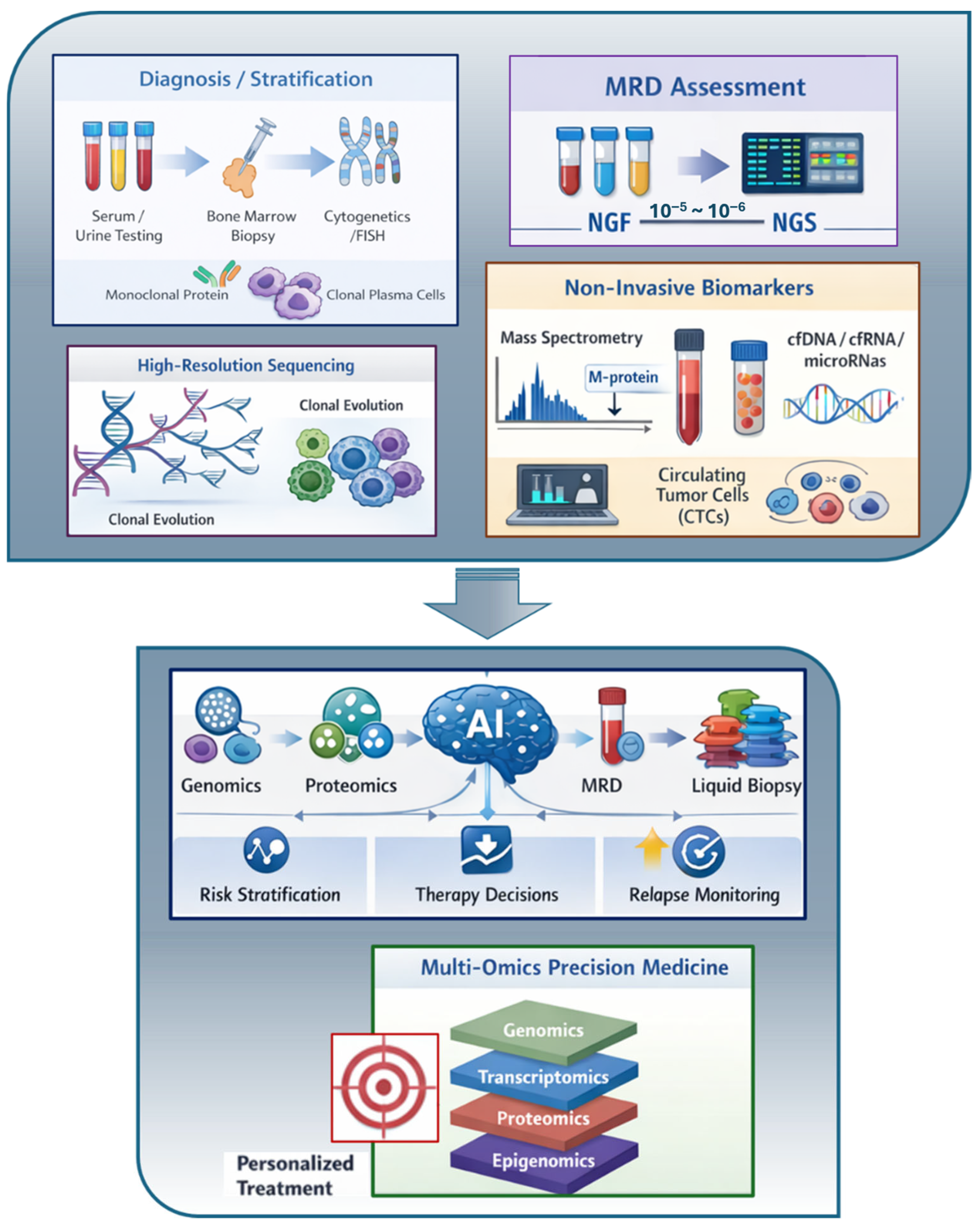
How Laboratory Innovations Are Shaping the Future of Multiple Myeloma Care

 , , ,
, , , 
Simple Summary
Abstract
1. Current Laboratory Methods in Multiple Myeloma: An Overview
1.1. Established Diagnostic Approaches
1.2. State-of-the-Art Response Evaluation
2. Emerging Non-Invasive Insights into MM
2.1. Mass Spectrometry (MS)
Challenges to Clinical Implementation
2.2. Circulating Tumor Cells (CTC)
Challenges to Clinical Implementation
2.3. Cell-Free DNA (cfDNA)
Challenges to Clinical Implementation
2.4. Cell-Free RNA (cfRNA)
Challenges to Clinical Implementation
3. Molecular Markers: Deepening the Genomic Picture
Challenges to Clinical Implementation
4. Artificial Intelligence (AI): Transforming Diagnostic and Therapeutic Decisions
Challenges to Clinical Implementation
5. Future Directions: The Multi-Omics Era in the Clinical Setting
6. Conclusions
Author Contributions
Funding
Institutional Review Board Statement
Informed Consent Statement
Data Availability Statement
Conflicts of Interest
Abbreviations
| MM | Multiple myeloma |
| PCs | Plasma cells |
| BM | Bone marrow |
| MGUS | Monoclonal gammopathy of undetermined significance |
| SMM | Smoldering MM |
| IMWG | International Myeloma Working Group |
| MDE | Myeloma-defining events |
| IGH | Immunoglobulin heavy chain |
| ISS | International Staging System |
| R-ISS | Revised ISS |
| R2-ISS | 2nd Revised ISS |
| CGS | Consensus Genomic Staging |
| CR | Complete response |
| sCR | Stringent CR |
| MRD | Measurable residual disease |
| PFS | Progression-free survival |
| OS | Overall survival |
| FDA | Food and Drug Administration |
| NDMM | Newly diagnosed MM |
| NGF | Next Generation Flow |
| NGS | Next Generation Sequencing |
| LLOD | Lower limit of detection |
| LLOQ | Lower limit of quantification |
| DNA | Deoxyribonucleic acid |
| MS | Mass spectrometry |
| SPE | Serum protein electrophoresis |
| IFE | Immunofixation electrophoresis |
| sFLC | Serum free light chain |
| MP | Monoclonal protein |
| QIP | Quantitative immunoprecipitation |
| CTC | Circulating tumor cells |
| PB | Peripheral blood |
| MFC | Multiparametric flow cytometry |
| HR | Hazard ratio |
| EM | Extramedullary |
| RR | Relapsed/refractory |
| cfDNA | Cell-free DNA |
| scRNA | Single-cell RNA |
| ULP | Ultra-low-pass |
| WGS | Whole-genome sequencing |
| TF | Tumor fraction |
| ctDNA | Circulating tumor DNA |
| RRMM | Relapsed/refractory MM |
| iFLC | Involved free light chain |
| CNVs | Copy number variations |
| PS | Paraskeletal |
| PET/CT | Positron Emission Tomography-Computed Tomography |
| Ig | Immunoglobulin |
| SD | Stable disease |
| PR | Partial response |
| cfRNA | Cell-free RNA |
| exRNA | Extracellular RNA |
| SNPs | Single-nucleotide polymorphisms |
| FISH | Fluorescence in situ hybridization |
| AI | Artificial intelligence |
| ML | Machine learning |
| IRMMa | Individualized Risk Model Myeloma |
Appendix A

| Study | Method | Proposed MRD Cut-Off |
|---|---|---|
| Garcés et al. [85] | NGF | ≥0.01% |
| Tembhare et al. [86] | NGF | ≥0.01% |
| Kastritis et al. [87] | NGF | ≥0.0014% |
| Bae et al. [88] | 5-color MFC | ≥0.02% |
| Kostopoulos et al. [89] | 8-color MFC | ≥0.02% |
| Bertamini et al. [90] | 8-color MFC | ≥0.07% |
References
- van de Donk, N.W.C.J.; Pawlyn, C.; Yong, K.L. Multiple Myeloma. Lancet 2021, 397, 410–427. [Google Scholar] [CrossRef] [Scilit] [PubMed]
- Rajkumar, S.V. Multiple Myeloma: 2024 Update on Diagnosis, Risk-Stratification, and Management. Am. J. Hematol. 2024, 99, 1802–1824. [Google Scholar] [CrossRef] [Scilit] [PubMed]
- Rajkumar, S.V.; Dimopoulos, M.A.; Palumbo, A.; Blade, J.; Merlini, G.; Mateos, M.V.; Kumar, S.; Hillengass, J.; Kastritis, E.; Richardson, P.; et al. International Myeloma Working Group Updated Criteria for the Diagnosis of Multiple Myeloma. Lancet Oncol. 2014, 15, e538–e548. [Google Scholar] [CrossRef] [Scilit] [PubMed]
- Dimopoulos, M.A.; Terpos, E.; Boccadoro, M.; Moreau, P.; Mateos, M.V.; Zweegman, S.; Cook, G.; Engelhardt, M.; Delforge, M.; Hajek, R.; et al. EHA–EMN Evidence-Based Guidelines for Diagnosis, Treatment and Follow-up of Patients with Multiple Myeloma. Nat. Rev. Clin. Oncol. 2025, 22, 680–700. [Google Scholar] [CrossRef] [Scilit]
- Furukawa, Y.; Kikuchi, J. Molecular Basis of Clonal Evolution in Multiple Myeloma. Int. J. Hematol. 2020, 111, 496–511. [Google Scholar] [CrossRef] [Scilit]
- Dutta, A.K.; Fink, J.L.; Grady, J.P.; Morgan, G.J.; Mullighan, C.G.; To, L.B.; Hewett, D.R.; Zannettino, A.C.W. Subclonal Evolution in Disease Progression from MGUS/SMM to Multiple Myeloma Is Characterised by Clonal Stability. Leukemia 2019, 33, 457–468. [Google Scholar] [CrossRef] [Scilit]
- Alaggio, R.; Amador, C.; Anagnostopoulos, I.; Attygalle, A.D.; Araujo, I.B.d.O.; Berti, E.; Bhagat, G.; Borges, A.M.; Boyer, D.; Calaminici, M.; et al. The 5th Edition of the World Health Organization Classification of Haematolymphoid Tumours: Lymphoid Neoplasms. Leukemia 2022, 36, 1720–1748. [Google Scholar] [CrossRef] [Scilit]
- Campo, E.; Jaffe, E.S.; Cook, J.R.; Quintanilla-Martinez, L.; Swerdlow, S.H.; Anderson, K.C.; Brousset, P.; Cerroni, L.; de Leval, L.; Dirnhofer, S.; et al. The International Consensus Classification of Mature Lymphoid Neoplasms: A Report from the Clinical Advisory Committee. Blood 2022, 140, 1229–1253. [Google Scholar] [CrossRef] [Scilit]
- Greipp, P.R.; Miguel, J.S.; Dune, B.G.M.; Crowley, J.J.; Barlogie, B.; Bladé, J.; Boccadoro, M.; Child, J.A.; Harousseau, J.L.; Kyle, R.A.; et al. International Staging System for Multiple Myeloma. J. Clin. Oncol. 2005, 23, 3412–3420. [Google Scholar] [CrossRef] [Scilit]
- Palumbo, A.; Avet-Loiseau, H.; Oliva, S.; Lokhorst, H.M.; Goldschmidt, H.; Rosinol, L.; Richardson, P.; Caltagirone, S.; Lahuerta, J.J.; Facon, T.; et al. Revised International Staging System for Multiple Myeloma: A Report from International Myeloma Working Group. J. Clin. Oncol. 2015, 33, 2863–2869. [Google Scholar] [CrossRef] [Scilit]
- D’agostino, M.; Cairns, D.A.; Lahuerta, J.J.; Wester, R.; Bertsch, U.; Waage, A.; Zamagni, E.; Mateos, M.V.; Dall’olio, D.; Van De Donk, N.W.C.J.; et al. Second Revision of the International Staging System (R2-ISS) for Overall Survival in Multiple Myeloma: A European Myeloma Network (EMN) Report Within the HARMONY Project. J. Clin. Oncol. 2022, 364, 3406–3418. [Google Scholar] [CrossRef] [Scilit] [PubMed]
- Brioli, A.; Melchor, L.; Cavo, M.; Morgan, G.J. The Impact of Intra-Clonal Heterogeneity on the Treatment of Multiple Myeloma. Br. J. Haematol. 2014, 165, 441–454. [Google Scholar] [CrossRef] [Scilit] [PubMed]
- Rajan, A.M.; Rajkumar, S.V. Interpretation of Cytogenetic Results in Multiple Myeloma for Clinical Practice. Blood Cancer J. 2015, 5, e365. [Google Scholar] [CrossRef] [Scilit] [PubMed]
- Abdallah, N.; Rajkumar, S.V.; Greipp, P.; Kapoor, P.; Gertz, M.A.; Dispenzieri, A.; Baughn, L.B.; Lacy, M.Q.; Hayman, S.R.; Buadi, F.K.; et al. Cytogenetic Abnormalities in Multiple Myeloma: Association with Disease Characteristics and Treatment Response. Blood Cancer J. 2020, 10, 82. [Google Scholar] [CrossRef] [Scilit]
- Avet-Loiseau, H.; Davies, F.E.; Samur, M.K.; Corre, J.; D’Agostino, M.; Kaiser, M.F.; Raab, M.S.; Weinhold, N.; Gutierrez, N.C.; Paiva, B.; et al. International Myeloma Society/International Myeloma Working Group Consensus Recommendations on the Definition of High-Risk Multiple Myeloma. J. Clin. Oncol. 2025, 43, 2739–2751. [Google Scholar] [CrossRef] [Scilit]
- Gran, C.; Uttervall, K.; Borg Bruchfeld, J.; Wallblom, A.; Alici, E.; Gahrton, G.; Nahi, H. Translocation (11;14) in Newly Diagnosed Multiple Myeloma, Time to Reclassify This Standard Risk Chromosomal Aberration? Eur. J. Haematol. 2019, 103, 588–596. [Google Scholar] [CrossRef] [Scilit]
- Barwick, B.G.; Neri, P.; Bahlis, N.J.; Nooka, A.K.; Dhodapkar, M.V.; Jaye, D.L.; Hofmeister, C.C.; Kaufman, J.L.; Gupta, V.A.; Auclair, D.; et al. Multiple Myeloma Immunoglobulin Lambda Translocations Portend Poor Prognosis. Nat. Commun. 2019, 10, 1911. [Google Scholar] [CrossRef] [Scilit]
- Zanwar, S.; Rajkumar, S.V. Current Risk Stratification and Staging of Multiple Myeloma and Related Clonal Plasma Cell Disorders. Leukemia 2025, 39, 2610–2617. [Google Scholar] [CrossRef] [Scilit]
- Diamond, B.T.; Rustad, E.; Maclachlan, K.; Thoren, K.; Ho, C.; Roshal, M.; Ulaner, G.A.; Landgren, C.O. Defining the Undetectable: The Current Landscape of Minimal Residual Disease Assessment in Multiple Myeloma and Goals for Future Clarity. Blood Rev. 2021, 46, 100732. [Google Scholar] [CrossRef] [Scilit]
- Perrot, A.; Lambert, J.; Hulin, C.; Pieragostini, A.; Karlin, L.; Arnulf, B.; Rey, P.; Garderet, L.; Macro, M.; Escoffre-Barbe, M.; et al. Measurable Residual Disease–Guided Therapy in Newly Diagnosed Myeloma. N. Engl. J. Med. 2025, 393, 425–437. [Google Scholar] [CrossRef] [Scilit]
- Kumar, S.; Paiva, B.; Anderson, K.C.; Durie, B.; Landgren, O.; Moreau, P.; Munshi, N.; Lonial, S.; Bladé, J.; Mateos, M.V.; et al. International Myeloma Working Group Consensus Criteria for Response and Minimal Residual Disease Assessment in Multiple Myeloma. Lancet Oncol. 2016, 17, e328–e346. [Google Scholar] [CrossRef] [Scilit] [PubMed]
- Lahuerta, J.J.; Paiva, B.; Vidriales, M.B.; Cordón, L.; Cedena, M.T.; Puig, N.; Martinez-Lopez, J.; Rosiñol, L.; Gutierrez, N.C.; Martín-Ramos, M.L.; et al. Depth of Response in Multiple Myeloma: A Pooled Analysis of Three PETHEMA/GEM Clinical Trials. J. Clin. Oncol. 2017, 35, 2900–2910. [Google Scholar] [CrossRef] [Scilit] [PubMed]
- Munshi, N.C.; Avet-Loiseau, H.; Rawstron, A.C.; Owen, R.G.; Child, J.A.; Thakurta, A.; Sherrington, P.; Samur, M.K.; Georgieva, A.; Anderson, K.C.; et al. Association of Minimal Residual Disease with Superior Survival Outcomes in Patients with Multiple Myeloma: A Meta-Analysis. JAMA Oncol. 2017, 3, 28–35. [Google Scholar] [CrossRef] [Scilit] [PubMed]
- Munshi, N.C.; Avet-Loiseau, H.; Anderson, K.C.; Neri, P.; Paiva, B.; Samur, M.; Dimopoulos, M.; Kulakova, M.; Lam, A.; Hashim, M.; et al. A Large Meta-Analysis Establishes the Role of MRD Negativity in Long-Term Survival Outcomes in Patients with Multiple Myeloma. Blood Adv. 2020, 4, 5988–5999. [Google Scholar] [CrossRef] [Scilit]
- Landgren, O.; Prior, T.J.; Masterson, T.; Heuck, C.; Bueno, O.F.; Dash, A.B.; Einsele, H.; Goldschmidt, H.; Knop, S.; Li, C.; et al. EVIDENCE Meta-Analysis: Evaluating Minimal Residual Disease as an Intermediate Clinical End Point for Multiple Myeloma. Blood 2024, 144, 359–367. [Google Scholar] [CrossRef] [Scilit]
- 26 September 2024: Meeting of the Oncologic Drugs Advisory Committee Meeting Announcement—26 September 2024|FDA. Available online: https://www.fda.gov/advisory-committees/advisory-committee-calendar/september-26-2024-meeting-oncologic-drugs-advisory-committee-meeting-announcement-09262024 (accessed on 22 February 2026).
- Martinez-Lopez, J.; Lopez-Muñoz, N.; Chari, A.; Dorado, S.; Barrio, S.; Arora, S.; Kumar, A.; Chung, A.; Martin, T.; Wolf, J. Measurable Residual Disease (MRD) Dynamics in Multiple Myeloma and the Influence of Clonal Diversity Analyzed by Artificial Intelligence. Blood Cancer J. 2024, 14, 131. [Google Scholar] [CrossRef] [Scilit]
- Romano, A.; Palumbo, G.A.; Parrinello, N.L.; Conticello, C.; Martello, M.; Terragna, C. Minimal Residual Disease Assessment Within the Bone Marrow of Multiple Myeloma: A Review of Caveats, Clinical Significance and Future Perspectives. Front. Oncol. 2019, 9, 699. [Google Scholar] [CrossRef] [Scilit]
- Sonneveld, P.; Dimopoulos, M.A.; Boccadoro, M.; Quach, H.; Ho, P.J.; Beksac, M.; Hulin, C.; Antonioli, E.; Leleu, X.; Mangiacavalli, S.; et al. Daratumumab, Bortezomib, Lenalidomide, and Dexamethasone for Multiple Myeloma. N. Engl. J. Med. 2024, 390, 301–313. [Google Scholar] [CrossRef] [Scilit]
- Krishnan, A.; Hoering, A.; Hari, P.; Sexton, R.; Orlowski, R.Z. Phase III Study of Daratumumab/Rhuph20 (Nsc-810307) + Lenalidomide or Lenalidomide As Post-Autologous Stem Cell Transplant Maintenance Therapyin Patients with Multiple Myeloma (Mm) Using Minimal Residual Disease Todirect Therapy Duration (DRAMMATIC Study). Blood 2020, 136, 21–22. [Google Scholar] [CrossRef] [Scilit]
- Costa, L.J.; Chhabra, S.; Medvedova, E.; Dholaria, B.R.; Schmidt, T.M.; Godby, K.N.; Silbermann, R.; Dhakal, B.; Bal, S.; Giri, S.; et al. Minimal Residual Disease Response-Adapted Therapy in Newly Diagnosed Multiple Myeloma (MASTER): Final Report of the Multicentre, Single-Arm, Phase 2 Trial. Lancet Haematol. 2023, 10, e890–e901. [Google Scholar] [CrossRef] [Scilit]
- Dhakal, B.; Silbermann, R.; Schmidt, T.M.; Medvedova, E.; Bal, S.; Giri, S.; Bumma, N.; Khan, A.M.; Cowan, A.J.; Chakraborty, R.; et al. MRD-Guided Sequential Therapy for Deep Response in Newly Diagnosed Multiple Myeloma (NDMM)-Master-2 Trial. Blood 2024, 144, 2000.1. [Google Scholar] [CrossRef] [Scilit]
- Perrot, A.; Touzeau, C.; Lambert, J.; Hulin, C.; Caillot, D.; Karlin, L.; Arnulf, B.; Rey, P.; Garderet, L.; Macro, M.; et al. Isatuximab, Carfilzomib, Lenalidomide, and Dexamethasone Induction in Newly Diagnosed Myeloma: Analysis of the MIDAS Trial. Blood 2025, 146, 52–61. [Google Scholar] [CrossRef] [Scilit] [PubMed]
- Derman, B.A.; Major, A.; Cooperrider, J.; Jiang, K.; Ramsland, A.; Karrison, T.; Kubicki, T.; Jakubowiak, A.J. Discontinuation of Maintenance Therapy in Multiple Myeloma Guided by Multimodal Measurable Residual Disease Negativity (MRD2STOP). Blood Cancer J. 2024, 14, 170. [Google Scholar] [CrossRef] [Scilit] [PubMed]
- Gay, F.; Musto, P.; Rota-Scalabrini, D.; Bertamini, L.; Belotti, A.; Galli, M.; Offidani, M.; Zamagni, E.; Ledda, A.; Grasso, M.; et al. Carfilzomib with Cyclophosphamide and Dexamethasone or Lenalidomide and Dexamethasone plus Autologous Transplantation or Carfilzomib plus Lenalidomide and Dexamethasone, Followed by Maintenance with Carfilzomib plus Lenalidomide or Lenalidomide Alone For. Lancet Oncol. 2021, 22, 1705–1720. [Google Scholar] [CrossRef] [Scilit] [PubMed]
- Cavo, M.; San-Miguel, J.; Usmani, S.Z.; Weisel, K.; Dimopoulos, M.A.; Avet-Loiseau, H.; Paiva, B.; Bahlis, N.J.; Plesner, T.; Hungria, V.; et al. Prognostic Value of Minimal Residual Disease Negativity in Myeloma: Combined Analysis of POLLUX, CASTOR, ALCYONE, and MAIA. Blood 2022, 139, 835–844. [Google Scholar] [CrossRef] [Scilit]
- Mateos, M.-V.; Robak, P.; Hus, M.; Zherebtsova, V.; Ward, C.; Ho, P.J.; Hajek, R.; Kim, K.; Grosicki, S.; Sia, H.; et al. Patients with Relapsed/Refractory Multiple Myeloma Who Achieved Sustained Minimal Residual Disease Negativity in the Dreamm-7 Trial. Blood 2025, 146, 2265. [Google Scholar] [CrossRef] [Scilit]
- Trudel, S.; Beksac, M.; Pour, L.; Delimpasi, S.; Vorobyev, V.; Quach, H.; Špička, I.; Radocha, J.; Robak, P.; Kim, K.; et al. Deep Responses and Durable Outcomes in Patients Treated with Belantamab Mafodotin plus Pomalidomide and Dexamethasone from Long-Term Follow-up of the Phase 3 Dreamm-8 Study. Blood 2025, 146, 2264. [Google Scholar] [CrossRef] [Scilit]
- Paiva, B.; Manrique, I.; Dimopoulos, M.A.; Gay, F.; Min, C.K.; Zweegman, S.; Špička, I.; Teipel, R.; Mateos, M.V.; Giuliani, N.; et al. MRD Dynamics during Maintenance for Improved Prognostication of 1280 Patients with Myeloma in the TOURMALINE-MM3 and -MM4 Trials. Blood 2023, 141, 579–591. [Google Scholar] [CrossRef] [Scilit]
- Chung, A.; Anderson, L.; Foster, L.; Chaulagain, C.; Pettijohn, E.M.; Cowan, A.J.; Costello, C.; Larson, S.; Sborov, D.; Shain, K.; et al. Minimal Residual Disease Dynamics in Post-Transplant Patients with Newly Diagnosed Multiple Myeloma Who Received Daratumumab plus Lenalidomide versus Lenalidomide Alone as Maintenance Therapy in the Auriga Study. Blood 2025, 146, 97. [Google Scholar] [CrossRef] [Scilit]
- Badros, A.; Foster, L.; Anderson, L.D.; Chaulagain, C.P.; Pettijohn, E.; Cowan, A.J.; Costello, C.; Larson, S.; Sborov, D.W.; Shain, K.H.; et al. Daratumumab with Lenalidomide as Maintenance after Transplant in Newly Diagnosed Multiple Myeloma: The AURIGA Study. Blood 2025, 145, 300–310. [Google Scholar] [CrossRef] [Scilit]
- Paiva, B.; Puig, N.; Cedena, M.T.; Rosiñol, L.; Cordón, L.; Vidriales, M.B.; Burgos, L.; Flores-Montero, J.; Sanoja-Flores, L.; Lopez-Anglada, L.; et al. Measurable Residual Disease by Next-Generation Flow Cytometry in Multiple Myeloma. J. Clin. Oncol. 2020, 38, 784–792. [Google Scholar] [CrossRef] [Scilit] [PubMed]
- Moreau, P.; Attal, M.; Hulin, C.; Arnulf, B.; Belhadj, K.; Benboubker, L.; Béné, M.C.; Broijl, A.; Caillon, H.; Caillot, D.; et al. Bortezomib, Thalidomide, and Dexamethasone with or without Daratumumab before and after Autologous Stem-Cell Transplantation for Newly Diagnosed Multiple Myeloma (CASSIOPEIA): A Randomised, Open-Label, Phase 3 Study. Lancet 2019, 394, 29–38. [Google Scholar] [CrossRef] [Scilit] [PubMed]
- Oliva, S.; Bruinink, D.H.O.; Rihova, L.; D’Agostino, M.; Pantani, L.; Capra, A.; van der Holt, B.; Troia, R.; Petrucci, M.T.; Villanova, T.; et al. Minimal Residual Disease Assessment by Multiparameter Flow Cytometry in Transplant-Eligible Myeloma in the EMN02/HOVON 95 MM Trial. Blood Cancer J. 2021, 11, 106. [Google Scholar] [CrossRef] [Scilit] [PubMed]
- Voorhees, P.M.; Kaufman, J.L.; Laubach, J.; Sborov, D.W.; Reeves, B.; Rodriguez, C.; Chari, A.; Silbermann, R.; Costa, L.J.; Anderson, L.D.; et al. Daratumumab, Lenalidomide, Bortezomib, and Dexamethasone for Transplant-Eligible Newly Diagnosed Multiple Myeloma: The GRIFFIN Trial. Blood 2020, 136, 936–945. [Google Scholar] [CrossRef] [Scilit]
- Facon, T.; Kumar, S.K.; Plesner, T.; Orlowski, R.Z.; Moreau, P.; Bahlis, N.; Basu, S.; Nahi, H.; Hulin, C.; Quach, H.; et al. Daratumumab, Lenalidomide, and Dexamethasone versus Lenalidomide and Dexamethasone Alone in Newly Diagnosed Multiple Myeloma (MAIA): Overall Survival Results from a Randomised, Open-Label, Phase 3 Trial. Lancet Oncol. 2021, 22, 1582–1596. [Google Scholar] [CrossRef] [Scilit]
- Dimopoulos, M.A.; Oriol, A.; Nahi, H.; San-Miguel, J.; Bahlis, N.J.; Usmani, S.Z.; Rabin, N.; Orlowski, R.Z.; Suzuki, K.; Plesner, T.; et al. Overall Survival with Daratumumab, Lenalidomide, and Dexamethasone in Previously Treated Multiple Myeloma (POLLUX): A Randomized, Open-Label, Phase III Trial. J. Clin. Oncol. 2023, 41, 1590–1599. [Google Scholar] [CrossRef] [Scilit]
- Martin, T.; Dimopoulos, M.A.; Mikhael, J.; Yong, K.; Capra, M.; Facon, T.; Hajek, R.; Špička, I.; Baker, R.; Kim, K.; et al. Isatuximab, Carfilzomib, and Dexamethasone in Patients with Relapsed Multiple Myeloma: Updated Results from IKEMA, a Randomized Phase 3 Study. Blood Cancer J. 2023, 13, 72. [Google Scholar] [CrossRef] [Scilit]
- Flores-Montero, J.; Sanoja-Flores, L.; Paiva, B.; Puig, N.; García-Sánchez, O.; Böttcher, S.; Van Der Velden, V.H.J.; Pérez-Morán, J.J.; Vidriales, M.B.; García-Sanz, R.; et al. Next Generation Flow for Highly Sensitive and Standardized Detection of Minimal Residual Disease in Multiple Myeloma. Leukemia 2017, 31, 2094–2103. [Google Scholar] [CrossRef] [Scilit]
- Arroz, M.; Came, N.; Lin, P.; Chen, W.; Yuan, C.; Lagoo, A.; Monreal, M.; de Tute, R.; Vergilio, J.A.; Rawstron, A.C.; et al. Consensus Guidelines on Plasma Cell Myeloma Minimal Residual Disease Analysis and Reporting. Cytom. Part B—Clin. Cytom. 2016, 90, 31–39. [Google Scholar] [CrossRef] [Scilit]
- Roshal, M.; Flores-Montero, J.A.; Gao, Q.; Koeber, M.; Wardrope, J.; Durie, B.G.M.; Dogan, A.; Orfao, A.; Landgren, O. MRD Detection in Multiple Myeloma: Comparison between MSKCC 10-Color Single-Tube and EuroFlow 8-Color 2-Tube Methods. Blood Adv. 2017, 1, 728–732. [Google Scholar] [CrossRef] [Scilit]
- Tembhare, P.R.; Subramanian, P.G.; Ghogale, S.; Chatterjee, G.; Patkar, N.V.; Gupta, A.; Shukla, R.; Badrinath, Y.; Deshpande, N.; Narula, G.; et al. A High-Sensitivity 10-Color Flow Cytometric Minimal Residual Disease Assay in B-Lymphoblastic Leukemia/Lymphoma Can Easily Achieve the Sensitivity of 2-in-106 and Is Superior to Standard Minimal Residual Disease Assay: A Study of 622 Patients. Cytom. Part B—Clin. Cytom. 2020, 98, 57–67. [Google Scholar] [CrossRef] [Scilit] [PubMed]
- Riebl, V.; Dold, S.M.; Wider, D.; Follo, M.; Ihorst, G.; Waldschmidt, J.M.; Jung, J.; Rassner, M.; Greil, C.; Wäsch, R.; et al. Ten Color Multiparameter Flow Cytometry in Bone Marrow and Apheresis Products for Assessment and Outcome Prediction in Multiple Myeloma Patients. Front. Oncol. 2021, 11, 708231. [Google Scholar] [CrossRef] [Scilit] [PubMed]
- Ching, T.; Duncan, M.E.; Newman-Eerkes, T.; McWhorter, M.M.E.; Tracy, J.M.; Steen, M.S.; Brown, R.P.; Venkatasubbarao, S.; Akers, N.K.; Vignali, M.; et al. Analytical Evaluation of the ClonoSEQ Assay for Establishing Measurable (Minimal) Residual Disease in Acute Lymphoblastic Leukemia, Chronic Lymphocytic Leukemia, and Multiple Myeloma. BMC Cancer 2020, 20, 612. [Google Scholar] [CrossRef] [Scilit]
- Brüggemann, M.; Kotrová, M.; Knecht, H.; Bartram, J.; Boudjogrha, M.; Bystry, V.; Fazio, G.; Froňková, E.; Giraud, M.; Grioni, A.; et al. Standardized Next-Generation Sequencing of Immunoglobulin and T-Cell Receptor Gene Recombinations for MRD Marker Identification in Acute Lymphoblastic Leukaemia; a EuroClonality-NGS Validation Study. Leukemia 2019, 33, 2241–2253. [Google Scholar] [CrossRef] [Scilit] [PubMed]
- Martinez-Lopez, J.; Sanchez-Vega, B.; Barrio, S.; Cuenca, I.; Ruiz-Heredia, Y.; Alonso, R.; Rapado, I.; Marin, C.; Cedena, M.T.; Paiva, B.; et al. Analytical and Clinical Validation of a Novel In-House Deep-Sequencing Method for Minimal Residual Disease Monitoring in a Phase II Trial for Multiple Myeloma. Leukemia 2017, 31, 1446–1449. [Google Scholar] [CrossRef] [Scilit]
- Medina, A.; Puig, N.; Flores-Montero, J.; Jimenez, C.; Sarasquete, M.E.; Garcia-Alvarez, M.; Prieto-Conde, I.; Chillon, C.; Alcoceba, M.; Gutierrez, N.C.; et al. Comparison of Next-Generation Sequencing (NGS) and next-Generation Flow (NGF) for Minimal Residual Disease (MRD) Assessment in Multiple Myeloma. Blood Cancer J. 2020, 10, 108. [Google Scholar] [CrossRef] [Scilit]
- Ferreira, B.; Caetano, J.; Barahona, F.; Lopes, R.; Carneiro, E.; Costa-Silva, B.; João, C. Liquid Biopsies for Multiple Myeloma in a Time of Precision Medicine. J. Mol. Med. 2020, 98, 513–525. [Google Scholar] [CrossRef] [Scilit]
- Puig, N.; Agulló, C.; Paiva, B.; Cedena, M.T.; Rosiñol, L.; Contreras, T.; Martínez-López, J.; Oriol, A.; Blanchard, M.J.; Ríos-Tamayo, R.; et al. A Critical Analysis of the IMWG Multiple Myeloma Complete Response Criterion in the Era of Mass Spectrometry. HemaSphere 2026, 10, e70301. [Google Scholar] [CrossRef] [Scilit]
- Agulló, C.; Puig, N.; Varo, N.; Iglesias, M.Á; Mugueta, C.; Pello, R.; Paiva, B.; Martínez-López, J.; Castro, S.; Cárdenas, M.C.; et al. Recommendations for the Study of Monoclonal Gammopathies in the Clinical Laboratory. A Consensus of the Spanish Society of Laboratory Medicine and the Spanish Society of Hematology and Hemotherapy. Part III: Clinical and analytical recommendations for the study of monoclonal gammopathies by MALDI-TOF mass spectrometry. Clin. Chem. Lab. Med. 2025, 64, 586–599. [Google Scholar] [CrossRef] [Scilit]
- Genovesi, L.; Schirm, M.; Dupuis, N.; Pottiez, G. Measuring Minimal Residual Disease in Plasma of Multiple Myeloma Patients By Intact Mass Spectrometry. Blood 2023, 142, 6652. [Google Scholar] [CrossRef] [Scilit]
- Puig, N.; Contreras, M.T.; Agulló, C.; Martínez-López, J.; Oriol, A.; Blanchard, M.J.; Ríos, R.; Martín, J.; Iñigo, M.B.; Sureda, A.; et al. Mass Spectrometry vs. Immunofixation for Treatment Monitoring in Multiple Myeloma. Blood Adv. 2022, 6, 3234–3239. [Google Scholar] [CrossRef] [Scilit]
- Jacobs, J.F.M. Mass spectrometry as a tool for minimal residual disease detection in the blood of myeloma patients. HemaSphere 2023, 7, 2. [Google Scholar] [CrossRef] [Scilit]
- Mina, R.; D’Agostino, M. It’s in Your (Peripheral) Blood. Blood 2024, 144, 2371–2372. [Google Scholar] [CrossRef] [Scilit] [PubMed]
- Puig, N.; Malandrakis, P.; Agullo, C.; Castro, S.; Contreras, T.; Gonzalez-Calle, V.; Rey-Búa, B.; Puertas Martínez, B.; Terpos, E.; Dimopoulos, M.A.; et al. Measurable Residual Disease and Peripheral Residual Disease to Assess Treatment Response in Real-World Patients with Newly Diagnosed Multiple Myeloma. Blood 2024, 144, 4694. [Google Scholar] [CrossRef] [Scilit]
- Kubicki, T.; Dytfeld, D.; Barnidge, D.; Sakrikar, D.; Przybyłowicz-Chalecka, A.; Jamroziak, K.; Robak, P.; Czyż, J.; Tyczyńska, A.; Druzd-Sitek, A.; et al. Mass Spectrometry-Based Assessment of M Protein in Peripheral Blood during Maintenance Therapy in Multiple Myeloma. Blood 2024, 144, 955–963. [Google Scholar] [CrossRef] [Scilit]
- Murray, D.L.; Puig, N.; Kristinsson, S.; Usmani, S.Z.; Dispenzieri, A.; Bianchi, G.; Kumar, S.; Chng, W.J.; Hajek, R.; Paiva, B.; et al. Mass Spectrometry for the Evaluation of Monoclonal Proteins in Multiple Myeloma and Related Disorders: An International Myeloma Working Group Mass Spectrometry Committee Report. Blood Cancer J. 2021, 11, 24. [Google Scholar] [CrossRef] [Scilit]
- Miller, I.D.; Kohlhagen, M.C.; Ladwig, P.M.; Dasari, S.; Kumar, S.; Dispenzieri, A.; Willrich, M.A.V.; Murray, D.L. Characterizing M-Protein Light Chain Glycosylation via Mass Spectrometry. Clin. Biochem. 2022, 109, 11–16. [Google Scholar] [CrossRef] [Scilit]
- Dispenzieri, A.; Larson, D.R.; Rajkumar, S.V.; Kyle, R.A.; Kumar, S.K.; Kourelis, T.; Arendt, B.; Willrcih, M.; Dasari, S.; Murray, D. N-Glycosylation of Monoclonal Light Chains on Routine MASS-FIX Testing Is a Risk Factor for MGUS Progression. Leukemia 2020, 34, 2749–2753. [Google Scholar] [CrossRef] [Scilit]
- Mills, J.R.; Kohlhagen, M.C.; Willrich, M.A.V.; Kourelis, T.; Dispenzieri, A.; Murray, D.L. A Universal Solution for Eliminating False Positives in Myeloma Due to Therapeutic Monoclonal Antibody Interference. Blood 2018, 132, 670–672. [Google Scholar] [CrossRef] [Scilit]
- Ortiz de Landazuri, I.; Oliver-Caldés, A.; Español-Rego, M.; Agulló, C.; Contreras, M.T.; Zabaleta, A.; Puig, N.; Cabañas, V.; González-Calle, V.; Zugasti, I.; et al. Serum Mass Spectrometry for Treatment Monitoring in Patients with Multiple Myeloma Receiving ARI0002h CAR T-Cells. Br. J. Haematol. 2024, 205, 1346–1355. [Google Scholar] [CrossRef] [Scilit]
- Pires, A.; Ferraz, P.; Martins, M.; Agulló, C.; Castro, S.; Barbosa, N.; Ribeiro, V.; Costa, E.; Carvalho, J.; Cunha, M. Precise Detection of Teclistamab in Multiple Myeloma Patients Using Mass Spectrometry. Proc. Livro Resumos Reun. Anu. Soc. Port. Hematol. 2025. Available online: https://www.sph.org.pt/images/reuniao_anual/2025/livro_resumos_SPH2025.pdf (accessed on 30 March 2026).
- Pello, R.; Iglesias, M.Á.; Vidal, R.; Mateos, R.; Outón, M.; Agulló, C.; Varo, N.; Blanco-Sánchez, A.; López-Muñoz, N.; García, Á.; et al. Mass Spectrometry Profiling of Therapeutic Antibodies in Multiple Myeloma: M/z Features and Concordance with Immunofixation Electrophoresis. Biomedicines 2025, 13, 2933. [Google Scholar] [CrossRef] [Scilit] [PubMed]
- Thoren, K.L. Will Mass Spectrometry Replace Current Techniques for Both Routine Monitoring and MRD Detection in Multiple Myeloma? Hemato 2021, 2, 764–768. [Google Scholar] [CrossRef] [Scilit]
- Langerhorst, P.; Noori, S.; Zajec, M.; De Rijke, Y.B.; Gloerich, J.; van Gool, A.J.; Caillon, H.; Joosten, I.; Luider, T.M.; Corre, J.; et al. Multiple Myeloma Minimal Residual Disease Detection: Targeted Mass Spectrometry in Blood vs. Next-Generation Sequencing in Bone Marrow. Clin. Chem. 2021, 67, 1689–1698. [Google Scholar] [CrossRef] [Scilit] [PubMed]
- Paiva, B.; Shi, Q.; Puig, N.; Cedena, M.T.; Orfao, A.; Durie, B.G.M.; Munshi, N.C.; San-Miguel, J. Opportunities and Challenges for MRD Assessment in the Clinical Management of Multiple Myeloma. Nat. Rev. Clin. Oncol. 2025, 22, 424–438. [Google Scholar] [CrossRef] [Scilit]
- Szalat, R.; Anderson, K.; Munshi, N. Role of Minimal Residual Disease Assessment in Multiple Myeloma. Haematologica 2024, 109, 2049. [Google Scholar] [CrossRef] [Scilit]
- Axelsson, U.; Bachmann, R.; Hällén, J. Frequency of Pathological Proteins (M-components) in 6995 Sera from an Adult Population. Acta Med. Scand. 1966, 179, 235–247. [Google Scholar] [CrossRef] [Scilit]
- Paiva, B.; Paino, T.; Sayagues, J.-M.; Garayoa, M.; San-Segundo, L.; Martín, M.; Mota, I.; Sanchez, M.-L.; Aires-Mejia, I.; Corchete, L.; et al. Detailed Characterization of Multiple Myeloma Circulating Tumor Cells Shows Unique Phenotypic, Cytogenetic, Functional, and Circadian Distribution Profile Key Points. Blood J. Am. Soc. Hematol. 2013, 122, 3591–3598. [Google Scholar] [CrossRef] [Scilit]
- Rawstron, A.C.; Owen, R.G.; Davies, F.E.; Johnson, R.J.; Jones, R.A.; Richards, S.J.; Evans, P.A.; Child, J.A.; Smith, G.M.; Jack, A.S.; et al. Circulating Plasma Cells in Multiple Myeloma: Characterization and Correlation with Disease Stage. Br. J. Haematol. 1997, 97, 46–55. [Google Scholar] [CrossRef] [Scilit]
- Sanoja-Flores, L.; Flores-Montero, J.; Puig, N.; Contreras-Sanfeliciano, T.; Pontes, R.; Corral-Mateos, A.; García-Sánchez, O.; Díez-Campelo, M.; de Magalhães, R.J.P.; García-Martín, L.; et al. Blood Monitoring of Circulating Tumor Plasma Cells by next Generation Flow in Multiple Myeloma after Therapy. Blood 2019, 134, 2218–2222. [Google Scholar] [CrossRef] [Scilit]
- Gonsalves, W.I.; Jevremovic, D.; Nandakumar, B.; Dispenzieri, A.; Buadi, F.K.; Dingli, D.; Lacy, M.Q.; Hayman, S.R.; Kapoor, P.; Leung, N.; et al. Enhancing the R-ISS Classification of Newly Diagnosed Multiple Myeloma by Quantifying Circulating Clonal Plasma Cells. Am. J. Hematol. 2020, 95, 310–315. [Google Scholar] [CrossRef] [Scilit]
- Li, Q.; Ai, L.; Zuo, L.; Li, J.; Zhao, F.; Xu, A.; Zhang, B.; Cai, L.; Hu, Y.; Sun, C. Circulating Plasma Cells as a Predictive Biomarker in Multiple Myeloma: An Updated Systematic Review and Meta-Analysis. Ann. Med. 2024, 56, 2338604. [Google Scholar] [CrossRef] [Scilit]
- Lasa, M.; Gonzalez, C.; Notarfranchi, L.; Zherniakova, A.; Alignani, D.; Burgos, L.; Calasanz, M.J.; Rodriguez-Otero, P.; Perez, J.J.; Gomez, C.; et al. Ultrasensitive Detection of Circulating Multiple Myeloma Cells by Next-Generation Flow after Immunomagnetic Enrichment. Blood 2025, 146, 964–970. [Google Scholar] [CrossRef] [Scilit] [PubMed]
- Garcés, J.J.; Cedena, M.T.; Puig, N.; Burgos, L.; Perez, J.J.; Cordon, L.; Flores-Montero, J.; Sanoja-Flores, L.; Calasanz, M.J.; Ortiol, A.; et al. Circulating Tumor Cells for the Staging of Patients With Newly Diagnosed Transplant-Eligible Multiple Myeloma. J. Clin. Oncol. 2022, 105, 3151–3161. [Google Scholar] [CrossRef] [Scilit] [PubMed]
- Tembhare, P.R.; Sriram, H.; Khanka, T.; Gawai, S.; Bagal, B.; Ghogale, S.G.; Deshpande, N.; Girase, K.; Patil, J.; Hasan, S.K.; et al. Circulating Tumor Plasma Cells and Peripheral Blood Measurable Residual Disease Assessment in Multiple Myeloma Patients Not Planned for Upfront Transplant. HemaSphere 2024, 8, e63. [Google Scholar] [CrossRef] [Scilit] [PubMed]
- Kastritis, E.; Malandrakis, P.; Kostopoulos, I.V.; Ntanasis-Stathopoulos, I.; Solia, I.; Theodorakakou, F.; Spiliopoulou, V.; Fotiou, D.; Migkou, M.; Kanellias, N.; et al. Circulating Tumor Cells by Next Generation Flow Cytometry as a New Prognostic Biomarker for Patients with Asymptomatic Monoclonal Gammopathies. Blood Cancer J. 2025, 15, 170. [Google Scholar] [CrossRef] [Scilit]
- Bae, M.H.; Park, C.J.; Kim, B.H.; Cho, Y.U.; Jang, S.; Lee, D.H.; Seo, E.J.; Yoon, D.H.; Lee, J.H.; Suh, C. Increased Circulating Plasma Cells Detected by Flow Cytometry Predicts Poor Prognosis in Patients with Plasma Cell Myeloma. Cytom. Part B—Clin. Cytom. 2018, 94, 493–499. [Google Scholar] [CrossRef] [Scilit]
- Kostopoulos, I.V.; Ntanasis-Stathopoulos, I.; Rousakis, P.; Eleutherakis-Papaiakovou, E.; Panteli, C.; Malandrakis, P.; Angelis, N.; Kanellias, N.; Orologas-Stavrou, N.; Papanota, A.; et al. Circulating Plasma Cells in Newly Diagnosed Multiple Myeloma: Prognostic and More. J. Clin. Oncol. 2023, 41, 708–710. [Google Scholar] [CrossRef] [Scilit]
- Bertamini, L.; Oliva, S.; Rota-Scalabrini, D.; Paris, L.; Morè, S.; Corradini, P.; Ledda, A.; Gentile, M.; De Sabbata, G.; Pietrantuono, G.; et al. High Levels of Circulating Tumor Plasma Cells as a Key Hallmark of Aggressive Disease in Transplant-Eligible Patients with Newly Diagnosed Multiple Myeloma. J. Clin. Oncol. 2022, 30, 3120–3131. [Google Scholar] [CrossRef] [Scilit]
- Martin-Sanchez, E.; Lasa, M.; Garces, J.-J.; Bertamini, L.; Kostopoulos, I.; D’Agostino, M.; Žihala, D.; Weinhold, N.; Roccaro, A.; Corre, J.; et al. Absence of Circulating Tumor Cells (CTCs) Defines a Subtype of Multiple Myeloma (MM) Patients (Pts) with Unique Clinical and Biological Features. Blood 2025, 146, 366. [Google Scholar] [CrossRef] [Scilit]
- Garces, J.J.; Diamond, B.; Sevcikova, T.; Nenarokov, S.; Bilek, D.; Radova, E.; Venglar, O.; Kapustova, V.; Firestone, R.; Maclachlan, K.; et al. Elevated Circulating Tumor Cells Reflect High Proliferation and Genomic Complexity in Multiple Myeloma. HemaSphere 2025, 9, e70218. [Google Scholar] [CrossRef] [Scilit]
- Mishima, Y.; Paiva, B.; Shi, J.; Park, J.; Manier, S.; Takagi, S.; Massoud, M.; Perilla-Glen, A.; Aljawai, Y.; Huynh, D.; et al. The Mutational Landscape of Circulating Tumor Cells in Multiple Myeloma. Cell Rep. 2017, 19, 218–224. [Google Scholar] [CrossRef] [Scilit] [PubMed]
- Dutta, A.K.; Alberge, J.B.; Lightbody, E.D.; Boehner, C.J.; Dunford, A.; Sklavenitis-Pistofidis, R.; Mouhieddine, T.H.; Cowan, A.N.; Su, N.K.; Horowitz, E.M.; et al. MinimuMM-Seq: Genome Sequencing of Circulating Tumor Cells for Minimally Invasive Molecular Characterization of Multiple Myeloma Pathology. Cancer Discov. 2023, 13, 348–363. [Google Scholar] [CrossRef] [Scilit] [PubMed]
- Garcés, J.J.; Bretones, G.; Burgos, L.; Valdes-Mas, R.; Puig, N.; Cedena, M.T.; Alignani, D.; Rodriguez, I.; Puente, D.Á.; Álvarez, M.G.; et al. Circulating Tumor Cells for Comprehensive and Multiregional Non-Invasive Genetic Characterization of Multiple Myeloma. Leukemia 2020, 34, 3007–3018. [Google Scholar] [CrossRef] [Scilit] [PubMed]
- Skerget, S.; Penaherrera, D.; Chari, A.; Jagannath, S.; Siegel, D.S.; Vij, R.; Orloff, G.; Jakubowiak, A.; Niesvizky, R.; Liles, D.; et al. Comprehensive Molecular Profiling of Multiple Myeloma Identifies Refined Copy Number and Expression Subtypes. Nat. Genet. 2024, 56, 1878–1889. [Google Scholar] [CrossRef] [Scilit]
- Sanoja-Flores, L.; Flores-Montero, J.; Garcés, J.J.; Paiva, B.; Puig, N.; García-Mateo, A.; García-Sánchez, O.; Corral-Mateos, A.; Burgos, L.; Blanco, E.; et al. Next Generation Flow for Minimally-Invasive Blood Characterization of MGUS and Multiple Myeloma at Diagnosis Based on Circulating Tumor Plasma Cells (CTPC). Blood Cancer J. 2018, 8, 117. [Google Scholar] [CrossRef] [Scilit]
- Kriegsmann, K.; Manta, C.; Schwab, R.; Mai, E.K.; Raab, M.S.; Salwender, H.J.; Fenk, R.; Besemer, B.; Dürig, J.; Schroers, R.; et al. Comparison of Bone Marrow and Peripheral Blood Aberrant Plasma Cell Assessment by NGF in Patients with MM. Blood Adv. 2023, 7, 379–383. [Google Scholar] [CrossRef] [Scilit]
- Toydemir, R.M.; Rets, A.V.; Hussong, J.W.; Atanackovic, D.; Salama, M.E. Immunophenotypic and Cytogenetic Evolution Patterns of the Neoplastic Plasma Cells in Multiple Myeloma Relapsed after Stem Cell Transplant. J. Hematop. 2018, 11, 75–80. [Google Scholar] [CrossRef] [Scilit]
- Manier, S.; Park, J.; Capelletti, M.; Bustoros, M.; Freeman, S.S.; Ha, G.; Rhoades, J.; Liu, C.J.; Huynh, D.; Reed, S.C.; et al. Whole-Exome Sequencing of Cell-Free DNA and Circulating Tumor Cells in Multiple Myeloma. Nat. Commun. 2018, 9, 1691. [Google Scholar] [CrossRef] [Scilit]
- Foulk, B.; Schaffer, M.; Gross, S.; Rao, C.; Smirnov, D.; Connelly, M.C.; Chaturvedi, S.; Reddy, M.; Brittingham, G.; Mata, M.; et al. Enumeration and Characterization of Circulating Multiple Myeloma Cells in Patients with Plasma Cell Disorders. Br. J. Haematol. 2018, 180, 71–81. [Google Scholar] [CrossRef] [Scilit]
- Neri, P.; Lee, H.; Bahlis, N.J. Artificial Intelligence Individualized Risk Classifier in Multiple Myeloma. J. Clin. Oncol. 2024, 42, 1207–1210. [Google Scholar] [CrossRef] [Scilit]
- Mack, E.K.M.; Hartmann, S.; Ross, P.; Wollmer, E.; Mann, C.; Neubauer, A.; Brendel, C.; Hoffmann, J. Monitoring Multiple Myeloma in the Peripheral Blood Based on Cell-Free DNA and Circulating Plasma Cells. Ann. Hematol. 2022, 101, 811–824. [Google Scholar] [CrossRef] [Scilit]
- Bolli, N.; D’Agostino, M.; Bagratuni, T.; Boccadoro, M.; Cavo, M.; Driessen, C.; Einsele, H.; Engelhardt, M.; Gay, F.; Gutiérrez, N.C.; et al. European Myeloma Network Group Consensus Statement on the Use of Next-Generation Sequencing for Prognostic Stratification of Newly Diagnosed Multiple Myeloma. HemaSphere 2025, 9, e70216. [Google Scholar] [CrossRef] [Scilit] [PubMed]
- Abelman, D.D.; Eagles, J.; Wong, A.; Shah, S.; Pedersen, S.; Bridges, S.; Bonolo De Campos, C.; White, D.; Sandhu, I.; Song, K.; et al. Cell-Free DNA Whole Genome Sequencing for Non-Invasive MRD Detection in Multiple Myeloma. Blood 2024, 144, 3338. [Google Scholar] [CrossRef] [Scilit]
- Martello, M.; Solli, V.; Mazzocchetti, G.; Solimando, A.G.; Bezzi, D.; Taurisano, B.; Kanapari, A.; Poletti, A.; Borsi, E.; Armuzzi, S.; et al. High Level of Circulating Cell-Free Tumor DNA at Diagnosis Correlates with Disease Spreading and Defines Multiple Myeloma Patients with Poor Prognosis. Blood Cancer J. 2024, 14, 208. [Google Scholar] [CrossRef] [Scilit] [PubMed]
- Waldschmidt, J.M.; Yee, A.J.; Vijaykumar, T.; Pinto, R.A.; Frede, J.; Anand, P.; Bianchi, G.; Guo, G.; Potdar, S.; Seifer, C.; et al. Cell-Free DNA for the Detection of Emerging Treatment Failure in Relapsed/ Refractory Multiple Myeloma. Leukemia 2022, 36, 1078–1087. [Google Scholar] [CrossRef] [Scilit]
- Ye, X.; Li, W.; Zhang, L.; Yu, J. Clinical Significance of Circulating Cell-Free DNA Detection in Multiple Myeloma: A Meta-Analysis. Front. Oncol. 2022, 12, 852573. [Google Scholar] [CrossRef] [Scilit]
- De Brouwer, W.; Heestermans, R.; Van der Straeten, J.; Falise, K.; De Becker, A.; Broek, V.; Schots, R.; Bakkus, M.; Van Riet, I. Comparative Analysis of Bone Marrow, CfDNA and CTCs for NGS-Based Multiple Myeloma Detection: A Pilot Study Indi-3 Cating the Potential of CTCs. Cancers 2025, 17, 4008. [Google Scholar] [CrossRef] [Scilit]
- Kondapally, Y.; Fortier, J.; Tin, A.; Kelley, S.; Renner, D.; Fiala, M.; Rodriguez, A.; Liu, M.; Schroeder, M.; Stockerl-Goldstein, K.; et al. Pilot Study of Cell-Free DNA (CfDNA) for Measurable Residual Disease Monitoring Following Autologous Hematopoietic Cell Transplant in Multiple Myeloma. Blood 2025, 146, 2219. [Google Scholar] [CrossRef] [Scilit]
- Heestermans, R.; Olsen, C.; Ameli, S.; Succari, J.; Janssen, T.; De Brouwer, W.; De Becker, A.; Vande Broek, I.; Bakkus, M.; Schots, R.; et al. Blood-Derived Cell-Free DNA Is a Superior Biomarker for Noninvasive DNA Methylation Profiling in Multiple Myeloma. Blood Adv. 2025, 9, 4306–4310. [Google Scholar] [CrossRef] [Scilit]
- Li, S.; Zhang, E.; Cai, Z. Liquid Biopsy by Analysis of Circulating Myeloma Cells and Cell-Free Nucleic Acids: A Novel Noninvasive Approach of Disease Evaluation in Multiple Myeloma. Biomark. Res. 2023, 11, 27. [Google Scholar] [CrossRef] [Scilit]
- Chen, M.; Mithraprabhu, S.; Ramachandran, M.; Choi, K.; Khong, T.; Spencer, A. Utility of Circulating Cell-Free RNA Analysis for the Characterization of Global Transcriptome Profiles of Multiple Myeloma Patients. Cancers 2019, 11, 887. [Google Scholar] [CrossRef] [Scilit]
- Pentakalos, A.; Coffey, D.; Jelinek, T.; Thoren, K.; Lyubchenko, E.; Fernandes, S.; Bahrani Fard, B.; Kazandjian, D.; Hoffman, J.; Diamond, B.; et al. Integrated Cell-Free DNA and RNA Sequencing Recapitulates Bone Marrow Genomic and Transcriptomic Alterations in Multiple Myeloma. Blood 2025, 146, 7483. [Google Scholar] [CrossRef] [Scilit]
- Bolli, N.; Avet-Loiseau, H.; Wedge, D.C.; Van Loo, P.; Alexandrov, L.B.; Martincorena, I.; Dawson, K.J.; Iorio, F.; Nik-Zainal, S.; Bignell, G.R.; et al. Heterogeneity of Genomic Evolution and Mutational Profiles in Multiple Myeloma. Nat. Commun. 2014, 5, 2997. [Google Scholar] [CrossRef] [Scilit] [PubMed]
- Hultcrantz, M.; Yellapantula, V.; Rustad, E.H. Genomic Profiling of Multiple Myeloma: New Insights and Modern Technologies. Best Pract. Res. Clin. Haematol. 2020, 33, 101153. [Google Scholar] [CrossRef] [Scilit] [PubMed]
- Maura, F.; Rajanna, A.R.; Ziccheddu, B.; Poos, A.M.; Derkach, A.; MacLachlan, K.; Durante, M.; Diamond, B.; Papadimitriou, M.; Davies, F.; et al. Genomic Classification and Individualized Prognosis in Multiple Myeloma. J. Clin. Oncol. 2024, 42, 1229–1240. [Google Scholar] [CrossRef] [Scilit] [PubMed]
- Le, G.N.; Bones, J.; Coyne, M.; Bazou, D.; Dowling, P.; O’Gorman, P.; Larkin, A.M. Current and Future Biomarkers for Risk-Stratification and Treatment Personalisation in Multiple Myeloma. Mol. Omics 2019, 15, 7–20. [Google Scholar] [CrossRef] [Scilit]
- Wallington-Beddoe, C.T.; Mynott, R.L. Prognostic and Predictive Biomarker Developments in Multiple Myeloma. J. Hematol. Oncol. 2021, 14, 151. [Google Scholar] [CrossRef] [Scilit]
- Davies, F.E.; Pawlyn, C.; Usmani, S.Z.; San-Miguel, J.F.; Einsele, H.; Boyle, E.M.; Corre, J.; Auclair, D.; Cho, H.J.; Lonial, S.; et al. Perspectives on the Risk-Stratified Treatment of Multiple Myeloma. Blood Cancer Discov. 2022, 3, 273–284. [Google Scholar] [CrossRef] [Scilit]
- Thakurta, A.; Ortiz, M.; Blecua, P.; Towfic, F.; Corre, J.; Serbina, N.V.; Flynt, E.; Yu, Z.; Yang, Z.; Palumbo, A.; et al. High Subclonal Fraction of 17p Deletion Is Associated with Poor Prognosis in Multiple Myeloma. Blood 2019, 133, 1217–1221. [Google Scholar] [CrossRef] [Scilit]
- Hebraud, B.; Leleu, X.; Lauwers-Cances, V.; Roussel, M.; Caillot, D.; Marit, G.; Karlin, L.; Hulin, C.; Gentil, C.; Guilhot, F.; et al. Deletion of the 1p32 Region Is a Major Independent Prognostic Factor in Young Patients with Myeloma: The IFM Experience on 1195 Patients. Leukemia 2014, 28, 675–679. [Google Scholar] [CrossRef] [Scilit]
- Schmidt, T.M.; Fonseca, R.; Usmani, S.Z. Chromosome 1q21 Abnormalities in Multiple Myeloma. Blood Cancer J. 2021, 11, 83. [Google Scholar] [CrossRef] [Scilit]
- Walker, B.A.; Mavrommatis, K.; Wardell, C.P.; Ashby, T.C.; Bauer, M.; Davies, F.; Rosenthal, A.; Wang, H.; Qu, P.; Hoering, A.; et al. A High-Risk, Double-Hit, Group of Newly Diagnosed Myeloma Identified by Genomic Analysis. Leukemia 2019, 33, 159–170. [Google Scholar] [CrossRef] [Scilit] [PubMed]
- Walker, B.A.; Mavrommatis, K.; Wardell, C.P.; Cody Ashby, T.; Bauer, M.; Davies, F.E.; Rosenthal, A.; Wang, H.; Qu, P.; Hoering, A.; et al. Identification of Novel Mutational Drivers Reveals Oncogene Dependencies in Multiple Myeloma. Blood 2018, 132, 587–597. [Google Scholar] [CrossRef] [Scilit] [PubMed]
- Chavan, S.S.; He, J.; Tytarenko, R.; Deshpande, S.; Patel, P.; Bailey, M.; Stein, C.K.; Stephens, O.; Weinhold, N.; Petty, N.; et al. Bi-Allelic Inactivation Is More Prevalent at Relapse in Multiple Myeloma, Identifying RB1 as an Independent Prognostic Marker. Blood Cancer J. 2017, 7, e535. [Google Scholar] [CrossRef] [Scilit] [PubMed]
- Jones, J.R.; Weinhold, N.; Ashby, C.; Walker, B.A.; Wardell, C.; Pawlyn, C.; Rasche, L.; Melchor, L.; Cairns, D.A.; Gregory, W.M.; et al. Clonal Evolution in Myeloma: The Impact of Maintenance Lenalidomide and Depth of Response on the Genetics and Sub-Clonal Structure of Relapsed Disease in Uniformly Treated Newly Diagnosed Patients. Haematologica 2019, 104, 1440–1450. [Google Scholar] [CrossRef] [Scilit]
- Lu, X.; Andersen, E.F.; Banerjee, R.; Eno, C.C.; Gonzales, P.R.; Kumar, S.; Lager, A.M.; Miron, P.M.; Pugh, T.; Quintero-Rivera, F.; et al. Guidelines for the Testing and Reporting of Cytogenetic Results for Risk Stratification of Multiple Myeloma: A Report of the Cancer Genomics Consortium Plasma Cell Neoplasm Working Group. Blood Cancer J. 2025, 15, 86. [Google Scholar] [CrossRef] [Scilit]
- Bolli, N.; Genuardi, E.; Ziccheddu, B.; Martello, M.; Oliva, S.; Terragna, C. Next-Generation Sequencing for Clinical Management of Multiple Myeloma: Ready for Prime Time? Front. Oncol. 2020, 10, 512594. [Google Scholar] [CrossRef] [Scilit]
- Rosa-Rosa, J.M.; Cuenca, I.; Medina, A.; Vázquez, I.; Sánchez-delaCruz, A.; Buenache, N.; Sánchez, R.; Jiménez, C.; Rosiñol, L.; Gutiérrez, N.C.; et al. NGS-Based Molecular Karyotyping of Multiple Myeloma: Results from the GEM12 Clinical Trial. Cancers 2022, 14, 5169. [Google Scholar] [CrossRef] [Scilit]
- Corre, J.; Cleynen, A.; Robiou du Pont, S.; Buisson, L.; Bolli, N.; Attal, M.; Munshi, N.; Avet-Loiseau, H. Multiple Myeloma Clonal Evolution in Homogeneously Treated Patients. Leukemia 2018, 32, 2636–2647. [Google Scholar] [CrossRef] [Scilit]
- Rustad, E.H.; Yellapantula, V.; Leongamornlert, D.; Bolli, N.; Ledergor, G.; Nadeu, F.; Angelopoulos, N.; Dawson, K.J.; Mitchell, T.J.; Osborne, R.J.; et al. Timing the Initiation of Multiple Myeloma. Nat. Commun. 2020, 11, 1917. [Google Scholar] [CrossRef] [Scilit]
- Jakobsen, M.Z.; Brøndum, R.F.; Gregersen, H.; Due, H.; Dybkær, K. A Systematic Literature Review on Clonal Evolution Events Preceding Relapse in Multiple Myeloma. Crit. Rev. Oncol. Hematol. 2025, 205, 104560. [Google Scholar] [CrossRef] [Scilit]
- Andrulis, M.; Lehners, N.; Capper, D.; Penzel, R.; Heining, C.; Huellein, J.; Zenz, T.; von Deimling, A.; Schirmacher, P.; Ho, A.D.; et al. Targeting the BRAF V600E Mutation in Multiple Myeloma. Cancer Discov. 2013, 3, 862–869. [Google Scholar] [CrossRef] [Scilit]
- Willenbacher, W.; Seeber, A.; Steiner, N.; Willenbacher, E.; Gatalica, Z.; Swensen, J.; Kimbrough, J.; Vranic, S. Towards Molecular Profiling in Multiple Myeloma: A Literature Review and Early Indications of Its Efficacy for Informing Treatment Strategies. Int. J. Mol. Sci. 2018, 19, 2087. [Google Scholar] [CrossRef] [Scilit] [PubMed]
- Lin, E.; Fuda, F.; Luu, H.S.; Cox, A.M.; Fang, F.; Feng, J.; Chen, M. Digital Pathology and Artificial Intelligence as the next Chapter in Diagnostic Hematopathology. Semin. Diagn. Pathol. 2023, 40, 88–94. [Google Scholar] [CrossRef] [Scilit] [PubMed]
- Alipour, E.; Pooyan, A.; Shomal Zadeh, F.; Darbandi, A.D.; Bonaffini, P.A.; Chalian, M. Current Status and Future of Artificial Intelligence in MM Imaging: A Systematic Review. Diagnostics 2023, 13, 3372. [Google Scholar] [CrossRef] [Scilit] [PubMed]
- Allegra, A.; Tonacci, A.; Sciaccotta, R.; Genovese, S.; Musolino, C.; Pioggia, G.; Gangemi, S. Machine Learning and Deep Learning Applications in Multiple Myeloma Diagnosis, Prognosis, and Treatment Selection. Cancers 2022, 14, 606. [Google Scholar] [CrossRef] [Scilit]
- Yan, W.; Shi, H.; He, T.; Chen, J.; Wang, C.; Liao, A.; Yang, W.; Wang, H. Employment of Artificial Intelligence Based on Routine Laboratory Results for the Early Diagnosis of Multiple Myeloma. Front. Oncol. 2021, 11, 608191. [Google Scholar] [CrossRef] [Scilit]
- Müller, M.-L.; Nadarajah, N.; Jhalani, K.; Heo, I.; Wetton, W.; Haferlach, C.; Haferlach, T.; Kern, W. Employment of Machine Learning Models Yields Highly Accurate Hematological Disease Prediction from Raw Flow Cytometry Matrix Data without the Need for Visualization or Human Intervention. Blood 2020, 136, 11. [Google Scholar] [CrossRef] [Scilit]
- Van Dongen, J.J.M.; Lhermitte, L.; Böttcher, S.; Almeida, J.; Van Der Velden, V.H.J.; Flores-Montero, J.; Rawstron, A.; Asnafi, V.; Lécrevisse, Q.; Lucio, P.; et al. EuroFlow Antibody Panels for Standardized N-Dimensional Flow Cytometric Immunophenotyping of Normal, Reactive and Malignant Leukocytes. Leukemia 2012, 26, 1908–1975. [Google Scholar] [CrossRef] [Scilit]
- Pedreira, C.E.; Lecrevisse, Q.; Fluxa, R.; Verde, J.; Barrena, S.; Flores-Montero, J.; Fernandez, P.; Morf, D.; van der Velden, V.H.J.; Mejstrikova, E.; et al. Comparison between Five Pattern-Based Approaches for Automated Diagnostic Classification of Mature/Peripheral B-Cell Neoplasms Based on Standardized EuroFlow Flow Cytometry Immunophenotypic Data. Comput. Biol. Med. 2025, 192, 110194. [Google Scholar] [CrossRef] [Scilit]
- Lee, E.S.; Durant, T.J.S. Supervised Machine Learning in the Mass Spectrometry Laboratory: A Tutorial. J. Mass Spectrom. Adv. Clin. Lab 2022, 23, 1–6. [Google Scholar] [CrossRef] [Scilit] [PubMed]
- Salinas, M.; Flores, E.; Blasco, A.; Lopez-Garrigós, M.; Torreblanca, R.; Leiva-Salinas, M.; Gutierrez, I.; Leiva-Salinas, C. Laboratory Reflex Testing Strategy for the Early Identification of Primary Care Patients with Multiple Myeloma. Clin. Biochem. 2024, 126, 110730. [Google Scholar] [CrossRef] [Scilit] [PubMed]
- Gutiérrez-González, A.; Del Hierro, I.; Cariaga-Martínez, A.E. Advancements in Multiple Myeloma Research: High-Throughput Sequencing Technologies, Omics, and the Role of Artificial Intelligence. Biology 2024, 13, 923. [Google Scholar] [CrossRef] [Scilit]
- Sharma, R.; Desai, K.; Dadhania, N.; Croce, P.; Thalji, M.; Hanif, A.; Mirza, W.; ElManzalawi, Y. Systematic Review of Currently Available Predictive Machine Learning Models for Multiple Myeloma. Blood 2024, 144, 7518. [Google Scholar] [CrossRef] [Scilit]
- Guerrero, C.; Puig, N.; Cedena, M.T.; Goicoechea, I.; Perez, C.; Garcés, J.J.; Botta, C.; Calasanz, M.J.; Gutierrez, N.C.; Martin-Ramos, M.L.; et al. A Machine Learning Model Based on Tumor and Immune Biomarkers to Predict Undetectable MRD and Survival Outcomes in Multiple Myeloma. Clin. Cancer Res. 2022, 28, 2598–2609. [Google Scholar] [CrossRef] [Scilit]
- Mosquera Orgueira, A.; González Pérez, M.S.; Diaz Arias, J.; Rosiñol, L.; Oriol, A.; Teruel, A.I.; Lopez, J.M.; Palomera, L.; Granell, M.; Blanchard, M.J.; et al. Unsupervised Machine Learning Improves Risk Stratification in Newly Diagnosed Multiple Myeloma: An Analysis of the Spanish Myeloma Group. Blood Cancer J. 2022, 12, 76. [Google Scholar] [CrossRef] [Scilit]
- Mosquera Orgueira, A.; Gonzalez Perez, M.S.; D’Agostino, M.; Cairns, D.A.; Larocca, A.; Palacios, J.J.L.; Wester, R.; Bertsch, U.; Waage, A.; Zamagni, E.; et al. Machine Learning Risk Stratification Strategy for Multiple Myeloma: Insights from the EMN–HARMONY Alliance Platform. HemaSphere 2025, 9, e70228. [Google Scholar] [CrossRef] [Scilit]
- Bao, L.; Wang, Y.T.; Zhuang, J.L.; Liu, A.J.; Dong, Y.J.; Chu, B.; Chen, X.H.; Lu, M.Q.; Shi, L.; Gao, S.; et al. Machine Learning–Based Overall Survival Prediction of Elderly Patients With Multiple Myeloma From Multicentre Real-Life Data. Front. Oncol. 2022, 12, 922039. [Google Scholar] [CrossRef] [Scilit]
- Park, S.S.; Lee, J.C.; Byun, J.M.; Choi, G.; Kim, K.H.; Lim, S.; Dingli, D.; Jeon, Y.W.; Yahng, S.A.; Shin, S.H.; et al. ML-Based Sequential Analysis to Assist Selection between VMP and RD for Newly Diagnosed Multiple Myeloma. npj Precis. Oncol. 2023, 7, 46. [Google Scholar] [CrossRef] [Scilit]
- Mosquera Orgueira, A.; González Pérez, M.S.; Díaz Arias, J.Á.; Antelo Rodríguez, B.; Alonso Vence, N.; Bendaña López, Á.; Abuín Blanco, A.; Bao Pérez, L.; Peleteiro Raíndo, A.; Cid López, M.; et al. Survival Prediction and Treatment Optimization of Multiple Myeloma Patients Using Machine-Learning Models Based on Clinical and Gene Expression Data. Leukemia 2021, 35, 2924–2935. [Google Scholar] [CrossRef] [Scilit]
- Romero, M.; Mosquera Orgueira, A.; Mejía Saldarriaga, M. How Artificial Intelligence Revolutionizes the World of Multiple Myeloma. Front. Hematol. 2024, 3, 1331109. [Google Scholar] [CrossRef] [Scilit]
- Acosta, J.N.; Falcone, G.J.; Rajpurkar, P.; Topol, E.J. Multimodal Biomedical AI. Nat. Med. 2022, 28, 1773–1784. [Google Scholar] [CrossRef] [Scilit]

| Domain | Specific Criteria | Threshold/Definition | Primary Method(s)/Technique(s) |
|---|---|---|---|
| MP | Serum MP | Any detectable level (≥3 gm/dL) | SPE; sIFE; quantitative Ig |
| Urinary MP | Any detectable level (≥500 mg/24 h) | 24-h UPEP; uIFE | |
| Serum FLC | Abnormal κ/λ ratio | Serum FLC assay | |
| Diagnosis of active MM (plus 1 or more MDE) | BM clonal PCs | ≥10% clonal PCs in BM aspirate/biopsy | BM aspiration and trephine BP; morphologic assessment; MFC; IHC |
| BP-proven plasmacytoma | Extramedullary or bone plasmacytoma | Core needle or surgical BP; histopathology with IHC | |
| CRAB features | Hypercalcemia (C) | Serum calcium > 0.25 mmol/L above upper limit of normal or >2.75 mmol/L (>11 mg/dL) | Calcium levels (colorimetric spectrophotometry or ion-selective electrode methods) |
| Renal insufficiency (R) | Creatinine clearance < 40 mL/min or serum creatinine > 177 µmol/L (>2 mg/dL) | Serum creatinine (enzymatic assays); eGFR; creatinine clearance | |
| Anemia (A) | Hemoglobin < 10 g/dL or >2 g/dL below lower limit of normal | CBC (automated hematology analyzer) | |
| Bone disease (B) | ≥1 osteolytic lesion | Whole-body low-dose CT (preferred); PET/CT; MRI; skeletal survey (radiographs, historical) | |
| SLiM features | BM clonal PCs (S) | ≥60% clonal PC | BM BP with morphologic count ± MFC |
| Serum involved/uninvolved FLC ratio (Li) | ≥100 (with involved FLC ≥ 100 mg/L) | Serum FLC assay | |
| MRI focal lesions (M) | >1 focal lesion ≥ 5 mm | Whole-body MRI or spine/pelvic MRI | |
| Urinary MP | Any detectable level (≥200 mg/day) | 24-h UPEP; uIFE | |
| Serum FLC | Abnormal κ/λ ratio | Serum FLC assay |
| Trial | Treatment | MRD Strategy and Implication |
|---|---|---|
| PERSEUS | Dara-VRd → ASCT → Dara-R maintenance | Evaluate maintenance cessation after ≥24 months in sustained MRD-negative patients |
| DRAMMATIC | Maintenance therapy | Evaluate MRD-adapted maintenance duration |
| MASTER | Dara-KRd → ASCT → consolidation | Feasibility of MRD-guided therapy cessation after sustained MRD < 10−5 (MRD-SURE phase— surveillance only) |
| MASTER-2 | Dara-VRd ± ASCT | Feasibility of adaptive MRD strategy: ASCT deferral if MRD-negative Intensify if MRD-positive |
| MIDAS MRD2STOP | MRD-guided consolidation/stop | Assess safe discontinuation of maintenance in deep MRD responses (<10−7) |
| FORTE; MAIA; ALCYONE; POLLUX; CASTOR | Dara-based regimens | Evaluate longitudinal MRD Dynamics to predict better outcome |
| DREAMM-7 DREAMM-8 | Belantamab mafodotin regimens | Confirm prognostic values of MRD assessment |
| TOURMALINE-MM3 TOURMALINE-MM4 AURIGA | Ixazomib or Dara maintenance | Associate depth and persistence of MRD negativity with outcome |
| MS | ||||
| Parameter | MGUS/SMM | NDMM | Post-ASCT | RRMM |
| Application | Detection of MP below SPE/sIFE thresholds; identifies clonal proteins in MGUS not detectable by conventional methods; may improve risk stratification | Baseline MP quantification and isotype characterization; superior sensitivity vs. SPE/sIFE; particularly valuable in oligosecretory disease | Complementary to BM for MRD detection; detects residual MP in CR/sCR; provides earlier relapse signal than sIFE; MS MRD negativity as stringent remission criterion | Sensitive relapse detection before clinical progression; identifies re-emerging MP in apparent CR; tracks isotype switching, Mass-Fix positivity independently predicts PFS/OS |
| Threshold | Mass-Fix sensitivity ~1–5 mg/L; superior to sIFE for low-level MP | Mass-Fix detects monoclonal Ig at <1 g/dL; MS MRD negativity combined with NGF/NGS associated with deeper remission | MS MRD negativity plus NGF/NGS MRD negativity associated with optimal post-transplant remission category | Mass-Fix positivity post-treatment is an independent PFS/OS predictor; earlier signal than sIFE |
| Limitations | Oligosecretory/traditionally non-measurable disease undetectable; cannot replace immunophenotyping or BM assessment | Oligosecretory/traditionally non-measurable disease undetectable; not yet universally standardized across laboratories | Integration with NGF/NGS MRD not yet fully standardized; Oligosecretory/traditionally non-measurable disease undetectable excluded | Requires high-sensitivity platform; small MP at early relapse may still be near detection limit |
| CTC | ||||
| Parameter | MGUS/SMM | NDMM | Post-ASCT | RRMM |
| Application | Exploratory risk stratification in high-risk SMM; CTC presence may predict progression independently of BM burden | Independent prognostic marker; detectable in 70–87% by NGF; undetectable CTC associated with 5-year PFS 80% vs. 50% and OS 92% vs. 72% | CTC persistence post-treatment may be a surrogate for BM MRD positivity; undetectable CTC plus MRD with negative CR: 5-year PFS 92%, OS 98% | Surrogate for BM MRD status; clonal evolution monitoring; genomic characterization of relapse clone (KRAS, NRAS, BRAF) |
| Threshold | Not yet validated for precursor stages | LOD ~2 × 10⁻⁶ (NGF/BloodFlow) | Detectable vs. undetectable (p = 0.02 vs. BM MRD) | Detectable vs. undetectable; lower counts associated with longer PFS independent of CR status (p < 0.0001) |
| Limitations | Very low CTC counts; high false-negative rate; no guideline recommendation | Fresh sample required; ~100× lower count than BM; expertise-dependent | Sensitivity inferior to BM MRD for all patients; not yet a stand-alone MRD tool | Therapy-induced phenotypic shift complicates marker-based selection; standardization lacking |
| cfDNA | ||||
| Parameter | MGUS/SMM | NDMM | Post-ASCT | RRMM |
| Application | Non-invasive detection of CNVs and early genomic instability in SMM; plasma-only risk classifiers under development | Tumor burden quantification; EM/PS disease detection correlated with PET/CT findings; plasma-only classifiers when BM unavailable or hypocellular | cfDNA positivity at day +100 predicts early relapse even when standard MRD is negative; captures extramedullary reservoirs missed by BM sampling | Refines IMWG response categories; cfDNA-positive SD/PR patients have significantly shorter PFS than cfDNA-negative counterparts; resistance mutation detection |
| Threshold | Tumor fraction not validated at precursor stage; low shedding limits utility | ctDNA >12% associated with poor prognosis independent of R-ISS; lower PFS/OS | Positivity at day +100 is early relapse predictor beyond standard MRD | cfDNA positivity/negativity within same IMWG category as independent PFS predictor; iFLC correlation |
| Limitations | Minimal tumor DNA shed in MGUS/SMM; high false-negative rate | Lower sensitivity than enriched CTC for Ig-MRD (76% vs. 100%); inflammation confounds total cfDNA | Post-ASCT tissue injury elevates total cfDNA; tumor fraction must be assessed separately | Focal BM disease may yield false negatives; deep sequencing costs; no standardized panels |
| cfRNA | ||||
| Parameter | MGUS/SMM | NDMM | Post-ASCT | RRMM |
| Application | Exploratory transcriptomic profiling of precursor clones | Gene expression profiling without BM aspirate | Exploratory relapse prediction signatures | Tracking transcriptomic changes associated with acquired resistance; complement to cfDNA |
| Threshold | Not established | No consensus panel | Not established | Not established |
| Limitations | Highly unstable analyte; no validated markers or clinical thresholds in precursor disease | RNA instability; pre-analytical sensitivity; significant inter-study variability; not clinically validated | No prospective post-transplant validation; largely exploratory | scRNA-seq from circulating material logistically demanding; limited to research settings |
| Molecular Marker | Current Recommendations | Observations |
|---|---|---|
| TP53 mutation | Consider in extended NGS panels | High-risk biology Complements del(17p) but not a standalone HR criterion |
| RAS/MAPK mutations (KRAS, NRAS, BRAF) | Optional in NGS profiling | Associated with progression and resistance Not validated for HR stratification |
| DIS3, FAM46C, CYLD mutations | Limited routine use (mostly research-supportive) | Associated with RNA processing/NF-κB pathways Variable prognostic value |
| Mutational burden | Not recommended for routine | Correlates with genomic instability; lacks validated cutoffs |
| APOBEC mutational signatures | Research only | Strongly associated with aggressive/relapsing MM |
| Whole-genome instability patterns (chromothripsis, templated insertions) | Investigational but promising | Powerful predictors of poor outcome Requires WGS |
| Gene expression profiling (GEP70, SKY92) | Promising but not standardized | Identifies molecular HR Not included in HR MM consensus |
| Single-cell molecular profiling (scRNA-seq, scDNA-seq) | Research only | Refine clonal hierarchy and evolution |
| Multi-omic risk scores (integrating genomics, transcriptomics, epigenomics) | Investigational | Likely use for precision stratification in the future |
| ctDNA | Under validation for future clinical use | Captures whole-body tumor genomics Correlates with MRD |
| cfDNA fragmentation and/or methylation patterns | Emerging | Traces clonal evolution Early relapse detection |
| PB NGS for genomic profiling | Under development | Potential alternative to BM sequencing |
Disclaimer/Publisher’s Note: The statements, opinions and data contained in all publications are solely those of the individual author(s) and contributor(s) and not of MDPI and/or the editor(s). MDPI and/or the editor(s) disclaim responsibility for any injury to people or property resulting from any ideas, methods, instructions or products referred to in the content. |
© 2026 by the authors. Licensee MDPI, Basel, Switzerland. This article is an open access article distributed under the terms and conditions of the Creative Commons Attribution (CC BY) license.
Share and Cite
Caetano, J.; Pires, A.M.; Costa, C.; Bergantim, R.; Roque, A.; Ferraz, P.; Cunha, M.R.; Bolli, N.; Puig, N.; João, C. How Laboratory Innovations Are Shaping the Future of Multiple Myeloma Care. Cancers 2026, 18, 1275. https://doi.org/10.3390/cancers18081275
Caetano J, Pires AM, Costa C, Bergantim R, Roque A, Ferraz P, Cunha MR, Bolli N, Puig N, João C. How Laboratory Innovations Are Shaping the Future of Multiple Myeloma Care. Cancers. 2026; 18(8):1275. https://doi.org/10.3390/cancers18081275
Chicago/Turabian StyleCaetano, Joana, Ana Marta Pires, Carlos Costa, Rui Bergantim, Adriana Roque, Patrícia Ferraz, Maria Rosário Cunha, Niccolo Bolli, Noemi Puig, and Cristina João. 2026. "How Laboratory Innovations Are Shaping the Future of Multiple Myeloma Care" Cancers 18, no. 8: 1275. https://doi.org/10.3390/cancers18081275
APA StyleCaetano, J., Pires, A. M., Costa, C., Bergantim, R., Roque, A., Ferraz, P., Cunha, M. R., Bolli, N., Puig, N., & João, C. (2026). How Laboratory Innovations Are Shaping the Future of Multiple Myeloma Care. Cancers, 18(8), 1275. https://doi.org/10.3390/cancers18081275