Machine-Learning-Based Survival Prediction in Glioblastoma Using Graph-Theoretical Analysis of Structural Network Alterations

 ,
,  , , , , and
Simple Summary
Abstract
1. Introduction
2. Materials and Methods
2.1. Patient Databases
- A total of 498 patients (199 females, 299 males, mean age ± standard deviation 63.4 ± 11.8 years, age range 21–89 years) were included from the UPenn-GBM cohort with a median OS of 387 days (OS range 3–2951 days), and
- A total of 373 patients (152 females, 221 males, 61.7 ± 12.0 years, 21–94 years) were included from the UCSF-PDGM cohort with a median OS 361 days (6–2144 days).
2.2. DTI Data Acquisition and Preprocessing
2.3. Network Feature Selection
2.4. Model Development and Validation
2.5. Held-Out Internal Model Performance Testing
3. Results
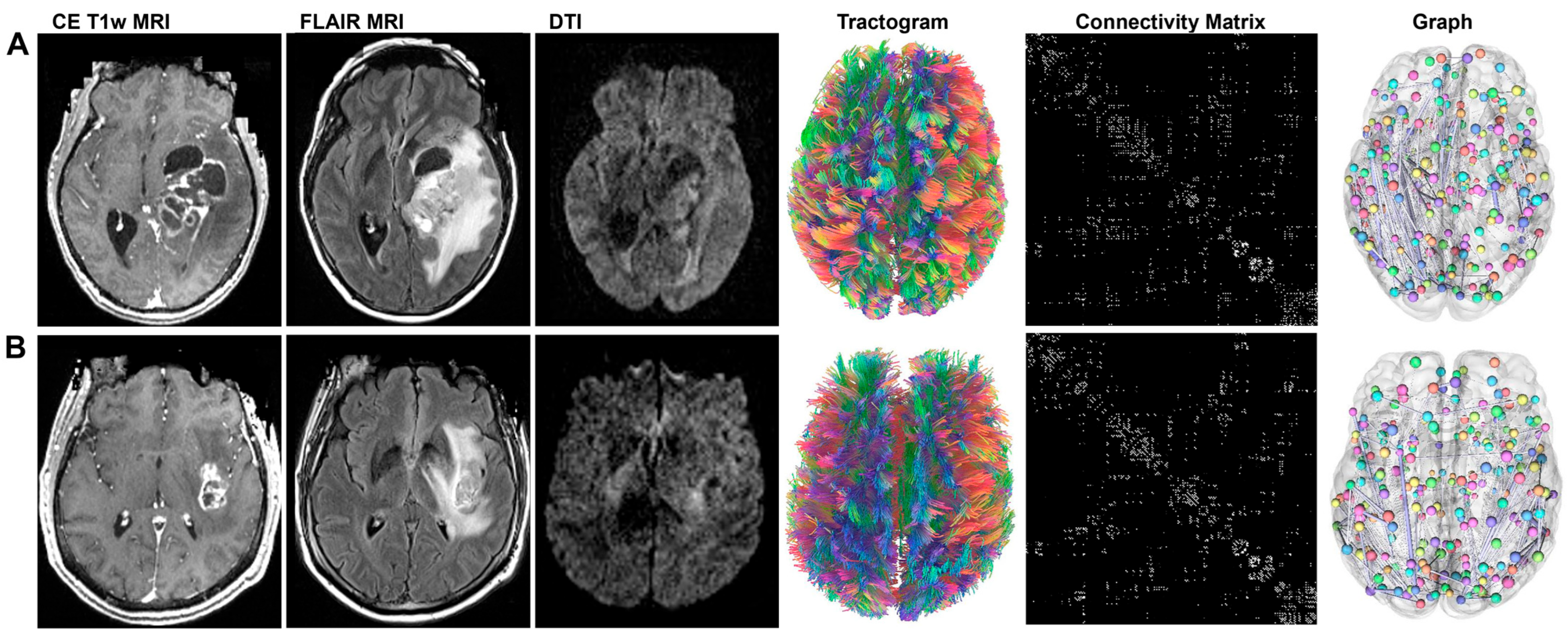
3.1. Graph-Theoretical Analysis
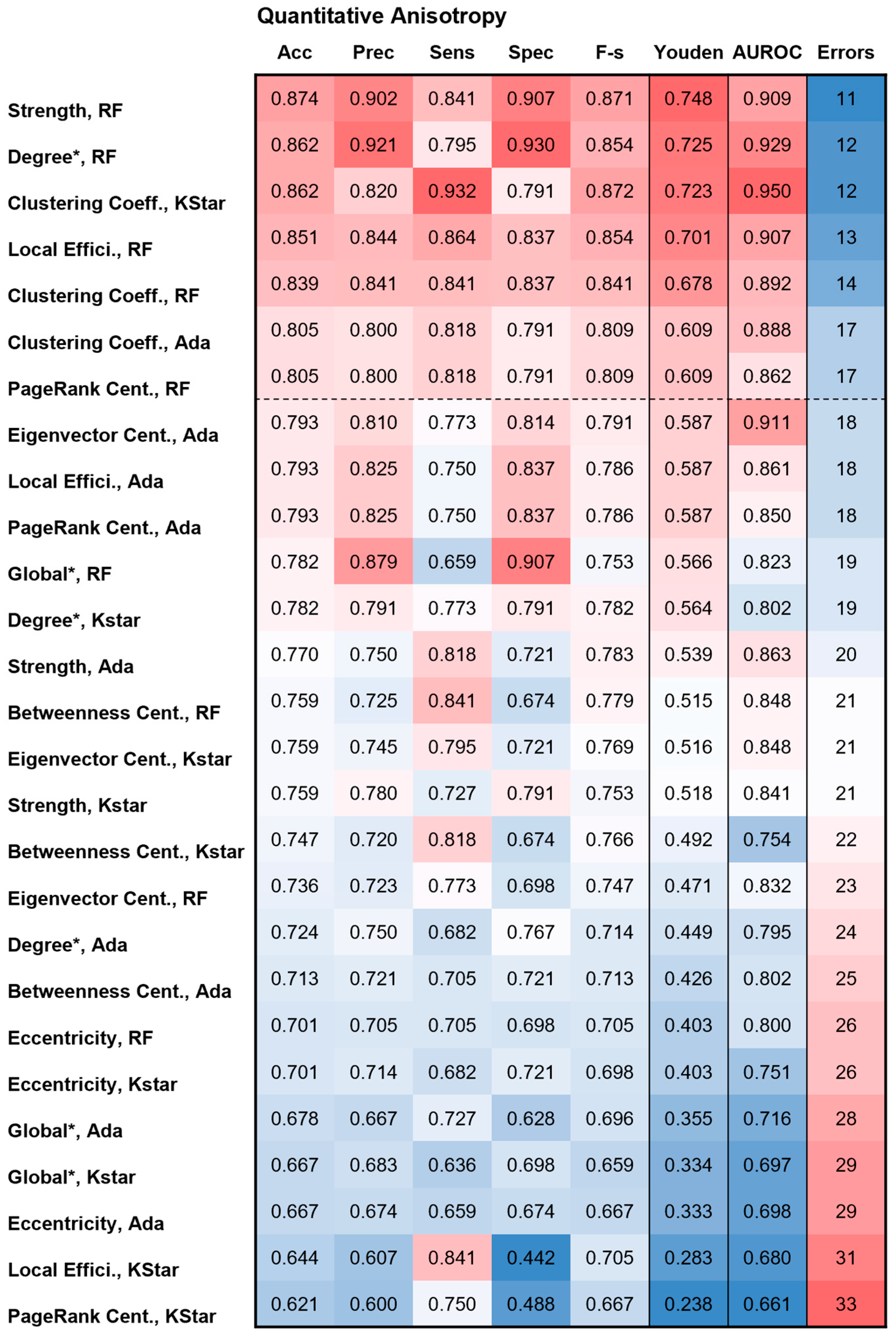
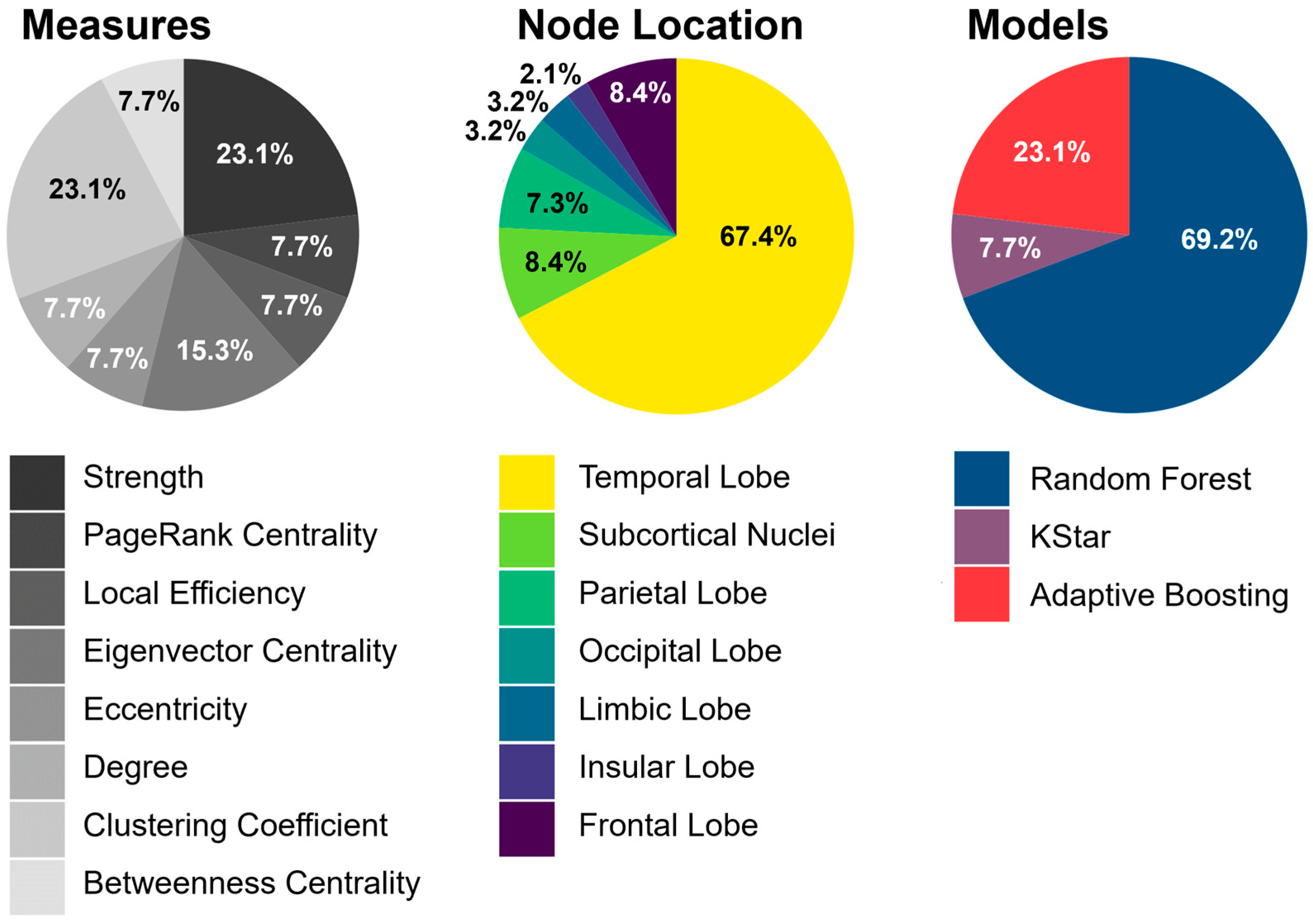
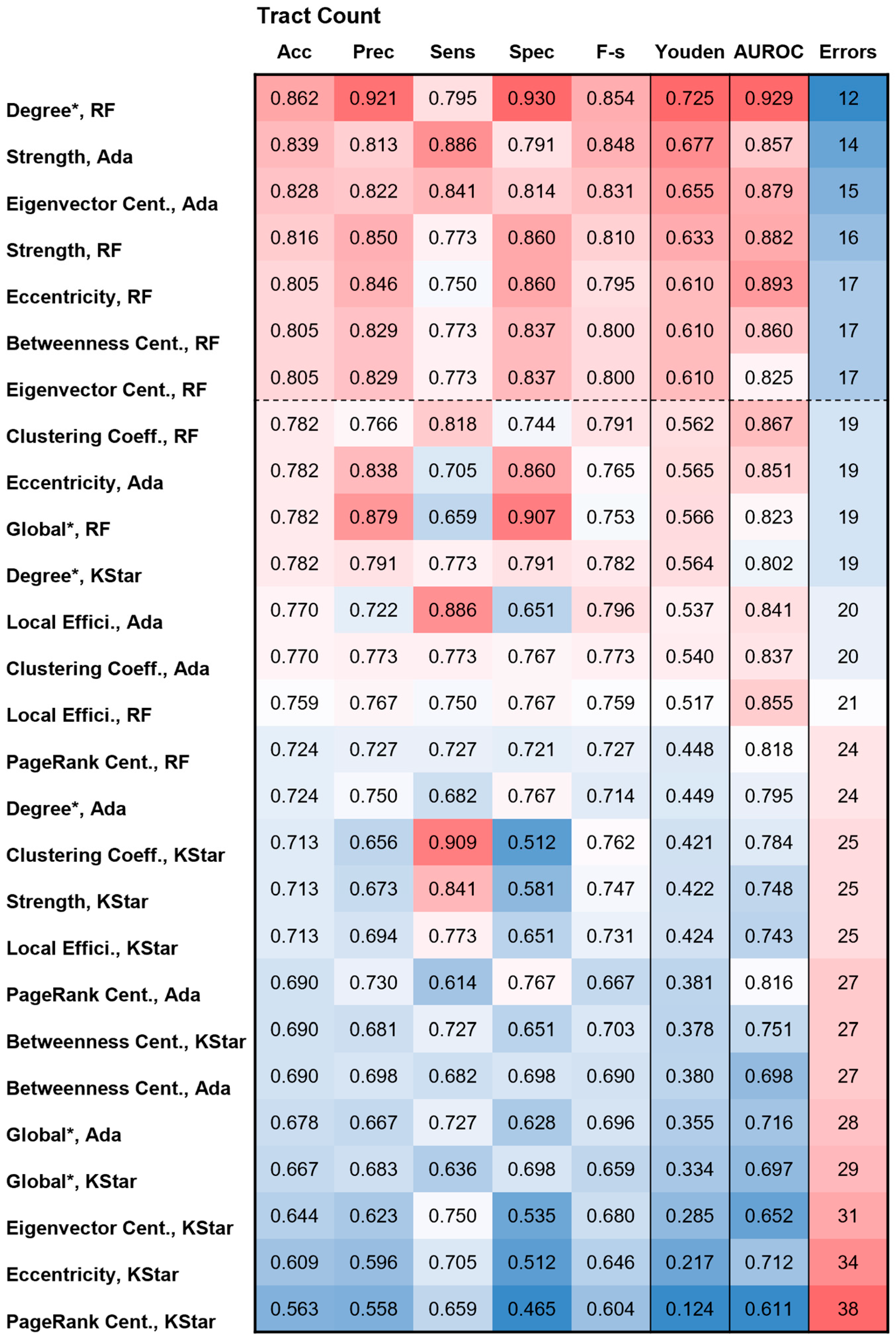
3.2. Training, Validation and Selection of Models
3.3. Held-Out Internal Testing of the Selected Models
4. Discussion
5. Conclusions
Supplementary Materials
Author Contributions
Funding
Institutional Review Board Statement
Informed Consent Statement
Data Availability Statement
Acknowledgments
Conflicts of Interest
Abbreviations
| ML | machine learning |
| DTI | diffusion tensor imaging |
| OS | overall survival |
| QA | quantitative anisotropy |
| AUROC | area under the receiver operating characteristic curve |
| IDH | isocitrate dehydrogenase |
| MGMT | O6-methylguanine-DNA methyltransferase |
| TCIA | The Cancer Imaging Archive |
| UPenn-GBM | University of Pennsylvania glioblastoma |
| UCSF-PDGM | University of California San Francisco Preoperative Diffuse Glioma MRI |
| HARDI | high angular resolution diffusion imaging |
| DICOM | Digital Imaging and Communications in Medicine |
| QSDR | Q-space diffeomorphic reconstruction |
| SDF | spin distribution function |
| MNI | Montreal Neurological Institute |
| KPS | Karnofsky Performance Status |
| SMOTE | Synthetic Minority Oversampling Technique |
| NB | naïve Bayes |
| Log | logistic regression |
| MP | multilayer perceptron |
| SVM | support vector machine |
| kNN | k-nearest neighbors |
| Ada | adaptive boosting |
| RF | random forest |
| Bag | bootstrap aggregating |
| GTR | gross total resection |
| STR | subtotal resection |
| ceT1w | contrast-enhanced T1-weighted |
| FLAIR | Fluid-Attenuated Inversion Recovery |
| Acc | accuracy |
| Prec | precision |
| Sens | sensitivity |
| Spec | specificity |
| F-s | F-score |
| NA | not available |
References
- Louis, D.N.; Perry, A.; Wesseling, P.; Brat, D.J.; Cree, I.A.; Figarella-Branger, D.; Hawkins, C.; Ng, H.K.; Pfister, S.M.; Reifenberger, G.; et al. The 2021 WHO Classification of Tumors of the Central Nervous System: A Summary. Neuro. Oncol. 2021, 23, 1231–1251. [Google Scholar] [CrossRef]
- Hegi, M.E.; Diserens, A.-C.; Gorlia, T.; Hamou, M.-F.; de Tribolet, N.; Weller, M.; Kros, J.M.; Hainfellner, J.A.; Mason, W.; Mariani, L.; et al. MGMT Gene Silencing and Benefit from Temozolomide in Glioblastoma. N. Engl. J. Med. 2005, 352, 997–1003. [Google Scholar] [CrossRef]
- Stupp, R.; Mason, W.P.; van den Bent, M.J.; Weller, M.; Fisher, B.; Taphoorn, M.J.B.; Belanger, K.; Brandes, A.A.; Marosi, C.; Bogdahn, U.; et al. Radiotherapy plus Concomitant and Adjuvant Temozolomide for Glioblastoma. N. Engl. J. Med. 2005, 352, 987–996. [Google Scholar] [CrossRef]
- Poursaeed, R.; Mohammadzadeh, M.; Safaei, A.A. Survival Prediction of Glioblastoma Patients Using Machine Learning and Deep Learning: A Systematic Review. BMC Cancer 2024, 24, 1581. [Google Scholar] [CrossRef]
- Karsy, M.; Neil, J.A.; Guan, J.; Mahan, M.A.; Colman, H.; Jensen, R.L. A Practical Review of Prognostic Correlations of Molecular Biomarkers in Glioblastoma. Neurosurg. Focus 2015, 38, E4. [Google Scholar] [CrossRef]
- Eckel-Passow, J.E.; Lachance, D.H.; Molinaro, A.M.; Walsh, K.M.; Decker, P.A.; Sicotte, H.; Pekmezci, M.; Rice, T.; Kosel, M.L.; Smirnov, I.V.; et al. Glioma Groups Based on 1p/19q, IDH, and TERT Promoter Mutations in Tumors. N. Engl. J. Med. 2015, 372, 2499–2508. [Google Scholar] [CrossRef]
- Aldape, K.; Zadeh, G.; Mansouri, S.; Reifenberger, G.; von Deimling, A. Glioblastoma: Pathology, Molecular Mechanisms and Markers. Acta Neuropathol. 2015, 129, 829–848. [Google Scholar] [CrossRef] [PubMed]
- van Dijck, J.T.J.M.; Ardon, H.; Balvers, R.K.; Bos, E.M.; Bosscher, L.; Brouwers, H.B.; Ho, V.K.Y.; Hovinga, K.; Kwee, L.; ter Laan, M.; et al. Survival Prediction in Glioblastoma: 10-Year Follow-Up from the Dutch Neurosurgery Quality Registry. J. Neurooncol. 2025, 174, 753–764. [Google Scholar] [CrossRef] [PubMed]
- Mijderwijk, H.-J.; Nieboer, D.; Incekara, F.; Berger, K.; Steyerberg, E.W.; van den Bent, M.J.; Reifenberger, G.; Hänggi, D.; Smits, M.; Senft, C.; et al. Development and External Validation of a Clinical Prediction Model for Survival in Patients with IDH Wild-Type Glioblastoma. J. Neurosurg. 2022, 137, 914–923. [Google Scholar] [CrossRef]
- Westphal, M.; Lamszus, K. The Neurobiology of Gliomas: From Cell Biology to the Development of Therapeutic Approaches. Nat. Rev. Neurosci. 2011, 12, 495–508. [Google Scholar] [CrossRef] [PubMed]
- Sporns, O.; Tononi, G.; Kötter, R. The Human Connectome: A Structural Description of the Human Brain. PLoS Comput. Biol. 2005, 1, e42. [Google Scholar] [CrossRef] [PubMed]
- Wei, Y.; Li, C.; Cui, Z.; Mayrand, R.C.; Zou, J.; Wong, A.L.K.C.; Sinha, R.; Matys, T.; Schönlieb, C.-B.; Price, S.J. Structural Connectome Quantifies Tumour Invasion and Predicts Survival in Glioblastoma Patients. Brain 2023, 146, 1714–1727. [Google Scholar] [CrossRef] [PubMed]
- Colpo, M.; Silvestri, E.; Salvalaggio, A.; Cecchin, D.; Corbetta, M.; Bertoldo, A. Structural-Functional Fingerprinting for Abnormalities Investigation in Glioma Patients. Sci. Rep. 2025, 15, 38404. [Google Scholar] [CrossRef] [PubMed]
- Mandal, A.S.; Brem, S.; Suckling, J. Brain Network Mapping and Glioma Pathophysiology. Brain Commun. 2023, 5, 2006. [Google Scholar] [CrossRef]
- Rubinov, M.; Sporns, O. Complex Network Measures of Brain Connectivity: Uses and Interpretations. Neuroimage 2010, 52, 1059–1069. [Google Scholar] [CrossRef]
- van den Heuvel, M.P.; Sporns, O. Network Hubs in the Human Brain. Trends Cogn. Sci. 2013, 17, 683–696. [Google Scholar] [CrossRef]
- Bullmore, E.; Sporns, O. Complex Brain Networks: Graph Theoretical Analysis of Structural and Functional Systems. Nat. Rev. Neurosci. 2009, 10, 186–198. [Google Scholar] [CrossRef]
- Ogut, E. Graph-Theoretical Mapping of Cortical and Subcortical Network Alterations in Preclinical Neurodegeneration. Discov. Neurosci. 2025, 20, 14. [Google Scholar] [CrossRef]
- Hejazi, S.; Karwowski, W.; Farahani, F.V.; Marek, T.; Hancock, P.A. Graph-Based Analysis of Brain Connectivity in Multiple Sclerosis Using Functional MRI: A Systematic Review. Brain Sci. 2023, 13, 246. [Google Scholar] [CrossRef]
- Karim, S.M.S.; Fahad, M.S.; Rathore, R.S. Identifying Discriminative Features of Brain Network for Prediction of Alzheimer’s Disease Using Graph Theory and Machine Learning. Front. Neuroinform. 2024, 18, 1384720. [Google Scholar] [CrossRef]
- Semmel, E.S.; Quadri, T.R.; King, T.Z. Graph Theoretical Analysis of Brain Network Characteristics in Brain Tumor Patients: A Systematic Review. Neuropsychol. Rev. 2022, 32, 651–675. [Google Scholar] [CrossRef]
- Bassett, D.S.; Sporns, O. Network Neuroscience. Nat. Neurosci. 2017, 20, 353–364. [Google Scholar] [CrossRef] [PubMed]
- Mahajan, P.; Uddin, S.; Hajati, F.; Moni, M.A. Ensemble Learning for Disease Prediction: A Review. Healthcare 2023, 11, 1808. [Google Scholar] [CrossRef] [PubMed]
- Naderalvojoud, B.; Hernandez-Boussard, T. Improving Machine Learning with Ensemble Learning on Observational Healthcare Data. AMIA Annu. Symp. Proc. 2023, 2023, 521–529. [Google Scholar]
- Bakas, S.; Sako, C.; Akbari, H.; Bilello, M.; Sotiras, A.; Shukla, G.; Rudie, J.D.; Santamaría, N.F.; Kazerooni, A.F.; Pati, S.; et al. The University of Pennsylvania Glioblastoma (UPenn-GBM) Cohort: Advanced MRI, Clinical, Genomics, & Radiomics. Sci. Data 2022, 9, 453. [Google Scholar] [CrossRef]
- Calabrese, E.; Villanueva-Meyer, J.E.; Rudie, J.D.; Rauschecker, A.M.; Baid, U.; Bakas, S.; Cha, S.; Mongan, J.T.; Hess, C.P. The University of California San Francisco Preoperative Diffuse Glioma MRI Dataset. Radiol. Artif. Intell. 2022, 4, 6. [Google Scholar] [CrossRef] [PubMed]
- Frank, E.; Hall, M.; Trigg, L.; Holmes, G.; Witten, I.H. Data Mining in Bioinformatics Using Weka. Bioinformatics 2004, 20, 2479–2481. [Google Scholar] [CrossRef]
- Yeh, F.-C. DSI Studio: An Integrated Tractography Platform and Fiber Data Hub for Accelerating Brain Research. Nat. Methods 2025, 22, 1617–1619. [Google Scholar] [CrossRef]
- Yeh, F.-C.; Wedeen, V.J.; Tseng, W.-Y.I. Estimation of Fiber Orientation and Spin Density Distribution by Diffusion Deconvolution. Neuroimage 2011, 55, 1054–1062. [Google Scholar] [CrossRef]
- Yeh, F.-C.; Tseng, W.-Y.I. NTU-90: A High Angular Resolution Brain Atlas Constructed by q-Space Diffeomorphic Reconstruction. Neuroimage 2011, 58, 91–99. [Google Scholar] [CrossRef]
- Yeh, F.-C.; Wedeen, V.J.; Tseng, W.-Y.I. Generalized Q-Sampling Imaging. IEEE Trans. Med. Imaging 2010, 29, 1626–1635. [Google Scholar] [CrossRef]
- Yeh, F.-C.; Vettel, J.M.; Singh, A.; Poczos, B.; Grafton, S.T.; Erickson, K.I.; Tseng, W.-Y.I.; Verstynen, T.D. Quantifying Differences and Similarities in Whole-Brain White Matter Architecture Using Local Connectome Fingerprints. PLoS Comput. Biol. 2016, 12, e1005203. [Google Scholar] [CrossRef] [PubMed]
- Yeh, F.-C.; Verstynen, T.D.; Wang, Y.; Fernández-Miranda, J.C.; Tseng, W.-Y.I. Deterministic Diffusion Fiber Tracking Improved by Quantitative Anisotropy. PLoS ONE 2013, 8, e80713. [Google Scholar] [CrossRef]
- Yeh, F.-C. Shape Analysis of the Human Association Pathways. Neuroimage 2020, 223, 117329. [Google Scholar] [CrossRef]
- Fan, L.; Li, H.; Zhuo, J.; Zhang, Y.; Wang, J.; Chen, L.; Yang, Z.; Chu, C.; Xie, S.; Laird, A.R.; et al. The Human Brainnetome Atlas: A New Brain Atlas Based on Connectional Architecture. Cereb. Cortex 2016, 26, 3508–3526. [Google Scholar] [CrossRef]
- Zacharaki, E.I.; Wang, S.; Chawla, S.; Soo Yoo, D.; Wolf, R.; Melhem, E.R.; Davatzikos, C. Classification of Brain Tumor Type and Grade Using MRI Texture and Shape in a Machine Learning Scheme. Magn. Reson. Med. 2009, 62, 1609–1618. [Google Scholar] [CrossRef]
- Stadlbauer, A.; Marhold, F.; Oberndorfer, S.; Heinz, G.; Buchfelder, M.; Kinfe, T.M.; Meyer-Bäse, A. Radiophysiomics: Brain Tumors Classification by Machine Learning and Physiological MRI Data. Cancers 2022, 14, 2363. [Google Scholar] [CrossRef] [PubMed]
- Chawla, N.V.; Bowyer, K.W.; Hall, L.O.; Kegelmeyer, W.P. SMOTE: Synthetic Minority Over-Sampling Technique. J. Artif. Intell. Res. 2002, 16, 321–357. [Google Scholar] [CrossRef]
- Zacharaki, E.I.; Kanas, V.G.; Davatzikos, C. Investigating Machine Learning Techniques for MRI-Based Classification of Brain Neoplasms. Int. J. Comput. Assist. Radiol. Surg. 2011, 6, 821–828. [Google Scholar] [CrossRef]
- Payabvash, S.; Aboian, M.; Tihan, T.; Cha, S. Machine Learning Decision Tree Models for Differentiation of Posterior Fossa Tumors Using Diffusion Histogram Analysis and Structural MRI Findings. Front. Oncol. 2020, 10, 71. [Google Scholar] [CrossRef]
- Cleary, J.G.; Trigg, L.E. K*: An Instance-Based Learner Using an Entropic Distance Measure. In Proceedings of the Twelfth International Conference on Machine Learning, Tahoe City, CA, USA, 9–12 July 1995; Elsevier: Amsterdam, The Netherlands, 1995; pp. 108–114. [Google Scholar]
- Cawley, G.C.; Talbot, N.L.C. On Over-Fitting in Model Selection and Subsequent Selection Bias in Performance Evaluation. J. Mach. Learn. Res. 2010, 11, 2079–2107. [Google Scholar]
- Shim, M.; Lee, S.-H.; Hwang, H.-J. Inflated Prediction Accuracy of Neuropsychiatric Biomarkers Caused by Data Leakage in Feature Selection. Sci. Rep. 2021, 11, 7980. [Google Scholar] [CrossRef]
- Bradley, A.P. The Use of the Area under the ROC Curve in the Evaluation of Machine Learning Algorithms. Pattern Recognit. 1997, 30, 1145–1159. [Google Scholar] [CrossRef]
- Wilson, E.B. Probable Inference, the Law of Succession, and Statistical Inference. J. Am. Stat. Assoc. 1927, 22, 209–212. [Google Scholar] [CrossRef]
- Fekonja, L.S.; Wang, Z.; Cacciola, A.; Roine, T.; Aydogan, D.B.; Mewes, D.; Vellmer, S.; Vajkoczy, P.; Picht, T. Network Analysis Shows Decreased Ipsilesional Structural Connectivity in Glioma Patients. Commun. Biol. 2022, 5, 258. [Google Scholar] [CrossRef] [PubMed]
- Pasquini, L.; Jenabi, M.; Yildirim, O.; Silveira, P.; Peck, K.K.; Holodny, A.I. Brain Functional Connectivity in Low- and High-Grade Gliomas: Differences in Network Dynamics Associated with Tumor Grade and Location. Cancers 2022, 14, 3327. [Google Scholar] [CrossRef] [PubMed]
- De Roeck, L.; Colaes, R.; Dupont, P.; Sunaert, S.; De Vleeschouwer, S.; Clement, P.M.; Sleurs, C.; Lambrecht, M. Increased Functional Network Segregation in Glioma Patients Posttherapy: A Neurological Compensatory Response or Catastrophe for Cognition? Netw. Neurosci. 2025, 9, 743–760. [Google Scholar] [CrossRef]
- Romero-Garcia, R.; Suckling, J.; Owen, M.; Assem, M.; Sinha, R.; Coelho, P.; Woodberry, E.; Price, S.J.; Burke, A.; Santarius, T.; et al. Memory Recovery in Relation to Default Mode Network Impairment and Neurite Density during Brain Tumor Treatment. J. Neurosurg. 2022, 136, 358–368. [Google Scholar] [CrossRef]
- Tuch, D.S. Q-ball Imaging. Magn. Reson. Med. 2004, 52, 1358–1372. [Google Scholar] [CrossRef]
- Yeh, F.-C.; Badre, D.; Verstynen, T. Connectometry: A Statistical Approach Harnessing the Analytical Potential of the Local Connectome. Neuroimage 2016, 125, 162–171. [Google Scholar] [CrossRef]
- Papinutto, N.; Galantucci, S.; Mandelli, M.L.; Gesierich, B.; Jovicich, J.; Caverzasi, E.; Henry, R.G.; Seeley, W.W.; Miller, B.L.; Shapiro, K.A.; et al. Structural Connectivity of the Human Anterior Temporal Lobe: A Diffusion Magnetic Resonance Imaging Study. Hum. Brain Mapp. 2016, 37, 2210–2222. [Google Scholar] [CrossRef] [PubMed]
- Herbet, G.; Maheu, M.; Costi, E.; Lafargue, G.; Duffau, H. Mapping Neuroplastic Potential in Brain-Damaged Patients. Brain 2016, 139, 829–844. [Google Scholar] [CrossRef]
- Bao, H.; Wang, H.; Sun, Q.; Wang, Y.; Liu, H.; Liang, P.; Lv, Z. The Involvement of Brain Regions Associated with Lower KPS and Shorter Survival Time Predicts a Poor Prognosis in Glioma. Front. Neurol. 2023, 14, 1264322. [Google Scholar] [CrossRef] [PubMed]
- Luckett, P.H.; Olufawo, M.; Lamichhane, B.; Park, K.Y.; Dierker, D.; Verastegui, G.T.; Yang, P.; Kim, A.H.; Chheda, M.G.; Snyder, A.Z.; et al. Predicting Survival in Glioblastoma with Multimodal Neuroimaging and Machine Learning. J. Neurooncol. 2023, 164, 309–320. [Google Scholar] [CrossRef] [PubMed]
- Hwang, K.; Bertolero, M.A.; Liu, W.B.; D’Esposito, M. The Human Thalamus Is an Integrative Hub for Functional Brain Networks. J. Neurosci. 2017, 37, 5594–5607. [Google Scholar] [CrossRef]
- Bouwen, B.L.J.; Pieterman, K.J.; Smits, M.; Dirven, C.M.F.; Gao, Z.; Vincent, A.J.P.E. The Impacts of Tumor and Tumor Associated Epilepsy on Subcortical Brain Structures and Long Distance Connectivity in Patients with Low Grade Glioma. Front. Neurol. 2018, 9, 1004. [Google Scholar] [CrossRef]
- Boes, A.D.; Prasad, S.; Liu, H.; Liu, Q.; Pascual-Leone, A.; Caviness, V.S.; Fox, M.D. Network Localization of Neurological Symptoms from Focal Brain Lesions. Brain 2015, 138, 3061–3075. [Google Scholar] [CrossRef]
- Kivioja, T.; Posti, J.P.; Sipilä, J.; Rauhala, M.; Frantzén, J.; Gardberg, M.; Rahi, M.; Rautajoki, K.; Nykter, M.; Vuorinen, V.; et al. Motor Dysfunction as a Primary Symptom Predicts Poor Outcome: Multicenter Study of Glioma Symptoms. Front. Oncol. 2024, 13, 1305725. [Google Scholar] [CrossRef]
- Cerono, G.; Melaiu, O.; Chicco, D. Clinical Feature Ranking Based on Ensemble Machine Learning Reveals Top Survival Factors for Glioblastoma Multiforme. J. Healthc. Inform. Res. 2024, 8, 1–18. [Google Scholar] [CrossRef]
- Wang, H.; Li, G. A Selective Review on Random Survival Forests for High Dimensional Data. Quant. Bio-Sci. 2017, 36, 85–96. [Google Scholar] [CrossRef]
- Duman, A.; Sun, X.; Thomas, S.; Powell, J.R.; Spezi, E. Reproducible and Interpretable Machine Learning-Based Radiomic Analysis for Overall Survival Prediction in Glioblastoma Multiforme. Cancers 2024, 16, 3351. [Google Scholar] [CrossRef]
- Karabacak, M.; Patil, S.; Gersey, Z.C.; Komotar, R.J.; Margetis, K. Radiomics-Based Machine Learning with Natural Gradient Boosting for Continuous Survival Prediction in Glioblastoma. Cancers 2024, 16, 3614. [Google Scholar] [CrossRef] [PubMed]
- Marasi, A.; Milesi, D.; Aquino, D.; Doniselli, F.M.; Pascuzzo, R.; Grisoli, M.; Redaelli, A.; De Momi, E. Glioblastoma Survival Prediction through MRI and Clinical Data Integration with Transfer Learning. Int. J. Comput. Assist. Radiol. Surg. 2025, 21, 473–482. [Google Scholar] [CrossRef]
- Fornito, A.; Zalesky, A.; Breakspear, M. The Connectomics of Brain Disorders. Nat. Rev. Neurosci. 2015, 16, 159–172. [Google Scholar] [CrossRef]
- De Roeck, L.; Blommaert, J.; Dupont, P.; Sunaert, S.; Sleurs, C.; Lambrecht, M. Brain Network Topology and Its Cognitive Impact in Adult Glioma Survivors. Sci. Rep. 2024, 14, 12782. [Google Scholar] [CrossRef]
- Gopalakrishnan, V.; Parekh, V.; LeCompte, M.C.; Huang, E.; Suresh, A.; Tarui, Y.; Li, A.; Reyes, J.M.; Redmond, K.J.; Jacobs, M.A.; et al. Machine Learning with Connectomics to Predict Prognosis in Glioblastoma after Radiation. Int. J. Radiat. Oncol. 2025, 123, e738. [Google Scholar] [CrossRef]
- Sporns, O.; Kötter, R. Motifs in Brain Networks. PLoS Biol. 2004, 2, e369. [Google Scholar] [CrossRef] [PubMed]





| UPenn-GBM | UCSF-PDGM | Training/ Validation | Held-Out Internal Testing | |
|---|---|---|---|---|
| Total number of patients | 498 | 373 | 784 | 87 |
| Age (mean ± sd) | 63.4 ± 11.8 yrs | 61.7 ± 12.0 yrs | 62.9 ± 11.8 yrs | 60.6 ± 12.6 yrs |
| Age Range | 21–89 yrs | 21–94 yrs | 21–94 yrs | 33–88 yrs |
| Gender: female | 199 (40.0%) | 152 (40.8%) | 320 (40.8%) | 31 (35.6%) |
| Gender: male | 299 (60.0%) | 221 (59.2%) | 464 (59.2%) | 56 (64.4%) |
| Overall survival median | 387 d | 361 d | 376 d | 365 d |
| Overall survival range | 3–2951 d | 6–2144 d | 3–2951 d | 17–2021 d |
| Extent of Resection: GTR | 288 (57.8%) | 218 (58.4%) | 449 (57.3%) | 57 (65.5%) |
| Extent of Resection: STR | 172 (34.6%) | 155 (41.6%) | 300 (38.3%) | 27 (31.0%) |
| Extent of Resection: NA | 38 (7.6%) | - | 35 (4.4%) | 3 (3.5%) |
| MGMT unmethylated | 135 (27.1%) | 105 (28.2%) | 208 (26.5%) | 32 (36.8%) |
| MGMT methylated | 112 (22.5%) | 256 (68.6%) | 325 (41.5%) | 43 (49.4%) |
| NA | 251 (50.4%) | 12 (3.2%) | 251 (32.0%) | 12 (13.8%) |
| KPS ≥ 80 | 60 (12.1%) | - | 55 (7.0%) | 5 (5.8%) |
| KPS < 80 | 13 (2.6%) | - | 12 (1.5%) | 1 (1.1%) |
| NA | 425 (85.3%) | 373 (100%) | 717 (91.5%) | 81 (93.1%) |
| patients with OS ≥ 1a | 270 (54.2%) | 183 (49.1%) | 409 (52.2%) | 44 (50.6%) |
| patients with OS < 1a | 228 (45.8%) | 190 (50.9%) | 375 (47.8%) | 43 (49.4%) |
Disclaimer/Publisher’s Note: The statements, opinions and data contained in all publications are solely those of the individual author(s) and contributor(s) and not of MDPI and/or the editor(s). MDPI and/or the editor(s) disclaim responsibility for any injury to people or property resulting from any ideas, methods, instructions or products referred to in the content. |
© 2026 by the authors. Licensee MDPI, Basel, Switzerland. This article is an open access article distributed under the terms and conditions of the Creative Commons Attribution (CC BY) license.
Share and Cite
Stadlbauer, A.; Oberndorfer, S.; Heinz, G.; Marhold, F.; Kinfe, T.M.; Dorostkar, M.; Schnell, O.; Meyer-Bäse, U.; Meyer-Bäse, A. Machine-Learning-Based Survival Prediction in Glioblastoma Using Graph-Theoretical Analysis of Structural Network Alterations. Cancers 2026, 18, 1161. https://doi.org/10.3390/cancers18071161
Stadlbauer A, Oberndorfer S, Heinz G, Marhold F, Kinfe TM, Dorostkar M, Schnell O, Meyer-Bäse U, Meyer-Bäse A. Machine-Learning-Based Survival Prediction in Glioblastoma Using Graph-Theoretical Analysis of Structural Network Alterations. Cancers. 2026; 18(7):1161. https://doi.org/10.3390/cancers18071161
Chicago/Turabian StyleStadlbauer, Andreas, Stefan Oberndorfer, Gertraud Heinz, Franz Marhold, Thomas M. Kinfe, Mario Dorostkar, Oliver Schnell, Uwe Meyer-Bäse, and Anke Meyer-Bäse. 2026. "Machine-Learning-Based Survival Prediction in Glioblastoma Using Graph-Theoretical Analysis of Structural Network Alterations" Cancers 18, no. 7: 1161. https://doi.org/10.3390/cancers18071161
APA StyleStadlbauer, A., Oberndorfer, S., Heinz, G., Marhold, F., Kinfe, T. M., Dorostkar, M., Schnell, O., Meyer-Bäse, U., & Meyer-Bäse, A. (2026). Machine-Learning-Based Survival Prediction in Glioblastoma Using Graph-Theoretical Analysis of Structural Network Alterations. Cancers, 18(7), 1161. https://doi.org/10.3390/cancers18071161