The Obesity Paradox in Hepatocellular Carcinoma: Insights from Continuous and Interaction-Based Analyses of Body Mass Index After Hepatic Resection
 , , , , , and
Simple Summary
Abstract
1. Introduction
2. Materials and Methods
2.1. Study Design and Patient Selection
2.2. Preoperative Assessment
2.3. Surgical Procedure
2.4. Data Collection and Variables
2.5. Definition of Outcomes
2.6. Statistical Analysis
3. Results
3.1. Baseline Characteristics According to BMI Category
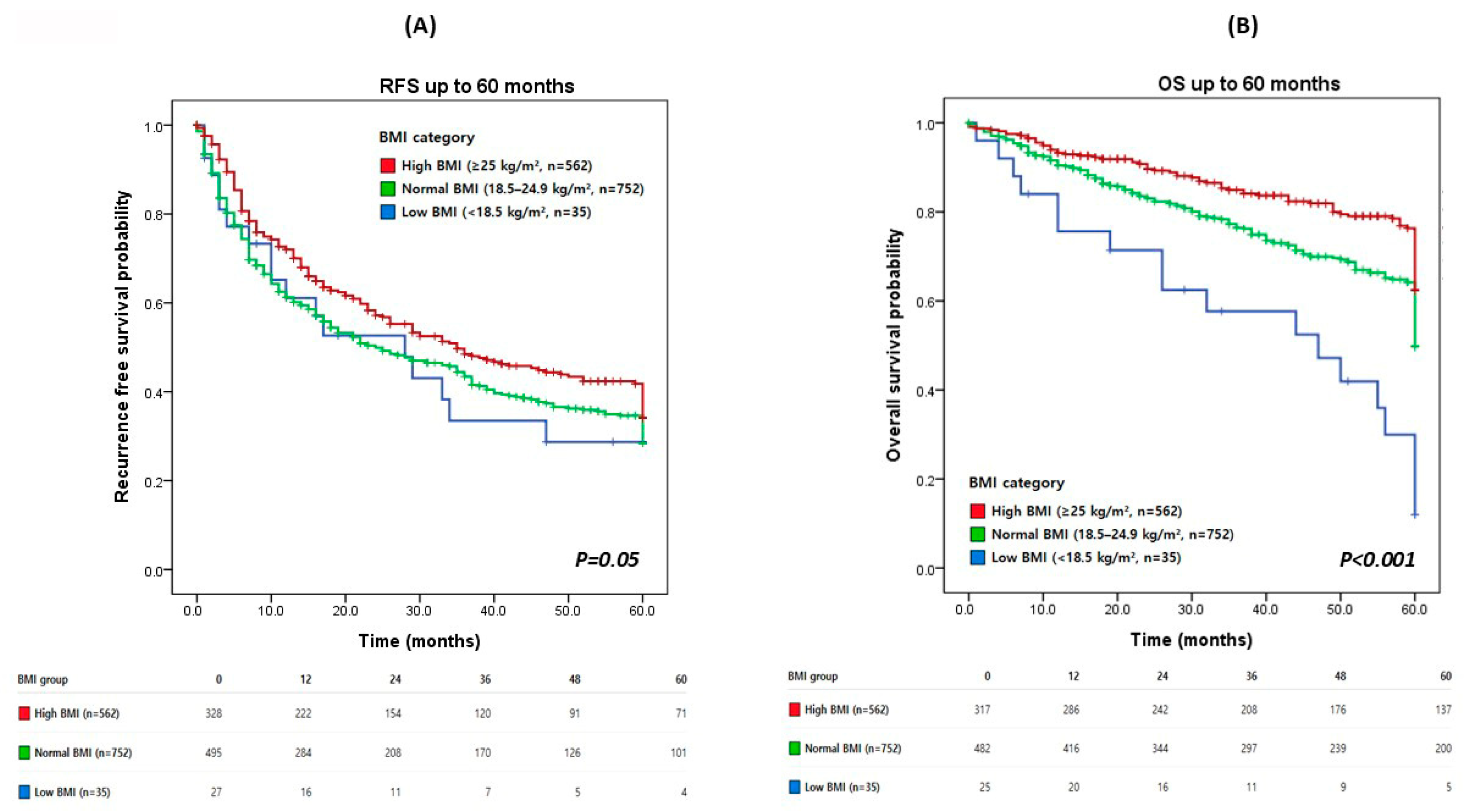
3.2. Survival Outcomes According to BMI Category
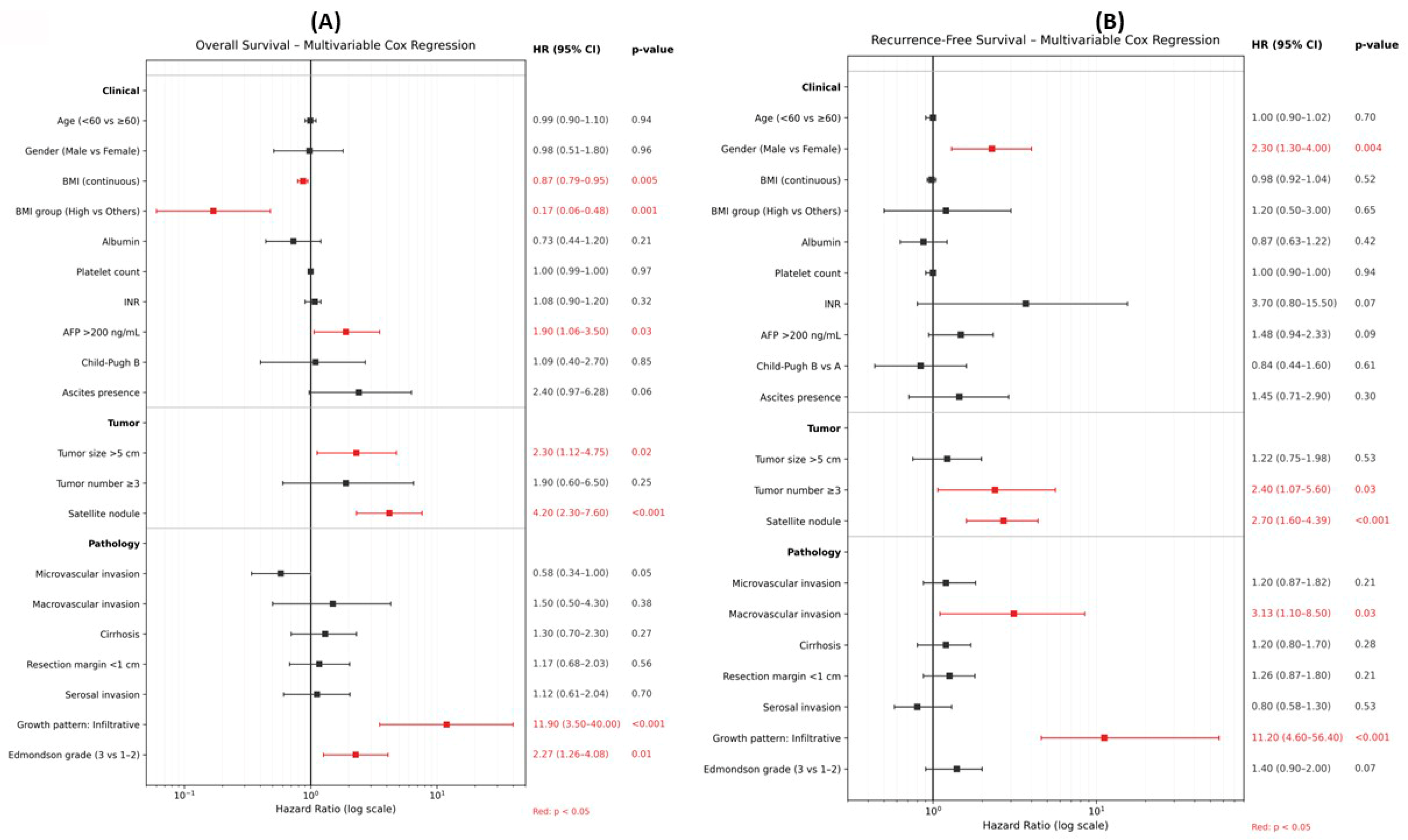
3.3. Multivariable Cox Regression Analysis for Survival Outcomes
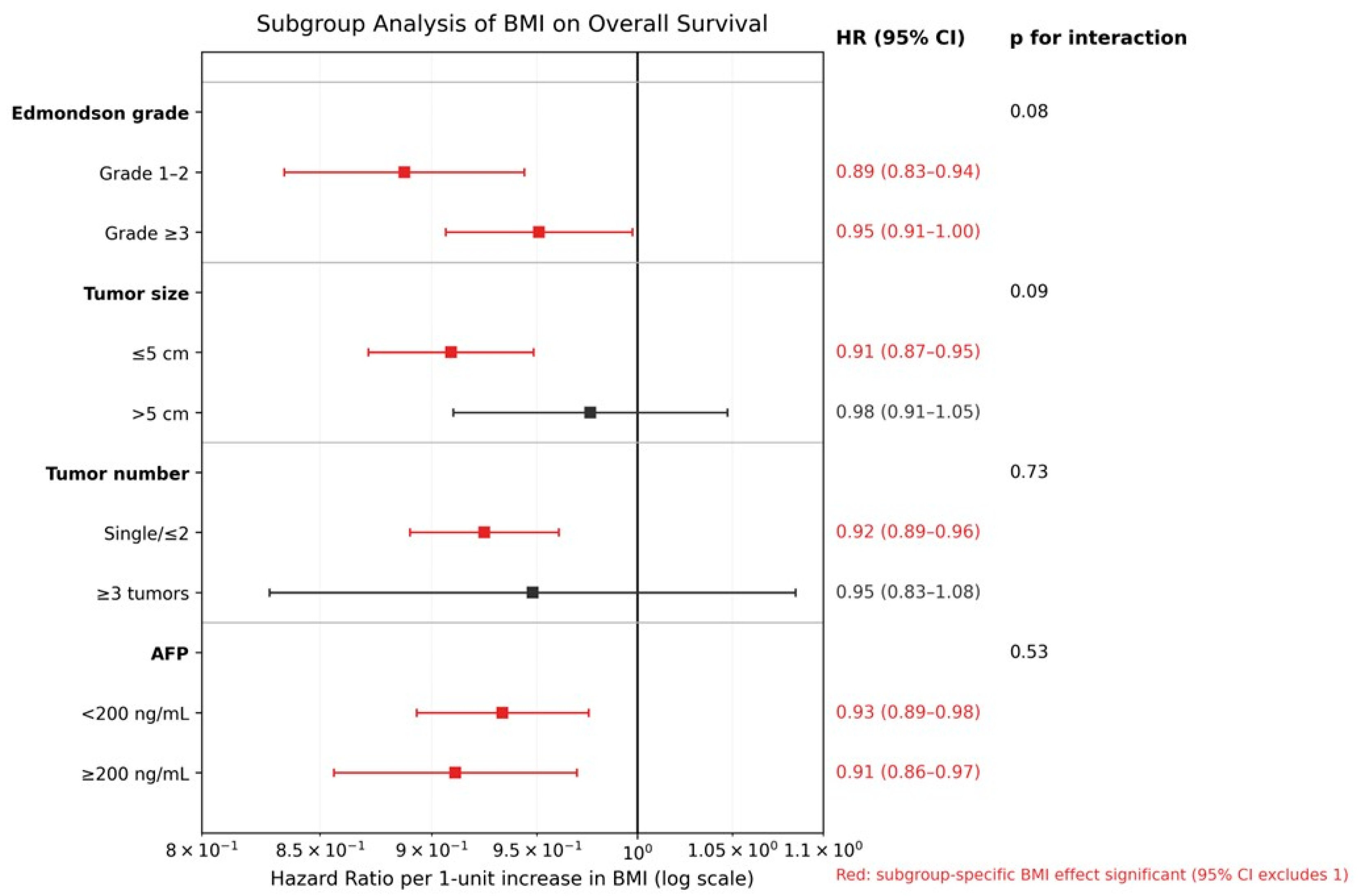
3.4. Subgroup Analysis of BMI on Overall Survival
4. Discussion
5. Conclusions
Author Contributions
Funding
Institutional Review Board Statement
Informed Consent Statement
Data Availability Statement
Conflicts of Interest
Abbreviations
| HCC | Hepatocellular carcinoma |
| BMI | Body mass index |
| OS | Overall survival |
| RFS | Recurrence-free survival |
| AFP | Alpha-fetoprotein |
| LLR | Laparoscopic liver resection |
| RFA | Radiofrequency ablation |
| TACE | Transarterial chemoembolization |
| AJCC | American Joint Committee on Cancer |
| BCLC | Barcelona Clinic Liver Cancer |
References
- Akinyemiju, T.; Abera, S.; Ahmed, M.; Alam, N.; Alemayohu, M.A.; Allen, C.; Al-Raddadi, R.; Alvis-Guzman, N.; Amoako, Y.; Artaman, A.; et al. Global Burden of Disease Liver Cancer Collaboration. The Burden of Primary Liver Cancer and Underlying Etiologies from 1990 to 2015 at the Global, Regional, and National Level. JAMA Oncol. 2017, 3, 1683–1691. [Google Scholar] [CrossRef] [PubMed]
- Yang, J.D.; Hainaut, P.; Gores, G.J.; Amadou, A.; Plymoth, A.; Roberts, L.R. A global view of hepatocellular carcinoma: Trends, risk, prevention and management. Nat. Rev. Gastroenterol. Hepatol. 2019, 16, 589–604. [Google Scholar] [CrossRef]
- Villanueva, A. Hepatocellular carcinoma. N. Engl. J. Med. 2019, 380, 1450–1462. [Google Scholar] [CrossRef] [PubMed]
- Heimbach, J.K.; Kulik, L.M.; Finn, R.S.; Sirlin, C.B.; Abecassis, M.M.; Roberts, L.R.; Zhu, A.X.; Murad, M.H.; Marrero, J.A. AASLD guidelines for the treatment of hepatocellular carcinoma. Hepatology 2017, 67, 358–380. [Google Scholar] [CrossRef] [PubMed]
- European Association for the Study of the Liver. EASL–EORTC Clinical Practice Guidelines: Management of hepatocellular carcinoma. J. Hepatol. 2012, 56, 908–943. [Google Scholar] [CrossRef]
- Plessier, A.; Codes, L.; Consigny, Y.; Sommacale, D.; Dondero, F.; Cortes, A.; Degos, F.; Brillet, P.-Y.; Vilgrain, V.; Paradis, V.; et al. Underestimation of the influence of satellite nodules as a risk factor for post-transplantation recurrence in patients with small hepatocellular carcinoma. Liver Transplant. 2004, 10, S86–S90. [Google Scholar] [CrossRef]
- Calle, E.E.; Rodriguez, C.; Walker-Thurmond, K.; Thun, M.J. Overweight, obesity, and mortality from cancer in a prospectively studied cohort of US adults. N. Engl. J. Med. 2003, 348, 1625–1638. [Google Scholar] [CrossRef]
- Omata, M.; Lesmana, L.A.; Tateishi, R.; Chen, P.-J.; Lin, S.-M.; Yoshida, H.; Kudo, M.; Lee, J.M.; Choi, B.I.; Poon, R.T.P.; et al. Asian Pacific Association for the Study of the Liver consensus recommendations on hepatocellular carcinoma. Hepatol. Int. 2010, 4, 439–474. [Google Scholar] [CrossRef]
- Itamoto, T.; Nakahara, H.; Amano, H.; Kohashi, T.; Ohdan, H.; Tashiro, H.; Asahara, T. Repeat hepatectomy for recurrent hepatocellular carcinoma. Surgery 2007, 141, 589–597. [Google Scholar] [CrossRef]
- Wu, C.C.; Cheng, S.B.; Yeh, D.C.; Wang, J.; P’eng, F.K. Second and third hepatectomies for recurrent hepatocellular carcinoma are justified. Br. J. Surg. 2009, 96, 1049–1057. [Google Scholar] [CrossRef]
- Ho, C.M.; Lee, P.H.; Shau, W.Y.; Ho, M.C.; Wu, Y.M.; Hu, R.H. Survival in patients with recurrent hepatocellular carcinoma after primary hepatectomy: Comparative effectiveness of treatment modalities. Surgery 2012, 151, 700–709. [Google Scholar] [CrossRef]
- Pinato, D.J.; Sharma, R. An inflammation-based prognostic index predicts survival advantage after transarterial chemoembolization in hepatocellular carcinoma. Transl. Res. 2012, 160, 146–152. [Google Scholar] [CrossRef] [PubMed]
- Lee, B.; Han, H.S.; Yoon, Y.S.; Cho, J.Y.; Lee, J.S. Impact of preoperative malnutrition, based on albumin level and body mass index, on operative outcomes in patients with pancreatic head cancer. J. Hepatobiliary Pancreat. Sci. 2021, 28, 1069–1075. [Google Scholar] [CrossRef] [PubMed]
- Lee, B.; Han, H.S.; Yoon, Y.S. Impact of preoperative malnutrition on postoperative long-term outcomes of patients with pancreatic head cancer. Ann. Surg. Open 2021, 2, e047. [Google Scholar] [CrossRef] [PubMed]
- Lee, B.; Han, H.S. Tackling surgical morbidity and mortality through modifiable risk factors in cancer patients. Nutrients 2022, 14, 3107. [Google Scholar] [CrossRef]
- Jeon, H.J.; Yoon, S.J.; Chae, H.C.; Kim, H.S.; Shin, S.H.; Han, I.W.; Heo, J.S.; Kim, H. Impact of preoperative prognostic factors on survival outcomes in intrahepatic cholangiocarcinoma: A retrospective cohort study. Ann. Surg. Treat. Res. 2025, 108, 345–351. [Google Scholar] [CrossRef]
- Lennon, H.; Sperrin, M.; Badrick, E.; Renehan, A.G. The obesity paradox in cancer: A review. Curr. Oncol. Rep. 2016, 18, 56. [Google Scholar] [CrossRef]
- Lee, B.; Han, H.S.; Yoon, Y.S.; Park, Y.; Kang, M.; Kim, J. Obesity paradox as a new insight from long-term survivors in pancreatic cancer patients. HPB 2025, 27, 922–929. [Google Scholar] [CrossRef]
- Celinski, S.A.; Gamblin, T.C. Hepatic resection nomenclature and techniques. Surg. Clin. N. Am. 2010, 90, 737–748. [Google Scholar] [CrossRef]
- Zhou, L.; Rui, J.A.; Ye, D.X.; Wang, S.B.; Chen, S.G.; Qu, Q. Edmondson-Steiner grading increases the predictive efficiency of TNM staging for long-term survival of patients with hepatocellular carcinoma after curative resection. World J. Surg. 2008, 32, 1748–1756. [Google Scholar] [CrossRef]
- Verma, M.; Rajput, M.; Kishore, K.; Kathirvel, S. Asian BMI criteria are better than WHO criteria in predicting hypertension: A cross-sectional study from rural India. J. Family Med. Prim. Care 2019, 8, 2095–2100. [Google Scholar] [CrossRef]
- Kroh, A.; Walter, J.; Fragoulis, A.; Möckel, D.; Lammers, T.; Kiessling, F.; Andruszkow, J.; Preisinger, C.; Egbert, M.; Jiao, L.; et al. Hepatocellular loss of mTOR aggravates tumor burden in nonalcoholic steatohepatitis-related HCC. Neoplasia 2023, 46, 100945. [Google Scholar] [CrossRef]
- Wang, J.; Chen, Z.; Wang, L.; Feng, S.; Qiu, Q.; Chen, D.; Li, N.; Xiao, Y. A new model based inflammatory index and tumor burden score (TBS) to predict the recurrence of hepatocellular carcinoma after liver resection. Sci. Rep. 2022, 12, 8670. [Google Scholar] [CrossRef]
- Ho, S.-Y.; Liu, P.-H.; Hsu, C.-Y.; Huang, Y.-H.; Liao, J.-I.; Su, C.-W.; Hou, M.-C.; Huo, T.-I. Tumor burden score as a new prognostic surrogate in patients with hepatocellular carcinoma undergoing radiofrequency ablation: Role of albumin-bilirubin (ALBI) grade vs easy ALBI grade. Expert. Rev. Gastroenterol. Hepatol. 2022, 16, 903–911. [Google Scholar] [CrossRef]
- Xu, L.; Wu, J.; Lu, W.; Yang, C.; Liu, H. Application of the albumin-bilirubin grade in predicting the prognosis of patients with hepatocellular carcinoma: A systematic review and meta-analysis. Transplant. Proc. 2019, 51, 3338–3346. [Google Scholar] [CrossRef] [PubMed]
- Zhou, S.; Wang, Z.; Li, M.; Wu, L. Elevated preoperative serum CA125 predicts larger tumor diameter in patients with hepatocellular carcinoma and low AFP levels. Biomed. Res. Int. 2019, 2019, 6959637. [Google Scholar] [CrossRef] [PubMed]
- Kim, S.J.; Jeong, W.K.; Han, H.J.; Choi, G.S.; Kim, K.H.; Kim, J. Comparison of initial treatments for resectable hepatocellular carcinoma within Milan criteria: An observational study based on a nationwide survey. Ann. Surg. Treat. Res. 2025, 108, 279–294. [Google Scholar] [CrossRef] [PubMed]
- Nevola, R.; Ruocco, R.; Criscuolo, L.; Villani, A.; Alfano, M.; Beccia, D.; Imbriani, S.; Claar, E.; Cozzolino, D.; Sasso, F.C.; et al. Predictors of early and late hepatocellular carcinoma recurrence. World J. Gastroenterol. 2023, 29, 1243–1260. [Google Scholar] [CrossRef]
- Kraglund, F.; Skou, N.; Villadsen, G.E.; Jepsen, P. Landmark analysis of the risk of recurrence after resection or ablation for HCC: A nationwide study. Hepatol. Commun. 2024, 8, e0472. [Google Scholar] [CrossRef]



| Total (n = 1349) | Low BMI (<18.5 kg/m2) N = 35 | Normal BMI (18.5–24.9 kg/m2) N = 752 | High BMI (≥25 kg/m2) N = 562 | p Value | |
|---|---|---|---|---|---|
| Male (n, %) | 559 (41.4%) | 5 (14.3%) | 268 (35.6%) | 286 (50.9%) | <0.001 |
| Age (mean ± SD) | 60.7 ± 11.0 | 63.0 ± 12.9 | 60.7 ± 11.2 | 60.6 ± 10.7 | 0.894 |
| * BMI (mean ± SD (range)) | 24.5 ± 3.4 (17.7–31.3) | 17.1 ± 2.5 (12.1–18.4) | 22.6 ± 1.6 (18.5–24.9) | 27.5 ± 2.4 (25.0–32.3) | - |
| HTN (n, %) | 373 (27.6%) | 8 (22.9%) | 181 (24.1%) | 184 (32.7%) | 0.004 |
| DM (n, %) | 422 (31.3%) | 11 (31.4%) | 218 (29.0%) | 193 (34.3%) | 0.138 |
| Previous abdomen op hx (n, %) | 362 (26.8%) | 14 (40.0%) | 203 (27.0%) | 145 (25.8%) | 0.143 |
| Previous TACE (n, % | 157 (11.6%) | 4 (11.4%) | 83 (11.0%) | 70 (12.5%) | 0.796 |
| Previous RFA (n, %) | 51 (3.8%) | 3 (8.6%) | 26 (3.5%) | 22 (3.9%) | 0.264 |
| Child–Pugh score (n, %) | 0.569 | ||||
| A | 1301 (96.4%) | 32 (91.4%) | 727 (96.7%) | 542 (96.4%) | |
| B | 48 (3.6%) | 3 (8.6%) | 25 (3.3%) | 20 (3.6%) | |
| Virology (n, %) | |||||
| HBV | 927 (60.8%) | 25 (73.5%) | 474 (70.2%) | 347 (67.1%) | 0.437 |
| HCV | 84 (5.5%) | 2 (5.9%) | 46 (6.8%) | 30 (5.8%) | 0.772 |
| MELD (mean ± SD) | 7.8 ± 2.5 | 6.0 ± 1.3 | 8.0 ± 1.6 | 7.6 ± 2.5 | 0.153 |
| Albumin (mean ± SD) | 4.2 ± 0.4 | 4.1 ± 0.4 | 4.2 ± 0.4 | 4.2 ± 0.5 | 0.043 |
| Plt (mean ± SD) | 171 ± 27.5 | 149.3 ± 58.5 | 176.4 ± 70.6 | 175.3 ± 63.9 | 0.153 |
| AFP (median [IQR]) | 54.9 (0–2482) | 72.0 (0–7120) | 14.2 (0–7580) | 85.2 (0–770) | 0.549 |
| Tumor size (mean ± SD) | 3.1 ± 2.0 | 2.7 ± 2.0 | 3.3 ± 1.8 | 3.2 ± 1.2 | 0.645 |
| Cirrhosis (n, %) | 811 (60.1%) | 23 (65.7%) | 455 (60.5%) | 333 (59.3%) | 0.445 |
| Anatomical resection (n, %) | 709 (52.6%) | 21 (60.0%) | 406 (54.0%) | 282 (50.2%) | 0.318 |
| Laparoscopy (n, %) | 952 (70.6%) | 22 (62.9%) | 511 (68.0%) | 419 (74.6%) | 0.516 |
| Major resection (n, %) | 271 (20.10%) | 7 (20.0%) | 168 (22.3%) | 96 (17.1%) | 0.554 |
Disclaimer/Publisher’s Note: The statements, opinions and data contained in all publications are solely those of the individual author(s) and contributor(s) and not of MDPI and/or the editor(s). MDPI and/or the editor(s) disclaim responsibility for any injury to people or property resulting from any ideas, methods, instructions or products referred to in the content. |
© 2026 by the authors. Licensee MDPI, Basel, Switzerland. This article is an open access article distributed under the terms and conditions of the Creative Commons Attribution (CC BY) license.
Share and Cite
Lee, B.; Han, H.-S.; Yoon, Y.-S.; Cho, J.Y.; Lee, H.W.; Park, Y.; Joo, H.; Lim, S.Y. The Obesity Paradox in Hepatocellular Carcinoma: Insights from Continuous and Interaction-Based Analyses of Body Mass Index After Hepatic Resection. Cancers 2026, 18, 1143. https://doi.org/10.3390/cancers18071143
Lee B, Han H-S, Yoon Y-S, Cho JY, Lee HW, Park Y, Joo H, Lim SY. The Obesity Paradox in Hepatocellular Carcinoma: Insights from Continuous and Interaction-Based Analyses of Body Mass Index After Hepatic Resection. Cancers. 2026; 18(7):1143. https://doi.org/10.3390/cancers18071143
Chicago/Turabian StyleLee, Boram, Ho-Seong Han, Yoo-Seok Yoon, Jai Young Cho, Hae Won Lee, Yeshong Park, Hyelim Joo, and Seung Yeon Lim. 2026. "The Obesity Paradox in Hepatocellular Carcinoma: Insights from Continuous and Interaction-Based Analyses of Body Mass Index After Hepatic Resection" Cancers 18, no. 7: 1143. https://doi.org/10.3390/cancers18071143
APA StyleLee, B., Han, H.-S., Yoon, Y.-S., Cho, J. Y., Lee, H. W., Park, Y., Joo, H., & Lim, S. Y. (2026). The Obesity Paradox in Hepatocellular Carcinoma: Insights from Continuous and Interaction-Based Analyses of Body Mass Index After Hepatic Resection. Cancers, 18(7), 1143. https://doi.org/10.3390/cancers18071143