Association of Statin Use with Reduced Primary Liver Cancer Risk, Independent of Age and Cirrhosis Protection in MASLD

 ,
,  ,
,  ,
,
Simple Summary
Abstract
1. Introduction
2. Methods
3. Results
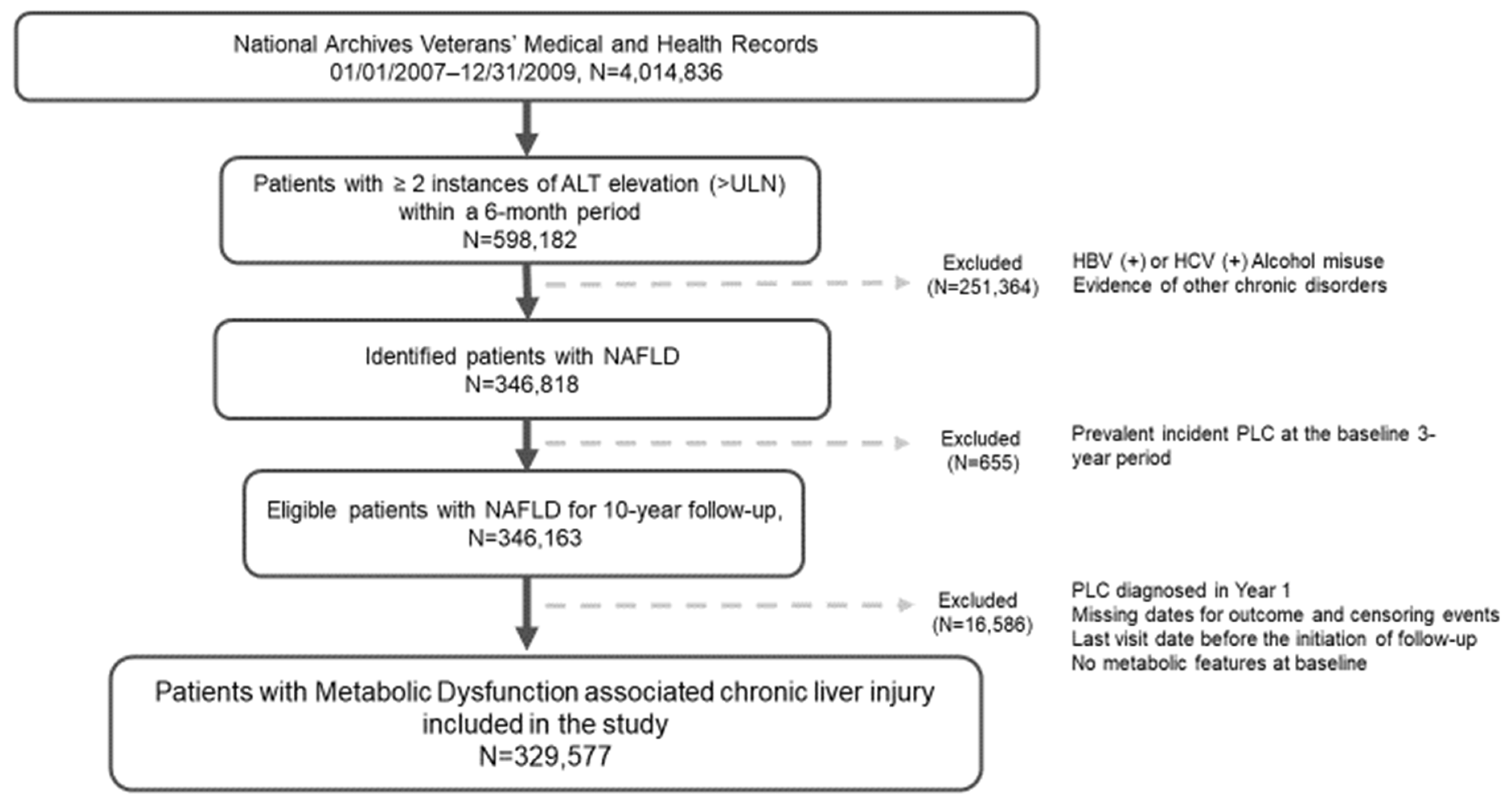
3.1. Clinical Characteristics of the Study Population
3.2. Cumulative Incidence of PLC During the Follow-Up and Variations by Age, Sex, and Baseline Cirrhosis Diagnosis
3.3. Unadjusted and Adjusted Association Between Incident PLC and Baseline Statin Use in the Overall Population, Stratified by Age and Sex
3.4. Association Between Statin Use During the Follow-Up and Incident PLC: Effect Modification by Age and Metabolic Syndrome
4. Discussion
5. Conclusions
Supplementary Materials
Author Contributions
Funding
Data Availability Statement
Acknowledgments
Conflicts of Interest
References
- Sung, H.; Ferlay, J.; Siegel, R.L.; Laversanne, M.; Soerjomataram, I.; Jemal, A.; Bray, F. Global cancer statistics 2020: Globocan estimates of incidence and mortality worldwide for 36 cancers in 185 countries. CA Cancer J. Clin. 2021, 71, 209–249. [Google Scholar] [CrossRef] [PubMed]
- Siegel, R.L.; Miller, K.D.; Jemal, A. Cancer statistics, 2018. CA Cancer J. Clin. 2018, 68, 7–30. [Google Scholar] [CrossRef] [PubMed]
- Welzel, T.M.; Graubard, B.I.; Quraishi, S.; Zeuzem, S.; Davila, J.A.; El-Serag, H.B.; McGlynn, K.A. Population-attributable fractions of risk factors for hepatocellular carcinoma in the united states. Am. J. Gastroenterol. 2013, 108, 1314–1321. [Google Scholar] [CrossRef]
- Makarova-Rusher, O.V.; Altekruse, S.F.; McNeel, T.S.; Ulahannan, S.; Duffy, A.G.; Graubard, B.I.; Greten, T.F.; McGlynn, K.A. Population attributable fractions of risk factors for hepatocellular carcinoma in the united states. Cancer 2016, 122, 1757–1765. [Google Scholar] [CrossRef] [PubMed]
- Younossi, Z.; Stepanova, M.; Ong, J.P.; Jacobson, I.M.; Bugianesi, E.; Duseja, A.; Eguchi, Y.; Wong, V.W.; Negro, F.; Yilmaz, Y.; et al. Non-alcoholic steatohepatitis is the fastest growing cause of hepatocellular carcinoma in liver transplant candidates. Clin. Gastroenterol. Hepatol. 2019, 4, 748–755. [Google Scholar] [CrossRef]
- Vitellius, C.; Desjonqueres, E.; Lequoy, M.; Amaddeo, G.; Fouchard, I.; N’Kontchou, G.; Canivet, C.M.; Ziol, M.; Regnault, H.; Lannes, A.; et al. Masld-related hcc: Multicenter study comparing patients with and without cirrhosis. JHEP Rep. 2024, 6, 101160. [Google Scholar] [CrossRef]
- Petrick, J.L.; Yang, B.; Altekruse, S.F.; Van Dyke, A.L.; Koshiol, J.; Graubard, B.I.; McGlynn, K.A. Risk factors for intrahepatic and extrahepatic cholangiocarcinoma in the united states: A population-based study in seer-medicare. PLoS ONE 2017, 12, e0186643. [Google Scholar] [CrossRef]
- Welzel, T.M.; Graubard, B.I.; Zeuzem, S.; El-Serag, H.B.; Davila, J.A.; McGlynn, K.A. Metabolic syndrome increases the risk of primary liver cancer in the united states: A study in the seer-medicare database. Hepatology 2011, 54, 463–471. [Google Scholar] [CrossRef]
- Villard, C.; Widman, L.; Sparrelid, E.; Bergquist, A.; Hagström, H. The risk of cholangiocarcinoma in patients with masld is not increased compared to the general population. Scand. J. Gastroenterol. 2024, 59, 1249–1251. [Google Scholar] [CrossRef]
- Cholesterol Treatment Trialists’ (CTT) Collaboration; Fulcher, J.; O’Connell, R.; Voysey, M.; Emberson, J.; Blackwell, L.; Mihaylova, B.; Simes, J.; Collins, R.; Kirby, A.; et al. Efficacy and safety of ldl-lowering therapy among men and women: Meta-analysis of individual data from 174,000 participants in 27 randomised trials. Lancet 2015, 385, 1397–1405. [Google Scholar] [CrossRef]
- Lonardo, A.; Nascimbeni, F.; Ballestri, S.; Fairweather, D.; Win, S.; Than, T.A.; Abdelmalek, M.F.; Suzuki, A. Sex differences in nafld: State of the art and identification of research gaps. Hepatology 2019, 70, 1457–1469. [Google Scholar] [CrossRef] [PubMed]
- Wiese, C.B.; Agle, Z.W.; Zhang, P.; Reue, K. Chromosomal and gonadal sex drive sex differences in lipids and hepatic gene expression in response to hypercholesterolemia and statin treatment. Biol. Sex Differ. 2022, 13, 63. [Google Scholar] [CrossRef] [PubMed]
- Suzuki, A.; Karachaliou, G.S.; Perkins, A.M.; Dorn, C.; Reeves, R.M.; Arnold, T.; Bashir, M.R.; Efird, J.T.; Abdelmalek, M.F.; Diehl, A.M. Age-specific protective effects of statins against cirrhosis in patients with chronic liver enzyme elevation associated with metabolic dysfunction: A retrospective cohort study of electronic health records. eClinicalMedicine 2025, 87, 103431. [Google Scholar] [CrossRef] [PubMed]
- Aravinthan, A.D.; Alexander, G.J.M. Senescence in chronic liver disease: Is the future in aging? J. Hepatol. 2016, 65, 825–834. [Google Scholar] [CrossRef]
- Bahrami, A.; Bo, S.; Jamialahmadi, T.; Sahebkar, A. Effects of 3-hydroxy-3-methylglutaryl coenzyme a reductase inhibitors on ageing: Molecular mechanisms. Ageing Res. Rev. 2020, 58, 101024. [Google Scholar] [CrossRef]
- Kanwal, F.; Kramer, J.R.; Mapakshi, S.; Natarajan, Y.; Chayanupatkul, M.; Richardson, P.A.; Li, L.; Desiderio, R.; Thrift, A.P.; Asch, S.M.; et al. Risk of hepatocellular cancer in patients with non-alcoholic fatty liver disease. Gastroenterology 2018, 155, 1828–1837.e2. [Google Scholar] [CrossRef]
- Laufs, U.; Filipiak, K.J.; Gouni-Berthold, I.; Catapano, A.L.; SAMS Expert Working Group. Practical aspects in the management of statin-associated muscle symptoms (SAMS). Atheroscler. Suppl. 2017, 26, 45–55. [Google Scholar] [CrossRef]
- Klann, J.G.; Joss, M.A.H.; Embree, K.; Murphy, S.N. Data model harmonization for the all of us research program: Transforming i2b2 data into the omop common data model. PLoS ONE 2019, 14, e0212463. [Google Scholar] [CrossRef]
- Hripcsak, G.; Levine, M.E.; Shang, N.; Ryan, P.B. Effect of vocabulary mapping for conditions on phenotype cohorts. J. Am. Med. Inform. Assoc. 2018, 25, 1618–1625. [Google Scholar] [CrossRef]
- FitzHenry, F.; Resnic, F.S.; Robbins, S.L.; Denton, J.; Nookala, L.; Meeker, D.; Ohno-Machado, L.; Matheny, M.E. Creating a common data model for comparative effectiveness with the observational medical outcomes partnership. Appl. Clin. Inform. 2015, 6, 536–547. [Google Scholar] [CrossRef]
- Wu, M.; Xu, H.; Liu, J.; Tan, X.; Wan, S.; Guo, M.; Long, Y.; Xu, Y. Metformin and fibrosis: A review of existing evidence and mechanisms. J. Diabetes Res. 2021, 2021, 6673525. [Google Scholar] [CrossRef]
- Kong, L.; Ma, J.; Dong, L.; Zhu, C.; Zhang, J.; Li, J. Metformin exerts anti-liver fibrosis effect based on the regulation of gut microbiota homeostasis and multi-target synergy. Heliyon 2024, 10, e24610. [Google Scholar] [CrossRef] [PubMed]
- Noureddin, N.; Noureddin, M.; Singh, A.; Alkhouri, N. Progression of nonalcoholic fatty liver disease-associated fibrosis in a large cohort of patients with type 2 diabetes. Dig. Dis. Sci. 2022, 67, 1379–1388. [Google Scholar] [CrossRef] [PubMed]
- Jachs, M.; Hartl, L.; Schaufler, D.; Desbalmes, C.; Simbrunner, B.; Eigenbauer, E.; Bauer, D.J.M.; Paternostro, R.; Schwabl, P.; Scheiner, B.; et al. Amelioration of systemic inflammation in advanced chronic liver disease upon beta-blocker therapy translates into improved clinical outcomes. Gut 2021, 70, 1758–1767. [Google Scholar] [CrossRef] [PubMed]
- Ohtsuka, T.; Hamada, M.; Hiasa, G.; Sasaki, O.; Suzuki, M.; Hara, Y.; Shigematsu, Y.; Hiwada, K. Effect of beta-blockers on circulating levels of inflammatory and anti-inflammatory cytokines in patients with dilated cardiomyopathy. J. Am. Coll. Cardiol. 2001, 37, 412–417. [Google Scholar] [CrossRef]
- Barone, M. Angiotensin-converting enzyme 2 and ampk/mtor pathway in the treatment of liver fibrosis: Should we consider further implications? World J. Gastroenterol. 2024, 30, 2391–2396. [Google Scholar] [CrossRef]
- Zhang, X.; Wong, G.L.; Yip, T.C.; Tse, Y.K.; Liang, L.Y.; Hui, V.W.; Lin, H.; Li, G.L.; Lai, J.C.; Chan, H.L.; et al. Angiotensin-converting enzyme inhibitors prevent liver-related events in nonalcoholic fatty liver disease. Hepatology 2022, 76, 469–482. [Google Scholar] [CrossRef]
- Simon, T.G.; Henson, J.; Osganian, S.; Masia, R.; Chan, A.T.; Chung, R.T.; Corey, K.E. Daily aspirin use associated with reduced risk for fibrosis progression in patients with nonalcoholic fatty liver disease. Clin. Gastroenterol. Hepatol. 2019, 17, 2776–2784.e4. [Google Scholar] [CrossRef]
- Simon, T.G.; Duberg, A.S.; Aleman, S.; Chung, R.T.; Chan, A.T.; Ludvigsson, J.F. Association of aspirin with hepatocellular carcinoma and liver-related mortality. N. Engl. J. Med. 2020, 382, 1018–1028. [Google Scholar] [CrossRef]
- Lee, T.Y.; Hsu, Y.C.; Tseng, H.C.; Yu, S.H.; Lin, J.T.; Wu, M.S.; Wu, C.Y. Association of daily aspirin therapy with risk of hepatocellular carcinoma in patients with chronic hepatitis B. JAMA Intern. Med. 2019, 179, 633–640. [Google Scholar] [CrossRef]
- Chen, J.; Katz, L.H.; Munoz, N.M.; Gu, S.; Shin, J.H.; Jogunoori, W.S.; Lee, M.H.; Belkin, M.D.; Kim, S.B.; White, J.C.; et al. Vitamin D deficiency promotes liver tumor growth in transforming growth factor-β/Smad3-deficient mice through Wnt and Toll-like receptor 7 pathway modulation. Sci. Rep. 2016, 6, 30217. [Google Scholar] [CrossRef] [PubMed]
- Guo, X.F.; Zhao, T.; Han, J.M.; Li, S.; Li, D. Vitamin D and liver cancer risk: A meta-analysis of prospective studies. Asia Pac. J. Clin. Nutr. 2020, 29, 175–182. [Google Scholar] [CrossRef] [PubMed]
- Alberti, K.G.; Eckel, R.H.; Grundy, S.M.; Zimmet, P.Z.; Cleeman, J.I.; Donato, K.A.; Fruchart, J.C.; James, W.P.; Loria, C.M.; Smith, S.C., Jr.; et al. Harmonizing the metabolic syndrome: A joint interim statement of the international diabetes federation task force on epidemiology and prevention; national heart, lung, and blood institute; american heart association; world heart federation; international atherosclerosis society; and international association for the study of obesity. Circulation 2009, 120, 1640–1645. [Google Scholar] [CrossRef] [PubMed]
- Baboota, R.K.; Spinelli, R.; Erlandsson, M.C.; Brandao, B.B.; Lino, M.; Yang, H.; Mardinoglu, A.; Bokarewa, M.I.; Boucher, J.; Kahn, C.R.; et al. Chronic hyperinsulinemia promotes human hepatocyte senescence. Mol. Metab. 2022, 64, 101558. [Google Scholar] [CrossRef]
- Bradley, K.A.; DeBenedetti, A.F.; Volk, R.J.; Williams, E.C.; Frank, D.; Kivlahan, D.R. AUDIT-C as a brief screen for alcohol misuse in primary care. Alcohol. Clin. Exp. Res. 2007, 31, 1208–1217. [Google Scholar] [CrossRef]
- McGlynn, K.A.; Petrick, J.L.; El-Serag, H.B. Epidemiology of hepatocellular carcinoma. Hepatology 2021, 73, 4–13. [Google Scholar] [CrossRef]
- van Buuren, S.; Groothuis-Oudshoorn, K. Mice: Multivariate imputation by chained equations in R. J. Stat. Softw. 2011, 45, 1–67. [Google Scholar] [CrossRef]
- Rybin, D.; Doros, G.; Rosenheck, R.; Lew, R. The impact of missing data on the results of a schizophrenia study. Pharm. Stat. 2015, 14, 4–10. [Google Scholar] [CrossRef]
- Harrell, F.E., Jr.; Beck, C.; Dupont, C. Hmisc: Harrell Miscellaneous. R Package Version 2024, 4. [Google Scholar]
- Team, R.C. R: A Language and Environment for Statistical Computing; R Foundation for Statistical Computing: Vienna, Austria, 2024. [Google Scholar]
- Wickham, H. Ggplot2: Elegant Graphics for Data Analysis; Springer: New York, NY, USA, 2016. [Google Scholar]
- Lagunas-Rangel, F.A.; Jonsson, J.; Jackevica, L.; Fredriksson, R.; Dambrova, M.; Schioth, H.B. Statins regulate kinase signaling by causing changes in phosphorylation, rather than through changes in gene expression or direct inhibition: Evidence in colorectal cancer. Front. Pharmacol. 2025, 16, 1653702. [Google Scholar] [CrossRef]
- Huang, S.S.; Chen, W.; Vaishnani, D.K.; Huang, L.J.; Li, J.Z.; Huang, S.R.; Li, Y.Z.; Xie, Q.P. Leucine-rich repeat-containing protein 19 suppresses colorectal cancer by targeting cyclin-dependent kinase 6/E2F1 and remodeling the immune microenvironment. World J. Gastroenterol. 2025, 31, 107893. [Google Scholar] [CrossRef] [PubMed]
- Vell, M.S.; Loomba, R.; Krishnan, A.; Wangensteen, K.J.; Trebicka, J.; Creasy, K.T.; Trautwein, C.; Scorletti, E.; Seeling, K.S.; Hehl, L.; et al. Association of statin use with risk of liver disease, hepatocellular carcinoma, and liver-related mortality. JAMA Netw. Open 2023, 6, e2320222. [Google Scholar] [CrossRef] [PubMed]
- Simon, T.G.; Duberg, A.S.; Aleman, S.; Hagstrom, H.; Nguyen, L.H.; Khalili, H.; Chung, R.T.; Ludvigsson, J.F. Lipophilic statins and risk for hepatocellular carcinoma and death in patients with chronic viral hepatitis: Results from a nationwide swedish population. Ann. Intern. Med. 2019, 171, 318–327. [Google Scholar] [CrossRef] [PubMed]
- Choi, J.; Nguyen, V.H.; Przybyszewski, E.; Song, J.; Carroll, A.; Michta, M.; Almazan, E.; Simon, T.G.; Chung, R.T. Statin use and risk of hepatocellular carcinoma and liver fibrosis in chronic liver disease. JAMA Intern. Med. 2025, 185, 522–530. [Google Scholar] [CrossRef]
- Yeh, Y.C.; Chen, Y.Y.; Chen, P.C. Statins were not associated with hepatocellular carcinoma after controlling for time-varying confounders in patients with diabetes. J. Clin. Epidemiol. 2022, 150, 98–105. [Google Scholar] [CrossRef]
- Pinyopornpanish, K.; Al-Yaman, W.; Butler, R.S.; Carey, W.; McCullough, A.; Romero-Marrero, C. Chemopreventive effect of statin on hepatocellular carcinoma in patients with nonalcoholic steatohepatitis cirrhosis. Am. J. Gastroenterol. 2021, 116, 2258–2269. [Google Scholar] [CrossRef]
- Zou, B.; Odden, M.C.; Nguyen, M.H. Statin use and reduced hepatocellular carcinoma risk in patients with nonalcoholic fatty liver disease. Clin. Gastroenterol. Hepatol. 2023, 21, 435–444 e436. [Google Scholar] [CrossRef]
- Grundy, S.M.; Stone, N.J.; Bailey, A.L.; Beam, C.; Birtcher, K.K.; Blumenthal, R.S.; Braun, L.T.; de Ferranti, S.; Faiella-Tommasino, J.; Forman, D.E.; et al. 2018 AHA/ACC/AACVPR/AAPA/ABC/ACPM/ADA/AGS/APhA/ASPC/NLA/PCNA guideline on the management of blood cholesterol: Executive summary: A report of the american college of cardiology/american heart association task force on clinical practice guidelines. J. Am. Coll. Cardiol. 2019, 73, 3168–3209. [Google Scholar] [CrossRef]
- Karalis, D.G.; Wild, R.A.; Maki, K.C.; Gaskins, R.; Jacobson, T.A.; Sponseller, C.A.; Cohen, J.D. Gender differences in side effects and attitudes regarding statin use in the understanding statin use in america and gaps in patient education (usage) study. J. Clin. Lipidol. 2016, 10, 833–841. [Google Scholar] [CrossRef]
- Allison, P. For Causal Analysis of Competing Risks, Don’t Use Fine & Gray’s Subdistribution Method. Stat. Horiz. 2018, 2022. [Google Scholar]
- Austin, P.C.; Putter, H.; Lee, D.S.; Steyerberg, E.W. Estimation of the absolute risk of cardiovascular disease and other events: Issues with the use of multiple fine-gray subdistribution hazard models. Circ. Cardiovasc. Qual. Outcomes 2022, 15, e008368. [Google Scholar] [CrossRef]
- Wang, J.; Qiu, K.; Zhou, S.; Gan, Y.; Jiang, K.; Wang, D.; Wang, H. Risk factors for hepatocellular carcinoma: An umbrella review of systematic review and meta-analysis. Ann. Med. 2025, 57, 2455539. [Google Scholar] [CrossRef]
- You, B.J.; Hour, M.J.; Chen, L.Y.; Luo, S.C.; Hsu, P.H.; Lee, H.Z. Fenofibrate induces human hepatoma Hep3B cells apoptosis and necroptosis through inhibition of thioesterase domain of fatty acid synthase. Sci. Rep. 2019, 9, 3306. [Google Scholar] [CrossRef]
- Yin, Y.; Wu, C.; Zhou, Y.; Zhang, M.; Mai, S.; Chen, M.; Wang, H.Y. Ezetimibe induces paraptosis through Niemann-Pick C1-like 1 inhibition of mammalian-target-of-rapamycin signaling in hepatocellular carcinoma cells. Genes 2023, 15, 4. [Google Scholar] [CrossRef]
- Sohn, W.; Hong, S.; Han, K.; Park, C.Y. Reduced risk of hepatocellular carcinoma in the use of fibrate as an add-on to statin: A retrospective population-based cohort study. Eur. J. Cancer 2025, 231, 116094. [Google Scholar] [CrossRef]
- Gao, Y.; Chen, W.; Zarogoulidis, P.; Yallapu, M.M.; Nikolic, M.V.; Vaishnani, D.K.; Zheng, J.; Nedeljkovic, N.; Ye, K.; Guo, Y.; et al. Multiomics and experimental validation reveal theophylline’s mechanism targeting il1a/actb/tlr4 and identify synergistic drugs in hepatocellular carcinoma. J. Pharmacol. Exp. Ther. 2026, 393, 103836. [Google Scholar] [CrossRef]
- Chen, W.; Li, Y.; Zhang, C.; Zhou, H.; Ma, J.; Vaishnani, D.K.; Zeng, B.; Yu, J.; Mao, H.; Zheng, J. Multi-omics and experimental validation reveal anti-HCC mechanisms of Tibetan Liuwei Muxiang Pill and quercetin. Pharmaceuticals 2025, 18, 900. [Google Scholar] [CrossRef]



| Baseline Clinical Characteristics | Statin Use | ||
|---|---|---|---|
| Overall | No (34%) | Yes (66%) | |
| Demographics | |||
| Age *, median [IQR] | 62 [53, 68] | 57 [46, 65] | 63 [56, 69] |
| Male sex *, % | 91.6 | 88.6 | 93.2 |
| Race *, % White/Black or African American/Asian/Am. Indian or Alaska Native/ Native Hawaiian or Other Pacific Islander/Unknown | 78.0/11.2/0.9/0.7/0.9/8.3 | 75.0/12.5/1.0/0.8/0.9/9.8 | 79.6/10.5/0.9/0.6/0.9/7.5 |
| Ethnicity *, % Hispanic or Latino/Non-Hispanic or Latino/Unknown | 6.0/89.8/4.2 | 6.9/87.8/5.3 | 5.5/90.8/3.7 |
| BMI *, kg/m2 | 31.60 [28.20, 35.60] | 31.50 [28.10, 35.40] | 31.60 [28.30, 35.70] |
| Cardiometabolic features | |||
| Metabolic syndrome (3+ metabolic factors) *, % | 78.6 | 68.4 | 83.9 |
| Obesity *, % | 62.6 | 61.9 | 63.0 |
| Diabetes mellitus *, % | 39.8 | 22.3 | 48.8 |
| Hypertension *, % | 73.9 | 58.7 | 81.8 |
| Hyperlipidemia *, % | 79.5 | 49.9 | 94.8 |
| Coronary artery disease *, % | 24.4 | 8.9 | 32.5 |
| Hepatic fibrosis/cirrhosis | |||
| FIB-4 score *, median [IQR] | 1.26 [0.88, 1.80] | 1.12 [0.77, 1.66] | 1.33 [0.95, 1.86] |
| Clinical diagnosis of cirrhosis *, % | 0.5 | 0.6 | 0.4 |
| Comedication use, % | |||
| Metformin * | 26.7 | 12.7 | 34.0 |
| ACE inhibitors/angiotensin receptor blockers * | 58.0 | 36.0 | 69.4 |
| Beta-blockers * | 38.2 | 21.4 | 46.9 |
| Aspirin/non-aspirin NSAIDs * | 54.8 | 49.4 | 57.5 |
| Vitamin D supplements * | 9.6 | 8.3 | 10.2 |
| Cirrhosis Dx at Baseline | No Cirrhosis Dx at Baseline | |||||
|---|---|---|---|---|---|---|
| No of Events | No of Persons at Risk | Cumulative Incidence with 95% CI | No of Events | No of Persons at Risk | Cumulative Incidence with 95% CI | |
| Overall | 134 | 1556 | 8.6% [7.3, 10.1] | 2583 | 328,021 | 0.8% [0.76, 0.82] |
| Women | 6 | 91 | 6.6% [3.1, 13.7] | 77 | 27,496 | 0.3% [0.22, 0.35] |
| Women ≤ 65 yo | 3 | 67 | 4.5% [1.5, 12.4] | 62 | 23,655 | 0.3% [0.20, 0.34] |
| Women > 65 yo | 3 | 24 | 12.5% [4.3, 31.0] | 15 | 3840 | 0.4% [0.24, 0.64] |
| Men | 128 | 1465 | 8.7% [7.4, 10.3] | 2506 | 300,525 | 0.8% [0.80, 0.87] |
| Men ≤ 65 yo | 77 | 864 | 8.9% [7.2, 11.0] | 1411 | 200,739 | 0.7% [0.67, 0.74] |
| Men > 65 yo | 51 | 601 | 8.5% [6.5, 11.0] | 1095 | 99,778 | 1.1% [1.03, 1.16] |
| Baseline statin use | Model 1 | Model 2 | Model 3 | Model 4 | Model 5 | Model 6 |
| 1.20 [1.08, 1.33], 0.0004 | 0.88 [0.80, 0.98], 0.018 | 0.81 [0.73, 0.90], <0.0001 | 0.64 [0.57, 0.71], <0.0001 | 0.64 [0.58, 0.72], <0.0001 | 0.66 [0.59, 0.74], <0.0001 |
| Model 4 | Model 6 | |
|---|---|---|
| HR [95%CI], p-value | HR [95%CI], p-value | |
| Cumulative Statin Dose, mg/year | ||
| 0 | Ref | Ref |
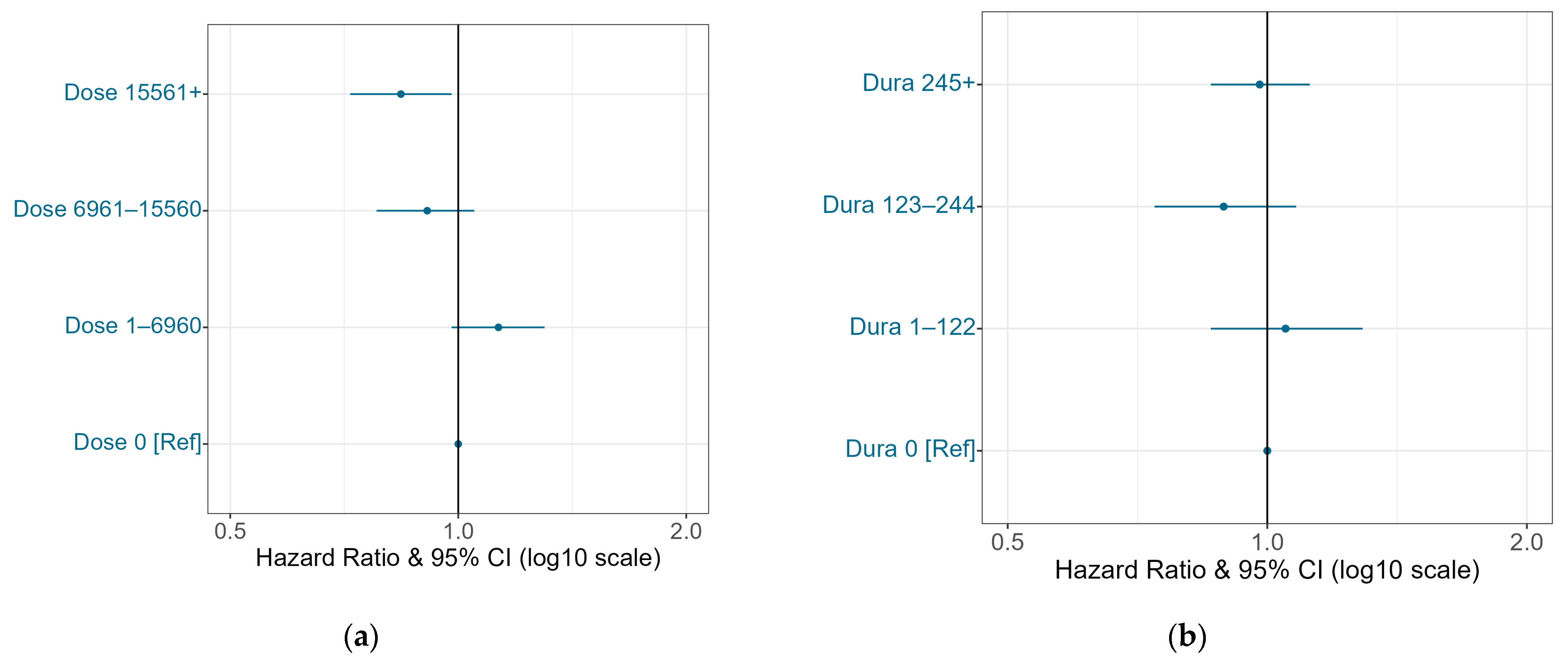
| 1–6960 | 1.10 [0.96–1.26], 0.183 | 1.13 [0.98–1.30], 0.085 |
| 6961–15,560 | 0.86 [0.74–0.99], 0.041 | 0.91 [0.78–1.05], 0.202 |
| ≥15,561 | 0.77 [0.66–0.90], 0.0008 | 0.84 [0.72–0.98], 0.024 |
| Cumulative Statin Duration, days/year | ||
| 0 | Ref | Ref |
| 1–122 | 1.02 [0.83–1.24], 0.874 | 1.05 [0.86–1.29], 0.612 |
| 123–244 | 0.85 [0.70–1.03], 0.101 | 0.89 [0.74–1.08], 0.237 |
| ≥245 | 0.92 [0.81–1.05], 0.231 | 0.98 [0.86–1.12], 0.764 |
Disclaimer/Publisher’s Note: The statements, opinions and data contained in all publications are solely those of the individual author(s) and contributor(s) and not of MDPI and/or the editor(s). MDPI and/or the editor(s) disclaim responsibility for any injury to people or property resulting from any ideas, methods, instructions or products referred to in the content. |
© 2026 by the authors. Licensee MDPI, Basel, Switzerland. This article is an open access article distributed under the terms and conditions of the Creative Commons Attribution (CC BY) license.
Share and Cite
Karachaliou, G.S.; Perkins, A.M.; Dorn, C.; Reeves, R.M.; Arnold, T.; Bashir, M.R.; Efird, J.T.; Abdelmalek, M.F.; Diehl, A.M.; Suzuki, A. Association of Statin Use with Reduced Primary Liver Cancer Risk, Independent of Age and Cirrhosis Protection in MASLD. Cancers 2026, 18, 1132. https://doi.org/10.3390/cancers18071132
Karachaliou GS, Perkins AM, Dorn C, Reeves RM, Arnold T, Bashir MR, Efird JT, Abdelmalek MF, Diehl AM, Suzuki A. Association of Statin Use with Reduced Primary Liver Cancer Risk, Independent of Age and Cirrhosis Protection in MASLD. Cancers. 2026; 18(7):1132. https://doi.org/10.3390/cancers18071132
Chicago/Turabian StyleKarachaliou, Georgia Sofia, Amy M. Perkins, Chad Dorn, Ruth M. Reeves, Timothy Arnold, Mustafa R. Bashir, Jimmy T. Efird, Manal F. Abdelmalek, Anna Mae Diehl, and Ayako Suzuki. 2026. "Association of Statin Use with Reduced Primary Liver Cancer Risk, Independent of Age and Cirrhosis Protection in MASLD" Cancers 18, no. 7: 1132. https://doi.org/10.3390/cancers18071132
APA StyleKarachaliou, G. S., Perkins, A. M., Dorn, C., Reeves, R. M., Arnold, T., Bashir, M. R., Efird, J. T., Abdelmalek, M. F., Diehl, A. M., & Suzuki, A. (2026). Association of Statin Use with Reduced Primary Liver Cancer Risk, Independent of Age and Cirrhosis Protection in MASLD. Cancers, 18(7), 1132. https://doi.org/10.3390/cancers18071132