Use of Scores in Risk Stratification of Febrile Neutropenia—A Scoping Review

 ,
,  , ,
, , 
Simple Summary
Abstract
1. Introduction
2. Methodology
2.1. Search Strategy
2.2. Inclusion and Exclusion Criteria
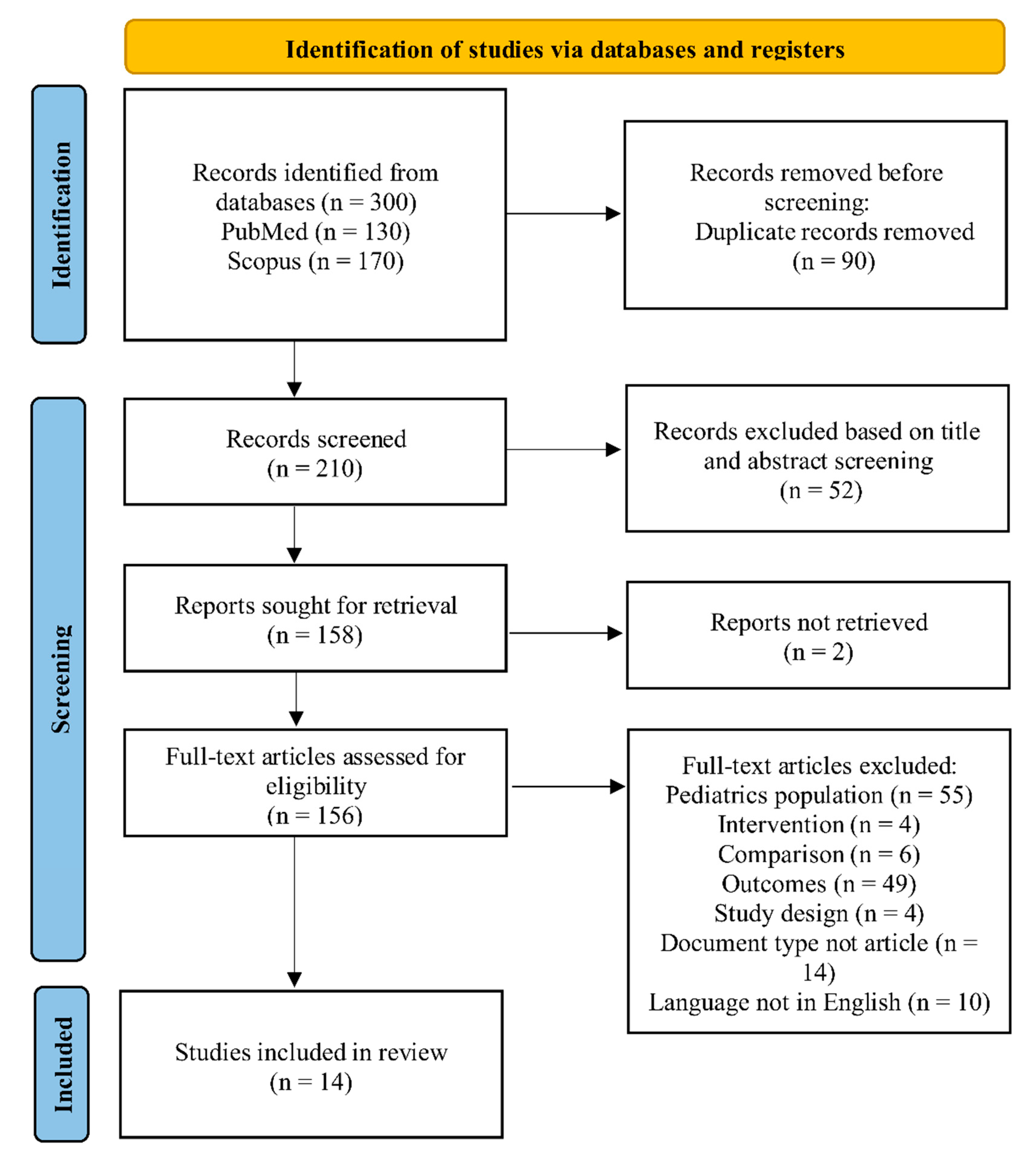
2.3. Study Selection and Data Extraction
3. Results
3.1. Size of Cohort and Cancer Type Distribution
3.2. Different Definitions of Febrile Neutropenia
3.3. Augmentation of Scores
3.4. Different Definition of Complications
3.5. Retrospective Studies
4. Discussion
5. Conclusions
Supplementary Materials
Author Contributions
Funding
Data Availability Statement
Conflicts of Interest
References
- Lucas, A.J.; Olin, J.; Coleman, M.D. Management and Preventive. Pharm. Ther. 2018, 43, 228–232. [Google Scholar]
- Malech, H.L.; DeLeo, F.R.; Quinn, M.T. The Role of Neutrophils in the Immune System: An Overview. In Neutrophil Methods and Protocols; Springer: Berlin/Heidelberg, Germany, 2014; Volume 1124, pp. 3–10. [Google Scholar]
- Bodey, G.P.; Buckley, M.; Sathe, Y.S.; Freireich, E.J. Quantitative relationships between circulating leukocytes and infection in patients with acute leukemia. Ann. Intern. Med. 1966, 64, 328–340. [Google Scholar] [CrossRef]
- Crawford, J.; Dale, D.C.; Kuderer, N.M.; Culakova, E.; Poniewierski, M.S.; Wolff, D.; Lyman, G.H. Risk and timing of neutropenic events in adult cancer patients receiving chemotherapy: The results of a prospective nationwide study of oncology practice. J. Natl. Compr. Cancer Netw. 2008, 6, 109–118. [Google Scholar] [CrossRef]
- Truong, J.; Lee, E.K.; Trudeau, M.E.; Chan, K.K.W. Interpreting febrile neutropenia rates from randomized, controlled trials for consideration of primary prophylaxis in the real world: A systematic review and meta-analysis. Ann. Oncol. 2016, 27, 608–618. [Google Scholar] [CrossRef] [PubMed]
- Kuderer, N.M.; Dale, D.C.; Crawford, J.; Cosler, L.E.; Lyman, G.H. Mortality, morbidity, and cost associated with febrile neutropenia in adult cancer patients. Cancer 2006, 106, 2258–2266. [Google Scholar] [CrossRef] [PubMed]
- Lalami, Y.; Klastersky, J. Impact of chemotherapy-induced neutropenia (CIN) and febrile neutropenia (FN) on cancer treatment outcomes: An overview about well-established and recently emerging clinical data. Crit. Rev. Oncol. Hematol. 2017, 120, 163–179. [Google Scholar] [CrossRef]
- Looi, M.-K. The European Healthcare Workforce Crisis: How Bad is it. BMJ 2024, 384, q8. [Google Scholar] [CrossRef] [PubMed]
- Cinar, D.; Tas, D. Cancer in the Elderly. North. Clin. Istanb. 2015, 2, 73–80. [Google Scholar] [CrossRef]
- Beard, J.R.; Officer, A.; de Carvalho, I.A.; Sadana, R.; Pot, A.M.; Micel, J.-P.; Lloyd-Sherlock, P.; Epping-Jordan, J.E.; Peeter, G.M.E.E.G.; Mahanani, W.R.; et al. The World report on ageing and health: A policy framework for healthy ageing. Lancet 2016, 387, 2145–2154. [Google Scholar] [CrossRef] [PubMed]
- Klastersky, J.; de Naurois, J.; Rolston, K.; Rapoport, B.; Maschmeyer, G.; Aapro, M.; Herrstedt, J.; ESMO Guidelines Committee. Management of febrile neutropaenia: ESMO Clinical Practice Guidelines. Ann. Oncol. 2016, 27, v111–v118. [Google Scholar] [CrossRef]
- Boccia, R.; Glaspy, J.; Crawford, J.; Aapro, M. Chemotherapy-Induced Neutropenia and Febrile Neutropenia in the US: A Beast of Burden That Needs to Be Tamed? Oncologist 2022, 27, 625–636. [Google Scholar] [CrossRef]
- Fortner, B.V.; Tauer, K.W.; Okon, T.; Houts, A.C.; Schwartzberg, L.S. Experiencing neutropenia: Quality of life interviews with adult cancer patients. BMC Nurs. 2005, 4, 4. [Google Scholar] [CrossRef][Green Version]
- Aagaard, T.; Roen, A.; Reekie, J.; Daugaard, G.; Brown, P.D.N.; Specht, L.; Sengeløv, H.; Mocroft, A.; Lundgren, J.; Helleberg, M. Development and Validation of a Risk Score for Febrile. JNCI Cancer Spectr. 2018, 2, pky053. [Google Scholar] [CrossRef] [PubMed]
- Forcano-Queralt, E.; Lemes-Quintana, C.; Orozco-Beltrán, D. Ambulatory management of low risk febrile neutropenia in adult. Support. Care Cancer 2023, 31, 665. [Google Scholar] [CrossRef] [PubMed]
- Klastersky, J.; Paesmans, M.; Rubenstein, E.B.; Boyer, M.; Elting, L.; Feld, R.; Gallagher, J.; Herrstedt, J.; Rapoport, B.; Rolston, K.; et al. The Multinational Association for Supportive Care in Cancer Risk Index: A Multinational Scoring System for Identifying Low-Risk Febrile Neutropenic Cancer Patients. J. Clin. Oncol. 2000, 18, 3038–3051. [Google Scholar] [CrossRef]
- Carmona-Bayonas, A.; Gómez, J.; González-Billalabeitia, E.; Canteras, M.; Navarrete, A.; Gonzálvez, M.L.; Vicente, V.; de la Peña, F.A. Prognostic evaluation of febrile neutropenia in apparently stable adult cancer patients. Br. J. Cancer 2011, 105, 612–617. [Google Scholar] [CrossRef]
- Luo, C.; Zhu, Y.; Zhu, Z.; Li, R.; Chen, G.; Wang, Z. A machine learning-based risk stratification tool for in-hospital mortality of intensive care unit patients with heart failure. J. Transl. Med. 2022, 20, 136. [Google Scholar] [CrossRef]
- Beaulieu-Jones, B.K.; Yuan, W.; Brat, G.A.; Beam, A.L.; Weber, G.; Ruffin, M.; Kohane, I.S. Machine learning for patient risk stratification: Standing on, or looking over, the shoulders of clinicians? npj Digit. Med. 2021, 4, 62. [Google Scholar] [CrossRef]
- Sarraju, A.; Ward, A.; Chung, S.; Li, J.; Scheinker, D.; Rodríguez, F. Machine learning approaches improve risk stratification for secondary cardiovascular disease prevention in multiethnic patients. Open Heart 2021, 8, e001802. [Google Scholar] [CrossRef] [PubMed]
- Peters, M.D.; Godfrey, C.; McInerney, P.; Munn, Z.; Tricco, A.C.; Khalil, H. Chapter 11: Scoping Reviews (2020 version). In JBI Manual for Evidence Synthesis; JBI: Adelaide, Australia, 2020; pp. 406–451. [Google Scholar]
- Mak, S.; Thomas, A. Steps for Conducting a Scoping Review. J. Grad. Med. Educ. 2022, 14, 565–567. [Google Scholar] [CrossRef]
- Munn, Z.; Peters, M.D.J.; Stern, C.; Tufanaru, C.; McArthur, A.; Aromataris, E. Systematic review or scoping review? Guidance for authors when choosing between a systematic or scoping review approach. BMC Med. Res. Methodol. 2018, 18, 143. [Google Scholar] [CrossRef] [PubMed]
- Tricco, A.C.; Lillie, E.; Zarin, W.; O’Brien, K.K.; Colquhoun, H.; Levac, D.; Moher, D.; Peters, M.D.J.; Horsley, T.; Weeks, L.; et al. PRISMA extension for scoping reviews (PRISMA-ScR): Checklist and explanation. Ann. Intern. Med. 2018, 169, 467–473. [Google Scholar] [CrossRef] [PubMed]
- Page, M.J.; McKenzie, J.E.; Bossuyt, P.M.; Boutron, I.; Hoffmann, T.C.; Mulrow, C.D.; Shamseer, L.; Tetzlaff, J.M.; Akl, E.A.; Brennan, S.E.; et al. The PRISMA 2020 statement: An updated guideline for reporting systematic reviews. BMJ 2021, 372, 71. [Google Scholar] [CrossRef]
- Stern, C.; Jordan, Z.; McArthur, A. Developing the review question and inclusion criteria. Am. J. Nurs. 2014, 114, 53–56. [Google Scholar] [CrossRef]
- Amir-Behghadami, M.; Janati, A. Population, Intervention, Comparison, Outcomes and Study (PICOS) design as a framework to formulate eligibility criteria in systematic reviews. Emerg. Med. J. 2020, 37, 387. [Google Scholar] [CrossRef]
- Gunderson, C.C.; Farell, R.; Dinh, B.C.; Thomas, E.D.; Vesely, K.S.; Lauer, J.K.; Kao, L.; Chopra, S.; Mcmeeking, D.S.; Moore, K.N. Inpatient versus outpatient management of neutropenic fever in gynecologic oncology patients: Is risk stratification useful? Gynecol. Oncol. 2013, 130, 411–415. [Google Scholar] [CrossRef]
- Coyne, C.J.; Castillo, M.E.; Shatsky, R.A.; Chan, T.C. Procalcitonin as Predictive Tool for Death and ICU admission among Febrile Neutropenia Patients Visiting the Emergency Department. Medicana 2022, 58, 985. [Google Scholar] [CrossRef]
- Kim, M.; Ahn, S.; Kim, W.Y.; Sohn, H.C.; Seo, D.W.; Lee, Y.-S. Predictive Performance of the quick Sequential Organ Failure Assessment score as screening tool for sepsis, mortality, and intensive care unit admission in patients with febrile neutropenia. Support. Care Cancer 2016, 25, 1557–1562. [Google Scholar] [CrossRef] [PubMed]
- Ahn, S.; Lee, Y.-S.; Lim, K.S.; Lee, J.-L. Adding procalcitonin to the MASCC risk-index score could improve risk stratification of patients with febrile neutropenia. Support. Care Cancer 2013, 21, 2303–2308. [Google Scholar] [CrossRef]
- Taj, M.; Nadeem, M.; Maqsood, S.; Shah, T.; Farzana, T.; Shamsi, T.S. Validation of MASCC score for Risk stratification in Patients of Hematological Disorders with Febrile Neutropenia. Indian Soc. Haematol. Transfus. Med. 2016, 33, 355–360. [Google Scholar] [CrossRef]
- Coyne, C.J.; Le, V.; Brennan, J.J.; Castillo, E.M.; Shatsky, R.A.; Ferran, K.; Brodine, S.; Vilke, G.M. Application of the MASCC and CISNE Risk-Stratification Scores to Identify Low-Risk Febrile Neutropenic Patients in the Emergency Department. Ann. Emerg. Med. 2016, 69, 755–764. [Google Scholar] [CrossRef]
- Kumar, P.; Bajpai, J.; Shetty, N.; Medekar, A.; Kurkue, P.; Gadyalpatatil, N.; Gupta, S.; Noronha, V.; Kanujia, A.; Parikh, P.; et al. Management of Febrile Neutropenia in malignancy using the MASCC score and other factors: Feasibility and safety in routine clinical practice. Indian J. Cancer 2014, 51, 491–495. [Google Scholar] [CrossRef]
- Baugh, C.W.; Wang, T.J.; Caterino, J.M.; Baker, O.N.; Brooks, G.A.; Reust, A.C.; Pallin, D.J. Emergency Department Management of Patients with Febrile Neutropenia: Guideline Concordant or Overly Aggressive? Acad. Emerg. Med. 2017, 24, 83–91. [Google Scholar] [CrossRef]
- Mohindra, R.; Mathew, R.; Yadav, S.; Aggarwal, P. CISNE vs. MASCC: Identifying low risk febrile neutropenic patients. Am. J. Emerg. Med. 2020, 38, 2259–2263. [Google Scholar] [CrossRef]
- Monuszko, K.A.; Albrigt, B.; De Oca, M.K.M.; Nguyen, N.T.T.; Havrilesky, L.J.; Davidson, B.A. Evaluation of the clinical index of stable febrile neutropenia risk stratification system for management of febrile neutropenia in gynecologic oncology patients. Gynecol. Oncol. Rep. 2021, 37, 100853. [Google Scholar] [CrossRef]
- Gunderson, C.C.; Wilkinson-Ryan, I.; Leath, C.A.; Moore, K.N. Prospective Evaluation of Multinational Association of Supportive Care in Cancer Risk Index Score for Gynecologic Oncology Patients with Febrile Neutropenia. Am. J. Clin. Oncol. 2019, 42, 138–142. [Google Scholar] [CrossRef] [PubMed]
- Wang, X.J.; Goh, D.Y.T.; Dorajoo, S.R.; Chan, A. The prognostic performance of adding patient-reported outcomes to the MASCC risk index to identify low-risk febrile neutropenia patients with solid tumors and lymphomas. Support. Care Cancer 2017, 25, 2815–2822. [Google Scholar] [CrossRef]
- De Guadiana-Romualdo, L.G.; Cerezuela-Fuentes, P.; Español-Morales, I.; Jiménez-Santos, P.E.-T.E.; Albaladejo-Otón, M.D. Prognostic value of procalcitonin and lipopolysaccharide binding protein in cancer patients with chemotherapy-associated febrile neutropenia presenting to an emergency department. Biochem. Medica 2019, 29, 57–67. [Google Scholar] [CrossRef] [PubMed]
- Yadav, S.; Mathew, R.; Sahu, A.K.; Jamshed, N.; Mohindra, R.; Aggarwal, P.; Batra, A.; Halder, D.; Brunda, R.L. Prognostic Value of Serum Procalcitonin Levels in Patients with Febrile Neutropenia Presenting to the Emergency Department. J. Emerg. Med. 2021, 60, 641–647. [Google Scholar] [CrossRef] [PubMed]
- Virizuela, J.A.; Carratalà, J.; Aguado, J.M.; Vicente, D.; Salavert, M.; Ruiz, M.; Ruiz, I.; Marco, F.; Lizasoain, M.; Jimènez-Fonseca, P.; et al. Management of infection and febrile neutropenia in patients with solid cancer. Clin. Transl. Oncol. 2015, 18, 557–570. [Google Scholar] [CrossRef]
- Agius, R.; Brieghel, C.; Andersen, M.A.; Pearson, A.T.; Ledergerber, B.; Cozzi-Lepri, A.; Louzoun, Y.; Andersen, C.L.; Bergstedt, J.; Von Stemann, J.H.; et al. Machine learning can identify newly diagnosed. Nat. Commun. 2020, 11, 363. [Google Scholar] [CrossRef] [PubMed]
- Zheng, B.; Toarta, C.; Cheng, W.; Taljaard, M.; Reaume, N.; Perry, J.J. Accuracy of the Multinational Association of Supportive Care in Cancer (MASCC) and Clinical Index of Stable Febrile Neutropenia (CISNE) scores for predicting serious complication in adult patients with febrile neutropenia: A systematic review and meta-ana. Crit. Rev. Oncol. Hematol. 2020, 149, 102922. [Google Scholar] [CrossRef] [PubMed]


| PICOS Components and Other Inclusion Criteria | Inclusion Criteria |
|---|---|
| P (population) | Adult participants diagnosed with FN. |
| I (intervention) | Scoring methods for FN risk stratification. |
| C (comparison) | Hybrid and other classical scoring methods for FN risk stratification. |
| O (outcomes) | Applying classical or hybrid risk stratification scores to predict low-risk or high-risk FN patients. |
| S (study design) | Clinical trials, quasi-experimental trial, randomized clinical trial (RCT), non-RCT, observational studies, retrospective cohorts, real world data and epidemiological studies. |
| Language | Publications in English. |
| Time | Publications between 2000 and 2024. |
| Document type | Articles. |
| Reference | Cohort Size | Age and Gender | Methods | Type of Cancer(s) | Definition of Fever | Definition of Neutropenic | Definition of Primary Outcome | Setting |
|---|---|---|---|---|---|---|---|---|
| Gunderson et al. [28] | 83 patients | Age: Mean 62 years (range 25–85) Male: 0% Female: 100% | MASCC | Gynecologic (100%) | One time reading: 38.3 °C Measurement with expected increase: 38.0 °C | ANC at admission: 1500 ANC with expected decrease: Not utilized | Primary outcome: As defined by [16] including death within 14 days of hospital discharge, fungal infection, allergic reaction. | Single center |
| Coyne et al. [29] | 4434 patients | Age: Mean 57.38 years Median 59 years Male: 59.3% Female: 40.7% | Procalcitonin (PCT) Level | Hematologic and solid tumors (distribution not presented) | One time reading: 38.0 °C Measurement with expected increase: Not utilized | ANC at admission: 1000 ANC with expected decrease: Not utilized | Primary outcome: in-hospital mortality Secondary outcome: admission to ICU. | Multicenter |
| Kim et al. [30] | 615 patients | Age: Mean ± SD 54.3 ± 13.8 years Male: 33.2% Female: 66.8% | MASCC, qSOFA and SIRS | Hematologic (20.8%) and solid tumors (79.2%) | One time reading: 38.0 °C Measurement with expected increase: Not utilized | ANC at admission: 500 ANC with expected decrease: 1000 | Primary outcome: sepsis (presence of infection, together with its systemic manifestations) Secondary outcome: ICU admission and 28-day mortality | Single center |
| Ahn et al. [31] | 355 patients | Age: Mean ± SD 54.0 ±14.2 years (range 17–86) Male: 36.9% Female: 63.1% | PCT level, as well as MASCC with PCT | Hematologic (19.2%) and solid tumors (80.8%) | One time reading: 38.0 °C Measurement with expected increase: Not utilized | ANC at admission: 500 ANC with expected decrease: 1000 | Septic shock and bacteremia are the primary outcomes. | Single center |
| Taj et al. [32] | 226 patients | Age: Mean 20 years (range 3–81) Male: 76.4% Female: 23.4 | MASCC | Hematologic (100%) | One time reading: 38.0 °C Measurement with expected increase: Not utilized | ANC at admission: 500 ANC with expected decrease: 1000 | Primary outcome: As defined by [16]. | Not mentioned |
| Coyne et al. [33] | 230 Patients | Age: Mean 55 years (range 21–86) Male: 49.1% Female: 50.9% | MASCC and CISNE | Hematologic (65.7%) and solid tumors (34.3%) | One time reading: 38.0 °C Measurement with expected increase: Not utilized | ANC at admission: 1000 ANC with expected decrease: Not utilized | Primary outcome: “those that caused severe discomfort or severely limited functioning and the performance of daily activities” Secondary outcome: “those that made the patients uncomfortable and had a negative influence on the performance of daily activities” | Not mentioned |
| Kumar et al. [34] | 159 patients | Age: Median 30 years (range 16–65) Male: 63.5% Female: 36.5% | MASCC at cutoff ≥21 and ≥18 | Hematologic (87.7%) and solid tumors (12.3%) | One time reading: 38.3 °C Measurement with expected increase: 38.0 °C | ANC at admission: 500 ANC with expected decrease: 1000 | Primary outcome: As defined by [16]. | Single center (or not mentioned) |
| Baugh et al. [35] | 173 patients | Low risk: Age: Median 58 years (IQR 47–66) High risk: Age: Median 61 years (IQR 49–67) Male: 57.2% Female: 42.8% | MASCC | Hematologic (46.9%) and solid tumors (53.1%) | One time reading: 38.0 °C Measurement with expected increase: Not utilized | ANC at admission: 1000 ANC with expected decrease: Not utilized | Primary outcome: Identification of bacteremia or fungemia (positive blood culture), sepsis-induced hypotension or death within 30 days of emergency department (ED) visit. | Single center |
| Mohindra et al. [36] | 129 patients | Age: Median 28 years (IQR 18–45) Male: 66.67% Female: 33.33% | CISNE and MASCC | Hematologic (90.6%) and solid tumors (9.4%) | One time reading: 38.0 °C Measurement with expected increase: Not utilized | ANC at admission: 1000 ANC with expected decrease: Not utilized | Primary outcome: 30-day mortality. | Single center |
| Monuszko et al. [37] | 50 patients | Age: Mean ± SD 60 ± 15 years Male: 0% Female: 100% | MASCC and CISNE retrospectively | Gynecologic (100%) | One time reading: 38.3 °C Measurement with expected increase: 38.0 °C | ANC at admission: 1000 ANC with expected decrease: Not utilized | Primary outcome: As defined by [16] including in-hospital death. | Single center |
| Gunderson et al. [38] | 31 Patients | Age: Median 63 years (range 47–77) Male: 0% Female: 100% | MASCC | Gynecologic (100%) | One time reading: 38.3 °C Measurement with expected increase: 38.0 °C | ANC at admission: 1500 ANC with expected decrease: Not utilized | Primary outcome: As defined by [16] including death within 14 days of hospital discharge, fungal infection, allergic reaction. | Multi center |
| Wang et al. [39] | 120 Patients | Age: Mean ± SD 54.8 ± 12.6 years Male: 31.7% Female: 68.3% | MASCC and PROMASCC | Hematologic (26.7%) and solid tumors (73.3%) | One time reading: 38.0 °C Measurement with expected increase: Not utilized | ANC at admission: 500 ANC with expected decrease: Not Utilized | Primary outcome: As defined by [16] in addition to death before fever resolution, the persistence of positive blood cultures or breakthrough bacteremia, proven invasive or superficial fungal infection, allergic reaction, hospital readmission before complete fever resolution, sepsis, or septic shock. | Single center |
| De Guadiana-Romualdo et al. [40] | 102 patients | Age: Median 63 years (range 21–85) Male: 39% Female: 61% | MASCC, PCT and LBP | Hematologic (77%) and solid tumors (23%) | One time reading: 38.0 °C Measurement with expected increase: Not utilized | ANC at admission: 500 ANC with expected decrease: Not Utilized | Primary outcome: As defined by [16] Secondary outcome: Bacteremia | Single center |
| Yadav et al. [41] | 100 patients | Age: Mean ± SD 30.22 ± 14.72 years (range 13–61) Male: 70% Female: 30% | MASCC and PCT | Hematologic (8%) and solid tumors (92%) | One time reading: 38.0 °C Measurement with expected increase: Not utilized | ANC at admission: 1000 ANC with expected decrease: Not Utilized | Primary outcome: “Those that caused severe discomfort or severely limited functioning and performance of daily activities” Secondary outcome: “Those that made the patient uncomfortable and negatively affected their daily activities” | Single center |
| Reference | Single ≥ 38.3 °C | Single ≥ 38.0 °C | Sustained ≥ 38.0 °C | ANC ≤ 500 | ANC ≤ 1000 | ANC ≤ 1500 | Expected ANC Decline |
|---|---|---|---|---|---|---|---|
| Gunderson et al. [28] | ✓ | - | ✓ | - | - | ✓ | - |
| Coyne et al. [29] | - | ✓ | - | - | ✓ | - | - |
| Kim et al. [30] | - | ✓ | - | ✓ | - | - | ✓ |
| Ahn et al. [31] | - | ✓ | - | ✓ | - | - | ✓ |
| Taj et al. [32] | - | ✓ | - | ✓ | - | - | ✓ |
| Coyne et al. [33] | - | ✓ | - | - | ✓ | - | - |
| Kumar et al. [34] | ✓ | - | ✓ | ✓ | - | - | ✓ |
| Baugh et al. [35] | - | ✓ | - | - | ✓ | - | - |
| Mohindra et al. [36] | - | ✓ | - | - | ✓ | - | - |
| Monuszko et al. [37] | ✓ | - | ✓ | - | ✓ | - | - |
| Gunderson et al. [38] | ✓ | - | ✓ | - | - | ✓ | - |
| Wang et al. [39] | - | ✓ | - | ✓ | - | - | - |
| De Guadiana-Romualdo et al. [40] | - | ✓ | - | ✓ | - | - | - |
| Yadav et al. [41] | - | ✓ | - | - | ✓ | - | - |
Disclaimer/Publisher’s Note: The statements, opinions and data contained in all publications are solely those of the individual author(s) and contributor(s) and not of MDPI and/or the editor(s). MDPI and/or the editor(s) disclaim responsibility for any injury to people or property resulting from any ideas, methods, instructions or products referred to in the content. |
© 2026 by the authors. Licensee MDPI, Basel, Switzerland. This article is an open access article distributed under the terms and conditions of the Creative Commons Attribution (CC BY) license.
Share and Cite
Fuglkjær, A.D.; Christensen, F.; Kılıç, D.K.; Poulsen, L.Ø.; Jensen, P.; Niemann, C.U.; El-Galaly, T.C.; Nielsen, I.E. Use of Scores in Risk Stratification of Febrile Neutropenia—A Scoping Review. Cancers 2026, 18, 987. https://doi.org/10.3390/cancers18060987
Fuglkjær AD, Christensen F, Kılıç DK, Poulsen LØ, Jensen P, Niemann CU, El-Galaly TC, Nielsen IE. Use of Scores in Risk Stratification of Febrile Neutropenia—A Scoping Review. Cancers. 2026; 18(6):987. https://doi.org/10.3390/cancers18060987
Chicago/Turabian StyleFuglkjær, Alexander Djupnes, Frederik Christensen, Deniz Kenan Kılıç, Laurids Østergaard Poulsen, Paw Jensen, Carsten Utoft Niemann, Tarec Christoffer El-Galaly, and Izabela Ewa Nielsen. 2026. "Use of Scores in Risk Stratification of Febrile Neutropenia—A Scoping Review" Cancers 18, no. 6: 987. https://doi.org/10.3390/cancers18060987
APA StyleFuglkjær, A. D., Christensen, F., Kılıç, D. K., Poulsen, L. Ø., Jensen, P., Niemann, C. U., El-Galaly, T. C., & Nielsen, I. E. (2026). Use of Scores in Risk Stratification of Febrile Neutropenia—A Scoping Review. Cancers, 18(6), 987. https://doi.org/10.3390/cancers18060987