A Novel Radiomic Model for Risk Stratification of Cerebral Herniation in Radiation-Induced Cystic Brain Necrosis
 , and
, and
Simple Summary
Abstract
1. Introduction
2. Materials and Methods
2.1. Study Design and Participants
2.2. MRI Appearances of Cystic Brain Necrosis
2.3. Endpoint
2.4. Ratio of Perilesional Enhancement
2.5. Workflow and Statistical Analysis
3. Results
3.1. Patient Characteristics
3.2. Radiomic Signature Construction and Performance Assessment
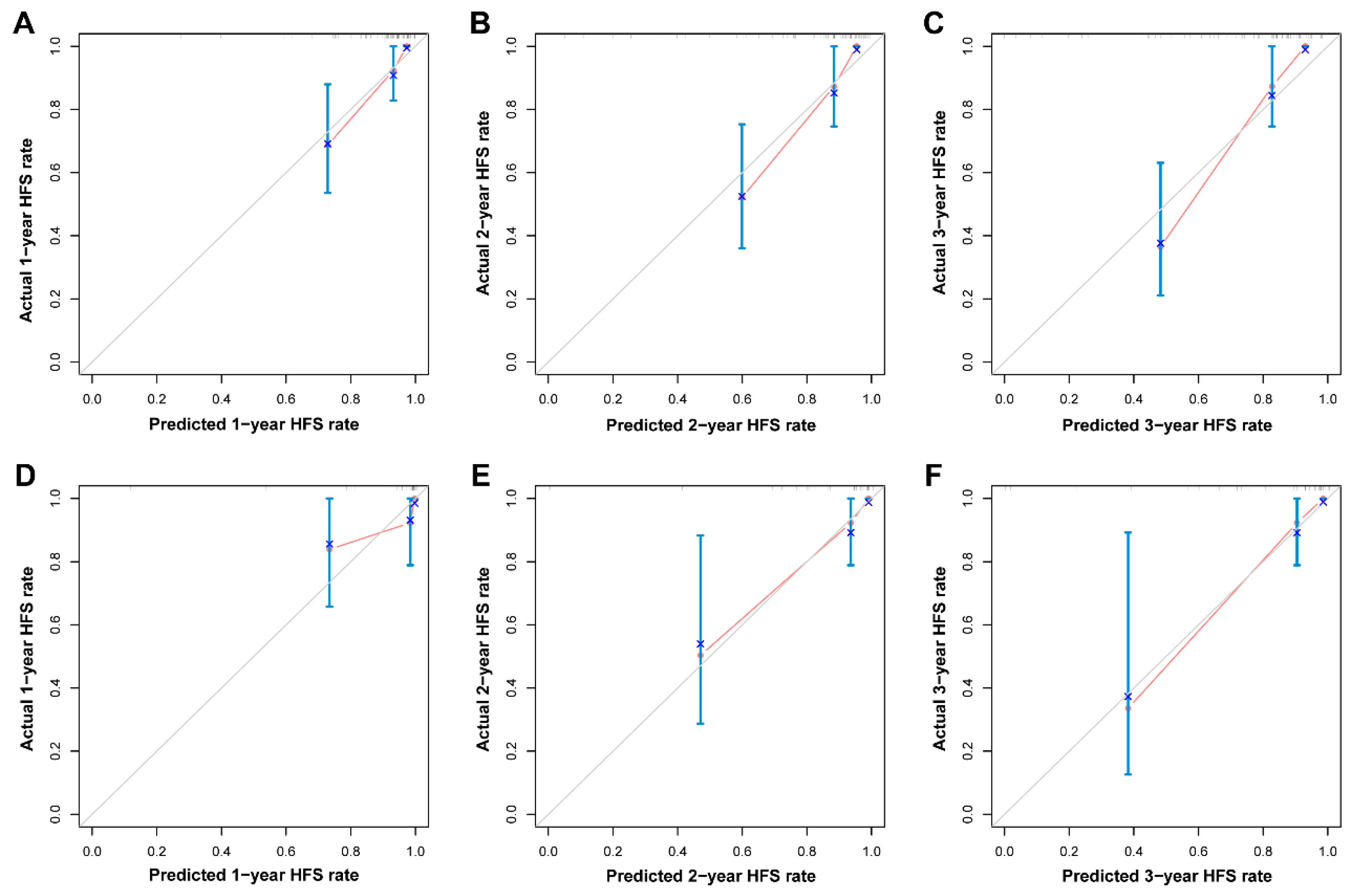
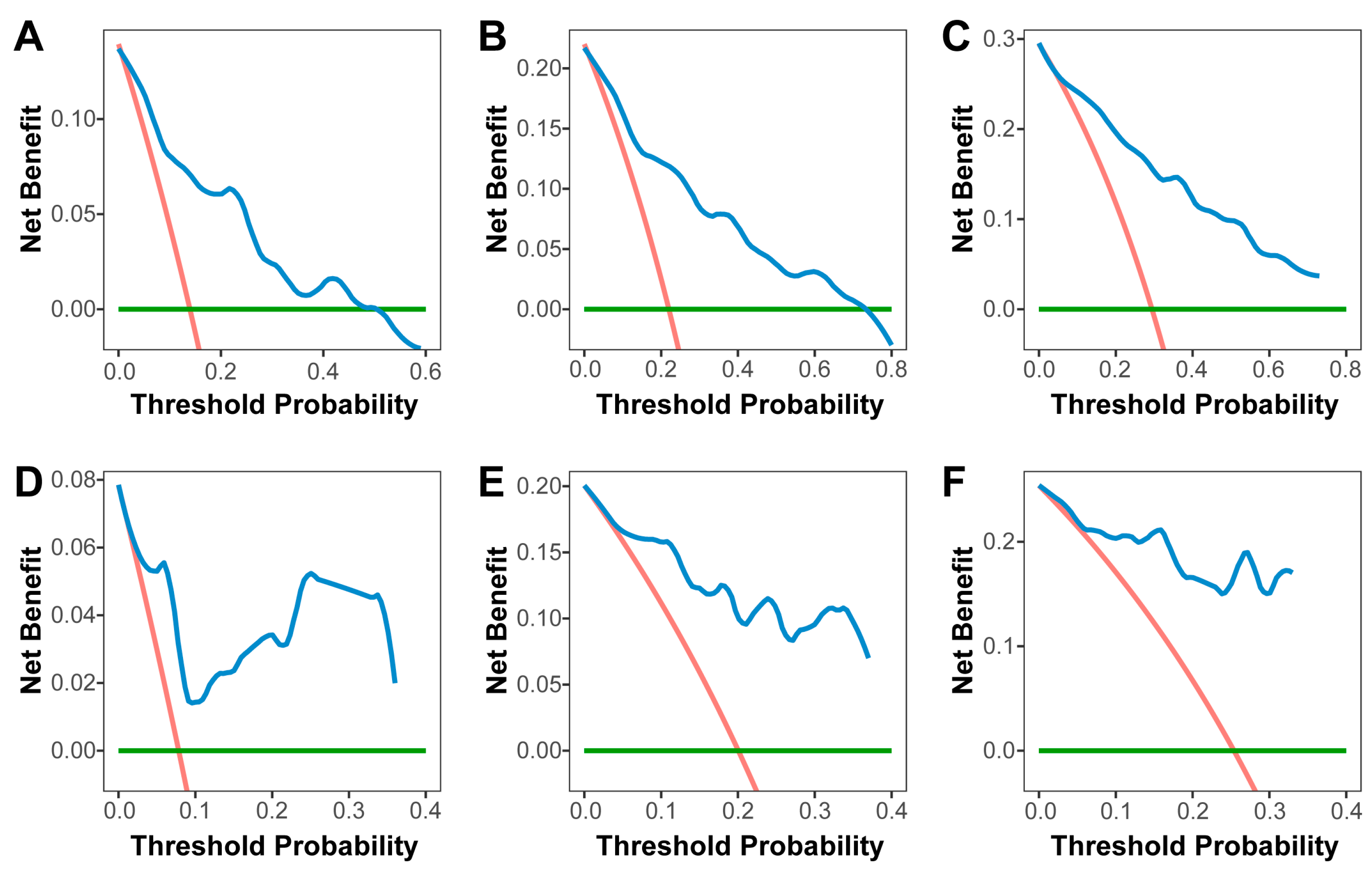
3.3. Construction of the Radiomic Model
3.4. Model Evaluation
4. Discussion
5. Conclusions
Supplementary Materials
Author Contributions
Funding
Institutional Review Board Statement
Informed Consent Statement
Data Availability Statement
Acknowledgments
Conflicts of Interest
References
- Wu, V.W.C.; Tam, S.-Y. Radiation induced temporal lobe necrosis in nasopharyngeal cancer patients after radical external beam radiotherapy. Radiat. Oncol. 2020, 15, 112. [Google Scholar] [CrossRef] [PubMed]
- Zheng, Z.; Wang, B.; Zhao, Q.; Zhang, Y.; Wei, J.; Meng, L.; Xin, Y.; Jiang, X. Research Progress on Mechanism and Imaging of Temporal Lobe Injury Induced by Radiotherapy for Head and Neck Cancer. Eur. Radiol. 2022, 32, 319–330. [Google Scholar] [CrossRef]
- Rübe, C.E.; Raid, S.; Palm, J.; Rübe, C. Radiation-Induced Brain Injury: Age Dependency of Neurocognitive Dysfunction Following Radiotherapy. Cancers 2023, 15, 2999. [Google Scholar] [CrossRef] [PubMed]
- Hou, J.; He, Y.; Li, H.; Ai, Z.; Lu, Q.; Zeng, B.; Xie, C.; Yu, X. Evolution of Radiation-Induced Temporal Lobe Injury after Intensity-Modulated Radiation Therapy in Nasopharyngeal Carcinoma: A Large Cohort Retrospective Study. Radiat. Oncol. 2024, 19, 9. [Google Scholar] [CrossRef]
- Fang, W.; Gu, B.; Jing, X.; Xiao, S.; Fan, S.; Liao, W.; Zheng, Y.; Liu, J. Late-Onset Cystic Brain Necrosis after Radiotherapy for Nasopharyngeal Carcinoma. Jpn. J. Clin. Oncol. 2017, 47, 499–504. [Google Scholar] [CrossRef]
- Wang, Y.-X.J.; King, A.D.; Zhou, H.; Leung, S.-F.; Abrigo, J.; Chan, Y.-L.; Hu, C.-W.; Yeung, D.K.W.; Ahuja, A.T. Evolution of Radiation-Induced Brain Injury: MR Imaging–Based Study. Radiology 2010, 254, 210–218. [Google Scholar] [CrossRef]
- Zhou, X.; Liao, X.; Ren, X.; Xiang, K.; Hu, Q.; Zhang, M.; He, H.; Shen, L.; Wei, Q. Dynamic MRI Follow-up of Radiation Encephalopathy in the Temporal Lobe Following Nasopharyngeal Carcinoma Radiotherapy. Oncol. Lett. 2017, 14, 715–724. [Google Scholar] [CrossRef]
- Hoshi, M.; Hayashi, T.; Kagami, H.; Murase, I.; Nakatsukasa, M. Late bilateral temporal lobe necrosis after conventional radiotherapy. Neurol. Med. Chir. 2003, 43, 213–216. [Google Scholar] [CrossRef] [PubMed]
- Alfotih, G.T.A.; Zheng, M.G.; Cai, W.Q.; Xu, X.K.; Hu, Z.; Li, F.C. Surgical Techniques in Radiation Induced Temporal Lobe Necrosis in Nasopharyngeal Carcinoma Patients. Neurol. Neurochir. Pol. 2016, 50, 172–179. [Google Scholar] [CrossRef] [PubMed]
- Shuto, T.; Ohtake, M.; Matsunaga, S. Proposed Mechanism for Cyst Formation and Enlargement Following Gamma Knife Surgery for Arteriovenous Malformations: Clinical Article. J. Neurosurg. 2012, 117, 135–143. [Google Scholar] [CrossRef]
- Al Hinai, Q.; Tampieri, D.; Souhami, L.; Sadikot, A.; Sinclair, D.; Leblanc, R. Cyst Formation Following Radiosurgery for AVMs: Report of 3 Cases. Can. J. Neurol. Sci. J. Can. Sci. Neurol. 2011, 38, 734–740. [Google Scholar] [CrossRef] [PubMed][Green Version]
- Hasegawa, T.; Kida, Y.; Kato, T.; Iizuka, H.; Kuramitsu, S.; Yamamoto, T. Long-term safety and efficacy of stereotactic radiosurgery for vestibular schwannomas: Evaluation of 440 patients more than 10 years after treatment with Gamma Knife surgery: Clinical article. J. Neurosurg. 2013, 118, 557–565. [Google Scholar] [CrossRef] [PubMed]
- Lam, T.-C.; Wong, F.C.S.; Leung, T.-W.; Ng, S.H.; Tung, S.Y. Clinical Outcomes of 174 Nasopharyngeal Carcinoma Patients with Radiation-Induced Temporal Lobe Necrosis. Int. J. Radiat. Oncol. 2012, 82, e57–e65. [Google Scholar] [CrossRef]
- Zhuang, H.; Shi, S.; Yuan, Z.; Chang, J.Y. Bevacizumab Treatment for Radiation Brain Necrosis: Mechanism, Efficacy and Issues. Mol. Cancer 2019, 18, 21. [Google Scholar] [CrossRef]
- Kuo, M.D.; Jamshidi, N. Behind the Numbers: Decoding Molecular Phenotypes with Radiogenomics—Guiding Principles and Technical Considerations. Radiology 2014, 270, 320–325. [Google Scholar] [CrossRef]
- Gillies, R.J.; Kinahan, P.E.; Hricak, H. Radiomics: Images Are More than Pictures, They Are Data. Radiology 2016, 278, 563–577. [Google Scholar] [CrossRef]
- Trebeschi, S.; Drago, S.G.; Birkbak, N.J.; Kurilova, I.; Cǎlin, A.M.; Delli Pizzi, A.; Lalezari, F.; Lambregts, D.M.J.; Rohaan, M.W.; Parmar, C.; et al. Predicting response to cancer immunotherapy using noninvasive radiomic biomarkers. Ann. Oncol. 2019, 30, 998–1004. [Google Scholar] [CrossRef]
- Cai, J.; Zheng, J.; Shen, J.; Yuan, Z.; Xie, M.; Gao, M.; Tan, H.; Liang, Z.; Rong, X.; Li, Y.; et al. A Radiomics Model for Predicting the Response to Bevacizumab in Brain Necrosis after Radiotherapy. Clin. Cancer Res. 2020, 26, 5438–5447. [Google Scholar] [CrossRef]
- Hou, J.; He, Y.; Li, H.; Lu, Q.; Lin, H.; Zeng, B.; Xie, C.; Yu, X. MRI-based radiomics models predict cystic brain radionecrosis of nasopharyngeal carcinoma after intensity modulated radiotherapy. Front. Neurol. 2024, 15, 1344324. [Google Scholar] [CrossRef] [PubMed]
- Naggar, A.; Omor, Y.; Latib, R. Bitemporal Lobe Cysts. J. Belg. Soc. Radiol. 2023, 107, 56. [Google Scholar] [CrossRef]
- Camp, R.L.; Dolled-Filhart, M.; Rimm, D.L. X-Tile: A New Bio-Informatics Tool for Biomarker Assessment and Outcome-Based Cut-Point Optimization. Clin. Cancer Res. Off. J. Am. Assoc. Cancer Res. 2004, 10, 7252–7259. [Google Scholar] [CrossRef]
- Guiot, J.; Vaidyanathan, A.; Deprez, L.; Zerka, F.; Danthine, D.; Frix, A.; Lambin, P.; Bottari, F.; Tsoutzidis, N.; Miraglio, B.; et al. A Review in Radiomics: Making Personalized Medicine a Reality via Routine Imaging. Med. Res. Rev. 2022, 42, 426–440. [Google Scholar] [CrossRef] [PubMed]
- Zhuo, X.; Huang, X.; Yan, M.; Li, H.; Li, Y.; Rong, X.; Lin, J.; Cai, J.; Xie, F.; Xu, Y.; et al. Comparison between High-Dose and Low-Dose Intravenous Methylprednisolone Therapy in Patients with Brain Necrosis after Radiotherapy for Nasopharyngeal Carcinoma. Radiother. Oncol. 2019, 137, 16–23. [Google Scholar] [CrossRef]
- Lee, A.W.; Ng, S.H.; Ho, J.H.; Tse, V.K.; Poon, Y.F.; Tse, C.C.; Au, G.K.; O, S.K.; Lau, W.H.; Foo, W.W. Clinical Diagnosis of Late Temporal Lobe Necrosis Following Radiation Therapy for Nasopharyngeal Carcinoma. Cancer 1988, 61, 1535–1542. [Google Scholar] [CrossRef]
- Zhuo, X.; Zhao, H.; Chen, M.; Mu, Y.; Li, Y.; Cai, J.; Li, H.; Xu, Y.; Tang, Y. A radiomics model for predicting the response to methylprednisolone in brain necrosis after radiotherapy for nasopharyngeal carcinoma. Radiat. Oncol. 2023, 18, 43. [Google Scholar] [CrossRef]
- Yang, X.; Ren, H.; Fu, J. Treatment of Radiation-Induced Brain Necrosis. Oxid. Med. Cell. Longev. 2021, 2021, 4793517. [Google Scholar] [CrossRef]
- Wang, P.; Liu, J.; Zhang, M.; Yang, J.; Lian, P.; Cheng, X.; Qin, J. Radiation Exposure Induced Blood-Brain Barrier Injury via Mitochondria-Mediated Sterile Inflammation. Adv. Sci. 2025, 12, e02356. [Google Scholar] [CrossRef]
- Cheng, J.; Jiang, J.; He, B.; Lin, W.-J.; Li, Y.; Duan, J.; Li, H.; Huang, X.; Cai, J.; Xie, J.; et al. A Phase 2 Study of Thalidomide for the Treatment of Radiation-Induced Blood-Brain Barrier Injury. Sci. Transl. Med. 2023, 15, eabm6543. [Google Scholar] [CrossRef]
- Norris, A.M.; Carrington, B.M.; Slevin, N.J. Late Radiation Change in the CNS: MR Imaging Following Gadolinium Enhancement. Clin. Radiol. 1997, 52, 356–362. [Google Scholar] [CrossRef] [PubMed]
- Smirniotopoulos, J.G.; Murphy, F.M.; Rushing, E.J.; Rees, J.H.; Schroeder, J.W. Patterns of Contrast Enhancement in the Brain and Meninges. RadioGraphics 2007, 27, 525–551. [Google Scholar] [CrossRef] [PubMed]
- Lambin, P.; Leijenaar, R.T.H.; Deist, T.M.; Peerlings, J.; de Jong, E.E.C.; van Timmeren, J.; Sanduleanu, S.; Larue, R.T.H.M.; Even, A.J.G.; Jochems, A.; et al. Radiomics: The Bridge between Medical Imaging and Personalized Medicine. Nat. Rev. Clin. Oncol. 2017, 14, 749–762. [Google Scholar] [CrossRef]
- Riveros Gilardi, B.; Muñoz López, J.I.; Hernández Villegas, A.C.; Garay Mora, J.A.; Rico Rodríguez, O.C.; Chávez Appendini, R.; De La Mora Malváez, M.; Higuera Calleja, J.A. Types of Cerebral Herniation and Their Imaging Features. RadioGraphics 2019, 39, 1598–1610. [Google Scholar] [CrossRef]
- Gao, G.; Wu, X.; Feng, J.; Hui, J.; Mao, Q.; Lecky, F.; Lingsma, H.; Maas, A.I.R.; Jiang, J. Clinical characteristics and outcomes in patients with traumatic brain injury in China: A prospective, multicentre, longitudinal, observational study. Lancet Neurol. 2020, 19, 670–677. [Google Scholar] [CrossRef]
- Coleman, M.E.; Roessler, M.E.H.; Peng, S.; Roth, A.R.; Risacher, S.L.; Saykin, A.J.; Apostolova, L.G.; Perry, B.L. Social Enrichment on the Job: Complex Work with People Improves Episodic Memory, Promotes Brain Reserve, and Reduces the Risk of Dementia. Alzheimers Dement. 2023, alz.13035. [Google Scholar] [CrossRef]
- Jeon, S.-B.; Kwon, S.U.; Park, J.C.; Lee, D.H.; Yun, S.-C.; Kim, Y.-J.; Ahn, J.-S.; Kwun, B.-D.; Kang, D.-W.; Choi, H.A.; et al. Reduction of Midline Shift Following Decompressive Hemicraniectomy for Malignant Middle Cerebral Artery Infarction. J. Stroke 2016, 18, 328–336. [Google Scholar] [CrossRef] [PubMed]
- Pullicino, P.M.; Alexandrov, A.V.; Shelton, J.A.; Alexandrova, N.A.; Smurawska, L.T.; Norris, J.W. Mass Effect and Death from Severe Acute Stroke. Neurology 1997, 49, 1090–1095. [Google Scholar] [CrossRef] [PubMed]
- Ropper, A.H. Lateral displacement of the brain and level of consciousness in patients with an acute hemispheral mass. N. Engl. J. Med. 1986, 314, 953–958. [Google Scholar] [CrossRef]
- Landis, J.R.; Koch, G.G. The Measurement of Observer Agreement for Categorical Data. Biometrics 1977, 33, 159–174. [Google Scholar] [CrossRef]
- Tibshirani, R. The Lasso Method for Variable Selection in the Cox Model. Stat. Med. 1997, 16, 385–395. [Google Scholar] [CrossRef]
- Collins, G.S.; Reitsma, J.B.; Altman, D.G.; Moons, K.G.M. Transparent Reporting of a Multivariable Prediction Model for Individual Prognosis or Diagnosis (TRIPOD): The TRIPOD Statement. BMJ 2015, 350, g7594. [Google Scholar] [CrossRef]



| Variable | Training Cohort (n = 91) | Testing Cohort (n = 39) | p-Value |
|---|---|---|---|
| Sex (male/female) | 72/19 | 27/12 | 0.225 |
| Age (years) | 52.5 (8.8) | 50.4 (9.5) | 0.231 |
| BMI (kg/m2) | 22.1 (3.5) | 21.3 (3.3) | 0.241 |
| Headache | 33 (36.3%) | 20 (51.3%) | 0.110 |
| Dizziness | 35 (38.5%) | 15 (38.5%) | >0.999 |
| Dysarthria | 15 (16.5%) | 3 (7.7%) | 0.184 |
| Difficulty swallowing and coughing | 37 (40.7%) | 11 (28.2%) | 0.178 |
| Blurred vision | 29 (31.9%) | 10 (25.6%) | 0.478 |
| Diplopia | 15 (16.5%) | 3 (7.7%) | 0.184 |
| Memory decline | 32 (35.2%) | 8 (20.5%) | 0.097 |
| Personality change | 9 (9.9%) | 7 (17.9%) | 0.245 |
| Psychiatric symptoms | 8 (8.8%) | 5 (12.8%) | 0.529 |
| Epilepsy | 33 (36.3%) | 13 (33.3%) | 0.749 |
| SBP (mmHg) | 124 (109.5, 134.5) | 128 (115, 138) | 0.334 |
| DBP (mmHg) | 79.6 (11.2) | 79.6 (12.6) | 0.984 |
| Heart rate (bpm) | 79.8 (12.9) | 79.2 (11.8) | 0.809 |
| Hemoglobin (g/L) | 129.8 (16.8) | 127.6 (15.8) | 0.484 |
| Neutrophils (×109/L) | 3.8 (2.9, 5.3) | 3.7 (2.9, 5.6) | 0.799 |
| Lymphocyte (×109/L) | 1.3 (1.0, 1.6) | 1.2 (1, 1.7) | 0.869 |
| ALT (U/L) | 19 (12, 25) | 15 (11.5, 22.5) | 0.191 |
| Total cholesterol (µmol/L) | 5.1 (4.4, 6.1) | 5.4 (4.7, 6.2) | 0.145 |
| Triglyceride (µmol/L) | 1.1 (0.8, 1.8) | 1.1 (0.7, 1.8) | 0.749 |
| HDL (µmol/L) | 1.2 (1, 1.5) | 1.3 (1.1, 1.4) | 0.913 |
| LDL (µmol/L) | 3.2 (2.5, 3.7) | 3.4 (2.8, 4.2) | 0.095 |
| Hs-CRP (mg/L) | 4.1 (1.5, 21.8) | 3.6 (1.5, 12.4) | 0.633 |
| ESR (mm/h) | 25 (12, 59) | 17 (10, 39.5) | 0.216 |
| MoCA | 22 (17, 26) | 25 (17.5, 27.5) | 0.216 |
| LENT/SOMA | 9 (3.5, 18) | 12 (3.5, 22) | 0.603 |
| Cyst volume (cm3) | 8.4 (3.1, 19.8) | 7.5 (3.6, 13.2) | 0.454 |
| Total brain lesion volume (cm3) | 26.3 (10.3, 50.1) | 28.3 (9.9, 48.5) | 0.875 |
| Extensive perilesional edema | 41 (45.1%) | 21 (53.8%) | 0.358 |
| Communication with lateral ventricle | 19 (20.9%) | 5 (12.8%) | 0.278 |
| Ratio of perilesional enhancement | 0.389 | ||
| Extensive enhancement | 71 (78.0%) | 33 (84.6%) | |
| Non-extensive enhancement | 20 (22.0%) | 6 (15.4%) | |
| FLAIR signal intensity | 0.619 | ||
| Markedly hypointense | 25 (27.5%) | 12 (30.8%) | |
| Hypointense | 45 (49.5%) | 21 (53.8%) | |
| Isointense | 15 (16.5%) | 3 (7.7%) | |
| Hyperintense | 6 (6.6%) | 3 (7.7%) | |
| Hemorrhage inside the cyst | 10 (11.0%) | 4 (10.3%) | 1.000 |
| Necrosis mass | 12 (13.2%) | 5 (12.8%) | 0.955 |
| Cyst locularity | 0.756 | ||
| Unilocular | 54 (59.3%) | 22 (56.4%) | |
| Multilocular | 37 (40.7%) | 17 (43.6%) | |
| Nasopharyngeal carcinoma stage | 0.367 | ||
| Stage I–II | 21 (23.1%) | 5 (12.8%) | |
| Stage III | 40 (44.0%) | 21 (53.8%) | |
| Stage IV | 30 (33.0%) | 13 (33.3%) | |
| Tumor radiation dose (Gy) | 70 (60, 72) | 68 (60, 73) | 0.700 |
| Neck radiation dose (Gy) | 61.2 (54, 66) | 60 (50, 66) | 0.661 |
| Radiation approach | 0.668 | ||
| Conventional radiotherapy | 55 (60.4%) | 22 (56.4%) | |
| IMRT | 36 (39.6%) | 17 (43.6%) | |
| Received chemotherapy | 53 (58.2%) | 28 (71.8%) | 0.144 |
| Interval between radiotherapy and RIBI (years) | 5 (3.2, 9.0) | 6.5 (3.6, 9.9) | 0.477 |
| Interval between radiotherapy and RCN (years) | 9.2 (7.2, 12.5) | 9 (7.8, 11.2) | 0.673 |
| Corticosteroid treatment at baseline | 46 (50.5%) | 15 (38.5%) | 0.206 |
| History of corticosteroid therapy | 29 (31.9%) | 12 (30.8%) | 0.902 |
| Follow-up time (years) | 1.9 (0.8, 3.8) | 2.2 (1.6, 4.7) | 0.063 |
| Cerebral herniation | 21 (23.1%) | 9 (23.1%) | 1.000 |
| Radiomic score | −0.1 (2.7) | 0.1 (2.9) | 0.749 |
| Variable | Univariable Cox Regression | Multivariable Cox Regression | ||
|---|---|---|---|---|
| Hazard Ratio (95% CI) | p Value | Hazard Ratio (95% CI) | p Value | |
| Radiomic score | 1.482 (1.242–1.768) | <0.001 | 1.374 (1.165–1.622) | <0.001 |
| Psychiatric symptoms | 4.153 (1.371–2.583) | 0.012 | ||
| Neutrophils (×109/L) | 1.140 (1.017–1.277) | 0.024 | ||
| Extensive perilesional edema | 4.298 (1.653–11.174) | 0.003 | ||
| RPE (extensive vs. non-extensive) | 6.041 (2.515–14.510) | <0.001 | 4.460 (1.785–11.143) | 0.001 |
| FLAIR hyperintensity | 5.013 (1.614–15.567) | 0.005 | ||
| Hemorrhage inside the cyst | 5.282 (2.019–13.821) | 0.001 | ||
| Necrosis mass | 5.672 (2.346–13.709) | <0.001 | ||
| History of corticosteroid therapy | 2.415 (1.020–5.713) | 0.045 | ||
Disclaimer/Publisher’s Note: The statements, opinions and data contained in all publications are solely those of the individual author(s) and contributor(s) and not of MDPI and/or the editor(s). MDPI and/or the editor(s) disclaim responsibility for any injury to people or property resulting from any ideas, methods, instructions or products referred to in the content. |
© 2026 by the authors. Licensee MDPI, Basel, Switzerland. This article is an open access article distributed under the terms and conditions of the Creative Commons Attribution (CC BY) license.
Share and Cite
Hou, H.; Cai, J.; Bao, M.; Yue, Z.; Xie, M.; Cai, Z.; Chen, Y.; Lin, Z.; Zeng, L.; Li, Y.; et al. A Novel Radiomic Model for Risk Stratification of Cerebral Herniation in Radiation-Induced Cystic Brain Necrosis. Cancers 2026, 18, 953. https://doi.org/10.3390/cancers18060953
Hou H, Cai J, Bao M, Yue Z, Xie M, Cai Z, Chen Y, Lin Z, Zeng L, Li Y, et al. A Novel Radiomic Model for Risk Stratification of Cerebral Herniation in Radiation-Induced Cystic Brain Necrosis. Cancers. 2026; 18(6):953. https://doi.org/10.3390/cancers18060953
Chicago/Turabian StyleHou, Hongbiao, Jinhua Cai, Mingyi Bao, Zongwei Yue, Mingwei Xie, Zhaoxi Cai, Yanting Chen, Zecong Lin, Le Zeng, Yi Li, and et al. 2026. "A Novel Radiomic Model for Risk Stratification of Cerebral Herniation in Radiation-Induced Cystic Brain Necrosis" Cancers 18, no. 6: 953. https://doi.org/10.3390/cancers18060953
APA StyleHou, H., Cai, J., Bao, M., Yue, Z., Xie, M., Cai, Z., Chen, Y., Lin, Z., Zeng, L., Li, Y., Li, H., Xu, Y., & Tang, Y. (2026). A Novel Radiomic Model for Risk Stratification of Cerebral Herniation in Radiation-Induced Cystic Brain Necrosis. Cancers, 18(6), 953. https://doi.org/10.3390/cancers18060953