Article

Anatomical Versus Non-Anatomical Pulmonary Metastasectomy: European Multicentre Analysis

by
Elena Prisciandaro
1,2,*,
Luca Bertolaccini
3,4,
Steffen Fieuws
5,
Laurens J. Ceulemans
6,7 and
on behalf of the ESTS Pulmonary Metastasectomy Initiative
1
Department of Thoracic Surgery, University Hospitals of Brussels, 1070 Brussels, Belgium
2
Department of Medical and Surgical Sciences (DIMEC), University of Bologna, 40126 Bologna, Italy
3
Department of Thoracic Surgery, IEO, European Institute of Oncology IRCCS, 20141 Milano, Italy
4
Department of Oncology and Hemato-Oncology, University of Milan, 20122 Milano, Italy
5
Interuniversity Institute for Biostatistics and Statistical Bioinformatics, KU Leuven, 3000 Leuven, Belgium
6
Department of Thoracic Surgery, University Hospitals Leuven, 3000 Leuven, Belgium
7
Laboratory of Respiratory Diseases and Thoracic Surgery (BREATHE), Department of Chronic Diseases and Metabolism (CHROMETA), KU Leuven, 3000 Leuven, Belgium
*
Author to whom correspondence should be addressed.
Details on the membership of the group are provided in the Acknowledgments.
Cancers 2026, 18(6), 1037; https://doi.org/10.3390/cancers18061037
Submission received: 13 February 2026 / Revised: 14 March 2026 / Accepted: 18 March 2026 / Published: 23 March 2026

Simple Summary

Pulmonary metastasectomy is a commonly performed surgical procedure, but there is still no agreement on how much lung tissue should be removed to achieve the best outcomes. Some surgeons prefer anatomical resections, while others favour more limited, non-anatomical resections. In this international multicentre study, we compared short- and long-term outcomes of these two surgical approaches in patients undergoing surgery with curative intent for lung metastases. By analysing data from a large European cohort, we aimed to clarify whether one approach offers advantages in terms of survival, disease recurrence, and postoperative complications. Our findings show that non-anatomical resections provide survival outcomes comparable to anatomical resections, with a lower risk of postoperative complications, while anatomical resections may reduce the risk of local recurrence in selected cases. These results support a tailored surgical approach, helping surgeons balance oncological effectiveness with preservation of lung function.

Abstract

Objectives: Pulmonary metastasectomy is not a standardised procedure, with no consensus regarding the optimal extent of lung resection. This international multicentre study aimed at comparing short and long-term outcomes of anatomical versus non-anatomical pulmonary metastasectomy. Methods: Retrospective database including 1647 patients aged ≥18 years, who underwent curative intent pulmonary metastasectomy between January 2010 and December 2018 at 15 European centres. Patients who underwent pneumonectomy, previous metastasectomies, and/or suffered from extrapulmonary recurrence at the time of lung surgery were excluded. Primary endpoint was overall survival. Secondary endpoints were recurrence-free survival and 30-day morbidity. Differences between the two groups were analysed using 3:1 matching. Results: In the matched cohort, 324 patients underwent anatomical resection, and 830 patients underwent non-anatomical resection. Five-year overall survival was 62.0%. Averaged over the entire follow-up, there was no significant difference in overall survival between the two groups (HR = 1.122, 95% CI = 0.909–1.385, p = 0.283). In the early period following pulmonary metastasectomy, anatomical resections were associated with worse overall survival (HR = 1.549, 95% CI = 1.135–2.114, p = 0.006). The difference in any-site recurrence-free survival between the two groups was not significant (HR = 0.832, 95% CI = 0.690–1.002, p = 0.053). Locoregional recurrence-free survival was significantly longer after anatomical resection (HR = 0.651, 95% CI = 0.520–0.817, p < 0.001). Thirty-day morbidity was significantly higher after anatomical resection (22.2% versus 13.7% for non-anatomical resections, p = 0.001). Conclusions: In a highly selected cohort, non-anatomical resection showed comparable survival and lower morbidity compared to anatomical resections, supporting the surgical strategy of favouring limited resections whenever technically and oncologically feasible. Anatomical resections remain a valid option in selected cases with acceptable outcomes.

1. Introduction

Pulmonary metastasectomy (PM) has become a routine practice worldwide, accounting for approximately 9% of all lung resections performed in Europe [1]. Indications for PM have broadened over the last decades [2,3] owing to significant improvements in imaging modalities, surgical techniques, and oncological therapies. As a result, surgical resection of lung metastases with a curative intent is now included in the multidisciplinary approach of selected patients with stage IV disease [4,5,6].
However, due to lack of consensus, appropriate eligibility criteria, surgical techniques, and treatment options have not been adequately addressed by current recommendations [7]. Limited tumour burden (controlled primary tumour, no extrapulmonary disease), low surgical risk, and the possibility to achieve radical (R0) resection are considered essential prerequisites for PM [5]. In this subset of carefully selected patients, PM may attain considerable survival benefits with acceptable morbidity [4,7].
Curative-intent surgery should ensure completeness of resection while preserving respiratory function, to minimise complications and allow potential subsequent PMs. In this regard, non-anatomical resections (nARs) (wedge resections, precision tumourectomies) are generally preferred [3]. Anatomical resections (ARs) (segmentectomies, lobectomies) have a greater impact on cardiopulmonary reserve and are therefore less frequently performed. However, due to the location and size of the lesions, AR may sometimes be the only surgical option. Pneumonectomies are rarely indicated, due to high morbidity and mortality [4,7,8,9,10].
On the other hand, nARs are associated with more narrow resection margins, a risk factor for recurrence and worse survival after PM [11], while ARs are considered more radical and oncologically safer. A systematic review from our group assessed survival differences between ARs and nARs for PM; however, it only included three studies on lung metastases from colorectal cancer, and a meta-analysis was not feasible [12].
The growing interest in the oncological outcomes of limited pulmonary resections is shown by recently published randomised trials, demonstrating the non-inferiority of sublobar resections to lobectomy in terms of survival, for patients with small-sized, peripheral, node-negative primary lung cancer [13,14]. Although these trials were conducted in the setting of primary lung cancer and their findings cannot be directly extrapolated to pulmonary metastases, they have contributed to a broader discussion regarding the oncological adequacy of parenchyma-sparing surgical strategies.
In contrast, the body of knowledge on PM mainly consists of retrospective series [5], and current surgical approaches are evaluated on a case-by-case basis [4].
To support surgical decision-making, we designed an international multicentre research project with the aim of investigating the impact of the extent of resection on short- and long-term outcomes in a large cohort of patients who underwent PM.

2. Materials and Methods

The results of the present study are reported in accordance with the Strengthening the Reporting of Observational Studies in Epidemiology (STROBE) guidelines. A STROBE checklist is provided in Appendix A (Table A1) [15].
A retrospective multicentre analysis was performed on a prospectively collected database of patients who underwent PM from January 2010 to December 2018 at 15 European Centres, listed in Appendix B. Institutional Ethics Committees approved the study (IEO 1438, 13 January 2021) in agreement with the General Data Protection Regulation. Due to the retrospective nature of the study, written patient informed consent was waived. Relevant data were retrieved from medical records and collected in a purpose-built Research Electronic Data Capture (REDCap) database [16,17]. When possible, information on events after discharge was collected from medical records, e-mails and/or phone interviews. Follow-up was closed in December 2022. Eligibility criteria were (1) patients aged 18 or older, (2) who underwent PM as their first metastasectomy, (3) PM performed with curative intent (macroscopic complete resection of all lung metastases), (4) PM performed for extrathoracic solid tumour metastases (but including oesophageal tumours), (5) clinical, radiological and/or histological evidence of locoregional control of the primary malignancy at the moment of PM. Exclusion criteria were (1) pneumonectomies, (2) patients who underwent PM prior to the considered period (2010–2018), (3) patients who underwent a metastasectomy of other anatomical sites prior to PM, (4) PM performed for non-solid tumours (haematologic malignancies), (5) performed with diagnostic intent, (6) clinical, radiological and/or histological evidence of extrapulmonary recurrence at the time of lung surgery.
The primary outcome was overall survival (OS). OS was defined as the time interval between PM and death or the last follow-up visit/interview. Patients with no information on OS were removed from the analyses.
Recurrence-free survival (RFS) was defined as the time interval between PM and detection of recurrence or death. Patients alive without any recurrence were censored at last follow-up. Patients without information on recurrence were removed from the RFS analyses. Any-site recurrence was defined as tumour relapse occurring at any site after PM. Locoregional recurrence was defined as tumour relapse occurring in the lung, pleura, hilar and/or mediastinal lymph node, and trachea.
Disease-free interval (DFI) was defined as the time interval between primary tumour diagnosis and diagnosis of lung metastases (or, if unknown, date of PM).
A time interval between primary tumour diagnosis and PM < 6 months corresponded to synchronous disease, while an interval ≥ 6 months corresponded to metachronous disease.
The sites of the primary malignancy were categorised as follows: (a) head and neck: ear, nose, tongue, pharynx, larynx, salivary glands/parotid, thyroid, and other, (b) digestive system: oesophagus, stomach, small bowel, colon and rectum, liver, gallbladder and biliary ducts, pancreas, and other, (c) urogenital/male reproductive system: kidney and ureters, urinary bladder and urethra, prostate and seminal vesicles, testicle, and other, (d) breasts/female reproductive system: breasts, uterus and adnexa, ovary, vagina, and other, (e) skin, (f) nervous system, (g) bone, muscle, vessel and soft tissues, (h) others.
The histology of the primary tumour was categorised as: adenocarcinoma, squamous cell carcinoma, sarcoma, germ cell tumour, melanoma, and others.
The American Society of Anesthesiologists (ASA) Physical Status Classification System [18] was used for perioperative patient assessment.
The Clavien-Dindo classification [19] was followed for grading postoperative complications occurring within 30 days after PM.
Quantitative variables were expressed as mean with standard deviation (SD) or median with interquartile range (IQR) 25–75%, whereas frequencies and percentages were given for nominal variables. Kaplan–Meier estimates and 95% confidence intervals (CI) were reported for OS and RFS. Using Cox regression, two approaches were used to assess differences in OS, any-site RFS, and locoregional RFS between AR and nAR patients. First, a multivariable Cox model was fitted on the total dataset, correcting for the following confounders: age at PM (continuous), sex (male versus female), number of confirmed metastases (1, 2–4, >4), size of the largest confirmed metastasis (<1 cm, 1–3 cm, >3 cm) and induction therapy before PM (yes versus no). The variables defined as confounders were selected based on previously published papers and on the opinions of three experienced authors (EP, LB, and LJC). ‘Centre’ was added as a random effect to handle the potential correlation between patients of the same centre. Second, a univariable Cox model was fitted on a dataset obtained after performing a 3:1 matching on a propensity score (three nAR patients for one AR patient). The matching was based on a propensity score derived from a multivariable logistic regression, using a calliper of 0.30 (on the logit scale). The variables defined as confounders in the multivariable model were used as predictors in the propensity model. However, an exact match was required for the categorical variables, hence differences in the propensity score between the AR patient and the nAR patients were completely determined by the differences in age. The matched dataset was obtained using a greedy matching algorithm. In the Cox models, robust standard errors [20] were used to take the matching into account. Note that AR patients for whom only one or two nAR patients could be found were also included in the analysis. Therefore, the results presented were obtained after weighting, i.e., a nAR patient in a cluster with less than 3 nAR patients received more weight than a nAR patient in a cluster with three nAR patients. Analyses in the matched sample were stratified on centre. In the Cox models, the proportional hazard assumption was verified with a test of Lin, Wei, and Ying [21]. Results were presented from an analysis using restricted cubic splines allowing the effect of AR to vary over time in a flexible way [22] when the proportional hazard assumption was violated. To further illustrate the time-varying effect of AR, a segmented model was fitted, allowing the effect of AR to differ before and after a cutpoint. The cutpoint was determined as the point maximising the likelihood, and a 95% bootstrap percentile confidence interval was reported.
The results of this model need to be interpreted with caution, since they do not reflect the uncertainty in the estimation of the cut-point.
Subgroup analyses were performed as a function of primary tumour site and histology. All analyses were performed using SAS software, version 9.4 of the SAS System for Windows [23].

3. Results

3.1. Unmatched Cohort Analyses

From 15 European centres, a total of 1867 subjects who underwent PM were included. After excluding 220 subjects (reasons for exclusion are detailed in Appendix C, Table A2), 1647 patients were analysed. Median age at primary tumour diagnosis was 60.8 (IQR 25–75% = 51.8–69.0) years, and median age at PM was 64.5 (IQR 25–75% = 55.1–72.5) years. Median disease-free interval (DFI) was 26.0 (IQR 25–75% = 14.0–45.0) months. Male/female ratio was 1.32:1. Median length of follow-up was 6.1 (IQR 25–75% = 4.2–8.1) years. ARs were performed in 376 patients (22.8%), while nARs were done in 1271 patients (77.2%) (Table 1).
The characteristics of the unmatched cohort are shown in Appendix D (Table A3, Table A4, Table A5, Table A6 and Table A7). Notably, ARs were more frequently associated with open procedures (48.1% versus 41.8%, p = 0.029), robotic-assisted thoracoscopic surgery (5.1% versus 2.3%, p = 0.005), and hilar-mediastinal lymph node dissection (88.3% versus 27.5%, p < 0.001), while nARs were more frequently associated with bilateral metastases (13.1% versus 0.8%, p < 0.001) and video-assisted thoracoscopic surgery (VATS) (57.3% versus 46.8%, p < 0.001). The prevalence of synchronous/metachronous lung metastases did not significantly differ between groups (p = 0·668). Single lung metastases were reported in 69.6% of cases (83.0% in the AR group versus 65.7% in the nAR group, p < 0.0001). The OS of the entire cohort at 1, 5, and 10 years was 94.2%, 62.0%, and 41.7%, respectively (Table 2).
Tumour progression was the reported cause of death for 84.0% patients. OS between synchronous and metachronous disease did not differ (p = 0.135). The univariable Cox regression did not detect any differences in OS between ARs and nARs (HR = 1.145, 95% CI = 0.954–1.374, p = 0.1471). Since the propensity hazard assumption was rejected (p < 0.001), the effect of the type of resection on OS was allowed to be time-varying. The multivariable Cox regression model showed that patients in the AR group had significantly worse OS in the first 2.5 years following PM (HR = 1.656, 95% CI = 1.266–2.167, p < 0.001), as opposed to after 2.5 years following PM (HR = 0.780, 95% CI = 0.595–1.024, p = 0.073). Lobectomies/bilobectomies showed a significantly worse OS than segmentectomies (p = 0.002) and wedge resections (p = 0.009), while OS was comparable between anatomical segmentectomies and wedge resections (p = 0.291). There were no significant differences in OS between ARs and nARs depending on the number of confirmed metastases (p = 0.709), and the size of the largest confirmed metastasis (p = 0.458). Any-site RFS at 1, 5, and 10 years was 64.1%, 29.6%, and 21.7%, respectively (Table 2). The univariable Cox regression showed no significant association with the broadness of resection margins (HR = 0.991, CI = 0.979–1.003, p = 0.128). ARs were associated with a significantly longer any-site RFS (HR = 0.779, 95% CI = 0.667–0.911, p = 0.002), which was confirmed at multivariable analyses (HR = 0.789, 95% CI = 0.668–0.932, p = 0.005). Locoregional RFS at 1, 5, and 10 years was 74.4%, 42.1%, and 31.3%, respectively (Table 2). A significant correlation with the broadness of resection margins was observed (HR = 0.989, CI = 0.979–1.000, p = 0.049). The univariable analysis showed longer locoregional RFS after ARs (HR = 0.643, 95% CI = 0.530–0.779, p < 0.0001), which was confirmed at multivariable analyses (HR = 0.655, 95% CI = 0.533–0.804, p < 0.0001). In a subset of patients who underwent lymph node dissection (323 in the AR group, 314 in the nAR group), the proportional hazard assumption was rejected (p = 0.014), and ARs were associated with a worse OS in the first 2.5 years after PM (HR = 1.540, 95% CI = 1.072–2.212, p = 0.020). In the multivariable Cox regression model, the effect of ARs on OS in the first 2.5 years following PM was not significant (HR = 1.393, 95% CI = 0.942–2.060, p = 0.097). In the nAR group, OS did not differ between patients who underwent lymph node dissection and those who did not (p = 0.154). Site-specific and histology-specific OS and RFS are reported in Appendix E (Table A8 and Table A9).

3.2. Matched Cohort Analyses

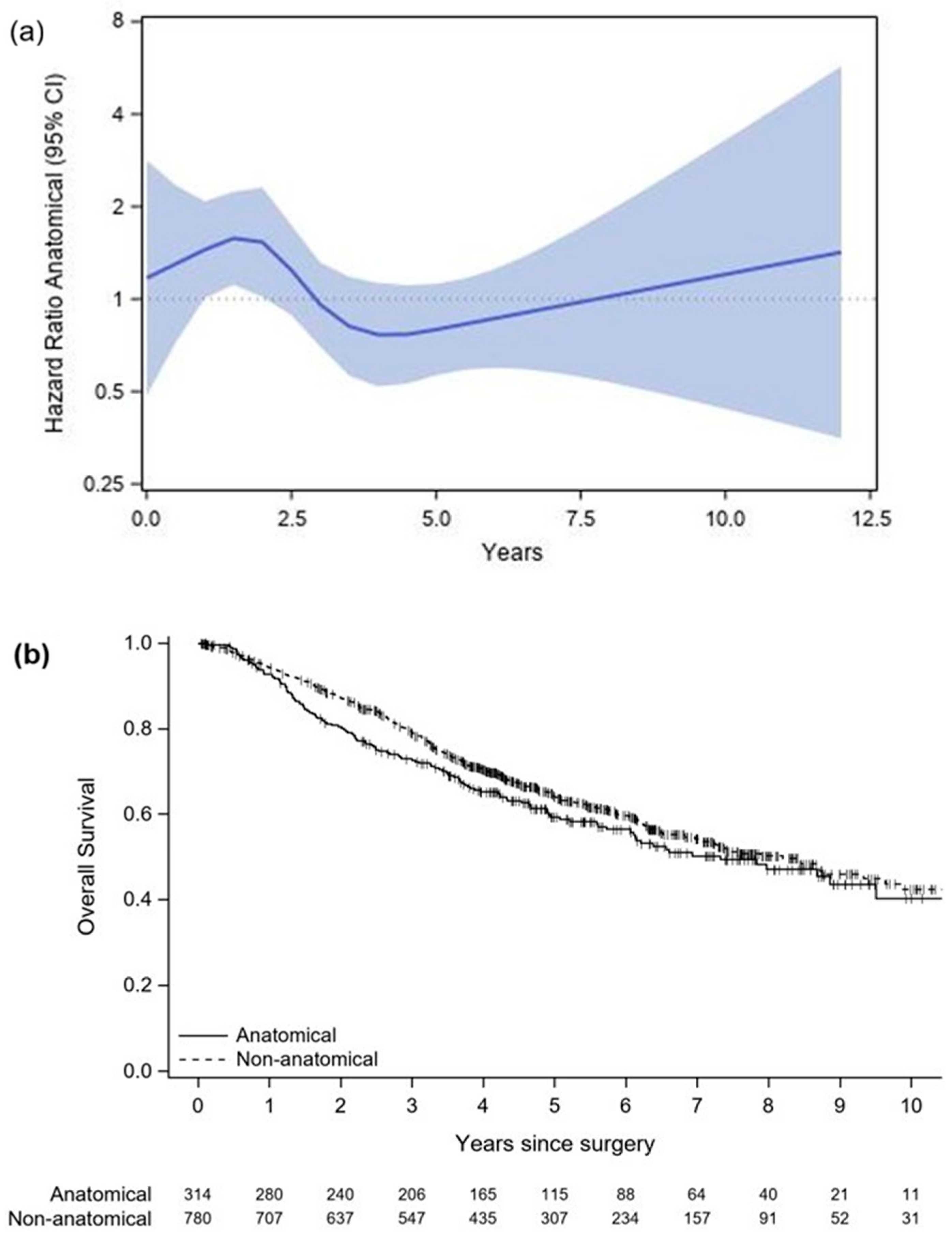
The two groups were matched 3:1 on age at PM, sex, size of the (largest) metastasis, number of confirmed metastases, and induction therapy before PM. An exact match was required for sex, size of the (largest) metastasis, number of confirmed metastases, and induction therapy before PM (standardised difference was 0). The evaluation of the balance of the variables involved in matching is shown in Appendix F (Table A10). Concerning age at PM, the standardised difference after matching was 0.154 (difference of 1.7 years). After matching, the AR group included 324 patients, while the nAR group consisted of 830 patients (62, 18, and 244 AR patients were matched with 1, 2, and 3 nAR patients, respectively). Information on OS was available for 314 AR and 780 nAR patients. There was no significant difference in OS between ARs and nARs (HR = 1.122, 95% CI = 0.909–1.385, p = 0.283). The proportional hazard assumption was rejected (p = 0.003). ARs had a worse OS in the first 2.5 years following PM (HR = 1.549, 95% CI = 1.135–2.114, p = 0.006) (Figure 1).
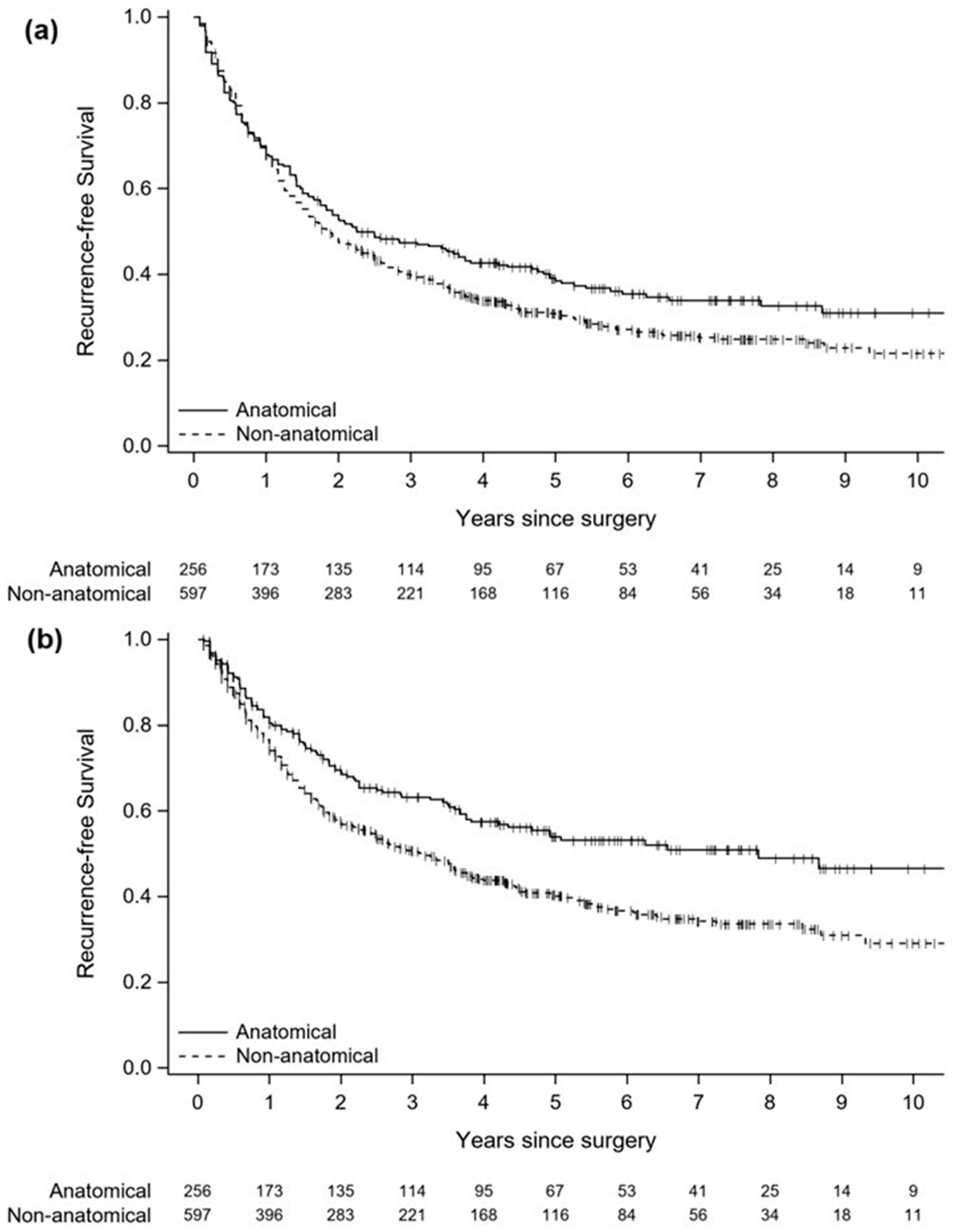
Information on recurrence was available for 256 patients in the AR group and 597 patients in the nAR group. There was a tendency towards longer any-site RFS after AR, but the difference was not significant (HR = 0.832, 95% CI = 0.690–1.002, p = 0.053). Locoregional RFS was significantly longer after AR (HR = 0.651, 95% CI = 0.520–0.817, p < 0.001) (Figure 2).
Data on 30-day postoperative complications were available for 324 patients who underwent AR and 830 who underwent nAR (Table 3).

4. Discussion

Pulmonary metastases are relatively common findings in patients with extrathoracic malignancies [4,5,6]. PM aims at achieving complete resection of lung metastases and has earned a place among the potentially curative approaches for stage IV tumours. Survival analyses comparing surgical resection to other treatment options for lung metastases are scarce, and the actual benefits of PM remain unclear. In a randomised controlled trial on patients with pulmonary metastases from colorectal cancer, survival rates after PM were similar to those of the control group [24]. However, despite not being supported by high-quality evidence [4], PM is increasingly performed in selected subsets of patients with lung metastases from various primary tumours [7]. This multicentre study assessed the survival impact of the extent of surgical resection in patients undergoing curative-intent PM. The unmatched cohort consisted of more than 1600 patients from 15 European centres, with a follow-up of 6 years and a variety of primary tumours and clinical presentations, being representative of the real-world PM population. After propensity-matching on five clinically relevant variables, no significant OS difference was observed between nARs and ARs. Our findings add to the growing evidence that sublobar lung resections provide equivalent long-term survival benefits to major anatomical resections [13,14]. In addition, our analyses revealed that nARs resulted in comparable OS to ARs regardless of the number of metastases, size of the largest metastasis, and lymph node dissection. Furthermore, we demonstrated that patients undergoing ARs had a worse OS in the early postoperative period (2.5 years). This could be ascribed to several, non-mutually exclusive factors. First, ARs were associated with a greater operative extent, with approximately 70% of procedures consisting of lobectomies or more extensive resections. Second, the AR group showed higher postoperative morbidity, particularly cardiac and respiratory complications and a higher incidence of Clavien–Dindo grade III–V events, which may contribute to early mortality. Third, confounding by indication cannot be excluded, as ARs are typically performed when lesions are central, larger, or technically unsuitable for limited resections. Unfortunately, information on the intraparenchymal location of metastases was not available in our dataset, preventing further exploration of this aspect. Previous studies have shown more severe and long-term invalidating sequelae after ARs, especially after major anatomical resections [25]. However, in this study, when restricting the comparison to anatomical segmentectomy versus wedge resection, OS was comparable, and the survival difference observed in the early period after PM was not detected anymore. Survival rates were remarkably higher than in previously reported cohorts: 5- and 10-year OS were 62.0% (versus 20.0–48.0%) and 41.7% (versus 15.8–37.7%), respectively [5]. This could be attributed to the improvements of systemic treatments for stage IV disease and our strict inclusion criteria (macroscopic complete resection of all lung metastases, no pneumonectomies). Regarding locoregional recurrence, ARs resulted in a significantly longer RFS. This could be related to the broader resection margins in the AR group. In fact, in the unmatched cohort, we observed a significant correlation between the broadness of resection margins and locoregional RFS, in line with previous research showing that narrow resection margins are a risk factor for local recurrences [3,11].
The improvement in loco-regional RFS, however, did not translate into a measurable survival benefit. This likely reflects the fact that overall survival is determined by multiple factors beyond local disease control, including tumour biology, the extent of systemic disease, and the effectiveness of systemic therapies. In the literature, repeated PMs are considered a safe and reliable approach to recurrent lung metastases [3,26]. In our cohort, almost one third of the patients underwent repeated PMs, the majority (86.0%) of them following a nAR as first PM. This may indicate greater preservation of lung parenchyma after the first PM in the nAR group, although differences in multidisciplinary decision-making after prior ARs may also have contributed. The role of lymph node assessment and its impact on OS remains controversial: despite being recommended [4,7,10], nodal dissection is not routinely performed in the setting of PM [8,9,10]. In our cohort, it was performed in 41.4% of cases and was strongly associated with ARs, but, in accordance with the existing research, it did not significantly affect survival after PM [27]. In order to increase the robustness of our findings, our study cohort was highly selected (patients aged ≥18, with lung metastases being the first and only site of disease relapse from an extrathoracic solid tumour, treated with curative-intent PM, exclusion of pneumonectomies, etc.). Nevertheless, it remains representative of real-world data on PM in Europe: more than half of patients suffered from digestive system tumours (mainly colorectal adenocarcinoma) [28], PMs were most often performed for solitary lung metastases (69.9%), mostly by VATS (54.9%), and mostly through nAR (77.2%) [4,7,9,29,30]. In accordance with previous publications [5,6,8], PM confirms itself as a safe procedure with acceptable intraoperative and postoperative morbidity. It has to be noted, however, that PM outcomes may also depend on tumour histology and the local microenvironment [31,32]. The main limitations of our study lie in its retrospective nature, which may introduce selection bias, and in the variety of practice patterns among the participating centres (patient selection protocols, primary tumours, non-surgical treatment strategies, postoperative surveillance protocols). We addressed the heterogeneity of our population by establishing stringent eligibility criteria and matching on clinically significant variables. Of note, median DFI was longer in the AR group (p = 0.005); however, since the difference with the nAR group (5.0 months) was deemed clinically irrelevant, DFI was not included among the confounders. Similarly, primary tumour histology was not included among the confounders; therefore, patients with different primary tumours may have been matched. Furthermore, different primary tumour histologies were regrouped based on their anatomical site. A minor residual discrepancy was observed for uncommon cancer types, including bone, muscle, vessel, and soft tissue tumours, which were slightly more frequent in the nAR group. While these represent a small fraction of the cohort, their unique prognostic and treatment profiles compared with the predominant colorectal histology could have influenced the outcomes. OS as well as RFS could theoretically be affected by lymph node dissection, which was more frequent in the AR group. However, nodal positivity was extremely rare (<1% in both groups) and is therefore unlikely to have influenced survival outcomes. Information on the location of pulmonary lesions within the parenchyma (central versus peripheral) was not available, although it represents a major factor influencing the decision between AR versus nAR and may have contributed to the worse early overall survival observed in the AR group. Patients with missing information (e.g., on recurrence) were excluded, potentially leading to an underestimation of the considered outcome. The strength of this study lies in its multicentre design, real-world approach, and large cohort. It assessed several clinically relevant short- and long-term endpoints. The reported evidence is supported by the consistency of the findings of unmatched and matched analyses.

5. Conclusions

Our findings support the long-standing surgical strategy of favouring limited resections whenever technically and oncologically feasible. ARs may be associated with longer RFS and remain a valuable option when nARs are not feasible (central, large and/or multiple ipsilobar lesions) while still ensuring acceptable morbidity and similar oncological outcomes. These results contribute to the standardisation of PM and provide meaningful guidance for multidisciplinary decision-making in the management of lung metastases.

Author Contributions

Conceptualization, E.P., L.B., S.F. and L.J.C.; methodology, E.P., L.B., S.F. and L.J.C.; software, E.P., S.F. and L.J.C.; validation, E.P. and S.F.; formal analysis, E.P., L.B., S.F. and L.J.C.; investigation, E.P., L.B., S.F., L.J.C. and ESTS Pulmonary Metastasectomy Initiative; data curation, E.P. and S.F.; writing—original draft preparation, E.P., L.B., S.F. and L.J.C.; writing—review and editing, E.P., L.B., S.F., L.J.C. and ESTS Pulmonary Metastasectomy Initiative; visualisation, E.P. and S.F.; supervision, L.B. and L.J.C.; project administration, E.P.; funding acquisition, L.J.C. All authors have read and agreed to the published version of the manuscript.

Funding

This research was supported by the European Society of Thoracic Surgery Biology Club Fellowship 2020, funded by Medtronic, and awarded to E.P.

Institutional Review Board Statement

The study (IEO 1438, 13 January 2021) was conducted in accordance with the Declaration of Helsinki, and approved by the Institutional Ethics Committees of the European Institute of Oncology (Milan, Italy) in agreement with the General Data Protection Regulation.

Informed Consent Statement

Patient consent was waived due to the retrospective nature of the study.

Data Availability Statement

The data presented in this study are available on request from the corresponding author due to ethical reasons.

Acknowledgments

Andrea Cara (Department of Thoracic Surgery, IEO European Institute of Oncology IRCCS, Milano, Italy), Lorenzo SpaggiariCara (Department of Thoracic Surgery, IEO European Institute of Oncology IRCCS, Milano, Italy; Department of Oncology and Hemato-Oncology, University of Milan, Milano, Italy), Lin Huang (Department of Cardiothoracic Surgery, Copenhagen University Hospital, Rigshospitalet, Copenhagen, Denmark), René H. Petersen (Department of Cardiothoracic Surgery, Copenhagen University Hospital, Rigshospitalet, Copenhagen, Denmark), Marco Lucchi (Division of Thoracic Surgery, Cardiac, Thoracic and Vascular Department, University Hospital of Pisa, Pisa, Italy), Maria G. Mastromarino (Division of Thoracic Surgery, Cardiac, Thoracic and Vascular Department, University Hospital of Pisa, Pisa, Italy), Annalisa Barbarossa (Department of Thoracic Surgery, University Hospitals Leuven, Leuven, Belgium), Paul De Leyn (Department of Thoracic Surgery, University Hospitals Leuven, Leuven, Belgium; KU Leuven, Laboratory of Respiratory Diseases and Thoracic Surgery (BREATHE), CHROMETA, Leuven, Belgium), Matteo Roffinella (Department of Thoracic Surgery, Azienda Ospedaliera Universitaria Città della Salute e della Scienza di Torino, Torino, Italy), Enrico Ruffini (Department of Surgical Science, Section of Thoracic Surgery, University of Torino, Torino, Italy), Abid Donlagic (Service of Thoracic Surgery, University Hospital of Lausanne, Lausanne, Switzerland), Michel Gonzalez (Service of Thoracic Surgery, University Hospital of Lausanne, Lausanne, Switzerland), Marta G. Fuentes-Gago (Department of Thoracic Surgery, Salamanca University Hospital, Salamanca, Spain), Clara Forcada-Barreda (Department of Thoracic Surgery, Salamanca University Hospital, Salamanca, Spain), Maria T. Congedo (Unit of Thoracic Surgery, Fondazione Policlinico Universitario A. Gemelli IRCCS, Roma, Italy), Stefano Margaritora (Unit of Thoracic Surgery, Fondazione Policlinico Universitario A. Gemelli IRCCS, Roma, Italy), Yaniss Belaroussi (Department of Thoracic Surgery, University Hospital Bordeaux, Pessac, France), Matthieu Thumerel (Department of Thoracic Surgery, University Hospital Bordeaux, Pessac, France), Jérémy Tricard (Department of Cardiac and Thoracic Surgery, University Hospital Limoges, Limoges, France), Pierre Felix (Department of Cardiac and Thoracic Surgery, University Hospital Limoges, Limoges, France), Nina Lebeda (Department of Thoracic Surgery, University Hospital Zürich, Zürich, Switzerland), Isabelle Opitz (Department of Thoracic Surgery, University Hospital Zürich, Zürich, Switzerland), Angela De Palma (Section of Thoracic Surgery, Department of Precision and Regenerative Medicine and Ionian Area, University of Bari “Aldo Moro”, Bari, Italy), Giuseppe Marulli (Section of Thoracic Surgery, Department of Precision and Regenerative Medicine and Ionian Area, University of Bari “Aldo Moro”, Bari, Italy), Cesare Braggio (Department of Thoracic Surgery, Lung Transplantation and Oesophageal diseases, North Hospital, Marseille, France), Pascal A. Thomas (Department of Thoracic Surgery, Lung Transplantation and Oesophageal diseases, North Hospital, Marseille, France), Frankie Mbadinga (Department of General and Cardiothoracic Surgery, University Hospital Rouen, Rouen, France), Jean-Marc Baste (Department of General and Cardiothoracic Surgery, University Hospital Rouen, Rouen, France), Bihter Sayan (Department of Thoracic Surgery, Marmara University School of Medicine, Istanbul, Turkey), Bedrettin Yildizeli (Department of Thoracic Surgery, Marmara University School of Medicine, Istanbul, Turkey), Jeroen Dekervel (Department of Digestive Oncology, University Hospitals Leuven, Leuven, Belgium), Dirk E. Van Raemdonck (Department of Thoracic Surgery, University Hospitals Leuven, Leuven, Belgium; KU Leuven, Laboratory of Respiratory Diseases and Thoracic Surgery (BREATHE), CHROMETA, Leuven, Belgium), Walter Weder (Department of Thoracic Surgery, Bethanien Klinik, Zürich, Switzerland).

Conflicts of Interest

The authors declare no conflicts of interest. The funders had no role in the design of the study; in the collection, analyses, or interpretation of data; in the writing of the manuscript; or in the decision to publish the results.

Abbreviations

The following abbreviations are used in this manuscript:
ARanatomical resection
ASAAmerican Society of Anesthesiologists
CIconfidence interval
DFIdisease-free interval
HRhazard ratio
IQRinterquartile range
nARnon-anatomical resection
OSoverall survival
PMpulmonary metastasectomy
REDCapResearch Electronic Data Capture
RFSrecurrence-free survival
SDstandard deviation
STROBEStrengthening the Reporting of Observational Studies in Epidemiology
VATSvideo-assisted thoracoscopic surgery

Appendix A

Table A1. STROBE Statement—Checklist of items that should be included in reports of cohort studies.
Item NoRecommendationPage No
Title and abstract1(a) Indicate the study’s design with a commonly used term in the title or the abstract1, 2
(b) Provide in the abstract an informative and balanced summary of what was done and what was found2
Introduction
Background/rationale2Explain the scientific background and rationale for the investigation being reported2–3
Objectives3State specific objectives, including any prespecified hypotheses2–3
Methods
Study design4Present key elements of study design early in the paper3–5
Setting5Describe the setting, locations, and relevant dates, including periods of recruitment, exposure, follow-up, and data collection3–5
Participants6(a) Give the eligibility criteria, and the sources and methods of selection of participants. Describe methods of follow-up3–5
(b) For matched studies, give matching criteria and number of exposed and unexposed3–5
Variables7Clearly define all outcomes, exposures, predictors, potential confounders, and effect modifiers. Give diagnostic criteria, if applicable3–5
Data sources/measurement8For each variable of interest, give sources of data and details of methods of assessment (measurement). Describe comparability of assessment methods if there is more than one group3–5
Bias9Describe any efforts to address potential sources of bias3–5
Study size10Explain how the study size was arrived at3–5
Quantitative variables11Explain how quantitative variables were handled in the analyses. If applicable, describe which groupings were chosen and why3–5
Statistical methods12(a) Describe all statistical methods, including those used to control for confounding3–5
(b) Describe any methods used to examine subgroups and interactions
(c) Explain how missing data were addressed
(d) If applicable, explain how loss to follow-up was addressed
(e) Describe any sensitivity analyses
Results
Participants13(a) Report numbers of individuals at each stage of study—e.g., numbers potentially eligible, examined for eligibility, confirmed eligible, included in the study, completing follow-up, and analysed5, Appendix C
(b) Give reasons for non-participation at each stage
(c) Consider use of a flow diagram
Descriptive data14(a) Give characteristics of study participants (e.g., demographic, clinical, social) and information on exposures and potential confounders5–9, Appendix D
(b) Indicate number of participants with missing data for each variable of interest
(c) Summarise follow-up time (e.g., average and total amount)
Outcome data15 Report numbers of outcome events or summary measures over timeFigure 1 and Figure 2, Appendix D and Appendix F
Main results16(a) Give unadjusted estimates and, if applicable, confounder-adjusted estimates and their precision (e.g., 95% confidence interval). Make clear which confounders were adjusted for and why they were included5–9, Appendix F
(b) Report category boundaries when continuous variables were categorised
(c) If relevant, consider translating estimates of relative risk into absolute risk for a meaningful time period
Other analyses17Report other analyses done—e.g., analyses of subgroups and interactions, and sensitivity analyses5–9,
Appendix D
Discussion
Key results18Summarise key results with reference to study objectives9–11
Limitations19Discuss limitations of the study, taking into account sources of potential bias or imprecision. Discuss both direction and magnitude of any potential bias9–11
Interpretation20Give a cautious overall interpretation of results considering objectives, limitations, multiplicity of analyses, results from similar studies, and other relevant evidence9–11
Generalisability21Discuss the generalisability (external validity) of the study results9–11
Other information
Funding22Give the source of funding and the role of the funders for the present study and, if applicable, for the original study on which the present article is based11

Appendix B

List of European centres participating to the study (IEO 1438—13 January 2021)
  • Divisione di Chirurgia Toracica, Istituto Europeo di Oncologia, Milano, Italy;
  • Divisione Universitaria di Chirurgia Toracica, Azienda Ospedaliero-Universitaria Città della Salute e della Scienza, Torino, Italy;
  • Unità Operativa di Chirurgia Toracica, Azienda Ospedaliero-Universitaria Pisana, Pisa, Italy;
  • Unità Operativa Complessa di Chirurgia Toracica, Azienda Ospedaliero-Universitaria Consorziale Policlinico, Bari, Italy;
  • Unità Operativa Complessa di Chirurgia Toracica, Ospedale Policlinico Universitario Agostino Gemelli, Roma, Italy;
  • Service de Chirurgie thoracique et des maladies de l’œsophage, Assistance Publique Hôpitaux de Marseille, Marseille, France;
  • Service de Chirurgie Thoracique et Cardio-Vasculaire, Centre Hospitalier Universitaire, Rouen, France;
  • Service de Chirurgie Cardio-Thoracique, Centre Hospitalier Universitaire de Limoges, Limoges, France;
  • Service de Chirurgie Thoracique et Cervicale et Transplantation Pulmonaire, Centre Hospitalier Universitaire de Bordeaux, Pessac, France;
  • Servicio de Cirugía Torácica, Complejo Asistencial Universitario de Salamanca, Salamanca, Spain;
  • Klinik für Thoraxchirurgie, Universitätsspital Zürich, Zürich, Switzerland;
  • Service de Chirurgie Thoracique, Centre Hospitalier Universitaire Vaudois, Lausanne, Switzerland;
  • Department of Thoracic Surgery, Marmara University Faculty of Medicine, Istanbul, Turkey;
  • Afdeling for Hjerte- og Lungekirurgi, Rigshospitalet og Institut for Klinisk Medicin, Københavns Universitet, København, Denmark;
  • Thoraxheelkunde, Universitaire Ziekenhuizen Leuven, Leuven, Belgium.

Appendix C

Table A2. Reasons for exclusion from analyses.
Reason for ExclusionN
Both anatomical and non-anatomical resections during the same procedure132
Subjects not fulfilling eligibility criteria53
Inconsistencies36
Missing information on type of resection7

Appendix D

Table A3. Demographic and baseline characteristics of the unmatched cohort.
VariableStatisticARsnARsp-Value
Sex 0.223
Femalen/N (%)152/376 (40.4)558/1269 (44.0)
Malen/N (%)224/376 (59.6)711/1269 (56.0)
Age at primary diagnosis (years)N36812470.033
Mean (SD)61.0 (11.5)59.1 (13.3)
Median (IQR)61.7 (53.8; 69.4)60.5 (51.3; 68.8)
Range (15.9; 87.8)(0.0; 85.8)
DFI (months)N2929740.005
Mean (SD)43.4 (46.7)35.9 (41.4)
Median (IQR)30.0 (16.0; 52.0)25.0 (14.0; 43.0)
Range (0.0; 406.0)(0.0; 601.0)
Age at PM (years)N37612710.003
Mean (SD)64.9 (11.2)62.3 (12.9)
Median (IQR)66.2 (57.3; 73.3)64.0 (54.4; 72.3)
Range(26.2; 91.0)(18.6; 88.3)
Timing of PM 0.668
Synchronous diseasen/N (%)29/353 (8.2)89/1183 (7.5)
Metachronous diseasen/N (%)324/353 (91.8)1094/1183 (92.5)
Year of surgery (first PM if bilateral) 0.566
2010n/N (%)27/376 (7.2)78/1271 (6.1)
2011n/N (%)21/376 (5.6)94/1271 (7.4)
2012n/N (%)33/376 (8.8)106/1271 (8.3)
2013n/N (%)41/376 (10.9)125/1271 (9.8)
2014n/N (%)37/376 (9.8)145/1271 (11.4)
2015n/N (%)49/376 (13.0)183/1271 (14.4)
2016n/N (%)49/376 (13.0)178/1271 (14.0)
2017n/N (%)50/376 (13.3)180/1271 (14.2)
2018n/N (%)69/376 (18.4)182/1271 (14.3)
Treatment of the primary tumourn/N (%)369/375 (98.4)1261/1270 (99.3)0.111
Completeness of resection 0.168
R0n/N (%)317/328 (96.6)1000/1055 (94.8)
R1n/N (%)11/328 (3.4)55/1055 (5.2)
Primary site 0.015
Head and Neckn/N (%)15/376 (4.0)84/1271 (6.6)
Digestive systemn/N (%)218/376 (58.0)653/1271 (51.4)
Urogenital/male reproductive systemn/N (%)50/376 (13.3)174/1271 (13.7)
Breasts/female reproductive systemn/N (%)46/376 (12.2)139/1271 (10.9)
Skinn/N (%)28/376 (7.5)96/1271 (7.6)
Nervous systemn/N (%)1/376 (0.3)4/1271 (0.3)
Bone, muscle, vessel, and soft tissuen/N (%)12/376 (3.2)106/1271 (8.3)
Othern/N (%)6/376 (1.6)15/1271 (1.2)
Histology 0.027
Adenocarcinoman/N (%)253/375 (67.5)748/1267 (59.0)
Squamous cell carcinoman/N (%)16/375 (4.3)61/1267 (4.8)
Sarcoman/N (%)22/375 (5.9)137/1267 (10.8)
Germ cell tumourn/N (%)2/375 (0.5)10/1267 (0.8)
Melanoman/N (%)29/375 (7.7)95/1267 (7.5)
Othern/N (%)53/375 (14.1)216/1267 (17.1)
AR: anatomical resection; DFI: disease-free interval; IQR: interquartile range; nAR: non-anatomical resection; PM: lung metastasectomy; SD: standard deviation.
Table A4. Preoperative characteristics of the unmatched cohort.
VariableStatisticARsnARsp-Value
Major comorbidities at the time of PMn/N (%)198/374 (52.9)685/1267 (54.0)0.702
Atrial fibrillation and/or dysrhythmiasn/N (%)28/375 (7.5)70/1271 (5.5)0.159
Myocardial ischemia and/or infarctionn/N (%)23/375 (6.2)68/1271 (5.4)0.560
Carotid artery stenosis and/or cerebrovascular eventsn/N (%)15/375 (4.0)55/1271 (4.3)0.783
Heart valve diseasen/N (%)14/375 (3.7)34/1271 (2.7)0.284
Thromboembolism and/or chronic obliterative vascular diseasen/N (%)23/375 (6.1)68/1271 (5.4)0.560
Heart failuren/N (%)9/375 (2.4)17/1271 (1.3)0.147
Chronic obstructive pulmonary diseasen/N (%)16/375 (4.3)88/1271 (6.9)0.063
Asthma and/or obstructive sleep apnoea syndromen/N (%)12/375 (3.2)32/1271 (2.5)0.472
Pulmonary hypertensionn/N (%)1/375 (0.3)3/1271 (0.2)0.916
Pulmonary fibrosisn/N (%)1/375 (0.3)2/1271 (0.2)0.663
Diabetesn/N (%)42/375 (11.2)126/1271 (9.9)0.470
Obesityn/N (%)36/375 (9.6)64/1271 (5.0)0.001
Dyslipidaemian/N (%)47/375 (12.5)179/1271 (14.1)0.443
Hypoalbuminemia and/or liver diseasen/N (%)7/375 (1.9)31/1271 (2.4)0.517
Other cancer (s)n/N (%)32/375 (8.5)112/1271 (8.8)0.867
ASA score 0.653
1n/N (%)15/370 (4.1)60/1249 (4.8)
2n/N (%)205/370 (55.4)647/1249 (51.8)
3n/N (%)146/370 (39.5)529/1249 (42.4)
4n/N (%)4/370 (1.1)13/1249 (1.0)
FEV1 (litres)N2638270.204
Mean (SD)2.7 (0.8)2.7 (0.8)
Median (IQR)2.5 (2.0; 3.1)2.7 (2.1; 3.2)
Range(0.5; 4.7)(0.5; 5.8)
DLCO (%)N2657250.939
Mean (SD)86.9 (18.9)87.0 (19.8)
Median (IQR)86.0 (74.3; 99.0)86.0 (74.6; 99.0)
Range (36.0; 139.2)(32.7; 154.0)
Induction therapy before PMn/N (%)49/375 (13.1)105/1271 (8.3)0.00
Chemotherapyn/N (%)42/375 (11.2)98/1271 (7.7)0.033
Radiation therapyn/N (%)6/375 (1.6)5/1271 (0.4)0.012
Hormone therapy/immunotherapy/targeted therapyn/N (%)4/375 (1.1)9/1271 (0.7)0.491
Treatment interruption due to toxicityn/N (%)1/375 (0.3)1/1271 (0.1)0.358
AR: anatomical resection; ASA: American Society of Anaesthesiologists; DLCO: diffusing lung capacity of carbon monoxide; FEV1: forced expiratory volume in one second; IQR: interquartile range; nAR: non-anatomical resection; PM: lung metastasectomy; SD: standard deviation.
Table A5. Surgical characteristics of the unmatched cohort.
VariableStatisticARsnARsp-Value
Side of surgery <0.001
Rightn/N (%)214/376 (56.9)602/1271 (47.4)
Leftn/N (%)159/376 (42.3)503/1271 (39.6)
Bilateraln/N (%)3/376 (0.8)166/1271 (13.1)
Type of bilateral PM 0.848
Concurrentn/N (%)1/3 (33.3)47/169 (28.3)
Sequentialn/N (%)2/3 (66.7)119/169 (71.7)
Type of surgical approach
VATSn/N (%)176/376 (46.8)728/1271 (57.3)<0.001
RATSn/N (%)19/376 (5.1)29/1271 (2.3)0.005
Openn/N (%)181/376 (48.1)531/1271 (41.8)0.029
Location of the resected lung lesions <0.001
Lower lobe (s)n/N (%)163/369 (44.2)441/1264 (34.9)
Middle-Upper lobe (s)n/N (%)192/369 (52.0)461/1264 (36.5)
Bothn/N (%)14/369 (3.8)362/1264 (28.6)
Total number of resected lung lesionsN3401115<0.001
Mean (SD)1.3 (0.8)2.7 (4.2)
Median (IQR)1.0 (1.0; 1.0)1.0 (1.0; 3.0)
Range(1.0; 6.0)(1.0; 57.0)
Hilar-mediastinal lymph node dissectionn/N (%)332/376 (88.3)349/1271 (27.5)<0.001
Intraoperative adverse eventsn/N (%)4/376 (1.1)5/1271 (0.4)0.121
AR: anatomical resection; IQR: interquartile range; nAR: non-anatomical resection; PM: lung metastasectomy; RATS: robot-assisted thoracoscopic surgery; SD: standard deviation; VATS: video-assisted thoracoscopic surgery.
Table A6. Histopathologic characteristics of the unmatched cohort.
VariableStatisticARsnARsp-Value
Number of metastases <0.001
1n/N (%)312/376 (83.0)835/1271 (65.7)
2–4n/N (%)57/376 (15.2)335/1271 (26.4)
>4n/N (%)5/376 (1.3)97/1271 (7.6)
Unknownn/N (%)2/376 (0.5)4/1271 (0.3)
Size of largest metastasis (mm) <0.001
<10n/N (%)34/369 (9.2)301/1241 (24.2)
10–30n/N (%)237/369 (64.2)858/1241 (69.1)
>30n/N (%)98/369 (26.6)82/1241 (6.6)
Negative resection margin (mm)N200715<0.001
Mean (SD)16.6 (14.0)6.7 (6.1)
Median (IQR)11.0 (6.0; 25.0)5.0 (2.0; 10.0)
Range(0.0; 60.0)(0.0; 40.0)
Completeness of resection 0.418
R0n/N (%)331/376 (88.0)1080/1271 (85.5)
R1n/N (%)12/376 (3.2)51/1271 (4.0)
Unknownn/N (%)33/343 (8.8)140/1271 (11.0)
AR: anatomical resection; IQR: interquartile range; nAR: non-anatomical resection; SD: standard deviation.
Table A7. Postoperative course of the unmatched cohort.
VariableStatisticARsnARsp-Value
ICU stay longer than 24 hn/N (%)16/370 (4.3)22/1242 (1.8)0.004
Complications within 30 days from PMn/N (%)83/376 (22.1)156/1271 (12.3)<0.001
Fever > 38 °Cn/N (%)14/376 (3.7)23/1271 (1.8)0.027
Atrial fibrillation and/or dysrhythmiasn/N (%)13/376 (3.5)16/1271 (1.3)0.004
Myocardial ischemia/infarctionn/N (%)2/376 (0.5)0/1271 (0.0)0.009
Thromboembolismn/N (%)2/376 (0.5)4/1271 (0.3)0.537
Prolonged air leaks (>5 days)n/N (%)21/376 (5.6)26/1271 (2.1)<0.001
Atelectasis and/or pneumonian/N (%)17/376 (4.5)29/1271 (2.3)0.020
Respiratory failuren/N (%)3/376 (0.8)5/1271 (0.4)0.319
Broncho-pleural fistula with or without empyeman/N (%)2/376 (0.5)3/1271 (0.2)0.358
Chylothoraxn/N (%)3/376 (0.8)2/1271 (0.2)0.047
Vocal fold dysfunctionn/N (%)6/376 (1.6)1/1271 (0.1)<0.001
Anaemia requiring blood transfusions and/or haemothoraxn/N (%)8/376 (2.1)26/1271 (2.1)0.915
Gastro-intestinal complicationsn/N (%)3/376 (0.8)11/1271 (0.9)0.904
Neurological complicationsn/N (%)2/376 (0.5)3/1271 (0.2)0.358
Urogenital complicationsn/N (%)2/376 (0.5)14/1271 (1.1)0.325
Complication grading according to Clavien-Dindo classification 0.448
In/N (%)31/83 (37.4)57/155 (36.8)
IIn/N (%)31/83 (37.4)70/155 (45.2)
IIIn/N (%)17/83 (20.5)23/155 (14.9)
IVn/N (%)3/83 (3.6)5/155 (3.2)
Vn/N (%)1/83 (1.2)0/155 (0.0)
Length of postoperative stayN373 1155 <0.001
Mean (SD)6.6 (4.9)4.5 (3.0)
Median (IQR)5.0 (4.0; 7.0)4.0 (3.0; 5.0)
Range(1.0; 43.0)(0.0; 32.0)
AR: anatomical resection; ICU: intensive care unit; IQR: interquartile range; nAR: non-anatomical resection; PM: lung metastasectomy; SD: standard deviation.

Appendix E

Table A8. Kaplan–Meier estimates and hazard ratios (anatomical versus non-anatomical resections) for overall survival and recurrence-free survival after pulmonary metastasectomy as a function of primary tumour site.
Primary Tumour SiteOverall Survival
5-Year Estimates (95% CI)Univariable Analysis †Multivariable Analysis ₹
ARsnARsHR (95% CI)p-ValueHR (95% CI)p-Value
Head and neck70.7 (39.4; 87.9)52.0 (39.1; 63.5)0.533 (0.189; 1.505)0.235**
Digestive system57.8 (50.3; 64.6)67.2 (63.0; 71.0)1.260 (0.991; 1.602)0.0591.177 (0.907; 1.528)0.219
Urogenital/male reproductive system53.2 (37.6; 66.5)68.1 (59.7; 75.1)1.574 (0.992; 2.497)0.0541.999 (1.147; 3.482)0.015
Breast/female reproductive system63.6 (45.0; 77.3)56.8 (46.6; 65.8)1.056 (0.611; 1.824)0.8451.215 (0.664; 2.224)0.528
Skin tumours, nervous system, and others63.6 (44.9; 77.5)51.4 (41.3; 60.5)0.785 (0.445; 1.385)0.4030.879 (0.461; 1.677)0.695
Bone, muscle, vessels, and soft tissues58.3 (27.0; 80.1)55.7 (43.6; 66.1)1.285 (0.568; 2.906)0.547**
Primary Tumour SiteLocoregional Recurrence-Free Survival
5-Year Estimates (95% CI)Univariable Analysis †Multivariable Analysis ₹
ARsnARsHR (95% CI)p-ValueHR (95% CI)p-Value
Head and neck72.7 (37.1; 90.3)16.5 (7.8; 27.9)0.193 (0.060; 0.620)0.006**
Digestive system54.1 (45.5; 61.9)46.7 (42.0; 51.3)0.747 (0.579; 0.964)0.0250.680 (0.515; 0.899)0.007
Urogenital/male reproductive system50.9 (32.6; 66.6)35.2 (26.5; 43.9)0.762 (0.453; 1.282)0.3060.857 (0.475; 1.546)0.608
Breast/female reproductive system47.2 (28.2; 64.0)27.6 (18.6; 37.3)0.527 (0.305; 0.909)0.0210.481 (0.255; 0.909)0.024
Skin tumours, nervous system, and others31.5 (11.4; 54.2)33.9 (22.7; 45.5)0.944 (0.520; 1.715)0.8511.015 (0.477; 2.156)0.9670
Bone, muscle, vessels, and soft tissues42.9 (9.8; 73.4)25.2 (15.5; 36.2)0.965 (0.349; 2.667)0.9457**
AR: anatomical resection; CI: confidence interval; HR: hazard ratio; nAR: non-anatomical resection. * No multivariable analysis performed due to small number of observations and/or events. † Results from an univariable Cox regression model assuming proportional hazards. ₹ Results from a multivariable Cox regression model with a random centre effect.
Table A9. Kaplan–Meier estimates and hazard ratios (anatomical versus non-anatomical resections) for overall survival and recurrence-free survival after pulmonary metastasectomy as a function of primary tumour histology.
Primary Tumour HistologyOverall Survival
5-Year Estimates (95% CI)Univariable Analysis †Multivariable Analysis ₹
ARsnARsHR (95% CI)p-ValueHR (95% CI)p-Value
Adenocarcinoma59.4 (52.5; 65.7)68.5 (64.7; 72.0)1.313 (1.049; 1.643)0.0171.257 (0.984; 1.607)0.068
Squamous cell carcinoma75.0 (46.3; 89.8)34.7 (21.5; 48.2)0.346 (0.123; 0.973)0.044**
Sarcoma52.4 (29.7; 70.9)57.7 (47.1; 66.9)1.493 (0.792; 2.816)0.2161.024 (0.474; 2.213)0.951
Melanoma68.0 (47.5; 81.9)46.1 (35.2; 56.4)0.61 (0.315; 1.164)0.13240.613 (0.284; 1.320)0.211
Primary Tumour HistologyLocoregional Recurrence-Free Survival
5-Year Estimates (95% CI)Univariable Analysis †Multivariable Analysis ₹
ARsnARsHR (95% CI)p-ValueHR (95% CI)p-Value
Adenocarcinoma53.1 (45.2; 60.4)45.1 (40.7; 49.4)0.742 (0.587; 0.939)0.0130.708 (0.549; 0.914)0.008
Squamous cell carcinoma73.8 (24.5; 93.7)18.7 (7.9; 33.0)0.103 (0.025; 0.429)0.002**
Sarcoma40.4 (15.2; 64.6)25.1 (16.7; 34.5)0.749 (0.361; 1.554)0.4370.777 (0.348; 1.733)0.538
Melanoma37.7 (13.8; 61.8)35.0 (21.1; 49.3)0.955 (0.483; 1.888)0.8951.135 (0.469; 2.747)0.779
AR: anatomical resection; CI: confidence interval; HR: hazard ratio; nAR: non-anatomical resection. * No multivariable analysis performed due to small number of observations and/or events. † Results from an univariable Cox regression model assuming proportional hazards. ₹ Results from a multivariable Cox regression model with a random center effect.

Appendix F

Table A10. Evaluation of balance of the variables involved in matching.
VariableStatisticARsnARsp-Value
Sex 0.694
Femalen/N (%)136/324 (42.0)359/830 (43.3)
Malen/N (%)188/324 (58.0)471/830 (56.7)
Age at PM (years)N3248300.030
Mean (SD)65.9 (10.7)64.38 (11.2)
Median (IQR)66.9 (59.4; 73.7)65.3 (57.6; 72.9)
Number of metastases
1n/N (%)266/324 (82.1)661/830 (79.6)#
2–4n/N (%)53/324 (16.4)154/830 (18.6)0.3822
>4n/N (%)5/324 (1.5)15/830 (1.8)0.7574
Size of largest metastasis (mm)
<10n/N (%)32/324 (9.9)95/830 (11.4)#
10–30n/N (%)234/324 (72.2)660/830 (79.5)0.0077
>30n/N (%)58/324 (17.9)75/830 (9.0)<0.001
Induction therapy before PMn/N (%)37.0 (11.4)69.0 (8.3)0.101
AR: anatomical resection; IQR: interquartile range; nAR: non-anatomical resection; PM: lung metastasectomy; SD: standard deviation; #: reference value.

References

  1. Database Annual Report 2023. The European Society of Thoracic Surgeons. Available online: https://www.ests.org/_userfiles/pages/files/silver_book2023_part1_part6_long_020623_final_zssp.pdf (accessed on 5 October 2023).
  2. Rusch, V.W. Pulmonary metastasectomy. Current indications. Chest 1995, 107, 322S–331S. [Google Scholar] [CrossRef]
  3. Eisenberg, M.; Deboever, N.; Antonoff, M.B. Pulmonary Metastasectomy: Indications, Best Practices, and Evolving Role in the Future. Thorac. Surg. Clin. 2023, 33, 149–158. [Google Scholar] [CrossRef] [PubMed]
  4. Corsini, E.M.; Antonoff, M.B. Is Pulmonary Metastasectomy Effective in Prolonging Survival? In Difficult Decisions in Thoracic Surgery: An Evidence-Based Approach; Springer: Cham, Switzerland, 2020; pp. 279–289. [Google Scholar] [CrossRef]
  5. Cheung, F.P.-Y.; Alam, N.Z.; Wright, G.M. The Past, Present and Future of Pulmonary Metastasectomy: A Review Article. Ann. Thorac. Cardiovasc. Surg. 2019, 25, 129–141. [Google Scholar] [CrossRef] [PubMed]
  6. Prisciandaro, E.; Bertolaccini, L.; Fieuws, S.; Cara, A.; Spaggiari, L.; Huang, L.; Petersen, R.H.; Ambrogi, M.C.; Sicolo, E.; Barbarossa, A.; et al. Multicentre retrospective analysis on pulmonary metastasectomy: An European perspective. Eur. J. Cardiothorac. Surg. 2024, 65, ezae141. [Google Scholar] [CrossRef] [PubMed]
  7. Handy, J.R.; Bremner, R.M.; Crocenzi, T.S.; Detterbeck, F.C.; Fernando, H.C.; Fidias, P.M.; Firestone, S.; Johnstone, C.A.; Lanuti, M.; Litle, V.R.; et al. Expert Consensus Document on Pulmonary Metastasectomy. Ann. Thorac. Surg. 2019, 107, 631–649. [Google Scholar] [CrossRef]
  8. Internullo, E.; Cassivi, S.D.; Van Raemdonck, D.; Friedel, G.; Treasure, T.; ESTS Pulmonary Metastasectomy Working Group. Pulmonary metastasectomy: A survey of current practice amongst members of the European Society of Thoracic Surgeons. J. Thorac. Oncol. 2008, 3, 1257–1266. [Google Scholar] [CrossRef]
  9. Gonzalez, M.; Brunelli, A.; Szanto, Z.; Passani, S.; Falcoz, P.-E. Report from the European Society of Thoracic Surgeons database 2019: Current surgical practice and perioperative outcomes of pulmonary metastasectomy. Eur. J. Cardiothorac. Surg. 2021, 59, 996–1003. [Google Scholar] [CrossRef]
  10. Caristo, J.M.; Tian, D.H.; Yan, T.D. Pulmonary metastasectomy: A cross sectional survey. J. Thorac. Dis. 2018, 10, 3757–3766. [Google Scholar] [CrossRef]
  11. Shiono, S.; Matsutani, N.; Hashimoto, H.; Yamauchi, Y.; Matsuguma, H.; Mun, M.; Kuroda, H.; Funai, K.; Nakajima, J.; Kawamura, M.; et al. Prospective study of recurrence at the surgical margin after wedge resection of pulmonary metastases. Gen. Thorac. Cardiovasc. Surg. 2021, 69, 950–959. [Google Scholar] [CrossRef]
  12. Prisciandaro, E.; Ceulemans, L.J.; Van Raemdonck, D.E.; Decaluwé, H.; De Leyn, P.; Bertolaccini, L. Impact of the extent of lung resection on postoperative outcomes of pulmonary metastasectomy for colorectal cancer metastases: An exploratory systematic review. J. Thorac. Dis. 2022, 14, 2677–2688. [Google Scholar] [CrossRef]
  13. Saji, H.; Okada, M.; Tsuboi, M.; Nakajima, R.; Suzuki, K.; Aokage, K.; Aoki, T.; Okami, J.; Yoshino, I.; Ito, H.; et al. Segmentectomy versus lobectomy in small-sized peripheral non-small-cell lung cancer (JCOG0802/WJOG4607L): A multicentre, open-label, phase 3, randomised, controlled, non-inferiority trial. Lancet 2022, 399, 1607–1617. [Google Scholar] [CrossRef]
  14. Altorki, N.; Wang, X.; Kozono, D.; Watt, C.; Landrenau, R.; Wigle, D.; Port, J.; Jones, D.R.; Conti, M.; Ashrafi, A.S.; et al. Lobar or Sublobar Resection for Peripheral Stage IA Non-Small-Cell Lung Cancer. N. Engl. J. Med. 2023, 388, 489–498. [Google Scholar] [CrossRef]
  15. von Elm, E.; Altman, D.G.; Egger, M.; Pocock, S.J.; Gøtzsche, P.C.; Vandenbroucke, J.P.; STROBE Initiative. The Strengthening the Reporting of Observational Studies in Epidemiology (STROBE) statement: Guidelines for reporting observational studies. Lancet 2007, 370, 1453–1457. [Google Scholar] [CrossRef] [PubMed]
  16. Harris, P.A.; Taylor, R.; Thielke, R.; Payne, J.; Gonzalez, N.; Conde, J.G. Research electronic data capture (REDCap)—A metadata-driven methodology and workflow process for providing translational research informatics support. J. Biomed. Inform. 2009, 42, 377–381. [Google Scholar] [CrossRef] [PubMed]
  17. Harris, P.A.; Taylor, R.; Minor, B.L.; Elliott, V.; Fernandez, M.; O’Neal, L.; McLeod, L.; Delacqua, G.; Delacqua, F.; Kirby, J.; et al. The REDCap consortium: Building an international community of software platform partners. J. Biomed. Inform. 2019, 95, 103208. [Google Scholar] [CrossRef] [PubMed]
  18. ASA House of Delegates/Executive Committee. American Society of Anesthesiologists Statement on ASA Physical Status Classification System. Available online: https://www.asahq.org/standards-and-guidelines/asa-physical-status-classification-system (accessed on 26 November 2019).
  19. Clavien, P.A.; Barkun, J.; de Oliveira, M.L.; Vauthey, J.N.; Dindo, D.; Schulick, R.D.; de Santibañes, E.; Pekolj, J.; Slankamenac, K.; Bassi, C.; et al. The Clavien-Dindo Classification of Surgical Complications: Five-Year Experience. Ann. Surg. 2009, 250, 187–196. [Google Scholar] [CrossRef]
  20. Lin, D.Y.; Wei, L.J. The robust inference for the cox proportional hazards model. J. Am. Stat. Assoc. 1989, 84, 1074–1078. [Google Scholar] [CrossRef]
  21. Lin, D.Y.; Wei, L.J.; Ying, Z. Checking the Cox Model with Cumulative Sums of Martingale-Based Residuals. Biometrika 1993, 80, 557–572. [Google Scholar] [CrossRef]
  22. Austin, P.C.; Fang, J.; Lee, D.S. Using fractional polynomials and restricted cubic splines to model non-proportional hazards or time-varying covariate effects in the Cox regression model. Stat. Med. 2022, 41, 612–624. [Google Scholar] [CrossRef]
  23. SAS Institute Inc. SAS® 9.4 Language Reference: Concepts, 6th ed.; SAS Institute Inc.: Cary, NC, USA, 2016. [Google Scholar]
  24. Treasure, T.; Leonard, P.; Milosevic, M.; Williams, N.R.; Macbeth, F.; Farewell, V. Pulmonary Metastasectomy in Colorectal Cancer: The PulMiCC randomised controlled trial. Br. J. Surg. 2020, 107, e489–e490. [Google Scholar] [CrossRef]
  25. Wang, S.; Li, X.; Li, Y.; Li, J.; Jiang, G.; Liu, J.; Wang, J. The long-term impact of postoperative pulmonary complications after video-assisted thoracic surgery lobectomy for lung cancer. J. Thorac. Dis. 2017, 9, 5143–5152. [Google Scholar] [CrossRef]
  26. Mills, A.C.; Hofstetter, W.L.; Mehran, R.J.; Rajaram, R.; Rice, D.C.; Sepesi, B.; Swisher, S.G.; Vaporciyan, A.A.; Walsh, G.L.; Antonoff, M.B. Repeated Pulmonary Metastasectomy: Third Operations and Beyond. Ann. Thorac. Surg. 2023, 115, 679–685. [Google Scholar] [CrossRef]
  27. Minervini, F.; Li, A.; Qu, M.; Nilius, H.; Shargall, Y. Prognostic significance of lymph nodes assessment during pulmonary metastasectomy: A systematic review and meta-analysis. J. Thorac. Dis. 2023, 15, 6447–6458. [Google Scholar] [CrossRef]
  28. Passman, J.E.; Kallan, M.J.; Roberson, J.L.; Ginzberg, S.P.; Amjad, W.; Soegaard Ballester, J.M.; Tortorello, G.; Fraker, D.; Karakousis, G.C.; Bartlett, E.K.; et al. Contemporary trends in utilization of metastasectomy in the era of targeted and immunotherapies. Cancer 2025, 131, e35664. [Google Scholar] [CrossRef] [PubMed]
  29. van Dorp, M.; Beck, N.; Steup, W.H.; Schreurs, W.H. Surgical treatment of pulmonary metastases in the Netherlands: Data from the Dutch Lung Cancer Audit for Surgery. Eur. J. Cardiothorac. Surg. 2020, 58, 768–774. [Google Scholar] [CrossRef] [PubMed]
  30. van Dorp, M.; Gonzalez, M.; Daddi, N.; Batirel, H.F.; Brunelli, A.; Schreurs, W.H. Metastasectomy for colorectal pulmonary metastases: A survey among members of the European Society of Thoracic Surgeons. Interdiscip. Cardiovasc. Thorac. Surg. 2023, 36, ivad002. [Google Scholar] [CrossRef] [PubMed]
  31. Zullo, L.; Filippiadis, D.; Hendriks, L.E.L.; Portik, D.; Spicer, J.D.; Wistuba, I.I.; Besse, B. Lung metastases. Nat. Rev. Dis. Primers 2025, 11, 60. [Google Scholar] [CrossRef]
  32. Prisciandaro, E.; Bertolaccini, L.; Fieuws, S.; Ceulemans, L.J. ESTS Pulmonary Metastasectomy Initiative. Predictors of Loco-Regional Recurrence after Pulmonary Non-Anatomical Metastasectomy: A Multicentre Retrospective Analysis. Eur. J. Cardiothorac. Surg. 2026, 68, ezag003. [Google Scholar] [CrossRef]
Figure 1. Overall survival in the matched cohort. (a) Hazard ratio (95% confidence interval) from a Cox regression with restricted cubic splines allowing the effect of anatomical resection to vary over time. Of note, confidence intervals for the spline-based hazard ratio widen after 10 years, reflecting the limited number of participants remaining at risk. (b) Kaplan–Meier curve showing overall survival in the matched cohort.
Cancers 18 01037 g001
Figure 2. Recurrence-free survival in the matched cohort. (a) Any-site recurrence-free survival. (b) Locoregional recurrence-free survival.
Cancers 18 01037 g002
Table 1. Description of the type of resection.
Type of Resection n/N (%)
AnatomicalLobectomy242/376 (64.4)
Bilobectomy15/376 (4.0)
Segmentectomy115/376 (30.6)
Combined lobectomy/segmentectomy4/376 (1.1)
Non-anatomicalWedge resection1103/1271 (86.8)
Combined wedge resection/precision tumourectomy116/1271 (9.1)
Precision tumourectomy52/1271 (4.1)
Table 2. Kaplan–Meier estimates for overall survival and recurrence-free survival after pulmonary metastasectomy.
Years Since PMOS
(95% CI)
Any-Site RFS (95% CI)Locoregional RFS (95% CI)
194.2 (93.0; 95.2)64.1 (62.1; 66.1)74.4 (72.4; 76.3)
285.6 (83.9; 87.2)46.4 (44.6; 48.2)59.1 (57.1; 61.1)
376.7 (74.7; 78.5)38.4 (36.8; 40.0)51.4 (49.4; 53.3)
562.0 (59.9; 64.0)29.6 (28.3; 31.0)42.1 (40.2; 43.9)
1041.7 (39.1; 44.3)21.7 (20.4; 23.0)31.3 (29.3; 33.3)
Location of recurrencesn/N (%)
Locoregional recurrence502/1540 (32.6)
Distant recurrence206/1540 (13.4)
Locoregional and distant recurrence144/1540 (9.4)
Unknown80/1540 (5.2)
CI: confidence interval; OS: overall survival; PM: pulmonary metastasectomy; RFS: recurrence-free survival.
Table 3. Postoperative complications in the matched and weighted cohort.
Complications Occurring Within 30 Days from PMARs, n/N (%)nARs, n/N (%)p-Value
Fever > 38 °C12.0/324 (3.7)18.8/830 (2.3)0.202
Atrial fibrillation and/or dysrhythmias12.0/324 (3.7)14.1/830 (1.7)0.064
Myocardial ischemia/infarction1.0/324 (0.3)0.0/830 (0.0)0.109
Thromboembolism2.0/324 (0.6)0.9/830 (0.1)0.095
Prolonged air leaks (>5 days)19.0/324 (5.9)17.9/830 (2.2)0.004
Atelectasis and/or pneumonia13.0/324 (4.0)23.1/830 (2.8)0.313
Respiratory failure3.0/324 (0.9)2.6/830 (0.3)0.156
Broncho-pleural fistula with/without empyema2.0/324 (0.6)1.7/830 (0.2)0.248
Chylothorax3.0/324 (0.9)1.7/830 (0.2)0.070
Vocal fold dysfunction5.0/324 (1.5)0.9/830 (0.1)0.001
Anaemia requiring blood transfusions and/or haemothorax6.0/324 (1.9)19.2/830 (2.3)0.642
Gastro-intestinal complications3.0/324 (0.9)8.5/830 (1.0)0.872
Neurological complications2.0/324 (0.6)0.9/830 (0.1)0.095
Urogenital complications2.0/324 (0.6)10.7/830 (1.3)0.353
AR: anatomical resection; nAR: non-anatomical resection; PM: pulmonary metastasectomy. p-values are based on a Chi2 test. ARs were associated with a higher rate of complications (22.2% versus 13.7%, p = 0.001). In a subgroup of 176 matched patients who experienced postoperative complications, ARs showed a higher prevalence of Clavien-Dindo grade III-IV-V morbidity (27.8% versus 12.0%, p = 0.010).
Disclaimer/Publisher’s Note: The statements, opinions and data contained in all publications are solely those of the individual author(s) and contributor(s) and not of MDPI and/or the editor(s). MDPI and/or the editor(s) disclaim responsibility for any injury to people or property resulting from any ideas, methods, instructions or products referred to in the content.