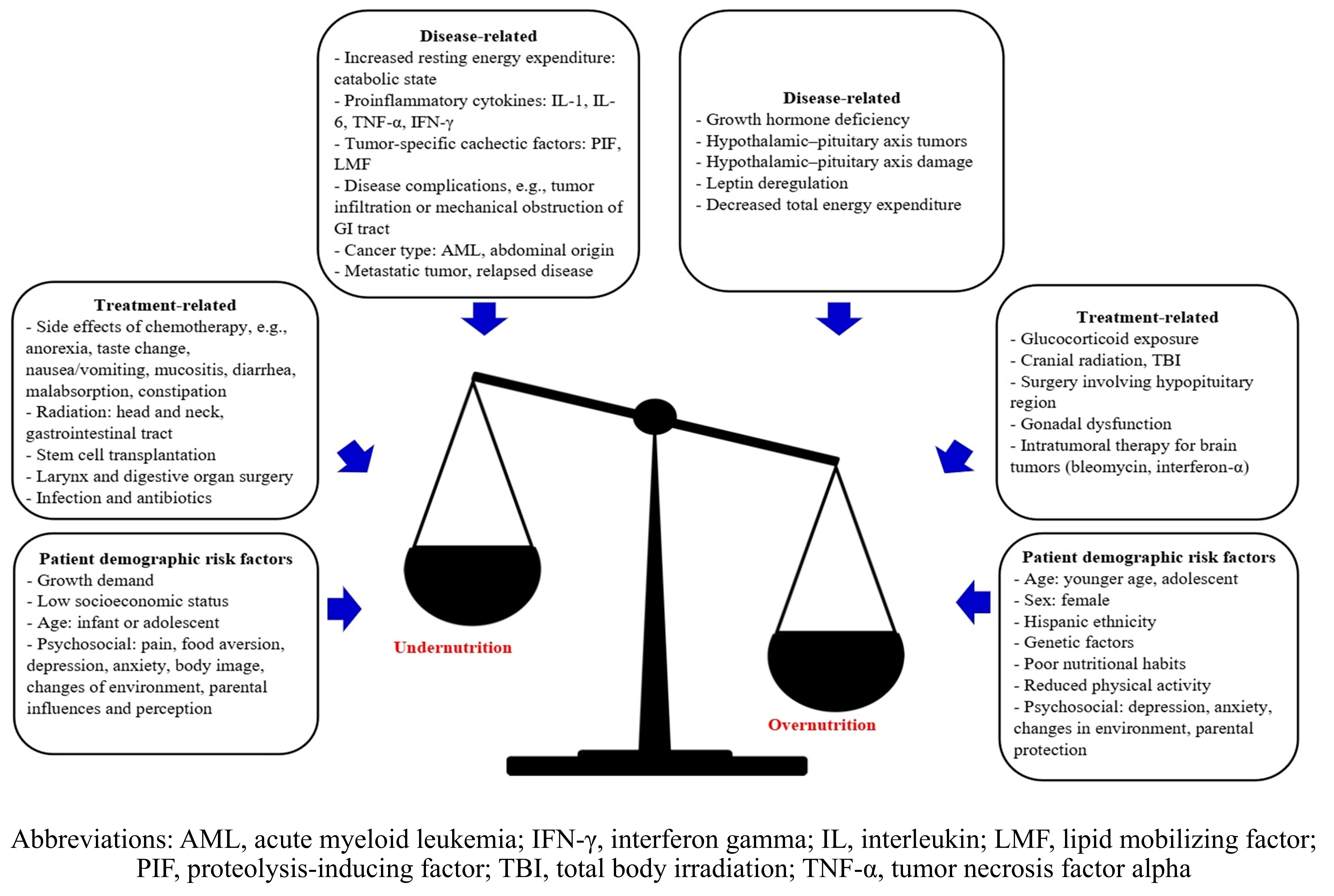
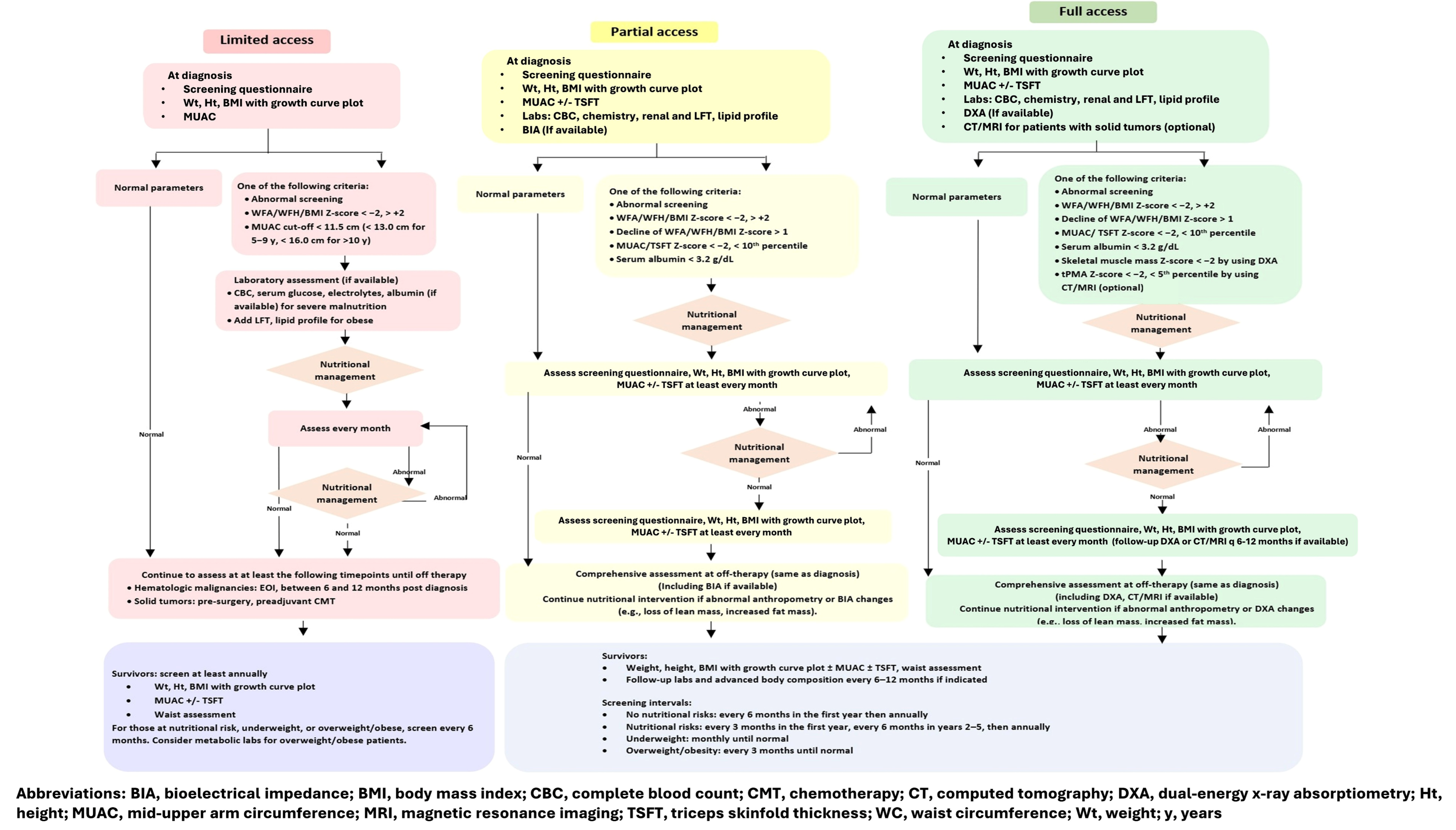
Nutritional Assessment of Children and Adolescents with Cancer in Various Resource Settings


Simple Summary
Abstract
1. Introduction
2. Undernutrition in Children with Cancer
3. Overnutrition in Children with Cancer
4. Evaluation of Nutritional Status
5. History Assessment and Dietary and Nutritional Evaluation
6. Biochemical Evaluation
7. Anthropometric Measurements: Measurements of Weight, Height, and Body Mass Index
8. Body Composition Analysis
9. Anthropometric Body Composition Evaluation
9.1. Waist Circumference, Waist-to-Hip Ratio, and Waist-to-Height Ratio
9.2. Mid-Upper Arm Circumference
9.3. Skinfold Measurements
9.4. Use of Anthropometric Body Composition Evaluation for Pediatric Patients with Cancer
10. Advanced Body Composition Evaluation
10.1. Bioelectrical Impedance Analysis
10.2. Dual-Energy X-Ray Absorptiometry
10.3. Computed Tomography and Magnetic Resonance Imaging
10.4. Use of Advanced Body Composition Evaluation for Pediatric Patients with Cancer
11. Cancer Diagnosis-Specific Considerations in Nutritional Assessment
12. Practical Recommendations for Various Resource Settings
13. Limitations and Future Directions
14. Conclusions
Supplementary Materials
Author Contributions
Funding
Data Availability Statement
Acknowledgments
Conflicts of Interest
References
- Popkin, B.M.; Corvalan, C.; Grummer-Strawn, L.M. Dynamics of the double burden of malnutrition and the changing nutrition reality. Lancet 2020, 395, 65–74. [Google Scholar] [CrossRef] [PubMed]
- UNICEF; World Health Organization; World Bank Group. Levels and Trends in Child Malnutrition: UNICEF/WHO/The World Bank Group Joint Child Malnutrition Estimates: Key Findings of the 2021 Edition; World Health Organization: Geneva, Switzerland, 2021; Available online: https://www.who.int/publications/i/item/9789240025257 (accessed on 23 February 2026).
- Fryar, C.D.; Carroll, M.D.; Afful, J. Prevalence of Overweight, Obesity, and Severe Obesity Among Children and Adolescents Aged 2–19 Years: United States, 1963–1965 Through 2017–2018. NCHS Health E-Stats. 2020. Available online: https://www.cdc.gov/nchs/data/hestat/obesity-child-17-18/overweight-obesity-child-H.pdf (accessed on 23 February 2026).
- Huibers, M.H.W.; Manda, G.; Silverstein, A.; Wanda, W.; Mtete, I.; Makuti, S.; Westmoreland, K.D.; Mehta, P.; Ozuah, N.W. The burden of malnutrition in childhood cancer in Malawi-risk regardless of age. Nutr. Cancer 2022, 74, 3322–3328. [Google Scholar] [CrossRef] [PubMed]
- Lifson, L.F.; Hadley, G.P.; Wiles, N.L.; Pillay, K. Nutritional status of children with Wilms’ tumour on admission to a South African hospital and its influence on outcome. Pediatr. Blood Cancer 2017, 64, e26382. [Google Scholar] [CrossRef] [PubMed]
- Muhammad, S.; Belgaumi, A.F.; Ashraf, M.S.; Akhtar, S.; Iftikhar, S.; Raza, M.R.; Yakoob, M.Y. Evaluation of baseline cardiac function by echocardiography and its association with nutritional status in pediatric cancer patients at the Indus Hospital in Karachi, Pakistan. J. Pediatr. Hematol. Oncol. 2019, 41, e388–e394. [Google Scholar] [CrossRef]
- Sasse, P.; Bergmann, A.; Afonso, W.; Ladas, E.J.; Ferman, S. Malnutrition at diagnosis and throughout therapy in pediatric patients with solid tumors: A single-institution study in a developing country. Pediatr. Blood Cancer 2021, 68, e29317. [Google Scholar] [CrossRef]
- Collins, L.; Nayiager, T.; Doring, N.; Kennedy, C.; Webber, C.; Halton, J.; Walker, S.; Sala, A.; Barr, R.D. Nutritional status at diagnosis in children with cancer I. An assessment by dietary recall-compared with body mass index and body composition measured by dual energy X-ray absorptiometry. J. Pediatr. Hematol. Oncol. 2010, 32, e299–e303. [Google Scholar] [CrossRef]
- Orgel, E.; Sposto, R.; Malvar, J.; Seibel, N.L.; Ladas, E.; Gaynon, P.S.; Freyer, D.R. Impact on survival and toxicity by duration of weight extremes during treatment for pediatric acute lymphoblastic leukemia: A report from the Children’s Oncology Group. J. Clin. Oncol. 2014, 32, 1331–1337. [Google Scholar] [CrossRef]
- Triarico, S.; Rinninella, E.; Cintoni, M.; Capozza, M.A.; Mastrangelo, S.; Mele, M.C.; Ruggiero, A. Impact of malnutrition on survival and infections among pediatric patients with cancer: A retrospective study. Eur. Rev. Med. Pharmacol. Sci. 2019, 23, 1165–1175. [Google Scholar] [CrossRef]
- Iijima, M.; Stall, M.; Wang, L.; Panetta, J.C.; Triplett, B.M.; Pui, C.H.; Ribeiro, R.C.; Rubnitz, J.E.; Pounds, S.B.; Inaba, H. Changes in body mass index, weight, and height in children with acute myeloid leukemia and the associations with outcome. Blood Adv. 2022, 6, 2824–2834. [Google Scholar] [CrossRef]
- Yaprak, D.S.; Yalcin, B.; Pinar, A.A.; Buyukpamukcu, M. Assessment of nutritional status in children with cancer: Significance of arm anthropometry and serum visceral proteins. Pediatr. Blood Cancer 2021, 68, e28752. [Google Scholar] [CrossRef]
- Sala, A.; Rossi, E.; Antillon, F.; Molina, A.L.; de Maselli, T.; Bonilla, M.; Hernandez, A.; Ortiz, R.; Pacheco, C.; Nieves, R.; et al. Nutritional status at diagnosis is related to clinical outcomes in children and adolescents with cancer: A perspective from Central America. Eur. J. Cancer 2012, 48, 243–252. [Google Scholar] [CrossRef]
- Shah, P.; Jhaveri, U.; Idhate, T.B.; Dhingra, S.; Arolkar, P.; Arora, B. Nutritional status at presentation, comparison of assessment tools, and importance of arm anthropometry in children with cancer in India. Indian J. Cancer 2015, 52, 210–215. [Google Scholar] [CrossRef] [PubMed]
- Browne, E.K.; Zhou, Y.; Chemaitilly, W.; Panetta, J.C.; Ness, K.K.; Kaste, S.C.; Cheng, C.; Relling, M.V.; Pui, C.H.; Inaba, H. Changes in body mass index, height, and weight in children during and after therapy for acute lymphoblastic leukemia. Cancer 2018, 124, 4248–4259. [Google Scholar] [CrossRef] [PubMed]
- Atun, R.; Bhakta, N.; Denburg, A.; Frazier, A.L.; Friedrich, P.; Gupta, S.; Lam, C.G.; Ward, Z.J.; Yeh, J.M.; Allemani, C.; et al. Sustainable care for children with cancer: A Lancet Oncology Commission. Lancet Oncol. 2020, 21, e185–e224. [Google Scholar] [CrossRef] [PubMed]
- McCarthy, H.; Dixon, M.; Crabtree, I.; Eaton-Evans, M.J.; McNulty, H. The development and evaluation of the Screening Tool for the Assessment of Malnutrition in Paediatrics (STAMP©) for use by healthcare staff. J. Hum. Nutr. Diet. 2012, 25, 311–318. [Google Scholar] [CrossRef]
- Hulst, J.M.; Zwart, H.; Hop, W.C.; Joosten, K.F. Dutch national survey to test the STRONGkids nutritional risk screening tool in hospitalized children. Clin. Nutr. 2010, 29, 106–111. [Google Scholar] [CrossRef]
- Murphy, A.J.; White, M.; Viani, K.; Mosby, T.T. Evaluation of the nutrition screening tool for childhood cancer (SCAN). Clin. Nutr. 2016, 35, 219–224. [Google Scholar] [CrossRef] [PubMed]
- Duggan, C.; Watkins, J.B.; Koletzko, B.; Walker, W.A. (Eds.) Nutrition In Pediatrics: Basic Science, Clinical Applications, 5th ed.; People’s Medixal Publishing House-USA: Shelton, CT, USA, 2016. [Google Scholar]
- Villanueva, G.; Blanco, J.; Rivas, S.; Molina, A.L.; Lopez, N.; Fuentes, A.L.; Muller, L.; Caceres, A.; Antillon, F.; Ladas, E.; et al. Nutritional status at diagnosis of cancer in children and adolescents in Guatemala and its relationship to socioeconomic disadvantage: A retrospective cohort study. Pediatr. Blood Cancer 2019, 66, e27647. [Google Scholar] [CrossRef]
- Oberholzer, R.; Hopkinson, J.B.; Baumann, K.; Omlin, A.; Kaasa, S.; Fearon, K.C.; Strasser, F. Psychosocial effects of cancer cachexia: A systematic literature search and qualitative analysis. J. Pain. Symptom Manag. 2013, 46, 77–95. [Google Scholar] [CrossRef]
- Gray, W.N.; Szulczewski, L.J.; Regan, S.M.; Williams, J.A.; Pai, A.L. Cultural influences in pediatric cancer: From diagnosis to cure/end of life. J. Pediatr. Oncol. Nurs. 2014, 31, 252–271. [Google Scholar] [CrossRef]
- Totadri, S.; Radhakrishnan, V.; Atreya, H.; Shenoy, P.K.; Ganesan, P.; Ganesan, T.S.; Sagar, T.G. Dietary perceptions and beliefs among families with children undergoing therapy for cancer. Pediatr. Hematol. Oncol. J. 2017, 2, 25–28. [Google Scholar] [CrossRef]
- Tripodi, S.I.; Bergami, E.; Panigari, A.; Caissutti, V.; Brovia, C.; De Cicco, M.; Cereda, E.; Caccialanza, R.; Zecca, M. The role of nutrition in children with cancer. Tumori J. 2023, 109, 19–27. [Google Scholar] [CrossRef]
- Morales, F.; Montserrat-de la Paz, S.; Leon, M.J.; Rivero-Pino, F. Effects of malnutrition on the immune system and infection and the role of nutritional strategies regarding improvements in children’s health status: A literature review. Nutrients 2023, 16, 1. [Google Scholar] [CrossRef]
- Sapkota, Y.; Qiu, W.; Dixon, S.B.; Wilson, C.L.; Wang, Z.; Zhang, J.; Leisenring, W.; Chow, E.J.; Bhatia, S.; Armstrong, G.T.; et al. Genetic risk score enhances the risk prediction of severe obesity in adult survivors of childhood cancer. Nat. Med. 2022, 28, 1590–1598. [Google Scholar] [CrossRef]
- Suwannaying, K.; Ong, A.A.; Dhaduk, R.; Pei, D.; Iijima, M.; Merkle, E.; Zhuang, T.Z.; Goodenough, C.G.; Brown, J.; Browne, E.K.; et al. Quantitative computed tomography analysis of body composition changes in paediatric patients with acute lymphoblastic leukaemia. Br. J. Haematol. 2024, 204, 1335–1343. [Google Scholar] [CrossRef] [PubMed]
- Rogers, P.C.; Meacham, L.R.; Oeffinger, K.C.; Henry, D.W.; Lange, B.J. Obesity in pediatric oncology. Pediatr. Blood Cancer 2005, 45, 881–891. [Google Scholar] [CrossRef] [PubMed]
- Gaeta, F.; Conti, V.; Pepe, A.; Vajro, P.; Filippelli, A.; Mandato, C. Drug dosing in children with obesity: A narrative updated review. Ital. J. Pediatr. 2022, 48, 168. [Google Scholar] [CrossRef] [PubMed]
- Lindsay Frazier, A.; Orjuela-Grimm, M.A.; Dietz, W. Obesity in pediatric oncology: Assessment, treatment strategies, and knowledge gaps. J. Natl. Cancer Inst. Monogr. 2019, 2019, 139–143. [Google Scholar] [CrossRef]
- Brinksma, A.; Sanderman, R.; Roodbol, P.F.; Sulkers, E.; Burgerhof, J.G.; de Bont, E.S.; Tissing, W.J. Malnutrition is associated with worse health-related quality of life in children with cancer. Support. Care Cancer 2015, 23, 3043–3052. [Google Scholar] [CrossRef]
- Karlage, R.E.; Wilson, C.L.; Zhang, N.; Kaste, S.; Green, D.M.; Armstrong, G.T.; Robison, L.L.; Chemaitilly, W.; Srivastava, D.K.; Hudson, M.M.; et al. Validity of anthropometric measurements for characterizing obesity among adult survivors of childhood cancer: A report from the St. Jude Lifetime Cohort Study. Cancer 2015, 121, 2036–2043. [Google Scholar] [CrossRef]
- Neville, K.A.; Cohn, R.J.; Steinbeck, K.S.; Johnston, K.; Walker, J.L. Hyperinsulinemia, impaired glucose tolerance, and diabetes mellitus in survivors of childhood cancer: Prevalence and risk factors. J. Clin. Endocrinol. Metab. 2006, 91, 4401–4407. [Google Scholar] [CrossRef]
- Ladas, E.J.; Arora, B.; Howard, S.C.; Rogers, P.C.; Mosby, T.T.; Barr, R.D. A framework for adapted nutritional therapy for children with cancer in low- and middle-income countries: A report from the Siop Podc Nutrition Working Group. Pediatr. Blood Cancer 2016, 63, 1339–1348. [Google Scholar] [CrossRef] [PubMed]
- Fabozzi, F.; Trovato, C.M.; Diamanti, A.; Mastronuzzi, A.; Zecca, M.; Tripodi, S.I.; Masetti, R.; Leardini, D.; Muratore, E.; Barat, V.; et al. Management of nutritional needs in pediatric oncology: A consensus statement. Cancers 2022, 14, 3378. [Google Scholar] [CrossRef] [PubMed]
- Bouma, S. Diagnosing pediatric malnutrition: Paradigm shifts of etiology-related definitions and appraisal of the indicators. Nutr. Clin. Pract. 2017, 32, 52–67. [Google Scholar] [CrossRef]
- World Health Organization. WHO Child Growth Standards: Length/Height-for-Age, Weight-for-Age, Weight-for-Length, Weight-for-Height and Body Mass Index-for-Age: Methods and Development. 2006. Available online: https://www.who.int/publications/i/item/924154693X (accessed on 23 February 2026).
- Centers for Disease Control and Prevention. Overview of the CDC Growth Charts. Available online: https://stacks.cdc.gov/view/cdc/29075/cdc_29075_DS1.pdf (accessed on 23 February 2026).
- de Onis, M.; Onyango, A.W.; Borghi, E.; Siyam, A.; Nishida, C.; Siekmann, J. Development of a WHO growth reference for school-aged children and adolescents. Bull. World Health Organ. 2007, 85, 660–667. [Google Scholar] [CrossRef]
- Grummer-Strawn, L.M.; Reinold, C.; Krebs, N.F.; Centers for Disease Control and Prevention (CDC). Use of World Health Organization and CDC growth charts for children aged 0–59 months in the United States. MMWR Recomm. Rep. 2010, 59, 1–15. [Google Scholar]
- de Onis, M.; Lobstein, T. Defining obesity risk status in the general childhood population: Which cut-offs should we use? Int. J. Pediatr. Obes. 2010, 5, 458–460. [Google Scholar] [CrossRef]
- Kuczmarski, R.J.; Ogden, C.L.; Guo, S.S.; Grummer-Strawn, L.M.; Flegal, K.M.; Mei, Z.; Wei, R.; Curtin, L.R.; Roche, A.F.; Johnson, C.L. 2000 CDC Growth Charts for the United States: Methods and development. Vital Health Stat. 2002, 246, 1–190. [Google Scholar]
- Wang, Y.; Chen, H.-J. Use of percentiles and Z-scores in anthropometry. In Handbook of Anthropometry; Preedy, V., Ed.; Springer: New York, NY, USA, 2012; pp. 29–48. [Google Scholar]
- Júlíusson, P.B.; Roelants, M.; Hoppenbrouwers, K.; Hauspie, R.; Bjerknes, R. Growth of Belgian and Norwegian children compared to the WHO growth standards: Prevalence below −2 and above +2 SD and the effect of breastfeeding. Arch. Dis. Child. 2011, 96, 916–921. [Google Scholar] [CrossRef]
- Ceniccola, G.D.; Castro, M.G.; Piovacari, S.M.F.; Horie, L.M.; Correa, F.G.; Barrere, A.P.N.; Toledo, D.O. Current technologies in body composition assessment: Advantages and disadvantages. Nutrition 2019, 62, 25–31. [Google Scholar] [CrossRef]
- Shuster, A.; Patlas, M.; Pinthus, J.H.; Mourtzakis, M. The clinical importance of visceral adiposity: A critical review of methods for visceral adipose tissue analysis. Br. J. Radiol. 2012, 85, 1–10. [Google Scholar] [CrossRef]
- Ruiz-Castell, M.; Samouda, H.; Bocquet, V.; Fagherazzi, G.; Stranges, S.; Huiart, L. Estimated visceral adiposity is associated with risk of cardiometabolic conditions in a population based study. Sci. Rep. 2021, 11, 9121. [Google Scholar] [CrossRef]
- Xi, B.; Zong, X.; Kelishadi, R.; Litwin, M.; Hong, Y.M.; Poh, B.K.; Steffen, L.M.; Galcheva, S.V.; Herter-Aeberli, I.; Nawarycz, T.; et al. International waist circumference percentile cutoffs for central obesity in children and adolescents aged 6 to 18 years. J. Clin. Endocrinol. Metab. 2020, 105, e1569–e1583. [Google Scholar] [CrossRef] [PubMed]
- World Health Organization. Waist Circumference and Waist-Hip Ratio. Report of a WHO Expert Consultation; World Health Organization: Geneva, Switzerland, 2008; Volume 2008, pp. 8–11. Available online: https://www.who.int/publications/i/item/9789241501491 (accessed on 23 February 2026).
- Mehta, S.K. Waist circumference to height ratio in children and adolescents. Clin. Pediatr. 2015, 54, 652–658. [Google Scholar] [CrossRef] [PubMed]
- Barr, R.; Collins, L.; Nayiager, T.; Doring, N.; Kennedy, C.; Halton, J.; Walker, S.; Sala, A.; Webber, C. Nutritional status at diagnosis in children with cancer. 2. An assessment by arm anthropometry. J. Pediatr. Hematol. Oncol. 2011, 33, e101–e104. [Google Scholar] [CrossRef]
- Revuelta Iniesta, R.; Paciarotti, I.; Davidson, I.; McKenzie, J.M.; Brougham, M.F.H.; Wilson, D.C. Nutritional status of children and adolescents with cancer in Scotland: A prospective cohort study. Clin. Nutr. ESPEN 2019, 32, 96–106. [Google Scholar] [CrossRef]
- Chincesan, M.I.; Marginean, C.O.; Voidazan, S. Assessment of body composition in a group of pediatric patients with cancer: A single Romanian center experience. J. Pediatr. Hematol. Oncol. 2016, 38, e217–e222. [Google Scholar] [CrossRef]
- World Health Organization. WHO Child Growth Standards: Head Circumference-for-Age, Arm Circumference-for-Age, Triceps Skinfold-for-Age and Subscapular Skinfold-for-Age: Methods and Development; World Health Organization: Geneva, Switzerland, 2007; Available online: https://www.who.int/publications/i/item/9789241547185 (accessed on 23 February 2026).
- World Health Organization. Guidelines for an Integrated Approach to the Nutritional Care of HIV-Infected Children (6 Months-14 Years); World Health Organization: Geneva, Switzerland, 2009; Available online: https://www.who.int/publications/i/item/9789241597524 (accessed on 23 February 2026).
- Mramba, L.; Ngari, M.; Mwangome, M.; Muchai, L.; Bauni, E.; Walker, A.S.; Gibb, D.M.; Fegan, G.; Berkley, J.A. A growth reference for mid upper arm circumference for age among school age children and adolescents, and validation for mortality: Growth curve construction and longitudinal cohort study. BMJ 2017, 358, j3423. [Google Scholar] [CrossRef]
- Frisancho, A.R. New norms of upper limb fat and muscle areas for assessment of nutritional status. Am. J. Clin. Nutr. 1981, 34, 2540–2545. [Google Scholar] [CrossRef]
- Sala, A.; Antillon, F.; Pencharz, P.; Barr, R.; AHOPCA Consortium. Nutritional status in children with cancer: A report from the AHOPCA Workshop held in Guatemala City, August 31–September 5, 2004. Pediatr. Blood Cancer 2005, 45, 230–236. [Google Scholar] [CrossRef]
- Ngaboyeka, G.; Bisimwa, G.; Neven, A.; Mwene-Batu, P.; Kambale, R.; Ongezi, E.; Chimanuka, C.; Ntagerwa, J.; Balolebwami, S.; Mulume, F.; et al. Arm circumference for age, arm circumference and weight-for-height z-score for the evaluation of severe acute malnutrition: A retrospective cohort study in eastern Democratic Republic of Congo. BMC Public Health 2024, 24, 587. [Google Scholar] [CrossRef]
- Chula de Castro, J.A.; Lima, T.R.; Silva, D.A.S. Body composition estimation in children and adolescents by bioelectrical impedance analysis: A systematic review. J. Bodyw. Mov. Ther. 2018, 22, 134–146. [Google Scholar] [CrossRef] [PubMed]
- Kelly, T.L.; Wilson, K.E.; Heymsfield, S.B. Dual energy X-Ray absorptiometry body composition reference values from NHANES. PLoS ONE 2009, 4, e7038. [Google Scholar] [CrossRef] [PubMed]
- Hinton, B.J.; Fan, B.; Ng, B.K.; Shepherd, J.A. Dual energy X-ray absorptiometry body composition reference values of limbs and trunk from NHANES 1999-2004 with additional visualization methods. PLoS ONE 2017, 12, e0174180. [Google Scholar] [CrossRef] [PubMed]
- Wells, J.C.; Williams, J.E.; Chomtho, S.; Darch, T.; Grijalva-Eternod, C.; Kennedy, K.; Haroun, D.; Wilson, C.; Cole, T.J.; Fewtrell, M.S. Body-composition reference data for simple and reference techniques and a 4-component model: A new UK reference child. Am. J. Clin. Nutr. 2012, 96, 1316–1326. [Google Scholar] [CrossRef]
- Guo, Y.; Franks, P.W.; Brookshire, T.; Antonio Tataranni, P. The intra- and inter-instrument reliability of DXA based on ex vivo soft tissue measurements. Obes. Res. 2004, 12, 1925–1929. [Google Scholar] [CrossRef]
- Simoni, P.; Guglielmi, R.; Aparisi Gómez, M.P. Imaging of body composition in children. Quant. Imaging Med. Surg. 2020, 10, 1661–1671. [Google Scholar] [CrossRef]
- Despres, J.P.; Lemieux, I. Abdominal obesity and metabolic syndrome. Nature 2006, 444, 881–887. [Google Scholar] [CrossRef]
- Faron, A.; Sprinkart, A.M.; Kuetting, D.L.R.; Feisst, A.; Isaak, A.; Endler, C.; Chang, J.; Nowak, S.; Block, W.; Thomas, D.; et al. Body composition analysis using CT and MRI: Intra-individual intermodal comparison of muscle mass and myosteatosis. Sci. Rep. 2020, 10, 11765. [Google Scholar] [CrossRef]
- Kuk, J.L.; Church, T.S.; Blair, S.N.; Ross, R. Does measurement site for visceral and abdominal subcutaneous adipose tissue alter associations with the metabolic syndrome? Diabetes Care 2006, 29, 679–684. [Google Scholar] [CrossRef] [PubMed]
- Ritz, A.; Froeba-Pohl, A.; Kolorz, J.; Vigodski, V.; Hubertus, J.; Ley-Zaporozhan, J.; von Schweinitz, D.; Haberle, B.; Schmid, I.; Kappler, R.; et al. Total psoas muscle area as a marker for sarcopenia is related to outcome in children with neuroblastoma. Front. Surg. 2021, 8, 718184. [Google Scholar] [CrossRef] [PubMed]
- Romano, A.; Triarico, S.; Rinninella, E.; Natale, L.; Brizi, M.G.; Cintoni, M.; Raoul, P.; Maurizi, P.; Attina, G.; Mastrangelo, S.; et al. Clinical impact of nutritional status and sarcopenia in pediatric patients with bone and soft tissue sarcomas: A pilot retrospective study (SarcoPed). Nutrients 2022, 14, 383. [Google Scholar] [CrossRef]
- Joffe, L.; Shen, W.; Shadid, G.; Jin, Z.; Ladas, E.J. Skeletal muscle and adipose tissue changes in the first phase of treatment of pediatric solid tumors. Cancer Med. 2021, 10, 15–22. [Google Scholar] [CrossRef] [PubMed]
- Lurz, E.; Patel, H.; Lebovic, G.; Quammie, C.; Woolfson, J.P.; Perez, M.; Ricciuto, A.; Wales, P.W.; Kamath, B.M.; Chavhan, G.B.; et al. Paediatric reference values for total psoas muscle area. J. Cachexia Sarcopenia Muscle 2020, 11, 405–414. [Google Scholar] [CrossRef]
- Somasundaram, E.; Castiglione, J.A.; Brady, S.L.; Trout, A.T. Defining normal ranges of skeletal muscle area and skeletal muscle index in children on CT using an automated deep learning pipeline: Implications for sarcopenia diagnosis. AJR Am. J. Roentgenol. 2022, 219, 326–336. [Google Scholar] [CrossRef]
- Marunowski, K.; Świętoń, D.; Bzyl, W.; Grzywinska, M.; Kaszubowski, M.; Bandosz, P.; Khrichenko, D.; Piskunowicz, M. MRI-derived subcutaneous and visceral adipose tissue reference values for children aged 6 to under 18 years. Front. Nutr. 2021, 8, 757274. [Google Scholar] [CrossRef]
- Brinksma, A.; Roodbol, P.F.; Sulkers, E.; Kamps, W.A.; de Bont, E.S.; Boot, A.M.; Burgerhof, J.G.; Tamminga, R.Y.; Tissing, W.J. Changes in nutritional status in childhood cancer patients: A prospective cohort study. Clin. Nutr. 2015, 34, 66–73. [Google Scholar] [CrossRef]
- Blijdorp, K.; van den Heuvel-Eibrink, M.M.; Pieters, R.; Boot, A.M.; Delhanty, P.J.; van der Lely, A.J.; Neggers, S.J. Obesity is underestimated using body mass index and waist-hip ratio in long-term adult survivors of childhood cancer. PLoS ONE 2012, 7, e43269. [Google Scholar] [CrossRef]
- Siviero-Miachon, A.A.; Spinola-Castro, A.M.; Lee, M.d.; Andreoni, S.; Geloneze, B.; Lederman, H.; Guerra-Junior, G. Cranial radiotherapy predisposes to abdominal adiposity in survivors of childhood acute lymphocytic leukemia. Radiat. Oncol. 2013, 8, 39. [Google Scholar] [CrossRef]
- Tram, N.K.; Chou, T.H.; Ettefagh, L.N.; Deep, K.; Bobbey, A.J.; Audino, A.N.; Stacy, M.R. Quantification of chemotherapy-induced changes in body composition in pediatric, adolescent, and young adult lymphoma using standard of care CT imaging. Eur. Radiol. 2022, 32, 7270–7277. [Google Scholar] [CrossRef]
- Ladas, E.J.; Sheng, H.; Athale, U.H.; Asselin, B.L.; Clavell, L.A.; Cole, P.D.; Flamand, Y.; Leclerc, J.-M.; Laverdiere, C.; Michon, B.; et al. Overweight or obesity and outcomes in children with acute lymphoblastic leukemia. JAMA Netw. Open 2025, 8, e259952. [Google Scholar] [CrossRef]
- Inaba, H.; Surprise, H.C.; Pounds, S.; Cao, X.; Howard, S.C.; Ringwald-Smith, K.; Buaboonnam, J.; Dahl, G.; Bowman, W.P.; Taub, J.W.; et al. Effect of body mass index on the outcome of children with acute myeloid leukemia. Cancer 2012, 118, 5989–5996. [Google Scholar] [CrossRef] [PubMed]
- Lange, B.J.; Gerbing, R.B.; Feusner, J.; Skolnik, J.; Sacks, N.; Smith, F.O.; Alonzo, T.A. Mortality in overweight and underweight children with acute myeloid leukemia. JAMA 2005, 293, 203–211. [Google Scholar] [CrossRef] [PubMed]
- Ritz, A.; Kolorz, J.; Hubertus, J.; Ley-Zaporozhan, J.; von Schweinitz, D.; Koletzko, S.; Haberle, B.; Schmid, I.; Kappler, R.; Berger, M.; et al. Sarcopenia is a prognostic outcome marker in children with high-risk hepatoblastoma. Pediatr. Blood Cancer 2021, 68, e28862. [Google Scholar] [CrossRef] [PubMed]
- Ijpma, I.; Lequin, M.H.; Nievelstein, R.A.J.; Fiocco, M.; Tissing, W.J.E. Body composition of patients with neuroblastoma using computed tomography. Pediatr. Blood Cancer 2021, 68, e29337. [Google Scholar] [CrossRef]
- Sklar, C.A.; Antal, Z.; Chemaitilly, W.; Cohen, L.E.; Follin, C.; Meacham, L.R.; Murad, M.H. Hypothalamic–pituitary and growth disorders in survivors of childhood cancer: An Endocrine Society clinical practice guideline. J. Clin. Endocrinol. Metab. 2018, 103, 2761–2784. [Google Scholar] [CrossRef]
- Ahmad, I. ABCDE of assessment for community nutritional status [editorial]. Gomal J. Med. Sci. 2019, 17, 27–28. [Google Scholar] [CrossRef]
- Damasco-Avila, E.; Zelaya Sagastizado, S.; Carrillo, M.; Blanco, J.; Fu, L.; Espinoza, D.; Ladas, E.J. Improving the quality of the delivery of nutritional care among children undergoing treatment for cancer in a low- and middle-income country. JCO Glob. Oncol. 2023, 9, e2300074. [Google Scholar] [CrossRef]
- Murphy, A.J.; Mosby, T.T.; Rogers, P.C.; Cohen, J.; Ladas, E.J. An international survey of nutritional practices in low- and middle-income countries: A report from the International Society of Pediatric Oncology (SIOP) PODC Nutrition Working Group. Eur. J. Clin. Nutr. 2014, 68, 1341–1345. [Google Scholar] [CrossRef]
- Lovell, A.L.; Laughton, S.; Wood, A.; Pugh, G. Nutrition screening, assessment, and intervention practices for children with cancer in Aotearoa, New Zealand. Nutrition 2023, 116, 112218. [Google Scholar] [CrossRef]



| Screening Tools | SCAN | STAMP | STRONGkids |
|---|---|---|---|
| Target population | Children with cancer | General hospitalized children | General hospitalized children |
| Validation studies available for specific pediatric cancers and timepoints? | Yes, cross-sectionally evaluated at diagnosis, active treatment, maintenance, post therapy | No | Yes, no specific time point |
| Components | 6 questions | 2 questions and anthropometric data | 4 questions |
| Criteria used | Risk of cancer Treatment intensity GI tract symptoms History of poor intake History of weight loss Signs of undernutrition | Diagnosis Dietary intakes Weight and height | Underlying disease with risk of malnutrition Signs of poor nutritional status Diarrhea, poor intake or history of nutritional supplement History of weight loss or stunted growth |
| Score indications | ≥3 points: at risk of malnutrition | 4–5 points: high risk 2–3 points: medium risk 0–1 point: low risk | 4–5 points: high risk 1–3 points: medium risk 0 point: low risk |
| Recommendations | ≥3 points Refer to dietician for further assessment | High risk Refer to nutritional supportteam Medium risk Monitor nutritional intake for 3 days and repeat exam after 3 days Low risk Routine clinical care | High risk Consult clinician and dietician for full diagnosis and individual nutritional advice Medium risk Consider nutritional intervention Low risk No nutritional intervention necessary |
| Pros and cons | Pros Designed specifically for childhood cancers Enables easy screening without anthropometric measurement Cons Need data on cancer risk and treatment intensity | Pros Usable by any health care provider without specific oncology knowledge Cons Screens all cancers as at least medium risk; cannot distinguish malnutrition patients | Pros Usable by any health care provider without specific oncology knowledge Enables easy screening without anthropometric measurement Cons Screens all cancers as at least medium risk; cannot distinguish malnutrition patients |
| WHO Criteria | CDC Criteria | ||||||
|---|---|---|---|---|---|---|---|
| Age | Nutritional Status | Indicator | Cut-Off Points | Age | Nutritional Status | Indicator | Cut-Off Points |
| Undernutrition | |||||||
| 0–5 y | Wasting (thinness) | W/L or W/H or BMI | ≤−2 SD | 0–2 y | Undernutrition | Recommend using WHO growth standards | |
| Stunting | L/A or H/A | <−2 SD | |||||
| Underweight | W/A | <−2 SD | |||||
| 5–19 y | Thinness | BMI | <−2 SD | 2–19 y | Underweight | BMI | <5th percentile |
| Stunting | H/A | <−2 SD | Short stature | H/A | <5th percentile | ||
| Adult ≥ 20 y Underweight: BMI < 18.5 kg/m2 | |||||||
| Overnutrition | |||||||
| 0–5 y | Overweight | W/L or W/H or BMI | >+2 SD and ≤+3 SD | 0–2 y | Overweight and obesity | Recommend using WHO growth standards | |
| Obesity | W/L or W/H or BMI | >+3 SD | |||||
| 5–19 y | Overweight | BMI | >+1 SD and ≤+2 SD | 2–19 y | Overweight | BMI | 85th to 94th percentile |
| Obesity | BMI | >+2 SD | Obesity | BMI | ≥95th percentile | ||
| Adults ≥ 20 y Overweight: BMI 25.0–29.9 kg/m2 Obesity: BMI ≥ 30 kg/m2 | |||||||
| Anthropometric Methods | Advantages | Disadvantages |
| Weight, height, BMI | Inexpensive Simple Suitable for large-scale studies | Unable to distinguish fat and fat-free mass tissue Unreliable for patients with large tumors |
| Waist measurement | Inexpensive Simple Surrogate estimate of trunk and visceral fat | Operator dependent Unreliable for patients with abdominal masses |
| MUAC | Inexpensive Simple More accurate in specific conditions (e.g., large tumor mass, edema) | Operator dependent No standard cut-offs for overweight or obesity |
| Skinfold thickness | Inexpensive Simple Can assess total body fat store | Operator dependent Requires instruments and specific equation assumptions |
| Advanced Methods | Advantages | Disadvantages |
| BIA | Inexpensive Quick and non-invasive Simple and reproducible Reference values are available | Indirect method Limited by hydration status Specific equation needed for each population Limited availability in LMICs |
| DXA | Able to differentiate fat, lean mass, and bone tissue Quick and non-invasive Low radiation exposure Well tolerated for repeated measurement High precision and accuracy Reference values available | Relatively high cost Variability of instrument calibration, procedure Inability to discriminate type of fat (visceral, subcutaneous, or intramuscular) Limited availability in LMICs |
| CT | Useful for evaluating specific body compartments, such as visceral/subcutaneous/adipose tissue Can use imaging for disease evaluation in patients with abdominal lesions | Radiation exposure High cost Limited population control |
| MRI | Useful for evaluating specific body compartments, such as visceral/subcutaneous/adipose tissue Can use imaging for disease evaluation in patients with abdominal lesions Provides soft tissue information: muscle edema, inflammation, atrophy, and fatty infiltration | Long study time Requires sedation of younger children High cost Limited population control |
| Limited Access | Partial Access | Full Access | |
|---|---|---|---|
| History taking | Use screening tools to identify patients at risk, e.g., use SCAN for every patient | Complete history taking for every patient | Complete history taking for every patient Comprehensive dietary assessment methods such as FFQ |
| Physical examination | Identify specific signs and symptoms of micronutrient deficiencies, especially in patients with suspected severe malnutrition | Complete physical examination for every patient | Complete physical examination for every patient |
| Anthropometric measurements | Wt, Ht, BMI MUAC cut-off for age | Wt, Ht, BMI, MUAC, WC, TSFT Use percentiles or Z-scores based on age and sex Include waist measurement for patients at risk of overweight/obesity Longitudinal growth curve plot | Wt, Ht, BMI, MUAC, WC, TSFT Use percentiles or Z-scores based on age and sex Include waist measurement for patients at risk of overweight/obesity Longitudinal growth curve plot |
| Biochemistry evaluation | Complete blood count Basic metabolic panel and albumin Prioritize investigations in patients with severe malnutrition (aim to prevent refeeding syndrome) | Complete blood count Comprehensive metabolic panels Specific micronutrient work-up based on history assessment and clinical signs | Complete blood count Comprehensive metabolic and micronutrient panels Screen all patients to identify those at risk |
| Advanced body composition methods | Not indicated | BIA Prioritized for patients at risk for conditions such as abnormal BMI, sarcopenia, osteopenia, or abnormal cardiometabolic profile or for those receiving treatments that increase the risk of cardiometabolic syndrome (e.g., corticosteroids, cranial radiation) | Advanced body composition methods such as DXA Consider using CT or MRI for disease evaluation or staging of abdominal tumors Screening at baseline to improve accuracy to diagnose specific conditions, (e.g., obesity, visceral organ adiposity, osteopenia, or sarcopenia) Longitudinal monitoring for patients at risk |
| Follow-up | Follow-up assessments of at-risk patients | History taking, physical examination, basic biochemistry evaluation as routine | History taking, physical examination, basic biochemistry evaluation as routine Longitudinal laboratory and advanced body composition monitoring for at-risk patients |
Disclaimer/Publisher’s Note: The statements, opinions and data contained in all publications are solely those of the individual author(s) and contributor(s) and not of MDPI and/or the editor(s). MDPI and/or the editor(s) disclaim responsibility for any injury to people or property resulting from any ideas, methods, instructions or products referred to in the content. |
© 2026 by the authors. Licensee MDPI, Basel, Switzerland. This article is an open access article distributed under the terms and conditions of the Creative Commons Attribution (CC BY) license.
Share and Cite
Suwannaying, K.; Rujkijyanont, P.; Inaba, H. Nutritional Assessment of Children and Adolescents with Cancer in Various Resource Settings. Cancers 2026, 18, 873. https://doi.org/10.3390/cancers18050873
Suwannaying K, Rujkijyanont P, Inaba H. Nutritional Assessment of Children and Adolescents with Cancer in Various Resource Settings. Cancers. 2026; 18(5):873. https://doi.org/10.3390/cancers18050873
Chicago/Turabian StyleSuwannaying, Kunanya, Piya Rujkijyanont, and Hiroto Inaba. 2026. "Nutritional Assessment of Children and Adolescents with Cancer in Various Resource Settings" Cancers 18, no. 5: 873. https://doi.org/10.3390/cancers18050873
APA StyleSuwannaying, K., Rujkijyanont, P., & Inaba, H. (2026). Nutritional Assessment of Children and Adolescents with Cancer in Various Resource Settings. Cancers, 18(5), 873. https://doi.org/10.3390/cancers18050873