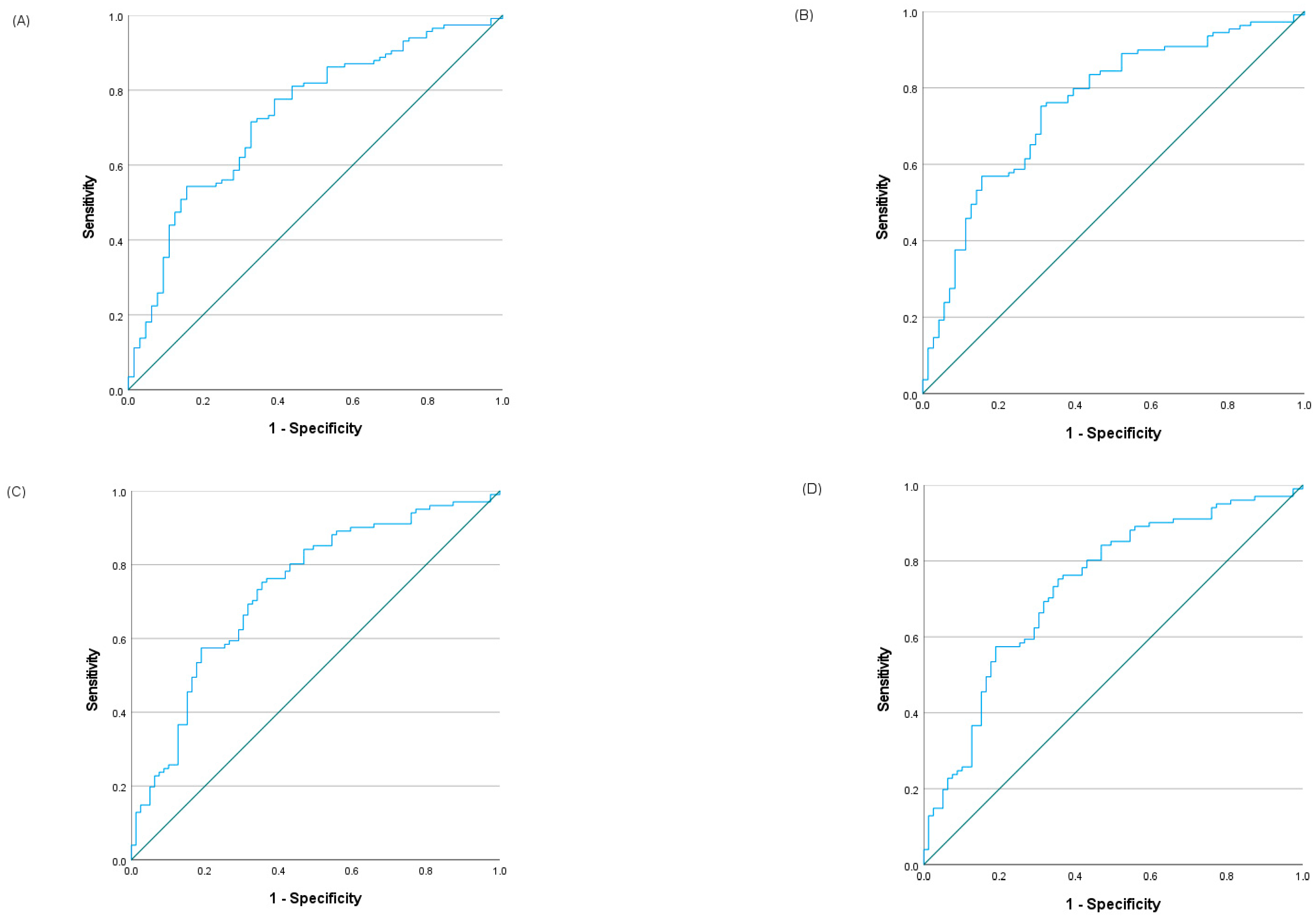
Prognostic Value of the CALLY Index in Diffuse Large B-Cell Lymphoma: Linking Inflammation, Nutrition, and Tumor Biology

 ,
,  , ,
, ,  and
and
Simple Summary
Abstract
1. Introduction
2. Materials and Methods
2.1. Study Population
2.2. Laboratory Analyses
2.3. Histopathology and Clinical DLBCL-Related Characteristics
2.4. Treatment and Response Assessment
2.5. Statistical Analysis
3. Results
3.1. Clinicopathological Characteristics and the CALLY Index
3.2. Patient Follow-Up and Survival Analysis
3.3. Predictors of Response to Treatment
3.3.1. ORR Analysis
3.3.2. R/R Status Analysis
4. Discussion
5. Conclusions
Supplementary Materials
Author Contributions
Funding
Institutional Review Board Statement
Informed Consent Statement
Data Availability Statement
Conflicts of Interest
Abbreviations
| ALC | Absolute lymphocyte count |
| AMC | Absolute monocyte count |
| AUC | Area under the curve |
| β2M | Beta2- microglobulin |
| CALLY | C-reactive protein–albumin–lymphocyte |
| CI | Confidence interval |
| CIRS | Cumulative Illness Rating Scale |
| COO | Cell of origin |
| CR | Complete remission |
| CRP | C-reactive protein |
| DLBCL | Diffuse large B cell lymphoma |
| ECOG | Eastern Cooperative Oncology Group |
| EFS | Event free survival |
| EN | Extranodal |
| F/M | Female to male ratio |
| GCB | Germinal center B cell like |
| Hb | Hemoglobin |
| HR | Hazard ratio |
| ICT | Immunochemotherapy |
| IL-6 | Interleukin-6 |
| IPI | International Prognostic Index |
| IQR | Interquartile range |
| LDH | Lactate dehydrogenase |
| NCCN-IPI | National Comprehensive Cancer Network International Prognostic Index |
| NHL | Non Hodgkin lymphoma |
| NOS | Not otherwise specified |
| OR | Odds ratio |
| ORR | Overall response rate |
| OS | Overall survival |
| PR | Partial remission |
| PS | Performance status |
| R-CHOP | Rituximab cyclophosphamide doxorubicin vincristine and prednisone |
| R-IPI | Revised International Prognostic Index |
| R/R | Relapsed or refractory |
| ROC | Receiver operating characteristic |
| ULN | Upper limit of normal |
| WHO HAEM5 | World Health Organization Classification of Haematolymphoid Tumours 5th edition |
References
- Ferlay, J.; Colombet, M.; Soerjomataram, I.; Parkin, D.M.; Piñeros, M.; Znaor, A.; Bray, F. Cancer statistics for the year 2020: An overview. Int. J. Cancer 2021, 149, 778–789. [Google Scholar] [CrossRef]
- Berhan, A.; Almaw, A.; Damtie, S.; Solomon, Y. Diffuse large B cell lymphoma (DLBCL): Epidemiology, pathophysiology, risk stratification, advancement in diagnostic approaches and prospects: Narrative review. Discov. Oncol. 2025, 16, 184. [Google Scholar] [CrossRef]
- Kanas, G.; Ge, W.; Quek, R.G.W.; Keeven, K.; Nersesyan, K.; Arnason, J.E. Epidemiology of diffuse large B-cell lymphoma (DLBCL) and follicular lymphoma (FL) in the United States and Western Europe: Population-level projections for 2020–2025. Leuk. Lymphoma 2022, 63, 54–63. [Google Scholar] [CrossRef] [PubMed]
- Wang, S.S. Epidemiology and etiology of diffuse large B-cell lymphoma. Semin. Hematol. 2023, 60, 255–266. [Google Scholar] [CrossRef]
- Chen, H.; Zhao, J.; Zhao, D.; Wang, W.; Wei, C.; Wang, Z.; Zhou, D.; Zhang, W. Lymphoma relapse 1 year or later after immunochemotherapy in DLBCL patients: Clinical features and outcome. Clin. Exp. Med. 2024, 24, 48. [Google Scholar] [CrossRef] [PubMed]
- He, T.; Geng, J.; Hou, C.; Li, H.; Zhang, H.; Zhao, P.; He, P.; Lu, X. Predictive Biomarkers and Molecular Subtypes in DLBCL: Insights from PCD Gene Expression and Machine Learning. Discov. Oncol. 2025, 16, 542. [Google Scholar] [CrossRef] [PubMed]
- Masnikosa, R.; Cvetković, Z.; Pirić, D. Tumor Biology Hides Novel Therapeutic Approaches to Diffuse Large B-Cell Lymphoma: A Narrative Review. Int. J. Mol. Sci. 2024, 25, 11384. [Google Scholar] [CrossRef]
- Jelicic, J.; Juul-Jensen, K.; Bukumiric, Z.; Runason Simonsen, M.; Roost Clausen, M.; Ludvigsen Al-Mashhadi, A.; Schou Pedersen, R.; Poulsen, C.B.; Gang, A.O.; Brown, P.; et al. International Prognostic Models as Tools for Selection of Higher-risk Trial-eligible Patients With Diffuse Large B-Cell lymphoma. Clin. Lymphoma Myeloma Leuk. 2026, 26, e62–e76. [Google Scholar] [CrossRef]
- Ziepert, M.; Hasenclever, D.; Kuhnt, E.; Glass, B.; Schmitz, N.; Pfreundschuh, M.; Loeffler, M. Standard International prognostic index remains a valid predictor of outcome for patients with aggressive CD20+ B-cell lymphoma in the rituximab era. J. Clin. Oncol. 2010, 28, 2373–2380. [Google Scholar] [CrossRef]
- Sehn, L.H.; Berry, B.; Chhanabhai, M.; Fitzgerald, C.; Gill, K.; Hoskins, P.; Klasa, R.; Savage, K.J.; Shenkier, T.; Sutherland, J.; et al. The revised International Prognostic Index (R-IPI) is a better predictor of outcome than the standard IPI for patients with diffuse large B-cell lymphoma treated with R-CHOP. Blood 2007, 109, 1857–1861. [Google Scholar] [CrossRef]
- Zhou, Z.; Sehn, L.H.; Rademaker, A.W.; Gordon, L.I.; Lacasce, A.S.; Crosby-Thompson, A.; Vanderplas, A.; Zelenetz, A.D.; Abel, G.A.; Rodriguez, M.A.; et al. An enhanced International Prognostic Index (NCCN-IPI) for patients with diffuse large B-cell lymphoma treated in the rituximab era. Blood 2014, 123, 837–842. [Google Scholar] [CrossRef] [PubMed]
- Atallah-Yunes, S.A.; Khurana, A.; Maurer, M. Challenges identifying DLBCL patients with poor outcomes to upfront chemoimmunotherapy and its impact on frontline clinical trials. Leuk. Lymphoma 2024, 65, 430–439. [Google Scholar] [CrossRef] [PubMed]
- Oehadian, A.; Gunadi, S.V.; Mersiana, L.; Susandi, E.; Wijaya, I.; Martha, J.W.; Supriyadi, R.; Prihatni, D. Inflammatory and Nutritional Biomarker in Different Subtypes of Early Stage Diffuse Large B-Cell Lymphoma: Towards a Diagnostic Model. Cancer Manag. Res. 2025, 17, 1361–1367. [Google Scholar] [CrossRef] [PubMed]
- Cvetković, Z.; Vučić, V.; Cvetković, B.; Karadžić, I.; Ranić, M.; Glibetić, M. Distribution of Plasma Fatty Acids Is Associated with Response to Chemotherapy in Non-Hodgkin’s Lymphoma Patients. Med. Oncol. 2013, 30, 741. [Google Scholar] [CrossRef]
- Cvetković, Z.; Milošević, M.; Cvetković, B.; Masnikosa, R.; Arsić, A.; Petrović, S.; Vučić, V. Plasma Phospholipid Changes Are Associated with Response to Chemotherapy in Non-Hodgkin Lymphoma Patients. Leuk. Res. 2017, 54, 39–46. [Google Scholar] [CrossRef]
- Peng, Y.; Jiang, T.; Chen, S.; Tang, X.; Zhang, Y.; Li, L.; Li, L.; Ran, L.; Wu, X.; Li, J.; et al. Nutritional and Immune-Inflammatory Scoring System for Predicting Outcomes in Newly Diagnosed Diffuse Large B-Cell Lymphoma Patients. Front. Nutr. 2025, 12, 1591508. [Google Scholar] [CrossRef]
- Raj, S.S.; Fei, T.; Fried, S.; Ip, A.; Fein, J.A.; Leslie, L.A.; Alarcon Tomas, A.; Leithner, D.; Peled, J.U.; Corona, M.; et al. An Inflammatory Biomarker Signature of Response to CAR-T Cell Therapy in Non-Hodgkin Lymphoma. Nat. Med. 2025, 31, 1183–1194. [Google Scholar] [CrossRef]
- Cvetković, Z.; Marković, O.; Marinković, G.; Pejić, S.; Vučić, V. Tumor Microenvironment, Inflammation, and Inflammatory Prognostic Indices in Diffuse Large B-Cell Lymphomas: A Narrative Review. Int. J. Mol. Sci. 2025, 26, 5670. [Google Scholar] [CrossRef]
- Troppan, K.T.; Schlick, K.; Deutsch, A.; Melchardt, T.; Egle, A.; Stojakovic, T.; Beham-Schmid, C.; Weiss, L.; Neureiter, D.; Wenzl, K.; et al. C-reactive protein level is a prognostic indicator for survival and improves the predictive ability of the R-IPI score in diffuse large B-cell lymphoma patients. Br. J. Cancer 2014, 111, 55–60. [Google Scholar] [CrossRef]
- Gradel, K.O.; Larsen, T.S.; Frederiksen, H.; Vinholt, P.J.; Iachina, M.; Póvoa, P.; Zampieri, F.G.; Nielsen, S.L.; Dessau, R.B.; Møller, J.K.; et al. Impact of C-reactive protein and albumin levels on short, medium, and long term mortality in patients with diffuse large B-cell lymphoma. Ann. Med. 2022, 54, 713–722. [Google Scholar] [CrossRef]
- Wei, X.; Zheng, J.; Zhang, Z.; Liu, Q.; Zhan, M.; Huang, W.; Chen, J.; Wei, Q.; Wei, Y.; Feng, R. Consecutive Hypoalbuminemia Predicts Inferior Outcome in Patients With Diffuse Large B-Cell Lymphoma. Front. Oncol. 2021, 10, 610681. [Google Scholar] [CrossRef]
- Vähämurto, P.; Pollari, M.; Clausen, M.R.; d’Amore, F.; Leppä, S.; Mannisto, S. Low Absolute Lymphocyte Counts in the Peripheral Blood Predict Inferior Survival and Improve the International Prognostic Index in Testicular Diffuse Large B-Cell Lymphoma. Cancers 2020, 12, 1967. [Google Scholar] [CrossRef] [PubMed]
- Kim, E.S.; Kim, S.Y.; Moon, A. C-Reactive Protein Signaling Pathways in Tumor Progression. Biomol. Ther. 2023, 31, 473–483. [Google Scholar] [CrossRef] [PubMed]
- Stec-Martyna, E.; Wojtczak, K.; Nowak, D.; Stawski, R. Battle of the Biomarkers of Systemic Inflammation. Biology 2025, 14, 438. [Google Scholar] [CrossRef]
- Soeters, P.B.; Wolfe, R.R.; Shenkin, A. Hypoalbuminemia: Pathogenesis and Clinical Significance. J. Parenter. Enter. Nutr. 2019, 43, 181–193. [Google Scholar] [CrossRef] [PubMed]
- Li, Y.; Chen, L.; Yang, X.; Cui, H.; Li, Z.; Chen, W.; Shi, H.; Zhu, M. Dynamic association of serum albumin changes with inflammation, nutritional status and clinical outcomes: A secondary analysis of a large prospective observational cohort study. Eur. J. Med. Res. 2025, 30, 679. [Google Scholar] [CrossRef]
- Ménétrier-Caux, C.; Ray-Coquard, I.; Blay, J.Y.; Caux, C. Lymphopenia in Cancer Patients and its Effects on Response to Immunotherapy: An opportunity for combination with Cytokines? J. Immunother. Cancer 2019, 7, 85. [Google Scholar] [CrossRef]
- Zhao, J.; Huang, W.; Wu, Y.; Luo, Y.; Wu, B.; Cheng, J.; Chen, J.; Liu, D.; Li, C. Prognostic role of pretreatment blood lymphocyte count in patients with solid tumors: A systematic review and meta-analysis. Cancer Cell Int. 2020, 20, 15. [Google Scholar] [CrossRef]
- Iida, H.; Tani, M.; Komeda, K.; Nomi, T.; Matsushima, H.; Tanaka, S.; Ueno, M.; Nakai, T.; Maehira, H.; Mori, H.; et al. Superiority of CRP-albumin-lymphocyte index (CALLY index) as a non-invasive prognostic biomarker after hepatectomy for hepatocellular carcinoma. HPB 2022, 24, 101–115. [Google Scholar] [CrossRef]
- Liu, X.Y.; Zhang, X.; Zhang, Q.; Ruan, G.T.; Liu, T.; Xie, H.L.; Ge, Y.Z.; Song, M.M.; Deng, L.; Shi, H.P. The value of CRP-albumin-lymphocyte index (CALLY index) as a prognostic biomarker in patients with non-small cell lung cancer. Support. Care Cancer 2023, 31, 533. [Google Scholar] [CrossRef]
- Zhuang, J.; Wang, S.; Wang, Y.; Wu, Y.; Hu, R. Prognostic Value of CRP-Albumin-Lymphocyte (CALLY) Index in Patients Undergoing Surgery for Breast Cancer. Int. J. Gen. Med. 2024, 17, 997–1005. [Google Scholar] [CrossRef]
- Wu, B.; Liu, J.; Shao, C.; Yu, D.; Liao, J. Integrating inflammation, nutrition, and immunity: The CALLY index as a prognostic tool in digestive system cancers—A systematic review and meta-analysis. BMC Cancer 2025, 25, 672. [Google Scholar] [CrossRef]
- Akgüner, G.; Altınbaş, M. Prognostic utility of the C-reactive protein-albumin-lymphocyte (CALLY) index in metastatic renal cell carcinoma. BMC Cancer 2025, 25, 1347. [Google Scholar] [CrossRef]
- Xi, P.; Huang, G.; Huang, K.; Qin, D.; Yao, Z.; Jiang, L.; Zhu, Q.; He, C. The Prognostic Significance of the CALLY Index in Ampullary Carcinoma: An Inflammation-Nutrition Retrospective Analysis. J. Inflamm. Res. 2025, 18, 621–635. [Google Scholar] [CrossRef]
- Cvetković, Z.; Bukurecki, I.; Pejić, S.; Marinković, G.; Pavlović, M.; Čolović Zvizdić, M.; Divac, A.; Kaplarević, M.; Milojević, Z.; Marković, O. CRP–Albumin–Lymphocyte (CALLY) Index: A Promising Prognostic Tool in Diffuse Large B-Cell Lymphoma (PF981). HemaSphere 2025, 9, 1385–1386. [Google Scholar]
- Pınar, İ.E.; Özkocaman, V.; Ersal, T.; Gürsoy, V.; Hunutlu, F.Ç.; Yiğit Ayhan, E.; Özkalemkaş, F. Immunonutritional Profiling for Prognostic Assessment in Diffuse Large B-Cell Lymphoma: An Initial Evaluation of the C-Reactive Protein–Albumin–Lymphocyte (CALLY) Index. J. Health Sci. Med. 2025, 8, 1112–1117. [Google Scholar] [CrossRef]
- Oken, M.M.; Creech, R.H.; Tormey, D.C.; Horton, J.; Davis, T.E.; McFadden, E.T.; Carbone, P.P. Toxicity and response criteria of the Eastern Cooperative Oncology Group. Am. J. Clin. Oncol. 1982, 5, 649–655. [Google Scholar] [CrossRef] [PubMed]
- Extermann, M.; Overcash, J.; Lyman, G.H.; Parr, J.; Balducci, L. Comorbidity and functional status are independent in older cancer patients. J. Clin. Oncol. 1998, 16, 1582–1587. [Google Scholar] [CrossRef] [PubMed]
- Goede, V.; Fischer, K.; Busch, R.; Engelke, A.; Eichhorst, B.; Wendtner, C.M.; Chagorova, T.; de la Serna, J.; Dilhuydy, M.S.; Illmer, T.; et al. Obinutuzumab plus chlorambucil in patients with CLL and coexisting conditions. N. Engl. J. Med. 2014, 370, 1101–1110. [Google Scholar] [CrossRef] [PubMed]
- Kittai, A.S.; Huang, Y.; Gordon, M.; Denlinger, N.; Mian, A.; Fitzgerald, L.; Bishop, J.; Nagle, S.; Stephens, D.M.; Jaglowski, S.; et al. Comorbidities Predict Inferior Survival in Patients Receiving Chimeric Antigen Receptor T Cell Therapy for Diffuse Large B Cell Lymphoma: A Multicenter Analysis. Transplant. Cell. Ther. 2021, 27, 46–52. [Google Scholar] [CrossRef]
- Hong, J.; Woo, H.S.; Kim, H.; Ahn, H.K.; Sym, S.J.; Park, J.; Ahn, J.Y.; Cho, E.K.; Shin, D.B.; Lee, J.H. Anemia as a useful biomarker in patients with diffuse large B-cell lymphoma treated with R-CHOP immunochemotherapy. Cancer Sci. 2014, 105, 1569–1575. [Google Scholar] [CrossRef]
- Kim, D.H.; Baek, J.H.; Chae, Y.S.; Kim, Y.K.; Kim, H.J.; Park, Y.H.; Song, H.S.; Chung, J.S.; Hyun, M.S.; Sohn, S.K. Absolute Lymphocyte Count Predicts Response to Chemotherapy and Survival in Diffuse Large B-Cell Lymphoma. Leukemia 2007, 21, 2227–2230. [Google Scholar] [CrossRef]
- Wilcox, R.A.; Ristow, K.; Habermann, T.M.; Inwards, D.J.; Micallef, I.N.; Johnston, P.B.; Colgan, J.P.; Nowakowski, G.S.; Ansell, S.M.; Witzig, T.E.; et al. The absolute monocyte and lymphocyte prognostic score predicts survival and identifies high-risk patients in diffuse large-B-cell lymphoma. Leukemia 2011, 25, 1502–1509. [Google Scholar] [CrossRef] [PubMed]
- Chen, H.; Qin, Y.; Yang, J.; Liu, P.; He, X.; Zhou, S.; Zhang, C.; Gui, L.; Yang, S.; Shi, Y. The pretreatment platelet count predicts survival outcomes of diffuse large B-cell lymphoma: An analysis of 1007 patients in the rituximab era. Leuk Res. 2021, 110, 106715. [Google Scholar] [CrossRef] [PubMed]
- Chen, L.; Pan, L.; Liu, T. Prognostic value of serum albumin level in patients with diffuse large B cell lymphoma. Acta Biochim. Pol. 2023, 70, 767–776. [Google Scholar] [CrossRef]
- Alaggio, R.; Amador, C.; Anagnostopoulos, I.; Attygalle, A.D.; Araujo, I.B.O.; Berti, E.; Bhagat, G.; Borges, A.M.; Boyer, D.; Calaminici, M.; et al. The 5th Edition of the World Health Organization Classification of Haematolymphoid Tumours: Lymphoid Neoplasms. Leukemia 2022, 36, 1720–1748. [Google Scholar] [CrossRef]
- Hans, C.P.; Weisenburger, D.D.; Greiner, T.C.; Gascoyne, R.D.; Delabie, J.; Ott, G.; Müller-Hermelink, H.K.; Campo, E.; Braziel, R.M.; Jaffe, E.S.; et al. Confirmation of the molecular classification of diffuse large B-cell lymphoma by immunohistochemistry using a tissue microarray. Blood 2004, 103, 275–282. [Google Scholar] [CrossRef]
- Huber, F.; Zwickl-Traxler, E.; Pecherstorfer, M.; Singer, J. Evaluation of Ki-67 as a Prognostic Marker in Diffuse Large B-Cell Lymphoma-A Single-Center Retrospective Cohort Study. Curr. Oncol. 2021, 28, 4521–4529. [Google Scholar] [CrossRef] [PubMed]
- Pfreundschuh, M.; Trümper, L.; Osterborg, A.; Pettengell, R.; Trneny, M.; Imrie, K.; Ma, D.; Gill, D.; Walewski, J.; Zinzani, P.L.; et al. CHOP-like chemotherapy plus rituximab versus CHOP-like chemotherapy alone in young patients with good-prognosis diffuse large-B-cell lymphoma: A randomised controlled trial by the MabThera International Trial (MInT) Group. Lancet Oncol. 2006, 7, 379–391. [Google Scholar] [CrossRef]
- Carbone, P.P.; Kaplan, H.S.; Musshoff, K.; Smithers, D.W.; Tubiana, M. Report of the Committee on Hodgkin’s Disease Staging Classification. Cancer Res. 1971, 31, 1860–1861. [Google Scholar]
- Cheson, B.D.; Fisher, R.I.; Barrington, S.F.; Cavalli, F.; Schwartz, L.H.; Zucca, E.; Lister, T.A. Recommendations for initial evaluation, staging, and response assessment of Hodgkin and non-Hodgkin lymphoma: The Lugano classification. J. Clin. Oncol. 2014, 32, 3059–3068. [Google Scholar] [CrossRef] [PubMed]
- Izumiyama, K.; Inao, T.; Goto, H.; Harada, S.; Senjo, H.; Suto, K.; Hashiguchi, J.; Ogasawara, R.; Saga, T.; Igarashi, T.; et al. Event-Free Survival at 36 Months Is a Suitable Endpoint for Diffuse Large B-Cell Lymphoma Patients Treated with Immunochemotherapy: Real-World Evidence from the North Japan Hematology Study Group. Haematologica 2024, 109, 3631–3640. [Google Scholar] [CrossRef]
- Papageorgiou, S.G.; Thomopoulos, T.P.; Katagas, I.; Bouchla, A.; Pappa, V. Prognostic molecular biomarkers in diffuse large B-cell lymphoma in the rituximab era and their therapeutic implications. Ther. Adv. Hematol. 2021, 12, 20406207211013987. [Google Scholar] [CrossRef]
- Winkelmann, M.; Raj, S.S.; Jain, M.D.; Iacoboni, G.; Müller, F.; Hansmann, L.; Corona, M.; Luna, A.; Jhaveri, K.; Shah, G.L.; et al. Optimization and validation of the international metabolic prognostic index for CD19 CAR-T in large B-cell lymphoma. Blood Cancer J. 2025, 15, 144. [Google Scholar] [CrossRef]
- Liang, X.J.; Song, X.Y.; Wu, J.L.; Liu, D.; Lin, B.Y.; Zhou, H.S.; Wang, L. Advances in Multi-Omics Study of Prognostic Biomarkers of Diffuse Large B-Cell Lymphoma. Int. J. Biol. Sci. 2022, 18, 1313–1327. [Google Scholar] [CrossRef] [PubMed]
- Ren, W.; Wan, H.; Own, S.A.; Berglund, M.; Wang, X.; Yang, M.; Li, X.; Liu, D.; Ye, X.; Sonnevi, K.; et al. Genetic and transcriptomic analyses of diffuse large B-cell lymphoma patients with poor outcomes within two years of diagnosis. Leukemia 2024, 38, 610–620. [Google Scholar] [CrossRef] [PubMed]
- Xing, D.; Luo, K.; He, X.; Hu, X.; Zhai, Y.; Jiang, Y.; Wu, W.; Zhao, Z. Programmed-Cell-Death-Related Signature Reveals Immune Microenvironment Characteristics and Predicts Therapeutic Response in Diffuse Large B Cell Lymphoma. Biomedicines 2025, 13, 2320. [Google Scholar] [CrossRef]
- Zhu, M.; Ma, Z.; Zhang, X.; Hang, D.; Yin, R.; Feng, J.; Xu, L.; Shen, H. C-reactive protein and cancer risk: A pan-cancer study of prospective cohort and Mendelian randomization analysis. BMC Med. 2022, 20, 301. [Google Scholar] [CrossRef]
- Hart, P.C.; Rajab, I.M.; Alebraheem, M.; Potempa, L.A. C-Reactive Protein and Cancer-Diagnostic and Therapeutic Insights. Front. Immunol. 2020, 11, 595835. [Google Scholar] [CrossRef]
- Huang, Z.; Wang, K.; Huang, S.; Lu, Q. Prognostic value of baseline C-reactive protein in diffuse large B-cell lymphoma: A systematic review and meta-analysis. Transl. Cancer Res. 2023, 12, 2169–2180. [Google Scholar] [CrossRef]
- Brighenti, E.; Calabrese, C.; Liguori, G.; Giannone, F.A.; Trerè, D.; Montanaro, L.; Derenzini, M. Interleukin 6 downregulates p53 expression and activity by stimulating ribosome biogenesis: A new pathway connecting inflammation to cancer. Oncogene 2014, 33, 4396–4406. [Google Scholar] [CrossRef]
- Mohamed, A.H.; Ahmed, A.T.; Al Abdulmonem, W.; Bokov, D.O.; Shafie, A.; Al-Hetty, H.R.A.K.; Hsu, C.Y.; Alissa, M.; Nazir, S.; Jamali, M.C.; et al. Interleukin-6 serves as a critical factor in various cancer progression and therapy. Med. Oncol. 2024, 41, 182. [Google Scholar] [CrossRef] [PubMed]
- Hohloch, K.; Ziepert, M.; Truemper, L.; Buske, C.; Held, G.; Poeschel, V.; Chapuy, B.; Altmann, B. Low serum albumin is an independent risk factor in elderly patients with aggressive B-cell lymphoma: Results from prospective trials of the German High-Grade Non-Hodgkin’s Lymphoma Study Group. EJHaem 2020, 1, 181–187. [Google Scholar] [CrossRef] [PubMed]
- Kaneko, H.; Shimura, K.; Yoshida, M.; Matsumoto, Y.; Kobayashi, T.; Uchiyama, H.; Kuroda, J.; Taniwaki, M. Serum Albumin Levels Strongly Predict Survival Outcome of Elderly Patients with Diffuse Large B-Cell Lymphoma Treated with Rituximab-Combined Chemotherapy. Int. J. Hematol. Oncol. Stem Cell Res. 2022, 16, 1–8. [Google Scholar] [CrossRef]
- Xu, T.; Na, J.; Liu, Q.; Kuang, G.; Zhang, Q.; Zhao, Y. The function of albumin and its application in tumor therapy. Mater. Today Commun. 2024, 41, 110575. [Google Scholar] [CrossRef]
- Hayata, N.; Hosui, A.; Kurahashi, T.; Suemura, S.; Namiki, A.; Okamoto, A.; Tanimoto, T.; Murai, H.; Ohnishi, K.; Hirao, M.; et al. Impact of Serum Albumin Levels on Prognosis and Recurrence in Patients with Hepatocellular Carcinoma. Cancers 2025, 17, 2971. [Google Scholar] [CrossRef]
- Luo, C.; Li, Q.; Li, X.; Wu, G.; Huang, X.; Zhang, Y.; Ma, Y.; Xie, M.; Sun, Y.; Huang, Y.; et al. Prognostic Role of Serum Albumin Level in Patients with Lymphoma Undergoing Autologous Stem Cell Transplantation. Ann. Transplant. 2021, 26, e933365. [Google Scholar] [CrossRef]
- Emile, G.; Penager, S.; Levy, C.; Johnson, A.; Allouache, D.; Lequesne, J.; Hrab, I.; Segura, C.; Morel, A.; Gunzer, K.; et al. Baseline lymphopenia as prognostic factor in patients with metastatic breast cancer treated with palbociclib. Oncol. Lett. 2022, 23, 25. [Google Scholar] [CrossRef]
- Takemura, K.; Yuasa, T.; Lemelin, A.; Ferrier, E.; Wells, J.C.; Saad, E.; Saliby, R.M.; Basappa, N.S.; Wood, L.A.; Jude, E.; et al. Prognostic significance of absolute lymphocyte count in patients with metastatic renal cell carcinoma receiving first-line combination immunotherapies: Results from the International Metastatic Renal Cell Carcinoma Database Consortium. ESMO Open 2024, 9, 103606. [Google Scholar] [CrossRef]
- Ray-Coquard, I.; Cropet, C.; Van Glabbeke, M.; Sebban, C.; Le Cesne, A.; Judson, I.; Tredan, O.; Verweij, J.; Biron, P.; Labidi, I.; et al. Lymphopenia as a prognostic factor for overall survival in advanced carcinomas, sarcomas, and lymphomas. Cancer Res. 2009, 69, 5383–5391. [Google Scholar] [CrossRef]
- Kim, Y.R.; Kim, J.S.; Kim, S.J.; Jung, H.A.; Kim, S.J.; Kim, W.S.; Lee, H.W.; Eom, H.S.; Jeong, S.H.; Park, J.S.; et al. Lymphopenia is an important prognostic factor in peripheral T-cell lymphoma (NOS) treated with anthracycline-containing chemotherapy. J. Hematol. Oncol. 2011, 4, 34. [Google Scholar] [CrossRef]
- Manzar, G.S.; Wu, S.Y.; Dudzinski, S.O.; Cha, E.E.; Yoder, A.K.; Corrigan, K.L.; Nasr, L.F.; Sallard, G.; Ahmed, S.; Fayad, L.E.; et al. Characterization of Lymphopenia and Correlating the Risk of Cytopenias With Dose and Bone Marrow Volume Irradiated in Aggressive B Cell Lymphoma Patients Bridged With Radiation Therapy for Chimeric Antigen Receptor-T Cell Therapy. Int. J. Radiat. Oncol. Biol. Phys. 2025, 121, 1011–1025. [Google Scholar] [CrossRef]
- Read, J.A.; Koff, J.L.; Nastoupil, L.J.; Williams, J.N.; Cohen, J.B.; Flowers, C.R. Evaluating cell-of-origin subtype methods for predicting diffuse large B-cell lymphoma survival: A meta-analysis of gene expression profiling and immunohistochemistry algorithms. Clin. Lymphoma Myeloma Leuk. 2014, 14, 460–467.e2. [Google Scholar] [CrossRef]
- Lu, T.X.; Gong, Q.X.; Wang, L.; Fan, L.; Zhang, X.Y.; Chen, Y.Y.; Wang, Z.; Xu, W.; Zhang, Z.H.; Li, J.Y. Immunohistochemical algorithm alone is not enough for predicting the outcome of patients with diffuse large B-cell lymphoma treated with R-CHOP. Int. J. Clin. Exp. Pathol. 2015, 8, 275–286. [Google Scholar] [PubMed]
- Khan, S.R.; Muhammad, A.; Soomar, S.M.; Shoaib, D.; Arshad Ali, A.; Muhammad, T.; Zahir, M.N.; Abdul Jabbar, A.; Abdul Rashid, Y.; Heger, M.; et al. No difference in treatment outcome between patients with nodal versus extranodal diffuse large B-cell lymphoma. J. Clin. Transl. Res. 2022, 9, 37–49. [Google Scholar]
- Balikó, A.; Szakács, Z.; Kajtár, B.; Ritter, Z.; Gyenesei, A.; Farkas, N.; Kereskai, L.; Vályi-Nagy, I.; Alizadeh, H.; Pajor, L. Clinicopathological analysis of diffuse large B-cell lymphoma using molecular biomarkers: A retrospective analysis from 7 Hungarian centers. Front. Oncol. 2023, 13, 1224733. [Google Scholar] [CrossRef]
- Vaidya, R.; Witzig, T.E. Prognostic factors for diffuse large B-cell lymphoma in the R(X)CHOP era. Ann. Oncol. 2014, 25, 2124–2133. [Google Scholar] [CrossRef] [PubMed]
- Ruppert, A.S.; Dixon, J.G.; Salles, G.; Wall, A.; Cunningham, D.; Poeschel, V.; Haioun, C.; Tilly, H.; Ghesquieres, H.; Ziepert, M.; et al. International prognostic indices in diffuse large B-cell lymphoma: A comparison of IPI, R-IPI, and NCCN-IPI. Blood 2020, 135, 2041–2048. [Google Scholar] [CrossRef] [PubMed]




| Category/Variable | Overall N = 180 (n, %) | CALLY < 6.5 N = 104 (57.8) (n, %) | CALLY ≥ 6.5 N = 76 (42.2) (n, %) | p-Value |
|---|---|---|---|---|
| Demographics | ||||
| Age: >60 years | 125 (69.4) | 78 (75.0) | 47 (61.8) | 0.058 |
| Sex: Female/Male | 101 (56.1)/ 79 (43.9) | 66 (63.5)/ 38 (36.5) | 35 (46.1)/ 41 (53.9) | 0.020 |
| Performance/Comorbidities | ||||
| ECOG: PS ≥ 2 | 41 (22.8) | 35 (33.7) | 6 (7.9) | <0.001 |
| Comorbidities: Yes | 143 (79.4) | 84 (80.8) | 59 (77.6) | 0.607 |
| CIRS: >6 | 28 (15.6) | 19 (18.3) | 9 (11.8) | 0.240 |
| Clinical Characteristics | ||||
| Ann Arbor CS: III–IV | 114 (63.3) | 82 (78.8) | 32 (42.1) | <0.001 |
| Bulky disease: >10 cm | 25 (13.9) | 23 (22.1) | 2 (2.6) | <0.001 |
| EN: Yes | 81 (45.0) | 49 (47.1) | 32 (42.1) | 0.505 |
| Laboratory Parameters | ||||
| Hb: <100 g/L | 31 (17.2) | 27 (26.0) | 4 (5.3) | <0.001 |
| ALC: <1 × 10⁹/L | 51 (28.3) | 40 (38.5) | 11 (14.5) | <0.001 |
| AMC: >0.63 × 10⁹/L | 65 (36.1) | 42 (40.4) | 23 (35.4) | 0.163 |
| Platelets: <157 × 109/L | 22 (12.2) | 15 (14.4) | 7 (9.2) | 0.292 |
| LDH: ULN | 104 (57.8) | 77 (74.0) | 27 (35.5) | <0.001 |
| Albumin: <35 g/L | 48 (26.7) | 45 (43.3) | 3 (3.9) | <0.001 |
| Β2M: ULN | 121 (67.2) | 89 (85.6) | 32 (42.1) | <0.001 |
| CRP: ULN | 121 (67.2) | 100 (96.2) | 21 (27.6) | <0.001 |
| Histopathology/Immunohistochemistry | ||||
| COO: Non-GCB/GCB | 120 (66.7)/ 60 (33.3) | 69 (66.3)/ 35 (33.7) | 51 (67.1)/ 25 (32.9) | 0.915 |
| BCL2: Positive | 118 (65.6) | 69 (66.3) | 49 (64.5) | 0.794 |
| BCL6: Positive | 130 (72.2) | 79 (76.0) | 51 (67.1) | 0.190 |
| Ki-67: >70% | 111 (61.7) | 67 (64.4) | 44 (57.9) | 0.374 |
| Prognostic Scores | ||||
| IPI: 0–2 (L/LI) vs. 3–5 (HI/H) | 97 (53.9)/ 83 (46.1) | 36 (34.6)/ 68 (65.4) | 61 (80.3)/ 15 (19.7) | <0.001 |
| R-IPI: VG/G vs. Poor | 105 (58.3)/ 75 (41.7) | 39 (37.5)/ 65 (62.5) | 66 (86.8)/ 10 (13.2) | <0.001 |
| NCCN-IPI: 0–3 (L/LI) vs. 4–8 (HI/H) | 63 (35.0)/ 117 (65.0) | 21 (20.2)/ 83 (79.8) | 42 (55.3)/ 34 (44.7) | <0.001 |
| Treatment Response and Outcome | ||||
| ORR: CR + PR vs. SD + PD | 127 (70.6)/ 53 (29.4) | 62 (59.6)/ 42 (40.4) | 65 (85.5)/ 11 (14.5) | <0.001 |
| Relapse: Yes | 17/127 (13.4) | 13/62 (21.0) | 4/65 (6.2) | 0.014 |
| R/R: Yes | 70 (38.9) | 55 (52.9) | 15 (19.7) | <0.001 |
| Alive/Dead | 101 (56.1)/ 79 (43.9) | 43 (41.3)/ 61 (58.7) | 58 (76.3)/ 18 (23.7) | <0.001 |
| EFS endpoint | 95 (52.8) | 70 (67.3) | 25 (32.9) | <0.001 |
| Non-DLBCL-related death | 18/79 (22.8) | 11/61 (18.0) | 7/18 (38.9) | 0.064 |
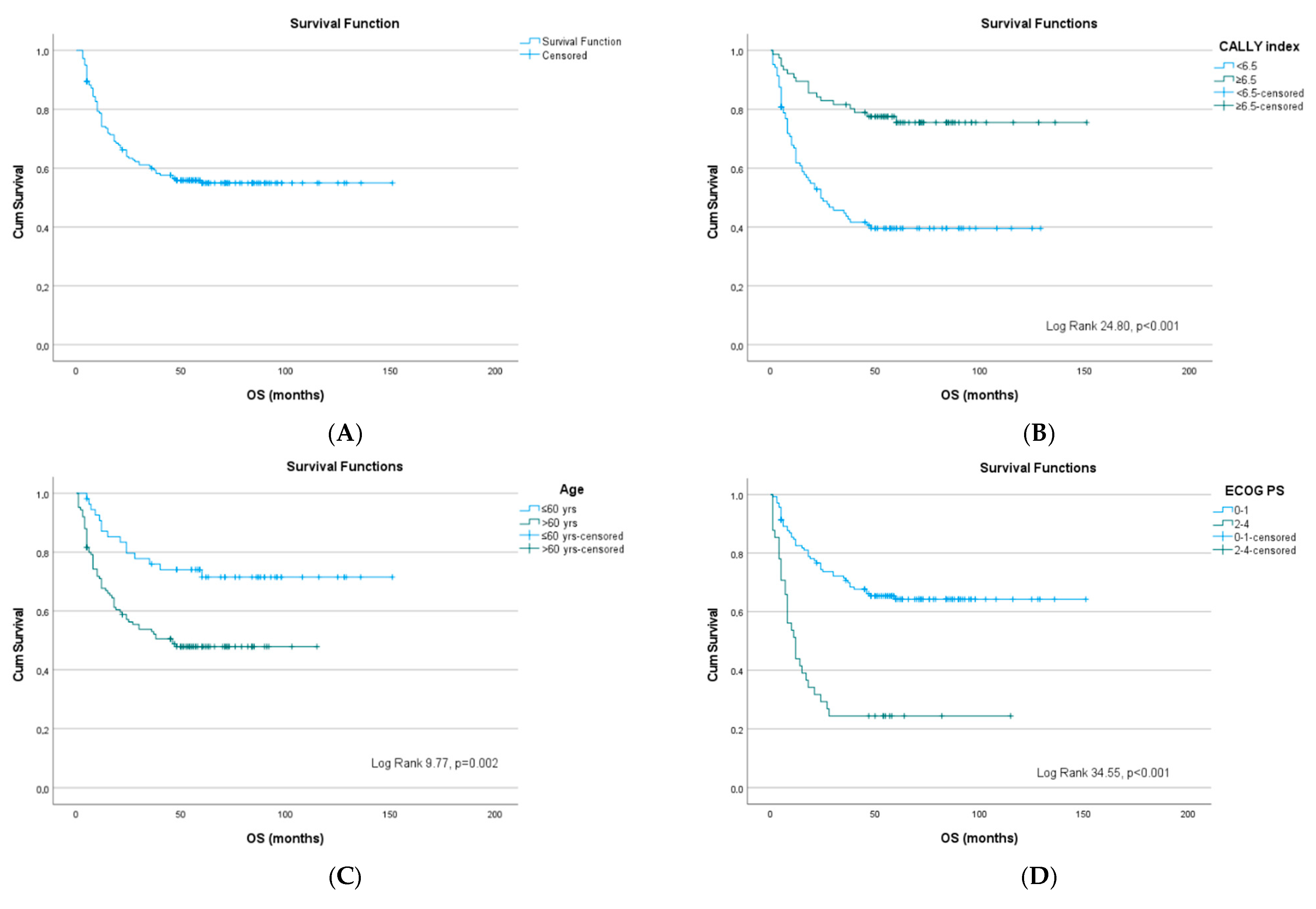
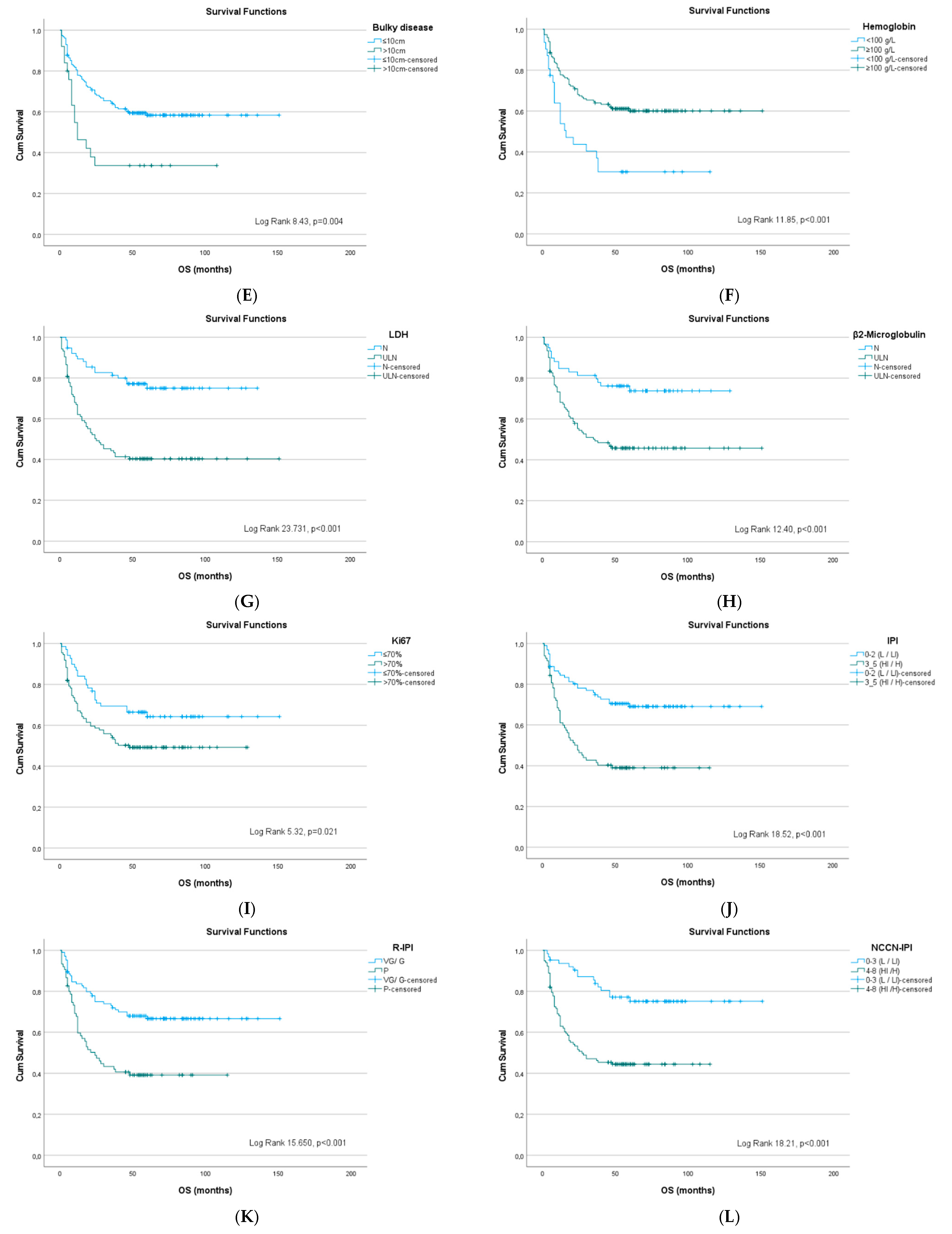
| Category/ Variable | Mean OS ± SE (95% CI) | Median OS (95% CI) | 3-Year OS (%) | 5-Year OS (%) | Log Rank | p-Value (Log Rank) | Univariate HR (95% CI) | p-Value (Uni) | Multivariate HR (95% CI) | p-Value (Multi) | |
|---|---|---|---|---|---|---|---|---|---|---|---|
| CALLY | ≥6.5 | 119.3 ± 6.6 (106.4–132.1) | NR * | 81.6 | 75.5 | 24.8 | <0.001 | 1.0 3.50 (2.1–5.9) | <0.001 | 1.0 2.2 (1.2–4.0) | 0.011 |
| <6.5 | 59.3 ± 5.7 (48.1–70.5) | 24.0 (9.1–38.9) | 43.7 | 39.6 | |||||||
| Demographics | |||||||||||
| Age (years) | ≤60 | 114.1 ± 8.1 (98.2–130.0) | NR | 76.0 | 71.5 | 9.7 | 0.002 | 1.0 2.35 (1.3–4.1) | 0.003 | - | - |
| >60 | 62.3 ± 4.6 (53.2–71.4) | 46.0 (NE **) | 53.0 | 47.9 | |||||||
| Sex | Female | 87.4 ± 6.9 (73.8–101.0) | NR | 57.0 | 53.2 | 0.2 | 0.616 | - | - | - | - |
| Male | 84.7 ± 6.8 (71.3–98.2) | NR | 63.8 | 57.2 | |||||||
| Performance/Comorbidities | |||||||||||
| ECOG PS | <2 | 103.8 ± 5.5 (93.0–114.6) | NR | 70.1 | 64.2 | 34.5 | <0.001 | 1.0 3.47 (2.2–5.5) | <0.001 | - | - |
| ≥2 | 35.39 ± 7.1 (21.4–49.4) | 12.0 (7.0–16.9) | 24.4 | 24.4 | |||||||
| Comorbidities | No | 109.5 ± 10.5 (88.9–130.1) | NR | 75.2 | 75.2 | 3.4 | 0.066 | - | - | - | - |
| Yes | 77.3 ± 5.2 (67.1–87.4) | NR | 56.1 | 51.2 | |||||||
| CIRS | ≤6 | 93.5 ± 5.5 (82.7–104.4) | NR | 61.9 | 57.7 | 2.6 | 0.110 | - | - | - | - |
| >6 | 59.4 ± 10.7 (38.3–80.5) | 24.0 (21.6–66.1) | 50.0 | 38.7 | |||||||
| Clinical characteristics | |||||||||||
| Ann Arbor CS | I-II | 103.5 ± 8.3 (87.4–119.7) | NR | 70.8 | 65.4 | 3.1 | 0.078 | - | - | - | - |
| III-IV | 75.4 ± 5.7 (64.2–86.6) | 48.0 (NE) | 54.0 | 51.4 | |||||||
| Bulky > 10 cm | No | 95.2 ± 5.4 (84.5–105.8) | NR | 64.1 | 58.3 | 8.4 | 0.004 | 1.0 2.24 (1.3–3.9) | 0.004 | 1.0 1.2 (0.7–2.19) | 0.466 |
| Yes | 42.7 ± 9.5 (23.9–61.4) | 12.0 (2.5–21.5) | 33.7 | 33.7 | |||||||
| EN | No | 74.9 ± 6.4 (61.8–87.2) | NR | 57.6 | 52.4 | 0.6 | 0.473 | - | - | - | - |
| Yes | 93.5 ± 6.8 (80.0–107.0) | NR | 61.9 | 57.3 | |||||||
| Laboratory parameters | |||||||||||
| Hb (g/L) | ≥100 | 97.2 ± 5.5 (86.3–108.0) | NR | 64.0 | 60.1 | 11.8 | <0.001 | 1.0 2.31 (1.4–3.8) | <0.001 | 1.0 1.4 (0.8–2.42) | 0.177 |
| <100 | 44.3 ± 8.7 (27.2–61.3) | 16.0 (4.51–27.5) | 40.4 | 30.3 | |||||||
| ALC (×109/L) | ≥1 | 95.5 ± 5.9 (83.9–107.2) | NR | 64.6 | 58.5 | 3.5 | 0.061 | - | - | - | - |
| <1 | 69.7 ± 8.7 (51.8–86.4) | 30.0 (NE) | 48.2 | 46.1 | |||||||
| AMC (×109/L) | ≤0.63 | 88.4 ± 5.6 (77.5–99.2) | NR | 67.1 | 59.4 | 3.1 | 0.076 | - | - | - | - |
| >0.63 | 78.8 ± 8.6 (61.9–95.6) | 35.0 (NE) | 47.7 | 47.7 | |||||||
| Platelets (×109/L) | ≥157 | 83.6 ± 4.8 (74.2–93.0) | NR | 53.1 | 48.3 | 1.3 | 0.246 | - | - | - | - |
| <157 | 78.66 ± 15.3 (46.6–108.7) | 46.0 (NE) | 60.9 | 55.9 | |||||||
| LDH (U/L) | N | 107.7 ± 5.8 (96.3–119.2) | NR | 81.3 | 75.0 | 23.7 | <0.001 | 1.0 3.36 (2.0–5.7) | <0.001 | - | - |
| ULN | 68.8 ± 6.7 (55.6–82.1) | 25.0 (10.7–39.3) | 44.3 | 40.4 | |||||||
| Albumin (g/L) | ≥35 | 102.0 ± 5.7 (90.7–113.2) | NR | 69.1 | 63.1 | 18.1 | <0.001 | 1.0 2.5 (1.6–3.9) | <0.001 | - | - |
| <35 | 45.9 ± 7.1 (31.9–60.0) | 15.0 (3.7–26.3) | 35.4 | 33.3 | |||||||
| β2M (mg/L) | N | 100.2 ± 6.5 (87.5–112.9) | NR | 81.4 | 73.8 | 12.4 | <0.001 | 1.0 2.7 (1.5–4.7) | <0.001 | 1.0 1.6 (0.8–2.9) | 0.159 |
| ULN | 76.9 ± 6.3 (64.5–89.3) | 36.0 (NE) | 49.3 | 45.7 | |||||||
| CRP (mg/L) | N | 108.1 ± 6.6 (95.2–120.9) | NR | 83.1 | 75.2 | 15.7 | <0.001 | 1.0 3.0 (1.7–5.4) | <0.001 | - | - |
| ULN | 75.4 ± 6.5 (62.9–87.8) | 35.0 (14.2–55.8) | 48.4 | 44.9 | |||||||
| Histopathology/Immunohistochemistry | |||||||||||
| COO | Non-GCB | 84.7 ± 7.1 (72.4–97.0) | NR | 57.2 | 50.8 | 2.1 | 0.152 | - | - | - | - |
| GCB | 84.6 ± 6.3 (70.6–98.5) | NR | 65.7 | 63.8 | |||||||
| BCL2 | Negative | 94.4 ± 8.7 (77.3–111.4) | NR | 60.3 | 57.9 | 0.4 | 0.500 | - | - | - | - |
| Positive | 79.8 ± 5.7 (68.7–90.9) | NR | 59.9 | 53.6 | |||||||
| BCL6 | Negative | 71.7 ± 8.2 (55.7–87.7) | 60.0 (NE) | 56.0 | 48.9 | 0.7 | 0.400 | - | - | - | - |
| Positive | 93.1 ± 6.0 (81.3–104.9) | NR | 61.6 | 57.5 | |||||||
| Ki-67 | ≤70% | 104.1 ± 7.7 (88.9–119.3) | NR | 69.4 | 64.3 | 5.3 | 0.021 | 1.0 1.7 (1.1–2.8) | 0.023 | 1.0 1.6 (1.01–2.72) | 0.046 |
| >70% | 70.4 ± 5.6 (59.4–81.4) | 48.0 (NE) | 54.0 | 49.2 | |||||||
| Prognostic scores | |||||||||||
| IPI | 0–2 (L/LI) | 110.2 ± 6.3 (97.8–122.7) | NR | 74.9 | 69.1 | 18.5 | <0.001 | 1.0 2.6 (1.6–4.1) | <0.001 | ─ a | ─ a |
| 3–5 (HI/H) | 52.8 ± 5.6 (41.9–63.7) | 24.0 (14.3–33.7) | 42.8 | 39.0 | |||||||
| R-IPI | VG/G | 106.7 ± 6.3 (94.5–119.0) | NR | 71.9 | 66.6 | 15.6 | <0.001 | 1.0 2.4 (1.5–3.7) | <0.001 | ─ a | ─ a |
| Poor | 53.0 ± 5.9 (41.4–64.5) | 24.0 (12.5–35.5) | 43.4 | 39.1 | |||||||
| NCCN-IPI | 0–3 (L/LI) | 120.4 ± 6.9 (106.8–133.9) | NR | 83.8 | 75.1 | 18.2 | <0.001 | 1.0 3.2 (1.8–5.6) | <0.001 | 1.0 1.8 (1.0–3.3) | 0.058 |
| 4–8 (HI/H) | 57.9 ± 4.8 (48.5–67.3) | 27.0 (3.3–51.0) | 47.1 | 44.4 | |||||||
| Treatment response/Outcome | |||||||||||
| ORR | CR + PR | 120.0 ± 4.9 (110.3–129.7) | NR | 81.4 | 75.2 | 155.3 | <0.001 | 1.0 12.0 (7.4–19.5) | <0.001 | - | - |
| SD + PD | 13.7 ± 2.2 (9.6–17.7) | 8.0 (6.2–9.8) | 9.4 | 7.5 | |||||||
| Relapse | No | 94.1 ± 5.4 (83.4–104.8) | NR | 61.8 | 58.8 | 4.0 | 0.047 | 1.0 1.7 (1.0–3.1) | 0.05 | - | - |
| Yes | 40.1 ± 6.0 (28.3–51.7) | 28.0 (17.6–38.4) | 44.4 | 22.2 | |||||||
| Non-DLBCL-related death | No | 25.4 ± 4.2 (16.8–33.5) | 18.0 (13.9–22.1) | 22.2 | 5.6 | 8.6 | 0.003 | 1.0 2.17 (1.2–3.8) | 0.007 | - | - |
| Yes | 13.52 ± 1.4 (10.7–16.2) | 10 (7.3–12.2) | 8.2 | 0 | |||||||
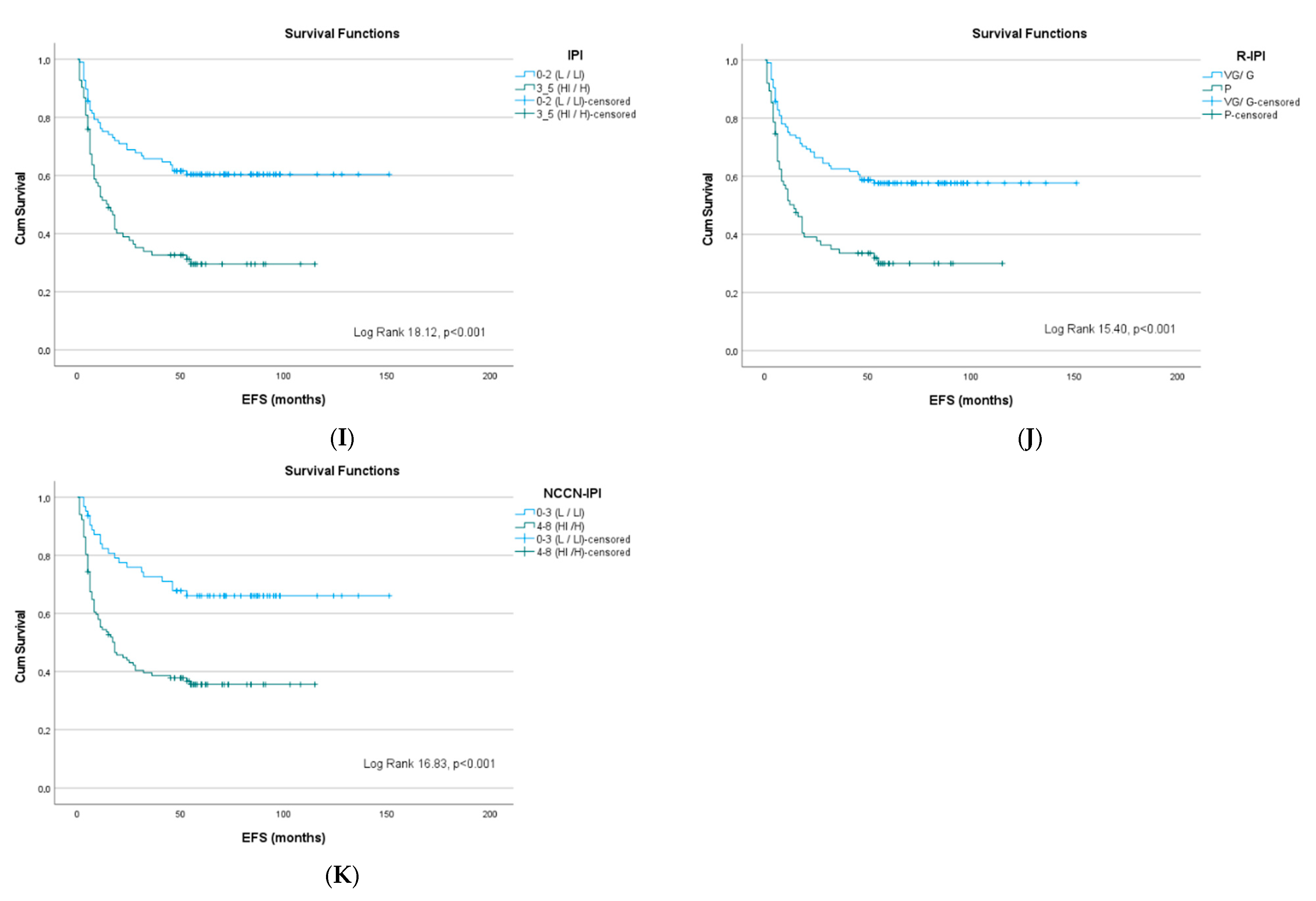
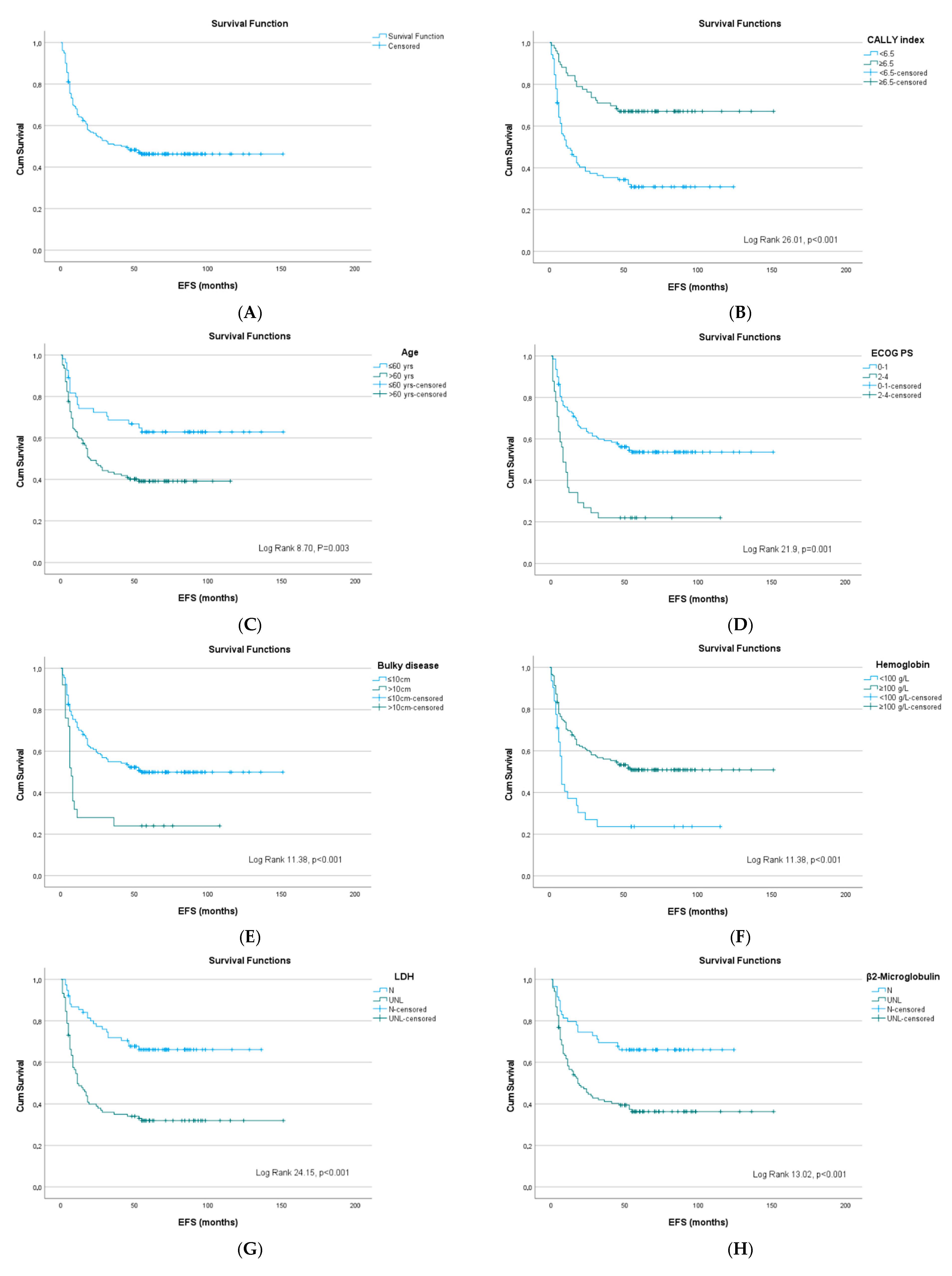
| Variable | Mean EFS ± SE (95% CI) | Median EFS (95% CI) | 3-Year EFS (%) | 5-Year EFS (%) | Log Rank | p-Value (Log Rank) | Univariate HR (95% CI) | p-Value (Uni) | Multivariate HR (95% CI) | p-Value (Multi) | |
|---|---|---|---|---|---|---|---|---|---|---|---|
| CALLY | ≥6.5 | 107.2 ± 7.2 (93.0–121.4) | NR * | 71.1 | 67.1 | 26.0 | <0.001 | 1.0 3.1 (1.9–4.8) | <0.001 | 1.0 1.9 (1.1–3.3) | 0.019 |
| <6.5 | 46.3 ± 5.3 (35.9–56.6) | 12.0 (5.2–18.7) | 35.3 | 30.9 | |||||||
| Demographics | |||||||||||
| Age (years) | ≤60 | 101.2 ± 8.9 (83.6–118.7) | NR | 68.7 | 62.9 | 8.7 | 0.003 | 1.0 2.1 (1.3–3.4) | 0.004 | - | - |
| >60 | 52.4 ± 4.6 (43.4–61.4) | 20.0 (11.4–28.6) | 42.6 | 39.2 | |||||||
| Sex | Female | 75.9 ± 6.9 (62.2–89.6) | 32.0 (NE **) | 49.1 | 45.7 | 0.1 | 0.826 | - | - | - | - |
| Male | 71.3 ± 7.0 (57.5–85.1) | 45.0 (NE) | 52.5 | 47.0 | |||||||
| Performance/Comorbidities | |||||||||||
| ECOG PS | <2 | 88.2 ± 5.9 (76.7–99.7) | NR | 59.1 | 53.6 | 21.9 | <0.001 | 1.0 2.6 (1.7–4.1) | <0.001 | - | - |
| ≥2 | 31.7 ± 7.0 (18.1–45.4) | 8.0 (4.2–11.7) | 22.0 | 22.0 | |||||||
| Comorbidities | No | 98.2 ± 11.2 (76.3–120.1) | NR | 67.0 | 61.3 | 3.6 | 0.057 | - | - | - | - |
| Yes | 65.2 ± 5.2 (55.0–75.4) | 27.0 (9.4–44.6) | 46.4 | 42.5 | |||||||
| CIRS | ≤6 | 80.1 ± 5.7 (68.9–91.3) | 53.0 (NE) | 52.2 | 48.5 | 2.3 | 0.130 | - | - | - | - |
| >6 | 37.3 ± 6.8 (24.0–50.6) | 19.0 (6.0–32.0) | 42.1 | 34.4 | |||||||
| Clinical characteristics | |||||||||||
| Ann Arbor CS | I–II | 87.1 ± 8.6 (70.1–104.1) | NR | 58.7 | 54.1 | 1.6 | 0.209 | - | - | - | - |
| III–IV | 64.7 ± 5.8 (53.3–76.1) | 27.0 (8.4–45.6) | 45.9 | 41.6 | |||||||
| Bulky > 10 cm | No | 82.7 ± 5.6 (71.8–93.7) | 55.0 (NE) | 54.9 | 49.9 | 11.4 | <0.001 | 1.0 2.3 (1.4–3.8) | <0.001 | 1.0 1.4 (0.8–2.4) | 0.177 |
| Yes | 31.3 ± 8.7 (14.3–48.4) | 7.0 (5.4–8.6) | 24.0 | 24.0 | |||||||
| EN | No | 63.6 ± 6.6 (50.7–76.6) | 46.0 (NE) | 48.0 | 45.2 | 0.4 | 0.546 | - | - | - | - |
| Yes | 79.5 ± 6.9 (65.8–93.2) | 27.0 (NE) | 52.8 | 47.2 | |||||||
| Laboratory parameters | |||||||||||
| Hb (g/L) | ≥100 | 83.9 ± 5.7 (72.8–95.1) | NR | 56.0 | 50.9 | 11.4 | <0.001 | 1.0 2.2 (1.4–3.5) | <0.001 | 1.0 1.5 (0.9–2.6) | 0.104 |
| <100 | 33.9 ± 8.3 (17.6–50.3) | 8.0 (6.7–9.3) | 23.7 | 23.7 | |||||||
| ALC (×109/L) | ≥1 | 81.8 ± 6.1 (69.7–93.8) | 53.0 (NE) | 53.1 | 49.8 | 2.8 | 0.093 | - | - | - | - |
| <1 | 59.2 ± 8.7 (42.3–76.2) | 22.0 (14.6–50.6) | 44.3 | 37.6 | |||||||
| AMC (×109/L) | ≤0.63 | 78.0 ± 5.7 (66.7–89.3) | NR | 57.6 | 51.9 | 5.2 | 0.022 | 1.0 1.6 (1.1–2.4) | <0.001 | 1.0 1.5 (1.0–2.3) | 0.064 |
| >0.63 | 61.8 ± 8.4 (45.1–78.5) | 14.0 (6.1–21.9) | 38.5 | 6.5 | |||||||
| Platelets (×109/L) | <157 | 63.7 ± 15.2 (33.9–93.5) | 9.0 (0.0–39.9) | 43.3 | 37.9 | 1.5 | 0.217 | - | - | - | - |
| ≥157 | 71.7 ± 4.9 (62.0–81.4) | 46.0 (NE) | 51.7 | 47.5 | |||||||
| LDH (U/L) | N | 96.7 ± 6.5 (83.9–109.4) | NR | 71.9 | 66.1 | 24.1 | <0.001 | 1.0 2.9 (1.8–4.7) | <0.001 | - | - |
| ULN | 55.6 ± 6.5 (42.8–68.4) | 11.0 (4.9–17.1) | 35.1 | 32.0 | |||||||
| Albumin (g/L) | ≥35 | 86.8 ± 6.0 (75.0–98.7) | NR | 57.7 | 52.7 | 13.1 | <0.001 | 1.0 2.1 (1.4–3.2) | <0.001 | - | - |
| <35 | 39.9 ± 7.1 (26.0–53.7) | 8.0 (4.9–11.0) | 31.3 | 29.0 | |||||||
| β2-M (mg/L) | N | 86.9 ± 6.8 (73.6–100.3) | NR | 69.5 | 66.1 | 13.0 | <0.001 | 1.0 2.4 (1.5–3.9) | <0.001 | 1.0 1.4 (0.8–2.4) | 0.231 |
| ULN | 63.1 ± 6.3 (50.9–75.3) | 18.0 (9.1–26.9) | 41.2 | 36.4 | |||||||
| CRP (mg/L) | N | 100.8 ± 7.0 (87.0–114.4) | NR | 74.6 | 69.5 | 20.2 | <0.001 | 1.0 3.1 (1.8–5.1) | <0.001 | - | - |
| ULN | 60.1 ± 6.2 (48.0–72.3) | 16.0 (10.4–21.6) | 38.7 | 34.9 | |||||||
| Histopathology/Immunohistochemistry | |||||||||||
| COO | Non-GCB | 73.6 ± 6.3 (61.3–86.1) | 28.0 (20.0–57.8) | 48.3 | 43.8 | 0.7 | 0.411 | - | - | - | - |
| GCB | 56.9 ± 5.7 (45.7–68.1) | NR | 55.4 | 51.8 | |||||||
| BCL2 | Negative | 85.5 ± 8.9 (68.1–102.9) | NR | 57.6 | 52.2 | 1.4 | 0.238 | - | - | - | - |
| Positive | 66.1 ± 5.7 (54.8–77.3) | 31.0 (3.1–58.9) | 46.9 | 43.2 | |||||||
| BCL6 | Negative | 65.2 ± 8.3 (48.9–81.4) | 25.0 (NE) | 50.0 | 45.6 | 0.2 | 0.896 | - | - | - | - |
| Positive | 77.6 ± 6.1 (65.5–89.6) | 45.0 (NE) | 50.8 | 46.6 | |||||||
| Ki-67 | ≤70% | 86.2 ± 8.2 (70.1–102.3) | NR | 59.2 | 51.7 | 2.7 | 0.101 | - | - | - | - |
| >70% | 61.4 ± 5.6 (50.4–72.5) | 25.0 (11.0–50.3) | 45.2 | 43.0 | |||||||
| Prognostic scores | |||||||||||
| IPI | 0–2 (L/LI) | 97.2 ± 6.8 (83.8–110.7) | NR | 65.7 | 60.4 | 18.1 | <0.001 | 1.0 2.4 (1.6–3.6) | <0.001 | ─ a | ─ a |
| 3–5 (HI/H) | 42.3 ± 5.4 (31.8–52.9) | 15.0 (9.2–20.8) | 32.6 | 29.5 | |||||||
| R-IPI | VG/G | 93.5 ± 6.6 (80.5–106.5) | NR | 62.6 | 57.7 | 15.4 | <0.001 | 1.0 2.2 (1.4–3.3) | <0.001 | ─ a | ─ a |
| Poor | 42.6 ± 5.7 (31.4–53.8) | 14.0 (8.0–20.0) | 33.5 | 30.0 | |||||||
| NCCN-IPI | 0–3 (L/LI) | 106 ± 8.0 (90.6–122.0) | NR | 72.7 | 66.1 | 16.8 | <0.001 | 1.0 2.6 (1.6–4.3) | <0.001 | 1.0 1.6 (1.0–2.7) | 0.072 |
| 4–8 (HI/H) | 48.3 ± 4.7 (39.1–57.6) | 18.0 (8.5–27.5) | 38.7 | 35.6 | |||||||
| Treatment response/Outcome | |||||||||||
| ORR | (CR + PR) | 107.1 ± 5.5 (96.2–118.0) | NR | 71.9 | 65.8 | 207.7 | <0.001 | 1.0 20.3 (12.1–34.2) | <0.001 | - | - |
| (SD + PD) | 5.54 ± 0.6 (4.3–6.8) | 5.0 (4.0–6.0) | 0.0 | 0.0 | |||||||
| Relapse | No | 83.4 ± 5.6 (72.4–94.3) | NR | 53.8 | 51.8 | 8.7 | 0.003 | 1.0 2.1 (1.3–3.5) | 0.005 | - | - |
| Yes | 23.3 ± 3.6 (16.3–30.3) | 17.0 (14.2–19.8) | 22.2 | 0.0 | |||||||
| Non-DLBCL-related death | No | 21.7 ± 4.0 (13.9–29.5) | 18.0 (9.7–26.2) | 16.7 | 5.6 | 17.2 | <0.001 | 1.0 3.1 (1.7–5.6) | <0.001 | - | - |
| Yes | 7.6 ± 0.92 (8.2–13.4) | 5.0 (3.9–6.1) | 1.6 | 0.0 | |||||||
| Variable/Category | ORR (N = 127) | R/R (N = 70) | |||
|---|---|---|---|---|---|
| OR (95% CI) | p Value | OR (95% CI) | p Value | ||
| CALLY | <6.5 vs. ≥6.5 | 4.0 (1.9–8.5) | <0.001 | 5.7 (2.8–11.5) | < 0.001 |
| Demographics | |||||
| Age (years) | >60 vs. ≤60 | 2.4 (1.1–5.1) | 0.031 | 2.6 (1.3–5.2) | 0.009 |
| Sex | Female vs. Male | 1.03 (0.5–2.0) | 0.931 | 1.09 (0.6–2.0) | 0.786 |
| Performance/Comorbidities | |||||
| ECOG PS | ≥2 vs. <2 | 4.6 (2.2–9.7) | <0.001 | 4.9 (2.1–11.4) | <0.001 |
| Comorbidities | Yes vs. No | 1.7 (0.7–3.9) | 0.245 | 1.7 (0.8–3.7) | 0.169 |
| CIRS | >6 vs. ≤6 | 1.1 (0.39–2.3) | 0.912 | 1.3 (0.5–3.2) | 0.626 |
| Clinical Characteristics | |||||
| Ann Arbor CS | III–IV vs. I–II | 1.1 (0.5–2.1) | 0.883 | 1.5 (0.8–2.8) | 0.245 |
| Bulky > 10 cm | Yes vs. No | 4.6 (1.9–11.1) | 0.001 | 4.3 (1.5–12.3) | 0.008 |
| EN | Yes vs. No | 1.4 (0.7–2.7) | 0.301 | 1.2 (0.6–2.2) | 0.659 |
| Laboratory Parameters | |||||
| Hb (g/L) | <100 vs. ≥100 | 3.2 (1.5–7.2) | 0.004 | 4.5 (1.8–11.4) | 0.001 |
| ALC (×109/L) | <1 vs. ≥1 | 1.7 (0.8–3.3) | 0.150 | 1.6 (0.8–3.2) | 0.198 |
| AMC (×109/L) | >0.63 vs. ≤0.63 | 2.2 (1.1–4.2) | 0.021 | 1.8 (0.9–3.6) | 0.071 |
| Platelets (×109/L) | <157 vs. ≥157 | 1.8 (0.7–4.5) | 0.212 | 1.4 (0.5–3.9) | 0.465 |
| LDH (U/L) | ULN vs. N | 6.5 (2.8–14.8) | <0.001 | 8.1 (3.8–17.3) | <0.001 |
| Albumin (g/L) | <35 vs. ≥35 | 4.60 (2.3–9.3) | <0.001 | 3.5 (1.7–7.3) | <0.001 |
| β2M (mg/L) | ULN vs. N | 1.7 (0.8–3.6) | 0.130 | 3.3 (1.6–6.6) | <0.001 |
| CRP (mg/L) | ULN vs. N | 4.6 (1.9–10.9) | 0.001 | 6.1 (2.7–13.5) | <0.001 |
| Histopathology/Immunohistochemistry | |||||
| COO | Non GCB vs. GCB | 1.2 (0.6–2.4) | 0.563 | 1.2 (0.6–2.4) | 0.571 |
| BCL2 | Positive vs. Negative | 1.7 (0.8–3.4) | 0.145 | 1.4 (0.7–2.7) | 0.301 |
| BCL6 | Positive vs. Negative | 1.2 (0.6–2.4) | 0.641 | 1.1 (0.6–2.3) | 0.739 |
| MUM1 | Positive vs. Negative | 1.4 (0.7–2.7) | 0.361 | 1.2 (0.6–2.3) | 0.660 |
| CD47 | Positive vs. Negative | 1.3 (0.5–3.3) | 0.575 | 1.2 (0.5–2.8) | 0.708 |
| Ki67 (%) | >70 vs. ≤70% | 1.9 (0.9–3.7) | 0.076 | 1.8 (1.0–3.6) | 0.069 |
| Prognostic Scores | |||||
| IPI | HI/H vs. L/LI | 2.8 (1.5–5.5) | 0.002 | 3.7 (1.9–7.3) | <0.001 |
| R-IPI | Poor vs. Very Good/Good | 2.7 (1.4–5.1) | 0.004 | 3.4 (1.7–6.5) | <0.001 |
| NCCN-IPI | HI/H vs. L/LI | 4.3 (1.9–9.8) | 0.001 | 4.7 (2.2–9.8) | <0.001 |
| Multivariate analysis of factors predicting ORR and R/R | |||||
| Variable/Category | ORR (N = 127) | R/R (N = 70) | |||
| OR (95% CI) | p value | OR (95% CI) | p value | ||
| CALLY | <6.5 vs. ≥6.5 | 1.8 (0.8–4.3) | 0.161 | 3.2 (1.5–7.0) | 0.004 |
| Bulky >10 cm | Yes vs. No | 2.4 (0.9–6.1) | 0.073 | 2.4 (0.8–7.4) | 0.132 |
| Hb (g/L) | <100 vs. ≥100 | 3.0 (1.2–7.5) | 0.019 | 2.8 (1.0–7.6) | 0.048 |
| AMC (×109/L) | >0.63 vs. ≤0.63 | 2.7 (1.3–5.8) | 0.008 | - | - |
| NCCN-IPI | HI/H vs. L/LI | 2.4 (1.0–5.8) | 0.063 | 2.2 (1.0–4.7) | 0.057 |
Disclaimer/Publisher’s Note: The statements, opinions and data contained in all publications are solely those of the individual author(s) and contributor(s) and not of MDPI and/or the editor(s). MDPI and/or the editor(s) disclaim responsibility for any injury to people or property resulting from any ideas, methods, instructions or products referred to in the content. |
© 2026 by the authors. Licensee MDPI, Basel, Switzerland. This article is an open access article distributed under the terms and conditions of the Creative Commons Attribution (CC BY) license.
Share and Cite
Cvetković, Z.; Bukurecki, I.; Pejić, S.; Divac Pravdić, A.; Pavlović, M.; Vučić, V.; Marković, O. Prognostic Value of the CALLY Index in Diffuse Large B-Cell Lymphoma: Linking Inflammation, Nutrition, and Tumor Biology. Cancers 2026, 18, 846. https://doi.org/10.3390/cancers18050846
Cvetković Z, Bukurecki I, Pejić S, Divac Pravdić A, Pavlović M, Vučić V, Marković O. Prognostic Value of the CALLY Index in Diffuse Large B-Cell Lymphoma: Linking Inflammation, Nutrition, and Tumor Biology. Cancers. 2026; 18(5):846. https://doi.org/10.3390/cancers18050846
Chicago/Turabian StyleCvetković, Zorica, Ilija Bukurecki, Snežana Pejić, Anica Divac Pravdić, Miroslav Pavlović, Vesna Vučić, and Olivera Marković. 2026. "Prognostic Value of the CALLY Index in Diffuse Large B-Cell Lymphoma: Linking Inflammation, Nutrition, and Tumor Biology" Cancers 18, no. 5: 846. https://doi.org/10.3390/cancers18050846
APA StyleCvetković, Z., Bukurecki, I., Pejić, S., Divac Pravdić, A., Pavlović, M., Vučić, V., & Marković, O. (2026). Prognostic Value of the CALLY Index in Diffuse Large B-Cell Lymphoma: Linking Inflammation, Nutrition, and Tumor Biology. Cancers, 18(5), 846. https://doi.org/10.3390/cancers18050846