Ten-Year Experience in the Treatment of Cancers of Unknown Primary from Poland: From Overall Survival to Factors Influencing Response in the Prepersonalization Era

 , ,
, ,
Simple Summary
Abstract
1. Introduction
2. Materials and Methods
2.1. Study Design and Study Group Characteristics
2.2. Parameters Evaluated
2.3. Statistical Analysis
3. Results
3.1. Demographics and Clinicopathological Presentation
3.2. Cancer Treatment
3.2.1. Chemotherapy
3.2.2. Radiotherapy
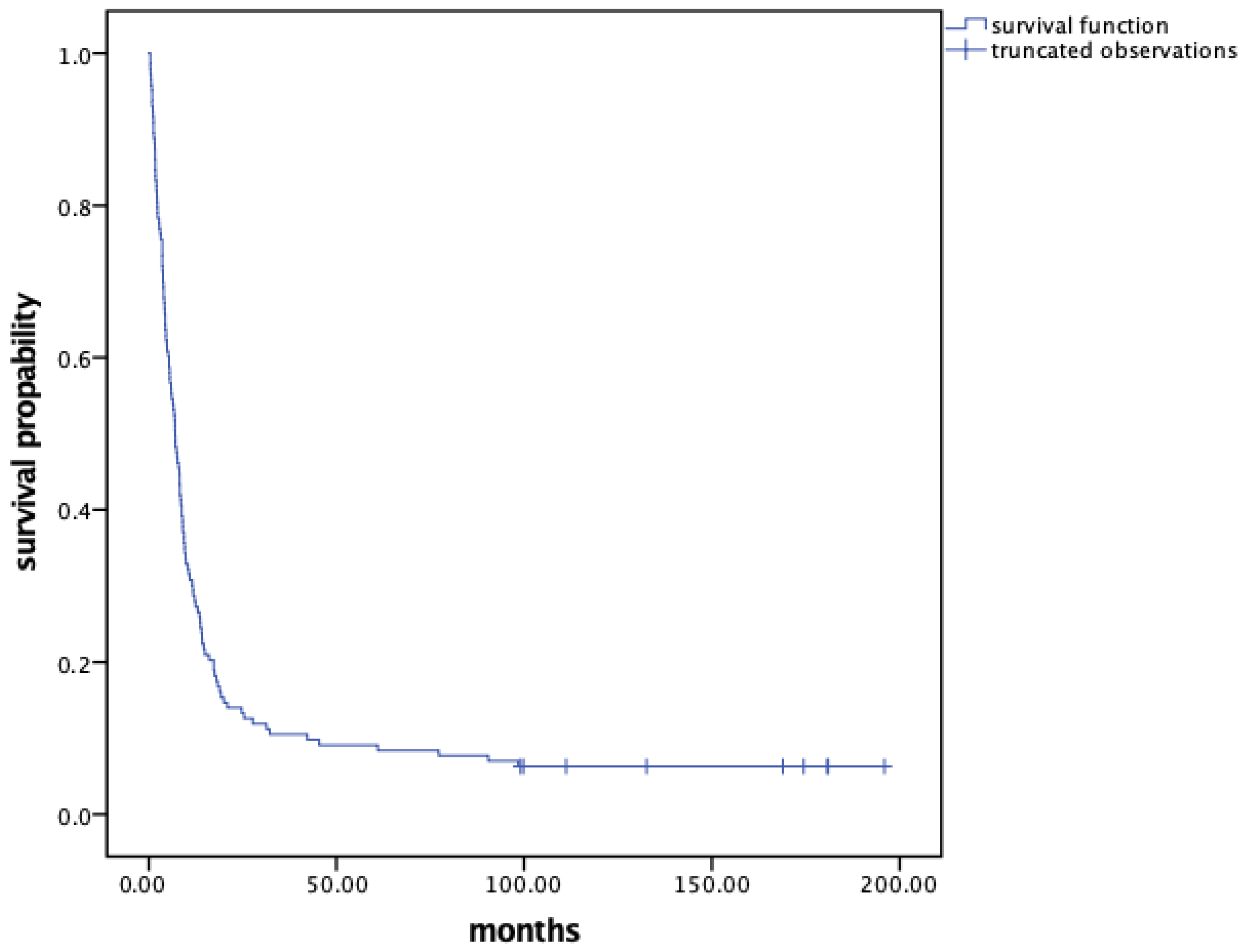
3.2.3. Survival Analysis
3.3. Univariate and Multivariate Analyses
4. Discussion
5. Conclusions
Author Contributions
Funding
Institutional Review Board Statement
Informed Consent Statement
Data Availability Statement
Acknowledgments
Conflicts of Interest
Abbreviations
| CUP | Cancer of unknown primary |
| LDH | Lactate dehydrogenase |
| ECOG | Eastern cooperative oncology group performance status |
| NGS | Next-generation sequencing |
| RWE | Real-world evidence |
| CBC | Complete blood count |
| Ca2+ | Blood calcium level |
| LDH | Blood lactate dehydrogenase |
| ALP | Alkaline phosphatase |
| NLR | Neutrophil-lymphocyte ratio |
| PLR | Platelet-lymphocyte ratio |
| OS | Overall survival |
| HR | Hazard ratio |
| CI | Confidence interval |
| ROC | Receiver operating characteristic |
| p-value | Probability value |
| CGP | Comprehensive genomic profiling |
| TOO | Tissue of origin |
| PFS | Progression-free survival |
References
- Rassy, E.; Pavlidis, N. The currently declining incidence of cancer of unknown primary. Cancer Epidemiol. 2019, 61, 139–141. [Google Scholar] [CrossRef]
- Didkowska, J.; Barańska, K.; Miklewska, M.J.; Wojciechowska, U. Cancer incidence and mortality in Poland in 2023. Nowotw. J. Oncol. 2024, 74, 75–93. [Google Scholar] [CrossRef]
- Binder, C.; Matthes, K.L.; Korol, D.; Rohrmann, S.; Moch, H. Cancer of unknown primary—Epidemiological trends and relevance of comprehensive genomic profiling. Cancer Med. 2018, 7, 4814–4824. [Google Scholar] [CrossRef]
- Krämer, A.; Bochtler, T.; Pauli, C.; Baciarello, G.; Delorme, S.; Hemminki, K.; Mileshkin, L.; Moch, H.; Oien, K.; Olivier, T.; et al. Cancer of unknown primary: ESMO Clinical Practice Guideline for diagnosis, treatment and follow-up. Ann. Oncol. 2022, 34, 228–246. [Google Scholar] [CrossRef]
- Culine, S.; Kramar, A.; Saghatchian, M.; Bugat, R.; Lesimple, T.; Lortholary, A.; Merrouche, Y.; Laplanche, A.; Fizazi, K. Development and Validation of a Prognostic Model to Predict the Length of Survival in Patients With Carcinomas of an Unknown Primary Site. J. Clin. Oncol. 2002, 20, 4679–4683. [Google Scholar] [CrossRef] [PubMed]
- Gross-Goupil, M.; Fourcade, A.; Blot, E.; Penel, N.; Négrier, S.; Culine, S.; Chaigneau, L.; Lesimple, T.; Priou, F.; Lortholary, A.; et al. Cisplatin alone or combined with gemcitabine in carcinomas of unknown primary: Results of the randomised GEFCAPI 02 trial. Eur. J. Cancer 2012, 48, 721–727. [Google Scholar] [CrossRef] [PubMed]
- Huebner, G.; Link, H.; Kohne, C.H.; Stahl, M.; Kretzschmar, A.; Steinbach, S.; Folprecht, G.; Bernhard, H.; Al-Batran, S.E.; Schoffski, P.; et al. Paclitaxel and carboplatin vs. gemcitabine and vinorelbine in patients with adeno- or undifferentiated carcinoma of unknown primary: A randomised prospective phase II trial. Br. J. Cancer 2009, 100, 44–49. [Google Scholar] [CrossRef]
- Lee, J.; Hahn, S.; Kim, D.-W.; Kim, J.; Kang, S.N.; Rha, S.Y.; Lee, K.B.; Kang, J.-H.; Park, B.-J. Evaluation of survival benefits by platinums and taxanes for an unfavourable subset of carcinoma of unknown primary: A systematic review and meta-analysis. Br. J. Cancer 2012, 108, 39–48. [Google Scholar] [CrossRef] [PubMed]
- Pouyiourou, M.; Kraft, B.N.; Wohlfromm, T.; Stahl, M.; Kubuschok, B.; Löffler, H.; Hacker, U.T.; Hübner, G.; Weiss, L.; Bitzer, M.; et al. Nivolumab and ipilimumab in recurrent or refractory cancer of unknown primary: A phase II trial. Nat. Commun. 2023, 14, 6761. [Google Scholar] [CrossRef]
- Raghav, K.P.; Stephen, B.; Karp, D.D.; Piha-Paul, S.; Hong, D.S.; Jain, D.; Onwugaje, D.O.C.; Abonofal, A.; Willett, A.F.; Overman, M.; et al. Efficacy of pembrolizumab in patients with advanced cancer of unknown primary (CUP): A phase 2 non-randomized clinical trial. J. Immunother. Cancer 2022, 10, e004822. [Google Scholar] [CrossRef]
- Fizazi, K.; Greco, F.A.; Pavlidis, N.; Daugaard, G.; Oien, K.; Pentheroudakis, G.; on behalf of the ESMO Guidelines Committee. Cancers of unknown primary site: ESMO Clinical Practice Guidelines for diagnosis, treatment and follow-up. Ann. Oncol. 2015, 26, v133–v138. [Google Scholar] [CrossRef] [PubMed]
- Von Elm, E.; Altman, D.G.; Egger, M.; Pocock, S.J.; Gøtzsche, P.C.; Vandenbroucke, J.P.; Initiative, S. The Strengthening the Reporting of Observational Studies in Epidemiology (STROBE) statement: Guidelines for reporting observational studies. Lancet 2007, 370, 1453–1457. [Google Scholar] [CrossRef]
- Orphanet: Cancer of Unknown Primary Site. Available online: https://www.orpha.net/en/disease/detail/631251 (accessed on 14 January 2025).
- Krämer, A.; Bochtler, T.; Pauli, C.; Shiu, K.-K.; Cook, N.; de Menezes, J.J.; Pazo-Cid, R.; Losa, F.; Robbrecht, D.G.; Tomášek, J.; et al. Molecularly guided therapy versus chemotherapy after disease control in unfavourable cancer of unknown primary (CUPISCO): An open-label, randomised, phase 2 study. Lancet 2024, 404, 527–539. [Google Scholar] [CrossRef]
- Brewster, D.H.; Lang, J.; Bhatti, L.A.; Thomson, C.S.; Oien, K.A. Descriptive epidemiology of cancer of unknown primary site in Scotland, 1961–2010. Cancer Epidemiol. 2014, 38, 227–234. [Google Scholar] [CrossRef]
- Seve, P.; Ray-Coquard, I.; Trillet-Lenoir, V.; Sawyer, M.; Hanson, J.; Broussolle, C.; Negrier, S.; Dumontet, C.; Mackey, J.R. Low serum albumin levels and liver metastasis are powerful prognostic markers for survival in patients with carcinomas of unknown primary site. Cancer 2006, 107, 2698–2705. [Google Scholar] [CrossRef]
- Löffler, H.; Puthenparambil, J.; Hielscher, T.; Neben, K.; Krämer, A. Patients with Cancer of Unknown Primary. Dtsch. Arztebl. Int. 2014, 111, 481–487. [Google Scholar] [CrossRef]
- Bochtler, T.; Reiling, A.; Endris, V.; Hielscher, T.; Volckmar, A.; Neumann, O.; Kirchner, M.; Budczies, J.; Heukamp, L.C.; Leichsenring, J.; et al. Integrated clinicomolecular characterization identifies RAS activation and CDKN2A deletion as independent adverse prognostic factors in cancer of unknown primary. Int. J. Cancer 2020, 146, 3053–3064. [Google Scholar] [CrossRef]
- Raghav, K.; Hwang, H.; Jácome, A.A.; Bhang, E.; Willett, A.; Huey, R.W.; Dhillon, N.P.; Modha, J.; Smaglo, B.; Matamoros, A.; et al. Development and Validation of a Novel Nomogram for Individualized Prediction of Survival in Cancer of Unknown Primary. Clin. Cancer Res. 2021, 27, 3414–3421. [Google Scholar] [CrossRef] [PubMed]
- Hainsworth, J.D.; Spigel, D.R.; Clark, B.L.; Shipley, D.; Thompson, D.S.; Farley, C.; West-Osterfield, K.; Lane, C.M.; Cescon, T.; Bury, M.J.; et al. Paclitaxel/Carboplatin/Etoposide Versus Gemcitabine/Irinotecan in the First-Line Treatment of Patients with Carcinoma of Unknown Primary Site. Cancer J. 2010, 16, 70–75. [Google Scholar] [CrossRef] [PubMed]
- Golfinopoulos, V.; Pentheroudakis, G.; Salanti, G.; Nearchou, A.D.; Ioannidis, J.P.; Pavlidis, N. Comparative survival with diverse chemotherapy regimens for cancer of unknown primary site: Multiple-treatments meta-analysis. Cancer Treat. Rev. 2009, 35, 570–573. [Google Scholar] [CrossRef]
- Culine, S.; Lortholary, A.; Voigt, J.-J.; Bugat, R.; Théodore, C.; Priou, F.; Kaminsky, M.-C.; Lesimple, T.; Pivot, X.; Coudert, B.; et al. Cisplatin in Combination With Either Gemcitabine or Irinotecan in Carcinomas of Unknown Primary Site: Results of a Randomized Phase II Study—Trial for the French Study Group on Carcinomas of Unknown Primary (GEFCAPI 01). J. Clin. Oncol. 2003, 21, 3479–3482. [Google Scholar] [CrossRef]
- Ross, J.S.; Wang, K.; Gay, L.; Otto, G.A.; White, E.; Iwanik, K.; Palmer, G.; Yelensky, R.; Lipson, D.M.; Chmielecki, J.; et al. Comprehensive Genomic Profiling of Carcinoma of Unknown Primary Site. JAMA Oncol. 2015, 1, 40–49. [Google Scholar] [CrossRef]
- Gatalica, Z.; Millis, S.Z.; Vranic, S.; Bender, R.; Basu, G.D.; Voss, A.; Von Hoff, D.D. Comprehensive tumor profiling identifies numerous biomarkers of drug response in cancers of unknown primary site: Analysis of 1806 cases. Oncotarget 2014, 5, 12440–12447. [Google Scholar] [CrossRef] [PubMed]
- Lee, M.; Ryoo, B.; Hsu, C.; Numata, K.; Stein, S.; Verret, W.; Hack, S.; Spahn, J.; Liu, B.; Abdullah, H.; et al. Randomised Efficacy and Safety Results for Atezolizumab (Atezo) + Bevacizumab (Bev) in Patients (pts) with Previously Untreated, Unresectable Hepatocellular Carcinoma (HCC). Ann. Oncol. 2019, 30, v851–v934. [Google Scholar] [CrossRef]
- Hayashi, H.; Kurata, T.; Takiguchi, Y.; Arai, M.; Takeda, K.; Akiyoshi, K.; Matsumoto, K.; Onoe, T.; Mukai, H.; Matsubara, N.; et al. Randomized Phase II Trial Comparing Site-Specific Treatment Based on Gene Expression Profiling With Carboplatin and Paclitaxel for Patients With Cancer of Unknown Primary Site. J. Clin. Oncol. 2019, 37, 570–579. [Google Scholar] [CrossRef]
- Tanizaki, J.; Yonemori, K.; Akiyoshi, K.; Minami, H.; Ueda, H.; Takiguchi, Y.; Miura, Y.; Segawa, Y.; Takahashi, S.; Iwamoto, Y.; et al. Open-label phase II study of the efficacy of nivolumab for cancer of unknown primary. Ann. Oncol. 2022, 33, 216–226. [Google Scholar] [CrossRef] [PubMed]
- Labaki, C.; Eid, M.; Bakouny, Z.; Hobeika, C.; Chehade, R.E.H.; Chebel, R.; Boussios, S.; Greco, F.A.; Pavlidis, N.; Rassy, E. Molecularly directed therapy in cancers of unknown primary: A systematic review and meta-analysis. Eur. J. Cancer 2025, 222, 115447. [Google Scholar] [CrossRef]
- Liu, X.; Zhang, X.; Jiang, S.; Mo, M.; Wang, Q.; Wang, Y.; Zhou, L.; Hu, S.; Yang, H.; Hou, Y.; et al. Site-specific therapy guided by a 90-gene expression assay versus empirical chemotherapy in patients with cancer of unknown primary (Fudan CUP-001): A randomised controlled trial. Lancet Oncol. 2024, 25, 1092–1102. [Google Scholar] [CrossRef]
- Dupain, C.; Jacquin, N.; Latouche, A.; Nevière, Z.; Gestraud, P.; Hamza, A.; Nedara, K.; Cockenpot, V.; Selves, J.; Allory, Y.; et al. Management and survival of patients with cancer of unknown primary discussed by a French national multidisciplinary tumour board: A retrospective analysis. Lancet Reg. Health-Eur. 2025, 60, 101524. [Google Scholar] [CrossRef]
- Brlek, P.; Bulić, L.; Shah, N.; Shah, P.; Primorac, D. In Silico Validation of OncoOrigin: An Integrative AI Tool for Primary Cancer Site Prediction with Graphical User Interface to Facilitate Clinical Application. Int. J. Mol. Sci. 2025, 26, 2568. [Google Scholar] [CrossRef]
- Briasoulis, E.; Tolis, C.; Bergh, J.; Pavlidis, N. ESMO Minimum Clinical Recommendations for diagnosis, treatment and follow-up of cancers of unknown primary site (CUP). Ann. Oncol. 2005, 16, i75–i76. [Google Scholar] [CrossRef]
- Briasoulis, E.; Pavlidis, N.; Felip, E. Cancers of unknown primary site: ESMO Clinical Recommendation for diagnosis, treatment and follow-up. Ann. Oncol. 2008, 19, ii106–ii107. [Google Scholar] [CrossRef]
- Fizazi, K.; Greco, F.A.; Pavlidis, N.; Pentheroudakis, G. Cancers of unknown primary site: ESMO Clinical Practice Guidelines for diagnosis, treatment and follow-up. Ann. Oncol. 2011, 22, vi64–vi68. [Google Scholar] [CrossRef]
- Warner, E.; Goel, R.; Chang, J.; Chow, W.; Verma, S.; Dancey, J.; Franssen, E.; Dulude, H.; Girouard, M.; Correia, J.; et al. A multicentre phase II study of carboplatin and prolonged oral etoposide in the treatment of cancer of unknown primary site (CUPS). Br. J. Cancer 1998, 77, 2376–2380. [Google Scholar] [CrossRef]
- Pentheroudakis, G.; Briasoulis, E.; Kalofonos, H.P.; Fountzilas, G.; Economopoulos, T.; Samelis, G.; Koutras, A.; Karina, M.; Xiros, N.; Samantas, E.; et al. Docetaxel and carboplatin combination chemotherapy as outpatient palliative therapy in carcinoma of unknown primary: A multicentre Hellenic Cooperative Oncology Group phase II study. Acta Oncol. 2008, 47, 1148–1155. [Google Scholar] [CrossRef] [PubMed]
- Huang, C.-Y.; Lu, C.-H.; Yang, C.-K.; Hsu, H.-C.; Kuo, Y.-C.; Huang, W.-K.; Chen, J.-S.; Lin, Y.-C.; Chia-Yen, H.; Shen, W.-C.; et al. A Simple Risk Model to Predict Survival in Patients With Carcinoma of Unknown Primary Origin. Medicine 2015, 94, e2135. [Google Scholar] [CrossRef] [PubMed]
- Petrakis, D.; Pentheroudakis, G.; Voulgaris, E.; Pavlidis, N. Prognostication in cancer of unknown primary (CUP): Development of a prognostic algorithm in 311 cases and review of the literature. Cancer Treat. Rev. 2013, 39, 701–708. [Google Scholar] [CrossRef]
- van der Gaast, A.; Verweij, J.; Planting, A.S.; Hop, W.C.; Stoter, G. Simple prognostic model to predict survival in patients with undifferentiated carcinoma of unknown primary site. J. Clin. Oncol. 1995, 13, 1720–1725. [Google Scholar] [CrossRef] [PubMed]
- Lorenzo, J.P.; Huerta, A.S.; Beveridge, R.D.; Ortiz, A.G.; Aparisi, F.A.; Kanonnikoff, T.F.; Aznar, P.R.; Sapiña, H.d.l.C.; Salcedo, J.M. Carcinoma of unknown primary site: Development in a single institution of a prognostic model based on clinical and serum variables. Clin. Transl. Oncol. 2007, 9, 452–458. [Google Scholar] [CrossRef]
- Abbruzzese, J.L.; Abbruzzese, M.C.; Hess, K.R.; Raber, M.N.; Lenzi, R.; Frost, P. Unknown primary carcinoma: Natural history and prognostic factors in 657 consecutive patients. J. Clin. Oncol. 1994, 12, 1272–1280. [Google Scholar] [CrossRef] [PubMed]
- Lenzi, R.; Hess, K.R.; Abbruzzese, M.C.; Raber, M.N.; Ordoñez, N.G.; Abbruzzese, J.L. Poorly differentiated carcinoma and poorly differentiated adenocarcinoma of unknown origin: Favorable subsets of patients with unknown-primary carcinoma? J. Clin. Oncol. 1997, 15, 2056–2066. [Google Scholar] [CrossRef] [PubMed]
- Hemminki, K.; Bevier, M.; Hemminki, A.; Sundquist, J. Survival in cancer of unknown primary site: Population-based analysis by site and histology. Ann. Oncol. 2011, 23, 1854–1863. [Google Scholar] [CrossRef]
- Mohamed, Z.; Pinato, D.J.; Mauri, F.; Chen, K.-W.; Chang, P.M.-H.; Sharma, R. Inflammation as a validated prognostic determinant in carcinoma of unknown primary site. Br. J. Cancer 2013, 110, 208–213. [Google Scholar] [CrossRef] [PubMed][Green Version]
- Kapała, A.; Różycka, K.; Grochowska, E.; Gazi, A.; Motacka, E.; Folwarski, M. Cancer, malnutrition and inflammatory biomarkers. Why do some cancer patients lose more weight than others? Wspolczesna Onkol. Oncol. 2025, 29, 45–54. [Google Scholar] [CrossRef]
- Zaher, D.M.; El-Gamal, M.I.; Omar, H.A.; Aljareh, S.N.; Al-Shamma, S.A.; Ali, A.J.; Zaib, S.; Iqbal, J. Recent advances with alkaline phosphatase isoenzymes and their inhibitors. Arch. Pharm. 2020, 353, e2000011. [Google Scholar] [CrossRef]
- Jiang, T.; Zeng, Q.; He, J. Do alkaline phosphatases have great potential in the diagnosis, prognosis, and treatment of tumors? Transl. Cancer Res. 2023, 12, 2932–2945. [Google Scholar] [CrossRef]
- Forget, P.; Khalifa, C.; Defour, J.-P.; Latinne, D.; Van Pel, M.-C.; De Kock, M. What is the normal value of the neutrophil-to-lymphocyte ratio? BMC Res. Notes 2017, 10, 12. [Google Scholar] [CrossRef]
- Cupp, M.A.; Cariolou, M.; Tzoulaki, I.; Aune, D.; Evangelou, E.; Berlanga-Taylor, A.J. Neutrophil to lymphocyte ratio and cancer prognosis: An umbrella review of systematic reviews and meta-analyses of observational studies. BMC Med. 2020, 18, 360. [Google Scholar] [CrossRef]
- Thio, Q.C.B.S.; Goudriaan, W.A.; Janssen, S.J.; Pereira, N.R.P.; Sciubba, D.M.; Rosovksy, R.P.; Schwab, J.H. Prognostic role of neutrophil-to-lymphocyte ratio and platelet-to-lymphocyte ratio in patients with bone metastases. Br. J. Cancer 2018, 119, 737–743. [Google Scholar] [CrossRef]
- Ying, H.-Q.; Deng, Q.-W.; He, B.-S.; Pan, Y.-Q.; Wang, F.; Sun, H.-L.; Chen, J.; Liu, X.; Wang, S.-K. The prognostic value of preoperative NLR, d-NLR, PLR and LMR for predicting clinical outcome in surgical colorectal cancer patients. Med. Oncol. 2014, 31, 305. [Google Scholar] [CrossRef] [PubMed]
- Qi, X.; Chen, J.; Wei, S.; Ni, J.; Song, L.; Jin, C.; Yang, L.; Zhang, X. Prognostic significance of platelet-to-lymphocyte ratio (PLR) in patients with breast cancer treated with neoadjuvant chemotherapy: A meta-analysis. BMJ Open 2023, 13, e074874. [Google Scholar] [CrossRef] [PubMed]
- Zhou, X.; Du, Y.; Huang, Z.; Xu, J.; Qiu, T.; Wang, J.; Wang, T.; Zhu, W.; Liu, P. Prognostic Value of PLR in Various Cancers: A Meta-Analysis. PLoS ONE 2014, 9, e101119. [Google Scholar] [CrossRef] [PubMed]
- Esbrit, P. Hypercalcemia of malignancy--new insights into an old syndrome. Clin. Lab. 2001, 47, 67–71. [Google Scholar]
- Ramos, R.E.d.O.; Mak, M.P.; Alves, M.F.S.; Piotto, G.H.M.; Takahashi, T.K.; da Fonseca, L.G.; Silvino, M.C.M.; Hoff, P.M.; de Castro, G. Malignancy-Related Hypercalcemia in Advanced Solid Tumors: Survival Outcomes. J. Glob. Oncol. 2017, 3, 728–733. [Google Scholar] [CrossRef] [PubMed]


| Variable | n (%) |
|---|---|
| Total number of patients | N = 143 |
| Mean age, years (range) | 59.02 +/− 11.49 (24–87 years) |
| Gender | |
| Male | 82 (57.34) |
| Female | 61 (42.66) |
| Performance status | |
| ECOG 0–1 | 85 (59.44) |
| ECOG 2 or more | 51 (35.66) |
| Metastatic sites | |
| Lymph nodes | 91 (63.64) |
| Liver | 59 (41.26) |
| Bones | 34 (23.78) |
| Lungs | 31 (21.68) |
| Peritoneum | 29 (20.28) |
| Subcutaneous tissue | 17 (11.89) |
| Adrenal Glands | 13 (9.09) |
| Brain | 8 (5.59) |
| Other | 23 (16.08) |
| Number of metastatic sites | |
| 1 | 52 (36.36) |
| 2 | 47 (32.87) |
| ≥3 | 44 (30.77) |
| platinum compound (carboplatin, cisplatin, oxaliplatin) | N = 84 (63.64%) |
| platinum compound monotherapy | 18 (13.64%) |
| platinum compound plus | |
| etoposide | 14 (10.61%) |
| fluorouracil | 20 (15.15%) |
| doxorubicin + cyclophosphamide | 8 (6.06%) |
| paclitaxel | 8 (6.06%) |
| gemcitabine | 5 (3.79%) |
| vinorelbine | 2 (1.52%) |
| other | 9 (6.82%) |
| other polychemotherapy regimens | N = 25 (18.94%) |
| FAM | 11 (8.33%) |
| FAC | 5 (3.79%) |
| CAV | 3 (2.27%) |
| other | 6 (4.55%) |
| monotherapy | N = 23 (17.42%) |
| gemcitabine | 8 (6.06%) |
| fluorouracil | 6 (4.55%) |
| methotrexate | 3 (2.27%) |
| paclitaxel | 3 (2.27%) |
| other | 3 (2.27%) |
| Radiotherapy | N = 69 | 48.25% | |
|---|---|---|---|
| Palliative | |||
| bones | 28 | 19.58% | |
| CNS | 8 | 5.59% | |
| lymph nodes | 8 | 5.59% | |
| VCSS | 1 | 0.70% | |
| other | 3 | 2.10% | |
| “Definitive” | |||
| sequential or concurrent with chemotherapy | 18 | 12.59% | |
| adjuvant after surgical excision | 3 | 2.10% | |
| Variable | n | Median Survival (Months) | 3-y Survival (%) | Univariate Analysis | Multivariate Analysis | |
|---|---|---|---|---|---|---|
| p-Value | HR | p-Value | ||||
| sex | 0.268 | |||||
| female | 61 | 8.2 | 9.84 | |||
| male | 82 | 5.73 | 8.54 | |||
| age | 0.441 | |||||
| <65 | 101 | 7.13 | 11.88 | |||
| ≥65 | 42 | 7.03 | 7.14 | |||
| metastatic organs | ||||||
| 1 | 52 | 9.1 | 21.15 | |||
| 2 | 47 | 7.17 | 2.13 | 0.007 | ||
| ≥3 | 44 | 3.97 | 6.82 | 0.001 | ||
| histopatology subtype | ||||||
| undifferentiated | 31 | 12.2 | 9.68 | |||
| squamous cell | 41 | 8.8 | 24.39 | 0.811 | ||
| neuroendocrine | 7 | 5.23 | 0 | 0.165 | ||
| adenocarcinoma | 62 | 4.3 | 3.23 | <0.001 | ||
| prognostic risk group (ECOG + LDH) | <0.001 | |||||
| favorable | 55 | 10.63 | 21.82 | |||
| unfavorable | 77 | 4.47 | 2.6 | |||
| LDH | <0.001 | 1.50 | 0.054 | |||
| normal | 73 | 9.03 | 16.44 | |||
| elevated | 57 | 4.83 | 3.51 | |||
| ECOG | <0.001 | 1.69 | 0.016 | |||
| 0–1 | 85 | 9.4 | 15.29 | |||
| ≥2 | 51 | 3.6 | 1.96 | |||
| ALP | <0.001 | 1.81 | 0.005 | |||
| normal | 73 | 9.6 | 15.07 | |||
| elevated | 62 | 4.3 | 4.84 | |||
| calcium level | 0.001 | 2.078 | 0.037 | |||
| normal | 122 | 7.17 | 11.48 | |||
| elevated | 12 | 3.17 | 0.0 | |||
| Hb level (g/dL) | 0.032 | |||||
| normal | 99 | 8.53 | 12.12 | |||
| <12 | 44 | 5.67 | 6.82 | |||
| PLT | 0.037 | |||||
| normal | 97 | 8.23 | 13.4 | |||
| >350 (ULN) | 46 | 4.93 | 4.35 | |||
| WBC | 0.03 | |||||
| normal | 74 | 8.8 | 13.51 | |||
| >10 (ULN) | 69 | 4.63 | 7.25 | |||
| NLR | <0.001 | 2.550 | <0.001 | |||
| <2.61 | 49 | 13.7 | 24.49 | |||
| ≥2.61 | 85 | 4.4 | 2.35 | |||
| PLR | 0.003 | |||||
| <174.79 | 72 | 8.8 | 16.67 | |||
| ≥174.79 | 62 | 5.73 | 3.23 | |||
Disclaimer/Publisher’s Note: The statements, opinions and data contained in all publications are solely those of the individual author(s) and contributor(s) and not of MDPI and/or the editor(s). MDPI and/or the editor(s) disclaim responsibility for any injury to people or property resulting from any ideas, methods, instructions or products referred to in the content. |
© 2026 by the authors. Licensee MDPI, Basel, Switzerland. This article is an open access article distributed under the terms and conditions of the Creative Commons Attribution (CC BY) license.
Share and Cite
Tałasiewicz, K.; Czachowska, A.; Folwarski, M.; Ługowska, I.; Jaxa-Larecka, D.; Kapała, A. Ten-Year Experience in the Treatment of Cancers of Unknown Primary from Poland: From Overall Survival to Factors Influencing Response in the Prepersonalization Era. Cancers 2026, 18, 565. https://doi.org/10.3390/cancers18040565
Tałasiewicz K, Czachowska A, Folwarski M, Ługowska I, Jaxa-Larecka D, Kapała A. Ten-Year Experience in the Treatment of Cancers of Unknown Primary from Poland: From Overall Survival to Factors Influencing Response in the Prepersonalization Era. Cancers. 2026; 18(4):565. https://doi.org/10.3390/cancers18040565
Chicago/Turabian StyleTałasiewicz, Konrad, Aleksandra Czachowska, Marcin Folwarski, Iwona Ługowska, Dominika Jaxa-Larecka, and Aleksandra Kapała. 2026. "Ten-Year Experience in the Treatment of Cancers of Unknown Primary from Poland: From Overall Survival to Factors Influencing Response in the Prepersonalization Era" Cancers 18, no. 4: 565. https://doi.org/10.3390/cancers18040565
APA StyleTałasiewicz, K., Czachowska, A., Folwarski, M., Ługowska, I., Jaxa-Larecka, D., & Kapała, A. (2026). Ten-Year Experience in the Treatment of Cancers of Unknown Primary from Poland: From Overall Survival to Factors Influencing Response in the Prepersonalization Era. Cancers, 18(4), 565. https://doi.org/10.3390/cancers18040565