Notch2, a Key Player in Chronic Lymphocytic Leukemia: Mechanism, Microenvironment Interactions, and Therapeutic Implications


 , and
, and
Simple Summary
Abstract
1. Chronic Lymphocytic Leukemia and Notch Family
2. The Physio-Pathological Role of Notch2 in B Cell Development and Differentiation
3. The Microenvironment’s Influence in CLL
Components of the CLL Microenvironment
- •
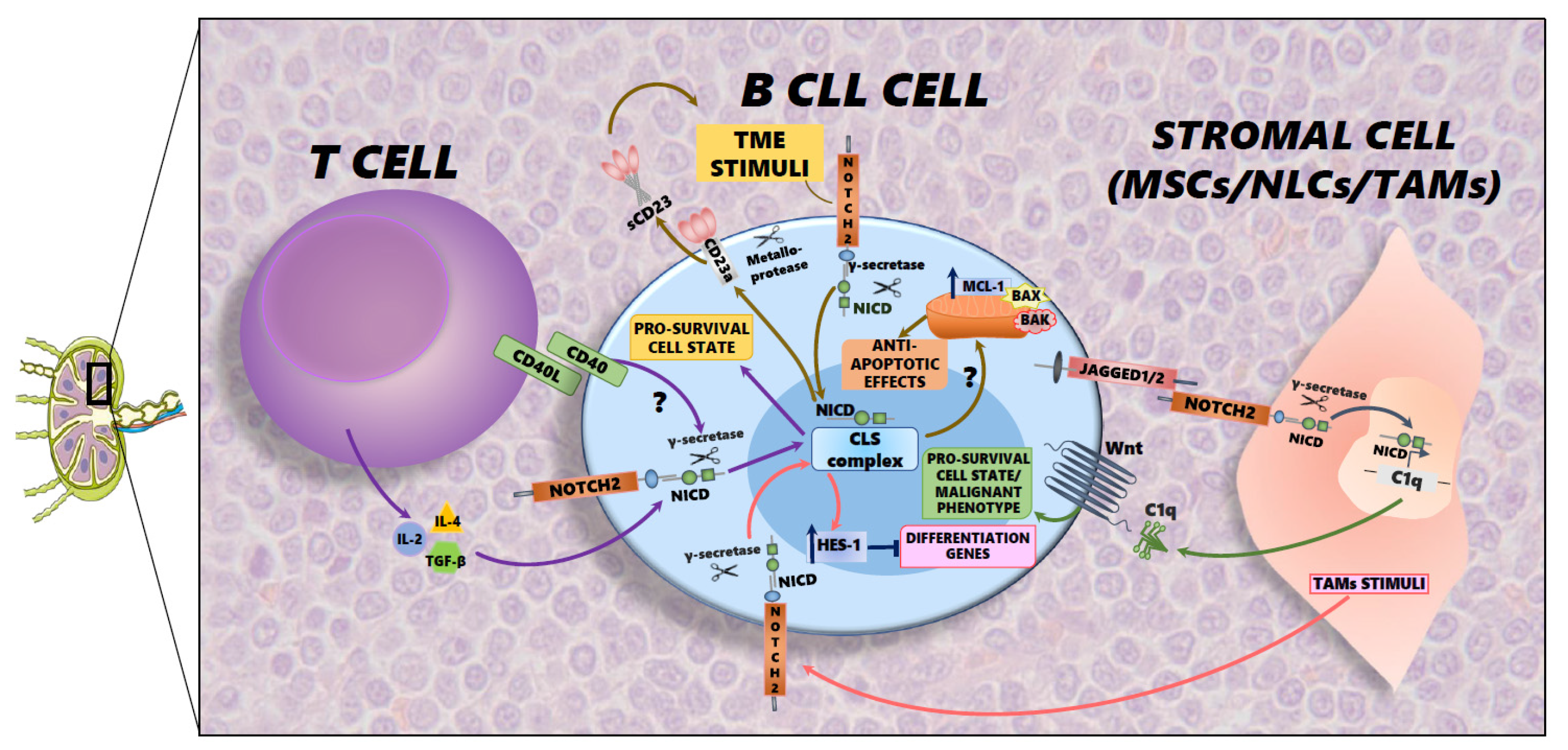
- Stromal Cells: The CLL tumor microenvironment is composed of various stromal components, including fibroblasts, endothelial cells, mesenchymal stem cells (MSCs), and nurse-like cells (NLCs). The latter two, in particular, are crucial for CLL pathogenesis, because in lymphatic tissue, they create a protective niche that nurtures leukemic B cells, providing CLL cells survival and proliferation stimuli through a variety of mechanisms [1]. Through direct contact, stromal cells provide survival stimuli to CLL cells, which thus leave the lymphatic organs and enter the bloodstream. These factors include growth factors, chemokines, and cytokines (e.g., IL-4, IL-6, TNF-a, CCL3, CCL4, CXCL12), which help to keep the leukemic clone alive in the lymph nodes and bone marrow. These factors can activate key signaling pathways like NF-kB and PI3K/AKT, which are central to cancer cell survival. In addition, stromal cells also communicate with CLL cells through extracellular vesicles that are exocytosed from the cells. These vesicles transport molecules that enter the leukemic cell and act to modify their genetic expression and behavior, activating or repressing the expression of specific genes. Conversely, CLL cells can also act by influencing the tumor microenvironment [17], producing vesicles containing proteins and microRNAs that in turn can reprogram stromal cells, turning them into cancer-associated fibroblasts (CAFs). These CAFs, in addition, secrete a variety of factors that further support leukemia clones [18]. Finally, TME also mediates the drug resistance that leukemic cells develop, partly due to contact with stromal cells. In fact, when CLL cells are in close contact with stromal cells, they tend to be less sensitive to traditional treatments, such as fludarabine, and also develop resistance to target agents, such as venetoclax, a well-known Bcl-2 inhibit. Stromal cells enable leukemic cells to resist drugs by upregulating the expression of anti-apoptotic factors such as Mcl-1 [19,20]. In summary, the TME shapes disease outcomes, and it is not merely a passive bystander but an active participant in CLL pathogenesis. Indeed, it affects cell survival, proliferation, migration, and drug resistance, making TME a crucial therapeutic target. Therefore, the general characteristics of cancer networks are also present in CLL: leukemic cells are shielded from immune destruction, growth factors are generated locally, and new vessels supply nutrients [21].
- •
- Extracellular Matrix (ECM): Inside the lymphoid tissues, the ECM supports leukemic cells by providing stimuli that induce survival and tissue infiltration. Alterations in ECM components, including fibronectin, collagen, and laminin, along with other molecules like proteoglycans, are commonly observed in CLL. These components make available adhesion sites for CLL cells and stromal cells, and this provides anti-apoptotic signals that protect cells from death and activate drug resistance mechanisms. In addition, CLL cells together with stromal cells secrete enzymes like matrix metalloproteinases (MMPs) that break down and remodel the ECM, facilitating migration and providing additional cell attachment sites to promote a protective environment within the niches of bone marrow and lymph nodes [22]. The resulting remodeling also releases growth factors that further fuel the survival and proliferation of cancer cells [23]. In particular, CLL cells bind the ECM through receptors such as Cd44, leading to the activation of pro-survival pathways such as PI3K/Akt, with consequent induction of survival proteins like Mcl-1 [24]
- •
- Immune Cells: The TME is heavily populated by immune cells that can both suppress immunovigilance mechanisms and directly affect CLL cells by activating their survival mechanisms. Under normal conditions, T cells are responsible for killing cancer cells, but in CLL, this function appears to be compromised. In CLL patients, T cells become exhausted due to chronic exposure to leukemic cells, resulting in a reduced ability to form functioning immune “synapses”. Furthermore, the Treg population is highly abundant and exerts immunosuppressive effects on T cells, thereby inhibiting their anti-tumor immune response. This creates a state of immune tolerance that effectively shields CLL clones. One of the most important axes, and among the most studied in CLL, is the CD40L/CD40 axis. This interaction is provided by CD4+ T cells, which supply CD40L to CLL cells that receive the signal via the CD40 receptor, through which important proliferation signals are mediated, protecting CLL cells from programmed death [25]. Equally important players in the immune system in CLL are macrophages and their precursors, monocytes, which participate in the TME and cooperate with leukemic cells. Specifically, CLL cells induce monocytes to differentiate into an immunosuppressive, M2-like macrophage phenotype, called nurse like cells in the context of CLL. These cells secrete factors that promote tumor growth and suppress the anti-tumor immune response and are called tumor-associated macrophages (TAMs). NLCs release chemokines such as CXCL12 and CXCL13, which are able to attract and protect CLL cells from spontaneous and drug-induced apoptosis [26,27]. Furthermore, by presenting antigens to other immune cells in an ineffective manner, macrophages may also contribute to immune evasion and weaken the overall response against leukemia. Lastly, natural killer (NK) cells are part of the innate system and are normally responsible for killing cancer cells. Despite an increase in their number, in CLL, this ability is compromised. Indeed, their ability to kill cancer cells in this context is reduced due to decreased expression of activating receptors and increased expression of inhibitory markers. Furthermore, CLL cells are able to suppress NK cells themselves through different mechanisms such as the production of immunosuppressive cytokines like TGF-beta, BAG6, and HLA-G, leading to the inhibition of NK cell activity and affecting the “killing signals” [28]. In addition, CLL cells escape from NK cells’ control by altering actin cytoskeleton remodeling, with consequent resistance to NK cell cytotoxicity [29].
4. Notch2 and Tumor Microenvironment Interaction in CLL
4.1. The Notch2/CD23 Axis in CLL Cell Survival and Homeostasis
4.2. Notch2-Driven Activation of Wnt Signaling: A Pro-Survival Pathway
4.3. Notch2-Mediated Upregulation of Mcl-1: The Anti-Apoptotic Guardian
4.4. Hes1 and Notch2: Mediating the Niche Survival Signal in CLL
5. Conclusions: The Notch2-TME Axis as the Engine of CLL Drug Resistance
Author Contributions
Funding
Data Availability Statement
Conflicts of Interest
Abbreviations
| CLL | Chronic Lymphocytic Leukemia |
| TME | Tumor Microenvironment |
| NICD | Notch Intracellular Domain |
| SMZL | Splenic Marginal Zone Lymphoma |
| MSCs | Mesenchymal Stem Cells |
| NLCs | Nurse-Like Cells |
| CAFs | Cancer-Associated Fibroblasts |
| ECM | Extracellular Matrix |
| MMPs | Matrix Metalloproteinases |
| TAMs | Tumor-Associated Macrophages |
| NK | Natural Killer |
| BCGFs | B Cell Growth Factors |
| TCF | T Cell Factor |
| LEF | Lymphoid Enhancer-binding Factor |
| Mcl-1 | Myeloid cell leukemia sequence-1 |
| Hes1 | Hairy and Enhancer of Split 1 |
| GSIs | γ-Secretase Inhibitors |
References
- Burger, J.A.; Ghia, P.; Rosenwald, A.; Caligaris-Cappio, F. The microenvironment in mature B-cell malignancies: A target for new treatment strategies. Blood 2009, 114, 3367–3375. [Google Scholar] [CrossRef]
- Del Giudice, I.; Rossi, D.; Chiaretti, S.; Marinelli, M.; Tavolaro, S.; Gabrielli, S.; Laurenti, L.; Marasca, R.; Rasi, S.; Fangazio, M.; et al. NOTCH1 mutations in +12 chronic lymphocytic leukemia (CLL) confer an unfavorable prognosis, induce a distinctive transcriptional profiling and refine the intermediate prognosis of +12 CLL. Haematologica 2012, 97, 437–441. [Google Scholar] [CrossRef] [PubMed]
- Pepe, F.; Rassenti, L.Z.; Pekarsky, Y.; Labanowska, J.; Nakamura, T.; Nigita, G.; Kipps, T.J.; Balatti, V.; Croce, C.M. A large fraction of trisomy 12, 17p−, and 11q− CLL cases carry unidentified microdeletions of miR-15a/16-1. Proc. Natl. Acad. Sci. USA 2022, 119, 1–8. [Google Scholar] [CrossRef]
- Kopan, R.; Ilagan, M.X.G. The Canonical Notch Signaling Pathway: Unfolding the Activation Mechanism. Cell 2009, 137, 216–233. [Google Scholar] [CrossRef]
- Kiel, M.J.; Velusamy, T.; Betz, B.L.; Zhao, L.; Weigelin, H.G.; Chiang, M.Y.; Huebner-Chan, D.R.; Bailey, N.G.; Yang, D.T.; Bhagat, G.; et al. Whole-genome sequencing identifies recurrent somatic NOTCH2 mutations in splenic marginal zone lymphoma. J. Exp. Med. 2012, 209, 1553–1565. [Google Scholar] [CrossRef]
- Mesini, N.; Fiorcari, S.; Atene, C.G.; Maffei, R.; Potenza, L.; Luppi, M.; Marasca, R. Role of Notch2 pathway in mature B cell malignancies. Front. Oncol. 2023, 12, 1073672. [Google Scholar] [CrossRef]
- Pozzo, F.; Bittolo, T.; Tissini, E.; Zucchetto, A.; Bomben, R.; Polcik, L.; Prosseda, S.D.; Hartmann, T.H.; Gattei, V. Multiple Mechanisms of NOTCH1 Activation in Chronic Lymphocytic Leukemia: NOTCH1 Mutations and Beyond. Cancers 2022, 14, 2997. [Google Scholar] [CrossRef]
- Rosati, E.; Baldoni, S.; De Falco, F.; Del Papa, B.; Dorillo, E.; Rompietti, C.; Albi, E.; Falzetti, F.; Di Ianni, M.; Sportoletti, P. NOTCH1 Aberrations in Chronic Lymphocytic Leukemia. Front. Oncol. 2018, 8, 229. [Google Scholar] [CrossRef]
- Guo, M.; Memis, T.; Ehrmann, A.S.; Pittrof, A.; Baumann, B.; Ferrante, F.; Tausch, E.; Fischer, K.; Döhner, H.; Borggrefe, T.; et al. A noncoding mutation in the NOTCH1 gene initiates oncogenic NOTCH signaling via wild-type NICD stabilization in CLL. Blood 2025, 146, 1936–1949. [Google Scholar] [CrossRef] [PubMed]
- Puente, X.S.; Pinyol, M.; Quesada, V.; Conde, L.; Ordoñez, G.R.; Villamor, N.; Escaramis, G.; Jars, P.; Beà, S.; González-Díaz, M.; et al. Whole-genome sequencing identifies recurrent mutations in chronic lymphocytic leukaemia. Nature 2011, 475, 101–105. [Google Scholar] [CrossRef] [PubMed]
- Fiorcari, S.; Maffei, R.; Atene, C.G.; Mesini, N.; Maccaferri, M.; Leonardi, G.; Martinelli, S.; Paolini, A.; Nasillo, V.; Debbia, G.; et al. Notch2 Increases the Resistance to Venetoclax-Induced Apoptosis in Chronic Lymphocytic Leukemia B Cells by Inducing Mcl-1. Front. Oncol. 2022, 11, 777587. [Google Scholar] [CrossRef] [PubMed]
- De Falco, F.; Sabatini, R.; Del Papa, B.; Falzetti, F.; Di Ianni, M.; Sportoletti, P.; Baldoni, S.; Screpanti, I.; Marconi, P.; Rosati, E. Notch signaling sustains the expression of Mcl-1 and the activity of eIF4E to promote cell survival in CLL. Oncotarget 2015, 6, 16559–16572. [Google Scholar] [CrossRef] [PubMed]
- Dang, C.V.; Kim, J.; Gao, P.; Yustein, J. The interplay between MYC and HIF in cancer. Nat. Rev. Cancer 2008, 8, 51–56. [Google Scholar] [CrossRef]
- Dhanasekaran, R.; Deutzmann, A.; Mahauad-Fernandez, W.D.; Hansen, A.S.; Gouw, A.M.; Felsher, D.W. The MYC oncogene—the grand orchestrator of cancer growth and immune evasion. Nat. Rev. Clin. Oncol. 2022, 19, 23–36. [Google Scholar] [CrossRef]
- Ghia, P.; Chiorazzi, N.; Stamatopoulos, K. Microenvironmental influences in chronic lymphocytic leukaemia: The role of antigen stimulation. J. Intern. Med. 2008, 264, 549–562. [Google Scholar] [CrossRef]
- Hartmann, T.N.; Grabosky, V.; Wang, W.; Desch, P.; Rubenzer, G.; Wollner, S.; Binsky, I.; Vallon-Eberhard, A.; Sapoznikov, A.; Burger, M.; et al. Circulating B-Cell Chronic Lymphocytic Leukemia Cells Display Impaired Migration to Lymph Nodes and Bone Marrow. Cancer Res. 2009, 69, 3121–3130. [Google Scholar] [CrossRef]
- Ten Hacken, E.; Burger, J.A. Microenvironment interactions and B-cell receptor signaling in Chronic Lymphocytic Leukemia: Implications for disease pathogenesis and treatment. Biochim. Biophys. Acta BBA-Mol. Cell Res. 2016, 1863, 401–413. [Google Scholar] [CrossRef]
- Paggetti, J.; Haderk, F.; Seiffert, M.; Janji, B.; Distler, U.; Ammerlaan, W.; Kim, Y.J.; Adam, J.; Lichter, P.; Solary, E.; et al. Exosomes released by chronic lymphocytic leukemia cells induce the transition of stromal cells into cancer-associated fibroblasts. Blood 2015, 126, 1106–1117. [Google Scholar] [CrossRef]
- Dubois, N.; Crompot, E.; Meuleman, N.; Bron, D.; Lagneaux, L.; Stamatopoulos, B. Importance of Crosstalk Between Chronic Lymphocytic Leukemia Cells and the Stromal Microenvironment: Direct Contact, Soluble Factors, and Extracellular Vesicles. Front. Oncol. 2020, 10, 1422. [Google Scholar] [CrossRef] [PubMed]
- Amigo-Jiménez, I.; Bailón, E.; Aguilera-Montilla, N.; Terol, M.J.; García-Marco, J.A.; García-Pardo, A. Bone marrow stroma-induced resistance of chronic lymphocytic leukemia cells to arsenic trioxide ivolves Mcl-1 upregulation and is overcome by inhibiting the PI3Kδ or PKCβ signaling pathway. Oncotarget 2015, 6, 44832–44848. [Google Scholar] [CrossRef] [PubMed]
- Caligaris-Cappio, F.; Bertilaccio, M.T.S.; Scielzo, C. How the microenvironment wires the natural history of chronic lymphocytic leukemia. Semin. Cancer Biol. 2014, 24, 43–48. [Google Scholar] [CrossRef] [PubMed]
- Redondo-Muñoz, J.; Ugarte-Berzal, E.; Terol, M.J.; Van den Steen, P.E.; Hernández del Cerro, M.; Roderfeld, M.; Roeb, E.; Opdenakker, G.; García -Marco, J.A.; García-Pardo, A. Matrix Metalloproteinase-9 Promotes Chronic Lymphocytic Leukemia B Cell Survival through Its Hemopexin Domain. Cancer Cell 2010, 17, 160–172. [Google Scholar] [CrossRef]
- Cerreto, M.; Foà, R.; Natoni, A. The Role of the Microenvironment and Cell Adhesion Molecules in Chronic Lymphocytic Leukemia. Cancers 2023, 15, 5160. [Google Scholar] [CrossRef]
- Herishanu, Y.; Gibellini, F.; Njuguna, N.; Hazan-halevy, I.; Farooqui, M.; Bern, S.; Keyvanfar, K.; Lee, E.; Wilson, W.; Wiesner, A. Activation of Cd44, a receptor for extracellular matrix components, protects chronic lymphocytic leukemia cells from spontaneous and drug induced apoptosis through MCL-1. Leuk. Lymphoma 2011, 52, 1758–1769. [Google Scholar] [CrossRef]
- Roessner, P.M.; Seiffert, M. T-cells in chronic lymphocytic leukemia: Guardians or drivers of disease? Leukemia 2020, 34, 2012–2024. [Google Scholar] [CrossRef]
- Mesaros, O.; Jimbu, L.; Neaga, A.; Popescu, C.; Berceanu, I.; Tomuleasa, C.; Fetica, B.; Zdrenghea, M. Macrophage Polarization in Chronic Lymphocytic Leukemia: Nurse-Like Cells Are the Caretakers of Leukemic Cells. Biomedicines 2020, 8, 516. [Google Scholar] [CrossRef]
- Jestrabek, H.; Kohlhas, V.; Hallek, M.; Nguyen, P.H. Impact of leukemia-associated macrophages on the progression and therapy response of chronic lymphocytic leukemia. Leuk. Res. 2024, 143, 107531. [Google Scholar] [CrossRef]
- Hofland, T.; Eldering, E.; Kater, A.P.; Tonino, S.H. Engaging cytotoxic T and NK cells for Immunotherapy in chronic lymphocytic leukemia. Int. J. Mol. Sci. 2019, 20, 4315. [Google Scholar] [CrossRef]
- Wurzer, H.; Filali, L.; Hoffmann, C.; Krecke, M.; Biolato, A.M.; Mastio, J.; De Wilde, S.; François, J.H.; Largeot, A.; Berchem, G.; et al. Intrinsinc resistance of chronic lymphocytic lekemia cells to NK cell-mediated lysis can be overcome in vitro by pharmacological inhibition of cdc42- induced actin cytokeleton remodeling. Front. Immunol. 2021, 12, 619069. [Google Scholar] [CrossRef] [PubMed]
- Meurette, O.; Mehlen, P. Notch signaling in tumor microenvironment. Cancer Cell 2018, 34, 536–548. [Google Scholar] [CrossRef] [PubMed]
- Lampert, I.A.; Wotherspoon, A.; Van Noorden, S.; Hasserjian, R.P. High expression of CD23 in the proliferation centers of chronic lymphocytic leukemia in lymph nodes and spleen. Hum. Pathol. 1999, 30, 648–654. [Google Scholar] [CrossRef] [PubMed]
- Hubmann, R.; Schwarzmeier, J.D.; Shehata, M.; Hilgarth, M.; Duechler, M.; Dettke, M.; Berger, R. Notch2 is involved in the overexpression of CD23 in B-cell chronic lymphocytic leukemia. Blood 2002, 99, 3742–3747. [Google Scholar] [CrossRef]
- Rosati, E.; Sabatini, R.; Rampino, G.; Tabilio, A.; Di Ianni, M.; Fettucciari, K.; Bartoli, A.; Coaccioli, S.; Screpanti, I.; Marconi, P. Constitutively activated Notch signaling is involved in survival and apoptosis resistance of B-CLL cells. Blood 2009, 113, 856–865. [Google Scholar] [CrossRef]
- Mangolini, M.; Götte, F.; Moore, A.; Ammon, T.; Oelsner, M.; Lutzny-Geier, G.; Klein-Hitpass, L.; Williamson, J.C.; Lehner, P.J.; Dürig, J.; et al. Notch2 controls non-autonomous Wnt-signalling in chronic lymphocytic leukaemia. Nat. Commun. 2018, 9, 3839. [Google Scholar] [CrossRef] [PubMed]
- Ruan, Y.; Kim, H.N.; Ogana, H.; Kim, Y.M. Wnt Signaling in Leukemia and Its Bone Marrow Microenvironment. Int. J. Mol. Sci. 2020, 21, 6247. [Google Scholar] [CrossRef]
- Kim, M.S.; Kang, H.; Baek, J.-H.; Cho, M.-G.; Chung, E.J.; Kim, S.-J.; Chung, J.-Y.; Chun, K.-H. Disrupting Notch signaling related HES1 in myeloid cells reinvigorates antitumor T cell responses. Exp. Hematol. Oncol. 2024, 13, 122. [Google Scholar] [CrossRef]
- Hubmann, R.; Düchler, M.; Schnabl, S.; Hilgarth, M.; Demirtas, D.; Mitteregger, D.; Hölbl, A.; Vanura, K.; Le, T.; Look, T.; et al. NOTCH2 links protein kinase C delta to the expression of CD23 in chronic lymphocytic leukaemia (CLL) cells. Br. J. Haematol. 2010, 148, 868–878. [Google Scholar] [CrossRef]
- Nusse, R.; Clevers, H. Wnt/β-Catenin Signaling, Disease, and Emerging Therapeutic Modalities. Cell 2017, 169, 985–999. [Google Scholar] [CrossRef]
- Clevers, H. Wnt/β-Catenin Signaling in Development and Disease. Cell 2006, 127, 469–480. [Google Scholar] [CrossRef]
- Youle, R.J.; Strasser, A. The BCL-2 protein family: Opposing activities that mediate cell death. Nat. Rev. Mol. Cell Biol. 2008, 9, 47–59. [Google Scholar] [CrossRef]
- Adams, J.M.; Cory, S. The BCL-2 arbiters of apoptosis and their growing role as cancer targets. Cell Death Differ. 2018, 25, 27–36. [Google Scholar] [CrossRef]
- Nakahara, F. Hes1 immortalizes committed progenitors and plays a role in blast crisis transition in chronic myelogenous leukemia. Rinsho Ketsueki 2011, 52, 329–341. [Google Scholar] [CrossRef]
- Rosati, E.; Sabatini, R.; De Falco, F.; Del Papa, B.; Falzetti, F.; Di Ianni, M.; Cavalli, L.; Fettucciari, K.; Bartoli, A.; Screpanti, I.; et al. γ-Secretase inhibitor I induces apoptosis in chronic lymphocytic leukemia cells by proteasome inhibition, endoplasmic reticulum stress increase and notch down-regulation. Int. J. Cancer 2013, 132, 1940–1953. [Google Scholar] [CrossRef]
- Böttcher, M.; Bruns, H.; Völkl, S.; Lu, J.; Chartomatsidou, E.; Papakonstantinou, N.; Mentz, K.; Büttner-Herold, M.; Zenz, T.; Herling, M.; et al. Control of PD-L1 expression in CLL-cells by stromal triggering of the Notch-c-Myc-EZH2 oncogenic signaling axis. J. Immunother. Cancer 2021, 9, e001889. [Google Scholar] [CrossRef]
- Nie, R.Z.; Wang, H.; Wang, S.S.; Chen, C.; Luo, H.M.; Zhang, H.K.; King, Z.H.; Li, P.F. The role of notch signaling pathway and non-coding RNAs in cancer and inflammation: Progress, therapeutic insights, and future directions. Front. Immunol. 2025, 16, 1567040. [Google Scholar] [CrossRef]


| Clinical Goal | Molecular Target | Mechanism of Action | Drug Type/ Approach | Strategy |
|---|---|---|---|---|
| Block Notch2 migration to the nucleus and prevent transcription of survival genes (Mcl-1, Wnt). | Notch2, Mcl-1, Wnt | Acts directly on the cleavage of the intracellular portion of Notch2. | γ-secretase inhibitors (GSIs) |
|
| Disable TME support and eliminate apoptosis-resistant CLL cells. | Notch2, Bcl-2, BCR | Simultaneous blockade of Bcl-2/BCR pathways and tumor microenvironment signals. | GSIs + existing target agents (e.g., Venetoclax or BCR inhibitors) |
|
| Enhance immune efficacy by modulating immunosuppressive signals regulated by Notch2. | Notch2, PD1, PD-L1 | Synergistic action to reverse immune evasion mediated by the microenvironment. | Anti-Notch2+ checkpoint inhibitors (e.g., PD1/PD-L1 inhibitors) |
|
Disclaimer/Publisher’s Note: The statements, opinions and data contained in all publications are solely those of the individual author(s) and contributor(s) and not of MDPI and/or the editor(s). MDPI and/or the editor(s) disclaim responsibility for any injury to people or property resulting from any ideas, methods, instructions or products referred to in the content. |
© 2026 by the authors. Licensee MDPI, Basel, Switzerland. This article is an open access article distributed under the terms and conditions of the Creative Commons Attribution (CC BY) license.
Share and Cite
Miserendino, R.; Atene, C.G.; Luppi, M.; Marasca, R.; Fiorcari, S. Notch2, a Key Player in Chronic Lymphocytic Leukemia: Mechanism, Microenvironment Interactions, and Therapeutic Implications. Cancers 2026, 18, 518. https://doi.org/10.3390/cancers18030518
Miserendino R, Atene CG, Luppi M, Marasca R, Fiorcari S. Notch2, a Key Player in Chronic Lymphocytic Leukemia: Mechanism, Microenvironment Interactions, and Therapeutic Implications. Cancers. 2026; 18(3):518. https://doi.org/10.3390/cancers18030518
Chicago/Turabian StyleMiserendino, Ramona, Claudio Giacinto Atene, Mario Luppi, Roberto Marasca, and Stefania Fiorcari. 2026. "Notch2, a Key Player in Chronic Lymphocytic Leukemia: Mechanism, Microenvironment Interactions, and Therapeutic Implications" Cancers 18, no. 3: 518. https://doi.org/10.3390/cancers18030518
APA StyleMiserendino, R., Atene, C. G., Luppi, M., Marasca, R., & Fiorcari, S. (2026). Notch2, a Key Player in Chronic Lymphocytic Leukemia: Mechanism, Microenvironment Interactions, and Therapeutic Implications. Cancers, 18(3), 518. https://doi.org/10.3390/cancers18030518