Lynch Syndrome as a Spectrum of Four Distinct Genetic Disorders: Toward Genotype-Guided Precision Management in the NGS Era

Simple Summary
Abstract
1. Introduction
2. Diagnostic Innovations and Challenges in the NGS Era
2.1. Historical Enhancement of Diagnostic Capability
2.2. Precision Subtyping of LLS
2.3. Reclassification Strategies for VUSs
2.4. Standardization and Integration of Testing Methods
2.5. Dissemination and Accessibility of Screening
3. Molecular Heterogeneity of the Four MMR Genes: The Biological Basis of Precision Management
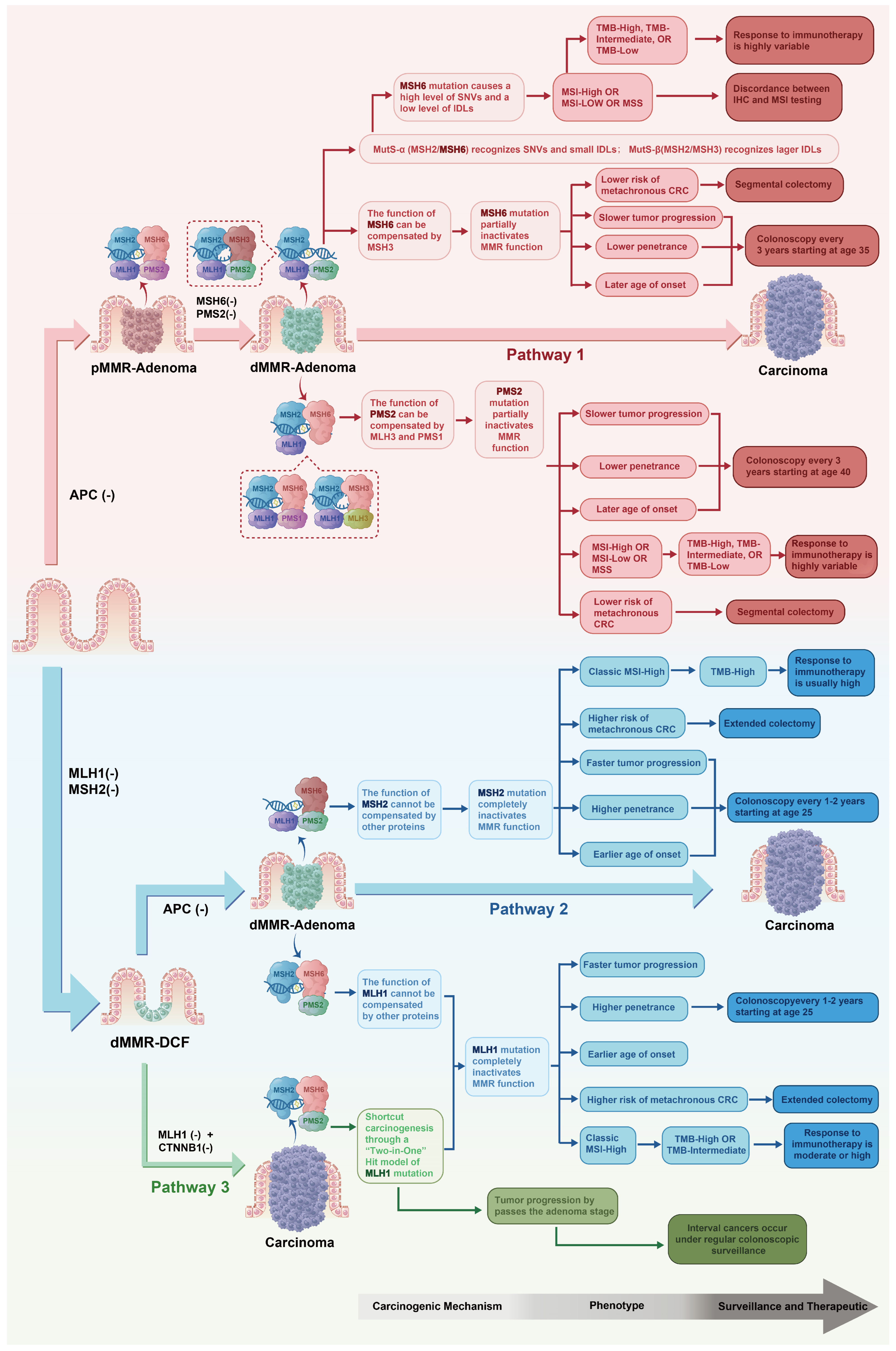
3.1. Diversified Carcinogenic Pathways in LS-Associated CRC
3.2. MLH1 Deficiency: A Rapid Carcinogenesis Model via a ”Two-in-One Hit” Mechanism
- (1)
- (2)
- Low APC mutation frequency (11%), contrasting with MSH2 [46];
- (3)
3.3. MSH2 Deficiency: The Molecular Basis of a Broad-Spectrum High-Risk Profile
3.4. MSH6 Deficiency: A Distinct Low-Instability Phenotype
- (1)
- (2)
- IHC recommended as first-line screening;
- (3)
- CTNNB1 alterations significantly less prevalent than in MLH1 (8% vs. 47%) [42], potentially underlying slower progression and lower interval cancer incidence;
- (4)
- Lower MSI levels and weaker frameshift mutation loads imply fewer frameshift-derived neopeptides, with potential implications for immune checkpoint inhibitors (ICI) responsiveness and vaccine development.
3.5. PMS2 Deficiency: The Molecular Basis of Attenuated Risk
- (1)
- Tends to follow conventional adenoma–carcinoma sequence;
- (2)
- PMS2 loss is often a late event rather than an initiating driver;
- (3)
- Low frequency of somatic KRAS hotspot mutations supports slow progression [52].
3.6. Genotypic–Molecular Feature Summary
4. Genotype-Guided Precision Clinical Management
4.1. Risk Stratification: From Population to Individual
4.1.1. Gene-Specific Cancer Risk
4.1.2. Multifactorial Risk Models
4.2. Surveillance Strategy Individualization
4.2.1. Genotype-Stratified Colonoscopy Surveillance
4.2.2. Emerging Surveillance Technologies (Investigational)
4.2.3. Surveillance of Extracolonic Cancers
4.3. Precision in Surgical Decision Making
4.4. Immunotherapy Application and Optimization
4.4.1. Efficacy of ICIs in LS-Associated Tumors
4.4.2. Genotype-Specific ICI Considerations (Hypothesis Generating)
4.4.3. ICIs in LS-Associated Rare Cancers (Limited Evidence)
4.5. Prevention Strategies
4.5.1. Chemoprevention
4.5.2. Immunoprevention (Investigational)
4.5.3. Genotype-Specific Prevention Strategies (Hypothesis Generating)
5. Current Challenges and Future Directions
5.1. Key Knowledge Gaps
5.2. Priority Research Directions
5.3. Clinical Translation Pathways
6. Conclusions
Author Contributions
Funding
Data Availability Statement
Conflicts of Interest
Abbreviations
| ACMG/AMP | American College of Medical Genetics and Genomics/Association for Molecular Pathology |
| C-index | Concordance index |
| CNS | Central nervous system |
| CNV | Copy number variation |
| CRC | Colorectal cancer |
| c-miRs | Circulating microRNAs |
| cn-LOH | Copy number neutral loss of heterozygosity |
| dMMR | Defective MMR |
| EC | Endometrial cancer |
| EHR | Electronic health record |
| EHTG/ESCP | European Hereditary Tumour Group/European Society of Coloproctology |
| ESMO | European Society for Medical Oncology |
| FSDNs | Frameshift-derived neopeptides |
| GBM | Glioblastoma |
| HLA | Integrate human leukocyte antigen |
| ICI | Immune checkpoint inhibitors |
| Indel | Insertion/deletion |
| InSiGHT | International Society for Gastrointestinal Hereditary Tumours |
| IHC | Immunohistochemistry |
| LS | Lynch syndrome |
| LLS | “Lynch-like” syndrome |
| MAIT | Mucosal-associated invariant T |
| MDT | Multidisciplinary team |
| MLPA | Multiplex ligation-dependent probe amplification |
| MMR | Mismatch repair |
| mOS | Median overall survival |
| MSI | Microsatellite instability |
| MSS | Microsatellite stable |
| Mut/Mb | Mutations per megabase |
| NAL | Neoantigen load |
| NCCN | National Comprehensive Cancer Network |
| NMD | Nonsense-mediated decay |
| NGS | Next-generation sequencing |
| NR | Not reported |
| NPV | Negative predictive value |
| ORR | Objective response rate |
| OS | Overall survival |
| PD-L1 | Programmed death-ligand 1 |
| PFS | Progression-free survival |
| PLSD | Prospective Lynch Syndrome Database |
| pCR | Pathological complete response |
| PGS | Polygenic risk scores |
| pMMR | Proficient MMR |
| SIR | Standardized incidence ratio |
| SNV | Single-nucleotide variants |
| SSLs | Sessile serrated lesions |
| TMB | Tumor mutation burden |
| TIL | Tumor-infiltrating lymphocyte |
| TME | Tumor microenvironment |
| UC | Urothelial carcinoma |
| UPS | Undifferentiated pleomorphic sarcoma |
| UTUC | Upper tract urothelial carcinoma |
| VUSs | Variants of uncertain significance |
| VOCs | Volatile organic compounds |
| WES | Whole-exome sequencing |
References
- Vasen, H.F.A.; Mecklin, J.-P.; Meera Khan, P.; Lynch, H.T. The International Collaborative Group on Hereditary Non-Polyposis Colorectal Cancer (ICG-HNPCC). Dis. Colon Rectum 1991, 34, 424–425. [Google Scholar] [CrossRef]
- Syngal, S.; Brand, R.E.; Church, J.M.; Giardiello, F.M.; Hampel, H.L.; Burt, R.W. ACG Clinical Guideline: Genetic Testing and Management of Hereditary Gastrointestinal Cancer Syndromes. Am. J. Gastroenterol. 2015, 110, 223–262. [Google Scholar] [CrossRef]
- Sobocińska, J.; Kolenda, T.; Teresiak, A.; Badziąg-Leśniak, N.; Kopczyńska, M.; Guglas, K.; Przybyła, A.; Filas, V.; Bogajewska-Ryłko, E.; Lamperska, K.; et al. Diagnostics of Mutations in MMR/EPCAM Genes and Their Role in the Treatment and Care of Patients with Lynch Syndrome. Diagnostics 2020, 10, 786. [Google Scholar] [CrossRef]
- Dominguez-Valentin, M.; Sampson, J.R.; Seppälä, T.T.; Ten Broeke, S.W.; Plazzer, J.-P.; Nakken, S.; Engel, C.; Aretz, S.; Jenkins, M.A.; Sunde, L.; et al. Cancer Risks by Gene, Age, and Gender in 6350 Carriers of Pathogenic Mismatch Repair Variants: Findings from the Prospective Lynch Syndrome Database. Genet. Med. 2020, 22, 15–25. [Google Scholar] [CrossRef]
- Møller, P.; Seppälä, T.T.; Bernstein, I.; Holinski-Feder, E.; Sala, P.; Gareth Evans, D.; Lindblom, A.; Macrae, F.; Blanco, I.; Sijmons, R.H.; et al. Cancer Risk and Survival in path_MMR Carriers by Gene and Gender up to 75 Years of Age: A Report from the Prospective Lynch Syndrome Database. Gut 2018, 67, 1306–1316. [Google Scholar] [CrossRef] [PubMed]
- Park, J.; Karnati, H.; Rustgi, S.D.; Hur, C.; Kong, X.-F.; Kastrinos, F. Impact of Population Screening for Lynch Syndrome Insights from the All of Us Data. Nat. Commun. 2025, 16, 523. [Google Scholar] [CrossRef] [PubMed]
- Fasano, C.; Lepore Signorile, M.; De Marco, K.; Forte, G.; Disciglio, V.; Sanese, P.; Grossi, V.; Simone, C. In Silico Deciphering of the Potential Impact of Variants of Uncertain Significance in Hereditary Colorectal Cancer Syndromes. Cells 2024, 13, 1314. [Google Scholar] [CrossRef] [PubMed]
- Walker, R.; Mahmood, K.; Joo, J.E.; Clendenning, M.; Georgeson, P.; Como, J.; Joseland, S.; Preston, S.G.; Antill, Y.; Austin, R.; et al. A Tumor Focused Approach to Resolving the Etiology of DNA Mismatch Repair Deficient Tumors Classified as Suspected Lynch Syndrome. J. Transl. Med. 2023, 21, 282. [Google Scholar] [CrossRef]
- Te Paske, I.B.A.W.; Mensenkamp, A.R.; Neveling, K.; Hoogerbrugge, N.; Ligtenberg, M.J.L.; De Voer, R.M.; Baert-Desurmont, S.; Claes, K.B.M.; De Leeneer, K.; Elze, L.; et al. Noncoding Aberrations in Mismatch Repair Genes Underlie a Substantial Part of the Missing Heritability in Lynch Syndrome. Gastroenterology 2022, 163, 1691–1694.e7. [Google Scholar] [CrossRef]
- Schamschula, E.; Kinzel, M.; Wernstedt, A.; Oberhuber, K.; Gottschling, H.; Schnaiter, S.; Friedrichs, N.; Merkelbach-Bruse, S.; Zschocke, J.; Gallon, R.; et al. Teenage-Onset Colorectal Cancers in a Digenic Cancer Predisposition Syndrome Provide Clues for the Interaction between Mismatch Repair and Polymerase δ Proofreading Deficiency in Tumorigenesis. Biomolecules 2022, 12, 1350. [Google Scholar] [CrossRef]
- Valle, L. Lynch Syndrome: A Single Hereditary Cancer Syndrome or Multiple Syndromes Defined by Different Mismatch Repair Genes? Gastroenterology 2023, 165, 20–23. [Google Scholar] [CrossRef]
- Eroglu, S.; Birsenogul, I.; Bowen, A.P.; Doyle, J.F.; Pupkin, S.E.; Villar, J.; Tarney, C.M.; Gandia, E.; Pastor, D.M.; Estrada-Veras, J.I. Lynch Syndrome in Focus: A Multidisciplinary Review of Cancer Risk, Clinical Management, and Special Populations. Cancers 2025, 17, 3981. [Google Scholar] [CrossRef] [PubMed]
- Boland, P.M.; Yurgelun, M.B.; Boland, C.R. Recent Progress in Lynch Syndrome and Other Familial Colorectal Cancer Syndromes. CA Cancer J. Clin. 2018, 68, 217–231. [Google Scholar] [CrossRef]
- Hodan, R.; Gupta, S.; Weiss, J.M.; Axell, L.; Burke, C.A.; Chen, L.-M.; Chung, D.C.; Clayback, K.M.; Felder, S.; Foda, Z.; et al. Genetic/Familial High-Risk Assessment: Colorectal, Endometrial, and Gastric, Version 3.2024, NCCN Clinical Practice Guidelines In Oncology. J. Natl. Compr. Cancer Netw. 2024, 22, 695–711. [Google Scholar] [CrossRef]
- Rustgi, S.D.; Kastrinos, F. Screening for Lynch Syndrome: Optimal Strategies and Performance Remain a Moving Target. Am. J. Gastroenterol. 2023, 118, 259–260. [Google Scholar] [CrossRef]
- Eikenboom, E.L.; Van Der Werf–‘t Lam, A.-S.; Rodríguez-Girondo, M.; Van Asperen, C.J.; Dinjens, W.N.M.; Hofstra, R.M.W.; Van Leerdam, M.E.; Morreau, H.; Spaander, M.C.W.; Wagner, A.; et al. Universal Immunohistochemistry for Lynch Syndrome: A Systematic Review and Meta-Analysis of 58,580 Colorectal Carcinomas. Clin. Gastroenterol. Hepatol. 2022, 20, e496–e507. [Google Scholar] [CrossRef]
- Carethers, J.M.; Stoffel, E.M. Lynch Syndrome and Lynch Syndrome Mimics: The Growing Complex Landscape of Hereditary Colon Cancer. World J. Gastroenterol. 2015, 21, 9253–9261. [Google Scholar] [CrossRef]
- Golubicki, M.; Díaz-Gay, M.; Bonjoch, L.; Franch-Expósito, S.; Muñoz, J.; Cuatrecasas, M.; Ocaña, T.; Iseas, S.; Mendez, G.; Carballido, M.; et al. Comprehensive Genomic Characterization of Fifteen Early-Onset Lynch-Like Syndrome Colorectal Cancers. Cancers 2021, 13, 1259. [Google Scholar] [CrossRef] [PubMed]
- Shen, W.; Erickson, L.A.; Gupta, S. Rare Causes of Lynch Syndrome: EPCAM Deletion and MSH2 Inversion. Mayo Clin. Proc. 2025, 100, 1450–1452. [Google Scholar] [CrossRef] [PubMed]
- Sjursen, W.; Svaasand, E.K.; Gilde, B.; Ravi, A.; Korseth, K.M.; Singh, A.K.; Johansen, J.; Rødningen, O.K.; Sevatdal, S.G.; Hegre, S.A.; et al. Lynch Syndrome Caused by SINE-VNTR-Alu-F Retrotransposon Insert in MSH6 Confirmed after 20 Years of Testing: A Case Report and Literature Review. Hered. Cancer Clin. Pract. 2025, 23, 22. [Google Scholar] [CrossRef]
- Hitchins, M.P.; Dámaso, E.; Alvarez, R.; Zhou, L.; Hu, Y.; Diniz, M.A.; Pineda, M.; Capella, G.; Pearlman, R.; Hampel, H. Constitutional MLH1 Methylation Is a Major Contributor to Mismatch Repair–Deficient, MLH1-Methylated Colorectal Cancer in Patients Aged 55 Years and Younger. J. Natl. Compr. Cancer Netw. 2023, 21, 743–752.e11. [Google Scholar] [CrossRef]
- Richards, S.; Aziz, N.; Bale, S.; Bick, D.; Das, S.; Gastier-Foster, J.; Grody, W.W.; Hegde, M.; Lyon, E.; Spector, E.; et al. Standards and Guidelines for the Interpretation of Sequence Variants: A Joint Consensus Recommendation of the American College of Medical Genetics and Genomics and the Association for Molecular Pathology. Genet. Med. 2015, 17, 405–424. [Google Scholar] [CrossRef] [PubMed]
- Spier, I.; Yin, X.; Richardson, M.; Pineda, M.; Laner, A.; Ritter, D.; Boyle, J.; Mur, P.; Hansen, T.V.O.; Shi, X.; et al. Gene-Specific ACMG/AMP Classification Criteria for Germline APC Variants: Recommendations from the ClinGen InSiGHT Hereditary Colorectal Cancer/Polyposis Variant Curation Expert Panel. Genet. Med. 2024, 26, 100992. [Google Scholar] [CrossRef]
- Drost, M.; Tiersma, Y.; Glubb, D.; Kathe, S.; Van Hees, S.; Calléja, F.; Zonneveld, J.B.M.; Boucher, K.M.; Ramlal, R.P.E.; Thompson, B.A.; et al. Two Integrated and Highly Predictive Functional Analysis-Based Procedures for the Classification of MSH6 Variants in Lynch Syndrome. Genet. Med. 2020, 22, 847–856. [Google Scholar] [CrossRef] [PubMed]
- Szabo, E.; Blackburn, E.; Amodeo, O.N.; Nadeau, S.; Radecki, A.A.; Grady, J.P.; Rath, A.; Heinen, C.D. A Cell-Based Functional Assay Calibrated for Analysis of MSH6 and MSH2 Mismatch Repair Gene Variants. Hum. Mutat. 2025, 2025, 3923193. [Google Scholar] [CrossRef]
- Scott, A.; Hernandez, F.; Chamberlin, A.; Smith, C.; Karam, R.; Kitzman, J.O. Saturation-Scale Functional Evidence Supports Clinical Variant Interpretation in Lynch Syndrome. Genome Biol. 2022, 23, 266. [Google Scholar] [CrossRef]
- Van Der Werf’t Lam, A.-S.; Helderman, N.C.; Boot, A.; Terlouw, D.; Morreau, H.; Mei, H.; Esveldt-van Lange, R.E.E.; Lakeman, I.M.M.; Van Asperen, C.J.; Aten, E.; et al. Assessing Pathogenicity of Mismatch Repair Variants of Uncertain Significance by Molecular Tumor Analysis. Exp. Mol. Pathol. 2024, 140, 104940. [Google Scholar] [CrossRef] [PubMed]
- Tricarico, R.; Kasela, M.; Mareni, C.; Thompson, B.A.; Drouet, A.; Staderini, L.; Gorelli, G.; Crucianelli, F.; Ingrosso, V.; Kantelinen, J.; et al. Assessment of the InSiGHT Interpretation Criteria for the Clinical Classification of 24 MLH1 and MSH2 Gene Variants. Hum. Mutat. 2017, 38, 64–77. [Google Scholar] [CrossRef]
- Yin, X.; Richardson, M.; Laner, A.; Shi, X.; Ognedal, E.; Vasta, V.; Hansen, T.v.O.; Pineda, M.; Ritter, D.; Den Dunnen, J.T.; et al. Large-Scale Application of ClinGen-InSiGHT APC-Specific ACMG/AMP Variant Classification Criteria Leads to Substantial Reduction in VUS. Am. J. Hum. Genet. 2024, 111, 2427–2443. [Google Scholar] [CrossRef]
- Lin, X.; Bian, C.; Liang, D.; Li, L.; Tang, Q.; Li, Q. An In-Frame Deletion Mutation in MLH1 Drives Lynch Syndrome-Associated Colorectal Cancer. BMC Cancer 2025, 25, 1165. [Google Scholar] [CrossRef]
- Nádorvári, M.L.; Kenessey, I.; Kiss, A.; Barbai, T.; Kulka, J.; Rásó, E.; Tímár, J. Comparison of Standard Mismatch Repair Deficiency and Microsatellite Instability Tests in a Large Cancer Series. J. Transl. Med. 2024, 22, 150. [Google Scholar] [CrossRef] [PubMed]
- Helderman, N.C.; Strobel, F.; Bohaumilitzky, L.; Terlouw, D.; van der Werf, A.S.; Van Wezel, T.; Morreau, H.; Von Knebel Doeberitz, M.; Nielsen, M.; Kloor, M.; et al. Lower Degree of Microsatellite Instability in Colorectal Carcinomas From MSH6-Associated Lynch Syndrome Patients. Mod. Pathol. 2025, 38, 100757. [Google Scholar] [CrossRef]
- Riedinger, C.J.; Esnakula, A.; Haight, P.J.; Suarez, A.A.; Chen, W.; Gillespie, J.; Villacres, A.; Chassen, A.; Cohn, D.E.; Goodfellow, P.J.; et al. Characterization of Mismatch-repair/Microsatellite Instability-discordant Endometrial Cancers. Cancer 2024, 130, 385–399. [Google Scholar] [CrossRef]
- Škerl, P.; Vogrič, V.; Stegel, V.; Šetrajčič Dragoš, V.; Blatnik, O.; Klančar, G.; Novaković, S. Real-World Evaluation of Microsatellite Instability Detection via Targeted NGS Panels in Routine Molecular Diagnostics. Int. J. Mol. Sci. 2025, 26, 7138. [Google Scholar] [CrossRef]
- Rako, I.; Vinceljak, E.; Popovic, M.; Zigman, T. The Application of the NGS and MLPA Methods in the Molecular Diagnostics of Lynch Syndrome. Diagnostics 2025, 15, 2950. [Google Scholar] [CrossRef] [PubMed]
- Feng, X.; Yin, W.; Ye, Q.; Chi, Y.; Wen, H.; Sun, Y.; Zheng, J.; Wang, Q.; Wang, Q.; Zhao, M.; et al. Deepath-MSI: A Clinic-Ready Deep Learning Model for Microsatellite Instability Detection in Colorectal Cancer Using Whole-Slide Imaging. npj Precis. Onc. 2025, 9, 302. [Google Scholar] [CrossRef] [PubMed]
- Alouani, E.; Taieb, J.; Tougeron, D.; Roces, G.; Hollebecque, A.; Parent, P.; Pernot, S.; Sinicrope, F.A.; Hautefeuille, V.; Ben-Abdelghani, M.; et al. Efficacy of Immunotherapy in Gastrointestinal (GI) Tumors with Mismatch Repair Deficient (MMRd) Unusual Phenotype: An AGEO Real-World Study. J. Immunother. Cancer 2025, 13, e011436. [Google Scholar] [CrossRef]
- Balmaña, J.; Balaguer, F.; Cervantes, A.; Arnold, D. Familial Risk-Colorectal Cancer: ESMO Clinical Practice Guidelines. Ann. Oncol. 2013, 24, vi73–vi80. [Google Scholar] [CrossRef]
- Seppälä, T.T.; Latchford, A.; Negoi, I.; Sampaio Soares, A.; Jimenez-Rodriguez, R.; Sánchez-Guillén, L.; Evans, D.G.; Ryan, N.; Crosbie, E.J.; Dominguez-Valentin, M.; et al. European Guidelines from the EHTG and ESCP for Lynch Syndrome: An Updated Third Edition of the Mallorca Guidelines Based on Gene and Gender. Br. J. Surg. 2021, 108, 484–498. [Google Scholar] [CrossRef]
- Jiang, S.; Guzauskas, G.F.; Garbett, S.; Graves, J.A.; Williams, M.S.; Hao, J.; Zhu, J.; Jarvik, G.P.; Carlson, J.J.; Peterson, J.F.; et al. Cost-Effectiveness of Population-Wide Genomic Screening for Lynch Syndrome and Polygenic Risk Scores to Inform Colorectal Cancer Screening. Genet. Med. 2025, 27, 101285. [Google Scholar] [CrossRef]
- Peltomäki, P.; Nyström, M.; Mecklin, J.-P.; Seppälä, T.T. Lynch Syndrome Genetics and Clinical Implications. Gastroenterology 2023, 164, 783–799. [Google Scholar] [CrossRef]
- Helderman, N.C.; Van Der Werf-’T Lam, A.-S.; Morreau, H.; Boot, A.; Van Wezel, T.; Nielsen, M.; Terlouw, D.; Bajwa-ten Broeke, S.W.; Rodríguez-Girondo, M.; Van Egmond, D.; et al. Molecular Profile of MSH6-Associated Colorectal Carcinomas Shows Distinct Features From Other Lynch Syndrome–Associated Colorectal Carcinomas. Gastroenterology 2023, 165, 271–274.e2. [Google Scholar] [CrossRef]
- Ahadova, A.; Stenzinger, A.; Seppälä, T.; Hüneburg, R.; Kloor, M.; Bläker, H.; Wittemann, J.-N.; Endris, V.; Gerling, L.; Bertram, V.; et al. A “Two-in-One Hit” Model of Shortcut Carcinogenesis in MLH1 Lynch Syndrome Carriers. Gastroenterology 2023, 165, 267–270.e4. [Google Scholar] [CrossRef]
- Martin, S.; Katainen, R.; Taira, A.; Välimäki, N.; Ristimäki, A.; Seppälä, T.; Renkonen-Sinisalo, L.; Lepistö, A.; Tahkola, K.; Mattila, A.; et al. Lynch Syndrome-Associated and Sporadic Microsatellite Unstable Colorectal Cancers: Different Patterns of Clonal Evolution Yield Highly Similar Tumours. Hum. Mol. Genet. 2024, 33, 1858–1872. [Google Scholar] [CrossRef] [PubMed]
- Mäki-Nevala, S.; Kauppinen, A.; Olkinuora, A.; Laiho, A.; Törönen, P.; Renkonen-Sinisalo, L.; Lepistö, A.; Seppälä, T.T.; Mecklin, J.-P.; Peltomäki, P. Genome-Wide DNA Methylation Profiles of Colorectal Tumors in Lynch Syndrome and Familial Adenomatous Polyposis. Clin. Epigenet. 2025, 17, 137. [Google Scholar] [CrossRef]
- Engel, C.; Ahadova, A.; Seppälä, T.T.; Aretz, S.; Bigirwamungu-Bargeman, M.; Bläker, H.; Bucksch, K.; Büttner, R.; De Vos Tot Nederveen Cappel, W.T.; Endris, V.; et al. Associations of Pathogenic Variants in MLH1, MSH2, and MSH6 With Risk of Colorectal Adenomas and Tumors and With Somatic Mutations in Patients With Lynch Syndrome. Gastroenterology 2020, 158, 1326–1333. [Google Scholar] [CrossRef] [PubMed]
- Giner-Calabuig, M.; De Leon, S.; Wang, J.; Fehlmann, T.D.; Ukaegbu, C.; Gibson, J.; Alustiza-Fernandez, M.; Pico, M.-D.; Alenda, C.; Herraiz, M.; et al. Mutational Signature Profiling Classifies Subtypes of Clinically Different Mismatch-Repair-Deficient Tumours with a Differential Immunogenic Response Potential. Br. J. Cancer 2022, 126, 1595–1603. [Google Scholar] [CrossRef]
- Khushman, M.M.; Toboni, M.D.; Xiu, J.; Manne, U.; Farrell, A.; Lou, E.; Shields, A.F.; Philip, P.A.; Salem, M.E.; Abraham, J.; et al. Differential Responses to Immune Checkpoint Inhibitors Are Governed by Diverse Mismatch Repair Gene Alterations. Clin. Cancer Res. 2024, 30, 1906–1915. [Google Scholar] [CrossRef]
- Salem, M.E.; Bodor, J.N.; Puccini, A.; Xiu, J.; Goldberg, R.M.; Grothey, A.; Korn, W.M.; Shields, A.F.; Worrilow, W.M.; Kim, E.S.; et al. Relationship between MLH1, PMS2, MSH2 and MSH6 Gene-specific Alterations and Tumor Mutational Burden in 1057 Microsatellite Instability-high Solid Tumors. Int. J. Cancer 2020, 147, 2948–2956. [Google Scholar] [CrossRef] [PubMed]
- Nikkola, J.; Ryyppö, L.; Vuorinen, J.; Moilanen, L.; Ahtiainen, M.; Pylvänäinen, K.; Selin, H.; Virtanen, T.; Nykter, M.; Veitonmäki, T.; et al. Constrained Hypermutation and Absence of TERT Promoter Mutations in Lynch Syndrome-Associated Urothelial Cancer. Cell Rep. 2025, 44, 116388. [Google Scholar] [CrossRef]
- Helderman, N.C.; Van Leerdam, M.E.; Kloor, M.; Ahadova, A.; Nielsen, M. Emerge of Colorectal Cancer in Lynch Syndrome despite Colonoscopy Surveillance: A Challenge of Hide and Seek. Crit. Rev. Oncol./Hematol. 2024, 197, 104331. [Google Scholar] [CrossRef]
- Andini, K.D.; Nielsen, M.; Suerink, M.; Helderman, N.C.; Koornstra, J.J.; Ahadova, A.; Kloor, M.; Mourits, M.J.E.; Kok, K.; Sijmons, R.H.; et al. PMS2-Associated Lynch Syndrome: Past, Present and Future. Front. Oncol. 2023, 13, 1127329. [Google Scholar] [CrossRef]
- Møller, P.; Seppälä, T.; Dowty, J.G.; Haupt, S.; Dominguez-Valentin, M.; Sunde, L.; Bernstein, I.; Engel, C.; Aretz, S.; Nielsen, M.; et al. Colorectal Cancer Incidences in Lynch Syndrome: A Comparison of Results from the Prospective Lynch Syndrome Database and the International Mismatch Repair Consortium. Hered. Cancer Clin. Pract. 2022, 20, 36. [Google Scholar] [CrossRef]
- Ten Broeke, S.W.; Van Der Klift, H.M.; Tops, C.M.J.; Aretz, S.; Bernstein, I.; Buchanan, D.D.; De La Chapelle, A.; Capella, G.; Clendenning, M.; Engel, C.; et al. Cancer Risks for PMS2 -Associated Lynch Syndrome. J. Clin. Oncol. 2018, 36, 2961–2968. [Google Scholar] [CrossRef] [PubMed]
- Dominguez-Valentin, M.; Haupt, S.; Seppälä, T.T.; Sampson, J.R.; Sunde, L.; Bernstein, I.; Jenkins, M.A.; Engel, C.; Aretz, S.; Nielsen, M.; et al. Mortality by Age, Gene and Gender in Carriers of Pathogenic Mismatch Repair Gene Variants Receiving Surveillance for Early Cancer Diagnosis and Treatment: A Report from the Prospective Lynch Syndrome Database. eClinicalMedicine 2023, 58, 101909. [Google Scholar] [CrossRef]
- Bujanda, L.; Sánchez, A.; Moreira, L.; Prat, R.; Hernández-Mesa, G.; Rodríguez-Alcalde, D.; Barreiro-Alonso, E.; Herráiz, M.; Cubiella, J.; Izquierdo, L.; et al. Pancreatic Cancer and Biliary Tract Tumors in Individuals with Lynch Syndrome. Dig. Liver Dis. 2025, 57, 2464–2469. [Google Scholar] [CrossRef] [PubMed]
- van der Werf, A.S.; Dowty, J.G.; Italia, M.; Bakker, A.C.; Koops, F.; Bleeker, F.; Gomez-Garcia, E.; van Hest, L.P.; Gille, H.J.P.; Cornips, C.C.; et al. Cancer Risks for MSH6 Pathogenic Variant Carriers. Eur. J. Cancer 2025, 231, 116098. [Google Scholar] [CrossRef] [PubMed]
- Kastrinos, F.; Ingram, M.A.; Silver, E.R.; Oh, A.; Laszkowska, M.; Rustgi, A.K.; Hur, C. Gene-Specific Variation in Colorectal Cancer Surveillance Strategies for Lynch Syndrome. Gastroenterology 2021, 161, 453–462.e15. [Google Scholar] [CrossRef]
- Prospective Lynch Syndrome Database. Metachronous Colorectal Cancer Risks after Extended or Segmental Resection in MLH1, MSH2, and MSH6 Lynch Syndrome: Multicentre Study from the Prospective Lynch Syndrome Database. Br. J. Surg. 2025, 112, znaf061. [Google Scholar] [CrossRef]
- Andresdottir, A.K.; Einarsson, H.; Jonsdottir, H.; Jonasson, J.G.; Bjornsson, E.S.; Haraldsdottir, S. Metachronous Colorectal Cancer in Icelandic MSH6 and PMS2 Lynch Syndrome Carriers in 1955–2017: A Population-Based Study. Gastroenterology 2023, 164, 1314–1316.e1. [Google Scholar] [CrossRef]
- Seppälä, T.T.; Ahadova, A.; Dominguez-Valentin, M.; Macrae, F.; Evans, D.G.; Therkildsen, C.; Sampson, J.; Scott, R.; Burn, J.; Möslein, G.; et al. Lack of Association between Screening Interval and Cancer Stage in Lynch Syndrome May Be Accounted for by Over-Diagnosis; a Prospective Lynch Syndrome Database Report. Hered. Cancer Clin. Pract. 2019, 17, 8. [Google Scholar] [CrossRef]
- Campoy, S.; Drouet, Y.; Rochefort, P.; Bonadona, V.; Lasset, C. Cancer Risks in Lynch Syndrome Carriers: A Systematic Review and Meta-Analysis. J. Natl. Cancer Inst. 2025, djaf349. [Google Scholar] [CrossRef] [PubMed]
- Mizukami, K.; Usui, Y.; Iwasaki, Y.; Shiraishi, K.; Hirata, M.; Kamatani, Y.; Endo, M.; Takahashi, S.; Mochizuki, Y.; Yamaguchi, M.; et al. Pan-Cancer Prevalence, Risk, and Clinical and Demographic Characteristics of Lynch Syndrome-Associated Variants in BioBank Japan. Commun. Med. 2025, 5, 522. [Google Scholar] [CrossRef]
- Li, S.; Luo, N.; Jin, G.; Han, T.; Yin, X.; Guo, D.; Zhang, X.; Tan, Z. Clinical and Genomic Features of Lynch Syndrome Differ by Tumor Site and Disease Spectrum. Nat. Commun. 2025, 16, 10179. [Google Scholar] [CrossRef]
- Helfand, T.Y.; Wei, J.; Mulford, A.J.; Tran, H.; Shi, Z.; Wang, C.-H.; Rifkin, A.S.; Ashworth, A.; Zheng, S.L.; Helfand, B.T.; et al. Polygenic Score Complements Family History and Lynch Syndrome Genes for Predicting Colorectal Cancer Risk. JCO Precis. Oncol. 2025, 9, e2500081. [Google Scholar] [CrossRef]
- Rodrigues, C.; Irving, S.C.; Alves, P.; Dinis-Ribeiro, M.; Brandão, C.; Correia, M. The Influence of Diet and Obesity in Lynch Syndrome: What Do We Know So Far. Nutrients 2024, 16, 4352. [Google Scholar] [CrossRef]
- Mori, G.; Pasca, M.R. Gut Microbial Signatures in Sporadic and Hereditary Colorectal Cancer. Int. J. Mol. Sci. 2021, 22, 1312. [Google Scholar] [CrossRef]
- Naddaf, R.; Carasso, S.; Reznick-Levi, G.; Hasnis, E.; Qarawani, A.; Maza, I.; Gefen, T.; Half, E.E.; Geva-Zatorsky, N. Gut Microbial Signatures Are Associated with Lynch Syndrome (LS) and Cancer History in Druze Communities in Israel. Sci. Rep. 2023, 13, 20677. [Google Scholar] [CrossRef]
- Chu, Y.L.; Georgeson, P.; Clendenning, M.; Mahmood, K.; Walker, R.; Como, J.; Joseland, S.; Preston, S.G.; Rice, T.; Lynch, B.M.; et al. Intratumoural Pks Escherichia Coli Is Associated with Risk of Metachronous Colorectal Cancer and Adenoma Development in People with Lynch Syndrome. eBioMedicine 2025, 114, 105661. [Google Scholar] [CrossRef] [PubMed]
- Kärkkäinen, M.; Sievänen, T.; Korhonen, T.; Tuomikoski, J.; Pylvänäinen, K.; Äyrämö, S.; Seppälä, T.T.; Mecklin, J.; Laakkonen, E.K.; Jokela, T. Integrative Omics Approaches to Uncover Liquid-based Cancer-predicting Biomarkers in Lynch Syndrome. Int. J. Cancer 2026, 158, 243–256. [Google Scholar] [CrossRef] [PubMed]
- Goverde, A.; Eikenboom, E.L.; Viskil, E.L.; Bruno, M.J.; Doukas, M.; Dinjens, W.N.M.; Dubbink, E.J.; Van Den Ouweland, A.M.W.; Hofstra, R.M.W.; Wagner, A.; et al. Yield of Lynch Syndrome Surveillance for Patients With Pathogenic Variants in DNA Mismatch Repair Genes. Clin. Gastroenterol. Hepatol. 2020, 18, 1112–1120.e1. [Google Scholar] [CrossRef] [PubMed]
- Liu, Y.L.; Cadoo, K.A.; Maio, A.; Patel, Z.; Kemel, Y.; Salo-Mullen, E.; Catchings, A.; Ranganathan, M.; Kane, S.; Soslow, R.; et al. Early Age of Onset and Broad Cancer Spectrum Persist in MSH6- and PMS2-Associated Lynch Syndrome. Genet. Med. 2022, 24, 1187–1195. [Google Scholar] [CrossRef]
- Boeri, M.; Signoroni, S.; Ciniselli, C.M.; Gariboldi, M.; Zanutto, S.; Rausa, E.; Segale, M.; Zanghì, A.; Ricci, M.T.; Verderio, P.; et al. Detection of (Pre)Cancerous Colorectal Lesions in Lynch Syndrome Patients by Microsatellite Instability Liquid Biopsy. Cancer Gene. Ther. 2024, 31, 842–850. [Google Scholar] [CrossRef]
- Van Liere, E.L.S.A.; Ramsoekh, D.; Daulton, E.; Dakkak, M.; Van Lingen, J.M.; Stewart, T.K.; Bosch, S.; Carvalho, B.; Dekker, E.; Jacobs, M.A.J.M.; et al. Faecal Volatile Organic Compounds to Detect Colorectal Neoplasia in Lynch Syndrome—A Prospective Longitudinal Multicentre Study. Aliment. Pharmacol. Ther. 2025, 61, 145–158. [Google Scholar] [CrossRef]
- Ortiz, O.; Daca-Alvarez, M.; Rivero-Sanchez, L.; Gimeno-Garcia, A.Z.; Carrillo-Palau, M.; Alvarez, V.; Ledo-Rodriguez, A.; Ricciardiello, L.; Pierantoni, C.; Hüneburg, R.; et al. An Artificial Intelligence-Assisted System versus White Light Endoscopy Alone for Adenoma Detection in Individuals with Lynch Syndrome (TIMELY): An International, Multicentre, Randomised Controlled Trial. Lancet Gastroenterol. Hepatol. 2024, 9, 802–810. [Google Scholar] [CrossRef]
- Hall, R.; Gallon, R.; Hayes, C.; Herrero-Belmonte, P.; Phelps, R.; Job, D.; Wake, R.; Ferrier, M.; Turner, H.; O’Donnell, R.; et al. Detection of Urothelial Carcinoma in Lynch Syndrome Using Microsatellite Instability Analysis of Urine Cell-Free DNA. eBioMedicine 2025, 121, 105969. [Google Scholar] [CrossRef] [PubMed]
- Labbate, C.; Igel, D.A.; Saporito, D.; Adibi, M.; Mork, M.; Ozambela, M.; Vilar-Sanchez, E.; Guo, C.; Czerniak, B.; Jonasch, E.; et al. Genotype-Phenotype Characterization of Lynch Syndrome–Associated Upper Tract Urothelial Carcinoma. Eur. Urol. Oncol. 2025, in press. [Google Scholar] [CrossRef]
- Kauppinen, A.K.; Olkinuora, A.P.; Mecklin, J.; Peltomäki, P.T. Molecular Analysis of the Evolutionary History of Endometrial and Ovarian Carcinoma in Lynch Syndrome. Int. J. Cancer 2025, 157, 2294–2308. [Google Scholar] [CrossRef]
- Persico, P.; Dipasquale, A.; Losurdo, A.; Santoro, A.; Simonelli, M. Primary Mismatch Repair Deficiency and Lynch Syndrome in Adult Diffuse Gliomas: A Call to Action. Cancer 2025, 131, e70026. [Google Scholar] [CrossRef]
- Katona, B.W.; Stadler, Z.K. Less Is More: Rethinking Colorectal Cancer Resection Strategies in Lynch Syndrome. Lancet Gastroenterol. Hepatol. 2023, 8, 1061–1063. [Google Scholar] [CrossRef] [PubMed]
- Emiloju, O.E.; Foster, N.R.; Shah, P.; Opneja, A.; Gupta, A.; Singh, M.; Bonneau, K.; Steinert, K.O.; Saeed, A.; Strickler, J.H.; et al. Immune Checkpoint Blockade in Locally Advanced Rectal Cancer with Deficient DNA Mismatch Repair: Retrospective Multicenter Experience. ESMO Open 2026, 11, 106022. [Google Scholar] [CrossRef] [PubMed]
- Yu, J.-H.; Xiao, B.-Y.; Tang, J.-H.; Li, D.-D.; Wang, F.; Ding, Y.; Han, K.; Kong, L.-H.; Ling, Y.-H.; Mei, W.-J.; et al. Efficacy of PD-1 Inhibitors for Colorectal Cancer and Polyps in Lynch Syndrome Patients. Eur. J. Cancer 2023, 192, 113253. [Google Scholar] [CrossRef]
- Eslinger, C.; Walden, D.; McGary, A.; Emiloju, O.; Ahn, D.; Sonbol, M.B.; Bekaii-Saab, T.; Zhu, M.; Hubbard, J.; Wu, C. Comparison of Survival Outcomes for Patients with Lynch vs. non-Lynch Syndrome and Microsatellite Unstable Colorectal Cancer Treated with Immunotherapy. Cancer 2025, 131, e35756. [Google Scholar] [CrossRef]
- Mestrallet, G.; Brown, M.; Bozkus, C.C.; Bhardwaj, N. Immune Escape and Resistance to Immunotherapy in Mismatch Repair Deficient Tumors. Front. Immunol. 2023, 14, 1210164. [Google Scholar] [CrossRef] [PubMed]
- Lemaire, C.; Boileve, A.; Manceau, G.; Coutzac, C.; Muller, M.; Girot, P.; Lellouche, L.; Saltel-Fulero, A.; Lagorce-Pages, C.; Gallois, C.; et al. Neoadjuvant Immunotherapy for Nonmetastatic dMMR/MSI Colon Cancer: A Real-World Retrospective AGEO Study. ESMO Open 2025, 10, 105516. [Google Scholar] [CrossRef] [PubMed]
- Harrold, E.C.; Foote, M.B.; Rousseau, B.; Walch, H.; Kemel, Y.; Richards, A.L.; Keane, F.; Cercek, A.; Yaeger, R.; Rathkopf, D.; et al. Neoplasia Risk in Patients with Lynch Syndrome Treated with Immune Checkpoint Blockade. Nat. Med. 2023, 29, 2458–2463. [Google Scholar] [CrossRef]
- Pellat, A.; Loisel, C.; Metras, J.; Lefevre, J.H.; Parc, Y.; Cohen, R.; Samaille, T.; Perrier, A.; Dardenne, A.; André, T. Occurrence of dMMR/MSI-H Tumor during Follow-up in Lynch Syndrome Patients Treated with Immune Checkpoint Inhibitors for Metastatic Digestive Cancer between 2015 and 2024: A Retrospective Analysis of a Monocentric Prospective Cohort Study. ESMO Open 2025, 10, 105559. [Google Scholar] [CrossRef]
- Maoz, A.; Biller, L.; Giannakis, M.; Rubinson, D.; Jayakrishnan, T.; Horiguchi, M.; Ukaegbu, C.; Caruso, A.; Syngal, S.; Yurgelun, M.B. Causes of Death Among Individuals With Lynch Syndrome in the Immunotherapy Era. JCO Precis. Oncol. 2025, 9, e2500700. [Google Scholar] [CrossRef]
- Walkowska, J.; Kallemose, T.; Jönsson, G.; Jönsson, M.; Andersen, O.; Andersen, M.H.; Svane, I.M.; Langkilde, A.; Nilbert, M.; Therkildsen, C. Immunoprofiles of Colorectal Cancer from Lynch Syndrome. OncoImmunology 2019, 8, e1515612. [Google Scholar] [CrossRef]
- Zheng, G.; Lu, Y.; Yang, Z.; Chen, H.; Liang, Q.; Zhu, Q.; Li, Y.; Xiao, X.; He, Z.; Zhu, Y.; et al. Immune Desert in MMR-Deficient Tumors Predicts Poor Responsiveness of Immune Checkpoint Inhibition. Front. Immunol. 2023, 14, 1142862. [Google Scholar] [CrossRef]
- Schwartz, C.J.; Da Silva, E.M.; Marra, A.; Gazzo, A.M.; Selenica, P.; Rai, V.K.; Mandelker, D.; Pareja, F.; Misyura, M.; D’Alfonso, T.M.; et al. Morphologic and Genomic Characteristics of Breast Cancers Occurring in Individuals with Lynch Syndrome. Clin. Cancer Res. 2022, 28, 404–413. [Google Scholar] [CrossRef]
- Poumeaud, F.; Valentin, T.; Fares, N.; Segier, B.; Watson, S.; Verret, B.; Tlemsani, C.; Penel, N.; Lejeune, S.; Firmin, N.; et al. Sarcomas Developed in Patients with Lynch Syndrome Are Enriched in Pleomorphic Soft-Tissue Sarcomas and Are Sensitive to Immunotherapy. Eur. J. Cancer 2025, 216, 115196. [Google Scholar] [CrossRef]
- Negm, L.; Chung, J.; Nobre, L.; Bennett, J.; Fernandez, N.R.; Nunes, N.M.; Liu, Z.A.; Komosa, M.; Aronson, M.; Zhang, C.; et al. The Landscape of Primary Mismatch Repair Deficient Gliomas in Children, Adolescents, and Young Adults: A Multi-Cohort Study. Lancet Oncol. 2025, 26, 123–135. [Google Scholar] [CrossRef] [PubMed]
- Yang, S.-R.; Gedvilaite, E.; Ptashkin, R.; Chang, J.; Ziegler, J.; Mata, D.A.; Villafania, L.B.; Nafa, K.; Hechtman, J.F.; Benayed, R.; et al. Microsatellite Instability and Mismatch Repair Deficiency Define a Distinct Subset of Lung Cancers Characterized by Smoking Exposure, High Tumor Mutational Burden, and Recurrent Somatic MLH1 Inactivation. J. Thorac. Oncol. 2024, 19, 409–424. [Google Scholar] [CrossRef] [PubMed]
- O’Connor, C.A.; Harrold, E.; Lin, D.; Walch, H.; Gazzo, A.; Ranganathan, M.; Kane, S.; Keane, F.; Schoenfeld, J.; Moss, D.; et al. Lynch Syndrome and Somatic Mismatch Repair Variants in Pancreas Cancer. JAMA Oncol. 2024, 10, 1511. [Google Scholar] [CrossRef]
- Ma, Y.-T.; Hua, F.; Zhong, X.-M.; Xue, Y.-J.; Li, J.; Nie, Y.-C.; Zhang, X.-D.; Ma, J.-W.; Lin, C.-H.; Zhang, H.-Z.; et al. Clinicopathological Characteristics, Molecular Landscape, and Biomarker Landscape for Predicting the Efficacy of PD-1/PD-L1 Inhibitors in Chinese Population with Mismatch Repair Deficient Urothelial Carcinoma: A Real-World Study. Front. Immunol. 2023, 14, 1269097. [Google Scholar] [CrossRef]
- Singhal, S.; Riggs, E.D.; Ruth, K.J.; Chavez-Salas, J.P.; Chertock, Y.; Daly, M.B.; Hall, M.J. Uptake of Aspirin Chemoprevention in Patients With Lynch Syndrome. JCO Precis. Oncol. 2024, 8, e2400562. [Google Scholar] [CrossRef]
- Bolivar, A.M.; Duzagac, F.; Sinha, K.M.; Vilar, E. Advances in Vaccine Development for Cancer Prevention and Treatment in Lynch Syndrome. Mol. Asp. Med. 2023, 93, 101204. [Google Scholar] [CrossRef]
- Bolivar, A.M.; Duzagac, F.; Deng, N.; Reyes-Uribe, L.; Chang, K.; Wu, W.; Bowen, C.M.; Taggart, M.W.; Thirumurthi, S.; Lynch, P.M.; et al. Genomic Landscape of Lynch Syndrome Colorectal Neoplasia Identifies Shared Mutated Neoantigens for Immunoprevention. Gastroenterology 2024, 166, 787–801.e11. [Google Scholar] [CrossRef]
- Kupfer, S.S. Broadening Our Understanding of the Immune Landscape in Lynch Syndrome. Gastroenterology 2022, 162, 1024–1025. [Google Scholar] [CrossRef] [PubMed]
- Yang, H.; Dungan, M.; Beyries, K.; Wang, X.; Kilpatrick, R.; Chen, B.; Oh, S.; Berkowitz, M.; Smith, D.; Koralov, S.B.; et al. MAIT Cell Enrichment in Lynch Syndrome Is Associated with Immune Surveillance and Colorectal Cancer Risk. bioRxiv 2025. [Google Scholar] [CrossRef] [PubMed]
- Bayó, C.; Castellano, G.; Marín, F.; Castillo-Iturra, J.; Ocaña, T.; Kumari, H.; Pellisé, M.; Moreira, L.; Rivero, L.; Daca-Alvarez, M.; et al. Discovery and Validation of Frameshift-Derived Neopeptides in Lynch Syndrome: Paving the Way for Novel Cancer Prevention Strategies. J. Immunother. Cancer 2025, 13, e011177. [Google Scholar] [CrossRef] [PubMed]
- De Marco, L.; Micarelli, E.; Panula, J.; Nikkola, J.; Moilanen, L.; Annala, M.; Härkönen, J.; Hokkanen, K.E.; D’Alise, A.M.; Pylvänäinen, K.; et al. NOUS-209 Off-the-Shelf Immunotherapy Has the Potential to Hit Primary and Metachronous Colorectal and Urothelial Cancers in Lynch Syndrome. Mol. Cancer Ther. 2025, OF1–OF12. [Google Scholar] [CrossRef] [PubMed]


| Layer | Name | Methods/Tools | Technical Details | Key Outcomes | Ref. |
|---|---|---|---|---|---|
| 1 | Theoretical prediction | SIFT, PolyPhen-2, Mutation Assessor, and PROVEAN | Computational algorithms for initial screening | Multi-algorithm complementary use advocated | [7] |
| 2 | Functional validation | CIMRA | Cell-free in vitro MMR activity assay | Activity < 25% = pathogenic; 88% MSH6 classification | [24] |
| inCAMA | CRISPR-edited variants in hESCs | Direct pathogenicity probability scores | [25] | ||
| MAVE | Saturation mutagenesis for MSH2 | 74% VUSs definitively classified | [26] | ||
| Tumor profiling | MSI/MMR-IHC/WES signature analysis | Identifies MMR deficiency and second hits | [27] | ||
| 3 | Epidemiologic cross-check | Population AF thresholds | Gene-specific thresholds (PM2, BS1, and BA1) | BS1 contributes most to benign reclassification | [23,28,29] |
| 4 | Integrative decision making | Bayesian framework | Multifactor likelihood analysis | Quantitative probability; example: MLH1 in-frame deletion reclassified VUSs → pathogenic via AlphaFold + functional + family analysis | [24,28,30] |
| Tier | Purpose | Methods | Key Criteria | Outcomes/Notes | Ref. |
|---|---|---|---|---|---|
| 1st | Screening | IHC | MLH1, MSH2, MSH6, and PMS2 expression | Prioritized initial screening | — |
| 2nd | Confirmation | NGS-based MSI + TMB | MSI borderline: 8.7–13.8%; TMB: ≥10 Mut/Mb | Accuracy: 92% → 99.6% with TMB | [34] |
| 3rd | Etiologic clarification | Tumor–germline subtyping | Comprehensive analysis | For unresolved cases | — |
| Auxiliary enhancement method | CNV detection | MLPA | Exon-level CNV | Identifies ~41% additional pathogenic variants; compensates NGS limitations | [35] |
| Feature | MLH1 | MSH2 | MSH6 | PMS2 | Refs. |
|---|---|---|---|---|---|
| CARCINOGENIC MECHANISM | |||||
| Primary pathway | “Two-in-one hit”: 3p cn-LOH → simultaneous MLH1 loss + CTNNB1 activation | Adenoma pathway with early MMR loss; rapid progression | Adenoma pathway; MMR loss may be late event | Classic adenoma–carcinoma sequence | [42,43,46,51,52] |
| Can bypass adenoma stage | Yes (common) | Rare | Rare | Rare | [43] |
| MSI PHENOTYPE and DETECTION | |||||
| Typical MSI-PCR result | MSI-H | MSI-H | MSI-L or MSS | MSI-H | [32,33,41] |
| IHC-MSI discordance | Low | Low | High | NR | [31,33] |
| Recommended detection | Standard IHC/MSI | Standard IHC/MSI | IHC preferred; NGS-MSI if IHC equivocal | Standard IHC/MSI; beware pseudogene | [32,34,52] |
| DRIVER MUTATION PROFILE | |||||
| CTNNB1 frequency | ~50% | ~7% | ~8% | NR | [11,42,43,46] |
| APC frequency | Low | High | NR | NR | [11,43] |
| DIAGNOSTIC DIFFERENTIATION | |||||
| LS vs. sporadic markers | Sporadic: BRAF V600E + MLH1 methylation; LS: BRAF absent | NR | NR | NR | [17,41,47,48] |
| Organ-specific markers | NR | UC: TERT promoter absent, FGFR3 ~80% | NR | NR | [50] |
| Testing caveats | Check MLH1 methylation in all MLH1-deficient tumors | NR | High IHC-MSI discordance; may miss with PCR-MSI alone | PMS2CL pseudogene interference | [20,32,52] |
| Dimension | MLH1 | MSH2 | MSH6 | PMS2 |
|---|---|---|---|---|
| CRC risk level | High (75 years: 46–57%) [5,53] | High (75 years: 43–51%) [5,53] | Moderate (75 years: 15–20%) [4,5] | Low (80 years ∼10%) [54] |
| Age at onset | Early (median 47–55 years) [5,55] | Early (median 54–56 years) [5,55] | Late (median 55–61 years) [4,55] | Late (median 66–71 years) [54,55] |
| Tumor spectrum predilection | Upper gastrointestinal and biliary–pancreatic [5,56] | Genitourinary and prostate [5,50,55] | Endometrial [4,55,57] | Predominantly limited to CRC/EC [52,54] |
| Colonoscopy initiation | 25 years [39,58] | 25 years [39,58] | 35 years [39,58] | 35–40 years [39,58] |
| Colonoscopy interval | 1–2 years [39,58] | 1–2 years [39,58] | 2–3 years [39,58] | 3–5 years [39,58] |
| Initial CRC surgical approach | Extended colectomy [38,59] | Extended colectomy [38,59] | Segmental resection (individualized risk–benefit consideration) [59] | Segmental resection [59,60] |
| TMB | High [49] | Highest [49] | NR | NR |
| Study | Journal | Year | Carriers (n) | Person-Years | Mean Follow-Up (Years) | Key Contribution |
|---|---|---|---|---|---|---|
| Møller et al. [5] | Gut | 2018 | 3119 | 24,475 | 7.8 | First large-scale gene-specific risk stratification |
| Seppälä et al. [61] | Hered Cancer Clin Pract | 2019 | 6350 | 51,646 | NR | Association between surveillance interval and stage at diagnosis |
| Dominguez-Valentin et al. [4] | Genet Med | 2020 | 6350 | 51,646 | NR | Integration of multicenter risk data across 18 countries |
| Møller et al. [53] | Hered Cancer Clin Pract | 2022 | 8153 | 67,604 | 8.3 | Updated cumulative risk estimates |
| PLSD Collaborative [59] | BJS | 2025 | 8438 | 65,370 | 7.8 | Surgical strategy and metachronous cancer risk |
| Dominguez-Valentin et al. [55] | eClinicalMedicine | 2023 | 8500 | 71,713 | 8.4 | Mortality and survival analysis |
| Panel A: Gene-Specific Risks for Colorectal and Endometrial Cancer in LS | ||||||
|---|---|---|---|---|---|---|
| Cancer Type | Risk Parameter | MLH1 | MSH2 | MSH6 | PMS2 | Clinical Implication |
| Colorectal | Cumulative risk by age 75 | 46–57% [5,53] | 43–51% [5,53] | 15–20% [4,5] | ∼10% [54] | Core basis for risk stratification |
| Colorectal | Median age at diagnosis | 48–55 years [5,55] | 54–56 years [5,55] | 57–61 years [4,55] | 66–71 years [54,55] | Basis for surveillance initiation age |
| Colorectal | Risk before age 50 | Significant [5] | Significant [5] | Lower [4] | Very low [54] | Early surveillance required for MLH1/MSH2 |
| Endometrial | Cumulative risk by age 75 | 37–43% [5] | 49–57% [5,55] | 41–46% [4,55] | 13–26% [54] | High risk for women with MSH2/MSH6 |
| Endometrial | Median age at diagnosis | 52 years [5] | 52 years [5] | 60 years [4] | 61 years [54] | Later onset in MSH6 |
| Panel B: Gene-specific risks for extracolonic cancers in LS | ||||||
| Cancer Type | Risk Parameter | MLH1 | MSH2 | MSH6 | PMS2 | Clinical Implication |
| Ovarian | Cumulative risk by age 75 | 10–11% [5] | 17% [5,55] | 11–13% [4] | 0–3% [54] | Highest in MSH2 |
| Urinary tract | Cumulative risk by age 75 | 5% [5] | 18% [55] | 3–8% [4] | 0% [54] | Marked predilection in MSH2 |
| Gastric | Cumulative risk by age 75 | 7–8% [5] | 8% [5] | 5% [4] | 0% [54] | MLH1/MSH2 warrant attention |
| Prostate | Cumulative risk by age 75 | 17% [5] | 32% [5,55] | 18% [4] | 0% [54] | Elevated risk in MSH2 |
| Pancreas/Biliary | Cumulative risk by age 75 | 10% [5] | 0.5–2% [5] | 1% [4] | 0% [54] | Marked predilection in MLH1 |
| Panel A: Surgical Strategy and Metachronous CRC Risk (Cumulative Risk by Age 75) | |||||
|---|---|---|---|---|---|
| Gene | Segmental Resection | Extended Resection | Absolute Risk Reduction | p Value | |
| MLH1 | 69.1% | 25.1% | 44.0% | <0.05 | |
| MSH2 | 65.4% | 14.7% | 50.7% | <0.05 | |
| MSH6 | 31.9% | 0% | 31.9% | 0.051 | |
| Panel B: Colonoscopy surveillance intervals and cancer stage (overall comparison p = 0.34) | |||||
| Interval | Cases (n) | Stage I (%) | Stage II (%) | Stages III–IV (%) | |
| <1.5 years | 36 | 61.1 | 22.2 | 16.7 | |
| 1.5–2.5 years | 93 | 49.5 | 31.2 | 19.4 | |
| 2.5–3.5 years | 56 | 53.6 | 37.5 | 8.9 | |
| >3.5 years | 33 | 36.4 | 48.5 | 15.1 | |
| Panel C: Cancer-related mortality (cumulative by age 75) | |||||
| Cancer type | MLH1 | MSH2 | MSH6 | PMS2 | % of total LS deaths |
| Colorectal | 6–8% | 5–9% | 2–3% | 1–2% | 36% |
| Non-colorectal | — | — | — | — | 64% |
| Panel A: Immunogenicity Determinants and Immune Microenvironment Features Relevant to ICIs in LS | ||||||
|---|---|---|---|---|---|---|
| Feature | MLH1 | MSH2 | MSH6 | PMS2 | Refs. | Clinical Implication |
| TMB (mut/Mb) | ~25 | ~47 | NR | NR | [49] | Higher TMB correlates with ICI response |
| Indel burden | High (theoretical) | High (theoretical) | Low | Intermediate | [32,42,49] | Indel generate immunogenic FSDNs |
| FSDN load | High (theoretical) | High (theoretical) | Low | Intermediate | [32,42] | Primary target for neoantigen vaccines |
| SNV-derived neoantigens | Moderate | Moderate | High | Moderate | [42] | May partially compensate for low FSDNs in MSH6 |
| CD8+ TIL density | NR | NR | NR | Lower | [52] | Predicts ICI response |
| Panel B: Immune escape mechanisms, hypothesized genotype-associated ICI sensitivity, and known resistance factors in LS | ||||||
| Feature | MLH1 | MSH2 | MSH6 | PMS2 | Refs. | Clinical Implication |
| B2M loss | ~28% (LS overall, not stratified by gene) | [89] | Mediates acquired ICI resistance | |||
| Hypothesized sensitivity | High | Highest | Potentially reduced | Intermediate | [49] | Requires prospective validation |
| Supporting rationale | High TMB/NAL; active immune infiltration | Highest TMB/NAL | Low Indel → fewer FSDNs | Lower immune infiltration | — | See Section 4.4.2 |
| BRAF V600E (sporadic MLH1) | Common in sporadic MLH1-methylated CRC | [83] | mOS 19 vs. 113 months | |||
| Mucinous histology | Associated Low ORR | [60] | Consider combination therapy | |||
Disclaimer/Publisher’s Note: The statements, opinions and data contained in all publications are solely those of the individual author(s) and contributor(s) and not of MDPI and/or the editor(s). MDPI and/or the editor(s) disclaim responsibility for any injury to people or property resulting from any ideas, methods, instructions or products referred to in the content. |
© 2026 by the authors. Licensee MDPI, Basel, Switzerland. This article is an open access article distributed under the terms and conditions of the Creative Commons Attribution (CC BY) license.
Share and Cite
Liu, Y.; Ye, S.; Liu, Z.; Chen, Z.; Liang, X. Lynch Syndrome as a Spectrum of Four Distinct Genetic Disorders: Toward Genotype-Guided Precision Management in the NGS Era. Cancers 2026, 18, 506. https://doi.org/10.3390/cancers18030506
Liu Y, Ye S, Liu Z, Chen Z, Liang X. Lynch Syndrome as a Spectrum of Four Distinct Genetic Disorders: Toward Genotype-Guided Precision Management in the NGS Era. Cancers. 2026; 18(3):506. https://doi.org/10.3390/cancers18030506
Chicago/Turabian StyleLiu, Yuanyuan, Shengwei Ye, Zhen Liu, Zhen Chen, and Xinjun Liang. 2026. "Lynch Syndrome as a Spectrum of Four Distinct Genetic Disorders: Toward Genotype-Guided Precision Management in the NGS Era" Cancers 18, no. 3: 506. https://doi.org/10.3390/cancers18030506
APA StyleLiu, Y., Ye, S., Liu, Z., Chen, Z., & Liang, X. (2026). Lynch Syndrome as a Spectrum of Four Distinct Genetic Disorders: Toward Genotype-Guided Precision Management in the NGS Era. Cancers, 18(3), 506. https://doi.org/10.3390/cancers18030506