Predictors of Peritoneal Surface Recurrence and Quantitative Association with Time to Relapse After Complete CRS/HIPEC for Colorectal Peritoneal Metastasis
by
 ,
,
Corey A. Hounschell
1,2,†, 
Aubrey C. Swilling
2,†,
Sahaam Mirza
2,
Katelyn Sanner-Dixon
2,
Jill Haley
2,
Luke V. Selby
2,
Shahid Umar
2 and
Mazin Al-Kasspooles
2,* 1
Providence Saint John’s Cancer Institute, Santa Monica, CA 90404, USA
2
Department of Surgery, University of Kansas Medical Center, Kansas City, KS 66211, USA
*
Author to whom correspondence should be addressed.
†
These authors contributed equally to this work.
Cancers 2026, 18(2), 299; https://doi.org/10.3390/cancers18020299
Submission received: 8 December 2025
/
Revised: 10 January 2026
/
Accepted: 16 January 2026
/
Published: 19 January 2026
(This article belongs to the Special Issue Advances in Locoregional Therapies for Gastrointestinal Cancer Metastases)
Simple Summary
Patients with colon cancer that has spread to the peritoneal cavity often undergo extensive surgery to remove all visible disease prior to the circulation of heated intraperitoneal chemotherapy. Despite this aggressive treatment, many patients experience peritoneal recurrence of disease. The factors that predict peritoneal recurrence and how they affect timing of recurrence are still poorly understood. In this study, patients treated at our center were reviewed to identify which features of their disease were linked to peritoneal recurrence and whether certain factors influenced how soon recurrence occurred. We found that both the original tumor location and amount of disease in the abdomen were important in predicting the likelihood of peritoneal recurrence. Importantly, we found that larger amounts of disease were linked to shorter time to peritoneal recurrence. These findings may help better estimate a patient’s individual risk and tailor surveillance strategies.
Abstract
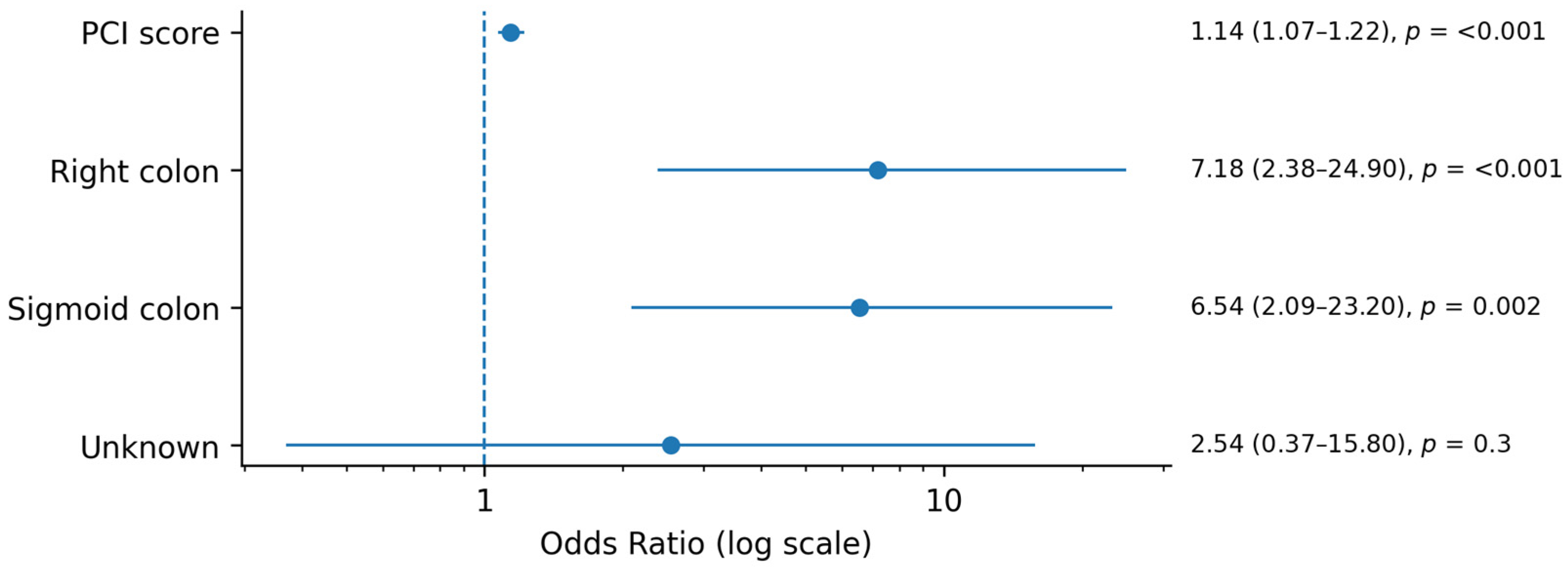
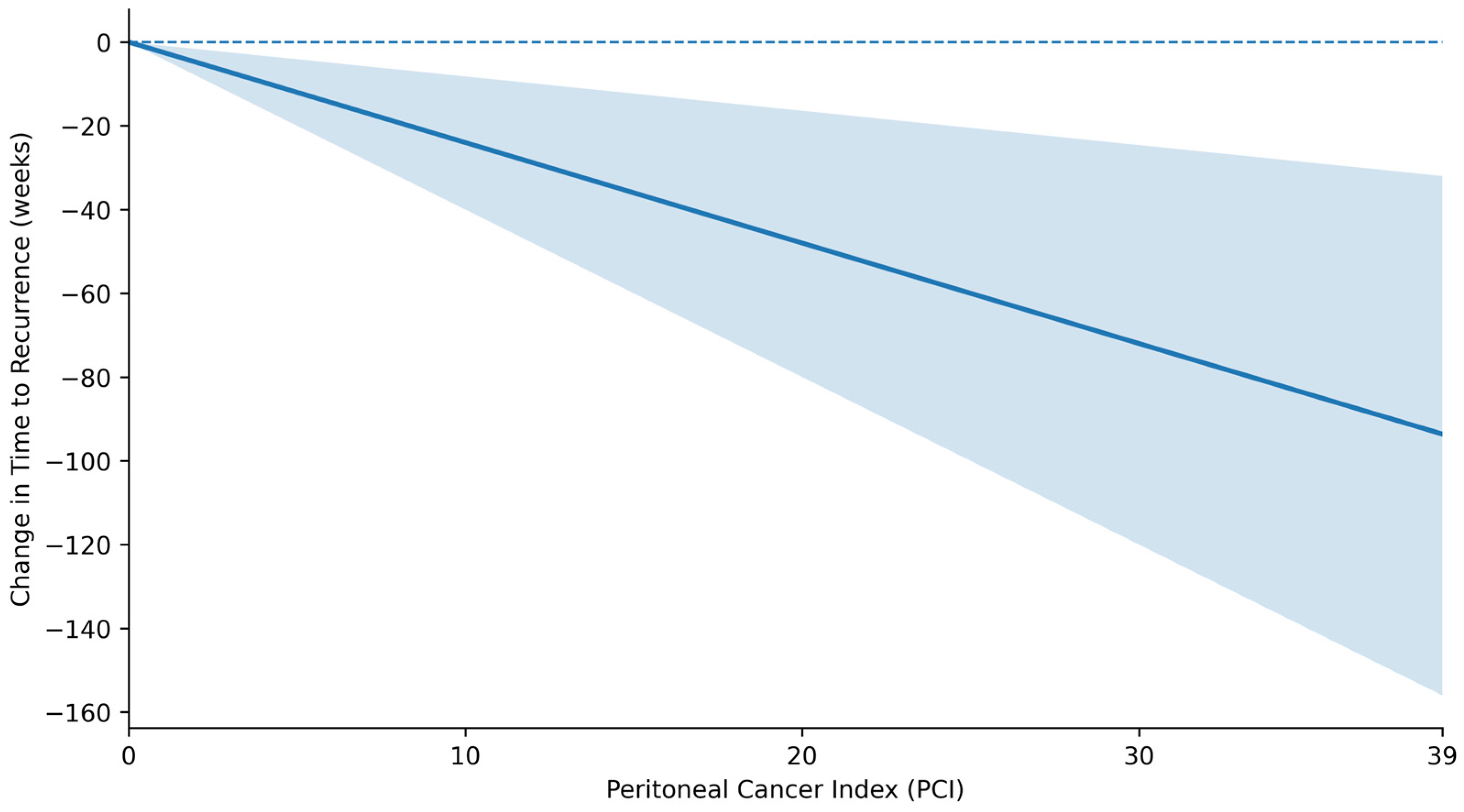
Background/Objectives: Peritoneal surface metastases (PSMs) from colorectal cancer have high rates of peritoneal recurrence after cytoreductive surgery (CRS) and hyperthermic intraperitoneal chemotherapy (HIPEC). Prior studies dichotomize peritoneal recurrence into “early” and “late,” limiting insight into how clinicopathologic factors influence recurrence timing. This study aimed to identify predictors of peritoneal recurrence and quantify their continuous association with time to recurrence following CRS/HIPEC. Methods: Patients undergoing CC-0 CRS/HIPEC for colorectal PSM from 2018 to 2024 were identified from a prospectively maintained database. The primary outcome was peritoneal surface recurrence. Variables included peritoneal cancer index (PCI), tumor location, histology, HIPEC regimen, and KRAS/BRAF/SMAD4 status. Factors with p < 0.10 on univariable analysis were entered into multivariable logistic regression (recurrence: yes/no) and linear regression (time to recurrence). Results: Among 133 patients, 64 (48.1%) developed peritoneal recurrence. Median time to recurrence was 41.4 weeks (IQR 24.9–74.0), and PCI was higher among those who recurred (median 11.0 vs. 5.0, p < 0.01). Neither tumor stage, histology, intraperitoneal chemotherapy agent, nor molecular alterations were associated with increased risk of peritoneal recurrence. When controlling for PCI, right- and sigmoid-colon primaries independently predicted peritoneal recurrence compared to all other locations without influence on recurrence timing (right: OR 7.18; sigmoid: OR 6.54; p < 0.01). Among patients who recurred, each one-point increase in PCI corresponded to a 2.43-week earlier relapse (p < 0.01). Conclusions: Nearly half of patients with colorectal PSM recurred despite complete CRS/HIPEC. Tumor location predicted peritoneal recurrence, while PCI independently shortened time to relapse. Modeling PCI as a continuous predictor refines postoperative risk stratification and may inform individualized surveillance strategies.
Keywords:
peritoneal surface malignancy; CRS/HIPEC; colon cancer