MRI-Based Prediction of Vestibular Schwannoma: Systematic Review

 , , ,
, , , 

Simple Summary
Abstract
1. Introduction
2. Materials and Methods
2.1. Search Strategy
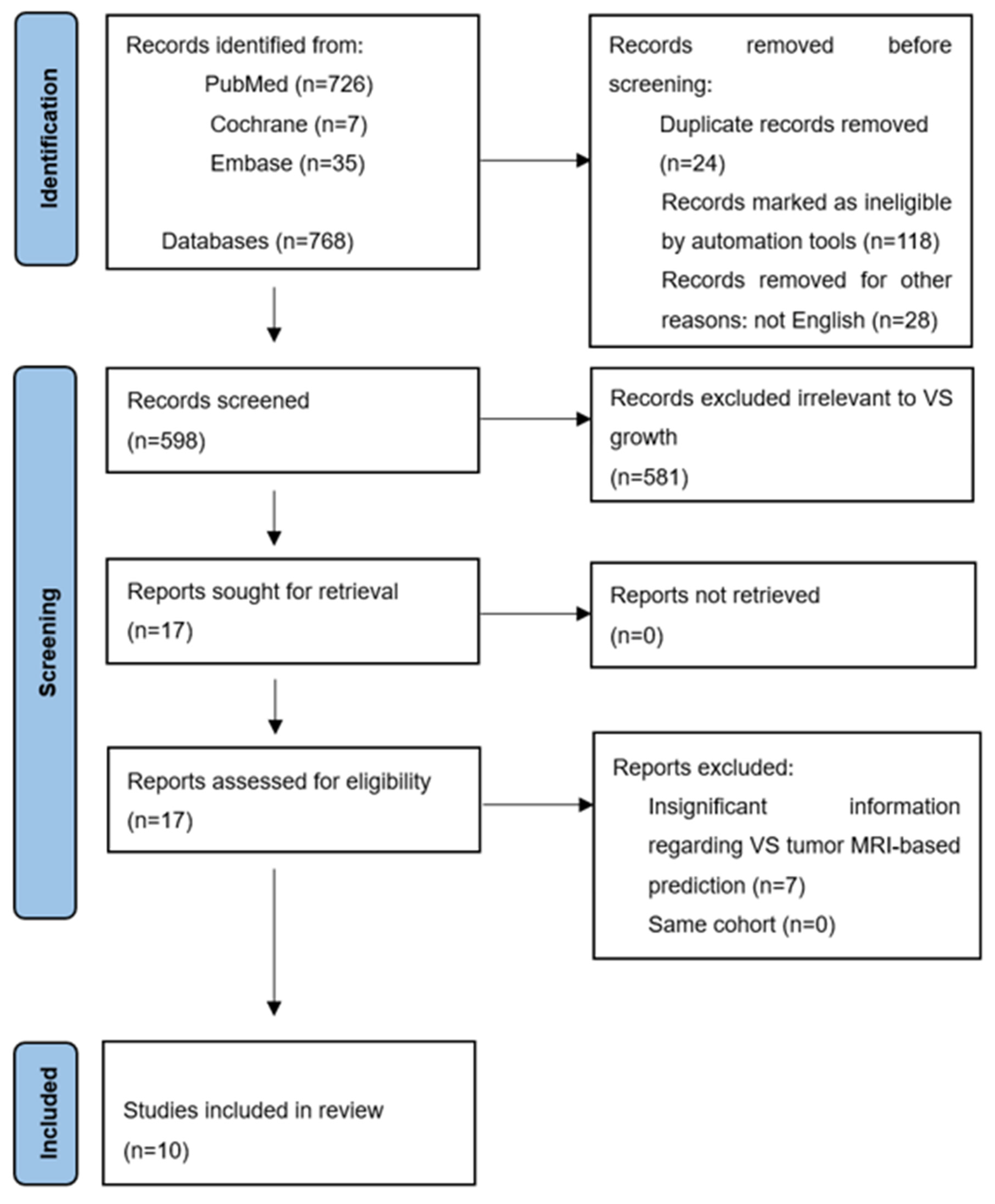
2.2. Study Selection
2.3. Data Collection
2.4. Quality Assessment
2.5. Statistical Analysis
3. Results
3.1. Characteristics of Inclusion in the Study
3.2. Study Quality and Risk of Bias
3.2.1. Heterogeneity Evaluation
3.2.2. NOS and Bias Evaluation
3.2.3. GRADE Assessment
3.3. Key Findings
3.3.1. MRI Texture Features
3.3.2. MRI Signal Intensity
3.3.3. Perfusion MRI
3.3.4. Apparent Diffusion Coefficient
4. Discussion
Limitations
5. Conclusions
Supplementary Materials
Author Contributions
Funding
Institutional Review Board Statement
Informed Consent Statement
Data Availability Statement
Conflicts of Interest
Abbreviations
| VS | Vestibular Schwannoma |
| MRI | Magnetic Resonance Imaging |
| PICOS | Population, Issue of Interest, Comparison, Outcome, and Study Design |
| TTE | Transient Tumor Enlargement |
| NOS | Newcastle–Ottawa Scale |
| GRADE | Grading of Recommendations, Assessment, Development and Evaluation |
| ROBIS | Risk of Bias in Systematic Reviews |
| ADC | Apparent Diffusion Coefficient |
| GLCM | Gray-Level Co-Occurrence Matrix |
| Idmn | Inverse Difference Moment Normalized |
| T/N | Tumor-to-Normal Tissue |
| T/Nm | Tumor-to-Temporalis Muscle |
| AUC | Area Under the ROC Curve |
| ASL | Arterial Spin Labeling |
| DSC | Dynamic Susceptibility Contrast |
| DCE | Dynamic Contrast-Enhanced |
| ANOVA | Analysis of Variance |
| IBSI | Image Biomarker Standardization Initiative |
References
- Gupta, V.K.; Thakker, A.; Gupta, K.K. Vestibular Schwannoma: What We Know and Where We are Heading. Head Neck Pathol. 2020, 14, 1058–1066. [Google Scholar] [CrossRef]
- Lin, E.P.; Crane, B.T. The Management and Imaging of Vestibular Schwannomas. AJNR Am. J. Neuroradiol. 2017, 38, 2034–2043. [Google Scholar] [CrossRef]
- Lewis, D.; Li, K.L.; Djoukhadar, I.; Hannan, C.J.; Pathmanaban, O.N.; Coope, D.J.; King, A.T. Emerging strategies for the prediction of behaviour, growth, and treatment response in vestibular schwannoma. Acta Neurochir. 2025, 167, 116. [Google Scholar] [CrossRef] [PubMed]
- Carlson, M.L.; Link, M.J. Vestibular Schwannomas. N. Engl. J. Med. 2021, 384, 1335–1348. [Google Scholar] [CrossRef]
- Whitley, H.; Benedict, N.T.; Tringali, S.; Gurusinghe, N.T.; Roberts, G.; Fieux, M.; Alalade, A.F. Identifying Factors Associated with the Growth of Vestibular Schwannomas: A Systematic Review. World Neurosurg. 2021, 149, e766–e779. [Google Scholar] [CrossRef]
- Gowtham, P.; Girigoswami, K.; Prabhu, A.D.; Pallavi, P.; Thirumalai, A.; Harini, K.; Girigoswami, A. Hydrogels of Alginate Derivative-Encased Nanodots Featuring Carbon-Coated Manganese Ferrite Cores with Gold Shells to Offer Antiangiogenesis with Multimodal Imaging-Based Theranostics. Adv. Ther. 2024, 7, 2400054. [Google Scholar] [CrossRef]
- Amir-Behghadami, M.; Janati, A. Population, Intervention, Comparison, Outcomes and Study (PICOS) design as a framework to formulate eligibility criteria in systematic reviews. Emerg. Med. J. 2020, 37, 387. [Google Scholar] [CrossRef]
- Wells, G.A.; Shea, B.; O’Connell, D.; Peterson, J.; Welch, V.; Losos, M.; Tugwell, P. The Newcastle-Ottawa Scale (NOS) for Assessing the Quality of Nonrandomised Studies in Meta-Analyses. 2000. Available online: https://ohri.ca/en/who-we-are/core-facilities-and-platforms/ottawa-methods-centre/newcastle-ottawa-scale#:~:text=It%20was%20developed%20to%20assess%20the%20quality%20of,quality%20assessments%20in%20the%20interpretation%20of%20meta-analytic%20results (accessed on 1 September 2025).
- Guyatt, G.; Oxman, A.D.; Akl, E.A.; Kunz, R.; Vist, G.; Brozek, J.; Norris, S.; Falck-Ytter, Y.; Glasziou, P.; DeBeer, H.; et al. GRADE guidelines: 1. Introduction-GRADE evidence profiles and summary of findings tables. J. Clin. Epidemiol. 2011, 64, 383–394. [Google Scholar] [CrossRef]
- Guyatt, G.H.; Oxman, A.D.; Vist, G.E.; Kunz, R.; Falck-Ytter, Y.; Alonso-Coello, P.; Schünemann, H.J. GRADE: An emerging consensus on rating quality of evidence and strength of recommendations. BMJ 2008, 336, 924–926. [Google Scholar] [CrossRef] [PubMed]
- Whiting, P.; Savović, J.; Higgins, J.P.; Caldwell, D.M.; Reeves, B.C.; Shea, B.; Davies, P.; Kleijnen, J.; Churchill, R. ROBIS: A new tool to assess risk of bias in systematic reviews was developed. J. Clin. Epidemiol. 2016, 69, 225–234. [Google Scholar] [CrossRef] [PubMed]
- Itoyama, T.; Nakaura, T.; Hamasaki, T.; Takezaki, T.; Uentani, H.; Hirai, T.; Mukasa, A. Whole Tumor Radiomics Analysis for Risk Factors Associated with Rapid Growth of Vestibular Schwannoma in Contrast-Enhanced T1-Weighted Images. World Neurosurg. 2022, 166, e572–e582. [Google Scholar] [CrossRef]
- Langenhuizen, P.; Zinger, S.; Leenstra, S.; Kunst, H.P.M.; Mulder, J.J.S.; Hanssens, P.E.J.; de With, P.H.N.; Verheul, J.B. Radiomics-Based Prediction of Long-Term Treatment Response of Vestibular Schwannomas Following Stereotactic Radiosurgery. Otol. Neurotol. 2020, 41, e1321–e1327. [Google Scholar] [CrossRef] [PubMed]
- George-Jones, N.A.; Wang, K.; Wang, J.; Hunter, J.B. Prediction of Vestibular Schwannoma Enlargement After Radiosurgery Using Tumor Shape and MRI Texture Features. Otol. Neurotol. 2021, 42, e348–e354. [Google Scholar] [CrossRef] [PubMed]
- Schouten, S.M.; Lewis, D.; Cornelissen, S.; Li, K.L.; Zhu, X.; Maas, M.C.; Pegge, S.; Jansen, T.T.G.; Mulder, J.J.S.; Waterval, J.J.; et al. Dynamic contrast-enhanced and diffusion-weighted MR imaging for predicting tumor growth of sporadic vestibular schwannomas: A prospective study. Neuro-Oncology 2024, 27, 1116–1127. [Google Scholar] [CrossRef] [PubMed]
- Langenhuizen, P.; Sebregts, S.H.P.; Zinger, S.; Leenstra, S.; Verheul, J.B.; de With, P.H.N. Prediction of transient tumor enlargement using MRI tumor texture after radiosurgery on vestibular schwannoma. Med. Phys. 2020, 47, 1692–1701. [Google Scholar] [CrossRef]
- Yamada, H.; Kai, N.; Hiratsuka, Y.; Mitani, S.; Suehiro, S.; Shiraishi, Y.; Kimura, T.; Takagi, T.; Iwata, S.; Teraoka, M.; et al. Comparison of the Signal Intensity of Vestibular Schwannoma Between Growing and Nongrowing Tumors. Laryngoscope 2022, 132, 198–203. [Google Scholar] [CrossRef]
- Kleijwegt, M.C.; van der Mey, A.G.; Wiggers-deBruine, F.T.; Malessy, M.J.; van Osch, M.J. Perfusion magnetic resonance imaging provides additional information as compared to anatomical imaging for decision-making in vestibular schwannoma. Eur. J. Radiol. Open 2016, 3, 127–133. [Google Scholar] [CrossRef][Green Version]
- Chuang, C.C.; Chang, C.S.; Tyan, Y.S.; Chuang, K.S.; Tu, H.T.; Huang, C.F. Use of apparent diffusion coefficients in evaluating the response of vestibular schwannomas to Gamma Knife surgery. J. Neurosurg. 2012, 117, 63–68. [Google Scholar] [CrossRef]
- Speckter, H.; Santana, J.; Bido, J.; Hernandez, G.; Rivera, D.; Suazo, L.; Valenzuela, S.; Oviedo, J.; Gonzalez, C.F.; Stoeter, P. Texture Analysis of Standard Magnetic Resonance Images to Predict Response to Gamma Knife Radiosurgery in Vestibular Schwannomas. World Neurosurg. 2019, 132, e228–e234. [Google Scholar] [CrossRef]
- Lewis, D.; Roncaroli, F.; Agushi, E.; Mosses, D.; Williams, R.; Li, K.L.; Zhu, X.; Hinz, R.; Atkinson, R.; Wadeson, A.; et al. Inflammation and vascular permeability correlate with growth in sporadic vestibular schwannoma. Neuro Oncol. 2019, 21, 314–325. [Google Scholar] [CrossRef]
- Soni, N.; Priya, S.; Bathla, G. Texture Analysis in Cerebral Gliomas: A Review of the Literature. AJNR Am. J. Neuroradiol. 2019, 40, 928–934. [Google Scholar] [CrossRef]
- Tonoyan, A.S.; Pronin, I.N.; Pitshelauri, D.I.; Shishkina, L.V.; Fadeeva, L.M.; Pogosbekyan, E.L.; Zakharova, N.E.; Shults, E.I.; Khachanova, N.V.; Kornienko, V.N.; et al. A correlation between diffusion kurtosis imaging and the proliferative activity of brain glioma. Zh Vopr. Neirokhir Im. N. N. Burdenko 2015, 79, 5–14. [Google Scholar] [CrossRef]
- Yang, C.; Alvarado, D.; Ravindran, P.K.; Keizer, M.E.; Hovinga, K.; Broen, M.P.G.; Kunst, H.; Temel, Y. Untreated Vestibular Schwannoma: Analysis of the Determinants of Growth. Cancers 2024, 16, 3718. [Google Scholar] [CrossRef] [PubMed]
- Wu, C.C.; Guo, W.Y.; Chung, W.Y.; Wu, H.M.; Lin, C.J.; Lee, C.C.; Liu, K.D.; Yang, H.C. Magnetic resonance imaging characteristics and the prediction of outcome of vestibular schwannomas following Gamma Knife radiosurgery. J. Neurosurg. 2017, 127, 1384–1391. [Google Scholar] [CrossRef] [PubMed]
- Yang, S.; Law, M.; Zagzag, D.; Wu, H.H.; Cha, S.; Golfinos, J.G.; Knopp, E.A.; Johnson, G. Dynamic contrast-enhanced perfusion MR imaging measurements of endothelial permeability: Differentiation between atypical and typical meningiomas. AJNR Am. J. Neuroradiol. 2003, 24, 1554–1559. [Google Scholar] [PubMed]
- van de Langenberg, R.; de Bondt, B.J.; Nelemans, P.J.; Baumert, B.G.; Stokroos, R.J. Follow-up assessment of vestibular schwannomas: Volume quantification versus two-dimensional measurements. Neuroradiology 2009, 51, 517–524. [Google Scholar] [CrossRef]
- Kania, R.; Vérillaud, B.; Camous, D.; Hautefort, C.; Somers, T.; Waterval, J.; Froelich, S.; Herman, P. EAONO position statement on Vestibular Schwannoma: Imaging Assessment Question: How should growth of Vestibular Schwannoma be defined? J. Int. Adv. Otol. 2018, 14, 90–94. [Google Scholar] [CrossRef]
- Lambin, P.; Leijenaar, R.T.H.; Deist, T.M.; Peerlings, J.; de Jong, E.E.C.; van Timmeren, J.; Sanduleanu, S.; Larue, R.; Even, A.J.G.; Jochems, A.; et al. Radiomics: The bridge between medical imaging and personalized medicine. Nat. Rev. Clin. Oncol. 2017, 14, 749–762. [Google Scholar] [CrossRef]
- deSouza, N.M.; Achten, E.; Alberich-Bayarri, A.; Bamberg, F.; Boellaard, R.; Clément, O.; Fournier, L.; Gallagher, F.; Golay, X.; Heussel, C.P.; et al. Validated imaging biomarkers as decision-making tools in clinical trials and routine practice: Current status and recommendations from the EIBALL* subcommittee of the European Society of Radiology (ESR). Insights Imaging 2019, 10, 87. [Google Scholar] [CrossRef]
- Hentschel, M.A.; Hannink, G.; Steens, S.C.A.; Mulder, J.J.S.; Rovers, M.M.; Kunst, H.P.M. Development of a model to predict vestibular schwannoma growth: An opportunity to introduce new wait and scan strategies. Clin. Otolaryngol. 2021, 46, 273–283. [Google Scholar] [CrossRef]
- Chen, Y.; Wolterink, J.M.; Neve, O.M.; Romeijn, S.R.; Verbist, B.M.; Hensen, E.F.; Tao, Q.; Staring, M. Vestibular Schwannoma Growth Prediction from Longitudinal MRI by Time-Conditioned Neural Fields. In Medical Image Computing and Computer Assisted Intervention–MICCAI 2024; Springer Nature: Cham, Switzerland, 2024; pp. 508–518. [Google Scholar]
- Hannan, C.J.; Lewis, D.; O’Leary, C.; Donofrio, C.A.; Evans, D.G.; Roncaroli, F.; Brough, D.; King, A.T.; Coope, D.; Pathmanaban, O.N. The inflammatory microenvironment in vestibular schwannoma. Neurooncol. Adv. 2020, 2, vdaa023. [Google Scholar] [CrossRef] [PubMed]


| Study Number | Author, Year | Patients Number | Growth Number | Age (y) | Mean (Median) FU/MRI Interval * (Mo) | Growth Measurement | MRI Field Strength | |
|---|---|---|---|---|---|---|---|---|
| Volume | Linear | |||||||
| T. Itoyama [12] | 2022 | 64 | 31 | 57.9 | / | / | >2 mm/year | / |
| P. Langenhuizen [13] | 2020 | 85 | 43 | / | 74 | >10% | / | / |
| Nicholas A George-Jones [14] | 2020 | 53 | 36 | / | 6.5 (IQR 5.9–7.4) * | >20% | / | / |
| Sammy M. Schouten [15] | 2024 | 110 | 70 | 58 (48–67) | 25 (IQR 17–35) | Subject-specific calculator | 3 T | |
| P. Langenhuizen [16] | 2020 | 99 | 38 (TTE) | 58 (IQR 47–66) | / | / | / | / |
| H. Yamada [17] | 2021 | 31 | 15 | 62.9 ± 11.93 | 27.10 ± 17.27 * | >100 mm3/year | / | 1.5 T and 3 T |
| M. C. Kleijwegt [18] | 2016 | 10 | 9 | 62 (45–74) | 7.6 * | >20%/year | ≥2 mm/year | 3 T |
| C. C. Chuang [19] | 2012 | 31 | 3 | / | 36.5 (IQR 18–60) | / | / | 1.5 T |
| Herwin Speckter [20] | 2019 | 23 | 4 | 51.6 (8.7–75.3) | 42.7 (IQR 23.7–80.3) | / | / | 3 T |
| Daniel Lewis [21] | 2019 | 19 | 7 | 57.7 (25.7–80.7) | / | / | / | 1.5 T |
| (A) | ||||
| Author | Year | Technology | Prediction | Key Metrics |
| T. Itoyama [12] | 2022 | Idmn | Tumor growth | Mixed model of texture and clinical factors: AUC = 0.69 Idmn: p = 0.003 |
| Herwin Speckter [20] | 2019 | Kurtosis | Tumor growth | 71% sensitivity, 78% specificity |
| Nicholas A George-Jones [14] | 2020 | First-order, GLCMs | Tumor growth | V > 1.006 cm3: 87% sensitivity, 73% specificity AUC = 0.76 V < 1.006 cm3: 95% sensitivity, 50% specificity AUC = 0.65 |
| Patrick P. J. H. Langenhuize [13] | 2020 | GLCMs | Tumor growth | V < 5 cm3: 71% sensitivity, 83% specificity AUC = 0.85 V > 5 cm3: 83% sensitivity, 82% specificity AUC = 0.99 |
| Patrick P. J. H. Langenhuizen [16] | 2020 | GLCMs | Tumor TTE | V < 6 cm3: 82% sensitivity, 69% specificity V > 6 cm3: 77% sensitivity, 89% specificity |
| (B) | ||||
| Author | Year | Technology | Prediction | Key Metrics |
| H. Yamada [17] | 2021 | Intensity ratio | Tumor growth | T/Np: 93.33% sensitivity, 75.00% specificity T/Nm: 100.00% sensitivity, 93.75% specificity |
| T. Itoyama [12] | 2022 | Minimum signal intensity (T1) | Tumor growth | p = 0.016 |
| Herwin Speckter [20] | 2019 | Minimum signal intensity (T2) | Tumor growth | Correlation coefficient ≈ −0.63 |
| (C) | ||||
| Study Number | Author, Year | Technology | Prediction | Key Metrics |
| M. C. Kleijwegt [18] | 2016 | DSC, ASL | Tumor growth | Hyperintense perfusion characteristics |
| Daniel Lewis [21] | 2019 | DCE | Tumor growth | ANOVA, p = 0.004 |
| Sammy M. Schouten [15] | 2024 | DCE | Tumor growth | 89% sensitivity, 73% specificity AUC = 0.85 |
| (D) | ||||
| Study Number | Author, Year | Technology | Prediction | Key Metrics |
| Sammy M. Schouten [15] | 2024 | ADC | Tumor growth | Associated with tumor shrinkage (p = 0.04) Not predictive of natural tumor growth(p = 0.14) |
| C. C. Chuang [19] | 2012 | ADC | Tumor growth | Increase in solid tumors Reduction in cystic tumors |
Disclaimer/Publisher’s Note: The statements, opinions and data contained in all publications are solely those of the individual author(s) and contributor(s) and not of MDPI and/or the editor(s). MDPI and/or the editor(s) disclaim responsibility for any injury to people or property resulting from any ideas, methods, instructions or products referred to in the content. |
© 2026 by the authors. Licensee MDPI, Basel, Switzerland. This article is an open access article distributed under the terms and conditions of the Creative Commons Attribution (CC BY) license.
Share and Cite
Yang, C.; Alvarado, D.; Ravindran, P.K.; Keizer, M.E.; Hovinga, K.; Broen, M.P.G.; Kunst, H.P.M.; Temel, Y. MRI-Based Prediction of Vestibular Schwannoma: Systematic Review. Cancers 2026, 18, 289. https://doi.org/10.3390/cancers18020289
Yang C, Alvarado D, Ravindran PK, Keizer ME, Hovinga K, Broen MPG, Kunst HPM, Temel Y. MRI-Based Prediction of Vestibular Schwannoma: Systematic Review. Cancers. 2026; 18(2):289. https://doi.org/10.3390/cancers18020289
Chicago/Turabian StyleYang, Cheng, Daniel Alvarado, Pawan Kishore Ravindran, Max E. Keizer, Koos Hovinga, Martinus P. G. Broen, Henricus P. M. Kunst, and Yasin Temel. 2026. "MRI-Based Prediction of Vestibular Schwannoma: Systematic Review" Cancers 18, no. 2: 289. https://doi.org/10.3390/cancers18020289
APA StyleYang, C., Alvarado, D., Ravindran, P. K., Keizer, M. E., Hovinga, K., Broen, M. P. G., Kunst, H. P. M., & Temel, Y. (2026). MRI-Based Prediction of Vestibular Schwannoma: Systematic Review. Cancers, 18(2), 289. https://doi.org/10.3390/cancers18020289