Tumor Growth Rate Predicts Pathological Outcomes in Breast Fibroepithelial Tumors: A Pilot Study and Review of Literature

 ,
,  , , ,
, , ,
Simple Summary
Abstract
1. Introduction
2. Materials and Methods
2.1. Study Design and Sample Selection
2.2. Pathological Evaluation
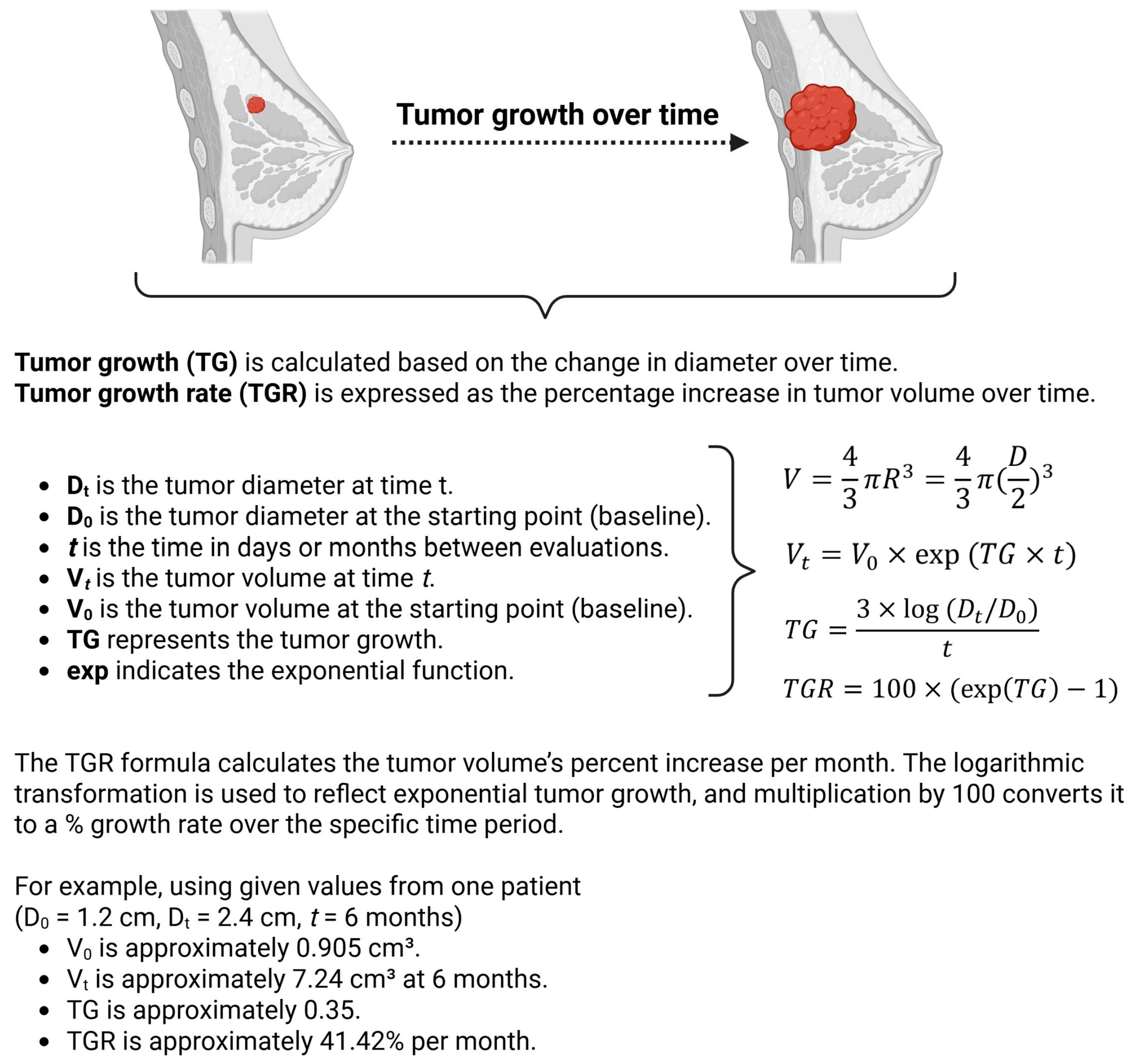
2.3. Imaging Data and Tumor Growth Rate Calculation
- •
- Vt is the tumor volume at time t;
- •
- V0 is the baseline tumor volume;
- •
- TG is the tumor growth;
- •
- exp indicates the exponential function.
- •
- Dt is the tumor diameter at time t;
- •
- D0 is the baseline tumor diameter;
- •
- t is the time in days or months between evaluations.
2.4. Statistical Analysis
3. Results
3.1. Patient Demographics and Tumor Characteristics
3.2. Core Needle Biopsy Concordance
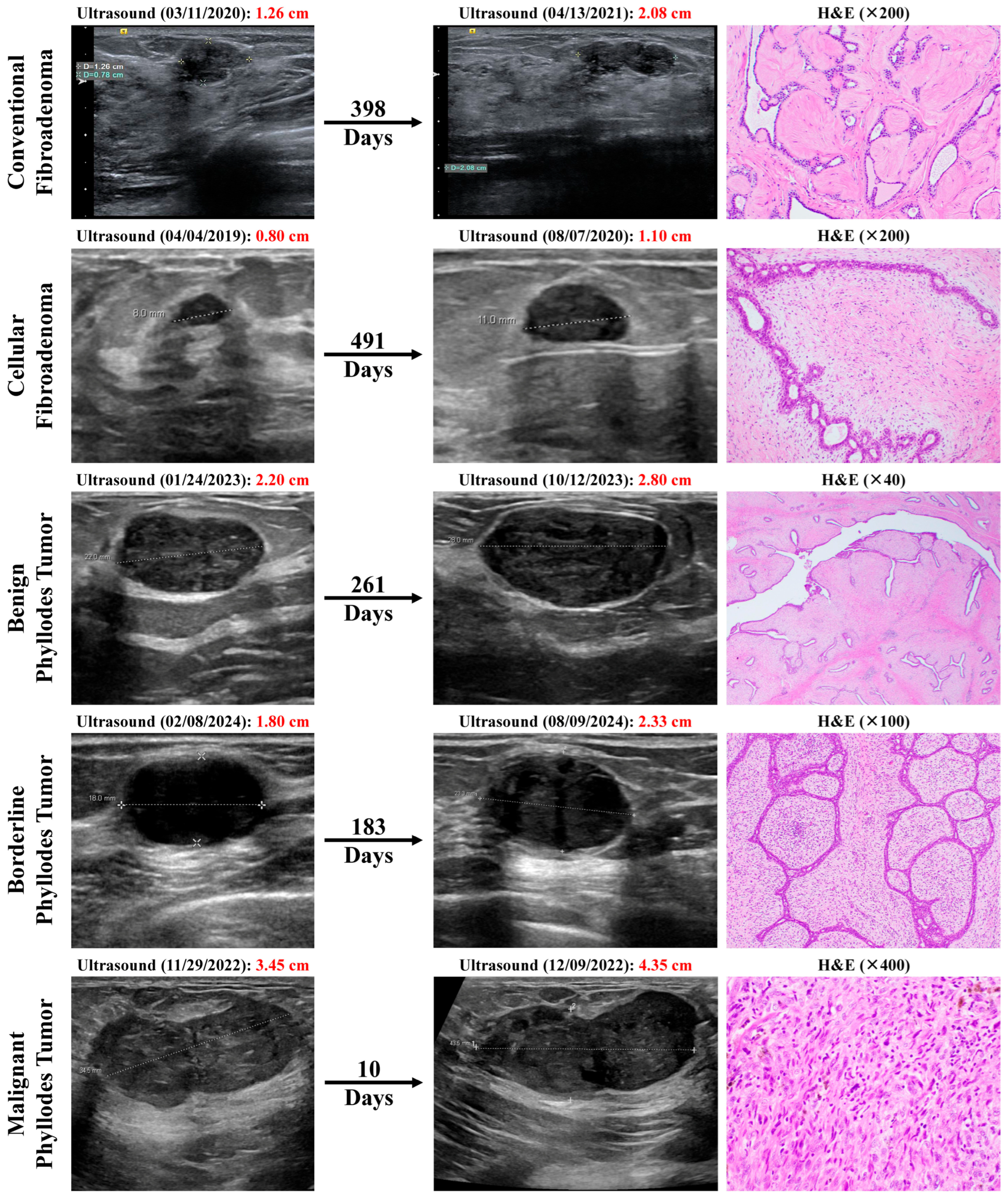
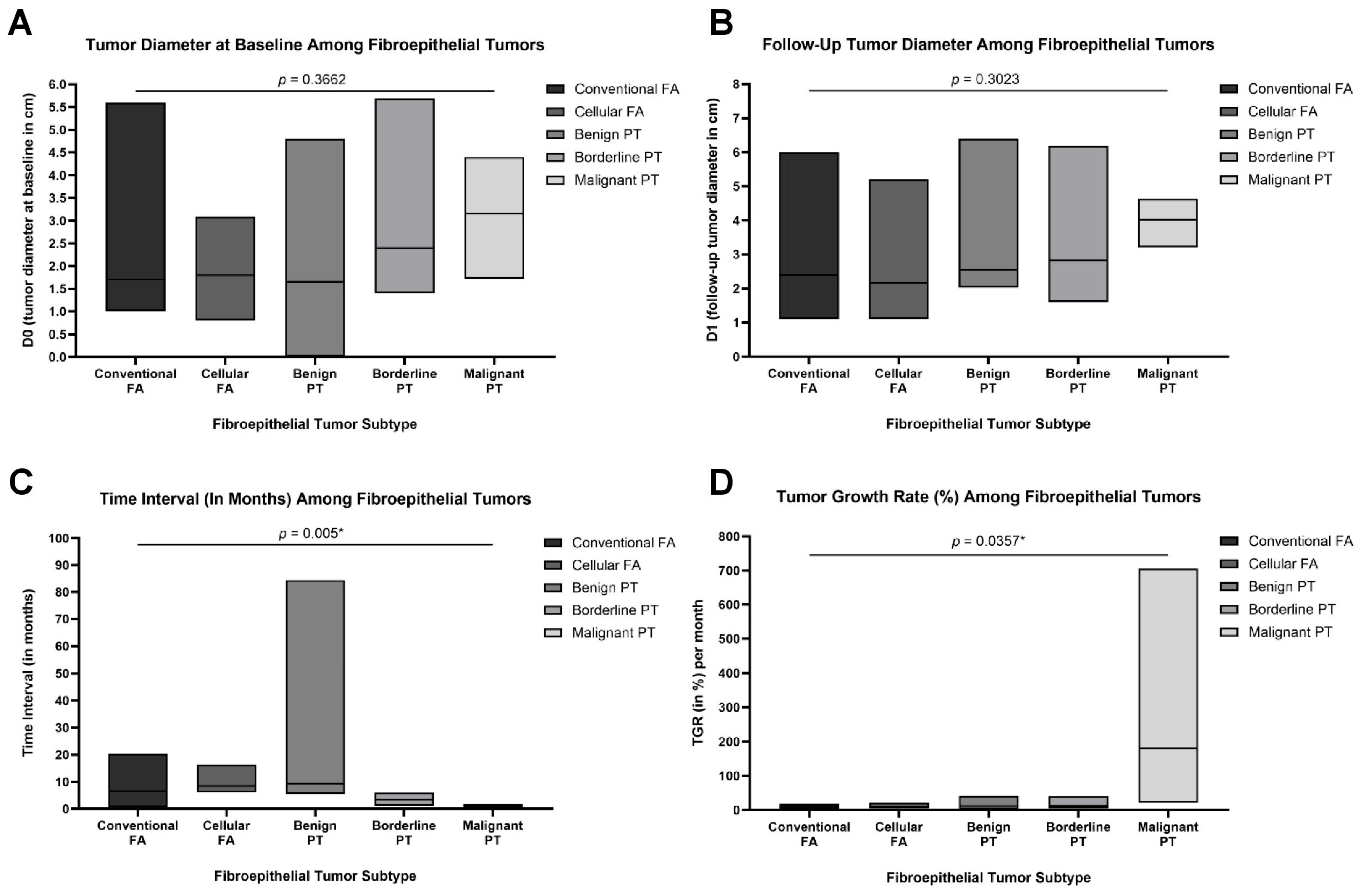
3.3. Radiological Growth Parameters
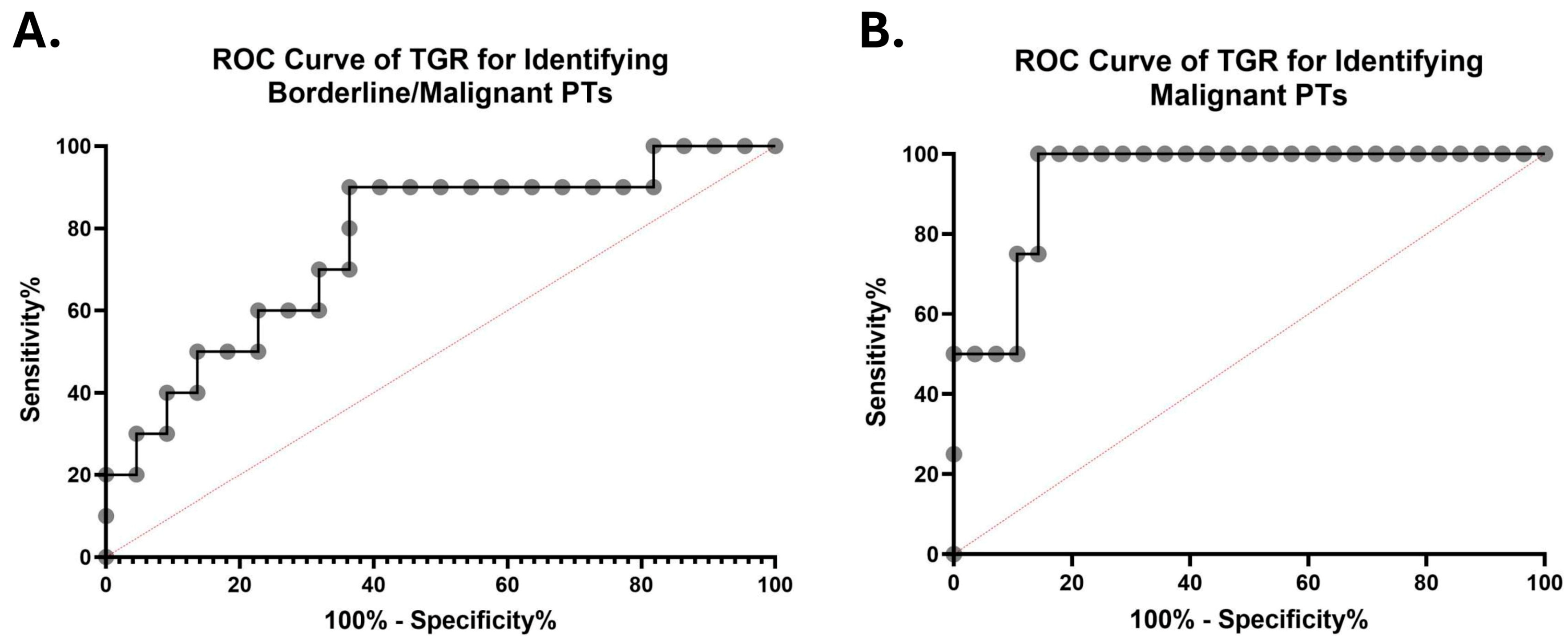
3.4. ROC and Optimal Cutoff Analyses
4. Discussion
5. Conclusions
Supplementary Materials
Author Contributions
Funding
Institutional Review Board Statement
Informed Consent Statement
Data Availability Statement
Acknowledgments
Conflicts of Interest
References
- Tan, B.Y.; Acs, G.; Apple, S.K.; Badve, S.; Bleiweiss, I.J.; Brogi, E.; Calvo, J.P.; Dabbs, D.J.; Ellis, I.O.; Eusebi, V.; et al. Phyllodes tumours of the breast: A consensus review. Histopathology 2016, 68, 5–21. [Google Scholar] [CrossRef] [PubMed]
- Wiratkapun, C.; Piyapan, P.; Lertsithichai, P.; Larbcharoensub, N. Fibroadenoma versus phyllodes tumor: Distinguishing factors in patients diagnosed with fibroepithelial lesions after a core needle biopsy. Diagn. Interv. Radiol. 2014, 20, 27–33. [Google Scholar] [CrossRef] [PubMed]
- Cowan, M.L.; Argani, P.; Cimino-Mathews, A. Benign and low-grade fibroepithelial neoplasms of the breast have low recurrence rate after positive surgical margins. Mod. Pathol. 2016, 29, 259–265. [Google Scholar] [CrossRef] [PubMed]
- Zhang, M.; Arjmandi, F.K.; Porembka, J.H.; Seiler, S.J.; Goudreau, S.H.; Merchant, K.; Hwang, H.; Hayes, J.C. Imaging and Management of Fibroepithelial Lesions of the Breast: Radiologic-Pathologic Correlation. Radiographics 2023, 43, e230051. [Google Scholar] [CrossRef]
- Iranmakani, S.; Mortezazadeh, T.; Sajadian, F.; Ghaziani, M.F.; Ghafari, A.; Khezerloo, D.; Musa, A.E. A review of various modalities in breast imaging: Technical aspects and clinical outcomes. Egypt. J. Radiol. Nucl. Med. 2020, 51, 57. [Google Scholar] [CrossRef]
- Gradishar, W.J.; Moran, M.S.; Abraham, J.; Abramson, V.; Aft, R.; Agnese, D.; Allison, K.H.; Anderson, B.; Bailey, J.; Burstein, H.J.; et al. NCCN Guidelines® Insights: Breast Cancer, Version 5.2025. J. Natl. Compr. Cancer Netw. 2025, 23, 426–436. [Google Scholar] [CrossRef]
- Kuroishi, T.; Tominaga, S.; Morimoto, T.; Tashiro, H.; Itoh, S.; Watanabe, H.; Fukuda, M.; Ota, J.; Horino, T.; Ishida, T.; et al. Tumor growth rate and prognosis of breast cancer mainly detected by mass screening. Jpn. J. Cancer Res. 1990, 81, 454–462. [Google Scholar] [CrossRef]
- Yoo, T.K.; Min, J.W.; Kim, M.K.; Lee, E.; Kim, J.; Lee, H.B.; Kang, Y.J.; Kim, Y.G.; Moon, H.G.; Moon, W.K.; et al. In Vivo Tumor Growth Rate Measured by US in Preoperative Period and Long Term Disease Outcome in Breast Cancer Patients. PLoS ONE 2015, 10, e0144144. [Google Scholar] [CrossRef]
- Fischer, U. Tumor Growth Rate of Luminal and Nonluminal Invasive Breast Cancer Calculated on MRI Imaging. Clin. Breast Cancer 2025, 25, 422–430. [Google Scholar] [CrossRef]
- Ferté, C.; Fernandez, M.; Hollebecque, A.; Koscielny, S.; Levy, A.; Massard, C.; Balheda, R.; Bot, B.; Gomez-Roca, C.; Dromain, C.; et al. Tumor growth rate is an early indicator of antitumor drug activity in phase I clinical trials. Clin. Cancer Res. 2014, 20, 246–252. [Google Scholar] [CrossRef]
- Lee, S.H.; Kim, Y.S.; Han, W.; Ryu, H.S.; Chang, J.M.; Cho, N.; Moon, W.K. Tumor growth rate of invasive breast cancers during wait times for surgery assessed by ultrasonography. Medicine 2016, 95, e4874. [Google Scholar] [CrossRef]
- Lamarca, A.; Ronot, M.; Moalla, S.; Crona, J.; Opalinska, M.; Lopez Lopez, C.; Pezzutti, D.; Najran, P.; Carvhalo, L.; Bezerra, R.O.F.; et al. Tumor Growth Rate as a Validated Early Radiological Biomarker Able to Reflect Treatment-Induced Changes in Neuroendocrine Tumors: The GREPONET-2 Study. Clin. Cancer Res. 2019, 25, 6692–6699. [Google Scholar] [CrossRef] [PubMed]
- He, L.N.; Zhang, X.; Li, H.; Chen, T.; Chen, C.; Zhou, Y.; Lin, Z.; Du, W.; Fang, W.; Yang, Y.; et al. Pre-Treatment Tumor Growth Rate Predicts Clinical Outcomes of Patients with Advanced Non-Small Cell Lung Cancer Undergoing Anti-PD-1/PD-L1 Therapy. Front. Oncol. 2020, 10, 621329. [Google Scholar] [CrossRef]
- Dromain, C.; Sundin, A.; Najran, P.; Vidal Trueba, H.; Dioguardi Burgio, M.; Crona, J.; Opalinska, M.; Carvalho, L.; Franca, R.; Borg, P.; et al. Tumor Growth Rate to Predict the Outcome of Patients with Neuroendocrine Tumors: Performance and Sources of Variability. Neuroendocrinology 2021, 111, 831–839. [Google Scholar] [CrossRef] [PubMed]
- Dall’Olio, F.G.; Parisi, C.; Marcolin, L.; Brocchi, S.; Caramella, C.; Conci, N.; Carpani, G.; Gelsomino, F.; Ardizzoni, S.; Marchese, P.V.; et al. Monitoring tumor growth rate to predict immune checkpoint inhibitors’ treatment outcome in advanced NSCLC. Ther. Adv. Med. Oncol. 2022, 14, 17588359211058391. [Google Scholar] [CrossRef]
- Feldstein, M.; Zelen, M. Inferring the natural time history of breast cancer: Implications for tumor growth rate and early detection. Breast Cancer Res. Treat. 1984, 4, 3–10. [Google Scholar] [CrossRef]
- Head, J.F.; Wang, F.; Elliott, R.L. Breast thermography is a noninvasive prognostic procedure that predicts tumor growth rate in breast cancer patients. Ann. N. Y. Acad. Sci. 1993, 698, 153–158. [Google Scholar] [CrossRef]
- He, P.; Gambhire, D.; Zhou, H.; Ma, X.; Emura, Y.; Laadem, A.; Leung, D.; Bates, S.; Fojo, A.T.; Rixe, O. Correlation between tumor growth rate and survival in patients with metastatic breast cancer treated with trastuzumab deruxtecan. Oncologist 2025, 30, oyaf057. [Google Scholar] [CrossRef]
- Bhattarai, S.; Klimov, S.; Aleskandarany, M.A.; Burrell, H.; Wormall, A.; Green, A.R.; Rida, P.; Ellis, I.O.; Osan, R.M.; Rakha, E.A.; et al. Machine learning-based prediction of breast cancer growth rate in vivo. Br. J. Cancer 2019, 121, 497–504. [Google Scholar] [CrossRef]
- Förnvik, D.; Lång, K.; Andersson, I.; Dustler, M.; Borgquist, S.; Timberg, P. Estimates of Breast Cancer Growth Rate from Mammograms and its Relation to Tumor Characteristics. Radiat. Prot. Dosim. 2016, 169, 151–157. [Google Scholar] [CrossRef]
- Rosenberger, L.H.; White, R.L.; Tafra, L.; Boughey, J.C.; Johnson, N.M.; Pass, H.A.; Boolbol, S.; Landrum, K.M.; Gao, Y.; Yao, K. American Society of Breast Surgeons and Society of Breast Imaging 2025 Guidelines for the Management of Benign Breast Fibroepithelial Lesions. JAMA Surg. 2025, 160, 1378–1385. [Google Scholar] [CrossRef] [PubMed]
- Tan, P.H.; Tse, G.; Shin, S.J.; Val-Bernal, J.F. Chapter 3: Fibroepithelial tumours and hamartomas of the breast. In WHO Classification of Tumours Editorial Board. Breast Tumours, 5th ed.; International Agency for Research on Cancer—IARC: Lyon, France, 2019. [Google Scholar]
- Therasse, P.; Arbuck, S.G.; Eisenhauer, E.A.; Wanders, J.; Kaplan, R.S.; Rubinstein, L.; Verweij, J.; Van Glabbeke, M.; van Oosterom, A.T.; Christian, M.C.; et al. New guidelines to evaluate the response to treatment in solid tumors. European Organization for Research and Treatment of Cancer, National Cancer Institute of the United States, National Cancer Institute of Canada. J. Natl. Cancer Inst. 2000, 92, 205–216. [Google Scholar] [CrossRef] [PubMed]
- Marcil, G.; Wong, S.; Trabulsi, N.; Allard-Coutu, A.; Parsyan, A.; Omeroglu, A.; Atinel, G.; Mesurolle, B.; Meterissian, S. Fibroepithelial breast lesions diagnosed by core needle biopsy demonstrate a moderate rate of upstaging to phyllodes tumors. Am. J. Surg. 2017, 214, 318–322. [Google Scholar] [CrossRef]
- Bartels, S.A.L.; van Olmen, J.P.; Scholten, A.N.; Bekers, E.M.; Drukker, C.A.; Vrancken Peeters, M.; van Duijnhoven, F.H. Real-world data on malignant and borderline phyllodes tumors of the breast: A population-based study of all 921 cases in the Netherlands (1989–2020). Eur. J. Cancer 2024, 201, 113924. [Google Scholar] [CrossRef] [PubMed]
- Liu, J.; Li, F.; Liu, X.; Lang, R.; Liang, R.; Lu, H. Malignant phyllodes tumors of the breast: The malignancy grading and associations with prognosis. Breast Cancer Res Treat 2023, 199, 435–444. [Google Scholar] [CrossRef]
- Di Liso, E.; Bottosso, M.; Lo Mele, M.; Tsvetkova, V.; Dieci, M.V.; Miglietta, F.; Falci, C.; Faggioni, G.; Tasca, G.; Giorgi, C.A.; et al. Prognostic factors in phyllodes tumours of the breast: Retrospective study on 166 consecutive cases. ESMO Open 2020, 5, e000843. [Google Scholar] [CrossRef]
- Mihai, R.; Callagy, G.; Qassid, O.L.; Loughlin, M.O.; Al-Hilfi, L.; Abbas, A.; Campora, M.; Hodi, Z.; Ellis, I.; Lee, A.H.S.; et al. Correlations of morphological features and surgical management with clinical outcome in a multicentre study of 241 phyllodes tumours of the breast. Histopathology 2021, 78, 871–881. [Google Scholar] [CrossRef]
- Li, J.; Tsang, J.Y.; Chen, C.; Chan, S.K.; Cheung, S.Y.; Wu, C.; Kwong, A.; Hu, J.; Hu, H.; Zhou, D.; et al. Predicting Outcome in Mammary Phyllodes Tumors: Relevance of Clinicopathological Features. Ann. Surg. Oncol. 2019, 26, 2747–2758. [Google Scholar] [CrossRef]
- Turashvili, G.; Ding, Q.; Liu, Y.; Peng, L.; Mrkonjic, M.; Mejbel, H.; Wang, Y.; Zhang, H.; Zhang, G.; Wang, J.; et al. Comprehensive Clinical-Pathologic Assessment of Malignant Phyllodes Tumors: Proposing Refined Diagnostic Criteria. Am. J. Surg. Pathol. 2023, 47, 1195–1206. [Google Scholar] [CrossRef]



| Total (N = 32) N (%) | Conventional FA (n = 10) n (%) | Cellular FA (n = 4) n (%) | Benign PT (n = 8) n (%) | Borderline PT (n = 6) n (%) | Malignant PT (n = 4) n (%) | p-Value | |
|---|---|---|---|---|---|---|---|
| Demographics | |||||||
| Age (years) | |||||||
| Median (IQR) | 38.5 (30.75–47.0) | 35.00 (25.75–43.00) | 37.5 (36.25–38.25) | 37.0 (22.0–47.0) | 47.0 (45.5–50.75) | 41.0 (35.75–47.5) | 0.2946 † |
| Mean (±SD) | 38.94 ± 11.99 | 35.20 ± 11.75 | 37.00 ± 2.16 | 36.63 ± 15.17 | 47.33 ± 7.66 | 42.25 ± 14.45 | - |
| Pathological features | |||||||
| Laterality | |||||||
| Left | 15 (46.87%) | 5 (50.00%) | 4 (100.00%) | 1 (12.50%) | 3 (50.00%) | 2 (50.00%) | 0.0824 ‡ |
| Right | 17 (53.13%) | 5 (50.00%) | 0 (0.00%) | 7 (87.50%) | 3 (50.00%) | 2 (50.00%) | |
| Tumor site (clock position) | |||||||
| 1 o’clock | 2 (6.25%) | 1 (10.00%) | 0 (0.00%) | 1 (12.50%) | 0 (0.00%) | 0 (0.00%) | 0.1986 ‡ |
| 2 o’clock | 7 (21.87%) | 4 (40.00%) | 1 (25.00%) | 1 (12.50%) | 0 (0.00%) | 1 (25.00%) | |
| 3 o’clock | 2 (6.25%) | 1 (10.00%) | 0 (0.00%) | 0 (0.00%) | 1 (16.67%) | 0 (0.00%) | |
| 4 o’clock | 2 (6.25%) | 0 (0.00%) | 1 (25.00%) | 0 (0.00%) | 0 (0.00%) | 1 (25.00%) | |
| 5 o’clock | 1 (3.13%) | 0 (0.00%) | 0 (0.00%) | 0 (0.00%) | 0 (0.00%) | 1 (25.00%) | |
| 6 o’clock | 2 (6.25%) | 1 (10.00%) | 0 (0.00%) | 0 (0.00%) | 1 (16.67%) | 0 (0.00%) | |
| 8 o’clock | 3 (9.37%) | 1 (10.00%) | 0 (0.00%) | 2 (25.00%) | 0 (0.00%) | 0 (0.00%) | |
| 9 o’clock | 3 (9.37%) | 0 (0.00%) | 0 (0.00%) | 1 (12.50%) | 2 (33.32%) | 0 (0.00%) | |
| 10 o’clock | 5 (15.63%) | 0 (0.00%) | 1 (25.00%) | 3 (37.50%) | 0 (0.00%) | 1 (25.00%) | |
| 11 o’clock | 1 (3.13%) | 0 (0.00%) | 1 (25.00%) | 0 (0.00%) | 0 (0.00%) | 0 (0.00%) | |
| 12 o’clock | 3 (9.37%) | 2 (20.00%) | 0 (0.00%) | 0 (0.00%) | 1 (16.67%) | 0 (0.00%) | |
| Axilla | 1 (3.13%) | 0 (0.00%) | 0 (0.00%) | 0 (0.00%) | 1 (16.67%) | 0 (0.00%) | |
| Diagnosis on biopsy | |||||||
| FA | 5 (15.63%) | 1 (10.00%) | 1 (25.00%) | 2 (25.00%) | 1 (16.67%) | 0 (0.00%) | <0.001 ‡* |
| FET | 23 (71.87%) | 9 (90.00%) | 3 (75.00%) | 6 (75.00%) | 5 (83.33%) | 0 (0.00%) | |
| Other | 4 (12.50%) | 0 (0.00%) | 0 (0.00%) | 0 (0.00%) | 0 (0.00%) | 4 (100.00%) | |
| Tumor gross size (greatest dimension in mm) | |||||||
| Median (IQR) | 25.50 (18.75–38.50) | 22.00 (15.75–26.00) | 19.50 (16.00–33.25) | 30.50 (24.00–39.25) | 25.00 (17.50–47.50) | 35.00 (31.00–36.25) | 0.4718 † |
| Mean (± SD) | 30.72 ± 17.11 | 25.70 ± 14.84 | 29.75 ± 27.23 | 35.38 ± 17.86 | 32.50 ± 19.63 | 32.25 ± 9.14 | - |
| Margin status | |||||||
| Negative | 9 (56.25%) | - | - | 3 (50.00%) | 3 (50.00%) | 3 (75.00%) | 0.685 ‡ |
| Positive | 7 (43.75%) | - | - | 3 (50.00%) | 3 (50.00%) | 1 (25.00%) | |
| Radiological features | |||||||
| D0 (tumor diameter at baseline in cm) | |||||||
| Median (IQR) | 1.90 (1.48–2.92) | 1.70 (1.33–2.43) | 1.80 (1.48–2.20) | 1.65 (1.55–2.25) | 2.40 (1.85–4.55) | 3.16 (2.58–3.69) | 0.3662 † |
| Mean (± SD) | 2.46 ± 1.51 | 2.43 ± 1.73 | 1.87 ± 0.94 | 1.96 ± 1.35 | 3.14 ± 1.83 | 3.11 ± 1.12 | - |
| Dt (tumor diameter at time t in cm) | |||||||
| Median (IQR) | 2.68 (2.03–3.86) | 2.39 (1.70–2.80) | 2.17 (1.70–3.13) | 2.55 (2.23–2.90) | 2.83 (2.41–4.80) | 4.03 (3.58–4.42) | 0.3023 † |
| Mean (± SD) | 3.11 ± 1.54 | 2.81 ± 1.69 | 2.66 ± 1.78 | 2.98 ± 1.44 | 3.53 ± 1.83 | 3.97 ± 0.64 | - |
| Time interval (in days) | |||||||
| Median (IQR) | 186.50 (55.00–313.25) | 198.00 (91.25–390.25) | 252.50 (222.50–325.25) | 278.50 (192.5–632.75) | 102.00 (45.50–163.00) | 33.00 (16.75–48.25) | 0.005 †* |
| Mean (± SD) | 308.50 ± 484.41 | 250.00 ± 193.22 | 295.24 ± 135.08 | 678.88 ± 859.67 | 105.33 ± 68.08 | 32.00 ± 20.64 | - |
| Time interval (in months) | |||||||
| Median (IQR) | 6.22 (1.83–10.44) | 6.60 (3.04–13.01) | 8.42 (7.42–10.84) | 9.28 (6.42–21.09) | 3.40 (1.52–5.43) | 1.10 (0.56–1.61) | 0.005 †* |
| Mean (± SD) | 10.28 ± 16.15 | 8.33 ± 6.44 | 9.84 ± 4.50 | 22.63 ± 28.66 | 3.51 ± 2.27 | 1.07 ± 0.69 | - |
| TGR (%) per month | |||||||
| Median (IQR) | 11.67 (5.90–19.25) | 7.72 (3.72–11.50) | 7.35 (5.90–12.04) | 11.36 (7.14–19.83) | 12.63 (11.65–15.59) | 180.42 (25.84–426.52) | 0.0357 †* |
| Mean (± SD) | 44.87 ± 133.55 | 8.19 ± 5.84 | 10.58 ± 7.78 | 15.59 ± 13.39 | 16.54 ± 12.51 | 271.93 ± 323.68 | - |
| Reference | Cohort Size | Intervention or TGR Calculation Method | Follow-Up | Results and Conclusions |
|---|---|---|---|---|
| Feldstein and Zelen, 1984 [16] | 692 breast cancer patients | A novel analytical approach was employed to reconstruct the natural progression of the disease as if no therapeutic intervention had occurred, enabling the estimation of the average time intervals between sequential changes in the biological parameters that define the disease’s natural history | Average around 8 years |
|
| Head et al., 1993 [17] | 126 deceased breast cancer patients, 100 breast cancer survivors, 100 controls | Assessment of breast thermography to correlate between the growth rate of tumors and their metabolic heat | Not clearly stated |
|
| Kuroishi et al., 1990 [7] | 122 breast cancer patients | TDT based on mass screening intervals and tumor diameter progression | Time interval between measurements ranged from 2 weeks to 91 months |
|
| Yoo et al., 2015 [8] | 957 breast cancer patients | SGR (%/day) calculation using two-time-point tumor sizes by US | Median follow-up period was 70.0 months (range, 0–139 months and mean TDT 14.51 days) |
|
| Lee et al., 2016 [11] | 323 breast cancer patients | SGR (%/day) calculation using two-time-point tumor sizes by US | Median 31 days (range, 8–78 days) from initial imaging to surgery |
|
| Fischer, 2025 [9] | 204 patients with 208 invasive breast carcinomas | Doubling time calculated from MRI (average interval 21 months) | Up to 5 years of retrospective MRI analysis |
|
| He et al., 2025 [18] | DB-03 study: 524 patients DB-04 study: 557 patients | Rate of tumor growth (g-score) estimated from exponential growth/decay models using CT-based tumor measurements | Until database lock of DB-03 (May 2021) and DB-04 (January 2022) |
|
Disclaimer/Publisher’s Note: The statements, opinions and data contained in all publications are solely those of the individual author(s) and contributor(s) and not of MDPI and/or the editor(s). MDPI and/or the editor(s) disclaim responsibility for any injury to people or property resulting from any ideas, methods, instructions or products referred to in the content. |
© 2026 by the authors. Licensee MDPI, Basel, Switzerland. This article is an open access article distributed under the terms and conditions of the Creative Commons Attribution (CC BY) license.
Share and Cite
Bahmad, H.F.; Falcon, A.; Araji, A.; Gharzeddine, K.; Tjendra, Y.; Brachtel, E.F.; Pula, N.; Brofman, N.; Jorda, M.; Gomez-Fernández, C. Tumor Growth Rate Predicts Pathological Outcomes in Breast Fibroepithelial Tumors: A Pilot Study and Review of Literature. Cancers 2026, 18, 269. https://doi.org/10.3390/cancers18020269
Bahmad HF, Falcon A, Araji A, Gharzeddine K, Tjendra Y, Brachtel EF, Pula N, Brofman N, Jorda M, Gomez-Fernández C. Tumor Growth Rate Predicts Pathological Outcomes in Breast Fibroepithelial Tumors: A Pilot Study and Review of Literature. Cancers. 2026; 18(2):269. https://doi.org/10.3390/cancers18020269
Chicago/Turabian StyleBahmad, Hisham F., Adriana Falcon, Abdallah Araji, Karem Gharzeddine, Youley Tjendra, Elena F. Brachtel, Natalie Pula, Nicole Brofman, Merce Jorda, and Carmen Gomez-Fernández. 2026. "Tumor Growth Rate Predicts Pathological Outcomes in Breast Fibroepithelial Tumors: A Pilot Study and Review of Literature" Cancers 18, no. 2: 269. https://doi.org/10.3390/cancers18020269
APA StyleBahmad, H. F., Falcon, A., Araji, A., Gharzeddine, K., Tjendra, Y., Brachtel, E. F., Pula, N., Brofman, N., Jorda, M., & Gomez-Fernández, C. (2026). Tumor Growth Rate Predicts Pathological Outcomes in Breast Fibroepithelial Tumors: A Pilot Study and Review of Literature. Cancers, 18(2), 269. https://doi.org/10.3390/cancers18020269