Quality of Outcome Reporting for Older Subgroups in FDA Registration Gastroesophageal Cancer Trials (2010–2024): A Systematic Review


Simple Summary
Abstract
1. Introduction
2. Materials and Methods
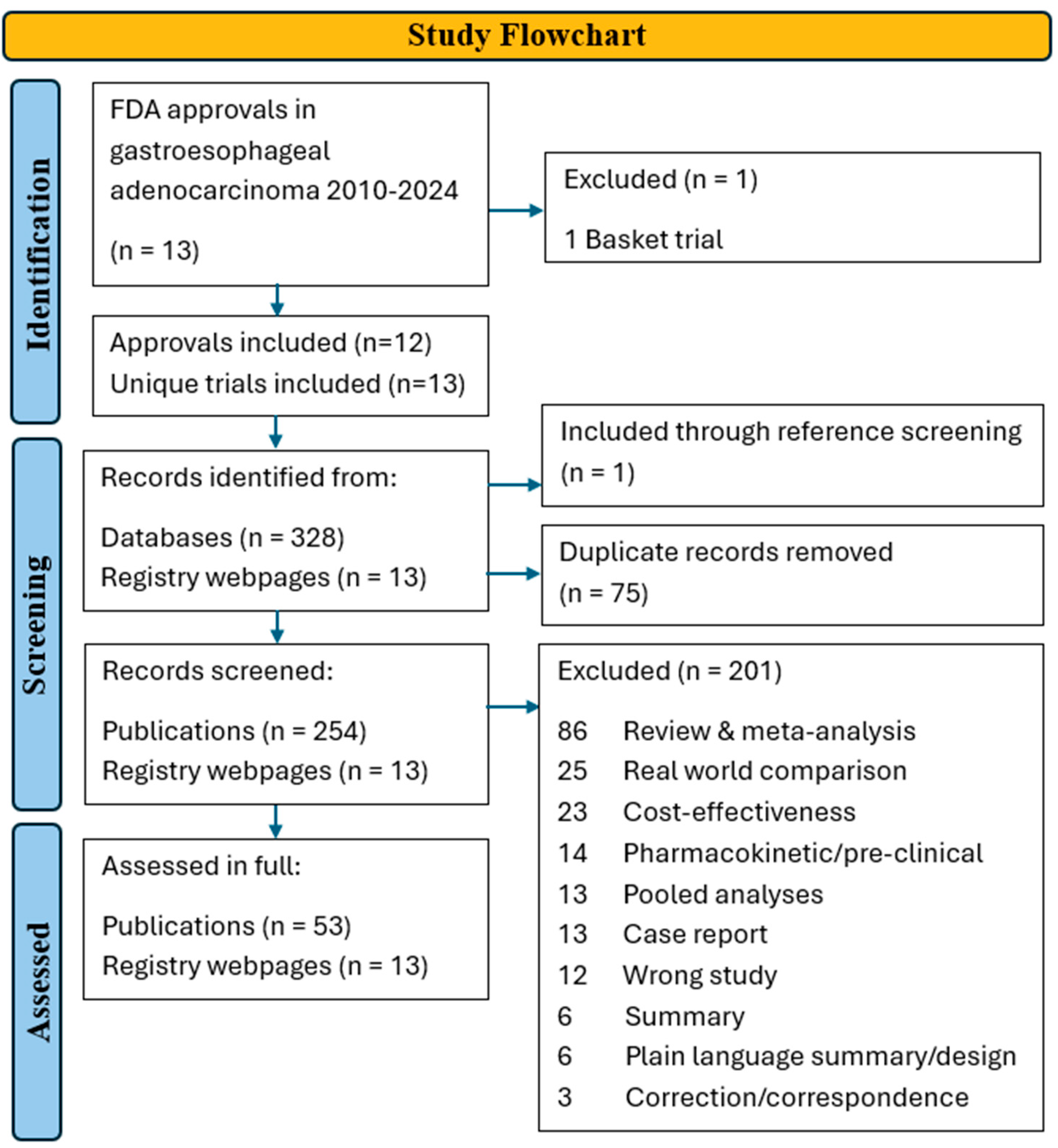
2.1. Trial and Publication Sample
2.2. Definition of Efficacy Endpoints
2.3. Data Extraction
3. Results
3.1. Trial and Study Characteristics
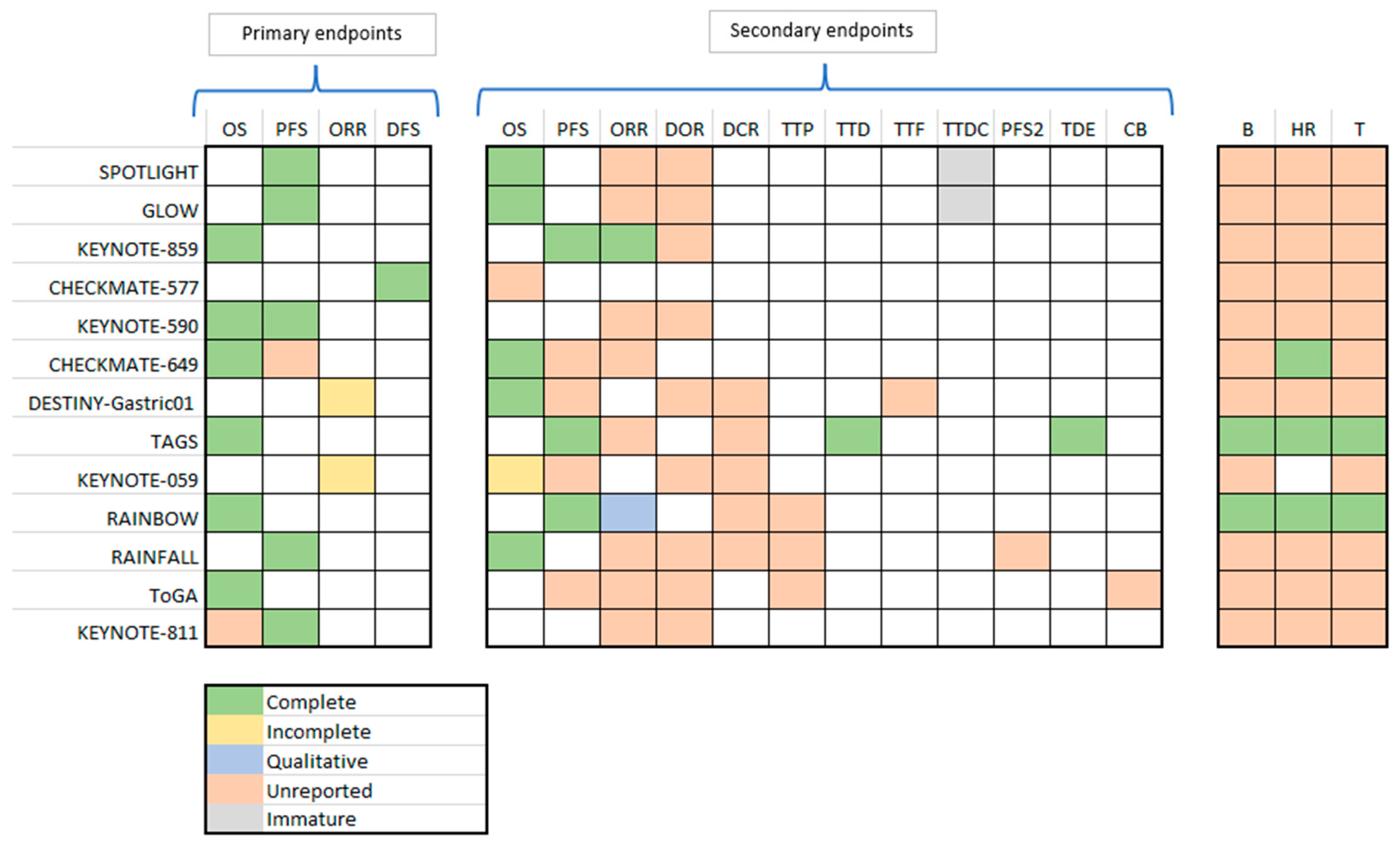
3.2. Efficacy Endpoint Reporting
3.3. Key Efficacy Points
3.4. Baseline Characteristics, Toxicity, and Health-Related Quality of Life
4. Discussion
5. Conclusions
Supplementary Materials
Author Contributions
Funding
Data Availability Statement
Conflicts of Interest
Abbreviations
| CB | Clinical benefit |
| DFS | Disease-free survival |
| DCR | Disease control rate |
| DOR | Duration of response |
| EAC | Oesophageal cancer |
| ECOG | Eastern Cooperative Oncology Group |
| FDA | Food and Drug Administration |
| GC | Gastric cancer |
| GEJ | Gastro-oesophageal junction cancer |
| GOA | Gastric, gastro-oesophageal junction and oesophageal adenocarcinoma |
| HRQOL | Health-related quality of life |
| OS | Overall survival |
| ORR | Objective response rate |
| PDL1 | Programmed death-ligand 1 |
| PFS | Progression-free survival |
| PFS2 | Progression-free survival measured from randomisation to progression (or death) on second-line systemic therapy |
| PS | Performance status |
| RCT | Randomised controlled trials |
| SSC | Squamous cell carcinoma |
| TDE | Time to treatment discontinuation |
| TTCD | Time to confirmed deterioration |
| TTF | Time to treatment failure |
| TTP | Time to progressive disease |
References
- Pilleron, S.; Sarfati, D.; Janssen-Heijnen, M.; Vignat, J.; Ferlay, J.; Bray, F.; Soerjomataram, I. Global cancer incidence in older adults, 2012 and 2035: A population-based study. Int. J. Cancer 2018, 144, 49–58. [Google Scholar] [CrossRef] [Scilit]
- Garner, W.B.; Smith, B.D.; Ludmir, E.B.; Wakefield, D.V.; Shabason, J.; Williams, G.R.; Martin, M.Y.; Wang, Y.; Ballo, M.T.; VanderWalde, N.A. Predicting future cancer incidence by age, race, ethnicity, and sex. J. Geriatr. Oncol. 2022, 14, 101393. [Google Scholar] [CrossRef] [Scilit]
- Ethun, C.G.; Bilen, M.A.; Jani, A.B.; Maithel, S.K.; Ogan, K.; Master, V.A. Frailty and cancer: Implications for oncology surgery, medical oncology, and radiation oncology. CA Cancer J. Clin. 2017, 67, 362–377. [Google Scholar] [CrossRef] [Scilit]
- Chen, W.; Altshuler, R.D.; Daschner, P.; Morales, C.S.; St Germain, D.C.; Guida, J.; Prasanna, P.G.S.; Buchsbaum, J.C. Older adults with cancer and common comorbidities—Challenges and opportunities in improving their cancer treatment outcomes. J. Natl. Cancer Inst. 2024, 116, 1730–1738. [Google Scholar] [CrossRef] [Scilit]
- Soto-Perez-De-Celis, E.; Dale, W.; Katheria, V.; Kim, H.; Fakih, M.; Chung, V.M.; Lim, D.; Mortimer, J.; Chien, L.C.; Charles, K.; et al. Outcome prioritization and preferences among older adults with cancer starting chemotherapy in a randomized clinical trial. Cancer 2024, 130, 3000–3010. [Google Scholar] [CrossRef] [Scilit]
- Grellety, T.; Bellera, C.; Cantarel, C.; Mertens, C.; Cabart, M.; Roubaud, G.; Chantecaille, M.-C.; Desclos, H.; Souyris, C.; Bouchaert, P.; et al. Important aspects of care and priorities of older patients with cancer: The PRIORITY multicenter cohort study. J. Geriatr. Oncol. 2025, 17, 102812. [Google Scholar] [CrossRef] [Scilit]
- Chow, R.; Lage, D.E.; Williams, G.R.; Sedrak, M.S.; Greer, J.A.; Temel, J.S.; Nipp, R.D. Representation and Outcomes of Older Adults in Practice-Changing Oncology Trials in the Era of Novel Therapies: A Guideline Appraisal. J. Natl. Compr. Cancer Netw. 2022, 20, 37–44. [Google Scholar] [CrossRef] [Scilit]
- Singh, H.; Kanapuru, B.; Smith, C.; Fashoyin-Aje, L.A.; Myers, A.; Kim, G.; Pazdur, R. FDA analysis of enrollment of older adults in clinical trials for cancer drug registration: A 10-year experience by the U.S. Food and Drug Administration. J. Clin. Oncol. 2017, 35, 10009. [Google Scholar] [CrossRef] [Scilit]
- Brintzenhofeszoc, K.; Krok-Schoen, J.L.; Canin, B.; Parker, I.; MacKenzie, A.R.; Koll, T.; Vankina, R.; Hsu, C.D.; Jang, B.; Pan, K.; et al. The underreporting of phase III chemo-therapeutic clinical trial data of older patients with cancer: A systematic review. J. Geriatr. Oncol. 2020, 11, 369–379. [Google Scholar] [CrossRef] [Scilit]
- DuMontier, C.; Loh, K.P.; Soto-Perez-De-Celis, E.; Dale, W. Decision Making in Older Adults with Cancer. J. Clin. Oncol. 2021, 39, 2164–2174. [Google Scholar] [CrossRef] [Scilit]
- DuMontier, C.; Loh, K.P.; Bain, P.A.; Silliman, R.A.; Hshieh, T.; Abel, G.A.; Djulbegovic, B.; Driver, J.A.; Dale, W. Defining Undertreatment and Overtreatment in Older Adults with Cancer: A Scoping Literature Review. J. Clin. Oncol. 2020, 38, 2558–2569. [Google Scholar] [CrossRef] [Scilit]
- Chen, R.C.; Royce, T.J.; Extermann, M.; Reeve, B.B. Impact of Age and Comorbidity on Treatment and Outcomes in Elderly Cancer Patients. Semin. Radiat. Oncol. 2012, 22, 265–271. [Google Scholar] [CrossRef] [Scilit]
- Baxter, M.A.; Khan, K.S.; Gall, L.S.; Samuelson, C.; McCollum, C.; Chuntamongkol, R.; Narramneni, L.R.; Al-Zuabi, M.; Bryce, G.; Shareef, H.E.J.; et al. Diagnosis, treatment, and outcome of patients with oesophagogastric cancer during the COVID-19 pandemic: National study. Br. J. Surg. 2023, 110, 456–461. [Google Scholar] [CrossRef] [Scilit]
- Handforth, C.; Clegg, A.; Young, C.; Simpkins, S.; Seymour, M.T.; Selby, P.J.; Young, J. The prevalence and outcomes of frailty in older cancer patients: A systematic review. Ann. Oncol. 2014, 26, 1091–1101. [Google Scholar] [CrossRef] [Scilit]
- Chang, W.H.; Lai, A.G. Pan-cancer analyses of the associations between 109 pre-existing conditions and cancer treatment patterns across 19 adult cancers. Sci. Rep. 2024, 14, 464. [Google Scholar] [CrossRef] [Scilit]
- Pucher, P.H.; Park, M.H.; Cromwell, D.A.; Crosby, T.C.; Thomas, B.; Trudgill, N.; Wahedally, M.; Maynard, N.; Gossage, J.A. Diagnosis and treatment for gastro-oesophageal cancer in England and Wales: Analysis of the National Oesophago-Gastric Cancer Audit (NOGCA) database 2012–2020. Br. J. Surg. 2023, 110, 701–709. [Google Scholar] [CrossRef] [Scilit]
- Rompen, I.F.; Crnovrsanin, N.; Nienhüser, H.; Neuschütz, K.; Fourie, L.; Sisic, L.; Müller-Stich, B.P.; Billeter, A.T. Age-dependent benefit of neoadjuvant treatment in adenocarcinoma of the esophagus and gastroesophageal junction: A multicenter retrospective observational study of young versus old patients. Int. J. Surg. 2023, 109, 3804–3814. [Google Scholar] [CrossRef] [Scilit]
- Nelen, S.D.; Verhoeven, R.H.A.; Lemmens, V.E.P.P.; de Wilt, J.H.W.; Bosscha, K. Increasing survival gap between young and elderly gastric cancer patients. Gastric Cancer 2017, 20, 919–928. [Google Scholar] [CrossRef] [Scilit]
- Sexton, R.E.; Al Hallak, M.N.; Diab, M.; Azmi, A.S. Gastric cancer: A comprehensive review of current and future treatment strategies. Cancer Metastasis Rev. 2020, 39, 1179–1203. [Google Scholar] [CrossRef] [Scilit]
- Kunene, V.; Ding, M.; Yap, M.; Griffiths, E.A.; Taniere, P.; Fackrell, D.; Butler, S.; Contino, G. Prognostic markers in oesophageal and gastric cancer review. Are they ready for clinical practice? ESMO Gastrointest. Oncol. 2024, 6, 100091. [Google Scholar] [CrossRef] [Scilit]
- Mac Eochagain, C.; Power, R.; Sam, C.; Gonzalez-Senac, N.M.; Walsh, D.; Roy, M.; Battisti, N.M.L. Inclusion, characteristics, and reporting of older adults in FDA registration studies of immunotherapy, 2018–2022. J. Immunother. Cancer 2024, 12, e009258. [Google Scholar] [CrossRef] [Scilit]
- U.S. Food and Drug Administration. Oncology (Cancer)/Hematologic Malignancies Approval Notifications. Available online: https://www.fda.gov/drugs/resources-information-approved-drugs/oncology-cancerhematologic-malignancies-approval-notifications (accessed on 13 February 2026).
- Meric-Bernstam, F.; Makker, V.; Oaknin, A.; Oh, D.-Y.; Banerjee, S.; González-Martín, A.; Jung, K.H.; Ługowska, I.; Manso, L.; Manzano, A.; et al. Efficacy and Safety of Trastuzumab Deruxtecan in Patients with HER2-Expressing Solid Tumors: Primary Results from the DESTINY-PanTumor02 Phase II Trial. J. Clin. Oncol. 2024, 42, 47–58. [Google Scholar] [CrossRef] [Scilit] [PubMed]
- Kelly, R.J.; Ajani, J.A.; Kuzdzal, J.; Zander, T.; Van Cutsem, E.; Piessen, G.; Mendez, G.; Feliciano, J.; Motoyama, S.; Lievre, A.; et al. Adjuvant Nivolumab in Resected Esophageal or Gastroesophageal Junction Cancer. N. Engl. J. Med. 2021, 384, 1191–1203. [Google Scholar] [CrossRef] [Scilit]
- Sun, J.-M.; Shen, L.; Shah, M.A.; Enzinger, P.; Adenis, A.; Doi, T.; Kojima, T.; Metges, J.-P.; Li, Z.; Kim, S.-B.; et al. Pembrolizumab plus chemotherapy versus chemotherapy alone for first-line treatment of advanced oesophageal cancer (KEYNOTE-590): A randomised, placebo-controlled, phase 3 study. Lancet 2021, 398, 759–771. [Google Scholar] [CrossRef] [Scilit]
- Shitara, K.; Bang, Y.-J.; Iwasa, S.; Sugimoto, N.; Ryu, M.-H.; Sakai, D.; Chung, H.-C.; Kawakami, H.; Yabusaki, H.; Lee, J.; et al. Trastuzumab Deruxtecan in Previously Treated HER2-Positive Gastric Cancer. N. Engl. J. Med. 2020, 382, 2419–2430. [Google Scholar] [CrossRef] [Scilit]
- Shitara, K.; Ajani, J.A.; Moehler, M.; Garrido, M.; Gallardo, C.; Shen, L.; Yamaguchi, K.; Wyrwicz, L.; Skoczylas, T.; Bragagnoli, A.C.; et al. Nivolumab plus chemotherapy or ipilimumab in gastro-oesophageal cancer. Nature 2022, 603, 942–948. [Google Scholar] [CrossRef] [Scilit]
- Hall, P.S.; Swinson, D.; Cairns, D.A.; Waters, J.S.; Petty, R.; Allmark, C.; Ruddock, S.; Falk, S.; Wadsley, J.; Roy, R.; et al. Efficacy of Reduced-Intensity Chemotherapy with Oxaliplatin and Capecitabine on Quality of Life and Cancer Control Among Older and Frail Patients with Advanced Gastroesophageal Cancer: The GO2 Phase 3 Randomized Clinical Trial. JAMA Oncol. 2021, 7, 869–877. [Google Scholar] [CrossRef] [Scilit]
- Chan, A.-W.; Hróbjartsson, A.; Haahr, M.T.; Gøtzsche, P.C.; Altman, D.G. Empirical evidence for selective reporting of outcomes in randomized trials: Comparison of protocols to published articles. JAMA 2004, 291, 2457–2465. [Google Scholar] [CrossRef] [Scilit]
- Eochagain, C.M.; Battisti, N.M.L. Reporting of older subgroups in registration breast cancer trials 2012–2021. Breast Cancer Res. Treat. 2023, 202, 411–421. [Google Scholar] [CrossRef] [Scilit]
- Shitara, K.; Doi, T.; Hosaka, H.; Thuss-Patience, P.; Santoro, A.; Longo, F.; Ozyilkan, O.; Cicin, I.; Park, D.; Zaanan, A.; et al. Efficacy and safety of trifluridine/tipiracil in older and younger patients with metastatic gastric or gastroesophageal junction cancer: Subgroup analysis of a randomized phase 3 study (TAGS). Gastric Cancer 2022, 25, 586–597. [Google Scholar] [CrossRef] [Scilit]
- Muro, K.; Cho, J.Y.; Bodoky, G.; Goswami, C.; Chao, Y.; dos Santos, L.V.; Shimada, Y.; Topuzov, E.; Van Cutsem, E.; Tabernero, J.; et al. Age does not influence efficacy of ramucirumab in advanced gastric cancer: Subgroup analyses of REGARD and RAINBOW. J. Gastroenterol. Hepatol. 2017, 33, 814–824. [Google Scholar] [CrossRef] [Scilit]
- Bang, Y.-J.; Van Cutsem, E.; Feyereislova, A.; Chung, H.C.; Shen, L.; Sawaki, A.; Lordick, F.; Ohtsu, A.; Omuro, Y.; Satoh, T.; et al. Trastuzumab in combination with chemotherapy versus chemotherapy alone for treatment of HER2-positive advanced gastric or gastro-oesophageal junction cancer (ToGA): A phase 3, open-label, randomised controlled trial. Lancet 2010, 376, 687–697. [Google Scholar] [CrossRef] [Scilit]
- Shitara, K.; Lordick, F.; Bang, Y.-J.; Enzinger, P.; Ilson, D.; Shah, M.A.; Van Cutsem, E.; Xu, R.-H.; Aprile, G.; Xu, J.; et al. Zolbetuximab plus mFOLFOX6 in patients with CLDN18.2-positive, HER2-negative, untreated, locally advanced unresectable or metastatic gastric or gastro-oesophageal junction adenocarcinoma (SPOTLIGHT): A multicentre, randomised, double-blind, phase 3 trial. Lancet 2023, 401, 1655–1668. [Google Scholar] [CrossRef] [Scilit]
- Shah, M.A.; Shitara, K.; Ajani, J.A.; Bang, Y.-J.; Enzinger, P.; Ilson, D.; Lordick, F.; Van Cutsem, E.; Plazas, J.G.; Huang, J.; et al. Zolbetuximab plus CAPOX in CLDN18.2-positive gastric or gastroesophageal junction adenocarcinoma: The randomized, phase 3 GLOW trial. Nat. Med. 2023, 29, 2133–2141. [Google Scholar] [CrossRef] [Scilit]
- Lin, D.; Quan, W.; Garretson, M.; Chirikov, V.; Chen, C.; Singh, P.; Davis, C.; Sugarman, R. Q-TWiST analysis of first-line nivolumab plus chemotherapy versus chemotherapy in patients with advanced gastric cancer, gastroesophageal junction cancer, or esophageal adenocarcinoma from CheckMate 649: 4-year follow-up results. Gastric Cancer 2025, 28, 935–944. [Google Scholar] [CrossRef] [Scilit]
- A Study to Compare Zolbetuximab (IMAB362) and Chemotherapy with Placebo and Chemotherapy in Adults with Gastric Cancer (Spotlight). ClinicalTrials.gov Identifier: NCT03504397. Updated 29 October 2025. Available online: https://clinicaltrials.gov/study/NCT03504397 (accessed on 21 January 2026).
- A Study of Zolbetuximab (IMAB362) Plus CAPOX Compared with Placebo Plus CAPOX as First-Line Treatment of Subjects with Claudin (CLDN) 18.2-Positive, HER2-Negative, Locally Advanced Unresectable or Metastatic Gastric or Gastroesophageal Junction (GEJ) Adenocarcinoma (GLOW). ClinicalTrials.gov Identifier: NCT03653507. Updated 24 October 2025. Available online: https://clinicaltrials.gov/study/NCT03653507 (accessed on 21 January 2026).
- Pembrolizumab (MK-3475) Plus Chemotherapy Versus Placebo Plus Chemotherapy in Participants Gastric or Gastroesophageal Junction (GEJ) Adenocarcinoma (MK-3475-859/KEYNOTE-859). ClinicalTrials.gov Identifier: NCT03675737. Updated 8 July 2025. Available online: https://clinicaltrials.gov/study/NCT03675737 (accessed on 21 January 2026).
- An Investigational Immuno-Therapy Study of Nivolumab or Placebo in Participants with Resected Esophageal or Gastroesophageal Junction Cancer (CheckMate 577). ClinicalTrials.gov Identifier: NCT02743494. Updated 18 November 2025. Available online: https://clinicaltrials.gov/study/NCT02743494 (accessed on 21 January 2026).
- First-line Esophageal Carcinoma Study with Pembrolizumab Plus Chemo vs. Chemo (MK-3475-590/KEYNOTE-590). ClinicalTrials.gov Identifier: NCT03189719. Updated 15 October 2024. Available online: https://clinicaltrials.gov/study/NCT03189719 (accessed on 21 January 2026).
- Efficacy Study of Nivolumab Plus Ipilimumab or Nivolumab Plus Chemotherapy Against Chemotherapy in Stomach Cancer or Stomach/Esophagus Junction Cancer (CheckMate649). ClinicalTrials.gov Identifier: NCT02872116. Updated 7 August 2025. Available online: https://clinicaltrials.gov/study/NCT02872116 (accessed on 21 January 2026).
- DS-8201a in Human Epidermal Growth Factor Receptor 2 (HER2)-Expressing Gastric Cancer [DESTINY-Gastric01]. ClinicalTrials.gov Identifier: NCT03329690. Updated 18 March 2022. Available online: https://clinicaltrials.gov/study/NCT03329690 (accessed on 21 January 2026).
- Study of TAS-102 or Placebo Plus BSC in Patients with Metastatic Gastric Cancer. ClinicalTrials.gov Identifier: NCT02500043. Updated 3 September 2024. Available online: https://clinicaltrials.gov/study/NCT02500043 (accessed on 21 January 2026).
- A Study of Pembrolizumab (MK-3475) in Participants with Recurrent or Metastatic Gastric or Gastroesophageal Junction Adenocarcinoma (MK-3475-059/KEYNOTE-059). ClinicalTrials.gov Identifier: NCT0233541. Updated 8 August 2022. Available online: https://clinicaltrials.gov/study/NCT02335411 (accessed on 21 January 2026).
- A Study of Paclitaxel with or Without Ramucirumab (IMC-1211B) in Metastatic Gastric Adenocarcinoma (RAINBOW). ClinicalTrials.gov Identifier: NCT01170663. Updated 18 September 2019. Available online: https://clinicaltrials.gov/study/NCT01170663 (accessed on 21 January 2026).
- A Study of Ramucirumab (LY3009806) in Combination with Capecitabine and Cisplatin in Participants with Stomach Cancer (RAINFALL). ClinicalTrials.gov Identifier: NCT02314117. Updated 26 August 2021. Available online: https://clinicaltrials.gov/study/NCT02314117 (accessed on 21 January 2026).
- ToGA Study—A Study of Herceptin (Trastuzumab) in Combination with Chemotherapy Compared with Chemotherapy Alone in Patients with HER2-Positive Advanced Gastric Cancer. ClinicalTrials.gov Identifier: NCT01041404. Updated 5 November 2014. Available online: https://clinicaltrials.gov/study/NCT01041404 (accessed on 21 January 2026).
- Pembrolizumab/Placebo Plus Trastuzumab Plus Chemotherapy in Human Epidermal Growth Factor Receptor 2 Positive (HER2+) Advanced Gastric or Gastroesophageal Junction (GEJ) Adenocarcinoma (MK-3475-811/KEYNOTE-811). ClinicalTrials.gov Identifier: NCT03615326. Updated 11 December 2025. Available online: https://clinicaltrials.gov/study/NCT03615326 (accessed on 21 January 2026).
- Sedrak, M.S.; Freedman, R.A.; Cohen, H.J.; Muss, H.B.; Jatoi, A.; Klepin, H.D.; Wildes, T.M.; Le-Rademacher, J.G.; Kimmick, G.G.; Tew, W.P.; et al. Older adult participation in cancer clinical trials: A systematic review of barriers and interventions. CA Cancer J. Clin. 2020, 71, 78–92. [Google Scholar] [CrossRef] [Scilit]
- Scher, K.S.; Hurria, A. Under-Representation of Older Adults in Cancer Registration Trials: Known Problem, Little Progress. J. Clin. Oncol. 2012, 30, 2036–2038. [Google Scholar] [CrossRef] [Scilit]
- Lewis, J.H.; Kilgore, M.L.; Goldman, D.P.; Trimble, E.L.; Kaplan, R.; Montello, M.J.; Housman, M.G.; Escarce, J.J. Participation of Patients 65 Years of Age or Older in Cancer Clinical Trials. J. Clin. Oncol. 2003, 21, 1383–1389. [Google Scholar] [CrossRef] [Scilit]
- Ludmir, E.B.; Mainwaring, W.; Lin, T.A.; Miller, A.B.; Jethanandani, A.; Espinoza, A.F.; Mandel, J.J.; Lin, S.H.; Smith, B.D.; Smith, G.L.; et al. Factors Associated with Age Disparities Among Cancer Clinical Trial Participants. JAMA Oncol. 2019, 5, 1769–1773. [Google Scholar] [CrossRef] [Scilit]
- Kornblith, A.B.; Kemeny, M.; Peterson, B.L.; Wheeler, J.; Crawford, J.; Bartlett, N.; Fleming, G.; Graziano, S.; Muss, H.; Cohen, H.J.; et al. Survey of oncologists’ perceptions of barriers to accrual of older patients with breast carcinoma to clinical trials. Cancer 2002, 95, 989–996. [Google Scholar] [CrossRef] [Scilit]
- Hurria, A.; Wong, F.L.; Villaluna, D.; Bhatia, S.; Chung, C.T.; Mortimer, J.; Hurvitz, S.; Naeim, A. Role of Age and Health in Treatment Recommendations for Older Adults with Breast Cancer: The Perspective of Oncologists and Primary Care Providers. J. Clin. Oncol. 2008, 26, 5386–5392. [Google Scholar] [CrossRef] [Scilit]
- Hurria, A.; Mohile, S.; Gajra, A.; Klepin, H.; Muss, H.; Chapman, A.; Feng, T.; Smith, D.; Sun, C.-L.; De Glas, N.; et al. Validation of a Prediction Tool for Chemotherapy Toxicity in Older Adults with Cancer. J. Clin. Oncol. 2016, 34, 2366–2371. [Google Scholar] [CrossRef] [Scilit]
- Dale, W.; Mohile, S.G.; Eldadah, B.A.; Trimble, E.L.; Schilsky, R.L.; Cohen, H.J.; Muss, H.B.; Schmader, K.E.; Ferrell, B.; Extermann, M.; et al. Biological, Clinical, and Psychosocial Correlates at the Interface of Cancer and Aging Research. J. Natl. Cancer Inst. 2012, 104, 581–589. [Google Scholar] [CrossRef] [Scilit]
- Brunello, A.; Sandri, R.; Extermann, M. Multidimensional geriatric evaluation for older cancer patients as a clinical and research tool. Cancer Treat. Rev. 2009, 35, 487–492. [Google Scholar] [CrossRef] [Scilit]
- Soto-Perez-De-Celis, E.; Li, D.; Yuan, Y.; Lau, Y.M.; Hurria, A. Functional versus chronological age: Geriatric assessments to guide decision making in older patients with cancer. Lancet Oncol. 2018, 19, e305–e316. [Google Scholar] [CrossRef] [Scilit]
- Lowsky, D.J.; Olshansky, S.J.; Bhattacharya, J.; Goldman, D.P. Heterogeneity in Healthy Aging. J. Gerontol. Ser. A 2013, 69, 640–649. [Google Scholar] [CrossRef] [Scilit]
- van Walree, I.C.; Scheepers, E.; van Huis-Tanja, L.; Emmelot-Vonk, M.H.; Bellera, C.; Soubeyran, P.; Hamaker, M.E. A systematic review on the association of the G8 with geriatric assessment, prognosis and course of treatment in older patients with cancer. J. Geriatr. Oncol. 2019, 10, 847–858. [Google Scholar] [CrossRef] [Scilit]
- Extermann, M.; Boler, I.; Reich, R.R.; Lyman, G.H.; Brown, R.H.; DeFelice, J.; Levine, R.M.; Lubiner, E.T.; Reyes, P.; Schreiber, F.J.; et al. Predicting the risk of chemotherapy toxicity in older patients: The Chemotherapy Risk Assessment Scale for High-Age Patients (CRASH) score. Cancer 2011, 118, 3377–3386. [Google Scholar] [CrossRef] [Scilit]
- Hurria, A.; Gupta, S.; Zauderer, M.; Zuckerman, E.L.; Cohen, H.J.; Muss, H.; Rodin, M.; Panageas, K.S.; Holland, J.C.; Saltz, L.; et al. Developing a cancer-specific geriatric assessment: A feasibility study. Cancer 2005, 104, 1998–2005. [Google Scholar] [CrossRef] [Scilit]
- Hurria, A.; Togawa, K.; Mohile, S.G.; Owusu, C.; Klepin, H.D.; Gross, C.P.; Lichtman, S.M.; Gajra, A.; Bhatia, S.; Katheria, V.; et al. Predicting Chemotherapy Toxicity in Older Adults with Cancer: A Prospective Multicenter Study. J. Clin. Oncol. 2011, 29, 3457–3465. [Google Scholar] [CrossRef] [Scilit]
- Hurria, A.; Akiba, C.; Kim, J.; Mitani, D.; Loscalzo, M.; Katheria, V.; Koczywas, M.; Pal, S.; Chung, V.; Forman, S.; et al. Reliability, Validity, and Feasibility of a Computer-Based Geriatric Assessment for Older Adults with Cancer. J. Oncol. Pr. 2016, 12, e1025–e1034. [Google Scholar] [CrossRef] [Scilit]
- Fitzsimmons, D.; Gilbert, J.; Howse, F.; Young, T.; Arrarras, J.-I.; Brédart, A.; Hawker, S.; George, S.; Aapro, M.; Johnson, C.D. A systematic review of the use and validation of health-related quality of life instruments in older cancer patients. Eur. J. Cancer 2009, 45, 19–32. [Google Scholar] [CrossRef] [Scilit]
- Fitch, M.I.; Strohschein, F.J.; Nyrop, K. Measuring quality of life in older people with cancer. Curr. Opin. Support. Palliat. Care 2021, 15, 39–47. [Google Scholar] [CrossRef] [Scilit]
- Seghers, P.A.L.; Kregting, J.A.; van Huis-Tanja, L.H.; Soubeyran, P.; O’Hanlon, S.; Rostoft, S.; Hamaker, M.E.; Portielje, J.E.A. What Defines Quality of Life for Older Patients Diagnosed with Cancer? A Qualitative Study. Cancers 2022, 14, 1123. [Google Scholar] [CrossRef] [Scilit]
- Wheelwright, S.; Darlington, A.-S.; Fitzsimmons, D.; Fayers, P.; Arraras, J.I.; Bonnetain, F.; Brain, E.; Bredart, A.; Chie, W.-C.; Giesinger, J.; et al. International validation of the EORTC QLQ-ELD14 questionnaire for assessment of health-related quality of life elderly patients with cancer. Br. J. Cancer 2013, 109, 852–858. [Google Scholar] [CrossRef] [Scilit]
- Culakova, E.; Mohile, S.G.; Peppone, L.; Ramsdale, E.; Mohamed, M.; Xu, H.; Wells, M.; Tylock, R.; Java, J.; Loh, K.P.; et al. Effects of a Geriatric Assessment Intervention on Patient-Reported Symptomatic Toxicity in Older Adults with Advanced Cancer. J. Clin. Oncol. 2023, 41, 835–846. [Google Scholar] [CrossRef] [Scilit]
- Li, D.; Sun, C.-L.; Kim, H.; Soto-Perez-de-Celis, E.; Chung, V.; Koczywas, M.; Fakih, M.; Chao, J.; Cabrera Chien, L.; Charles, K.; et al. Geriatric Assessment-Driven Intervention (GAIN) on Chemotherapy-Related Toxic Effects in Older Adults with Cancer: A Randomized Clinical Trial. JAMA Oncol. 2021, 7, e214158. [Google Scholar] [CrossRef] [Scilit]
- Battisti, N.M.L.; Arora, S.P. An overview of chemotherapy toxicity prediction tools in older adults with cancer: A young international society of geriatric oncology and nursing and allied health initiative. J. Geriatr. Oncol. 2022, 13, 521–525. [Google Scholar] [CrossRef] [Scilit]
- Welaya, K.; Loh, K.P.; Messing, S.; Szuba, E.; Magnuson, A.; Mohile, S.G.; Maggiore, R.J. Geriatric assessment and treatment outcomes in older adults with cancer receiving immune checkpoint inhibitors. J. Geriatr. Oncol. 2020, 11, 523–528. [Google Scholar] [CrossRef] [Scilit]
- Dale, W.; Klepin, H.D.; Williams, G.R.; Alibhai, S.M.H.; Bergerot, C.; Brintzenhofeszoc, K.; Hopkins, J.O.; Jhawer, M.P.; Katheria, V.; Loh, K.P.; et al. Practical Assessment and Management of Vulnerabilities in Older Patients Receiving Systemic Cancer Therapy: ASCO Guideline Update. J. Clin. Oncol. 2023, 41, 4293–4312. [Google Scholar] [CrossRef] [Scilit]
- Baldini, C.; Mislang, A.R.A.; Cheung, K.-L.; Pilleron, S.; Wildiers, H.; Rostoft, S.; Neuendorff, N.R.; Frelaut, M.; Kanesvaran, R.; Papamichael, D.; et al. The ESMO/SIOG Cancer in the Elderly Working Group pragmatic strategies for clinical trial designs and endpoints in older adults with cancer. ESMO Open 2026, 11, 105940. [Google Scholar] [CrossRef] [Scilit]
- Hurria, A.; Levit, L.A.; Dale, W.; Mohile, S.G.; Muss, H.B.; Fehrenbacher, L.; Magnuson, A.; Lichtman, S.M.; Bruinooge, S.S.; Soto-Perez-De-Celis, E.; et al. Improving the Evidence Base for Treating Older Adults with Cancer: American Society of Clinical Oncology Statement. J. Clin. Oncol. 2015, 33, 3826–3833. [Google Scholar] [CrossRef] [Scilit]
- Mohile, S.G.; Dale, W.; Somerfield, M.R.; Schonberg, M.A.; Boyd, C.M.; Burhenn, P.S.; Canin, B.; Cohen, H.J.; Holmes, H.M.; Hopkins, J.O.; et al. Practical Assessment and Management of Vulnerabilities in Older Patients Receiving Chemotherapy: ASCO Guideline for Geriatric Oncology. J. Clin. Oncol. 2018, 36, 2326–2347. [Google Scholar] [CrossRef] [Scilit] [PubMed]
- Le-Rademacher, J.; Mohile, S.; Unger, J.; Hudson, M.F.; Foster, J.; Lichtman, S.; Perlmutter, J.; Dotan, E.; Extermann, M.; Dodd, K.; et al. Trial Design Considerations to Increase Older Adult Accrual to National Cancer Institute Clinical Trials. JNCI Monogr. 2022, 2022, 135–141. [Google Scholar] [CrossRef] [Scilit]
- Hurria, A.; Dale, W.; Mooney, M.; Rowland, J.H.; Ballman, K.V.; Cohen, H.J.; Muss, H.B.; Schilsky, R.L.; Ferrell, B.; Extermann, M.; et al. Designing Therapeutic Clinical Trials for Older and Frail Adults with Cancer: U13 Conference Recommendations. J. Clin. Oncol. 2014, 32, 2587–2594. [Google Scholar] [CrossRef] [Scilit]



| Domain | Inclusion | Exclusion |
|---|---|---|
| Study characteristics |
• Primary study reports • Secondary publications • Clinicaltrial.gov database |
• Plain language summaries & study design • Review papers & meta- analyses • Pooled analyses without new primary data • Conference reviews & corrections & correspondence • Case reports • Summary |
| Population | • Gastric, gastro-oesophageal junction and oesophageal adenocarcinoma | • Oesophageal squamous cell carcinoma • Trials specifically in older adults |
| Intervention/ exposure | • Clinical trials leading to a US Food and Drug Administration (FDA) full approval or accelerated approval between 2010 and 2024 | • Dose de-escalation studies (i.e., GO2 [28]) |
| Outcomes | • Primary and secondary efficacy outcomes • Baseline characteristics • Toxicity • Health-related quality of life | • Cost-effectiveness analysis • Pharmacokinetics/pre-clinical focus • Real-world comparison |
| Level of Reporting | Reported Data | Sufficient for Inclusion in Meta-Analysis |
|---|---|---|
| Complete | (1) Number of participants per group (2) Effect size (3) Precision or precise p-value for continuous data | Yes |
| Partial | Effect size or precision (±p-value, ±sample size) | No |
| Qualitative | p-value ± sample size | No |
| Unreported | Not available | No |
| Domain | Minimum Threshold |
|---|---|
| Baseline characteristics | Performance status OR co-morbidities AND ≥1 Key prognostic OR predictive factor(s) * |
| Toxicity | ≥3 Key toxicity domain(s) by organ site OR Overall G3 toxicity AND ≥1 key toxicity domain * |
| HRQOL | ≥1 validated HRQOL instrument(s) |
| Level of Reporting | Reported Data |
| Complete | Meets minimum threshold, including numerical data sufficient for inclusion in meta-analysis |
| Partial | Meets minimum threshold, including numerical data insufficient for inclusion in meta-analysis |
| Qualitative | Meets minimum threshold, without numerical data |
| Unreported | Does not meet minimum threshold |
| Number | Percentage | |
|---|---|---|
| Phase | ||
| II | 2 | 15.4% |
| III | 11 | 84.6% |
| Disease site | ||
| GC and GEJC | 10 | 76.9% |
| EAC and GEJC | 2 | 15.3% |
| GC, EAC and GEJC | 1 | 7.7% |
| Histology | ||
| Adenocarcinoma | 11 | 84.6% |
| Adenocarcinoma & SSC | 2 | 15.4% |
| Setting | ||
| Advanced/metastatic | 12 | 92.3% |
| Adjuvant | 1 | 7.7% |
| Molecular characteristics | ||
| HER2-positive | 3 | 23.1% |
| HER2-negative | 5 | 38.5% |
| CDLN18.2 positive | 2 | 15.4% |
| Drug type | ||
| Monoclonal antibody * | 6 | 46.2% |
| Checkpoint inhibitor * | 5 | 38.5% |
| Monoclonal antibody & checkpoint inhibitor * | 1 | 7.7% |
| Chemotherapy | 1 | 7.7% |
| Enrolment | ||
| N (mean, 95% CI) | 716.9 | 462.7–971.2 |
| 100–250 | 1 | 7.7% |
| 250–500 | 1 | 7.7% |
| 500–750 | 8 | 61.5% |
| 750–1000 | 1 | 7.7% |
| >1000 | 2 | 15.4% |
| Population | ||
| Total | 9320 | 100% |
| Older adult ^ | 3736 | 40.1% |
| ECOG 0 ± | 3690 | 42.2% |
| ECOG 1 ± | 5025 | 57.5% |
| ECOG 2 | 63 | 0.7% |
| N | Complete (%) | Partial (%) | Qualitative (%) | Unreported (%) | |
|---|---|---|---|---|---|
| Primary endpoints | 21 | 14 (66.7%) | 2 (9.5%) | 0 (0.0%) | 5 (23.8%) |
| Secondary endpoints | 65 | 13 (20.0%) | 1 (1.5%) | 1 (1.5%) | 50 (76.9%) |
| Baseline | 13 | 2 (15.4%) | 0 (0.0%) | 0 (0.0%) | 11 (84.6%) |
| Toxicity | 13 | 2 (15.4%) | 0 (0.0%) | 0 (0.0%) | 11 (84.6%) |
| HRQOL * | 12 | 3 (25.0%) | 0 (0.0%) | 0 (0.0%) | 9 (75.0%) |
Disclaimer/Publisher’s Note: The statements, opinions and data contained in all publications are solely those of the individual author(s) and contributor(s) and not of MDPI and/or the editor(s). MDPI and/or the editor(s) disclaim responsibility for any injury to people or property resulting from any ideas, methods, instructions or products referred to in the content. |
© 2026 by the authors. Licensee MDPI, Basel, Switzerland. This article is an open access article distributed under the terms and conditions of the Creative Commons Attribution (CC BY) license.
Share and Cite
Trip, I.; Kormi, M.; Smyth, E.; Petty, R.D.; Baxter, M.A. Quality of Outcome Reporting for Older Subgroups in FDA Registration Gastroesophageal Cancer Trials (2010–2024): A Systematic Review. Cancers 2026, 18, 2747. https://doi.org/10.3390/cancers18172747
Trip I, Kormi M, Smyth E, Petty RD, Baxter MA. Quality of Outcome Reporting for Older Subgroups in FDA Registration Gastroesophageal Cancer Trials (2010–2024): A Systematic Review. Cancers. 2026; 18(17):2747. https://doi.org/10.3390/cancers18172747
Chicago/Turabian StyleTrip, Ilse, Martha Kormi, Elizabeth Smyth, Russell D. Petty, and Mark A. Baxter. 2026. "Quality of Outcome Reporting for Older Subgroups in FDA Registration Gastroesophageal Cancer Trials (2010–2024): A Systematic Review" Cancers 18, no. 17: 2747. https://doi.org/10.3390/cancers18172747
APA StyleTrip, I., Kormi, M., Smyth, E., Petty, R. D., & Baxter, M. A. (2026). Quality of Outcome Reporting for Older Subgroups in FDA Registration Gastroesophageal Cancer Trials (2010–2024): A Systematic Review. Cancers, 18(17), 2747. https://doi.org/10.3390/cancers18172747