Predicting Therapeutic Response to Antibody-Drug Conjugates Using Targeted PET Imaging: A Systematic Review

 , , ,
, , ,
Simple Summary
Abstract
1. Introduction
2. Material and Methods
3. Results
3.1. Trials Concerning HER2-Targeted ADCs

| Author, Year (Ref) | Summary Therapy Prediction Results | Phase | Patient | Treatment | PET | Evaluation | ||||||||||
|---|---|---|---|---|---|---|---|---|---|---|---|---|---|---|---|---|
| n | Cancer Type | ECOG | Prior Therapy Lines | Name | Target | Dose and Treatment Intervals | Targeting Vector | Radionuclide | MBq Injected | Outcome Measure (Evaluation Modality) | Time to Evaluation | Definition of PET-Positive Lesion | Definition of PET-Positive Patient | |||
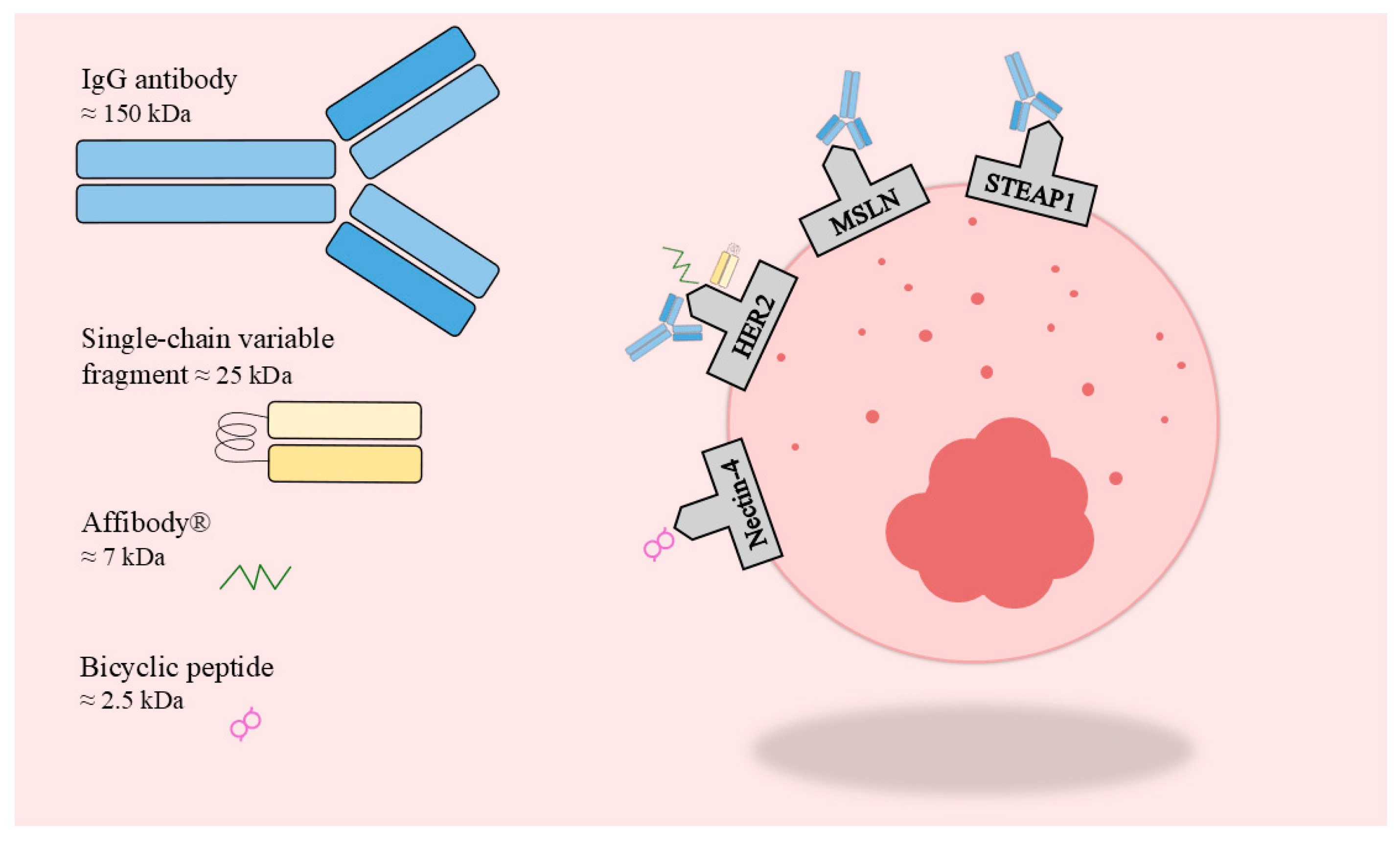
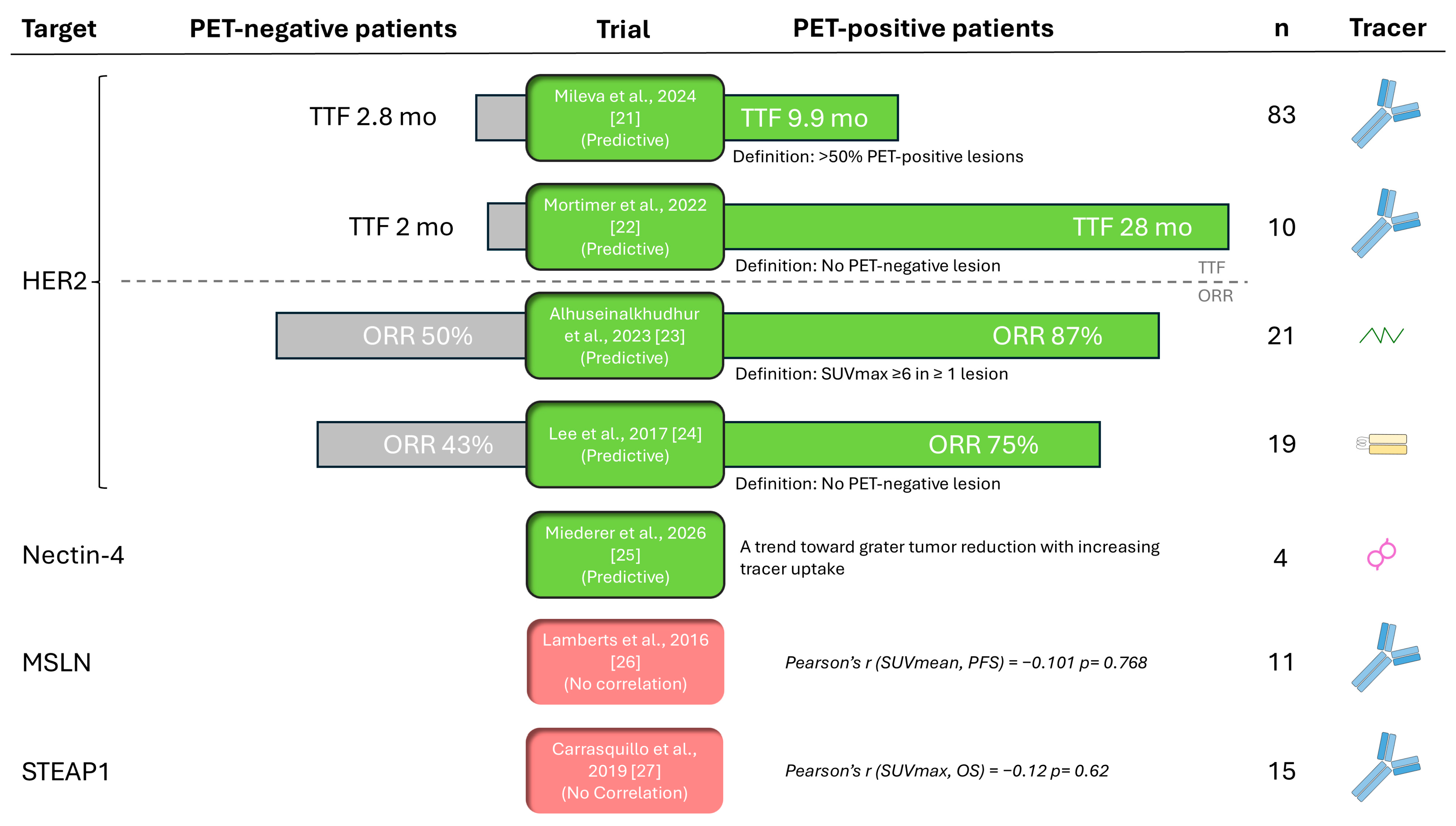
| Mileva et al., 2024 [21] | Patient: PPV 77% (95% CI 64–88%), NPV 84% (95% CI 64–95%) Lesion: PPV 72% (95% CI 64–78%), NPV 81% (95% CI 71–88%) TTF 9.9 vs. 2.8 months | II | 83 | Breast | 0–1 | 0–11+ | T-DM1 | HER2 | 3.6 mg/kg in 3-week intervals | Trastuzumab | 89Zr | 37 ± 10% | Anatomical response + TTF (CT, RECIST 1.1) | 3 treatment cycles (9 weeks) | Qualitative comparison to healthy tissue | Dominant part of lesions determined as PET-positive |
| Mortimer et al., 2022 [22] | TTF 28 vs. 2 months, HR 0.1 (95% CI 0.1–1.0) | 0 | 10 | Breast | 0–2 | NR | T-DM1 | HER2 | 3.6 (8 patients) or 2.7–3.0 (2 patients) mg/kg 3-week intervals. | Trastuzumab | 64Cu | 475–606 | TTF (FDG-PET, PERCIST) | 2 treatment cycles (6 weeks) | SUVmax ≥ 5.5 g/mL | No PET-negative lesion |
| Alhuseinalkhudhur et al., 2023 [23] | PBC + MBC: Sensitivity 56%, Specificity 66% MBC: Sensitivity 71%, Specificity 67% Soft-tissue lesions: Sensitivity 86%, Specificity 67% Skeletal lesions: Sensitivity 69%, Specificity 83% | II | 40 ** | Breast | 0–2 | 0–6+ | TZB, Pertuzumab, Chemotherapy and T-DM1 | HER2 | NR | HER2-targeted Affibody | 68Ga | 139 ± 43 | Metabolic response, delta-TLG lower than −25%. (FDG-PET, measured in the 5 largest lesions) | 2 treatment cycles (6 weeks) | Soft tissue: SUVmax ≥ 6 Skeletal lesions: SUVmax ≥ 16.2 | SUVmax ≥ 10.7 (all patients) or ≥10.9 (MBC) in at least one lesion |
| Lee et al., 2017 [24] | PR/SD: 75% vs. 43% PFS 2.0 vs. 1.7 months | I * | 19 | Breast | 0–1 | NR | MM-302 + TZB with or without CTX | HER2 | MM-302: 30 mg/m2. TZB: 6 mg/kg, some interpatient variation. CTX: 450 mg/m2 (10 patients) Every 3 weeks. | Single-chain variable fragment (scFv) | 64Cu | 337–432 | Anatomical response + PFS (CT, RECIST 1.1) | Every 8 weeks | %-injected dose/kg ≥ 2 | No PET-negative lesion |
| Lamberts et al., 2016 [26] | Mean SUVmax did not correlate to PFS or anatomical response. | I * | 11 | Pancreas (n = 7) Ovarian (n = 4) | 0–1 | NR | DMOT4039A | MSLN | 0.8–1.2 mg/kg every week (5 patients). 2.4–2.8 mg/kg in 3-week intervals (6 patients). | MSLN-targeted IgG1 monoclonal antibody | 89Zr | 36.78 ± 1.26 | Anatomical response + PFS (CT, RECIST 1.1) | 2 treatment cycles (2 and 6 weeks) | NA | NA |
| Carrasquillo et al., 2019 [27] | SUVmax did not correlate to OS, nadir PSA, or time on study drug. | I/II | 15 | Prostate | KPS ≥ 60% | 1–8 | DSTP3086S | STEAP1 | Dose escalation study: 0.3 to 2.8 mg/kg in 3-week intervals | STEAP1-targeted IgG1 monoclonal antibody | 89Zr | 170–199 | PSA, OS, Time on study drug (Blood samples) | NR | NA | NA |
| Miedere et al., 2026 [25] | Trend towards greater change in tumor volume with increasing SUVmean. | I | 4 | Urothelial cancer | NR | 0–2 | EV/P | Nectin-4 | NR | Bicyclic peptide | 68Ga | 1.6 ± 0.5/kg | % change in tumor volume (CT) | 12 weeks | NA | NA |
3.2. Trials Concerning Nectin-4 Targeted ADC
3.3. Trials of Emerging Targets for ADC’s
3.4. Risk of Bias Assessment
4. Discussion
Defining PET-Positivity
5. Limitations
6. Conclusions
Supplementary Materials
Author Contributions
Funding
Institutional Review Board Statement
Informed Consent Statement
Data Availability Statement
Conflicts of Interest
References
- Modi, S.; Jacot, W.; Iwata, H.; Park, Y.H.; Losada, M.V.; Li, W.; Tsurutani, J.; Ueno, N.T.; Zaman, K.; Prat, A.; et al. Trastuzumab deruxtecan in HER2-low metastatic breast cancer: Long-term survival analysis of the randomized, phase 3 DESTINY-Breast04 trial. Nat. Med. 2025, 31, 4205–4213. [Google Scholar] [CrossRef] [Scilit]
- Blohmer, J.-U.; Schmid, P.; Hilfrich, J.; Friese, K.; Kleine-Tebbe, A.; Koelbl, H.; Sommer, H.; Morack, G.; Wischnewsky, M.B.; Lichtenegger, W.; et al. Epirubicin and cyclophosphamide versus epirubicin and docetaxel as first-line therapy for women with metastatic breast cancer: Final results of a randomised phase III trial. Ann. Oncol. 2010, 21, 1430–1435. [Google Scholar] [CrossRef] [Scilit] [PubMed]
- Hanahan, D.; Weinberg, R.A. Hallmarks of cancer: The next generation. Cell 2011, 144, 646–674. [Google Scholar] [CrossRef] [Scilit] [PubMed]
- Wright, B.D.; Lapi, S.E. Designing the magic bullet? The advancement of immuno-PET into clinical use. J. Nucl. Med. 2013, 54, 1171–1174. [Google Scholar] [CrossRef] [Scilit] [PubMed]
- Bailly, C.; Cléry, P.-F.; Faivre-Chauvet, A.; Bourgeois, M.; Guérard, F.; Haddad, F.; Barbet, J.; Chérel, M.; Kraeber-Bodere, F.; Carlier, T.; et al. Immuno-PET for Clinical Theranostic Approaches. Int. J. Mol. Sci. 2016, 18, 57. [Google Scholar] [CrossRef] [Scilit] [PubMed]
- Riccardi, F.; Bo, M.D.; Macor, P.; Toffoli, G. A comprehensive overview on antibody-drug conjugates: From the conceptualization to cancer therapy. Front. Pharmacol. 2023, 14, 1274088. [Google Scholar] [CrossRef] [Scilit] [PubMed] [PubMed Central]
- Zhou, W.; Xu, Z.; Liu, S.; Lou, X.; Liu, P.; Xie, H.; Zhang, S.; Liu, X.; Zhuo, B.; Huang, H. Landscape of clinical drug development of ADCs used for the pharmacotherapy of cancers: An overview of clinical trial registry data from 2002 to 2022. BMC Cancer 2024, 24, 898. [Google Scholar] [CrossRef] [Scilit] [PubMed] [PubMed Central]
- Altena, R.; Tzortzakakis, A.; Burén, S.A.; Tran, T.A.; Frejd, F.Y.; Bergh, J.; Axelsson, R. Current status of contemporary diagnostic radiotracers in the management of breast cancer: First steps toward theranostic applications. EJNMMI Res. 2023, 13, 43. [Google Scholar] [CrossRef] [Scilit] [PubMed] [PubMed Central]
- van Dongen, G.A.M.S.; Poot, A.J.; Vugts, D.J. PET imaging with radiolabeled antibodies and tyrosine kinase inhibitors: Immuno-PET and TKI-PET. Tumor Biol. 2012, 33, 607–615. [Google Scholar] [CrossRef] [Scilit] [PubMed] [PubMed Central]
- Akhavanallaf, A.; Peterson, A.B.; Fitzpatrick, K.; Roseland, M.; Wong, K.K.; El-Naqa, I.; Zaidi, H.; Dewaraja, Y.K. The predictive value of pretherapy [68Ga]Ga-DOTA-TATE PET and biomarkers in [177Lu]Lu-PRRT tumor dosimetry. Eur. J. Nucl. Med. Mol. Imaging 2023, 50, 2984–2996. [Google Scholar] [CrossRef] [Scilit] [PubMed] [PubMed Central]
- Strosberg, J.; El-Haddad, G.; Wolin, E.; Hendifar, A.; Yao, J.; Chasen, B.; Mittra, E.; Kunz, P.L.; Kulke, M.H.; Jacene, H.; et al. Phase 3 Trial of 177Lu-Dotatate for Midgut Neuroendocrine Tumors. N. Engl. J. Med. 2017, 376, 125–135. [Google Scholar] [CrossRef] [Scilit] [PubMed] [PubMed Central]
- Sartor, O.; de Bono, J.; Chi, K.N.; Fizazi, K.; Herrmann, K.; Rahbar, K.; Tagawa, S.T.; Nordquist, L.T.; Vaishampayan, N.; El-Haddad, G.; et al. Lutetium-177–PSMA-617 for Metastatic Castration-Resistant Prostate Cancer. N. Engl. J. Med. 2021, 385, 1091–1103. [Google Scholar] [CrossRef] [Scilit] [PubMed] [PubMed Central]
- Peslier, H.; Seegers, V.; Dufour, P.-A. Study of predictive factors for response to 177LU-PSMA in patients with metastatic castration-resistant prostate cancer. Front. Med. 2025, 12, 1538507. [Google Scholar] [CrossRef] [Scilit] [PubMed] [PubMed Central]
- Rosar, F.; Wenner, F.; Khreish, F.; Dewes, S.; Wagenpfeil, G.; Hoffmann, M.A.; Schreckenberger, M.; Bartholomä, M.; Ezziddin, S. Early molecular imaging response assessment based on determination of total viable tumor burden in [68Ga]Ga-PSMA-11 PET/CT independently predicts overall survival in [177Lu]Lu-PSMA-617 radioligand therapy. Eur. J. Nucl. Med. Mol. Imaging 2022, 49, 1584–1594. [Google Scholar] [CrossRef] [Scilit] [PubMed] [PubMed Central]
- Xijing, L.; Cheng, B. Recent advances in radionuclide drug conjugates (RDCs) for cancer theranostics: From targeted design to clinical translation. Bioorg. Chem. 2025, 167, 109240. [Google Scholar] [CrossRef] [Scilit] [PubMed]
- Mosele, F.; Deluche, E.; Lusque, A.; Le Bescond, L.; Filleron, T.; Pradat, Y.; Ducoulombier, A.; Pistilli, B.; Bachelot, T.; Viret, F.; et al. Trastuzumab deruxtecan in metastatic breast cancer with variable HER2 expression: The phase 2 DAISY trial. Nat. Med. 2023, 29, 2110–2120. [Google Scholar] [CrossRef] [Scilit] [PubMed]
- Yuan, P.; Long, Y.; Wei, N.; Wang, Y.; Zhu, Z.; Han, J.; Jiang, D.; Lan, X.; Gai, Y. Peptide-based PET tracer targeting LAG-3 for evaluating the efficacy of immunotherapy in melanoma. J. Immunother. Cancer 2024, 12, e009010. [Google Scholar] [CrossRef] [Scilit] [PubMed] [PubMed Central]
- Eissler, N.; Altena, R.; Alhuseinalkhudhur, A.; Bragina, O.; Feldwisch, J.; Wuerth, G.; Loftenius, A.; Brun, N.; Axelsson, R.; Tolmachev, V.; et al. Affibody PET Imaging of HER2-Expressing Cancers as a Key to Guide HER2-Targeted Therapy. Biomedicines 2024, 12, 1088. [Google Scholar] [CrossRef] [Scilit] [PubMed] [PubMed Central]
- Page, M.J.; McKenzie, J.E.; Bossuyt, P.M.; Boutron, I.; Hoffmann, T.C.; Mulrow, C.D.; Shamseer, L.; Tetzlaff, J.M.; Akl, E.A.; Brennan, S.E.; et al. The PRISMA 2020 statement: An updated guideline for reporting systematic reviews. BMJ 2021, 372, n71. [Google Scholar] [CrossRef] [Scilit] [PubMed]
- Hayden, J.A.; Van Der Windt, D.A.; Cartwright, J.L.; Côté, P.; Bombardier, C. Assessing bias in studies of prognostic factors. Ann. Intern. Med. 2013, 158, 280–286. [Google Scholar] [CrossRef] [Scilit] [PubMed]
- Mileva, M.; de Vries, E.G.E.; Guiot, T.; Wimana, Z.; Deleu, A.-L.; Schröder, C.P.; Lefebvre, Y.; Paesmans, M.; Stroobants, S.; Huizing, M.; et al. Molecular imaging predicts lack of T-DM1 response in advanced HER2-positive breast cancer (final results of ZEPHIR trial). npj Breast Cancer 2024, 10, 4. [Google Scholar] [CrossRef] [Scilit] [PubMed]
- Mortimer, J.E.; Bading, J.R.; Frankel, P.H.; Carroll, M.I.; Yuan, Y.; Park, J.M.; Tumyan, L.; Gidwaney, N.; Poku, E.K.; Shively, J.E.; et al. Use of 64Cu-DOTA-Trastuzumab PET to Predict Response and Outcome of Patients Receiving Trastuzumab Emtansine for Metastatic Breast Cancer: A Pilot Study. J. Nucl. Med. 2022, 63, 1145–1148. [Google Scholar] [CrossRef] [Scilit] [PubMed] [PubMed Central]
- Alhuseinalkhudhur, A.; Lindman, H.; Liss, P.; Sundin, T.; Frejd, F.Y.; Hartman, J.; Iyer, V.; Feldwisch, J.; Lubberink, M.; Rönnlund, C.; et al. Human Epidermal Growth Factor Receptor 2-Targeting [68Ga]Ga-ABY-025 PET/CT Predicts Early Metabolic Response in Metastatic Breast Cancer. J. Nucl. Med. 2023, 64, 1364–1370. [Google Scholar] [CrossRef] [Scilit] [PubMed] [PubMed Central]
- Lee, H.; Shields, A.F.; Siegel, B.A.; Miller, K.D.; Krop, I.; Ma, C.X.; LoRusso, P.M.; Munster, P.N.; Campbell, K.; Gaddy, D.F.; et al. 64Cu-MM-302 Positron Emission Tomography Quantifies Variability of Enhanced Permeability and Retention of Nanoparticles in Relation to Treatment Response in Patients with Metastatic Breast Cancer. Clin. Cancer Res. 2017, 23, 4190–4202. [Google Scholar] [CrossRef] [Scilit] [PubMed] [PubMed Central]
- Miederer, M.; Pretze, M.; Abbate, E.; Hartig, A.; Machado, J.D.M.F.; Böhm, K.; Sommer, U.; Hoberück, S.; Bundschuh, R.A.; Kotzerke, J.; et al. Staging metastatic urothelial cancer with Nectin-4 imaging using Gallium-68-N188 PET/CT. BJU Int. 2025, 137, 166–172. [Google Scholar] [CrossRef] [Scilit] [PubMed] [PubMed Central]
- Lamberts, L.E.; Menke-van der Houven, C.W.; ter Weele, E.J.; Bensch, F.; Smeenk, M.M.; Voortman, J.; Hoekstra, O.S.; Williams, S.P.; Fine, B.M.; Maslyar, D.; et al. ImmunoPET with Anti-Mesothelin Antibody in Patients with Pancreatic and Ovarian Cancer before Anti-Mesothelin Antibody-Drug Conjugate Treatment. Clin. Cancer Res. 2016, 22, 1642–1652. [Google Scholar] [CrossRef] [Scilit] [PubMed]
- Carrasquillo, J.A.; Fine, B.M.; Pandit-Taskar, N.; Larson, S.M.; Fleming, S.E.; Fox, J.J.; Cheal, S.M.; O’donoghue, J.A.; Ruan, S.; Ragupathi, G.; et al. Imaging Patients with Metastatic Castration-Resistant Prostate Cancer Using 89Zr-DFO-MSTP2109A Anti-STEAP1 Antibody. J. Nucl. Med. 2019, 60, 1517–1523. [Google Scholar] [CrossRef] [Scilit] [PubMed] [PubMed Central]
- Altena, R.; Burén, S.A.; Blomgren, A.; Karlsson, E.; Tzortzakakis, A.; Brun, N.; Moein, M.M.; Jussing, E.; Frejd, F.Y.; Bergh, J.; et al. Human Epidermal Growth Factor Receptor 2 (HER2) PET Imaging of HER2-Low Breast Cancer with [68Ga]Ga-ABY-025: Results from a Pilot Study. J. Nucl. Med. 2024, 65, 700–707. [Google Scholar] [CrossRef] [Scilit] [PubMed]
- Gebhart, G.; Lamberts, L.E.; Wimana, Z.; Garcia, C.; Emonts, P.; Ameye, L.; Stroobants, S.; Huizing, M.; Aftimos, P.; Tol, J.; et al. Molecular imaging as a tool to investigate heterogeneity of advanced HER2-positive breast cancer and to predict patient outcome under trastuzumab emtansine (T-DM1): The ZEPHIR trial. Ann. Oncol. 2016, 27, 619–624. [Google Scholar] [CrossRef] [Scilit] [PubMed]
- Ogitani, Y.; Hagihara, K.; Oitate, M.; Naito, H.; Agatsuma, T. Bystander killing effect of DS-8201a, a novel anti-human epidermal growth factor receptor 2 antibody-drug conjugate, in tumors with human epidermal growth factor receptor 2 heterogeneity. Cancer Sci. 2016, 107, 1039–1046. [Google Scholar] [CrossRef] [Scilit] [PubMed] [PubMed Central]
- Lodge, M.A. Repeatability of SUV in Oncologic 18F-FDG PET. J. Nucl. Med. 2017, 58, 523–532. [Google Scholar] [CrossRef] [Scilit] [PubMed] [PubMed Central]
- Soret, M.; Bacharach, S.L.; Buvat, I. Partial-volume effect in PET tumor imaging. J. Nucl. Med. 2007, 48, 932–945. [Google Scholar] [CrossRef] [Scilit] [PubMed]
- Wahl, R.L.; Jacene, H.; Kasamon, Y.; Lodge, M.A. From RECIST to PERCIST: Evolving Considerations for PET response criteria in solid tumors. J. Nucl. Med. 2009, 50, 122S–150S. [Google Scholar] [CrossRef] [Scilit] [PubMed] [PubMed Central]
- Mohr, P.; van Sluis, J.; Hooge, M.N.L.-D.; Lammertsma, A.A.; Brouwers, A.H.; Tsoumpas, C. Advances and challenges in immunoPET methodology. Front. Nucl. Med. 2024, 4, 1360710. [Google Scholar] [CrossRef] [Scilit] [PubMed] [PubMed Central]
- Sandberg, D.; Tolmachev, V.; Velikyan, I.; Olofsson, H.; Wennborg, A.; Feldwisch, J.; Carlsson, J.; Lindman, H.; Sörensen, J. Intra-image referencing for simplified assessment of HER2-expression in breast cancer metastases using the Affibody molecule ABY-025 with PET and SPECT. Eur. J. Nucl. Med. Mol. Imaging 2017, 44, 1337–1346. [Google Scholar] [CrossRef] [Scilit] [PubMed] [PubMed Central]
- Moustaquim, J.; van Wonderen, G.E.; van Geel, J.J.; van Kruchten, M.; de Vries, E.F.; Jager, A.; Kuip, E.; Stokkel, M.P.; Glaudemans, A.W.; Brouwers, A.H.; et al. Comparative analysis of FES-PET/CT and FDG-PET/CT in patients with ER-positive metastatic invasive lobular breast cancer. Eur. J. Cancer 2025, 229, 115792. [Google Scholar] [CrossRef] [Scilit] [PubMed]
- van Geel, J.J.; Moustaquim, J.; Boers, J.; Elias, S.G.; Smeets, E.M.; Knip, J.J.; Glaudemans, A.W.; de Vries, E.F.; Hospers, G.A.; van Kruchten, M.; et al. Intrapatient 16α-[18F]Fluoro-17β-Estradiol PET Heterogeneity as a Prognostic Factor for Endocrine Therapy Response and Survival in Patients with Estrogen Receptor-Positive Metastatic Breast Cancer. J. Nucl. Med. 2025, 66, 194–200. [Google Scholar] [CrossRef] [Scilit] [PubMed]


| Antibody-Drug Conjugate (Trade Name) | Target | Cytotoxic Drug | Indication | Approval Year (Medical Agency) |
|---|---|---|---|---|
| Gemtuzumab ozogamicin (Mylotarg®) | CD33 | Calicheamicin | Acute myeloid leukemia | 2000 (FDA) 2018 (EMA) |
| Brentuximab vedotin (Adcetris®) | CD30 | MMAE (Monomethyl auristatin E) | Hodgkin’s lymphoma Systemic anaplastic large cell lymphoma Cutaneous T-cell lymphoma | 2011 (FDA) 2012 (EMA) |
| Trastuzumab emtansine (Kadcyla®) | HER2 | DM1 | HER2+ breast cancer | 2013 (FDA/EMA) |
| Inotuzumab ozogamicin (Besponsa®) | CD22 | Calicheamicin | B-cell precursor acute lymphoblastic leukemia | 2017 (FDA/EMA) |
| Moxetumomab pasudotox (Lumoxiti®) | CD22 | PE38 | Hairy cell leukemia | 2018 (FDA/EMA) |
| Polatuzumab vedotin (Polivy®) | CD79 | MMAE | Diffuse large B-cell lymphoma | 2019 (FDA) 2020 (EMA) |
| Enfortumab vedotin (Padcev®) | Nectin-4 | MMAE | Urothelial cancer | 2019 (FDA) 2022 (EMA) |
| Trastuzumab deruxtecan (Enhertu®) | HER2 | DXd | HER2+/low breast cancer Non-small cell lung cancer HER2+ gastric cancer Tumor agnostic approval by FDA | 2019 (FDA) 2021 (EMA) |
| Cetuximab sarotalocan (Akalux®) | EGFR | 700DX dye: laser activatable agent | Head and neck squamous cell carcinoma | 2020 (PMDA) |
| Belantamab mafodotin (Blenrep®) * | BCMA | MMAF | Multiple myeloma | 2020 (FDA/EMA) |
| Sacituzumab govitecan (Trodelvy®) | Trop-2 | SN-38 | HER2− breast cancer | 2020 (FDA) 2021 (EMA) |
| Disitamab vedotin (Aidixi®) | HER2 | MMAE | Urothelial carcinoma HER2+ gastric cancer | 2021 (NMPA) |
| Loncastuximab tesirine (Zynlonta®) | CD19 | SG3199 | Diffuse large B-cell lymphoma High-grade B-cell lymphoma | 2021 (FDA) 2022 (EMA) |
| Tisotumab vedotin (Tivdak®) | Tissue Factor | MMAE | Cervical cancer | 2021 (FDA) 2025 (EMA) |
| Mirvetuximab soravtansine (Elahere®) | FRα | DM4 | Epithelial ovarian, fallopian tube, or primary peritoneal cancer | 2022 (FDA) 2024 (EMA) |
| Sacituzumab tirumotecan (Jiataile®) | Trop-2 | KL610023 | HER2− breast cancer | 2024 (NMPA) |
| Telisotuzumab vedotin (Emrelis®) | c-Met | MMAE | Non-squamous non-small cell lung cancer | 2025 (FDA) |
| Datopotamab deruxtecan (Datroway®) | Trop-2 | DXd | Metastatic, HR+ HER2− breast cancer Non-small cell lung cancer | 2025 (FDA/EMA) |
| Trastuzumab rezetecan (SHR-A1811) | HER2 | SHR169265 | Non-small cell lung cancer | 2025 (NMPA) |
| Trastuzumab botidotin (A166) | HER2 | Duostatin 5 | HER2+ breast cancer | 2025 (NMPA) |
| Becotatug vedotin (MRG003) | EGFR | MMAE | Nasopharyngeal carcinoma | 2025 (NMPA) |
| Pivekimab sunirine (Decnupaz®) | CD123 | DGN462 | Blastic plasmacytoid dendritic cell neoplasm | 2026 (FDA) |
| Potential Bias Domains | Mileva et al. (2024) [21] | Mortimer et al. (2022) [22] | Alhuseinalkhudhur et al. (2023) [23] | Lee et al. (2017) [24] | Lamberts et al. (2016) [26] | Carrasquillo et al. (2019) [27] | Miederer et al. 2026 [25] |
|---|---|---|---|---|---|---|---|
| Study participation | |||||||
| Source of target population is adequately described | Yes | Yes | Yes | Yes | Yes | Yes | Yes |
| Methods used to identify population and methods to limit potential bias in recruitment are described | No | No | No | No | No | No | No |
| Recruitment period is described | Yes | No | Yes | Yes | Yes | No | No |
| Places of recruitment are described | Yes | No | No | No | Yes | No | No |
| Inclusion and exclusion criteria are described | Yes | Yes | Yes | Yes | Yes | Yes | Yes |
| Adequate study participation | Partial | No | No | No | No | No | No |
| Baseline characteristics of participants are described | Yes | Yes | Yes | Yes | Yes | Yes | Yes |
| Summary (High/Moderate/Low) | Low | High | Moderate | Moderate | Moderate | High | High |
| Study Attrition | |||||||
| Proportion of baseline sample available for analysis | Yes | Yes | Yes | Yes | Yes | Yes | Yes |
| Attempts to collect information on participants who dropped out | No | NA | Yes | NA | NA | No | NA |
| Reasons and impact of loss to follow-up are provided | Partial | NA | Yes | NA | NA | No | Yes |
| Description and/or negation of important differences between participants who completed the study and those who did not? | No | NA | Yes | NA | NA | No | No |
| Summary (High/Moderate/Low) | Moderate | Low | Low | Low | Low | Moderate | Moderate |
| Prognostic Factor Measurement | |||||||
| Clear definition of prognostic factor | Yes | Yes | Partial | Yes | Yes | Yes | Yes |
| Valid and reliable measurement of prognostic factor | Yes | Yes | Yes | Yes | Yes | Yes | Yes |
| Method and setting of prognostic factor measurement | Yes | No | No | No | No | No | Yes |
| Proportion of data on prognostic factors available for analysis | Yes | Yes | Partial | Partial | Yes | Partial | Yes |
| Method used for missing data | NA | NA | NA | NA | NA | NA | NA |
| Summary (High/Moderate/Low) | Low | Moderate | High | High | High | High | Low |
| Outcome Measurement | |||||||
| Definition of the outcome | Yes | Yes | Yes | Yes | Yes | Yes | Yes |
| Valid and reliable measurement of outcome | Yes | Yes | Yes | Yes | Yes | Partial | Yes |
| Method and setting of outcome measurement is the same for all participants | Yes | Yes | Yes | Yes | Yes | Yes | Yes |
| Summary (High/Moderate/Low) | Low | Low | Low | Low | Low | Moderate | Low |
| Study Confounding | |||||||
| Important confounders measured | Yes | Partial | Partial | Partial | Partial | Yes | No |
| Clear definition of confounding factor(s) | No | No | No | No | No | No | No |
| Valid and reliable measurement of confounders | Unsure | Unsure | Yes | Unsure | Unsure | Unsure | No |
| The method and setting of confounding measurements are the same for all participants | Unsure | Unsure | Unsure | Unsure | Unsure | Unsure | Partial |
| Method used for missing data | Unsure | Unsure | Unsure | Unsure | Unsure | Unsure | Unsure |
| Important potential confounders are accounted for in study design and/or analysis | No | No | Yes | No | No | No | No |
| Summary (High/Moderate/Low) | High | High | Moderate | High | High | High | Moderate |
| Statistical Analysis and Reporting | |||||||
| Sufficient presentation of data to assess the analytical strategy | Yes | Yes | Yes | NA | Yes | Yes | Yes |
| Statistical model and strategy for model building | Yes | Yes | Yes | NA | Yes | Yes | NA |
| Reporting of results | Yes | Yes | Yes | Yes | Yes | Yes | Yes |
| Summary (High/Moderate/Low) | Low | Low | Low | Low | Low | Low | Low |
Disclaimer/Publisher’s Note: The statements, opinions and data contained in all publications are solely those of the individual author(s) and contributor(s) and not of MDPI and/or the editor(s). MDPI and/or the editor(s) disclaim responsibility for any injury to people or property resulting from any ideas, methods, instructions or products referred to in the content. |
© 2026 by the authors. Licensee MDPI, Basel, Switzerland. This article is an open access article distributed under the terms and conditions of the Creative Commons Attribution (CC BY) license.
Share and Cite
Mourath, D.; Romdhani, N.S.; Bergman, V.; Siikanen, J.; Tran, T.A.; Alhuseinalkhudhur, A.; Kistner, A.; Altena, R. Predicting Therapeutic Response to Antibody-Drug Conjugates Using Targeted PET Imaging: A Systematic Review. Cancers 2026, 18, 2514. https://doi.org/10.3390/cancers18152514
Mourath D, Romdhani NS, Bergman V, Siikanen J, Tran TA, Alhuseinalkhudhur A, Kistner A, Altena R. Predicting Therapeutic Response to Antibody-Drug Conjugates Using Targeted PET Imaging: A Systematic Review. Cancers. 2026; 18(15):2514. https://doi.org/10.3390/cancers18152514
Chicago/Turabian StyleMourath, David, Nour Susaeg Romdhani, Viveka Bergman, Jonathan Siikanen, Thuy A. Tran, Ali Alhuseinalkhudhur, Anna Kistner, and Renske Altena. 2026. "Predicting Therapeutic Response to Antibody-Drug Conjugates Using Targeted PET Imaging: A Systematic Review" Cancers 18, no. 15: 2514. https://doi.org/10.3390/cancers18152514
APA StyleMourath, D., Romdhani, N. S., Bergman, V., Siikanen, J., Tran, T. A., Alhuseinalkhudhur, A., Kistner, A., & Altena, R. (2026). Predicting Therapeutic Response to Antibody-Drug Conjugates Using Targeted PET Imaging: A Systematic Review. Cancers, 18(15), 2514. https://doi.org/10.3390/cancers18152514