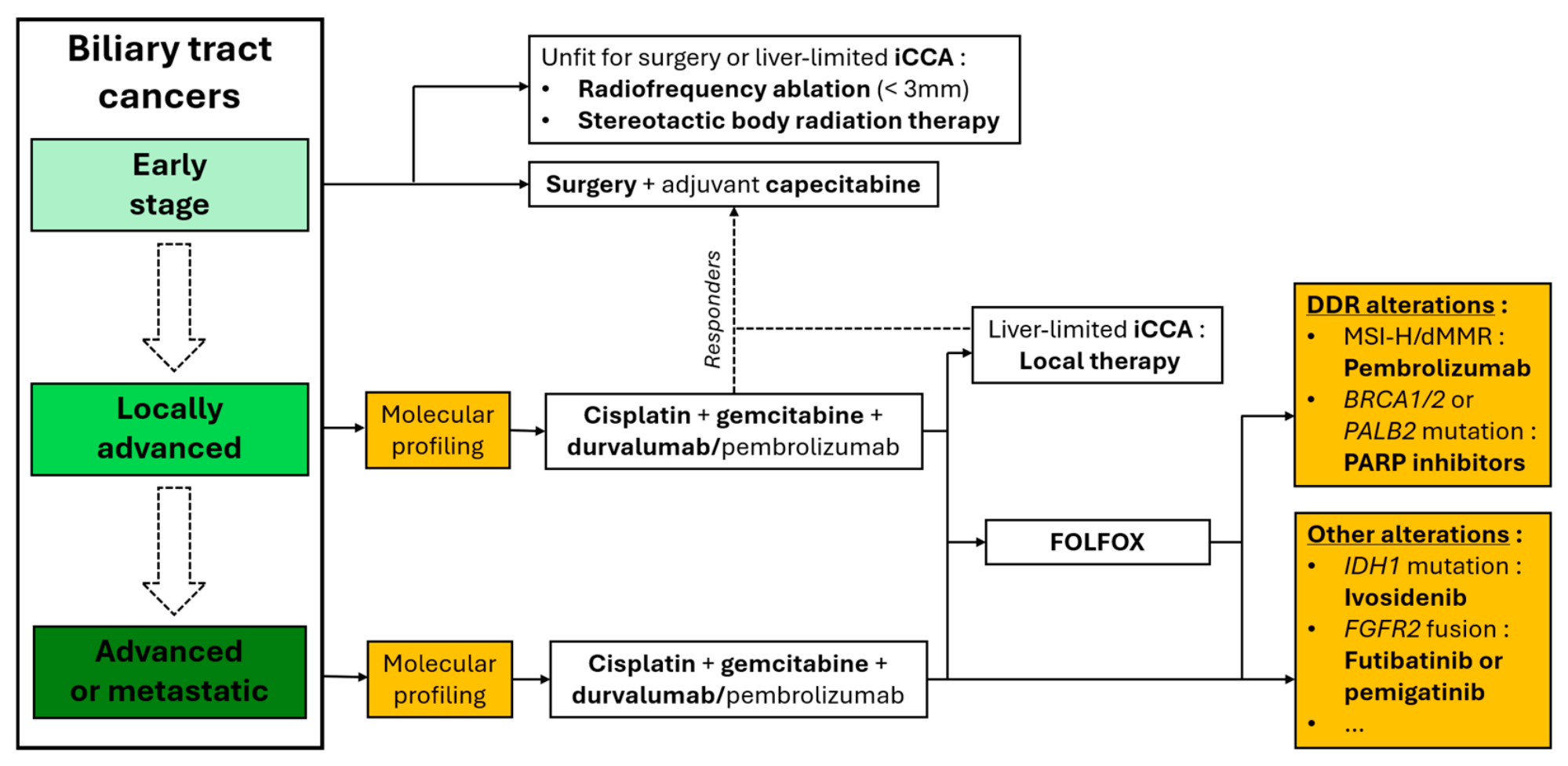
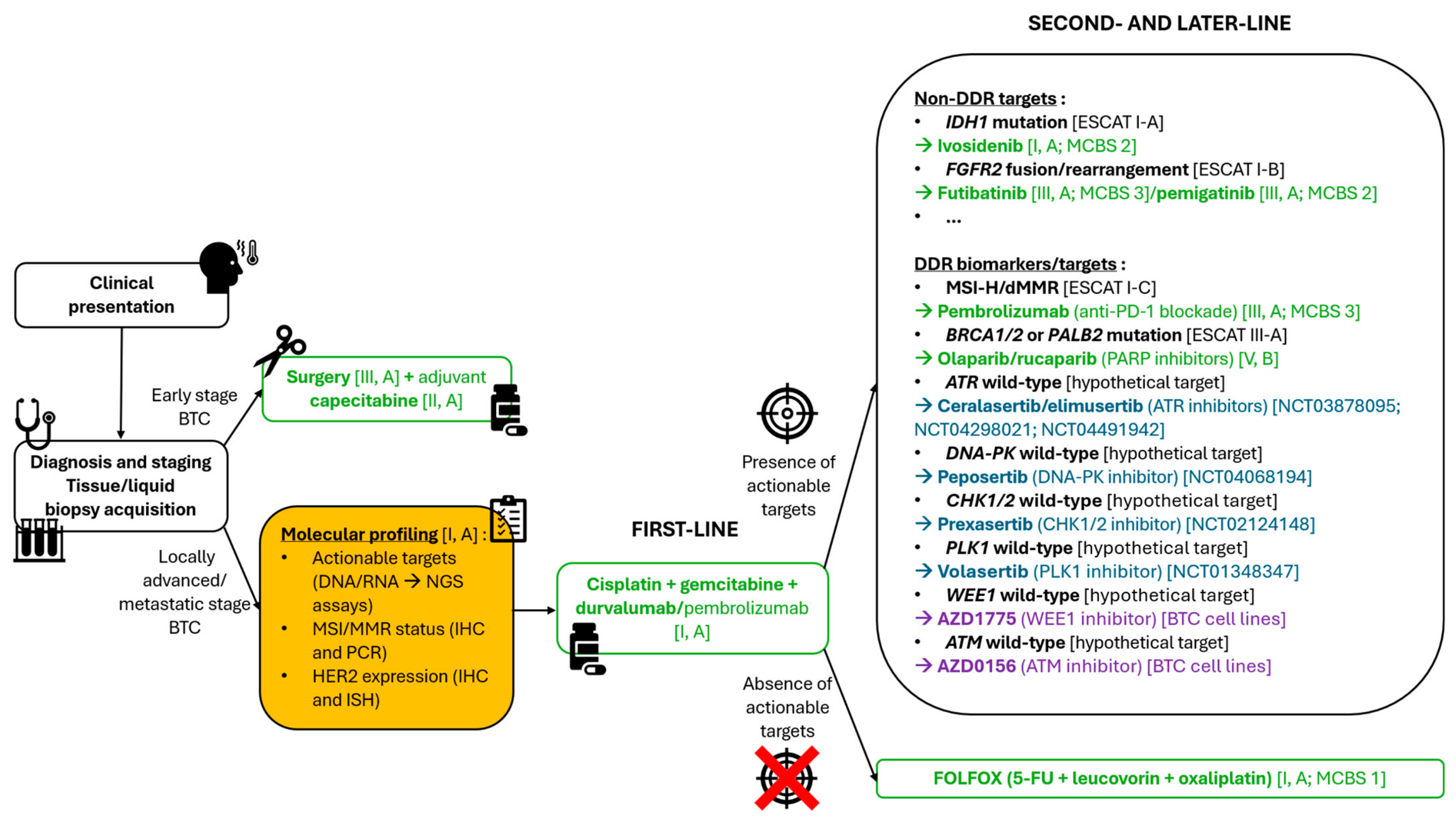
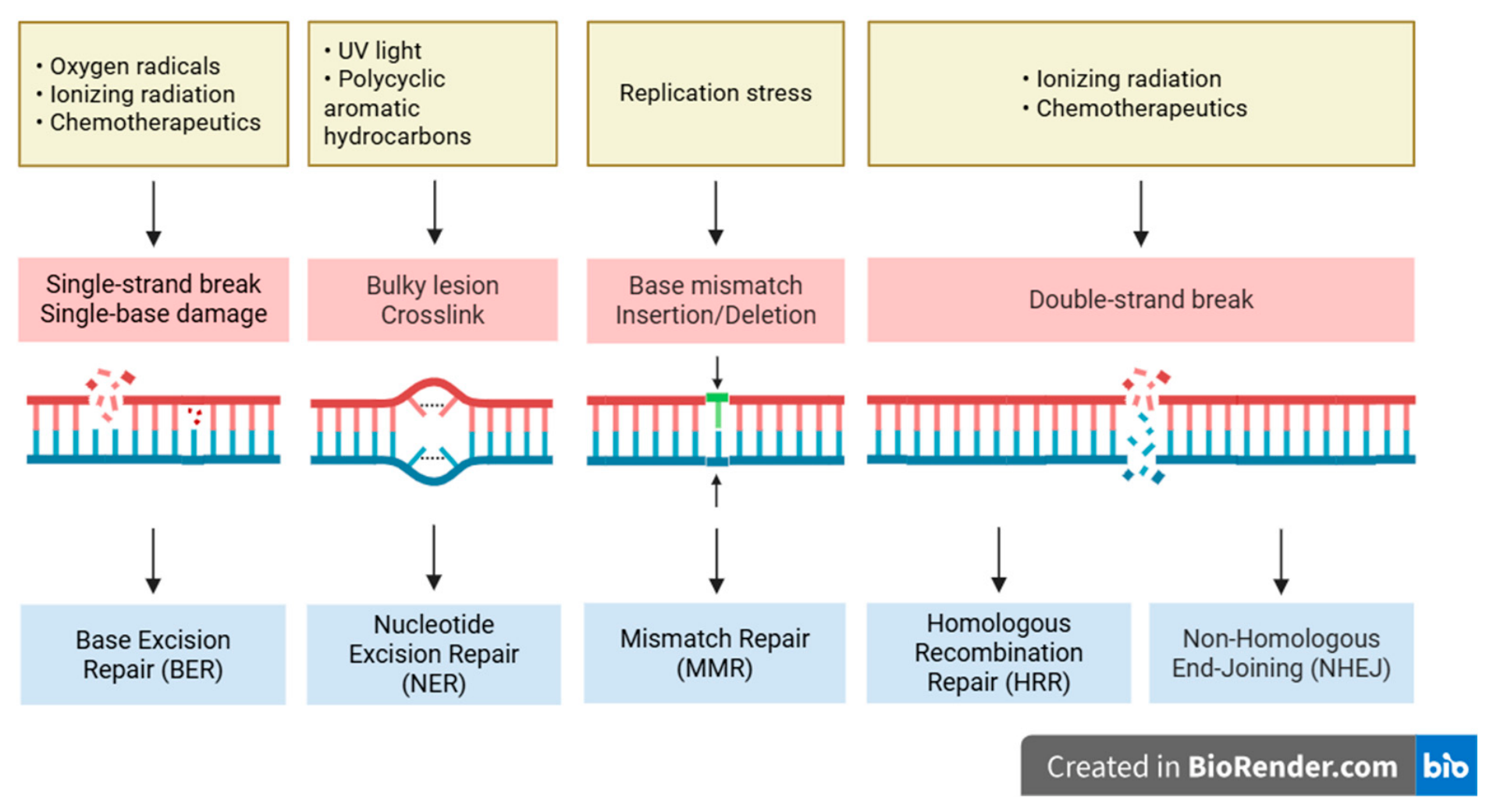
Prognostic, Predictive, and Clinical Relevance of DNA Damage Repair Alterations in Biliary Tract Cancers
 , , , and
Simple Summary
Abstract
1. Introduction
2. DNA Damage Repair Mechanisms
3. DNA Damage Repair Alterations in Cancer
4. DNA Damage Repair Alterations in Biliary Tract Cancers

| DDR Mechanisms and Genes | Alteration Rate (%) | Alteration Type (Functional Impact) | Therapeutic/Clinical Significance (Level of Evidence) | References | ||||
|---|---|---|---|---|---|---|---|---|
| iCCA | pCCA/ dCCA | GBC | All BTCs | |||||
| Base excision repair (BER) | MGMT | 38 | 26–60 | 59–62 | 38 | Promoter methylation (gene inactivation) | Clinical: Poor prognosis (meta-analysis). | [82,94,95,96] |
| PARP | NA | NA | NA | ~1–2 | Missense and substitution/indel SM (loss) | In vitro/clinical: PARP inhibitors are the most advanced DDR-targeting therapies in BTC (NCT03207347, NCT03337087, NCT03639935, NCT03878095, NCT04042831, NCT04306367). Results of NCT03212274 (olaparib), NCT03991832 (olaparib + durvalumab), NCT04298021 (ceralasertib + olaparib), NCT04779151 (dostarlimab + niraparib), NCT05222971 (olaparib ± durvalumab), NCT06441747 (olaparib + durvalumab) and NCT07269158 (durvalumab/pembrolizumab ± venadaparib) trials are pending. | [74,97,98,99,100,101,102,103,104,105,106,107,108,109] | |
| Mismatch repair (MMR) | All MMR genes | 5 | 4–65.7 | 51.3–59 | 11–14 | SM, GM (dMMR) | Clinical: MSI-H/dMMR patients sensitive to pembrolizumab (SoC). | [23,45,81,85,94,110,111] |
| Non-homologous end-joining (NHEJ) | ARID1A | 19–22 | 14 | 16.4 | 5.4–21.7 | SM, gene deletion (loss) | Clinical: Potential marker of worse prognosis and higher risk of recurrence in iCCA. | [76,81,86,111,112,113] |
| Homologous recombination repair (HRR) | ATM | 4–9 | 5–8.57 | 5.6–6.3 | 4.5–11.8 | Missense, nonsense, and substitution/indel SM, truncation, GM (loss) | In vitro: ATM inhibition (AZD0156) effective in BTC cell lines (monotherapy/combination regimens). | [28,74,76,86,90,91,112,113,114,115,116,117] |
| ATR | NA | NA | ~1.3 | 3–6 | Missense and substitution/indel SM, truncation (loss) | In vitro: ATR inhibition (AZD6738) effective in BTC cell lines (monotherapy/combination regimens). Clinical: ORR of 0% after treatment of CCA patients with IDH mutation with olaparib and ceralasertib (NCT03878095). Results of NCT04298021 (ceralasertib + durvalumab) and NCT04491942 (elimusertib + cisplatin ± gemcitabine) trials are pending. | [74,76,81,102,112,118,119,120,121] | |
| ATRX | NA | NA | NA | 1.8–4 | SM (loss) | NA | [86,112] | |
| BAP1 | 1–50 | ~4–50 | ~1.3–9.5 | 4–8.8 | Missense SM, rearrangement, GM (loss) | Clinical: Potential marker of worse prognosis; mCCA patient with BAP1 mutation derived benefit from olaparib (case report). | [74,76,81,86,91,112,113,117,122,123,124,125,126,127,128,129] | |
| BARD1 | NA | NA | NA | 2.5 | SM, GM (loss) | NA | [74,112] | |
| BLM | NA | NA | NA | ~1–1.9 | Missense and substitution/indel SM (loss) | NA | [74,112] | |
| BRCA1 | 0.4–9.23 | ~1–8 | 0.3–4 | 0.9–1.9 | Missense and substitution/indel SM, GM (loss) | Clinical: Sensitivity to PARP inhibitors (SoC). | [23,28,74,86,90,92,112,117,130] | |
| BRCA2 | 2.7–20 | ~2–8 | 4 | 3.3–4.4 | Missense, nonsense and indel SM, GM (loss) | Clinical: Sensitivity to PARP inhibitors (SoC). | [23,28,74,76,90,92,117,130,131] | |
| CHK1 | NA | NA | NA | ~0.5–1 | Missense and nonsense SM (loss) | In vitro/in vivo: Treatment with rabusertib (CHK1 inhibitor) was effective against KRAS-mutated iCCA cells and was associated with a significant decrease in PARP1 levels. Clinical: Combination of prexasertib (CHK1/2 inhibitor) with standard treatments showed acceptable safety profiles in the phase I NCT02124148 trial. | [74,112,132] | |
| CHK2 | NA | NA | NA | ~0.3–1.9 | Missense and substitution/indel SM, GM (loss) | Clinical: Combination of prexasertib (CHK1/2 inhibitor) with standard treatments showed acceptable safety profiles in the phase I NCT02124148 trial. | [74,86,112] | |
| FANC | NA | NA | ~2 | 2.5–7.3 | Missense and nonsense SM, CNA, rearrangement, GM (loss or upregulation) | In vitro/clinical: Potential association of upregulation of FANC genes with resistance to gemcitabine. | [76,112,133] | |
| NBN | NA | NA | NA | ~1–1.4 | Missense SM (loss) | NA | [74,112] | |
| PALB2 | 12.31 | NA | ~1.3 | 1.9 | Missense, nonsense and substitution/indel SM, GM (loss) | Clinical: Sensitivity to PARP inhibitors (SoC). | [23,74,76,90,112,134] | |
| PBRM1 | 9.9 | 4–4.5 | ~5–7.5 | 5–21 | Missense, nonsense and substitution/indel SM (loss) | Clinical: PBRM1 mutations may sensitize BTC tumors to DDR (e.g., PARP, ATR) inhibition. | [74,76,81,113,117,135,136] | |
| RAD50 | NA | NA | NA | ~1.3–1.8 | Missense SM, GM (loss) | NA | [74,112] | |
| RAD51 (B,C,D) | NA | NA | NA | 0.8–4.6 | Missense SM, translocation (CNA), GM (loss) | In vitro: RAD51 inhibitor enhanced sensitivity of BTC cells to gemcitabine/cisplatin. | [74,112,133] | |
| WRN | NA | NA | NA | 4.9 | SM (loss) | NA | [112] | |
| All HRR genes | NA | NA | NA | 5–43 | SM/GM/CNA (mostly HRR deficiency) | Clinical: Sensitivity to PARP inhibitors. | [44,85,112] | |
5. DNA Damage Repair Alterations as Biomarkers
5.1. DNA Damage Repair Alterations as Prognostic Biomarkers
5.2. DNA Damage Repair Alterations as Predictive Biomarkers for Immunotherapy Response
5.3. DNA Damage Repair Alterations as Predictive Biomarkers for Chemotherapy Response
5.4. DNA Damage Repair Alterations as Predictive Biomarkers for Radiotherapy Response
6. DNA Damage Repair Proteins as Therapeutic Targets
7. Conclusions and Future Directions
Author Contributions
Funding
Data Availability Statement
Conflicts of Interest
References
- Razumilava, N.; Gores, G.J. Cholangiocarcinoma. Lancet 2014, 383, 2168–2179. [Google Scholar] [CrossRef] [PubMed]
- Liao, P.; Cao, L.; Chen, H.; Pang, S.Z. Analysis of Metastasis and Survival between Extrahepatic and Intrahepatic Cholangiocarcinoma: A Large Population-Based Study. Medicine 2021, 100, e25635. [Google Scholar] [CrossRef] [PubMed]
- Nakeeb, A.; Pitt, H.A.; Sohn, T.A.; Coleman, J.A.; Abrams, R.A.; Piantadosi, S.; Hruban, R.H.; Lillemoe, K.D.; Yeo, C.J.; Cameron, J.L. Cholangiocarcinoma: A Spectrum of Intrahepatic, Perihilar, and Distal Tumors. Ann. Surg. 1996, 224, 463–475. [Google Scholar] [CrossRef] [PubMed]
- Nakanuma, Y.; Kakuda, Y. Pathologic Classification of Cholangiocarcinoma: New Concepts. Best Pract. Res. Clin. Gastroenterol. 2015, 29, 277–293. [Google Scholar] [CrossRef] [PubMed]
- Banales, J.M.; Marin, J.J.G.; Lamarca, A.; Rodrigues, P.M.; Khan, S.A.; Roberts, L.R.; Cardinale, V.; Carpino, G.; Andersen, J.B.; Braconi, C.; et al. Cholangiocarcinoma 2020: The next Horizon in Mechanisms and Management. Nat. Rev. Gastroenterol. Hepatol. 2020, 17, 557–588. [Google Scholar] [CrossRef] [PubMed]
- Vogel, A.; Bridgewater, J.; Edeline, J.; Kelley, R.K.; Klümpen, H.J.; Malka, D.; Primrose, J.N.; Rimassa, L.; Stenzinger, A.; Valle, J.W.; et al. Biliary Tract Cancer: ESMO Clinical Practice Guideline for Diagnosis, Treatment and Follow-up. Ann. Oncol. 2023, 34, 127–140. [Google Scholar] [CrossRef] [PubMed]
- Choi, J.; Ghoz, H.M.; Peeraphatdit, T.; Baichoo, E.; Addissie, B.D.; Harmsen, W.S.; Therneau, T.M.; Olson, J.E.; Chaiteerakij, R.; Roberts, L.R. Aspirin Use and the Risk of Cholangiocarcinoma. Hepatology 2016, 64, 785–796. [Google Scholar] [CrossRef] [PubMed]
- Khan, S.A.; Tavolari, S.; Brandi, G. Cholangiocarcinoma: Epidemiology and Risk Factors. Liver Int. 2019, 39, 19–31. [Google Scholar] [CrossRef] [PubMed]
- Ferlay, J.; Ervik, M.; Lam, F.; Colombet, M.; Mery, L.; Piñeros, M.; Znaor, A.; Soerjomataram, I.; Bray, F. Global Cancer Observatory: Cancer Today; International Agency for Research on Cancer: Lyon, France; Available online: https://gco.iarc.fr/today (accessed on 29 September 2021).
- DeOliveira, M.L.; Cunningham, S.C.; Cameron, J.L.; Kamangar, F.; Winter, J.M.; Lillemoe, K.D.; Choti, M.A.; Yeo, C.J.; Schulick, R.D. Cholangiocarcinoma: Thirty-One-Year Experience with 564 Patients at a Single Institution. Ann. Surg. 2007, 245, 755–762. [Google Scholar] [CrossRef] [PubMed]
- Bertuccio, P.; Malvezzi, M.; Carioli, G.; Hashim, D.; Boffetta, P.; El-Serag, H.B.; La Vecchia, C.; Negri, E. Global Trends in Mortality from Intrahepatic and Extrahepatic Cholangiocarcinoma. J. Hepatol. 2019, 71, 104–114. [Google Scholar] [CrossRef] [PubMed]
- Bray, F.; Ferlay, J.; Soerjomataram, I.; Siegel, R.L.; Torre, L.A. Global Cancer Statistics 2018: GLOBOCAN Estimates of Incidence and Mortality Worldwide for 36 Cancers in 185 Countries. CA Cancer J. Clin. 2018, 68, 394–424, Erratum in CA Cancer J. Clin. 2020, 70, 313. https://doi.org/10.3322/caac.21609. [Google Scholar] [CrossRef] [PubMed]
- Valle, J.W.; Borbath, I.; Khan, S.A.; Huguet, F.; Gruenberger, T.; Arnold, D.; On Behalf of the ESMO Guidelines Committee. Biliary Cancer: ESMO Clinical Practice Guidelines for Diagnosis, Treatment and Follow-Up. Ann. Oncol. 2016, 27, v28–v37. [Google Scholar] [CrossRef] [PubMed]
- Rizzo, A.; Brandi, G. Pitfalls, Challenges, and Updates in Adjuvant Systemic Treatment for Resected Biliary Tract Cancer. Expert Rev. Gastroenterol. Hepatol. 2021, 15, 547–554. [Google Scholar] [CrossRef] [PubMed]
- Bridgewater, J.; Fletcher, P.; Palmer, D.H.; Malik, H.Z.; Prasad, R.; Mirza, D.; Anthony, A.; Corrie, P.; Falk, S.; Finch-Jones, M.; et al. Long-Term Outcomes and Exploratory Analyses of the Randomized Phase III BILCAP Study. J. Clin. Oncol. 2022, 40, 2048–2057. [Google Scholar] [CrossRef] [PubMed]
- Jarnagin, W.R.; Ruo, L.; Little, S.A.; Klimstra, D.; D’Angelica, M.; DeMatteo, R.P.; Wagman, R.; Blumgart, L.H.; Fong, Y. Patterns of Initial Disease Recurrence after Resection of Gallbladder Carcinoma and Hilar Cholangiocarcinoma: Implications for Adjuvant Therapeutic Strategies. Cancer 2003, 98, 1689–1700. [Google Scholar] [CrossRef] [PubMed]
- Wang, S.J.; Lemieux, A.; Kalpathy-Cramer, J.; Ord, C.B.; Walker, G.V.; Fuller, C.D.; Kim, J.S.; Thomas, C.R. Nomogram for Predicting the Benefit of Adjuvant Chemoradiotherapy for Resected Gallbladder Cancer. J. Clin. Oncol. 2011, 29, 4627–4632. [Google Scholar] [CrossRef] [PubMed]
- Wang, Y.; Li, J.; Xia, Y.; Gong, R.; Wang, K.; Yan, Z.; Wan, X.; Liu, G.; Wu, D.; Shi, L.; et al. Prognostic Nomogram for Intrahepatic Cholangiocarcinoma after Partial Hepatectomy. J. Clin. Oncol. 2013, 31, 1188–1195. [Google Scholar] [CrossRef] [PubMed]
- Oh, D.-Y.; He, A.R.; Qin, S.; Chen, L.-T.; Okusaka, T.; Vogel, A.; Kim, J.W.; Suksombooncharoen, T.; Lee, M.A.; Kitano, M.; et al. A Phase 3 Randomized, Double-Blind, Placebo-Controlled Study of Durvalumab in Combination with Gemcitabine plus Cisplatin (GemCis) in Patients (Pts) with Advanced Biliary Tract Cancer (BTC): TOPAZ-1. J. Clin. Oncol. 2022, 40, 378. [Google Scholar] [CrossRef]
- Dalbeth, N.; Gosling, A.L.; Gaffo, A.; Abhishek, A. Department of Error. Lancet 2021, 397, 1843–1855, Erratum in Lancet 2024, 403, 1140. https://doi.org/10.1016/S0140-6736(24)00545-2. [Google Scholar] [CrossRef] [PubMed]
- Balarine, M.; Felismino, T.; Camandaroba, M. P-52 FOLFIRI or FOLFOX in Second Line of Advanced Biliary Tract Cancer: A Retrospective Analysis. Ann. Oncol. 2022, 33, S265. [Google Scholar] [CrossRef]
- Lamarca, A.; Palmer, D.H.; Wasan, H.S.; Ross, P.J.; Ma, Y.T.; Arora, A.; Falk, S.; Gillmore, R.; Wadsley, J.; Patel, K.; et al. Second-Line FOLFOX Chemotherapy versus Active Symptom Control for Advanced Biliary Tract Cancer (ABC-06): A Phase 3, Open-Label, Randomised, Controlled Trial. Lancet Oncol. 2021, 22, 690–701. [Google Scholar] [CrossRef] [PubMed]
- Vogel, A.; Ducreux, M. ESMO Clinical Practice Guideline Interim Update on the Management of Biliary Tract Cancer. ESMO Open 2025, 10, 104003. [Google Scholar] [CrossRef] [PubMed]
- Roth, G.S.; Verlingue, L.; Sarabi, M.; Blanc, J.F.; Boleslawski, E.; Boudjema, K.; Bretagne-Bignon, A.L.; Camus-Duboc, M.; Coriat, R.; Créhange, G.; et al. Biliary Tract Cancers: French National Clinical Practice Guidelines for Diagnosis, Treatments and Follow-up (TNCD, SNFGE, FFCD, UNICANCER, GERCOR, SFCD, SFED, AFEF, SFRO, SFP, SFR, ACABi, ACHBPT). Eur. J. Cancer 2024, 202, 114000. [Google Scholar] [CrossRef] [PubMed]
- Sia, D.; Hoshida, Y.; Villanueva, A.; Roayaie, S.; Ferrer, J.; Tabak, B.; Peix, J.; Sole, M.; Tovar, V.; Alsinet, C.; et al. Integrative Molecular Analysis of Intrahepatic Cholangiocarcinoma Reveals 2 Classes That Have Different Outcomes. Gastroenterology 2013, 144, 829–840. [Google Scholar] [CrossRef] [PubMed]
- Jusakul, A.; Cutcutache, I.; Yong, C.H.; Lim, J.Q.; Huang, M.N.; Padmanabhan, N.; Nellore, V.; Kongpetch, S.; Ng, A.W.T.; Ng, L.M.; et al. Whole-Genome and Epigenomic Landscapes of Etiologically Distinct Subtypes of Cholangiocarcinoma. Cancer Discov. 2017, 7, 1116–1135. [Google Scholar] [CrossRef] [PubMed]
- Nepal, C.; Zhu, B.; O’Rourke, C.J.; Bhatt, D.K.; Lee, D.; Song, L.; Wang, D.; Van Dyke, A.L.; Choo-Wosoba, H.; Liu, Z.; et al. Integrative Molecular Characterisation of Gallbladder Cancer Reveals Micro-Environment-Associated Subtypes. J. Hepatol. 2021, 74, 1132–1144. [Google Scholar] [CrossRef] [PubMed]
- Wilbur, H.C.; Soares, H.P.; Azad, N.S. Neoadjuvant and Adjuvant Therapy for Biliary Tract Cancer: Advances and Limitations. Hepatology 2024, 82, 1287–1302. [Google Scholar] [CrossRef] [PubMed]
- Barsch, M.; Dopfer, E.P.; Schultheis, A.M.; Quante, M. Molecular Testing for Intrahepatic Cholangiocarcinoma: What, When, How? J. Gastrointest. Cancer 2026, 57, 15. [Google Scholar] [CrossRef] [PubMed]
- Abou-Alfa, G.K.; Macarulla, T.; Javle, M.M.; Kelley, R.K.; Lubner, S.J.; Adeva, J.; Cleary, J.M.; Catenacci, D.V.; Borad, M.J.; Bridgewater, J.; et al. Ivosidenib in IDH1-mutant, chemotherapy-refractory cholangiocarcinoma (ClarIDHy): A multicentre, randomised, double-blind, placebo-controlled, phase 3 study. Lancet Oncol. 2020, 21, 796–807, Correction in Lancet Oncol. 2024, 25, e61. https://doi.org/10.1016/S1470-2045(24)00013-5. [Google Scholar] [PubMed]
- Gopal, P.; Robert, M.E.; Zhang, X. Cholangiocarcinoma Pathologic and Molecular Classification in the Era of Precision Medicine. Arch. Pathol. Lab. Med. 2024, 148, 359–370. [Google Scholar] [PubMed]
- Arsenijevic, T.; Coulonval, K.; Raspé, E.; Demols, A.; Roger, P.P.; Van Laethem, J.L. CDK4/6 Inhibitors in Pancreatobiliary Cancers: Opportunities and Challenges. Cancers 2023, 15, 968. [Google Scholar] [CrossRef] [PubMed]
- Goyal, L.; Meric-Bernstam, F.; Hollebecque, A.; Valle, J.W.; Morizane, C.; Karasic, T.B.; Abrams, T.A.; Furuse, J.; Kelley, R.K.; Cassier, P.A.; et al. Futibatinib for FGFR2 -Rearranged Intrahepatic Cholangiocarcinoma. N. Engl. J. Med. 2023, 388, 228–239. [Google Scholar] [CrossRef] [PubMed]
- Abou-Alfa, G.K.; Sahai, V.; Hollebecque, A.; Vaccaro, G.; Melisi, D.; Al-Rajabi, R.; Paulson, A.S.; Borad, M.J.; Gallinson, D.; Murphy, A.G.; et al. Pemigatinib for previously treated, locally advanced or metastatic cholangiocarcinoma: A multicentre, open-label, phase 2 study. Lancet Oncol. 2020, 21, 671–684, Correction in Lancet Oncol. 2024, 25, e3. https://doi.org/10.1016/S1470-2045(23)00642-3. [Google Scholar] [CrossRef] [PubMed]
- Subbiah, V.; Lassen, U.; Élez, E.; Italiano, A.; Curigliano, G.; Javle, M.; de Braud, F.; Prager, G.W.; Greil, R.; Stein, A.; et al. Dabrafenib plus Trametinib in Patients with BRAFV600E-Mutated Biliary Tract Cancer (ROAR): A Phase 2, Open-Label, Single-Arm, Multicentre Basket Trial. Lancet Oncol. 2020, 21, 1234–1243. [Google Scholar] [CrossRef] [PubMed]
- Meric-Bernstam, F.; Beeram, M.; Hamilton, E.; Oh, D.Y.; Hanna, D.L.; Kang, Y.K.; Elimova, E.; Chaves, J.; Goodwin, R.; Lee, J.; et al. Zanidatamab, a Novel Bispecific Antibody, for the Treatment of Locally Advanced or Metastatic HER2-Expressing or HER2-Amplified Cancers: A Phase 1, Dose-Escalation and Expansion Study. Lancet Oncol. 2022, 23, 1558–1570. [Google Scholar] [CrossRef] [PubMed]
- Ohba, A.; Morizane, C.; Kawamoto, Y.; Komatsu, Y.; Ueno, M.; Kobayashi, S.; Ikeda, M.; Sasaki, M.; Furuse, J.; Okano, N.; et al. Trastuzumab Deruxtecan (T-DXd; DS-8201) in Patients (Pts) with HER2-Expressing Unresectable or Recurrent Biliary Tract Cancer (BTC): An Investigator-Initiated Multicenter Phase 2 Study (HERB Trial). J. Clin. Oncol. 2022, 40, 4006. [Google Scholar] [CrossRef]
- Drilon, A.; Laetsch, T.W.; Kummar, S.; DuBois, S.G.; Lassen, U.N.; Demetri, G.D.; Nathenson, M.; Doebele, R.C.; Farago, A.F.; Pappo, A.S.; et al. Efficacy of Larotrectinib in TRK Fusion–Positive Cancers in Adults and Children. N. Engl. J. Med. 2018, 378, 731–739. [Google Scholar] [CrossRef] [PubMed]
- Demols, A.; Rocq, L.; Perez-Casanova, L.; Charry, M.; De Nève, N.; Ramadhan, A.; Van Campenhout, C.; De Clercq, S.; Maris, C.; Closset, J.; et al. A Two-Step Diagnostic Approach for NTRK Gene Fusion Detection in Biliary Tract and Pancreatic Adenocarcinomas. Oncologist 2023, 28, e520–e525. [Google Scholar] [CrossRef] [PubMed]
- Doebele, R.C.; Drilon, A.; Paz-Ares, L.; Siena, S.; Shaw, A.T.; Farago, A.F.; Blakely, C.M.; Seto, T.; Cho, B.C.; Tosi, D.; et al. Entrectinib in patients with advanced or metastatic NTRK fusion-positive solid tumours: Integrated analysis of three phase 1–2 trials. Lancet Oncol. 2020, 21, 271–282, Correction in Lancet Oncol. 2021, 22, e428. https://doi.org/10.1016/S1470-2045(21)00538-6. [Google Scholar] [CrossRef] [PubMed]
- Subbiah, V.; Wolf, J.; Konda, B.; Kang, H.; Spira, A.; Weiss, J.; Takeda, M.; Ohe, Y.; Khan, S.; Ohashi, K.; et al. Tumour-Agnostic Efficacy and Safety of Selpercatinib in Patients with RET Fusion-Positive Solid Tumours Other than Lung or Thyroid Tumours (LIBRETTO-001): A Phase 1/2, Open-Label, Basket Trial. Lancet Oncol. 2022, 23, 1261–1273. [Google Scholar] [CrossRef] [PubMed]
- McNamara, M.G.; Jacobs, T.; Lamarca, A.; Hubner, R.A.; Valle, J.W.; Amir, E. Impact of High Tumor Mutational Burden in Solid Tumors and Challenges for Biomarker Application. Cancer Treat. Rev. 2020, 89, 102084. [Google Scholar] [CrossRef] [PubMed]
- Yuan, Z.G.; Zeng, T.M.; Tao, C.J. Current and Emerging Immunotherapeutic Approaches for Biliary Tract Cancers. Hepatobiliary Pancreat. Dis. Int. 2022, 21, 440–449. [Google Scholar] [CrossRef] [PubMed]
- Nakamura, H.; Arai, Y.; Totoki, Y.; Shirota, T.; Elzawahry, A.; Kato, M.; Hama, N.; Hosoda, F.; Urushidate, T.; Ohashi, S.; et al. Genomic Spectra of Biliary Tract Cancer. Nat. Genet. 2015, 47, 1003–1010. [Google Scholar] [CrossRef] [PubMed]
- Le, D.T.; Uram, J.N.; Wang, H.; Bartlett, B.R.; Kemberling, H.; Eyring, A.D.; Skora, A.D.; Luber, B.S.; Azad, N.S.; Laheru, D.; et al. PD-1 Blockade in Tumors with Mismatch-Repair Deficiency. N. Engl. J. Med. 2015, 372, 2509–2520. [Google Scholar] [CrossRef] [PubMed]
- Piha-Paul, S.A.; Oh, D.Y.; Ueno, M.; Malka, D.; Chung, H.C.; Nagrial, A.; Kelley, R.K.; Ros, W.; Italiano, A.; Nakagawa, K.; et al. Efficacy and Safety of Pembrolizumab for the Treatment of Advanced Biliary Cancer: Results from the KEYNOTE-158 and KEYNOTE-028 Studies. Int. J. Cancer 2020, 147, 2190–2198. [Google Scholar] [CrossRef] [PubMed]
- Vivaldi, C.; Genovesi, V.; Ugolini, C.; Bernardini, L.; Casadei-Gardini, A.; Formica, V.; Salani, F.; Orsi, G.; Massa, V.; Cacciato-Insilla, A.; et al. Mismatch Repair Deficiency in Biliary Tract Cancer: Prognostic Implications and Correlation with Histology. Oncology 2024, 102, 157–167. [Google Scholar] [CrossRef] [PubMed]
- Lamarca, A.; Barriuso, J.; McNamara, M.G.; Valle, J.W. Biliary Tract Cancer: State of the Art and Potential Role of DNA Damage Repair. Cancer Treat. Rev. 2018, 70, 168–177. [Google Scholar] [CrossRef] [PubMed]
- Hanahan, D. Hallmarks of Cancer: New Dimensions. Cancer Discov. 2022, 12, 31–46. [Google Scholar] [CrossRef] [PubMed]
- Clements, O.; Eliahoo, J.; Kim, J.U.; Taylor-Robinson, S.D.; Khan, S.A. Risk Factors for Intrahepatic and Extrahepatic Cholangiocarcinoma: A Systematic Review and Meta-Analysis. J. Hepatol. 2020, 72, 95–103. [Google Scholar] [CrossRef] [PubMed]
- Mori, H.; Noma, T.; Morine, Y.; Ishibashi, H.; Shimada, M. Carcinogenic Risk in the Biliary Epithelium of Children with Congenital Biliary Dilatation via the DNA Damage Repair Pathway. Surg. Today 2023, 53, 1126–1131. [Google Scholar] [CrossRef] [PubMed]
- Jaiswal, M.; LaRusso, N.F.; Burgart, L.J.; Gores, G.J. Inflammatory Cytokines Induce DNA Damage and Inhibit DNA Repair in Cholangiocarcinoma Cells by a Nitric Oxide-Dependent Mechanism. Cancer Res. 2000, 60, 184–190. [Google Scholar] [PubMed]
- Banales, J.M.; Cardinale, V.; Carpino, G.; Marzioni, M.; Andersen, J.B.; Invernizzi, P.; Lind, G.E.; Folseraas, T.; Forbes, S.J.; Fouassier, L.; et al. Expert Consensus Document: Cholangiocarcinoma: Current Knowledge and Future Perspectives Consensus Statement from the European Network for the Study of Cholangiocarcinoma (ENS-CCA). Nat. Rev. Gastroenterol. Hepatol. 2016, 13, 261–280. [Google Scholar] [PubMed]
- Hopkins, J.L.; Lan, L.; Zou, L. DNA Repair Defects in Cancer and Therapeutic Opportunities. Genes Dev. 2022, 34, 278–293. [Google Scholar] [CrossRef]
- Ciccia, A.; Elledge, S.J. The DNA Damage Response: Making It Safe to Play with Knives. Mol. Cell 2010, 40, 179–204. [Google Scholar] [CrossRef] [PubMed]
- Minten, E.V.; Yu, D.S. DNA Repair: Translation to the Clinic. Clin. Oncol. 2019, 31, 303–310. [Google Scholar] [CrossRef] [PubMed]
- Ricci, A.D.; Rizzo, A.; Bonucci, C.; Tober, N.; Palloni, A.; Mollica, V.; Maggio, I.; Deserti, M.; Tavolari, S.; Brandi, G. PARP Inhibitors in Biliary Tract Cancer: A New Kid on the Block? Medicines 2020, 7, 54. [Google Scholar] [CrossRef] [PubMed]
- Stover, E.H.; Konstantinopoulos, P.A.; Matulonis, U.A.; Swisher, E.M. Biomarkers of Response and Resistance to DNA Repair Targeted Therapies. Clin. Cancer Res. 2016, 22, 5651–5660. [Google Scholar] [CrossRef] [PubMed]
- Groelly, F.J.; Fawkes, M.; Dagg, R.A.; Blackford, A.N.; Tarsounas, M. Targeting DNA Damage Response Pathways in Cancer. Nat. Rev. Cancer 2023, 23, 78–94. [Google Scholar] [PubMed]
- O’Connor, M.J. Targeting the DNA Damage Response in Cancer. Mol. Cell 2015, 60, 547–560. [Google Scholar] [CrossRef] [PubMed]
- Chen, C.C.; Feng, W.; Lim, P.X.; Kass, E.M.; Jasin, M. Homology-Directed Repair and the Role of BRCA1, BRCA2, and Related Proteins in Genome Integrity and Cancer. Annu. Rev. Cancer Biol. 2018, 2, 313–336. [Google Scholar] [CrossRef] [PubMed]
- Mersch, J.; Jackson, M.A.; Park, M.; Nebgen, D.; Peterson, S.K.; Singletary, C.; Arun, B.K.; Litton, J.K. Cancers Associated with BRCA1 and BRCA2 Mutations Other than Breast and Ovarian. Cancer 2015, 121, 269–275. [Google Scholar] [CrossRef] [PubMed]
- Niraj, J.; Färkkilä, A.; D’Andrea, A.D. The Fanconi Anemia Pathway in Cancer. Annu. Rev. Cancer Biol. 2019, 3, 457–478. [Google Scholar] [CrossRef] [PubMed]
- Cong, K.; Peng, M.; Kousholt, A.N.; Lee, W.T.C.; Lee, S.; Nayak, S.; Krais, J.; VanderVere-Carozza, P.S.; Pawelczak, K.S.; Calvo, J.; et al. Replication Gaps Are a Key Determinant of PARP Inhibitor Synthetic Lethality with BRCA Deficiency. Mol. Cell 2021, 81, 3128–3144.e7. [Google Scholar] [CrossRef] [PubMed]
- Hirao, A.; Cheung, A.; Duncan, G.; Girard, P.-M.; Elia, A.J.; Wakeham, A.; Okada, H.; Sarkissian, T.; Wong, J.A.; Sakai, T.; et al. Chk2 Is a Tumor Suppressor That Regulates Apoptosis in Both an Ataxia Telangiectasia Mutated (ATM)-Dependent and an ATM-Independent Manner. Mol. Cell. Biol. 2002, 22, 6521–6532. [Google Scholar] [CrossRef] [PubMed]
- Kabeche, L.; Nguyen, H.D.; Buisson, R.; Zou, L. A Mitosis-Specific and R Loop-Driven ATR Pathway Promotes Faithful Chromosome Segregation. Science 2018, 359, 108–114. [Google Scholar] [CrossRef] [PubMed]
- Jette, N.R.; Kumar, M.; Radhamani, S.; Arthur, G.; Goutam, S.; Yip, S.; Kolinsky, M.; Williams, G.J.; Bose, P.; Lees-Miller, S.P. ATM-Deficient Cancers Provide New Opportunities for Precision Oncology. Cancers 2020, 12, 687. [Google Scholar] [CrossRef] [PubMed]
- McPherson, M.T.; Holub, A.S.; Husbands, A.Y.; Petreaca, R.C. Mutation Spectra of the Mrn (Mre11, Rad50, Nbs1/Nbn) Break Sensor in Cancer Cells. Cancers 2020, 12, 3794. [Google Scholar] [CrossRef] [PubMed]
- Jiricny, J. Postreplicative Mismatch Repair. Cold Spring Harb. Perspect. Biol. 2013, 5, a012633. [Google Scholar] [CrossRef]
- Mur, P.; García-Mulero, S.; del Valle, J.; Magraner-Pardo, L.; Vidal, A.; Pineda, M.; Cinnirella, G.; Martín-Ramos, E.; Pons, T.; López-Doriga, A.; et al. Role of POLE and POLD1 in Familial Cancer. Genet. Med. 2020, 22, 2089–2100. [Google Scholar] [CrossRef] [PubMed]
- Campbell, B.B.; Light, N.; Fabrizio, D.; Zatzman, M.; Fuligni, F.; de Borja, R.; Davidson, S.; Edwards, M.; Elvin, J.A.; Hodel, K.P.; et al. Comprehensive Analysis of Hypermutation in Human Cancer. Cell 2017, 171, 1042–1056.e10. [Google Scholar] [CrossRef] [PubMed]
- Thota, R.; Fulde, G.; Lewis, M.A.; Haslem, D.S.; Nadauld, L.; Moulton, B.; Romero, R.; Abraham, T.; Christensen, B.; Raghunath, S.; et al. DNA Damage Repair (DDR) Pathway Defects in Gastrointestinal (GI) Malignancies. J. Clin. Oncol. 2018, 36, 647. [Google Scholar] [CrossRef]
- Ahn, D.H.; Bekaii-Saab, T. Biliary Tract Cancer and Genomic Alterations in Homologous Recombinant Deficiency: Exploiting Synthetic Lethality with PARP Inhibitors. Chin. Clin. Oncol. 2020, 9, 6. [Google Scholar] [CrossRef] [PubMed]
- Lin, J.; Cao, Y.; Yang, X.; Li, G.; Shi, Y.; Wang, D.; Long, J.; Song, Y.; Mao, J.; Xie, F.; et al. Mutational Spectrum and Precision Oncology for Biliary Tract Carcinoma. Theranostics 2021, 11, 4585–4598. [Google Scholar] [CrossRef] [PubMed]
- Javle, M.M.; Catenacci, D.; Jain, A.; Young, L.; Wang, K.; Chung, J.; Hezel, A.F.; Schrock, A.B.; Goyal, L.; Gay, L.M.; et al. Precision Medicine for Gallbladder Cancer Using Somatic Copy Number Amplifications (SCNA) and DNA Repair Pathway Gene Alterations. J. Clin. Oncol. 2017, 35, 4076. [Google Scholar] [CrossRef]
- Abdel-Wahab, R.; Yap, T.A.; Madison, R.; Pant, S.; Cooke, M.; Wang, K.; Zhao, H.; Bekaii-Saab, T.; Karatas, E.; Kwong, L.N.; et al. Genomic Profiling Reveals High Frequency of DNA Repair Genetic Aberrations in Gallbladder Cancer. Sci. Rep. 2020, 10, 22087. [Google Scholar] [CrossRef] [PubMed]
- Carbone, M.; Yang, H.; Pass, H.I.; Krausz, T.; Testa, J.R.; Gaudino, G. BAP1 and Cancer. Nat. Rev. Cancer 2013, 13, 153–159. [Google Scholar] [CrossRef] [PubMed]
- Silva, V.W.K.; Askan, G.; Daniel, T.D.; Lowery, M.; Klimstra, D.S.; Abou-Alfa, G.K.; Shia, J. Biliary Carcinomas: Pathology and the Role of DNA Mismatch Repair Deficiency. Chin. Clin. Oncol. 2016, 5, 62. [Google Scholar] [CrossRef] [PubMed]
- Golan, T.; Raitses-Gurevich, M.; Kelley, R.K.; Bocobo, A.G.; Borgida, A.; Shroff, R.T.; Holter, S.; Gallinger, S.; Ahn, D.H.; Aderka, D.; et al. Overall Survival and Clinical Characteristics of BRCA-Associated Cholangiocarcinoma: A Multicenter Retrospective Study. Oncologist 2017, 22, 804–810. [Google Scholar] [CrossRef] [PubMed]
- Cloyd, J.M.; Chun, Y.S.; Ikoma, N.; Vauthey, J.N.; Aloia, T.A.; Cuddy, A.; Rodriguez-Bigas, M.A.; Nancy You, Y. Clinical and Genetic Implications of DNA Mismatch Repair Deficiency in Biliary Tract Cancers Associated with Lynch Syndrome. J. Gastrointest. Cancer 2018, 49, 93–96. [Google Scholar] [CrossRef] [PubMed]
- Wardell, C.P.; Fujita, M.; Yamada, T.; Simbolo, M.; Fassan, M.; Karlic, R.; Polak, P.; Kim, J.; Hatanaka, Y.; Maejima, K.; et al. Genomic Characterization of Biliary Tract Cancers Identifies Driver Genes and Predisposing Mutations. J. Hepatol. 2018, 68, 959–969. [Google Scholar] [CrossRef] [PubMed]
- Niger, M.; Nichetti, F.; Casadei-Gardini, A.; Morano, F.; Pircher, C.; Tamborini, E.; Perrone, F.; Canale, M.; Lipka, D.B.; Vingiani, A.; et al. MGMT Inactivation as a New Biomarker in Patients with Advanced Biliary Tract Cancers. Mol. Oncol. 2022, 16, 2733–2746. [Google Scholar] [CrossRef] [PubMed]
- Chae, H.; Kim, D.; Yoo, C.; Kim, K.P.; Jeong, J.H.; Chang, H.M.; Lee, S.S.; Park, D.H.; Song, T.J.; Hwang, S.; et al. Therapeutic Relevance of Targeted Sequencing in Management of Patients with Advanced Biliary Tract Cancer: DNA Damage Repair Gene Mutations as a Predictive Biomarker. Eur. J. Cancer 2019, 120, 31–39. [Google Scholar] [CrossRef] [PubMed]
- Saeed, A.; Park, R.; Al-Jumayli, M.; Al-Rajabi, R.; Sun, W. Biologics, Immunotherapy, and Future Directions in the Treatment of Advanced Cholangiocarcinoma. Clin. Colorectal Cancer 2019, 18, 81–90. [Google Scholar] [CrossRef] [PubMed]
- Shao, Y.; Ou, Q.; Fang, Z.; Liu, R.; Bao, H.; Wu, X. Genomic Profiling of Biliary Tract Cancers to Reveal Clinically Actionable Genes and Therapeutic Biomarkers. J. Clin. Oncol. 2021, 39, e16187. [Google Scholar] [CrossRef]
- Lamarca, A.; Kapacee, Z.; Breeze, M.; Bell, C.; Belcher, D.; Staiger, H.; Taylor, C.; McNamara, M.G.; Hubner, R.A.; Valle, J.W. Molecular Profiling in Daily Clinical Practice: Practicalities in Advanced Cholangiocarcinoma and Other Biliary Tract Cancers. J. Clin. Med. 2020, 9, 2854. [Google Scholar] [CrossRef] [PubMed]
- Geyik, Ö.G.; Anichini, G.; Ulukaya, E.; Marra, F.; Raggi, C. DNA Damage Response Inhibitors in Cholangiocarcinoma: Current Progress and Perspectives. Cells 2022, 11, 1463. [Google Scholar] [CrossRef]
- Abdel-Wahab, R.; Ali, S.M.; Borad, M.J.; Shroff, R.T.; Kwong, L.; Vauthey, J.-N.; Koay, E.J.; Zuo, M.; Rashid, A.; Schrock, A.B.; et al. Variations in DNA Repair Genomic Alterations and Tumor Mutation Burden in Biliary Tract Cancer (BTC) Subtypes. J. Clin. Oncol. 2018, 36, 263. [Google Scholar] [CrossRef]
- Weinberg, B.A.; Xiu, J.; Lindberg, M.R.; Shields, A.F.; Hwang, J.J.; Poorman, K.; Salem, M.E.; Pishvaian, M.J.; Holcombe, R.F.; Marshall, J.L.; et al. Molecular Profiling of Biliary Cancers Reveals Distinct Molecular Alterations and Potential Therapeutic Targets. J. Gastrointest. Oncol. 2019, 10, 652–662. [Google Scholar] [CrossRef] [PubMed]
- Xiao, Z.; Zhang, J.; Zhou, Q.; He, C.; Mao, K.; Chen, T.; Xie, W.; Huang, M. 68P Analysis of DNA Damage Repair (DDR) Pathway Genes in Biliary Tract Cancer and Correlation with Immunogenic Biomarker. Ann. Oncol. 2020, 31, S267. [Google Scholar] [CrossRef]
- Gou, H. The Impact of DNA Damage Repair Gene Mutations on Therapeutic Response among Chinese Patients Diagnosed with Advanced Biliary Tract Cancer. J. Clin. Oncol. 2023, 41, e16190. [Google Scholar] [CrossRef]
- Spizzo, G.; Puccini, A.; Xiu, J.; Goldberg, R.M.; Grothey, A.; Shields, A.F.; Arora, S.P.; Khushman, M.D.; Salem, M.E.; Battaglin, F.; et al. Molecular Profile of BRCA-Mutated Biliary Tract Cancers. ESMO Open 2020, 5, e000682, Erratum in ESMO Open 2020, 5, e000682corr1. https://doi.org/10.1136/esmoopen-2020-000682corr1. [Google Scholar] [CrossRef] [PubMed]
- Ricci, A.D.; Rizzo, A.; Brandi, G. The DNA Damage Repair (DDR) Pathway in Biliary Tract Cancer (BTC): A New Pandora’s Box? ESMO Open 2020, 5, e001042. [Google Scholar] [CrossRef] [PubMed]
- Kohya, N.; Miyazaki, K.; Matsukura, S.; Yakushiji, H.; Kitajima, Y.; Kitahara, K.; Fukuhara, M.; Nakabeppu, Y.; Sekiguchi, M. Deficient Expression of O6-Methylguanine-DNA Methyltransferase Combined with Mismatch-Repair Proteins HMLH1 and HMSH2 Is Related to Poor Prognosis in Human Biliary Tract Carcinoma. Ann. Surg. Oncol. 2002, 9, 371–379. [Google Scholar] [CrossRef]
- Alzibdeh, A.; Khanfar, A.; Al-Hussaini, M.; Abuhijlih, R.; Mohamad, I.; Abdel-Razeq, H.; Abuhijla, F. Impact of MGMT Methylation on Overall Survival in Solid Tumors: A Systematic Review and Meta-analysis. Exp. Ther. Med. 2025, 31, 53. [Google Scholar] [CrossRef] [PubMed]
- Niger, M.; Morano, F.; Manglaviti, S.; Nichetti, F.; Tamborini, E.; Perrone, F.; Marcuzzo, M.; Peverelli, G.; Brambilla, M.; Pagani, F.; et al. Is MGMT Methylation a New Therapeutic Target for Biliary Tract Cancer? Ann. Oncol. 2019, 30, v281. [Google Scholar] [CrossRef]
- Kim, J.M.; Nam, A.R.; Oh, K.S.; Bang, J.H.; Jeong, Y.; Choo, S.Y.; Kim, H.J.; Lee, S.I.; Yoon, J.; Kim, T.Y.; et al. Fadraciclib, a CDK2/CDK9 Inhibitor, Shows Efficacy in Biliary Tract Cancer and Synergistic Potential with Olaparib and JQ1 Based on MCL1 Expression. Cell Commun. Signal. 2025, 23, 530. [Google Scholar] [CrossRef] [PubMed]
- Ni, X.; Li, M.; Qiu, W.; Han, J.; Yu, M.; Zhang, S.; Zheng, B.; He, J.; Liu, H. Targeting E2F8 Sensitizes Gemcitabine-Resistant Gallbladder Cancer to PARP Inhibitors by Disrupting RRM2-Driven DNA Repair. J. Exp. Clin. Cancer Res. 2025, 45, 19. [Google Scholar] [CrossRef] [PubMed]
- George, T.J.; DeRemer, D.L.; Parekh, H.D.; Lee, J.-H.; Markham, M.J.; Daily, K.C.; Kaye, F.J.; Staal, S.; Jones, D.V.; Stechmiller, B.K.; et al. Phase II Trial of the PARP Inhibitor, Niraparib, in BAP1 and Other DNA Damage Response (DDR) Pathway Deficient Neoplasms Including Cholangiocarcinoma. J. Clin. Oncol. 2020, 38, TPS591. [Google Scholar] [CrossRef]
- Ma, W.W.; Zemla, T.J.; Walden, D.; McWilliams, R.R.; Shaib, W.L.; Ahn, D.H.; El-Rayes, B.F.; Halfdanarson, T.R.; Hobday, T.J.; Bruggeman, S.; et al. A Phase I Study of Pharmacokinetic (PK)-Driven Sequential Dosing of Rucaparib (RUB) with Irinotecan Liposome (Nal-IRI) and Fluorouracil (5FU) in Metastatic Gastrointestinal (MGI) and Pancreas (PANC) Cancers. J. Clin. Oncol. 2022, 40, 563. [Google Scholar] [CrossRef]
- Sahai, V.; Griffith, K.A.; Goff, L.W.; Crysler, O.V.; Enzler, T.; Zalupski, M. Phase 2 Multicenter Trial of Rucaparib and Nivolumab as Maintenance Therapy Following First-Line Platinum-Based Chemotherapy in Patients with Advanced Biliary Tract Cancer (BTC): BilT-02. J. Clin. Oncol. 2023, 41, 4113. [Google Scholar] [CrossRef]
- Costa, P.A.; Hafez, N.; Pilat, M.J.P.; Kalyan, A.; Azad, N.S.; Gore, S.; Shields, A.F.; Al Hallak, M.N.; Jin, N.; Malalur, P.; et al. A Phase 2 Study of the Olaparib and AZD6738, an ATM/ATR Inhibitor, in Isocitrate Dehydrogenase (IDH) Mutant Solid Tumors. J. Clin. Oncol. 2025, 43, 3089. [Google Scholar] [CrossRef]
- Tsang, E.S.; O’Kane, G.M.; Knox, J.J.; Chen, E.X. A Phase II Study of Olaparib and Durvalumab in Patients with IDH-Mutated Cholangiocarcinoma. J. Clin. Oncol. 2023, 41, 4099. [Google Scholar] [CrossRef]
- Study Details|NCT04042831|Olaparib in Treating Patients with Metastatic Biliary Tract Cancer with Aberrant DNA Repair Gene Mutations|ClinicalTrials.Gov. Available online: https://clinicaltrials.gov/study/NCT04042831?cond=nct04042831&viewType=Card&rank=1&tab=results (accessed on 17 June 2026).
- Sadagopan, N.; Wang, H.; Yin, C.; Weinberg, B.A.; Noel, M.S.; Mukherji, R.; Geng, X.; Marshall, J.L.; He, A.R. A Phase II Single-Arm Study of Combination Pembrolizumab and Olaparib in the Treatment of Patients with Advanced Biliary Tract Cancer. NPJ Precis. Oncol. 2025, 9, 229. [Google Scholar] [CrossRef] [PubMed]
- Study Details|NCT04779151|Basket Trial Exploring the Efficacy and Safety of the Combination of Niraparib and Dostarlimab|ClinicalTrials.Gov. Available online: https://clinicaltrials.gov/study/NCT04779151?cond=NCT04779151%20&viewType=Card&rank=1 (accessed on 29 May 2026).
- Kim, Y.; Ok, B.; Park, I.; Ryoo, B.-Y.; Kim, K.-P.; Yoo, C. Randomized Phase 2 Study of Maintenance Olaparib vs Olaparib plus Durvalumab for DNA Damage Repair (DDR) Gene Mutated Unresectable or Metastatic Biliary Tract Cancer (BTC) with Durable Response to First-Line Platinum-Based Chemotherapy: OPTIMUM Trial. J. Clin. Oncol. 2023, 41, TPS4180. [Google Scholar] [CrossRef]
- Study Details|NCT06441747|Phase II Study of the Combination of Durvalumab (MEDI4736) (PDL1 Inhibitor) and Olaparib (PARP Inhibitor) in Advanced Cholangiocarcinoma After Initial Chemotherapy and Durvalumab (BIL-PPP)|ClinicalTrials.Gov. Available online: https://clinicaltrials.gov/study/NCT06441747?cond=Cholangiocarcinoma&viewType=Card&intr=Olaparib&rank=1 (accessed on 17 June 2026).
- Study Details|NCT07269158|A Phase IIb Randomized Clinical Trial of Immune Checkpoint Inhibitor-Based Maintenance Therapy in Patients with Advanced Biliary Tract Cancer|ClinicalTrials.Gov. Available online: https://clinicaltrials.gov/study/NCT07269158?cond=NCT07269158%20&viewType=Card&rank=1 (accessed on 29 May 2026).
- Marabelle, A.; O’Malley, D.M.; Hendifar, A.E.; Ascierto, P.A.; Motola-Kuba, D.; Penel, N.; Cassier, P.A.; Bariani, G.; De Jesus-Acosta, A.; Doi, T.; et al. Pembrolizumab in Microsatellite-Instability-High and Mismatch-Repair-Deficient Advanced Solid Tumors: Updated Results of the KEYNOTE-158 Trial. Nat. Cancer 2025, 6, 253–258. [Google Scholar] [CrossRef] [PubMed]
- Montal, R.; Leow, W.Q.; Montironi, C.; Bassaganyas, L.; Moeini, A.; Sia, D.; Pinyol, R.; Peix, J.; Cabellos, L.; Maeda, M.; et al. Molecular Classification and Potential Therapeutic Targets in Extrahepatic Cholangiocarcinoma. Hepatology 2018, 68, 18A–19A. [Google Scholar]
- Yin, C.; Kulasekaran, M.; Roy, T.; Decker, B.; Alexander, S.; Margolis, M.; Jha, R.C.; Kupfer, G.M.; He, A.R. Homologous Recombination Repair in Biliary Tract Cancers: A Prime Target for PARP Inhibition? Cancers 2022, 14, 2561. [Google Scholar] [CrossRef] [PubMed]
- Andraus, W.; Tustumi, F.; de Meira Junior, J.D.; Pinheiro, R.S.N.; Waisberg, D.R.; Lopes, L.D.; Arantes, R.M.; Rocha Santos, V.; de Martino, R.B.; Carneiro D’Albuquerque, L.A. Molecular Profile of Intrahepatic Cholangiocarcinoma. Int. J. Mol. Sci. 2024, 25, 461. [Google Scholar]
- Lin, S.H.; Pan, Y.R.; Hung, T.H.; Huang, W.K.; Yeh, C.N. Ataxia-Telangiectasia Mutated Kinase Inhibition Overcomes Gemcitabine Resistance in Intrahepatic Cholangiocarcinoma via DNA Ligase I-Dependent Repair Vulnerability. Cancer Gene Ther. 2026, 33, 289–300. [Google Scholar] [CrossRef] [PubMed]
- Jaidee, R.; Pocasap, P.; Jusakul, A.; Senggunprai, L.; Prawan, A.; Hong, J.H.; Heng, H.L.; Kukongviriyapan, V.; Teh, B.T.; Kongpetch, S. Synergistic Suppression of Cholangiocarcinoma Cells via DNA Damage Response and Cell Cycle Arrest by Dual Targeting PARP and ATM in DNA Damage Repair Pathway. Biomed. Pharmacother. 2025, 189, 118273. [Google Scholar] [CrossRef] [PubMed]
- Pan, Y.R.; Wu, C.E.; Yeh, C.N. Atm Inhibitor Suppresses Gemcitabine-Resistant Btc Growth in a Polymerase θ Deficiency-Dependent Manner. Biomolecules 2020, 10, 1529. [Google Scholar] [CrossRef] [PubMed]
- Montal, R.; Sia, D.; Montironi, C.; Leow, W.Q.; Esteban-Fabró, R.; Pinyol, R.; Torres-Martin, M.; Bassaganyas, L.; Moeini, A.; Peix, J.; et al. Molecular Classification and Therapeutic Targets in Extrahepatic Cholangiocarcinoma. J. Hepatol. 2020, 73, 315–327. [Google Scholar] [CrossRef] [PubMed]
- Nam, A.R.; Jin, M.H.; Bang, J.H.; Oh, K.S.; Seo, H.R.; Oh, D.Y.; Bang, Y.J. Inhibition of ATR Increases the Sensitivity to WEE1 Inhibitor in Biliary Tract Cancer Original Article. Cancer Res. Treat. 2020, 52, 945–956. [Google Scholar] [CrossRef] [PubMed]
- Moolmuang, B.; Ruchirawat, M. The Antiproliferative Effects of Ataxia-Telangiectasia Mutated and ATM- And Rad3-Related Inhibitions and Their Enhancements with the Cytotoxicity of DNA Damaging Agents in Cholangiocarcinoma Cells. J. Pharm. Pharmacol. 2021, 73, 40–51. [Google Scholar] [CrossRef] [PubMed]
- Study Details|NCT04298021|DDR-Umbrella Study of DDR Targeting Agents in Advanced Biliary Tract Cancer|ClinicalTrials.Gov. Available online: https://clinicaltrials.gov/study/NCT04298021?cond=nct04298021&viewType=Card&rank=1 (accessed on 29 May 2026).
- Study Details|NCT04491942|Testing the Addition of an Anti-Cancer Drug, BAY 1895344, to the Usual Chemotherapy Treatment (Cisplatin, or Cisplatin and Gemcitabine) for Advanced Solid Tumors with Emphasis on Urothelial Cancer|ClinicalTrials.Gov. Available online: https://clinicaltrials.gov/study/NCT04491942?tab=study (accessed on 15 June 2026).
- Mosbeh, A.; Halfawy, K.; Abdel-Mageed, W.S.; Sweed, D.; Rahman, M.H.A. Nuclear BAP1 Loss Is Common in Intrahepatic Cholangiocarcinoma and a Subtype of Hepatocellular Carcinoma but Rare in Pancreatic Ductal Adenocarcinoma. Cancer Genet. 2018, 224–225, 21–28. [Google Scholar] [CrossRef] [PubMed]
- Lowery, M.A.; Abou-Alfa, G.K.; Burris, H.A.; Janku, F.; Shroff, R.T.; Cleary, J.M.; Azad, N.S.; Goyal, L.; Maher, E.A.; Gore, L.; et al. Phase I Study of AG-120, an IDH1 Mutant Enzyme Inhibitor: Results from the Cholangiocarcinoma Dose Escalation and Expansion Cohorts. J. Clin. Oncol. 2017, 35, 4015. [Google Scholar] [CrossRef]
- Zou, S.; Li, J.; Zhou, H.; Frech, C.; Jiang, X.; Chu, J.S.C.; Zhao, X.; Li, Y.; Li, Q.; Wang, H.; et al. Mutational Landscape of Intrahepatic Cholangiocarcinoma. Nat. Commun. 2014, 5, 5696. [Google Scholar] [CrossRef] [PubMed]
- Farshidfar, F.; Zheng, S.; Gingras, M.C.; Newton, Y.; Shih, J.; Robertson, A.G.; Hinoue, T.; Hoadley, K.A.; Gibb, E.A.; Roszik, J.; et al. Integrative Genomic Analysis of Cholangiocarcinoma Identifies Distinct IDH-Mutant Molecular Profiles. Cell Rep. 2017, 18, 2780–2794. [Google Scholar] [CrossRef] [PubMed]
- Chan-On, W.; Nairismägi, M.L.; Ong, C.K.; Lim, W.K.; Dima, S.; Pairojkul, C.; Lim, K.H.; McPherson, J.R.; Cutcutache, I.; Heng, H.L.; et al. Exome Sequencing Identifies Distinct Mutational Patterns in Liver Fluke-Related and Non-Infection-Related Bile Duct Cancers. Nat. Genet. 2013, 45, 1474–1478. [Google Scholar] [CrossRef] [PubMed]
- Jiao, Y.; Pawlik, T.M.; Anders, R.A.; Selaru, F.M.; Streppel, M.M.; Lucas, D.J.; Niknafs, N.; Guthrie, V.B.; Maitra, A.; Argani, P.; et al. Exome Sequencing Identifies Frequent Inactivating Mutations in BAP1, ARID1A and PBRM1 in Intrahepatic Cholangiocarcinomas. Nat. Genet. 2013, 45, 1470–1473. [Google Scholar] [CrossRef] [PubMed]
- Churi, C.R.; Shroff, R.; Wang, Y.; Rashid, A.; Kang, H.S.C.; Weatherly, J.; Zuo, M.; Zinner, R.; Hong, D.; Meric-Bernstam, F.; et al. Mutation Profiling in Cholangiocarcinoma: Prognostic and Therapeutic Implications. PLoS ONE 2014, 9, e115383. [Google Scholar] [CrossRef] [PubMed]
- Sabbatino, F.; Liguori, L.; Malapelle, U.; Schiavi, F.; Tortora, V.; Conti, V.; Filippelli, A.; Tortora, G.; Ferrone, C.R.; Pepe, S. Case Report: BAP1 Mutation and RAD21 Amplification as Predictive Biomarkers to PARP Inhibitor in Metastatic Intrahepatic Cholangiocarcinoma. Front. Oncol. 2020, 10, 567289. [Google Scholar] [CrossRef] [PubMed]
- Golan, T.; Hammel, P.; Reni, M.; Van Cutsem, E.; Macarulla, T.; Hall, M.J.; Park, J.-O.; Hochhauser, D.; Arnold, D.; Oh, D.-Y.; et al. Maintenance Olaparib for Germline BRCA -Mutated Metastatic Pancreatic Cancer. N. Engl. J. Med. 2019, 381, 317–327. [Google Scholar] [CrossRef] [PubMed]
- Tan, S.; Feng, M.; Zhou, N.; Zhang, S.; Yi, C.; Gou, H. DNA Damage Response and Repair Gene Mutations Predict Clinical Outcomes in Biliary Tract Cancer. Cancer 2025, 131, e35726. [Google Scholar] [CrossRef] [PubMed]
- Keggenhoff, F.L.; Castven, D.; Becker, D.; Stojkovic, S.; Castven, J.; Zimpel, C.; Straub, B.K.; Gerber, T.; Langer, H.; Hähnel, P.; et al. PARP-1 Selectively Impairs KRAS-Driven Phenotypic and Molecular Features in Intrahepatic Cholangiocarcinoma. Gut 2024, 73, 1712–1724. [Google Scholar] [CrossRef] [PubMed]
- Nakashima, S.; Kobayashi, S.; Nagano, H.; Tomokuni, A.; Tomimaru, Y.; Asaoka, T.; Hama, N.; Wada, H.; Kawamoto, K.; Marubashi, S.; et al. BRCA/Fanconi Anemia Pathway Implicates Chemoresistance to Gemcitabine in Biliary Tract Cancer. Cancer Sci. 2015, 106, 584–591. [Google Scholar] [CrossRef] [PubMed]
- Reiss, K.A.; Mick, R.; O’Hara, M.H.; Teitelbaum, U.; Karasic, T.B.; Schneider, C.; Cowden, S.; Southwell, T.; Romeo, J.; Izgur, N.; et al. Phase II Study of Maintenance Rucaparib in Patients with Platinum-Sensitive Advanced Pancreatic Cancer and a Pathogenic Germline or Somatic Variant in BRCA1, BRCA2, or PALB2. J. Clin. Oncol. 2021, 39, 2497–2505. [Google Scholar] [CrossRef] [PubMed]
- Zimmer, K.; Kocher, F.; Untergasser, G.; Kircher, B.; Amann, A.; Baca, Y.; Xiu, J.; Korn, W.M.; Berger, M.D.; Lenz, H.J.; et al. PBRM1 Mutations Might Render a Subtype of Biliary Tract Cancers Sensitive to Drugs Targeting the DNA Damage Repair System. NPJ Precis. Oncol. 2023, 7, 64. [Google Scholar] [CrossRef] [PubMed]
- Wagh, H.; Bhattacharya, S. Targeted Therapy with Polymeric Nanoparticles in PBRM1-Mutant Biliary Tract Cancers: Harnessing DNA Damage Repair Mechanisms. Crit. Rev. Oncol. Hematol. 2024, 204, 104505. [Google Scholar] [CrossRef] [PubMed]
- Grabsch, H.; Dattani, M.; Barker, L.; Maughan, N.; Maude, K.; Hansen, O.; Gabbert, H.E.; Quirke, P.; Mueller, W. Expression of DNA Double-Strand Break Repair Proteins ATM and BRCA1 Predicts Survival in Colorectal Cancer. Clin. Cancer Res. 2006, 12, 1494–1500. [Google Scholar] [CrossRef] [PubMed]
- Wang, G.; Mantas, A.; Liu, D.; Al-Masri, T.M.; Lueong, S.S.; Siveke, J.; Luedde, T.; Ulmer, T.F.; Amygdalos, I.; Vondran, F.W.R.; et al. The Prognostic Value of the XPC Rs2228001 Single Nucleotide Polymorphism in Cholangiocarcinoma. Liver Int. 2025, 45, e70292. [Google Scholar] [CrossRef] [PubMed]
- Jia, Q.; Chen, Y.; Pan, Y.; Gao, S.; Wei, X.; Fan, Y.; Li, P.; Yang, Z.; Pu, J.; Nan, P.; et al. Clinicopathologic and Genomic Characterization of SMARCA4-Deficient Carcinoma of the Gallbladder. Mod. Pathol. 2025, 38, 100868. [Google Scholar] [CrossRef] [PubMed]
- Louis, C.; Edeline, J.; Coulouarn, C. Targeting the Tumor Microenvironment in Cholangiocarcinoma: Implications for Therapy. Expert Opin. Ther. Targets 2021, 25, 153–162. [Google Scholar] [CrossRef] [PubMed]
- Gani, F.; Nagarajan, N.; Kim, Y.; Zhu, Q.; Luan, L.; Bhaijjee, F.; Anders, R.A.; Pawlik, T.M. Program Death 1 Immune Checkpoint and Tumor Microenvironment: Implications for Patients With Intrahepatic Cholangiocarcinoma. Ann. Surg. Oncol. 2016, 23, 2610–2617. [Google Scholar] [CrossRef] [PubMed]
- Mouw, K.W.; Goldberg, M.S.; Konstantinopoulos, P.A.; D’Andrea, A.D. DNA Damage and Repair Biomarkers of Immunotherapy Response. Cancer Discov. 2017, 7, 675–693. [Google Scholar] [CrossRef] [PubMed]
- Ballhausen, A.; Przybilla, M.J.; Jendrusch, M.; Haupt, S.; Pfaffendorf, E.; Seidler, F.; Witt, J.; Hernandez Sanchez, A.; Urban, K.; Draxlbauer, M.; et al. The Shared Frameshift Mutation Landscape of Microsatellite-Unstable Cancers Suggests Immunoediting during Tumor Evolution. Nat. Commun. 2020, 11, 4740. [Google Scholar] [CrossRef] [PubMed]
- Kim, J.W.; Lee, H.J.; Lee, J.Y.; Park, S.R.; Kim, Y.J.; Hwang, I.G.; Kyun Bae, W.; Byun, J.H.; Kim, J.S.; Kang, E.J.; et al. Phase II Study of Nivolumab in Patients with Genetic Alterations in DNA Damage Repair and Response Who Progressed after Standard Treatment for Metastatic Solid Cancers (KM-06). J. Immunother. Cancer 2024, 12, e008638. [Google Scholar] [CrossRef] [PubMed]
- Cercek, A.; Lumish, M.; Sinopoli, J.; Weiss, J.; Shia, J.; Lamendola-Essel, M.; El Dika, I.H.; Segal, N.; Shcherba, M.; Sugarman, R.; et al. PD-1 Blockade in Mismatch Repair–Deficient, Locally Advanced Rectal Cancer. N. Engl. J. Med. 2022, 386, 2363–2376. [Google Scholar] [CrossRef] [PubMed]
- Ando, Y.; Kumamoto, K.; Matsukawa, H.; Ishikawa, R.; Suto, H.; Oshima, M.; Kamada, H.; Morishita, A.; Kobara, H.; Matsunaga, T.; et al. Low Prevalence of Biliary Tract Cancer with Defective Mismatch Repair Genes in a Japanese Hospital-Based Population. Oncol. Lett. 2022, 23, 4. [Google Scholar] [CrossRef] [PubMed]
- Yu, H.; Deng, T.; Liu, H. Immunotherapy-Induced Microsatellite Instability Status Shift in Recurrent Perihilar Cholangiocarcinoma: A Case Report. Hum. Vaccin. Immunother. 2025, 21, 2471226. [Google Scholar] [CrossRef] [PubMed]
- Chen, X.; Wu, X.; Wu, H.; Gu, Y.; Shao, Y.; Shao, Q.; Zhu, F.; Li, X.; Qian, X.; Hu, J.; et al. Camrelizumab plus Gemcitabine and Oxaliplatin (GEMOX) in Patients with Advanced Biliary Tract Cancer: A Single-Arm, Open-Label, Phase II Trial. J. Immunother. Cancer 2020, 8, e001240. [Google Scholar] [CrossRef] [PubMed]
- Ueno, M.; Ikeda, M.; Morizane, C.; Kobayashi, S.; Ohno, I.; Kondo, S.; Okano, N.; Kimura, K.; Asada, S.; Namba, Y.; et al. Nivolumab Alone or in Combination with Cisplatin plus Gemcitabine in Japanese Patients with Unresectable or Recurrent Biliary Tract Cancer: A Non-Randomised, Multicentre, Open-Label, Phase 1 Study. Lancet Gastroenterol. Hepatol. 2019, 4, 611–621. [Google Scholar] [CrossRef] [PubMed]
- Kim, R.D.; Chung, V.; Alese, O.B.; El-Rayes, B.F.; Li, D.; Al-Toubah, T.E.; Schell, M.J.; Zhou, J.M.; Mahipal, A.; Kim, B.H.; et al. A Phase 2 Multi-Institutional Study of Nivolumab for Patients with Advanced Refractory Biliary Tract Cancer. JAMA Oncol. 2020, 6, 888–894. [Google Scholar] [CrossRef] [PubMed]
- Yoo, C.; Oh, D.Y.; Choi, H.J.; Kudo, M.; Ueno, M.; Kondo, S.; Chen, L.T.; Osada, M.; Helwig, C.; Dussault, I.; et al. Phase i Study of Bintrafusp Alfa, a Bifunctional Fusion Protein Targeting TGF-β and PD-L1, in Patients with Pretreated Biliary Tract Cancer. J. Immunother. Cancer 2020, 8, e000564. [Google Scholar] [CrossRef] [PubMed]
- Doki, Y.; Ueno, M.; Hsu, C.H.; Oh, D.Y.; Park, K.; Yamamoto, N.; Ioka, T.; Hara, H.; Hayama, M.; Nii, M.; et al. Tolerability and Efficacy of Durvalumab, Either as Monotherapy or in Combination with Tremelimumab, in Patients from Asia with Advanced Biliary Tract, Esophageal, or Head-and-Neck Cancer. Cancer Med. 2022, 11, 2550–2560. [Google Scholar] [CrossRef] [PubMed]
- Wu, M.; Huang, Q.; Xie, Y.; Wu, X.; Ma, H.; Zhang, Y.; Xia, Y. Improvement of the Anticancer Efficacy of PD-1/PD-L1 Blockade via Combination Therapy and PD-L1 Regulation. J. Hematol. Oncol. 2022, 15, 24. [Google Scholar] [PubMed]
- Ahn, D.H.; Javle, M.; Ahn, C.W.; Jain, A.; Mikhail, S.; Noonan, A.M.; Wu, C.; Shroff, R.T.; Chen, J.L.; Bekaii-Saab, T. Next-Generation Sequencing Survey of Biliary Tract Cancer Reveals the Association between Tumor Somatic Variants and Chemotherapy Resistance. Cancer 2016, 122, 3657–3666. [Google Scholar] [CrossRef] [PubMed]
- Hwang, I.G.; Jang, J.S.; Do, J.H.; Kang, J.H.; Lee, G.W.; Oh, S.Y.; Kwon, H.C.; Jun, H.J.; Lim, H.Y.; Lee, S.; et al. Different Relation between ERCC1 Overexpression and Treatment Outcomes of Two Platinum Agents in Advanced Biliary Tract Adenocarcinoma Patients. Cancer Chemother. Pharmacol. 2011, 68, 935–944. [Google Scholar] [CrossRef] [PubMed]
- Gu, Y.; Yang, R.; Zhang, Y.; Guo, M.; Takehiro, K.; Zhan, M.; Yang, L.; Wang, H. Molecular Mechanisms and Therapeutic Strategies in Overcoming Chemotherapy Resistance in Cancer. Mol. Biomed. 2025, 6, 2. [Google Scholar] [CrossRef] [PubMed]
- Kondo, T.; Kanai, M.; Kou, T.; Sakuma, T.; Mochizuki, H.; Kamada, M.; Nakatsui, M.; Uza, N.; Kodama, Y.; Masui, T.; et al. Association between Homologous Recombination Repair Gene Mutations and Response to Oxaliplatin in Pancreatic Cancer. Oncotarget 2018, 9, 19817–19825. [Google Scholar] [CrossRef] [PubMed]
- Sundar, R.; Miranda, S.; Rodrigues, D.N.; Chénard-Poirier, M.; Dolling, D.; Clarke, M.; Figueiredo, I.; Bertan, C.; Yuan, W.; Ferreira, A.; et al. Ataxia Telangiectasia Mutated Protein Loss and Benefit from Oxaliplatin-Based Chemotherapy in Colorectal Cancer. Clin. Color. Cancer 2018, 17, 280–284. [Google Scholar] [CrossRef] [PubMed]
- Kidoikhammouan, S.; Saengboonmee, C.; Wongkham, S.; Seubwai, W. Molecular Mechanisms of Gemcitabine Resistance in Cholangiocarcinoma. Oncol. Res. 2025, 33, 3679–3699. [Google Scholar] [CrossRef] [PubMed]
- Ma, X.; Fu, T.; Ke, Z.Y.; Du, S.L.; Wang, X.C.; Zhou, N.; Zhong, M.Y.; Liu, Y.J.; Liang, A.L. MiR-17-5p/RRM2 Regulated Gemcitabine Resistance in Lung Cancer A549 Cells. Cell Cycle 2023, 22, 1367–1379. [Google Scholar] [CrossRef] [PubMed]
- Jiang, Q.; Li, G.; Li, H.; Jiang, X.; Xiang, D. Multifaceted Mechanisms and Precision Strategies to Overcome Therapeutic Resistance in Gallbladder Cancer. Crit. Rev. Oncol. Hematol. 2026, 219, 105152. [Google Scholar] [CrossRef] [PubMed]
- Chen, X.; Li, W.F.; Wu, X.; Zhang, H.C.; Chen, L.; Zhang, P.Y.; Liu, L.Y.; Ma, D.; Chen, T.; Zhou, L.; et al. Dicer Regulates Non-Homologous End Joining and Is Associated with Chemosensitivity in Colon Cancer Patients. Carcinogenesis 2017, 38, 873–882. [Google Scholar] [CrossRef] [PubMed]
- Mian, M.; McNamara, M.G.; Doherty, M.; Hedley, D.; Knox, J.J.; Serra, S. Predictive and Prognostic Values of ERCC1 and XRCC1 in Biliary Tract Cancers. J. Clin. Pathol. 2016, 69, 695–701. [Google Scholar] [CrossRef] [PubMed]
- Sakamoto, Y.; Morizane, C.; Okusaka, T.; Mizusawa, J.; Hiraoka, N.; Shirota, T.; Ueno, M.; Kobayashi, S.; Ikeda, M.; Imaoka, H.; et al. Impact of ERCC1 on the Outcomes of Chemotherapy in Advanced Biliary Tract Cancer. Sci. Rep. 2025, 15, 33862. [Google Scholar] [CrossRef] [PubMed]
- Sato, J.; Kimura, T.; Saito, T.; Anazawa, T.; Kenjo, A.; Sato, Y.; Tsuchiya, T.; Gotoh, M. Gene Expression Analysis for Predicting Gemcitabine Resistance in Human Cholangiocarcinoma. J. Hepato-Biliary-Pancreat. Pancreat. Sci. 2011, 18, 700–711. [Google Scholar] [CrossRef] [PubMed]
- Cheng, X.; Wang, M.; Li, W.; Tian, B.; Zhang, J.; Zhang, C.; Liu, P. C1QBP Forms a Positive Feedback Loop with the PAICS/FAK/C-MYC Axis to Promote Cancer Cell Proliferation. Oncogene 2025, 44, 4363–4376. [Google Scholar] [CrossRef] [PubMed]
- Wu, Z.; Miao, X.; Zhang, Y.; Li, D.; Zou, Q.; Yuan, Y.; Liu, R.; Yang, Z. XRCC1 Is a Promising Predictive Biomarker and Facilitates Chemo-Resistance in Gallbladder Cancer. Front. Mol. Biosci. 2020, 7, 70. [Google Scholar] [CrossRef] [PubMed]
- Masumotu, N.; Nakano, S.; Fujishima, H.; Kohno, K.; Niho, Y. V-Src Induces Cisplatin Resistance by Increasing the Repair of Cisplatin-DNA Interstrand Cross-Links in Human Gallbladder Adenocarcinoma Cells. Int. J. Cancer 1999, 80, 731–737. [Google Scholar] [CrossRef]
- Fang, J.; Ye, Z.; Gu, F.; Yan, M.; Lin, Q.; Lin, J.; Wang, Z.; Xu, Y.; Wang, Y. Dusp1 Enhances the Chemoresistance of Gallbladder Cancer via the Modulation of the P38 Pathway and Dna Damage/Repair System. Oncol. Lett. 2018, 16, 1869–1875. [Google Scholar] [CrossRef] [PubMed]
- Dai, J.; Jiang, M.; He, K.; Wang, H.; Chen, P.; Guo, H.; Zhao, W.; Lu, H.; He, Y.; Zhou, C. DNA Damage Response and Repair Gene Alterations Increase Tumor Mutational Burden and Promote Poor Prognosis of Advanced Lung Cancer. Front. Oncol. 2021, 11, 708294. [Google Scholar] [CrossRef] [PubMed]
- Miller, G.; Socci, N.D.; Dhall, D.; D’Angelica, M.; Dematteo, R.P.; Allen, P.J.; Singh, B.; Fong, Y.; Blumgart, L.H.; Klimstra, D.S.; et al. Genome Wide Analysis and Clinical Correlation of Chromosomal and Transcriptional Mutations in Cancers of the Biliary Tract. J. Exp. Clin. Cancer Res. 2009, 28, 62. [Google Scholar] [CrossRef] [PubMed]
- Jin, J.; Tao, Z.; Cao, J.; Li, T.; Hu, X. DNA Damage Response Inhibitors: An Avenue for TNBC Treatment. Biochim. Biophys. Acta Rev. Cancer 2021, 1875, 188521. [Google Scholar] [CrossRef] [PubMed]
- Minchom, A.; Aversa, C.; Lopez, J. Dancing with the DNA Damage Response: Next-Generation Anti-Cancer Therapeutic Strategies. Ther. Adv. Med. Oncol. 2018, 10, 1758835918786658. [Google Scholar] [CrossRef] [PubMed]
- Chen, J.; Harding, S.M.; Natesan, R.; Tian, L.; Benci, J.L.; Li, W.; Minn, A.J.; Asangani, I.A.; Greenberg, R.A. Cell Cycle Checkpoints Cooperate to Suppress DNA- and RNA-Associated Molecular Pattern Recognition and Anti-Tumor Immune Responses. Cell Rep. 2020, 32, 108080. [Google Scholar] [CrossRef] [PubMed]
- Sheng, H.; Huang, Y.; Xiao, Y.; Zhu, Z.; Shen, M.; Zhou, P.; Guo, Z.; Wang, J.; Wang, H.; Dai, W.; et al. ATR Inhibitor AZD6738 Enhances the Antitumor Activity of Radiotherapy and Immune Checkpoint Inhibitors by Potentiating the Tumor Immune Microenvironment in Hepatocellular Carcinoma. J. Immunother. Cancer 2020, 8, e000340. [Google Scholar] [CrossRef] [PubMed]
- Chen, Y.; Wei, M.; Shen, S.; Chen, S.; Li, D.; Wang, Y.; Kuang, M.; Peng, Z. The Combination of Radiation Therapy and Immunotherapy Is Effective and Well-Tolerated for Unresectable Biliary Tract Cancer. Int. J. Radiat. Oncol. Biol. Phys. 2022, 113, 816–824. [Google Scholar] [CrossRef] [PubMed]
- Kong, W.; Wei, J.; Liu, J.; Qiu, Y.; Shi, J.; He, J.; Su, M.; Xiao, M.; Liu, B. Significant Benefit of Nivolumab Combining Radiotherapy in Metastatic Gallbladder Cancer Patient with Strong PD-L1 Expression: A Case Report. Onco. Targets. Ther. 2019, 12, 5389–5393. [Google Scholar] [CrossRef] [PubMed]
- Hong, T.S.; Goyal, L.; Parikh, A.R.; Yeap, B.Y.; Ulysse, C.A.; Drapek, L.C.; Allen, J.N.; Clark, J.W.; Christopher, B.; Bolton, C.; et al. A Pilot Study of Durvalumab/Tremelimumab (Durva/Treme) and Radiation (XRT) for Metastatic Biliary Tract Cancer (MBTC): Preliminary Safety and Efficacy. J. Clin. Oncol. 2020, 38, 547. [Google Scholar] [CrossRef]
- Hwang, W.L.; Pike, L.R.G.; Royce, T.J.; Mahal, B.A.; Loeffler, J.S. Safety of Combining Radiotherapy with Immune-Checkpoint Inhibition. Nat. Rev. Clin. Oncol. 2018, 15, 477–494. [Google Scholar] [CrossRef] [PubMed]
- Liu, X.; Yao, J.; Song, L.; Zhang, S.; Huang, T.; Li, Y. Local and Abscopal Responses in Advanced Intrahepatic Cholangiocarcinoma with Low TMB, MSS, PMMR and Negative PD-L1 Expression Following Combined Therapy of SBRT with PD-1 Blockade. J. Immunother. Cancer 2019, 7, 204. [Google Scholar] [CrossRef] [PubMed]
- Kaelin, W.G. The Concept of Synthetic Lethality in the Context of Anticancer Therapy. Nat. Rev. Cancer 2005, 5, 689–698. [Google Scholar] [CrossRef] [PubMed]
- Fong, P.C.; Boss, D.S.; Yap, T.A.; Tutt, A.; Wu, P.; Mergui-Roelvink, M.; Mortimer, P.; Swaisland, H.; Lau, A.; O’Connor, M.J.; et al. Inhibition of Poly(ADP-Ribose) Polymerase in Tumors from BRCA Mutation Carriers. N. Engl. J. Med. 2009, 361, 123–134. [Google Scholar] [CrossRef] [PubMed]
- Beck, C.; Robert, I.; Reina-San-Martin, B.; Schreiber, V.; Dantzer, F. Poly(ADP-Ribose) Polymerases in Double-Strand Break Repair: Focus on PARP1, PARP2 and PARP3. Exp. Cell Res. 2014, 329, 18–25. [Google Scholar] [PubMed]
- Murai, J.; Huang, S.Y.N.; Das, B.B.; Renaud, A.; Zhang, Y.; Doroshow, J.H.; Ji, J.; Takeda, S.; Pommier, Y. Trapping of PARP1 and PARP2 by Clinical PARP Inhibitors. Cancer Res. 2012, 72, 5588–5599. [Google Scholar] [CrossRef] [PubMed]
- Zhou, T.; Mahn, R.; Möhring, C.; Sadeghlar, F.; Meyer, C.; Toma, M.; Kreppel, B.; Essler, M.; Glowka, T.; Matthaei, H.; et al. Case Report: Sustained Complete Remission on Combination Therapy with Olaparib and Pembrolizumab in BRCA2-Mutated and PD-L1-Positive Metastatic Cholangiocarcinoma after Platinum Derivate. Front. Oncol. 2022, 12, 933943. [Google Scholar] [CrossRef] [PubMed]
- Darman, L.; Kaurich, Q.; Hassan, M.S.; von Holzen, U.; Awasthi, N. Expanding Horizons in Cholangiocarcinoma: Emerging Targets Beyond FGFR2 and IDH1. Int. J. Mol. Sci. 2025, 26, 10755. [Google Scholar] [CrossRef] [PubMed]
- Han, A.; Purwin, T.J.; Aplin, A.E. Roles of the BAP1 Tumor Suppressor in Cell Metabolism. Cancer Res. 2021, 81, 2807–2814. [Google Scholar] [CrossRef] [PubMed]
- Mohan, A.; Quingalahua, E.; Gunchick, V.; Paul, S.; Kumar-Sinha, C.; Crysler, O.; Zalupski, M.M.; Sahai, V. PARP Inhibitor Therapy in Patients with IDH1 Mutated Cholangiocarcinoma. Oncologist 2024, 29, 725–730. [Google Scholar] [CrossRef] [PubMed]
- Weigelt, B.; Comino-Méndez, I.; De Bruijn, I.; Tian, L.; Meisel, J.L.; García-Murillas, I.; Fribbens, C.; Cutts, R.; Martelotto, L.G.; Ng, C.K.Y.; et al. Diverse BRCA1 and BRCA2 Reversion Mutations in Circulating Cell-Free DNA of Therapy-Resistant Breast or Ovarian Cancer. Clin. Cancer Res. 2017, 23, 6708–6720. [Google Scholar] [CrossRef] [PubMed]
- Friedlander, M.; Matulonis, U.; Gourley, C.; du Bois, A.; Vergote, I.; Rustin, G.; Scott, C.; Meier, W.; Shapira-Frommer, R.; Safra, T.; et al. Long-Term Efficacy, Tolerability and Overall Survival in Patients with Platinum-Sensitive, Recurrent High-Grade Serous Ovarian Cancer Treated with Maintenance Olaparib Capsules Following Response to Chemotherapy. Br. J. Cancer 2018, 119, 1075–1085. [Google Scholar] [CrossRef] [PubMed]
- Buisson, R.; Boisvert, J.L.; Benes, C.H.; Zou, L. Distinct but Concerted Roles of ATR, DNA-PK, and Chk1 in Countering Replication Stress during S Phase. Mol. Cell 2015, 59, 1011–1024. [Google Scholar] [CrossRef] [PubMed]
- Nam, A.R.; Yoon, J.; Jin, M.H.; Bang, J.H.; Oh, K.S.; Seo, H.R.; Kim, J.M.; Kim, T.Y.; Oh, D.Y. ATR Inhibition Amplifies Antitumor Effects of Olaparib in Biliary Tract Cancer. Cancer Lett. 2021, 516, 38–47. [Google Scholar] [CrossRef] [PubMed]
- Nam, A.R.; Jin, M.H.; Park, J.E.; Bang, J.H.; Oh, D.Y.; Bang, Y.J. Therapeutic Targeting of the DNA Damage Response Using an ATR Inhibitor in Biliary Tract Cancer. Cancer Res. Treat. 2019, 51, 1167–1179. [Google Scholar] [CrossRef] [PubMed]
- Shapiro, G.I.; Wesolowski, R.; Devoe, C.; Lord, S.; Pollard, J.; Hendriks, B.S.; Falk, M.; Diaz-Padilla, I.; Plummer, R.; Yap, T.A. Phase 1 Study of the ATR Inhibitor Berzosertib in Combination with Cisplatin in Patients with Advanced Solid Tumours. Br. J. Cancer 2021, 125, 520–527. [Google Scholar] [CrossRef] [PubMed]
- Seo, H.R.; Nam, A.R.; Bang, J.H.; Oh, K.S.; Kim, J.M.; Yoon, J.; Kim, T.Y.; Oh, D.Y. Inhibition of WEE1 Potentiates Sensitivity to PARP Inhibitor in Biliary Tract Cancer. Cancer Res. Treat. 2022, 54, 541–553. [Google Scholar] [CrossRef] [PubMed]
- Ghelli Luserna Di Rorà, A.; Cerchione, C.; Martinelli, G.; Simonetti, G. A WEE1 Family Business: Regulation of Mitosis, Cancer Progression, and Therapeutic Target. J. Hematol. Oncol. 2020, 13, 126. [Google Scholar] [CrossRef]
- Hematulin, A.; Sagan, D.; Sawanyawisuth, K.; Seubwai, W.; Wongkham, S. Association between Cellular Radiosensitivity and G1/G2 Checkpoint Proficiencies in Human Cholangiocarcinoma Cell Lines. Int. J. Oncol. 2014, 45, 1159–1166. [Google Scholar] [CrossRef] [PubMed]
- Moore, K.N.; Hong, D.S.; Patel, M.R.; Pant, S.; Ulahannan, S.V.; Jones, S.; Meric-Bernstam, F.; Wang, J.S.; Aljumaily, R.; Hamilton, E.P.; et al. A Phase 1b Trial of Prexasertib in Combination with Standard-of-Care Agents in Advanced or Metastatic Cancer. Target. Oncol. 2021, 16, 569–589. [Google Scholar] [CrossRef] [PubMed]
- Zhang, Y.; Liu, Y.; Duan, J.; Wang, H.; Zhang, Y.; Qiao, K.; Wang, J. Cholesterol Depletion Sensitizes Gallbladder Cancer to Cisplatin by Impairing DNA Damage Response. Cell Cycle 2019, 18, 3337–3350. [Google Scholar] [CrossRef] [PubMed]
- Study Details|NCT04068194|Testing the Combination of New Anti-Cancer Drug Nedisertib With Avelumab and Radiation Therapy for Advanced/Metastatic Solid Tumors and Hepatobiliary Malignancies|ClinicalTrials.Gov. Available online: https://clinicaltrials.gov/study/NCT04068194?cond=nct04068194.&viewType=Card&rank=1 (accessed on 29 May 2026).
- He, J.; Zhang, M.; Shi, Y.; Ji, Z.; Lu, Y.; Yu, W.; Wang, F.; Guan, Q.; Yan, H.; Chen, G.; et al. Targeting Xanthine Oxidoreductase Reverses Resistance to EGFR Tyrosine Kinase Inhibitors in Intrahepatic Cholangiocarcinoma. J. Hepatol. 2026, 84, 355–369. [Google Scholar] [CrossRef] [PubMed]
- Olaizola, I.; Odriozola-Gimeno, M.; Olaizola, P.; Caballero-Camino, F.J.; Pastor-Toyos, N.; Tena-Garitaonaindia, M.; Lapitz, A.; Val, B.; Guimaraes, A.R.; Asensio, M.; et al. New Platinum Derivatives Selectively Cause Double-Strand DNA Breaks and Death in Naïve and Cisplatin-Resistant Cholangiocarcinomas. J. Hepatol. 2025, 83, 1077–1091. [Google Scholar] [CrossRef] [PubMed]
- Loeuillard, E.; Conboy, C.B.; Gores, G.J.; Ilyas, S.I. Immunobiology of Cholangiocarcinoma. JHEP Rep. 2019, 1, 297–311. [Google Scholar] [CrossRef] [PubMed]
- Sun, W.; Zhang, Q.; Wang, R.; Li, Y.; Sun, Y.; Yang, L. Targeting DNA Damage Repair for Immune Checkpoint Inhibition: Mechanisms and Potential Clinical Applications. Front. Oncol. 2021, 11, 648687. [Google Scholar] [CrossRef] [PubMed]
- Vikas, P.; Borcherding, N.; Chennamadhavuni, A.; Garje, R. Therapeutic Potential of Combining PARP Inhibitor and Immunotherapy in Solid Tumors. Front. Oncol. 2020, 10, 570. [Google Scholar] [CrossRef] [PubMed]
- Park, W.; O’Connor, C.; Chou, J.; Hilmi, M.; Tarcan, Z.; Schwartz, C.; Larsen, M.; Chatila, W.; Sivaprakasam, K.; Umeda, S.; et al. Pembrolizumab and olaparib in homologous-recombination-deficient metastatic pancreatic cancer: The phase 2 POLAR trial. Nat. Med. 2026, 32, 1783–1793. [Google Scholar] [CrossRef] [PubMed]
- Castet, F.; Garcia-Carbonero, R.; Lobo, M.; Martínez de Castro, E.; De la Camara Gomez, J.; Muñoz Martín, A.J.; Gallego Jiménez, I.; Laquente, B.; Pazo, R.; Gallego Plazas, J.; et al. Phase II Study of Durvalumab plus Olaparib in Patients with Metastatic Pancreatic Cancer and DNA Damage Repair Gene Alterations. J. Clin. Oncol. 2026, 44, 724. [Google Scholar] [CrossRef]
- Sun, L.-L.; Yang, R.-Y.; Li, C.-W.; Chen, M.-K.; Shao, B.; Hsu, J.-M.; Chan, L.-C.; Yang, Y.; Hsu, J.L.; Lai, Y.-J.; et al. Inhibition of ATR Downregulates PD-L1 and Sensitizes Tumor Cells to T Cell-Mediated Killing. Am. J. Cancer Res. 2018, 8, 1307. [Google Scholar] [PubMed]
- Nokihara, H.; Yamada, Y.; Fujiwara, Y.; Yamamoto, N.; Wakui, H.; Nakamichi, S.; Kitazono, S.; Inoue, K.; Harada, A.; Taube, T.; et al. Phase i Trial of Volasertib, a Polo-like Kinase Inhibitor, in Japanese Patients with Advanced Solid Tumors. Investig. New Drugs 2016, 34, 66–74. [Google Scholar] [CrossRef] [PubMed]
- Costa, P.A.; Pilat, M.J.P.; Rodon Ahnert, J.; Burgess, M.A.; Tinoco, G.; Close, J.L.; Groisberg, R.; Subbiah, V.; Powers, B.; Haddox, C.L.; et al. A Phase 2 Study of Olaparib in IDH1 and IDH2 Mutant Advanced Chondrosarcomas and Other Solid Tumors. J. Clin. Oncol. 2025, 43, 3087. [Google Scholar] [CrossRef]


| Study Identifier (Status, Location) | Phase | Treatments | Targets | N | Conditions | Primary Objectives and Time Frame | Results | Ref. |
|---|---|---|---|---|---|---|---|---|
| NCT01348347 (Completed; Japan) | I | Volasertib | PLK1 | 15 | Advanced lung, skin, esophageal, gastric, pancreatic, and hepatobiliary tumors | Number of participants with DLT and MTD up to 21 days | Number of participants with DLT: 200 mg cohort: 0/3 300 mg cohort: 0/6 350 mg cohort: 2/6 MTD: 300 mg | [209] |
| NCT02124148 (Completed; USA) | I | Prexasertib + cisplatin (A) or cetuximab (B) or pemetrexed (C) or fluorouracil (D) or LY3023414 (E) | CHK1/2 DNA-PK | 167 | Advanced solid cancers, including CCA | MTD up to 24 weeks for each combination | (A): 80 mg/m2 (B): 70 mg/m2 (C): NA (D): 40 mg/m2 (E): NA | [198] |
| NCT03207347 (Completed; USA) | II | Niraparib | PARP | 37 | Mesothelioma; uveal melanoma; renal cell carcinoma; CCA (DDR-wild-type vs. DDR-mutated) | ORR at 1 year | DDR-wild-type cohort: 1/18 (5.6%) DDR-mutated cohort: 0/13 (0%) | [99] |
| NCT03212274 (Active, not recruiting; USA) | II | Olaparib | PARP | 89 | IDH-mutant advanced/recurrent solid neoplasm; glioma; glioblastoma; CCA | ORR up to 8 weeks | NA | [210] |
| NCT03337087 (Unknown status; USA) | I/II | Rucaparib + irinotecan + 5-FU ± leucovorin calcium | PARP | 18 | Metastatic GI malignancies, including mBTC | Number of participants with DLT up to 28 days | 1/12 (8.3%) | [100] |
| NCT03639935 (Completed; USA) | II | Rucaparib + nivolumab | PARP PD-1 | 32 | mBTC | Proportion of patients alive and without radiological or clinical progression at 4 months | 17/31 (54.8%) | [101] |
| NCT03878095 (Active, not recruiting; USA) | II | Olaparib + ceralasertib | PARP ATR | 24 | IDH-mutant solid tumors, including CCA | ORR up to 30 days | 0/24 (0%) | [102] |
| NCT03991832 (Recruiting; Canada) | II | Olaparib + durvalumab | PARP PD-L1 | 58 | IDH-mutant solid tumors, including glioma and CCA | ORR and DCR at 3 years | NA | [103] |
| NCT04042831 (Active, not recruiting; USA) | II | Olaparib | PARP | 32 | mBTC with DDR alterations | Number of patients alive and progression-free survival at 8 weeks | 23/31 (74.2%) | [104] |
| NCT04068194 (Active, not recruiting; USA) | I/II | Avelumab ± peposertib (+hypofractionated radiotherapy) | PD-L1 DNA-PK | 103 | Advanced/metastatic solid tumors and hepatobiliary malignancies | MTD up to 28 days and ORR at 12 weeks | NA | [200] |
| NCT04298021 (Unknown status; South Korea) | II | Ceralasertib + durvalumab; ceralasertib + olaparib | ATR PD-L1 PARP | 74 | aBTC | DCR at ~1 year | NA | [120] |
| NCT04306367 (Completed; USA) | II | Olaparib + pembrolizumab | PARP PD-1 | 14 | aCCA | ORR up to 2 years | 2/13 (15.4%) | [105] |
| NCT04491942 (Active, not recruiting; USA) | I | Elimusertib + cisplatin ± gemcitabine | ATR | 74 | Advanced solid tumors, including BTC | Incidence of adverse events up to 28 days (after treatment completion) and recommended phase II dose of elimusertib up to 21 days (from treatment start date) | NA | [121] |
| NCT04779151 (Terminated; France) | II | Dostarlimab + niraparib | PD-1 PARP | 51 | Renal cell carcinoma; head and neck cancer; urothelial bladder cancer, and GI cancer, including BTC | ORR at 15 weeks | NA | [106] |
| NCT05222971 (Recruiting; South Korea) | II | Olaparib ± durvalumab | PARP PD-L1 | 62 | mBTC | Six-month PFS rate | NA | [107] |
| NCT06441747 (Recruiting; Australia) | II | Olaparib + durvalumab | PARP PD-L1 | 40 | aCCA | Efficacy of PARP and PD-L1 inhibition 12 months post randomization | NA | [108] |
| NCT07269158 (Not yet recruiting; South Korea) | I/II | Durvalumab/ pembrolizumab ± venadaparib | PD-L1 PD-1 PARP | 160 | aBTC | Recommended phase II dose and PFS up to 4 years | NA | [109] |
Disclaimer/Publisher’s Note: The statements, opinions and data contained in all publications are solely those of the individual author(s) and contributor(s) and not of MDPI and/or the editor(s). MDPI and/or the editor(s) disclaim responsibility for any injury to people or property resulting from any ideas, methods, instructions or products referred to in the content. |
© 2026 by the authors. Licensee MDPI, Basel, Switzerland. This article is an open access article distributed under the terms and conditions of the Creative Commons Attribution (CC BY) license.
Share and Cite
Tarfouss, J.; Azurmendi Senar, O.; Stosic, K.; Verset, L.; Bouchart, C.; Navez, J.; Van Laethem, J.-L.; Demols, A.; Arsenijevic, T. Prognostic, Predictive, and Clinical Relevance of DNA Damage Repair Alterations in Biliary Tract Cancers. Cancers 2026, 18, 2134. https://doi.org/10.3390/cancers18132134
Tarfouss J, Azurmendi Senar O, Stosic K, Verset L, Bouchart C, Navez J, Van Laethem J-L, Demols A, Arsenijevic T. Prognostic, Predictive, and Clinical Relevance of DNA Damage Repair Alterations in Biliary Tract Cancers. Cancers. 2026; 18(13):2134. https://doi.org/10.3390/cancers18132134
Chicago/Turabian StyleTarfouss, Jawad, Oier Azurmendi Senar, Kosta Stosic, Laurine Verset, Christelle Bouchart, Julie Navez, Jean-Luc Van Laethem, Anne Demols, and Tatjana Arsenijevic. 2026. "Prognostic, Predictive, and Clinical Relevance of DNA Damage Repair Alterations in Biliary Tract Cancers" Cancers 18, no. 13: 2134. https://doi.org/10.3390/cancers18132134
APA StyleTarfouss, J., Azurmendi Senar, O., Stosic, K., Verset, L., Bouchart, C., Navez, J., Van Laethem, J.-L., Demols, A., & Arsenijevic, T. (2026). Prognostic, Predictive, and Clinical Relevance of DNA Damage Repair Alterations in Biliary Tract Cancers. Cancers, 18(13), 2134. https://doi.org/10.3390/cancers18132134