Interactions Between Circulating Tumor Cells and the Immune System in Colorectal Cancer: Friends or Foes?



Simple Summary
Abstract
1. Introduction
2. Immune Escape Mechanisms of CTCs in Colorectal Cancer
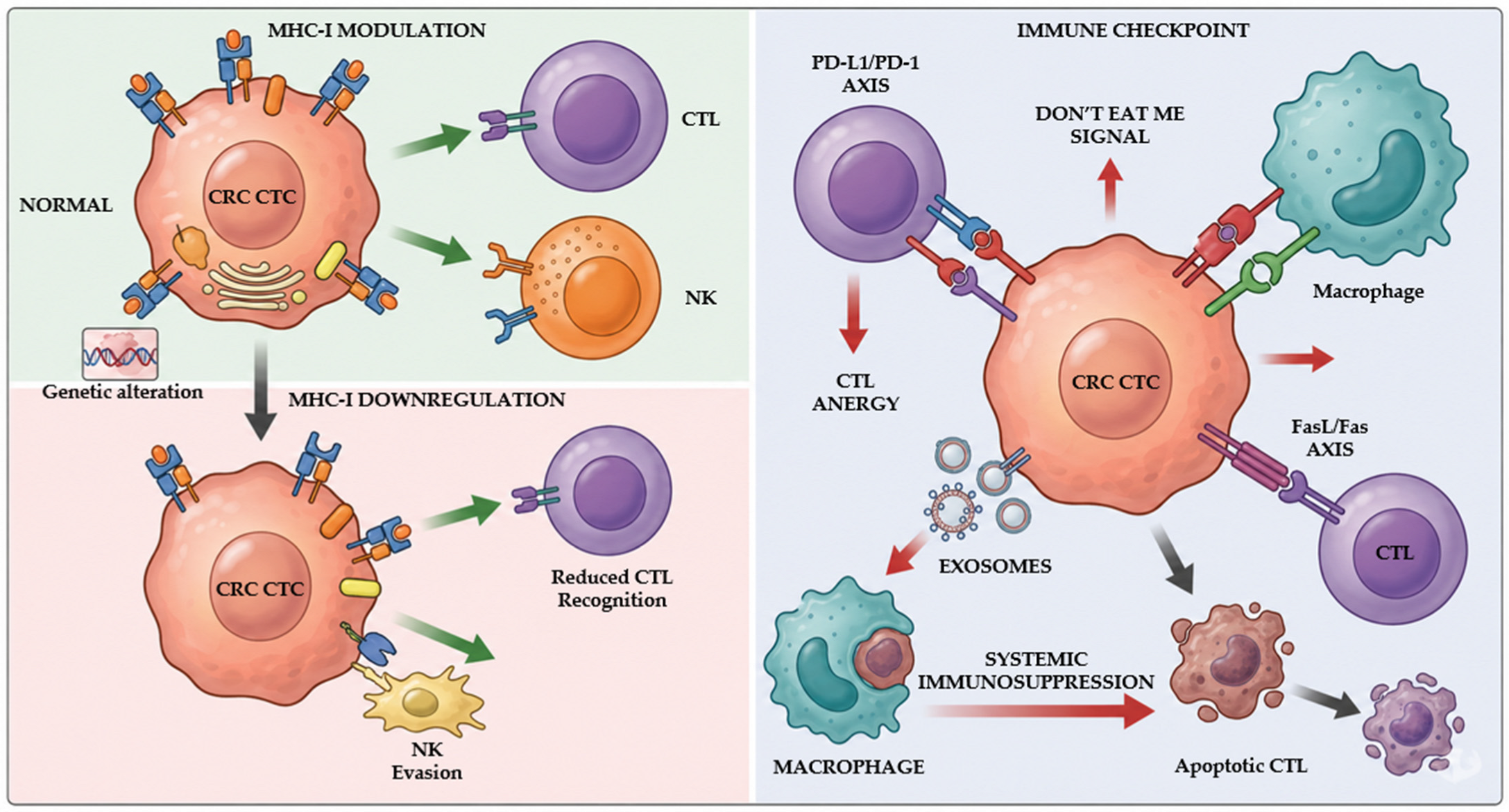
2.1. Modulation of MHC Expression and Antigen Presentation Machinery
2.2. Expression of Immune Checkpoints on CTCs
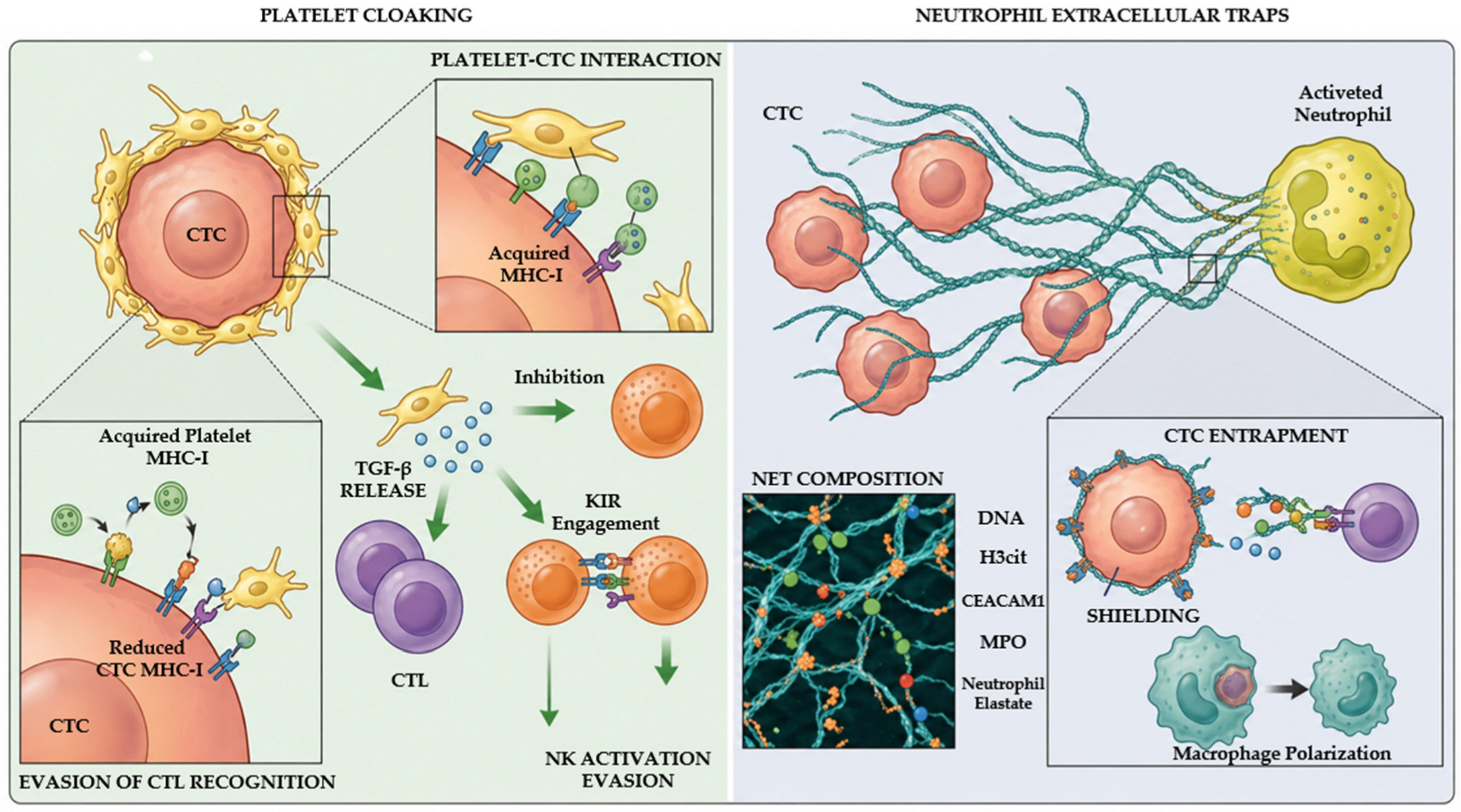
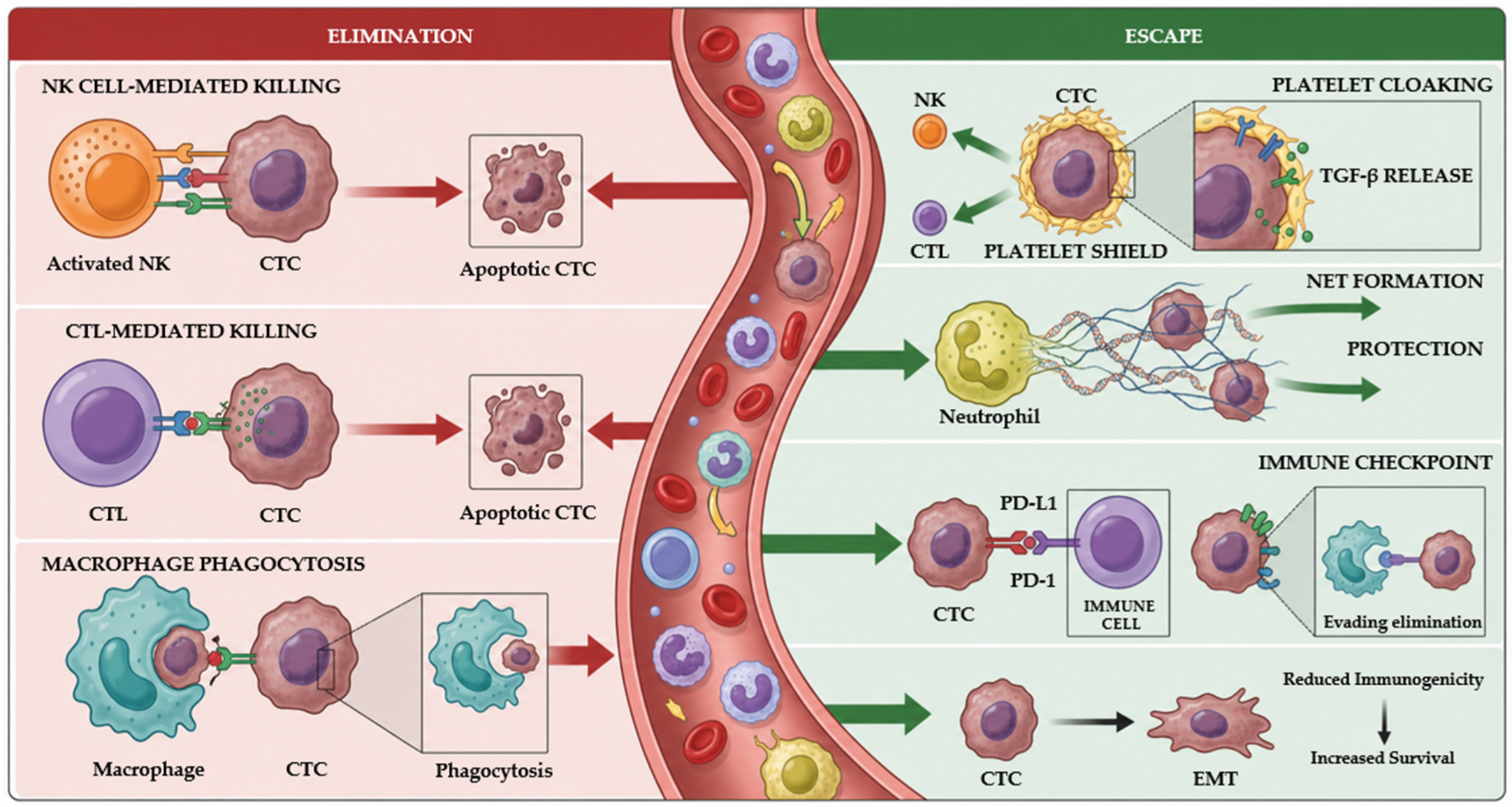
2.3. Extrinsic Protection Mechanisms: “Platelet Cloaking” and Neutrophil Extracellular Traps
3. CTC Cellular Interactions in the Circulation
3.1. The Liver Microenvironment in Colorectal Cancer Metastasis
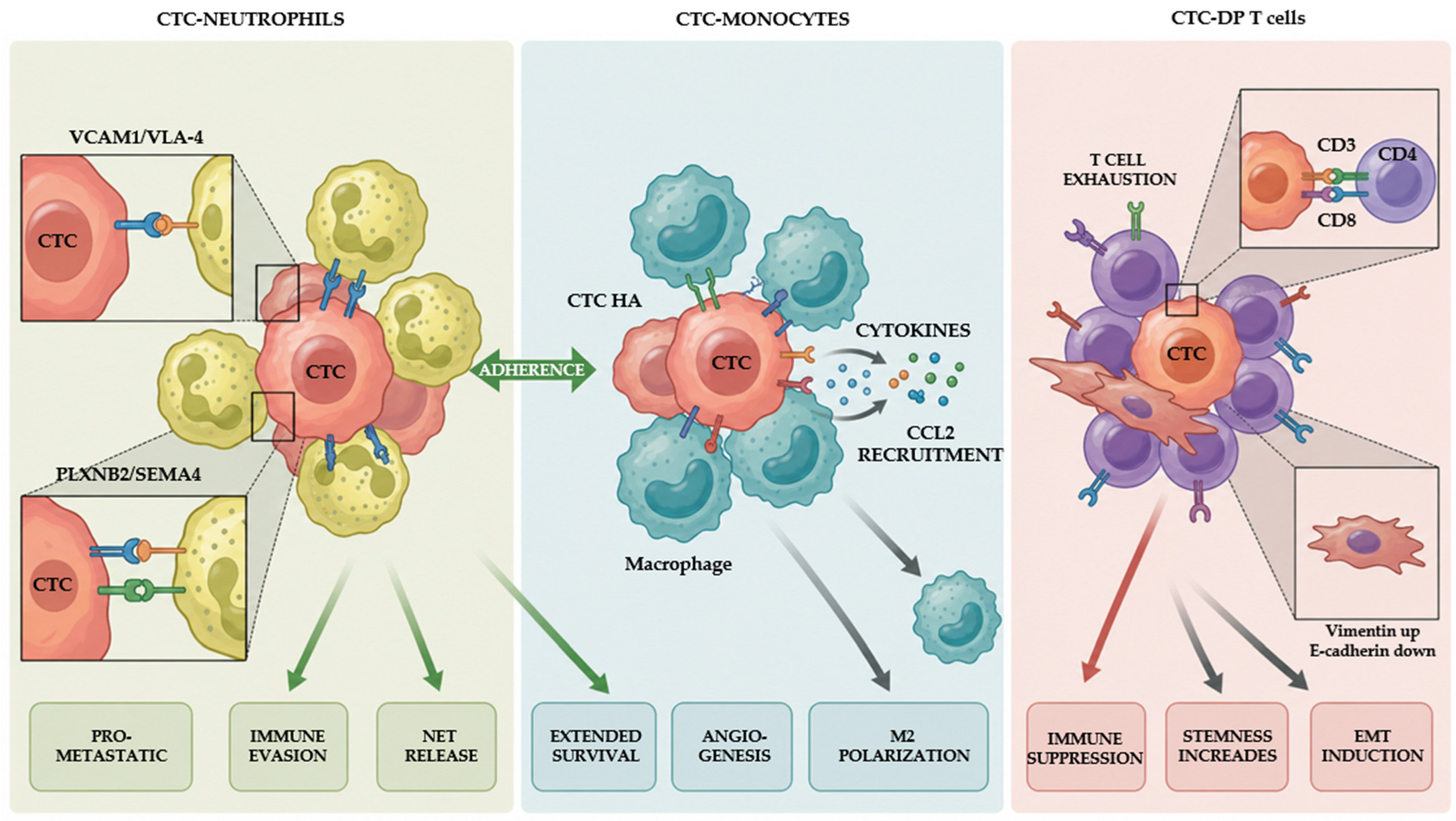
3.2. CTC-PBMC Clusters: Cellular Crosstalk and Pro-Metastatic Niches
3.3. Macrophages and Myeloid-Derived Suppressor Cells
4. The Role of the Immune System in CTC Elimination: Still Effective?
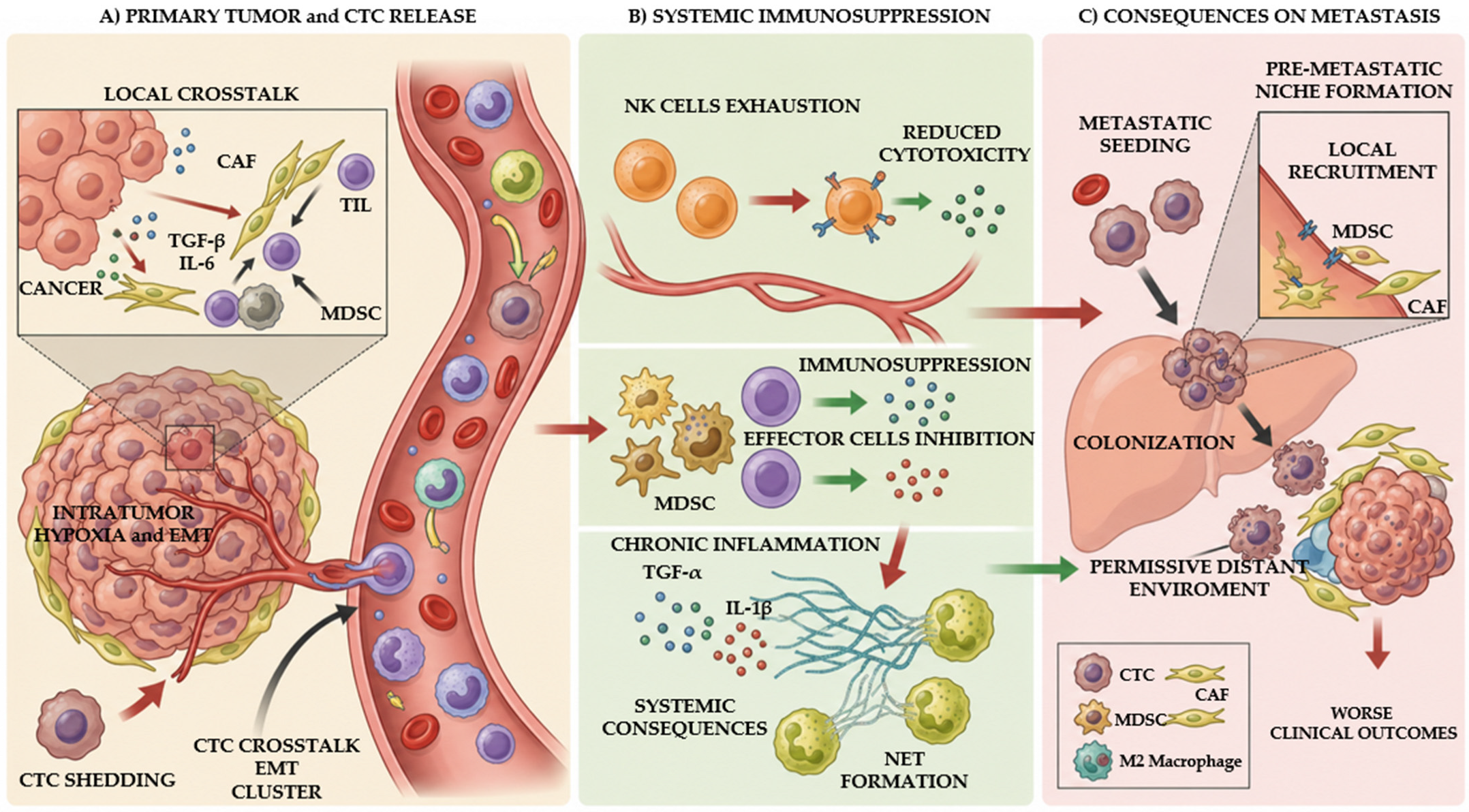
5. Impact of CTCs on Systemic Immunity in CRC
6. Therapeutic Implications and Future Directions
6.1. CTC–Immune System Interplay and Metastatic Dissemination
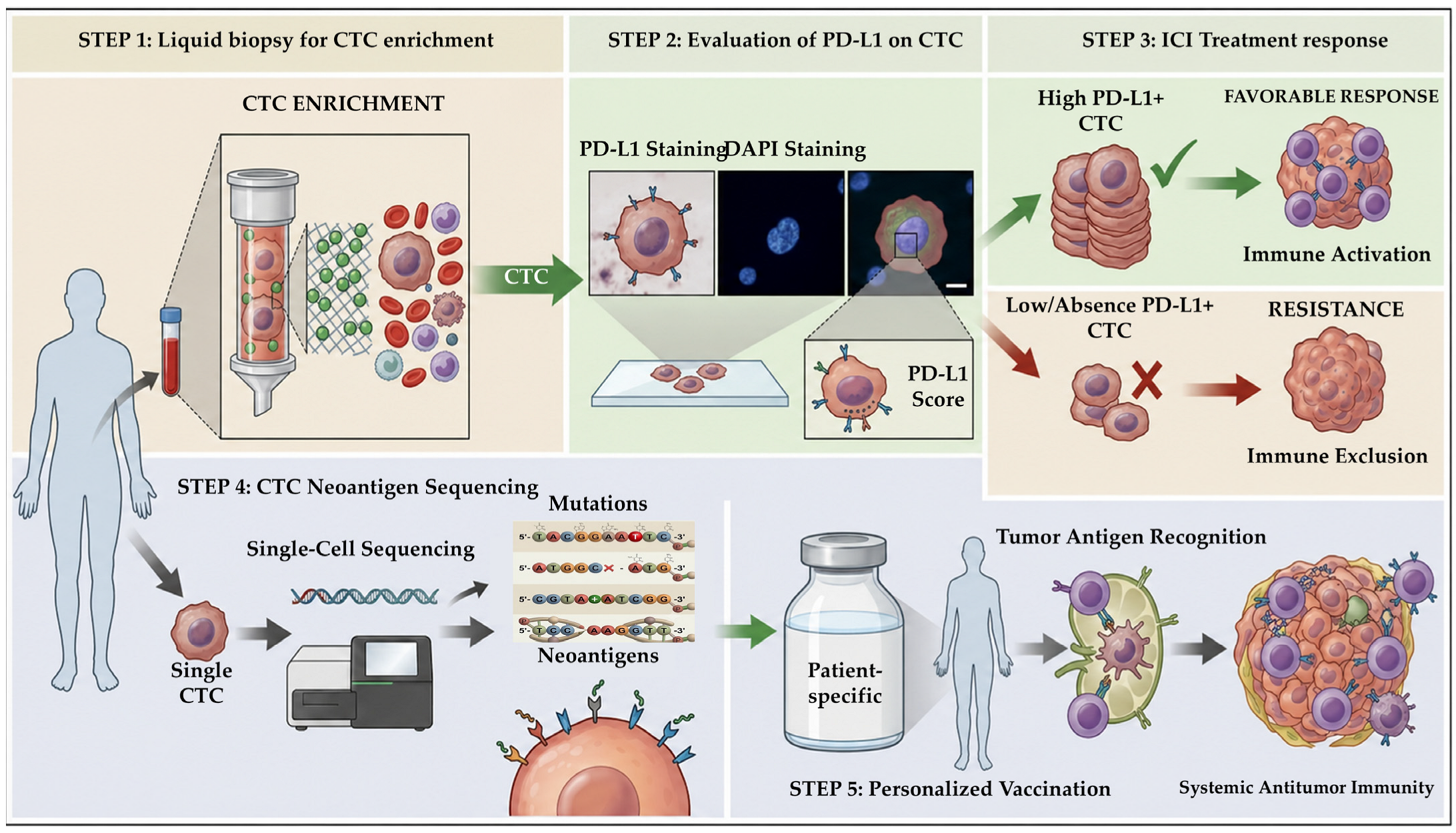
6.2. Therapeutic Implications: Neoantigens, Vaccines, and Emerging Technologies
6.3. Current Challenges and Future Directions
7. Conclusions
Author Contributions
Funding
Data Availability Statement
Acknowledgments
Conflicts of Interest
References
- Cañellas-Socias, A.; Sancho, E.; Batlle, E. Mechanisms of metastatic colorectal cancer. Nat. Rev. Gastroenterol. Hepatol. 2024, 21, 609–625. [Google Scholar] [CrossRef] [PubMed]
- Hernandez Dominguez, O.; Yilmaz, S.; Steele, S.R. Stage IV Colorectal Cancer Management and Treatment. J. Clin. Med. 2023, 12, 2072. [Google Scholar] [CrossRef] [PubMed]
- Morabito, M.; Thibodot, P.; Gigandet, A.; Compagnon, P.; Toso, C.; Berishvili, E.; Lacotte, S.; Peloso, A. Liver Extracellular Matrix in Colorectal Liver Metastasis. Cancers 2025, 17, 953. [Google Scholar] [CrossRef] [PubMed]
- Shin, A.E.; Giancotti, F.G.; Rustgi, A.K. Metastatic colorectal cancer: Mechanisms and emerging therapeutics. Trends Pharmacol. Sci. 2023, 44, 222–236. [Google Scholar] [CrossRef] [PubMed]
- Winkler, J.; Abisoye-Ogunniyan, A.; Metcalf, K.J.; Werb, Z. Concepts of extracellular matrix remodelling in tumour progression and metastasis. Nat. Commun. 2020, 11, 5120. [Google Scholar] [CrossRef] [PubMed]
- Radhakrishnan, V.; Kaifi, J.T.; Suvilesh, K.N. Circulating Tumor Cells: How Far Have We Come with Mining These Seeds of Metastasis? Cancers 2024, 16, 816. [Google Scholar] [CrossRef] [PubMed]
- Yang, Y.P.; Giret, T.M.; Cote, R.J. Circulating Tumor Cells from Enumeration to Analysis: Current Challenges and Future Opportunities. Cancers 2021, 13, 2723. [Google Scholar] [CrossRef] [PubMed]
- Pantel, K.; Alix-Panabières, C. Crucial roles of circulating tumor cells in the metastatic cascade and tumor immune escape: Biology and clinical translation. J. Immunother. Cancer 2022, 10, e005615. [Google Scholar] [CrossRef] [PubMed]
- Narayan, S.; Courcoubetis, G.; Mason, J.; Naghdloo, A.; Kolenčík, D.; Patterson, S.D.; Kuhn, P.; Shishido, S.N. Defining A Liquid Biopsy Profile of Circulating Tumor Cells and Oncosomes in Metastatic Colorectal Cancer for Clinical Utility. Cancers 2022, 14, 4891. [Google Scholar] [CrossRef] [PubMed]
- Zhang, W.; Xu, F.; Yao, J.; Mao, C.; Zhu, M.; Qian, M.; Hu, J.; Zhong, H.; Zhou, J.; Shi, X.; et al. Single-cell metabolic fingerprints discover a cluster of circulating tumor cells with distinct metastatic potential. Nat. Commun. 2023, 14, 2485. [Google Scholar] [CrossRef] [PubMed]
- De Angelis, M.L.; Francescangeli, F.; Nicolazzo, C.; Signore, M.; Giuliani, A.; Colace, L.; Boe, A.; Magri, V.; Baiocchi, M.; Ciardi, A.; et al. An organoid model of colorectal circulating tumor cells with stem cell features, hybrid EMT state and distinctive therapy response profile. J. Exp. Clin. Cancer Res. 2022, 41, 86. [Google Scholar] [CrossRef] [PubMed]
- Dianat-Moghadam, H.; Azizi, M.; Eslami-S, Z.; Cortés-Hernández, L.E.; Heidarifard, M.; Nouri, M.; Alix-Panabières, C. The Role of Circulating Tumor Cells in the Metastatic Cascade: Biology, Technical Challenges, and Clinical Relevance. Cancers 2020, 12, 867. [Google Scholar] [CrossRef] [PubMed]
- Capuozzo, M.; Ferrara, F.; Santorsola, M.; Zovi, A.; Ottaiano, A. Circulating Tumor Cells as Predictive and Prognostic Biomarkers in Solid Tumors. Cells 2023, 12, 2590. [Google Scholar] [CrossRef] [PubMed]
- Kakizaki, F.; Oshiro, K.; Enoki, Y.; Kawanishi, K.; Masuda, N.; Maekawa, H.; Matsubayashi, J.; Kawashima, M.; Miyoshi, H.; Takemura, Y.; et al. Precision Oncology Framework Using Circulating Tumor Cells. Int. J. Mol. Sci. 2025, 26, 5539. [Google Scholar] [CrossRef] [PubMed]
- Zhou, S.; Xu, H.; Duan, Y.; Tang, Q.; Huang, H.; Bi, F. Survival mechanisms of circulating tumor cells and their implications for cancer treatment. Cancer Metastasis Rev. 2024, 43, 941–957. [Google Scholar] [CrossRef] [PubMed]
- Ring, A.; Nguyen-Sträuli, B.D.; Wicki, A.; Aceto, N. Biology, vulnerabilities and clinical applications of circulating tumour cells. Nat. Rev. Cancer 2023, 23, 95–111. [Google Scholar] [CrossRef] [PubMed]
- Kroemer, G.; Chan, T.A.; Eggermont, A.M.M.; Galluzzi, L. Immunosurveillance in clinical cancer management. CA Cancer J. Clin. 2024, 74, 187–202. [Google Scholar] [CrossRef] [PubMed]
- Yi, M.; Li, T.; Niu, M.; Mei, Q.; Zhao, B.; Chu, Q.; Dai, Z.; Wu, K. Exploiting innate immunity for cancer immunotherapy. Mol. Cancer 2023, 22, 187. [Google Scholar] [CrossRef] [PubMed]
- Lu, J.; Luo, Y.; Rao, D.; Wang, T.; Lei, Z.; Chen, X.; Zhang, B.; Li, Y.; Liu, B.; Xia, L.; et al. Myeloid-derived suppressor cells in cancer: Therapeutic targets to overcome tumor immune evasion. Exp. Hematol. Oncol. 2024, 13, 39. [Google Scholar] [CrossRef] [PubMed]
- Mundhara, N.; Sadhukhan, P. Cracking the Codes behind Cancer Cells’ Immune Evasion. Int. J. Mol. Sci. 2024, 25, 8899. [Google Scholar] [CrossRef] [PubMed]
- O’Donnell, J.S.; Teng, M.W.L.; Smyth, M.J. Cancer immunoediting and resistance to T cell-based immunotherapy. Nat. Rev. Clin. Oncol. 2019, 16, 151–167. [Google Scholar] [CrossRef] [PubMed]
- Ward, M.P.; Kane, L.E.; Norris, L.A.; Mohamed, B.M.; Kelly, T.; Bates, M.; Clarke, A.; Brady, N.; Martin, C.M.; Brooks, R.D.; et al. Platelets, immune cells and the coagulation cascade; friend or foe of the circulating tumour cell? Mol. Cancer 2021, 20, 59. [Google Scholar] [CrossRef] [PubMed]
- Ren, X.; Song, M.; Liu, X.; He, W. Circulating tumor cells: Mechanisms and clinical significance in colorectal cancer metastasis. Mol. Cancer 2025, 24, 242. [Google Scholar] [CrossRef] [PubMed]
- Jhunjhunwala, S.; Hammer, C.; Delamarre, L. Antigen presentation in cancer: Insights into tumour immunogenicity and immune evasion. Nat. Rev. Cancer 2021, 21, 298–312. [Google Scholar] [CrossRef] [PubMed]
- Merhi, M.; Ahmad, F.; Taib, N.; Inchakalody, V.; Uddin, S.; Shablak, A.; Dermime, S. The complex network of transcription factors, immune checkpoint inhibitors and stemness features in colorectal cancer: A recent update. Semin. Cancer Biol. 2023, 89, 1–17. [Google Scholar] [CrossRef] [PubMed]
- Yang, C.; Liu, C.; Xia, C.; Fu, L. Clinical applications of circulating tumor cells in metastasis and therapy. J. Hematol. Oncol. 2025, 18, 80. [Google Scholar] [CrossRef] [PubMed]
- Cornel, A.M.; Mimpen, I.L.; Nierkens, S. MHC Class I Downregulation in Cancer: Underlying Mechanisms and Potential Targets for Cancer Immunotherapy. Cancers 2020, 12, 1760. [Google Scholar] [CrossRef] [PubMed]
- Sari, G.; Rock, K.L. Tumor immune evasion through loss of MHC class-I antigen presentation. Curr. Opin. Immunol. 2023, 83, 102329. [Google Scholar] [CrossRef] [PubMed]
- Ling, A.; Löfgren-Burström, A.; Larsson, P.; Li, X.; Wikberg, M.L.; Öberg, Å.; Stenling, R.; Edin, S.; Palmqvist, R. TAP1 down-regulation elicits immune escape and poor prognosis in colorectal cancer. Oncoimmunology 2017, 6, e1356143. [Google Scholar] [CrossRef] [PubMed]
- Sethumadhavan, S.; Silva, M.; Philbrook, P.; Nguyen, T.; Hatfield, S.M.; Ohta, A.; Sitkovsky, M.V. Hypoxia and hypoxia-inducible factor (HIF) downregulate antigen-presenting MHC class I molecules limiting tumor cell recognition by T cells. PLoS ONE 2017, 12, e0187314. [Google Scholar] [CrossRef] [PubMed]
- Wu, X.; Li, T.; Jiang, R.; Yang, X.; Guo, H.; Yang, R. Targeting MHC-I molecules for cancer: Function, mechanism, and therapeutic prospects. Mol. Cancer 2023, 22, 194. [Google Scholar] [CrossRef] [PubMed]
- Garrido, F.; Aptsiauri, N. Cancer immune escape: MHC expression in primary tumours versus metastases. Immunology 2019, 158, 255–266. [Google Scholar] [CrossRef] [PubMed]
- McGranahan, N.; Rosenthal, R.; Hiley, C.T.; Rowan, A.J.; Watkins, T.B.K.; Wilson, G.A.; Birkbak, N.J.; Veeriah, S.; Van Loo, P.; Herrero, J.; et al. Allele-Specific HLA Loss and Immune Escape in Lung Cancer Evolution. Cell 2017, 171, 1259–1271.e11. [Google Scholar] [CrossRef] [PubMed]
- Catalán, E.; Charni, S.; Jaime, P.; Aguiló, J.I.; Enríquez, J.A.; Naval, J.; Pardo, J.; Villalba, M.; Anel, A. MHC-I modulation due to changes in tumor cell metabolism regulates tumor sensitivity to CTL and NK cells. Oncoimmunology 2015, 4, e985924. [Google Scholar] [CrossRef] [PubMed]
- Nicolazzo, C.; Gradilone, A.; Carpino, G.; Gazzaniga, P.; Raimondi, C. Molecular Characterization of Circulating Tumor Cells to Study Cancer Immunoevasion. Methods Mol. Biol. 2019, 1884, 247–258. [Google Scholar] [CrossRef] [PubMed]
- Strati, A.; Economopoulou, P.; Lianidou, E.; Psyrri, A. Clinical Significance of PD-L1 Status in Circulating Tumor Cells for Cancer Management during Immunotherapy. Biomedicines 2023, 11, 1768. [Google Scholar] [CrossRef] [PubMed]
- Vasudevan, A.; Dongare, M.; Jayant, S.; Gourishankar, A.; Ganesh, K.; Prathamesh, P.; Tanvi, D.; Vikas, L.B.J.; Sujata, M.; Nayan, M.; et al. Measure of minimal residual burden on circulating tumor cells with over-expression of programmed death-ligand 1 as a dynamic biomarker in patients with colorectal cancer. J. Clin. Oncol. 2024, 42, e14553. [Google Scholar] [CrossRef]
- Vasudevan, A.; Aland, G.; Jayant, S.; Manoj, D.; Ganesh, K.; Tanvi, D.; Shubham, K.; Ashwini, J.; Suhas, M.; Amol, K.; et al. Circulating tumor cells and clusters exhibiting expression of PD-L1 in colorectal patients. J. Clin. Oncol. 2025, 43, e15038. [Google Scholar] [CrossRef]
- Satelli, A.; Batth, I.S.; Brownlee, Z.; Rojas, C.; Meng, Q.H.; Kopetz, S.; Li, S. Potential role of nuclear PD-L1 expression in cell-surface vimentin positive circulating tumor cells as a prognostic marker in cancer patients. Sci. Rep. 2016, 6, 28910. [Google Scholar] [CrossRef] [PubMed]
- Secinti, I.E.; Ozgur, T.; Dede, I. PD-L1 Expression in Colorectal Adenocarcinoma Is Associated With the Tumor Immune Microenvironment and Epithelial-Mesenchymal Transition. Am. J. Clin. Pathol. 2022, 158, 506–515. [Google Scholar] [CrossRef] [PubMed]
- Li, P.; Huang, T.; Zou, Q.; Liu, D.; Wang, Y.; Tan, X.; Wei, Y.; Qiu, H. FGFR2 Promotes Expression of PD-L1 in Colorectal Cancer via the JAK/STAT3 Signaling Pathway. J. Immunol. 2019, 202, 3065–3075. [Google Scholar] [CrossRef] [PubMed]
- Wu, Y.; Xiao, Y.; Ding, Y.; Ran, R.; Wei, K.; Tao, S.; Mao, H.; Wang, J.; Pang, S.; Shi, J.; et al. Colorectal cancer cell-derived exosomal miRNA-372-5p induces immune escape from colorectal cancer via PTEN/AKT/NF-κB/PD-L1 pathway. Int. Immunopharmacol. 2024, 143, 113261. [Google Scholar] [CrossRef] [PubMed]
- Wang, H.; Yao, H.; Li, C.; Liang, L.; Zhang, Y.; Shi, H.; Zhou, C.; Chen, Y.; Fang, J.Y.; Xu, J. PD-L2 expression in colorectal cancer: Independent prognostic effect and targetability by deglycosylation. Oncoimmunology 2017, 6, e1327494. [Google Scholar] [CrossRef] [PubMed]
- Steinert, G.; Schölch, S.; Niemietz, T.; Iwata, N.; García, S.A.; Behrens, B.; Voigt, A.; Kloor, M.; Benner, A.; Bork, U.; et al. Immune escape and survival mechanisms in circulating tumor cells of colorectal cancer. Cancer Res. 2014, 74, 1694–1704. [Google Scholar] [CrossRef] [PubMed]
- Willingham, S.B.; Volkmer, J.P.; Gentles, A.J.; Sahoo, D.; Dalerba, P.; Mitra, S.S.; Wang, J.; Contreras-Trujillo, H.; Martin, R.; Cohen, J.D.; et al. The CD47-signal regulatory protein alpha (SIRPa) interaction is a therapeutic target for human solid tumors. Proc. Natl. Acad. Sci. USA 2012, 109, 6662–6667. [Google Scholar] [CrossRef] [PubMed]
- Tang, Z.; Zhong, M.C.; Qian, J.; Galindo, C.C.; Davidson, D.; Li, J.; Zhao, Y.; Hui, E.; Veillette, A. CD47 masks pro-phagocytic ligands in cis on tumor cells to suppress antitumor immunity. Nat. Immunol. 2023, 24, 2032–2041. [Google Scholar] [CrossRef] [PubMed]
- Miller, W.D.; Manion, A.; Mishra, A.K.; Sheedy, C.J.; Bond, A.; Gardner, B.M.; Montell, D.J.; Morrissey, M.A. CD47 inhibits phagocytosis through Vav dephosphorylation. J. Cell Biol. 2025, 224, e202502206. [Google Scholar] [CrossRef] [PubMed]
- Arai, H.; Gandhi, N.; Battaglin, F.; Wang, J.; Algaze, S.; Jayachandran, P.; Soni, S.; Zhang, W.; Yang, Y.; Millstein, J.; et al. Role of CD47 gene expression in colorectal cancer: A comprehensive molecular profiling study. J. Immunother. Cancer 2024, 12, e010326. [Google Scholar] [CrossRef] [PubMed]
- Kang, X.; Li, Y.; Han, Y.; Wu, M.; Qian, P.; Dong, J.; Wei, J. Dual blockade of TNFR2 and CD47 reshape tumor immune microenvironment and improve antitumor effects in colorectal cancer. Mol. Ther. 2025, 33, 4600–4617. [Google Scholar] [CrossRef] [PubMed]
- O’Connell, J.; O’Sullivan, G.C.; Collins, J.K.; Shanahan, F. The Fas counterattack: Fas-mediated T cell killing by colon cancer cells expressing Fas ligand. J. Exp. Med. 1996, 184, 1075–1082. [Google Scholar] [CrossRef] [PubMed]
- Song, E.; Chen, J.; Ouyang, N.; Su, F.; Wang, M.; Heemann, U. Soluble Fas ligand released by colon adenocarcinoma cells induces host lymphocyte apoptosis: An active mode of immune evasion in colon cancer. Br. J. Cancer 2001, 85, 1047–1054. [Google Scholar] [CrossRef] [PubMed]
- Papadaki, M.A.; Papadaki, E.; Chatziavraam, S.; Aggouraki, D.; Michaelidou, K.; Fotsitzoudis, C.; Vassilakopoulou, M.; Mavroudis, D.; Agelaki, S. Prognostic Value of Fas/Fas Ligand Expression on Circulating Tumor Cells (CTCs) and Immune Cells in the Peripheral Blood of Patients with Metastatic Breast Cancer. Cancers 2024, 16, 2927. [Google Scholar] [CrossRef] [PubMed]
- Zhu, L.; Qu, Y.; Yang, J.; Shao, T.; Kuang, J.; Liu, C.; Qi, Y.; Li, M.; Li, Y.; Zhang, S.; et al. PD-L2 act as an independent immune checkpoint in colorectal cancer beyond PD-L1. Front. Immunol. 2024, 15, 1486888. [Google Scholar] [CrossRef] [PubMed]
- Lv, J.; Jiang, Z.; Yuan, J.; Zhuang, M.; Guan, X.; Liu, H.; Yin, Y.; Ma, Y.; Liu, Z.; Wang, H.; et al. Pan-cancer analysis identifies PD-L2 as a tumor promotor in the tumor microenvironment. Front. Immunol. 2023, 14, 1093716. [Google Scholar] [CrossRef] [PubMed]
- Liu, T.; Cheng, S.; Peng, B.; Zang, H.; Zhu, X.; Wang, X.; Zhao, X.; Gu, Y.; Pan, Y.; Hu, H.; et al. PD-L2 of tumor-derived exosomes mediates the immune escape of cancer cells via the impaired T cell function. Cell Death Dis. 2024, 15, 800. [Google Scholar] [CrossRef] [PubMed]
- Placke, T.; Örgel, M.; Schaller, M.; Jung, G.; Rammensee, H.G.; Kopp, H.G.; Salih, H.R. Platelet-derived MHC class I confers a pseudonormal phenotype to cancer cells that subverts the antitumor reactivity of natural killer immune cells. Cancer Res. 2012, 72, 440–448. [Google Scholar] [CrossRef] [PubMed]
- Gan, J.; Zhang, X.; Guo, J. The role of platelets in tumor immune evasion and metastasis: Mechanisms and therapeutic implications. Cancer Cell Int. 2025, 25, 258. [Google Scholar] [CrossRef] [PubMed]
- Labelle, M.; Begum, S.; Hynes, R.O. Direct signaling between platelets and cancer cells induces an epithelial-mesenchymal-like transition and promotes metastasis. Cancer Cell 2011, 20, 576–590. [Google Scholar] [CrossRef] [PubMed]
- Cluxton, C.D.; Spillane, C.; O’Toole, S.A.; Sheils, O.; Gardiner, C.M.; O’Leary, J.J. Suppression of Natural Killer cell NKG2D and CD226 anti-tumour cascades by platelet cloaked cancer cells: Implications for the metastatic cascade. PLoS ONE 2019, 14, e0211538. [Google Scholar] [CrossRef] [PubMed]
- Sun, Y.; Li, T.; Ding, L.; Wang, J.; Chen, C.; Liu, T.; Liu, Y.; Li, Q.; Wang, C.; Huo, R.; et al. Platelet-mediated circulating tumor cell evasion from natural killer cell killing through immune checkpoint CD155-TIGIT. Hepatology 2025, 81, 791–807. [Google Scholar] [CrossRef] [PubMed]
- Plantureux, L.; Mège, D.; Crescence, L.; Carminita, E.; Robert, S.; Cointe, S.; Brouilly, N.; Ezzedine, W.; Dignat-Feorge, G.; Dubois, C.; et al. The Interaction of Platelets with Colorectal Cancer Cells Inhibits Tumor Growth but Promotes Metastasis. Cancer Res. 2020, 80, 291–303. [Google Scholar] [CrossRef] [PubMed]
- Eslami-S, Z.; Cortés-Hernández, L.E.; Glogovitis, I.; Antunes-Ferreira, M.; D’Ambrosi, S.; Kurma, K.; Garima, F.; Cayrefourcq, L.; Best, M.G.; Koppers-Lalic, D.; et al. In vitro cross-talk between metastasis-competent circulating tumor cells and platelets in colon cancer: A malicious association during the harsh journey in the blood. Front. Cell Dev. Biol. 2023, 11, 1209846. [Google Scholar] [CrossRef] [PubMed]
- Takemoto, A.; Okitaka, M.; Takagi, S.; Takami, M.; Sato, S.; Nishio, M.; Okumura, S.; Fujita, N. A critical role of platelet TGF-β release in podoplanin-mediated tumour invasion and metastasis. Sci. Rep. 2017, 7, 42186. [Google Scholar] [CrossRef] [PubMed]
- Shahzad, M.H.; Rayes, R.F.; Cools-Lartigue, J.; Spicer, J.D. Neutrophil extracellular traps in cancer. Nat. Rev. Cancer 2026, 26, 104–117. [Google Scholar] [CrossRef] [PubMed]
- Najmeh, S.; Cools-Lartigue, J.; Rayes, R.F.; Gowing, S.; Vourtzoumis, P.; Bourdeau, F.; Giannias, B.; Berube, J.; Rousseau, S.; Ferri, L.E.; et al. Neutrophil extracellular traps sequester circulating tumor cells via β1-integrin mediated interactions. Int. J. Cancer 2017, 140, 2321–2330. [Google Scholar] [CrossRef] [PubMed]
- Yang, L.; Liu, Q.; Zhang, X.; Liu, X.; Zhou, B.; Chen, J.; Huang, D.; Li, J.; Li, H.; Chen, F.; et al. DNA of neutrophil extracellular traps promotes cancer metastasis via CCDC25. Nature 2020, 583, 133–138. [Google Scholar] [CrossRef] [PubMed]
- Teijeira, Á.; Garasa, S.; Gato, M.; Alfaro, C.; Migueliz, I.; Cirella, A.; de Andrea, C.; Ochoa, M.C.; Otano, I.; Etxeberria, I.; et al. CXCR1 and CXCR2 Chemokine Receptor Agonists Produced by Tumors Induce Neutrophil Extracellular Traps that Interfere with Immune Cytotoxicity. Immunity 2020, 52, 856–871.e8. [Google Scholar] [CrossRef] [PubMed]
- Rayes, R.F.; Vourtzoumis, P.; Bou Rjeily, M.; Seth, R.; Bourdeau, F.; Giannias, B.; Berube, J.; Huang, Y.H.; Rousseau, S.; Camilleri-Broet, S.; et al. Neutrophil Extracellular Trap-Associated CEACAM1 as a Putative Therapeutic Target to Prevent Metastatic Progression of Colon Carcinoma. J. Immunol. 2020, 204, 2285–2294. [Google Scholar] [CrossRef] [PubMed]
- Stehr, A.M.; Wang, G.; Demmler, R.; Stemmler, M.P.; Krug, J.; Tripal, P.; Schmid, B.; Geppert, C.I.; Hartmann, A.; Muñoz, L.E.; et al. Neutrophil extracellular traps drive epithelial-mesenchymal transition of human colon cancer. J. Pathol. 2022, 256, 455–467. [Google Scholar] [CrossRef] [PubMed]
- Li, N.; Yang, S.; Hu, C.; Zheng, J.; Yang, H.; Jiang, T.; Li, X.; Han, Q.; Zhang, X.; Yang, Y.; et al. Neutrophil extracellular traps regulate LDHA expression to promote colorectal cancer liver metastasis. J. Transl. Med. 2025, 23, 1208. [Google Scholar] [CrossRef] [PubMed]
- Pan, B.; Yao, Y.; Zhang, Z.; Ye, D.; Wu, H.; Zhang, X.; Wang, X.; Tang, N. Escherichia coli promotes colorectal cancer metastasis by maintaining enhancer-promoter loops through releasing neutrophil extracellular traps. Nat. Commun. 2026, 17, 2290. [Google Scholar] [CrossRef] [PubMed]
- Lee, S.; Kim, E.Y.; Park, W.; Lee, Y.S.; Yim, K. Neutrophil extracellular traps predict poor survival in cancer: A systematic review and meta-analysis of studies on tissue and circulating biomarkers. Front. Immunol. 2025, 16, 1676854. [Google Scholar] [CrossRef] [PubMed]
- Rahkola, O.; Tuomisto, A.; Elomaa, H.; Henna, K.; Ville, K.Ä.; Meeri, K.; Vilja, V.T.; Akseli, K.; Aino, O.; Vesa-Matti, P.; et al. Significance of tumor infiltrating granulocytes and neutrophil extracellular traps in colorectal cancer. Br. J. Cancer 2026, 134, 1692–1703. [Google Scholar] [CrossRef] [PubMed]
- Taylor, B.c.; Sun, X.; Gonzalez-Ericsson, P.I.; Sanchez, V.; Sanders, M.E.; Wescott, E.C.; Opalenik, S.R.; Hanna, A.; Chou, S.T.; Van Kaer, L.; et al. NKG2A Is a Therapeutic Vulnerability in Immunotherapy Resistant MHC-I Heterogeneous Triple-Negative Breast Cancer. Cancer Discov. 2024, 14, 290–307. [Google Scholar] [CrossRef] [PubMed]
- Bern, M.D.; Parikh, B.A.; Yang, L.; Beckman, D.L.; Poursine-Laurent, J.; Yokoyama, W.M. Inducible down-regulation of MHC class I results in natural killer cell tolerance. J. Exp. Med. 2019, 216, 99–116. [Google Scholar] [CrossRef] [PubMed]
- Huang, S.; Qin, Z.; Wang, F.; Kang, Y.; Ren, B. A potential mechanism of tumor immune escape: Regulation and application of soluble natural killer group 2 member D ligands (Review). Oncol. Rep. 2024, 52, 137. [Google Scholar] [CrossRef] [PubMed]
- Doubrovina, E.S.; Doubrovin, M.M.; Vider, E.; Sisson, R.B.; O’Reilly, R.J.; Dupont, B.; Vyas, Y.M. Evasion from NK cell immunity by MHC class I chain-related molecules expressing colon adenocarcinoma. J. Immunol. 2003, 171, 6891–6899. [Google Scholar] [CrossRef] [PubMed]
- Chitadze, G.; Lettau, M.; Bhat, J.; Wesch, D.; Steinle, A.; Fürst, D.; Mytilineos, J.; Kalthoff, H.; Janssen, O.; Oberg, H.H.; et al. Shedding of endogenous MHC class I-related chain molecules A and B from different human tumor entities: Heterogeneous involvement of the “a disintegrin and metalloproteases” 10 and 17. Int. J. Cancer 2013, 133, 1557–1566. [Google Scholar] [CrossRef] [PubMed]
- Pereira-Veiga, T.; Schneegans, S.; Pantel, K.; Wikman, H. Circulating tumor cell-blood cell crosstalk: Biology and clinical relevance. Cell Rep. 2022, 40, 111298. [Google Scholar] [CrossRef] [PubMed]
- Chen, S.; Zhang, S.; Shi, Y.; Liu, X. Microenvironment crosstalk and immune evasion of circulating tumor cells: From mechanism to clinical significance. Chin. Med. J. 2026, 139, 515–535. [Google Scholar] [CrossRef] [PubMed]
- Muraro, E.; Brisotto, G. Circulating tumor cells and host immunity: A tricky liaison. Int. Rev. Cell Mol. Biol. 2023, 381, 131–157. [Google Scholar] [CrossRef] [PubMed]
- Zhao, W.; Dai, S.; Yue, L.; Xu, F.; Gu, J.; Dai, X.; Qian, X. Emerging mechanisms progress of colorectal cancer liver metastasis. Front. Endocrinol. 2022, 13, 1081585. [Google Scholar] [CrossRef] [PubMed]
- Shasha, T.; Gruijs, M.; van Egmond, M. Mechanisms of colorectal liver metastasis development. Cell. Mol. Life Sci. 2022, 79, 607. [Google Scholar] [CrossRef] [PubMed]
- Tiegs, G.; Lohse, A.W. Immune tolerance: What is unique about the liver. J. Autoimmun. 2010, 34, 1–6. [Google Scholar] [CrossRef] [PubMed]
- Zeng, X.; Ward, S.E.; Zhou, J.; Cheng, A.S.L. Liver Immune Microenvironment and Metastasis from Colorectal Cancer-Pathogenesis and Therapeutic Perspectives. Cancers 2021, 13, 2418. [Google Scholar] [CrossRef] [PubMed]
- Mourad, M.; Al Mahmasani, L.; Abbas, N.; Shamseddine, A. Organ-specific pre-metastatic and metastatic niches in colorectal cancer: “discrepancy in response to immune checkpoint inhibitors in liver and lung metastasis”. Front. Immunol. 2026, 17, 1838169. [Google Scholar] [CrossRef] [PubMed]
- Wu, Y.; Yang, S.; Ma, J.; Chen, Z.; Song, G.; Rao, D.; Cheng, Y.; Huang, S.; Liu, Y.; Jiang, S.; et al. Spatiotemporal Immune Landscape of Colorectal Cancer Liver Metastasis at Single-Cell Level. Cancer Discov. 2022, 12, 134–153. [Google Scholar] [CrossRef] [PubMed]
- Li, J.J.; Wang, J.H.; Tian, T.; Liu, J.; Zheng, Y.Q.; Mo, H.Y.; Sheng, H.; Chen, Y.X.; Wu, Q.N.; Han, Y.; et al. The liver microenvironment orchestrates FGL1-mediated immune escape and progression of metastatic colorectal cancer. Nat. Commun. 2023, 14, 6690. [Google Scholar] [CrossRef] [PubMed]
- Yang, L.; Liu, L.; Zhang, R.; Hong, J.; Wang, Y.; Wang, J.; Zuo, J.; Zhang, J.; Chen, J.; Hao, H. IL-8 mediates a positive loop connecting increased neutrophil extracellular traps (NETs) and colorectal cancer liver metastasis. J. Cancer 2020, 11, 4384–4396. [Google Scholar] [CrossRef] [PubMed]
- Xu, Z.; Feng, H.; Feng, W.; Zhang, Y.; Huo, J.; Xu, Z.; Chen, F.; Gao, H.; Lv, Z.; Liu, W.; et al. Agonist signaling drives neutrophil subpopulations to promote/inhibit colorectal cancer liver metastasis. Nat. Commun. 2025, 17, 865. [Google Scholar] [CrossRef] [PubMed]
- Zhou, M.; Guan, B.; Liu, Y.; Gu, Q.; Chen, W.; Xie, B.; Zhou, M.; Xiang, J.; Zhao, S.; Zhao, Q.; et al. Fibrinogen-like 2 in tumor-associated macrophage-derived extracellular vesicles shapes an immunosuppressive microenvironment in colorectal liver metastases by promoting tumor stemness and neutrophil extracellular traps formation. Cancer Lett. 2025, 618, 217642. [Google Scholar] [CrossRef] [PubMed]
- Jiang, Y.; Long, G.; Huang, X.; Wang, W.; Cheng, B.; Pan, W. Single-cell transcriptomic analysis reveals dynamic changes in the liver microenvironment during colorectal cancer metastatic progression. J. Transl. Med. 2025, 23, 336. [Google Scholar] [CrossRef] [PubMed]
- Kimura, Y.; Inoue, A.; Hangai, S.; Saijo, S.; Negishi, H.; Nishio, J.; Yamasaki, S.; Iwakura, Y.; Yanai, H.; Taniguchi, T. The innate immune receptor Dectin-2 mediates the phagocytosis of cancer cells by Kupffer cells for the suppression of liver metastasis. Proc. Natl. Acad. Sci. USA 2016, 113, 14097–14102. [Google Scholar] [CrossRef] [PubMed]
- Zhou, X.; Liu, W.; Hu, J.; Yao, Q.; Zhang, F.; Wu, Q.; Li, L.; Li, J.; Zhu, L.; Chen, C.; et al. Kupffer cell calibration of T cell responses via VSIG4-CD5 interaction promotes tumor evasion. Nat. Immunol. 2026, 27, 1253–1267. [Google Scholar] [CrossRef] [PubMed]
- Araujo David, B.; Andreata, F.; Blériot, C.; Ginhoux, F.; Kubes, P.; Iannacone, M. Kupffer cells in liver homeostasis and disease: From immune sentinels to metabolic gatekeepers. Nat. Rev. Immunol. 2026, 26, 538–554. [Google Scholar] [CrossRef] [PubMed]
- Chen, Q.; Zou, J.; He, Y.; Pan, Y.; Yang, G.; Zhao, H.; Huang, Y.; Zhao, Y.; Wang, A.; Chen, W.; et al. A narrative review of circulating tumor cells clusters: A key morphology of cancer cells in circulation promote hematogenous metastasis. Front. Oncol. 2022, 12, 944487. [Google Scholar] [CrossRef] [PubMed]
- Aceto, N.; Bardia, A.; Miyamoto, D.T.; Donaldson, M.C.; Wittner, B.S.; Spencer, J.A.; Yu, M.; Pely, A.; Engstrom, A.; Zhu, H.; et al. Circulating tumor cell clusters are oligoclonal precursors of breast cancer metastasis. Cell 2014, 158, 1110–1122. [Google Scholar] [CrossRef] [PubMed]
- Divella, R.; Daniele, A.; Abbate, I.; Bellizzi, A.; Savino, E.; Simone, G.; Giannone, G.; Giuliani, F.; Fazio, V.; Gadaleta-Caldarola, G.; et al. The presence of clustered circulating tumor cells (CTCs) and circulating cytokines define an aggressive phenotype in metastatic colorectal cancer. Cancer Causes Control 2014, 25, 1531–1541. [Google Scholar] [CrossRef] [PubMed]
- Singh, A.; Liu, H.; El-Shennawy, L. Multi-omic features and clustering phenotypes of circulating tumor cells associated with metastasis and clinical outcomes. Int. Rev. Cell Mol. Biol. 2025, 392, 67–100. [Google Scholar] [CrossRef] [PubMed]
- Gvozdenovic, A.; Aceto, N. A growing entourage for heterotypic circulating tumor cell clusters. Trends Cancer 2025, 11, 1137–1138. [Google Scholar] [CrossRef] [PubMed]
- Tao, J.; Zhu, L.; Yakoub, M.; Reißfelder, C.; Loges, S.; Schölch, S. Cell-Cell Interactions Drive Metastasis of Circulating Tumor Microemboli. Cancer Res. 2022, 82, 2661–2671. [Google Scholar] [CrossRef] [PubMed]
- Bobkov, G.O.M.; Patel, K.J.; Lege, B.M.; Zheng, R.; Shaulsky, G.; Ellis, M.J.; Cheng, C. Extracellular matrix mediates circulating tumor cell clustering in triple-negative breast cancer metastasis. Nat. Commun. 2026, 17, 1352. [Google Scholar] [CrossRef] [PubMed]
- Szczerba, B.M.; Castro-Giner, F.; Vetter, M.; Krol, I.; Gkountela, S.; Landin, J.; Scheidmann, M.C.; Donato, C.; Scherrer, R.; Singer, J.; et al. Neutrophils escort circulating tumour cells to enable cell cycle progression. Nature 2019, 566, 553–557. [Google Scholar] [CrossRef] [PubMed]
- Ju, J.A.; Thompson, K.N.; Annis, D.A.; Mull, M.L.; Gilchrist, D.E.; Moriarty, A.; Chang, K.T.; Stemberger, M.B.; Noto, M.J.; Vitolo, M.I.; et al. Tubulin-Based Microtentacles Aid in Heterotypic Clustering of Neutrophil-Differentiated HL-60 Cells and Breast Tumor Cells. Adv. Sci. 2025, 12, e2409260. [Google Scholar] [CrossRef] [PubMed]
- Spiegel, A.; Brooks, M.W.; Houshyar, S.; Reinhardt, F.; Ardolino, M.; Fessler, E.; Chen, M.B.; Krall, J.A.; DeCock, J.; Zervantonakis, I.K.; et al. Neutrophils Suppress Intraluminal NK Cell-Mediated Tumor Cell Clearance and Enhance Extravasation of Disseminated Carcinoma Cells. Cancer Discov. 2016, 6, 630–649. [Google Scholar] [CrossRef] [PubMed]
- Scholten, D.; El-Shennawy, L.; Jia, Y.; Zhang, Y.; Hyun, E.; Reduzzi, C.; Hoffmann, A.D.; Almubarak, H.F.; Tong, F.; Dashzeveg, N.K.; et al. Double-positive T cells form heterotypic clusters with circulating tumor cells to foster cancer metastasis. J. Clin. Investig. 2025, 135, e193521. [Google Scholar] [CrossRef] [PubMed]
- Schuster, E.; Dashzeveg, N.K.; Tong, F.; Jia, Y.; El-Shennawy, L.; Zhang, T.; Hoffman, A.D.; Kitata, R.B.; Kibria, G.; Zhang, Y.; et al. Computational ranking identifies Plexin-B2 in circulating tumor cell clustering with monocytes in breast cancer metastasis. Nat. Commun. 2025, 16, 7649. [Google Scholar] [CrossRef] [PubMed]
- Amin, A.; Koul, A.M.; Wani, U.M.; Farooq, F.; Amin, B.; Wani, Z.; Lone, A.; Qadri, A.; Qadri, R.A. Dissection of paracrine/autocrine interplay in lung tumor microenvironment mimicking cancer cell-monocyte co-culture models reveals proteins that promote inflammation and metastasis. BMC Cancer 2023, 23, 926. [Google Scholar] [CrossRef] [PubMed]
- Wei, C.; Yang, C.; Wang, S.; Shi, D.; Zhang, C.; Lin, X.; Liu, Q.; Dou, R.; Xiong, B. Crosstalk between cancer cells and tumor associated macrophages is required for mesenchymal circulating tumor cell-mediated colorectal cancer metastasis. Mol. Cancer 2019, 18, 64. [Google Scholar] [CrossRef] [PubMed]
- Schuster, E.; Taftaf, R.; Reduzzi, C.; Albert, M.K.; Romero-Calvo, I.; Liu, H. Better together: Circulating tumor cell clustering in metastatic cancer. Trends Cancer 2021, 7, 1020–1032. [Google Scholar] [CrossRef] [PubMed]
- Vrynas, A.; Bazban-Shotorbani, S.; Arfan, S.; Satia, K.; Cunningham, B.; Sagindykova, G.; Ashna, M.; Zhang, A.; Visan, D.; Chen, A.; et al. Circulating Tumor Cells Shed Shearosome Extracellular Vesicles in Capillary Bifurcations That Activate Endothelial and Immune Cells. Adv. Sci. 2025, 12, e06339. [Google Scholar] [CrossRef] [PubMed]
- Osmulski, P.A.; Cunsolo, A.; Chen, M.; Qian, Y.; Lin, C.L.; Hung, C.N.; Mahalingam, D.; Kirma, N.B.; Chen, C.L.; Taverna, J.A.; et al. Contacts with Macrophages Promote an Aggressive Nanomechanical Phenotype of Circulating Tumor Cells in Prostate Cancer. Cancer Res. 2021, 81, 4110–4123. [Google Scholar] [CrossRef] [PubMed]
- Li, R.; Hebert, J.D.; Lee, T.A.; Xing, H.; Boussommier-Calleja, A.; Hynes, R.O.; Lauffenburger, D.A.; Kamm, R.D. Macrophage-Secreted TNFα and TGFβ1 Influence Migration Speed and Persistence of Cancer Cells in 3D Tissue Culture via Independent Pathways. Cancer Res. 2017, 77, 279–290. [Google Scholar] [CrossRef] [PubMed]
- Henriques, A.; Salvany-Celades, M.; Nieto, P.; Palomo-Ponce, S.; Sevillano, M.; Hernando-Momblona, X.; Middendorp-Guerra, E.; Llanses Martinez, M.; Haak, E.M.; Nieto, J.; et al. TGF-β builds a dual immune barrier in colorectal cancer by impairing T cell recruitment and instructing immunosuppressive SPP1+ macrophages. Nat. Genet. 2025, 57, 3050–3065. [Google Scholar] [CrossRef] [PubMed]
- Harney, A.S.; Arwert, E.N.; Entenberg, D.; Wang, Y.; Guo, P.; Qian, B.Z.; Oktay, M.H.; Pollard, J.W.; Jones, J.G.; Condeelis, J.S. Real-Time Imaging Reveals Local, Transient Vascular Permeability, and Tumor Cell Intravasation Stimulated by TIE2hi Macrophage-Derived VEGFA. Cancer Discov. 2015, 5, 932–943. [Google Scholar] [CrossRef] [PubMed]
- Genna, A.; Duran, C.L.; Entenberg, D.; Condeelis, J.S.; Cox, D. Macrophages Promote Tumor Cell Extravasation across an Endothelial Barrier through Thin Membranous Connections. Cancers 2023, 15, 2092. [Google Scholar] [CrossRef] [PubMed]
- Häuselmann, I.; Roblek, M.; Protsyuk, D.; Huck, V.; Knopfova, L.; Grässle, S.; Bauer, A.T.; Schneider, S.W.; Borsig, L. Monocyte Induction of E-Selectin-Mediated Endothelial Activation Releases VE-Cadherin Junctions to Promote Tumor Cell Extravasation in the Metastasis Cascade. Cancer Res. 2016, 76, 5302–5312. [Google Scholar] [CrossRef] [PubMed]
- Cassetta, L.; Pollard, J.W. A timeline of tumour-associated macrophage biology. Nat. Rev. Cancer 2023, 23, 238–257. [Google Scholar] [CrossRef] [PubMed]
- Friedman-DeLuca, M.; Karagiannis, G.S.; Condeelis, J.S.; Oktay, M.H.; Entenberg, D. Macrophages in tumor cell migration and metastasis. Front. Immunol. 2024, 15, 1494462. [Google Scholar] [CrossRef] [PubMed]
- Wang, K.; Zhang, X.; Li, A.; Qiao, X.; Xu, Y. The mechanism of action and therapeutic potential of tumor-associated macrophages in tumor immune evasion. Front. Immunol. 2025, 16, 1545928. [Google Scholar] [CrossRef] [PubMed]
- Lippitz, B.E. Cytokine patterns in patients with cancer: A systematic review. Lancet Oncol. 2013, 14, e218–e228. [Google Scholar] [CrossRef] [PubMed]
- Wang, Z.; Du, X.; Xing, X.; Xie, W.; Xin, H.; Liu, W. Myeloid-Derived Suppressor Cells: Orchestrators of Tumor Immune Evasion and Therapeutic Vulnerabilities. Mol. Cancer Res. 2025, 23, 829–838. [Google Scholar] [CrossRef] [PubMed]
- Groth, C.; Hu, X.; Weber, R.; Fleming, V.; Altevogt, P.; Utikal, J.; Umansky, V. Immunosuppression mediated by myeloid-derived suppressor cells (MDSCs) during tumour progression. Br. J. Cancer 2019, 120, 16–25. [Google Scholar] [CrossRef] [PubMed]
- Santibanez, J.F. Myeloid-Derived Suppressor Cells: Implications in Cancer Immunology and Immunotherapy. Front. Biosci. 2025, 30, 25203. [Google Scholar] [CrossRef] [PubMed]
- Ya, G.; Ren, W.; Qin, R.; He, J.; Zhao, S. Role of myeloid-derived suppressor cells in the formation of pre-metastatic niche. Front. Oncol. 2022, 12, 975261. [Google Scholar] [CrossRef] [PubMed]
- Shi, H.; Zhang, J.; Han, X.; Li, H.; Xie, M.; Sun, Y.; Liu, W.; Ba, X.; Zeng, X. Recruited monocytic myeloid-derived suppressor cells promote the arrest of tumor cells in the premetastatic niche through an IL-1β-mediated increase in E-selectin expression. Int. J. Cancer 2017, 140, 1370–1383. [Google Scholar] [CrossRef] [PubMed]
- Liu, Q.; Liao, Q.; Zhao, Y. Myeloid-derived suppressor cells (MDSC) facilitate distant metastasis of malignancies by shielding circulating tumor cells (CTC) from immune surveillance. Med. Hypotheses 2016, 87, 34–39. [Google Scholar] [CrossRef] [PubMed]
- Papadaki, M.A.; Aggouraki, D.; Vetsika, E.K.; Xenidis, N.; Kallergi, G.; Kotsakis, A.; Georgoulias, V. Epithelial-to-mesenchymal Transition Heterogeneity of Circulating Tumor Cells and Their Correlation With MDSCs and Tregs in HER2-negative Metastatic Breast Cancer Patients. Anticancer Res. 2021, 41, 661–670. [Google Scholar] [CrossRef] [PubMed]
- Mohme, M.; Riethdorf, S.; Pantel, K. Circulating and disseminated tumour cells—Mechanisms of immune surveillance and escape. Nat. Rev. Clin. Oncol. 2017, 14, 155–167. [Google Scholar] [CrossRef] [PubMed]
- Dompé, C.; Chojnowska, A.; Ramlau, R.; Nowicki, M.; Alix-Panabières, C.; Budna-Tukan, J. Unveiling the dynamics of circulating tumor cells in colorectal cancer: From biology to clinical applications. Front. Cell Dev. Biol. 2024, 12, 1498032. [Google Scholar] [CrossRef] [PubMed]
- Ghazvinian, Z.; Abdolahi, S.; Tokhanbigli, S.; Tarzemani, S.; Piccin, A.; Reza Zali, M.; Verdi, J.; Baghaei, K. Contribution of natural killer cells in innate immunity against colorectal cancer. Front. Oncol. 2023, 12, 1077053. [Google Scholar] [CrossRef] [PubMed]
- Brodbeck, T.; Nehmann, N.; Bethge, A.; Wedemann, G.; Schumacher, U. Perforin-dependent direct cytotoxicity in natural killer cells induces considerable knockdown of spontaneous lung metastases and computer modelling-proven tumor cell dormancy in a HT29 human colon cancer xenograft mouse model. Mol. Cancer 2014, 13, 244. [Google Scholar] [CrossRef] [PubMed]
- Gorelik, E.; Wiltrout, R.H.; Okumura, K.; Habu, S.; Herberman, R.B. Role of NK cells in the control of metastatic spread and growth of tumor cells in mice. Int. J. Cancer 1982, 30, 107–112. [Google Scholar] [CrossRef] [PubMed]
- Russo, E.; D’Aquino, C.; Di Censo, C.; Laffranchi, M.; Tomaipitinca, L.; Licursi, V.; Garofalo, S.; Promeuschel, J.; Peruzzi, G.; Sozio, F.; et al. Cxcr3 promotes protection from colorectal cancer liver metastasis by driving NK cell infiltration and plasticity. J. Clin. Investig. 2025, 135, e184036. [Google Scholar] [CrossRef] [PubMed]
- Sun, Y.; Hu, H.; Liu, Z.; Xu, J.; Gao, Y.; Zhan, X.; Zhou, S.; Zhong, W.; Wu, D.; Wang, P.; et al. Macrophage STING signaling promotes NK cell to suppress colorectal cancer liver metastasis via 4-1BBL/4-1BB co-stimulation. J. Immunother. Cancer 2023, 11, e006481. [Google Scholar] [CrossRef] [PubMed]
- von Kries, A.; Garcés-Lázaro, I.; Balzasch, B.M.; Sticht, C.; Shaltiel, I.A.; Boonekamp, K.E.; Sams, A.; Triassi, A.; Hofman, T.; Burgermeister, E.; et al. Colorectal cancer organoids drive hypoxia, TGF-β, and patient-specific diversification of NK cell activation programs. J. Immunother. Cancer 2025, 13, e012988. [Google Scholar] [CrossRef] [PubMed]
- Toffoli, E.C.; van Vliet, A.A.; Verheul, H.W.M.; van der Vliet, H.J.; Tuynman, J.; Spanholtz, J.; de Gruijl, T.D. Allogeneic NK cells induce monocyte-to-dendritic cell conversion, control tumor growth, and trigger a pro-inflammatory shift in patient-derived cultures of primary and metastatic colorectal cancer. J. Immunother. Cancer 2023, 11, e007554. [Google Scholar] [CrossRef] [PubMed]
- Feng, Y.; Liu, G.; Cai, Q.; Zhou, J. Unveiling the dual role of circulating tumor cells in colorectal cancer immunotherapy: A comprehensive review of biomarker utility and immune microenvironment crosstalk. Front. Immunol. 2025, 16, 1591359. [Google Scholar] [CrossRef] [PubMed]
- Zlatnik, E.Y.; Novikova, I.A.; Bondarenko, E.S.; Gevorkyan, Y.A.; Soldatkina, N.V.; Petrov, S.P.; Kolesnikov, V.E.; Savchenko, D.A.; Tolmakh, R.E.; Dashkov, A.V.; et al. Factors of innate immunity in patients with colon cancer with different levels of circulating tumor cells. J. Clin. Oncol. 2022, 40, e15501. [Google Scholar] [CrossRef]
- Sitkovskaya, A.O.; Zlatnik, E.Y.; Kit, O.I.; Kit, O.I.; Novikova, I.A.; Bondarenko, E.S.; Gevorkyan, Y.A.; Soldatkina, N.V.; Kolesnikov, V.E.; Aleksandrovich, M.K.; et al. Circulation of tumor cells to destroy correlations in immune system of colorectal cancer patients. J. Clin. Oncol. 2021, 39, e15508. [Google Scholar] [CrossRef]
- Novikova, I.A.; Kit, O.I.; Zlatnik, E.Y.; Sitkovskaya, A.O.; Shulgina, O.G.; Ulianova, E.P.; Gevorkyan, Y.A.; Soldatkina, N.V.; Kolesnikov, V.E.; Aleksandrovich, M.K.; et al. Peripheral blood levels of tumor-infiltrating lymphocytes (TILs) and circulating tumor cells (CTCs) in patients with colorectal cancer. J. Clin. Oncol. 2021, 39, e15510. [Google Scholar] [CrossRef]
- Li, Y.C.; Zou, J.M.; Luo, C.; Shu, Y.; Luo, J.; Qin, J.; Wang, Y.; Li, D.; Wang, S.S.; Chi, G.; et al. Circulating tumor cells promote the metastatic colonization of disseminated carcinoma cells by inducing systemic inflammation. Oncotarget 2017, 8, 28418–28430. [Google Scholar] [CrossRef] [PubMed]
- Tseng, J.Y.; Yang, C.Y.; Liang, S.C.; Liu, R.S.; Yang, S.H.; Lin, J.K.; Chen, Y.M.; Wu, Y.C.; Jiang, J.K.; Lin, C.H. Interleukin-17A modulates circulating tumor cells in tumor draining vein of colorectal cancers and affects metastases. Clin. Cancer Res. 2014, 20, 2885–2897. [Google Scholar] [CrossRef] [PubMed]
- Yamada, N.; Kuranaga, Y.; Kumazaki, M.; Shinohara, H.; Taniguchi, K.; Akao, Y. Colorectal cancer cell-derived extracellular vesicles induce phenotypic alteration of T cells into tumor-growth supporting cells with transforming growth factor-β1-mediated suppression. Oncotarget 2016, 7, 27033–27043. [Google Scholar] [CrossRef] [PubMed]
- Wadhonkar, K.; Das, D.; Kant Chittela, R.; Obukhov, A.G.; Baig, M.S. Role of colorectal cancer-derived exosomes in modulating macrophage phenotype during tumor development. Carcinogenesis 2025, 47, bgag003. [Google Scholar] [CrossRef] [PubMed]
- Zhao, X.; Yuan, C.; Wangmo, D.; Subramanian, S. Tumor-Secreted Extracellular Vesicles Regulate T-Cell Costimulation and Can Be Manipulated To Induce Tumor-Specific T-Cell Responses. Gastroenterology 2021, 161, 560–574.e11. [Google Scholar] [CrossRef] [PubMed]
- Koni, M.; Lopatina, T.; Grange, C.; Sarcinella, A.; Cedrino, M.; Bruno, S.; Buffolo, F.; Femminò, S.; Camussi, G.; Brizzi, M.F. Circulating extracellular vesicles derived from tumor endothelial cells hijack the local and systemic anti-tumor immune response: Role of mTOR/G-CSF pathway. Pharmacol. Res. 2023, 195, 106871. [Google Scholar] [CrossRef] [PubMed]
- Dianat-Moghadam, H.; Mahari, A.; Heidarifard, M.; Parnianfard, N.; Pourmousavi-Kh, L.; Rahbarghazi, R.; Amoozgar, Z. NK cells-directed therapies target circulating tumor cells and metastasis. Cancer Lett. 2021, 497, 41–53. [Google Scholar] [CrossRef] [PubMed]
- Ruggeri, S.; Pizzitola, B.; Laffranchi, M.; Beltrame, L.; Sciumé, G.; Grimaldi, A.; Fiori, E.; Caronna, R.; De Peppo, V.; Grazi, G.L.; et al. TNF-α deficiency underlies NK cell dysfunction in colorectal cancer. Oncoimmunology 2026, 15, 2636311. [Google Scholar] [CrossRef] [PubMed]
- Yin, Y.; Liu, B.; Cao, Y.; Yao, S.; Liu, Y.; Jin, G.; Qin, Y.; Chen, Y.; Cui, K.; Zhou, L.; et al. Colorectal Cancer-Derived Small Extracellular Vesicles Promote Tumor Immune Evasion by Upregulating PD-L1 Expression in Tumor-Associated Macrophages. Adv. Sci. 2022, 9, 2102620. [Google Scholar] [CrossRef] [PubMed]
- Wang, S.; Ye, G.; Xu, X.; Lin, Y.; Li, X.; Zhang, Z.; Qi, M.; Tan, L.; Cheng, M.; Zhang, H.; et al. Pericyte drives the formation of circulating tumour cell-neutrophil clusters to promote colorectal cancer metastasis. Gut 2025, 75, 81–93. [Google Scholar] [CrossRef] [PubMed]
- Nicolò, E.; Reduzzi, C.; Pierga, J.Y.; Gazzaniga, P.; Stoecklein, N.H.; Denninghoff, V.; Rothwell, D.G.; De Bono, J.S.; Marchetti, D.; Lianidou, E.; et al. International expert consensus on the clinical integration of circulating tumor cells in solid tumors. Eur. J. Cancer 2025, 231, 116050. [Google Scholar] [CrossRef] [PubMed]
- Rzhevskiy, A.; Kapitannikova, A.; Malinina, P.; Volovetsky, A.; Aboulkheyr Es, H.; Kulasinghe, A.; Thiery, J.P.; Maslennikova, A.; Zvyagin, A.V.; Ebrahimi Warkiani, M. Emerging role of circulating tumor cells in immunotherapy. Theranostics 2021, 11, 8057–8075. [Google Scholar] [CrossRef] [PubMed]
- Alix-Panabières, C.; Pantel, K. From Discovery to Diagnosis: A Perspective for Circulating Tumor Cells in Personalized Oncology. Cancer Discov. 2025, 15, 1985–2001. [Google Scholar] [CrossRef] [PubMed]
- Heitzer, E.; Auer, M.; Gasch, C.; Pichler, M.; Ulz, P.; Hoffmann, E.M.; Lax, S.; Waldispuehl-Geigl, J.; Mauermann, O.; Lackner, C.; et al. Complex tumor genomes inferred from single circulating tumor cells by array-CGH and next-generation sequencing. Cancer Res. 2013, 73, 2965–2975. [Google Scholar] [CrossRef] [PubMed]
- Keller, L.; Pantel, K. Unravelling tumour heterogeneity by single-cell profiling of circulating tumour cells. Nat. Rev. Cancer 2019, 19, 553–567. [Google Scholar] [CrossRef] [PubMed]
- Chen, C.; Liu, S.; Qu, R.; Li, B. Recurrent Neoantigens in Colorectal Cancer as Potential Immunotherapy Targets. Biomed. Res. Int. 2020, 2020, 2861240. [Google Scholar] [CrossRef] [PubMed]
- Yu, X.; Tsunedomi, R.; Hazama, S.; Nakagami, Y.; Tomochika, S.; Iida, M.; Ioka, T.; Takahashi, H.; Tamada, K.; Nagano, H. Immunogenicity of Neoantigens in Colorectal Cancer: Potential Influence of Tumor Mutation Burden, Stages, and Metastasis. Anticancer Res. 2025, 45, 2385–2399. [Google Scholar] [CrossRef] [PubMed]
- Battaglin, F.; Elliott, A.; Xiu, J.; Algaze, S.; Wang, J.; Jayachandran, P.; Soni, S.; Ashouri, K.; Wong, A.; Mittal, P.; et al. Identification and characterization of immunogenic neoantigens in colorectal cancer (CRC). J. Clin. Oncol. 2024, 42, 161. [Google Scholar] [CrossRef]
- Lyberopoulou, A.; Aravantinos, G.; Efstathopoulos, E.P.; Nikiteas, N.; Bouziotis, P.; Isaakidou, A.; Papalois, A.; Marinos, E.; Gazouli, M. Mutational analysis of circulating tumor cells from colorectal cancer patients and correlation with primary tumor tissue. PLoS ONE 2015, 10, e0123902. [Google Scholar] [CrossRef] [PubMed]
- Islam, M.S.; Ranjit, E.; Aktar, S.; Moetamedirad, N.; Lu, C.T.; Shiddiky, M.J.A.; Gopalan, V.; Lam, A.K. Mutation profiling of KRAS and BRAF in primary tumours and circulating tumour cells of colorectal cancer patients using PNA-LNA molecular switch. Biochim. Biophys. Acta Mol. Basis Dis. 2025, 1871, 167982. [Google Scholar] [CrossRef] [PubMed]
- Kozuka, M.; Battaglin, F.; Jayachandran, P.; Wang, J.; Arai, H.; Soni, S.; Zhang, W.; Hirai, M.; Matsusaka, S.; Lenz, H.J. Clinical Significance of Circulating Tumor Cell Induced Epithelial-Mesenchymal Transition in Patients with Metastatic Colorectal Cancer by Single-Cell RNA-Sequencing. Cancers 2021, 13, 4862. [Google Scholar] [CrossRef] [PubMed]
- Cai, J.; Zhang, W.; Lu, Y.; Liu, W.; Zhou, H.; Liu, M.; Bi, X.; Liu, J.; Chen, J.; Yin, Y.; et al. Single-cell exome sequencing reveals polyclonal seeding and TRPS1 mutations in colon cancer metastasis. Signal Transduct. Target. Ther. 2024, 9, 247. [Google Scholar] [CrossRef] [PubMed]
- Parkhurst, M.; Goff, S.L.; Lowery, F.J.; Beyer, R.K.; Halas, H.; Robbins, P.F.; Prickett, T.D.; Gartner, J.J.; Sindiri, S.; Krishna, S.; et al. Adoptive transfer of personalized neoantigen-reactive TCR-transduced T cells in metastatic colorectal cancer: Phase 2 trial interim results. Nat. Med. 2024, 30, 2586–2595. [Google Scholar] [CrossRef] [PubMed]
- Cafri, G.; Gartner, J.J.; Zaks, T.; Hopson, K.; Levin, N.; Paria, B.C.; Parkhurst, M.R.; Yossef, R.; Lowery, F.J.; Jafferji, M.S.; et al. mRNA vaccine-induced neoantigen-specific T cell immunity in patients with gastrointestinal cancer. J. Clin. Investig. 2020, 130, 5976–5988. [Google Scholar] [CrossRef] [PubMed]
- Cho, S.; Kwak, W.; Yoon, H.; Lee, J.; Lee, S.; Park, H.J.; Jo, S.; Lee, Y.S.; Seo, Y.J.; Cho, Y.; et al. Rapid-Turnaround Co-Administration of mRNA-Based MHC-I and MHC-II-Restricted Neoantigens Enhances Immune Responses of Antigen-Specific CD8+ T Cells and Anti-Cancer Efficacy in Colorectal Cancer. Adv. Sci. 2025, 12, e06426. [Google Scholar] [CrossRef] [PubMed]
- Chen, H.; Chen, B.; Yang, Y.; Li, S.; Cai, H.; Zhuang, Z.; Wu, Y.; Gao, Y.; Chen, Y.; Liu, X.; et al. Personalized Neoantigen Vaccine plus Regorafenib Increases Rgs2+CD8+ T Cells Infiltration and Reprograms the Tumor Microenvironment in Microsatellite Stable Colorectal Cancer Liver Metastases. Adv. Sci. 2025, 12, e08040. [Google Scholar] [CrossRef] [PubMed]
- Kojima, M.; Hiyama, E. Whole-Genome Amplification for Circulating Tumor Cells. Methods Mol. Biol. 2026, 3003, 1–9. [Google Scholar] [CrossRef] [PubMed]
- Sisca, L.; Polito, M.G.; Iuliani, M.; Papalia, G.F.; Tonini, G.; Pantano, F. Circulating Tumor Cells: Isolation, Preclinical Models, and Clinical Applications for Personalized Cancer Therapy. Biomolecules 2026, 16, 394. [Google Scholar] [CrossRef] [PubMed]
- Vasudevan, K.; T, D.; Hebbar, S.R.; Rambabu, M.; Anbarasu, K.; Rohini, K. Multi-omics and AI-driven immune subtyping to optimize neoantigen-based vaccines for colorectal cancer. Sci. Rep. 2025, 15, 19333. [Google Scholar] [CrossRef] [PubMed]
- Dong, Z.; Wang, Y.; Xu, G.; Liu, B.; Wang, Y.; Reboud, J.; Jajesniak, P.; Yan, S.; Ma, P.; Liu, F.; et al. Genetic and phenotypic profiling of single living circulating tumor cells from patients with microfluidics. Proc. Natl. Acad. Sci. USA 2024, 121, e2315168121. [Google Scholar] [CrossRef] [PubMed]
- Clauzon, L.; Verona, F.; Shams, K.; Brancato, O.R.; Di Bella, S.; Di Miceli, N.; Stassi, G.; Di Franco, S. Hallmarks of epithelial-mesenchymal plasticity in cancer. Mol. Cancer, 2026; Online ahead of print. [CrossRef]
- Jiang, H.; Xu, B. The critical role of epithelial-mesenchymal transition (EMT) in colorectal cancer progression and therapeutic outcomes. Crit. Rev. Oncol. Hematol. 2026, 220, 105189. [Google Scholar] [CrossRef] [PubMed]
- Mizukoshi, K.; Okazawa, Y.; Haeno, H.; Koyama, Y.; Sulidan, K.; Komiyama, H.; Saeki, H.; Ohtsuji, N.; Ito, Y.; Kojima, Y.; et al. Metastatic seeding of human colon cancer cell clusters expressing the hybrid epithelial/mesenchymal state. Int. J. Cancer 2020, 146, 2547–2562. [Google Scholar] [CrossRef] [PubMed]
- Huang, M.S.; Fu, L.H.; Yan, H.C.; Cheng, L.Y.; Ru, H.M.; Mo, S.; Wei, C.Y.; Li, D.M.; Mo, X.W.; Tang, W.Z.; et al. Proteomics and liquid biopsy characterization of human EMT-related metastasis in colorectal cancer. Front. Oncol. 2022, 12, 790096. [Google Scholar] [CrossRef] [PubMed]
- Zhang, N.; Ng, A.S.; Cai, S.; Li, Q.; Yang, L.; Kerr, D. Novel therapeutic strategies: Targeting epithelial-mesenchymal transition in colorectal cancer. Lancet Oncol. 2021, 22, e358–e368. [Google Scholar] [CrossRef] [PubMed]
- Cheng, K.S.; Pan, R.; Pan, H.; Li, B.; Meena, S.S.; Xing, H.; Ng, Y.J.; Qin, K.; Liao, X.; Kosgei, B.K.; et al. ALICE: A hybrid AI paradigm with enhanced connectivity and cybersecurity for a serendipitous encounter with circulating hybrid cells. Theranostics 2020, 10, 11026–11048. [Google Scholar] [CrossRef] [PubMed]
- De Meo, M.; Siringo, M.; Vici, A.; Zeuner, A.; Gandini, O.; Gazzaniga, P.; Nicolazzo, C. The ACCEPTance of automation: Refining circulating tumor cells enumeration for improved metastatic colorectal cancer prognosis. Mol. Oncol. 2025, 19, 3651–3664. [Google Scholar] [CrossRef] [PubMed]
- MSaini, V.; Oner, E.; Ward, M.P.; Hurley, S.; Henderson, B.D.; Lewis, F.; Finn, S.P.; Fitzmaurice, G.J.; O’Leary, J.J.; O’Toole, S.; et al. A comparative study of circulating tumor cell isolation and enumeration technologies in lung cancer. Mol. Oncol. 2025, 19, 2014–2037. [Google Scholar] [CrossRef] [PubMed]
- Alexander, P.G.; McMillan, D.C.; Park, J.H. A meta-analysis of CD274 (PD-L1) assessment and prognosis in colorectal cancer and its role in predicting response to anti-PD-1 therapy. Crit. Rev. Oncol. Hematol. 2021, 157, 103147. [Google Scholar] [CrossRef] [PubMed]
- Page, R.; Patil, D.; Akolkar, D.; Murthy, S.S.; Bendale, K.; Patil, R.; Fulmali, P.; Fulmali, P.; Adhav, A.; Puranik, S.; et al. Circulating tumor cell assay to non-invasively evaluate PD-L1 and other therapeutic targets in multiple cancers. PLoS ONE 2022, 17, e0270139. [Google Scholar] [CrossRef] [PubMed]
- Nobin, H.; Garvin, S.; Hagman, H.; Nodin, B.; Jirström, K.; Brunnström, H. The prognostic value of programmed death-ligand 1 (PD-L1) expression in resected colorectal cancer without neoadjuvant therapy—Differences between antibody clones and cell types. BMC Cancer 2024, 24, 1051. [Google Scholar] [CrossRef] [PubMed]
- Nicolazzo, C.; Raimondi, C.; Mancini, M.; Caponnetto, S.; Gradilone, A.; Gandini, O.; Mastromartino, M.; Del Bene, G.; Prete, A.; Longo, F.; et al. Monitoring PD-L1 positive circulating tumor cells in non-small cell lung cancer patients treated with the PD-1 inhibitor Nivolumab. Sci. Rep. 2016, 6, 31726. [Google Scholar] [CrossRef] [PubMed]
- Wei, X.L.; Wu, Q.N.; Chen, D.L.; Zeng, Z.L.; Lu, J.B.; Liu, Z.X.; Ju, H.Q.; Ren, C.; Pan, Z.Z.; Wang, F.H.; et al. The Clinical and Biomarker Association of Programmed Death Ligand 1 and its Spatial Heterogeneous Expression in Colorectal Cancer. J. Cancer 2018, 9, 4325–4333. [Google Scholar] [CrossRef] [PubMed]
- Janning, M.; Kobus, F.; Babayan, A.; Wikman, H.; Velthaus, J.L.; Bergmann, S.; Schatz, S.; Falk, M.; Berger, L.A.; Böttcher, L.M.; et al. Determination of PD-L1 Expression in Circulating Tumor Cells of NSCLC Patients and Correlation with Response to PD-1/PD-L1 Inhibitors. Cancers 2019, 11, 835. [Google Scholar] [CrossRef] [PubMed]
- Gao, W.W.; Zhou, B.; Chen, X.; Xu, G.X.; Zhang, F.; Zhang, W. Expression and prognostic analysis of three clones of PD-L1 antibody in colorectal cancer. Pathol. Res. Pract. 2025, 273, 156144. [Google Scholar] [CrossRef] [PubMed]
- Gao, X.; Li, X.; Xu, W.; Jiao, M.; Guo, Y.; Wang, J.; Wang, W.; Feng, J.; Guo, Q.; Wu, C.; et al. Identification of multiple genomic alterations and prediction of neoantigens from circulating tumor cells at the single-cell level. Nat. Commun. 2025, 16, 6901. [Google Scholar] [CrossRef] [PubMed]



| Mechanism | Key Molecules | Effect on Immune Cell | Evidence in CRC |
|---|---|---|---|
| Downregulation of antigen presentation machinery | MHC-I, TAP1/2, β2-microglobulin, LMP7 | Reduced recognition by CD8+ CTL; partial loss prevents “missing self” recognition by NK cells | [27,28,29,30,31,32,33,34] |
| Upregulation of immune checkpoints | PD-L1 | Inhibition of T cell cytotoxicity via PD-1; T cell exhaustion | [35,36,37,38,39,40,41,42,43] |
| “Don’t eat me” signal | CD47 | Inhibition of macrophage phagocytosis via SIRPα; cis-masking of SLAMF7 | [44,45,46,47,48,49] |
| Fas counterattack | FasL | Induction of apoptosis in Fas-expressing T lymphocytes | [50,51,52] |
| Alternative Immune checkpoint | PD-L2 | Suppression of T cell function; expansion of Tregs; expressed on tumor exosomes | [53,54,55] |
| Platelet cloaking | Platelet MHC-I, TGF-β, CD155 | Physical shield; transfer of MHC-I to CTC; suppression of NK cytotoxicity via CD155-TIGIT; induction of EMT | [56,57,58,59,60,61,62,63] |
| Neutrophil extracellular traps (NETs) | NET-DNA, CEACAM1, histones | Physical barrier blocking CTL/NK contact; chemotaxis via CCDC25; induction of EMT | [62,63,64,65,66,67,68,69,70,71,72,73] |
| Cluster Type | Key Mediators/Crosstalk | Functional Effect | Model | Refs. |
|---|---|---|---|---|
| CTC–neutrophil | Microtentacles (detyrosinated tubulin, vimentin); IL-1β, MMPs | Enhanced survival, inhibition of NK cells, extravasation | Breast cancer | [103,104,105] |
| CTC–monocyte/TAM-like | Plexin-B2 (PLXNB2) with SEMA4A; TNF-α, IL-6, TGF-β, IL-10; JAK2/STAT3/miR-506-3p/FoxQ1 | EMT, mechanical fitness, clustering, extravasation, M2 polarization | Breast cancer, prostate cancer, melanoma, CRC, lung cancer | [107,108,109,112,113,114,115,116,117] |
| CTC-DPT | VCAM1/VLA-4 axis | T-cell exhaustion, immunosuppression | Advanced breast cancer | [106] |
| CTC-PBMC | Hyaluronic acid (HA); shearosomes (extracellular [86,87,88] vesicles) | Clustering, protection from hemodynamic stress, M2 polarization, endothelial barrier alteration | Triple-negative breast cancer and lung cancer | [102,111] |
| CTC–macrophage | CCL2 loop, IL-6, JAK2/STAT3 | Increase in mesenchymal CTCs, positive feedback recruitment | CRC | [109] |
| Model System | Condition | Effect | Key Findings | Refs. |
|---|---|---|---|---|
| Murine xenograft (HT29 CRC cell line) | pfp/rag2 mice (perforin-deficient NK) vs. rag2 (functional NK) | Lung metastases: 81% vs. 25%; mean number 789 vs. 210 | Perforin-dependent NK cytotoxicity eliminates ~80% of CTC; forces dormancy for ≥30 days | [132] |
| C57BL/6 mice (intravenous CRC cells) | NK depletion with anti-asialo GM1 | 10-fold increase in lung metastases; accelerated spontaneous metastases | NK control both initial seeding and spontaneous dissemination | [133] |
| Murine CRC liver metastasis (MC38) | NK depletion; CXCR3 conditional deletion | Increased metastatic burden; CXCR3+CD49a+ NKs are key cytotoxic subset | CXCR3 required for NK accumulation and function in metastases | [134] |
| Murine CRC liver metastasis | STING signaling in macrophages; NK depletion | Increased metastatic burden in NK-depleted wild-type; no effect in myeloid STING-deficient | 4-1BBL/4-1BB co-stimulation from macrophages promotes NK anti-tumor function | [135] |
| Patient-derived CRC organoids (PDOs) | CMS2/CMS3 PDO; HIF1A/EPAS1 or TGF-βR1 targeting; anti-CEACAM1 | Enhanced NK-mediated lysis | MHC-I deficiency and NKG2D ligands facilitate killing; pharmacological targeting further potentiates lysis | [136] |
| Allogeneic cord blood NK + primary/metastatic CRC cells | NK alone or with R848 | Tumor cell lysis; monocyte → DC conversion; CD8+/CD4+ T activation; Treg reduction | Combination with R848 increases IFN-γ, IL-2, IL-12p70 | [137] |
| Challenge | Clinical Impact | Potential Solution | References |
|---|---|---|---|
| Heterogeneity of CTCs | Underestimation of CTCs; missed aggressive subclones | Phenotype-independent isolation methods (e.g., size-based, microfluidic); multi-marker panels | [7,8,9,10,11,12,79,179] |
| Low frequency of CTCs in peripheral blood | Difficult to obtain sufficient material for molecular analysis | Pre-analytical enrichment; sensitive detection platforms (e.g., NICHE microfluidic) | [152,171] |
| Lack of standardization in isolation and analysis | Poor reproducibility across studies; no widely accepted cut-offs for PD-L1+ CTCs | International consensus protocols; automated systems; validation in large prospective cohorts | [152,180,181,182] |
| Discrepancy between peripheral CTCs and tumor microenvironment | CTCs may not fully reflect TME immune status | Integrated multi-omics approaches (scRNA-seq, proteomics) matched with tissue biopsies | [137,162,163] |
| Dynamic changes in PD-L1 expression on CTCs (under therapy pressure) | Risk of false negative/positive for immunotherapy guidance | Serial liquid biopsies; real-time monitoring; use of multiple antibody clones | [183,184,185,186] |
| Validation of neoantigen prediction from CTCs | Limited material for WES; low immunogenicity of common neoantigens | Single-cell sequencing; “public” neoantigen libraries (KRAS G12D, etc.); functional T cell assays | [157,158,159,160,161,168,187] |
| Clinical translation of CTC-based vaccination | Need for large trials; cost and logistics of personalized vaccines | mRNA vaccine platforms (personalized); neoantigen ranking by AI; combination with immune checkpoint inhibitors | [164,165,166,167,170] |
Disclaimer/Publisher’s Note: The statements, opinions and data contained in all publications are solely those of the individual author(s) and contributor(s) and not of MDPI and/or the editor(s). MDPI and/or the editor(s) disclaim responsibility for any injury to people or property resulting from any ideas, methods, instructions or products referred to in the content. |
© 2026 by the authors. Licensee MDPI, Basel, Switzerland. This article is an open access article distributed under the terms and conditions of the Creative Commons Attribution (CC BY) license.
Share and Cite
De Meo, M.; Nicolazzo, C. Interactions Between Circulating Tumor Cells and the Immune System in Colorectal Cancer: Friends or Foes? Cancers 2026, 18, 2104. https://doi.org/10.3390/cancers18132104
De Meo M, Nicolazzo C. Interactions Between Circulating Tumor Cells and the Immune System in Colorectal Cancer: Friends or Foes? Cancers. 2026; 18(13):2104. https://doi.org/10.3390/cancers18132104
Chicago/Turabian StyleDe Meo, Michela, and Chiara Nicolazzo. 2026. "Interactions Between Circulating Tumor Cells and the Immune System in Colorectal Cancer: Friends or Foes?" Cancers 18, no. 13: 2104. https://doi.org/10.3390/cancers18132104
APA StyleDe Meo, M., & Nicolazzo, C. (2026). Interactions Between Circulating Tumor Cells and the Immune System in Colorectal Cancer: Friends or Foes? Cancers, 18(13), 2104. https://doi.org/10.3390/cancers18132104