


Low-Frequency PPM1D Gene Mutations Affect Treatment Response to BCMA-Targeted CAR T-Cell Therapy in Multiple Myeloma
 , ,
, ,  , , and
Simple Summary
Abstract
1. Introduction
2. Materials and Methods
3. Results
3.1. Prevalence of PPM1D Mutations
3.2. Baseline Clinical Characteristics
3.3. Disease Features and CAR T-Cell Treatment
3.4. Clinical Outcomes After CAR T-Cell Therapy
4. Discussion
5. Conclusions
Supplementary Materials
Author Contributions
Funding
Institutional Review Board Statement
Informed Consent Statement
Data Availability Statement
Acknowledgments
Conflicts of Interest
Abbreviations
| BCMA | B-Cell maturation antigen |
| CAR | Chimeric antigen receptor |
| RRMM | Relapsed/refractory multiple myeloma |
| PPM1D | Protein phosphatase Mg2+/Mn2+-dependent 1D |
| MM | Multiple myeloma |
| R-ISS | Revised International Staging System |
| PFS | Progression-free survival |
| OS | Overall survival |
| PI | Proteasome inhibitor |
| IMiD | Immunomodulatory drugs |
| mAb | Monoclonal antibodies |
| HDCT | High-dose chemotherapy |
| ASCT | Autologous stem cell transplantation |
| CRS | Cytokine release syndrome |
| ICANS | Immune effector cell-associated neurotoxicity syndrome |
| CH | Clonal hematopoiesis |
| VAF | Variant allele frequency |
| DDR | DNA damage response |
| PMBC | Peripheral blood mononuclear cell |
| NGS | Next generation sequencing |
| wt | Wild type |
| mut | Mutated |
References
- Rajkumar, S.V. Multiple Myeloma: Every Year a New Standard? Hematol. Oncol. 2019, 37, 62–65. [Google Scholar] [CrossRef] [Scilit] [PubMed]
- Kumar, S.K.; Rajkumar, S.V.; Dispenzieri, A.; Lacy, M.Q.; Hayman, S.R.; Buadi, F.K.; Zeldenrust, S.R.; Dingli, D.; Russell, S.J.; Lust, J.A.; et al. Improved Survival in Multiple Myeloma and the Impact of Novel Therapies. Blood 2008, 111, 2516–2520. [Google Scholar] [CrossRef] [Scilit] [PubMed]
- Dimopoulos, M.A.; Moreau, P.; Terpos, E.; Mateos, M.V.; Zweegman, S.; Cook, G.; Delforge, M.; Hájek, R.; Schjesvold, F.; Cavo, M.; et al. Multiple Myeloma: EHA-ESMO Clinical Practice Guidelines for Diagnosis, Treatment and Follow-Up†. Ann. Oncol. 2021, 32, 309–322. [Google Scholar] [CrossRef] [Scilit] [PubMed]
- Rajkumar, S.V. Multiple Myeloma: 2024 Update on Diagnosis, Risk-stratification, and Management. Am. J. Hematol. 2024, 99, 1802–1824. [Google Scholar] [CrossRef] [Scilit] [PubMed]
- Kumar, S.K.; Therneau, T.M.; Gertz, M.A.; Lacy, M.Q.; Dispenzieri, A.; Rajkumar, S.V.; Fonseca, R.; Witzig, T.E.; Lust, J.A.; Larson, D.R.; et al. Clinical Course of Patients With Relapsed Multiple Myeloma. Mayo Clin. Proc. 2004, 79, 867–874. [Google Scholar] [CrossRef] [Scilit] [PubMed]
- Mateos, M.-V.; Weisel, K.; De Stefano, V.; Goldschmidt, H.; Delforge, M.; Mohty, M.; Dytfeld, D.; Angelucci, E.; Vincent, L.; Perrot, A.; et al. LocoMMotion: A Study of Real-Life Current Standards of Care in Triple-Class Exposed Patients with Relapsed/Refractory Multiple Myeloma—2-Year Follow-up (Final Analysis). Leukemia 2024, 38, 2554–2560. [Google Scholar] [CrossRef] [Scilit] [PubMed]
- Kumar, S.K.; Dimopoulos, M.A.; Kastritis, E.; Terpos, E.; Nahi, H.; Goldschmidt, H.; Hillengass, J.; Leleu, X.; Beksac, M.; Alsina, M.; et al. Natural History of Relapsed Myeloma, Refractory to Immunomodulatory Drugs and Proteasome Inhibitors: A Multicenter IMWG Study. Leukemia 2017, 31, 2443–2448. [Google Scholar] [CrossRef] [Scilit] [PubMed]
- Gandhi, U.H.; Cornell, R.F.; Lakshman, A.; Gahvari, Z.J.; McGehee, E.; Jagosky, M.H.; Gupta, R.; Varnado, W.; Fiala, M.A.; Chhabra, S.; et al. Outcomes of Patients with Multiple Myeloma Refractory to CD38-Targeted Monoclonal Antibody Therapy. Leukemia 2019, 33, 2266–2275. [Google Scholar] [CrossRef] [Scilit] [PubMed]
- Manier, S.; Ingegnere, T.; Escure, G.; Prodhomme, C.; Nudel, M.; Mitra, S.; Facon, T. Current State and Next-Generation CAR-T Cells in Multiple Myeloma. Blood Rev. 2022, 54, 100929. [Google Scholar] [CrossRef] [Scilit] [PubMed]
- Swan, D.; Madduri, D.; Hocking, J. CAR-T Cell Therapy in Multiple Myeloma: Current Status and Future Challenges. Blood Cancer J. 2024, 14, 206. [Google Scholar] [CrossRef] [Scilit] [PubMed]
- Raje, N.; Berdeja, J.; Lin, Y.; Siegel, D.; Jagannath, S.; Madduri, D.; Liedtke, M.; Rosenblatt, J.; Maus, M.V.; Turka, A.; et al. Anti-BCMA CAR T-Cell Therapy Bb2121 in Relapsed or Refractory Multiple Myeloma. N. Engl. J. Med. 2019, 380, 1726–1737. [Google Scholar] [CrossRef] [Scilit] [PubMed]
- Munshi, N.C.; Anderson, L.D.; Shah, N.; Madduri, D.; Berdeja, J.; Lonial, S.; Raje, N.; Lin, Y.; Siegel, D.; Oriol, A.; et al. Idecabtagene Vicleucel in Relapsed and Refractory Multiple Myeloma. N. Engl. J. Med. 2021, 384, 705–716. [Google Scholar] [CrossRef] [Scilit] [PubMed]
- Rodriguez-Otero, P.; Ailawadhi, S.; Arnulf, B.; Patel, K.; Cavo, M.; Nooka, A.K.; Manier, S.; Callander, N.; Costa, L.J.; Vij, R.; et al. Ide-Cel or Standard Regimens in Relapsed and Refractory Multiple Myeloma. N. Engl. J. Med. 2023, 388, 1002–1014. [Google Scholar] [CrossRef] [Scilit] [PubMed]
- Sanoyan, D.A.; Seipel, K.; Bacher, U.; Kronig, M.-N.; Porret, N.; Wiedemann, G.; Daskalakis, M.; Pabst, T. Real-Life Experiences with CAR T-Cell Therapy with Idecabtagene Vicleucel (Ide-Cel) for Triple-Class Exposed Relapsed/Refractory Multiple Myeloma Patients. BMC Cancer 2023, 23, 345. [Google Scholar] [CrossRef] [Scilit] [PubMed]
- Ailawadhi, S.; Arnulf, B.; Patel, K.; Cavo, M.; Nooka, A.K.; Manier, S.; Callander, N.; Costa, L.J.; Vij, R.; Bahlis, N.J.; et al. Ide-Cel vs Standard Regimens in Triple-Class–Exposed Relapsed and Refractory Multiple Myeloma: Updated KarMMa-3 Analyses. Blood 2024, 144, 2389–2401. [Google Scholar] [CrossRef] [Scilit] [PubMed]
- Xu, J.; Wang, B.-Y.; Yu, S.-H.; Chen, S.-J.; Yang, S.-S.; Liu, R.; Chen, L.-J.; Hou, J.; Chen, Z.; Zhao, W.-H.; et al. Long-Term Remission and Survival in Patients with Relapsed or Refractory Multiple Myeloma after Treatment with LCAR-B38M CAR T Cells: 5-Year Follow-up of the LEGEND-2 Trial. J. Hematol. Oncol. 2024, 17, 23. [Google Scholar] [CrossRef] [Scilit] [PubMed]
- Berdeja, J.G.; Madduri, D.; Usmani, S.Z.; Jakubowiak, A.; Agha, M.; Cohen, A.D.; Stewart, A.K.; Hari, P.; Htut, M.; Lesokhin, A.; et al. Ciltacabtagene Autoleucel, a B-Cell Maturation Antigen-Directed Chimeric Antigen Receptor T-Cell Therapy in Patients with Relapsed or Refractory Multiple Myeloma (CARTITUDE-1): A Phase 1b/2 Open-Label Study. Lancet 2021, 398, 314–324. [Google Scholar] [CrossRef] [Scilit] [PubMed]
- San-Miguel, J.; Dhakal, B.; Yong, K.; Spencer, A.; Anguille, S.; Mateos, M.-V.; Fernández De Larrea, C.; Martínez-López, J.; Moreau, P.; Touzeau, C.; et al. Cilta-Cel or Standard Care in Lenalidomide-Refractory Multiple Myeloma. N. Engl. J. Med. 2023, 389, 335–347. [Google Scholar] [CrossRef] [Scilit] [PubMed]
- Jagannath, S.; Jackson, C.C.; Schecter, J.M.; Lendvai, N.; Sun, H.; Akram, M.; Patel, N.; Martin, T.G. Cilta-Cel, a BCMA-Targeting CAR-T Therapy for Patients with Multiple Myeloma. Expert Opin. Biol. Ther. 2024, 24, 339–350. [Google Scholar] [CrossRef] [Scilit] [PubMed]
- Patel, K.; Rodríguez-Otero, P.; Manier, S.; Baz, R.; Raab, M.S.; Cavo, M.; Callander, N.; Costa, L.; Moreau, P.; Solomon, S.; et al. S195: Idecabtagene Vicleucel (Ide-Cel) vs. Standard Regimens in Patients with Triple-Class–Exposed (Tce) Relapsed and Refractory Multiple Myeloma (Rrmm): A Karmma-3 Analysis in High-Risk Subgroups. HemaSphere 2023, 7, e369897b. [Google Scholar] [CrossRef] [Scilit]
- Chohan, K.L.; Siegler, E.L.; Kenderian, S.S. CAR-T Cell Therapy: The Efficacy and Toxicity Balance. Curr. Hematol. Malig. Rep. 2023, 18, 9–18. [Google Scholar] [CrossRef] [Scilit] [PubMed]
- Lin, Y.; Qiu, L.; Usmani, S.; Joo, C.W.; Costa, L.; Derman, B.; Du, J.; Einsele, H.; Fernandez De Larrea, C.; Hajek, R.; et al. Consensus Guidelines and Recommendations for the Management and Response Assessment of Chimeric Antigen Receptor T-Cell Therapy in Clinical Practice for Relapsed and Refractory Multiple Myeloma: A Report from the International Myeloma Working Group Immunotherapy Committee. Lancet Oncol. 2024, 25, e374–e387. [Google Scholar] [CrossRef] [Scilit] [PubMed]
- Jagannath, S.; Martin, T.G.; Lin, Y.; Cohen, A.D.; Raje, N.; Htut, M.; Deol, A.; Agha, M.; Berdeja, J.G.; Lesokhin, A.M.; et al. Long-Term (≥5-Year) Remission and Survival After Treatment With Ciltacabtagene Autoleucel in CARTITUDE-1 Patients With Relapsed/Refractory Multiple Myeloma. J. Clin. Oncol. 2025, 43, 2766–2771. [Google Scholar] [CrossRef] [Scilit] [PubMed]
- Hansen, D.K.; Peres, L.C.; Dima, D.; Richards, A.; Shune, L.; Afrough, A.; Midha, S.; Dhakal, B.; Kocoglu, M.H.; Atrash, S.; et al. Comparison of Standard-of-Care Idecabtagene Vicleucel and Ciltacabtagene Autoleucel in Relapsed/Refractory Multiple Myeloma. J. Clin. Oncol. 2025, 43, 1597–1609. [Google Scholar] [CrossRef] [Scilit] [PubMed]
- Roex, G.; Timmers, M.; Wouters, K.; Campillo-Davo, D.; Flumens, D.; Schroyens, W.; Chu, Y.; Berneman, Z.N.; Lion, E.; Luo, F.; et al. Safety and Clinical Efficacy of BCMA CAR-T-Cell Therapy in Multiple Myeloma. J. Hematol. Oncol. 2020, 13, 164. [Google Scholar] [CrossRef] [Scilit] [PubMed]
- Bolton, K.L.; Ptashkin, R.N.; Gao, T.; Braunstein, L.; Devlin, S.M.; Kelly, D.; Patel, M.; Berthon, A.; Syed, A.; Yabe, M.; et al. Cancer Therapy Shapes the Fitness Landscape of Clonal Hematopoiesis. Nat. Genet. 2020, 52, 1219–1226. [Google Scholar] [CrossRef] [Scilit] [PubMed]
- Pich, O.; Reyes-Salazar, I.; Gonzalez-Perez, A.; Lopez-Bigas, N. Discovering the Drivers of Clonal Hematopoiesis. Nat. Commun. 2022, 13, 4267. [Google Scholar] [CrossRef] [Scilit] [PubMed]
- Warren, J.T.; Link, D.C. Clonal Hematopoiesis and Risk for Hematologic Malignancy. Blood 2020, 136, 1599–1605. [Google Scholar] [CrossRef] [Scilit] [PubMed]
- Fiscella, M.; Zhang, H.; Fan, S.; Sakaguchi, K.; Shen, S.; Mercer, W.E.; Vande Woude, G.F.; O’Connor, P.M.; Appella, E. Wip1, a Novel Human Protein Phosphatase That Is Induced in Response to Ionizing Radiation in a P53-Dependent Manner. Proc. Natl. Acad. Sci. USA 1997, 94, 6048–6053. [Google Scholar] [CrossRef] [Scilit] [PubMed]
- Husby, S.; Hjermind Justesen, E.; Grønbæk, K. Protein Phosphatase, Mg2+/Mn2+-dependent 1D (PPM1D) Mutations in Haematological Cancer. Br. J. Haematol. 2021, 192, 697–705. [Google Scholar] [CrossRef] [Scilit] [PubMed]
- Lu, X.; Nguyen, T.-A.; Moon, S.-H.; Darlington, Y.; Sommer, M.; Donehower, L.A. The Type 2C Phosphatase Wip1: An Oncogenic Regulator of Tumor Suppressor and DNA Damage Response Pathways. Cancer Metastasis Rev. 2008, 27, 123–135. [Google Scholar] [CrossRef] [Scilit] [PubMed]
- Lu, X.; Nannenga, B.; Donehower, L.A. PPM1D Dephosphorylates Chk1 and P53 and Abrogates Cell Cycle Checkpoints. Genes Dev. 2005, 19, 1162–1174. [Google Scholar] [CrossRef] [Scilit] [PubMed]
- Lindqvist, A.; De Bruijn, M.; Macurek, L.; Brás, A.; Mensinga, A.; Bruinsma, W.; Voets, O.; Kranenburg, O.; Medema, R.H. Wip1 Confers G2 Checkpoint Recovery Competence by Counteracting P53-dependent Transcriptional Repression. EMBO J. 2009, 28, 3196–3206. [Google Scholar] [CrossRef] [Scilit] [PubMed]
- Goloudina, A.R.; Kochetkova, E.Y.; Pospelova, T.V.; Demidov, O.N. Wip1 Phosphatase: Between P53 and MAPK Kinases Pathways. Oncotarget 2016, 7, 31563–31571. [Google Scholar] [CrossRef] [Scilit] [PubMed]
- Hsu, J.I.; Dayaram, T.; Tovy, A.; De Braekeleer, E.; Jeong, M.; Wang, F.; Zhang, J.; Heffernan, T.P.; Gera, S.; Kovacs, J.J.; et al. PPM1D Mutations Drive Clonal Hematopoiesis in Response to Cytotoxic Chemotherapy. Cell Stem Cell 2018, 23, 700–713.e6. [Google Scholar] [CrossRef] [Scilit] [PubMed]
- Kleiblova, P.; Shaltiel, I.A.; Benada, J.; Evčík, J.; Pecháčková, S.; Pohlreich, P.; Voest, E.E.; Dundr, P.; Bartek, J.; Kleibl, Z.; et al. Gain-of-Function Mutations of PPM1D/Wip1 Impair the P53-Dependent G1 Checkpoint. J. Cell Biol. 2013, 201, 511–521. [Google Scholar] [CrossRef] [Scilit] [PubMed]
- Stoyanov, M.; Martinikova, A.S.; Matejkova, K.; Horackova, K.; Zemankova, P.; Burdova, K.; Zemanova, Z.; Kleiblova, P.; Kleibl, Z.; Macurek, L. PPM1D Activity Promotes Cellular Transformation by Preventing Senescence and Cell Death. Oncogene 2024, 43, 3081–3093. [Google Scholar] [CrossRef] [Scilit] [PubMed]
- Coombs, C.C.; Zehir, A.; Devlin, S.M.; Kishtagari, A.; Syed, A.; Jonsson, P.; Hyman, D.M.; Solit, D.B.; Robson, M.E.; Baselga, J.; et al. Therapy-Related Clonal Hematopoiesis in Patients with Non-Hematologic Cancers Is Common and Associated with Adverse Clinical Outcomes. Cell Stem Cell 2017, 21, 374–382.e4. [Google Scholar] [CrossRef] [Scilit] [PubMed]
- Wong, T.N.; Miller, C.A.; Jotte, M.R.M.; Bagegni, N.; Baty, J.D.; Schmidt, A.P.; Cashen, A.F.; Duncavage, E.J.; Helton, N.M.; Fiala, M.; et al. Cellular Stressors Contribute to the Expansion of Hematopoietic Clones of Varying Leukemic Potential. Nat. Commun. 2018, 9, 455. [Google Scholar] [CrossRef] [Scilit] [PubMed]
- Kahn, J.D.; Miller, P.G.; Silver, A.J.; Sellar, R.S.; Bhatt, S.; Gibson, C.; McConkey, M.; Adams, D.; Mar, B.; Mertins, P.; et al. PPM1D-Truncating Mutations Confer Resistance to Chemotherapy and Sensitivity to PPM1D Inhibition in Hematopoietic Cells. Blood 2018, 132, 1095–1105. [Google Scholar] [CrossRef] [Scilit] [PubMed]
- Miller, P.G.; Sperling, A.S.; Brea, E.J.; Leick, M.B.; Fell, G.G.; Jan, M.; Gohil, S.H.; Tai, Y.-T.; Munshi, N.C.; Wu, C.J.; et al. Clonal Hematopoiesis in Patients Receiving Chimeric Antigen Receptor T-Cell Therapy. Blood Adv. 2021, 5, 2982–2986. [Google Scholar] [CrossRef] [Scilit] [PubMed]
- Mouhieddine, T.H.; Sperling, A.S.; Redd, R.; Park, J.; Leventhal, M.; Gibson, C.J.; Manier, S.; Nassar, A.H.; Capelletti, M.; Huynh, D.; et al. Clonal Hematopoiesis Is Associated with Adverse Outcomes in Multiple Myeloma Patients Undergoing Transplant. Nat. Commun. 2020, 11, 2996. [Google Scholar] [CrossRef] [Scilit] [PubMed]
- Panagiota, V.; Kerschbaum, J.F.; Penack, O.; Stein, C.M.; Arends, C.M.; Koenecke, C.; Strzelecka, P.M.; Kloos, A.; Wiegand, L.; Lasch, A.; et al. Clinical Implications and Dynamics of Clonal Hematopoiesis in Anti-CD19 CAR T-Cell Treated Patients. HemaSphere 2023, 7, e957. [Google Scholar] [CrossRef] [Scilit] [PubMed]
- Gibson, C.J.; Lindsley, R.C.; Tchekmedyian, V.; Mar, B.G.; Shi, J.; Jaiswal, S.; Bosworth, A.; Francisco, L.; He, J.; Bansal, A.; et al. Clonal Hematopoiesis Associated With Adverse Outcomes After Autologous Stem-Cell Transplantation for Lymphoma. J. Clin. Oncol. 2017, 35, 1598–1605. [Google Scholar] [CrossRef] [Scilit] [PubMed]
- Husby, S.; Favero, F.; Nielsen, C.; Sørensen, B.S.; Bæch, J.; Grell, K.; Hansen, J.W.; Rodriguez-Gonzalez, F.G.; Haastrup, E.K.; Fischer-Nielsen, A.; et al. Clinical Impact of Clonal Hematopoiesis in Patients with Lymphoma Undergoing ASCT: A National Population-Based Cohort Study. Leukemia 2020, 34, 3256–3268. [Google Scholar] [CrossRef] [Scilit] [PubMed]
- Schmid, C.N.; Sponagel, K.; Bacher, U.; Seipel, K.; Porret, N.; Wiedemann, G.; Hoffmann, M.; Daskalakis, M.; Pabst, T. Clonal Hematopoiesis and Outcomes After High-Dose Chemotherapy and Autologous Stem Cell Transplantation in Patients with AML, Myeloma, and Lymphoma. Int. J. Mol. Sci. 2025, 26, 8021. [Google Scholar] [CrossRef] [Scilit] [PubMed]
- Seipel, K.; Veglio, N.Z.; Nilius, H.; Jeker, B.; Bacher, U.; Pabst, T. Rising Prevalence of Low-Frequency PPM1D Gene Mutations after Second HDCT in Multiple Myeloma. Curr. Issues Mol. Biol. 2024, 46, 8197–8208. [Google Scholar] [CrossRef] [Scilit] [PubMed]
- Seipel, K.; Frey, M.; Nilius, H.; Akhoundova, D.; Banz, Y.; Bacher, U.; Pabst, T. Low-Frequency PPM1D Gene Mutations Affect Treatment Response to CD19-Targeted CAR T-Cell Therapy in Large B-Cell Lymphoma. Curr. Oncol. 2023, 30, 10463–10476. [Google Scholar] [CrossRef] [Scilit] [PubMed]
- Seipel, K.; Benninger, L.; Bacher, U.; Pabst, T. Low-Frequency PPM1D Gene Mutations Associated with Inferior Treatment Response to CD19 Targeted CAR-T Cell Therapy in Mantle Cell Lymphoma. Therapeutics 2024, 1, 95–105. [Google Scholar] [CrossRef] [Scilit]
- Therneau, T.M.; Grambsch, P.M. Modeling Survival Data: Extending the Cox Model; Statistics for Biology and Health; Springer: New York, NY, USA, 2000. [Google Scholar]
- Fuster, J.J.; MacLauchlan, S.; Zuriaga, M.A.; Polackal, M.N.; Ostriker, A.C.; Chakraborty, R.; Wu, C.-L.; Sano, S.; Muralidharan, S.; Rius, C.; et al. Clonal Hematopoiesis Associated with TET2 Deficiency Accelerates Atherosclerosis Development in Mice. Science 2017, 355, 842–847. [Google Scholar] [CrossRef] [Scilit] [PubMed]
- Yura, Y.; Miura-Yura, E.; Katanasaka, Y.; Min, K.-D.; Chavkin, N.; Polizio, A.H.; Ogawa, H.; Horitani, K.; Doviak, H.; Evans, M.A.; et al. The Cancer Therapy-Related Clonal Hematopoiesis Driver Gene Ppm1d Promotes Inflammation and Non-Ischemic Heart Failure in Mice. Circ. Res. 2021, 129, 684–698. [Google Scholar] [CrossRef] [Scilit] [PubMed]

| Classification | Locus | VAF | NT Change | AA Change |
| nonsense | chr17:60,6663352 | 0.011 | G/T | E540 * |
| nonsense | chr17:60,6663292 | 0.013 | C/T | Q520 * |
| nonsense | chr17:60,6663182 | 0.018 | T/G | L484 * |
| nonsense | chr17:60,6663077 | 0.013 | T/G | L450 * |
| nonsense | chr17:60,6663136 | 0.012 | C/A | S468 * |
| nonsense | chr17:60,6663345 | 0.015 | T/G | L538 * |
| nonsense | chr17:60,6663158 | 0.014 | G/T | E475 * |
| indel | chr17:60,6663077 | 0.069 | AT/A | L450fs |
| indel | chr17:60,6663310 | 0.039 | GA/G | I526fs |
| missense | chr17:60,6663086 | 0.071 | G/A | E451K |
| indel | chr17:60,6663040 | 0.052 | TA/T | R536fs |
| indel | chr17:60,6663273 | 0.062 | AT/A | L513fs |
| Cohort (n = 83) | PPM1Dwt (n = 71) | PPM1Dmut (n = 12) | p-Value | |
|---|---|---|---|---|
| Sex (female:male) | 26:57 | 23:48 | 3:9 | 0.74 |
| Median age at ID (years) | 58 (33–78) | 58 (33–78) | 63.5 (43–76) | 0.08 |
| Median age at CAR T (years) | 67 (42–84) | 66 (42–82) | 70.5 (50–84) | 0.16 |
| R-ISS stage at ID | 0.05 | |||
| I | 21 (25%) | 19 (27%) | 2 (17%) | |
| II | 33 (40%) | 31 (44%) | 2 (17%) | |
| III | 21 (25%) | 14 (20%) | 7 (58%) | |
| no info | 8 (10%) | 7 (10%) | 1 (8%) | |
| Cytogenetic abnormalities | 0.68 | |||
| standard risk | 32 (39%) | 27 (38%) | 5 (42%) | |
| high risk | 28 (34%) | 23 (32%) | 5 (42%) | |
| no info | 23 (28%) | 21 (30%) | 2 (17%) | |
| Extramedullary disease | 17 (20%) | 15 (21%) | 2 (17%) | >0.99 |
| Number of treatment lines prior to CAR T-cell therapy | >0.99 | |||
| 1–3 | 33 (40%) | 28 (39%) | 5 (42%) | |
| ≥4 | 50 (60%) | 43 (61%) | 7 (58%) | |
| Radiotherapy | 44 (53%) | 36 (51%) | 8 (67%) | 0.36 |
| Prior HDCT/ASCT | 64 (77%) | 58 (82%) | 6 (50%) | 0.02 |
| Prior BCMA exposure | 7 (8%) | 6 (8%) | 1 (8%) | >0.99 |
| Bridging Therapy | 48 (58%) | 41 (58%) | 7 (58%) | >0.99 |
| Cohort (n = 83) | PPM1Dwt (n = 71) | PPM1Dmut (n = 12) | p-Value | |
|---|---|---|---|---|
| LD Chemotherapy | 0.35 | |||
| Flu/Cy | 40 (48%) | 36 (51%) | 4 (33%) | |
| Bendamustine | 43 (52%) | 35 (49%) | 8 (67%) | |
| CAR T-cell product | 0.76 | |||
| Abecma® | 47 (57%) | 41 (58%) | 6 (50%) | |
| Carvykti® | 36 (43%) | 30 (42%) | 6 (50%) | |
| Stage at CAR T-cell infusion | >0.99 | |||
| CR | 6 (7%) | 5 (7%) | 1 (8%) | |
| PR | 21 (25%) | 18 (25%) | 3 (25%) | |
| SD | 18 (22%) | 16 (23%) | 2 (17%) | |
| PD | 38 (46%) | 32 (45%) | 6 (50%) | |
| Median interval ID to CAR T-cell infusion (months) | 76 (8–349) | 82 (11–224) | 66 (8–349) | 0.14 |
| Cohort (n = 83) | PPM1Dwt (n = 71) | PPM1Dmut (n = 12) | p-Value | |
|---|---|---|---|---|
| CRS | 72 (87%) | 64 (90%) | 8 (67%) | 0.04 |
| grade 1 | 58 (70%) | 53 (75%) | 5 (42%) | |
| grade 2 | 13 (16%) | 10 (14%) | 3 (25%) | |
| grade 3 | 0 (0%) | 0 (0%) | 0 (0%) | |
| grade 4 | 1 (1%) | 1 (1%) | 0 (0%) | |
| ICANS | 8 (10%) | 5 (7%) | 3 (25%) | 0.07 |
| grade 1 | 3 (4%) | 1 (1%) | 2 (17%) | |
| grade 2 | 3 (4%) | 2 (3%) | 1 (8%) | |
| grade 3 | 0 (0%) | 0 (0%) | 0 (0%) | |
| grade 4 | 2 (2%) | 2 (3%) | 0 (0%) | |
| Admissions to IMC/ICU | 7 (8%) | 6 (8%) | 1 (8%) | >0.99 |
| Median Hospitalization time (days) | 17 (8–93) | 17 (8–93) | 15.5 (9–21) | 0.24 |
| Best remission status post CAR T-cell therapy | 0.64 | |||
| CR | 57 (69%) | 49 (69%) | 8 (67%) | |
| PR | 11 (13%) | 9 (13%) | 2 (17%) | |
| SD | 3 (4%) | 2 (3%) | 1 (8%) | |
| PD | 12 (14%) | 11 (15%) | 1 (8%) | |
| Relapse/Progression | 34 (41%) | 28 (39%) | 6 (50%) | 0.54 |
| Median survival time | ||||
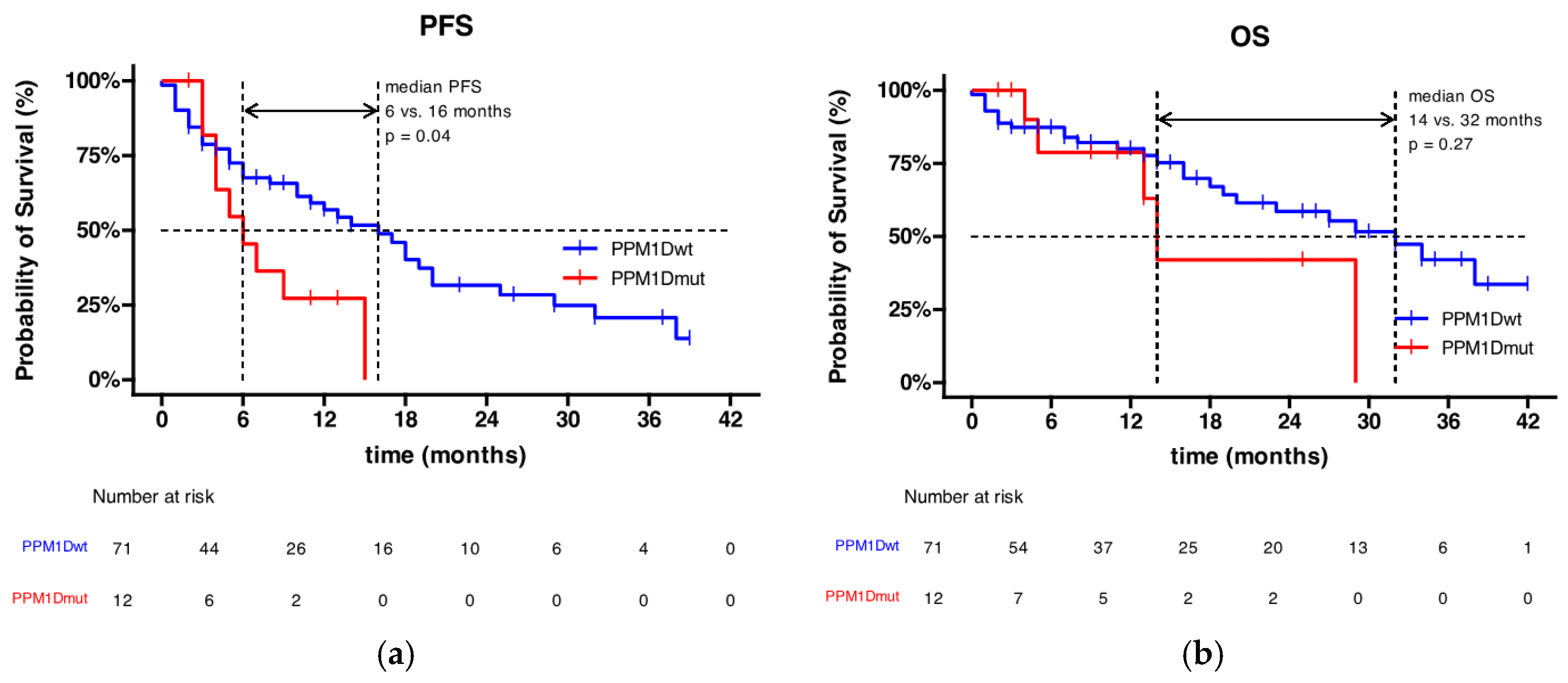
| PFS (months) | 14 | 16 | 6 | 0.04 |
| OS (months) | 29 | 32 | 14 | 0.27 |
Disclaimer/Publisher’s Note: The statements, opinions and data contained in all publications are solely those of the individual author(s) and contributor(s) and not of MDPI and/or the editor(s). MDPI and/or the editor(s) disclaim responsibility for any injury to people or property resulting from any ideas, methods, instructions or products referred to in the content. |
© 2026 by the authors. Licensee MDPI, Basel, Switzerland. This article is an open access article distributed under the terms and conditions of the Creative Commons Attribution (CC BY) license.
Share and Cite
van der Weg, K.; Bertschinger, M.; Bacher, U.; Hoffmann, M.; Nilius, H.; Seipel, K.; Pabst, T. Low-Frequency PPM1D Gene Mutations Affect Treatment Response to BCMA-Targeted CAR T-Cell Therapy in Multiple Myeloma. Cancers 2026, 18, 2032. https://doi.org/10.3390/cancers18132032
van der Weg K, Bertschinger M, Bacher U, Hoffmann M, Nilius H, Seipel K, Pabst T. Low-Frequency PPM1D Gene Mutations Affect Treatment Response to BCMA-Targeted CAR T-Cell Therapy in Multiple Myeloma. Cancers. 2026; 18(13):2032. https://doi.org/10.3390/cancers18132032
Chicago/Turabian Stylevan der Weg, Katharina, Martina Bertschinger, Ulrike Bacher, Michele Hoffmann, Henning Nilius, Katja Seipel, and Thomas Pabst. 2026. "Low-Frequency PPM1D Gene Mutations Affect Treatment Response to BCMA-Targeted CAR T-Cell Therapy in Multiple Myeloma" Cancers 18, no. 13: 2032. https://doi.org/10.3390/cancers18132032
APA Stylevan der Weg, K., Bertschinger, M., Bacher, U., Hoffmann, M., Nilius, H., Seipel, K., & Pabst, T. (2026). Low-Frequency PPM1D Gene Mutations Affect Treatment Response to BCMA-Targeted CAR T-Cell Therapy in Multiple Myeloma. Cancers, 18(13), 2032. https://doi.org/10.3390/cancers18132032

