Risk Factors for Catastrophic Health Events in Head and Neck Cancer: A Scoping Review to Inform Risk Prediction


 , , , ,
  and
and
Simple Summary
Abstract
1. Introduction
2. Materials and Methods
2.1. Study Design
2.2. Search Strategy and Eligibility Criteria
2.3. Study Selection
2.4. Study Outcomes
2.5. Data Extraction, Charting and Synthesis
3. Results
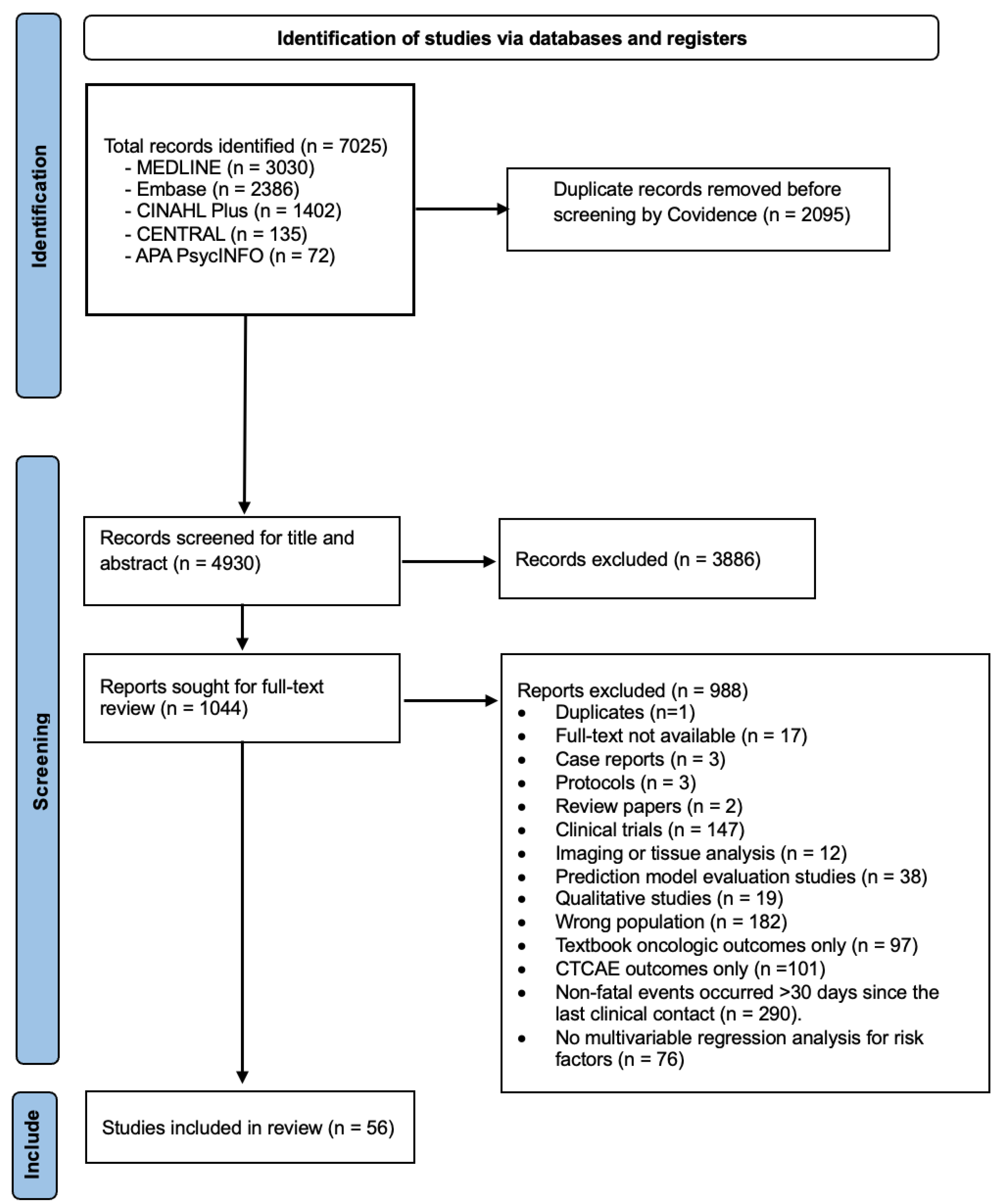
3.1. Study Inclusion
3.2. Study Characteristics
3.3. Catastrophic Health Events
3.4. Risk Factor for Catastrophic Health Events
4. Discussion
5. Conclusions
Supplementary Materials
Author Contributions
Funding
Data Availability Statement
Acknowledgments
Conflicts of Interest
Abbreviations
| ACE-27 | Adult Comorbidity Evaluation-27 scoring system |
| ADG | Aggregated Diagnosis Groups |
| APA | American Psychological Association |
| APACHE | Acute Physiology and Chronic Health Evaluation |
| ASA | American Society of Anesthesiologists |
| BMI | Body Mass Index |
| CCI | Charlson Comorbidity Index |
| CENTRAL | Cochrane Central Register of Controlled Trials |
| Chemo | Chemotherapy |
| CINAHL | Cumulative Index to Nursing and Allied Health Literature |
| COPD | Chronic obstructive pulmonary disease |
| CTCAE | Common Terminology Criteria for Adverse Events |
| ED | Emergency department |
| ESAS | Edmonton Symptom Assessment System |
| GI | Gastrointestinal |
| HNC | Head and neck cancer |
| HNSCC | Head and neck squamous cell carcinoma |
| ICU | Intensive care unit |
| IMRT | Intensity-modulated radiation therapy |
| KPS | Karnofsky Performance Status |
| LOS | length of stay |
| MDADI | MD Anderson Dysphagia Inventory |
| OR | Operating room |
| PRISMA-ScR | Preferred Reporting Items for Systematic reviews and Meta-Analyses extensions for Scoping Reviews |
| PRO | Patient-reported outcomes |
| SCC | Squamous cell carcinoma |
| SEER | Surveillance, Epidemiology, and End Results |
| SES | Socioeconomic status |
| SSI | Surgical site infections |
| TPF | Taxotere-Platinol-Fluorouracil |
References
- Common Terminology Criteria for Adverse Events (CTCAE) v6.0 (MedDRA 28.0). Available online: https://dctd.cancer.gov/research/ctep-trials/for-sites/adverse-events/ctcae-v6.pdf (accessed on 16 June 2026).
- Sampieri, G.; Li, H.; Ataalla, P.; Merriman, K.; Noel, C.W.; Hallet, J.; Coburn, N.; Karam, I.; Smoragiewicz, M.; Wong, B.; et al. Interventions for Concerning Patient-Reported Outcomes in Routine Cancer Care: A Systematic Review. Ann. Surg. Oncol. 2024, 31, 1148–1170. [Google Scholar] [CrossRef] [PubMed]
- Basch, E.; Reeve, B.B.; Mitchell, S.A.; Clauser, S.B.; Minasian, L.M.; Dueck, A.C.; Mendoza, T.R.; Hay, J.; Atkinson, T.M.; Abernethy, A.P.; et al. Development of the National Cancer Institute’s Patient-Reported Outcomes Version of the Common Terminology Criteria for Adverse Events (PRO-CTCAE). JNCI J. Natl. Cancer Inst. 2014, 106, dju244. [Google Scholar] [CrossRef] [PubMed]
- Cancer Care Ontario Edmonton Symptom Assessment System - Revised + 2020. Available online: https://www.cancercareontario.ca/sites/ccocancercare/files/assets/CCOESAS-r-Plus.pdf (accessed on 16 June 2026).
- Jonas, K.; Meers, A.; Gao, M. Complication of Head and Neck Cancer: Carotid Blowout Syndrome. Am. J. Emerg. Med. 2024, 77, e231.e5–e231.e6. [Google Scholar] [CrossRef] [PubMed]
- Feng, K.; Hu, J.; Huang, Q.; Cai, W.; Zhuang, Z.; Liu, H.; Hou, J.; Liu, X.; Wang, C. Risk Factors and Nomogram for Predicting Carotid Blowout Syndrome Based on Computed Tomography Angiography. Oral. Dis. 2022, 28, 2131–2138. [Google Scholar] [CrossRef] [PubMed]
- Vasudevan, S.S.; Albornoz Alvarez, V.; Schwab, S.; Olinde, L.; Nathan, C.-A.O. Global Incidence, Standardized Mortality Ratio, and Risk Factors for Suicide in Head and Neck Cancer versus Other Cancer Population: A Systematic Review and Meta-Analysis. Acta Oto-Laryngol. 2025, 145, 726–734. [Google Scholar] [CrossRef] [PubMed]
- Nassar, S.I.; Durgham, R.A.; Nguyen, S.A.; Newman, J.G.; Kejner, A.E.; Albergotti, W.G. Risk Factors for Suicide Among Head and Neck Cancer Patients: A Systematic Review and Meta-Analysis. Head Neck 2025, 47, 2231–2247. [Google Scholar] [CrossRef] [PubMed]
- Hanna, J.R.; McCloy, K.; Anderson, J.; McKeever, A.; Semple, C.J. Suicide and Head and Neck Cancer: A Systematic Review With Meta-Analysis and Narrative Synthesis. Psycho-Oncology 2025, 34, e70233. [Google Scholar] [CrossRef] [PubMed]
- Jimenez-Labaig, P.; Aymerich, C.; Braña, I.; Rullan, A.; Cacicedo, J.; González-Torres, M.Á.; Harrington, K.J.; Catalan, A. A Comprehensive Examination of Mental Health in Patients with Head and Neck Cancer: Systematic Review and Meta-Analysis. JNCI Cancer Spectr. 2024, 8, pkae031. [Google Scholar] [CrossRef] [PubMed]
- Sharma, S.; Vasudevan, S.S.; Walker, N.; Shimkus, G.; Goyal, S.; Pang, J.; Beedupalli, K.; Nathan, C.-A.O. Global Prevalence and Risk Factors of Suicidality among Head and Neck Cancer Patients—Systematic Review and Meta-Analysis. Support Care Cancer 2025, 33, 286. [Google Scholar] [CrossRef] [PubMed]
- Bushi, G.; Khatib, M.N.; Singh, M.P.; Pattanayak, M.; Vishwakarma, T.; Ballal, S.; Bansal, P.; Gaidhane, A.M.; Tomar, B.S.; Ashraf, A.; et al. Prevalence of Suicidal Ideation, Attempts and Associated Risk Factors in Oral Cancer Patients: A Systematic Review and Meta-Analysis. BMC Oral. Health 2025, 25, 140. [Google Scholar] [CrossRef] [PubMed]
- Van Der Elst, S.; Bardash, Y.; Wotman, M.; Kraus, D.; Tham, T. The Prognostic Impact of Depression or Depressive Symptoms on Patients with Head and Neck Cancer: A Systematic Review and Meta-analysis. Head Neck 2021, 43, 3608–3617. [Google Scholar] [CrossRef] [PubMed]
- Coca-Pelaz, A.; Halmos, G.B.; Strojan, P.; De Bree, R.; Bossi, P.; Bradford, C.R.; Rinaldo, A.; Vander Poorten, V.; Sanabria, A.; Takes, R.P.; et al. The Role of Age in Treatment-related Adverse Events in Patients with Head and Neck Cancer: A Systematic Review. Head Neck 2019, 41, 2410–2429. [Google Scholar] [CrossRef] [PubMed]
- Araújo, A.L.D.; Kowalski, L.P.; Sanabria, A.; Santos-Silva, A.R.; Coca-Pelaz, A.; Robbins, K.T.; Rodrigo, J.P.; Guntinas-Lichius, O.; López, F.; Mäkitie, A.A.; et al. Older Patients with Head and Neck Cancer: A Scoping Review of Differences Regarding Diagnosis and Outcomes. Head Neck 2025, 47, 2570–2583. [Google Scholar] [CrossRef] [PubMed]
- Noel, C.W.; Forner, D.; Wu, V.; Enepekides, D.; Irish, J.C.; Husain, Z.; Chan, K.K.W.; Hallet, J.; Coburn, N.; Eskander, A. Predictors of Surgical Readmission, Unplanned Hospitalization and Emergency Department Use in Head and Neck Oncology: A Systematic Review. Oral Oncol. 2020, 111, 105039. [Google Scholar] [CrossRef] [PubMed]
- Margalit, D.N.; Salz, T.; Venchiarutti, R.; Milley, K.; McNamara, M.; Chima, S.; Wong, J.; Druce, P.; Nekhlyudov, L. Interventions for Head and Neck Cancer Survivors: Systematic Review. Head Neck 2022, 44, 2579–2599. [Google Scholar] [CrossRef] [PubMed]
- De Oliveira Faria, S.; Hurwitz, G.; Kim, J.; Liberty, J.; Orchard, K.; Liu, G.; Barbera, L.; Howell, D. Identifying Patient-Reported Outcome Measures (PROMs) for Routine Surveillance of Physical and Emotional Symptoms in Head and Neck Cancer Populations: A Systematic Review. J. Clin. Med. 2021, 10, 4162. [Google Scholar] [CrossRef] [PubMed]
- Mäkitie, A.A.; Alabi, R.O.; Pulkki-Råback, L.; Almangush, A.; Beitler, J.J.; Saba, N.F.; Strojan, P.; Takes, R.; Guntinas-Lichius, O.; Ferlito, A. Psychological Factors Related to Treatment Outcomes in Head and Neck Cancer. Adv. Ther. 2024, 41, 3489–3519. [Google Scholar] [CrossRef] [PubMed]
- Dorr, M.C.; Hoesseini, A.; Sewnaik, A.; Hardillo, J.A.; Baatenburg De Jong, R.J.; Offerman, M.P.J. Impact of a Prognostic Model for Overall Survival on the Decision-making Process in a Head and Neck Cancer Multidisciplinary Consultation Meeting. Head Neck 2022, 44, 2481–2490. [Google Scholar] [CrossRef] [PubMed]
- Tu, I.W.-H.; Shannon, N.B.; Thankappan, K.; Balasubramanian, D.; Pillai, V.; Shetty, V.; Rangappa, V.; Chandrasekhar, N.H.; Kekatpure, V.; Kuriakose, M.A.; et al. Risk Stratification in Oral Cancer: A Novel Approach. Front. Oncol. 2022, 12, 836803. [Google Scholar] [CrossRef] [PubMed]
- Emerick, K.S.; Leavitt, E.R.; Michaelson, J.S.; Diephuis, B.; Clark, J.R.; Deschler, D.G. Initial Clinical Findings of a Mathematical Model to Predict Survival of Head and Neck Cancer. Otolaryngol. Head Neck Surg. 2013, 149, 572–578. [Google Scholar] [CrossRef] [PubMed]
- L’Esperance, H.E.; Kallogjeri, D.; Yousaf, S.; Piccirillo, J.F.; Rich, J.T. Prediction of Mortality and Morbidity in Head and Neck Cancer Patients 80 Years of Age and Older Undergoing Surgery. Laryngoscope 2018, 128, 871–877. [Google Scholar] [CrossRef] [PubMed]
- Tseng, Y.-J.; Wang, H.-Y.; Lin, T.-W.; Lu, J.-J.; Hsieh, C.-H.; Liao, C.-T. Development of a Machine Learning Model for Survival Risk Stratification of Patients With Advanced Oral Cancer. JAMA Netw. Open 2020, 3, e2011768. [Google Scholar] [CrossRef] [PubMed]
- Yao, C.M.K.L.; Hueniken, K.; Huang, S.H.; Liu, G.; Bratman, S.; Hope, A.; McPartlin, A.; Tsai, J.C.; Tzelnik, S.; Goldstein, D.; et al. Development of a Patient Reported Outcomes Based Machine Learning Model to Predict Recurrences in Head and Neck Cancer. Oral Oncol. 2025, 165, 107304. [Google Scholar] [CrossRef] [PubMed]
- Xu, J.; Liu, Q.; Yin, Y.; Gao, J.; Dong, G. Prediction of Local Recurrence in Cohorts of Head and Neck Cancer Patients after Intensity-Modulated Radiation Therapy Based on CT Radiomics: A Double-Center Observation Study. Transl. Oncol. 2026, 63, 102622. [Google Scholar] [CrossRef] [PubMed]
- Wang, K.; Dohopolski, M.; Zhang, Q.; Sher, D.; Wang, J. Towards Reliable Head and Neck Cancers Locoregional Recurrence Prediction Using Delta-radiomics and Learning with Rejection Option. Med. Phys. 2023, 50, 2212–2223. [Google Scholar] [CrossRef] [PubMed]
- Jung, H.A.; Merkin, R.; Feng, A.L.; Lee, D.; Lee, K.; Park, S.; Sun, J.-M.; Lee, S.-H.; Ahn, J.S.; Ahn, M.-J.; et al. Artificial Intelligence-Powered Real-Time Multimodal Model for Predicting Recurrence and Survival in Head and Neck Cancer: A Multicenter, Multinational Study. ESMO Open 2026, 11, 106046. [Google Scholar] [CrossRef] [PubMed]
- Montero, P.H.; Yu, C.; Palmer, F.L.; Patel, P.D.; Ganly, I.; Shah, J.P.; Shaha, A.R.; Boyle, J.O.; Kraus, D.H.; Singh, B.; et al. Nomograms for Preoperative Prediction of Prognosis in Patients with Oral Cavity Squamous Cell Carcinoma. Cancer 2014, 120, 214–221. [Google Scholar] [CrossRef] [PubMed]
- Luo, T.; Huang, C.; Zhou, R.; Sun, Y. Predicting Complications in Elderly Patients Undergoing Oral Cancer Resection with Free Flap Reconstruction in China: A Retrospective Cohort Study Using the Modified Frailty Index and Prognostic Nutritional Index. BMJ Open 2024, 14, e085985. [Google Scholar] [CrossRef] [PubMed]
- Koenen, L.; Arens, P.; Olze, H.; Dommerich, S. Classifying and Predicting Surgical Complications After Laryngectomy: A Novel Approach to Diagnosing and Treating Patients. Ear Nose Throat J. 2024, 103, NP53–NP59. [Google Scholar] [CrossRef] [PubMed]
- Mayo, C.S.; Mierzwa, M.; Yalamanchi, P.; Evans, J.; Worden, F.; Medlin, R.; Schipper, M.; Schonewolf, C.; Shah, J.; Spector, M.; et al. Machine Learning Model of Emergency Department Use for Patients Undergoing Treatment for Head and Neck Cancer Using Comprehensive Multifactor Electronic Health Records. JCO Clin. Cancer Inform. 2023, 7, e2200037. [Google Scholar] [CrossRef] [PubMed]
- Noel, C.W.; Sutradhar, R.; Gotlib Conn, L.; Forner, D.; Chan, W.C.; Fu, R.; Hallet, J.; Coburn, N.G.; Eskander, A. Development and Validation of a Machine Learning Algorithm Predicting Emergency Department Use and Unplanned Hospitalization in Patients with Head and Neck Cancer. JAMA Otolaryngol. Head Neck Surg. 2022, 148, 764. [Google Scholar] [CrossRef] [PubMed]
- Tricco, A.C.; Lillie, E.; Zarin, W.; O’Brien, K.K.; Colquhoun, H.; Levac, D.; Moher, D.; Peters, M.D.J.; Horsley, T.; Weeks, L.; et al. PRISMA Extension for Scoping Reviews (PRISMA-ScR): Checklist and Explanation. Ann. Intern. Med. 2018, 169, 467–473. [Google Scholar] [CrossRef] [PubMed]
- Arksey, H.; O’Malley, L. Scoping Studies: Towards a Methodological Framework. Int. J. Soc. Res. Methodol. 2005, 8, 19–32. [Google Scholar] [CrossRef]
- Levac, D.; Colquhoun, H.; O’Brien, K.K. Scoping Studies: Advancing the Methodology. Implement. Sci. 2010, 5, 69. [Google Scholar] [CrossRef] [PubMed]
- Sauro, K.M.; Smith, C.; Ibadin, S.; Thomas, A.; Ganshorn, H.; Bakunda, L.; Bajgain, B.; Bisch, S.P.; Nelson, G. Enhanced Recovery After Surgery Guidelines and Hospital Length of Stay, Readmission, Complications, and Mortality: A Meta-Analysis of Randomized Clinical Trials. JAMA Netw. Open 2024, 7, e2417310. [Google Scholar] [CrossRef] [PubMed]
- Merriam-Webster Synonyms of Catastrophic. Available online: https://www.merriam-webster.com/thesaurus/catastrophic (accessed on 1 November 2025).
- Noel, C.W.; Sutradhar, R.; Zhao, H.; Delibasic, V.; Forner, D.; Irish, J.C.; Kim, J.; Husain, Z.; Mahar, A.; Karam, I.; et al. Patient-Reported Symptom Burden as a Predictor of Emergency Department Use and Unplanned Hospitalization in Head and Neck Cancer: A Longitudinal Population-Based Study. J. Clin. Oncol. 2021, 39, 675–684. [Google Scholar] [CrossRef] [PubMed]
- Bollig, C.A.; Wang, K.; Llerena, P.; Puram, S.V.; Pipkorn, P.J.; Jackson, R.S.; Stubbs, V.C. National Analysis of Oropharyngeal Salivary Gland Malignancies Treated With Transoral Robotic Surgery. Otolaryngol. Head Neck Surg. 2022, 166, 886–893. [Google Scholar] [CrossRef] [PubMed]
- Wong, S.; Tang, L.; Kwon, D.; Swanson, M.; Kokot, N.C.; Sinha, U.K.; Han, A.Y. Complications After Transoral Surgery for Oropharyngeal Cancer: An ACS-NSQIP Database Study. Laryngoscope 2025, 135, 2385–2391. [Google Scholar] [CrossRef] [PubMed]
- Chaudhary, H.; Stewart, C.M.; Webster, K.; Herbert, R.J.; Frick, K.D.; Eisele, D.W.; Gourin, C.G. Readmission Following Primary Surgery for Larynx and Oropharynx Cancer in the Elderly. Laryngoscope 2017, 127, 631–641. [Google Scholar] [CrossRef] [PubMed]
- Zhao, E.H.; Nishimori, K.; Brady, J.; Siddiqui, S.H.; Eloy, J.A.; Baredes, S.; Park, R.C.W. Analysis of Risk Factors for Unplanned Reoperation Following Free Flap Surgery of the Head and Neck. Laryngoscope 2018, 128, 2790–2795. [Google Scholar] [CrossRef] [PubMed]
- Sangal, N.R.; Nishimori, K.; Zhao, E.; Siddiqui, S.H.; Baredes, S.; Chan Woo Park, R. Understanding Risk Factors Associated With Unplanned Reoperation in Major Head and Neck Surgery. JAMA Otolaryngol. Head Neck Surg. 2018, 144, 1044. [Google Scholar] [CrossRef] [PubMed]
- Ferrandino, R.; Garneau, J.; Roof, S.; Pacheco, C.; Poojary, P.; Saha, A.; Chauhan, K.; Miles, B. The National Landscape of Unplanned 30-day Readmissions after Total Laryngectomy. Laryngoscope 2018, 128, 1842–1850. [Google Scholar] [CrossRef] [PubMed]
- Osborn, H.A.; Rathi, V.K.; Tjoa, T.; Goyal, N.; Yarlagadda, B.B.; Rich, D.L.; Emerick, K.S.; Lin, D.T.; Deschler, D.G.; Durand, M.L. Risk Factors for Thirty-day Readmission Following Flap Reconstruction of Oncologic Defects of the Head and Neck. Laryngoscope 2018, 128, 343–349. [Google Scholar] [CrossRef] [PubMed]
- Helman, S.N.; Brant, J.A.; Moubayed, S.P.; Newman, J.G.; Cannady, S.B.; Chai, R.L. Predictors of Length of Stay, Reoperation, and Readmission Following Total Laryngectomy: Risk Factors Following Total Laryngectomy. Laryngoscope 2017, 127, 1339–1344. [Google Scholar] [CrossRef] [PubMed]
- Sylvester, M.J.; Marchiano, E.; Park, R.C.W.; Baredes, S.; Eloy, J.A. Impact of Chronic Obstructive Pulmonary Disease on Patients Undergoing Laryngectomy for Laryngeal Cancer. Laryngoscope 2017, 127, 417–423. [Google Scholar] [CrossRef] [PubMed]
- Carniol, E.T.; Marchiano, E.; Brady, J.S.; Merchant, A.M.; Eloy, J.A.; Baredes, S.; Park, R.C.W. Head and Neck Microvascular Free Flap Reconstruction: An Analysis of Unplanned Readmissions. Laryngoscope 2017, 127, 325–330. [Google Scholar] [CrossRef] [PubMed]
- Zhan, K.Y.; Graboyes, E.M.; Nguyen, S.A.; Day, T.A. Risk Factors Associated With Unplanned Readmission in Patients Undergoing Parotid Cancer Surgery: A Study of the National Cancer Database. JAMA Otolaryngol. Head Neck Surg. 2016, 142, 544. [Google Scholar] [CrossRef] [PubMed]
- Raikundalia, M.D.; Fang, C.H.; Spinazzi, E.F.; Vazquez, A.; Park, R.C.; Baredes, S.; Eloy, J.A. Impact of Diabetes Mellitus on Head and Neck Cancer Patients Undergoing Surgery. Otolaryngol. Head Neck Surg. 2016, 154, 294–299. [Google Scholar] [CrossRef] [PubMed]
- Tu, Z.; Li, C.; Hu, Q.; Luo, J. Larysuicide: An Online Risk Stratification System to Identify Patients at High Risk of Suicide after the Laryngeal Cancer Diagnosis. J. Cancer Res. Clin. Oncol. 2023, 149, 6455–6465. [Google Scholar] [CrossRef] [PubMed]
- Chung, T.; Edalati, S.; Vasan, V.; Iloreta, A.M.; Govindaraj, S. Risk Factors for Suicidal Ideation and Attempt in Patients With Skull Base Tumors. Otolaryngol. Head Neck Surg. 2025, 172, 1300–1308. [Google Scholar] [CrossRef] [PubMed]
- Badr, H.; Sobrero, M.; Chen, J.; Kotz, T.; Genden, E.; Sikora, A.G.; Miles, B. Associations between Pre-, Post-, and Peri-Operative Variables and Health Resource Use Following Surgery for Head and Neck Cancer. Oral Oncol. 2019, 90, 102–108. [Google Scholar] [CrossRef] [PubMed]
- Frenkel, C.H.; Yang, J.; Zhang, M.; Ferrara, A.; Telem, D.A.; Samara, G.J. Gastrostomy in the Era of Minimally Invasive Head and Neck Cancer Surgery. Laryngoscope 2018, 128, 847–851. [Google Scholar] [CrossRef] [PubMed]
- Garg, R.K.; Wieland, A.M.; Hartig, G.K.; Poore, S.O. Risk Factors for Unplanned Readmission Following Head and Neck Microvascular Reconstruction: Results from the National Surgical Quality Improvement Program, 2011–2014. Microsurgery 2017, 37, 502–508. [Google Scholar] [CrossRef] [PubMed]
- Ghiam, M.K.; Langerman, A.; Sargi, Z.; Rohde, S. Head and Neck Cancer Patients: Rates, Reasons, and Risk Factors for 30-Day Unplanned Readmission. Otolaryngol. Head Neck Surg. 2018, 159, 149–157. [Google Scholar] [CrossRef] [PubMed]
- Goel, A.N.; Badran, K.W.; Mendelsohn, A.H.; Chhetri, D.K.; Sercarz, J.A.; Blackwell, K.E.; John, M.A.S.; Long, J.L. Readmission after Surgery for Oropharyngeal Cancer: An Analysis of Rates, Causes, and Risk Factors. Laryngoscope 2019, 129, 910–918. [Google Scholar] [CrossRef] [PubMed]
- Madrigal, J.; Tie, E.K.; Verma, A.; Benharash, P.; Rapkin, D.A.; St. John, M.A. The Increasing Burden of Depression in Patients Undergoing Head and Neck Cancer Operations. Laryngoscope 2023, 133, 3396–3402. [Google Scholar] [CrossRef] [PubMed]
- Nieman, C.L.; Pitman, K.T.; Tufaro, A.P.; Eisele, D.W.; Frick, K.D.; Gourin, C.G. The Effect of Frailty on Short-term Outcomes after Head and Neck Cancer Surgery. Laryngoscope 2018, 128, 102–110. [Google Scholar] [CrossRef] [PubMed]
- Oliver, J.R.; Persky, M.J.; Wang, B.; Duvvuri, U.; Gross, N.D.; Vaezi, A.E.; Morris, L.G.T.; Givi, B. Transoral Robotic Surgery Adoption and Safety in Treatment of Oropharyngeal Cancers. Cancer 2022, 128, 685–696. [Google Scholar] [CrossRef] [PubMed]
- Shaikh, N.; Noor, K.; Jafary, H.; Chung, J.; Fancy, T.; Stokes, W. Effect of 2 Teams and Operative Time on Complications After Oral Cavity Free Flap Reconstruction. Ann. Otol. Rhinol. Laryngol. 2023, 132, 1430–1437. [Google Scholar] [CrossRef] [PubMed]
- Sindhar, S.; Kallogjeri, D.; Wildes, T.S.; Avidan, M.S.; Piccirillo, J.F. Association of Preoperative Functional Performance With Outcomes After Surgical Treatment of Head and Neck Cancer: A Clinical Severity Staging System. JAMA Otolaryngol. Head Neck Surg. 2019, 145, 1128. [Google Scholar] [CrossRef] [PubMed]
- Van Abel, K.M.; Sauer, A.B.; Kruthiventi, S.C.; Weingarten, T.N.; Noel, D.B.; Price, D.L.; Kasperbauer, J.L.; Janus, J.R.; Olsen, K.D.; Moore, E.J. Non-Opioid Analgesics and Post-Operative Pain Following Transoral Robotic Surgery for Oropharyngeal Cancer. J. Laryngol. Otol. 2022, 136, 527–534. [Google Scholar] [CrossRef] [PubMed]
- Voora, R.S.; Qian, A.S.; Kotha, N.V.; Qiao, E.M.; Meineke, M.; Murphy, J.D.; Orosco, R.K. Frailty Index as a Predictor of Readmission in Patients With Head and Neck Cancer. Otolaryngol. Head Neck Surg. 2022, 167, 89–96. [Google Scholar] [CrossRef] [PubMed]
- Lee, T.-F.; Liou, M.-H.; Ting, H.-M.; Chang, L.; Lee, H.-Y.; Wan Leung, S.; Huang, C.-J.; Chao, P.-J. Patient- and Therapy-Related Factors Associated with the Incidence of Xerostomia in Nasopharyngeal Carcinoma Patients Receiving Parotid-Sparing Helical Tomotherapy. Sci. Rep. 2015, 5, 13165. [Google Scholar] [CrossRef] [PubMed]
- Zeng, S.; Chang, C.; Sun, M.; Chen, W.; Wu, S.; Zhang, J. Comparison of Surgical Complications after Curative Surgery in Patients with Oral Cavity Squamous Cell Carcinoma and Sarcopenia. J. Cachexia Sarcopenia Muscle 2023, 14, 576–584. [Google Scholar] [CrossRef] [PubMed]
- Lin, K.-C.; Chen, T.-M.; Yuan, K.S.-P.; Wu, A.T.H.; Wu, S.-Y. Assessment of Predictive Scoring System for 90-Day Mortality Among Patients With Locally Advanced Head and Neck Squamous Cell Carcinoma Who Have Completed Concurrent Chemoradiotherapy. JAMA Netw. Open 2020, 3, e1920671. [Google Scholar] [CrossRef] [PubMed]
- Chiou, L.; Lee, C. Textbook Outcome Was Associated with Better Survival in Oral Cancer Surgery in Southern Taiwan. Oral Dis. 2024, 30, 1128–1138. [Google Scholar] [CrossRef] [PubMed]
- Wang, C.-K.; Ho, C.-F.; Niu, K.-Y.; Wu, C.-C.; Chang, Y.-C.; Hsiao, C.-H.; Yen, C.-C. Risk Factors for Rebleeding and Long-Term Outcomes in Patients with Head and Neck Cancer Bleeding: A Multicenter Study. BMC Cancer 2022, 22, 841. [Google Scholar] [CrossRef] [PubMed]
- Yen, C.-C.; Yeh, H.; Ho, C.-F.; Hsiao, C.-H.; Niu, K.-Y.; Yeh, C.-C.; Lu, J.-X.; Wu, C.-C.; Chang, Y.-C.; Ng, C.-J. Risk Factors for 30-Day Mortality in Patients with Head and Neck Cancer Bleeding in the Emergency Department. Am. J. Emerg. Med. 2022, 58, 9–15. [Google Scholar] [CrossRef] [PubMed]
- Luo, T.; Zhou, R.; Sun, Y. The Impact of Postoperative Glucocorticoids on Complications after Head and Neck Cancer Surgery with Free Flap Reconstruction: A Retrospective Study. PLoS ONE 2025, 20, e0319655. [Google Scholar] [CrossRef] [PubMed]
- Li, S.; Huang, Z.; Chen, W.; Pan, C.; Huang, Z. Risk Factors for Postoperative Hemorrhage in Patients with Oral Squamous Cell Carcinoma: A Retrospective Study. Head Neck 2019, 41, 2093–2099. [Google Scholar] [CrossRef] [PubMed]
- Yao, Z.; Zhang, B.; Huang, J.; Shi, L.; Cheng, B. Radiation-Induced Acute Injury of Intensity-Modulated Radiotherapy versus Three-Dimensional Conformal Radiotherapy in Induction Chemotherapy Followed by Concurrent Chemoradiotherapy for Locoregionally Advanced Nasopharyngeal Carcinoma: A Prospective Cohort Study. Sci. Rep. 2021, 11, 7693. [Google Scholar] [CrossRef] [PubMed]
- Choi, N.; Park, S.I.; Kim, H.; Sohn, I.; Jeong, H.-S. The Impact of Unplanned Reoperations in Head and Neck Cancer Surgery on Survival. Oral Oncol. 2018, 83, 38–45. [Google Scholar] [CrossRef] [PubMed]
- Lee, J.; Kwon, M.; Roh, J.; Choi, J.; Choi, S.; Nam, S.; Kim, S. Postoperative Hypoalbuminemia as a Risk Factor for Surgical Site Infection after Oral Cancer Surgery. Oral Dis. 2015, 21, 178–184. [Google Scholar] [CrossRef] [PubMed]
- Sasaki, T.; Takenaka, Y.; Hayashi, T.; Yamamoto, M.; Cho, H.; Fukusumi, T.; Takemoto, N.; Hanamoto, A.; Yasui, T.; Nakahara, S.; et al. Factors Predicting Severe Infections during Chemotherapy in Head and Neck Cancer Patients. Acta Oto-Laryngol. 2015, 135, 1086–1091. [Google Scholar] [CrossRef] [PubMed]
- Crosetti, E.; Caracciolo, A.; Molteni, G.; Sprio, A.E.; Berta, G.N.; Presutti, L.; Succo, G. Svelare i Fattori Di Rischio Che Sottendono La Chirurgia Laringea Negli Anziani. Acta Otorhinolaryngol. Ital. 2016, 36, 185–193. [Google Scholar] [CrossRef] [PubMed]
- Chiesa-Estomba, C.M.; Sistiaga-Suárez, J.A.; González-García, J.Á.; Sarasola, E.L.; Vilanova, A.V.; Altuna, X. Unplanned Hospital Readmission and Visit to the Emergency Room in the First Thirty Days after Head and Neck Surgery: A Prospective, Single-Center Study. Int. Arch. Otorhinolaryngol. 2022, 26, e103–e110. [Google Scholar] [CrossRef] [PubMed]
- Astrup, G.L.; Rustøen, T.; Miaskowski, C.; Paul, S.M.; Bjordal, K. Changes in and Predictors of Pain Characteristics in Patients with Head and Neck Cancer Undergoing Radiotherapy. Pain 2015, 156, 967–979. [Google Scholar] [CrossRef] [PubMed]
- Salati, V.; Mandralis, K.; Becce, F.; Koerfer, J.; Lambercy, K.; Simon, C.; Gorostidi, F. Preoperative CT-Based Skeletal Muscle Mass Depletion and Outcomes after Total Laryngectomy. Cancers 2023, 15, 3538. [Google Scholar] [CrossRef] [PubMed]
- Mirza, A.H.; Aylin, P.; Middleton, S.; King, E.V.; Nouraei, R.A.R.; Repanos, C. Impact of Social Deprivation on the Outcome of Major Head and Neck Cancer Surgery in England: A National Analysis. Head Neck 2019, 41, 692–700. [Google Scholar] [CrossRef] [PubMed]
- Kouka, M.; Buentzel, J.; Kaftan, H.; Boeger, D.; Mueller, A.H.; Wittig, A.; Schultze-Mosgau, S.; Ernst, T.; Guntinas-Lichius, O. Early Mortality among Patients with Head and Neck Cancer Diagnosed in Thuringia, Germany, between 1996 and 2016—A Population-Based Study. Cancers 2022, 14, 3099. [Google Scholar] [CrossRef] [PubMed]
- Klingelhöffer, C.; Obst, A.; Ettl, T.; Meier, J.; Müller, S.; Reichert, T.; Spanier, G. Severe Postoperative Dysphagia as an Early Predictor for Decreased Overall Survival in Patients with Oral Cancer. J. Cranio-Maxillofac. Surg. 2019, 47, 1363–1369. [Google Scholar] [CrossRef] [PubMed]
- Talani, C.; Högmo, A.; Laurell, G.; Mäkitie, A.; Farnebo, L. Six-Month Mortality Has Decreased for Patients with Curative Treatment Intent for Head and Neck Cancer in Sweden. PLoS ONE 2024, 19, e0296534. [Google Scholar] [CrossRef] [PubMed]
- Talani, C.; Astradsson, T.; Farnebo, L.; Mäkitie, A.; Ehrsson, Y.T.; Laurell, G. Pretreatment Fat-free Mass Index Correlates with Early Death in Patients with Head and Neck Squamous Cell Carcinoma. Head Neck 2024, 46, 808–818. [Google Scholar] [CrossRef] [PubMed]
- Schaller, A.K.C.S.; Peterson, A.; Bäckryd, E. Pain Management in Patients Undergoing Radiation Therapy for Head and Neck Cancer—A Descriptive Study. Scand. J. Pain 2021, 21, 256–265. [Google Scholar] [CrossRef] [PubMed]
- Haapio, E.; Kiviniemi, T.; Irjala, H.; Koivunen, P.; Airaksinen, J.K.E.; Kinnunen, I. Incidence and Predictors of 30-Day Cardiovascular Complications in Patients Undergoing Head and Neck Cancer Surgery. Eur. Arch. Otorhinolaryngol. 2016, 273, 4601–4606. [Google Scholar] [CrossRef] [PubMed]
- Bazina, M.; Nikkilä, R.; Haapaniemi, A.; Bäck, L.; Ventelä, S.; Mäkitie, A. Risk of Early Death after Treatment with Curative Intent for Head and Neck Squamous Cell Carcinoma: A Retrospective Population-Based Study. Acta Oncol. 2025, 64, 339–348. [Google Scholar] [CrossRef] [PubMed]
- Foley, J.; Wishart, L.R.; Ward, E.C.; Burns, C.L.; Packer, R.L.; Philpot, S.; Kenny, L.M.; Stevens, M. Exploring the Impact of Remoteness on People with Head and Neck Cancer: Utilisation of a State-wide Dataset. Aust. J. Rural Health 2023, 31, 726–743. [Google Scholar] [CrossRef] [PubMed]
- Frauenfelder, C.A.; Raith, E.P.; Krishnan, S.; Udy, A.; Pilcher, D. Outcomes for Head and Neck Cancer Patients Admitted to Intensive Care in Australia and New Zealand between 2000 and 2016. J. Laryngol. Otol. 2021, 135, 702–709. [Google Scholar] [CrossRef] [PubMed]
- Nieman, C.L.; Stewart, C.M.; Eisele, D.W.; Pronovost, P.J.; Gourin, C.G. Frailty, Hospital Volume, and Failure to Rescue after Head and Neck Cancer Surgery. Laryngoscope 2018, 128, 1365–1370. [Google Scholar] [CrossRef] [PubMed]
- Carrasco-Ribelles, L.A.; Llanes-Jurado, J.; Gallego-Moll, C.; Cabrera-Bean, M.; Monteagudo-Zaragoza, M.; Violán, C.; Zabaleta-del-Olmo, E. Prediction Models Using Artificial Intelligence and Longitudinal Data from Electronic Health Records: A Systematic Methodological Review. J. Am. Med. Inform. Assoc. 2023, 30, 2072–2082. [Google Scholar] [CrossRef] [PubMed]
- Lee, C.S.; Lee, A.Y. Clinical Applications of Continual Learning Machine Learning. Lancet Digit. Health 2020, 2, e279–e281. [Google Scholar] [CrossRef] [PubMed]
- Abdelrazig Merghani, A.M.; Ahmed Esmail, A.K.; Mubarak Osman, A.M.E.; Abdelfrag Mohamed, N.A.; Mohamed Ali Shentour, S.M.; Abdelrazig Merghani, S.M. The Role of Machine Learning in Management of Operating Room: A Systematic Review. Cureus 2025, 17, e79400. [Google Scholar] [CrossRef]
- Mulwafu, W. The Quality of Hand-Written Operative Notes in a Surgical Unit at Queen Elizabeth Central Hospital (QECH), Malawi: A Prospective Completed Audit Loop Study. Mal. Med. J. 2018, 30, 86. [Google Scholar] [CrossRef] [PubMed]
- Møller, K.E.; Sørensen, J.L.; Topperzer, M.K.; Koerner, C.; Ottesen, B.; Rosendahl, M.; Grantcharov, T.; Strandbygaard, J. Implementation of an Innovative Technology Called the OR Black Box: A Feasibility Study. Surg. Innov. 2023, 30, 64–72. [Google Scholar] [CrossRef] [PubMed]
- Abdurahman, S.; Salkhordeh Ziabari, A.; Moore, A.K.; Bartels, D.M.; Dehghani, M. A Primer for Evaluating Large Language Models in Social-Science Research. Adv. Methods Pract. Psychol. Sci. 2025, 8, 25152459251325174. [Google Scholar] [CrossRef]
- Yahya, N.; Manan, H.A. Quality of Life and Patient-Reported Outcomes Following Proton Therapy for Oropharyngeal Carcinoma: A Systematic Review. Cancers 2023, 15, 2252. [Google Scholar] [CrossRef] [PubMed]
- Vasudevan, S.S.; Deeb, H.; Katta, A.; Olinde, L.; Pang, J.; Asarkar, A.A.; Katz, S.; Nathan, C.O. Efficacy and Safety of Proton Therapy versus Intensity-modulated Radiation Therapy in the Treatment of Head and Neck Tumors: A Systematic Review and Meta-analysis. Head Neck 2024, 46, 2616–2631. [Google Scholar] [CrossRef] [PubMed]
- Buciuman, N.; Marcu, L.G. Dosimetric Justification for the Use of Volumetric Modulated Arc Therapy in Head and Neck Cancer—A Systematic Review of the Literature. Laryngoscope Investig. Oto 2021, 6, 999–1007. [Google Scholar] [CrossRef] [PubMed]
- De Felice, F.; Bonomo, P.; Sanguineti, G.; Orlandi, E. Moderately Accelerated Intensity-modulated Radiation Therapy Using Simultaneous Integrated Boost: Practical Reasons or Evidence-based Choice? A Critical Appraisal of Literature. Head Neck 2020, 42, 3405–3414. [Google Scholar] [CrossRef] [PubMed]
- Green, M.; Van Nest, S.J.; Soisson, E.; Huber, K.; Liao, Y.; McBride, W.; Dominello, M.M.; Burmeister, J.; Joiner, M.C. Three Discipline Collaborative Radiation Therapy (3DCRT) Special Debate: We Should Treat All Cancer Patients with Hypofractionation. J. Appl. Clin. Med. Phys. 2020, 21, 7–14. [Google Scholar] [CrossRef] [PubMed]
- Orland, M.D.; Ullah, F.; Yilmaz, E.; Geiger, J.L. Immunotherapy for Head and Neck Squamous Cell Carcinoma: Present and Future Approaches and Challenges. JCO Oncol. Pract. 2024, 20, 1588–1595. [Google Scholar] [CrossRef] [PubMed]
- Bray, F.; Laversanne, M.; Sung, H.; Ferlay, J.; Siegel, R.L.; Soerjomataram, I.; Jemal, A. Global Cancer Statistics 2022: GLOBOCAN Estimates of Incidence and Mortality Worldwide for 36 Cancers in 185 Countries. CA Cancer J. Clin. 2024, 74, 229–263. [Google Scholar] [CrossRef] [PubMed]


| Source | Country | Study Design | Study Cohort | Age 1 | Male | Cancer Site | Advanced Disease 2 | Treatment Intent |
|---|---|---|---|---|---|---|---|---|
| Astrup 2015 [80] | Norway | Single-centre pros cohort | Adults undergoing radiation (n = 133) | 60 ± 11 | 71.0 | Oropharynx | 69 | Both |
| Badr 2019 [54] | USA | Single-centre retro cohort | Adults seen for pre-surgical consult for HNC surgery (n = 166) | 64 ± 11 | 75.0 | Oral cavity, pharynx, larynx, paranasal sinus/nasal cavity | 61.0 | Curative |
| Bazina 2025 [89] | Finland | National retro cohort | Adults diagnosed with HNSCC (n = 718) | 18+ | 70.0 | Oral cavity | 42.0 | Curative |
| Bollig 2022 [40] | USA | National retro cohort | Adults treated surgically (n = 785) | 58.1 ± 15.0 | 40.0 | Oropharynx | 13.9 | Curative |
| Carniol 2017 [49] | USA | National retro cohort | Adults undergoing HNC surgery with free flap reconstruction (n = 1204) | 18+ | 65.5 | Unspecified | Unknown | Curative |
| Chaudhary 2017 [42] | USA | Multi-centre retro cohort | Older adults (≥66) undergoing primary HNC surgery (n = 1518) | Mean 74.4 | 79.0 | Larynx | 22.4 | Curative |
| Chiesa-Estomba 2022 [79] | Spain | Single-centre pros cohort | Adults undergoing HNC surgery (n = 342) | 59 ± 15 | 68.7 | Larynx | Unknown | Curative |
| Chiou 2024 [69] | Taiwan | Single-centre retro cohort | Adults undergoing oral cancer resection/reconstruction (n = 386) | 56.9 ± 10.1 | 93.5 | Oral cavity | 72.8 | Curative |
| Choi 2018 [75] | South Korea | Single-centre retro cohort | Adults undergoing curative HNC surgery with or without a flap reconstruction (n = 574) | 58.8 ± 12.4 | 78.4 | Oropharynx, larynx, hypopharynx | 36.0 | Curative |
| Chung 2025 [53] | USA | National retro cohort | Adults hospitalized for skull base tumour (n = 275,195) | 62.9 ± 17.5 | 38.4 | Skull base | Unknown | Both |
| Crosetti 2016 [78] | Italy | Multi-centre retro cohort | Older adults (≥70) with SCC (n = 212) | 75.8 ± 4.5 | 93.9 | Larynx | 36.3 | Curative |
| Ferrandino 2018 [45] | USA | National retro cohort | Adults undergoing total laryngectomy (n = 2931) | 18+ | 73.9 | Larynx | Unknown | Curative |
| Foley 2023 [90] | Australia | Multi-centre retro cohort | Adults diagnosed with HNC in Queensland (n = 1991) | 18+ | 77.7 | Oropharynx | 73.1 | Curative |
| Frauenfelder 2021 [91] | Australia, New Zealand | Multi-centre retro cohort | Adults admitted to an ICU after HNC surgery (n = 10,721) | Median 64.1, range 54.4–73.5 | 71.6 | Unspecified | Unknown | Curative |
| Frenkel 2018 [55] | USA | Single-centre retro cohort | Adults undergoing a transoral robotic surgery (n = 441) | 55 or older, 70.3% | 78.0 | Unspecified | Unknown | Curative |
| Garg 2017 [56] | USA | National retro cohort | Adults undergoing HNC resection and reconstruction (n = 1063) | 65 or older, 46.8% | 62.7 | Unspecified | Unknown | Curative |
| Ghiam 2018 [57] | USA | Multi-centre retro cohort | Adults undergoing HNC surgery (n = 18,121) | 61.7 ± 11.6 | 70.4 | Oropharynx | Unknown | Curative |
| Goel 2019 [58] | USA | National retro cohort | Adults undergoing HNC surgery (n = 16,902) | 60 or older, 53.1% | 73.1 | Oropharynx | Unknown | Curative |
| Haapio 2016 [88] | Finland | Single-centre retro cohort | Adults undergoing HNC surgery (n = 456) | Mean 62, range 23–93 | 66.7 | Oral cavity, pharynx, larynx, salivary glands, nasal cavity, paranasal sinuses | Unknown | Both |
| Helman 2017 [47] | USA | National retro cohort | Adults undergoing total laryngectomy (n = 871) | 63.1 ± 10.9 | 82.1 | Larynx | Unknown | Curative |
| Klingelhoffer 2019 [84] | Germany | Single-centre retro cohort | Adults with primary oral cancer (n = 400) | 62.3 ± 11.2 | 66.3 | Oral cavity | 28.9 | Curative |
| Koenen 2024 [31] | Germany | Single-centre retro cohort | Adults diagnosed with SCC treated with total laryngectomy (n = 148) | 64 ± 10 | 84.0 | Larynx, hypopharynx | 53 | Curative |
| Kouka 2022 [83] | Germany | Provincial retro cohort | Adults with primary HNC (n = 8288) | Median 60 | 78.9 | Oropharynx | 55.5 | Both |
| L’Esperance 2018 [23] | USA | Single-centre retro cohort | Older adults (≥80) undergoing ablative HNC surgery (n = 219) | Mean 85 | 60.2 | Unspecified | Unknown | Curative |
| Lee 2015 [66] | Taiwan | Single-centre pros cohort | Adults treated with parotid-sparing helical tomotherapy (n = 67) | Mean 46 | 82.1 | Nasopharynx | 31.3 | Curative |
| Lee 2015 [76] | South Korea | Single-centre retro cohort | Adults undergoing major surgery for oral SCC (n = 337) | Median 57, range 18–84 | 69.7 | Oral cavity | 61.7 | Curative |
| Li 2019 [73] | China | Single-centre retro cohort | Adults with oral SCC who had received surgery (n = 1513) | 60 or older, 41.5% | 66.7 | Oral cavity | 55.1 | Curative |
| Lin 2020 [68] | Taiwan | National retro cohort | Adults with locally advanced HNSCC on chemoradiation (n = 16,029) | 52.3 ± 10.1 | 94.2 | Unspecified | 100 | Curative |
| Luo 2024 [30] | China | Multi-centre retro cohort | Older adults (≥60) undergoing oral cancer resection and free flap reconstruction (n = 1197) | 60+ | N/A | Oral cavity, oropharynx | Unknown | Curative |
| Luo 2025 [72] | China | Single-centre retro cohort | Older adults (≥60) undergoing HNC surgery with free-flap reconstruction (n = 711) | 68.5 ± 6.4 | 64.1 | Tongue | 38.3 | Curative |
| Madrigal 2023 [59] | USA | National retro cohort | Adults hospitalized for HNC surgery (n = 133,018) | Median 63 | 68.3 | Oral cavity, pharynx, larynx | Unknown | Curative |
| Mirza 2019 [82] | UK | National retro cohort | Adults undergoing first major HNC surgery (n = 12,333) | 61.8 ± 11.8 | 71.1 | Oral cavity | Unknown | Curative |
| Nieman 2018 [92] | USA | National cross-sectional | Adults undergoing ablative HNC surgery (n = 159,301) | Mean 62 | 70.0 | Oral cavity, larynx, pharynx | Unknown | Curative |
| Noel 2021 [39] | Canada | Provincial retro cohort | Adults with HNC completed at least one outpatient ESAS assessment (n = 11,741) | 60 or older, 61.6% | 75.4 | Oral cavity, oropharynx, larynx, hypopharynx | Unknown | Both |
| Oliver 2022 [61] | USA | National retro cohort | Adults undergoing surgical and nonsurgical treatment (n = 73,661) | Median 60 | 82.0 | Tonsil, base of tongue, oropharynx | 31.4 | Curative |
| Osborn 2018 [46] | USA | Single-centre retro cohort | Adults undergoing a flap reconstruction (n = 682) | 18+ | 69.4 | Oral cavity | Unknown | Curative |
| Raikundalia 2016 [51] | USA | National retro cohort | Adults undergoing HNC surgical resection (n = 31,075) | 61.7 ± 12.7 | ~71.0 | Unspecified | Unknown | Curative |
| Salati 2023 [81] | Switzerland | Single-centre retro cohort | Adults undergoing laryngectomy (n = 84) | 64.6 ± 9.0 | 81.0 | Laryngo-pharyngeal | Unknown | Curative |
| Sangal 2018 [44] | USA | National retro cohort | Adults undergoing major HNC surgery (n = 1941) | 61 or older, 56.9% | 66.9 | Floor of mouth, larynx, pharynx, mandible | Unknown | Curative |
| Sasaki 2015 [77] | Japan | Multi-centre retro cohort | Adults receiving chemotherapy (n = 129) | Mean 65 | 85.0 | Pharynx, oral cavity | Unknown | Curative |
| Schaller 2021 [87] | Sweden | Single-centre pros cohort | Adults undergoing radiation (n = 63) | Mean 67, range 36–86 | 62.0 | Oral cavity, pharynx, larynx, others | Unknown | Curative |
| Shaikh 2023 [62] | USA | Single-centre cross-sectional | Adults undergoing a glossectomy and free flap reconstruction (n = 839) | 60.2 ± 12.4 | 64.2 | Oral tongue | Unknown | Curative |
| Sindhar 2019 [63] | USA | Single-centre retro cohort | Adults surgically treated for HNSCC (n = 657) | 62.0 ± 11.3 | 73.0 | Lip, oral cavity, pharynx, larynx | 67.0 | Curative |
| Sylvester 2017 [48] | USA | National retro cohort | Adults (≥40) undergoing laryngectomy (n = 40,441) | Mean 63 | 80.3 | Larynx | Unknown | Curative |
| Talani 2024 [85] | Sweden | Multi-centre pros cohort | Adults newly diagnosed with curable HNSCC (n = 404) | 63 ± 11 | 71.0 | Oropharynx | 40.0 | Curative |
| Talani 2024 [86] | Sweden | National retro cohort | Adults undergoing curative treatment (n = 16,786) | 66.1 ± 12.6 | 63.8 | Oropharynx | 49.1 | Both |
| Tu 2023 [52] | USA and China | National (SEER) and a single-centre (China) retro cohort | Adults with laryngeal cancer (n = 42,066 SEER; n = 4207 Chinese) | 18+ | ~80 | Glottis | 20.2 | Curative |
| Van Abel 2022 [64] | USA | Single-centre retro cohort | Adults undergoing transoral robotic surgery (n = 216) | 59.1 ± 8.3 | 89.4 | Base of tongue, tonsil, soft palate, oropharynx | 12.5 | Curative |
| Voora 2022 [65] | USA | National retro cohort | Adults undergoing major HNC surgery (n = 14,420) | 65 or older, 46.1% | 70.0 | Oral cavity, larynx, pharynx | Unknown | Curative |
| Wang 2022 [70] | Taiwan | Multi-centre retro cohort | Adults with HNC presenting to the ED with bleeding (n = 231) | 56.7 ± 10.9 | 93.1 | Oral cavity, pharynx, larynx | 68.4 | Unknown |
| Wong 2025 [41] | USA | Multi-centre retro cohort | Adults with SCC undergoing transoral surgery (n = 3489) | 60.6 ± 10.0 | 81.5 | Oropharynx | Unknown | Curative |
| Yao 2021 [74] | China | Single-centre pros cohort | Adults with non-metastatic HNC receiving chemoradiation (n = 182) | 50.2 ± 11.4 | 80.2 | Nasopharynx | 69.2 | Curative |
| Yen 2022 [71] | Taiwan | Multi-centre retro cohort | Adults with HNC presenting to an ED with bleeding (n = 241) | 56.9 ± 11.2 | 92.5 | Oral cavity, pharynx, larynx | 68.4 | Unknown |
| Zeng 2023 [67] | Taiwan | National retro cohort | Adults undergoing curative HNC surgery (n = 16,293) | 56.4 ± 11.2 | 89.8 | Oral cavity | Unknown | Curative |
| Zhan 2016 [50] | USA | National retro cohort | Adults undergoing surgery for untreated parotid cancer (n = 11,394) | 18+ | 48.0 | Parotid | 27.1 | Curative |
| Zhao 2018 [43] | USA | National retro cohort | Adults undergoing a free flap surgery for HNC (n = 1796) | 61 or older, 55.2% | 64.7 | Unspecified | Unknown | Curative |
| Source | Phase of Care | Outcome 1 | Incidence | Risk Factors |
|---|---|---|---|---|
| Domain 1—Sudden or premature deaths | ||||
| Bazina 2025 [89] | Curative treatment | Early death (6 m after completion) | 10.7% | Older age, T4, N2/N3 |
| Bollig 2021 [40] | Post-op | Death | 0.25% | Older age, high-grade tumour, T4a, N1 |
| Chaudhary 2017 [42] | Post-op | Death | 1.5% | Preop weight loss, hospital LOS ≥ 6 d, 30 d unplanned readmission |
| Frauenfelder 2021 [91] | Post-op | In-hospital death | ICU 0.7%, hospital 2.7% | Older age, mechanical ventilation, higher APACHE III score |
| Haapio 2016 [88] | Post-op | Cardiovascular death | 1.3% | Older age, coronary artery disease |
| Kouka 2022 [83] | Post-diagnosis | Death (30 d–180 d) | 30 d 1.8%, 90 d 5.1%, 180 d 9.6% | Male, older age, higher T, M1, advanced stage; oral cavity, oropharynx, or hypopharynx tumour (180 d only), no treatment |
| L’Esperance 2018 [23] | Post-op | Death (90 d) | 10.4% | Older age (90–96), severe comorbidity (ACE-27 = 3), dysphagia, large resection |
| Lin 2020 [68] | Post-treatment | Death (90 d) | 6.7% | Older age, coronary artery disease, COPD, cerebrovascular accident, myocardial infarction, peptic ulcer disease, peripheral vascular disease, metastatic solid cancers |
| Mirza 2019 [82] | Post-op | In-hospital death | 3.35% | Socially deprived, emergency surgery, alcohol use, hypopharynx-larynx tumour, trach, highly invasive resection |
| Nieman 2018 [92] | Post-op | In-hospital death | 0.9% | Older age (>80), Medicare/Medicaid, major procedure, pedicled or free flap reconstruction, urgent admission, frailty, low-volume hospital |
| Oliver 2022 [61] | Post-op | Early death | 1.0% | Older age, CCI > 0, higher T, low-volume hospital |
| Raikundalia 2016 [51] | Post-op | Death | 2.1% | Diabetes, cardiac events, acute renal failure |
| Shaikh 2023 [62] | Post-op | Death | 0.5% | Long surgery duration, 2-team approach |
| Talani 2024 [85] | Post-treatment | Early death | 6 m 2.2%, 12 m 6.2% | Lower fat-free mass index at diagnosis, treatment nonresponse |
| Talani 2024 [86] | Post-diagnosis | Death (6 m) | 3.7% | Older age, male, higher WHO Performance Score, hypopharyngeal tumour, advanced TNM |
| Tu 2023 [52] | Post-diagnosis | Suicide | 1.4% | Older age (≥60), White, subglottic or supraglottic tumour, grade III or IV, distant metastasis, SCC, prior radiation |
| Voora 2022 [65] | Post-discharge | Death | 1.47% | Non-teaching hospitals |
| Wang 2022 [70] | Post-ED visit | Death | 15% | Local recurrence |
| Wong 2025 [41] | Post-op | Death | 0.7% | Smoking (within 1 y), severe COPD, bleeding disorder |
| Yen 2022 [71] | Post-ED visit | Death | 8.3% | Heart rate > 100 bpm, requirement for inotropic support |
| Zeng 2022 [67] | Post-op | In-hospital death | 0.58% | Sarcopenia |
| Zhan 2016 [50] | Post-op | Death | 0.3% | Unplanned 30 d readmission |
| Domain 2—Severe treatment-related complications | ||||
| Li 2019 [73] | Post-op | Hematoma, jugular rupture, carotid blowout syndrome | 2.2% | Flap necrosis, SSI |
| Wang 2022 [70] | After ED visit | Rebleeding | 23% | Heart rate > 110 bpm, chemoradiation, second primary or laryngeal tumour, underweight |
| Wong 2025 [41] | Post-op | Hemorrhage | 2.6% | Diabetes, ASA class III or above, base of tongue tumour |
| Crosetti 2016 [78] | Post-op | Complications | 20.3% | More invasive open neck surgery, surgery duration > 2 h |
| Haapio 2016 [88] | Post-op | Major cardiac and cerebrovascular events | 7.2% | Older age, coronary artery disease |
| Koenen 2024 [31] | Post-op | Complications | Grade III–IV 28%, Grade IV 14.2%, death 0.7% | Higher CCI, intraoperative reconstruction |
| L’Esperance 2018 [23] | Post-op | Serious complications (death, unplanned transfer to ICU or return to OR, readmission < 30 d) | 30.0% | ASA class IV or above, surgery duration ≥ 6 h |
| Lee 2015 [76] | Post-op | Surgical site infection | 26.1% | Postop severe hypoalbuminemia |
| Luo 2024 [30] | Post-op | Complications | Pulmonary 16.5%, delirium 8.1%, flap 6.9%, cardiac insufficiency 5.6%, hepatic insufficiency 5.3% | Malnourished and/or frail (pulmonary or flap complication, acute renal injury, hepatic or cardiac insufficiency, postop delirium) |
| Luo 2025 [72] | Post-op | Complications | Pulmonary 43.3%, digestive 37.7%, flap 34.5%, atelectasis, 2.1%, hyperglycemia, 55.3% | Using high-dose glucocorticoid after surgery (any complications, atelectasis, hyperglycemia, flap complications) |
| Mirza 2019 [82] | Post-op | Complications | 37.9% | Older age, social deprivation, smoking, alcohol use, emergency surgery, neck dissection, trach |
| Nieman 2018 [92] | Post-op | Complications | 35.6% | Medicaid, frailty, major procedure, pedicled or free flap reconstruction, urgent/emergent admission |
| Raikundalia 2016 [51] | Post-op | Complications | Cardiac event 4.9%, acute renal failure 1.7%, pulmonary edema or failure, 5.8% | Diabetes (infections, cardiac event, acute renal failure) |
| Salati 2023 [81] | Post-op | Complications (fistula) | 28.6% | Flap reconstruction; prior locoregional radiation, chemo, or trach |
| Sasaki 2015 [77] | During chemotherapy | Severe infections, febrile neutropenia | Severe infection: 18.6%, febrile neutropenia 38.8% | Severe infections: higher CCI, tube feeding; Febrile neutropenia: TPF regimen, tube feeding |
| Shaikh 2023 [62] | Post-op | Complications | 35.4% | Long surgery duration, 2-team approach |
| Sylvester 2017 [48] | Post-op | Complications | Pulmonary 22.3%, nonpulmonary surgical 14.3%, nonpulmonary medical, 12.5% | COPD (for pulmonary and nonpulmonary medical complications after partial laryngectomy or just pulmonary complications after a total laryngectomy) |
| Yao 2021 [74] | During treatment | Leukopenia, bone-marrow toxicity, and GI injury | Leukopenia 39.0%, bone-marrow toxicity 39.0%, GI injury 20.3% | Leukopenia: IMRT, bone-marrow toxicity: female, hepatitis, GI injury: IMRT |
| Zeng 2022 [67] | Post-op | Major complications | Pneumonia 9.5%, acute renal failure 1.5%, septicaemia 8.4% | Sarcopenia |
| Domain 3—Unplanned acute care encounters | ||||
| Badr 2019 [54] | Post-op | ED visit, readmission | ED visit 6%, readmission 11% | Readmissions: male, psychiatric history, lower preop MDADI scores; ED visits: lower preop MDADI scores |
| Carniol 2017 [49] | Post-op | Readmission | 9.6% | Diabetes, hyponatremia, leukocytosis, SSI, organ/space SSI, wound disruption, blood transfusion < 72 h, sepsis during surgery |
| Chaudhary 2017 [42] | Post-op | Readmission | 214/1518 (14.1%) | Older age (>80), divorced/separated, stage III/IV, CCI > 1, preop trach, major surgical procedure, hospital LOS ≥ 6 d, postop pneumonia, acute cardiovascular event, postop dysphagia |
| Chiesa-Estomba 2022 [79] | Post-op | Readmission, ED visit | Readmission 11.4%, ED visit 17.5% | High ASA class, malnutrition, hospital LOS > 7 d |
| Chiou 2024 [69] | Post-op | ED revisit (≤3 d), readmission | ED revisit 12%, readmission 3% | Older age, non-buccal tumour, CCI > 0, lower BMI, lower hemoglobin, lower albumin, bilateral neck dissection |
| Choi 2018 [75] | Post-op | Reoperation | 10.5% | N2, long surgery duration, previous treatment before surgery |
| Ferrandino 2018 [45] | Post-op | Readmission | 17.5% | Medicaid/Medicare, coagulopathy, liver disease, valvular heart disease, pedicle graft/flap, primary tracheoesophageal fistulization, mechanical ventilation < 96 h, hospital LOS ≤ 10 d |
| Foley 2023 [90] | Post-op | Readmission | 58.8% | Affluent socioeconomic status, higher CCI, stage III/IV disease, (chemo)radiation |
| Frenkel 2018 [55] | Post-op | ED visit or readmission due to poor oral intake | ED visit 5.2%, readmission 5.0% | Delayed gastrostomy tube placement |
| Garg 2017 [56] | Post-op | Readmission | 8.8% | Deep wound infection, wound dehiscence, ASA class IV, disseminated cancer, laryngopharyngectomy, blood transfusion ≤ 72 h |
| Ghiam 2018 [57] | Post-op | Readmission | 13.8% | Hypopharynx, oropharynx, pharynx, larynx tumour, flap procedures, laryngectomy, electrolyte imbalances, diabetes, depression, metastatic cancer, congestive heart failure. |
| Goel 2019 [58] | Post-op | Non-elective readmission | 10.2% | Medicare/Medicaid, higher CCI, total glossectomy, pharyngotomy, or mandibulectomy, prior radiation, index admission via the ED, hospital LOS ≥ 6 d |
| Helman 2017 [47] | Post-op | Readmission, reoperation | Readmission 11.9%, reoperation 9.5% | Reoperation: preop steroid use, systemic inflammatory response syndrome, Class III contaminated wound, smoking (within 1 y); Readmission: contaminated or dirty/infected wounds (Class IV) |
| Madrigal 2023 [59] | Post-op | Readmission | 10.1% | Depression diagnosis |
| Noel 2021 [39] | Outpatient clinic visits during routine care | Hospital admission or an ED visit (14 d) | At least one event 27.0% (patients), ED w/o hospital admission 5.5% (visits), admission 1.6% (visits) | Male, non-major urban or rural dwelling, higher ADG, recent receipt of chemoradiation or surgery + chemoradiation, diagnosed in more recent era (2012–2018), high individual symptom scores (except for nausea, anxiety, or depression) or the highest individual symptom score (h-ESAS) from the last ESAS assessment |
| Osborn 2018 [46] | Post-op | Readmission | 19.8% | SSI, open wounds, use of retained hardware |
| Sangal 2018 [44] | Post-op | Reoperation | 14.2% | Black race, disseminated cancer, long surgery duration, SSI, wound dehiscence, ventilator dependence > 48 h |
| Sindhar 2019 [63] | Post-op | Readmission | 11% | Medicare/Medicaid, advanced TMN stage |
| Voora 2022 [65] | Post-op | Readmission | 11% | Older age (>75), Hospital Frailty Risk Score ≥ 5, electrolyte abnormalities |
| Wong 2025 [41] | Post-op | Readmission, Reoperation | Readmission 8.9%, reoperation 5.8% | Readmission: smoking (within 1 y), congestive heart failure; reoperation: diabetes, ASA class III or above |
| Zhan 2016 [50] | Post-op | Readmission | 2.1% | Uninsured status, advanced pathologic T, CCI > 0 |
| Zhao 2018 [43] | Post-op | Reoperation | 20.0% | SSI, wound disruption, blood transfusion < 72 h, ventilation > 48 h |
| Domain 4—Severe patient-reported symptoms | ||||
| Astrup 2015 [80] | During radiation | Self-reported pain | Moderate 20%, severe 25% | Higher comorbidity (Self-administrated Comorbidity Questionnaire-19), difficulty swallowing, mouth sores, sleep disturbance, fatigue, low social support, low KPS, no surgery before radiation |
| Chung 2025 [53] | Post-diagnosis | Suicidal ideation | 0.78% | Younger age, emergent admission, socioeconomic difficulties; depressive, bipolar, adjustment, anxiety, alcohol use, or cannabis use disorder; longer hospital LOS |
| Klingelhoffer 2019 [84] | Post-op | Swallowing impairment (7 d) | 98.2% | Larger tumour size, higher N stage, trach, insufficient dental status, flap reconstruction |
| Lee 2015 [66] | Post-radiation | Moderate-to-severe xerostomia | 46.2% | High mean dose to ipsilateral submandibular gland, the contralateral submandibular gland, or the oral cavity, baseline xerostomia |
| Schaller 2021 [87] | During radiation | Opioid use for pain | 0.78% | Pharyngeal tumour, concurrent chemo, higher mucositis grade |
| Van Abel 2022 [64] | Post-op | Severe pain (0 d–3 d) | Postop day zero 32.9%, day one 27.6%, day two 22.4%, day three 9.3% | Younger age, high T stage (only days 1 and 2) |
Disclaimer/Publisher’s Note: The statements, opinions and data contained in all publications are solely those of the individual author(s) and contributor(s) and not of MDPI and/or the editor(s). MDPI and/or the editor(s) disclaim responsibility for any injury to people or property resulting from any ideas, methods, instructions or products referred to in the content. |
© 2026 by the authors. Licensee MDPI, Basel, Switzerland. This article is an open access article distributed under the terms and conditions of the Creative Commons Attribution (CC BY) license.
Share and Cite
Oghinan, C.; ElRufaei, D.; Dun-Dery, F.; Lorenzetti, D.; Mallya, S.; Fung, A.S.; Chandarana, S.P.; Matthews, T.W.; Hyndman, T.; Dort, J.C.; et al. Risk Factors for Catastrophic Health Events in Head and Neck Cancer: A Scoping Review to Inform Risk Prediction. Cancers 2026, 18, 2008. https://doi.org/10.3390/cancers18122008
Oghinan C, ElRufaei D, Dun-Dery F, Lorenzetti D, Mallya S, Fung AS, Chandarana SP, Matthews TW, Hyndman T, Dort JC, et al. Risk Factors for Catastrophic Health Events in Head and Neck Cancer: A Scoping Review to Inform Risk Prediction. Cancers. 2026; 18(12):2008. https://doi.org/10.3390/cancers18122008
Chicago/Turabian StyleOghinan, Christabel, Deema ElRufaei, Frederick Dun-Dery, Diane Lorenzetti, Sasha Mallya, Andrea S. Fung, Shamir P. Chandarana, T. Wayne Matthews, Tracy Hyndman, Joseph C. Dort, and et al. 2026. "Risk Factors for Catastrophic Health Events in Head and Neck Cancer: A Scoping Review to Inform Risk Prediction" Cancers 18, no. 12: 2008. https://doi.org/10.3390/cancers18122008
APA StyleOghinan, C., ElRufaei, D., Dun-Dery, F., Lorenzetti, D., Mallya, S., Fung, A. S., Chandarana, S. P., Matthews, T. W., Hyndman, T., Dort, J. C., & Fu, R. (2026). Risk Factors for Catastrophic Health Events in Head and Neck Cancer: A Scoping Review to Inform Risk Prediction. Cancers, 18(12), 2008. https://doi.org/10.3390/cancers18122008