Honokiol and Its Emerging Role in Breast Cancer Therapy

 ,
,  and
and 
Simple Summary
Abstract
1. Introduction
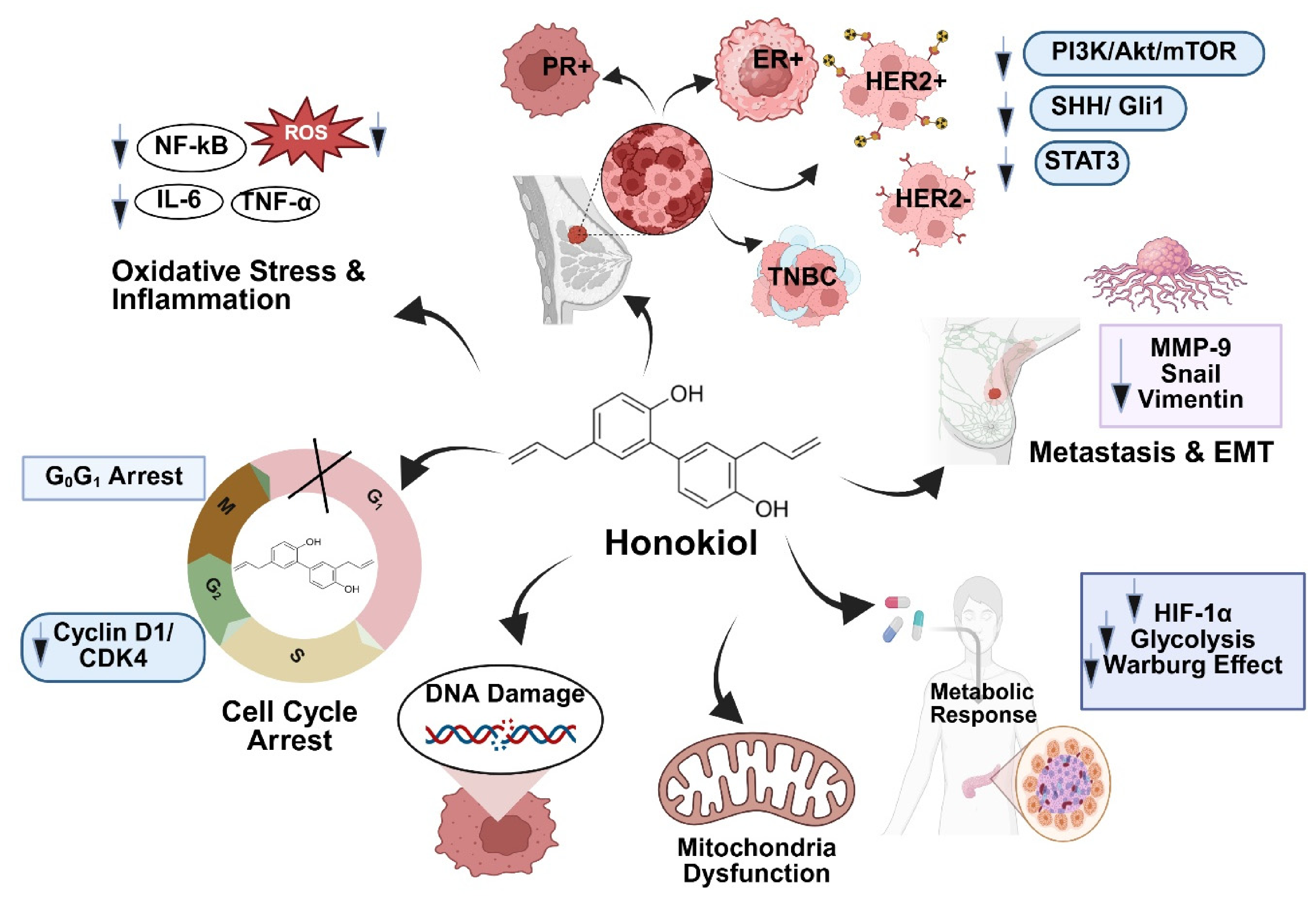
2. Honokiol and Its Anticancer Mechanisms
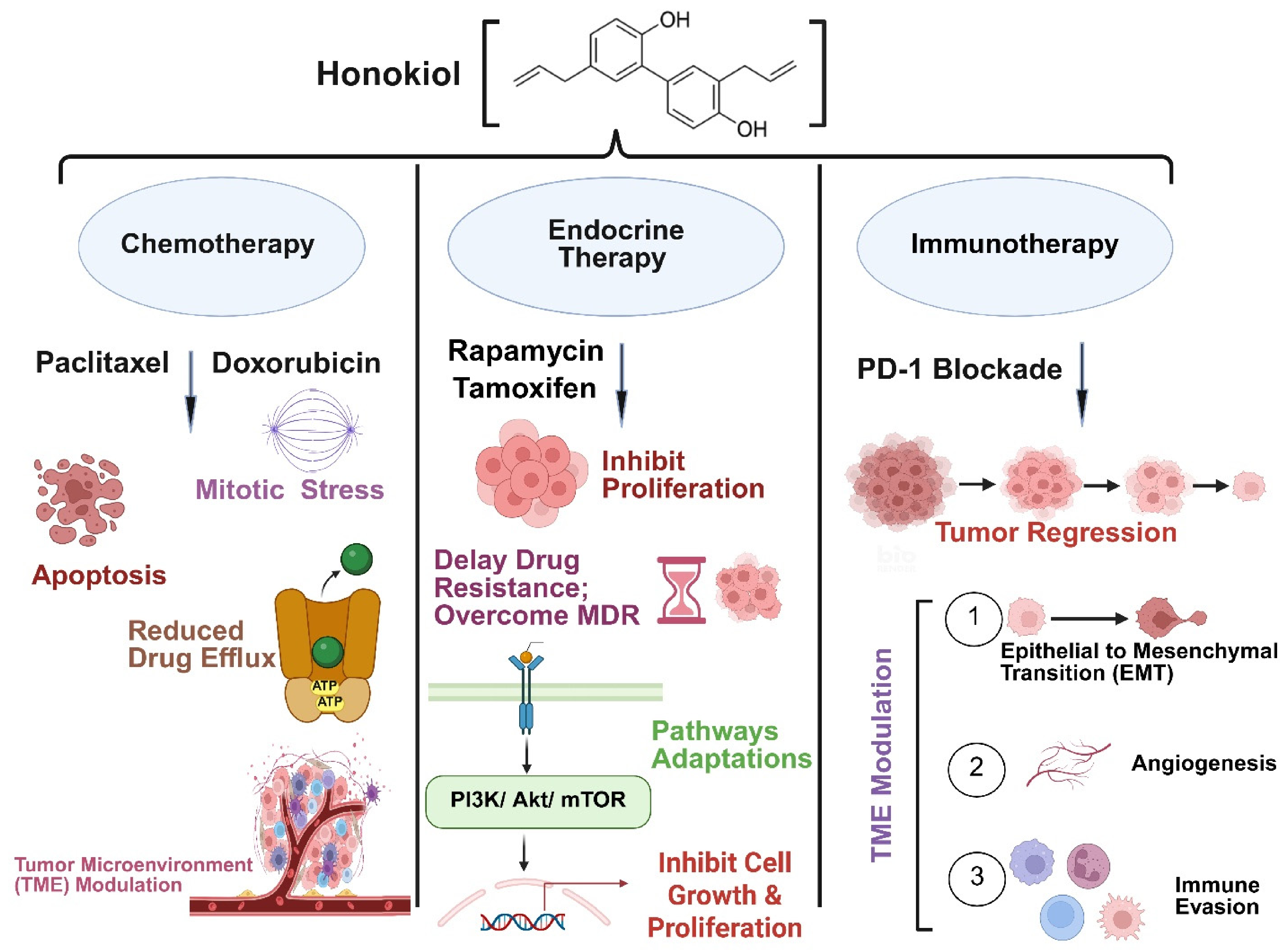
3. HNK with Chemotherapy: Synergistic Interactions
4. HNK Synergy with Targeted and Endocrine Therapies
5. HNK in Immunotherapy and Multimodal Interactions
6. Honokiol and Drug-Resistance Mechanisms in BrCa
7. Preclinical Results for HNK in Treatment of BrCa
8. Clinical Evidence for the Use of HNK
9. Challenges and Future Directions for HNK in BrCa
10. Conclusions
Author Contributions
Funding
Informed Consent Statement
Data Availability Statement
Acknowledgments
Conflicts of Interest
References
- Akinsipe, T.; Mohamedelhassan, R.; Akinpelu, A.; Pondugula, S.R.; Mistriotis, P.; Avila, L.A.; Suryawanshi, A. Cellular interactions in tumor microenvironment during breast cancer progression: New frontiers and implications for novel therapeutics. Front. Immunol. 2024, 15, 1302587. [Google Scholar] [CrossRef] [Scilit] [PubMed]
- Eliaz, I.; Weil, E. Intravenous Honokiol in Drug-Resistant Cancer: Two Case Reports. Integr. Cancer Ther. 2020, 19, 1534735420922615. [Google Scholar] [CrossRef] [Scilit] [PubMed]
- Kinnel, B.; Singh, S.K.; Oprea-Ilies, G.; Singh, R. Targeted Therapy and Mechanisms of Drug Resistance in Breast Cancer. Cancers 2023, 15, 1320. [Google Scholar] [CrossRef] [Scilit] [PubMed]
- Ong, C.P.; Lee, W.L.; Tang, Y.Q.; Yap, W.H. Honokiol: A Review of Its Anticancer Potential and Mechanisms. Cancers 2019, 12, 48. [Google Scholar] [CrossRef] [Scilit] [PubMed]
- Yi, X.; Qi, M.; Huang, M.; Zhou, S.; Xiong, J. Honokiol Inhibits HIF-1α-Mediated Glycolysis to Halt Breast Cancer Growth. Front. Pharmacol. 2022, 13, 796763. [Google Scholar] [CrossRef] [Scilit] [PubMed]
- Goleij, P.; Heidari, M.M.; Motevalli, H.; Abolfazli, S.; Khazeei Tabari, M.A.; Rezaee, A.; Larsen, D.S.; Daglia, M.; Aschner, M.; Khan, H. Targeting the HGF/MET axis in cancer: Therapeutic promise for natural compounds. Eur. J. Med. Chem. 2025, 298, 118027. [Google Scholar] [CrossRef] [Scilit] [PubMed]
- Islam, M.R.; Islam, F.; Nafady, M.H.; Akter, M.; Mitra, S.; Das, R.; Urmee, H.; Shohag, S.; Akter, A.; Chidambaram, K.; et al. Natural Small Molecules in Breast Cancer Treatment: Understandings from a Therapeutic Viewpoint. Molecules 2022, 27, 2165. [Google Scholar] [CrossRef] [Scilit] [PubMed]
- Han, X.; Cheng, Y.; Jiang, Z.; Alu, A.; Ma, X. Honokiol Exhibits Anti-Tumor Effects in Breast Cancer by Modulating the miR-148a-5p-CYP1B1 Axis. Am. J. Chin. Med. 2024, 52, 1843–1861. [Google Scholar] [CrossRef] [Scilit] [PubMed]
- Wang, Z.; Li, X.; Wang, D.; Zou, Y.; Qu, X.; He, C.; Deng, Y.; Jin, Y.; Zhou, Y.; Zhou, Y.; et al. Concurrently suppressing multidrug resistance and metastasis of breast cancer by co-delivery of paclitaxel and honokiol with pH-sensitive polymeric micelles. Acta Biomater. 2017, 62, 144–156. [Google Scholar] [CrossRef] [Scilit] [PubMed]
- Rawat, L.; Solanki, R.; Kumar, R.; Pal, S.; Sabarwal, A. Honokiol in cancer: Roles in enhancing combination therapy efficacy and preventing post-transplant malignancies. Tumor Discov. 2025, 4, 42–54. [Google Scholar] [CrossRef] [Scilit] [PubMed]
- Dominiak, K.; Gostyńska, A.; Szulc, M.; Stawny, M. The Anticancer Application of Delivery Systems for Honokiol and Magnolol. Cancers 2024, 16, 2257. [Google Scholar] [CrossRef] [Scilit] [PubMed]
- Mikhaevich, E.I.; Sorokin, D.V.; Scherbakov, A.M. Honokiol inhibits the growth of hormone-resistant breast cancer cells: Its promising effect in combination with metformin. Res. Pharm. Sci. 2023, 18, 580–591. [Google Scholar] [CrossRef] [Scilit] [PubMed]
- Kinnel, B.; Srivastava, A.K.; Singh, S.K.; Singh, R. In Silico and In Vitro Profiling of Honokiol and Paclitaxel-Loaded PBM Nanoparticles for Targeted Breast Cancer Delivery. Pharmaceuticals 2025, 18, 1814. [Google Scholar] [CrossRef] [Scilit] [PubMed]
- Mei, M.; Tang, L.; Zhou, H.; Xue, N.; Li, M. Honokiol prevents lung metastasis of triple-negative breast cancer by regulating polarization and recruitment of macrophages. Eur. J. Pharmacol. 2023, 959, 176076. [Google Scholar] [CrossRef] [Scilit] [PubMed]
- Hermawan, A.; Putri, H.; Hanif, N.; Fatimah, N.; Prasetio, H.H. Identification of potential target genes of honokiol in overcoming breast cancer resistance to tamoxifen. Front. Oncol. 2022, 12, 1019025. [Google Scholar] [CrossRef] [Scilit] [PubMed]
- Li, L.; Han, W.; Gu, Y.; Qiu, S.; Lu, Q.; Jin, J.; Luo, J.; Hu, X. Honokiol induces a necrotic cell death through the mitochondrial permeability transition pore. Cancer Res. 2007, 67, 4894–4903. [Google Scholar] [CrossRef] [Scilit] [PubMed]
- Singh, T.; Katiyar, S.K. Honokiol, a phytochemical from Magnolia spp., inhibits breast cancer cell migration by targeting nitric oxide and cyclooxygenase-2. Int. J. Oncol. 2011, 38, 769–776. [Google Scholar] [CrossRef] [Scilit] [PubMed]
- Wang, T.J.; Liu, H.T.; Lai, Y.H.; Jan, T.R.; Nomura, N.; Chang, H.W.; Chou, C.C.; Lee, Y.J.; Tsai, P.S.J. Honokiol, a Polyphenol Natural Compound, Attenuates Cisplatin-Induced Acute Cytotoxicity in Renal Epithelial Cells Through Cellular Oxidative Stress and Cytoskeleton Modulations. Front. Pharmacol. 2018, 9, 357. [Google Scholar] [CrossRef] [Scilit] [PubMed]
- Park, E.J.; Min, H.Y.; Chung, H.J.; Hong, J.Y.; Kang, Y.J.; Hung, T.M.; Youn, U.J.; Kim, Y.S.; Bae, K.; Kang, S.S.; et al. Down-regulation of c-Src/EGFR-mediated signaling activation is involved in the honokiol-induced cell cycle arrest and apoptosis in MDA-MB-231 human breast cancer cells. Cancer Lett. 2009, 277, 133–140. [Google Scholar] [CrossRef] [Scilit] [PubMed]
- Avtanski, D.B.; Nagalingam, A.; Bonner, M.Y.; Arbiser, J.L.; Saxena, N.K.; Sharma, D. Honokiol inhibits epithelial—Mesenchymal transition in breast cancer cells by targeting signal transducer and activator of transcription 3/Zeb1/E-cadherin axis. Mol. Oncol. 2014, 8, 565–580. [Google Scholar] [CrossRef] [Scilit] [PubMed]
- Shi, H.; Wang, Y.; Yao, M.; Zhang, D.; Fang, W.; Zhou, T.; Gan, D.; Yue, S.; Qian, H.; Chen, T. Honokiol inhibits the growth of SKBR3 cells. Transl. Cancer Res. 2020, 9, 7596–7604. [Google Scholar] [CrossRef] [Scilit] [PubMed]
- Avtanski, D.B.; Nagalingam, A.; Bonner, M.Y.; Arbiser, J.L.; Saxena, N.K.; Sharma, D. Honokiol activates LKB1-miR-34a axis and antagonizes the oncogenic actions of leptin in breast cancer. Oncotarget 2015, 6, 29947–29962. [Google Scholar] [CrossRef] [Scilit] [PubMed]
- Bhateja, P.; Cherian, M.; Majumder, S.; Ramaswamy, B. The Hedgehog Signaling Pathway: A Viable Target in Breast Cancer? Cancers 2019, 11, 1126. [Google Scholar] [CrossRef] [Scilit] [PubMed]
- Jiang, J. Hedgehog signaling mechanism and role in cancer. Semin. Cancer Biol. 2022, 85, 107–122. [Google Scholar] [CrossRef] [Scilit] [PubMed]
- Neelakantan, D.; Zhou, H.; Oliphant, M.U.J.; Zhang, X.; Simon, L.M.; Henke, D.M.; Shaw, C.A.; Wu, M.-F.; Hilsenbeck, S.G.; White, L.D.; et al. EMT cells increase breast cancer metastasis via paracrine GLI activation in neighbouring tumour cells. Nat. Commun. 2017, 8, 15773. [Google Scholar] [CrossRef] [Scilit] [PubMed]
- Singh, S.K.; Singh, R. Abstract 192: Honokiol effectively induces apoptosis by targeting the hedgehog signaling pathways in breast cancer. Cancer Res. 2025, 85, 192. [Google Scholar] [CrossRef] [Scilit]
- Medina, M.A.; Oza, G.; Sharma, A.; Arriaga, L.G.; Hernandez Hernandez, J.M.; Rotello, V.M.; Ramirez, J.T. Triple-Negative Breast Cancer: A Review of Conventional and Advanced Therapeutic Strategies. Int. J. Environ. Res. Public Health 2020, 17, 2078. [Google Scholar] [CrossRef] [Scilit] [PubMed]
- Rauf, A.; Patel, S.; Imran, M.; Maalik, A.; Arshad, M.U.; Saeed, F.; Mabkhot, Y.N.; Al-Showiman, S.S.; Ahmad, N.; Elsharkawy, E. Honokiol: An anticancer lignan. Biomed. Pharmacother. 2018, 107, 555–562. [Google Scholar] [CrossRef] [Scilit] [PubMed]
- Wang, W.-D.; Shang, Y.; Li, Y.; Chen, S.-Z. Honokiol inhibits breast cancer cell metastasis by blocking EMT through modulation of Snail/Slug protein translation. Acta Pharmacol. Sin. 2019, 40, 1219–1227. [Google Scholar] [CrossRef] [Scilit] [PubMed]
- Xie, L.; Jiang, F.; Zhang, X.; Alitongbieke, G.; Shi, X.; Meng, M.; Xu, Y.; Ren, A.; Wang, J.; Cai, L.; et al. Honokiol sensitizes breast cancer cells to TNF-α induction of apoptosis by inhibiting Nur77 expression. Br. J. Pharmacol. 2016, 173, 344–356. [Google Scholar] [PubMed]
- Singh, D.; Nandani; Bedi, N. Honokiol as a next-generation phytotherapeutic: Anticancer, neuroprotective, and nanomedicine perspectives. Pharmacol. Res.-Mod. Chin. Med. 2025, 17, 100713. [Google Scholar] [CrossRef] [Scilit]
- Wang, X.; Beitler, J.J.; Wang, H.; Lee, M.J.; Huang, W.; Koenig, L.; Nannapaneni, S.; Amin, A.R.M.R.; Bonner, M.; Shin, H.J.C.; et al. Honokiol enhances paclitaxel efficacy in multi-drug resistant human cancer model through the induction of apoptosis. PLoS ONE 2014, 9, e86369. [Google Scholar] [CrossRef] [Scilit] [PubMed]
- Fried, L.E.; Arbiser, J.L. Honokiol, a multifunctional antiangiogenic and antitumor agent. Antioxid. Redox Signal. 2009, 11, 1139–1148. [Google Scholar] [CrossRef] [Scilit] [PubMed]
- Muniraj, N.; Siddharth, S.; Shriver, M.; Nagalingam, A.; Parida, S.; Woo, J.; Elsey, J.; Gabrielson, K.; Gabrielson, E.; Arbiser, J.L.; et al. Induction of STK11-dependent cytoprotective autophagy in breast cancer cells upon honokiol treatment. Cell Death Discov. 2020, 6, 81. [Google Scholar] [CrossRef] [Scilit] [PubMed]
- Lu, X.; Lu, X.; Yang, P.; Zhang, Z.; Lv, H. Honokiol nanosuspensions loaded thermosensitive hydrogels as the local delivery system in combination with systemic paclitaxel for synergistic therapy of breast cancer. Eur. J. Pharm. Sci. 2022, 175, 106212. [Google Scholar] [CrossRef] [Scilit] [PubMed]
- Solanki, R.; Rawat, L.; Tabasum, S.; Pal, S.; Patel, S.; Sabarwal, A. A comprehensive review of anti-cancer mechanisms of polyphenol honokiol and nano carrier-based approaches to enhance its therapeutic potential. Phytochem. Rev. 2025, 24, 5701–5727. [Google Scholar] [CrossRef] [Scilit]
- Musheyev, D.; Alayev, A. Endocrine therapy resistance: What we know and future directions. Explor. Target. Anti-Tumor Ther. 2022, 3, 480–496. [Google Scholar] [CrossRef] [Scilit] [PubMed]
- Nagalingam, A.; Arbiser, J.L.; Bonner, M.Y.; Saxena, N.K.; Sharma, D. Honokiol activates AMP-activated protein kinase in breast cancer cells via an LKB1-dependent pathway and inhibits breast carcinogenesis. Breast Cancer Res. 2012, 14, R35. [Google Scholar] [CrossRef] [Scilit] [PubMed]
- Ring, A.; Dowsett, M. Mechanisms of tamoxifen resistance. Endocr. Relat. Cancer 2004, 11, 643–658. [Google Scholar] [CrossRef] [Scilit] [PubMed]
- Marra, A.; Viale, G.; Curigliano, G. Recent advances in triple negative breast cancer: The immunotherapy era. BMC Med. 2019, 17, 90. [Google Scholar] [CrossRef] [Scilit] [PubMed]
- Gupta, S.; Roy, A.; Dwarakanath, B.S. Metabolic Cooperation and Competition in the Tumor Microenvironment: Implications for Therapy. Front. Oncol. 2017, 7, 68. [Google Scholar] [CrossRef] [Scilit] [PubMed]
- Luo, L.; Wu, T.; Ji, M.; Xiang, J.; Zou, Y.; Liao, Y. Honokiol suppress the PD-L1 expression to improve anti-tumor immunity in lung cancer. Int. Immunopharmacol. 2024, 133, 112098. [Google Scholar] [CrossRef] [Scilit] [PubMed]
- Wu, Q.; You, L.; Nepovimova, E.; Heger, Z.; Wu, W.; Kuca, K.; Adam, V. Hypoxia-inducible factors: Master regulators of hypoxic tumor immune escape. J. Hematol. Oncol. 2022, 15, 77. [Google Scholar] [CrossRef] [Scilit] [PubMed]
- Zhi, S.; Chen, C.; Huang, H.; Zhang, Z.; Zeng, F.; Zhang, S. Hypoxia-inducible factor in breast cancer: Role and target for breast cancer treatment. Front. Immunol. 2024, 15, 1370800. [Google Scholar] [CrossRef] [Scilit] [PubMed]
- Ma, S.; Zhao, Y.; Lee, W.C.; Ong, L.-T.; Lee, P.L.; Jiang, Z.; Oguz, G.; Niu, Z.; Liu, M.; Goh, J.Y.; et al. Hypoxia induces HIF1α-dependent epigenetic vulnerability in triple negative breast cancer to confer immune effector dysfunction and resistance to anti-PD-1 immunotherapy. Nat. Commun. 2022, 13, 4118. [Google Scholar] [CrossRef] [Scilit] [PubMed]
- Liu, Z.J.; Semenza, G.L.; Zhang, H.F. Hypoxia-inducible factor 1 and breast cancer metastasis. J. Zhejiang Univ. Sci. B 2015, 16, 32–43. [Google Scholar] [CrossRef] [Scilit] [PubMed]
- Belisario, D.C.; Sapino, A.; Roato, I.; Bosia, A.; Doublier, S.; Marchiò, S. ERRα and HIF-1α Cooperate to Enhance Breast Cancer Aggressiveness and Chemoresistance Under Hypoxic Conditions. Cancers 2025, 17, 2382. [Google Scholar] [CrossRef] [Scilit] [PubMed]
- Doedens, A.L.; Stockmann, C.; Rubinstein, M.P.; Liao, D.; Zhang, N.; DeNardo, D.G.; Coussens, L.M.; Karin, M.; Goldrath, A.W.; Johnson, R.S. Macrophage expression of hypoxia-inducible factor-1α suppresses T-cell function and promotes tumor progression. Cancer Res. 2010, 70, 7465–7475. [Google Scholar] [CrossRef] [Scilit] [PubMed]
- Rashid, M.; Ramezani, M.; Molavi, O.; Ghesmati, Z.; Baradaran, B.; Sabzichi, M.; Ramezani, F. Targeting hypoxia-inducible factor 1 alpha augments synergistic effects of chemo/immunotherapy via modulating tumor microenvironment in a breast cancer mouse model. BioImpacts 2025, 15, 30424. [Google Scholar] [PubMed]
- Xu, D.; Lu, Q.; Hu, X. Down-regulation of P-glycoprotein expression in MDR breast cancer cell MCF-7/ADR by honokiol. Cancer Lett. 2006, 243, 274–280. [Google Scholar] [CrossRef] [Scilit] [PubMed]
- Wolf, I.; O’Kelly, J.; Wakimoto, N.; Nguyen, A.; Amblard, F.; Karlan, B.Y.; Arbiser, J.L.; Koeffler, H.P. Honokiol, a natural biphenyl, inhibits in vitro and in vivo growth of breast cancer through induction of apoptosis and cell cycle arrest. Int. J. Oncol. 2007, 30, 1529–1537. [Google Scholar] [CrossRef] [Scilit] [PubMed]
- Putra, I.M.R.; Lestari, I.A.; Fatimah, N.; Hanif, N.; Ujiantari, N.S.O.; Putri, D.D.P.; Hermawan, A. Bioinformatics and In Vitro Study Reveal ERα as The Potential Target Gene of Honokiol to Enhance Trastuzumab Sensitivity in HER2+ Trastuzumab-Resistant Breast Cancer Cells. Comput. Biol. Chem. 2024, 111, 108084. [Google Scholar] [CrossRef] [Scilit] [PubMed]
- Liu, H.; Zang, C.; Emde, A.; Planas-Silva, M.D.; Rosche, M.; Kühnl, A.; Schulz, C.-O.; Elstner, E.; Possinger, K.; Eucker, J. Anti-tumor effect of honokiol alone and in combination with other anti-cancer agents in breast cancer. Eur. J. Pharmacol. 2008, 591, 43–51. [Google Scholar] [CrossRef] [Scilit] [PubMed]
- Zhou, C.; Zhong, Q.; Rhodes, L.V.; Townley, I.; Bratton, M.R.; Zhang, Q.; Martin, E.C.; Elliott, S.; Collins-Burow, B.M.; Burow, M.E.; et al. Proteomic analysis of acquired tamoxifen resistance in MCF-7 cells reveals expression signatures associated with enhanced migration. Breast Cancer Res. 2012, 14, R45. [Google Scholar] [CrossRef] [Scilit] [PubMed]
- Obeagu, E.I. Hypoxia-inducible factors in breast cancer: Prognostic indicators and emerging biomarkers: Narrative review. Ann. Med. Surg. 2025, 87, 5614–5623. [Google Scholar] [CrossRef] [Scilit] [PubMed]
- Luo, S.; Jiang, Y.; Zheng, A.; Zhao, Y.; Wu, X.; Li, M.; Du, F.; Chen, Y.; Deng, S.; Chen, M.; et al. Targeting hypoxia-inducible factors for breast cancer therapy: A narrative review. Front. Pharmacol. 2022, 13, 1064661. [Google Scholar] [CrossRef] [Scilit] [PubMed]
- Avtanski, D.B.; Nagalingam, A.; Kuppusamy, P.; Bonner, M.Y.; Arbiser, J.L.; Saxena, N.K.; Sharma, D. Honokiol abrogates leptin-induced tumor progression by inhibiting Wnt1-MTA1-β-catenin signaling axis in a microRNA-34a dependent manner. Oncotarget 2015, 6, 16396–16410. [Google Scholar] [CrossRef] [Scilit] [PubMed]
- Noel, B.; Singh, S.K.; Lillard, J.W., Jr.; Singh, R. Role of natural compounds in preventing and treating breast cancer. Front. Biosci. 2020, 12, 137–160. [Google Scholar] [CrossRef] [Scilit] [PubMed]
- Thulasiraman, P.; Johnson, A.B. Regulation of Mucin 1 and multidrug resistance protein 1 by honokiol enhances the efficacy of doxorubicin-mediated growth suppression in mammary carcinoma cells. Int. J. Oncol. 2016, 49, 479–486. [Google Scholar] [CrossRef] [Scilit] [PubMed]
- Arora, S.; Singh, S.; Piazza, G.; Contreras, C.; Panyam, J.; Singh, A. Honokiol: A novel natural agent for cancer prevention and therapy. Curr. Mol. Med. 2012, 12, 1244–1252. [Google Scholar] [CrossRef] [Scilit] [PubMed]
- Du, Q.; Zhang, Q.; Li, J.; Wang, X.; Gao, X.; Tan, G.; Feng, Q.; Li, J.; Meng, Y.; Yu, Y. Enhanced integrated therapy for breast cancer employing Honokiol-loaded mesoporous polydopamine nanoparticles in conjunction with photothermal effects and low-dose metformin. APL Bioeng. 2025, 9, 016115. [Google Scholar] [CrossRef] [Scilit] [PubMed]
- Yang, J.; Shang, J.; Yang, L.; Wei, D.; Wang, X.; Deng, Q.; Zhong, Z.; Ye, Y.; Zhou, M. Nanotechnology-Based Drug Delivery Systems for Honokiol: Enhancing Therapeutic Potential and Overcoming Limitations. Int. J. Nanomed. 2023, 18, 6639–6665. [Google Scholar] [CrossRef] [Scilit] [PubMed]
- Oehler, J.B.; Rajapaksha, W.; Albrecht, H. Emerging Applications of Nanoparticles in the Diagnosis and Treatment of Breast Cancer. J. Pers. Med. 2024, 14, 723. [Google Scholar] [CrossRef] [Scilit] [PubMed]
- Viegas, C.; Patrício, A.B.; Prata, J.M.; Nadhman, A.; Chintamaneni, P.K.; Fonte, P. Solid Lipid Nanoparticles vs. Nanostructured Lipid Carriers: A Comparative Review. Pharmaceutics 2023, 15, 1593. [Google Scholar] [CrossRef] [Scilit] [PubMed]
- Almurisi, S.H.; En, G.W.; Hafiq, M.Z.; Sheng, L.K.; Sri, P.; Mazlan, N.A.B.A.; Bhatnagar, P.; Madheswaran, T. Review of Lipid Nanoparticles for Breast Cancer Management: Targeting Strategies and Clinical Perspective. Curr. Nanomed. 2026, 16, 330–346. [Google Scholar] [CrossRef] [Scilit]
- Haggag, Y.A.; Ibrahim, R.R.; Hafiz, A.A. Design, Formulation and in vivo Evaluation of Novel Honokiol-Loaded PEGylated PLGA Nanocapsules for Treatment of Breast Cancer. Int. J. Nanomed. 2020, 15, 1625–1642. [Google Scholar] [CrossRef] [Scilit] [PubMed]
- Li, Y.; Tao, T.; Xiong, Y.; Guo, W.; Liang, Y. Multifunctional PLGA nanosystems: Enabling integrated diagnostic and therapeutic strategies. Front. Pharmacol. 2025, 16, 1670397. [Google Scholar] [CrossRef] [Scilit] [PubMed]
- Teixeira, S.; Carvalho, M.A.; Castanheira, E.M.S. Functionalized Liposome and Albumin-Based Systems as Carriers for Poorly Water-Soluble Anticancer Drugs: An Updated Review. Biomedicines 2022, 10, 486. [Google Scholar] [CrossRef] [Scilit] [PubMed]
- Kashyap, B.K.; Singh, V.V.; Solanki, M.K.; Kumar, A.; Ruokolainen, J.; Kesari, K.K. Smart Nanomaterials in Cancer Theranostics: Challenges and Opportunities. ACS Omega 2023, 8, 14290–14320. [Google Scholar] [CrossRef] [Scilit] [PubMed]
- Wang, C.; Cai, Z.; Huang, Y.; Liu, X.; Liu, X.; Chen, F.; Li, W. Honokiol in glioblastoma recurrence: A case report. Front. Neurol. 2023, 14, 1172860. [Google Scholar] [CrossRef] [Scilit] [PubMed]
- Lipinski, C.A.; Lombardo, F.; Dominy, B.W.; Feeney, P.J. Experimental and computational approaches to estimate solubility and permeability in drug discovery and development settings. Adv. Drug Deliv. Rev. 2001, 46, 3–26. [Google Scholar] [CrossRef] [Scilit] [PubMed]
- Usach, I.; Alaimo, A.; Fernández, J.; Ambrosini, A.; Mocini, S.; Ochiuz, L.; Peris, J.-E. Magnolol and Honokiol: Two Natural Compounds with Similar Chemical Structure but Different Physicochemical and Stability Properties. Pharmaceutics 2021, 13, 224. [Google Scholar] [CrossRef] [Scilit] [PubMed]
- Wang, L.; Wu, W.; Wang, L.; Wang, L.; Zhao, X. Highly Water-Soluble Solid Dispersions of Honokiol: Preparation, Solubility, and Bioavailability Studies and Anti-Tumor Activity Evaluation. Pharmaceutics 2019, 11, 573. [Google Scholar] [CrossRef] [Scilit] [PubMed]
- Crane, C.; Panner, A.; Pieper, R.O.; Arbiser, J.; Parsa, A.T. Honokiol-mediated inhibition of PI3K/mTOR pathway: A potential strategy to overcome immunoresistance in glioma, breast, and prostate carcinoma without impacting T cell function. J. Immunother. 2009, 32, 585–592. [Google Scholar] [CrossRef] [Scilit] [PubMed]
- Jun-Jun, W.; Xiao-Lei, M.; Jing-Ya, C.; Yong, C. The Pharmacokinetics and Tissue Distribution of Honokiol and its Metabolites in Rats. Eur. J. Drug Metab. Pharmacokinet. 2016, 41, 587–594. [Google Scholar] [PubMed]
- Böhmdorfer, M.; Maier-Salamon, A.; Taferner, B.; Reznicek, G.; Thalhammer, T.; Hering, S.; Hüfner, A.; Schühly, W.; Jäger, W. In vitro metabolism and disposition of honokiol in rat and human livers. J. Pharm. Sci. 2011, 100, 3506–3516. [Google Scholar] [CrossRef] [Scilit] [PubMed]
- Yu, H.E.; Oh, S.J.; Ryu, J.K.; Kang, J.S.; Hong, J.T.; Jung, J.; Han, S.; Seo, S.; Kim, Y.H.; Park, S.; et al. Pharmacokinetics and metabolism of 4-O-methylhonokiol in rats. Phytother. Res. 2014, 28, 568–578. [Google Scholar] [PubMed]
- Lee, H.S.; Cho, Y.-Y.; Jeong, H.-U.; Kim, J.-H. Effect of honokiol on the induction of drug-metabolizing enzymes in human hepatocytes. Drug Des. Dev. Ther. 2014, 8, 2137–2145. [Google Scholar] [CrossRef] [Scilit] [PubMed]
- Yang, T.; Song, W.; Lu, Z.; Zhou, G.; Wang, Z.; Zhou, Q.; Geng, P.; Al Mamun, A.; Wang, S.; Shi, Y. Effect of honokiol on abemaciclib metabolism both in vitro and in vivo. J. Pharm. Pharmacol. 2026, 78, rgaf108. [Google Scholar] [PubMed]
- Kim, S.-B.; Kim, K.-S.; Ryu, H.-M.; Hong, S.-H.; Kim, B.-K.; Kim, D.-D.; Park, J.W.; Yoon, I.-S. Modulation of Rat Hepatic CYP1A and 2C Activity by Honokiol and Magnolol: Differential Effects on Phenacetin and Diclofenac Pharmacokinetics In Vivo. Molecules 2018, 23, 1470. [Google Scholar] [CrossRef] [Scilit] [PubMed]
- Godugu, C.; Doddapaneni, R.; Singh, M. Honokiol nanomicellar formulation produced increased oral bioavailability and anticancer effects in triple negative breast cancer (TNBC). Colloids Surf. B Biointerfaces 2017, 153, 208–219. [Google Scholar] [CrossRef] [Scilit] [PubMed]



| Drug Partners | Model/Cell Types | Mechanism of Action | Outcome | References |
|---|---|---|---|---|
| Doxorubicin (DOX) | MCF-7, MDA-MB-231 cells | Suppress MRP1 (ABCC1); target, MUC1-MRP1 axis. | Enhanced chemosensitivity and improved therapeutic effectiveness; cell growth inhibition; enhancing anti-tumor activity. | [59] |
| Trastuzumab | HCC1954 cells | Regulate ER signaling; modulates PI3K/AKT, STAT3, and ERα (ESR1) signaling | Increased cytotoxicity in resistant cells (TR-HCC1954); restores trastuzumab sensitivity. | [52] |
| Rapamycin | BT-474 cells | Augments mTOR inhibition by suppressing PI3K/Akt/mTOR; suppresses S6K signaling. | Reduces adaptive survival signaling and cell proliferation and enhances growth inhibition and apoptosis. | [53,60] |
| Tamoxifen | MCF-7/TAMR cells | Restores ER sensitivity in tamoxifen-resistant cells by suppressing survival and cell-cycle pathways. resulting in reduced tumor growth. | Reversal of endocrine resistance and reduction in tumor growth and cell proliferation in tamoxifen-resistant models. | [15] |
| PD-1 blockade | 4T1 murine model, and other cancers | Enhances immunotherapy efficacy by reducing inflammatory cytokines and boosting CD4+ and CD8+ T-cell activity. | Greater anti-tumor immunity and improved tumor regression. | [14,42] |
| Metformin | MCF7; MDA-MB-231, and SKBR3 | Accumulation of cleaved PARP; downregulation of Bcl-2 and ERα; induces apoptosis. | Limits tumor growth. | [12,61] |
| Chloroquine | MCF7, MDA-MB-231, HCC1569, BT549, and MDA-MB-468 | Activates autophagy markers: LC3B-II conversion, ATG protein expression, autophagosome formation, and autophagosome–lysosome fusion. | Inhibition of tumor growth and metastasis. | [34] |
| Nanocarrier systems | Xenograft models and the 4T1 model | Improves HNK bioavailability and enhances apoptosis, tumor suppression, and chemotherapy sensitization. | Improved drug delivery, tumor suppression, and reduced systemic toxicity. | [11] |
| PBM Nanoparticle | HCC70 and MDA-MB-468 cells | Induces cell death via suppression of MUC1. | Improved cytotoxicity compared to free drug, HNK | [13] |
| Paclitaxel with HNK dual drug-loaded PEOz-PLA micelles | MCF-7/ADR, and MDA-MB-231 cells | Enhanced cytotoxicity in drug-resistant BrCa cells; Induces anti-invasion and anti-migration in BrCa cells; P-gp inhibition; and MMP inhibition. | Increased chemosensitivity; Suppressed MDR and metastasis of BrCa | [9] |
Disclaimer/Publisher’s Note: The statements, opinions and data contained in all publications are solely those of the individual author(s) and contributor(s) and not of MDPI and/or the editor(s). MDPI and/or the editor(s) disclaim responsibility for any injury to people or property resulting from any ideas, methods, instructions or products referred to in the content. |
© 2026 by the authors. Licensee MDPI, Basel, Switzerland. This article is an open access article distributed under the terms and conditions of the Creative Commons Attribution (CC BY) license.
Share and Cite
Singh, S.K.; Kondamudi, M.; Ittuveetil, A.; Dababneh, M.N.; Rivers, B.M.; Singh, R. Honokiol and Its Emerging Role in Breast Cancer Therapy. Cancers 2026, 18, 1989. https://doi.org/10.3390/cancers18121989
Singh SK, Kondamudi M, Ittuveetil A, Dababneh MN, Rivers BM, Singh R. Honokiol and Its Emerging Role in Breast Cancer Therapy. Cancers. 2026; 18(12):1989. https://doi.org/10.3390/cancers18121989
Chicago/Turabian StyleSingh, Santosh Kumar, Manasvi Kondamudi, Avinash Ittuveetil, Melad N. Dababneh, Brian M. Rivers, and Rajesh Singh. 2026. "Honokiol and Its Emerging Role in Breast Cancer Therapy" Cancers 18, no. 12: 1989. https://doi.org/10.3390/cancers18121989
APA StyleSingh, S. K., Kondamudi, M., Ittuveetil, A., Dababneh, M. N., Rivers, B. M., & Singh, R. (2026). Honokiol and Its Emerging Role in Breast Cancer Therapy. Cancers, 18(12), 1989. https://doi.org/10.3390/cancers18121989