In Vivo CAR-Based Immune Cell Engineering: Future Applications and Challenges in Malignant Glioma

 , ,
, ,
Simple Summary
Abstract
1. Introduction
2. Methods
3. Current Clinical Experience of Ex Vivo CAR-T Cell Therapy in Malignant Glioma
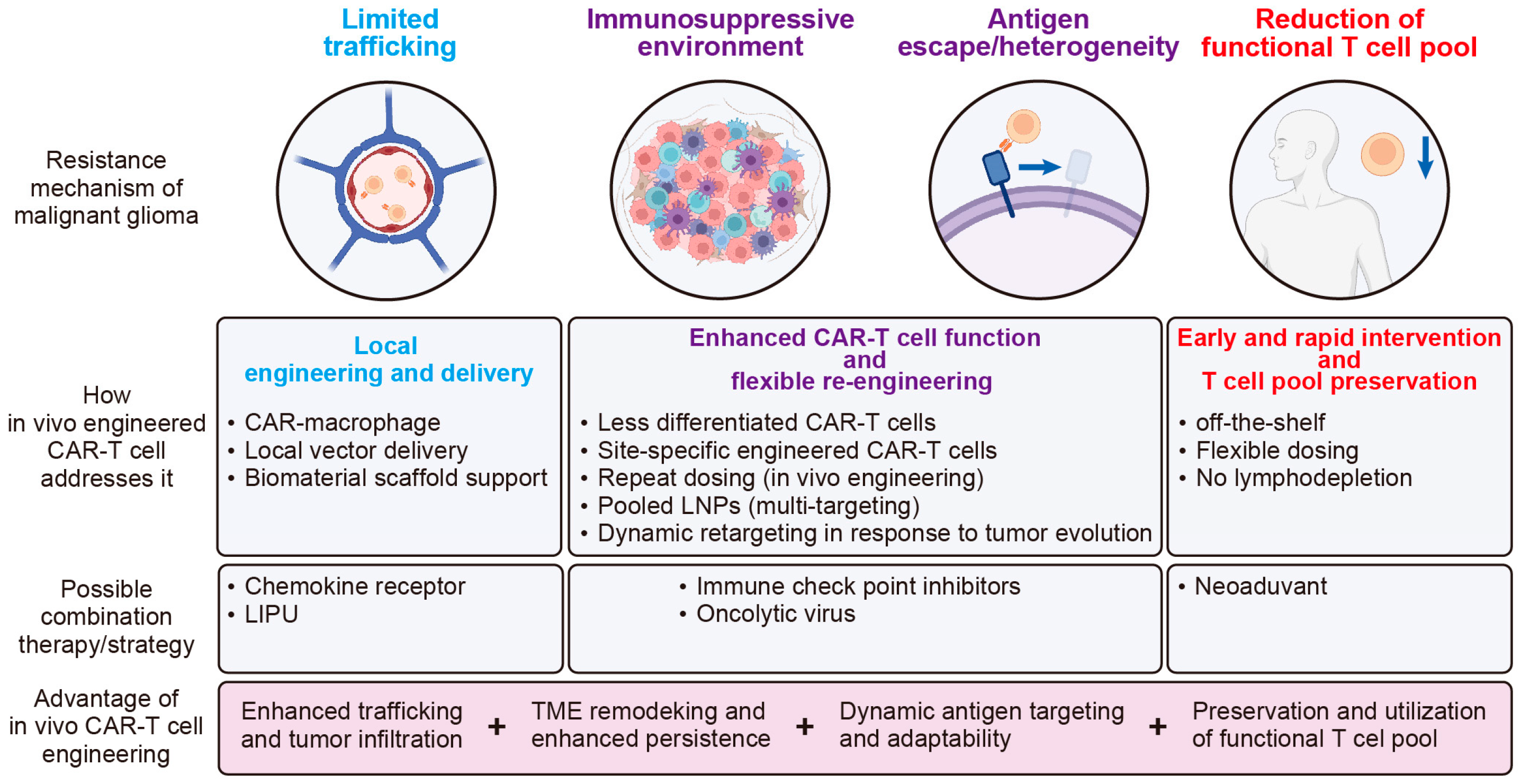
4. Resistance Mechanisms to CAR-T Cell Therapy in Malignant Glioma
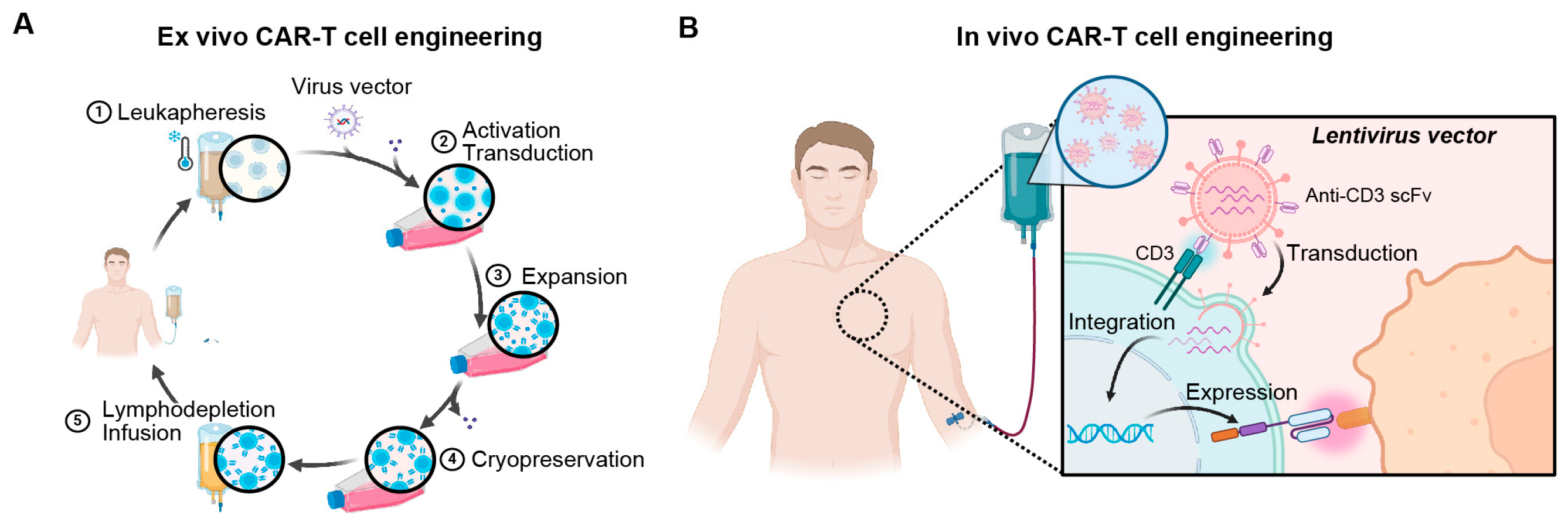
5. Limitations of Current Ex Vivo CAR-T Cell Manufacturing
6. Potential Advantages of In Vivo CAR-T Cell Engineering
7. Transient Expression vs. Stable Expression, Site-Specific Integration
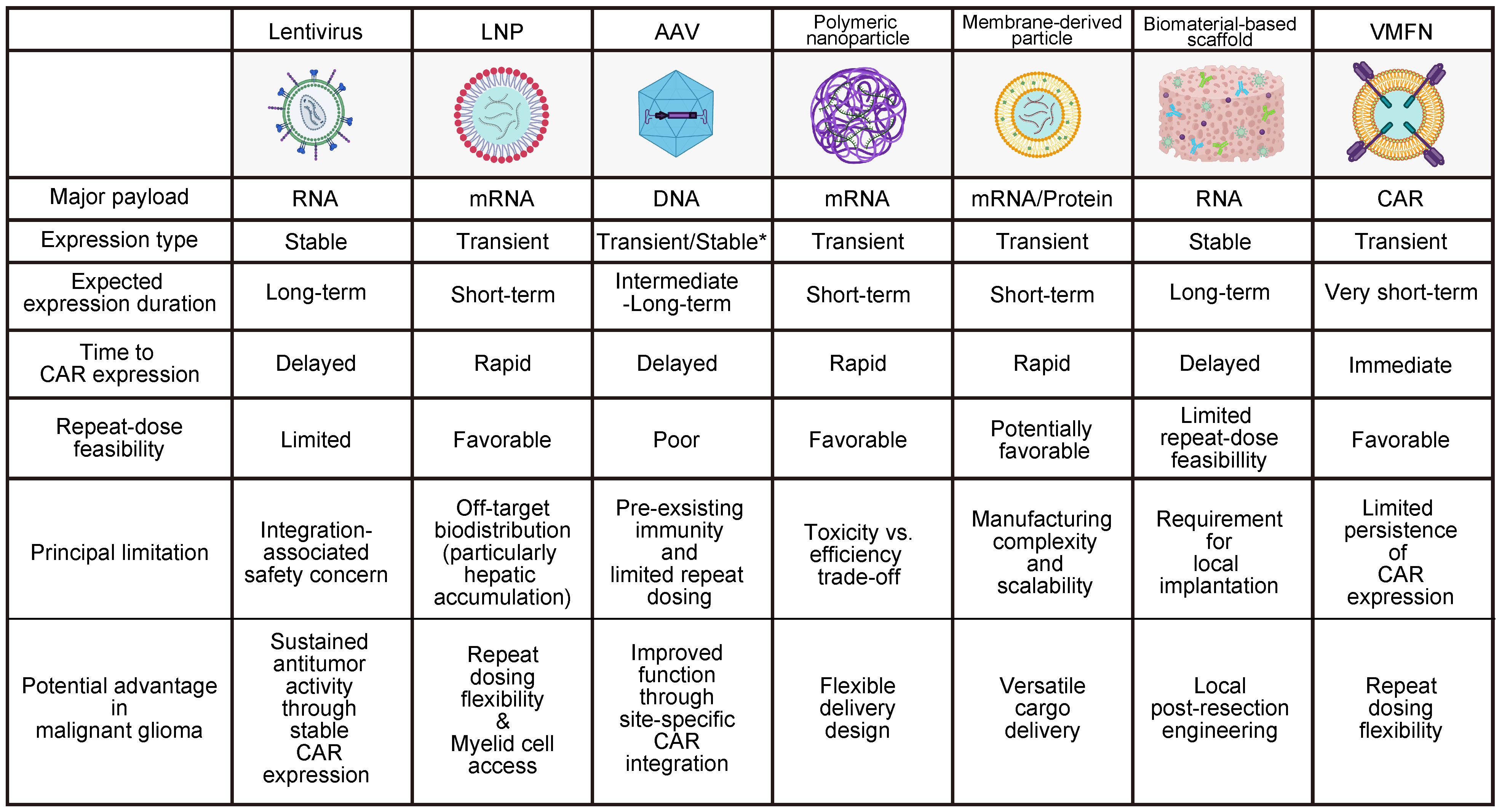
8. In Vivo CAR-T Cell Engineering Platforms
8.1. Lentivirus
8.2. Lipid Nanoparticle
8.3. AAV
8.4. Polymeric Nanoparticle
8.5. Membrane-Derived Particle
8.6. Biomaterial-Based Scaffolds
8.7. Virus Mimetic-Fusogenic Nanovesicle (VMFN)
9. Clinical Studies Evaluating In Vivo-Engineered CAR-Based Immune Cells
10. Challenges of Applying In Vivo-Engineered CAR-Based Immune Cell Therapies to Malignant Glioma
11. Potential Combination Strategies for In Vivo-Engineered CAR-T Cell Therapy in Malignant Glioma
12. Conclusions
Author Contributions
Funding
Data Availability Statement
Conflicts of Interest
Abbreviations
| CAR | Chimeric antigen receptor |
| scFv | Single-chain variable fragment |
| NK | Natural killer |
| GBM | Glioblastoma |
| IL13Rα2 | Interleukin-13 receptor alpha 2 |
| EGFR | Epidermal growth factor receptor |
| ICANS | Immune Effector Cell-Associated Neurotoxicity Syndrome |
| DIPG | Diffuse intrinsic pontine glioma |
| IV | Intravenous |
| ICV | Intracerebroventricular |
| TIAN | Tumor inflammation-associated neurotoxicity |
| CRS | Cytokine release syndrome |
| BBB | Blood–brain barrier |
| TME | Tumor microenvironment |
| TMZ | Temozolomide |
| CTLA-4 | Cytotoxic T-lymphocyte-associated protein 4 |
| MDSC | Myeloid-derived suppressor cell |
| EGFRvIII | Epidermal growth factor receptor variant III |
| COL1A1 | Collagen type 1 alpha chain |
| CNS | Central nervous system |
| FDA | Food and Drug Administration |
| LV | Lentivirus |
| IL | Interleukin |
| TCR | T cell receptor |
| MHC | Major histocompatibility complex |
| iPSC | Induced pluripotent stem cells |
| GVHD | Graft-versus-host disease |
| LNP | Lipid nanoparticle |
| AAV | Adeno-associated virus |
| EMA | European Medicine Agency |
| TRAC | T cell receptor alpha constant |
| PD-1 | Programmed cell death protein 1 |
| AAVS | Adeno-associated virus integration site 1 |
| EDV | Enveloped delivery vehicle |
| GMP | Good manufacturing practice |
| DARPin | Designed ankyrin repeat protein |
| MDF | Multidomain fusion |
| PEI | Polyethylenimine |
| PBAE | Poly (β-amino ester) |
| PEG | Poly(ethylene glycol) |
| CCL | C-C motif chemokine ligand |
| EV | Extracellular vesicles |
| VLP | Virus-like particles |
| VFMN | Virus mimetic fusogenic nanoparticle |
| BCMA | B-cell maturation antigen |
| AST | Aspartate Aminotransferase |
| TNF | Tumor necrosis factor |
| VSV-G | Vesicular stomatitis virus glycoprotein |
| PR | Partial response |
| VGPR | Very good partial response |
| TROP2 | Trophoblast cell surface antigen 2 |
| LDL-R | Low-density lipoprotein receptor |
| GPC3 | Glypican-3 |
| HER2 | Human epidermal growth factor receptor 2 |
| CAF | Cancer-associated fibroblast |
| CXCR | C-X-C motif chemokine receptor |
| B7-H3 | B7 homolog 3 |
| CCR | C-C motif chemokine receptor |
| CSF1R | Colony-stimulating factor 1 receptor |
| LIPU | Low-intensity pulsed ultrasound |
| ICI | Immune checkpoint inhibitor |
| PD-L1 | Programmed death-ligand 1 |
| HSV1-TK | Herpes simplex virus type 1 thymidine kinase |
| Flt3L | Fms-like tyrosine kinase 3 ligand |
| DAMP | Damage-associated molecular pattern |
References
- Ozelo, M.C.; Mahlangu, J.; Pasi, K.J.; Giermasz, A.; Leavitt, A.D.; Laffan, M.; Symington, E.; Quon, D.V.; Wang, J.-D.; Peerlinck, K.; et al. Valoctocogene Roxaparvovec Gene Therapy for Hemophilia A. N. Engl. J. Med. 2022, 386, 1013–1025. [Google Scholar] [CrossRef] [Scilit] [PubMed]
- Madan, B.; Ozelo, M.C.; Raheja, P.; Symington, E.; Quon, D.V.; Leavitt, A.D.; Pipe, S.W.; Lowe, G.; Kenet, G.; Reding, M.T.; et al. Three-year outcomes of valoctocogene roxaparvovec gene therapy for hemophilia A. J. Thromb. Haemost. 2024, 22, 1880–1893. [Google Scholar]
- Mercuri, E.; Muntoni, F.; Baranello, G.; Masson, R.; Boespflug-Tanguy, O.; Bruno, C.; Corti, S.; Daron, A.; Deconinck, N.; Servais, L.; et al. Onasemnogene abeparvovec gene therapy for symptomatic infantile-onset spinal muscular atrophy type 1 (STR1VE-EU): An open-label, single-arm, multicentre, phase 3 trial. Lancet Neurol. 2021, 20, 832–841. [Google Scholar] [PubMed]
- Ghassemi, S.; Durgin, J.S.; Nunez-Cruz, S.; Patel, J.; Leferovich, J.; Pinzone, M.; Shen, F.; Cummins, K.D.; Plesa, G.; Cantu, V.A.; et al. Rapid manufacturing of non-activated potent CAR T cells. Nat. Biomed. Eng. 2022, 6, 118–128. [Google Scholar] [CrossRef] [Scilit] [PubMed]
- Berger, C.; Jensen, M.C.; Lansdorp, P.M.; Gough, M.; Elliott, C.; Riddell, S.R. Adoptive transfer of effector CD8+ T cells derived from central memory cells establishes persistent T cell memory in primates. J. Clin. Investig. 2008, 118, 294–305. [Google Scholar] [CrossRef] [Scilit] [PubMed]
- Wang, R.; Yu, J.; Caligiuri, M.A.; Ma, S. Optimizing In Vivo CAR-T Cell Engineering for Cancer Immunotherapy. Cancer Res. 2026, 86, 1823–1835. [Google Scholar] [PubMed]
- Li, Y.-R.; Zhu, Y.; Halladay, T.; Yang, L. In vivo CAR engineering for immunotherapy. Nat. Rev. Immunol. 2025, 25, 725–744. [Google Scholar] [CrossRef] [Scilit] [PubMed]
- Bagley, S.J.; Logun, M.; Fraietta, J.A.; Wang, X.; Desai, A.S.; Bagley, L.J.; Nabavizadeh, A.; Jarocha, D.; Martins, R.; Maloney, E.; et al. Intrathecal bivalent CAR T cells targeting EGFR and IL13Rα2 in recurrent glioblastoma: Phase 1 trial interim results. Nat. Med. 2024, 30, 1320–1329. [Google Scholar] [CrossRef] [Scilit] [PubMed]
- Brown, C.E.; Hibbard, J.C.; Alizadeh, D.; Blanchard, M.S.; Natri, H.M.; Wang, D.; Ostberg, J.R.; Aguilar, B.; Wagner, J.R.; Paul, J.A.; et al. Locoregional delivery of IL-13Rα2-targeting CAR-T cells in recurrent high-grade glioma: A phase 1 trial. Nat. Med. 2024, 30, 1001–1012. [Google Scholar] [CrossRef] [Scilit] [PubMed]
- Monje, M.; Mahdi, J.; Majzner, R.; Yeom, K.W.; Schultz, L.M.; Richards, R.M.; Barsan, V.; Song, K.-W.; Kamens, J.; Baggott, C.; et al. Intravenous and intracranial GD2-CAR T cells for H3K27M+ diffuse midline gliomas. Nature 2025, 637, 708–715. [Google Scholar] [PubMed]
- Giles, A.J.; Hutchinson, M.-K.N.D.; Sonnemann, H.M.; Jung, J.; Fecci, P.E.; Ratnam, N.M.; Zhang, W.; Song, H.; Bailey, R.; Davis, D.; et al. Dexamethasone-induced immunosuppression: Mechanisms and implications for immunotherapy. J. Immunother. Cancer 2018, 6, 51. [Google Scholar] [CrossRef] [Scilit] [PubMed]
- PChongsathidkiet, P.; Jackson, C.; Koyama, S.; Loebel, F.; Cui, X.; Farber, S.H.; Woroniecka, K.; Elsamadicy, A.A.; Dechant, C.A.; Kemeny, H.R.; et al. Sequestration of T cells in bone marrow in the setting of glioblastoma and other intracranial tumors. Nat. Med. 2018, 24, 1459–1468. [Google Scholar] [CrossRef] [Scilit] [PubMed]
- Mittelbrunn, M.; Kroemer, G. Hallmarks of T cell aging. Nat. Immunol. 2021, 22, 687–698. [Google Scholar] [CrossRef] [Scilit] [PubMed]
- Han, S.; Georgiev, P.; Ringel, A.E.; Sharpe, A.H.; Haigis, M.C. Age-associated remodeling of T cell immunity and metabolism. Cell Metab. 2023, 35, 36–55. [Google Scholar] [CrossRef] [Scilit] [PubMed]
- Müller, S.; Kohanbash, G.; Liu, S.J.; Alvarado, B.; Carrera, D.; Bhaduri, A.; Watchmaker, P.B.; Yagnik, G.; Di Lullo, E.; Malatesta, M.; et al. Single-cell profiling of human gliomas reveals macrophage ontogeny as a basis for regional differences in macrophage activation in the tumor microenvironment. Genome Biol. 2017, 18, 234. [Google Scholar] [CrossRef] [Scilit] [PubMed]
- Friebel, E.; Kapolou, K.; Unger, S.; Núñez, N.G.; Utz, S.; Rushing, E.J.; Regli, L.; Weller, M.; Greter, M.; Tugues, S.; et al. Single-Cell Mapping of Human Brain Cancer Reveals Tumor-Specific Instruction of Tissue-Invading Leukocytes. Cell 2020, 181, 1626–1642.e20. [Google Scholar] [CrossRef] [Scilit] [PubMed]
- Jackson, C.; Cherry, C.; Bom, S.; Dykema, A.G.; Wang, R.; Thompson, E.; Zhang, M.; Li, R.; Ji, Z.; Hou, W.; et al. Distinct myeloid-derived suppressor cell populations in human glioblastoma. Science 2025, 387, eabm5214. [Google Scholar] [CrossRef] [Scilit] [PubMed]
- Hatae, R.; Kyewalabye, K.; Yamamichi, A.; Chen, T.; Phyu, S.; Chuntova, P.; Nejo, T.; Levine, L.S.; Spitzer, M.H.; Okada, H. Enhancing CAR-T cell metabolism to overcome hypoxic conditions in the brain tumor microenvironment. JCI Insight 2024, 9, e177141. [Google Scholar] [CrossRef] [Scilit] [PubMed]
- Yamaguchi, J.; Watanabe, K.; Nakamura, A.; Lin, N.Y.-T.; Maeda, S.; Sugiyama, D.; Kato, S.; Nagata, A.; Nishinakamura, H.; Itahashi, K.; et al. On-demand GLUT3 expression augments CAR T cell metabolic fitness and antitumor efficacy in preclinical models of glioblastoma. Sci. Transl. Med. 2026, 18, eadu3532. [Google Scholar] [CrossRef] [Scilit] [PubMed]
- O’rourke, D.M.; Nasrallah, M.P.; Desai, A.; Melenhorst, J.J.; Mansfield, K.; Morrissette, J.J.D.; Martinez-Lage, M.; Brem, S.; Maloney, E.; Shen, A.; et al. A single dose of peripherally infused EGFRvIII-directed CAR T cells mediates antigen loss and induces adaptive resistance in patients with recurrent glioblastoma. Sci. Transl. Med. 2017, 9, eaaa0984. [Google Scholar] [CrossRef] [Scilit] [PubMed]
- Brown, C.E.; Aguilar, B.; Starr, R.; Yang, X.; Chang, W.-C.; Weng, L.; Chang, B.; Sarkissian, A.; Brito, A.; Sanchez, J.F.; et al. Optimization of IL13Rα2-Targeted Chimeric Antigen Receptor T Cells for Improved Anti-tumor Efficacy against Glioblastoma. Mol. Ther. 2018, 26, 31–44. [Google Scholar] [CrossRef] [Scilit] [PubMed]
- Bagley, S.J.; Desai, A.S.; Fraietta, J.A.; Silverbush, D.; Chafamo, D.; Freeburg, N.F.; Gopikrishna, G.K.; Rech, A.J.; Nabavizadeh, A.; Bagley, L.J.; et al. Intracerebroventricular bivalent CAR T cells targeting EGFR and IL-13Rα2 in recurrent glioblastoma: A phase 1 trial. Nat. Med. 2025, 31, 2778–2787. [Google Scholar] [CrossRef] [Scilit] [PubMed]
- Choi, B.D.; Gerstner, E.R.; Frigault, M.J.; Leick, M.B.; Mount, C.W.; Balaj, L.; Nikiforow, S.; Carter, B.S.; Curry, W.T.; Gallagher, K.; et al. Intraventricular CARv3-TEAM-E T Cells in Recurrent Glioblastoma. N. Engl. J. Med. 2024, 390, 1290–1298. [Google Scholar] [CrossRef] [Scilit] [PubMed]
- Cliff, E.R.S.; Kelkar, A.H.; Russler-Germain, D.A.; Tessema, F.A.; Raymakers, A.J.; Feldman, W.B.; Kesselheim, A.S. High Cost of Chimeric Antigen Receptor T-Cells: Challenges and Solutions. Am. Soc. Clin. Oncol. Educ. Book 2023, 43, e397912. [Google Scholar] [CrossRef] [Scilit] [PubMed]
- Ghassemi, S.; Nunez-Cruz, S.; O’COnnor, R.S.; Fraietta, J.A.; Patel, P.R.; Scholler, J.; Barrett, D.M.; Lundh, S.M.; Davis, M.M.; Bedoya, F.; et al. Reducing Ex Vivo Culture Improves the Antileukemic Activity of Chimeric Antigen Receptor (CAR) T Cells. Cancer Immunol. Res. 2018, 6, 1100–1109. [Google Scholar] [CrossRef] [Scilit] [PubMed]
- Finney, O.C.; Brakke, H.M.; Rawlings-Rhea, S.; Hicks, R.; Doolittle, D.; Lopez, M.; Futrell, B.; Orentas, R.J.; Li, D.; Gardner, R.A.; et al. CD19 CAR T cell product and disease attributes predict leukemia remission durability. J. Clin. Investig. 2019, 129, 2123–2132. [Google Scholar] [CrossRef] [Scilit] [PubMed]
- Georgiadis, C.; Nickolay, L.; Syed, F.; Zhan, H.; Gkazi, S.A.; Etuk, A.; Abramowski-Mock, U.; Preece, R.; Cuber, P.; Adams, S.; et al. Umbilical cord blood T cells can be isolated and enriched by CD62L selection for use in ‘off the shelf’ chimeric antigen receptor T-cell therapies to widen transplant options. Haematologica 2024, 109, 3941–3951. [Google Scholar] [PubMed]
- Arcangeli, S.; Bove, C.; Mezzanotte, C.; Camisa, B.; Falcone, L.; Manfredi, F.; Bezzecchi, E.; El Khoury, R.; Norata, R.; Sanvito, F.; et al. CAR T cell manufacturing from naive/stem memory T lymphocytes enhances antitumor responses while curtailing cytokine release syndrome. J. Clin. Investig. 2022, 132, e150807. [Google Scholar] [CrossRef] [Scilit] [PubMed]
- Amini, L.; Silbert, S.K.; Maude, S.L.; Nastoupil, L.J.; Ramos, C.A.; Brentjens, R.J.; Sauter, C.S.; Shah, N.N.; Abou-El-Enein, M. Preparing for CAR T cell therapy: Patient selection, bridging therapies and lymphodepletion. Nat. Rev. Clin. Oncol. 2022, 19, 342–355. [Google Scholar] [CrossRef] [Scilit] [PubMed]
- Dudley, M.E.; Wunderlich, J.R.; Robbins, P.F.; Yang, J.C.; Hwu, P.; Schwartzentruber, D.J.; Topalian, S.L.; Sherry, R.; Restifo, N.P.; Hubicki, A.M.; et al. Cancer regression and autoimmunity in patients after clonal repopulation with antitumor lymphocytes. Science 2002, 298, 850–854. [Google Scholar] [CrossRef] [Scilit] [PubMed]
- Hay, K.A. Cytokine release syndrome and neurotoxicity after CD19 chimeric antigen receptor-modified (CAR-) T cell therapy. Br. J. Haematol. 2018, 183, 364–374. [Google Scholar] [CrossRef] [Scilit] [PubMed]
- Mullard, A. In vivo CAR T cells move into clinical trials. Nat. Rev. Drug Discov. 2024, 23, 727–730. [Google Scholar] [CrossRef] [Scilit] [PubMed]
- Li, X.; Shang, X.; Liu, J.; Zhang, Y.; Jia, X.; Li, H.; Wang, Y.; Gao, J.; Ma, X.; Zhang, X.; et al. Intrathecal CRISPR-edited allogeneic IL-13Rα2 CAR T Cells for recurrent high-grade Glioma: Preclinical characterization and phase I trial. Nat. Commun. 2026, 17, 1362. [Google Scholar] [CrossRef] [Scilit] [PubMed]
- Themeli, M.; Kloss, C.C.; Ciriello, G.; Fedorov, V.D.; Perna, F.; Gonen, M.; Sadelain, M. Generation of tumor-targeted human T lymphocytes from induced pluripotent stem cells for cancer therapy. Nat. Biotechnol. 2013, 31, 928–933. [Google Scholar] [CrossRef] [Scilit] [PubMed]
- Ueda, T.; Shiina, S.; Iriguchi, S.; Terakura, S.; Kawai, Y.; Kabai, R.; Sakamoto, S.; Watanabe, A.; Ohara, K.; Wang, B.; et al. Optimization of the proliferation and persistency of CAR T cells derived from human induced pluripotent stem cells. Nat. Biomed. Eng. 2023, 7, 24–37. [Google Scholar] [PubMed]
- Jing, R.; Falchetti, M.; Han, T.; Najia, M.; Hensch, L.T.; Meader, E.; Lummertz da Rocha, E.; Kononov, M.; Wang, S.; Bingham, T.; et al. Maturation and persistence of CAR T cells derived from human pluripotent stem cells via chemical inhibition of G9a/GLP. Cell Stem Cell 2025, 32, 71–85.e5. [Google Scholar] [CrossRef] [Scilit] [PubMed]
- Shokati, A.; Sanjari-Pour, M.; Rahnama, M.A.; Hoseinzadeh, S.; Vaezi, M.; Ahmadvand, M. Allogeneic CART progress: Platforms, current progress and limitations. Front. Immunol. 2025, 16, 1557157. [Google Scholar] [CrossRef] [Scilit] [PubMed]
- Rurik, J.G.; Tombácz, I.; Yadegari, A.; Fernández, P.O.M.; Shewale, S.V.; Li, L.; Kimura, T.; Soliman, O.Y.; Papp, T.E.; Tam, Y.K.; et al. CAR T cells produced in vivo to treat cardiac injury. Science 2022, 375, 91–96. [Google Scholar] [CrossRef] [Scilit] [PubMed]
- Nicholson, J.G.; Fine, H.A. Diffuse Glioma Heterogeneity and Its Therapeutic Implications. Cancer Discov. 2021, 11, 575–590. [Google Scholar] [CrossRef] [Scilit] [PubMed]
- Patel, A.P.; Tirosh, I.; Trombetta, J.J.; Shalek, A.K.; Gillespie, S.M.; Wakimoto, H.; Cahill, D.P.; Nahed, B.V.; Curry, W.T.; Martuza, R.L.; et al. Single-cell RNA-seq highlights intratumoral heterogeneity in primary glioblastoma. Science 2014, 344, 1396–1401. [Google Scholar] [CrossRef] [Scilit] [PubMed]
- Viaud, S.; Ma, J.S.Y.; Hardy, I.R.; Hampton, E.N.; Benish, B.; Sherwood, L.; Nunez, V.; Ackerman, C.J.; Khialeeva, E.; Weglarz, M.; et al. Switchable control over in vivo CAR T expansion, B cell depletion, and induction of memory. Proc. Natl. Acad. Sci. USA 2018, 115, E10898–E10906. [Google Scholar] [CrossRef] [Scilit] [PubMed]
- Dickinson, M.J.; Barba, P.; Jäger, U.; Shah, N.N.; Blaise, D.; Briones, J.; Shune, L.; Boissel, N.; Bondanza, A.; Mariconti, L.; et al. A Novel Autologous CAR-T Therapy, YTB323, with Preserved T-cell Stemness Shows Enhanced CAR T-cell Efficacy in Preclinical and Early Clinical Development. Cancer Discov. 2023, 13, 1982–1997. [Google Scholar] [PubMed]
- Pflepsen, K.R.; Peterson, C.D.; Kitto, K.F.; Riedl, M.S.; McIvor, R.S.; Wilcox, G.L.; Vulchanova, L.; Fairbanks, C.A. Biodistribution of Adeno-Associated Virus Serotype 5 Viral Vectors Following Intrathecal Injection. Mol. Pharm. 2021, 18, 3741–3749. [Google Scholar] [CrossRef] [Scilit] [PubMed]
- Cheng, Q.; Wei, T.; Farbiak, L.; Johnson, L.T.; Dilliard, S.A.; Siegwart, D.J. Selective organ targeting (SORT) nanoparticles for tissue-specific mRNA delivery and CRISPR-Cas gene editing. Nat. Nanotechnol. 2020, 15, 313–320. [Google Scholar] [CrossRef] [Scilit] [PubMed]
- Michels, K.R.; Sheih, A.; A Hernandez, S.; Brandes, A.H.; Parrilla, D.; Irwin, B.; Perez, A.M.; Ting, H.-A.; Nicolai, C.J.; Gervascio, T.; et al. Preclinical proof of concept for VivoVec, a lentiviral-based platform for in vivo CAR T-cell engineering. J. Immunother. Cancer 2023, 11, e006292. [Google Scholar] [CrossRef] [Scilit] [PubMed]
- Nyberg, W.A.; Ark, J.; To, A.; Clouden, S.; Reeder, G.; Muldoon, J.J.; Chung, J.-Y.; Xie, W.H.; Allain, V.; Steinhart, Z.; et al. An evolved AAV variant enables efficient genetic engineering of murine T cells. Cell 2023, 186, 446–460.e19. [Google Scholar] [CrossRef] [Scilit] [PubMed]
- Ho, N.; Agarwal, S.; Milani, M.; Cantore, A.; Buchholz, C.J.; Thalheimer, F.B. In vivo generation of CAR T cells in the presence of human myeloid cells. Mol. Ther. Methods Clin. Dev. 2022, 26, 144–156. [Google Scholar] [CrossRef] [Scilit] [PubMed]
- Dagher, O.K.; Pedard, M.; Bedoya, D.M.; Brookens, S.K.; Migliorini, D.; Posey, A.D., Jr. Preclinical efficacy of multi-targeting mRNA-based CAR T cell therapy in resection models of glioblastoma. Mol. Ther. Nucleic Acids 2025, 36, 102676. [Google Scholar] [CrossRef] [Scilit] [PubMed]
- Mount, C.W.; Majzner, R.G.; Sundaresh, S.; Arnold, E.P.; Kadapakkam, M.; Haile, S.; Labanieh, L.; Hulleman, E.; Woo, P.J.; Rietberg, S.P.; et al. Potent antitumor efficacy of anti-GD2 CAR T cells in H3-K27M+ diffuse midline gliomas. Nat. Med. 2018, 24, 572–579. [Google Scholar] [CrossRef] [Scilit] [PubMed]
- Foster, J.B.; Madsen, P.J.; Harvey, K.; Griffin, C.; Stern, A.; Patterson, L.; Joshi, N.; Dickson, C.; McManus, O.; Beaubien, E.; et al. Transient mRNA CAR T cells targeting GD2 provide dose-adjusted efficacy against diffuse midline glioma and high-grade glioma models. Neuro Oncol. 2025, 27, 2684–2696. [Google Scholar] [CrossRef] [Scilit] [PubMed]
- Berg, P.; Bakker, C.; Sander, M.; Lundstrøm, N.H.; Erneholm, K.; Tshinanu, F.M.; Kholmanshikh, O.; Van Nuffel, F.; Müller, S.; Ruppert-Seipp, G.; et al. Secondary malignancy of T-cell origin after CAR T-cell therapy: EMA’s conclusions from the evaluation of 38 suspected cases. Gene Ther. 2026, 33, 260–265. [Google Scholar] [PubMed]
- Maurer, K.; Jacobson, C.A. T-cell neoplasias and secondary malignancies after CAR-T cell therapy: Current knowledge, risk factors, and implications from CAR-T engineering strategies. Leuk. Lymphoma 2025, 66, 1189–1197. [Google Scholar] [CrossRef] [Scilit] [PubMed]
- Eyquem, J.; Mansilla-Soto, J.; Giavridis, T.; van der Stegen, S.J.C.; Hamieh, M.; Cunanan, K.M.; Odak, A.; Gönen, M.; Sadelain, M. Targeting a CAR to the TRAC locus with CRISPR/Cas9 enhances tumour rejection. Nature 2017, 543, 113–117. [Google Scholar] [CrossRef] [Scilit] [PubMed]
- Chen, W.; Tan, L.; Zhou, Q.; Li, W.; Li, T.; Zhang, C.; Wu, J. AAVS1 site-specific integration of the CAR gene into human primary T cells using a linear closed-ended AAV-based DNA vector. J. Gene Med. 2020, 22, e3157. [Google Scholar] [PubMed]
- Ling, X.; Chang, L.; Chen, H.; Liu, T. Efficient generation of locus-specific human CAR-T cells with CRISPR/cCas12a. STAR Protoc. 2022, 3, 101321. [Google Scholar] [CrossRef] [Scilit] [PubMed]
- Nyberg, W.A.; Bernard, P.-L.; Ngo, W.; Wang, C.H.; Ark, J.; Rothrock, A.; Borgo, G.M.; Kimmerly, G.R.; Jung, J.H.; Allain, V.; et al. In vivo site-specific engineering to reprogram T cells. Nature 2026, 652, 712–721. [Google Scholar] [CrossRef] [Scilit] [PubMed]
- Kosicki, M.; Tomberg, K.; Bradley, A. Repair of double-strand breaks induced by CRISPR-Cas9 leads to large deletions and complex rearrangements. Nat. Biotechnol. 2018, 36, 765–771. [Google Scholar] [CrossRef] [Scilit] [PubMed]
- Aussel, C.; Cathomen, T.; Fuster-García, C. The hidden risks of CRISPR/Cas: Structural variations and genome integrity. Nat. Commun. 2025, 16, 7208. [Google Scholar] [CrossRef] [Scilit] [PubMed]
- Labbé, R.P.; Vessillier, S.; Rafiq, Q.A. Lentiviral Vectors for T Cell Engineering: Clinical Applications, Bioprocessing and Future Perspectives. Viruses 2021, 13, 1528. [Google Scholar] [CrossRef] [Scilit] [PubMed]
- Arduini, A.; Katiyar, H.; Liang, C. Progress in Pseudotyping Lentiviral Vectors Towards Cell-Specific Gene Delivery In Vivo. Viruses 2025, 17, 802. [Google Scholar] [CrossRef] [Scilit] [PubMed]
- Wayne Bequette, B. Process Systems Engineering in Precision Medicine: Opportunities in Autologous CAR-T Therapy. Eng. Life Sci. 2026, 26, e70067. [Google Scholar] [CrossRef] [Scilit] [PubMed]
- Baek, Y.; Seo, Y.R.; Kim, S.; Jung, S.; Kim, C.H.; Lee, Y.H. From Ex Vivo to In Vivo: Advances in Lentiviral Vector Engineering for CAR-T Therapy. Immune Netw. 2026, 26, e13. [Google Scholar] [CrossRef] [Scilit] [PubMed]
- Garcia, J.; Dehner, C.; Teoh, J.; Wallis, W. A Phase 1, Multicenter, Open-Label Study of UB-VV111 in Combination with Rapamycin in Relapsed/Refractory CD19+ B-Cell Malignancies. Blood 2024, 144, 1750.1. [Google Scholar] [CrossRef] [Scilit]
- Cappell, K.M.; Kochenderfer, J.N. Long-term outcomes following CAR T cell therapy: What we know so far. Nat. Rev. Clin. Oncol. 2023, 20, 359–371. [Google Scholar] [CrossRef] [Scilit] [PubMed]
- Barbieri, E.; Heldt, C.L. Challenges and Opportunities in Lentivirus Viral Vector Manufacturing for In Vivo Applications. Biomedicines 2026, 14, 369. [Google Scholar] [CrossRef] [Scilit] [PubMed]
- Shim, W.; Natelson, D.; Arbiol, J.; Besley, E.; Dionne, J.A.; Herrmann, C.; Jariwala, D.; Lau, C.N.; Li, L.-J.; Manna, L.; et al. The Next 25 Years of Nanoscience and Nanotechnology: A Nano Letters Roadmap. Nano Lett. 2025, 25, 12789–12798. [Google Scholar] [CrossRef] [Scilit] [PubMed]
- Billingsley, M.M.; Gong, N.; Mukalel, A.J.; Thatte, A.S.; El-Mayta, R.; Patel, S.K.; Metzloff, A.E.; Swingle, K.L.; Han, X.; Xue, L.; et al. In Vivo mRNA CAR T Cell Engineering via Targeted Ionizable Lipid Nanoparticles with Extrahepatic Tropism. Small 2024, 20, e2304378. [Google Scholar] [PubMed]
- Zhao, Z.; Li, M.; Zheng, X.; Gao, P.; Huang, C.; Yu, Q.; Jin, L.; Zhang, L.; Zhu, D.; Li, F. mRNA lipid nanoparticles in CAR-T therapy: A novel strategy to improve efficacy. Nanotechnology 2025, 36, 222003. [Google Scholar] [CrossRef] [Scilit] [PubMed]
- Sciuto, L.; Kooijmans, S.A.A.; Schiffelers, R.M. Toward In Vivo CAR T Cell Therapy: Perfecting CAR and Lipid Nanoparticle Design. Nano Lett. 2026, 26, 2337–2347. [Google Scholar] [CrossRef] [Scilit] [PubMed]
- Park, K.S.; Cho, Y.I.; Mitragotri, S.; Zhao, Z. Viral vector-based gene therapies in the clinic: An update. Bioeng. Transl. Med. 2026, 11, e70106. [Google Scholar] [PubMed]
- Guo, J.; Lin, L.F.; Oraskovich, S.V.; de Jesús, J.A.R.; Listgarten, J.; Schaffer, D.V. Computationally guided AAV engineering for enhanced gene delivery. Trends Biochem. Sci. 2024, 49, 457–469. [Google Scholar] [CrossRef] [Scilit] [PubMed]
- Nisanov, A.M.; de Jesús, J.A.R.; Schaffer, D.V. Advances in AAV capsid engineering: Integrating rational design, directed evolution and machine learning. Mol. Ther. 2025, 33, 1937–1945. [Google Scholar] [CrossRef] [Scilit] [PubMed]
- Hamilton, J.R.; Chen, E.; Perez, B.S.; Espinoza, C.R.S.; Kang, M.H.; Trinidad, M.; Ngo, W.; Doudna, J.A. In vivo human T cell engineering with enveloped delivery vehicles. Nat. Biotechnol. 2024, 42, 1684–1692. [Google Scholar] [CrossRef] [Scilit] [PubMed]
- Li, X.; Wei, X.; Lin, J.; Ou, L. A versatile toolkit for overcoming AAV immunity. Front. Immunol. 2022, 13, 991832. [Google Scholar] [CrossRef] [Scilit] [PubMed]
- Brommel, C.M.; Cooney, A.L.; Sinn, P.L. Adeno-Associated Virus-Based Gene Therapy for Lifelong Correction of Genetic Disease. Hum. Gene Ther. 2020, 31, 985–995. [Google Scholar] [CrossRef] [Scilit] [PubMed]
- Suoranta, T.; Laham-Karam, N.; Ylä-Herttuala, S. Strategies to improve safety profile of AAV vectors. Front. Mol. Med. 2022, 2, 1054069. [Google Scholar] [CrossRef] [Scilit] [PubMed]
- Arvizo, R.R.; Miranda, O.R.; Moyano, D.F.; Walden, C.A.; Giri, K.; Bhattacharya, R.; Robertson, J.D.; Rotello, V.M.; Reid, J.M.; Mukherjee, P. Modulating pharmacokinetics, tumor uptake and biodistribution by engineered nanoparticles. PLoS ONE 2011, 6, e24374. [Google Scholar] [CrossRef] [Scilit] [PubMed]
- Suk, J.S.; Xu, Q.; Kim, N.; Hanes, J.; Ensign, L.M. PEGylation as a strategy for improving nanoparticle-based drug and gene delivery. Adv. Drug Deliv. Rev. 2016, 99, 28–51. [Google Scholar] [CrossRef] [Scilit] [PubMed]
- Zhu, C.; Ke, L.; Ao, X.; Chen, Y.; Cheng, H.; Xin, H.; Xu, X.; Loh, X.; Li, Z.; Lyu, H.; et al. Injectable Supramolecular Hydrogels for In Situ Programming of Car-T Cells toward Solid Tumor Immunotherapy. Adv. Mater. 2024, 36, e2310078. [Google Scholar] [PubMed]
- Liu, S.; Deng, S.; Li, X.; Chen, J.; Yuan, Y.; Zhao, H.; Zhou, J.; Wang, J.; Zhang, H.; Cheng, D. Endosomal Escapable and Nuclear Localizing Cationic Polyaspartate-Based CRISPR Activation System for Preventing Respiratory Virus Infection by Specifically Inducing Interferon-λ. ACS Appl. Mater. Interfaces 2022, 14, 55376–55391. [Google Scholar] [CrossRef] [Scilit] [PubMed]
- Smith, T.T.; Stephan, S.B.; Moffett, H.F.; McKnight, L.E.; Ji, W.; Reiman, D.; Bonagofski, E.; Wohlfahrt, M.E.; Pillai, S.P.S.; Stephan, M.T. In situ programming of leukaemia-specific T cells using synthetic DNA nanocarriers. Nat. Nanotechnol. 2017, 12, 813–820. [Google Scholar] [CrossRef] [Scilit] [PubMed]
- Ibrahim, M.; Ramadan, E.; Elsadek, N.E.; Emam, S.E.; Shimizu, T.; Ando, H.; Ishima, Y.; Elgarhy, O.H.; Sarhan, H.A.; Hussein, A.K.; et al. Polyethylene glycol (PEG): The nature, immunogenicity, and role in the hypersensitivity of PEGylated products. J. Control Release 2022, 351, 215–230. [Google Scholar] [CrossRef] [Scilit] [PubMed]
- Huang, S.; Lin, Y.; Pan, C.; Chen, Y.; Shie, M.; Chen, C.; Kan, K.; Chen, Y.; Liu, M.; Wu, C.; et al. CD3ε Nanobody-Engineered Extracellular Vesicles Driving In Vivo Generation of TCE-secreting CAR-Ts for Solid Tumor Therapy with Memory Response and Minimal Immunogenicity. Adv. Sci. 2026, 13, e19440. [Google Scholar] [CrossRef] [Scilit] [PubMed]
- Hamilton, J.R.; Tsuchida, C.A.; Nguyen, D.N.; Shy, B.R.; McGarrigle, E.R.; Espinoza, C.R.S.; Carr, D.; Blaeschke, F.; Marson, A.; Doudna, J.A. Targeted delivery of CRISPR-Cas9 and transgenes enables complex immune cell engineering. Cell Rep. 2021, 35, 109207. [Google Scholar] [CrossRef] [Scilit] [PubMed]
- Inamdar, V.; Hao, S.; Stephan, S.; Stephan, M. Biomaterial-based scaffolds for direct in situ programming of tumor-infiltrating T lymphocytes. J. Control Release 2024, 370, 310–317. [Google Scholar] [CrossRef] [Scilit] [PubMed]
- Meany, E.L.; Klich, J.H.; Jons, C.K.; Mao, T.; Chaudhary, N.; Utz, A.; Baillet, J.; Song, Y.E.; Saouaf, O.M.; Ou, B.S.; et al. Generation of an inflammatory niche in a hydrogel depot through recruitment of key immune cells improves efficacy of mRNA vaccines. Sci. Adv. 2025, 11, eadr2631. [Google Scholar] [CrossRef] [Scilit] [PubMed]
- Zhao, G.; Zhang, Y.; Xu, C.-F.; Wang, J. In vivo production of CAR-T cells using virus-mimetic fusogenic nanovesicles. Sci. Bull. 2024, 69, 354–366. [Google Scholar] [CrossRef] [Scilit] [PubMed]
- Liang, S.; Lin, K.; Zhou, S.; Zeng, Y.; Chen, Y.; Sun, Y.; Xiao, Z.; Zhao, G.; Xu, C.; Lai, P. T-cell-targeted fusogenic nanovesicles generate CAR-T cells in vivo for rheumatoid arthritis therapy. Biomark. Res. 2026, 14, 30. [Google Scholar] [CrossRef] [Scilit] [PubMed]
- Harrison, S.; Ho, P.J.; Lim, S.-L.; Talam, S.; Pahl, H.; Dingar, D.; Currence, S.; Quigley, T.; Spencer, A. Minimal residual disease (MRD)-negative outcomes following a novel, in vivo gene therapy generating anti–B-cell maturation antigen (BCMA) chimeric antigen receptor (CAR)-T cells in patients with relapsed and refractory multiple myeloma (RRMM): Preliminary results from inMMyCAR, the first-in-human phase 1 study of KLN-1010. Blood 2025, 146, LBA-1. [Google Scholar] [CrossRef] [Scilit]
- An, N.; Wang, D.; Zhang, P.; Zhang, J.; Parone, P.; Hu, J.; Bao, Y.; Xu, L.; Ruan, H.; Wan, Y.; et al. In vivo generation of anti-BCMA CAR-T cells in relapsed or refractory multiple myeloma: A phase 1 study. Nat. Med. 2026, 32, 1257–1266. [Google Scholar] [PubMed]
- Zhang, S.; Li, Y.; Fan, X.; Yi, Q.; Zhang, Y.; Bian, L.; Zhu, J.; Sun, M.; Jiang, Z.; Hao, R. IMV101, a novel CD19-targeted In Vivo CAR T therapy exhibits potent efficacy and tolerable safety profiles in preclinical models. Blood 2025, 146, 5875. [Google Scholar] [CrossRef] [Scilit]
- Lemech, C.R.; Humphries, T.G.; Kichenadasse, G.; Richardson, G.E.; Nagrial, A.; Teng, C.; Liu, J.; Joshua, A.; Yeo, B.; Cohen, H.; et al. 1342 First-in-human dose escalation study to investigate the safety, pharmacokinetics, pharmacodynamics and initial efficacy of mRNA-LNP MT-302 in vivo CAR therapy in solid tumors. J. Immunother. Cancer 2025, 13, A1583. [Google Scholar] [CrossRef] [Scilit]
- Humphries, T.G.; Roberts, S.K.; Sim, H.-W.; Kim, Y.J.; Chon, H.J.; Heo, J.; Cohen, H.; Cioffi, M.; Barnett, M.; Maurer, M.A.; et al. A first-in-human study of MT-303, an innovative in vivo mRNA chimeric antigen receptor (CAR) therapy targeting GPC3, in adults with hepatocellular carcinoma. J. Clin. Oncol. 2025, 43, TPS4218. [Google Scholar] [CrossRef] [Scilit]
- Nicolai, C.J.; Parker, M.H.; Qin, J.; Tang, W.; Ulrich-Lewis, J.T.; Gottschalk, R.J.; Cooper, S.E.; Lopez, S.A.H.; Parrilla, D.; Mangio, R.S.; et al. In vivo CAR T-cell generation in nonhuman primates using lentiviral vectors displaying a multidomain fusion ligand. Blood 2024, 144, 977–987. [Google Scholar] [CrossRef] [Scilit] [PubMed]
- Trobridge, G.D.; A Wu, R.; Hansen, M.; Ironside, C.; Watts, K.L.; Olsen, P.; Beard, B.C.; Kiem, H.P. Cocal-pseudotyped lentiviral vectors resist inactivation by human serum and efficiently transduce primate hematopoietic repopulating cells. Mol. Ther. 2010, 18, 725–733. [Google Scholar] [CrossRef] [Scilit] [PubMed]
- Andorko, J.I.; Russell, R.M.; Schnepp, B.C.; Grubaugh, D.; Mullen, K.F.; Wakabayashi, A.; Carrington, L.J.; O’malley, T.; Kuri-Cervantes, L.; Culp, T.D.; et al. Targeted in vivo delivery of genetic medicines utilizing an engineered lentiviral vector platform results in CAR T and NK cell generation. Mol. Ther. 2025, 33, 4937–4952. [Google Scholar] [CrossRef] [Scilit] [PubMed]
- Argueta, S.; Wang, Y.; Zhao, H.; Diwanji, N.; Gorgievski, M.; Cochran, E.; Grudzien-Nogalska, E.; D’alessandro, J.; McCreedy, B.; Prod’homme, T.; et al. In vivo programmed myeloid cells expressing novel chimeric antigen receptors show potent anti-tumor activity in preclinical solid tumor models. Front. Immunol. 2024, 15, 1501365. [Google Scholar] [CrossRef] [Scilit] [PubMed]
- Reiss, K.A.; Angelos, M.G.; Dees, E.C.; Yuan, Y.; Ueno, N.T.; Pohlmann, P.R.; Johnson, M.L.; Chao, J.; Shestova, O.; Serody, J.S.; et al. CAR-macrophage therapy for HER2-overexpressing advanced solid tumors: A phase 1 trial. Nat. Med. 2025, 31, 1171–1182. [Google Scholar] [CrossRef] [Scilit] [PubMed]
- Parayath, N.N.; Stephan, S.B.; Koehne, A.L.; Nelson, P.S.; Stephan, M.T. In vitro-transcribed antigen receptor mRNA nanocarriers for transient expression in circulating T cells in vivo. Nat. Commun. 2020, 11, 6080. [Google Scholar] [CrossRef] [Scilit] [PubMed]
- Goff, S.L.; Morgan, R.A.; Yang, J.C.; Sherry, R.M.; Robbins, P.F.; Restifo, N.P.; Feldman, S.A.; Lu, Y.-C.; Lu, L.; Zheng, Z.; et al. Pilot Trial of Adoptive Transfer of Chimeric Antigen Receptor-transduced T Cells Targeting EGFRvIII in Patients with Glioblastoma. J. Immunother. 2019, 42, 126–135. [Google Scholar] [CrossRef] [Scilit] [PubMed]
- Bagley, S.J.; Binder, Z.A.; Lamrani, L.; Marinari, E.; Desai, A.S.; Nasrallah, M.P.; Maloney, E.; Brem, S.; Lustig, R.A.; Kurtz, G.; et al. Repeated peripheral infusions of anti-EGFRvIII CAR T cells in combination with pembrolizumab show no efficacy in glioblastoma: A phase 1 trial. Nat. Cancer 2024, 5, 517–531. [Google Scholar] [CrossRef] [Scilit] [PubMed]
- Wikstrand, C.J.; Hale, L.P.; Batra, S.K.; Hill, M.L.; Humphrey, P.A.; Kurpad, S.N.; McLendon, R.E.; Moscatello, D.; Pegram, C.N.; Reist, C.J.; et al. Monoclonal antibodies against EGFRvIII are tumor specific and react with breast and lung carcinomas and malignant gliomas. Cancer Res. 1995, 55, 3140–3148. [Google Scholar] [PubMed]
- Brown, C.E.; Badie, B.; Barish, M.E.; Weng, L.; Ostberg, J.R.; Chang, W.-C.; Naranjo, A.; Starr, R.; Wagner, J.; Wright, C.; et al. Bioactivity and Safety of IL13Rα2-Redirected Chimeric Antigen Receptor CD8+ T Cells in Patients with Recurrent Glioblastoma. Clin. Cancer Res. 2015, 21, 4062–4072. [Google Scholar] [PubMed]
- Jarboe, J.S.; Johnson, K.R.; Choi, Y.; Lonser, R.R.; Park, J.K. Expression of interleukin-13 receptor alpha2 in glioblastoma multiforme: Implications for targeted therapies. Cancer Res. 2007, 67, 7983–7986. [Google Scholar] [CrossRef] [Scilit] [PubMed]
- Brown, C.E.; Warden, C.D.; Starr, R.; Deng, X.; Badie, B.; Yuan, Y.-C.; Forman, S.J.; E Barish, M. Glioma IL13Rα2 is associated with mesenchymal signature gene expression and poor patient prognosis. PLoS ONE 2013, 8, e77769. [Google Scholar] [CrossRef] [Scilit] [PubMed]
- Vitanza, N.A.; Ronsley, R.; Choe, M.; Seidel, K.; Huang, W.; Rawlings-Rhea, S.D.; Beam, M.; Steinmetzer, L.; Wilson, A.L.; Brown, C.; et al. Intracerebroventricular B7-H3-targeting CAR T cells for diffuse intrinsic pontine glioma: A phase 1 trial. Nat. Med. 2025, 31, 861–868. [Google Scholar] [CrossRef] [Scilit] [PubMed]
- Zhou, Z.; Luther, N.; Ibrahim, G.M.; Hawkins, C.; Vibhakar, R.; Handler, M.H.; Souweidane, M.M. B7-H3, a potential therapeutic target, is expressed in diffuse intrinsic pontine glioma. J. Neuro-Oncol. 2013, 111, 257–264. [Google Scholar] [CrossRef] [Scilit] [PubMed]
- Juković-Bihorac, F.; Đuričić, S.; Begagić, E.; Bečulić, H.; Efendić, A.; Vranić, S.; Pojskić, M. B7-H3 as a Reliable Diagnostic Biomarker for the Differentiation of High-Grade Gliomas (HGGs) and Low-Grade Gliomas (LGGs). Brain Sci. 2025, 15, 872. [Google Scholar] [CrossRef] [Scilit] [PubMed]
- Ahmed, N.; Brawley, V.; Hegde, M.; Bielamowicz, K.; Kalra, M.; Landi, D.; Robertson, C.; Gray, T.L.; Diouf, O.; Wakefield, A.; et al. HER2-Specific Chimeric Antigen Receptor-Modified Virus-Specific T Cells for Progressive Glioblastoma: A Phase 1 Dose-Escalation Trial. JAMA Oncol. 2017, 3, 1094–1101. [Google Scholar] [CrossRef] [Scilit] [PubMed]
- Vitanza, N.A.; Johnson, A.J.; Wilson, A.L.; Brown, C.; Yokoyama, J.K.; Künkele, A.; Chang, C.A.; Rawlings-Rhea, S.; Huang, W.; Seidel, K.; et al. Locoregional infusion of HER2-specific CAR T cells in children and young adults with recurrent or refractory CNS tumors: An interim analysis. Nat. Med. 2021, 27, 1544–1552. [Google Scholar] [CrossRef] [Scilit] [PubMed]
- Ahmed, N.; Salsman, V.S.; Kew, Y.; Shaffer, D.; Powell, S.; Zhang, Y.J.; Grossman, R.G.; Heslop, H.E.; Gottschalk, S. HER2-specific T cells target primary glioblastoma stem cells and induce regression of autologous experimental tumors. Clin. Cancer Res. 2010, 16, 474–485. [Google Scholar] [CrossRef] [Scilit] [PubMed]
- Lin, Q.; Ba, T.; Ho, J.; Chen, D.; Cheng, Y.; Wang, L.; Xu, G.; Xu, L.; Zhou, Y.; Wei, Y.; et al. First-in-Human Trial of EphA2-Redirected CAR T-Cells in Patients with Recurrent Glioblastoma: A Preliminary Report of Three Cases at the Starting Dose. Front. Oncol. 2021, 11, 694941. [Google Scholar] [CrossRef] [Scilit] [PubMed]
- Wykosky, J.; Gibo, D.M.; Stanton, C.; Debinski, W. EphA2 as a novel molecular marker and target in glioblastoma multiforme. Mol. Cancer Res. 2005, 3, 541–551. [Google Scholar] [CrossRef] [Scilit] [PubMed]
- Z Liu, Z.; Zhou, J.; Yang, X.; Liu, Y.; Zou, C.; Lv, W.; Chen, C.; Cheng, K.K.-Y.; Chen, T.; Chang, L.-J.; et al. Safety and antitumor activity of GD2-Specific 4SCAR-T cells in patients with glioblastoma. Mol. Cancer 2023, 22, 3. [Google Scholar] [CrossRef] [Scilit] [PubMed]
- Lin, F.Y.; Stuckert, A.; Tat, C.; White, M.; Ruggieri, L.; Zhang, H.; Mehta, B.; Lapteva, N.; Mei, Z.; Major, A.; et al. Phase I Trial of GD2.CART Cells Augmented with Constitutive Interleukin-7 Receptor for Treatment of High-Grade Pediatric CNS Tumors. J. Clin. Oncol. 2024, 42, 2769–2779. [Google Scholar] [CrossRef] [Scilit] [PubMed]
- Sidhu, R.S.; Guo, S.; Wang, G.; Liu, M. Role of Notch and its oncogenic signaling crosstalk in glioma and glioma stem cells. Gene 2025, 969, 149761. [Google Scholar] [CrossRef] [Scilit] [PubMed]
- Huang, B.; Zheng, S.; Sudarshan, K.; Mukkamala, R.; Srinivasarao, M.; Sardesai, T.; Yang, X.; Chu, H.; Low, P.S. Use of a universal targeting CAR T cell to simultaneously kill cancer cells and cancer-associated fibroblasts. Front. Immunol. 2025, 16, 1539265. [Google Scholar] [CrossRef] [Scilit] [PubMed]
- Wang, L.-C.S.; Lo, A.; Scholler, J.; Sun, J.; Majumdar, R.S.; Kapoor, V.; Antzis, M.; Cotner, C.E.; Johnson, L.A.; Durham, A.C.; et al. Targeting fibroblast activation protein in tumor stroma with chimeric antigen receptor T cells can inhibit tumor growth and augment host immunity without severe toxicity. Cancer Immunol. Res. 2014, 2, 154–166. [Google Scholar] [CrossRef] [Scilit] [PubMed]
- Kim, S.; Lim, E.; Yoo, K.; Zhao, Y.; Kang, J.; Lim, E.; Shin, I.; Kang, S.; Lim, H.W.; Lee, S. Glioblastoma-educated mesenchymal stem-like cells promote glioblastoma infiltration via extracellular matrix remodelling in the tumour microenvironment. Clin. Transl. Med. 2022, 12, e997. [Google Scholar] [CrossRef] [Scilit] [PubMed]
- Kendirli, A.; de la Rosa, C.; Lämmle, K.F.; Eglseer, K.; Bauer, I.J.; Kavaka, V.; Winklmeier, S.; Zhuo, L.; Wichmann, C.; Gerdes, L.A.; et al. A genome-wide in vivo CRISPR screen identifies essential regulators of T cell migration to the CNS in a multiple sclerosis model. Nat. Neurosci. 2023, 26, 1713–1725. [Google Scholar] [CrossRef] [Scilit] [PubMed]
- Zhu, X.; Fallert-Junecko, B.A.; Fujita, M.; Ueda, R.; Kohanbash, G.; Kastenhuber, E.R.; McDonald, H.A.; Liu, Y.; Kalinski, P.; Reinhart, T.A.; et al. Poly-ICLC promotes the infiltration of effector T cells into intracranial gliomas via induction of CXCL10 in IFN-alpha and IFN-gamma dependent manners. Cancer Immunol. Immunother. 2010, 59, 1401–1409. [Google Scholar] [CrossRef] [Scilit] [PubMed]
- Liu, L.; Cheng, Y.; Zhang, F.; Chen, J.; Tian, P.; Shi, W.; Zhou, F.; Yang, M.; Zhou, M.; Liu, B. IL-2/GM-CSF enhances CXCR3 expression in CAR-T cells via the PI3K/AKT and ERK1/2 pathways. J. Cancer Res. Clin. Oncol. 2023, 149, 5547–5557. [Google Scholar] [PubMed]
- Loetscher, M.; Gerber, B.; Loetscher, P.; A Jones, S.; Piali, L.; Clark-Lewis, I.; Baggiolini, M.; Moser, B. Chemokine receptor specific for IP10 and mig: Structure, function, and expression in activated T-lymphocytes. J. Exp. Med. 1996, 184, 963–969. [Google Scholar] [CrossRef] [Scilit] [PubMed]
- Song, E.Z.; Timpanaro, A.; Meechan, M.; Elena-Sanchez, L.; Li, L.Z.; Jamet, S.; Lau, D.S.; Winter, L.I.; Dun, M.D.; Foster, J.B.; et al. Engineered CXCR3-A expression enhances B7-H3-targeting CAR T cell migration and efficacy against diffuse intrinsic pontine glioma. Nat. Commun. 2025, 16, 9914. [Google Scholar] [CrossRef] [Scilit] [PubMed]
- Jin, L.; Tao, H.; Karachi, A.; Long, Y.; Hou, A.Y.; Na, M.; Dyson, K.A.; Grippin, A.J.; Deleyrolle, L.P.; Zhang, W.; et al. CXCR1- or CXCR2-modified CAR T cells co-opt IL-8 for maximal antitumor efficacy in solid tumors. Nat. Commun. 2019, 10, 4016. [Google Scholar] [CrossRef] [Scilit] [PubMed]
- Zhang, Y.; Zhao, L.; Liu, J.; Yang, X.; Chen, T.; Chen, Z.; Li, W.; Hu, Z.; Pan, F.; Chen, J.; et al. CCR2/CXCR6 enhances tumor infiltration and antitumor efficacy of MSLN CAR-T cells. Cell Mol. Life Sci. 2025, 83, 9. [Google Scholar] [CrossRef] [Scilit] [PubMed]
- Kumar, R.; Veillard, I.E.; Xu, M.; Al-Alem, L.; Rueda, B.R.; Yeku, O.O. CCR2 improves tumor directed CAR-T cell trafficking in ovarian cancer. Front. Pharmacol. 2025, 16, 1651526. [Google Scholar] [CrossRef] [Scilit] [PubMed]
- Fu, Z.; Zhao, X.; Zhang, Q.; Han, M.; Zhang, J.; Yang, Z.; Wang, Y.; Yao, Z.; Liu, Y.; Tang, C.; et al. Synthetic SIGLEC9-based chimeric switch receptor augments the efficacy of CAR macrophages against glioblastoma. Proc. Natl. Acad. Sci. USA 2026, 123, e2519819123. [Google Scholar] [CrossRef] [Scilit] [PubMed]
- ALei, A.; Yu, H.; Lu, S.; Lu, H.; Ding, X.; Tan, T.; Zhang, H.; Zhu, M.; Tian, L.; Wang, X.; et al. A second-generation M1-polarized CAR macrophage with antitumor efficacy. Nat. Immunol. 2024, 25, 102–116. [Google Scholar]
- Alrefai, H.; Lin, B.; Elkholy, A.; Kumar, M.; Schanel, T.L.; Lee, K.J.; Hicks, P.H.; Anderson, J.C.; Guo, G.; Ahn, E.-Y.E.; et al. Xenoline-polarized macrophages as an alternative in vitro model of tumor-associated macrophages in glioblastoma. Acta Neuropathol. Commun. 2025, 13, 137. [Google Scholar] [CrossRef] [Scilit] [PubMed]
- Maalej, K.M.; Merhi, M.; Inchakalody, V.P.; Mestiri, S.; Alam, M.; Maccalli, C.; Cherif, H.; Uddin, S.; Steinhoff, M.; Marincola, F.M.; et al. CAR-cell therapy in the era of solid tumor treatment: Current challenges and emerging therapeutic advances. Mol. Cancer 2023, 22, 20. [Google Scholar] [CrossRef] [Scilit] [PubMed]
- Klichinsky, M.; Ruella, M.; Shestova, O.; Lu, X.M.; Best, A.; Zeeman, M.; Schmierer, M.; Gabrusiewicz, K.; Anderson, N.R.; Petty, N.E.; et al. Human chimeric antigen receptor macrophages for cancer immunotherapy. Nat. Biotechnol. 2020, 38, 947–953. [Google Scholar] [CrossRef] [Scilit] [PubMed]
- Hatae, R.; Watchmaker, P.B.; Yamamichi, A.; Kyewalabye, K.; Okada, K.; Phyu, S.; Goretsky, Y.; Haegelin, J.; Pineo-Cavanaugh, P.; Gallus, M.; et al. Comparative evaluation of CAR-expressing T-, NK-, NKT-cells, and macrophages in an immunocompetent mouse glioma model. Neuro-Oncol. Adv. 2025, 7, vdaf074. [Google Scholar] [CrossRef] [Scilit] [PubMed]
- Biederstädt, A.; Rezvani, K. Engineering the next generation of CAR-NK immunotherapies. Int. J. Hematol. 2021, 114, 554–571. [Google Scholar] [CrossRef] [Scilit] [PubMed]
- Sabahi, M.; Jouzdani, A.F.; Sadeghian, Z.; Ohadi, M.A.D.; Sultan, H.; Salehipour, A.; Maniakhina, L.; Rezaei, N.; Adada, B.; Mansouri, A.; et al. CAR-engineered NK cells versus CAR T cells in treatment of glioblastoma; strength and flaws. J. Neuro-Oncol. 2025, 171, 495–530. [Google Scholar]
- Liu, E.; Marin, D.; Banerjee, P.; Macapinlac, H.A.; Thompson, P.; Basar, R.; Kerbauy, L.N.; Overman, B.; Thall, P.; Kaplan, M.; et al. Use of CAR-Transduced Natural Killer Cells in CD19-Positive Lymphoid Tumors. N. Engl. J. Med. 2020, 382, 545–553. [Google Scholar] [CrossRef] [Scilit] [PubMed]
- Sabbagh, A.; Beccaria, K.; Ling, X.; Marisetty, A.; Ott, M.; Caruso, H.; Barton, E.; Kong, L.-Y.; Fang, D.; Latha, K.; et al. Opening of the Blood-Brain Barrier Using Low-Intensity Pulsed Ultrasound Enhances Responses to Immunotherapy in Preclinical Glioma Models. Clin. Cancer Res. 2021, 27, 4325–4337. [Google Scholar] [CrossRef] [Scilit] [PubMed]
- Cloughesy, T.F.; Mochizuki, A.Y.; Orpilla, J.R.; Hugo, W.; Lee, A.H.; Davidson, T.B.; Wang, A.C.; Ellingson, B.M.; Rytlewski, J.A.; Sanders, C.M.; et al. Neoadjuvant anti-PD-1 immunotherapy promotes a survival benefit with intratumoral and systemic immune responses in recurrent glioblastoma. Nat. Med. 2019, 25, 477–486. [Google Scholar] [CrossRef] [Scilit] [PubMed]
- McFaline-Figueroa, J.R.; Sun, L.; Youssef, G.C.; Huang, R.; Li, G.; Kim, J.; Lee, E.Q.; Nayak, L.; Chukwueke, U.; Beroukhim, R.; et al. Neoadjuvant anti-PD1 immunotherapy for surgically accessible recurrent glioblastoma: Clinical and molecular outcomes of a stage 2 single-arm expansion cohort. Nat. Commun. 2024, 15, 10757. [Google Scholar] [CrossRef] [Scilit] [PubMed]
- Ling, A.L.; Solomon, I.H.; Landivar, A.M.; Nakashima, H.; Woods, J.K.; Santos, A.; Masud, N.; Fell, G.; Mo, X.; Yilmaz, A.S.; et al. Clinical trial links oncolytic immunoactivation to survival in glioblastoma. Nature 2023, 623, 157–166. [Google Scholar] [CrossRef] [Scilit] [PubMed]
- Wang, G.; Zhang, Z.; Zhong, K.; Wang, Z.; Yang, N.; Tang, X.; Li, H.; Lu, Q.; Wu, Z.; Yuan, B.; et al. CXCL11-armed oncolytic adenoviruses enhance CAR-T cell therapeutic efficacy and reprogram tumor microenvironment in glioblastoma. Mol. Ther. 2023, 31, 134–153. [Google Scholar] [CrossRef] [Scilit] [PubMed]
- Evgin, L.; Huff, A.L.; Wongthida, P.; Thompson, J.; Kottke, T.; Tonne, J.; Schuelke, M.; Ayasoufi, K.; Driscoll, C.B.; Shim, K.G.; et al. Oncolytic virus-derived type I interferon restricts CAR T cell therapy. Nat. Commun. 2020, 11, 3187. [Google Scholar] [CrossRef] [Scilit] [PubMed]
- Faisal, S.M.; Castro, M.G.; Lowenstein, P.R. Combined cytotoxic and immune-stimulatory gene therapy using Ad-TK and Ad-Flt3L: Translational developments from rodents to glioma patients. Mol. Ther. 2023, 31, 2839–2860. [Google Scholar] [CrossRef] [Scilit] [PubMed]
- King, G.D.; Muhammad, A.G.; Curtin, J.F.; Barcia, C.; Puntel, M.; Liu, C.; Honig, S.B.; Candolfi, M.; Mondkar, S.; Lowenstein, P.R.; et al. Flt3L and TK gene therapy eradicate multifocal glioma in a syngeneic glioblastoma model. Neuro Oncol. 2008, 10, 19–31. [Google Scholar] [CrossRef] [Scilit] [PubMed]



| Feature | Ex Vivo CAR-T Cell Engineering | In Vivo CAR-T Cell Engineering |
|---|---|---|
| Manufacturing | Patient-specific cell collection, engineering, expansion, and reinfusion | Direct genetic engineering of endogenous immune cells |
| Time to treatment | Several weeks | Potentially same-day administration |
| Manufacturing cost | High (>USD 500,000 per product; >USD F1–1.5 million total treatment cost) | Potentially lower; cost reduction remains theoretical and requires clinical validation |
| Manufacturing scalability | Limited by individualized manufacturing | Potentially scalable and off-the-shelf |
| CAR expression | Typically stable genomic integration | Transient, stable, or site-specific depending on platform |
| Lymphodepletion | Usually required | Platform-dependent; may be reduced or omitted |
| Immune system integrity | Lymphodepletion may impair endogenous immunity | Potentially better preservation of endogenous immune responses |
| T cell fitness | May be impaired by prolonged ex vivo manipulation and expansion | Potentially preserved through engineering in the native physiological environment |
| Safety concerns | Lymphodepletion- and treatment-related toxicities | Vector/delivery-related toxicities, off-target transduction, and immune-mediated toxicities |
| Clinical readiness | Clinically established; multiple FDA-approved products | Early clinical development; no approved products |
| Clinical Trial Number | Phase | Product Name | Disease | Target Antigen | Target Cell | Vector | Injection Route | Number of Dosing | Expression Duration | Company | Source Type |
|---|---|---|---|---|---|---|---|---|---|---|---|
| NCT07075185 | Phase 1 | KLN-1010 | R/R multiple myeloma | BCMA | T cells | LV | IV | Single | Stable | Kelonia Therapeutics | ClinicalTrials.gov Company disclosure Conference abstract [89] |
| NCT06743503 | Phase 1 | UB-VV400 | R/R aggressive lymphoma | CD22 | T cells | LV | IV | Single | Stable | Umoja Biopharma | ClinicalTrials.gov Company disclosure |
| NCT06528301 | Phase 1 | UB-VV111 | R/R CD19+ B cell Malignancies | CD19 | T cells | LV | IV | Single | Stable | Umoja Biopharma | ClinicalTrials.gov Company disclosure |
| NCT07284927, NCT07312630 | Phase 1 | LV009 | R/R CD19+ hematolymphoid malignancies | CD19 | T cells | LV | IV | Single | Stable | PersonGen BioTherapeutics | ClinicalTrials.gov Company disclosure |
| NCT07002112 | Phase 1 | LB2501 | R/R B cell malignancies | CD19 and CD20 (dual target) | T cell | LV | IV | Single | Stable | Legend Biotech | ClinicalTrials.gov Company disclosure |
| NCT06691685, NCT06791681 | Early Phase 1 | ESO-T01 | R/R multiple myeloma | BCMA | T cells | LV | IV | Single | Stable | Esobiotech | ClinicalTrials.gov Company disclosure Peer review paper [90] |
| NCT07376642 | Early Phase 1 | IMV101 | R/R B cell non-Hodgkin lymphoma | CD19 | T cells | LV | IV | Single | Stable | Shenzhen Immunofoco Biotechnology | ClinicalTrials.gov Company disclosure Conference abstract [91] |
| NCT07395479 | Early Phase 1 | V001 | Advanced malignant tumors (including hematological malignancies and solid tumors) | BCMA, GPRC5D, DLL3 and FcRH5 (by cohort) | T cells | LV | IV | Single | Stable | Undisclosed | ClinicalTrials.gov Company disclosure |
| NCT07101705 | Early Phase 1 | OriV508 | R/R B cell hematological malignancies | BCMA and CD19 (dual target) | T cells | LV | IV | Single | Stable | OriCell Therapeutics | ClinicalTrials.gov Company disclosure |
| NCT07065279, NCT06689917, NCT06678282, NCT06890065, NCT06940960, NCT06514768 | Not applicable | JY231 | R/R B cell Malignancies | CD19 | T cells | LV | IV | Single | Stable | Shenzhen Genocury Biotech | ClinicalTrials.gov Company disclosure |
| NCT07336823 | Early Phase 1 | JY232 | R/R multiple myeloma | BCMA | T cells | LV | IV | Single | Stable | Shenzhen Genocury Biotech | ClinicalTrials.gov Company disclosure |
| NCT06539338 | Phase 1 | INT2104 | R/R B cell Malignancies | CD20 | T cells and NK cells | LV | IV | Single | Stable | Kite Pharma | ClinicalTrials.gov Company disclosure |
| Clinical Trial Number | Phase | Product Name | Disease | Target Antigen | Target Cell | Vector | Injection Route | Number of Dosing | Expression Duration | Company | Source Type |
|---|---|---|---|---|---|---|---|---|---|---|---|
| NCT06618313 | Not applicable | JCXH-213 | R/R B cell non-Hodgkin lymphoma | CD19 | T cells | LNP | IV | Not specified | Transient | Immorna Biotechnology | ClinicalTrials.gov Company disclosure |
| NCT05969041 | Phase 1 | MT-302 | Metastatic or advanced epithelial cancer | TROP2 | Myeloid cells | LNP | IV | Multiple | Transient | Create Medicines | ClinicalTrials.gov Company disclosure Conference abstract [92] |
| NCT06478693 | Phase 1 | MT-303 | Advanced or metastatic GPC3-expressing cancers | GPC3 | Myeloid cells | LNP | IV | Multiple | Transient | Create Medicines | ClinicalTrials.gov Company disclosure Conference abstract [93] |
| NCT07334119 | Phase 1 | MT-304 | Advanced HER2-expression solid tumors | HER2 | NK cells and myeloid cells | LNP | IV | Multiple | Transient | Create Medicines | ClinicalTrials.gov Company disclosure |
| NCT07398963 | Phase 1 | RGV005 | R/R B cell lymphoma | CD19 | T cells and myeloid cells | OVV | IV or IT | Single | Transient | Undisclosed | ClinicalTrials.gov |
| NCT07294625 | Early Phase 1 | LVIVO-TaVec200 | R/R multiple myeloma | GPRC5D | T cells | Undisclosed | IV | Single | Undisclosed | Legend Biotech | ClinicalTrials.gov Company disclosure |
| NCT07239323 | Phase 1 | Undisclosed | R/R hematological malignancies | CD19 | T cells | Undisclosed | IV | Single | Undisclosed | Chongqing Precision Biotech | ClinicalTrials.gov Company disclosure |
| Antigen | Prevalence | Heterogeneity | On-Target/Off-Tumor Toxicity | Clinical Ex Vivo CAR-T Cell Experience | Preferred Expression Mode | Refs. |
|---|---|---|---|---|---|---|
| EGFRvIII | 20–30% in GBM | High | Minimal | NCT01454596 [100], NCT02209376 [20], NCT03726515 [101], NCT05660369 [23] | Stable | [102] |
| IL13Rα2 | 50–60% in GBM | High | Low | NCT00730613 [103], NCT01082926, NCT02208362 [9], NCT05168423 [22], NCT04003649 | Transient or stable | [104,105] |
| B7-H3 | ~75% in GBM > 90% in DIPG | Low-Moderate | Moderate | NCT04185038 [106], NCT05835687, NCT07390539, NCT05474378 | Transient | [107,108] |
| HER2 | ~80% in GBM | Moderate | Moderate-High | NCT01109095 [109], NCT03500991 [110] | Transient | [111] |
| EphA2 | 90% In GBM | Moderate-High | High | NCT03423992 [112] | Transient | [113] |
| GD2 | ~40% in GBM Highly expressed in DIPG | Moderate | Moderate-High | NCT03170141 [114], NCT04196413 [10], NCT04099797 [115] | Transient | [10,114] |
Disclaimer/Publisher’s Note: The statements, opinions and data contained in all publications are solely those of the individual author(s) and contributor(s) and not of MDPI and/or the editor(s). MDPI and/or the editor(s) disclaim responsibility for any injury to people or property resulting from any ideas, methods, instructions or products referred to in the content. |
© 2026 by the authors. Licensee MDPI, Basel, Switzerland. This article is an open access article distributed under the terms and conditions of the Creative Commons Attribution (CC BY) license.
Share and Cite
Yamaguchi, J.; Bergquist, A.; Lu, J.; Lakshmanachetty, S.; Khan, S.H.; Okada, H. In Vivo CAR-Based Immune Cell Engineering: Future Applications and Challenges in Malignant Glioma. Cancers 2026, 18, 1986. https://doi.org/10.3390/cancers18121986
Yamaguchi J, Bergquist A, Lu J, Lakshmanachetty S, Khan SH, Okada H. In Vivo CAR-Based Immune Cell Engineering: Future Applications and Challenges in Malignant Glioma. Cancers. 2026; 18(12):1986. https://doi.org/10.3390/cancers18121986
Chicago/Turabian StyleYamaguchi, Junya, Alejandra Bergquist, Jianwen Lu, Senthilnath Lakshmanachetty, Safwaan H. Khan, and Hideho Okada. 2026. "In Vivo CAR-Based Immune Cell Engineering: Future Applications and Challenges in Malignant Glioma" Cancers 18, no. 12: 1986. https://doi.org/10.3390/cancers18121986
APA StyleYamaguchi, J., Bergquist, A., Lu, J., Lakshmanachetty, S., Khan, S. H., & Okada, H. (2026). In Vivo CAR-Based Immune Cell Engineering: Future Applications and Challenges in Malignant Glioma. Cancers, 18(12), 1986. https://doi.org/10.3390/cancers18121986